dieKatze is going around town with books #1
This topic was continued by dieKatze is going around town with books #2.
Talk 2016 Category Challenge
This group has been archived. Find out more.
Join LibraryThing to post.
1Tara1Reads

Hi everyone. I was in the 2015 group mostly for the group reads last year, but the CATs interested me this year so I decided to actually try the category challenge and make a thread for the upcoming year.
I will aim for 3 books in each category although I am not really concerned about the number; I just want to read good books!
Where Do You Want to Go?
Shoe Store: Memoirs
Antiques Shop: Classics
Pet Store: Animal-Related Books
Magazine Stand: Short Stories and Essay Collections
Pharmacy: Science and Medicine Books
Salon & Spa: Chick Lit Books
Bookstore: General Fiction
Designer Clothing Store: Celebrity Books
Sporting Goods Store: Self-Improvement & Psychology Books
Comic Book Store: Graphic Novels, Comics, and Humor Books
Computer Supply Store: Biography & Autobiography
Movie Theater: Suspense, Horror, Thriller, Mystery, & Science Fiction
Museum: Non-Fiction (Non-fiction catch-all category)
City Hall: Political Books
Shopping Mall: Young Adult Books
CATS, DOGs, & PUPs
DeweyCAT
RandomCAT
BingoDOG
Woman BingoPUP

2Tara1Reads
Shoe Store

In someone else's shoes so...Memoirs
1. Identical Strangers: A Memoir of Twins Separated and Reunited by Elyse Schein and Paula Bernstein
2. A Stolen Life: A Memoir by Jaycee Dugard
3.
In someone else's shoes so...Memoirs
1. Identical Strangers: A Memoir of Twins Separated and Reunited by Elyse Schein and Paula Bernstein
2. A Stolen Life: A Memoir by Jaycee Dugard
3.


5Tara1Reads
Magazine Stand

Magazine articles are short so...Short Stories and Essay Collections.
1. My America: What My Country Means to Me by 150 Americans from All Walks of Life
2. The Opposite of Loneliness: Essays and Stories
3.

Magazine articles are short so...Short Stories and Essay Collections.
1. My America: What My Country Means to Me by 150 Americans from All Walks of Life
2. The Opposite of Loneliness: Essays and Stories
3.
6Tara1Reads
Pharmacy

Books about Science and Medicine
1. Complications: A Surgeon's Notes on an Imperfect Science
2.
3.

Books about Science and Medicine
1. Complications: A Surgeon's Notes on an Imperfect Science
2.
3.
7Tara1Reads
Salon & Spa

Chick Lit Books.
1. The Summer of Us by Holly Chamberlin
2. The Nanny Diaries by Emma McLaughlin and Nicola Kraus
3.

Chick Lit Books.
1. The Summer of Us by Holly Chamberlin
2. The Nanny Diaries by Emma McLaughlin and Nicola Kraus
3.
8Tara1Reads
Bookstore

General Fiction
1. The Uncoupling by Meg Wolitzer
2. The Post-Birthday World by Lionel Shriver
3. The Corrections by Jonathan Franzen
---------------------------------------------------------------------------------------------------------------------------------
4. The Mermaid Chair by Sue Monk Kidd

General Fiction
1. The Uncoupling by Meg Wolitzer
2. The Post-Birthday World by Lionel Shriver
3. The Corrections by Jonathan Franzen
---------------------------------------------------------------------------------------------------------------------------------
4. The Mermaid Chair by Sue Monk Kidd
9Tara1Reads
Designer Clothing Store

Celebrities wear designer clothes so books by and/or about Celebrities.
Examples: Nick Offerman, Tori Spelling, Goldie Hawn, etc.
1.
2.
3.

Celebrities wear designer clothes so books by and/or about Celebrities.
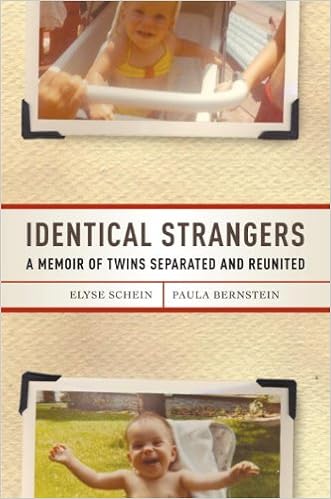
Examples: Nick Offerman, Tori Spelling, Goldie Hawn, etc.
1.
2.
3.
10Tara1Reads
Sporting Goods Store

Self-Improvement, Self-Help, and Psychology Books
1. Introvert Power: Why Your Inner Life Is Your Hidden Strength
2. The Relaxation Response
3. The Zen Path Through Depression
Self-Improvement, Self-Help, and Psychology Books
1. Introvert Power: Why Your Inner Life Is Your Hidden Strength
2. The Relaxation Response
3. The Zen Path Through Depression
11Tara1Reads
Comic Book Store

This category will encompass Graphic Novels, Graphic Memoirs, Comic Books as well as Humorous Books that might be memoirs or books of essays from David Sedaris, Sloane Crosley, Jenny Lawson, etc.
1. This One Summer
2. The Walking Dead: Days Gone Bye, Vol. 1
3. Relish: My Life in the Kitchen
---------------------------------------------------------------------------------------------------------------------------
4. The Walking Dead: Miles Behind Us, Vol. 2
5. American Born Chinese

This category will encompass Graphic Novels, Graphic Memoirs, Comic Books as well as Humorous Books that might be memoirs or books of essays from David Sedaris, Sloane Crosley, Jenny Lawson, etc.
1. This One Summer
2. The Walking Dead: Days Gone Bye, Vol. 1
3. Relish: My Life in the Kitchen
---------------------------------------------------------------------------------------------------------------------------
4. The Walking Dead: Miles Behind Us, Vol. 2
5. American Born Chinese
12Tara1Reads
Computer Store

Computers make me think of research. A lot of research is needed for Biographies and Autobiographies.
1.
2.
3.

Computers make me think of research. A lot of research is needed for Biographies and Autobiographies.
1.
2.
3.
13Tara1Reads
Movie Theater

A lot of Suspense, Thriller, Mystery, Horror, and Science Fiction books make good movies.
1. A Crime in the Neighborhood
2. Bird Box
3.

A lot of Suspense, Thriller, Mystery, Horror, and Science Fiction books make good movies.
1. A Crime in the Neighborhood
2. Bird Box
3.
14Tara1Reads
Museum

I think I will make this a Non-fiction catch-all category because I realized some of the non-fiction I read or am interested in possibly reading do not fall into any of the categories I made for myself. Museums are about learning and you learn a lot from non-fiction so this fits well enough.
1.
2.
3.

I think I will make this a Non-fiction catch-all category because I realized some of the non-fiction I read or am interested in possibly reading do not fall into any of the categories I made for myself. Museums are about learning and you learn a lot from non-fiction so this fits well enough.
1.
2.
3.
15Tara1Reads
City Hall
Books about political figures, elections, or politics in general.
1. One Nation: What We Can All Do to Save America's Future
2.
3.
Books about political figures, elections, or politics in general.
1. One Nation: What We Can All Do to Save America's Future
2.
3.
16Tara1Reads
Shopping Mall

Teenagers like to go to the mall and hang out with friends (at least they used to--I don't know what they do these days). So the shopping mall will be for Young Adult books.
1. We Were Liars
2. The Absolutely True Diary of a Part-Time Indian
3.
Teenagers like to go to the mall and hang out with friends (at least they used to--I don't know what they do these days). So the shopping mall will be for Young Adult books.
1. We Were Liars
2. The Absolutely True Diary of a Part-Time Indian
3.
17Tara1Reads
DeweyCAT

January: 000: Computer Science & Information:
February: 100: Philosophy & Psychology: Introvert Power: Why Your Inner Life is Your Hidden Strength (155 Dewey, Philosophy and Psychology, Developmental and Differential Psychology, Individual Psychology), The Relaxation Response (155 Dewey, Philosophy and Psychology, Developmental and Differential Psychology)
March: 200: Religion: The Mermaid Chair (Fiction) The Zen Path Through Depression (294 Dewey)
April: 300-354: Sociology, Anthropology, Political Science, Law: One Nation: What We Can All Do to Save America's Future (306 Dewey, Social Sciences, Sociology, Anthropology, Culture and Institutions, Biography and History, North America)
Identical Strangers: A Memoir of Twins Separated and Reunited (306 Dewey, Social Sciences, Sociology, Anthropology, Culture and Institutions, Marriage and Parenting)
May: 355-399: Social Services, Criminology, Education: A Stolen Life: A Memoir (364 Dewey, Social Sciences, Social Problems, Social Services, Criminology, Types of crimes, Kidnapping)
June: 400: Language:
July: 500: Science & Math:
August: 600: Technology, Medicine, Health, Agriculture & Home: Animals Make Us Human (636 Dewey, Technology, Agriculture, Domestic Animals, Zootechny, Primary Care), Complications: A Surgeon's Notes on an Imperfect Science (617 Dewey, Technology, Medicine, Surgery)
September: 700: Arts & Recreation:
October: 800: Literature: The Opposite of Loneliness: Essays and Stories (818 Dewey)
November: 900 - 939: World History, Travel, Biography, & Ancient History:
December: 940 - 999: History of Europe, Asia, Africa, the Americas, Oceania, and Extraterrestrial Worlds: My America: What My Country Means to Me by 150 Americans from All Walks of Life (973 Dewey, Biography and History of North America specifically the U.S.)

January: 000: Computer Science & Information:
February: 100: Philosophy & Psychology: Introvert Power: Why Your Inner Life is Your Hidden Strength (155 Dewey, Philosophy and Psychology, Developmental and Differential Psychology, Individual Psychology), The Relaxation Response (155 Dewey, Philosophy and Psychology, Developmental and Differential Psychology)
March: 200: Religion: The Mermaid Chair (Fiction) The Zen Path Through Depression (294 Dewey)
April: 300-354: Sociology, Anthropology, Political Science, Law: One Nation: What We Can All Do to Save America's Future (306 Dewey, Social Sciences, Sociology, Anthropology, Culture and Institutions, Biography and History, North America)
Identical Strangers: A Memoir of Twins Separated and Reunited (306 Dewey, Social Sciences, Sociology, Anthropology, Culture and Institutions, Marriage and Parenting)
May: 355-399: Social Services, Criminology, Education: A Stolen Life: A Memoir (364 Dewey, Social Sciences, Social Problems, Social Services, Criminology, Types of crimes, Kidnapping)
June: 400: Language:
July: 500: Science & Math:
August: 600: Technology, Medicine, Health, Agriculture & Home: Animals Make Us Human (636 Dewey, Technology, Agriculture, Domestic Animals, Zootechny, Primary Care), Complications: A Surgeon's Notes on an Imperfect Science (617 Dewey, Technology, Medicine, Surgery)
September: 700: Arts & Recreation:
October: 800: Literature: The Opposite of Loneliness: Essays and Stories (818 Dewey)
November: 900 - 939: World History, Travel, Biography, & Ancient History:
December: 940 - 999: History of Europe, Asia, Africa, the Americas, Oceania, and Extraterrestrial Worlds: My America: What My Country Means to Me by 150 Americans from All Walks of Life (973 Dewey, Biography and History of North America specifically the U.S.)
18Tara1Reads
RandomCAT

I will participate where it fits with books I have/am interested in.
January Host: lkernagh: Embrace Your Uniqueness - My America: What My Country Means to Me by 150 Americans from All Walks of Life (28 LT members including me)
February Host: sturlington: It Takes Two - Identical Strangers: A Memoir of Twins Separated and Reunited by Elyse Schein and Paula Bernstein
March Host: LoisB Celebrations - The Post-Birthday World
April Host: majkia Earth Day/We're All in This Together -
May Host: LittleTaiko Color Your World -
June Host: LadyoftheLodge I Do, I Do (Marriage) -
July Host: Chrischi_HH Good Times -
August Host: thornton37814
September Host: Robertgreaves
October Host: LibraryCin
November Host: DeltaQueen50
December Host: Clue
I will participate where it fits with books I have/am interested in.
January Host: lkernagh: Embrace Your Uniqueness - My America: What My Country Means to Me by 150 Americans from All Walks of Life (28 LT members including me)
February Host: sturlington: It Takes Two - Identical Strangers: A Memoir of Twins Separated and Reunited by Elyse Schein and Paula Bernstein
March Host: LoisB Celebrations - The Post-Birthday World
April Host: majkia Earth Day/We're All in This Together -
May Host: LittleTaiko Color Your World -
June Host: LadyoftheLodge I Do, I Do (Marriage) -
July Host: Chrischi_HH Good Times -
August Host: thornton37814
September Host: Robertgreaves
October Host: LibraryCin
November Host: DeltaQueen50
December Host: Clue
19Tara1Reads
BingoDOG
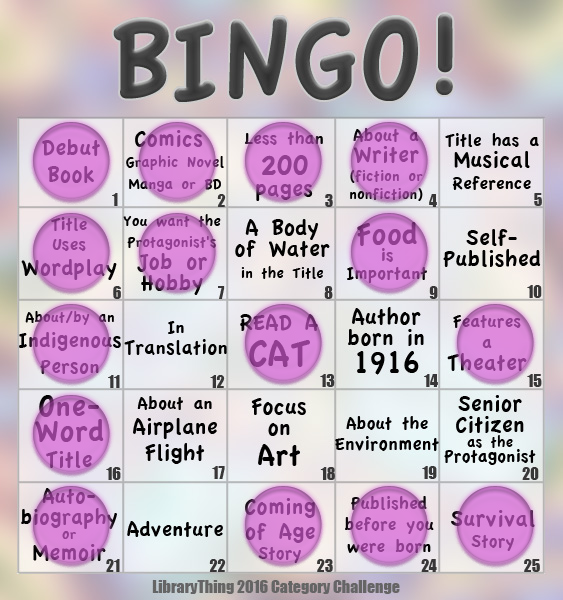
I will fill in the list below as I read them. I am not going to stress about trying to fill the whole Bingo card.
1. Debut book: Stolen Life: A Memoir by Jaycee Dugard
2. Comic, Graphic Novel, Manga, or BD: This One Summer
3. Less than 200 pages: The Relaxation Response
4. About a writer: The Post-Birthday World (book illustrator turned children's book author)
5. Title has a musical reference:
6. Title uses wordplay: The Walking Dead: Days Gone Bye, Vol. 1
7. You want the protagonist's job/hobby: One Nation: What We Can All Do to Save America's Future (writer/politician)
8. A body of water in the title:
9. Food is important: Relish: My Life in the Kitchen
10. Self-published:
11. By/about an indigenous person: The Absolutely True Diary of a Part-Time Indian
12. Translated work:
13. Read a CAT: My America: What My Country Means to Me by 150 Americans from All Walks of Life (Fits both DeweyCAT and January's RandomCAT)
14. Author born in 1916:
15. Features a theater: The Uncoupling
16. One-word title: The Corrections
17. About an airplane flight:
18. Focus on art:
19. About the environment:
20. Protagonist is senior citizen:
21. Autobiography/Memoir: Identical Strangers: A Memoir of Twins Separated and Reunited
22. Adventure:
23. Coming-of-age story: A Crime in the Neighborhood
24. Published before you were born: The Professor's House
25. Survival story: Bird Box
I will fill in the list below as I read them. I am not going to stress about trying to fill the whole Bingo card.
1. Debut book: Stolen Life: A Memoir by Jaycee Dugard
2. Comic, Graphic Novel, Manga, or BD: This One Summer
3. Less than 200 pages: The Relaxation Response
4. About a writer: The Post-Birthday World (book illustrator turned children's book author)
5. Title has a musical reference:
6. Title uses wordplay: The Walking Dead: Days Gone Bye, Vol. 1
7. You want the protagonist's job/hobby: One Nation: What We Can All Do to Save America's Future (writer/politician)
8. A body of water in the title:
9. Food is important: Relish: My Life in the Kitchen
10. Self-published:
11. By/about an indigenous person: The Absolutely True Diary of a Part-Time Indian
12. Translated work:
13. Read a CAT: My America: What My Country Means to Me by 150 Americans from All Walks of Life (Fits both DeweyCAT and January's RandomCAT)
14. Author born in 1916:
15. Features a theater: The Uncoupling
16. One-word title: The Corrections
17. About an airplane flight:
18. Focus on art:
19. About the environment:
20. Protagonist is senior citizen:
21. Autobiography/Memoir: Identical Strangers: A Memoir of Twins Separated and Reunited
22. Adventure:
23. Coming-of-age story: A Crime in the Neighborhood
24. Published before you were born: The Professor's House
25. Survival story: Bird Box
20Tara1Reads
Woman BingoPUP
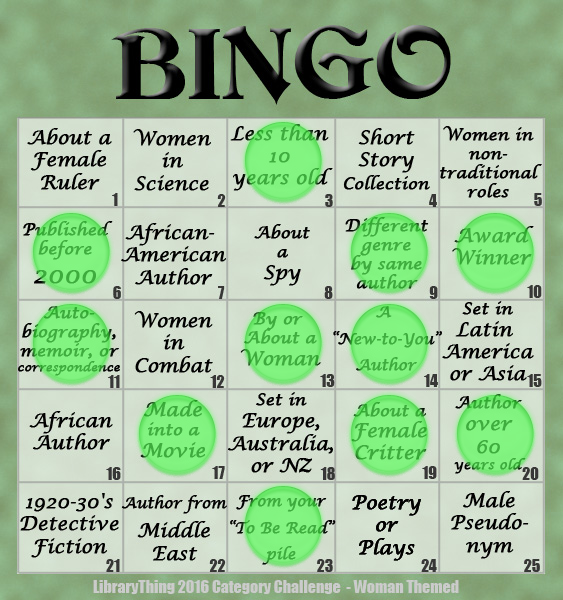
I will fill in the list below as I read them. I am not going to stress about trying to fill the whole Bingo card.
1. About a female ruler:
2. Women in science:
3. Less than 10 years old: The Opposite of Loneliness: Essays and Stories (Pub. 2014)
4. Short story collection:
5. Women in non-traditional roles:
6. Published before 2000: The Professor's House (Published in 1925)
7. African-American author:
8. About a spy:
9. Different genre by same author: We Were Liars
10. Award winner: A Crime in the Neighborhood
11. Autobiography, memoir, or correspondence: Identical Strangers: A Memoir of Twins Separated and Reunited
12. Women in combat:
13. By/about a woman: The Post-Birthday World
14. A new-to-you author: The Uncoupling by Meg Wolitzer
15. Set in Latin America or Asia:
16. African author:
17. Made into a movie: The Nanny Diaries
18. Set in Europe, Australia, or New Zealand:
19. About a female critter: The Mermaid Chair
20. Author over 60 years old when book was published: Animals Make Us Human (Temple Grandin was 62 when this was published).
21. 1920s-1930s Detective Fiction:
22. Author from Middle East:
23. From your TBR pile: Introvert Power: Why Your Inner Life Is Your Hidden Strength
24. Poetry or plays:
25. Male pseudonym:
I will fill in the list below as I read them. I am not going to stress about trying to fill the whole Bingo card.
1. About a female ruler:
2. Women in science:
3. Less than 10 years old: The Opposite of Loneliness: Essays and Stories (Pub. 2014)
4. Short story collection:
5. Women in non-traditional roles:
6. Published before 2000: The Professor's House (Published in 1925)
7. African-American author:
8. About a spy:
9. Different genre by same author: We Were Liars
10. Award winner: A Crime in the Neighborhood
11. Autobiography, memoir, or correspondence: Identical Strangers: A Memoir of Twins Separated and Reunited
12. Women in combat:
13. By/about a woman: The Post-Birthday World
14. A new-to-you author: The Uncoupling by Meg Wolitzer
15. Set in Latin America or Asia:
16. African author:
17. Made into a movie: The Nanny Diaries
18. Set in Europe, Australia, or New Zealand:
19. About a female critter: The Mermaid Chair
20. Author over 60 years old when book was published: Animals Make Us Human (Temple Grandin was 62 when this was published).
21. 1920s-1930s Detective Fiction:
22. Author from Middle East:
23. From your TBR pile: Introvert Power: Why Your Inner Life Is Your Hidden Strength
24. Poetry or plays:
25. Male pseudonym:
21Chrischi_HH
Love your theme! Great idea to link the stores in town with book categories. Have fun!
22Tara1Reads
>21 Chrischi_HH: Thanks! I am already having fun just thinking about what I might read next year!
25Tara1Reads
Thank you >23 mamzel: and thank you >24 VivienneR:. It is a cute topper. I can't wait to dive into the books!
26countrylife
Love your categories!
27dudes22
Like the way you linked the stores to your book categories. Looking forward to seeing what you read.
28Tara1Reads
>26 countrylife: and >27 dudes22: Thank you both! I am really looking forward to the new year.
29rabbitprincess
Great setup! I'll be checking out the movie theatre especially. ;) Enjoy your challenge!
30DeltaQueen50
What an excellent theme! It's going to be hard to wait until January to get started!
31Tara1Reads
>29 rabbitprincess: Thank you! I hope I don't disappoint in that category.
>30 DeltaQueen50: Thank you! I was mildly excited about the new year before, but something about creating my thread and looking at others' threads has made me even more excited.
>30 DeltaQueen50: Thank you! I was mildly excited about the new year before, but something about creating my thread and looking at others' threads has made me even more excited.
33Tara1Reads
>32 Kristelh: Thank you!
34MissWatson
This is a great set-up! Enjoy your reading year!
35Tara1Reads
>34 MissWatson: Thank you!
36LittleTaiko
Love your categories! Good luck with your challenge.
37Tara1Reads
>36 LittleTaiko: Thanks! I am excited to get started.
40Tara1Reads
Thank you >38 -Eva-: and >39 lkernagh:!
41mysterymax
Unique! Well-done!
42Tara1Reads
>41 mysterymax: Thanks!
43LA12Hernandez
Great theme can't wait to see what your reading in each category.
44Tara1Reads
>43 LA12Hernandez: Thank you!
46Tara1Reads
>45 Tess_W: Thank you!
47thornton37814
Nice theme!
48Tara1Reads
>47 thornton37814: Thanks!
49Tara1Reads
Since I did not have a 2015 thread I thought I would post this here. Touchstones are all correct.
End of 2015 Book Meme
Describe yourself: Woman Rebel
Describe how you feel: Beloved
Describe where you currently live: The Mosquito Coast
If you could go anywhere, where would you go: Holidays on Ice
Your favorite form of transportation: Flight Behavior
Your best friend is: Princess
You and your friends are: Wise Children
What’s the weather like: The Cold Dish
You fear: No Place to Hide
What is the best advice you have to give: More Baths, Less Talking
Thought for the day: Eat, Pray, Love
How I would like to die: Fly Away Home
My soul’s present condition: Deaf Heaven
End of 2015 Book Meme
Describe yourself: Woman Rebel
Describe how you feel: Beloved
Describe where you currently live: The Mosquito Coast
If you could go anywhere, where would you go: Holidays on Ice
Your favorite form of transportation: Flight Behavior
Your best friend is: Princess
You and your friends are: Wise Children
What’s the weather like: The Cold Dish
You fear: No Place to Hide
What is the best advice you have to give: More Baths, Less Talking
Thought for the day: Eat, Pray, Love
How I would like to die: Fly Away Home
My soul’s present condition: Deaf Heaven
50Tara1Reads
A little late but Happy New Year, Everyone!


51thornton37814
>49 Tara1Reads: Great meme answers.
52Tara1Reads
>51 thornton37814: Thanks! :-)
53Tara1Reads
This One Summer by Mariko Tamaki
Published: 2014
Pages: 319

This is a young adult graphic novel of a girl's time at her family's summer cottage. The illustrations done by Mariko's cousin, Jillian Tamaki, are excellent. I was very impressed with Jillian's ability to so accurately portray people and their facial expressions to match their feelings.
The story was lacking though. This summer is definitely a time for learning and growing up for the main character, Rose. Also there is some conflict between her parents that makes Rose feel conflicted, but there wasn't any resolution to the story. The book just ended when it was time for the family to pack up and leave the cottage at the end of the summer. The story that was there was very good; I just wanted more.
Published: 2014
Pages: 319

This is a young adult graphic novel of a girl's time at her family's summer cottage. The illustrations done by Mariko's cousin, Jillian Tamaki, are excellent. I was very impressed with Jillian's ability to so accurately portray people and their facial expressions to match their feelings.
The story was lacking though. This summer is definitely a time for learning and growing up for the main character, Rose. Also there is some conflict between her parents that makes Rose feel conflicted, but there wasn't any resolution to the story. The book just ended when it was time for the family to pack up and leave the cottage at the end of the summer. The story that was there was very good; I just wanted more.
54lovelyluck
Awesome theme - why can't I be this creative? looks like it should be fun!
55Tara1Reads
>54 lovelyluck: Thanks! But I think your challenge is plenty creative. I am especially interested in the cooking challenge you have posted. My area of interest besides reading good books is cooking and eating good, healthy food.
56lovelyluck
>55 Tara1Reads: I love cookbooks - and food... I'm trying to get keep up with a healthy eating lifestyle - but it is difficult - I love chocolate - and I have diabetes - definitely not a good combination.... :(
57cammykitty
I've been wondering about This One Summer. Sounds like I might think it's kind of meh.
Cookbooks! That's another category of books to hoard! I read somewhere that the average person uses only about 4 recipes per cookbook they own. I sure wish there were a way to turn the photos into food instantly.
Cookbooks! That's another category of books to hoard! I read somewhere that the average person uses only about 4 recipes per cookbook they own. I sure wish there were a way to turn the photos into food instantly.
58Tara1Reads
>56 lovelyluck: I understand the struggle. My grandma has Type 2 and a lot of the diabetic products on the market have horrible fake sugars etc. My favorite tricks are to use dates for natural sweetness and unsweetened cocoa powder and/or unsweetened carob chips for a chocolate flavor. Let's see if I can find some recipes...
I love the Chocolate Covered Katie blog for healthier desserts:
http://chocolatecoveredkatie.com/2015/09/03/refined-sugar-free-chocolate-cake/
http://chocolatecoveredkatie.com/2014/09/18/sugar-free-granola-bars/
The brand Sunspire makes some unsweetened carob chips http://www.sunspire.com/unsweetened-carob-chips.
And for chocolate ice cream my favorite is to freeze some peeled, ripe bananas at least overnight (they last a long time in the freezer) and then putting them through the food processor with whatever flavor you want like vanilla extract (or the scrapings of an actual vanilla bean if you want to be fancy) for vanilla ice cream or unsweetened cocoa powder for a chocolate version. Or here is an almond or peanut ice cream version: http://www.wholefoodsmarket.com/recipe/banana-nice-cream.
And last but not least chocolate mousse/chocolate pudding!
http://www.wholefoodsmarket.com/recipe/chocolate-pudding
http://vegan-magic.blogspot.com/search?q=chocolate+mousse
Ooh wait let's not forget chocolate fudge for the ice cream!
http://happyhealthymama.com/2014/05/no-sugar-added-vegan-chocolate-fudge-sauce.h...
I love the Chocolate Covered Katie blog for healthier desserts:
http://chocolatecoveredkatie.com/2015/09/03/refined-sugar-free-chocolate-cake/
http://chocolatecoveredkatie.com/2014/09/18/sugar-free-granola-bars/
The brand Sunspire makes some unsweetened carob chips http://www.sunspire.com/unsweetened-carob-chips.
And for chocolate ice cream my favorite is to freeze some peeled, ripe bananas at least overnight (they last a long time in the freezer) and then putting them through the food processor with whatever flavor you want like vanilla extract (or the scrapings of an actual vanilla bean if you want to be fancy) for vanilla ice cream or unsweetened cocoa powder for a chocolate version. Or here is an almond or peanut ice cream version: http://www.wholefoodsmarket.com/recipe/banana-nice-cream.
And last but not least chocolate mousse/chocolate pudding!
http://www.wholefoodsmarket.com/recipe/chocolate-pudding
http://vegan-magic.blogspot.com/search?q=chocolate+mousse
Ooh wait let's not forget chocolate fudge for the ice cream!
http://happyhealthymama.com/2014/05/no-sugar-added-vegan-chocolate-fudge-sauce.h...
59Tara1Reads
>57 cammykitty: It is a YA book so I don't know what I was expecting, but I wanted the story to go deeper into what was happening since I was interested in the story. It only took me 2 hours to read it; I pretty much just read it straight through with only a small break. So if you decide to read it it's not like it would eat up too much time of you hated it.
Yes, I believe it. I don't know why it is, but I seem to gravitate towards recipes that are in magazines or online instead of using the cookbooks and recipe cards I already have.
Yes, I believe it. I don't know why it is, but I seem to gravitate towards recipes that are in magazines or online instead of using the cookbooks and recipe cards I already have.
61Tara1Reads
>60 LisaMorr: Thanks! Haha I hadn't looked at it like that before but I guess reading from different genres is like shopping around in the book world. :-)
62Tara1Reads
My America: What My Country Means to Me by 150 Americans from All Walks of Life edited by Hugh Downs

Published: 2002
Pages: 266
DeweyCAT: 940-999
RandomCAT: January theme Embrace Your Uniqueness
This book is a collection of essays compiled and edited by Hugh Downs. The essays were all written by celebrities (musicians, actors, singers), journalists, news broadcasters, writers, astronauts, and politicians in the months following the events of September 11th.
I have mixed feelings about this book. I was so excited to read this when I first learned about it, but I was disappointed that a lot of people's essays were the same--the same sentiments sometimes expressed using the same words and the same phrases. I guess there's only so many words to use to describe your feelings about your country. Or maybe it's a good thing and shows unity that people feel the same way. It was just boring to read back-to-back essays that were so similar. But the unique essays would snap me out of it, and I really enjoyed those.
Some of the most interesting essays were the ones in which people described where they were and what they were doing when they found out about 9/11 and their immediate reaction to it. But one of the essays that stands out the most to me is by Steven Englund who described seeing how the French responded to the 9/11 attacks since he had been living in Paris, France for awhile and was still there during 9/11. It put things in a better context in light of the recent Paris terrorist attacks and the response from Americans.
I still think this book was worth reading because it made me think. I would often stop reading and get caught up in my thoughts about something from a particular essay. Also, even the boring essays helped give me a new perspective on America. I had never stopped to fully think about this but the United States is still a relatively new country and an experimental one at that given the wide diversity of people, culture, and language that mix in one place and the set-up of the democracy. So of course there are bumps along the way to achieving the ideal, and, of course, there are still some kinks to work out. Quite a few of the essayists brought up the point that in the history of the world nations fail; they don't last forever and forever. America has lasted a long time so far and may continue and not collapse if it can keep to the ideals of the Founding Fathers that have worked thus far.
I can't say it was the most enjoyable read since it became a slog at times with the boring essays, but it was definitely worthwhile. I have to let it marinate longer before giving it a star rating.

Published: 2002
Pages: 266
DeweyCAT: 940-999
RandomCAT: January theme Embrace Your Uniqueness
This book is a collection of essays compiled and edited by Hugh Downs. The essays were all written by celebrities (musicians, actors, singers), journalists, news broadcasters, writers, astronauts, and politicians in the months following the events of September 11th.
I have mixed feelings about this book. I was so excited to read this when I first learned about it, but I was disappointed that a lot of people's essays were the same--the same sentiments sometimes expressed using the same words and the same phrases. I guess there's only so many words to use to describe your feelings about your country. Or maybe it's a good thing and shows unity that people feel the same way. It was just boring to read back-to-back essays that were so similar. But the unique essays would snap me out of it, and I really enjoyed those.
Some of the most interesting essays were the ones in which people described where they were and what they were doing when they found out about 9/11 and their immediate reaction to it. But one of the essays that stands out the most to me is by Steven Englund who described seeing how the French responded to the 9/11 attacks since he had been living in Paris, France for awhile and was still there during 9/11. It put things in a better context in light of the recent Paris terrorist attacks and the response from Americans.
I still think this book was worth reading because it made me think. I would often stop reading and get caught up in my thoughts about something from a particular essay. Also, even the boring essays helped give me a new perspective on America. I had never stopped to fully think about this but the United States is still a relatively new country and an experimental one at that given the wide diversity of people, culture, and language that mix in one place and the set-up of the democracy. So of course there are bumps along the way to achieving the ideal, and, of course, there are still some kinks to work out. Quite a few of the essayists brought up the point that in the history of the world nations fail; they don't last forever and forever. America has lasted a long time so far and may continue and not collapse if it can keep to the ideals of the Founding Fathers that have worked thus far.
I can't say it was the most enjoyable read since it became a slog at times with the boring essays, but it was definitely worthwhile. I have to let it marinate longer before giving it a star rating.
63lovelyluck
>58 Tara1Reads: Wow thanks.... the vanilla extract with banana sound super yummy - I will have to try these things out for sure!
64cammykitty
Too bad My America wasn't edited a little more stringently. A good anthology wouldn't leave you thinking that anyone thought the same thing. I suppose he left them in there because they were by famous people, and the essays were probably solicited. It sounds like it would have been an awesome anthology if it only had ten essays in it.
65Tara1Reads
>63 lovelyluck: No problem. Let me know how you like any of the recipes if you try them! :-)
>64 cammykitty: Yes it could've used a little more editing. The essays were all solicited after 9/11. They were either written in the last couple months of 2001 or sometime in 2002 and the book was published in 2002, so it was a very quick turnaround time.
>64 cammykitty: Yes it could've used a little more editing. The essays were all solicited after 9/11. They were either written in the last couple months of 2001 or sometime in 2002 and the book was published in 2002, so it was a very quick turnaround time.
66thornton37814
>62 Tara1Reads: I have to laugh about the Hugh Downs book. We were playing a game over Christmas. It was one of these where you had to give clues about the person or thing on the card and have other people guess it. My nephew drew the Hugh Downs one, but he didn't have a clue who he was. He ended up putting it back and drawing another one. When we asked him about the card he'd rejected, he told us it was "Hugh Downs." I was surprised my brother who is older than I am didn't know who Hugh was. I told them all who he was. Of course, no one would have been able to guess that one correctly except me, and I'm the only person who could have given a "real clue" about it, although I think my nephew could have done a clue where he got people to say "Hugh" and then "Downs" and then combine them.
67Tara1Reads
>66 thornton37814: I love those games! I probably would've gotten people to say "Hugh" and "Downs" separately too.
68Tara1Reads
The Opposite of Loneliness: Essays and Stories by Marina Keegan

Published: 2014
Pages: 208
DeweyCAT: 800
WomanBingoPUP: Published less than 10 years ago
Ugh. This book is so sad. But so good. The book is divided into two parts the first being fictional short stories, the second being non-fiction essays. The first short story "Cold Pastoral" had me bawling. The next two short stories "Winter Break" and "Reading Aloud" were really good too. Then the stories in the middle started becoming too similar for me and names of characters were repeated which became confusing. I rushed through these stories though. So maybe I didn't give them a fair chance because when I slowed down to read the last short story, "Challenger Deep," before moving onto the essays, it was just as good as the first three stories. I love Marina's style, the way she has of building things up in the story, and slowly revealing things, and then usually having some sort of punch at the end.
There wasn't a single essay that I didn't like in the non-fiction part of the book. I can't even pick a favorite.
There is no doubt that Marina was talented. I was impressed by the wide range of knowledge she had about various topics and her ability to turn them into a short story or incorporate them into an essay. There was an awesome blend of youthfulness and maturity from young love, smoking pot, and wondering about future career plans, to thinking about the universe as a whole and our place in it as humans.
I loved Anne Fadiman's introduction and the three page acknowledgments written by Marina's parents at the beginning of the book. It did give a really emotional start to the book which is maybe why I reacted to the first short story the way I did.
For anyone who doesn't know the story about Marina, I won't mention it here because I read the book without knowing the whole story and I liked it that way. But for anyone that's curious here is the link to the website about her and the book: http://theoppositeofloneliness.com/
P.S. I don't think the book is sad just because of Marina's story, although that is part of it, but the stories themselves are sad because they deal with some heavy topics.

Published: 2014
Pages: 208
DeweyCAT: 800
WomanBingoPUP: Published less than 10 years ago
Ugh. This book is so sad. But so good. The book is divided into two parts the first being fictional short stories, the second being non-fiction essays. The first short story "Cold Pastoral" had me bawling. The next two short stories "Winter Break" and "Reading Aloud" were really good too. Then the stories in the middle started becoming too similar for me and names of characters were repeated which became confusing. I rushed through these stories though. So maybe I didn't give them a fair chance because when I slowed down to read the last short story, "Challenger Deep," before moving onto the essays, it was just as good as the first three stories. I love Marina's style, the way she has of building things up in the story, and slowly revealing things, and then usually having some sort of punch at the end.
There wasn't a single essay that I didn't like in the non-fiction part of the book. I can't even pick a favorite.
There is no doubt that Marina was talented. I was impressed by the wide range of knowledge she had about various topics and her ability to turn them into a short story or incorporate them into an essay. There was an awesome blend of youthfulness and maturity from young love, smoking pot, and wondering about future career plans, to thinking about the universe as a whole and our place in it as humans.
I loved Anne Fadiman's introduction and the three page acknowledgments written by Marina's parents at the beginning of the book. It did give a really emotional start to the book which is maybe why I reacted to the first short story the way I did.
For anyone who doesn't know the story about Marina, I won't mention it here because I read the book without knowing the whole story and I liked it that way. But for anyone that's curious here is the link to the website about her and the book: http://theoppositeofloneliness.com/
P.S. I don't think the book is sad just because of Marina's story, although that is part of it, but the stories themselves are sad because they deal with some heavy topics.
69-Eva-
>68 Tara1Reads:
I've no idea who she is, but I'm definitely intrigued now.
ETA: Who she was, as it turns out. :(
I've no idea who she is, but I'm definitely intrigued now.
ETA: Who she was, as it turns out. :(
70Tara1Reads
>69 -Eva-: Yes, it was a great book. I am still thinking about it and wishing I had a keeper copy. I just read a library copy and was sad to return it.
71LittleTaiko
>70 Tara1Reads: - that is the sure sign of a good book when you want to have a keeper copy.
72Tara1Reads
>71 LittleTaiko: Yeah I don't know if I could re-read the stories though even if I had a keeper copy. I have a hard time with re-reading; once I know the ending to something I can't maintain interest when I try reading it again.
73Tara1Reads
Real life has spun out of control which has kept me from reading. I started a new job in December and I don't work a regular, consistent schedule or regular hours. My hours have, unfortunately, been cutback though, so maybe that will allow me to have more reading time once I get my house and stuff back in order!
74Tara1Reads
DNF The Shelf by Phyllis Rose
DeweyCAT: January- Libraries, Information Science (0.28)

I was trying to read this for January's DeweyCAT. I hadn't planned on reading it but just stumbled across it in the library when looking through the 000s. Unforunately, I have to abandon it. Phyllis Rose was too snobby for my tastes and I am not familiar with the writers or works she is writing about in this book. I felt like reading about her experience reading The Phantom of the Opera was going to ruin Phantom for me since I have never seen the opera or read the book. So that's where I stopped reading.
Rose had the same urge all of us bookworms get at one point--the urge to read EVERYTHING in the library. But she knew that was unrealistic so she decided to read everything from one shelf. But then she sets these weird rules about what kind of books and which authors must be on the shelf she chooses to read from for her reading challenge/experiment. So instead of reading everything from the shelf, it becomes her picking and choosing books to read from a shelf that she pretty carefully selected. There's a bunch of name-dropping because Rose is friends with such-and-such author, so she doesn't want to read from the shelf with their books on it because she would feel awkward writing about them for this book.
Then there's this:
The "worthy as these writers may be" part still felt like a jab at Jodi Picoult and Danielle Steel. I actually wonder if she originally included that statement or if an editor made her include it. I don't care what people read; I am happy anyone reads at all. If there's constant snobbery and judgment out there then some people will shut down and not read anything. It's not healthy to read nothing but the same-old same-old all the time. But if someone tries a book by an author that someone like Phyllis Rose would turn their nose up at and likes the book and that book/author got them to branch out to try reading other things or just get more into reading in general then that's great. No one should have anything to complain about. As long as people read I don't care what author or genre got them into it or even if they stick to that one author or that one genre that's still better than nothing.
Phyllis Rose also irritated me because every book she read and every new-to-her author she tried from her shelf she had something negative to say about it. The first thing she read was One for the Devil by Etienne Leroux. She basically hated it, didn't understand it, and felt like she got more out of watching the video of Leroux's funeral on YouTube than she did reading his work. Here is what Rose said about it: "Leroux's work was not worth much to me. I would never go back to it, I would never recommend it, whereas I have looked at that film clip more than once on the edge of tears." I think it's fine if you don't like a book or an author or you just can't relate to it at all, but she didn't need to be so harsh to someone's body of work they probably spent years and years working on!
And again when she read A Hero of Our Time by Mikhail Lermontov: "I could see the interest of A Hero of Our Time. But it did not speak to me. It would never make it to that inner shelf of books that affected my life." I get it. We all feel this way about most of the books we read probably. Good but not great. We don't need keeper copies. We don't need/want to revisit them. Once was enough. But I still don't see why Rose was so harsh about every book she read, and she read A Hero of Our Time at least three times, a different translation every time. If you know it doesn't speak to you after the first time or two, why do you keep re-reading it?? She went on this whole thing about researching who did the cover art for this copy of A Hero of Our Time that she liked and she talked more about the cover image and the person who selected it, etc. than the book. She even said she felt like the person who selected the cover art (who had never read A Hero of Our Time) understood the book better than she did and selected the perfect image without knowing anything about the book. It became this whole thing with Rose describing the cover art just like she described poor Etienne Leroux's YouTube funeral video. The book seemed full of such padding.
Edited to correct touchstone.
DeweyCAT: January- Libraries, Information Science (0.28)

I was trying to read this for January's DeweyCAT. I hadn't planned on reading it but just stumbled across it in the library when looking through the 000s. Unforunately, I have to abandon it. Phyllis Rose was too snobby for my tastes and I am not familiar with the writers or works she is writing about in this book. I felt like reading about her experience reading The Phantom of the Opera was going to ruin Phantom for me since I have never seen the opera or read the book. So that's where I stopped reading.
Rose had the same urge all of us bookworms get at one point--the urge to read EVERYTHING in the library. But she knew that was unrealistic so she decided to read everything from one shelf. But then she sets these weird rules about what kind of books and which authors must be on the shelf she chooses to read from for her reading challenge/experiment. So instead of reading everything from the shelf, it becomes her picking and choosing books to read from a shelf that she pretty carefully selected. There's a bunch of name-dropping because Rose is friends with such-and-such author, so she doesn't want to read from the shelf with their books on it because she would feel awkward writing about them for this book.
Then there's this:
Many shelves were filled with the popular entertainments, especially the detective stories, of another age. As for the entertainments of today, I had already read the ones I cared to. I had read almost every Elmore Leonard, Sarah Paretsky, and Alexander McCall Smith. This experiment was not about my learning to love Jodi Picoult or Danielle Steel, worthy as these writers may be.
The "worthy as these writers may be" part still felt like a jab at Jodi Picoult and Danielle Steel. I actually wonder if she originally included that statement or if an editor made her include it. I don't care what people read; I am happy anyone reads at all. If there's constant snobbery and judgment out there then some people will shut down and not read anything. It's not healthy to read nothing but the same-old same-old all the time. But if someone tries a book by an author that someone like Phyllis Rose would turn their nose up at and likes the book and that book/author got them to branch out to try reading other things or just get more into reading in general then that's great. No one should have anything to complain about. As long as people read I don't care what author or genre got them into it or even if they stick to that one author or that one genre that's still better than nothing.
Phyllis Rose also irritated me because every book she read and every new-to-her author she tried from her shelf she had something negative to say about it. The first thing she read was One for the Devil by Etienne Leroux. She basically hated it, didn't understand it, and felt like she got more out of watching the video of Leroux's funeral on YouTube than she did reading his work. Here is what Rose said about it: "Leroux's work was not worth much to me. I would never go back to it, I would never recommend it, whereas I have looked at that film clip more than once on the edge of tears." I think it's fine if you don't like a book or an author or you just can't relate to it at all, but she didn't need to be so harsh to someone's body of work they probably spent years and years working on!
And again when she read A Hero of Our Time by Mikhail Lermontov: "I could see the interest of A Hero of Our Time. But it did not speak to me. It would never make it to that inner shelf of books that affected my life." I get it. We all feel this way about most of the books we read probably. Good but not great. We don't need keeper copies. We don't need/want to revisit them. Once was enough. But I still don't see why Rose was so harsh about every book she read, and she read A Hero of Our Time at least three times, a different translation every time. If you know it doesn't speak to you after the first time or two, why do you keep re-reading it?? She went on this whole thing about researching who did the cover art for this copy of A Hero of Our Time that she liked and she talked more about the cover image and the person who selected it, etc. than the book. She even said she felt like the person who selected the cover art (who had never read A Hero of Our Time) understood the book better than she did and selected the perfect image without knowing anything about the book. It became this whole thing with Rose describing the cover art just like she described poor Etienne Leroux's YouTube funeral video. The book seemed full of such padding.
Edited to correct touchstone.
75mamzel
This is a case where we thank you for taking one for the team. It's curious how this got published at all!
76rabbitprincess
>74 Tara1Reads: The idea of reading only from one shelf is an interesting one, but not if the rules keep being bent or added to. Otherwise, what's the point of the challenge? Thank you for reducing my TBR list by one!
77Tara1Reads
>75 mamzel: I think it got published because she's a literary critic and married the guy that wrote the Babar the elephant books. I think she has friends in high places. She also wrote a memoir about her experience reading Proust for a year.
>76 rabbitprincess: Rose said in The Shelf that rules should be malleable.
>76 rabbitprincess: Rose said in The Shelf that rules should be malleable.
78rabbitprincess
>77 Tara1Reads: Ha, I probably just have double standards. If I personally were doing the challenge, I'd totally bend the rules. But if I'm reading about the challenge, I want the person writing about it to adhere more closely to the rules.
79Tara1Reads
>78 rabbitprincess: Haha yeah I am probably applying a double standard to Rose too. The way her rule-bending came about was that she would make a rule and then try to apply it to a library shelf and see how restrictive it was then bend it to make it more reasonable. I think in real life we would probably all do the same. But as I was reading it I was thinking "Lady, just stick with a set of rules already!"
81lkernagh
Congrats on the new job and good for you in seeing the silver lining in unfortunately having irregular and reduced working hours.
>74 Tara1Reads: - Sounds like a book - and a method of determining what books to read - to avoid.
>74 Tara1Reads: - Sounds like a book - and a method of determining what books to read - to avoid.
82Tara1Reads
>80 hailelib: Indeed it was.
>81 lkernagh: Thanks! Yeah I don't think you would be missing much if you didn't read The Shelf.
>81 lkernagh: Thanks! Yeah I don't think you would be missing much if you didn't read The Shelf.
83Tara1Reads
One Nation: What We Can All Do to Save America's Future by Ben Carson
Published: 2014
Pages: 211
DeweyCAT: 300 - 354
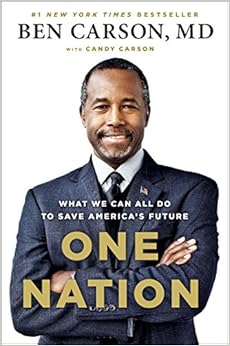
This is a pretty easy, common sense read. Carson explains what he sees as the problems facing America today and then gives solutions to those problems. The book is divided into three main parts: "Causes of Disunity and Decline," "Solutions," and "Who We Are." He also includes the text of his 2013 National Prayer Breakfast speech which many people see as the event that jumpstarted his involvement in politics.
I agree with some of what Carson says. I agree with the common sense ideas, which I think people of any political persuasion would agree with. I am not a religious or spiritual person so I didn't really see eye-to-eye with Carson on some of the issues that he takes more of a conservative Christian approach on. But I did appreciate that he could see why some people recoil from religion, and he can at least respect why others have the opinions they do. So I would say for those that are very squeamish about religion it's best to avoid this book since it was published by a Christian publisher and Carson starts off each chapter with a Bible verse.
The writing wasn't stellar. It was very simplistic. I sometimes wondered if Carson dumbed it down on purpose because he believes that government documents and laws should all be able to be understood by 7th graders and that everyone should be able to read at an 8th grade level so maybe he wanted his book to be at a 7th/8th grade level?
The part that annoyed me more than the simplistic writing was the repetition. In his chapter on bigotry, he discusses racism, ageism, homophobia, sexism, and religious bigotry. But many of these topics he discusses once or twice more later in the book. Also, there are at least two or three sections on helping the poor as well as his thoughts about the welfare system throughout the book.
My favorite parts, and where I can agree with Carson the most, are on the topics of education, reading, being an informed citizen, and having knowledge and wisdom and knowing the difference between the two. In the beginning of the book, he explains the Carson Scholars Fund that he and his wife started to provide academic awards to high achievers and to establish reading rooms in Title I schools where the children usually do not have great access to books. Carson talks about education and reading throughout One Nation and explains how reading improved his own academic performance and changed his outlook on his own life. But he also devotes two chapters to education and knowledge in the "Solutions" part of his book. These are topics I think all of us book nerds would agree on!
NB: If anyone wants to read this to evaluate Carson as a politician, he barely touches on foreign policy.
Published: 2014
Pages: 211
DeweyCAT: 300 - 354
This is a pretty easy, common sense read. Carson explains what he sees as the problems facing America today and then gives solutions to those problems. The book is divided into three main parts: "Causes of Disunity and Decline," "Solutions," and "Who We Are." He also includes the text of his 2013 National Prayer Breakfast speech which many people see as the event that jumpstarted his involvement in politics.
I agree with some of what Carson says. I agree with the common sense ideas, which I think people of any political persuasion would agree with. I am not a religious or spiritual person so I didn't really see eye-to-eye with Carson on some of the issues that he takes more of a conservative Christian approach on. But I did appreciate that he could see why some people recoil from religion, and he can at least respect why others have the opinions they do. So I would say for those that are very squeamish about religion it's best to avoid this book since it was published by a Christian publisher and Carson starts off each chapter with a Bible verse.
The writing wasn't stellar. It was very simplistic. I sometimes wondered if Carson dumbed it down on purpose because he believes that government documents and laws should all be able to be understood by 7th graders and that everyone should be able to read at an 8th grade level so maybe he wanted his book to be at a 7th/8th grade level?
The part that annoyed me more than the simplistic writing was the repetition. In his chapter on bigotry, he discusses racism, ageism, homophobia, sexism, and religious bigotry. But many of these topics he discusses once or twice more later in the book. Also, there are at least two or three sections on helping the poor as well as his thoughts about the welfare system throughout the book.
My favorite parts, and where I can agree with Carson the most, are on the topics of education, reading, being an informed citizen, and having knowledge and wisdom and knowing the difference between the two. In the beginning of the book, he explains the Carson Scholars Fund that he and his wife started to provide academic awards to high achievers and to establish reading rooms in Title I schools where the children usually do not have great access to books. Carson talks about education and reading throughout One Nation and explains how reading improved his own academic performance and changed his outlook on his own life. But he also devotes two chapters to education and knowledge in the "Solutions" part of his book. These are topics I think all of us book nerds would agree on!
NB: If anyone wants to read this to evaluate Carson as a politician, he barely touches on foreign policy.
84Tara1Reads
Introvert Power: Why Your Inner Life is Your Hidden Strength by Laurie Helgoe

Published: 2008
Pages: 237
DeweyCAT: 100s
WomanBingoPUP: From your TBR pile
This is one of those books that came to me at the right time. I had had this sitting on my shelf for years and had never really been interested in picking it up, but I picked it up at just the right time. I had been having some frustrations at my new job and thought they were related to differences between introvert-extrovert styles, and I was right.
Laurie Helgoe has a PhD in psychology, is an introvert from a family of 10 children, and married an extrovert and had two children. So through her own experiences she definitely learned strategies for remaining true to one's introvert self in more extroverted settings and when dealing with extroverted people.
In Introvert Power Laurie Helgoe puts to rest all the arguments propagated by extroverts that introverts are unhappy, depressed, mentally ill, dumb, psychopathic, or somehow inferior by showing that these are just expectations of the talkative, loud extroverts that get more attention in society. These extroverts, by the way, do not even make up the majority in society as introverts make up a little more than half of society at 57%. Us in the 57% just aren't as talkative and as loud as those in the 43% so our demands for a society to be quieter and more slow-paced gets overshadowed.
This book is very true to it's title. Laurie Helgoe really does make the introverted reader feel that we introverts have more power in ourselves than we realize. She energized me and made me feel invigorated and proud to be an introvert. I plan to start implementing the practical advice she gives about remaining introverted even in conversations, at work, at parties, etc.
I haven't read Susan Cain's Quiet. But I have heard and read that it's more research-oriented as cbl_tn points out. I have read Marti Olsen Laney's The Hidden Gifts of the Introverted Child and LOVED it, but I read it years ago, so I can't comment on specifics to compare it to the Helgoe book. But I definitely think the Helgoe book could apply to introverts of any age. I also think Introvert Power would be a great read for any extroverts looking to understand their introverted family members or friends.
I cannot recommend this book enough.

Published: 2008
Pages: 237
DeweyCAT: 100s
WomanBingoPUP: From your TBR pile
This is one of those books that came to me at the right time. I had had this sitting on my shelf for years and had never really been interested in picking it up, but I picked it up at just the right time. I had been having some frustrations at my new job and thought they were related to differences between introvert-extrovert styles, and I was right.
Laurie Helgoe has a PhD in psychology, is an introvert from a family of 10 children, and married an extrovert and had two children. So through her own experiences she definitely learned strategies for remaining true to one's introvert self in more extroverted settings and when dealing with extroverted people.
In Introvert Power Laurie Helgoe puts to rest all the arguments propagated by extroverts that introverts are unhappy, depressed, mentally ill, dumb, psychopathic, or somehow inferior by showing that these are just expectations of the talkative, loud extroverts that get more attention in society. These extroverts, by the way, do not even make up the majority in society as introverts make up a little more than half of society at 57%. Us in the 57% just aren't as talkative and as loud as those in the 43% so our demands for a society to be quieter and more slow-paced gets overshadowed.
This book is very true to it's title. Laurie Helgoe really does make the introverted reader feel that we introverts have more power in ourselves than we realize. She energized me and made me feel invigorated and proud to be an introvert. I plan to start implementing the practical advice she gives about remaining introverted even in conversations, at work, at parties, etc.
I haven't read Susan Cain's Quiet. But I have heard and read that it's more research-oriented as cbl_tn points out. I have read Marti Olsen Laney's The Hidden Gifts of the Introverted Child and LOVED it, but I read it years ago, so I can't comment on specifics to compare it to the Helgoe book. But I definitely think the Helgoe book could apply to introverts of any age. I also think Introvert Power would be a great read for any extroverts looking to understand their introverted family members or friends.
I cannot recommend this book enough.
85cbl_tn
>84 Tara1Reads: That one sounds good! I'll have to check and see if it's available from the library.
86Tara1Reads
>85 cbl_tn: I hope you don't mind the shout out I gave you in my review. :-)
87cbl_tn
>86 Tara1Reads: Not at all! I am enjoying all of the conversations about introversion and extroversion!
88Tara1Reads
>87 cbl_tn: Me too!
89lkernagh
>84 Tara1Reads: - Great review! I am an introvert and my other half is a strong extrovert. I think this book would be a good read for both of us!
90Tara1Reads
>89 lkernagh: Thanks! Helgoe does talk about the dynamics between her and her extroverted husband as well as just basic differences between their personalities. She touches on the fact that a lot of people are attracted to their opposites because they see in the other person qualities they wish they possessed themselves. Helgoe argues that introverts usually do possess the traits we admire in extroverts, but sometimes it takes learning from the extroverts for us to recognize what other qualities and strengths we have within us.
I am blessed with an introverted significant other who is a bit more extroverted than I in the sense that he can usually talk to people better than me in sticky situations and knows how to deal with salespeople etc., which is something Helgoe said she also struggles with and has tried learning from watching her husband!
I am blessed with an introverted significant other who is a bit more extroverted than I in the sense that he can usually talk to people better than me in sticky situations and knows how to deal with salespeople etc., which is something Helgoe said she also struggles with and has tried learning from watching her husband!
91Tara1Reads
Identical Strangers: A Memoir of Twins Separated and Reunited by Elyse Schein and Paula Bernstein
Published: 2007
Pages: 266
DeweyCAT: 300-354
RandomCAT: February - It Takes Two
WomanBingoPUP: Autobiography, memoir, or correspondence by a woman
BingoDOG: Autobiography or memoir
I have had this book sitting on my shelves for years. If it wasn't for the RandomCAT, I might not have ever read it. I had lost interest in reading it after it sat on my shelf for so long; it no longer sounded interesting and the average star rating on both LT and GR is a little low which further dampened my enthusiasm. But once I picked this up I fell right into the whirlwind story of Elyse wanting to find out more about her birth mother and instead discovering that she has an identical twin sister.
Once New Yorkers, Elyse and Paula, find out about each other, they research why they were separated in the first place which turns out to be a twin study about nature vs. nuture and the heritability of schizophrenia. Even though Elyse and Paula were separated for the twin study they were dropped from the study later (still without ever being informed that they had a twin or that they were in a study) and the study results were never published anyway.
The story is a page-turner. I kept wanting to read more and more to find out about the twins' early lives, why they were separated, and about their biological parents and why they gave their twins up for adoption. Also the now-defunct Jewish adoption agency, Louise Wise Services, Elyse and Paula were adopted from had always been highly revered by Jewish families in New York turns out to be sort of a train wreck and had some insensitive and incompetent employees.
I appreciated that the book was written from the perspective of each twin. Each chapter is divided up into sections for Elyse and for Paula. I assume they each wrote their own section, but they were both remarkably good writers (or had a good ghost writer that worked on both sections). But maybe they have similar writing styles because they are identical twins! In the beginning, I had trouble remembering whose section I was reading and would have to flip back to see if it was Elyse or Paula, but later on I could differentiate the twins and it was no longer a problem. Generally, Elyse came across as more desperate and clingy. She said she felt relieved at finding out she had a twin sister because growing up she had felt like she was missing a twin. So once she finds out the news and meets Paula she is all "Oh my gosh! We're twins! Let's be best friends!" Whereas Paula comes across as snobby, self-absorbed, and not-so-thrilled about the sudden intrusion of a close family member in her life.
I had a hard time understanding both their reaction to finding out they had been separated for the purposes of a twin study or being separated at all really and their reactions to each other once they met and started spending time together.They were outraged that they had been separated for a twin study and portrayed the psychologists doing the research as downright evil. From my perspective and from what's presented in the book, the psychologists were curious scientists who had read a few studies that had already been published about twins that intrigued them. When they had the opportunity to work with an adoption agency in the 1960's when there were no laws about separating twins it gave them a perfect opportunity to research their interest, so they did. Was that the ethical thing to do? Well, everyone has different opinions. I just had a hard time understanding Elyse and Paula's reaction; it wasn't the worst thing that could've happened to them. And it came across as a bit whiny given that both twins ended up doing pretty well for themselves and were adopted by loving families that could afford to adopt multiple children, go on vacations, send them on overseas trips in high school, and send them to college. When Elyse finds out she has a twin, she is living in Paris after having previously lived in Prague. When Paula goes to Paris to visit Elyse, Paula says she's already been to Paris before and has already seen all the tourist sites so she can focus on just getting to know Elyse and her Parisian lifestyle. They also try to slap some lawsuits on the adoption agency and the organization that was holding the sealed records pertaining to the twin study, but the lawyer they meet with points out "What harm has been done to you? What damages could we seek? NONE!" (not a direct quote from the book) So, thankfully, in my opinion, they never get anywhere with the lawsuits.
There is a lot of ethics to ponder and the state laws at the time Paula and Elyse were adopted in the late 1960's were different than what we have today. Most states used to have sealed adoption records and would not let adopted children access them until they were eighteen and even then they had to plead extenuating circumstances. This law applied even in the case of trying to access important family medical history. There were some cases of some adopted children dying possibly preventable deaths and their stories are included in this book. Louise Wise Services also had some strange rules including one that the same family could not adopt multiple children unless the children were adopted three years apart. Louise Wise Services thought having a three year age gap between siblings was ideal. This rule is how both Paula and Elyse ended up with adopted brothers that were both three years older than them.
I think the book is worth reading for the facts and history that's included as well as the almost-unbelievable story that Paula and Elyse have about the circumstances of their adoption even if the sisters come across as annoying, bourgeois types.
I almost feel like I am giving away too much about the book. But the most fascinating part to me was the story of Paula and Elyse's biological mother, which I haven't mentioned at all. There is also a lot about the twins' childhoods and adoptive families and their relationships with them, etc.
Edited to fix a typo and to add the spoiler function. I really had a hard time writing this review and have had a hard time trying to determine if I am giving away too much.
Published: 2007
Pages: 266
DeweyCAT: 300-354
RandomCAT: February - It Takes Two
WomanBingoPUP: Autobiography, memoir, or correspondence by a woman
BingoDOG: Autobiography or memoir
I have had this book sitting on my shelves for years. If it wasn't for the RandomCAT, I might not have ever read it. I had lost interest in reading it after it sat on my shelf for so long; it no longer sounded interesting and the average star rating on both LT and GR is a little low which further dampened my enthusiasm. But once I picked this up I fell right into the whirlwind story of Elyse wanting to find out more about her birth mother and instead discovering that she has an identical twin sister.
Once New Yorkers, Elyse and Paula, find out about each other, they research why they were separated in the first place which turns out to be a twin study about nature vs. nuture and the heritability of schizophrenia. Even though Elyse and Paula were separated for the twin study they were dropped from the study later (still without ever being informed that they had a twin or that they were in a study) and the study results were never published anyway.
The story is a page-turner. I kept wanting to read more and more to find out about the twins' early lives, why they were separated, and about their biological parents and why they gave their twins up for adoption. Also the now-defunct Jewish adoption agency, Louise Wise Services, Elyse and Paula were adopted from had always been highly revered by Jewish families in New York turns out to be sort of a train wreck and had some insensitive and incompetent employees.
I appreciated that the book was written from the perspective of each twin. Each chapter is divided up into sections for Elyse and for Paula. I assume they each wrote their own section, but they were both remarkably good writers (or had a good ghost writer that worked on both sections). But maybe they have similar writing styles because they are identical twins! In the beginning, I had trouble remembering whose section I was reading and would have to flip back to see if it was Elyse or Paula, but later on I could differentiate the twins and it was no longer a problem. Generally, Elyse came across as more desperate and clingy. She said she felt relieved at finding out she had a twin sister because growing up she had felt like she was missing a twin. So once she finds out the news and meets Paula she is all "Oh my gosh! We're twins! Let's be best friends!" Whereas Paula comes across as snobby, self-absorbed, and not-so-thrilled about the sudden intrusion of a close family member in her life.
I had a hard time understanding both their reaction to finding out they had been separated for the purposes of a twin study or being separated at all really and their reactions to each other once they met and started spending time together.
There is a lot of ethics to ponder and the state laws at the time Paula and Elyse were adopted in the late 1960's were different than what we have today. Most states used to have sealed adoption records and would not let adopted children access them until they were eighteen and even then they had to plead extenuating circumstances. This law applied even in the case of trying to access important family medical history. There were some cases of some adopted children dying possibly preventable deaths and their stories are included in this book. Louise Wise Services also had some strange rules including one that the same family could not adopt multiple children unless the children were adopted three years apart. Louise Wise Services thought having a three year age gap between siblings was ideal. This rule is how both Paula and Elyse ended up with adopted brothers that were both three years older than them.
I think the book is worth reading for the facts and history that's included as well as the almost-unbelievable story that Paula and Elyse have about the circumstances of their adoption even if the sisters come across as annoying, bourgeois types.
I almost feel like I am giving away too much about the book. But the most fascinating part to me was the story of Paula and Elyse's biological mother, which I haven't mentioned at all. There is also a lot about the twins' childhoods and adoptive families and their relationships with them, etc.
Edited to fix a typo and to add the spoiler function. I really had a hard time writing this review and have had a hard time trying to determine if I am giving away too much.
92cammykitty
Identical Strangers sounds interesting. I would have the same reaction about the twin study though. At that time, I'm sure a lot of adoption agencies would break up infant twins just because there were people waiting for one baby, but not that many lined up for twins. As for the study, I'm not sure how much was known about schizophrenia at the time and if the had a family history of it, I can certainly understand why scientists would want to study them. Similar twin studies were done on Autism, and I'm sure separated twins were very valuable because it took a little of the nature/nurture piece out of the question. Now you make me curious about the mother's story.
93Tara1Reads
>92 cammykitty: As a science-y person myself I can see the reasons for separating the twins definitely, and I can see the importance of the research. That's why I don't think the researchers were inherently evil as Paula and Elyse tried to make them out to be in their book. But I can also see Paula and Elyse's perspective that they are real people with their own lives and they and their adoptive parents should've been allowed to make their own decisions but weren't. Neither set of adoptive parents were informed that the baby they were adopting was an identical twin and they definitely weren't given the option of adopting both twins. And there wasn't anything close to informed consent for the research study since no one not the biological parents, the twins themselves (since they were babies when it started), nor the adoptive parents (since that could skew results) were informed about the twin study. So I can see both the medical reasons and scientific curiosity for the research, and I can see why Elyse and Paula were upset about the whole thing and felt that the researchers and adoption agency played God with their lives.
Edited to add the spoiler function. I keep thinking I have said too much! I guess it's harder to tell what is or isn't a spoiler for a non-fiction book!
Edited to add the spoiler function. I keep thinking I have said too much! I guess it's harder to tell what is or isn't a spoiler for a non-fiction book!
94Tara1Reads
The Uncoupling by Meg Wolitzer

Published: 2011
Pages: 271
BingoDOG: Features a theater
WomanBingoPUP: A new-to-you author
A new drama teacher is hired at the high school in a small suburban New Jersey town and decides to put on a production of the Greek comedy Lysistrata. Unbeknownst to all of them, all of the women in this town fall under the spell of the play and start "uncoupling" from their husbands, boyfriends, and lovers and refusing to have intercourse anymore. In the Greek play, the titular heroine, Lysistrata, calls for all the women to go on a sex strike to try to get all the men to stop participating in the Peloponnesian War so maybe the war will finally end.
This is the first book I have read by Meg Wolitzer and she is clearly a very talented writer. She made such realistic and relatable characters. I felt like I knew people like these characters in real life. There were a lot of mundane, everyday, suburban life details that contrasted with the magical realism elements of the plot. Wolitzer paired these two components together in a way that really worked for me. Wolitzer also has a great sense of humor and there are a few laugh aloud parts. One of the married couples in the book is composed of two high school English teachers, so I loved all the bookish things they said and did and the book references. Wolitzer also seems particularly talented at being able to create both believable young adult and adult characters. The cast of characters in The Uncoupling is split pretty evenly between the adults of the town, teachers of the high school, and the high school students themselves. Sometimes I felt that the book did skew a bit more towards the young adult arena though.
I would have loved to have read this book at the same time as someone else because I think it gives a lot of fodder for discussion about feminist vs. equality of the sexes themes.
The Uncoupling has me listening to this song https://www.youtube.com/watch?v=n_BHJNAJk8Q.
Also, I enjoyed watching this interview (http://www.loc.gov/today/cyberlc/feature_wdesc.php?rec=6954) with Wolitzer about her book Belzhar. It made me want to read Belzhar which I did check out of the library and had to return unread--long story! But I still do want to read it, and now that I have read a Wolitzer book I am definitely interested in reading some of her other books.
Edited to correct a typo and add the links.

Published: 2011
Pages: 271
BingoDOG: Features a theater
WomanBingoPUP: A new-to-you author
A new drama teacher is hired at the high school in a small suburban New Jersey town and decides to put on a production of the Greek comedy Lysistrata. Unbeknownst to all of them, all of the women in this town fall under the spell of the play and start "uncoupling" from their husbands, boyfriends, and lovers and refusing to have intercourse anymore. In the Greek play, the titular heroine, Lysistrata, calls for all the women to go on a sex strike to try to get all the men to stop participating in the Peloponnesian War so maybe the war will finally end.
This is the first book I have read by Meg Wolitzer and she is clearly a very talented writer. She made such realistic and relatable characters. I felt like I knew people like these characters in real life. There were a lot of mundane, everyday, suburban life details that contrasted with the magical realism elements of the plot. Wolitzer paired these two components together in a way that really worked for me. Wolitzer also has a great sense of humor and there are a few laugh aloud parts. One of the married couples in the book is composed of two high school English teachers, so I loved all the bookish things they said and did and the book references. Wolitzer also seems particularly talented at being able to create both believable young adult and adult characters. The cast of characters in The Uncoupling is split pretty evenly between the adults of the town, teachers of the high school, and the high school students themselves. Sometimes I felt that the book did skew a bit more towards the young adult arena though.
I would have loved to have read this book at the same time as someone else because I think it gives a lot of fodder for discussion about feminist vs. equality of the sexes themes.
The Uncoupling has me listening to this song https://www.youtube.com/watch?v=n_BHJNAJk8Q.
Also, I enjoyed watching this interview (http://www.loc.gov/today/cyberlc/feature_wdesc.php?rec=6954) with Wolitzer about her book Belzhar. It made me want to read Belzhar which I did check out of the library and had to return unread--long story! But I still do want to read it, and now that I have read a Wolitzer book I am definitely interested in reading some of her other books.
Edited to correct a typo and add the links.
95mathgirl40
>94 Tara1Reads: Nice review of The Uncoupling. I've never read any of Meg Wolitzer's works myself, but many have recommended her works so she is definitely on my to-read list.
96Tara1Reads
>95 mathgirl40: Thanks! I look forward to reading more of her books.
97LisaMorr
>94 Tara1Reads: The Uncoupling sounds good; I'll take a BB.
98Tara1Reads
>97 LisaMorr: Thanks! I hope you enjoy it when you get to it.
99Tara1Reads
The Relaxation Response by Herbert Benson with Miriam Z. Klipper

Published: Orig. Pub. Date: 1975, Edition I Read: 2000
Pages: 188
BingoDOG: Less than 200 pages
DeweyCAT: February 100s - Philosophy and Psychology
I read the updated version of this book, the 25th anniversary edition, that was published in 2000 with a new and updated introduction by Benson. This isn't what my cover looks like, but it was hard to find very many pictures of this book cover to begin with.
This was an important read health-wise. Benson is a cardiologist, a Harvard Medical School professor and researcher, and he is talented at simplifying scientific concepts so that readers of any background can understand. There are diagrams included to help explain some of the physiology. I definitely think that I will implement the Relaxation Response technique into my life now or at least give it a try following the 5-week calendar Benson includes at the end of the book.
What's depressing is reading this book 41 years after it was initially published and seeing that the healthcare system is no more closer to using the three-pronged approach to care Benson recommends than they were back then really. Benson's three-legged stool approach is that patients should be treated with a combination of self-care (this includes the Relaxation Response), medication, and procedures/surgery. Sadly, it seems that most doctors still just focus on the latter two and ignore self-care!
My biggest qualm with this book is that it's a book I want to recommend to a lot of people, but it's hard to recommend it when it's so poorly organized and repetitive. It's extremely repetitive for a book that's under 200 pages! Also, it is one of those books where you have to read the introduction because there is lots of important information in there; however, it's mixed up with the history of this book, Benson's gratitude to the people who helped him with it, and his reaction to the books success etc. There's no organization. Benson jumps all over the place in the introduction and ends up repeating himself a lot and the whole book ends up being like this. That's why it took me forever to read this short book.
The other thing that makes me grimace about recommending it to people is some of Benson's outdated ideas about women and people of color. I just read these parts in light of the fact that this book was originally published in 1975, so I kind of let it slide. But you'd think they would have edited these parts when the book was re-published in 2000.
Overall, I still think it's an easy, accessible, and important read for everyone, and I am still going to recommend it.
If anyone is curious about the Relaxation Response technique or Benson's research the website is here: http://www.relaxationresponse.org/

Published: Orig. Pub. Date: 1975, Edition I Read: 2000
Pages: 188
BingoDOG: Less than 200 pages
DeweyCAT: February 100s - Philosophy and Psychology
I read the updated version of this book, the 25th anniversary edition, that was published in 2000 with a new and updated introduction by Benson. This isn't what my cover looks like, but it was hard to find very many pictures of this book cover to begin with.
This was an important read health-wise. Benson is a cardiologist, a Harvard Medical School professor and researcher, and he is talented at simplifying scientific concepts so that readers of any background can understand. There are diagrams included to help explain some of the physiology. I definitely think that I will implement the Relaxation Response technique into my life now or at least give it a try following the 5-week calendar Benson includes at the end of the book.
What's depressing is reading this book 41 years after it was initially published and seeing that the healthcare system is no more closer to using the three-pronged approach to care Benson recommends than they were back then really. Benson's three-legged stool approach is that patients should be treated with a combination of self-care (this includes the Relaxation Response), medication, and procedures/surgery. Sadly, it seems that most doctors still just focus on the latter two and ignore self-care!
My biggest qualm with this book is that it's a book I want to recommend to a lot of people, but it's hard to recommend it when it's so poorly organized and repetitive. It's extremely repetitive for a book that's under 200 pages! Also, it is one of those books where you have to read the introduction because there is lots of important information in there; however, it's mixed up with the history of this book, Benson's gratitude to the people who helped him with it, and his reaction to the books success etc. There's no organization. Benson jumps all over the place in the introduction and ends up repeating himself a lot and the whole book ends up being like this. That's why it took me forever to read this short book.
The other thing that makes me grimace about recommending it to people is some of Benson's outdated ideas about women and people of color. I just read these parts in light of the fact that this book was originally published in 1975, so I kind of let it slide. But you'd think they would have edited these parts when the book was re-published in 2000.
Overall, I still think it's an easy, accessible, and important read for everyone, and I am still going to recommend it.
If anyone is curious about the Relaxation Response technique or Benson's research the website is here: http://www.relaxationresponse.org/
100mamzel
But you'd think they would have edited these parts when the book was re-published in 2000.
Really! I wonder why they didn't. Sloppy.
Really! I wonder why they didn't. Sloppy.
101thornton37814
>99 Tara1Reads: Interesting that one was republished in 2000. I wonder if they'll do a 50th anniversary edition in 2025 and what updates might be included.
102Tara1Reads
>100 mamzel: Yep!
>101 thornton37814: Benson said some of the research looked like it could be applicable to anxiety. It would be cool to see an updated version actually including research results showing the Relaxation Response to be effective against anxiety. However, Benson is getting old...but maybe one of his colleagues could publish something.
>101 thornton37814: Benson said some of the research looked like it could be applicable to anxiety. It would be cool to see an updated version actually including research results showing the Relaxation Response to be effective against anxiety. However, Benson is getting old...but maybe one of his colleagues could publish something.
103Tara1Reads
The Post-Birthday World by Lionel Shriver

Published: 2007
Pages: 517
RandomCAT: March - Celebrations
BingoDOG: About a writer
WomanBingoPUP: By and/or about a woman
The Post-Birthday World is the story of the adult life of Irina, a Russian-American ex-pat living in London. The story is told in two alternate realities showing how her life would have been if she had chosen Path A and how it would have been different if she had chosen Path B. The book is set up so that each path gets its own chapter and the alternate realities are running simultaneously, so there are two chapter twos and two chapter threes and so on. I think this is super cool, and I have never read a book constructed in this way before.
I really loved this book despite having a few problems with the writing. I connected with the story and the way it was told without really connecting that deeply with any specific character or having a greater sympathy towards one character over another. So that's weird for me. I think it's a strange experience to have while reading a book that you can feel such strong emotions but not necessarily because you care that much about any of the characters or feel for any of them specifically. But I think that's the biggest reason why I love the book is because of how strongly it did make me feel which is definitely a very rare thing for a book to do. I think I might have connected with one of the male characters more if we had gotten his perspective every now and then but the book focuses on Irina. I came out of the book feeling neutral towards all the characters which is such a strange experience. I think it's a testament to Shriver though that she was able to portray the three main characters in a very realistic way where we saw both the good and the bad and came away with a greater understanding of them.
I did sometimes feel that the book was too long and parts of it were boring. Mostly I was only bored by the descriptions of the snooker matches since I don't know what all the terms mean, and I did not care enough to look them up. Also, Shriver studied Russian in college apparently which is why she decided to make Irina Russian-American and there is a lot (too much) Russian in the book so that a serious reader less lazy than I really should look up the translations because full sentences and some dialogue were in Russian. I never wanted to take the time to look up translations since like I said the book already felt long enough sometimes. But I feel like I probably missed out on some humor and insights sometimes by not knowing what Irina's Russian mother was saying! (My problems with the length may be my own problem though since I feel like I haven't finished a book in soooo long, I feel all this pressure to finish!).
Even though it seems like I have mixed emotions about this book, I did really enjoy it. I keep thinking I have no idea what to read next because I feel that any novel I pick up after for a long time after this will suffer in comparison.
Reading this makes me much more interested in reading Fates and Furies now since that book actually gives the male character's perspective. So I think sometime in the future it would be interesting to read Fates and Furies and then compare these two books.

Published: 2007
Pages: 517
RandomCAT: March - Celebrations
BingoDOG: About a writer
WomanBingoPUP: By and/or about a woman
The Post-Birthday World is the story of the adult life of Irina, a Russian-American ex-pat living in London. The story is told in two alternate realities showing how her life would have been if she had chosen Path A and how it would have been different if she had chosen Path B. The book is set up so that each path gets its own chapter and the alternate realities are running simultaneously, so there are two chapter twos and two chapter threes and so on. I think this is super cool, and I have never read a book constructed in this way before.
I really loved this book despite having a few problems with the writing. I connected with the story and the way it was told without really connecting that deeply with any specific character or having a greater sympathy towards one character over another. So that's weird for me. I think it's a strange experience to have while reading a book that you can feel such strong emotions but not necessarily because you care that much about any of the characters or feel for any of them specifically. But I think that's the biggest reason why I love the book is because of how strongly it did make me feel which is definitely a very rare thing for a book to do. I think I might have connected with one of the male characters more if we had gotten his perspective every now and then but the book focuses on Irina. I came out of the book feeling neutral towards all the characters which is such a strange experience. I think it's a testament to Shriver though that she was able to portray the three main characters in a very realistic way where we saw both the good and the bad and came away with a greater understanding of them.
I did sometimes feel that the book was too long and parts of it were boring. Mostly I was only bored by the descriptions of the snooker matches since I don't know what all the terms mean, and I did not care enough to look them up. Also, Shriver studied Russian in college apparently which is why she decided to make Irina Russian-American and there is a lot (too much) Russian in the book so that a serious reader less lazy than I really should look up the translations because full sentences and some dialogue were in Russian. I never wanted to take the time to look up translations since like I said the book already felt long enough sometimes. But I feel like I probably missed out on some humor and insights sometimes by not knowing what Irina's Russian mother was saying! (My problems with the length may be my own problem though since I feel like I haven't finished a book in soooo long, I feel all this pressure to finish!).
Even though it seems like I have mixed emotions about this book, I did really enjoy it. I keep thinking I have no idea what to read next because I feel that any novel I pick up after for a long time after this will suffer in comparison.
Reading this makes me much more interested in reading Fates and Furies now since that book actually gives the male character's perspective. So I think sometime in the future it would be interesting to read Fates and Furies and then compare these two books.
104Tara1Reads
The Walking Dead: Days Gone Bye Volume 1 by Robert Kirkman

I love The Walking Dead TV show, but I had always avoided the comics. I am not sure why I did but I guess I thought they would ruin the show for me somehow. But I really enjoyed this and had fun comparing it to the show. The two are definitely different in some major ways which surprised me. The comics are much faster in the pacing. Everything that happened in this one volume of the comic book series took place over multiple episodes of the TV show. That has gotten me thinking a lot about the two mediums and what could make the difference between the pacing or if it was a conscious choice by the show's producers to slow things down to really build the suspense and tension in the show. The other difference between the show and the comic is that the comic is more brutal than the show in terms of relentlessly killing off characters. I think that again goes back to the pacing. But, still, three characters are gone in only this first volume of the comic book series!
I think the artists made the right decision in doing the entire comic in black and white. It would've been too busy and distracting to have the disgusting, decaying bodies of the dead in color.
I loved Robert Kirkman's introduction. I am grateful he decided to create these comics that follow the characters for a long time after the initial outbreak and surrounding chaos because I agree with him that how people would hypothetically cope with all the gruesomeness and survive long-term in the aftermath of a situation like this is the more interesting facet to consider. That's much more interesting than just a gore fest of the initial outbreak and everyone hitting the panic button that people are being eaten and turning into zombies and some people die end of story.
My only complaint is that a lot of the words in the dialogue were in bold. Too many of them. And it was words that didn't need the extra emphasis. It was jarring to emphasize two words in every short sentence or two while I am reading. I am not sure if this is a normal thing for comic books or if this is just a glitch with how the ink done by the artist gets translated into the paper mass-produced comic book form. I really don't know. Are there any seasoned comic book readers that have an explanation for this?
I do plan to continue reading the series since I liked this first installment and I already have the next three.

I love The Walking Dead TV show, but I had always avoided the comics. I am not sure why I did but I guess I thought they would ruin the show for me somehow. But I really enjoyed this and had fun comparing it to the show. The two are definitely different in some major ways which surprised me. The comics are much faster in the pacing. Everything that happened in this one volume of the comic book series took place over multiple episodes of the TV show. That has gotten me thinking a lot about the two mediums and what could make the difference between the pacing or if it was a conscious choice by the show's producers to slow things down to really build the suspense and tension in the show. The other difference between the show and the comic is that the comic is more brutal than the show in terms of relentlessly killing off characters. I think that again goes back to the pacing. But, still, three characters are gone in only this first volume of the comic book series!
I think the artists made the right decision in doing the entire comic in black and white. It would've been too busy and distracting to have the disgusting, decaying bodies of the dead in color.
I loved Robert Kirkman's introduction. I am grateful he decided to create these comics that follow the characters for a long time after the initial outbreak and surrounding chaos because I agree with him that how people would hypothetically cope with all the gruesomeness and survive long-term in the aftermath of a situation like this is the more interesting facet to consider. That's much more interesting than just a gore fest of the initial outbreak and everyone hitting the panic button that people are being eaten and turning into zombies and some people die end of story.
My only complaint is that a lot of the words in the dialogue were in bold. Too many of them. And it was words that didn't need the extra emphasis. It was jarring to emphasize two words in every short sentence or two while I am reading. I am not sure if this is a normal thing for comic books or if this is just a glitch with how the ink done by the artist gets translated into the paper mass-produced comic book form. I really don't know. Are there any seasoned comic book readers that have an explanation for this?
I do plan to continue reading the series since I liked this first installment and I already have the next three.
105rabbitprincess
>104 Tara1Reads: My BF has been reading the comics, but he's somewhat behind because they've only just released the third Compendium, which is the format he reads them in. I like to hear him talk about how the show differs from the comics (even though I am far too squeamish to read the comics myself). He also read one of the Governor spin-off novels but wasn't too impressed with the writing.
106Tara1Reads
>105 rabbitprincess: I didn't realize the comic book series was still going until after I read the first one and looked up the series to try to determine how many volumes there are etc. I also didn't know about the Governor spin-off novels, but I despise the Governor and don't think I could take reading about him! Haha So you watch the show but you think you're too squeamish for the comics? To me, if you can handle the show you can definitely handle the comics! In my opinion it seems like the show would be harder to take since you get everything in color plus the sound effects.
107rabbitprincess
>106 Tara1Reads: Very true. Some of the special effects are nasty! Impressive, but gross. I admire the endurance of the extras who portray the walkers, with all that fake blood and makeup.
I don't really watch the show avidly these days because the Governor isn't on it... David Morrissey was the reason I watched in the first place. I think maybe I'm more squeamish/not willing to read about the ultra-evil Governor that I hear exists in the comic books. Not that TV Governor was sunshine and puppies of course, but Comic Book Governor sounds irredeemably bad.
I don't really watch the show avidly these days because the Governor isn't on it... David Morrissey was the reason I watched in the first place. I think maybe I'm more squeamish/not willing to read about the ultra-evil Governor that I hear exists in the comic books. Not that TV Governor was sunshine and puppies of course, but Comic Book Governor sounds irredeemably bad.
108Tara1Reads
>107 rabbitprincess: Well post-Governor there is a Negan plot line, and I have heard that the Negan stuff is way worse than even the Governor in the comic books. So I have THAT to look forward to. :-/ So far the Negan stuff hasn't been that bad, comparatively speaking, in the show.
109Tara1Reads
The Corrections by Jonathan Franzen

Pages: 566
Published: 2001
BingoDOG: One-word title (I am determined to count this book towards SOMETHING, so I am counting it here at least until/if I read a book that actually does have a one-word title, but for now I am just going to say let's ignore articles and pretend this is a one-word title. I just really want this book to count somewhere after 566 pages and so much time spent reading it!)
I started reading this at the very end of 2015 and did not finish it until now. I pretty much didn't pick it up again until recently though and just concentrated on other books for these last three months. This is a typical Franzen dysfunctional family story with 100% despicable characters. It's the story of the aging parents, Alfred and Enid, and their three adult children. Alfred has Parkinson's disease and signs of dementia. When Alfred and Enid go on a cruise together, Alfred's symptoms get a lot worse and the story gets absurd/bizarre and that's where I put the book down and didn't pick it up for three months!
This is the second Franzen book I have read, and I didn't enjoy this one as much as Freedom. I don't need likable characters in my books/TV shows/movies, but I really didn't like the characters in The Corrections or even understand their motivations. If I recall correctly, I sympathized with some of the despicable characters in Freedom but that was not the case with The Corrections. My favorite parts of The Corrections were the scenes with the older son, Gary, and his wife, Caroline. But the way Franzen formatted The Corrections there are just big chunks that primarily focus on one character and then move along to another character. So I was hoping to come back to the Gary and Caroline story line but that never really happens. Snippets are mentioned in the last 100 pages, but Caroline never shows up again as a character; she just gets mentioned by other characters.
The title, The Corrections, is partially related to the downward corrections the U.S. economy was taking at the time this book was published in 2001. These corrections can precede a recession and they pretty much did because the final blowout was in 2008. Franzen includes a bunch of financial talk in this book, and the middle son, Chip, goes to Lithuania and then Franzen includes details about Lithuanian politics and all of those things just went over my head. Those parts were really boring and hard to get through. But in between the absurd and/or boring parts there would be immensely readable and enjoyable parts where I would be reading along at a fast pace and surprised to look down and see how many pages had went by. There are a lot of good quotes to be taken from this book, but for all the effort and time I spent reading it, I would like to feel like I learned something or got some great insight, but I didn't.
I would still recommend this to someone who really likes family dramas and doesn't need likable characters in their books because this book is enjoyable. I think my experience reading it is shadowed by my putting the book down for three months because I couldn't get over this one hiccup in the middle, which may not even be a hiccup for most readers! My best friend, who has similar reading taste to me, loved The Corrections and did not get bogged down in the middle like I did.
Just stay very far away from Franzen if you're the type of reader who needs at least one character to sympathize with in books. You won't like Franzen novels at all, and you'll just end up torturing yourself trying to read 500+ pages about horrible people.

Pages: 566
Published: 2001
BingoDOG: One-word title (I am determined to count this book towards SOMETHING, so I am counting it here at least until/if I read a book that actually does have a one-word title, but for now I am just going to say let's ignore articles and pretend this is a one-word title. I just really want this book to count somewhere after 566 pages and so much time spent reading it!)
I started reading this at the very end of 2015 and did not finish it until now. I pretty much didn't pick it up again until recently though and just concentrated on other books for these last three months. This is a typical Franzen dysfunctional family story with 100% despicable characters. It's the story of the aging parents, Alfred and Enid, and their three adult children. Alfred has Parkinson's disease and signs of dementia. When Alfred and Enid go on a cruise together, Alfred's symptoms get a lot worse and the story gets absurd/bizarre and that's where I put the book down and didn't pick it up for three months!
This is the second Franzen book I have read, and I didn't enjoy this one as much as Freedom. I don't need likable characters in my books/TV shows/movies, but I really didn't like the characters in The Corrections or even understand their motivations. If I recall correctly, I sympathized with some of the despicable characters in Freedom but that was not the case with The Corrections. My favorite parts of The Corrections were the scenes with the older son, Gary, and his wife, Caroline. But the way Franzen formatted The Corrections there are just big chunks that primarily focus on one character and then move along to another character. So I was hoping to come back to the Gary and Caroline story line but that never really happens. Snippets are mentioned in the last 100 pages, but Caroline never shows up again as a character; she just gets mentioned by other characters.
The title, The Corrections, is partially related to the downward corrections the U.S. economy was taking at the time this book was published in 2001. These corrections can precede a recession and they pretty much did because the final blowout was in 2008. Franzen includes a bunch of financial talk in this book, and the middle son, Chip, goes to Lithuania and then Franzen includes details about Lithuanian politics and all of those things just went over my head. Those parts were really boring and hard to get through. But in between the absurd and/or boring parts there would be immensely readable and enjoyable parts where I would be reading along at a fast pace and surprised to look down and see how many pages had went by. There are a lot of good quotes to be taken from this book, but for all the effort and time I spent reading it, I would like to feel like I learned something or got some great insight, but I didn't.
I would still recommend this to someone who really likes family dramas and doesn't need likable characters in their books because this book is enjoyable. I think my experience reading it is shadowed by my putting the book down for three months because I couldn't get over this one hiccup in the middle, which may not even be a hiccup for most readers! My best friend, who has similar reading taste to me, loved The Corrections and did not get bogged down in the middle like I did.
Just stay very far away from Franzen if you're the type of reader who needs at least one character to sympathize with in books. You won't like Franzen novels at all, and you'll just end up torturing yourself trying to read 500+ pages about horrible people.
110LittleTaiko
>109 Tara1Reads: - Oh dear, I really didn't like Freedom, which is why I've put off reading The Corrections. Maybe I should just purge it from my shelf.
111Tara1Reads
>110 LittleTaiko: It wasn't as good as I was hoping it would be. I liked Freedom more and so did my friend's fiancé who is a grad student in English lit if that means anything to you. So if you didn't even like Freedom, then I would say definitely scratch The Corrections from your to-read list.
112Tara1Reads
The Mermaid Chair by Sue Monk Kidd

Published: 2005
Pages: 332
WomanBingoPUP: About a female critter (mermaids)
DeweyCAT: March - Religion (The setting is on a island off the coast of South Carolina in a town with a monastery and the monks, prior, and abbot, etc. are some of the characters. The main character's mother is devoutly Catholic; she also lives next to the monastery and cooks the meals for the monastery.)
This book was rather blah. I don't have that much to say about it. The main character, Jessie, goes back to her hometown on a island off the coast of South Carolina when she gets a phone call that her mother has chopped off one of her fingers (as in severed the bone chopped it off). So Jessie returns home to try to figure out what caused her mother to self-mutilate. While she is there, she falls in love with someone on the island and the relationship becomes sort of all-consuming for her and she neglects her mother. Stuff happens.
These two storylines--what's wrong with the mother and the love story--never really have much to do with each other besides the fact Jessie wouldn't have met the man she falls in love with if it wasn't for returning to the island to take care of her mother. The characters are all flat and the writing is very simplistic. There isn't much plot or anything much happening. I thought I knew how it was going to end. But Sue Monk Kidd did a better job of building suspense in the last few chapters and kept me interested. Then the book didn't go the way I thought it would. So that was a good surprise.
Still, overall the book was just okay.
Edited to correct spelling.

Published: 2005
Pages: 332
WomanBingoPUP: About a female critter (mermaids)
DeweyCAT: March - Religion (The setting is on a island off the coast of South Carolina in a town with a monastery and the monks, prior, and abbot, etc. are some of the characters. The main character's mother is devoutly Catholic; she also lives next to the monastery and cooks the meals for the monastery.)
This book was rather blah. I don't have that much to say about it. The main character, Jessie, goes back to her hometown on a island off the coast of South Carolina when she gets a phone call that her mother has chopped off one of her fingers (as in severed the bone chopped it off). So Jessie returns home to try to figure out what caused her mother to self-mutilate. While she is there, she falls in love with someone on the island and the relationship becomes sort of all-consuming for her and she neglects her mother. Stuff happens.
These two storylines--what's wrong with the mother and the love story--never really have much to do with each other besides the fact Jessie wouldn't have met the man she falls in love with if it wasn't for returning to the island to take care of her mother. The characters are all flat and the writing is very simplistic. There isn't much plot or anything much happening. I thought I knew how it was going to end. But Sue Monk Kidd did a better job of building suspense in the last few chapters and kept me interested. Then the book didn't go the way I thought it would. So that was a good surprise.
Still, overall the book was just okay.
Edited to correct spelling.
113Tara1Reads
Relish: My Life in the Kitchen by Lucy Knisley

Published: 2013
Pages: 173
BingoDOG: Food is important
This is an excellent graphic memoir of Lucy Knisley's reminiscence on her life in terms of her experiences with food--how food was important at different stages of her life and what kind of food she gravitates towards and when. Lucy grew up with a mother who was always cooking and a father who was always eating at fancy restaurants. The influence of her parents helped shape the important role food has had in Lucy's life. Inevitably, in telling the story of how a recipe came about or why a particular dish is important to her, she tells the story of her and her parents.
I really enjoyed reading this. I liked the parts about her life just as much as the food elements. I could've read this book in a single sitting, but all the food made me so hungry so I did stop and get a snack. ;-) There are recipes in every chapter and the book opens with how to make chai tea before the first chapter even begins. I wrote down six recipes from this book even though there were more than six recipes included.
The illustration for this memoir is spot-on. Lucy grew up reading comics and went to art school, so she did all of the colorful illustration for this graphic memoir herself. At the end of the book, she included real pictures from her childhood and her parent's lives.
Definitely recommended (Although if you are vegan/vegetarian or sensitive about the issue of eating certain animal products, definitely avoid this book because Lucy is not shy about her love of foie gras and the like).

Published: 2013
Pages: 173
BingoDOG: Food is important
This is an excellent graphic memoir of Lucy Knisley's reminiscence on her life in terms of her experiences with food--how food was important at different stages of her life and what kind of food she gravitates towards and when. Lucy grew up with a mother who was always cooking and a father who was always eating at fancy restaurants. The influence of her parents helped shape the important role food has had in Lucy's life. Inevitably, in telling the story of how a recipe came about or why a particular dish is important to her, she tells the story of her and her parents.
I really enjoyed reading this. I liked the parts about her life just as much as the food elements. I could've read this book in a single sitting, but all the food made me so hungry so I did stop and get a snack. ;-) There are recipes in every chapter and the book opens with how to make chai tea before the first chapter even begins. I wrote down six recipes from this book even though there were more than six recipes included.
The illustration for this memoir is spot-on. Lucy grew up reading comics and went to art school, so she did all of the colorful illustration for this graphic memoir herself. At the end of the book, she included real pictures from her childhood and her parent's lives.
Definitely recommended (Although if you are vegan/vegetarian or sensitive about the issue of eating certain animal products, definitely avoid this book because Lucy is not shy about her love of foie gras and the like).
114mamzel
>112 Tara1Reads: I loved The Secret Life of Bees and was terribly disappointed and annoyed by this one to the point where I don't think I'll read any more of her books. Glad you liked it more than I did.
115Tara1Reads
>114 mamzel: What annoyed you about The Mermaid Chair? I thought Jessie was kind of mean to her husband and didn't seem to care if she hurt his feelings, then she stays with him in the end! . I remember really liking The Secret Life of Bees very much when I read it years ago, so yes, compared to The Secret Life of Bees, the Mermaid Chair was a huge letdown. It looks like The Invention of Wings has been getting good ratings though.
116mamzel
The whole love affair was distasteful to me. I know the heart does not always distinguish who is available and who is not but adults should be able to control themselves. I should also mention that I am not a big fan of romance or so-called chicklit so this preference may have shadowed my enjoyment. I tried to find any comments I had but I must have read it pre-LT.
117VictoriaPL
>112 Tara1Reads: I did not care for that one at all.
118Tara1Reads
>116 mamzel: The affair part didn't and doesn't bother me. I just didn't think the book as a whole was written very well at all; it wasn't believable that the guy would reciprocate Jessie's feelings with the exact same intensity. The characters were very flat. Everything about it was so poorly conceived like Monk Kidd didn't put much thought into writing it so that I was never invested in the story or the characters. I finished it because I am trying to read more books off my shelves, and it fit a CAT and a Bingo square, so I had some motivation.
>117 VictoriaPL: Yes, I can understand that. See my comment just above to mamzel.
>117 VictoriaPL: Yes, I can understand that. See my comment just above to mamzel.
119Tara1Reads
The Zen Path Through Depression by Philip Martin

Published: 1999
Pages: 143
DeweyCAT: March - Religion (200s Dewey)
This is a short guide to getting through depression taking a Zen Buddhist approach. I just came across this when I was looking through my library's online catalog for something to read for the 200's for the DeweyCAT in March.
There are a lot of short chapters not really organized in any specific way that touch on emotions you might feel when going through depression or emotions commonly used to cover up the pain and sadness such as fear, anger, doubt, etc. There are chapters on gratitude, community, usefulness and work, etc. Each chapter begins with a quote or two related to that chapter topic. At the end of each chapter, there is an optional "Further Exploration" which is an activity to get you to write, think, meditate on what was just discussed in the chapter.
The author, Philip Martin, has a degree in Buddhist psychology and he holds Buddhist psychology workshops. His regular job is as a psychiatric social worker and case manager or at least this was all true in 1999 when the book was published. Martin decided to write this book after suffering from depression himself and getting through it by using Zen Buddhist approaches. He thought the best advice would be from someone who's been there and tried these things, so he wrote this book.
I think it's a good starting place. It wasn't as helpful as I was hoping it would be. But I also read a library copy. I think I would have utilized the book more if it was my own copy, and I could take my time with it and annotate it throughout. I might order my own copy and re-read the book.

Published: 1999
Pages: 143
DeweyCAT: March - Religion (200s Dewey)
This is a short guide to getting through depression taking a Zen Buddhist approach. I just came across this when I was looking through my library's online catalog for something to read for the 200's for the DeweyCAT in March.
There are a lot of short chapters not really organized in any specific way that touch on emotions you might feel when going through depression or emotions commonly used to cover up the pain and sadness such as fear, anger, doubt, etc. There are chapters on gratitude, community, usefulness and work, etc. Each chapter begins with a quote or two related to that chapter topic. At the end of each chapter, there is an optional "Further Exploration" which is an activity to get you to write, think, meditate on what was just discussed in the chapter.
The author, Philip Martin, has a degree in Buddhist psychology and he holds Buddhist psychology workshops. His regular job is as a psychiatric social worker and case manager or at least this was all true in 1999 when the book was published. Martin decided to write this book after suffering from depression himself and getting through it by using Zen Buddhist approaches. He thought the best advice would be from someone who's been there and tried these things, so he wrote this book.
I think it's a good starting place. It wasn't as helpful as I was hoping it would be. But I also read a library copy. I think I would have utilized the book more if it was my own copy, and I could take my time with it and annotate it throughout. I might order my own copy and re-read the book.
120mathgirl40
>113 Tara1Reads: A graphic novel about food and cooking sounds wonderful!
121inge87
>113 Tara1Reads: Glad to see you enjoyed Relish. Knisley's first graphic novel, French Milk, about a trip she and her mother took to Paris, is also worth reading.
122Tara1Reads
>120 mathgirl40: It was good! The next recipe I am most looking forward to trying is the one for sangria.
>121 inge87: That's good to know! I have heard lots of good things about Displacement and some of her other travel graphic memoirs, but nothing about French Milk.
>121 inge87: That's good to know! I have heard lots of good things about Displacement and some of her other travel graphic memoirs, but nothing about French Milk.
123inge87
>122 Tara1Reads: It's her first book, so it's not perfect, but it has a lot of the elements that she used later in Relish.
124Tara1Reads
The Walking Dead: Miles Behind Us, Vol. 2 by Robert Kirkman

This second volume in the comic book series was much closer to the TV show. It was pretty easy reading and I sped through it in one sitting. I am trying not to race through the next couple of volumes because the local used bookstore hasn't had volume 5 in stock in awhile. So I have been trying to space out my reading of the first four volumes to see if the used bookstore ever gets volume 5 in that way I can proceed with the series without any bumps in my reading progression.

This second volume in the comic book series was much closer to the TV show. It was pretty easy reading and I sped through it in one sitting. I am trying not to race through the next couple of volumes because the local used bookstore hasn't had volume 5 in stock in awhile. So I have been trying to space out my reading of the first four volumes to see if the used bookstore ever gets volume 5 in that way I can proceed with the series without any bumps in my reading progression.
125Tara1Reads
Animals Make Us Human by Temple Grandin
Published: 2009
Pages: 302
WomanBingoPUP: Author over 60 years old when the book is published
DeweyCAT: 600s
I have had this on my shelf for years and finally picked it up because I wanted to read the cat chapter. Since we have moved my cat that was once indoors/outdoors is now only indoors and I wanted to know if there was anything I could do to make my cat happier (the subtitle of the book is 'Creating the Best Life for Animals' after all). This book didn't really answer my questions regarding my cat or give me any concrete ideas of what I could do to make her happier. But I still enjoyed reading this and learned things from it anyway. I initially thought I would just read the cat chapter; I wasn't sure I would want to continue on and read the whole book, but I ended up going back and reading the dog chapter (because it comes before the cat chapter for some weird reason :-p) and then proceeding to read the whole book.
The way the book is laid out is that in Grandin's introduction she explains the core emotions of animals and then each chapter after that she goes through those emotions for that particular animal that that chapter focuses on. The core emotions are seeking (curiosity), fear, panic, rage, lust, care (maternal emotions), and play. Grandin focuses on seeking, play, fear, and rage in this book. The whole idea of core emotions in animals comes from Dr. Jaak Panksepp and his research and he calls the core emotions blue-ribbon emotions. The animals covered in this book are dogs, cats, horses, cows, pigs, poultry, wildlife, and zoo animals. The whole book is primarily about the emotional and intellectual well-being of animals not their physical well-being because we're under the assumption the animals are well taken care of physically and have all their physical needs met. The one exception to this is the chapter on poultry since they are the food animals that still do not have their physical needs met in the animal industry. Temple Grandin felt this was too big and too important of an issue to not discuss so she included the current way poultry are dealt with physically and how it could be improved as well as their intellectual and emotional needs.
I have a degree in animal science and I still learned things from reading this book. I had never heard of the animal whisperers as Grandin calls them (because that's what they are usually called even if it is sometimes a misnomer and there are definitely some misconceptions about the whole idea of an animal whisperer but that's another discussion!). I really enjoyed looking the animal whisperers up on YouTube and watching videos of these people working with animals. The animal whisperers are people who have spent time quietly observing animals to learn their natural behavior then they use that knowledge in their work with animals. It's basically just observing the animal to find out what scares it, what makes it react, how the animal reacts, etc. so then the stockperson can use that to get the animal to quietly move from the pasture to the barn or from the barn to the trailer, etc. instead of using pushing, kicking, screaming, hitting, etc. to get the animal to do what you want it to do which is unfortunately the methods used by less patient animal handlers who never took the time to observe the animals' natural behavior. This is how the whole book proceeds. Grandin lays out the animals' natural behavior and then explains how to use the animals' natural behavior to keep their positive core emotions (seeking and play) turned on and the negative core emotions (fear and rage) turned off. It's such a simple thing really and makes working with animals a whole lot easier, faster, and safer, but there are still plenty of stock people who would rather use force (pushing, screaming, etc.) than taking the time to learn the animals' natural behavior! For anyone interested, the animal whisperers mentioned for horses are Monty Roberts, Tom Dorrance, Pat Parelli, and Ray Hunt. And the cow whisperer Grandin mentions is Bud Williams.
The other thing I learned about from reading this book is clicker training. It's interesting to me that the animals that clicker training works for the best are the three animals that we keep as pets and not the food production/livestock animals. Grandin says that clicker training can be used to successfully train cats, dogs, and horses. There are plenty of videos online showing animals being trained with the clicker training method. I watched some of the cat videos. People trained their cats to do all sorts of things such as walk through their owner's legs, jump through hoops, jump from place to place on command, and even press the buttons on the thermostat in the house (why you would want your pet to mess with the thermostat I don't know...) and many tricks that people think only dogs can do.
I really enjoyed this book and learned a lot and I will probably reference it in the future and continue to seek out information from some of the so-called animal whisperers (natural horsemen and cattlemen) because I hope to have a farm with all sorts of animals some day.
My only problems with the book are that it did get kind of repetitive towards the end. And there were a few times where things were explained that I didn't need explained since I have an animal science degree but the book was written to be accessible to the masses. But that's to be expected from a popular science book and more of my own problem and not a problem with the book. There were times when it would have been easier and faster for Grandin to use the animal science lingo and say something more succinctly and us animal science people would immediately know what she's talking about and we could continue reading, but making the book accessible to everyone meant she had to take a sentence or two to describe that concept instead of using the one word or phrase we would use for it in animal science. So that was kind of frustrating for me, but again, I understand why she did it that way and it's not really a problem. Also, I did get frustrated with a few minor, picky details in the book that I thought were just wrong and there was one glaringly obvious mistake in the cat chapter where she says something about cats getting HIV. I am sure that was just a typo, but I don't understand how Grandin, her co-author, or an editor didn't catch this mistake. I know it's impossible for book editors to be experts in all the subjects they have to read books about so they can't read a book and edit for scientific accuracy, etc., but do people really not know that HIV stands for HUMAN immunodeficiency virus? Cats cannot get the HUMAN form. Cats get FIV the FELINE form of the virus. This is where having a degree in the subject the popular science book is about can actually be a hindrance and problematic because then you get hung up on these details. And my sort of animal "specialty" and area of interest is goats and there wasn't a chapter about goats or sheep which made me sad!
Anyway, this book is still recommended for anyone with the most common pets (cats and dogs) and/or farm animals or anyone wanting to get these animals or wanting to learn more and ensure the animals are happy and well taken care of beyond the basics of having food, shelter, water, and not being physically abused.
Published: 2009
Pages: 302
WomanBingoPUP: Author over 60 years old when the book is published
DeweyCAT: 600s
I have had this on my shelf for years and finally picked it up because I wanted to read the cat chapter. Since we have moved my cat that was once indoors/outdoors is now only indoors and I wanted to know if there was anything I could do to make my cat happier (the subtitle of the book is 'Creating the Best Life for Animals' after all). This book didn't really answer my questions regarding my cat or give me any concrete ideas of what I could do to make her happier. But I still enjoyed reading this and learned things from it anyway. I initially thought I would just read the cat chapter; I wasn't sure I would want to continue on and read the whole book, but I ended up going back and reading the dog chapter (because it comes before the cat chapter for some weird reason :-p) and then proceeding to read the whole book.
The way the book is laid out is that in Grandin's introduction she explains the core emotions of animals and then each chapter after that she goes through those emotions for that particular animal that that chapter focuses on. The core emotions are seeking (curiosity), fear, panic, rage, lust, care (maternal emotions), and play. Grandin focuses on seeking, play, fear, and rage in this book. The whole idea of core emotions in animals comes from Dr. Jaak Panksepp and his research and he calls the core emotions blue-ribbon emotions. The animals covered in this book are dogs, cats, horses, cows, pigs, poultry, wildlife, and zoo animals. The whole book is primarily about the emotional and intellectual well-being of animals not their physical well-being because we're under the assumption the animals are well taken care of physically and have all their physical needs met. The one exception to this is the chapter on poultry since they are the food animals that still do not have their physical needs met in the animal industry. Temple Grandin felt this was too big and too important of an issue to not discuss so she included the current way poultry are dealt with physically and how it could be improved as well as their intellectual and emotional needs.
I have a degree in animal science and I still learned things from reading this book. I had never heard of the animal whisperers as Grandin calls them (because that's what they are usually called even if it is sometimes a misnomer and there are definitely some misconceptions about the whole idea of an animal whisperer but that's another discussion!). I really enjoyed looking the animal whisperers up on YouTube and watching videos of these people working with animals. The animal whisperers are people who have spent time quietly observing animals to learn their natural behavior then they use that knowledge in their work with animals. It's basically just observing the animal to find out what scares it, what makes it react, how the animal reacts, etc. so then the stockperson can use that to get the animal to quietly move from the pasture to the barn or from the barn to the trailer, etc. instead of using pushing, kicking, screaming, hitting, etc. to get the animal to do what you want it to do which is unfortunately the methods used by less patient animal handlers who never took the time to observe the animals' natural behavior. This is how the whole book proceeds. Grandin lays out the animals' natural behavior and then explains how to use the animals' natural behavior to keep their positive core emotions (seeking and play) turned on and the negative core emotions (fear and rage) turned off. It's such a simple thing really and makes working with animals a whole lot easier, faster, and safer, but there are still plenty of stock people who would rather use force (pushing, screaming, etc.) than taking the time to learn the animals' natural behavior! For anyone interested, the animal whisperers mentioned for horses are Monty Roberts, Tom Dorrance, Pat Parelli, and Ray Hunt. And the cow whisperer Grandin mentions is Bud Williams.
The other thing I learned about from reading this book is clicker training. It's interesting to me that the animals that clicker training works for the best are the three animals that we keep as pets and not the food production/livestock animals. Grandin says that clicker training can be used to successfully train cats, dogs, and horses. There are plenty of videos online showing animals being trained with the clicker training method. I watched some of the cat videos. People trained their cats to do all sorts of things such as walk through their owner's legs, jump through hoops, jump from place to place on command, and even press the buttons on the thermostat in the house (why you would want your pet to mess with the thermostat I don't know...) and many tricks that people think only dogs can do.
I really enjoyed this book and learned a lot and I will probably reference it in the future and continue to seek out information from some of the so-called animal whisperers (natural horsemen and cattlemen) because I hope to have a farm with all sorts of animals some day.
My only problems with the book are that it did get kind of repetitive towards the end. And there were a few times where things were explained that I didn't need explained since I have an animal science degree but the book was written to be accessible to the masses. But that's to be expected from a popular science book and more of my own problem and not a problem with the book. There were times when it would have been easier and faster for Grandin to use the animal science lingo and say something more succinctly and us animal science people would immediately know what she's talking about and we could continue reading, but making the book accessible to everyone meant she had to take a sentence or two to describe that concept instead of using the one word or phrase we would use for it in animal science. So that was kind of frustrating for me, but again, I understand why she did it that way and it's not really a problem. Also, I did get frustrated with a few minor, picky details in the book that I thought were just wrong and there was one glaringly obvious mistake in the cat chapter where she says something about cats getting HIV. I am sure that was just a typo, but I don't understand how Grandin, her co-author, or an editor didn't catch this mistake. I know it's impossible for book editors to be experts in all the subjects they have to read books about so they can't read a book and edit for scientific accuracy, etc., but do people really not know that HIV stands for HUMAN immunodeficiency virus? Cats cannot get the HUMAN form. Cats get FIV the FELINE form of the virus. This is where having a degree in the subject the popular science book is about can actually be a hindrance and problematic because then you get hung up on these details. And my sort of animal "specialty" and area of interest is goats and there wasn't a chapter about goats or sheep which made me sad!
Anyway, this book is still recommended for anyone with the most common pets (cats and dogs) and/or farm animals or anyone wanting to get these animals or wanting to learn more and ensure the animals are happy and well taken care of beyond the basics of having food, shelter, water, and not being physically abused.
126Tara1Reads
A Stolen Life: A Memoir by Jaycee Dugard
Published: 2011
Pages: 273
BingoDOG: Debut book (Dugard has a second book coming out this summer.)
DeweyCAT: 355-399
This is gripping reading. I read this book in two days for many reasons. One is that it is written at a very easy level and Jaycee does come across as sort of childlike at times and the book is written in that way for the most part and there are even photocopies of the journal she kept while she was in captivity. (I am not saying she is dumb by any means just saying that her mental and intellectual growth were stunted while she was in captivity. She wasn't given much mental stimulation much less formal education for 18 years.) So she wrote the book how she could only write the book at the time that she wrote it. But you also kind of want to read the book fast so you don't have to spend too much time in the horrible world that was Jaycee's life in this backyard campground of horrors that she does describe in graphic detail in the beginning. Fortunately, she only goes into graphic detail in the beginning just to explain what types of things she endured and for the rest of the book she just references them in a way that the reader understands what she is referring to but so she doesn't have to go into details anymore. But in the beginning my heart rate would shoot up when she was giving graphic details or when she was explaining something and you knew you were about to come to a graphic part, my heart felt like it was going to beat out of my chest. But once I made it past that first part of the book I didn't experience that anymore for the rest of the book. And towards the end she does get quickly into her rescue and her life post-captivity.
The entire time I was reading this I kept thinking about what everyone thinks about when they hear Jaycee's story. Why did she not ever try to escape? Not one single solitary time did she try to escape! I think I would have tried to escape if I had been in her shoes. I think I would've been scared and thinking about the risks of trying to escape because I would be afraid that my captor might get enraged and kill me if he/she found out I had tried to escape or caught me while trying to escape. I think that's what I would've been weighing and trying to figure out if I had been in her situation. But Jaycee never says she even considered trying to escape or that these are things that she thought about. She says she can't even explain why she didn't really consider it! There is kind of an explanation for this though if you know her story and the types of enclosures and environment she was kept in it kind of makes sense that she knew she couldn't really escape that or there was very minimal chance she would make it out. I also don't know how realistic it is to expect an 11 year old to be able to think of clever ways to escape or to be brave enough to do it. I am just assuming that I as an 11 year old girl would've been thinking about escaping and ways to do it, but I can't really think back to what my brain was like at 11 years of age to know if I would've really been thinking that way or not. So it's hard to say if anyone else should've or could've been thinking those things either. Hindsight is 20/20 after all.
This book made a nice companion piece to Animals Make Us Human. It was purely coincidence that I read them back-to-back. But as a part of her recovery, Jaycee and her family lived on a farm with horses as Jaycee knew she didn't want traditional therapy of just sitting in a room with a therapist talking about her experiences. She had already been confined to rooms and tents for 18 years so how therapeutic would it be really to be confined in a room with a strange therapist that you don't know talking about the trauma you've endured? It made much more sense for her to have therapy outside! Horses have been instrumental in her recovery process and a huge part of teaching her lessons about life and helping her heal from her traumatic experiences. Jaycee talks about some of the exercises she and her family did with the horses and what she learned from them.
Even if you don't want to read her book, I still recommend visiting the website for the JAYC(pronounced like Jace/Jase) Foundation. Jaycee and her family started the foundation to provide therapy for other families that have been through trauma and/or have been separated for lengthy time periods and need to find ways to reconnect. The JAYC part is an acronym for Just Ask Yourself to Care. Her foundation is also working on group workshops for school children in grades 4 and 5 to talk about bullying and other problems that arise from a lack of empathy, compassion, and understanding of what others go through. The website is here http://thejaycfoundation.org/. The foundation also has a YouTube channel showing the therapy work with horses https://www.youtube.com/channel/UCsRQpVHFLLMx5m5-IAbMXAg.
Jaycee has a new book coming out July 12th entitled Freedom: My Book of Firsts about all the things she was never able to do in captivity that the rest of us take for granted such as buying groceries and cooking a meal for herself and learning to drive and taking care of her car by herself, etc. I will probably read that book eventually when my library gets it.
Published: 2011
Pages: 273
BingoDOG: Debut book (Dugard has a second book coming out this summer.)
DeweyCAT: 355-399
This is gripping reading. I read this book in two days for many reasons. One is that it is written at a very easy level and Jaycee does come across as sort of childlike at times and the book is written in that way for the most part and there are even photocopies of the journal she kept while she was in captivity. (I am not saying she is dumb by any means just saying that her mental and intellectual growth were stunted while she was in captivity. She wasn't given much mental stimulation much less formal education for 18 years.) So she wrote the book how she could only write the book at the time that she wrote it. But you also kind of want to read the book fast so you don't have to spend too much time in the horrible world that was Jaycee's life in this backyard campground of horrors that she does describe in graphic detail in the beginning. Fortunately, she only goes into graphic detail in the beginning just to explain what types of things she endured and for the rest of the book she just references them in a way that the reader understands what she is referring to but so she doesn't have to go into details anymore. But in the beginning my heart rate would shoot up when she was giving graphic details or when she was explaining something and you knew you were about to come to a graphic part, my heart felt like it was going to beat out of my chest. But once I made it past that first part of the book I didn't experience that anymore for the rest of the book. And towards the end she does get quickly into her rescue and her life post-captivity.
The entire time I was reading this I kept thinking about what everyone thinks about when they hear Jaycee's story. Why did she not ever try to escape? Not one single solitary time did she try to escape! I think I would have tried to escape if I had been in her shoes. I think I would've been scared and thinking about the risks of trying to escape because I would be afraid that my captor might get enraged and kill me if he/she found out I had tried to escape or caught me while trying to escape. I think that's what I would've been weighing and trying to figure out if I had been in her situation. But Jaycee never says she even considered trying to escape or that these are things that she thought about. She says she can't even explain why she didn't really consider it! There is kind of an explanation for this though if you know her story and the types of enclosures and environment she was kept in it kind of makes sense that she knew she couldn't really escape that or there was very minimal chance she would make it out. I also don't know how realistic it is to expect an 11 year old to be able to think of clever ways to escape or to be brave enough to do it. I am just assuming that I as an 11 year old girl would've been thinking about escaping and ways to do it, but I can't really think back to what my brain was like at 11 years of age to know if I would've really been thinking that way or not. So it's hard to say if anyone else should've or could've been thinking those things either. Hindsight is 20/20 after all.
This book made a nice companion piece to Animals Make Us Human. It was purely coincidence that I read them back-to-back. But as a part of her recovery, Jaycee and her family lived on a farm with horses as Jaycee knew she didn't want traditional therapy of just sitting in a room with a therapist talking about her experiences. She had already been confined to rooms and tents for 18 years so how therapeutic would it be really to be confined in a room with a strange therapist that you don't know talking about the trauma you've endured? It made much more sense for her to have therapy outside! Horses have been instrumental in her recovery process and a huge part of teaching her lessons about life and helping her heal from her traumatic experiences. Jaycee talks about some of the exercises she and her family did with the horses and what she learned from them.
Even if you don't want to read her book, I still recommend visiting the website for the JAYC(pronounced like Jace/Jase) Foundation. Jaycee and her family started the foundation to provide therapy for other families that have been through trauma and/or have been separated for lengthy time periods and need to find ways to reconnect. The JAYC part is an acronym for Just Ask Yourself to Care. Her foundation is also working on group workshops for school children in grades 4 and 5 to talk about bullying and other problems that arise from a lack of empathy, compassion, and understanding of what others go through. The website is here http://thejaycfoundation.org/. The foundation also has a YouTube channel showing the therapy work with horses https://www.youtube.com/channel/UCsRQpVHFLLMx5m5-IAbMXAg.
Jaycee has a new book coming out July 12th entitled Freedom: My Book of Firsts about all the things she was never able to do in captivity that the rest of us take for granted such as buying groceries and cooking a meal for herself and learning to drive and taking care of her car by herself, etc. I will probably read that book eventually when my library gets it.
127mamzel
>125 Tara1Reads: I have two chickens at present who live fenced in on the side of our house. The live under one plum and two fig trees and have a coop that is tall enough for us to walk in to clean with a little ramp/door for them. After they were attacked by a fox this past winter we are more vigilant to close them in at night. These mornings I have given them cantaloupe rind and yesterday they had fresh corn at the market so now I am a goddess in their eyes. We get one egg every other day but that is OK. Little do they know we are planning on adopting four new chicks this summer. I hope we are doing well in keeping them happy and secure.
128Tara1Reads
>127 mamzel: What kind of chickens do you have? What kind of chicks are you getting this summer?
My Dad and I used to keep Rhode Island Reds. My Dad built a hen house type of thing for them that had a door on the front large enough for us to get through to go in and clean up their poop and collect eggs every day. Then the side had a little door just big enough for the chickens to walk through and down this little ramp to give them access to a fenced-in grass area. We always made sure we had them in the hen house locked away safely at night since we do have coyotes, foxes, neighborhood dogs running loose, etc. in our area that will kill the chickens. The little side door leading from the hen house to the grassy area that the hens used to go "indoors" or "outdoors" had a little latch on it that you could bolt on the outside so we could be sure they were secured in the hen house at night. Anyway it sounds like basically the same set-up you have.
That's funny about the corn but not surprising; most animals love corn because it's all starchy and sweet, so it's like a sweet treat to them.
Temple Grandin specifically mentions the importance of letting the hens be hidden while they are laying their eggs, but not entrapped where they can't poke their head out to see what is going on while they are in their nesting box/area laying eggs. If they don't feel safe and secure while laying, they will be full of fear and not be very good layers. A great solution to this that Grandin mentions is using a square piece of rubber to just be a flap over the front of their nesting area because it's cheap for you to buy it, easy for you to nail it up, and lightweight enough for the hen to push the rubber flap forward with her beak to see out when she gets curious while she's laying.
Grandin also talks about how much chickens like to seek out new things to peck at with their beaks. The example in the book is just simple pieces of string for them to peck at to keep them in their positive seeking (curious) and playful modes. Grandin says a little goes a long way to keeping chickens happy so you don't even have to provide that many enrichments (like string or other toys) or change them out that often to something completely different. They can stay satisfied with the same toy for a long time.
The other thing to consider, since you're getting new chicks this summer, is making sure the hens you already have don't get aggressive with the newcomers to their flock and hen-peck the new ladies to death when you introduce them to each other. Ideally, the hen houses should have horizontal bars or something inside to be used as perches. When hens are getting picked on by other members of the flock, they can jump up on the perches to get away from the bullies. It also keeps their legs strong to jump up and down on and off the perches.
Grandin says chickens like dust baths, but she considers that a luxury for them!
Anyway, it sounds like you're already doing a great job. Let me know if you try any of these ideas, and if you do, how they work for you and your chickens!
My Dad and I used to keep Rhode Island Reds. My Dad built a hen house type of thing for them that had a door on the front large enough for us to get through to go in and clean up their poop and collect eggs every day. Then the side had a little door just big enough for the chickens to walk through and down this little ramp to give them access to a fenced-in grass area. We always made sure we had them in the hen house locked away safely at night since we do have coyotes, foxes, neighborhood dogs running loose, etc. in our area that will kill the chickens. The little side door leading from the hen house to the grassy area that the hens used to go "indoors" or "outdoors" had a little latch on it that you could bolt on the outside so we could be sure they were secured in the hen house at night. Anyway it sounds like basically the same set-up you have.
That's funny about the corn but not surprising; most animals love corn because it's all starchy and sweet, so it's like a sweet treat to them.
Temple Grandin specifically mentions the importance of letting the hens be hidden while they are laying their eggs, but not entrapped where they can't poke their head out to see what is going on while they are in their nesting box/area laying eggs. If they don't feel safe and secure while laying, they will be full of fear and not be very good layers. A great solution to this that Grandin mentions is using a square piece of rubber to just be a flap over the front of their nesting area because it's cheap for you to buy it, easy for you to nail it up, and lightweight enough for the hen to push the rubber flap forward with her beak to see out when she gets curious while she's laying.
Grandin also talks about how much chickens like to seek out new things to peck at with their beaks. The example in the book is just simple pieces of string for them to peck at to keep them in their positive seeking (curious) and playful modes. Grandin says a little goes a long way to keeping chickens happy so you don't even have to provide that many enrichments (like string or other toys) or change them out that often to something completely different. They can stay satisfied with the same toy for a long time.
The other thing to consider, since you're getting new chicks this summer, is making sure the hens you already have don't get aggressive with the newcomers to their flock and hen-peck the new ladies to death when you introduce them to each other. Ideally, the hen houses should have horizontal bars or something inside to be used as perches. When hens are getting picked on by other members of the flock, they can jump up on the perches to get away from the bullies. It also keeps their legs strong to jump up and down on and off the perches.
Grandin says chickens like dust baths, but she considers that a luxury for them!
Anyway, it sounds like you're already doing a great job. Let me know if you try any of these ideas, and if you do, how they work for you and your chickens!
129Tara1Reads
The Summer of Us by Holly Chamberlin

Published: 2004
Pages: 403
This is a summery beach read about three women in their late 20's living and working in Boston who have never met each other before but decide to split the rent three ways and rent a summer house together in Oak Bluffs, MA, one of the little coastal towns in the Martha's Vineyard area.
At the start of the summer, one woman is single and not really dating, one woman is single but actively looking for a man that will fulfill all the criteria on her husband-material checklist, and the third woman is in a long-term relationship with her boyfriend from college who she is cohabitating with. Of course, over the summer, things change with their relationships statuses and within their relationships while they are tackling the things that come up with suddenly sharing a house with two strangers.
A lot of people complain that chick lit books are predictable. I guess I haven't read enough of the genre to have this complaint yet. My main problem with this book was that the characters were nothing but stereotypes. They were flat as cardboard and there was no information given about them other than some stereotypes. There wasn't even physical descriptions really so I couldn't visualize any of the characters as real people while I was reading. However, the stereotypical characters is also part of what made the book so fast-paced and enjoyable because I didn't have to pay too close attention to every word as I was reading. I knew which character was saying which line because they would all say something stereotypical!
I enjoyed this light and fast-paced beach read. It was just what I needed at the time to let my brain rest after reading so much non-fiction for awhile.
I can see why other readers could have problems with the book too though. Chamberlin inserts a lot of hot-button issues (homosexuality, gender roles, infidelity, etc.) and of course none of them are explored with any depth or handled with finesse. I don't expect my summery beach reads to explore these types of issues with any depth though, so it doesn't bother me that much. I thought Holly Chamberlin inserted too many hot-button issues and sticky subjects, but that's neither here nor there.
Edited to correct touchstone

Published: 2004
Pages: 403
This is a summery beach read about three women in their late 20's living and working in Boston who have never met each other before but decide to split the rent three ways and rent a summer house together in Oak Bluffs, MA, one of the little coastal towns in the Martha's Vineyard area.
At the start of the summer, one woman is single and not really dating, one woman is single but actively looking for a man that will fulfill all the criteria on her husband-material checklist, and the third woman is in a long-term relationship with her boyfriend from college who she is cohabitating with. Of course, over the summer, things change with their relationships statuses and within their relationships while they are tackling the things that come up with suddenly sharing a house with two strangers.
A lot of people complain that chick lit books are predictable. I guess I haven't read enough of the genre to have this complaint yet. My main problem with this book was that the characters were nothing but stereotypes. They were flat as cardboard and there was no information given about them other than some stereotypes. There wasn't even physical descriptions really so I couldn't visualize any of the characters as real people while I was reading. However, the stereotypical characters is also part of what made the book so fast-paced and enjoyable because I didn't have to pay too close attention to every word as I was reading. I knew which character was saying which line because they would all say something stereotypical!
I enjoyed this light and fast-paced beach read. It was just what I needed at the time to let my brain rest after reading so much non-fiction for awhile.
I can see why other readers could have problems with the book too though. Chamberlin inserts a lot of hot-button issues (homosexuality, gender roles, infidelity, etc.) and of course none of them are explored with any depth or handled with finesse. I don't expect my summery beach reads to explore these types of issues with any depth though, so it doesn't bother me that much. I thought Holly Chamberlin inserted too many hot-button issues and sticky subjects, but that's neither here nor there.
Edited to correct touchstone
130mamzel
>128 Tara1Reads: I have one Americauna and one Golden Laced Wyandotte.


We are planning to get a couple more Americaunas (love the green eggs) and Monsieur is fond of the dowdy but reliable Barred Rocks. In the past we have had Black Astrolorps (gorgeous and bossy) and Rhode Island Reds. It generally depends on what is in stock when we go to the feed store. I was interested to learn about how they like to stick their heads out when they are laying. It's a little late, I thnk, to add that to our coop's design. Besides that would be a way for unwanted visitors to enter. I can definitely see that they enjoy play. When I bring them corn I generally leave the husk in their area and they seem to head for the silk to peck at first. They know just where I leave their treats and this morning they beelined for the corn.
We do keep a close eye on the little ones when introducing them to the existing flock. We haven't had any trouble in the past, guessing that is because they have plenty of space to begin with. And I have seen them enjoy dust baths. It's finally getting dry enough for dust to appear.


We are planning to get a couple more Americaunas (love the green eggs) and Monsieur is fond of the dowdy but reliable Barred Rocks. In the past we have had Black Astrolorps (gorgeous and bossy) and Rhode Island Reds. It generally depends on what is in stock when we go to the feed store. I was interested to learn about how they like to stick their heads out when they are laying. It's a little late, I thnk, to add that to our coop's design. Besides that would be a way for unwanted visitors to enter. I can definitely see that they enjoy play. When I bring them corn I generally leave the husk in their area and they seem to head for the silk to peck at first. They know just where I leave their treats and this morning they beelined for the corn.
We do keep a close eye on the little ones when introducing them to the existing flock. We haven't had any trouble in the past, guessing that is because they have plenty of space to begin with. And I have seen them enjoy dust baths. It's finally getting dry enough for dust to appear.
131VictoriaPL
>130 mamzel: beautiful birds, mamzel!
132Tara1Reads
>130 mamzel: Those are pretty birds! Yeah the Black Australorps seem like they would be fun to have. It sounds like your hens are happy and well taken care of. I can imagine them running for the corn! :-)
I am not sure what you mean about the rubber flaps letting unwanted visitors inside. Maybe I didn't explain it very well. If the nesting boxes are inside their coop like this picture the rubber flaps would just be over each individual hen's nesting box.
Feel free to post pictures of your new chicks when you get them!
I am not sure what you mean about the rubber flaps letting unwanted visitors inside. Maybe I didn't explain it very well. If the nesting boxes are inside their coop like this picture
 the rubber flaps would just be over each individual hen's nesting box.
 Feel free to post pictures of your new chicks when you get them!
133Tara1Reads
We Were Liars by E. Lockhart

Published: 2013
Pages: 225
WomanBingoPUP: Different genre by same author
After all the hype, I naïvely thought this book would be really good. I didn't realize it is YA until I decided to get it from the library because all or most of the hype I had been seeing around the book community about this book was from adults, so I assumed that it's an adult book. But it's actually about a teenaged rich white girl, Cadence, whose privileged family owns their own private island near Martha's Vineyard, MA where they all go to spend every summer together.
Cadence has selective amnesia after a traumatic family event and the book centers around her trying to remember what the event is and what led up to it occurring. So readers are kept in the dark and wondering what the big mystery is until the end. I thought the book would have some really good twist since that's how it had been described whenever I heard about the book, but no. The "twist" isn't really much of a twist. I don't understand how so many readers are surprised and impressed by it. It's a common thing among books and movies; it's nothing new. I don't see the big deal. I saw it coming a couple pages before it actually happened. I actually thought the big twist was stupid too, but I can't go into details without spoiling anything. This book is not a thrilling, page-turner that had me racing to the end to find out the big twist. I got bored 150 pages from the end and I got bored 50 pages from the end. I could've finished this book in a couple of days because it's a short and easy read, but I didn't care that much about picking it up. I don't think I ever put books down 50 pages from the end because to me that means I am almost done, so I read until I finish. But with this book I just didn't care.
The writing is annoyingly pretentious with some verse-like sections scattered about when Cadence is getting all emotional. I guess that works for teenagers with all their overwrought emotions. I just thought it was annoying. The characters are all flat as cardboard so I never connected with Cadence, the protagonist, or anyone else since we never get anyone else's perspective. I hated all the characters' names too. All the names are sort of androgynous and pretentious sounding--Taft, Mirren, and Gatwick aka Gat.
I think this books has gotten more attention than it deserves because of the whole "read it and then recommend it to people but lie and tell outrageous, crazy stories about what it's actually about" thing. That still is a cool, social phenomenon sort of way of getting people interested in a book. It's what got me interested in the book because I am the type of person that doesn't like knowing too much about a book before I read it, so I was able to go into this book blind to what it's about. But I don't think the book actually deserves all this hype and attention. I won't be recommending it to people with some made-up story about how it's actually about killing trolls or something.
Bottom line: I didn't **hate** this. It wasn't painful for me to read. But I was really let down.
Edited to add WomanBingoPUP square.

Published: 2013
Pages: 225
WomanBingoPUP: Different genre by same author
After all the hype, I naïvely thought this book would be really good. I didn't realize it is YA until I decided to get it from the library because all or most of the hype I had been seeing around the book community about this book was from adults, so I assumed that it's an adult book. But it's actually about a teenaged rich white girl, Cadence, whose privileged family owns their own private island near Martha's Vineyard, MA where they all go to spend every summer together.
Cadence has selective amnesia after a traumatic family event and the book centers around her trying to remember what the event is and what led up to it occurring. So readers are kept in the dark and wondering what the big mystery is until the end. I thought the book would have some really good twist since that's how it had been described whenever I heard about the book, but no. The "twist" isn't really much of a twist. I don't understand how so many readers are surprised and impressed by it. It's a common thing among books and movies; it's nothing new. I don't see the big deal. I saw it coming a couple pages before it actually happened. I actually thought the big twist was stupid too, but I can't go into details without spoiling anything. This book is not a thrilling, page-turner that had me racing to the end to find out the big twist. I got bored 150 pages from the end and I got bored 50 pages from the end. I could've finished this book in a couple of days because it's a short and easy read, but I didn't care that much about picking it up. I don't think I ever put books down 50 pages from the end because to me that means I am almost done, so I read until I finish. But with this book I just didn't care.
The writing is annoyingly pretentious with some verse-like sections scattered about when Cadence is getting all emotional. I guess that works for teenagers with all their overwrought emotions. I just thought it was annoying. The characters are all flat as cardboard so I never connected with Cadence, the protagonist, or anyone else since we never get anyone else's perspective. I hated all the characters' names too. All the names are sort of androgynous and pretentious sounding--Taft, Mirren, and Gatwick aka Gat.
I think this books has gotten more attention than it deserves because of the whole "read it and then recommend it to people but lie and tell outrageous, crazy stories about what it's actually about" thing. That still is a cool, social phenomenon sort of way of getting people interested in a book. It's what got me interested in the book because I am the type of person that doesn't like knowing too much about a book before I read it, so I was able to go into this book blind to what it's about. But I don't think the book actually deserves all this hype and attention. I won't be recommending it to people with some made-up story about how it's actually about killing trolls or something.
Bottom line: I didn't **hate** this. It wasn't painful for me to read. But I was really let down.
Edited to add WomanBingoPUP square.
134Tara1Reads
I decided to scrap the GeoCAT since it's May and I haven't been paying attention to the GeoCAT or participated in a single month (at least not intentionally). So I used that empty post to make a category for Young Adult reads since I have read a couple Young Adult books recently and they didn't really fit into any of my other categories. I might change another category or two in the future too.
135rabbitprincess
Excellent choice of venue for your YA category. Teenagers still hang out at the mall, or at least they do where I am. :)
137Tara1Reads

I got my first Bingo on my BingoDOG card! Book review to come later.
139DeltaQueen50
That first Bingo is quite the milestone. It seems like the rest seem to fall into place after the first one is achieved.
140Tara1Reads
>138 lkernagh: Thank you.
>139 DeltaQueen50: Oh I hope so. There is only one square I am worried I won't get to. The WomanBingoPUP on the other hand has been a lot harder for me.
>139 DeltaQueen50: Oh I hope so. There is only one square I am worried I won't get to. The WomanBingoPUP on the other hand has been a lot harder for me.
141Tara1Reads
The Absolutely True Diary of a Part-Time Indian by Sherman Alexie

Published: 2007
Pages: 230
BingoDOG: By/about an indigenous person
I don't have anything to say about this book that probably hasn't already been said. It's heart-breaking and rather depressing. But I think everyone should read it not just for the commentary about how Native Americans are still treated in the U.S., but the book also shows how terrible people are to one another in general. Arnold, the main character, is bullied physically and verbally by other Native Americans on his reservation.
I can't believe this book only came out in 2007. After all the press this book has received it felt like I had been hearing about the book for way longer than 9 years. I just thought this book was way older than 9 years old, but I guess that's just a testament to how much this book has been talked about and what a splash it made when it came out that it's been talked up for what seems like way more than 9 years of talking.
I also never realized this book has illustrations. I know the front cover says "Art by Ellen Forney" but I never thought they meant art throughout the text. I think I was just assuming that meant the cover art. But in the book, Arnold loves to draw comics. Reading and drawing comics are his escape from the bullying, the poverty, and the alcoholism, and all the adult problems that surround him everyday. So the illustrations throughout the book are done in comic book style and they are great. There was one that was done so well it made me cringe because it was describing a particularly nasty, bigoted person and he is drawn as a slug with a human head and it's drawn so disgustingly well I had to cringe.
I am so glad I finally got around to reading this. I look forward to reading more from Sherman Alexie. I definitely recommend this book. Just be forewarned that it is heart-wrenching. Bullying is one of those topics that really gets to me and this book has a lot of that, but also, Alexie does a great job of really making you root for Arnold and every time you know something is about to happen and you're hoping it goes well Arnold just gets dumped all over and most things go wrong. One bad thing after another happens to Arnold and that's all I will say about that before I spoil anything, but it's definitely not a cheery book so just be warned.

Published: 2007
Pages: 230
BingoDOG: By/about an indigenous person
I don't have anything to say about this book that probably hasn't already been said. It's heart-breaking and rather depressing. But I think everyone should read it not just for the commentary about how Native Americans are still treated in the U.S., but the book also shows how terrible people are to one another in general. Arnold, the main character, is bullied physically and verbally by other Native Americans on his reservation.
I can't believe this book only came out in 2007. After all the press this book has received it felt like I had been hearing about the book for way longer than 9 years. I just thought this book was way older than 9 years old, but I guess that's just a testament to how much this book has been talked about and what a splash it made when it came out that it's been talked up for what seems like way more than 9 years of talking.
I also never realized this book has illustrations. I know the front cover says "Art by Ellen Forney" but I never thought they meant art throughout the text. I think I was just assuming that meant the cover art. But in the book, Arnold loves to draw comics. Reading and drawing comics are his escape from the bullying, the poverty, and the alcoholism, and all the adult problems that surround him everyday. So the illustrations throughout the book are done in comic book style and they are great. There was one that was done so well it made me cringe because it was describing a particularly nasty, bigoted person and he is drawn as a slug with a human head and it's drawn so disgustingly well I had to cringe.
I am so glad I finally got around to reading this. I look forward to reading more from Sherman Alexie. I definitely recommend this book. Just be forewarned that it is heart-wrenching. Bullying is one of those topics that really gets to me and this book has a lot of that, but also, Alexie does a great job of really making you root for Arnold and every time you know something is about to happen and you're hoping it goes well Arnold just gets dumped all over and most things go wrong. One bad thing after another happens to Arnold and that's all I will say about that before I spoil anything, but it's definitely not a cheery book so just be warned.
142mamzel
>141 Tara1Reads: I loved this book and recommend it to students all the time. One thing that struck me (working in a school library and dealing with textbooks) was how he found his mother's name inside his math (?) book.
143Tara1Reads
>142 mamzel: Yes it was his geometry book. Arnoldsaid the book was at least 30 years older than he was and if he was 14 then that means the book was 44 years old at least. It was just more sad evidence of how impoverished they were on the reservation that they couldn't even afford new textbooks so the schools used very outdated textbooks. So depressing!
144Tara1Reads
I changed my Grocery Store category that was previously for Food & Eating Books to a Salon & Spa category for Chick Lit books. I think I burnt myself out on food and eating books a few years ago when I read so many of them in such a short time frame. Hopefully, my interest will revive in that topic in the future, but so far this year, it hasn't. I am trying to build my categories on what I am actually interested in reading. I also tweaked my Museum category to be a non-fiction catch-all category since some of the non-fiction I want to read doesn't lend itself easily to any particular category that I have set up or I may only read one book like it so it wouldn't really warrant its own category anyway. The museum category was one I was previously going to use for non-fiction history and historical fiction both, just anything historical, but I haven't read any at all so far this year. I just haven't been in the mood for historical fiction really. My reading moods always come and go so maybe at another time I will need a historical fiction category.
145rabbitprincess
>144 Tara1Reads: Just build a new wing on the museum if you decide to have a historical fiction category again ;)
I love how versatile your theme is! You picked a great one.
I love how versatile your theme is! You picked a great one.
146Tara1Reads
>145 rabbitprincess: That's so true! I could just build onto the museum...
Yeah it is easy to change things up with this theme.
Yeah it is easy to change things up with this theme.
147Tara1Reads
I have been forgetting to talk about the books I have DNF'd since the last book I mentioned DNFing back in February. I only have two books to talk about that I have DNF'd. I have started other books and put them aside, but I am not counting them as DNFs because they are books I own that I can pick from my shelf in the future if I decide I'm in the mood for them. So the two books I am going to talk about are from the library, and I probably won't be picking them up again anytime soon.
148Tara1Reads
DNF Lolita by Vladimir Nabokov

I enjoyed the first half but became extremely bored in the second half. My reading slowed down dramatically. I used up all my library renewals and then realized I would never finish the book by the final due date. For anyone who has read it, I enjoyed (not enjoy but you know what I mean) the creepiness and disturbing aspects in the first half. Part of my interest was in Humbert's relationship with Charlotte and how he used her to get closer to Lolita and his consideration of killing Charlotte to have full access to and control over Lolita. So once Charlotte died and it was just Humbert and Lolita on their road trip around the USA, I was really bored. Should I have kept reading?

I enjoyed the first half but became extremely bored in the second half. My reading slowed down dramatically. I used up all my library renewals and then realized I would never finish the book by the final due date. For anyone who has read it,
149Tara1Reads
DNF World War Z by Max Brooks

It had a few disturbing and slightly suspenseful moments. But, mostly, it's boring interviews with survivors of this world wide zombie outbreak. There's no main character or plot. The reader just jumps around from country to country and state to state in the U.S. to listen to stories from survivors about how they first learned about the outbreak. I flipped ahead and the rest of the book continues in this format. I am assuming the interviews will change to being about how people actually survived instead of just about how they learned about the outbreak, but I made it to the beginning of part 3 of the book when there is a total of 8 parts and we were still discussing how people learned about the outbreak.
This book was such a disappointment to me. I thought it would be a fast, thrilling read. But it turned out to be just the opposite. Each time there is a new interview with a person in another country Brooks explores the politics and current happenings of that country at the time the outbreak was starting. Some of it I just didn't understand because I don't know enough about that country's politics, history, etc. and it was all extremely boring when you're expecting a completely different type of book.
My boyfriend has watched the movie a couple of times and from what he says the book and the movie sound completely different. I might just go watch the movie and hopefully get the experience I was looking to get out of the book.

It had a few disturbing and slightly suspenseful moments. But, mostly, it's boring interviews with survivors of this world wide zombie outbreak. There's no main character or plot. The reader just jumps around from country to country and state to state in the U.S. to listen to stories from survivors about how they first learned about the outbreak. I flipped ahead and the rest of the book continues in this format. I am assuming the interviews will change to being about how people actually survived instead of just about how they learned about the outbreak, but I made it to the beginning of part 3 of the book when there is a total of 8 parts and we were still discussing how people learned about the outbreak.
This book was such a disappointment to me. I thought it would be a fast, thrilling read. But it turned out to be just the opposite. Each time there is a new interview with a person in another country Brooks explores the politics and current happenings of that country at the time the outbreak was starting. Some of it I just didn't understand because I don't know enough about that country's politics, history, etc. and it was all extremely boring when you're expecting a completely different type of book.
My boyfriend has watched the movie a couple of times and from what he says the book and the movie sound completely different. I might just go watch the movie and hopefully get the experience I was looking to get out of the book.
150VictoriaPL
>149 Tara1Reads: The book and movie are completely different. I enjoyed just jumping into different chapters without having to remember too much of a plot or who was who. It is very different.
Better luck with your next read!
Better luck with your next read!
151Tara1Reads
>150 VictoriaPL: I already am having better luck with my next read! I picked up another book and started reading it while I was on the fence with DNFing World War Z. I am already on page 106 in that book whereas I only made it to page 78 in World War Z. That's what helped me decide I should just give up on World War Z.
152mamzel
The reasons you disliked WWZ are the reasons I loved it! I thought it was quite the departure from the run, hide, moan, groan, "Braaaaaiiiiinnnnssss!" kind of zombie story that I dislike. I thought it showed a global awareness of an epidemic and how different approaches worked or didn't. Knowing that that the movie was going back to run, hide, etc. was why I wouldn't watch it (even with Brad starring).
153VictoriaPL
>152 mamzel: I thought the movie was interesting due to a particular plot point, something I had never seen done before with zombies.
154Tara1Reads
>152 mamzel: and >153 VictoriaPL: Ack! Maybe I should've finished it then?? I just got home from returning it to the library. I have never read any other zombie anything (except for the Walking Dead comic series which I also just started) so I don't have much to compare WWZ to.
155Tara1Reads
A Crime in the Neighborhood by Suzanne Berne

Published: 1997
Pages: 285
BingoDOG: Coming-of-age story
WomanBingoPUP: Award winner (Won the Orange/Bailey's Prize for Women's Fiction in 1999)
This is literary fiction with a mystery element. The story is told by Marsha as an adult looking back on the summer of 1972 when she was 10 years old. A crime happened that summer in the small, "family" type of community in the suburban Spring Hill neighborhood of the Virginia/Washington D.C. area where Marsha and her family lived.
It's not a traditional mystery so don't expect a lot of police investigation. Don't expect policemen as main characters. Don't expect a nicely tied up ending either. That's not this book. In fact, we are told in the first few pages that the criminal is never caught because finding and convicting the perpetrator of the crime is not this book's focus. The book is more of a coming-of-age story about what Marsha goes through in this summer, how she reacts to it then, and her reflections looking back on it now as an adult. I want to say more about the themes in this book, but I am struggling to come up with the right words in order to be coherent but not give too much away.
The atmosphere of this book is wonderful. There is a strong sense of place and time. The book does have a really summery feeling and a 1970s vibe. As you're reading, you can easily imagine Marsha and her family and their neighbors sitting on their porches drinking lemonade and watering their flowers in the hot summer evenings, etc. Berne does a great job building the atmosphere and describing scenery without going into too much detail. She perfectly sets a scene in just a few words. It turned out to be more summery than a lot of typical summer reads that are actually set at beaches and more vacation-type locales. So that was a pleasant surprise with this book.
I am so glad I finally read it; this book had been on my TBR shelves for years and it turned out to be a TBR hidden gem. I think lots of people would enjoy it as long as they go into it with the right expectations.
Definitely recommended.

Published: 1997
Pages: 285
BingoDOG: Coming-of-age story
WomanBingoPUP: Award winner (Won the Orange/Bailey's Prize for Women's Fiction in 1999)
This is literary fiction with a mystery element. The story is told by Marsha as an adult looking back on the summer of 1972 when she was 10 years old. A crime happened that summer in the small, "family" type of community in the suburban Spring Hill neighborhood of the Virginia/Washington D.C. area where Marsha and her family lived.
It's not a traditional mystery so don't expect a lot of police investigation. Don't expect policemen as main characters. Don't expect a nicely tied up ending either. That's not this book. In fact, we are told in the first few pages that the criminal is never caught because finding and convicting the perpetrator of the crime is not this book's focus. The book is more of a coming-of-age story about what Marsha goes through in this summer, how she reacts to it then, and her reflections looking back on it now as an adult. I want to say more about the themes in this book, but I am struggling to come up with the right words in order to be coherent but not give too much away.
The atmosphere of this book is wonderful. There is a strong sense of place and time. The book does have a really summery feeling and a 1970s vibe. As you're reading, you can easily imagine Marsha and her family and their neighbors sitting on their porches drinking lemonade and watering their flowers in the hot summer evenings, etc. Berne does a great job building the atmosphere and describing scenery without going into too much detail. She perfectly sets a scene in just a few words. It turned out to be more summery than a lot of typical summer reads that are actually set at beaches and more vacation-type locales. So that was a pleasant surprise with this book.
I am so glad I finally read it; this book had been on my TBR shelves for years and it turned out to be a TBR hidden gem. I think lots of people would enjoy it as long as they go into it with the right expectations.
Definitely recommended.
156Tara1Reads
American Born Chinese by Gene Luen Yang

Published: 2006
Pages: 233
This is a graphic novel with three storylines that intersect by the end of the book. The first storyline introduced is that of a monkey king. The second is that of a Chinese-American boy named Jin living in California with his Chinese immigrant parents. The last storyline is that of Danny, an average white American school boy, who has a Chinese cousin, Chin-Kee, that visits Danny and his family in the U.S. every year during the school year and accompanies Danny to school every day.
I thought this book was non-fiction. I was expecting a graphic memoir of Gene Luen Yang's childhood. I didn't look up too much about the book online beforehand. I didn't read the inside of the cover flaps as it is my usual custom to avoid those. I also refrain from looking up stuff online about the books I am reading until I have finished them. I still didn't think the book was fiction even after reading the first chapter about the monkey king (obviously a talking monkey that's mastered kung fu etc. doesn't and can't exist). But I thought it was just a part of Luen Wang's story because he dedicated the book to both of his parents on the dedication page thanking them for telling him the story of the monkey king and of the Taiwanese boy (also another aspect of the book). So imagine my surprise when I keep reading and there are three different storylines none of which focus on Gene Luen Wang as a character. I kept reading and wondering how all these stories were going to be tied together.
Needless to say, I was confused while reading this book, so I got even more confused by the twist at the end that connected all three stories together. I get that the monkey king's story is a parable for what was happening in Jin's life, but I am still fuzzy on how Danny and Chin-Kee fit in.
This book was just kind of a muddled mess for me. And to top it off, there is a lot of religion, spirituality, and philosophy stuff mentioned in the monkey king chapters that kind of went over my head and bored me.
I don't know what I was supposed to get out of this book other than something as simple as "accept yourself for who you are and live as you truly are and not behind some façade."
I can say the artwork is amazing. The cartoonist won an award in 2007 for her work on this book. And Luen Yang does a great job with infusing the story itself with humor in the darkest parts of the book when something is definitely needed to lighten things up.
If anyone has read this, can you provide some sort of clarification? I feel rather dumb that I just didn't get this one.

Published: 2006
Pages: 233
This is a graphic novel with three storylines that intersect by the end of the book. The first storyline introduced is that of a monkey king. The second is that of a Chinese-American boy named Jin living in California with his Chinese immigrant parents. The last storyline is that of Danny, an average white American school boy, who has a Chinese cousin, Chin-Kee, that visits Danny and his family in the U.S. every year during the school year and accompanies Danny to school every day.
I thought this book was non-fiction. I was expecting a graphic memoir of Gene Luen Yang's childhood. I didn't look up too much about the book online beforehand. I didn't read the inside of the cover flaps as it is my usual custom to avoid those. I also refrain from looking up stuff online about the books I am reading until I have finished them. I still didn't think the book was fiction even after reading the first chapter about the monkey king (obviously a talking monkey that's mastered kung fu etc. doesn't and can't exist). But I thought it was just a part of Luen Wang's story because he dedicated the book to both of his parents on the dedication page thanking them for telling him the story of the monkey king and of the Taiwanese boy (also another aspect of the book). So imagine my surprise when I keep reading and there are three different storylines none of which focus on Gene Luen Wang as a character. I kept reading and wondering how all these stories were going to be tied together.
Needless to say, I was confused while reading this book, so I got even more confused by the twist at the end that connected all three stories together. I get that the monkey king's story is a parable for what was happening in Jin's life, but I am still fuzzy on how Danny and Chin-Kee fit in.
This book was just kind of a muddled mess for me. And to top it off, there is a lot of religion, spirituality, and philosophy stuff mentioned in the monkey king chapters that kind of went over my head and bored me.
I don't know what I was supposed to get out of this book other than something as simple as "accept yourself for who you are and live as you truly are and not behind some façade."
I can say the artwork is amazing. The cartoonist won an award in 2007 for her work on this book. And Luen Yang does a great job with infusing the story itself with humor in the darkest parts of the book when something is definitely needed to lighten things up.
If anyone has read this, can you provide some sort of clarification? I feel rather dumb that I just didn't get this one.
157Tara1Reads
The Nanny Diaries by Emma McLaughlin and Nicola Kraus

Published: 2002
Pages: 306
WomanBingoPUP: Book made into a movie
If you want to read about rich New York City parents ruining their child mentally, emotionally, psychologically what have you, then this is the book for you. I enjoyed this novel based on the co-authors experiences as nannies in New York. The book is very New York so you get a strong sense of place. The book isn't typical chick lit where it focuses on a romance plot line instead of what the book is supposed to be about. There is a romantic relationship that develops for the main character but it never becomes the focus. The book really does stay inside the nanny experience to give you a full picture of what it's like being a nanny for the wealthy families of New York.
Any complaints I have about this book are small. The characters names are strange. The main character's name is Nanny. Why did the authors want to name her after her occupation? And the family she works for has just a single letter as a last name--X. It's never explained if this is supposed to be short for something; you just have to accept it as their name. (It's interesting that Nanny's name is changed to Annie for the movie.)
There are also letter-looking passages that appear in various fonts throughout the book and it's not always clear if these are hand-written notes, emails, or text messages (it seems plausible the wealthy in New York were text messaging in 2002). In some cases, it wouldn't make any sense for them to be hand-written notes, but again, it's never explained because they are just plopped into the middle of chapters.
There are some unanswered questions at the end, but none of them are questions I am dying to know the answer to. I don't really think the book needed a sequel.
Anyway, those are all minor complaints. I enjoyed reading this book. I had had this book sitting unread on my shelves for I don't know how many years. I am glad I read it and that I can finally watch the movie.

Published: 2002
Pages: 306
WomanBingoPUP: Book made into a movie
If you want to read about rich New York City parents ruining their child mentally, emotionally, psychologically what have you, then this is the book for you. I enjoyed this novel based on the co-authors experiences as nannies in New York. The book is very New York so you get a strong sense of place. The book isn't typical chick lit where it focuses on a romance plot line instead of what the book is supposed to be about. There is a romantic relationship that develops for the main character but it never becomes the focus. The book really does stay inside the nanny experience to give you a full picture of what it's like being a nanny for the wealthy families of New York.
Any complaints I have about this book are small. The characters names are strange. The main character's name is Nanny. Why did the authors want to name her after her occupation? And the family she works for has just a single letter as a last name--X. It's never explained if this is supposed to be short for something; you just have to accept it as their name. (It's interesting that Nanny's name is changed to Annie for the movie.)
There are also letter-looking passages that appear in various fonts throughout the book and it's not always clear if these are hand-written notes, emails, or text messages (it seems plausible the wealthy in New York were text messaging in 2002). In some cases, it wouldn't make any sense for them to be hand-written notes, but again, it's never explained because they are just plopped into the middle of chapters.
There are some unanswered questions at the end, but none of them are questions I am dying to know the answer to. I don't really think the book needed a sequel.
Anyway, those are all minor complaints. I enjoyed reading this book. I had had this book sitting unread on my shelves for I don't know how many years. I am glad I read it and that I can finally watch the movie.
158Tara1Reads
Bird Box by Josh Malerman

Published: 2014
Pages: 260
BingoDOG: Survival story
This is a post-apocalyptic, psychological thriller, horror novel. The chapters alternate (for the most part) back and forth between present day and 4 years prior to explain what's happening in the present day.
Reports of people going insane and killing themselves in gruesome ways and sometimes killing others before committing suicide first start to appear in Russia then reports start popping up in the United States. People begin to believe that people are driven mad by seeing something outside and all it takes is a few seconds then they go insane and kill. This leads to people covering their eyes outside and boarding up their windows which increases to people keeping their eyes closed all the time or wearing blindfolds outside if they venture out at all.
I pretty much read this is one sitting. I only took breaks for food and water and such. It was definitely a page turner. Throughout the entire book I felt my heart pounding and a queasy feeling in my stomach because you just never know what's going to happen. I was really scared while reading this. I enjoyed jotting down some notes including some of my guesses about what it was that was making people go insane and behave this waybut the ending let me down because it's never really explained. The book ends with the reader not having any more information about this phenomenon than they began the book with! . So the ending knocked the book down half of a star for me.
Recommended for people that can handle scary reads or like them. I don't read a lot of horror, so to some people this book may not be scary though.
ETA: In the beginning when the reports of people going crazy and becoming homicidal and suicidal were first happening, everyone was shutting themselves in their houses with the windows boarded up. The main character and her sister are together in their rental house they share and the main character's sister is obsessed with following the news reports. She creates her own news station in their living room with the TV on all the time, a laptop set up to check the news and social media sites online, and keeps a radio going. There is some spoiler-ish stuff that happens that I won't go into here. But for those of you that have read this book I was thinkingwhat the author was maybe trying to get at was that following the news so closely and believing every single news story that becomes sensationalized is what maybe what led these people to these actions. It was kind of like people were blindly following one another. People would go out and see other people covering their eyes, so they would think "Well there has been all those reports on the news. Maybe I should cover my eyes too." And everyone became like sheep, blindly, literally, following what everyone else was doing. So I was thinking the author was trying to say something about people blindly following others and getting caught up in the mass hysteria that social media and a 24/7 news cycle creates. The people in the book that committed suicide were the ones the most heavily involved in what was happening in terms of following the news and really believing something bad was happening--Shannon, George, Robin, and Olympia.At one point, Don says "They'll eventually get us. There's no reason to think otherwise. It's end times, people. And if it's a matter of a creature our brains are incapable of comprehending, then we deserve it. I always assumed the end would come because of our own stupidity." (Pg. 107) But I am still not sure why only women were attacked. On page 118, it says "But Tom is very aware that no report described a man being attacked." So maybe Malerman wanted the ending to be how it was to make sure readers thought about the book and came to their own conclusion (and possibly the above conclusion?). I don't really know!
I would love to discuss with anyone that's read this!

Published: 2014
Pages: 260
BingoDOG: Survival story
This is a post-apocalyptic, psychological thriller, horror novel. The chapters alternate (for the most part) back and forth between present day and 4 years prior to explain what's happening in the present day.
Reports of people going insane and killing themselves in gruesome ways and sometimes killing others before committing suicide first start to appear in Russia then reports start popping up in the United States. People begin to believe that people are driven mad by seeing something outside and all it takes is a few seconds then they go insane and kill. This leads to people covering their eyes outside and boarding up their windows which increases to people keeping their eyes closed all the time or wearing blindfolds outside if they venture out at all.
I pretty much read this is one sitting. I only took breaks for food and water and such. It was definitely a page turner. Throughout the entire book I felt my heart pounding and a queasy feeling in my stomach because you just never know what's going to happen. I was really scared while reading this. I enjoyed jotting down some notes including some of my guesses about what it was that was making people go insane and behave this way
Recommended for people that can handle scary reads or like them. I don't read a lot of horror, so to some people this book may not be scary though.
ETA: In the beginning when the reports of people going crazy and becoming homicidal and suicidal were first happening, everyone was shutting themselves in their houses with the windows boarded up. The main character and her sister are together in their rental house they share and the main character's sister is obsessed with following the news reports. She creates her own news station in their living room with the TV on all the time, a laptop set up to check the news and social media sites online, and keeps a radio going. There is some spoiler-ish stuff that happens that I won't go into here. But for those of you that have read this book I was thinking
I would love to discuss with anyone that's read this!
159DeltaQueen50
>158 Tara1Reads: I haven't read Bird Box yet, but I do have it on my shelves so I will certainly let you know when I finally get to it.
160Tara1Reads
Happy 4th of July to my fellow Americans!

I should have some book reviews posted within the next week!

I should have some book reviews posted within the next week!
161LisaMorr
Happy Independence Day to you too!
I need to get around to reading The Absolutely True Diary of a Part-Time Indian - thanks for your review. I'm also very intrigued by your comments on Bird Box - on to the list it goes!
I need to get around to reading The Absolutely True Diary of a Part-Time Indian - thanks for your review. I'm also very intrigued by your comments on Bird Box - on to the list it goes!
162mbecken
>1 Tara1Reads: meandering through posts of what I missed the first several months... I just had to tell you that the "stores" as categories are so great. Love them!
163Tara1Reads
>161 LisaMorr: I am so glad I finally read The Absolutely True Diary of a Part-Time Indian. And if I had known it had such wonderful illustrations I might have read it sooner! Haha. Glad I could add to your wish list.
>162 mbecken: Thank you!
>162 mbecken: Thank you!
164Tara1Reads
The Professor's House by Willa Cather

Published: 1925
Pages: 258
BingoDOG: Published before you were born
WomanBingoPUP: Published before 2000
This book is divided into three parts. In Book One we get the story of a history professor, his wife, their two adult daughters and their husbands. The professor and his wife have built a new house and are moving into it, but the professor has a hard time letting go of the old house that contains the study he has worked in all these years while writing his history books. Tom Outland is a character that is mentioned a lot on Book One and Book Two explains Tom's story leading up to his involvement with the professor and the professor's family. Book Three goes back to the professor.
This is the first book I have read by Willa Cather. I admit to always being interested in her books but having some trepidation about reading them. Cather gets a bad reputation for boring some readers. This novel definitely wasn't heavy on plot but was much more about the characters and their internal workings and their relationships to each other and to the scenery and places they were in. And that can definitely bore some types of readers.
I loved this book. I could relate to the professor's descriptions of his connection to Lake Michigan and his feelings at having to move away from that place. Not because I have any connection to Lake Michigan but because I have my own connection to a place I have had to leave. This is a feeling that is repeated throughout the book with the professor having to leave the house and the study he has been attached to all these years. And Tom has to leave a place and things he grows attached to as well. I could definitely relate to all the feelings the professor and Tom had about leaving or giving up a place and the scenery and the attached/associated things.
There's also some interesting relations between the characters and musings about academia and college students. There is a lot about money, wealth, jealousy, and greed which is interesting to think about given the Depression was about to happen a few years after this book was published.
The professor was hands down my favorite character. He's a crotchety old man professor type. I loved it. He's clearly an introverted, quiet type who is sometimes misunderstood by his more outgoing wife and daughters. He doesn't mind being shut up in his study to read and write but his wife really doesn't understand it and sees it as wrong to a certain extent. I could definitely relate to the professor in this aspect as well. I loved all the passages about living and leading a quiet, secluded life.
Cather has some amazing descriptions of the scenery especially in Book Two when we are in New Mexico with Tom. Her descriptions of a mesa there are so well-written. I could just imagine the mesa as a beautiful, breath-taking, awe-inspiring place.
Definitely recommended. It was a great, quiet, introverted look at people, their relationships with each other and with the landscapes around them.
Edited to correct touchstone.

Published: 1925
Pages: 258
BingoDOG: Published before you were born
WomanBingoPUP: Published before 2000
This book is divided into three parts. In Book One we get the story of a history professor, his wife, their two adult daughters and their husbands. The professor and his wife have built a new house and are moving into it, but the professor has a hard time letting go of the old house that contains the study he has worked in all these years while writing his history books. Tom Outland is a character that is mentioned a lot on Book One and Book Two explains Tom's story leading up to his involvement with the professor and the professor's family. Book Three goes back to the professor.
This is the first book I have read by Willa Cather. I admit to always being interested in her books but having some trepidation about reading them. Cather gets a bad reputation for boring some readers. This novel definitely wasn't heavy on plot but was much more about the characters and their internal workings and their relationships to each other and to the scenery and places they were in. And that can definitely bore some types of readers.
I loved this book. I could relate to the professor's descriptions of his connection to Lake Michigan and his feelings at having to move away from that place. Not because I have any connection to Lake Michigan but because I have my own connection to a place I have had to leave. This is a feeling that is repeated throughout the book with the professor having to leave the house and the study he has been attached to all these years. And Tom has to leave a place and things he grows attached to as well. I could definitely relate to all the feelings the professor and Tom had about leaving or giving up a place and the scenery and the attached/associated things.
There's also some interesting relations between the characters and musings about academia and college students. There is a lot about money, wealth, jealousy, and greed which is interesting to think about given the Depression was about to happen a few years after this book was published.
The professor was hands down my favorite character. He's a crotchety old man professor type. I loved it. He's clearly an introverted, quiet type who is sometimes misunderstood by his more outgoing wife and daughters. He doesn't mind being shut up in his study to read and write but his wife really doesn't understand it and sees it as wrong to a certain extent. I could definitely relate to the professor in this aspect as well. I loved all the passages about living and leading a quiet, secluded life.
Cather has some amazing descriptions of the scenery especially in Book Two when we are in New Mexico with Tom. Her descriptions of a mesa there are so well-written. I could just imagine the mesa as a beautiful, breath-taking, awe-inspiring place.
Definitely recommended. It was a great, quiet, introverted look at people, their relationships with each other and with the landscapes around them.
Edited to correct touchstone.
165Tara1Reads
Complications: A Surgeon's Notes on an Imperfect Science by Atul Gawande

Published: 2002
Pages: 252
Atul Gawande wrote this book while he was completing his residency in general surgery. The fact that he wrote this during residency is remarkable enough in itself because I don't know how he had the time or energy to write during residency. A lot of the chapters were originally published as articles for places like Slate or The New Yorker, so it probably helped that he was writing one short work at a time.
Gawande has a clear, straight forward style with occasional humor. This is Gawande's first book where he starts his trademark questioning of how things are done in medicine. He tells stories of patients he has cared for during residency--what went wrong, what went well, and why, and what can be done to improve the gaps in knowledge or skill etc. Some of the stories he tells are fascinating, some are terrifying, some are morally and ethically dubious. All of them are thought-provoking and important to varying degrees. It's obvious Gawande cares for his patients. But he also thinks it is important that doctors know and keep in mind their limitations and work well despite their limitations. He talks a lot about how he knows doctors will never be perfect but there are always ways for them to be better and constantly improve.
Since this book was published in 2002, it's interesting to compare medicine in the late 90's to now to see what has changed and what hasn't and whether things have changed for the better or for worse.
I read Being Mortal last year and Gawande touches on hospice and palliative care, end-of-life issues, and patients' rights in this book--all of which are topics he delves into more deeply in Being Mortal.
I definitely recommend this if you can handle a realistic look at being a doctor--a person that is human after all and makes mistakes--and a surgeon at that, so that means some blood and guts and descriptions of needles and incisions, etc.
Edited to correct typo.

Published: 2002
Pages: 252
Atul Gawande wrote this book while he was completing his residency in general surgery. The fact that he wrote this during residency is remarkable enough in itself because I don't know how he had the time or energy to write during residency. A lot of the chapters were originally published as articles for places like Slate or The New Yorker, so it probably helped that he was writing one short work at a time.
Gawande has a clear, straight forward style with occasional humor. This is Gawande's first book where he starts his trademark questioning of how things are done in medicine. He tells stories of patients he has cared for during residency--what went wrong, what went well, and why, and what can be done to improve the gaps in knowledge or skill etc. Some of the stories he tells are fascinating, some are terrifying, some are morally and ethically dubious. All of them are thought-provoking and important to varying degrees. It's obvious Gawande cares for his patients. But he also thinks it is important that doctors know and keep in mind their limitations and work well despite their limitations. He talks a lot about how he knows doctors will never be perfect but there are always ways for them to be better and constantly improve.
Since this book was published in 2002, it's interesting to compare medicine in the late 90's to now to see what has changed and what hasn't and whether things have changed for the better or for worse.
I read Being Mortal last year and Gawande touches on hospice and palliative care, end-of-life issues, and patients' rights in this book--all of which are topics he delves into more deeply in Being Mortal.
I definitely recommend this if you can handle a realistic look at being a doctor--a person that is human after all and makes mistakes--and a surgeon at that, so that means some blood and guts and descriptions of needles and incisions, etc.
Edited to correct typo.
166rabbitprincess
>165 Tara1Reads: Great review! I too wanted to read this book after reading Being Mortal, so I appreciate hearing how you found it with that book in mind.
167LittleTaiko
>165 Tara1Reads: - I would love to read this! Thanks for the review.
168Tara1Reads
>166 rabbitprincess: >167 LittleTaiko: Thank you!
>167 LittleTaiko: I hope you enjoy it when you get to it. There's always something to learn from Gawande it seems even from his older books that are slightly outdated now.
>167 LittleTaiko: I hope you enjoy it when you get to it. There's always something to learn from Gawande it seems even from his older books that are slightly outdated now.
This topic was continued by dieKatze is going around town with books #2.

