1lfsmagina
2asburytr
3elladan0891
Xenophon's Anabasis: 1897 translation by Henry Dakyns. You might want to look at Folio Society's edition instead, translated as The Persian Expedition by Rex Warner in 1949 (easy to read).
Argonautica, a beautiful book, uses 1889 translation by Coleridge. It's a prose translation, easy to read in my opinion, but you better check for yourself in the picture below taken from an excellent review by LT contributor busywine. It does have one design flaw - it was printed in italics, which most find hard on the eyes.
https://booksandvines.files.wordpress.com/2014/01/img_7137.jpg
and the whole review: https://booksandvines.com/2014/01/15/argonautica-by-apollonius-rhodius-limited-e...
As an alternative, you can check out 2014 Folio Society edition which uses 1959 translation by Rieu (also in prose). Beautiful book with stunning illustrations.
There is also an earlier Folio edition with retelling by Robert Graves.
Oresteia - 1909 verse translation by Morshead. Definitely uses antiquated language:
This word from thee, this word from one who rows
Low at the oars beneath, what time we rule,
We of the upper tier? Thou'lt know anon,
'Tis bitter to be taught again in age,
By one so young, submission at the word.
But iron of the chain and hunger's throes
Can minister unto an o'erswoln pride
Marvellous well, ay, even in the old.
Hast eyes, and seest not this? Peace—kick not thus
Against the pricks, unto thy proper pain!
Ironically, Lysistrata, cough-cough, uses an easy to read 1932 translation in modern English.
Edited to add:
Three Plays by Eurepedes uses fairly modern translations from 1950s and 1960s, so while I haven't read them they should be fine.
4astropi
5elladan0891
6elladan0891
Non-native speakers usually struggle with antiquated forms of English, which is the reason OP is asking his question. It's usually the case for non-native speakers of most languages; e.g. if you're a native English speaker and think your non-native Spanish is decent, try reading Don Quixote in the original.
Of course, Shakespeare and Cervantes are worth the struggle as they are the originals, unlike English translations of Ancient Greek works.
7astropi
Also, the reasoning did not escape me. I was merely pointing out that if possible, I recommend reading it in so-called "antiquated" English which I greatly enjoy.
8elladan0891
Um, no, this is not what I'm saying.
I'm saying that there is no point for a non-native English speaker who finds that "it is tiring to read old english or antiquate translations" to read antiquated translations. They are just translations; archaic words and antiquated style in themselves don't make a translation any more authentic, better or closer to the original. You won't be reading what Euripides or Xenophon wrote either way; it's NOT the same as reading Shakespeare or Cervantes in original.
Btw, it's totally fine to prefer and enjoy antiquated translations. Nothing wrong with that. I was just pointing to the fact that OP clearly does not enjoy and wants to avoid them.
P.S. Perception of antiquated and archaic forms of a language is usually different for non-native speakers. It's considerably more alien for non-natives, who lack much of the context and background; they'd never seen this language in school, they didn't grow up seeing and hearing various references to it. It's usually significantly harder for a non-native to read archaic forms of a language.
9lfsmagina
10Django6924
The LEC attempted to use the best translations then available, which, considering the publication dates, often meant using ones which have been superseded by later translations. Although there are those who appreciate Pope's achievement in his Homer translations as the most poetical, from what I can tell from having read several translations over the years, his heroic couplets don't do justice to the impetuous rush of the Homeric line. The later translation of The Odyssey by Lawrence of Arabia, used in the later LEC printing, is a good one--perhaps the best prose translation.
I am more positive about Dryden's translations of the Aeneid and Georgics, and comparing them recently to Rolfe Humphries' modern translation, found I almost always preferred Dryden, though a prose translation might be easier for a non-English speaking reader.
Morehead's translation of the Oresteia seems to me very good at finding a balance between literalness and poetry, but for a non-English speaker, I think a modern prose translation may be better. The Prometheus Bound translation by Rex Warner is very accessible, as are the Vellacott translations of Euripides' three plays, Elizabeth Wyckoff's Antigone, and Francis Storr's Oedipus Rex. Aristophanes' The Birds and The Frogs are likewise a pleasure to read. Gilbert Seldes' translation of Lysistrata is extremely accessible, but alas, has little of the raucous gusto of the play, containing nothing that would offend anyone except a war monger. Ironic that this least characteristic of Aristophanes' translations should, thanks to Picasso's reputation, be the one LEC that commands the highest price.
As for the philosophers and historians, I found most of them accessible with a few exceptions--North's Plutarch might be heavier going than the Dryden-supervised version which the Folio Society used, and Robert Grave's Suetonius is much easier going than the classic Philemon Holland translation used by the LEC.
A particular favorite on mine is the Jack Lindsay translation of Apuleius' The Golden Ass.
11GardenOfForkingPaths
After reading the Euripides LEC (loved it, very readable translation), I decided to move on to the LEC The Frogs. It's certainly a lovely book, and I really like Austen's wood engravings. I must admit, though, I'm having reservations about the older translation. This is my first experience reading Aristophanes, so I'm speaking from a position of ignorance, but the language chosen by the translator is quite tame, and comparisons with snippets of other translations I have seen online seems to confirm this. Within a few pages, it also became clear to me that I'm going to benefit greatly from some notes for all the references within the text.
Looking at modern translations, the two most readily available are the current Penguin edition of The Frogs and Other Plays translated by David Barrett (1964) or the current Oxford World's Classics The Frogs and Other Plays translated by Stephen Halliwell (1997, I think).
Does anyone have a translation recommendation? Or perhaps you're a fan of the LEC (William James Hickie) and would recommend I persevere? Regardless, the LEC will retain it's place on my shelf as a book of beauty.
(EDIT: I have ordered the Penguin and Oxford editions in paperback and will report back.)
12Eumnestes
I read the David Barrett translations of Aristophanes in college, and found them fine. I've never read the Halliwell. Good luck on your research!
13GardenOfForkingPaths
I have now read some of the Barrett and Halliwell translations online and they offer a very different reading experience to Hickie's translation. As you say, much more colloquial. In the end, I couldn't decide between the Penguin/Oxford so I ordered both and await their arrival. Oxford is verse and Penguin is prose (apart from the chorus which seems to be in rhyming verse).
Even though the Barrett is relatively modern (1964 and more recently revised), when I checked the notes online, I noticed that there was still mention of some of the cruder jokes and references having been omitted. It will be interesting to compare with the Halliwell if that is unfiltered!
14Django6924
The one play not credited to Anon. is The Frogs which is credited to Gilbert Murray, a highly respected Greek scholar of the first half of the 20th century. I think Oates introduction should be kept in mind when discussing the relative tameness of language:
The subject of the play is almost wholly literary and its treatment contains astonishingly few passages that can arouse the antipathy of the puritan. It has consequently enjoyed a modern popularity entirely out of proportion to its rather slender merits. Poorly constructed and deficient in wit, it exhibits a solemnity of manner and a thinness of spirit hardly to be expected from the author of “The Birds” and “The Thesmophoriazusae.”
I have to say this is what I felt when I read it, and what is amazing is the the illustrator I thought least appropriate for the earthy Aristophanes, did a great job.
15GardenOfForkingPaths
I was able to find an online version of the Complete Greek Drama edition that you mentioned, so I will keep it on hand as I go along.
16GardenOfForkingPaths
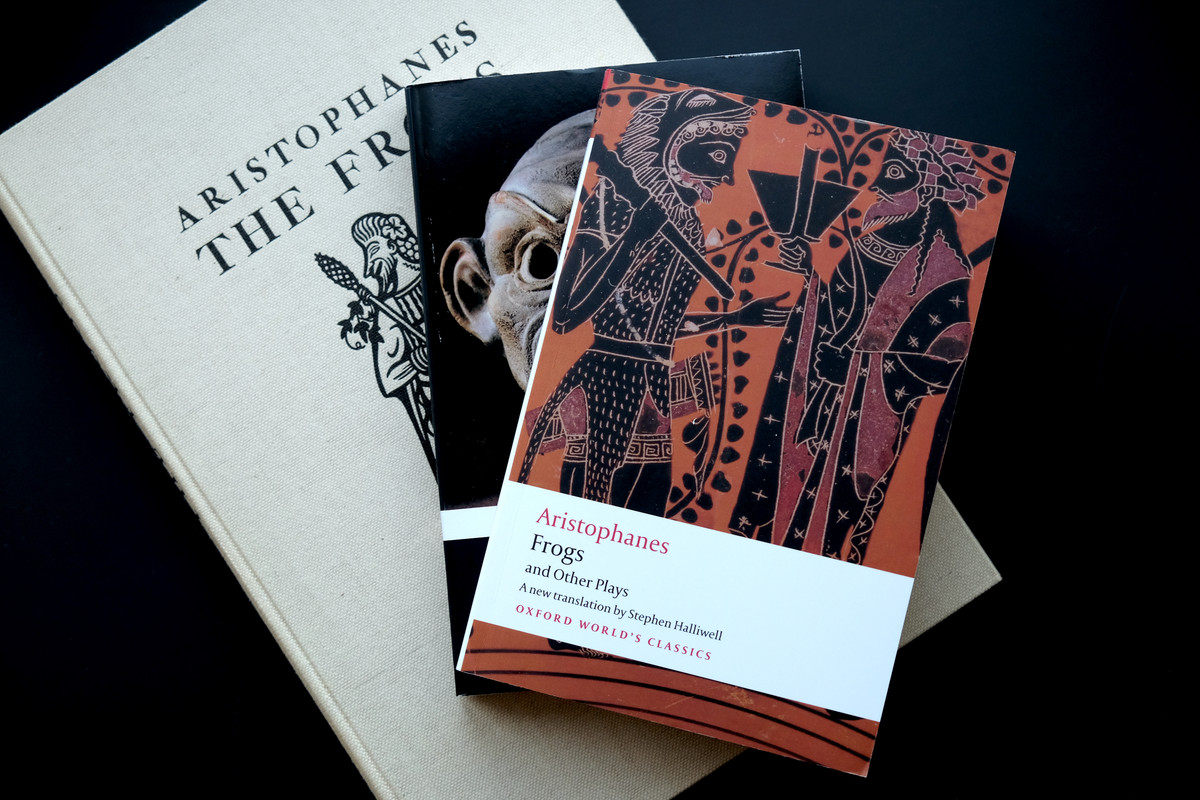
An update on my reading of the The Frogs in varying editions:
At the start, I flip-flopped between the Oxford World's Classics (Halliwell) and Penguin (Barrett) translations, eventually committing to the former. I then read the LEC and some of the Gilbert Murray afterwards for good measure.
The Oxford is an excellent edition (I refer to the content only, the paperback quality is bad, sub-Penguin) and I felt it had everything that a newcomer to Aristophanes would need to enjoy and appreciate the work. There's a superb 90-page general introduction, which includes sections on historical context, the roots of Old Comedy, satire, fantasy, stage performance, the technicalities of form, and, finally, how society's approach to assessing, translating and performing Aristophanes has changed over time. The writing is scholarly, but also lively and pitched at the right level for general readership. Additionally, there are 15-page introductions (commentaries, really) for each of the plays, and an index of names. Comprehensive but not overwhelming.
A snippet from the section about Halliwell's approach to the translation:
My translation has accordingly been guided by the conviction that, while it is desirable to make Aristophanes as accessible as possible, accessibility must involve access to something that is not our own, rather than a modern substitute for it. The comic pleasure which can still be obtained from these plays depends on the willingness of readers to participate in a well-informed experience of a historically peculiar, even alien, mode of drama. What I have tried to provide are versions which approximate as closely to the original texture of Aristophanic poetry, and to the proclivities of Aristophanic humour as is compatible with a reasonable fluency in modern English. This means, for one thing, that I have generally retained as much as possible of the historical fabric of names, references, and allusions so that readers will not at any rate be badly misled about the kinds of things Aristophanes wrote and imagined. It also, and equally importantly, means that I have chosen not to translate the plays into prose, since that would involve, to my judgement, too great (and comfortable) an assimilation to the dominant medium of comic drama in our own world, with a corresponding loss of the poetic forms which are so integral to the nature of Old Comedy. Here as elsewhere, however, some compromise is appropriate.
This was music to my ears. Despite being largely in prose, the parts of the Barrett (Penguin) translation that I read also seemed good. However, one of the main differences is Barrett's decision to translate the chorus sections into rhyming verse, giving it a far too comfortable and 'twee' (to borrow one of Halliwell's phrases) feel to it, almost like a Gilbert and Sullivan operetta. Although the Barrett is 'modern', it's now 60 years old, and I was interested to see what a more recent translation would look like.
Halliwell's translation is much more dynamic than the older efforts, and he imparts more liveliness and zip to proceedings. Additionally, he seems to restore all the obscenity, vulgarity and innuendo that has been otherwise sanitised or excised by other translators. This is especially noticeable within the first parts of the play; the final third being more concerned with a sort of literary criticism of Euripides and Aeschylus, which represents a satirical commentary on the (then) current state (decline?) of Greek tragedy, as well as posing a sort of moral question about what approach (Aeschylus - heroic, warlike; Euripides - complex, realistic, psychological, cunning) might best serve Athens in its hour of need as Sparta turned the screws in the Peloponnesian War.
It's rich and complex, and I would be lying if I said the finer points of the literary criticism didn't elude me, even with the scholarly support. Nonetheless, I think anyone who has read Euripides and Aeschylus might find comments and quips which resonate with their experience of the works of these playwrights and the differences between them. The obscenity in the first sections of the play is important (though as Oates points out, not as prevalent as other plays), the convergence of sophisticated and base humour being essential elements of Old Comedy (so I learned).
Compare a passage from the Gilbert Murray, LEC, Penguin and Oxford translations: (be warned, the Oxford is very explicit).
Gilbert Murray (late 19th, early 20th Century?)
In a wild despairing humour
Sits huddled up and tearing out his hair among the graves.
To believe he would incline us
That a person named Sebinus
Is tossing yet unburied on the waves!
While Callias, says tattle
Has attended a sea-battle,
And lionesses' scalps were the uniform he wore!
LEC (William James Hickie - mid to late 19th century?)
Penguin (David Barrett - 1960s, revised 2007)
care;
He's lost his precious lover boy, his sad cries rend the air,
As he takes a pair of tweezers to his last superfluous hair.
Now Callias, the naval man, is at best ashore,
Where he can show his seamanship in actions by the score,
And when they see his lion-skin the girls cry out for
more.
Oxford: (Stephen Halliwell, 2015?)
was seen among the tombstones
When plucking the hairs from his anus and
tearing his cheeks.
He flailed away, bent double,
and wailed and shrieked aloud
For someone called Fuck-you from Anaphlystos.
And Kallias, it's rumoured,
The son of one Horse-fucker,
Fought naval battles with cunts while dressed in
lion skin.
Isn't it wild how different they all are from one another? It just shows how important it is to find a translation that works for you personally. Halliwell's translation is so much more raw. Does it go too far? I would need someone who reads ancient Greek to tell me. Still, look at the difference in the way Halliwell unpacks the "Hippobinus" joke. Apparently, it's a pun on the person's real name, "Hippokinos" ("Horse-Victor").
The LEC takes a different approach. The introducer, Gilbert Seldes, states:
...Aristophanes is better off without the explanation...(he then cites an example where an explanation or footnote would be redundant). And so it goes in a hundred cases. The apparatus of scholarship stands between us and the work it tries to explain.
'...stands between us and the work it tries to explain'. I'm not sure I agree with that. But does he have a point? Jokes are usually strained once you have to stop and explain them!
However, looking at the passage I compared above, you can see how flawed Seldes' comment is. In the LEC, the name of "Hippobinus" is left intact, but without a footnote the joke is simply lost for anyone who doesn't read Greek. There are dozens of examples like this. Halliwell, in addition to explaining the "Hippobinus" joke in a footnote also provides additional context: the "tombstones" are apparently a hint at one of the seedier associations of the Karameikos area of the city. "Anaphlystos" is also explained: a district of Athens, but the word is also close to another slang word with rude connotations. With these clues we can begin to build a picture of the richness and complexity of the wordplay.
There are obviously different approaches to translation at play here. The dominant mode in older translations has been to either smooth over the intricacies and vulgarities of the joke, or else attempt to make the English amusing in it's own right. We can also keep in mind that in doing this they faced the task of conforming to the social mores of their day. That's quite a challenge! The need to accommodate everything in rhyming couplets seems to further strain some of the translations away from the details and specifics of the text. Halliwell appears to give us something less filtered and also provides us with the means to understand why an Athenian would have found it funny, all without necessarily expecting a modern reader to be amused by his translation.
Here's another example:
Xanthias and Dionysus have descended to Hades and narrowly escaped an encounter with the monster Empousa:
Oxford:
XANTHIAS:
Take heart. It's all turned out okay.
We can say, just like the actor Hegelochos did:
'After stormy waters, I see once more - a weasel!'.
LEC:
XANTHIAS:
Be good of courage: we are altogether prosperous, and we may say, like Hegelochus, 'for after the billows again I see a calm'.
Where did the "weasel" come from?! Halliwell explains Aristophanes' joke here: the Greek word is a mispronunciation of the word for 'calm'. Hegelochos was a famous tragedian actor and had made a terrible slip when reciting the line in a performance of Euripides' Orestes. The slip had become notorious in Athenian society - it marked the end of poor Hegelochos' acting career! The LEC either glosses over the weasel joke or expects the reader to be aware of it. I understand it's a fairly well known anecdote, but I appreciated the footnote.
For me, this is the beauty of reading an ancient comedic text - not necessarily to be in stitches myself (though there are undoubtedly funny parts) - but to be able to understand and imagine why a crowd of 5,000 Athenians in the Theatre of Dionysus would be laughing at this joke. These are the details which bring it all to life and add texture and colour to our understanding of a society that produced these self-reflective works. I keep thinking about Halliwell's comment about the need for us to be willing to explore this strange form of comedy on its own terms. It's that feeling of encountering a text that is 2400 years old and finding something that is alien but, at times, strangely familiar. It's a fascinating and unnerving experience.
I don't say all this to criticise the LEC. It doesn't aim to be a scholarly edition - why should it? Also, Macy probably used one of the best translations available at the time. Indeed, the ML explains that the Hickie translation was chosen because it preserved "more of the broad slapstick quality of the play" and was "less weighed down by reverence for the literary qualities of the Greek language", suggesting that this was one of the least conservative options available. I did find Gilbert Seldes introduction somewhat infuriating, though. It seems to suggest: "don't worry about seeking to gain a deeper understanding of Aristophanes, just have at it!". I don’t know if that will serve most people well, especially for The Frogs. Not me, at least.
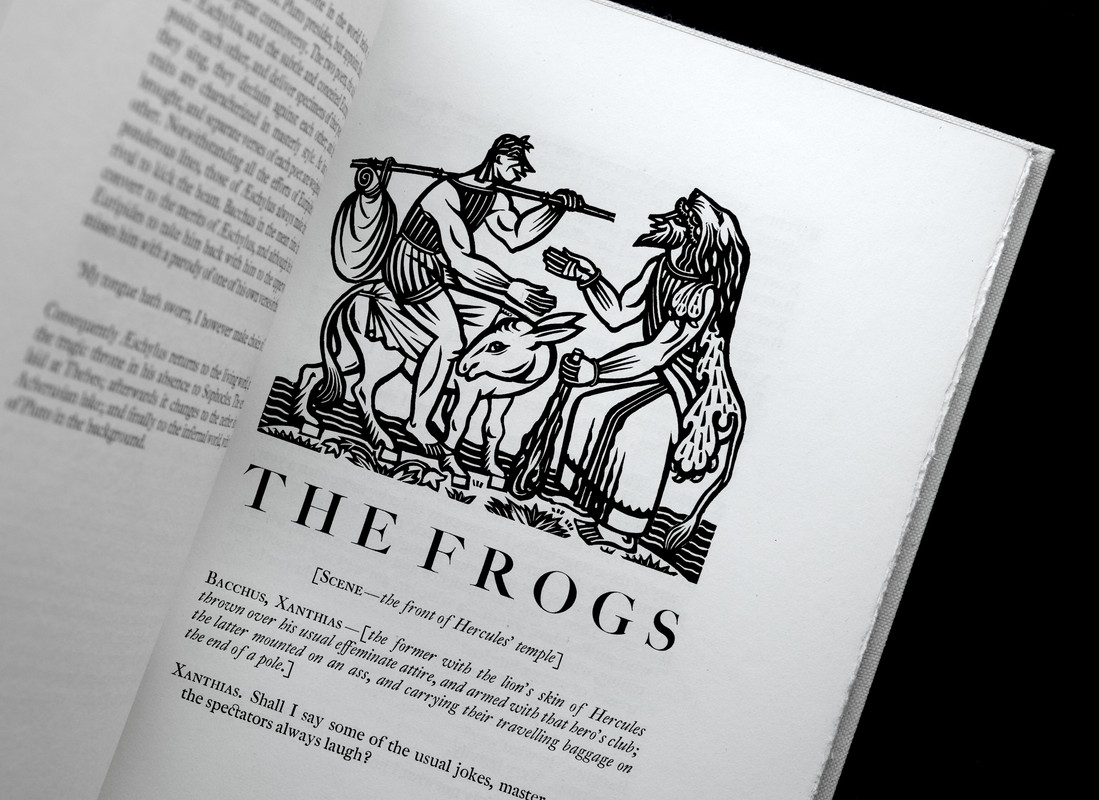
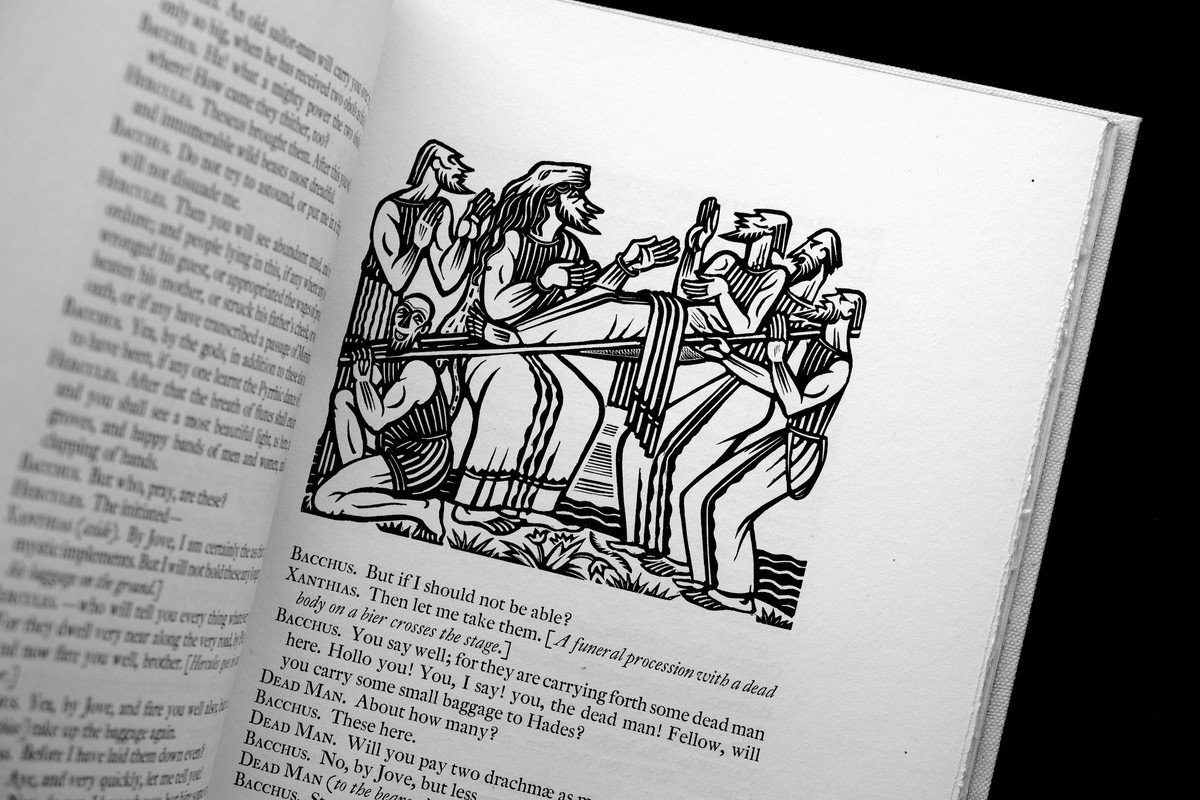
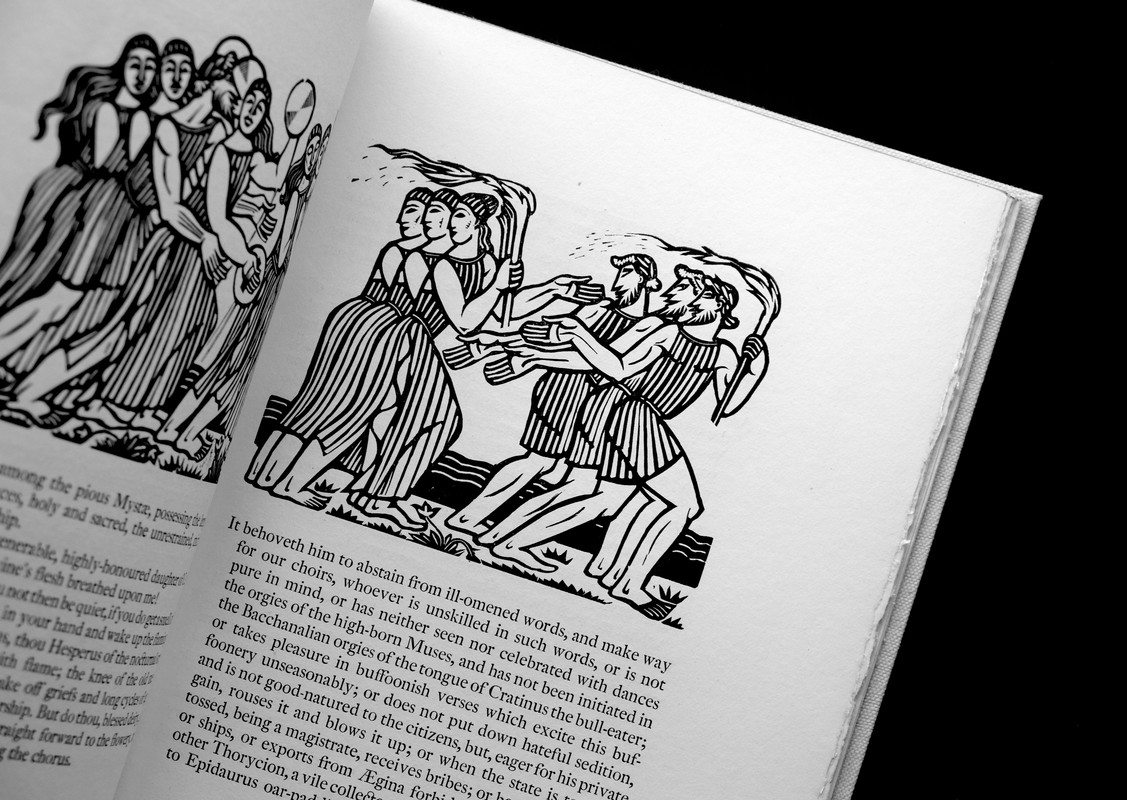
The LEC binding and paper are lovely, and the illustrations are brilliant, though perhaps not quite 'grotesque' enough. According to the ML, one of the reasons the LEC produced an edition of The Frogs was because John Austen was so enthusiastic about illustrating the play.
17Django6924
Murray’s translation in my Complete Greek Drama relies on footnotes and the Glossary to elucidate these points. He footnotes the passage with what becomes somewhat of a formula in his footnotes: “For what was actually said…” and then “see Hegolochus in the Glossary,” which is an extensive collection of Greek names. There we read:
HEGELOCHUS. An Athenian actor who, in a performance of Euripides' Orestes had made a slight and fatal slip in diction; he had pronounced galen' horo (galena with the final a elided) so that it sounded like galen horo (galen without any a to elide). This created a ridiculous line, for instead
"After the storm I perceive
the calm," he tragically declaimed,
"After the storm I perceive the cat.”
Don’t know whether the actual Greek is “cat” or “weasel” but I got the joke. Similar is Murray’s translation note 15 (Complete Greek Drama) to the lines (in the LEC translation "Sabinus, who is the Anaphlystian” and in Murray “…that a person named Sebinus /Is tossing yet unburied on the waves!”):
“In the Greek Sebinus is called an Anaphlystian, for which see the Glossary,” where we read: “ANAPHLYSTIA. An Attic seaport whose name suggests the Greek word anaphlan, ‘masturbate.’”
This same footnote goes on: “…the father of Callias is comically altered from Hipponicus to Hippocinus, ‘he who makes love to a mare.’”
As you can see, Halliwell’s translation, while certainly less squeamish than the others, may be taking the jokes a bit too far to the blue; and although Murray does provide what is probably the more accurate rendering in his scholarly apparatus, it’s too bad he couldn’t have somehow incorporated the more ribald meaning in the text of the play itself (although I have to say that the use of the word “tossing” in “that a person named Sebinus, Is tossing yet unburied on the waves!” had connotations that a person of Murray’s era would have recognized as an allusion to self-abuse).
Obviously, the best translation of Aristophanes would have to be the one in which modern equivalences of his puns and allusions, which the reader of the translator’s era would appreciate, would mean an ongoing series of translations. For Aristophanes was a very topical playwright, and if the play is to have the effect on the reader similar to the ay the play had on 5th century Athenians, it needs to be written with a thorough knowledge of the puns and allusions of the original transposed to the current idiom.
I think Halliwell is a bit too raw in his choices. Some of Aristophanes’ language is every bit as raw, but he also can slyly create a raunchy effect without resorting to gutter language. A wonderful English-language example of this ability is found in this lyric from Cole Porter, in his song “Brush up your Shakespeare”:
If she says your behavior is heinous, Kick her right in the Coriolanus Brush up your Shakespeare, And they'll all kow-tow….”
I agree John Austen’s illustrations are brilliant; unexpectedly so as I always considered his illustrations a bit on the precious side (“twee” as you said, a term used by a couple of the British members of this site, sadly missing these days) to describe him. Far more in keeping with the character of the work than Picasso’s for Lysistrata.
18GardenOfForkingPaths
From what I read, I liked Murray's translation and would have read right to the end if I had a physical copy (I might get one). I felt there was a better sense of comic timing compared to Hickie's. How Murray uses the endnotes was particularly interesting to me. In many ways his is the 'cleanest' of the translations that I read e.g. in the opening salvo of Xanthias/Dionysus jokes he has them talking about 'sneezing' and 'blowing their noses' whereas the others translate these jokes as scatalogical. Then, just as you have explained, those jokes are rewritten in all their crude glory in the endnotes.
Perhaps this was the line he had to tread at this moment in history. Likewise, in the Barrett translation, the endnotes, which were added by someone else in recent times, have numerous entries that begin with "this translation plays down the coarseness of the original...".
It seems like we were possibly overdue for something a bit freer and perhaps a bit coarser, but, like you, I wonder about the rawness of Halliwell's language in those comparisons and if we are losing any subtlety here. (Although, lest I do him a terrible disservice, I should add that I did happen to choose a particularly explicit passage, and it's not all like that.)
As you say, "he who makes love to a mare" sounds very different from Halliwell's choice! And his expletive in the penultimate line seems to come out of nowhere compared to the other translations. Since I can't read the Greek, it's impossible for me to tell which is the 'appropriate' tone, if there is one?
Ultimately, I guess there's more than one way to skin a cat...or a weasel.
19bacchus.
If I recall correctly the play was written around 400 BC, a bit after Euripides and Sophocles passed away. That pretty much marked the end of the golden drama age.
20Django6924
This brings up an interesting point: do we read classical works, (and let me clarify I'm speaking about works originally intended for performance, the ancient Greek plays, Shakespeare, etc.) sometimes ancient works, for an understanding of the period they reflect/embody, or for seeing how human nature, tends to be fairly constant despite a greater awareness of Nature and how it works, or purely for entertainment--probably for most of us on this site a mixture of all three.
Because I am quite an opera fan, I have been fascinated by several productions which either present the operas as museum pieces, or restage them in such a way to make them more relevant to today's audiences. Depending on the work in question, restaging can be very entertaining and can get the audience more involved. Sometimes, it can just be gimmicky and brings nothing to the work. Recently a local opera company staged Madame Butterfly by setting it in the silent film era. Many found this odd, at least, and I found it distracting. When a different company staged Die Fledermaus and set it in Hollywood at the time when silents were being replaced by talkies, it was considered by all a brilliant success.
Trying to determine why one approach worked and a similar approach in a different work didn't, really didn't have anything to do with the intrinsic artistic merit of the respective works. But the setting of Golden Age Hollywood, with its stars and wannabes and its social mix of the very affluent and the "bourgeoisie" is not that different from fin de siècle Vienna of Strauss' opera. Definitely more accessible to the Los Angeles audience who loved it.
But Madame Butterfly is not the same set in a different period. When Puccini was writing, the institution of "treaty port" marriages was still in effect, and it was sometimes the case that a young girl would be sold by her family into what, though it had the dubious distinction of being a legal agreement, was little short of prostitution, but that often the highly impressionable girls would think this was going to be a lasting relationship--especially if children resulted. This is what creates Cio-Cio-San's tragedy, and without this understanding of the social conditions of her time and place, the piece can seem just melodramatic, and Cio-Cio-San naive at best, and foolishly gullible at worst, and turn Pinkerton from a fey young man who believes everyone knows the rules of the game, into Oil-Can Harry.
This is a long preamble to the point: I would prefer the translation of the plays to be as close as possible to the original, with footnotes and other scholarly apparatus such as Murray provides--that is if I'm going to read the work, rather than see it performed. If it's a performance, I think you do need to take the audience into account and try to remove barriers of archaism.
For an example of the latter approach in classical Greek dramatic literature, look up on the internet Peter Hall's 1983 televised production of the Oresteia, using minimalist settings, dramatic masks fully covering the faces of the actors, and men in the female roles. It is very highly considered; and perhaps if I had been in the theater audience I would have found it so myself (though I doubt it), but as seen through modern filmmaking techniques, intercutting, closeups, etc., I found it distracting and ultimately an unsatisfying version of what is one of the most important works of Western Civilization. I'll stick with reading Morshead's translation in the LEC with Michael Ayrton's great illustrations.
Then again, you may have a different opinion.
21GardenOfForkingPaths
>20 Django6924: I agree. I think you have highlighted the crux of the matter. For me, the motivation to read these works is the mixture of the three aspects you mentioned: understanding of the period/culture, reflections on the universal and constant aspects of human nature, and entertainment. How we like that cocktail to be mixed might draw us to one translation style or another. Reflecting on this, I probably place a particular emphasis on the first aspect (I was a history student!).
In all the translators' introductions that I read, there were often descriptions of the peculiar difficulties and pressures of translating comedy.
In the case of comic texts, the temptation to prefer assimilation and modernisation over the acknowledgement and savouring of historical distance is very considerable, for the simple reason that readers of comedy readily expect to be amused, and amusement is by nature a relatively spontaneous response which does not normally require a special effort of imagination or understanding. But the present translation tries, in the main, to resist this temptation, on the assumption that readers of Aristophanes should be looking for something other than a ready-made entertainment of a kind straightforwardly equivalent to and interchangeable with the products of their own culture.
Still, there is much in Frogs that will not feel strange to our modern sense of comedy. Like Heracles' directions for travelling to Hades:
HERACLES:
Then take a stroll to the Kerameikos.
DIONYSUS:
What then?
HERACLES:
Climb up the tower, that high one.
DIONYSUS:
And what after that?
HERACLES:
Look down from there when they're going to hold a torch race.
Then, when you hear the spectators all shout "Go then!"
At that point go yourself.
DIONYSUS:
Go Where?
HERACLES:
Straight down!
This kind of joke sounds wonderfully familiar, and it's in those moments that the 'historical distance' appears to shrink to nothing. The impact of those moments of familiarity is only strengthened by giving due weight to the alien aspects of the work.
Just as you described with Madame Butterfly, there is much of Frogs that seems to be highly specific to the time: in this case, the religious and historical context of the day and the peculiarities of Old Comedy. I'm happy to sacrifice some immediate laughs and read through a few footnotes in order to understand it on its own terms - as much as is possible, anyway.
It's so true that performance is another matter entirely, and I'm sure it comes with a different set of pressures, including financial. If the 'temptation to prefer assimilation and modernisation' is there for the translator, it must be doubly so for someone adapting or staging it. And, as you say, they are often quite right to give in to that temptation and break down a few barriers!
I enjoyed reading your reflections on Madame Butterfly and the Oresteia.
Join to post

