This topic is currently marked as "dormant"—the last message is more than 90 days old. You can revive it by posting a reply.
1The_Hibernator


Hi, my name's Rachel (the_hibernator), and I work in the healthcare industry. In my spare time, I volunteer for a rehabilitative justice program with the Minnesota DOC. I'm passionate about reducing stigma about mental illness. I have bipolar disorder and talk about it a lot because I think more people need to know that mental illness is something that you don't have to be ashamed of. I have three cats: Myra, Hero, and Puck. I'm currently training for a 100 mile bike ride in the Lake Itasca (Mississippi headwaters) area in September.
I tried setting up a Club Read thread in the past because I really like the higher concentration of nonfiction, classics, and literary fiction in this group, but my thread went to the wayside when I felt I was posting too much fluff. However, I am told by several Club Read members to be unashamed of my fluff and to come on over. :) I look forward to seeing everyone's thoughtful reviews here on Club Read.
Above is a picture of my reading plans for the upcoming year. In addition, I hope to have time to liberally throw in some spontaneity.
If you want to follow me on other media:
Twitter: @hibernatorslibr
Litsy: @the_hibernator
blog: http://hibernatorslibrary.blogspot.com

3The_Hibernator
Rachel's World Travels in Books (A 5 Year Project)

visited 3 states (1.33%)
Create your own visited map of The World
Ireland - In the Woods, by Tana French
visited 3 states (1.33%)
Create your own visited map of The World
Ireland - In the Woods, by Tana French
4The_Hibernator
Pop Sugar Reading Challenge: Don't know if I'll read all of these, but it's worth a try.
1. A book recommended by a librarian Walking Drum, by Louis L'Amour
2. A book that's been on your TBR list for way too long In the Woods, by Tana French
3. A book of letters We Need to Talk About Kevin, by Lionel Shriver
4. An audio book The Stand, by Stephen King
5. A book by a person of color The New Jim Crow, by Michelle Alexander
6. A book with one of the four seasons in the title Winter's Tale, by William Shakespeare
7. A book that is a story within a story The Unwinding, by George Packer
8. A book with multiple authors The Bible
9. An espionage thriller Tinker, Tailor, Soldier, Spy by John le Carre
10. A book with a cat on the cover The Wizard of Oz, by L. Frank Baum
11. A book by an author who uses a pseudonym 10 Days in a Madhouse, by Nellie Bly
12. A bestseller from a genre you don't normally read Hillbilly Elegy by J. D. Vance
13. A book by or about a person who has a disability Ben in the World, by Doris Lessing
14. A book involving travel Enrique's Journey by Sonia Nazario
15. A book with a subtitle Evicted, by Matthew Desmond
16. A book published in 2017 Dragonwatch, by Brandon Mull
17. A book involving a mythical creature Harry Potter and the Prisoner of Azkaban, by J. K. Rowling
18. A book you've read before that never fails to make you smile Harry Potter and the Sorcerer's Stone, by J. K. Rowling
19. A book about food Omnivore's Dilema, by Michael Pollan
20. A book with career advice How to Win Friends and Influence People, by Dale Carnegie
21. A book from a nonhuman perspective Paradise Lost, by John Milton
22. A steampunk Novel First Men in the Moon, by HG Wells
23. A book with a red spine The Underground Railroad, by Colson Whitehead
24. A book set in the wilderness Lord of the Flies, by William Golding
25. A book you loved as a child Charlotte's Web, by E. B. White
26. A book by an author from a country you never visited Born a Crime, by Trevor Noah
27. A book with a title that's a character's name Swann's Way, by Marcel Proust
28. A novel set during wartime Catch-22, by Joseph Heller
29. A book with an unreliable narrator In the Woods, by Tana French
30. A book with pictures The Marvelous Land of Oz, by L. Frank Baum
31. A book where the main character is a different ethnicity than you Roots by Alex Haley
32. A book about an interesting woman Come Be My Light, by Mother Teresa
33. A book set in two different time periods Kindred, by Octavia E. Butler
34. A book with a month or day of the week in the title Mister Monday, by Garth Nix
35. A book set in a hotel A Gentleman in Moscow, by Amor Towles
36. A book written by someone you admire The Autistic Brain, by Temple Grandin
37. A book that's becoming a movie in 2017 Handmaid's Tale, by Margaret Atwood
38. A book set around a holiday other than Christmas The Legend of Sleepy Hallow, by Washington Irving
39. The first book in a series you haven't read before Binti, by Nnedi Okorafor
40. A book you bought while traveling White Trash, by Nancy Isenberg
1. A book recommended by a librarian Walking Drum, by Louis L'Amour
2. A book that's been on your TBR list for way too long In the Woods, by Tana French
3. A book of letters We Need to Talk About Kevin, by Lionel Shriver
4. An audio book The Stand, by Stephen King
5. A book by a person of color The New Jim Crow, by Michelle Alexander
6. A book with one of the four seasons in the title Winter's Tale, by William Shakespeare
7. A book that is a story within a story The Unwinding, by George Packer
8. A book with multiple authors The Bible
9. An espionage thriller Tinker, Tailor, Soldier, Spy by John le Carre
10. A book with a cat on the cover The Wizard of Oz, by L. Frank Baum
11. A book by an author who uses a pseudonym 10 Days in a Madhouse, by Nellie Bly
12. A bestseller from a genre you don't normally read Hillbilly Elegy by J. D. Vance
13. A book by or about a person who has a disability Ben in the World, by Doris Lessing
14. A book involving travel Enrique's Journey by Sonia Nazario
15. A book with a subtitle Evicted, by Matthew Desmond
16. A book published in 2017 Dragonwatch, by Brandon Mull
17. A book involving a mythical creature Harry Potter and the Prisoner of Azkaban, by J. K. Rowling
18. A book you've read before that never fails to make you smile Harry Potter and the Sorcerer's Stone, by J. K. Rowling
19. A book about food Omnivore's Dilema, by Michael Pollan
20. A book with career advice How to Win Friends and Influence People, by Dale Carnegie
21. A book from a nonhuman perspective Paradise Lost, by John Milton
22. A steampunk Novel First Men in the Moon, by HG Wells
23. A book with a red spine The Underground Railroad, by Colson Whitehead
24. A book set in the wilderness Lord of the Flies, by William Golding
25. A book you loved as a child Charlotte's Web, by E. B. White
26. A book by an author from a country you never visited Born a Crime, by Trevor Noah
27. A book with a title that's a character's name Swann's Way, by Marcel Proust
28. A novel set during wartime Catch-22, by Joseph Heller
30. A book with pictures The Marvelous Land of Oz, by L. Frank Baum
31. A book where the main character is a different ethnicity than you Roots by Alex Haley
32. A book about an interesting woman Come Be My Light, by Mother Teresa
33. A book set in two different time periods Kindred, by Octavia E. Butler
34. A book with a month or day of the week in the title Mister Monday, by Garth Nix
35. A book set in a hotel A Gentleman in Moscow, by Amor Towles
36. A book written by someone you admire The Autistic Brain, by Temple Grandin
37. A book that's becoming a movie in 2017 Handmaid's Tale, by Margaret Atwood
38. A book set around a holiday other than Christmas The Legend of Sleepy Hallow, by Washington Irving
39. The first book in a series you haven't read before Binti, by Nnedi Okorafor
40. A book you bought while traveling White Trash, by Nancy Isenberg
5kidzdoc
Welcome back to Club Read, Rachel! I'm glad that you'll be joining us in 2017, especially since we'll be reading several of the same books. I'll get a thread up and running early next week, since I have to work over the Christmas and New Year's Day holidays.
6The_Hibernator
Thank Darryl! I know I set my thread up pretty early. But I'll be on vacation for part of the last week of December and I want to be prepared in case I'm short of time. Though I'm guessing the lodge I'm going to has free wi-fi, and I'll probably have spare time to lounge around...
7kidzdoc
I just finished setting up my thread, Rachel. I'll be off until Friday, but I'm working all but two days over the Christmas and New Year's holidays from December 23 to January 3, so I may not be online much after Thursday.
8The_Hibernator
For anyone interested, I started up a group read thread for Evicted, by Matthew Desmond, The Unwinding by George Packer, and the Bible.
Evicted: https://www.librarything.com/topic/243885
The Unwinding: https://www.librarything.com/topic/243872
Bible: https://www.librarything.com/topic/243886
Evicted: https://www.librarything.com/topic/243885
The Unwinding: https://www.librarything.com/topic/243872
Bible: https://www.librarything.com/topic/243886
9The_Hibernator
I'll go ahead and start posting reviews here since there's only one week left and this is my only active Club Read thread:

The Righteous Mind explores the polarization of American politics with a focus on the different moral foundations of conservatives versus liberals. He explores the question of why both conservatives and liberals tend to think they are morally in the right and that the other side is morally wrong. Haidt spends the first two chapters providing experimental evidence of why Hume was right to say that reason is the slave of passion. He suggests that you can't make reasoned decisions without emotional backing. Haidt uses Damasio's findings, presented in his book Descartes' Error, to back this up. Damasio found that people who do not feel emotion due to brain damage are flummoxed by even small decisions like what brand of milk to buy or what order to perform a set of tasks. Haidt then references studies that suggest that people will use emotional intuition to come up with a point of view, and then look specifically at evidence that supports this intuition, ignoring evidence that contradicts their own views.
In his own studies (see figure below), Haidt breaks down people's morals into categories: care about others, fairness, loyalty, authority, and sanctity. According to Haidt's studies, liberals value caring about others and fairness much more than loyalty, authority, and sanctity. Conservatives value loyalty, authority, and sanctity more, and value care and fairness to a lesser degree. The interesting bit is that conservatives have a broader (more diverse) range of what they care about than liberals do. They care about their less important values more than liberals care about their less important values. Haidt suggests that this is why Republican candidates purposely apply to the emotional side of people more than Democrats do. And since people's rational decisions are based on emotion, the Republican candidates have an advantage with moderate voters.
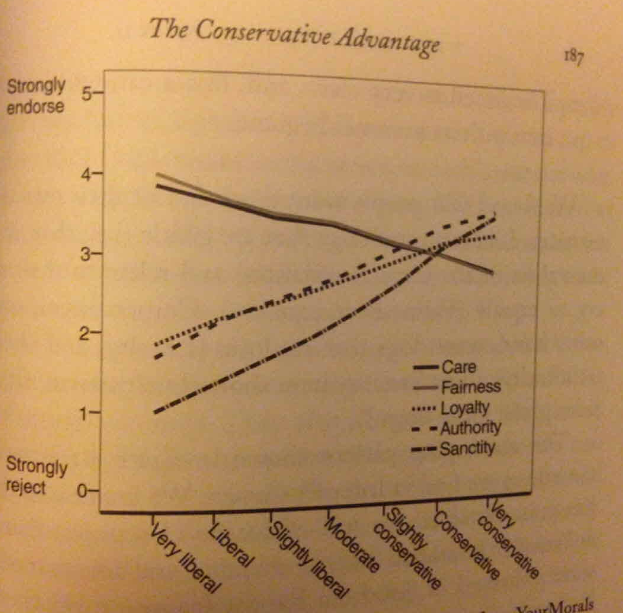
Haidt goes on to answer the question: "Why do poor, rural, white folk vote against their economic best interests?" He suggests that they're voting for their moral interests - loyalty, authority, and sanctity.
The next part of the book is about evolutionary group selection. Many people believe that groupish behavior evolved in our species because a group of individuals was more successful at producing offspring than single individuals. But Haidt asks the question: how can such behavior evolve when selfish individuals within a group can take advantage of the group to be even more successful than the altruistic group members? Wouldn't evolution then favor the selfish ones? He answers this question describing a situation breeding chickens. If the chickens who produce the most eggs are inbred, then the offspring end up laying more eggs. But they also end up more aggressive, which is a trait linked to high production of eggs. Because the chickens are more aggressive, they attack and kill each other, leading to lower egg production per cage. If you, instead, breed the cage that produces the most eggs compared to the other cages, the cages of offspring end up with more eggs. Thus, evolutionary group selection is about selecting an entire group, and not about breeding individuals within a group. Haidt suggests that this is why humans tend to break into groups.
Haidt goes on to suggest that religious belief evolved as group selection (groups of religious people survive better than groups of nonreligious people) rather than as an evolutionary trait of individuals. So people not only have a tendency to break into groups, but to have a formal set of values within each group. In the end, we follow our values and tend not to understand that another group's values may be founded in truth as well.


The Righteous Mind explores the polarization of American politics with a focus on the different moral foundations of conservatives versus liberals. He explores the question of why both conservatives and liberals tend to think they are morally in the right and that the other side is morally wrong. Haidt spends the first two chapters providing experimental evidence of why Hume was right to say that reason is the slave of passion. He suggests that you can't make reasoned decisions without emotional backing. Haidt uses Damasio's findings, presented in his book Descartes' Error, to back this up. Damasio found that people who do not feel emotion due to brain damage are flummoxed by even small decisions like what brand of milk to buy or what order to perform a set of tasks. Haidt then references studies that suggest that people will use emotional intuition to come up with a point of view, and then look specifically at evidence that supports this intuition, ignoring evidence that contradicts their own views.
In his own studies (see figure below), Haidt breaks down people's morals into categories: care about others, fairness, loyalty, authority, and sanctity. According to Haidt's studies, liberals value caring about others and fairness much more than loyalty, authority, and sanctity. Conservatives value loyalty, authority, and sanctity more, and value care and fairness to a lesser degree. The interesting bit is that conservatives have a broader (more diverse) range of what they care about than liberals do. They care about their less important values more than liberals care about their less important values. Haidt suggests that this is why Republican candidates purposely apply to the emotional side of people more than Democrats do. And since people's rational decisions are based on emotion, the Republican candidates have an advantage with moderate voters.
Haidt goes on to answer the question: "Why do poor, rural, white folk vote against their economic best interests?" He suggests that they're voting for their moral interests - loyalty, authority, and sanctity.
The next part of the book is about evolutionary group selection. Many people believe that groupish behavior evolved in our species because a group of individuals was more successful at producing offspring than single individuals. But Haidt asks the question: how can such behavior evolve when selfish individuals within a group can take advantage of the group to be even more successful than the altruistic group members? Wouldn't evolution then favor the selfish ones? He answers this question describing a situation breeding chickens. If the chickens who produce the most eggs are inbred, then the offspring end up laying more eggs. But they also end up more aggressive, which is a trait linked to high production of eggs. Because the chickens are more aggressive, they attack and kill each other, leading to lower egg production per cage. If you, instead, breed the cage that produces the most eggs compared to the other cages, the cages of offspring end up with more eggs. Thus, evolutionary group selection is about selecting an entire group, and not about breeding individuals within a group. Haidt suggests that this is why humans tend to break into groups.
Haidt goes on to suggest that religious belief evolved as group selection (groups of religious people survive better than groups of nonreligious people) rather than as an evolutionary trait of individuals. So people not only have a tendency to break into groups, but to have a formal set of values within each group. In the end, we follow our values and tend not to understand that another group's values may be founded in truth as well.
10VivienneR
>4 The_Hibernator: Your current reads are tempting. I recently read Stephen King for the first time and enjoyed him more than I expected I would. Mary Roach is another writer I have enjoyed a lot, and Packing for Mars is now on my wishlist. So far I haven't tried the Tana French that is on my tbr shelf, so I'll look forward to your opinion.
11alphaorder
I have been meaning to read The Righteous Mind for years. Seems like now is the time to do so.
Glad to see you are reading Evicted in January. I can't say enough good things about that book and Desmond's work.
Glad to see you are reading Evicted in January. I can't say enough good things about that book and Desmond's work.
12The_Hibernator

Merry Christmas to everyone that celebrates!
>10 VivienneR: Hi Vivienne! I'm enjoying all of the books I'm reading right now. :) Looks like we have some overlapping tastes!
>11 alphaorder: Hi Nancy! You really should read The Righteous Mind. It's fantastic.
13RidgewayGirl
Interesting thoughts on The Righteous Mind. And your planned reading for next year looks worthwhile. I look forward to finding out what you think.
14PaulCranswick
Rachel, just to let you know that I'll be keeping a thread over here too this year.
I am going to have a go at my own version of the Around the World in 80 Books challenge you suggested all from my present TBR.
I am going to have a go at my own version of the Around the World in 80 Books challenge you suggested all from my present TBR.
17The_Hibernator
>13 RidgewayGirl: Hi Alison! Thanks for your interest in my 2017 reading. I have high ambitions that hopefully I'll be able to fulfill! I've already started on my January books, though.
>14 PaulCranswick: Hi Paul! Already went and checked out your thread. It'll be fun to have it condensed down so I can better catch the books you're reading. As it is on your 75ers thread, I always feel like I'm behind. ;)
>15 NanaCC: This is my first Tana French, Colleen, and I'm enjoying it quite a bit.
>16 charl08: Hi Charlotte! Thanks for the luck. I'll need it. lol
>14 PaulCranswick: Hi Paul! Already went and checked out your thread. It'll be fun to have it condensed down so I can better catch the books you're reading. As it is on your 75ers thread, I always feel like I'm behind. ;)
>15 NanaCC: This is my first Tana French, Colleen, and I'm enjoying it quite a bit.
>16 charl08: Hi Charlotte! Thanks for the luck. I'll need it. lol
18The_Hibernator

Hope in the Dark is a short book of essays about the importance of recognizing small victories in the face of what seems insurmountable challenge. Solnit is a radical activist who passionately protests many issues such as NAFTA, the destruction of the environment, and war. The book was beautifully written - Solnit surely knows how to compose a sentence.
The reviews of this book seem overwhelmingly positive, and I, too, thought the book had an important point. However, I was not moved by the book as other people are. I think part of the problem is that many of the issues were older - it was originally published in 2004 and republished in 2016 with a new forward and afterward which address more timely issues. Unfortunately, I couldn't get my hands on a 2016 copy since I was trying to get it read in time for the Social Justice bookclub (still time to sign up!) which will read it in January. (I have too many other books in January to be able to fit it in then.)
Another issue I had with the book is it assumed prior knowledge of the issues such as why NAFTA is bad. I've never thought about NAFTA in the past - in fact, I only became aware of it being a controversial issue when Trump recently suggested nixing it. Perhaps that's a lack of awareness on my part, but I would have appreciated more information. But explaining the issues was not what this book was about. This book was about hope, not about education. Because of this "flaw," I found the book very boring in parts - I'm a fan of educational books more so than uplifting ones.
That said, I totally understand why people are moved by this book, and I appreciate the timeliness of preaching hope in the appearances of failure.


19kidzdoc
Nice review of Hope in the Dark, Rachel. I'll read her book Men Explain Things to Me in 2017.
20dchaikin
Interesting to read your thoughts on Solnit and that was an excellent and fascinating review of The Righteous Mind. And, about the fluff, post what you like. There is no seriousness quota here.
21The_Hibernator
>19 kidzdoc: Thanks Darryl! Hopefully you enjoy it. She has a beautiful writing style.
>20 dchaikin: I guess my impression of Club Read was that it shouldn't be fluffy, Daniel, since voicing those beliefs I have been convinced otherwise. :)
>20 dchaikin: I guess my impression of Club Read was that it shouldn't be fluffy, Daniel, since voicing those beliefs I have been convinced otherwise. :)
22The_Hibernator

Packing for Mars is a hilarious and informative book about the difficulties astronauts face in outer space. It covers most bodily functions, eating, and what happens to food (and bodily fluids) in zero gravity. However, it has very little to do with visiting Mars.
I admit that I found this book a bit slow at the beginning, but it perked up around the time she started talking about the sleep studies NASA is performing. I want $7000 to lie around in bed all day for 3 months! I even called up the number provided on the NASA website to volunteer, but the number didn't work. *sigh* Oh well, I really didn't want to ruin my bones. Having studied bones for my dissertation, I recognize the long-term effects of a study like that. I was also thrilled when Roach quoted my dissertation adviser on the effects of hibernation on bear bones. How funny!
I definitely recommend this quirky book to anyone who enjoys knowledge for the sake of knowledge and isn't easily grossed out.

23dchaikin
Points for following up and making the call about the bed test, which I find somehow charming. Roach is fun.
25The_Hibernator
>23 dchaikin: Hi Daniel. Yes, I actually called and tried the web page...I would have enjoyed signing up for it to see if I were qualified. I'd be a good candidate because I'm unmarried and could take a break from my job. I'm also healthy besides my bipolar disorder (which would probably be the one disqualifier).
>24 japaul22: Roach is a lot of fun. This is my second Roach, the other being Stiff, which I really enjoyed.
>24 japaul22: Roach is a lot of fun. This is my second Roach, the other being Stiff, which I really enjoyed.
26The_Hibernator
Currently reading:
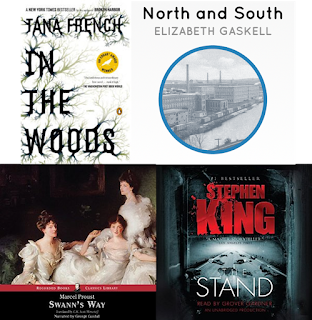
27The_Hibernator

This year, one of my big projects is to read the Bible cover to cover. Everyone is welcome to watch my progress or read along with me. The thread is here: https://www.librarything.com/topic/243886 I'll post my blog posts here on my thread as well as on that thread, but I expect some good discussion to be going on on the Bible thread.
Several people have approached me about the pros and cons of reading the Bible cover to cover instead of reading it in assigned excerpts in programs designed by professionals. Lots of people get bogged down in the genealogies, my friends say, and they quit. My answer to this is that cover to cover is not a great way to read the Bible for spiritual or historical approaches, but for a literary approach it makes sense to read each book as one literary unit. That way we can appreciate the style and story progression of each book.
Many people think that reading the Bible as literature betrays a liberal bias, that it's foreign to the original intent, or that it implies the Bible is fiction and not divinely inspired. I say that the Bible is, by nature, a literary work.
"Without literary form, no content can exist. We can not extract the moral or theological meaning of a story without first assimilating the plot, setting, and characters of the story." (1)
Thus a literary reading is a good place for anyone, conservative or liberal, antiquated or modern, theological or non-religious, to start.
One very important starting point to reading the Bible as literature is to recognize that the Bible is a meta-narrative - it's an anthology of books written over many eras by people of different cultures and languages. But the overall structure of the Biblical narrative has a U shape: it tells an overall story, starting with paradise for the innocent (Eden), flowing through depths of sin and deprivation, and then ending in paradise for the faithful (Revelations). The Biblical anthology has many genres including the narrative (hero story, gospel, epic, tragedy, comedy, and parable) and poetic (lyric, lament, psalm, love poem, nature poem, wedding poem). Of these, the far most common is narrative.
Over the next two weeks, I'm going to read the book of Genesis, which is an epic narrative.
(1)Ryken & Ryken in their introduction to The Literary Study Bible
28ELiz_M
Happy New Year! I enjoy following your thread -- the books and discussions around them are always interesting. I started a "read the whole Bible" project in 2015, but got waylaid. You've inspired me to re-start it this year. I won't be following along as I following a chronological path.
29valkyrdeath
I'm glad to see you've got a thread again this year. I really enjoyed following it in the early part of last year. I see you're reading North and South, I'm hoping to read that sometime in the next couple of months too, so I'll be interested to see how you find it.
I've read the same two Mary Roach books that you have too and loved them both. I remember the part about hibernation in Packing for Mars and it must have been odd to come across your dissertation advisor in the book!
Hope you have a good year ahead!
I've read the same two Mary Roach books that you have too and loved them both. I remember the part about hibernation in Packing for Mars and it must have been odd to come across your dissertation advisor in the book!
Hope you have a good year ahead!
30OscarWilde87
Happy New Year! I'll be following along here. Will be interesting to see your progress on the Bible project.
31Rebeki
Hi Rachel, it seems to me your reading is anything but fluffy! Your review in >9 The_Hibernator: is really interesting and I admire your reading plans in this respect.
32avaland
Happy New Year, Rachel. I have the Thomas Frank book in my pile also. Not sure it's at the top of the pile, though, post election. Still, it's not a long book...
North and South is a favorite classic of mine (but I have so many favorites...)
North and South is a favorite classic of mine (but I have so many favorites...)
33The_Hibernator

In addition to reading the Bible, I'm reading Paradise Lost over a period of a year (one book per month). I'm reading the Norton Critical Edition, and listening to the audiobook narrated by Charlton Griffin.
This week I read Book I, verses 1-191. The story begins just after Satan and his minions have been booted out of Heaven because they revolted, thinking they could be as powerful as God. They land in a firey landscape with all their former brightness and luster diminished, but their strength intact. Satan, with wrath and wounded pride says to Beelzebub that God was stronger than he'd thought, but that they'd been thrown out because God had doubted himself against Satan's army's power. Satan exclaims that since their strength still remains eternal, they'll wage a war with God until the end of time. Beelzebub suggests that they have been left their strength so that they may withstand all the more suffering, or that perhaps they are meant, from now on, to work as thralls to God (which would also require their full strength). He asks Satan what it would avail to wage war against God when he must be almighty to have overthrown an army such as their own. Satan does not answer this inquiry, but vows that they shall bring evil out of the good acts of God.
Then Satan notices that God has recalled his own army back to the gates of Heaven. Despite whether this recall is because God's wrath has been satiated or whether God simply scorns Satan's powers and feels the army is no longer needed, Satan's army will rest and confer about what to do.
The first thing that struck me while reading is: no wonder Satan wanted Adam and Eve expelled from paradise - just as he and his own army had been expelled from their own paradise. The title "Paradise Lost" may not only refer to Adam and Eve's loss, but to Satan's as well.
Another thing that struck me is that this story is in the viewpoint of Satan. He will be fighting for evil simply because it is the opposite of what God wants. He doesn't seem to want evil out of his own nature, but because God has driven him to it.
I loved the vivid imagery in this section. The descriptions of Hell were delicious. Milton sure does know how to set a scene and a mood.
I'm glad that I'm listening to this on audio while reading, I think it's really helping my comprehension.
34The_Hibernator
>28 ELiz_M: I know a lot of people who are following a chronological path reading the Bible. Maybe next time I read the Bible I'll choose a different approach.
>29 valkyrdeath: I loved North and South and will review it within the week (I've got a backlog of posts...I post them on my blog and then here once they're up on the blog.)
>30 OscarWilde87: Thanks! I'm glad so many people are interested in my progress in the Bible.
>31 Rebeki: Trust me, the fluff will come. :)
>32 avaland: I really loved North and South too.
>29 valkyrdeath: I loved North and South and will review it within the week (I've got a backlog of posts...I post them on my blog and then here once they're up on the blog.)
>30 OscarWilde87: Thanks! I'm glad so many people are interested in my progress in the Bible.
>31 Rebeki: Trust me, the fluff will come. :)
>32 avaland: I really loved North and South too.
35arubabookwoman
Hi Rachel--Welcome to Club Read, and best wishes for a great reading year. It looks like you have an impressive start!
37dchaikin
>33 The_Hibernator: this was a fun post and a great choice to go along with reading the bible. Milton defeated my one try at him. I think I made it to book four. But that try was memorable.
39kidzdoc
Great review of the first book of Paradise Lost, Rachel. I look forward to your thoughts on the subsequent books in it.
40The_Hibernator

Chapter one of Genesis sets the scene. The creation story is filled with beautiful imagery. My favorite line is before God actually creates anything. "And the spirit of God was hovering over the face of the waters." (Genesis 1:2 ESV) Because I liked it so much, I found it interesting to see how this line was translated in the different versions:
NABRE: And a mighty wind sweeping over the waters.
NRSV: While a wind from God swept over the face of the waters.
kjv: And the spirit of God moved upon the face of the waters.
Personally, I like the ESV best.
The style is formulaic with a certain set of ingredients on each of 6 creation days: 1) the announcement "and God said," 2) a divine command beginning with "let" 3) the report "and it was so" 4) an evaluation "God saw that it was good" and 5) placement in time "there was evening and there was morning, the _______ day." (1)
There is only one character in the chapter - God - and very little is said about who he is...only what he does. What we should think of God? He created the earth, but was he omnipotent? What were his reasons? Who was God? These issues are left a mystery. Most people already have an idea of who they think God is before starting the Bible. Is this why God was left a mystery? Or is it because God is a mystery?
(1) Ryken, Leland. Ryken, Philip.(2001) The Literary Study Bible, Wheaton, IL, Good News Publishers.
41The_Hibernator
>35 arubabookwoman: Thanks arubawoman!
>36 qebo: Hi Katherine!
>37 dchaikin: Hi Daniel! I tried Milton once before and didn't get through the first book. I ended up moving from OH to MN at that time and never picked it up again after I'd packed it all up. I know Milton is notorious for helping people fall asleep.
>38 This-n-That: Hi Lisa! Apparently fluff is less scorned than I thought it was here at Club Read, lol.
>39 kidzdoc: Hi Darryl! That wasn't a review of the first book, it was just the first 191 lines. :) I remember from the last time I read Milton that I had comprehension/attention issues if I became too complacent in my reading. This time I'm going to actively read it and take notes while I'm doing so. I imagine I won't write something on every 200 lines, of course, but it was nice to have an introduction. :)
>36 qebo: Hi Katherine!
>37 dchaikin: Hi Daniel! I tried Milton once before and didn't get through the first book. I ended up moving from OH to MN at that time and never picked it up again after I'd packed it all up. I know Milton is notorious for helping people fall asleep.
>38 This-n-That: Hi Lisa! Apparently fluff is less scorned than I thought it was here at Club Read, lol.
>39 kidzdoc: Hi Darryl! That wasn't a review of the first book, it was just the first 191 lines. :) I remember from the last time I read Milton that I had comprehension/attention issues if I became too complacent in my reading. This time I'm going to actively read it and take notes while I'm doing so. I imagine I won't write something on every 200 lines, of course, but it was nice to have an introduction. :)
42dchaikin
I love your post on Gen 1. Wish I was reading with you and could give better feedback. As for Milton, I think I told myself I was just pausing because I had other things to read...but yeah, he is a bit slow going.
43The_Hibernator
Thanks Daniel! Reading the Bible is a huge commitment so I totally get why you wouldn't want to go through it deeply again so soon - unless you were super religious or a Bible scholar!
When I originally started reading Paradise Lost several years ago, I was thinking of rewriting it as a teen novel. Though the content may be a little too adult for that. And I'm not sure if I could do it justice. I was planning on writing a "practice novel" next year, just to get my writing juices going, but I don't think it will be a teen novel of Paradise Lost!
When I originally started reading Paradise Lost several years ago, I was thinking of rewriting it as a teen novel. Though the content may be a little too adult for that. And I'm not sure if I could do it justice. I was planning on writing a "practice novel" next year, just to get my writing juices going, but I don't think it will be a teen novel of Paradise Lost!
44The_Hibernator

Like Chapter 1 of Genesis, Chapter 2 is also filled with vivid imagery: man being formed of dust, woman being formed of man's rib while he sleeps, a description of the four rivers emerging from the Garden of Eden. All beautiful and worthy of perusing slowly.
In this chapter, though, we have two characters - God and Adam. Little is said about Adam, other than that he is lonely, but God appears in this chapter to be sympathetic and compassionate to his lonely creation, even to the point of making it clear that God put Adam to sleep before taking out his rib to make "Woman" (who remains unnamed in the second chapter).
There's an ominous last line: And the man and his wife were both naked and were not ashamed. (Genesis 2:25 ESV). The assumption here is that the reader believes that being naked is something to be ashamed of. It also sets up Adam and his wife for a rather nasty discovery. But for now, Adam and his wife seem innocent and child-like.

Chapter 3 of Genesis describes the Fall of Adam and his wife (who remains unnamed until after the Fall). A clever serpent tempts Adam's wife into eating of the forbidden Tree of Life by telling her that she will "be like God" and know good from evil if she eats. She eats, and shares a piece with her husband who was with her. When God finds out, Adam, like a whiny child, blames it on his wife, and his wife, also whiny, blames it on the serpent. Indeed, it is the fault of both Adam and his wife that they ate of the Tree of Knowledge. They both could have said no.
God punishes Adam's wife by giving her pain in childbirth and saying that her desire shall be contrary to Adam's, and that he will rule over her. He punishes Adam by making him toil the land for food and foretelling his eventual death. And he punishes the serpent by making him crawl upon the ground and foretelling how he shall be the enemy of woman and her children. After all this, Adam names his wife Eve because she shall be the mother of all peoples. Perhaps he doesn't name her before because she was not to be a mother until after the Fall?
Here's where the action begins in the Bible. There are four main characters: God, Adam, Eve, and the serpent. They are following a temptation/punishment motif. God here appears to be a just judge, and Adam and Eve are whiny children from whom the truth is to be wheedled. It is also an how-it-came-to-be story which explains why there is strife and labor.
One thing that struck me while I read this chapter is when "The LORD God said 'Behold, the man has become like one of us in knowing good and evil.'" (Genesis 3:22 ESV). Who is he talking to? And who are "us?" There's no mention before this of other gods or other creatures like God. Was this written at a time when the worshiping of other gods was so accepted that it was assumed others existed? Kugel, in his book How to Read the Bible, suggests that this is so. That Hebrews were supposed to worship the LORD God alone, but that they accepted that other gods existed.
Another striking issue is that God walks among Adam and Eve like a creature rather than as a spirit. Was God supposed to be incarnate like His animals and people?
45The_Hibernator

There's an 11-month project on Litsy to read one chapter a day of Harry Potter and comment on a theme. Today is the first day of the project, and we're reading Chapter 1 of Harry Potter and the Sorcerer's Stone with the theme of commitment. These posts will contain spoilers.
I could talk about the commitment of the teachers of Hogwarts in bringing Harry safely to the Dursleys', but instead I'm going to focus on the Dursleys themselves. Using the first definition above, the Dursleys are committed to normalcy. They don't even talk about Mrs. Dursley's strange sister. They want nothing more than for others to view them as the most normal people on the planet. Mr. Dursley is so committed to normalcy that he ignores abnormal things all day long. He sees a cat reading a newspaper, people running around in cloaks, owls swooping around town, but he manages to "not see" at the same time. He explains it all away, and manages to forget about it. Until he can't anymore - he hears the names of Mrs. Dursley's sister's family mentioned by the strangely dressed people. But he's so committed to normalcy that he can hardly bear to mention the incident to his wife, who acts like some sort of vow is broken when he does.
On top of that, the teachers of Hogwarts are asking for a commitment from the Dursleys when they drop Harry off on their doorstep. That's a lot to ask of someone, especially someone who doesn't even want the name of "Potter" mentioned in their household. We know from future chapters that the second definition of commitment applies in this case - that the Dursleys feel obligated and that their actions are restricted by this obligation. But since we are not supposed to discuss future chapters, I'll stop here.
46kaylaraeintheway
>45 The_Hibernator: That sounds like a very cool project! I'll definitely have to check it out
47NanaCC
I read the full Harry Potter series last year for the second, third, fourth....who knows how many times. I get something new out of it every time I read it. Sounds like a fun project.
48The_Hibernator

Adam and Eve at first bear two sons - Cain and Abel. These two offer sacrifices to God, who smiles upon Abel's offering but is not pleased with Cain's offering. In a jealous rage, Cain kills his brother. When God discovers the murder, he banishes Cain to a life of wandering - he can no longer work the land to get food, so he becomes a nomad. Cain worries that someone will kill him for what he has done, but God says that anyone who kills Cain will be punished seven-fold.
This story is the crime and punishment motif. It begins with Cain offering disrespect to authority (God) by offering "fruit of the ground." I take this to mean he just picked up some fruit off the ground. Potentially it was rotten or had worms in it, but at best he didn't toil or sacrifice in order to give this offering to God. Abel, on the other hand, offered the firstborn of his flock and some nice juicy fat - a real sacrifice. Was Cain lazy? Selfish? Or simply disrespectful? When God rejected Cain's sacrifice, Cain held a grudge. He then committed murder. And murdering his own brother makes the crime even darker. Finally, he lied to God when asked if he knew where Abel was.
Clearly, Cain had the heart of a criminal. His crime was even worse than that of his parents. So why did God say that if anyone murdered Cain the murderer would be punished seven-fold? Was that to show the mercifulness of God? Or was it to explain the existence of nomadic peoples (Cain's descendants)? Also, given that Cain was an evil person, what does that say about the Hebrews' view of the nomadic peoples that descended from Cain? Were they viewed as evil as well?
One thing that struck me is that God does not appear to be omniscient in this story. He does not know where Abel is at first, and thus asks Cain. Or was he simply setting Cain up for a lie? That seems unmerciful, and contrasts with the mercy shown when God says that anyone who murders Cain will be punished seven-fold. Did God have human-like flaws like inconsistencies? Unlikely. Therefore I'll have to assume that God is not omniscient in this story.
Another thing that stuck me is the assumption that there were enough people out there that someone would murder Cain if he wandered away from his family. And whom did he marry? This wife of his was not mentioned in the genealogy of Adam and Eve (which occurs at the end of the chapter). Though women are notably absent from the genealogy. But if he did marry his sister, what does this say about her, that she would marry her brother's murderer? I feel that the story means to imply that there were more than just Adam and Eve's family, but that contradicts Genesis 3:20 which said that Eve "was the mother of all living." I am tempted to consider each story as partly independent from the others.
49The_Hibernator
>46 kaylaraeintheway: Are you on Litsy! You should. There's a lot of people doing it so there should be some good discussion.
>47 NanaCC: It seems like it's going to be fun, and God knows I need some light reading thrown in this year.
>47 NanaCC: It seems like it's going to be fun, and God knows I need some light reading thrown in this year.
50The_Hibernator

This is part of an 11-month group project on Litsy to read one chapter of Harry Potter a day, and to comment on a theme each day. These posts will have spoilers. Today's theme is loneliness.
There are three lonely characters in chapter 2: Harry himself, the snake, and presumably Mrs. Figg. Mrs Figg is only mentioned glancingly, but I think a little loneliness is shown in an older woman living alone who delights in showing off pictures of her many cats. I'll focus on Harry and the snake.
Both Harry and the snake are being raised away from their natural homes. They are both kept in cages - Harry in a cupboard and the snake in a cage - and both get poked and prodded and abused (the snake through the glass). They can sense this in one another, and this is why they make an instant bond together.
What was Rowling trying to say about loneliness in this chapter? Partly that it can bring together outcasts who would otherwise have nothing in common. Loneliness can be a glue. Whether this glue creates a healthy relationship or not depends on the people. In this case, both Harry and the snake benefited from the relationship. The snake was released from captivity, and Dudley was scared out of his wits (not that he has many wits to begin with). This was a healthy relationship. There are unhealthy relationships that loneliness creates in future chapters of the book, but this post is only on the second chapter.
51The_Hibernator

One of the best known stories of Genesis is that of Noah's Ark:
Because the world was filled with evil people, God "regretted that he had made man on the earth, and it grieved him to his heart." He decided to blot humans out. Luckily for humanity, though, Noah found favor in God's eyes. God gave Noah precise instructions on how to build an ark to protect Noah, his family, and pairs of every living thing of the world from the flood. After they were safely ensconced in this ark, "the fountains of the great deep burst forth, and the windows of the heavens were opened" (Genesis 7:11). The rain fell for 40 days and 40 nights. The earth was covered even to the tips of the highest mountains. And the water remained for 150 days. Another 40 days elapsed, and Noah released a dove from the ark to determine if it were safe to disembark. On the second attempt, the dove returned with an olive branch, and on the third, it didn't return at all. But Noah still waited until God told him to come out before disembarking. (I'd say this was probably the wisest choice.) When the occupants of the ship were safely on dry ground, God made a covenant with Noah and his descendants that he would never again destroy the earth by flood. The rainbow is the sign of that covenant.
This flood story is likely one that was well-known in the region when the book of Genesis was written, given its similarities to Utnapishtim's flood story in the Epic of Gilgamesh (which precedes the book of Genesis). In order to determine what was important in this story, it is interesting to compare the similarities and differences between the two legends.
For instance, both stories have a flood that destroys the earth - leaving only one protagonist, his family, and a pair of every living thing to survive. Both have an ark, in which all of these lucky survivors seek refuge. Both end in a covenant saying the earth's occupants will no longer be destroyed. This is the skeleton of the story around which the author of Genesis and the author of Gilgamesh weave their details. This is the adventure part of the story. The part we all remember. But the differences are the parts that make Noah stand out from Utnaphishtim.
The main differences I notice in the story are all about righteousness. First of all, the reason the gods had to destroy the earth in Utnapishtim's story was simply that men were loud and annoying. The LORD God's reason, on the other hand, was because men were enmeshed irrevocably in evil. In Noah's story, therefore, there is a moral - if we become evil, we will suffer for it. Whereas in Utnapishtim's story the moral (if there is one) is that the gods make arbitrary choices that we have no control over.
Another difference is that in Utnapishtim's story, he was told to lie to his neighbors, telling them that if they helped him build the ark for the gods, a season of plenty (beginning with some nice heavy rains) would ensue. Noah, on the other hand, was saved because he was a righteous man, and God wouldn't tell a righteous man to lie to his neighbors. In fact, the author of Genesis leaves it a complete mystery how Noah's neighbors reacted to his ark and how Noah managed to build the thing all alone.
(I've always thought that Noah warned the people around him of the impending flood, but to no avail. I see no reference to that in the Genesis story. Does this omission mean that Noah kept it a secret? Is that really a righteous thing to do?)
Noah's story continues with a debacle which throws a shadow on Noah's righteousness. After the flood disperses, Noah goes into his tent and drinks to the point of passing out. His youngest son, Ham, enters the tent, finds his father naked, and goes out to gossip with his brothers. His brothers don't find the situation worthy of gossip, though, and they back into the tent (so as not to see their father naked) and cover him with a blanket. When he awakens, Noah curses Ham and his descendants and blesses his older sons.
Why did the author of Genesis include this little tail end to the story, which until then held Noah in such a fine light? Was it to show that evil did still pervade humanity despite the flood?
52kaylaraeintheway
>49 The_Hibernator: I am! I'm following the group and have been enjoying reading the comments
53RidgewayGirl
>51 The_Hibernator: I never caught the viciousness of the flood until I saw a painting in Munich's Alte Pinakothek (I wish I'd made a note of the painter) of the flood. It was all drowning infants and desperation. One thing about the Medieval mind - it didn't shy away from the harshness of judgement.
54The_Hibernator
>52 kaylaraeintheway: :) Good.
>53 RidgewayGirl: Yeah, as a childhood story the story of Noah's Ark seems sweet and full of hope, doesn't it?
>53 RidgewayGirl: Yeah, as a childhood story the story of Noah's Ark seems sweet and full of hope, doesn't it?
55The_Hibernator

This is part of an 11-month group project to read a chapter a day of Harry Potter and comment on a theme. These posts will contain spoilers. Today's theme is "fear."
When Harry first gets his letter, both Mr. and Mrs. Dursely react by paling noticeably. They are visibly shaken. So much so that their instinct to give Dudley everything he wants is eclipsed. They even give Harry Dudley's free room in realization that someone must be watching them if that person knows Harry lives in the cupboard. What are they afraid will happen to them if they involve themselves in this mysterious world? The fear eventually drives Mr. Dursley mad.
I think the interesting thing about Rowling's depiction of fear in this chapter is the difference between Harry's reaction to fear and the Dursley's reaction to fear. The Dursley's (who aren't drawn in a positive light in the first three chapters) are driven to distraction by their fear. Harry doesn't let it control his life. Perhaps that's because Harry has a connection to some spiritual peace that the Dursleys lack.
56The_Hibernator
Books completed this week: In the Woods, by Tana French. Just in time for my RL book club on Sunday. And my first Serial Reader book, North and South, by Elizabeth Gaskell. Reviews coming up on Sunday and Monday.

I'm currently reading this unwieldy compilation of books which will probably be whittled down to a more reasonable number of books soon: Wizard of Oz (blogosphere group-read), Paradise Lost (blogosphere group read), Bible (group read), Harry Potter (#hpchapteraday), The Stand (been working on this one for a while, it's long), The Winter's Tale (Serial Reader book for "A book with one of the four seasons in the title" category of Pop Sugar Challenge and "Romance" category of Back to the Classics 2017), The Unwinding (group read), Evicted (group read), Kindred (AAC), Swann's Way (group read). As it is, I don't expect to finish any of them during the following week. :)

And I acquired a graphic novel of Pride and Prejudice (this was actually an accidental purchase, but I'm still happy with it); Listen, Liberal by Thomas Frank; The Populist Explosion, by John B Judis; Strangers in Their Own Land, by Arlie Russell Hochschild (all three for the understanding Trump's win read-a-long); and Ben in the World, by Doris Lessing (the sequel to The Fifth Child, which I read in November).


I'm currently reading this unwieldy compilation of books which will probably be whittled down to a more reasonable number of books soon: Wizard of Oz (blogosphere group-read), Paradise Lost (blogosphere group read), Bible (group read), Harry Potter (#hpchapteraday), The Stand (been working on this one for a while, it's long), The Winter's Tale (Serial Reader book for "A book with one of the four seasons in the title" category of Pop Sugar Challenge and "Romance" category of Back to the Classics 2017), The Unwinding (group read), Evicted (group read), Kindred (AAC), Swann's Way (group read). As it is, I don't expect to finish any of them during the following week. :)

And I acquired a graphic novel of Pride and Prejudice (this was actually an accidental purchase, but I'm still happy with it); Listen, Liberal by Thomas Frank; The Populist Explosion, by John B Judis; Strangers in Their Own Land, by Arlie Russell Hochschild (all three for the understanding Trump's win read-a-long); and Ben in the World, by Doris Lessing (the sequel to The Fifth Child, which I read in November).

57The_Hibernator

This is part of an 11-month group project to read a chapter a day of Harry Potter and comment on a theme. These posts will contain spoilers. Today's theme is "generosity."
There are several characters either actively working or passively working in this chapter: Hagrid, Harry, the Durleys, Harry's parents, and Voldemort. As we all know, Voldemort epitomizes all that is antonym to "generosity." And as far as Dudley is concerned, only the second definition applies to him.
The obvious examples of the first definition of generosity in this chapter is Hagrid's generosity to Harry. And Harry's parents' generosity to the world. Hagrid fed Harry, he patiently explained what was going on, and he gave Harry his coat to keep him warm. Best of all, he remembered Harry's birthday. Harry's parents gave their lives to help defeat evil.
A less obvious example of generosity is the Dursleys. They are, at some level, generous to raise Harry despite their obvious distaste to do so. They don't spend much, but they do spend time and money on him. They risk everyone learning that they are not "normal" by raising a child that is anything but normal. Both Voldemort and the Dursleys can be considered "bad sorts of people." But notice that the Dursleys aren't as evil as Voldemort. They have some good in them. And part of that good is shown in their willingness to raise Harry despite every inclination not to do so.
58dchaikin
Another word- overwhelming. One definition: the pile of books Rachel is currently reading.
Good luck R!
Good luck R!
59The_Hibernator
LOL Daniel. Yeah, I'm reading way too many books this month, as I over committed myself. I tend to do this in waves over the year. I'll become overwhelmed with it in a few weeks and get it back down to a reasonable number. Part of the problem is that I have a short attention span. I can no longer sit and read the same book all day. I have to switch them up.
60The_Hibernator

Margaret is living the high life in London with her cousin and aunt, but when her cousin gets married, Margaret goes back to her humble, but peaceful life with her parents at a parsonage in Helstone. But all this changes when her father unexpectedly decides that he no longer agrees with his church, and will leave the religious calling to be a tutor in the Northern factory city of Milton. There, the family lives in relative poverty, but earns the friendship of Mr. Thornton. He is a self-made man, who worked his way up from curtain sales to merchant, and he would like to educate himself in the classics under the tutelage of Margaret's father Mr. Hale. But Margaret is proud and thinks gentlemen and ladies should be considered higher than merchants. Although she appreciates the friendship that Mr. Thornton offers her lonely father, she looks down upon the merchant class and Milton in general.
Margaret is in for an education, though. She soon becomes enmeshed in the union politics. She kindly bestows her friendship upon a poor factory worker's family, and hears both sides of the union politics - the side of the factory workers as well as Mr. Thornton's side. Much of this tome is dedicated to discussions on this subject, thus educating the reader on the subject.
And of course, let's not forget the romance. After a time, Mr. Thornton begins to admire Margaret, despite her lack of fortune. However, Margaret does not admire (or believes she does not) admire Mr. Thornton because of his lowly merchant class. There is a lot of romantic tension throughout the story.
I have to say, although I love Jane Austen's satires and I think she's probably the better student of human nature, Elizabeth Gaskell is by far the better student of societal issues. In fact, I'd say Gaskell is a fascinating mixture of Austen's romance and Dickens' social commentary. Throughout my reading, I learned a lot about why unions were developed and what good (and bad) they did the factory workers. I also learned about class structure between the merchant and the gentry.
Gaskell described the poor working conditions and low pay that the factory workers suffered. But she also showed the reader how a strike, in those early days of unions, could make the poor laborers lose money and suffer consequences when scab workers are called in. They can, in fact, be ruined themselves. On the other hand, Mr. Thornton carefully explains why he's making the choices he's making in response to the union strike, and you can't help but feel his pain as well.
Overall, an excellent novel, and I look forward to reading more Gaskell in the future.
61kidzdoc
Great review of North and South, Rachel.
63qebo
>60 The_Hibernator: I've had this one sitting around for years, based on... something someone said that sounded promising... Your review raises its priority.
64The_Hibernator
>61 kidzdoc: Thanks Darryl!
>62 baswood: Thanks Baswood!
>63 qebo: It really was pretty good Katherine. You should read it. :)
>62 baswood: Thanks Baswood!
>63 qebo: It really was pretty good Katherine. You should read it. :)
65The_Hibernator

Years ago, three children disappeared into the woods near the small town of Knocknaree - only one was found. He was covered in blood and remembered nothing of what happened. Years later, that little boy is a grown man and is a detective with the Dublin Murder Squad. When a new child murder case pops up in Knocknaree, detective Ryan struggles to remember what happened to himself all those years ago.
This book is really hard for me to review because in some ways it was very, very satisfying, and in some ways it was dissatisfying. But the dissatisfying aspects were where realism meets mystery / police procedural. I guess the element of realism, and the fantastic writing, are why people consider this a piece of "literary fiction"
66RidgewayGirl
I'm glad that you liked In the Woods. It's certainly a polarizing book - you either like it or hate it. The premise of the second book, The Likeness, is outrageously unlikely, but I think French makes it work.
67The_Hibernator
>66 RidgewayGirl: I'll probably get to the rest of the series someday, Alison. It was good writing.
68The_Hibernator

Until this year, I wasn't very familiar with the Tower of Babel. I'd heard of it, of course, but never thought about it. The story is one paragraph in Chapter 11 of Genesis. The people, who were united and had only one language, said "Come, let us build ourselves a city and a tower with its top in the heavens, and let us make a name for ourselves, lest we be dispersed over the face of the whole earth." (Genesis 11: 3 ESV) And God came down to see the tower and was displeased because "Nothing that they propose to do will now be impossible for them." (Genesis 11:6 ESV) So God confused the language of the people so that there were many languages. The people could no longer understand each other, so they dispersed across the earth.
Why is this short story included in the Bible between the story of Noah and the story of Abram? I suppose if you look at Genesis as a history of the people, this story was necessary to show how people dispersed around the world and developed different languages. It introduced the fact that there were now many peoples, and that Abram would have to navigate through some of those peoples in his migration later in the biblical narrative.
Looking at the story more minutely, though, why was God displeased by the city and tower? Is it because humans aspired to become like God? Was he teaching them a lesson in humility? That's what many scholars think of this story. But that makes little sense to me because of verse 6. If everything humans aspire to is now possible to them, then that implies that it is possible to be like God. It implies that God felt threatened. This is not our modern conception of God, certainly. Was it the ancient perception of God?
Ryken and Ryken point out in The Literary Study Bible that the story is satirical. The people are trying to build a tower that reaches the heavens, and yet God has to "come down" from the heavens to look at it. Also, they were building with bitumen and asphalt instead of mortar. But, again, if their attempt was in vain, then why did God say that everything they aspire to will be possible to them?
Ryken and Ryken also point out that this story is typical of human nature. We strive to develop technology that will make us more comfortable and more powerful - in essence, we strive to be like gods over our planet.
69valkyrdeath
Good review of North and South! I'm definitely looking forward to reading it shortly.
You have a lot of interesting projects going at the moment!
You have a lot of interesting projects going at the moment!
71The_Hibernator
>69 valkyrdeath: Hi Gary! Hope you enjoy it as much as I did.
>70 This-n-That: Thanks Lisa! I got a bit behind in Harry Potter due to health problems of my dad (he had a TIA, and we've been running to get tests for him to see if he's about to have a major stroke any time soon). I'll try to catch up this week so I can get back on track with my posts.
>70 This-n-That: Thanks Lisa! I got a bit behind in Harry Potter due to health problems of my dad (he had a TIA, and we've been running to get tests for him to see if he's about to have a major stroke any time soon). I'll try to catch up this week so I can get back on track with my posts.
72The_Hibernator

Genesis 12 describes God's call to Abram to leave his home and family in the land of Chaldea and travel forth to the land which God appoints for him. God promises "And I will make of you a great nation, and I will bless you and make your name great, so that you will be a blessing. I will bless those who bless you, and him who dishonors you I will curse," (Genesis 12:2-3 ESV). So Abram, his wife Sarai, and his nephew Lot all traveled forth to the land of Canan, where they settled.
But a famine drove them to Egypt. There, Abram was afraid that he'd be murdered because his wife Sarai was so beautiful, so he told her to call him her brother. Pharaoh took Sarai into his harem, and Abram became rich because of his "sister." But soon, a curse fell upon Pharaoh, who discovered that Sarai was Abram's wife not his sister. He was angry at the deception, but sent Abram and Sarai safely on their way. Presumably for fear of Abram's god. This lie is how Abram made his fortune.
Later, Abram and Lot separate, both to build their families in peace. Lot went to live in Sodom. But there was war going on between rivaling cities, and Lot was taken prisoner by Sodom's enemy. Abram built and army and saved his nephew. The king of Sodom then praised Abram and told Abram to take the goods that he had rescued, but Abram refused, saying he didn't want people to say that he had become rich because of the king of Sodom.
These chapters (Genesis 12 - 14) introduce a hero, Abram, who becomes a lasting part of the biblical narrative henceforth. Abram is considered righteous - why else would God have chosen him - but he also has his flaws. Instead of telling the truth and hoping for the best, Abram lies about Sarai in Egypt. Despite Sarai's probable mortification of being part of Pharaoh's harem (did she deserve this fate?), Abram profited greatly off the situation, and then happily left with his wife and his fortune when he was found out. He could be said to have been made rich by Pharoah, but then later he refuses to be made rich by the king of Sodom. Why is this? Does he have more respect for the king of Sodom (a city later destroyed by God because of its wickedness?) than he did for Pharaoh? Or did he simply want to be more careful when he was so close to home?
I also wonder about Abram's lack of faith in God during his time in Egypt. Why didn't he trust that God would keep him and Sarai safe? Why, instead, did he put Sarai in harm's way? And why did God save Abram despite his lack of faith? What had Abram done that was so respectable in God's eyes?
73The_Hibernator

Abram's story continues with a vision from the LORD. Abram complained to the LORD that despite His promise when Abram left Chaldea, God had given Abram no offspring. So God renewed his promise that Abram would have numbers of descendants to rival the stars. But Abram was still not satisfied. He asked: "O LORD GOD, how am I to know that I shall possess it?" (Genesis 15:8 ESV). God requested a sacrifice, which Abram provided. Thus a covenant was formed. But the LORD said "Know for certain that your offspring will be sojourners in a land that is not theirs and will be servants there, and they will be afflicted for four hundred years. But I will bring judgement on the nation that they serve, and afterward they shall come out with great possessions." (Genesis 15:13-14 ESV).
Because Sarai had given Abram no children, she told him to sleep with her servant. When the servant, Hagar, became pregnant with Ishmael, Hagar scorned Sarai for being barren, and Sarai became so angry that Hagar ran away. But the LORD found Hagar and told her to return to Sarai, and that her descendants would be innumerable.
Time passed until the LORD again reminded Abram of the covenant. The LORD said "No longer shall your name be called Abram, but your name shall be Abraham, for I have made you the father of a multitude of nations." (Genesis 17:5 ESV). God told Abraham that for him to keep the covenant he must circumcise himself and his entire household, including family, servants, and slaves. God also changed the name of Abraham's wife from Sarai to Sarah. God promised to bless Sarah and make her the mother of nations. But Abraham laughed at this proposal. Weren't he and Sarah too old to bear children? Couldn't God bless Ishmael? But God told Abraham that Sarah would bear a son, and that he should be named Isaac. But that Ishmael, too, would be the father of kings.
So Abraham circumcised himself and his entire household.
This story shows the patience of God despite the ongoing doubt of Abraham - a doubt which foreshadowed those of Abraham's many descendants during the Exodus from Egypt - a doubt which seemed to encourage God to punish Abraham's ancestors by bonding them into slavery for centuries.
But why was God so patient with Abraham. What was so special about him? And why the name changes? What did these changes signify?
In addition to further developing the characters of God and Abram/Abraham, this story also developed the character of Sarai. Before this, she was only mentioned as a passive character, but here she was shown to love her husband so much that she wanted him to bear a child, even from someone else. But when that someone else, a servant, scorned her, Sarai was no longer placid and giving. She became bitter and angry. This character development foreshadows further angst later in the narrative.
74The_Hibernator

Chapter 6 of Kugel's How to Read the Bible covers the call of Abram to leave the land of Canan (Genesis 12 - 15).
Abram (or Abraham) is thought of as the first monotheist, but where did this legend come from? It is not explicitly stated in the story of Abram that he is monotheistic (though allusions to it are included in the New Testament and supporting documents written later in the Hebrew history). This belief that Abram was a monotheist comes originally from early scholars who believed that Abram must have done something to deserve being singled out by God and given great nations of descendants.
Philo suggested that the people of the land of Chaldea, whence Abram was said to have traveled, were astronomers. They had calculated the movements of the sun and stars very well, and worshiped the sun and stars as Gods. Therefore, when God said to "Leave Chaldea!" he was telling Abram to believe in only one God.
Josephus, had a similar theory about the astronomy of Chaldea. The Chaldeans had calculated the number of days in a year to be 354.25. But what kind of number is 354.25? Wouldn't a god have chosen a nice round number? This inconsistency with god's order suggested that the sun was not a god.
Early scholars probably believed Abram was a historical figure, but later scholars (modern scholars before the 1900s) tended to believe that he was metaphorical. However, starting in 1933 archaeologists discovered a huge library of clay tablets in the ancient city of Mari. These mentioned many of the cities that were described in Abram's narrative. Some of these documents date back to the time when Abram probably would have lived if he lived. After this, biblical archaeology was explored with fervency.
75The_Hibernator

In Chapter 18 of Genesis two angels and God appeared at Abraham's tent. Abraham saw them and thought they were three men, so he rushed to extend his hospitality to the guests. Hospitality was of very high importance to Abraham's culture, and he did everything right. He set Sarah to work kneading flour, prepared a calf, and provided curds and milk. After this, the angels and the LORD revealed themselves to Abraham and told him that Sarah would bear a child. Sarah, who was eavesdropping, laughed at this, and the LORD scolded her. Sarah, afraid, denied laughing.
After this, the LORD forewarned Abraham that he was going to destroy the city of Sodom. This was a turning point in the narrative - God had never before used Abraham as a confidant, and Abraham jumped right on top of his new level of relationship by questioning "Suppose there are fifty righteous within the city. Will you then sweep away the place and not spare it for the fifty righteous who are in it?" (Genesis 18:24 ESV). When the LORD said that he would not sweep away the city for the sake of the fifty, Abraham questioned about forty-five, forty, thirty, twenty, and ten. Each time the LORD answered that he would save the city for the sake of those righteous people.
Then, the two angels went down to Sodom. Lot saw them, and thinking they were men, invited them to his home, and provided a feast. But the evil men of Sodom surrounded Lot's house and demanded the guests be sent out so the men could sodomize them. Lot stepped out into danger himself and refused to send out the guests, instead offering his virgin daughters as an exchange. When the evil men of the city threatened to worse-than-sodomize Lot, the angels intervened and struck blind the men at the gate. They told Lot to take his entire family, including his daughters' grooms, and leave the city for it was about to be destroyed. But Lot's sons-in-law thought he was joking and didn't heed the warning. The angels insisted, and finally Lot left the city with only his daughters and wife. They were told not to look back, and because Lot's wife looked back, she was turned to a pillar of salt.
Lot was living in a cave alone with his daughters, who were concerned that there were no longer men to marry. They worried that Lot's line would thus end. So they got Lot drunk and raped him while he was passed out.
This is an early example of the thriller/suspense genre. The reader hears that these cities will be destroyed, and wonders (along with Abraham) whether God will destroy the righteous with the evil. And how will God respond at being questioned so closely by Abraham? Did Abraham overstep his relationship with God? It seems not, because God answered Abraham patiently and kept his promise.
The suspense heightens throughout the story, with each incident showing how evil the men of Sodom were and how righteous Lot was. That is, assuming that when the story was written readers would interpret Lot's offer of his virgin daughters instead of his guests as the height of hospitality (and therefore worthy of God's smiles). Of course, to me, sending out innocent girls doesn't seem a good solution at all.
The action peaks when Lot's wife is turned to a pillar of salt because she looks back at the destruction of Sodom. This don't-look-back plot point is similar to the older story of Orpheus, who went on a quest into Hades to rescue his deceased (and dearly loved) wife Eurydice. He was told not to look back when leaving Hades, but couldn't resist looking back to see the face of Eurydice, who then disappeared back into Hades.
The end of the story is a bit puzzling. Why, after Lot had been so righteous throughout the story, was he rewarded by being raped by his daughters? Surely this incest was just as disgusting to the readers of the time as it would be to us?
The notes in The Literary Study Bible have a different interpretation of Lot's righteousness than I do. It points out that despite the New Testament commentary on Lot as a righteous man (2 Peter 2:6-8), Lot was closely tied to the evil city of Sodom. This close tie was shown by his reluctance to leave the city, even when the angels said that it would be destroyed. They had to drag him out of the city by his hand, in fact. The commentary ends by saying "it is easier to get the family out of Sodom than it is to get Sodom out of the family."
77RidgewayGirl
I'm really enjoying your summaries of your Biblical reading.
78The_Hibernator
>76 This-n-That: Thanks Lisa! I'm afraid I'm falling even further behind on the Harry Potter and may have to give it up for good. :( I don't want it to become a constant struggle, that's no fun at all.
>77 RidgewayGirl: Thanks Alison!
>77 RidgewayGirl: Thanks Alison!
79The_Hibernator

Finally, God gave Sarah the promised son, Isaac. Due to her love of Isaac and her jealousy of Hagar and Ishmael she expelled the two. Abraham was loathe to abandon Ishmael to the elements, but God promised to take care of Ishmael, and that he would be the father of of a nation, so Abraham trusted God and did what he was told.
But God wasn't done testing Abraham. He asked Abraham to bring Isaac up the mountain and sacrifice him. Abraham did so, but just as he was about to kill Isaac, an angel called called to him from heaven, telling him not to sacrifice Isaac, but to sacrifice a lamb that was caught in the brambles.
This is another example of why I wonder if God was considered omnipotent by the writers of the Pentateuch. I wonder why God did so much testing of Abraham if God knew that Abraham would pass. It seems cruel.
I was disappointed in the Abraham's personality again when he lied to Isaac about the sacrifice: "And Isaac said to his father Abraham, 'My father!' And he said, 'Here am I, my son.' He said, 'Behold, the fire and the wood, but where is the lamb for a burnt offering?' Abraham said, 'God will provide for himself the lamb for a burnt offering, my son.'" (Genesis 22:7-8 ESV) Wouldn't it have been better for Abraham to give Isaac the chance to volunteer for the mission? God did not order Abraham to lie to his child.
80The_Hibernator

After God's test of Abraham in the sacrifice of Isaac, Sarah dies, Isaac marries Rebekah, and Abraham dies. Following these events comes the story of Jacob and Esau. The story almost ignores Isaac's life as an adult, and skips on to his sons Jacob and Esau.
Jacob and Esau were twins born to Rebekah. Esau was the first twin to emerge, and therefore the rightful heir to Isaac. But Jacob was born holding the heel of Esau, which has become a symbol of the stealing of a birthright. Later, Jacob actually steals Esau's birthright as well as Esau's blessing from Isaac.
Jacob was a mamma's boy. He lived in the tents. What he did there is a mystery that is not explained in the Bible, other than that he was a quiet man. Esau, on the other hand, was a hunter. Isaac preferred Esau, because Isaac liked himself some game.
At one point in the story, Esau returns from hunting famished, to find Jacob cooking a stew. Esau asks for some of the stew (which seems fair, but maybe this is meant to portray that Esau wasn't successful in his hunting whereas Jacob was successfully providing food for the family). Jacob refuses to give any stew to Esau unless Esau gives up his birthright. Esau is very hungry and readily gives up his birthright.
Then Isaac wants to give Esau his blessing as the firstborn and favorite of the twins. He asks Esau to bring some game and prepare it the way Isaac likes. Rebekah, who favors Jacob, encourages him to take advantage of his father's blindness and feebleness and to steal the blessing. She tells him to bring her a goat and she would prepare them as Isaac likes. Then she gave Jacob Esau's clothes (that smelled like Esau) and put fur on Jacob's hands so that he felt hairy like Esau. Jacob lied more than once to Isaac, who recognized Jacob's voice but was fooled by the food, the smell, and the fur. He thus blessed Jacob.
When Esau returned from hunting and discovered Jacob's deception, he threatened to kill Jacob. So, with the encouragement of God, who told Jacob where to flee to, Jacob ran away from Esau.
Jacob was a mamma's boy and lived in tents. I wonder what the ancient Hebrews thought of men who lived in tents and did not have an occupation. Were the Hebrews approving of mamma's boys?
What are we supposed to think of Esau selling his birthright? Of course, it seems that Esau didn't appreciate the gift given to him by God - being the firstborn. He treasured corporal things such as food. But on the other hand, what are we supposed to think of Jacob manipulating Esau into giving up his the birthright? It didn't seem honest or fair. I'm not a fan of the behavior of either of the brothers. This story is yet another example of the imperfections of people in the Bible.
Another character flaw that comes up in the Bible is that Jacob and Rebekah are so willing to take advantage of Isaac's feebleness and to steal Esau's blessing. Jacob isn't even the one who prepares the goats for Isaac. He lets his mother do the hard work. He outwardly lies to his father. Then he appears cowardly when he runs from Esau instead of facing the consequences of his actions.
81The_Hibernator

After Jacob steals Esau's blessing, he flees Esau to journey to the land of his maternal uncle Laban. At a well, Jacob sees and falls in love with Rachel, Laban's daughter. He asks Laban for Rachel as a wife, offering to work for Laban for seven years in order to earn Rachel. After the seven years are up, he has a wedding, and only discovers after the consummation that he had been tricked into marrying Leah, the older (and less attractive) sister of Rachel. Laban points out that Leah is the older, and should be married first, so Jacob offers to work for another seven years for Rachel. After his marriage to Rachel, Jacob fathers several sons by Leah, a couple by Leah's servant woman, and a copule by Rachel's servant woman. Finally Rachel bears Joseph (Jacob's favorite son) and Ben.
In the meantime, Jacob makes a fortune in livestock by offering to work for Laban for several years, taking only the spotted and striped goats as payment. God was kind to Jacob and gave him many goats (however, Jacob did encourage the goats to give birth to spotted and striped by breeding them among sticks - I'm not sure how that works, but ok).
After a while, Laban's sons became angry at Jacob for "stealing" their father's fortune and Jacob decides to flee Laban with his family and fortune. Rachel steals her father's household gods before the flight. Laban pursues Jacob, and searches for the household gods, but finds nothing because Rachel sits upon them and lies to Laban, saying she is bleeding.
Laban finally allows Jacob to leave, and he travels to his homeland. When he gets near, he fears that his brother Esau is still angry and will kill him. So he splits his group into two encampments, and sends many gifts ahead for Esau to receive before meeting with Jacob. Despite Jacob's fears, Esau embraces Jacob and welcomes him back home.
Why did Rachel steal the household gods? Did she worship them instead of Jacob's God? Or was she trying to anger her father? What does this show about how the ancient Hebrews viewed the worship of other gods? Did they accept that there were more gods than one, but that their God alone should be worshiped by themselves?
Why was Esau so willing to welcome Jacob and forgive him? Was this a sign that Esau had changed into a more honorable man? Or was he just pleased by the gifts provided by Jacob? It seems that the first is the more reasonable option since Esau tells Jacob to keep his gifts, for he himself had more than enough.
83janemarieprice
I'm fascinated by your Bible read. I've always wanted to do it but feel like I can put it off a few more years and read your recaps. :)

