lorax tracks her reading
Talk 75 Books Challenge for 2017
This group has been archived. Find out more.
Join LibraryThing to post.
1lorax
I wanted to track my reading this year, and this seems like as good a place as any. Please forgive me for opting out of things like TIOLI and animated reading trackers and trying to remember that someone whose username is Bob actually wants to be known as Steve, which I know puts me well outside of the social norms for the group - I hope I can post here anyway. I just want to keep track of what I read.
JANUARY:
1. Authority by Jeff Vandermeer
2. Flat Earth: The history of an infamous idea by Christine Garwood
3. The Secret Life of Pronouns by James Pennebaker
4. The Drunken Botanist by Amy Stewart
5. The Dead in their Vaulted Arches by Alan Bradley
6. The Wizard's Dilemma by Diane Duane
7. Godmother Night by Rachel Pollack
8. The Apprentice by Jacques Pepin
9. Memory of Water by Emmi Itaranta
FEBRUARY:
10. The Woman who Fell from the Sky by Jennifer Steil
11. Reading the Rocks by Marcia Bjornerud
12. March: Book 3 by John Lewis
13. The Invisible Library by Genevieve Cogman
14. On Care for our Common Home by Pope Francis
15. The Dark Forest by Cixin Liu
16. Stuff Matters by Mark Miodownik
MARCH:
17. Norse Mythology by Neil Gaiman
18. The Republic of Imagination by Azar Nafisi
19. A Wizard Alone by Diane Duane
20. Armada by Ernest Cline
21. Plato and a Platypus Walk into a Bar by Thomas Cathcart
22. The Last Continent by Terry Pratchett
23. The Great Animal Orchestra by Bernie Krause
24. Taco USA by Gustavo Arellano
25. Persian Fire by Tom Holland
APRIL:
26. Binti: Home by Nnedi Okorafor
27. Barking by Tom Holt
28. Acceptance by Jeff Vandermeer
29. All Fishermen are Liars by Linda Greenlaw
30. The Soul of an Octopus by Sy Montgomery
31. Fun Home by Alison Bechdel
32. Thief of Time by Terry Pratchett
MAY AND JUNE:
33. Too Like the Lightning by Ada Palmer (reread)
34. Wizard's Holiday by Diane Duane (reread)
35. How to Talk so Little Kids will Listen by Joanna Faber
36. Wizards at War by Diane Duane (reread)
37. Hair Story by Ayana Byrd
38. Seven Surrenders by Ada Palmer
39. Coyote America by Dan Flores
40. The Truth by Terry Pratchett (reread)
41. All the President's Men by Bob Woodward (reread)
42. Homegoing by Yaa Gyasi
43. The Good, the Bad, and the Smug by Tom Holt
44. The Eighth Continent by Peter Tyson
45. Escape from North Korea by Melanie Kirkpatrick
JANUARY:
1. Authority by Jeff Vandermeer
2. Flat Earth: The history of an infamous idea by Christine Garwood
3. The Secret Life of Pronouns by James Pennebaker
4. The Drunken Botanist by Amy Stewart
5. The Dead in their Vaulted Arches by Alan Bradley
6. The Wizard's Dilemma by Diane Duane
7. Godmother Night by Rachel Pollack
8. The Apprentice by Jacques Pepin
9. Memory of Water by Emmi Itaranta
FEBRUARY:
10. The Woman who Fell from the Sky by Jennifer Steil
11. Reading the Rocks by Marcia Bjornerud
12. March: Book 3 by John Lewis
13. The Invisible Library by Genevieve Cogman
14. On Care for our Common Home by Pope Francis
15. The Dark Forest by Cixin Liu
16. Stuff Matters by Mark Miodownik
MARCH:
17. Norse Mythology by Neil Gaiman
18. The Republic of Imagination by Azar Nafisi
19. A Wizard Alone by Diane Duane
20. Armada by Ernest Cline
21. Plato and a Platypus Walk into a Bar by Thomas Cathcart
22. The Last Continent by Terry Pratchett
23. The Great Animal Orchestra by Bernie Krause
24. Taco USA by Gustavo Arellano
25. Persian Fire by Tom Holland
APRIL:
26. Binti: Home by Nnedi Okorafor
27. Barking by Tom Holt
28. Acceptance by Jeff Vandermeer
29. All Fishermen are Liars by Linda Greenlaw
30. The Soul of an Octopus by Sy Montgomery
31. Fun Home by Alison Bechdel
32. Thief of Time by Terry Pratchett
MAY AND JUNE:
33. Too Like the Lightning by Ada Palmer (reread)
34. Wizard's Holiday by Diane Duane (reread)
35. How to Talk so Little Kids will Listen by Joanna Faber
36. Wizards at War by Diane Duane (reread)
37. Hair Story by Ayana Byrd
38. Seven Surrenders by Ada Palmer
39. Coyote America by Dan Flores
40. The Truth by Terry Pratchett (reread)
41. All the President's Men by Bob Woodward (reread)
42. Homegoing by Yaa Gyasi
43. The Good, the Bad, and the Smug by Tom Holt
44. The Eighth Continent by Peter Tyson
45. Escape from North Korea by Melanie Kirkpatrick
2PaulCranswick

I am part of the group.
I love being part of the group.
I love the friendships bestowed upon my by dint of my membership of this wonderful fellowship.
I love that race and creed and gender and age and sexuality and nationality make absolutely no difference to our being a valued member of the group.
Thank you for also being part of the group.
4FAMeulstee
Welcome, happy reading in 2017!
6lorax
Authority by Jeff Vandermeer

The second in the Southern Reach trilogy was a step down for me from the first, possibly because I read them about six months apart but mostly I think because "sneaky office politics in a backdrop of deep weirdness" was less interesting for me than "expedition into the deeply weird". For much of the book, absolutely nothing happened; while I'm not totally allergic to novels of character it helps if the character isn't someone I want to smack. Middle books are always hard, and it picked up enough toward the end and ended on enough of a cliffhanger that I'll finish off the trilogy, but this was still a disappointment for me.

The second in the Southern Reach trilogy was a step down for me from the first, possibly because I read them about six months apart but mostly I think because "sneaky office politics in a backdrop of deep weirdness" was less interesting for me than "expedition into the deeply weird". For much of the book, absolutely nothing happened; while I'm not totally allergic to novels of character it helps if the character isn't someone I want to smack. Middle books are always hard, and it picked up enough toward the end and ended on enough of a cliffhanger that I'll finish off the trilogy, but this was still a disappointment for me.
8lorax
>7 _Zoe_:
Thanks. I decided I was going to take the good parts and see if I could avoid what were for me the bad. (Do you have a thread? I have the group as a whole on ignore but would like to follow yours, if you do.)
Thanks. I decided I was going to take the good parts and see if I could avoid what were for me the bad. (Do you have a thread? I have the group as a whole on ignore but would like to follow yours, if you do.)
9_Zoe_
>8 lorax: I don't have a thread yet (I've spent most of the year in transit/at a conference so far), but it should be created in the next few days and I'll let you know. Speaking of avoiding the bad, I'm just as happy to skip the first-week craziness here!

11lorax
The Secret Life of Pronouns by James Pennebaker

Again, please see my Dewey thread - I don't want to just cut-and-paste from there. But most of what I read isn't going to qualify as a new section over there, so don't worry, not everything here is just going to be a link!

Again, please see my Dewey thread - I don't want to just cut-and-paste from there. But most of what I read isn't going to qualify as a new section over there, so don't worry, not everything here is just going to be a link!
12lorax
The Drunken Botanist by Amy Stewart

An amusing book for dipping into a bit at a time (made simple by its division into very short sections about various plants used either in the production of or the flavoring of various types of alcohol); I read it as my on-the-train commute, which worked well. I prefer beer to cocktails but still found much of interest here. And it does make me want to branch out a bit when I do venture into making mixed drinks.

An amusing book for dipping into a bit at a time (made simple by its division into very short sections about various plants used either in the production of or the flavoring of various types of alcohol); I read it as my on-the-train commute, which worked well. I prefer beer to cocktails but still found much of interest here. And it does make me want to branch out a bit when I do venture into making mixed drinks.
13_Zoe_
I've started a thread, though it doesn't yet contain any books: https://www.librarything.com/topic/246514
15lorax
The Dead in Their Vaulted Arches by Alan Bradley

Not a lot to say about this one; I pick up the Flavia de Luce books occasionally, but my level of interest is low enough that despite the colossal cliffhanger at the end of the previous book I didn't get this one for more than a year, but when I found it for a buck at the library book sale I picked it up anyway. More of the same.

Not a lot to say about this one; I pick up the Flavia de Luce books occasionally, but my level of interest is low enough that despite the colossal cliffhanger at the end of the previous book I didn't get this one for more than a year, but when I found it for a buck at the library book sale I picked it up anyway. More of the same.
16lorax
The Wizard's Dilemma by Diane Duane

I discovered the Young Wizards books late, but they're well-written enough that I'm reading - and rereading - them anyway. Duane had a half-off deal on the ebook version prior to the release of the newest one (which I haven't read yet; I'm going to finish the reread first), so I picked them up - I've started reading on my tablet on the train rather than carrying paper books around, since the weight does matter and it's quicker to put away. The ebooks are a revised edition; the first book, So You Want to be a Wizard, was originally published in 1983, which for the target audience is a difficult age; it's old enough to seem wrong, but not enough to clearly be "old-timey". This is especially a problem in the third book which features computer technology as a major part of the plot, and that's the one with the biggest changes.
The changes are pretty small in this one, an occasional reference to texting and looking things up online is about it. Mostly this is a major turning point in the series in that the protagonist fails, not completely, but definitely. She's learning the limitations of her own powers, and faced with a very adult dilemma as the crux of the plot -will she sacrifice her power to help others, and by the way the world works in these books accelerate entropy by doing so, in order to save her mother's life ?

I discovered the Young Wizards books late, but they're well-written enough that I'm reading - and rereading - them anyway. Duane had a half-off deal on the ebook version prior to the release of the newest one (which I haven't read yet; I'm going to finish the reread first), so I picked them up - I've started reading on my tablet on the train rather than carrying paper books around, since the weight does matter and it's quicker to put away. The ebooks are a revised edition; the first book, So You Want to be a Wizard, was originally published in 1983, which for the target audience is a difficult age; it's old enough to seem wrong, but not enough to clearly be "old-timey". This is especially a problem in the third book which features computer technology as a major part of the plot, and that's the one with the biggest changes.
The changes are pretty small in this one, an occasional reference to texting and looking things up online is about it. Mostly this is a major turning point in the series in that the protagonist fails, not completely, but definitely. She's learning the limitations of her own powers, and faced with a very adult dilemma as the crux of the plot -
17lorax
Godmother Night by Rachel Pollack

This was very much a mid-1990s period piece, but that's not a bad thing. It follows the lives of a lesbian couple, Jaqe and Laurie, and their daughter Kate, and their involvement with the titular Mother (or Godmother) Night, who is also Death. (Less sympathetic than Pratchett's version, but more so than the stereotypical Grim Reaper.) Since it's a fantasy that starts in the present-when-written and covers the span of a couple decades, it has the awkward status of a fantasy set in the then-near-future, which reading it from when that near future is now means the lack of any technological advancement really shows; it's just as much 1996 on the last page as the first (other than a reference to two women getting married, which could be read non-literally.) Notable for failing the reverse Bechdel test, unless I missed something; I don't recall two men ever having a conversation in the book, and if they did it was probably about a woman. (One character and his son may have spoken briefly late in the book, but if they did I missed it; the son's a walk-on character only.)

This was very much a mid-1990s period piece, but that's not a bad thing. It follows the lives of a lesbian couple, Jaqe and Laurie, and their daughter Kate, and their involvement with the titular Mother (or Godmother) Night, who is also Death. (Less sympathetic than Pratchett's version, but more so than the stereotypical Grim Reaper.) Since it's a fantasy that starts in the present-when-written and covers the span of a couple decades, it has the awkward status of a fantasy set in the then-near-future, which reading it from when that near future is now means the lack of any technological advancement really shows; it's just as much 1996 on the last page as the first (other than a reference to two women getting married, which could be read non-literally.) Notable for failing the reverse Bechdel test, unless I missed something; I don't recall two men ever having a conversation in the book, and if they did it was probably about a woman. (One character and his son may have spoken briefly late in the book, but if they did I missed it; the son's a walk-on character only.)
18lorax
The Apprentice: My life in the kitchen by Jacques Pepin

Late last year I read The French Chef in America, a follow-up to the delightful My Life in France by Julia Child and her grand-nephew Alex Prud'homme; written (obviously) by Prud'homme alone this tells about Julia Child's television career and later life in the US after returning from France. At one point she mentions her friend and classically trained French chef Jacques Pepin working for Howard Johnsons' to develop recipes for the chain, and I thought "wait, what?"
A bit later I was at my in-laws at Christmas and found myself short on reading material, so I grabbed a sample of this and was hooked enough that I went ahead and bought it. I found the first part, where Pepin talks about the old-school apprenticeship system he went through learning to be a chef in France, far more interesting than the meandering story of his life in America, but that part was interesting enough to me.

Late last year I read The French Chef in America, a follow-up to the delightful My Life in France by Julia Child and her grand-nephew Alex Prud'homme; written (obviously) by Prud'homme alone this tells about Julia Child's television career and later life in the US after returning from France. At one point she mentions her friend and classically trained French chef Jacques Pepin working for Howard Johnsons' to develop recipes for the chain, and I thought "wait, what?"
A bit later I was at my in-laws at Christmas and found myself short on reading material, so I grabbed a sample of this and was hooked enough that I went ahead and bought it. I found the first part, where Pepin talks about the old-school apprenticeship system he went through learning to be a chef in France, far more interesting than the meandering story of his life in America, but that part was interesting enough to me.
19lorax
Memory of Water by Emmi Itaranta

This is an interesting achievement - depending on how you think of it, either translated by the author or written in two languages, one after the other. (Both Dewey and LC consider it to be a translation, based on their classification of the books, but "Did the author translate this or rewrite it?" is more a philosophical question than anything else.)
This is a poetically written dystopia about a post-climate-change world where fresh water is scarce, set in the "New Scandinavian Union" ruled by what appears to be a Chinese-descended "New Qian". Nario Kaitio, the narrator, is an apprentice "tea master", a prestigious position. As the story unfolds, you learn that what originally appear to be worldbuilding failures in some of how she uses and thinks about water are actually indications of her own privileged status, and a drought brings the dystopian features into sharper relief. I wouldn't call this YA, but people who automatically put everything with a teenage protagonist into that box might to so - there's nothing in here that would rule out that classification, and the plot's straightforward enough to allow it - it's mostly the rich prose that prevents me from classifying it as such.

This is an interesting achievement - depending on how you think of it, either translated by the author or written in two languages, one after the other. (Both Dewey and LC consider it to be a translation, based on their classification of the books, but "Did the author translate this or rewrite it?" is more a philosophical question than anything else.)
This is a poetically written dystopia about a post-climate-change world where fresh water is scarce, set in the "New Scandinavian Union" ruled by what appears to be a Chinese-descended "New Qian". Nario Kaitio, the narrator, is an apprentice "tea master", a prestigious position. As the story unfolds, you learn that what originally appear to be worldbuilding failures in some of how she uses and thinks about water are actually indications of her own privileged status, and a drought brings the dystopian features into sharper relief. I wouldn't call this YA, but people who automatically put everything with a teenage protagonist into that box might to so - there's nothing in here that would rule out that classification, and the plot's straightforward enough to allow it - it's mostly the rich prose that prevents me from classifying it as such.
20lorax
The Woman Who Fell from the Sky by Jennifer Steil

(Copied from my Dewey thread)
Current and recent geopolitics mean that it seems like books on the Middle East are distinctly gendered; there are war-and-terror focused books featuring guns and/or men in military uniform on the cover, and there are women's memoirs. See https://www.librarything.com/mds/956 or https://www.librarything.com/mds/958 to see what I mean.
Having little patience for violence or sensationalism, I find the latter more to my liking. The Woman who Fell from the Sky is American journalist Jennifer Steil's account of her time running the Yemen Observer newspaper, trying to teach the journalists there basic journalistic concepts like use of multiple sources, separation between advertising and news, and meeting deadlines. Yemen is a country most Americans know very little about, and while the balance between discussion of the country as a whole and the workings of the paper lean a bit more toward the paper than I'd like, I still learned quite a bit. As a Western woman, Steil enjoys a unique position; as a woman, she is able to access women-only spaces and talk freely with Yemeni women, but as a Westerner she is able to access male spaces as well and is not restricted to women's spaces. As a result this is a more complete picture of the country than a Western man would be able to provide.
My primary complaint is that the ending feels rushed, especially with the tacked-on love story (I know it's what happened to her, but that doesn't mean she needed to include it) involving the British ambassador.

(Copied from my Dewey thread)
Current and recent geopolitics mean that it seems like books on the Middle East are distinctly gendered; there are war-and-terror focused books featuring guns and/or men in military uniform on the cover, and there are women's memoirs. See https://www.librarything.com/mds/956 or https://www.librarything.com/mds/958 to see what I mean.
Having little patience for violence or sensationalism, I find the latter more to my liking. The Woman who Fell from the Sky is American journalist Jennifer Steil's account of her time running the Yemen Observer newspaper, trying to teach the journalists there basic journalistic concepts like use of multiple sources, separation between advertising and news, and meeting deadlines. Yemen is a country most Americans know very little about, and while the balance between discussion of the country as a whole and the workings of the paper lean a bit more toward the paper than I'd like, I still learned quite a bit. As a Western woman, Steil enjoys a unique position; as a woman, she is able to access women-only spaces and talk freely with Yemeni women, but as a Westerner she is able to access male spaces as well and is not restricted to women's spaces. As a result this is a more complete picture of the country than a Western man would be able to provide.
My primary complaint is that the ending feels rushed, especially with the tacked-on love story (I know it's what happened to her, but that doesn't mean she needed to include it) involving the British ambassador.
21lorax
Reading the Rocks by Marcia Bjornerud

This was...odd. Parts of it were interesting and very readable basic geology, accessible but not dumbed down, and parts were weird interpositions of the Gaia theory or discussion of climate change. I'm not sure who the latter was directed at; at this point, we're either all familiar with the problem and at least the basic outline of the evidence, and anyone who doesn't believe it either believes it's a hoax or that science is entirely meaningless (and I don't think anyone believing the Earth is only a few thousand years old would be reading a book on geology anyway.)

This was...odd. Parts of it were interesting and very readable basic geology, accessible but not dumbed down, and parts were weird interpositions of the Gaia theory or discussion of climate change. I'm not sure who the latter was directed at; at this point, we're either all familiar with the problem and at least the basic outline of the evidence, and anyone who doesn't believe it either believes it's a hoax or that science is entirely meaningless (and I don't think anyone believing the Earth is only a few thousand years old would be reading a book on geology anyway.)
22lorax
March: Book Three by John Lewis

The first two books of the March trilogy lead up to the 1963 March on Washington (incidentally, I bought my copy of the first book after attending the 50th anniversary march with my then-baby son, who is black; I wanted to be able to tell him he was there). There's a tendency in American history to view that march as the culmination of the civil rights movement, after which everyone lived happily ever after. Book Three details the next two years of the struggle, opening with the Birmingham church bombing and concluding with the signing of the Voting Rights Act. Like the previous two, it is unflinching in its depiction of the violence of the era. In a way, reading this when the Voting Rights Act is being dismantled was oddly comforting - a reminder that within living memory things were much worse than they are at the moment, and that while getting to where we were in 2009 was painful and bloody it was possible. So it should be possible for us to get back there again; we aren't yet back at the point where Black people are being physically attacked for registering to vote.

The first two books of the March trilogy lead up to the 1963 March on Washington (incidentally, I bought my copy of the first book after attending the 50th anniversary march with my then-baby son, who is black; I wanted to be able to tell him he was there). There's a tendency in American history to view that march as the culmination of the civil rights movement, after which everyone lived happily ever after. Book Three details the next two years of the struggle, opening with the Birmingham church bombing and concluding with the signing of the Voting Rights Act. Like the previous two, it is unflinching in its depiction of the violence of the era. In a way, reading this when the Voting Rights Act is being dismantled was oddly comforting - a reminder that within living memory things were much worse than they are at the moment, and that while getting to where we were in 2009 was painful and bloody it was possible. So it should be possible for us to get back there again; we aren't yet back at the point where Black people are being physically attacked for registering to vote.
23lorax
The Invisible Library by Genevieve Cogman

Total catnip to a bibliophile. A secret society of Librarians operates out of the mysterious Library that sits between the worlds, going on missions to one or another "alternate" to retrieve books that are unique to that version of reality or important for other reasons. Most of the book is set in a Victorian-ish alternate with a kitchen sink of fantasy and steampunk elements; the Fae, vampires, and zeppelins. Lots of neat worldbuilding elements (the nature of dragons, the Language that can be used for what amounts to magic by describing the nature of reality, the tattoos that bind Librarians to the Library).
This sucked me in fast enough and hard enough that, when I thought I had left my copy on a trip (my wife ended up finding it in the suitcase a week later), I immediately not only ordered a replacement copy but a copy of the next book as well.

Total catnip to a bibliophile. A secret society of Librarians operates out of the mysterious Library that sits between the worlds, going on missions to one or another "alternate" to retrieve books that are unique to that version of reality or important for other reasons. Most of the book is set in a Victorian-ish alternate with a kitchen sink of fantasy and steampunk elements; the Fae, vampires, and zeppelins. Lots of neat worldbuilding elements (the nature of dragons, the Language that can be used for what amounts to magic by describing the nature of reality, the tattoos that bind Librarians to the Library).
This sucked me in fast enough and hard enough that, when I thought I had left my copy on a trip (my wife ended up finding it in the suitcase a week later), I immediately not only ordered a replacement copy but a copy of the next book as well.
24lorax
On Care for our Common Home

(Crossposted from my Dewey thread)
I've heard it said that the current Pope is more popular among non-Catholics than among Catholics, and while the singular of data is not anecdote I'm an example of that suggestion. His encyclical on climate change got a lot of attention when it came out a year ago, and I'd been meaning to pick it up - I just didn't want to be seen reading something so blatantly religious on the subway (No offense to Catholics or other religious folk, I hope.) So once I started doing my subway reading on the tablet I picked it up. The first two-thirds or so were really not very explicitly Catholic at all; he ends up reaching some conclusions and making some points about the interconnectedness of life on Earth and the importance of all people that I as a UU see as very Unitarian, starting from totally different axioms. And in a country where the most visible and vocal sect of religious involvement in secular affairs is loudly and proudly anti-science, anti-environment, and anti-equality in all forms it's refreshing to see something so deeply in favor of all of those. It was a bit strange, though, to read something set in such a completely different context from anything I've read - almost all of the abundant footnotes cite only other Catholic writings, a totally parallel set of literature. The last third got more specifically Christian (though most Protestants wouldn't find much to object to, I think) and lost my interest.

(Crossposted from my Dewey thread)
I've heard it said that the current Pope is more popular among non-Catholics than among Catholics, and while the singular of data is not anecdote I'm an example of that suggestion. His encyclical on climate change got a lot of attention when it came out a year ago, and I'd been meaning to pick it up - I just didn't want to be seen reading something so blatantly religious on the subway (No offense to Catholics or other religious folk, I hope.) So once I started doing my subway reading on the tablet I picked it up. The first two-thirds or so were really not very explicitly Catholic at all; he ends up reaching some conclusions and making some points about the interconnectedness of life on Earth and the importance of all people that I as a UU see as very Unitarian, starting from totally different axioms. And in a country where the most visible and vocal sect of religious involvement in secular affairs is loudly and proudly anti-science, anti-environment, and anti-equality in all forms it's refreshing to see something so deeply in favor of all of those. It was a bit strange, though, to read something set in such a completely different context from anything I've read - almost all of the abundant footnotes cite only other Catholic writings, a totally parallel set of literature. The last third got more specifically Christian (though most Protestants wouldn't find much to object to, I think) and lost my interest.
25_Zoe_
>22 lorax: I like the idea of seeing the past as comforting—we've come so far!—but at the same time, I'm not sure I can fully manage to be comforted. I can see it equally as a warning: people can be so horrible, so we potentially have a lot farther to fall.
>23 lorax: And that's a book bullet.
Just this past weekend I rediscovered a book that I had lost in a suitcase maybe a year ago, but it was unfortunately not so compelling; I didn't seek out a replacement and still haven't finished it.
I've been tempted to read some of Pope Francis' writings as well.
>23 lorax: And that's a book bullet.
Just this past weekend I rediscovered a book that I had lost in a suitcase maybe a year ago, but it was unfortunately not so compelling; I didn't seek out a replacement and still haven't finished it.
I've been tempted to read some of Pope Francis' writings as well.
26bell7
Hope you don't mind if I chime in. I just read March Book 1 this week and have the other two ready to go. You make a really good point about us having a way of thinking that the civil rights movement was the end game and not remembering that more came after the march and still needs to be done.
I read The Invisible Library last year and enjoyed it but wasn't sure I'd want to read the sequel, so I'll look forward to your thoughts on it to help me decide.
I read The Invisible Library last year and enjoyed it but wasn't sure I'd want to read the sequel, so I'll look forward to your thoughts on it to help me decide.
27drneutron
>23 lorax: mrsdrneutron got me Invisible Library and the sequels for Christmas - I'm hoping to get to them soon. I could use some catnip for bibliophiles. :)
28lorax
>26 bell7:
Of course I don't mind! Welcome!
>27 drneutron:
I'd better follow your thread so I can find out what you think. Welcome.
Of course I don't mind! Welcome!
>27 drneutron:
I'd better follow your thread so I can find out what you think. Welcome.
29PaulCranswick
>22 lorax: we aren't yet back at the point where Black people are being physically attacked for registering to vote.
Heaven forbid.
The answer must be to give people hope and engender enthusiasm in the polity and in making a change. trump might inadvertently set that process in motion and people will come together just to spite him!
Have a great weekend.
Heaven forbid.
The answer must be to give people hope and engender enthusiasm in the polity and in making a change. trump might inadvertently set that process in motion and people will come together just to spite him!
Have a great weekend.
30lorax
The Dark Forest by Cixin Liu

Spoilers for the previous book in the trilogy, The Three-Body Problem.
Sequel to the Hugo-winning The Three-Body Problem which was the first major SF work translated to English from Chinese. 3BP was classic old-school alien contact SF, primarily set in an environment unfamiliar to most English readers (i.e. China) and featuring a strange alien species; over the course of 3BP we and the characters learn that the alien Trisolarians are both far superior to humans technologically and ruthless. (The solution to the Fermi problem implied here, which is that any technological race foolish enough to broadcast its location is rapidly wiped out, is not a new one.)
At the start of The Dark Forest, the Trisolarian invasion fleet is on its way (restricted to a realistic speed, so humanity has centuries to contemplate and attempt to stave off impending doom), and humanity is trying to find ways to fight without the all-seeing Trisolarian "sophons" (one of the sillier bits from the previous book) finding out. Much of the book features the "Wallfacers", chosen to plan humanity's defense without ever explaining themselves in a way that could lead to the Trisolarians finding out.
Unfortunately, while the rubber science in 3BP could be handwaved away as a necessary McGuffin, I found some of the howlers here harder to swallow, notably the idea that a signal coming from a particular star wouldn't be enough to tell a species that intercepted it the location of that star. This is critical to the resolution of the book, and it's total nonsense. I liked the book enough despite that to recommend it, and that I plan to read the final book in the triology (the fact that there is a third book makes me view the ending in a very different light than I otherwise would), but it was unfortunate.

Spoilers for the previous book in the trilogy, The Three-Body Problem.
Sequel to the Hugo-winning The Three-Body Problem which was the first major SF work translated to English from Chinese. 3BP was classic old-school alien contact SF, primarily set in an environment unfamiliar to most English readers (i.e. China) and featuring a strange alien species; over the course of 3BP we and the characters learn that the alien Trisolarians are both far superior to humans technologically and ruthless. (The solution to the Fermi problem implied here, which is that any technological race foolish enough to broadcast its location is rapidly wiped out, is not a new one.)
At the start of The Dark Forest, the Trisolarian invasion fleet is on its way (restricted to a realistic speed, so humanity has centuries to contemplate and attempt to stave off impending doom), and humanity is trying to find ways to fight without the all-seeing Trisolarian "sophons" (one of the sillier bits from the previous book) finding out. Much of the book features the "Wallfacers", chosen to plan humanity's defense without ever explaining themselves in a way that could lead to the Trisolarians finding out.
Unfortunately, while the rubber science in 3BP could be handwaved away as a necessary McGuffin, I found some of the howlers here harder to swallow, notably the idea that a signal coming from a particular star wouldn't be enough to tell a species that intercepted it the location of that star. This is critical to the resolution of the book, and it's total nonsense. I liked the book enough despite that to recommend it, and that I plan to read the final book in the triology (the fact that there is a third book makes me view the ending in a very different light than I otherwise would), but it was unfortunate.
31lorax
Stuff Matters by Mark Miodownik
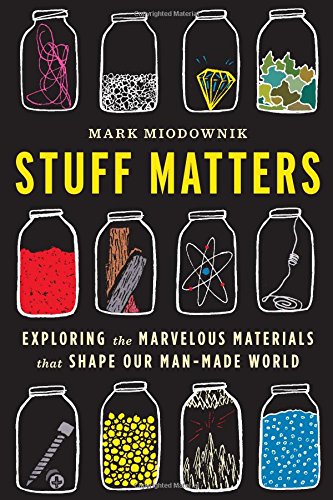
Not too much to say about this. It's a look at some of the more commonplace or interesting materials we encounter on a daily basis - chocolate, paper, glass, etc. that also touches on less-common materials like carbon fibers and aerogels. I read it on the train, and it held my interest, but I wouldn't seek it out or particularly recommend it.
Not too much to say about this. It's a look at some of the more commonplace or interesting materials we encounter on a daily basis - chocolate, paper, glass, etc. that also touches on less-common materials like carbon fibers and aerogels. I read it on the train, and it held my interest, but I wouldn't seek it out or particularly recommend it.
32m.belljackson
And yet...we do seem to be at an even stranger point -
where young Black Men are being shot and killed by police
and other men
who are then only rarely held accountable for the attacks...
... and not for trying to register to vote, just for being Black.
where young Black Men are being shot and killed by police
and other men
who are then only rarely held accountable for the attacks...
... and not for trying to register to vote, just for being Black.
33m.belljackson
Yet, the Good Pope STILL does not address the major Catholic contribution to Climate Change:
the responsibility of his Church in not slowing (education, condoms, and so much more)
the Over Population of our Earth which has been the cause of much of the destruction.
the responsibility of his Church in not slowing (education, condoms, and so much more)
the Over Population of our Earth which has been the cause of much of the destruction.
34drneutron
Nice review of The Dark Forest. I've got it lined up for sometime in the next few months. I really liked 3BP, but like you say, the science was iffy for me in spots. Glad you like the second in spite of this.
35lorax
>32 m.belljackson:
I don't think that's anything new, though. I think white people are more aware of it than we used to be. They've got other ways of keeping minorities from voting these days anyway, between closing polling places in minority precincts and shortening voting hours and stricter ID requirements that just happen to predominantly impact minorities.
>33 m.belljackson:
You appear to have mistaken me for some sort of Catholic apologist, which is truly risible. It's more that I'm pleasantly surprised when I agree with them about anything.
I don't think that's anything new, though. I think white people are more aware of it than we used to be. They've got other ways of keeping minorities from voting these days anyway, between closing polling places in minority precincts and shortening voting hours and stricter ID requirements that just happen to predominantly impact minorities.
>33 m.belljackson:
You appear to have mistaken me for some sort of Catholic apologist, which is truly risible. It's more that I'm pleasantly surprised when I agree with them about anything.
36lorax
Norse Mythology by Neil Gaiman

I really enjoyed this. I'd been wanting to read some Norse mythology for a while now, in conjunction with my Dewey challenge, but hadn't really found anything suitable - I wasn't interested in something for kids, but I didn't feel up to tackling the Eddas head-on. So I was delighted when I heard Gaiman was writing a retelling - I trust his ear for myth, and he did a decent job with Loki in Sandman.
These aren't for young kids; while the language is simple and straightforward, there's a lot of violence and death here, up to and including the end of the world. The choice of simple prose reminds me of the beginning of Heaney's translation of Beowulf, where the Old English "Hwaet", so often translated as an overblown "Hark!" or "Lo!", is instead rendered as "So." They're stories told around the fire, not being declaimed by a great poet. While it's a short book and a quick read, it's probably best to savor it, reading a tale or two a night, which is what I did.
While it left me wanting more, it's important to emphasize that these are retellings, not new stories, and some modern things like character development are lacking; Loki doesn't have a motivation for what he does, he does what he does because he's Loki, and that's his nature. Taken on its own terms, it's a highly readable version of a pantheon less familiar to most of us than the Greek but no less interesting.

I really enjoyed this. I'd been wanting to read some Norse mythology for a while now, in conjunction with my Dewey challenge, but hadn't really found anything suitable - I wasn't interested in something for kids, but I didn't feel up to tackling the Eddas head-on. So I was delighted when I heard Gaiman was writing a retelling - I trust his ear for myth, and he did a decent job with Loki in Sandman.
These aren't for young kids; while the language is simple and straightforward, there's a lot of violence and death here, up to and including the end of the world. The choice of simple prose reminds me of the beginning of Heaney's translation of Beowulf, where the Old English "Hwaet", so often translated as an overblown "Hark!" or "Lo!", is instead rendered as "So." They're stories told around the fire, not being declaimed by a great poet. While it's a short book and a quick read, it's probably best to savor it, reading a tale or two a night, which is what I did.
While it left me wanting more, it's important to emphasize that these are retellings, not new stories, and some modern things like character development are lacking; Loki doesn't have a motivation for what he does, he does what he does because he's Loki, and that's his nature. Taken on its own terms, it's a highly readable version of a pantheon less familiar to most of us than the Greek but no less interesting.
37drneutron
>36 lorax: Once again, nice review. This is another that's on my list - though I may just buy a copy instead of waiting through the long request line at the library. And I'm completely with you on Heaney's translation, very glad Gaiman takes a similar tack on it.
38_Zoe_
>36 lorax: It sounds like I'll have to read that book. I've always vaguely intended to learn more about Norse mythology, but never quite got around to it. So this sounds like something I'd appreciated even though I've never been a huge fan of Gaiman in general.
39m.belljackson
Please read again - not directed toward YOU, post is in response to the Pope's directives.
40bell7
>36 lorax: I'm curious, because we've recently had this discussion at my library. Would you expect to find Norse Mythology in fiction or nonfiction (folklore/mythology)?
41lorax
>40 bell7:
New releases? :-)
I'd put it in mythology, for a couple of reasons. First, that's where OCLC Classify overwhelmingly has it. Second, for someone like _Zoe_ above, or like me, looking for something on Norse mythology, I'd want them to be able to find it - which they will if it's with the rest of the mythology books. A diehard Gaiman fan will find it anyway, and a casual fan just looking for a novel may be disappointed if they pick it up from the fiction section. There's lots of fiction out there, very little in the way of good retellings of Norse myths, and I'd want to make sure people looking for the latter could find this.
New releases? :-)
I'd put it in mythology, for a couple of reasons. First, that's where OCLC Classify overwhelmingly has it. Second, for someone like _Zoe_ above, or like me, looking for something on Norse mythology, I'd want them to be able to find it - which they will if it's with the rest of the mythology books. A diehard Gaiman fan will find it anyway, and a casual fan just looking for a novel may be disappointed if they pick it up from the fiction section. There's lots of fiction out there, very little in the way of good retellings of Norse myths, and I'd want to make sure people looking for the latter could find this.
42lorax
The Republic of Imagination by Azar Nafisi

This follow-up to the bestselling Reading Lolita in Tehran leans much more toward literary criticism and less toward memoir than its predecessor, and what there is of memoir deals with Nafisi's time in the United States, which I found less compelling than her account of revolutionary and pre-revolutionary Iran. The introduction and the title both speak prominently of imagination in literature, with the introduction referencing The Wizard of Oz and 1001 Nights, but the text itself retreats from the notion that imaginative literature can be serious literature, and deals with capitalized Classics of American Literature.
I've read only one of the three novels featured here (Huck Finn); I suspect the reason I found that section most compelling is because of that, though it's also probably just a better book than the others (Babbit and The Heart is a Lonely Hunter). I found the other portions somewhat tedious.
As an aside, I think the cover design for my edition (shown here) is perfect. What you can't tell from this image is that it's not only an open book shaped like a US map, but a book open to one of the most famous passages of American literature (Huck's "All right then, I'll go to hell" moment).

This follow-up to the bestselling Reading Lolita in Tehran leans much more toward literary criticism and less toward memoir than its predecessor, and what there is of memoir deals with Nafisi's time in the United States, which I found less compelling than her account of revolutionary and pre-revolutionary Iran. The introduction and the title both speak prominently of imagination in literature, with the introduction referencing The Wizard of Oz and 1001 Nights, but the text itself retreats from the notion that imaginative literature can be serious literature, and deals with capitalized Classics of American Literature.
I've read only one of the three novels featured here (Huck Finn); I suspect the reason I found that section most compelling is because of that, though it's also probably just a better book than the others (Babbit and The Heart is a Lonely Hunter). I found the other portions somewhat tedious.
As an aside, I think the cover design for my edition (shown here) is perfect. What you can't tell from this image is that it's not only an open book shaped like a US map, but a book open to one of the most famous passages of American literature (Huck's "All right then, I'll go to hell" moment).
43lorax
A Wizard Alone by Diane Duane

Next up in my reread of the series. I'd previously read the original editions; this is the revised "New Millennium" ebook edition.
I'm really, really grateful for the changes Duane made to this one. Previously most of the changes had been to update the technology (only in the forefront in one book, but the total absence of mobile phones and texting, for something not explicitly set in The Past, would make the original versions read very oddly to the modern kids the books are aimed at); in this one, featuring a young autistic wizard as a main character, the changes are much more substantial, having to do with his characterization and plot points, and this is much, much better. (Getting into details would involve spoilers for both versions, which are probably different enough to warrant separation on LT, so I won't, but I'll say that anyone considering the series should seek out the new editions, which I believe are currently only available from the author as ebooks.)

Next up in my reread of the series. I'd previously read the original editions; this is the revised "New Millennium" ebook edition.
I'm really, really grateful for the changes Duane made to this one. Previously most of the changes had been to update the technology (only in the forefront in one book, but the total absence of mobile phones and texting, for something not explicitly set in The Past, would make the original versions read very oddly to the modern kids the books are aimed at); in this one, featuring a young autistic wizard as a main character, the changes are much more substantial, having to do with his characterization and plot points, and this is much, much better. (Getting into details would involve spoilers for both versions, which are probably different enough to warrant separation on LT, so I won't, but I'll say that anyone considering the series should seek out the new editions, which I believe are currently only available from the author as ebooks.)
44lorax
Armada by Ernest Cline

Cline's debut novel, Ready Player One, got a lot of buzz as a 1980s nerd-nostalgia romp, and as a child of the 1980s and a definite nerd I enjoyed it tremendously. Armada got a lot less buzz, which ought to have been a hint that it doesn't live up to Cline's potential as demonstrated in his first book. It starts out like a completely standard riff on "Video game becomes reality"; to his credit, Cline acknowledges how hoary this trope is and in fact helpfully provides the reader, in-story with a list of most of the predecessors. The major omission I can think of, Pratchett's Only You can Save Mankind, is a plausible omission given the background of the character making the list, and including it may have tipped Cline's hand on the ending just a bit.
Cline makes it reasonably obvious from the start that there's more here than just another "video gamer saves the world using his mad skillz" riff, thankfully, but unfortunately there's not enough more there for me to recommend it. (At one point I hopedit was a double fakeout, with the alien invasion being an elaborate hoax to get more players for the game , but that wasn't the case.) Teenage gamers might like this one, but it's skippable for most others.

Cline's debut novel, Ready Player One, got a lot of buzz as a 1980s nerd-nostalgia romp, and as a child of the 1980s and a definite nerd I enjoyed it tremendously. Armada got a lot less buzz, which ought to have been a hint that it doesn't live up to Cline's potential as demonstrated in his first book. It starts out like a completely standard riff on "Video game becomes reality"; to his credit, Cline acknowledges how hoary this trope is and in fact helpfully provides the reader, in-story with a list of most of the predecessors. The major omission I can think of, Pratchett's Only You can Save Mankind, is a plausible omission given the background of the character making the list, and including it may have tipped Cline's hand on the ending just a bit.
Cline makes it reasonably obvious from the start that there's more here than just another "video gamer saves the world using his mad skillz" riff, thankfully, but unfortunately there's not enough more there for me to recommend it. (At one point I hoped
45drneutron
>44 lorax: I just finished part 1, so just got through the part where he's picked up by the EDF ship . I've seen a few small hints that this may be more than a rehash, though. Still, I agree, even from the start it seemed like he missed the mark on this one.
46bell7
>41 lorax: ha, yes, fortunately it's in new releases for now and probably not too hard to find either way we classify it. Added to the challenge is that our population is not huge on either mythology (outside of the Percy Jackson series) or Neil Gaiman (fantasy in general). But I may very well change it back; that does seem to be where the majority of libraries are shelving it.
47LibraryPerilous
Godmother Night sounds interesting, and I've read a few rave reviews of The Invisible Library.
48lorax
Plato and a Platypus Walk into a Bar by Thomas Cathcart

(Crossposted from my Dewey thread)
I don't really have much to say about this; the conceit is amusing, but the jokes are mostly ones you've heard before and only slightly related to the philosophical concepts they're supposed to illuminate (at least from the point of view of someone with a 101-at-best understanding of the field, which is squarely where this book is aimed, as a 101-level intro or refresher.) It's a quick read, at least.

(Crossposted from my Dewey thread)
I don't really have much to say about this; the conceit is amusing, but the jokes are mostly ones you've heard before and only slightly related to the philosophical concepts they're supposed to illuminate (at least from the point of view of someone with a 101-at-best understanding of the field, which is squarely where this book is aimed, as a 101-level intro or refresher.) It's a quick read, at least.
49lorax
The Last Continent by Terry Pratchett

An impulse reread; my bedtime read was a slow-going nonfiction work, and I was fighting a cold, so I picked up something fluffy. Pratchett's not universally fluffy, of course, he was tremendously smart and thoughtful, but this is a Rincewind book and they were fluff. This is the "Rincewind goes to Australia" one.
(As an aside, has anyone else in the US noticed "no worries" showing up here a lot more in the last decade? When I visited Australia a bit more than ten years ago I hadn't really encountered the phrase here, and now it seems fairly common.)

An impulse reread; my bedtime read was a slow-going nonfiction work, and I was fighting a cold, so I picked up something fluffy. Pratchett's not universally fluffy, of course, he was tremendously smart and thoughtful, but this is a Rincewind book and they were fluff. This is the "Rincewind goes to Australia" one.
(As an aside, has anyone else in the US noticed "no worries" showing up here a lot more in the last decade? When I visited Australia a bit more than ten years ago I hadn't really encountered the phrase here, and now it seems fairly common.)
50drneutron
>49 lorax: I've found myself using it more and more over the last few years. I blame the son - he got me started on it. :)
51alcottacre
>23 lorax: I enjoyed that one too and am really looking forward to reading the next book in the series.
53lorax
The Great Animal Orchestra by Bernie Krause
(Crossposted from my Dewey thread)

I really enjoyed this one. Krause is a musician-turned ecologist, focusing on recordings of "soundscapes", the entire auditory picture of a portion of the natural world. Prior investigations had focused exclusively on specific sounds of individual animals; this is a lion, this is a warbler, this is a humpback whale. (Birdsong recordings in particular are almost obsessive about singling out the target animal to the exclusion of all context. Krause focuses on the big picture, how the sounds of different species fit together with each species (or, in some cases, each individual) finding a unclaimed part of time- and frequency-space in order to be heard. He speculates a bit about how this interposition of different sounds influenced the development of human music, which is interesting, but the real joy of this book is the recordings on his website, noted at relevant points by musical notes in the text. (Minor quibble: I'd much have preferred the indicator to come before the text, rather than after, so I could be listening as I read, rather than "Read, stop to listen to a 2-minute recording, resume reading".) Krause points that his library of soundscape recordings spanning decades can demonstrate the change in species number and abundance more so than images can, and gives an example of a logged forest where a thin strip of uncut trees were left close to roads and trails; the forest looked unchanged, but was virtually silent after logging compared to the rich combination of sounds beforehand. Recommended.
(Crossposted from my Dewey thread)

I really enjoyed this one. Krause is a musician-turned ecologist, focusing on recordings of "soundscapes", the entire auditory picture of a portion of the natural world. Prior investigations had focused exclusively on specific sounds of individual animals; this is a lion, this is a warbler, this is a humpback whale. (Birdsong recordings in particular are almost obsessive about singling out the target animal to the exclusion of all context. Krause focuses on the big picture, how the sounds of different species fit together with each species (or, in some cases, each individual) finding a unclaimed part of time- and frequency-space in order to be heard. He speculates a bit about how this interposition of different sounds influenced the development of human music, which is interesting, but the real joy of this book is the recordings on his website, noted at relevant points by musical notes in the text. (Minor quibble: I'd much have preferred the indicator to come before the text, rather than after, so I could be listening as I read, rather than "Read, stop to listen to a 2-minute recording, resume reading".) Krause points that his library of soundscape recordings spanning decades can demonstrate the change in species number and abundance more so than images can, and gives an example of a logged forest where a thin strip of uncut trees were left close to roads and trails; the forest looked unchanged, but was virtually silent after logging compared to the rich combination of sounds beforehand. Recommended.
54lorax
Taco USA by Gustavo Arellano

This was a lot of fun. It's a look at how Mexican food became ubiquitous in the US, including purely American regional cuisines like Tex-Mex that are not found in Mexico itself; we get a look at the early development of Tex-Mex and the spread of the "combo plate", tamale stands both many years ago and now, the fetishization of authenticity, the rise of chains like Taco Bell and Chipotle, and much more. I lived in Tucson, Arizona for eight years, where "Mexican food" was just "food" and where "No solicitation except tamale lady" signs have been sighted, where the Tamale Lady who for years sold outside my favorite used bookstore has a 4.5 star average Yelp rating, and origin of the "Sonoran hot dog" that gets mentioned (and the chimichanga which doesn't). You won't find much about Mexican food in Mexico here, little of the glories of a good mole negro or cochinita pibil, but it's a really fun read. I love a good mole negro or cochinita pibil as much as the next gal; I ordered chilhuacles negros, important for making a truly authentic mole negro, from the only source that sells them in the USA (they're hard to find even in Mexico outside Oaxaca), cochinita pibil - Yucatecan roast pork - is my go-to for parties for its depth of flavor without chile heat, and I've had grasshopper tacos. But Tex-Mex (and Sonoran food, which gets much less attention perhaps because unlike Tex-Mex it hasn't spread nationally) its its own regional cuisine, not a bastardization of something else, and there's no shame in a gooey cheese enchilada.
Late in the book Arellano talks about Kogi, the first Korean BBQ taco truck (they're ubiquitous now anywhere food trucks are found). When it was new, tourists from Seoul scorned it as 'not authentic Korean food.' The chef replied that it wasn't supposed to be, it was authentic Koreatown food, from a place where a given strip mall might have signs in four or five languages possibly even including English. Is it Mexican? No, but it's clearly the product of a country and a city that has deeply embraced Mexican food.

This was a lot of fun. It's a look at how Mexican food became ubiquitous in the US, including purely American regional cuisines like Tex-Mex that are not found in Mexico itself; we get a look at the early development of Tex-Mex and the spread of the "combo plate", tamale stands both many years ago and now, the fetishization of authenticity, the rise of chains like Taco Bell and Chipotle, and much more. I lived in Tucson, Arizona for eight years, where "Mexican food" was just "food" and where "No solicitation except tamale lady" signs have been sighted, where the Tamale Lady who for years sold outside my favorite used bookstore has a 4.5 star average Yelp rating, and origin of the "Sonoran hot dog" that gets mentioned (and the chimichanga which doesn't). You won't find much about Mexican food in Mexico here, little of the glories of a good mole negro or cochinita pibil, but it's a really fun read. I love a good mole negro or cochinita pibil as much as the next gal; I ordered chilhuacles negros, important for making a truly authentic mole negro, from the only source that sells them in the USA (they're hard to find even in Mexico outside Oaxaca), cochinita pibil - Yucatecan roast pork - is my go-to for parties for its depth of flavor without chile heat, and I've had grasshopper tacos. But Tex-Mex (and Sonoran food, which gets much less attention perhaps because unlike Tex-Mex it hasn't spread nationally) its its own regional cuisine, not a bastardization of something else, and there's no shame in a gooey cheese enchilada.
Late in the book Arellano talks about Kogi, the first Korean BBQ taco truck (they're ubiquitous now anywhere food trucks are found). When it was new, tourists from Seoul scorned it as 'not authentic Korean food.' The chef replied that it wasn't supposed to be, it was authentic Koreatown food, from a place where a given strip mall might have signs in four or five languages possibly even including English. Is it Mexican? No, but it's clearly the product of a country and a city that has deeply embraced Mexican food.
55thornton37814
>54 lorax: Sounds like an interesting book. I'm not adding it at the moment, but if I run across it in the library or at a bargain in the used bookstore, I might pick it up.
56norabelle414
>54 lorax: I'm hungry just reading your review
57drneutron
>56 norabelle414: Yeah, that's what I was thinking. :)
58lorax
I got hungry writing it, too! I'm really grateful that just in the past few years we've been getting more good tacos in the Washington, DC area - it used to be we had to drive all the way out to Hyattsville or up to a tiny taqueria by BWI to get good tacos, now there are several good ones in the city itself. My four-year-old loves the goat barbacoa at one of the local places, and almost lost it one time when they were sold out and he had to settle for the al pastor (which is my favorite, with the goat a close second). We've gone from "make their own tortillas" being a rare find worth driving across town for to the baseline expectation for anyplace decent.
59norabelle414
A District Taco just opened next door to my work. While they're not my favorite, they're very reliable and certainly the best food in my office park. So my taco consumption has risen quite sharply.
60drneutron
>58 lorax: I might know that place by BWI. Also, there was a place in Jessup across from the prison, guy started a taco stand in a Shell station. Really good tacos, one of my favorite places. Got featured on Diners, Drive-ins, and Dives, pace got mobbed, he closed down and opened a new place in Baltimore far off my beaten path. :(
61lorax
>60 drneutron:
R&R Taqueria? They apparently moved across the parking lot, out of the Shell station, to someplace with actual tables. Haven't been for awhile since the District started getting decent tacos, but my wife stopped on her way back from Baltimore a week or two ago.
R&R Taqueria? They apparently moved across the parking lot, out of the Shell station, to someplace with actual tables. Haven't been for awhile since the District started getting decent tacos, but my wife stopped on her way back from Baltimore a week or two ago.
62lorax
Persian Fire by Tom Holland
I actually finished this one a week and a half ago, posted to my Dewey thread, and completely forgot to crosspost here. Oops!

Another that I wouldn't have picked up without the Dewey challenge to prod me, and while it was slow going in places I'm glad I did. Holland gives a close and thorough account of the Greco-Persian wars, starting with brief histories of both sides of the conflict and eventually narrowing to a detailed account of key battles. I would have appreciated a reference in the back with key names, though; it was a bit difficult for me to keep all the key players straight at times.
I actually finished this one a week and a half ago, posted to my Dewey thread, and completely forgot to crosspost here. Oops!

Another that I wouldn't have picked up without the Dewey challenge to prod me, and while it was slow going in places I'm glad I did. Holland gives a close and thorough account of the Greco-Persian wars, starting with brief histories of both sides of the conflict and eventually narrowing to a detailed account of key battles. I would have appreciated a reference in the back with key names, though; it was a bit difficult for me to keep all the key players straight at times.
63lorax
Binti: Home by Nnedi Okorafor

Sequel to Binti, this ends on a bit of a cliff-hanger that caught me by surprise since I was keeping an eye on the remaining pages (I read this as an ebook) and didn't realize there were seven pages of non-story material at the end. This story of Binti's return home to Earth and her family from Oomza University is far more nuanced than many "return to an isolated and traditional culture from far away" stories, and Binti clearly feels the pull of her family and tradition as well as its limitations. I'm counting this even though it's a novella, since it's published as a standalone in both paper and electronic forms, and a hundred pages isn't that much shorter than plenty of actual no-question books that I have.

Sequel to Binti, this ends on a bit of a cliff-hanger that caught me by surprise since I was keeping an eye on the remaining pages (I read this as an ebook) and didn't realize there were seven pages of non-story material at the end. This story of Binti's return home to Earth and her family from Oomza University is far more nuanced than many "return to an isolated and traditional culture from far away" stories, and Binti clearly feels the pull of her family and tradition as well as its limitations. I'm counting this even though it's a novella, since it's published as a standalone in both paper and electronic forms, and a hundred pages isn't that much shorter than plenty of actual no-question books that I have.
64lorax
Barking by Tom Holt

I needed some fluff. This provided it. Not one of Holt's better efforts, to my mind. Werewolf and vampire lawyers, with Holt's usual hapless, unlucky British schlub of a protagonist.

I needed some fluff. This provided it. Not one of Holt's better efforts, to my mind. Werewolf and vampire lawyers, with Holt's usual hapless, unlucky British schlub of a protagonist.
65drneutron
>61 lorax: Yep, that's it! I didn't realize he moved so close - will have to hunt for it. :)
>62 lorax: Onto my list with that one.
>62 lorax: Onto my list with that one.
66lorax
Oh dear. I thought I'd posted here, but I'd just updated the top post and not actually said anything about the books! So very, very behind. At any rate, next on the list is
Acceptance by Jeff Vandermeer

This was a disappointment for me - I only found two of the four POV interesting (one of the non-interesting ones was the guy from Authority I mention wanting to smack), and it ended up being weirdness for its own sake in a way that I don't have a lot of interest in anymore. The first book in the series was still very strong - it was all weird together, and the characters were compelling - but neither of the latter two lived up to it.
Acceptance by Jeff Vandermeer

This was a disappointment for me - I only found two of the four POV interesting (one of the non-interesting ones was the guy from Authority I mention wanting to smack), and it ended up being weirdness for its own sake in a way that I don't have a lot of interest in anymore. The first book in the series was still very strong - it was all weird together, and the characters were compelling - but neither of the latter two lived up to it.

68lorax
The Soul of an Octopus by Sy Montgomery

I have a soft spot for cephalopods, and octopuses are definitely no exception. They're the closest thing to intelligent aliens we're ever likely to encounter, after all, and they're the only animals that are commonly eaten in the US that I won't eat because of their intelligence. (Primates, cetaceans, and corvids don't often appear on menus in this country, after all.) I picked this book up expecting a natural history of octopuses; there's some of that, but most of it is devoted to the author's interactions with several captive octopuses at the New England aquarium, each of which she got to know (and vice versa - it's very clear that the animals could recognize individual people, and with their exquisitely sensitive chemical senses could even tell when someone was on medication.) If you're familiar with your cephalopod basics (color-changing as communication and concealment, tool use (multiple wild octopuses have been seen carrying empty coconut shell halves around to use as portable shelter), and so on, there's not a lot more octopus biology here, but the careful studies of individuals is definitely worthwhile. The short lifespans and aquatic nature of the species means we'll never truly have a Jane Goodall of octopuses, living with them and truly understanding them on their own terms (they're not social animals, either) so careful study of captive individuals may be the best we can do.

I have a soft spot for cephalopods, and octopuses are definitely no exception. They're the closest thing to intelligent aliens we're ever likely to encounter, after all, and they're the only animals that are commonly eaten in the US that I won't eat because of their intelligence. (Primates, cetaceans, and corvids don't often appear on menus in this country, after all.) I picked this book up expecting a natural history of octopuses; there's some of that, but most of it is devoted to the author's interactions with several captive octopuses at the New England aquarium, each of which she got to know (and vice versa - it's very clear that the animals could recognize individual people, and with their exquisitely sensitive chemical senses could even tell when someone was on medication.) If you're familiar with your cephalopod basics (color-changing as communication and concealment, tool use (multiple wild octopuses have been seen carrying empty coconut shell halves around to use as portable shelter), and so on, there's not a lot more octopus biology here, but the careful studies of individuals is definitely worthwhile. The short lifespans and aquatic nature of the species means we'll never truly have a Jane Goodall of octopuses, living with them and truly understanding them on their own terms (they're not social animals, either) so careful study of captive individuals may be the best we can do.
69lorax
Fun Home by Alison Bechdel

I've been a Bechdel fan since way back, enough so that I was annoyed when she started slowing work on Dykes to Watch Out For to work on Fun Home, her outstanding memoir about her father and growing up and coming out and family secrets. (Which I did not know at the time was anything but a "memoir".) My wife and I went to see her give a reading at the library in Tucson, where we ilved at the time - it was the first stop on her tour, and she was incredibly nervous. Then and now, I was absolutely blown away; the language, the art, the complexity of what she chooses to tell about her life and how she tells it, the almost OCD attention to detail (Bechdel did, after all, originate the question "Does anal-retentive have a hyphen?") - on one page, she shows her father's bird book, and you can immediately tell that yes, it's an old edition of Roger Tory Peterson, and I am utterly certain that if I tracked down that edition (she probably tracked down his actual copy) everything down to the page number is correct.
Last weekend my wife and I had tickets to go see the touring production of the Fun Home musical here in DC, which prompted this reread. It's just as good as I remember.

I've been a Bechdel fan since way back, enough so that I was annoyed when she started slowing work on Dykes to Watch Out For to work on Fun Home, her outstanding memoir about her father and growing up and coming out and family secrets. (Which I did not know at the time was anything but a "memoir".) My wife and I went to see her give a reading at the library in Tucson, where we ilved at the time - it was the first stop on her tour, and she was incredibly nervous. Then and now, I was absolutely blown away; the language, the art, the complexity of what she chooses to tell about her life and how she tells it, the almost OCD attention to detail (Bechdel did, after all, originate the question "Does anal-retentive have a hyphen?") - on one page, she shows her father's bird book, and you can immediately tell that yes, it's an old edition of Roger Tory Peterson, and I am utterly certain that if I tracked down that edition (she probably tracked down his actual copy) everything down to the page number is correct.
Last weekend my wife and I had tickets to go see the touring production of the Fun Home musical here in DC, which prompted this reread. It's just as good as I remember.
70PaulCranswick
Wishing you a splendid weekend
71lorax
Catching up, here's what I've read since the beginning of May:
Too Like the Lightning by Ada Palmer (reread)
Wizard's Holiday by Diane Duane (reread)
How to Talk so Little Kids will Listen by Joanna Faber
Wizards at War by Diane Duane (reread)
Hair Story by Ayana Byrd
Seven Surrenders by Ada Palmer
The Eighth Continent by Peter Tyson
Coyote America by Dan Flores
The Truth by Terry Pratchett (reread)
All the President's Men by Bob Woodward (reread)
Homegoing by Yaa Gyasi
The Good, the Bad, and the Smug by Tom Holt
Since the only way I was going to get back to this thread was just to post everything in a lump and move on, I'm not going to talk about everything, but I'm happy to talk about a particular title if anyone is interested.
Too Like the Lightning by Ada Palmer (reread)
Wizard's Holiday by Diane Duane (reread)
How to Talk so Little Kids will Listen by Joanna Faber
Wizards at War by Diane Duane (reread)
Hair Story by Ayana Byrd
Seven Surrenders by Ada Palmer
The Eighth Continent by Peter Tyson
Coyote America by Dan Flores
The Truth by Terry Pratchett (reread)
All the President's Men by Bob Woodward (reread)
Homegoing by Yaa Gyasi
The Good, the Bad, and the Smug by Tom Holt
Since the only way I was going to get back to this thread was just to post everything in a lump and move on, I'm not going to talk about everything, but I'm happy to talk about a particular title if anyone is interested.
72lorax
Back to actually updating when I read something, at least for the moment:
Escape from North Korea by Melanie Kirkpatrick

I've read and been fascinated by a few North Korea books - Guy de Lisle's Pyongyang, Blaine Harden's Escape from Camp 14, and the outstanding Nothing to Envy by Barbara Demick (my review of that one), so I picked this one up, but was disappointed. It's mostly interviews with and profiles of Western and South Korean people active in assisting North Koreans in leaving China (they're mostly on their own for actually getting out of North Korea; it's primarily a matter of bribing the border guards), and those parts are less interesting than the actual experience of the North Koreans. I realize that going into too much detail could endanger everyone involved, but I do think it could have been better done than this.
Most irritating, though, was Kirkpatrick's obvious and unquestioning religious viewpoint; it may be the case that people most involved in helping North Korean refugees are Christian (because South Korea, and Korean-Americans, are largely Christian), but she unquestioningly parrots their line that this is due to Christianity, and even repeats the laughable notion that Christianity is inherently associated with freedom (tell that to any gay person in the US!) The extent of her bias on that front made me question the reliability of what she did say on the issue; are there secular organizations she chose not to profile because they didn't fit her profile?
I suspect that the positive reviews out there (on Other Sites, reviews here on LT are basically nonexistent) are primarily from people who hadn't read any other books on North Korea. Read Nothing to Envy instead.
Escape from North Korea by Melanie Kirkpatrick

I've read and been fascinated by a few North Korea books - Guy de Lisle's Pyongyang, Blaine Harden's Escape from Camp 14, and the outstanding Nothing to Envy by Barbara Demick (my review of that one), so I picked this one up, but was disappointed. It's mostly interviews with and profiles of Western and South Korean people active in assisting North Koreans in leaving China (they're mostly on their own for actually getting out of North Korea; it's primarily a matter of bribing the border guards), and those parts are less interesting than the actual experience of the North Koreans. I realize that going into too much detail could endanger everyone involved, but I do think it could have been better done than this.
Most irritating, though, was Kirkpatrick's obvious and unquestioning religious viewpoint; it may be the case that people most involved in helping North Korean refugees are Christian (because South Korea, and Korean-Americans, are largely Christian), but she unquestioningly parrots their line that this is due to Christianity, and even repeats the laughable notion that Christianity is inherently associated with freedom (tell that to any gay person in the US!) The extent of her bias on that front made me question the reliability of what she did say on the issue; are there secular organizations she chose not to profile because they didn't fit her profile?
I suspect that the positive reviews out there (on Other Sites, reviews here on LT are basically nonexistent) are primarily from people who hadn't read any other books on North Korea. Read Nothing to Envy instead.
73_Zoe_
>72 lorax: I'm sorry that one was so disappointing. It would have been nice to hear about another worthwhile North Korea book.

