This topic is currently marked as "dormant"—the last message is more than 90 days old. You can revive it by posting a reply.
1CassieBash
It seems silly for me to continue holding on to the summer thread found here, when I've emptied and cleaned almost all of my caterpillar tanks, started bringing in the garden decor, and done other winter-prep things around the house and yard. *Sigh.* It was such an overall pleasant summer, I hate to see it go. Still, it's part of the cycle here in northwest Indiana. Winter must come so that our plant pals have time to rest properly so that they can come back stronger next year.
So I'll be posting less on gardens and more on fall/winter events (like the annual Christmas tree hunt at the tree farm, with mom, my sisters, and our collie Serenity), the various wildlife that shows up around the yard, fields, pastures, etc., and of course if we get a decent packing snow--snow sculpted creatures. And, of course, I'll continue with the Critter of the Week, finishing up our Halloween critters. So stay tuned as we prep for the snowfall (which I've heard may be higher than average this year...but I hear that every year up here).
So I'll be posting less on gardens and more on fall/winter events (like the annual Christmas tree hunt at the tree farm, with mom, my sisters, and our collie Serenity), the various wildlife that shows up around the yard, fields, pastures, etc., and of course if we get a decent packing snow--snow sculpted creatures. And, of course, I'll continue with the Critter of the Week, finishing up our Halloween critters. So stay tuned as we prep for the snowfall (which I've heard may be higher than average this year...but I hear that every year up here).
2fuzzi
Found and starred your new thread!
We're two or three weeks away from our first frost, weather has been lovely (70s during the day), and I'm still seeing butterflies. Just a few minutes ago I saw my second Monarch for the season.
We're two or three weeks away from our first frost, weather has been lovely (70s during the day), and I'm still seeing butterflies. Just a few minutes ago I saw my second Monarch for the season.
3CassieBash
>2 fuzzi: You know, I was still seeing monarchs last week in central Indiana. Not so much up here, which is good. They should, for the most part, be in Mexico in a week and a half or two.
Critter of the Week: So, let's see...I've done spiders, owls, and wolves. What other Halloween critter can there be? Ah, but of course! No Halloween is complete without a bat! Though few people differentiate between species of bats this time of year, I'm going to focus this week on none other than the common vampire bat, Desmodus rotundus. There are actually two other species of vampire bats, the hairy-legged and the white-winged, but interestingly enough, they have their own genus and are not Desmodus (they are Diphylla and Diaemus, respectively). Each of these species are the only ones in their genus and all three are a subfamily of the New World leaf-nosed bat family. All vampire bat species are from Central and/or South America, with a vampire bat ranging into the US is extremely rare, even along the border. And while many nowadays are aware that bats overall aren't rabid, disease-infested, blood-sucking creatures just waiting to attack people, the vampire bat hasn't shaken this reputation, despite the fact that the common vampire bat doesn't tend to attack humans, preferring larger animals like cattle. Can and will they feed on humans? Yes, if the situation presents itself--but this usually means that the person is sleeping outside, perhaps around the livestock the bats naturally prefer. Even in their native territories, vampire bat bites on humans are rare, and the biggest concern if someone is bitten is rabies--not because the disease is necessarily rampant in vampire bats, but because of the limited access to the vaccine in economically poor areas of its range. And while in the movies, vampire bat bites look huge and bloody, the bat's bite is really very tiny--though due to the anticoagulant chemicals in the bat's saliva, the tiny wound can bleed quite a bit. And the bats don't suck the tablespoon of blood they drink from a victim; they lap it like a cat or dog. This species of bat, aside from the typical echolocation of most bats, has an extra sensor that allows it to be efficient in choosing a spot on its victim; it has a thermometer on its nose, that helps it find areas where the blood flows close to the surface of the skin, much in the way snakes can detect heat with their thermoreceptors on their tongues. Interestingly, unlike insect, fruit, and pollen feeding bats, who feed throughout the night or from dusk through dawn, the vampire bats hunt only when it is truly night and then, after filling themselves in a couple of hours, return to their roost to digest their meal.
Like many bats, the common vampire bat roosts in social groups--mainly the females and their offspring, with perhaps a few permanent males in residence, or in large groups of unattached males, which may be allowed to join the female groups if the temperature drops. Like other bats, vampire bats group together for warmth as well as for social interaction, and the more, the merrier when the temperature dips enough. And don't think that these guys don't have a softer side--they have close bonds within the colony; no bat is guaranteed to find food, and scientists have observed that hungry, even starving bats may be approached by full, well-fed bats and given a "donation" of blood through regurgitation. (Don't be too grossed out; it's not any different really from mother birds feeding their babies.)
And like most things people find gross in nature, it has its positive, beneficial side to humans. Scientists have been working with that anticoagulant saliva to create drugs that can help stroke patients.
Like the spider, I realize many people don't like bats, either. So I'll use my typical filler to create a buffer. For those of you worried that you'll see blood, never fear! I've found a picture of a roosting bat that doesn't show it feeding.
This is filler.
This is filler.
This is filler.
This is filler.
This is filler.
This is filler.
This is filler.
This is filler.
This is filler.
This is filler.
This is filler.
This is filler.
This is filler.
This is filler.
This is filler.
Desmodus rotundus, Picture taken at Sangayan Island, Paracas National Reserve, Departamento Ica, Peru, in March 2005.

Critter of the Week: So, let's see...I've done spiders, owls, and wolves. What other Halloween critter can there be? Ah, but of course! No Halloween is complete without a bat! Though few people differentiate between species of bats this time of year, I'm going to focus this week on none other than the common vampire bat, Desmodus rotundus. There are actually two other species of vampire bats, the hairy-legged and the white-winged, but interestingly enough, they have their own genus and are not Desmodus (they are Diphylla and Diaemus, respectively). Each of these species are the only ones in their genus and all three are a subfamily of the New World leaf-nosed bat family. All vampire bat species are from Central and/or South America, with a vampire bat ranging into the US is extremely rare, even along the border. And while many nowadays are aware that bats overall aren't rabid, disease-infested, blood-sucking creatures just waiting to attack people, the vampire bat hasn't shaken this reputation, despite the fact that the common vampire bat doesn't tend to attack humans, preferring larger animals like cattle. Can and will they feed on humans? Yes, if the situation presents itself--but this usually means that the person is sleeping outside, perhaps around the livestock the bats naturally prefer. Even in their native territories, vampire bat bites on humans are rare, and the biggest concern if someone is bitten is rabies--not because the disease is necessarily rampant in vampire bats, but because of the limited access to the vaccine in economically poor areas of its range. And while in the movies, vampire bat bites look huge and bloody, the bat's bite is really very tiny--though due to the anticoagulant chemicals in the bat's saliva, the tiny wound can bleed quite a bit. And the bats don't suck the tablespoon of blood they drink from a victim; they lap it like a cat or dog. This species of bat, aside from the typical echolocation of most bats, has an extra sensor that allows it to be efficient in choosing a spot on its victim; it has a thermometer on its nose, that helps it find areas where the blood flows close to the surface of the skin, much in the way snakes can detect heat with their thermoreceptors on their tongues. Interestingly, unlike insect, fruit, and pollen feeding bats, who feed throughout the night or from dusk through dawn, the vampire bats hunt only when it is truly night and then, after filling themselves in a couple of hours, return to their roost to digest their meal.
Like many bats, the common vampire bat roosts in social groups--mainly the females and their offspring, with perhaps a few permanent males in residence, or in large groups of unattached males, which may be allowed to join the female groups if the temperature drops. Like other bats, vampire bats group together for warmth as well as for social interaction, and the more, the merrier when the temperature dips enough. And don't think that these guys don't have a softer side--they have close bonds within the colony; no bat is guaranteed to find food, and scientists have observed that hungry, even starving bats may be approached by full, well-fed bats and given a "donation" of blood through regurgitation. (Don't be too grossed out; it's not any different really from mother birds feeding their babies.)
And like most things people find gross in nature, it has its positive, beneficial side to humans. Scientists have been working with that anticoagulant saliva to create drugs that can help stroke patients.
Like the spider, I realize many people don't like bats, either. So I'll use my typical filler to create a buffer. For those of you worried that you'll see blood, never fear! I've found a picture of a roosting bat that doesn't show it feeding.
This is filler.
This is filler.
This is filler.
This is filler.
This is filler.
This is filler.
This is filler.
This is filler.
This is filler.
This is filler.
This is filler.
This is filler.
This is filler.
This is filler.
This is filler.
Desmodus rotundus, Picture taken at Sangayan Island, Paracas National Reserve, Departamento Ica, Peru, in March 2005.

4fuzzi
I think he's cute, for a bat.
We do get some bats here during the summer, but I don't see them as frequently as the Chimney swifts, which feast on mosquitoes at dusk, yippee!
We do get some bats here during the summer, but I don't see them as frequently as the Chimney swifts, which feast on mosquitoes at dusk, yippee!
5CassieBash
>4 fuzzi: Yeah, I do, too, but a lot of people think I have a tendency to extend the "cute" category a bit too far. Opossums usually fall in that category for me, but a lot of people I know just shudder and say they look like big rats which, by the way, also fall into my "cute" category. Most animals do. Exceptions tend to be ticks, fleas, and mosquitoes. There are others, but those are the big three in this area. Most other creatures are OK in my book.
Gotta love those insectivores! We don't have swifts, but we do have our barn swallows. Since our barn's renovation, the barn swallow nests are less noticeable--better hidden--but I have some 35 mm shots from several years ago of their babies' faces peering over the mud nests they build.
You really can tell why he's a member of the leaf-nosed bat family from that photo.
Gotta love those insectivores! We don't have swifts, but we do have our barn swallows. Since our barn's renovation, the barn swallow nests are less noticeable--better hidden--but I have some 35 mm shots from several years ago of their babies' faces peering over the mud nests they build.
You really can tell why he's a member of the leaf-nosed bat family from that photo.
6CassieBash
Critter of the Week:
This one may shock you; after all, this is the week of Halloween, and certainly I've saved the scariest of all for this week--right? But this is also a very important week for our southern neighbors who celebrate Dia de los Muertos--Day of the Dead--and for Lepidoptera lovers. Because this is the week that, according to tradition, the monarchs return to Mexico for their winter hibernation. So this week's critter is the monarch butterfly!

For people in Mexico, the arrival of the butterflies coincide with their harvests and their celebration of Day of the Dead, during which people believe that the souls of their departed loved ones return to them. Before Christianity came to Mexico, the Aztecs believed that butterflies (and hummingbirds) were the spirits of the dead, and this belief was carried over when missionaries brought Christianity. Therefore, the coincidental return of the monarch butterflies with the festival Dia de los Muertos have become deeply embedded in the Mexican beliefs.
This year, however, may not work out quite according to tradition. Apparently, our warmer-than-average fall temperatures have delayed monarchs in their migration, and no one is sure whether they will make it in time for Dia de los Muertos.
While the monarch population numbers aren't fully calculated yet, one estimate in July suggests that the numbers will be up, and up a significant way. Of course, this was in late July and much can happen between July and November--and there is still the winter and spring threats for them to survive. But with the projected increase, I'm hopeful that next year's numbers will start out strong. Hopefully, we have another good spring, summer and fall next year as well.
This one may shock you; after all, this is the week of Halloween, and certainly I've saved the scariest of all for this week--right? But this is also a very important week for our southern neighbors who celebrate Dia de los Muertos--Day of the Dead--and for Lepidoptera lovers. Because this is the week that, according to tradition, the monarchs return to Mexico for their winter hibernation. So this week's critter is the monarch butterfly!

For people in Mexico, the arrival of the butterflies coincide with their harvests and their celebration of Day of the Dead, during which people believe that the souls of their departed loved ones return to them. Before Christianity came to Mexico, the Aztecs believed that butterflies (and hummingbirds) were the spirits of the dead, and this belief was carried over when missionaries brought Christianity. Therefore, the coincidental return of the monarch butterflies with the festival Dia de los Muertos have become deeply embedded in the Mexican beliefs.
This year, however, may not work out quite according to tradition. Apparently, our warmer-than-average fall temperatures have delayed monarchs in their migration, and no one is sure whether they will make it in time for Dia de los Muertos.
While the monarch population numbers aren't fully calculated yet, one estimate in July suggests that the numbers will be up, and up a significant way. Of course, this was in late July and much can happen between July and November--and there is still the winter and spring threats for them to survive. But with the projected increase, I'm hopeful that next year's numbers will start out strong. Hopefully, we have another good spring, summer and fall next year as well.
7fuzzi
>6 CassieBash: interesting, thanks. My Monarch has moved on, I think, as I've not seen it in several days.
I wonder if all the hurricanes this year may have had something to do with delaying the Monarchs' return, too.
I wonder if all the hurricanes this year may have had something to do with delaying the Monarchs' return, too.
8CassieBash
>7 fuzzi: Possible. We know so little about why they migrate and what triggers the migration, though there is a theory about bird predation of caterpillars in the tropics v. the more temperate regions that might explain the why. But I do know that we had an incredibly mild October until the last week or so. September was beautiful. So it could just be that the monarchs were still finding enough food. Heck, we've had temps overnight in the 30s and I still have verbena, pentas, and heliotrope blooming in my garden, plus a few morning glories--mostly the purple ones.
**WARNING: FEMININE MEDICAL ISSUES**
Had more feminine tests yesterday; still having the same ongoing issue. I think that this Friday, when they go over the results of the scans, will be when we talk over options. I'm not so bothered by the periods themselves--they're lighter, with less cramping and on the whole shorter than they were before the surgery--as much as by what they might mean, a sort of canary in the coal mine. If the endometrial lining inside the uterus is coming back, what does that mean regarding any possible lining outside of it? (For those new to my threads, I was diagnosed with endometriosis during a surgery in January, had both ovaries and tubes removes, and should be in menopause and not having anymore periods. As of July, I've been cycling regularly.) At one point, the NP mentioned a pill that would keep the endometrial lining from re-growing, as well as ablation, and I'm open to both options but leaning more toward the pill, as ablation would only solve the problem inside the uterus and wouldn't get rid of the underlying problem of whatever is triggering its regrowth--and the possible regrowth of the lining outside the uterus, which concerns me far more. After all, I've lived with periods since the 6th grade and these are so much more (relatively) pleasant than what I used to get, so while they're an annoyance, I'd rather do something that would control the possible regrowth of the endometriosis. I hate to go on medication again, only because I believe that if you can get by without it, you're better off, but obviously something's off still and my guess is hormonal. I'm suspicious that a small fragment of one or both ovaries is still in there and producing just enough estrogen to trigger a cycle, albeit lighter, maybe perimenopausal, ones. But no fragment has, as of yet, shown up on a scan so it's possible that it's so small it's easily overlooked (I've read that even slivers can produce enough estrogen to trigger cycles), so I'm guessing that neither the doctor nor I would want him to go in again and try to find it. We'll see what they say on Friday.
**WARNING: FEMININE MEDICAL ISSUES**
Had more feminine tests yesterday; still having the same ongoing issue. I think that this Friday, when they go over the results of the scans, will be when we talk over options. I'm not so bothered by the periods themselves--they're lighter, with less cramping and on the whole shorter than they were before the surgery--as much as by what they might mean, a sort of canary in the coal mine. If the endometrial lining inside the uterus is coming back, what does that mean regarding any possible lining outside of it? (For those new to my threads, I was diagnosed with endometriosis during a surgery in January, had both ovaries and tubes removes, and should be in menopause and not having anymore periods. As of July, I've been cycling regularly.) At one point, the NP mentioned a pill that would keep the endometrial lining from re-growing, as well as ablation, and I'm open to both options but leaning more toward the pill, as ablation would only solve the problem inside the uterus and wouldn't get rid of the underlying problem of whatever is triggering its regrowth--and the possible regrowth of the lining outside the uterus, which concerns me far more. After all, I've lived with periods since the 6th grade and these are so much more (relatively) pleasant than what I used to get, so while they're an annoyance, I'd rather do something that would control the possible regrowth of the endometriosis. I hate to go on medication again, only because I believe that if you can get by without it, you're better off, but obviously something's off still and my guess is hormonal. I'm suspicious that a small fragment of one or both ovaries is still in there and producing just enough estrogen to trigger a cycle, albeit lighter, maybe perimenopausal, ones. But no fragment has, as of yet, shown up on a scan so it's possible that it's so small it's easily overlooked (I've read that even slivers can produce enough estrogen to trigger cycles), so I'm guessing that neither the doctor nor I would want him to go in again and try to find it. We'll see what they say on Friday.
9fuzzi
>8 CassieBash: our flesh/bodies are so complicated, it's no wonder that they don't always work as intended. You have my sympathy. Please keep me/us updated as you feel comfortable in doing.
I saw another Monarch butterfly today, outside my work place! We've not yet had our first frost, and the azaleas are blooming like crazy. I even saw a Camellia in bloom by the door.
I saw another Monarch butterfly today, outside my work place! We've not yet had our first frost, and the azaleas are blooming like crazy. I even saw a Camellia in bloom by the door.
10CassieBash
>9 fuzzi: Well, I'm not exceedingly worried about cancer, unless it's a sudden, fast-growing one, since I was just tested a couple of months ago and everything came back OK--nothing abnormal. Wondering if it's endometrial hyperplasia; if so, thinking it's just the simplest kind, which isn't likely to become cancer and is usually treated with progesterone. I'll know more tomorrow, I hope.
The last butterfly I saw was on Halloween; I had just finished storytelling in Culver in the afternoon, and when I came back to my car, a beautiful buckeye butterfly was sitting on the ground by my driver side front tire. Knowing it would be crushed sitting there, I picked it up and set it on a scarf and drove it home. The drive had warmed it enough that it flew off, hopefully to find shelter for the night, as we've been having cold ones.
Hope everyone had a happy Halloween, and Happy Dia de los Muertos!
The last butterfly I saw was on Halloween; I had just finished storytelling in Culver in the afternoon, and when I came back to my car, a beautiful buckeye butterfly was sitting on the ground by my driver side front tire. Knowing it would be crushed sitting there, I picked it up and set it on a scarf and drove it home. The drive had warmed it enough that it flew off, hopefully to find shelter for the night, as we've been having cold ones.
Hope everyone had a happy Halloween, and Happy Dia de los Muertos!
11fuzzi
>10 CassieBash: love Buckeyes!
I saw a Monarch at work yesterday, in the courtyard. All around were people talking or on their phones, and no one but me noticed the Monarch busy at work on the remaining azalea blossoms.
You can miss out a lot on life if you focus all your attention on electronics...
I saw a Monarch at work yesterday, in the courtyard. All around were people talking or on their phones, and no one but me noticed the Monarch busy at work on the remaining azalea blossoms.
You can miss out a lot on life if you focus all your attention on electronics...
12CassieBash
>11 fuzzi: Too true!
Critter of the Week: OK, I haven't put a lot of thought into this week's critter, I'll admit. I've had other things on my mind, and we're in between holidays. (Somehow, doing turkeys for Thanksgiving seems somehow sad, since we all know what happens to turkeys at this time of year. Besides, I haven't been seeing them recently. I'll save my wild turkeys for another month.) I do plan on doing winter wonderland critters for Christmas, so expect those creatures found in colder climes to be December's focus. So I've decided that this month, I'm going to focus on the hibernators, because this is the time of year that many animals start preparing for their winter sleep. Let's start with a familiar creature that most gardeners east of the Mississippi know: the Isabella Tiger Moth, or as it's usually called, the Banded Woolly Bear.

This common moth caterpillar actually overwinters as a caterpillar instead of a cocoon, as most native moths do. In fact, other than the giant leopard moth (those big bristly black caterpillars), they are the only caterpillars you may see out and about on warmer spring or fall days. Of course, "warmer" is a relative term. These are usually the first caterpillars I see (along with giant leopard moth caterpillars) in the spring.

Woolly bears, like groundhogs, are supposed to be able to predict the winter weather, most typically by the striping. The more black that is on the caterpillar, the harsher the winter. Like groundhogs, their track records are poor when it comes to predicting the weather (but then again, so are humans', overall). My personal experience of raising an entire brood (I had the good luck to find a dying moth laying her eggs and was able to salvage and raise them) clearly showed that, like typical siblings, they couldn't agree on how harsh the winter was going to be, and I had some that had hardly any black at all to those who were mostly black stripes. So even in the same family, you get a huge variation in the amount of black v. brown.
Like many invertebrates that hibernate, the woolly bear caterpillar dehydrates itself and its body starts circulating a chemical instead that freezes the caterpillar's body solid, preventing water from freezing inside its body and rupturing cells and tissues. If you find a "frozen stiff" caterpillar--return it to where you found it, because it might not really be dead! As temperatures rise, the caterpillars thaw and start becoming active, coming out on warmer days to nibble at plants under the leaves and debris in which they may have hidden. Woolly bears eat a lot of weeds and wildflowers, so they have lots of choices as new growth starts up under the dead leaves.
There are several places in the eastern United States with woolly bear festivals, including cities in Ohio, New York, Pennsylvania, Kentucky, and North Carolina. There's even one as far north as Ontario, Canada.
FEMALE HEALTH UPDATE
So they have ruled out the last of the "serious" possibilities, endometrial hyperplasia, which is an abnormal thickening of the uterus lining that can happen after menopause and can, in some cases, lead to uterine cancer. However, my ultrasounds and uterine scoping, plus the NP's physical exam on Friday, could see no signs of this thickening, so they have decided that they have missed a tiny ovarian fragment in there after all. Endometriosis, especially a bad case like mine, can make it difficult to find and collect everything, especially as it "gums up the works" and can cause the ovaries and other organs to stick to each other in one great big mass. The bad news is that I probably do have a little estrogen cycling through my body for the endometriosis to feed on, if there's any still in there (and it's likely there are still tiny cells), plus the ovary can regenerate and come back, getting stronger and releasing still more estrogen. However, we're cautiously optimistic since my periods have actually gotten lighter since they started back up; I had a 5 day one in early October, mostly light flow and spotting, so we're thinking maybe I'm trying to go through a sort of perimenopause. However, they've given me progesterone to help thin that lining. The bad news is that it won't do much on endometriosis as I was hoping, as it tends to target the lining in the uterus more. They don't want to go in again since they can't find the fragment and aren't sure it isn't in a location where it might be more dangerous to try removing it, so if the progesterone doesn't lighten the periods, or makes them worse, I think we're going to just monitor the situation and hope that this bit of ovary eventually just gives up. The positive side of this is, of course, that there's nothing "unnatural" going on in there and that I'm not in any immediate risk category that would require another surgery. As I told the NP, monthly cycles are nothing new and these have been, compared to what I once went through, a cake walk.
I'll have another update on February 2, Groundhog Day, when I go back for another exam and to check in and let them know how things are going.
Critter of the Week: OK, I haven't put a lot of thought into this week's critter, I'll admit. I've had other things on my mind, and we're in between holidays. (Somehow, doing turkeys for Thanksgiving seems somehow sad, since we all know what happens to turkeys at this time of year. Besides, I haven't been seeing them recently. I'll save my wild turkeys for another month.) I do plan on doing winter wonderland critters for Christmas, so expect those creatures found in colder climes to be December's focus. So I've decided that this month, I'm going to focus on the hibernators, because this is the time of year that many animals start preparing for their winter sleep. Let's start with a familiar creature that most gardeners east of the Mississippi know: the Isabella Tiger Moth, or as it's usually called, the Banded Woolly Bear.

This common moth caterpillar actually overwinters as a caterpillar instead of a cocoon, as most native moths do. In fact, other than the giant leopard moth (those big bristly black caterpillars), they are the only caterpillars you may see out and about on warmer spring or fall days. Of course, "warmer" is a relative term. These are usually the first caterpillars I see (along with giant leopard moth caterpillars) in the spring.

Woolly bears, like groundhogs, are supposed to be able to predict the winter weather, most typically by the striping. The more black that is on the caterpillar, the harsher the winter. Like groundhogs, their track records are poor when it comes to predicting the weather (but then again, so are humans', overall). My personal experience of raising an entire brood (I had the good luck to find a dying moth laying her eggs and was able to salvage and raise them) clearly showed that, like typical siblings, they couldn't agree on how harsh the winter was going to be, and I had some that had hardly any black at all to those who were mostly black stripes. So even in the same family, you get a huge variation in the amount of black v. brown.
Like many invertebrates that hibernate, the woolly bear caterpillar dehydrates itself and its body starts circulating a chemical instead that freezes the caterpillar's body solid, preventing water from freezing inside its body and rupturing cells and tissues. If you find a "frozen stiff" caterpillar--return it to where you found it, because it might not really be dead! As temperatures rise, the caterpillars thaw and start becoming active, coming out on warmer days to nibble at plants under the leaves and debris in which they may have hidden. Woolly bears eat a lot of weeds and wildflowers, so they have lots of choices as new growth starts up under the dead leaves.
There are several places in the eastern United States with woolly bear festivals, including cities in Ohio, New York, Pennsylvania, Kentucky, and North Carolina. There's even one as far north as Ontario, Canada.
FEMALE HEALTH UPDATE
So they have ruled out the last of the "serious" possibilities, endometrial hyperplasia, which is an abnormal thickening of the uterus lining that can happen after menopause and can, in some cases, lead to uterine cancer. However, my ultrasounds and uterine scoping, plus the NP's physical exam on Friday, could see no signs of this thickening, so they have decided that they have missed a tiny ovarian fragment in there after all. Endometriosis, especially a bad case like mine, can make it difficult to find and collect everything, especially as it "gums up the works" and can cause the ovaries and other organs to stick to each other in one great big mass. The bad news is that I probably do have a little estrogen cycling through my body for the endometriosis to feed on, if there's any still in there (and it's likely there are still tiny cells), plus the ovary can regenerate and come back, getting stronger and releasing still more estrogen. However, we're cautiously optimistic since my periods have actually gotten lighter since they started back up; I had a 5 day one in early October, mostly light flow and spotting, so we're thinking maybe I'm trying to go through a sort of perimenopause. However, they've given me progesterone to help thin that lining. The bad news is that it won't do much on endometriosis as I was hoping, as it tends to target the lining in the uterus more. They don't want to go in again since they can't find the fragment and aren't sure it isn't in a location where it might be more dangerous to try removing it, so if the progesterone doesn't lighten the periods, or makes them worse, I think we're going to just monitor the situation and hope that this bit of ovary eventually just gives up. The positive side of this is, of course, that there's nothing "unnatural" going on in there and that I'm not in any immediate risk category that would require another surgery. As I told the NP, monthly cycles are nothing new and these have been, compared to what I once went through, a cake walk.
I'll have another update on February 2, Groundhog Day, when I go back for another exam and to check in and let them know how things are going.
13fuzzi
>12 CassieBash: basically good news on the home front, that's great!
Thanks for the info re: woolly bear caterpillars, regarding finding them frozen. That's a new one on me.
I'd love to read about how frogs hibernate, wanna give that one a go?
Thanks for the info re: woolly bear caterpillars, regarding finding them frozen. That's a new one on me.
I'd love to read about how frogs hibernate, wanna give that one a go?
14CassieBash
>13 fuzzi: Let me suggest Winter World for how animals survive winter weather as a great read! Aquatic frogs don't bury themselves in the mud like turtles do; they spend the winter underwater and on top of the mud, or at best partially buried, so they don't suffocate. (Remember, frogs and toads breathe through their skin, while turtles, being reptiles, rely solely on their lungs.) They need oxygen-rich water around them, so our pond, with the skimmer/waterfall and the smaller pump that churns the water in one spot, makes for a great hiberation spot! Small wonder the tadpoles of those species (bullfrogs and green frogs, for instance) like to spend the winter inside the skimmer, where the water is constantly on the move and therefore is full of oxygen. Terrestrial frogs and toads that are diggers go under the frost line, while others that aren't diggers, like spring peepers, find cracks and crevices that partially protect them. But even all of this is only partial protection, and ice crystals will still form in some parts of the frog or toad body where water is, especially the organs like the bladder. But the frog and toad can produce glucose in high levels--so high, it acts like an antifreeze! Again, like woolly bear and leopard moth caterpillars, don't assume a frog or toad has frozen to death. They can appear quite dead and can even be clinically dead--they won't breathe or have a heart beat--but can reanimate when temps get high enough. Night of the Living Dead Frogs! :)
15fuzzi
>14 CassieBash: well, I guess I won't be turning off the pump for the winter. I usually do, but when I had goldfish in the pond, I would add an airstone.
16CassieBash
OOOHHH! I got a couple of new books! Check them out below:

The really neat thing about this title is that they show you the caterpillar in actual size--but if it's really tiny, they provide a magnified view of it as well. Not quite as practical as my guide to caterpillars of Eastern North America, since many of these species are tropical, but the pictures are drool-worthy and now, having seen what blue morpho butterflies and chrysalises look like from the zoo, I also know what the caterpillar looks like--in actual size! (They're a little bigger than I thought they'd be, actually, and the colors!) I didn't have time to go through and appreciate every picture yet...but I will.
OK, and the second one...well, I must admit I have an addiction...to coloring books. I mean, I never really outgrew my first childhood--didn't see the point in that since so many people go through a second one, so I thought, why not just stay a child at heart all the time? Do we really have to truly grow up in every aspect of our lives? (I think this is still why I raise caterpillars; the wonder of the whole thing is still there.) So one of my favorite childhood past times, coloring, stuck with me. Back before this whole "adult coloring" craze, I was forced to try to find more challenging children's coloring books, and of course Dover has always had some really nice coloring books, so I'd collected those, but now there are just so many to choose from! So when I find that I have enough points earned via my credit card, I finally cashed in those points for some juicy Barnes and Noble gift cards. Not only have I gotten my caterpillar guide and this really cool coloring book--but I renewed my BN membership--all for free! (I really need to cash those points in on a regular basis; gas purchases must add up.)

So this coloring book is "edutainment"; the coloring aspect is the entertainment half, but each creature has a brief note about country of origin, what it does, and sometimes a little story/myth about the thing, so you not only get to color a peryton but you also learn (in case you didn't know) that this winged stag hates humans, is born with a human shadow, and must kill a man, woman, or child in order to rid itself of its shadow. Pretty cool for a coloring book, huh? And it's hardcover! The problem is, after looking at it, I'm not sure if I'm brave enough to risk "spoiling" the pictures by coloring them! I may have to visit a photocopier.... :)

The really neat thing about this title is that they show you the caterpillar in actual size--but if it's really tiny, they provide a magnified view of it as well. Not quite as practical as my guide to caterpillars of Eastern North America, since many of these species are tropical, but the pictures are drool-worthy and now, having seen what blue morpho butterflies and chrysalises look like from the zoo, I also know what the caterpillar looks like--in actual size! (They're a little bigger than I thought they'd be, actually, and the colors!) I didn't have time to go through and appreciate every picture yet...but I will.
OK, and the second one...well, I must admit I have an addiction...to coloring books. I mean, I never really outgrew my first childhood--didn't see the point in that since so many people go through a second one, so I thought, why not just stay a child at heart all the time? Do we really have to truly grow up in every aspect of our lives? (I think this is still why I raise caterpillars; the wonder of the whole thing is still there.) So one of my favorite childhood past times, coloring, stuck with me. Back before this whole "adult coloring" craze, I was forced to try to find more challenging children's coloring books, and of course Dover has always had some really nice coloring books, so I'd collected those, but now there are just so many to choose from! So when I find that I have enough points earned via my credit card, I finally cashed in those points for some juicy Barnes and Noble gift cards. Not only have I gotten my caterpillar guide and this really cool coloring book--but I renewed my BN membership--all for free! (I really need to cash those points in on a regular basis; gas purchases must add up.)
So this coloring book is "edutainment"; the coloring aspect is the entertainment half, but each creature has a brief note about country of origin, what it does, and sometimes a little story/myth about the thing, so you not only get to color a peryton but you also learn (in case you didn't know) that this winged stag hates humans, is born with a human shadow, and must kill a man, woman, or child in order to rid itself of its shadow. Pretty cool for a coloring book, huh? And it's hardcover! The problem is, after looking at it, I'm not sure if I'm brave enough to risk "spoiling" the pictures by coloring them! I may have to visit a photocopier.... :)
17CassieBash
Out of curiosity, does anyone know if there is there a coloring book group on LT? And if not, why not?!
18fuzzi
>17 CassieBash: no idea. Did you look?
You could start one...
BTW, I love those books. Is the caterpillar one a soft or hard cover?
You could start one...
BTW, I love those books. Is the caterpillar one a soft or hard cover?
19CassieBash
>18 fuzzi: I've looked a couple of times but didn't find anything. I even browsed via group tags but no luck. I am kicking around the idea of starting one, but if one already exists, figured there wasn't a point in starting a new one. Of course, maybe it doesn't exist because there's not enough members interested, and I'd have to post rules about not posting uncolored pictures and stuff (copyright violation risk). I'd think posting pictures of colored works would be OK, though...like free advertising for the book.
The caterpillar book is hardcover though there might be a soft cover version available for less money. (But it's over 600 pages so hardcover might be the better way to go.) It's published by U. of Chicago Press and is probably about a foot tall. It has some introductory information on caterpillars, metamorphosis, defenses, etc. Butterfly caterpillars are first, then moths. Each one-page entry gives the family, distribution (including a map), habitat, quick notes, conservation status, adult wingspan, caterpillar length, scientific and common name, last name of the person who discovered it and the year of discovery, and a couple of paragraphs and a detailed note down by the full-color photo(s).
The caterpillar book is hardcover though there might be a soft cover version available for less money. (But it's over 600 pages so hardcover might be the better way to go.) It's published by U. of Chicago Press and is probably about a foot tall. It has some introductory information on caterpillars, metamorphosis, defenses, etc. Butterfly caterpillars are first, then moths. Each one-page entry gives the family, distribution (including a map), habitat, quick notes, conservation status, adult wingspan, caterpillar length, scientific and common name, last name of the person who discovered it and the year of discovery, and a couple of paragraphs and a detailed note down by the full-color photo(s).
20CassieBash
While I'm here, today is going to be a sad day for my garden. Today, I'm officially winterizing it, pulling plants from pots so I can put the pots away until next year. Only one pot is going to not get stored; it's going to be my office plant, if I can get the verbena in it to live through the winter on my office window sill.
21MarthaJeanne
That book looks gorgeous, and I see there is a matching frog book. They aren't even that expensive.
22fuzzi
>19 CassieBash: re: the caterpillar book, sounds more like it would more likely be on the coffee table as in the field. Either way, it looks beautiful.
>20 CassieBash: I pulled my vincas and then planted small chrysanthemums in my side and front steps pots. It doesn't get as cold here, so they might do well, and even bloom at one point!
>20 CassieBash: I pulled my vincas and then planted small chrysanthemums in my side and front steps pots. It doesn't get as cold here, so they might do well, and even bloom at one point!
23CassieBash
>21 MarthaJeanne: There's a matching frog book?!? Guess I know what I'm getting with my next point rewards. Thanks, credit card! ;)
>22 fuzzi: Yeah, it's definitely coffee table worthy. Field portable it's not. On the other hand, I'm used to bringing the field in sometimes for identification purposes, so that's OK.
My chosen verbena plant had been wilty but after bringing it into the house where the temperature is above freezing and giving it a drink, then trimmed the dead stuff out, it looks much better. It actually has a bud on the end of one of the stalks. If it does well I may take it to the Open Exhibit at the fair this year, along with my faerie garden craft.
>22 fuzzi: Yeah, it's definitely coffee table worthy. Field portable it's not. On the other hand, I'm used to bringing the field in sometimes for identification purposes, so that's OK.
My chosen verbena plant had been wilty but after bringing it into the house where the temperature is above freezing and giving it a drink, then trimmed the dead stuff out, it looks much better. It actually has a bud on the end of one of the stalks. If it does well I may take it to the Open Exhibit at the fair this year, along with my faerie garden craft.
24CassieBash
We are (more or less) ready for winter regarding our gardens and flowers. We long ago moved in those plants that mom and my sisters want to winter over on our enclosed porch: the gerbera daisies, the shamrock plants, the asparagus fern, a few herbs, a small rose, the pomegranate and the jasmine, and a few others. I don't usually try to get anything to winter over, so the verbena is an experiment to see how suitable my office, with its limited winter light and temperature flux (our maintenance person swears it's more energy efficient to power down the system for the weekend, but then it takes forever to get warm due to the openness of the library area). Still, it shouldn't freeze and even if the plant goes into a dormant or semi-dormant state, it should be OK. It's mostly due to its size that I'm able to do this; it was easy for me to take it into my office at work, since there's no room on the porch, by the time everyone else gets their plants settled, for any of mine. You may remember pics of it during the summer garden posts. Oh, and it looks like there's a bud on her top-most stalk. If it blooms, I'll be sure to take a picture.

It still looks a little frazzled from the cold and getting a bit dried out, but most of it has perked up since even yesterday's post.
This week's critter is a public service announcement opportunity. Few people think of pets hibernating, but if you have a Syrian, or golden, hamster (including the breed variant known as the "teddy bear"), you might want to rethink Fluffy's "death". Note: Other hamsters may or may not hibernate; I've found sites that say dwarf hamsters don't, but other sites aren't so sure. To be on the safe side, it's probably best to assume that any hamster may hibernate if it gets cold enough.
I don't own a golden hamster, nor do I know of anyone offhand who does, so here is, as usual in these cases, a Wikipedia/Wikimedia picture. Feel free to post your own pictures of your hamsters below.
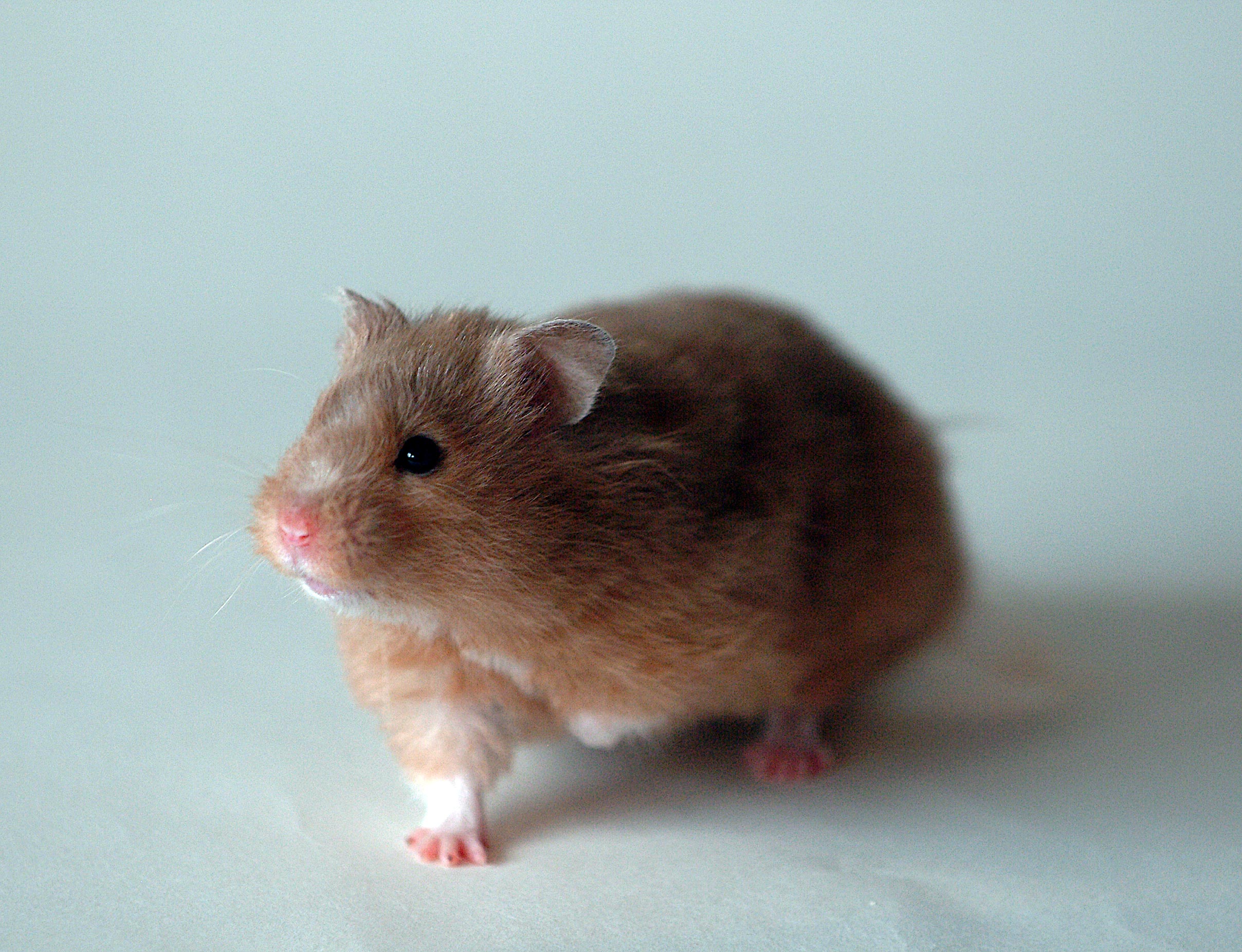
Adamjennison111 at English Wikipedia GFDL (http://www.gnu.org/copyleft/fdl.html), CC-BY-SA-3.0 (http://creativecommons.org/licenses/by-sa/3.0/) or CC BY 2.5 (http://creativecommons.org/licenses/by/2.5), via Wikimedia Commons
Syrian hamsters, which originate from (obviously) Syria and other areas of the Middle East, though it's exact range is unknown, it's thought to be limited. They are desert animals, nocturnal, and love to stockpile food. When exposed to extreme cold, even for an hour or two, their bodies can go into hibernation mode. For a pet hamster, who may not have made "plans" for a sudden hibernation, this can be dangerous and can lead to hypothermia and dehydration.
Wild Syrian hamsters are apparently not particularly good at hibernation, either, and studies have shown inconsistencies in individual hamsters regarding hibernation; some hibernate with no problems, others dehydrate or go into hypothermia, and still others don't hibernate at all, even when exposed to the same conditions. Scientists aren't sure if there are triggers outside of cold temperatures that trigger hibernation in Syrian hamsters; some theorize that reduced light or food supplies may also be a factor. Others suggest that genetics might also have a role, and that some hamsters lack the "hibernation" gene.
Unlike certain other animals, like groundhogs and bears, the Syrian hamster has the "choice" to hibernate; it doesn't store up on fat (it instead hoards food in its burrows) and go into hibernation every year, which is why a pet hamster may never (and should never) feel the need to do so. If you suspect your hamster has gone into hibernation, there are plenty of good resources regarding how to wake them up, including this Wiki How page and the Hamster Portal. Of course, if you're really concerned about your hamster's health, or it's not responding to warmth, you should take your hamster to a vet right away.

It still looks a little frazzled from the cold and getting a bit dried out, but most of it has perked up since even yesterday's post.
This week's critter is a public service announcement opportunity. Few people think of pets hibernating, but if you have a Syrian, or golden, hamster (including the breed variant known as the "teddy bear"), you might want to rethink Fluffy's "death". Note: Other hamsters may or may not hibernate; I've found sites that say dwarf hamsters don't, but other sites aren't so sure. To be on the safe side, it's probably best to assume that any hamster may hibernate if it gets cold enough.
I don't own a golden hamster, nor do I know of anyone offhand who does, so here is, as usual in these cases, a Wikipedia/Wikimedia picture. Feel free to post your own pictures of your hamsters below.
Adamjennison111 at English Wikipedia GFDL (http://www.gnu.org/copyleft/fdl.html), CC-BY-SA-3.0 (http://creativecommons.org/licenses/by-sa/3.0/) or CC BY 2.5 (http://creativecommons.org/licenses/by/2.5), via Wikimedia Commons
Syrian hamsters, which originate from (obviously) Syria and other areas of the Middle East, though it's exact range is unknown, it's thought to be limited. They are desert animals, nocturnal, and love to stockpile food. When exposed to extreme cold, even for an hour or two, their bodies can go into hibernation mode. For a pet hamster, who may not have made "plans" for a sudden hibernation, this can be dangerous and can lead to hypothermia and dehydration.
Wild Syrian hamsters are apparently not particularly good at hibernation, either, and studies have shown inconsistencies in individual hamsters regarding hibernation; some hibernate with no problems, others dehydrate or go into hypothermia, and still others don't hibernate at all, even when exposed to the same conditions. Scientists aren't sure if there are triggers outside of cold temperatures that trigger hibernation in Syrian hamsters; some theorize that reduced light or food supplies may also be a factor. Others suggest that genetics might also have a role, and that some hamsters lack the "hibernation" gene.
Unlike certain other animals, like groundhogs and bears, the Syrian hamster has the "choice" to hibernate; it doesn't store up on fat (it instead hoards food in its burrows) and go into hibernation every year, which is why a pet hamster may never (and should never) feel the need to do so. If you suspect your hamster has gone into hibernation, there are plenty of good resources regarding how to wake them up, including this Wiki How page and the Hamster Portal. Of course, if you're really concerned about your hamster's health, or it's not responding to warmth, you should take your hamster to a vet right away.
25fuzzi
That worries me...how many hamsters might have been buried/discarded by owners who thought their pet had died???
26CassieBash
>25 fuzzi: Yes, not having had hamsters, I didn't realize this until I was looking up other animals that hibernate and they showed up on the search. I have a hermit crab but you definitely know the difference between a dead crab and a live one; the smell is terrible if they've died, and it doesn't take long for the smell to happen. So I hope that hamster owners who may read this will think twice about assuming their pet has died.
This goes into the area of researching your pet thoroughly before getting one. My first two hermit crabs I got from a friend who was feeding them stale Captain Crunch cereal and using an old, slightly rusty Miracle Whip lid for their water dish. The first thing I did when I got them was change their diet to a balanced one and switched to a plastic water dish, since iron and other metals are extremely harmful to hermit crabs; it keeps them from molting their exoskeletons properly. Which, sadly, is what happened to those first two, so I think the damage was done. I have had my current crab for years now and he seems quite well; no metal decor or food, and I take the metal part out of the cuttlebone I give him for extra calcium (calcium is good for their exoskeletons, just like it's good for our bones). But honestly, once he's passed, I don't think I'm going to get another one. I want to reclaim the space his tank is using (it's a 30 gallon long, so it's pretty big) for desk space. My cat will love it, because it will be another surface she will be able to sit on when I'm not using it (and maybe even when I am!).
This goes into the area of researching your pet thoroughly before getting one. My first two hermit crabs I got from a friend who was feeding them stale Captain Crunch cereal and using an old, slightly rusty Miracle Whip lid for their water dish. The first thing I did when I got them was change their diet to a balanced one and switched to a plastic water dish, since iron and other metals are extremely harmful to hermit crabs; it keeps them from molting their exoskeletons properly. Which, sadly, is what happened to those first two, so I think the damage was done. I have had my current crab for years now and he seems quite well; no metal decor or food, and I take the metal part out of the cuttlebone I give him for extra calcium (calcium is good for their exoskeletons, just like it's good for our bones). But honestly, once he's passed, I don't think I'm going to get another one. I want to reclaim the space his tank is using (it's a 30 gallon long, so it's pretty big) for desk space. My cat will love it, because it will be another surface she will be able to sit on when I'm not using it (and maybe even when I am!).
27fuzzi
A 30 gallon long...just how big is your Hermit crab?
Snails also smell ghastly once dead, so no mistaking it when one has "passed".
This might interest you...speaking of horrible smells, I have had three Stinkhorn mushrooms sprout in the mulch around my pond, phew! The flies love 'em. I won't post a picture, these fungi look positively pornographic.
http://www.walterreeves.com/gardening-q-and-a/stinkhorn-mushroom-identification-...
Snails also smell ghastly once dead, so no mistaking it when one has "passed".
This might interest you...speaking of horrible smells, I have had three Stinkhorn mushrooms sprout in the mulch around my pond, phew! The flies love 'em. I won't post a picture, these fungi look positively pornographic.
http://www.walterreeves.com/gardening-q-and-a/stinkhorn-mushroom-identification-...
28lesmel
>26 CassieBash: I had hermies! https://www.flickr.com/photos/bloglass/albums/264726 I ended up giving them and their entire set up away prior to moving from IL to TX. I was moving in the middle of winter; and couldn't guarantee their safety during transport (mostly b/c my dog fixated on them when they were in the isolation/cleaning day tanks). They were really hilarious pets. Nearly all of them molted while in my care; and I never had a problem with shell theft. If I could create a big set up for them, I'd have hermies again.
29CassieBash
>27 fuzzi: I used to have several, but now I just have one big one. One by one the others died. He fills up the palm of my hand rather nicely. But I have a nice fake choya-wood tunnel, a twisted branch for climbing, a half of a coconut shell with a "door" for his house, and a great big wading pool in there, along with some big shells if he wants to swap, as well as his feeding station. At one point, though, I had a good 6-8 at a time, of various sizes, and this size tank was great for that population.
Yeah, we had some "elegant" (if you can really call them that) stinkhorns this past summer in one of the flowerbeds for a month or so. And you're right about the look; if you notice, the scientific name backs up your summation of their appearance.
>28 lesmel: My cat sometimes likes to watch him, but she generally ignores him anymore. I sometimes "talk" with mine when he's over at the side of the tank; I'll put four fingers up by my nose and move them in tandem with his "whiskers", and he seems fascinated, mirroring me sometimes if I moved a finger out of step with him. Did you ever do that with yours? Only the first two of mine had true molting problems; they were some time ago, probably about 20 years back. Not sure why the others passed; a few were good-sized so perhaps they'd reached the natural end, some were rescue crabs from those little cups in Wal-mart that maybe had been sick from poor care. (They put water in the bottom of the cup and because it's just the same cups they use for those poor beta fish, there's not room to keep the food separate, so it molds.) A few were cannibalized after molting. I've probably had over the course of time about a dozen or so crabs. I love them, but I could use the work space and I can use the tank for caterpillars like hornworms, that don't climb the tank sides (the cover doesn't lift off but rather slides along a track, so this is no good for caterpillars that can climb and get caught under the track).
Yeah, we had some "elegant" (if you can really call them that) stinkhorns this past summer in one of the flowerbeds for a month or so. And you're right about the look; if you notice, the scientific name backs up your summation of their appearance.
>28 lesmel: My cat sometimes likes to watch him, but she generally ignores him anymore. I sometimes "talk" with mine when he's over at the side of the tank; I'll put four fingers up by my nose and move them in tandem with his "whiskers", and he seems fascinated, mirroring me sometimes if I moved a finger out of step with him. Did you ever do that with yours? Only the first two of mine had true molting problems; they were some time ago, probably about 20 years back. Not sure why the others passed; a few were good-sized so perhaps they'd reached the natural end, some were rescue crabs from those little cups in Wal-mart that maybe had been sick from poor care. (They put water in the bottom of the cup and because it's just the same cups they use for those poor beta fish, there's not room to keep the food separate, so it molds.) A few were cannibalized after molting. I've probably had over the course of time about a dozen or so crabs. I love them, but I could use the work space and I can use the tank for caterpillars like hornworms, that don't climb the tank sides (the cover doesn't lift off but rather slides along a track, so this is no good for caterpillars that can climb and get caught under the track).
30MarthaJeanne
>27 fuzzi: Following a link from your link, I found this: 'Etty Darwin (granddaughter of Charles), who "so despised stinkhorns that she mounted an antifungal jihad with the aid of gloves and a pointed stick," burning the stinkhorns in secret to protect "the purity of thought among her female servants" (Money, p. 3).'
When we visited St. John (US Virgin Islands) years ago there were lots of hermit crabs around. Some of them were using baby food jars as shells. We were staying in a camp, and needed to use flashlights when going to the toilets at night. They were all over the paths.
When we visited St. John (US Virgin Islands) years ago there were lots of hermit crabs around. Some of them were using baby food jars as shells. We were staying in a camp, and needed to use flashlights when going to the toilets at night. They were all over the paths.
31CassieBash
>30 MarthaJeanne: Thanks for the little side note about the Darwin war against stinkhorns. Fascinating.
Yes, hermit crabs tend to be nocturnal, so that makes sense. And you wouldn't want to step on one, especially if they were using glass jars for shells. I've heard of crabs using all sorts of human trash for shells, not always to their benefit. I don't see my crab often during the day, but I sometimes hear him moving around at night after I've turned off the lights. I need to change his bedding; I use shredded coconut husk, which is great for burrowing, is soft and comfortable, and when first put in the tank, is nice and wet and warm, because I buy it as compacted bricks that fluff up when you add hot water to them. Especially right now, going into winter, he loves fresh bedding.
Yes, hermit crabs tend to be nocturnal, so that makes sense. And you wouldn't want to step on one, especially if they were using glass jars for shells. I've heard of crabs using all sorts of human trash for shells, not always to their benefit. I don't see my crab often during the day, but I sometimes hear him moving around at night after I've turned off the lights. I need to change his bedding; I use shredded coconut husk, which is great for burrowing, is soft and comfortable, and when first put in the tank, is nice and wet and warm, because I buy it as compacted bricks that fluff up when you add hot water to them. Especially right now, going into winter, he loves fresh bedding.
32MarthaJeanne
I'd like to point out that if the female servants were really 'pure' they would not know what the stinkhorns looked like, so their purity would not be affected.
33fuzzi
>28 lesmel: there are several really good shots in that collection. Thanks for sharing!
I never thought much about Hermit crabs as pets: we lived at the shore when I was a youngster, and I'd play with them on the beach.
I never thought much about Hermit crabs as pets: we lived at the shore when I was a youngster, and I'd play with them on the beach.
34CassieBash
Winter brings a lot of dangers to animals: dwindling food supply, heavy snows that can envelop a small animal and/or their burrows, hypothermia, dessication as the air dries and cold winds suck moisture from bodies. One of the nastiest perils, though, is frostbite, which is when the moisture in tissues freezes. I've shared with you how frogs rid their bodies of much of their moisture to keep ice crystals from forming, but there is a tiny garden critter that seals moisture in for their winter sleep: the snail. Again, I don't have handy snail pictures right now, though I think I have some from several years ago somewhere in my back files, but here's one:
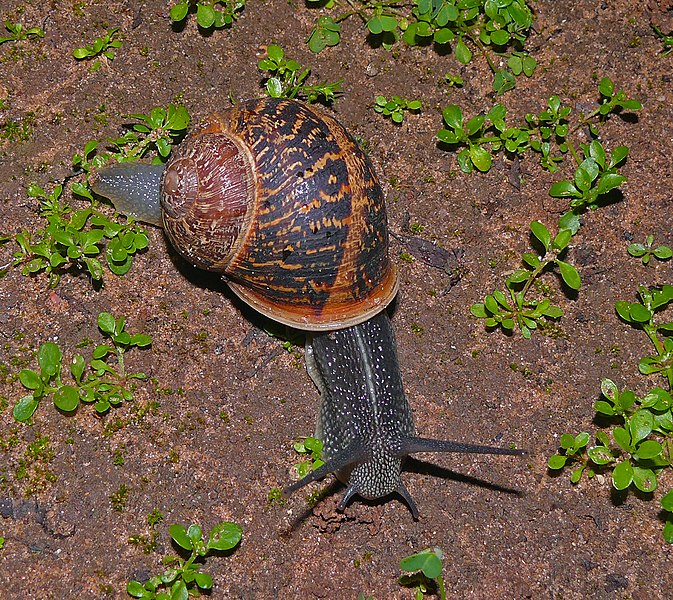
This image was created by Zachi Evenor צחי אבנור and is released under Creative Commons CC-BY license. Thanks, Zachi!
So like frogs, snails rely on the moisture in their bodies to survive, and if something compromises that moisture content, it can be detrimental to them. Like land frogs, land snails can't overwinter at the bottom of ponds, surrounding themselves with moisture--not without risking death by drowning. And like land frogs, ice crystals are deadly. And like land frogs, they try to reduce the water content in their bodies. But unlike frogs, snails can't produce that special "anti-freeze", and they can't dry out completely, so snails try to preserve what's left of their moisture by trapping it within their shells. Finding a sheltered spot, they will use a special mucus that they secrete to create a tight door, and literally will seal themselves in for the winter. They have a bit of insulation inside the shell, too--air that they trap inside will not only sustain them through the winter as they breathe and sleep, but will also act as insulation, just as the air trapped between the winter hairs of furry animals does. While not every snail does this, most do.
Next week, I will cover the last of the overwintering critter choice before starting my Christmas Critter of the Week. I've got lots of possibilities, from common nativity animals to animals we associate with more secular aspects of Christmas: seals, reindeer, polar bears, etc. And then I've come across some more...unusual critters. So I'd like some suggestions--would you rather I focus on common Christmas creatures like donkeys, doves, and reindeer, or would you like me to concentrate on the lesser known creatures of Christmas?
This image was created by Zachi Evenor צחי אבנור and is released under Creative Commons CC-BY license. Thanks, Zachi!
So like frogs, snails rely on the moisture in their bodies to survive, and if something compromises that moisture content, it can be detrimental to them. Like land frogs, land snails can't overwinter at the bottom of ponds, surrounding themselves with moisture--not without risking death by drowning. And like land frogs, ice crystals are deadly. And like land frogs, they try to reduce the water content in their bodies. But unlike frogs, snails can't produce that special "anti-freeze", and they can't dry out completely, so snails try to preserve what's left of their moisture by trapping it within their shells. Finding a sheltered spot, they will use a special mucus that they secrete to create a tight door, and literally will seal themselves in for the winter. They have a bit of insulation inside the shell, too--air that they trap inside will not only sustain them through the winter as they breathe and sleep, but will also act as insulation, just as the air trapped between the winter hairs of furry animals does. While not every snail does this, most do.
Next week, I will cover the last of the overwintering critter choice before starting my Christmas Critter of the Week. I've got lots of possibilities, from common nativity animals to animals we associate with more secular aspects of Christmas: seals, reindeer, polar bears, etc. And then I've come across some more...unusual critters. So I'd like some suggestions--would you rather I focus on common Christmas creatures like donkeys, doves, and reindeer, or would you like me to concentrate on the lesser known creatures of Christmas?
36CassieBash
Have a happy Thanksgiving, all!


37fuzzi
>36 CassieBash: Happy Thanksgiving back atcha!
39fuzzi
>38 MarthaJeanne: oh, wow. Thanks.
I've never had a hamster, though we had two gerbils at one point when my dh and I were first married. I don't recall how they died.
I've never had a hamster, though we had two gerbils at one point when my dh and I were first married. I don't recall how they died.
40CassieBash
I didn't exactly promise pictures of my hermit crab, but here are a few. That's my hand and his shell.


Also, yard-wise, we've begun decorating for Christmas. While most of the other gardens look sad and dead, our holly, spirea, and maple bushes all are decked out for the holidays--even if the spirea and maple ones look pretty dead themselves:


The pond doesn't look much different yet, except for all the leaves, most of which seem to be sitting on lily pads.


This week, being mostly a week in November, means the last week of our winter survival technique month for the Critter of the Week's theme. Most of the critters here have used certain survival strategies that allow them to sleep through cold weather, and it's possible that some of these creatures may not ever see snow. Well, this week I'm reversing this trend and I'm going to give this week's honor to an invertebrate that actually is noticed more often jumping around on the snow, an activity you don't generally expect to see outside of birds or mammals. But for those of you in northern climes like ours, snow fleas or, as is more proper, springtails are common sights.

Now they may not look like much, but these guys are a gardener's friend. They help break down leaf litter and other decaying organic vegetable matter into rich soil. But their dark color tends to hide them well in the soil; during the warmer months, there will be hundreds of thousands of these little critters within a square cubic meter of dirt. On snow, they look like tiny little bits of pepper--until they move. Like frogs, they can produce a large amount of an antifreeze chemical; this chemical is being studied by scientists who are interested in using their findings to help preserve organs and tissues for transplantation during the transport from one place to another. Springtails move by propelling themselves with a flexible furcula--a tail-like thing that acts like a spring, sending them "jumping" into the air--thus the "snow fleas" nickname. But why are they out in the snow? The answer seems to be simple--because they can be, and there's still plenty of leaf litter lying around in the snow. While there is a limit, temperature-wise, to how cold it can get before you don't see them, as long as it's a fairly warm winter day, they'll be out.
There is a very cool picture of a whole mass of snow fleas at this link. They really do make an impressive sight when you get a whole mess of them on the snow.
Enjoy, and next month I'll start up with my Christmas-themed Critter of the Week. Here's a hint: pine cones aren't just for Christmas trees!


Also, yard-wise, we've begun decorating for Christmas. While most of the other gardens look sad and dead, our holly, spirea, and maple bushes all are decked out for the holidays--even if the spirea and maple ones look pretty dead themselves:


The pond doesn't look much different yet, except for all the leaves, most of which seem to be sitting on lily pads.


This week, being mostly a week in November, means the last week of our winter survival technique month for the Critter of the Week's theme. Most of the critters here have used certain survival strategies that allow them to sleep through cold weather, and it's possible that some of these creatures may not ever see snow. Well, this week I'm reversing this trend and I'm going to give this week's honor to an invertebrate that actually is noticed more often jumping around on the snow, an activity you don't generally expect to see outside of birds or mammals. But for those of you in northern climes like ours, snow fleas or, as is more proper, springtails are common sights.

Now they may not look like much, but these guys are a gardener's friend. They help break down leaf litter and other decaying organic vegetable matter into rich soil. But their dark color tends to hide them well in the soil; during the warmer months, there will be hundreds of thousands of these little critters within a square cubic meter of dirt. On snow, they look like tiny little bits of pepper--until they move. Like frogs, they can produce a large amount of an antifreeze chemical; this chemical is being studied by scientists who are interested in using their findings to help preserve organs and tissues for transplantation during the transport from one place to another. Springtails move by propelling themselves with a flexible furcula--a tail-like thing that acts like a spring, sending them "jumping" into the air--thus the "snow fleas" nickname. But why are they out in the snow? The answer seems to be simple--because they can be, and there's still plenty of leaf litter lying around in the snow. While there is a limit, temperature-wise, to how cold it can get before you don't see them, as long as it's a fairly warm winter day, they'll be out.
There is a very cool picture of a whole mass of snow fleas at this link. They really do make an impressive sight when you get a whole mess of them on the snow.
Enjoy, and next month I'll start up with my Christmas-themed Critter of the Week. Here's a hint: pine cones aren't just for Christmas trees!
42CassieBash
The two koi are fine; in fact, Sunny is the big golden fish on the right side of the last two pond pictures. Amalthea, the white one, was further under the lily. Only the goldfish and frog population were hit. The koi are much bigger--over a foot long--and with plenty of goldfish, the heron might have decided the smaller fish were easier prey. Alas, my blue fish was likely a victim; I haven't seen her since he'd moved in. We'll have to watch for him in the spring; he may decide to come back.
44CassieBash
>43 fuzzi: Yeah, stinkin' heron. But he was pretty.
Our newest pretty bird pest is a Cooper's Hawk. He's staking out the bird feeders for easy kills.
I meant to tell all of you that last weekend, I adopted some tiny and unexpected friends. Due to unseasonably warm temps, I think a few broods of grasshoppers have hatched early. I found a couple of small ones and am trying to raise them inside in an improvised terrarium (a Kroger brand fried onion container, to be exact). They're doing well, if the signs of droppings are any indication, though I'm not sure if they'll make it to adulthood. It's hard to say if they're growing.
Because next week is finals week, I'm going to post the Critter of the Week now, while I have a quiet moment here. So as I said, pine cones aren't just found on Christmas trees--they're also found in the ocean! This week's critter is a family of fish known as pinecone fishes; the largest species is known as a pineapple fish. Whichever you call it, you can definitely see the resemblance to both:
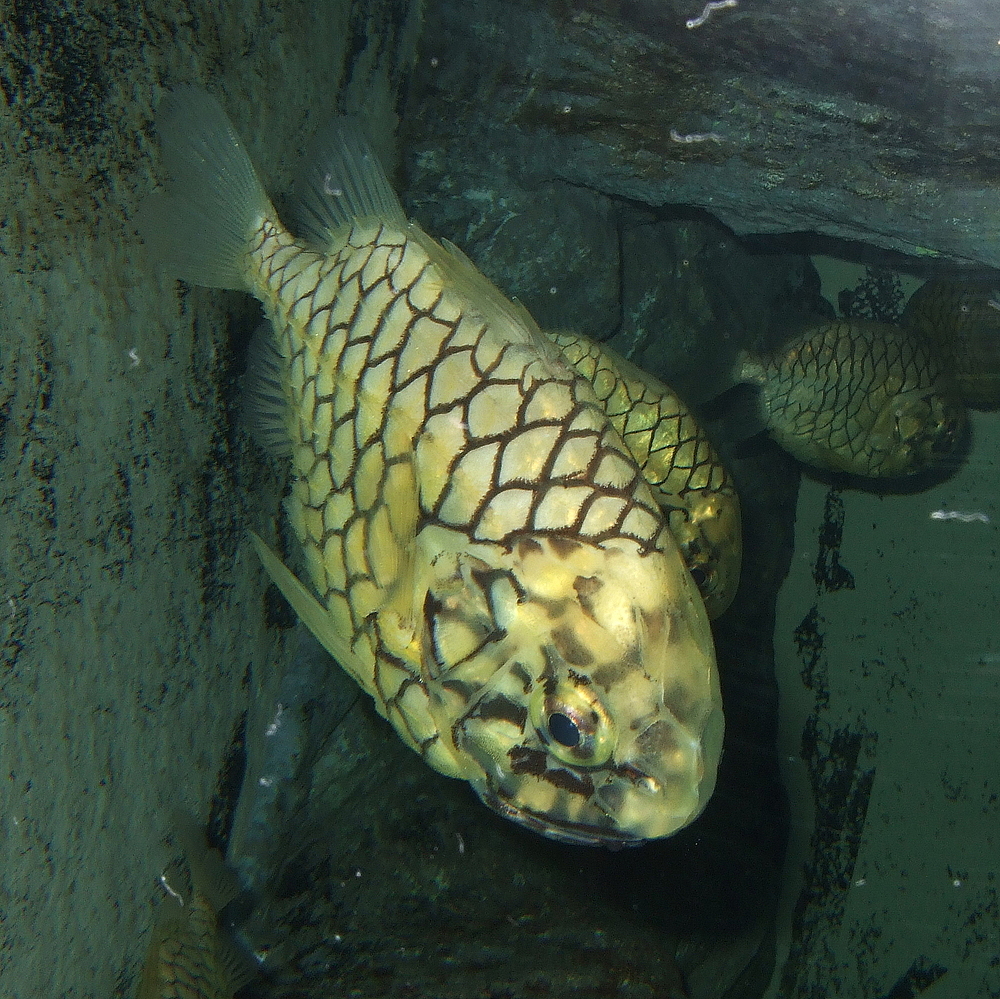
Pineapples do, now that I think of it, resemble oversized pine cones....
These fish are pretty interesting: attractive coloration and markings, bioluminescence, and an unusual skeleton. Yellow or orange with dark brown outlining the large scales on their bodies, they have light organs on the sides of their mouths, filled with bioluminescent bacteria that glow a pretty green, though in older fish, the color may be red. If you have a 50+ gallon tank, the money, and a bit of luck (they can be difficult to keep, one of my reference sites says), you can keep these fellows, but you'll have to have plenty of caves for hiding; they're nocturnal and don't like light. They like live prey, too; shrimp and small fish are their diet. Native to the seas and oceans around Australia, New Zealand, South Africa, Southern Japan, Mauritius, and Indonesia, they live at a depth that allows for little light--65--650 feet deep--and they love hanging out with each other; these fish school.
Maybe I should have saved this critter for Halloween; while they look like lovely pine cones on the outside, their skeletons are rather creepy, the bones thick, covered in hard plates of armor with spikes. Clicking this link will let you view scans of this interesting fish's skeleton.
Our newest pretty bird pest is a Cooper's Hawk. He's staking out the bird feeders for easy kills.
I meant to tell all of you that last weekend, I adopted some tiny and unexpected friends. Due to unseasonably warm temps, I think a few broods of grasshoppers have hatched early. I found a couple of small ones and am trying to raise them inside in an improvised terrarium (a Kroger brand fried onion container, to be exact). They're doing well, if the signs of droppings are any indication, though I'm not sure if they'll make it to adulthood. It's hard to say if they're growing.
Because next week is finals week, I'm going to post the Critter of the Week now, while I have a quiet moment here. So as I said, pine cones aren't just found on Christmas trees--they're also found in the ocean! This week's critter is a family of fish known as pinecone fishes; the largest species is known as a pineapple fish. Whichever you call it, you can definitely see the resemblance to both:
Pineapples do, now that I think of it, resemble oversized pine cones....
These fish are pretty interesting: attractive coloration and markings, bioluminescence, and an unusual skeleton. Yellow or orange with dark brown outlining the large scales on their bodies, they have light organs on the sides of their mouths, filled with bioluminescent bacteria that glow a pretty green, though in older fish, the color may be red. If you have a 50+ gallon tank, the money, and a bit of luck (they can be difficult to keep, one of my reference sites says), you can keep these fellows, but you'll have to have plenty of caves for hiding; they're nocturnal and don't like light. They like live prey, too; shrimp and small fish are their diet. Native to the seas and oceans around Australia, New Zealand, South Africa, Southern Japan, Mauritius, and Indonesia, they live at a depth that allows for little light--65--650 feet deep--and they love hanging out with each other; these fish school.
Maybe I should have saved this critter for Halloween; while they look like lovely pine cones on the outside, their skeletons are rather creepy, the bones thick, covered in hard plates of armor with spikes. Clicking this link will let you view scans of this interesting fish's skeleton.
45CassieBash
Students have been working hard, and are enjoying our cookies and punch Christmas/finals week treat. But I have a few moments of quiet and peace for the moment, so I thought I'd share with you a couple of pictures of the grasshoppers.


46fuzzi
>45 CassieBash: cute little grasshoppers! They just aren't as pretty once they get big, imo.
>44 CassieBash: I thought those fish were fascinating, and even showed the pictures to my dh.
I have two aquariums full of plecos and corys. Both types of fish are armored catfish, though not as extensively protected as the pineapple fish you referenced. The 29 gallon is my main aquarium, but the 10 gallon I just set up a few weeks ago as a nursery for all the pleco fry that my pair have been producing!
The corys laid eggs a couple days ago, too, what is in the water???
>44 CassieBash: I thought those fish were fascinating, and even showed the pictures to my dh.
I have two aquariums full of plecos and corys. Both types of fish are armored catfish, though not as extensively protected as the pineapple fish you referenced. The 29 gallon is my main aquarium, but the 10 gallon I just set up a few weeks ago as a nursery for all the pleco fry that my pair have been producing!
The corys laid eggs a couple days ago, too, what is in the water???
47CassieBash
>46 fuzzi: I don't know; I think it depends on the species. I think these are two banded grasshoppers, based on their general shape and the striping on their hind legs (you can't see it as well on the green, because of the shadows and angle, but you can kind of see the dark stripes on my one-legged brown one). Bug Guide has a page of pictures of the two banded grasshoppers in various stages of development, and I agree that this species isn't any more attractive as adults than they are as nymphs. But a Carolina locust with wings spread are actually more attractive than their nymph stage. Of course, like with most insects, the prettiest grasshoppers are tropical; do a Google images search for tropical grasshoppers and just marvel at the beauty of the colors and patterns!
I love catfish and plecos both; in fact, if it were practical (and legal; not sure about that), I'd say we should put a native catfish or two in our pond. Better watch out, your catfish could be the next to spawn.... :)
I love catfish and plecos both; in fact, if it were practical (and legal; not sure about that), I'd say we should put a native catfish or two in our pond. Better watch out, your catfish could be the next to spawn.... :)
48fuzzi
>47 CassieBash: that's what happened: first the Bristlenose plecos started spawning (they've been doing it repeatedly for months!) and then this weekend the Corydoras started laying eggs.
It's a planted tank I've had them in for a couple years. The only difference I can see is that I've been doing daily water changes of about 10%. After siphoning about 1/3 of the dirty water from the small "nursery" tank, I've been moving 2-3 gallons from the main tank water into the small tank, so there's no big shock of water temperature or Ph for the fry. That means that every day the Corys have had 10% fresh cold water added to their environment. Hmm.
It's a planted tank I've had them in for a couple years. The only difference I can see is that I've been doing daily water changes of about 10%. After siphoning about 1/3 of the dirty water from the small "nursery" tank, I've been moving 2-3 gallons from the main tank water into the small tank, so there's no big shock of water temperature or Ph for the fry. That means that every day the Corys have had 10% fresh cold water added to their environment. Hmm.
49fuzzi
Since I posted twice by mistake, I'll just add a couple pictures here of the fry...don't think you'll mind, @cassiebash?

10 gallon "nursery" tank, filled with albino Bristlenose plecostomus fry

Same 10 gallon "nursery" tank during the cleaning process, posted to show how many I currently have!
Anyone want some?

10 gallon "nursery" tank, filled with albino Bristlenose plecostomus fry

Same 10 gallon "nursery" tank during the cleaning process, posted to show how many I currently have!
Anyone want some?
50CassieBash
>48 fuzzi: Yep, missed that part up on >46 fuzzi:. My sister used to have corys some time ago, but she's letting her fish population die off slowly as nature deems, and has no intention of continuing with an aquarium, mostly due to time constraints. She's now down to one ancient and primitive-looking catfish specimen with barbs--a Raphael catfish named Trinidad. I think she liked the name, being an artist.
>49 fuzzi: So. Many. Pleco. Babies. I love them all! Squee!
>49 fuzzi: So. Many. Pleco. Babies. I love them all! Squee!
51MarthaJeanne
I love grasshoppers. They come into the house sometimes in summer, and I carefully take them out again. In my opinion, the bigger, the better. We have a lovely picture of one of our boys at 4 with a big (4-5 cm.) grasshopper on his hand. All the other kids around were rather grossed out, but Edward was delighted!
52fuzzi
>51 MarthaJeanne: funny how some children seem to delight in nature, while others back away.
53CassieBash
>51 MarthaJeanne: Edward is my kind of kid!
54CassieBash
Just a grasshopper update: they seem to be doing well, though I can't yet say if they've grown. They are full of energy though; the green one hopped out onto my shirt this morning when I went to check on them.
We had our first, very temporary, accumulation of snow yesterday. Nothing more than a thin coating, but it was enough that the roads were slick in spots, and there are still areas where it didn't melt off completely. Tonight and tomorrow, we are under a winter weather advisory with totals between 3-5 inches by early Sunday morning. This comes complete with blowing and drifting snow from 30 mph winds, plus a possibly higher accumulation if we get hit with the dreaded lake effect bands.
Mother Nature is apparently serious about this "winter" thing now.
We had our first, very temporary, accumulation of snow yesterday. Nothing more than a thin coating, but it was enough that the roads were slick in spots, and there are still areas where it didn't melt off completely. Tonight and tomorrow, we are under a winter weather advisory with totals between 3-5 inches by early Sunday morning. This comes complete with blowing and drifting snow from 30 mph winds, plus a possibly higher accumulation if we get hit with the dreaded lake effect bands.
Mother Nature is apparently serious about this "winter" thing now.
55fuzzi
>54 CassieBash: brr. I almost wish we had snow. It's been raining all week, and today the temps are just above freezing, it's RAW, damp & cold!
56CassieBash
Well, we had about 6 inches, and there's more on the way, apparently. We're under a Winter Storm Watch starting tonight and running until Wednesday morning. As usual, it's mostly lake effect, so how much we'll see will depend on where the lake effect bands set up and how long they linger.
Now for this week's Critter. I'm not much up on my crustaceans outside of hermit crabs, but I do like shrimp. Ever since The Oatmeal introduced me to the peacock mantis shrimp, I've appreciated their beauty and unique appearance. (I've never much been one to appreciate them at the table; while I'll eat the occasional fish, I'm just not a big seafood person, so shrimp have nothing to fear from me.) So when I came across this festive-looking fellow, I couldn't resist giving him a chance to shine. Especially since I found out that he's a wonderful friend to another aquatic denizen, and that the two have formed a symbiotic fellowship that should be an inspiration to us all.
You see, the Critter this week has poor eyesight, but it's an excellent digger. But with such very bad eyesight that it can't really see to defend or flee from its predators, it's a sitting duck...er, shrimp. Fortunately, a species of goby fish--the Randall's prawn goby--partners up with a shrimp and provides the eyesight, while the shrimp provides a safe burrow for itself and the goby. These two are inseparable friends and the goby will even stay with the shrimp after mating, going so far as to raise its family in the same burrow.
The shrimp's official name is the Randall's pistol shrimp, but it has a second name, for its brilliant red striping on a white background: the candy cane shrimp! The Marine Science Institute has a wonderful video of the shrimp and goby sharing a burrow as well as some pictures, including the one below:

Hayley of the Marine Science Institute Blog provided me with this picture on their site.
Next week I will post two Critters, since the holidays will keep me busy and I might not find it easy to post the week of Christmas, especially pictures, which seem to be impossible to post well via an iPhone. Therefore, I'll save myself a bit of a headache and, weather permitting, I'll post one on the 18th and one on the 21st.
Now for this week's Critter. I'm not much up on my crustaceans outside of hermit crabs, but I do like shrimp. Ever since The Oatmeal introduced me to the peacock mantis shrimp, I've appreciated their beauty and unique appearance. (I've never much been one to appreciate them at the table; while I'll eat the occasional fish, I'm just not a big seafood person, so shrimp have nothing to fear from me.) So when I came across this festive-looking fellow, I couldn't resist giving him a chance to shine. Especially since I found out that he's a wonderful friend to another aquatic denizen, and that the two have formed a symbiotic fellowship that should be an inspiration to us all.
You see, the Critter this week has poor eyesight, but it's an excellent digger. But with such very bad eyesight that it can't really see to defend or flee from its predators, it's a sitting duck...er, shrimp. Fortunately, a species of goby fish--the Randall's prawn goby--partners up with a shrimp and provides the eyesight, while the shrimp provides a safe burrow for itself and the goby. These two are inseparable friends and the goby will even stay with the shrimp after mating, going so far as to raise its family in the same burrow.
The shrimp's official name is the Randall's pistol shrimp, but it has a second name, for its brilliant red striping on a white background: the candy cane shrimp! The Marine Science Institute has a wonderful video of the shrimp and goby sharing a burrow as well as some pictures, including the one below:

Hayley of the Marine Science Institute Blog provided me with this picture on their site.
Next week I will post two Critters, since the holidays will keep me busy and I might not find it easy to post the week of Christmas, especially pictures, which seem to be impossible to post well via an iPhone. Therefore, I'll save myself a bit of a headache and, weather permitting, I'll post one on the 18th and one on the 21st.
57fuzzi
>56 CassieBash: lovely shrimp and friend! I have a couple Red Cherry shrimps in my main aquarium, and they are fun to watch.
We had rain, rain, and more COLD rain here. It never snowed or iced, but since the temps dropped overnight, my car was frozen shut this morning, grr.
We had rain, rain, and more COLD rain here. It never snowed or iced, but since the temps dropped overnight, my car was frozen shut this morning, grr.
58CassieBash
>57 fuzzi: Lovely. I remember winters in Muncie; rain was common and so was ice. Snow--not so much. But we did have one year when the arctic blast that we're so familiar with in the northwest corner of the state actually made it that far south. Except for my student worker position at Bracken Library, I only had student teaching to do. Of course, when the wind chill dips into the -50s, they close the public schools--so no teaching on those days. My poor roommate had to go to classes (which half of the time she would find had been cancelled) while I got to stay inside until I had to go to work.
Right now, our watch is predicting 5-9 inches with maybe up to 12 in some spots, with blowing and drifting, thanks to those 30-40 mph winds.
Right now, our watch is predicting 5-9 inches with maybe up to 12 in some spots, with blowing and drifting, thanks to those 30-40 mph winds.
59fuzzi
>58 CassieBash: hope you enjoy the snow, but keep warm! Brr.
60CassieBash
They've downgraded our totals but the big concern is blowing and drifting. Already some of the country roads are less than decent. Without classes to support, I'm now monitoring the local school systems. If they close, I close. But our county has been downgraded into a winter weather advisory for the moment, as lake effect bands are setting up to run in such a diagonal pattern that the heaviest stuff will hit St. Joseph and Elkhart counties in Indiana. Starke and Laporte, who usually get hammered by snow from the lake, are actually no longer under even an advisory.
61CassieBash
My little grasshoppers are still alive but they don't seem much different, except that the green one may have a bit more brown to his coloration now. Judging by the droppings and their powerful jumps, they seem to be getting enough food. Since the snow has been falling on and off all week, they're now getting organic salad greens.
I'll share more pictures of them next week.
I'll share more pictures of them next week.
62fuzzi
>61 CassieBash: what are you going to do with them once they get really big?
63CassieBash
>62 fuzzi: I've been thinking that I might move them into the hermit crab tank. The hermit crab isn't likely to be able to catch them, there would be plenty of room, and they wouldn't bother him.
64CassieBash
Now that we've had a bit of a warm-up and some snow melt-off, I've found some nice, yummy chickweed, nice and tender, for the grasshoppers. They seem to be maybe a bit on the lethargic side, but that could be also that they're getting used to all the handling, and don't see the need to jump frantically around whenever I reach in, or perhaps they are beginning to die, or maybe they're getting ready to molt. They'll die warm if that's what's going on, at least. They haven't seemed to grow much, but I can't remember how quickly grasshoppers grow; it's been so long since I've kept them, I honestly can't remember how often they molted. Here are a couple of pictures:


We all have our Christmas trees up now, right? (Well, everyone who celebrates Christmas, anyway....) Or at least you're thinking about getting one? How about getting one of these:

By Nhobgood Nick Hobgood (Own work) CC BY-SA 3.0 (https://creativecommons.org/licenses/by-sa/3.0) or GFDL (http://www.gnu.org/copyleft/fdl.html), via Wikimedia Commons.
You'll need an aquarium for these Christmas trees; they're actually an aquatic worm. Spirobranchus giganteus ("spiral gills gigantic"; you can see that it's a fitting description) is commonly known as the Christmas tree worm. Most of what you're seeing--the tree part--is designed solely for breathing and eating. The worm's body itself is more tube-like, with bristle-like appendages that help it move (it doesn't swim). Each worm has two of these, and the branches of the trees capture and direct the food--plankton--to the worm's mouth. While food capture and delivery is the structures' primary use, these "trees" can also act like gills.
These guys are tropical and can be found in many of the warmer oceans worldwide, mainly in depths of less than 100 feet. They usually hang out on coral, particularly large specimens like brain corals, and it creates a calcified tube structure around its soft and defenseless body; it can retract into the tube if threatened. These tubes have a plug that the worm can use like a door to shut out predators. While they are considered stable as a species, any threat to the coral reefs obviously may impact their numbers. While not sought after commercially, they are favorites with divers and underwater photographers.
This is my favorite December critter so far; they come in so many color variations and they really do look like little oceanic Christmas trees to me. Go on, Google Image "Christmas tree worms". You know you want to... :)


We all have our Christmas trees up now, right? (Well, everyone who celebrates Christmas, anyway....) Or at least you're thinking about getting one? How about getting one of these:

By Nhobgood Nick Hobgood (Own work) CC BY-SA 3.0 (https://creativecommons.org/licenses/by-sa/3.0) or GFDL (http://www.gnu.org/copyleft/fdl.html), via Wikimedia Commons.
You'll need an aquarium for these Christmas trees; they're actually an aquatic worm. Spirobranchus giganteus ("spiral gills gigantic"; you can see that it's a fitting description) is commonly known as the Christmas tree worm. Most of what you're seeing--the tree part--is designed solely for breathing and eating. The worm's body itself is more tube-like, with bristle-like appendages that help it move (it doesn't swim). Each worm has two of these, and the branches of the trees capture and direct the food--plankton--to the worm's mouth. While food capture and delivery is the structures' primary use, these "trees" can also act like gills.
These guys are tropical and can be found in many of the warmer oceans worldwide, mainly in depths of less than 100 feet. They usually hang out on coral, particularly large specimens like brain corals, and it creates a calcified tube structure around its soft and defenseless body; it can retract into the tube if threatened. These tubes have a plug that the worm can use like a door to shut out predators. While they are considered stable as a species, any threat to the coral reefs obviously may impact their numbers. While not sought after commercially, they are favorites with divers and underwater photographers.
This is my favorite December critter so far; they come in so many color variations and they really do look like little oceanic Christmas trees to me. Go on, Google Image "Christmas tree worms". You know you want to... :)
65MarthaJeanne
Proper Austrians don't put up their Christmas trees until the 24th. Generally Papa takes the children off for an outing while Mama decorates the tree. Sorry. No! While the children are out, and Mama is resting or making preparations for later, the Christkind comes and sets up the decorated tree in a room that can be closed off and leaves all the presents under it. Then after everyone has arrived the candles are lit, and then the door is opened to let the children in.
The tree is supposed to stay up until Epiphany, by which time the traditional busy days for the fire departments come, as many trees are not in water, so lighting them one last time can create problems.
Since we no longer have a teenager around to help drag the tree to and from the house, we have a tree-shaped frame to put up in one of the windows. I'll get it down from the attic sometime this week. No hurry.
I've put a picture in my member gallery, but it is on its side. http://www.librarything.com/pic/6142015
The tree is supposed to stay up until Epiphany, by which time the traditional busy days for the fire departments come, as many trees are not in water, so lighting them one last time can create problems.
Since we no longer have a teenager around to help drag the tree to and from the house, we have a tree-shaped frame to put up in one of the windows. I'll get it down from the attic sometime this week. No hurry.
I've put a picture in my member gallery, but it is on its side. http://www.librarything.com/pic/6142015
66CassieBash
>65 MarthaJeanne: Yes, I've actually heard of that tradition; the Victorians did that a lot. Probably brought it with them from Europe. And actually, I know that there are people here in the U.S. who also wait until last minute--though whether that's a tradition or procrastination, it may be hard to tell. :) But your tree frame is quite pretty. Thanks for sharing about your customs.
67fuzzi
>65 MarthaJeanne: >66 CassieBash: we did that, growing up, getting our tree on December 24th. My dad would take us out to the tree lots, and while my mother waited in the car, he would bring appropriate trees over for my mother's approval. I used to think it was just my father being cheap (prices would drop on Christmas Eve), but perhaps that was part tradition. My father is Swedish/German, and my mom was half Danish. We still open our gifts on Christmas Eve after trimming the tree and reading Luke 2 from the Bible.
68CassieBash
>67 fuzzi: Since we entertain a week or two before Christmas weekend, and like a very festive look to our house, we usually get ours the first weekend of December. It gets watered as needed--the stand is large and holds a few gallons of water--and we don't light it unsupervised, except to leave it on all night on Christmas eve. Usually, we're up fairly late that night, so it's only unsupervised for a few hours. Most of the lights are LEDs now, so they don't get warm like the old-fashioned lights do. It stays up through New Year's weekend and then comes down the next week.
It's a pity that I'm not good with aquatic creatures, or I'd love to try getting some Christmas tree worms and having a reef aquarium. Then I could have Christmas trees year-round! :)
It's a pity that I'm not good with aquatic creatures, or I'd love to try getting some Christmas tree worms and having a reef aquarium. Then I could have Christmas trees year-round! :)
69fuzzi
>68 CassieBash: aquatic creature cultivation is like other critter cultivation, except you have to be a little more observant of their environment. If you do decide to try, start with freshwater, not marine/salt. I haven't tried the latter, yet, as it's not only more complicated, but costs more $$$.
70CassieBash
>69 fuzzi: I don't even have luck with goldfish. Sadly, I think I kept the aquarium too clean. I'll enjoy the pond fish and stick to that, for the sake of the fish.
When my last hermit crab is gone, I'm going to reclaim the piece of furniture his tank sits on--a sewing machine table--and use it as a desk. My cat will love this, since it will be one more flat, tidy surface that she can sit on. But I can then use it as a desk for writing, coloring, drawing, and crafting.
When my last hermit crab is gone, I'm going to reclaim the piece of furniture his tank sits on--a sewing machine table--and use it as a desk. My cat will love this, since it will be one more flat, tidy surface that she can sit on. But I can then use it as a desk for writing, coloring, drawing, and crafting.
71fuzzi
>70 CassieBash: I used to kill fish. But I kept reading and learning, and I'm doing pretty well. All the fish in my aquarium have been alive for at least a year, though some of the albino corys are older, like maybe 2-3 years old.
Here's a great source of information for anyone either interested in starting an aquarium, or troubleshooting their existing setup, or just learning:
http://wetwebmedia.com/
I can spend hours on that site. The Q & As are very funny at times, but also educational.
Here's a great source of information for anyone either interested in starting an aquarium, or troubleshooting their existing setup, or just learning:
http://wetwebmedia.com/
I can spend hours on that site. The Q & As are very funny at times, but also educational.
72CassieBash
>71 fuzzi: Thanks for the info! Maybe someday I'll be brave enough to get another goldfish. Until then, I'll stick with the hermit crab and cat. Oh, and grasshoppers and caterpillars. Let's not forget them! :)
Tomorrow I will be back with next week's critter, since we get to shut down for an entire week, and I'll be on LT only once or twice, if at all. I've been giving a lot of attention to aquatic animals; I think my next one will be terrestrial.
Tomorrow I will be back with next week's critter, since we get to shut down for an entire week, and I'll be on LT only once or twice, if at all. I've been giving a lot of attention to aquatic animals; I think my next one will be terrestrial.
73fuzzi
>72 CassieBash: looking forward to the next critter.
74CassieBash
Wait no more! I thought long and hard on this one; I've scoured the Christmas legends for an animal that doesn't get a lot of press in our area as a Christmas legend. I wanted something really unique. There were several birds: wrens, robins, even roosters (the only time a rooster crowed at night was the night Jesus was born, according to Latin American legends). But then I found an animal that we, as Americans, would likely never think of as a "Christmas" animal, unless you have Scandinavian blood in your veins and you follow tradition. This is probably one of the most unusual mammals associated with Christmas, probably in part because it's associated with the Devil. Yet in Scandinavian countries, this animal is still used as a Christmas symbol, and it even has its own special name, Julbocken. This animal is....
the Yule goat.

19th century Christmas card God Jul by Jenny Nyström, Wikipedia, public domain (published before 1946; author deceased longer than 70 years)
OK, this critter is more symbolic than literal in many ways, but still, it's a pretty interesting custom, and an old one, too. You must remember that much of Europe, when it was first Christianized, still embraced its pagan traditions, and these traditions became part of the new celebrations. Well, in Norse mythology, goats were important; a pair of them drew Thor's chariot through the sky, and goats were no doubt an important source of food and clothing. Every year at the end of the harvest season, a bundle of grain was saved and named Julbocken, and people would dress up as goats to go caroling and begging for sweets and libations--a sort of combination caroling and trick-or-treat. In some places, instead of Santa Claus, St. Nickolas, Father Christmas, etc., a large goat would be the bringer of gifts. Sometimes, like above, St. Nickolas or Father Christmas would be depicted riding a goat, or driving a goat-drawn cart; some see this as symbolizing the triumph of good (St. Nickolas) over evil (the goat representing the Devil, of course).
Sometimes, little wooden or straw goat figures are used as decorations and sometimes, they are hidden secretly in the homes of neighbors and friends as a sort of trick or prank; once discovered, the figure is supposed to be passed on to another household in the same manner.
This is a picture of what is probably the most famous Julbocken, made fresh each year, which unfortunately has a tendency to attract vandals and arsonists every year, too:

The Gävle Goat, posted by Baltica, from Wikipedia, 2004--public domain (released into public domain by author)
Though not the intention, and though it's definitely illegal, the goat is often set on fire by, as one site put it, "jerks". It's also been kicked and even hit with a car. One might have been "goat-napped" by helicopter, only the guard on duty supposedly refused the bribe (which was a bit over $7,000 USD). Unfortunately, not even Christmas decorations are free from mean-spirited people's actions.
I'll see you in January for the start of a new year's worth of critters!
the Yule goat.

19th century Christmas card God Jul by Jenny Nyström, Wikipedia, public domain (published before 1946; author deceased longer than 70 years)
OK, this critter is more symbolic than literal in many ways, but still, it's a pretty interesting custom, and an old one, too. You must remember that much of Europe, when it was first Christianized, still embraced its pagan traditions, and these traditions became part of the new celebrations. Well, in Norse mythology, goats were important; a pair of them drew Thor's chariot through the sky, and goats were no doubt an important source of food and clothing. Every year at the end of the harvest season, a bundle of grain was saved and named Julbocken, and people would dress up as goats to go caroling and begging for sweets and libations--a sort of combination caroling and trick-or-treat. In some places, instead of Santa Claus, St. Nickolas, Father Christmas, etc., a large goat would be the bringer of gifts. Sometimes, like above, St. Nickolas or Father Christmas would be depicted riding a goat, or driving a goat-drawn cart; some see this as symbolizing the triumph of good (St. Nickolas) over evil (the goat representing the Devil, of course).
Sometimes, little wooden or straw goat figures are used as decorations and sometimes, they are hidden secretly in the homes of neighbors and friends as a sort of trick or prank; once discovered, the figure is supposed to be passed on to another household in the same manner.
This is a picture of what is probably the most famous Julbocken, made fresh each year, which unfortunately has a tendency to attract vandals and arsonists every year, too:

The Gävle Goat, posted by Baltica, from Wikipedia, 2004--public domain (released into public domain by author)
Though not the intention, and though it's definitely illegal, the goat is often set on fire by, as one site put it, "jerks". It's also been kicked and even hit with a car. One might have been "goat-napped" by helicopter, only the guard on duty supposedly refused the bribe (which was a bit over $7,000 USD). Unfortunately, not even Christmas decorations are free from mean-spirited people's actions.
I'll see you in January for the start of a new year's worth of critters!
76CassieBash
>75 fuzzi: Dala horses are pretty cool--and now you can add goats to your Christmas animal traditions! (Makes as much sense as pickles to me.) I think the goat customs, in some way, shape, and form, span all the Scandinavian cultures, so Norway and maybe Denmark might have some part of this custom as well, but certainly Sweden and Norway, being the two countries with probably the most Viking/Norse myth backgrounds.
Let me know if you hide a small Julbocken in someone's house this Christmas season.... ;)
Let me know if you hide a small Julbocken in someone's house this Christmas season.... ;)
77fuzzi
>76 CassieBash: I want a live Julbocken in my yard...
78CassieBash
>77 fuzzi: Well, I hear that goats love to eat kudzu and ivy, if you have problems with those. But they have a knack for climbing and/or jumping fences, so you may not be popular with your neighbors.... :))
My dad had a small Christmas tree in one of the rooms in his new house, and it had a small Julbocken on it, complete with the red ribbon motif. My stepmom had a friend who made little straw Christmas figures (the tree also had a tiny straw angel), and he kept them after she passed away. So of course I had to tell him about the Julbocken custom--though theirs wasn't snuck in but gifted.
The green grasshopper has passed away, and I think the brown one will die soon, too. I don't really know why, as there's evidence that they have been eating (dents in leaves and droppings). At least they were kept warm and fed.
My dad had a small Christmas tree in one of the rooms in his new house, and it had a small Julbocken on it, complete with the red ribbon motif. My stepmom had a friend who made little straw Christmas figures (the tree also had a tiny straw angel), and he kept them after she passed away. So of course I had to tell him about the Julbocken custom--though theirs wasn't snuck in but gifted.
The green grasshopper has passed away, and I think the brown one will die soon, too. I don't really know why, as there's evidence that they have been eating (dents in leaves and droppings). At least they were kept warm and fed.
79CassieBash
RIP, little grasshoppers. Whether due to illness, parasites, poor nutrition, or other factors, at least you didn't freeze to death. This morning, I felt I was going to, however. Wow, this is a big change from last year's freakishly warm weather. Now we're getting freakishly cold temperatures; I'm pretty sure we actually broke the record set back over 100 years ago for our low, but we came close if we didn't (the projected low was only a degree or two above the record, so we probably did--my car thermometer read -16 degrees this morning). Top that off with a wind chill warning, and we've got one nasty temperature situation out there. Brrr! Where's that hot flash when I need it.
This week's critter is my first microscopic selection and I'm choosing him because he can survive the cold we're experiencing, and then some. In fact, some of these fellows are capable of surviving temperatures down to under -400 degrees Fahrenheit and, on the other extreme, 300 degrees Fahrenheit for several minutes. They can withstand pressure higher than those found in the deepest underwater trenches of the oceans, and as if that wasn't enough, it can withstand radiation levels hundreds of times greater than lethal doses for humans. They can dehydrate themselves until they're less than 3% water (which explains how they can survive the freezing cold). But they do have their limits; the longer they are exposed to these harsh conditions, the lower their survival rate. They are virtually everywhere; they've even been into outer space, surviving pretty much all harsh conditions humans could throw at them. They are the tardigrades, or water bears, and they look like something from a science fiction TV show or movie:

Schokraie E, Warnken U, Hotz-Wagenblatt A, Grohme MA, Hengherr S, et al. (2012) - Schokraie E, Warnken U, Hotz-Wagenblatt A, Grohme MA, Hengherr S, et al. (2012) Comparative proteome analysis of Milnesium tardigradum in early embryonic state versus adults in active and anhydrobiotic state. PLoS ONE 7(9): e45682. doi:10.1371/journal.pone.0045682
You can kind of see the resemblance to a bear, if you know of any bears with twice as many legs as the norm. There are, believe it or not, more than one type of tardigrade, though the specific species' appearances are only slightly different (there are over 1000 species) and that mostly what seems to make the difference is small physical differences and location. Some tardigrades seem to prefer hot springs, others the cold waters of Antarctica, while still others don't live in water at all but hang out in mosses and lichen or even the soil. (The terrestrial ones are the ones most capable of surviving extremes, probably because aquatic ones see little sudden flux of temperatures and therefore didn't need to have a plan to survive a terrestrial winter, for example.) All have the basic tardigrade shape, with the barrel-like segmented body (many feel they are arthropods, but some claim they are closer to nematodes--their taxonomy is not entirely settled). Many of them are herbivores, living on algae, lichen, or other plants, some eat bacteria, and a few are carnivorous, even eating other species of tardigrades.
The possible key to their extreme survival? Scientists have begun looking at how microscopic animals pirate DNA from other sources, including viruses, bacteria, and other single-celled animals and plants through a process called horizontal gene transfer, which is how organisms obtain DNA from ways other than direct transfer from parents. Tardigrades come into contact with other simple life forms, they absorb the DNA into their own; scientists estimate that about 6,000 of their genes come from other sources rather than their parents--and most of this comes from bacteria, which are known for their abilities to survive in extremes.
So while this weather isn't fit for man nor beast, the local tardigrades are probably doing just fine.
This week's critter is my first microscopic selection and I'm choosing him because he can survive the cold we're experiencing, and then some. In fact, some of these fellows are capable of surviving temperatures down to under -400 degrees Fahrenheit and, on the other extreme, 300 degrees Fahrenheit for several minutes. They can withstand pressure higher than those found in the deepest underwater trenches of the oceans, and as if that wasn't enough, it can withstand radiation levels hundreds of times greater than lethal doses for humans. They can dehydrate themselves until they're less than 3% water (which explains how they can survive the freezing cold). But they do have their limits; the longer they are exposed to these harsh conditions, the lower their survival rate. They are virtually everywhere; they've even been into outer space, surviving pretty much all harsh conditions humans could throw at them. They are the tardigrades, or water bears, and they look like something from a science fiction TV show or movie:

Schokraie E, Warnken U, Hotz-Wagenblatt A, Grohme MA, Hengherr S, et al. (2012) - Schokraie E, Warnken U, Hotz-Wagenblatt A, Grohme MA, Hengherr S, et al. (2012) Comparative proteome analysis of Milnesium tardigradum in early embryonic state versus adults in active and anhydrobiotic state. PLoS ONE 7(9): e45682. doi:10.1371/journal.pone.0045682
You can kind of see the resemblance to a bear, if you know of any bears with twice as many legs as the norm. There are, believe it or not, more than one type of tardigrade, though the specific species' appearances are only slightly different (there are over 1000 species) and that mostly what seems to make the difference is small physical differences and location. Some tardigrades seem to prefer hot springs, others the cold waters of Antarctica, while still others don't live in water at all but hang out in mosses and lichen or even the soil. (The terrestrial ones are the ones most capable of surviving extremes, probably because aquatic ones see little sudden flux of temperatures and therefore didn't need to have a plan to survive a terrestrial winter, for example.) All have the basic tardigrade shape, with the barrel-like segmented body (many feel they are arthropods, but some claim they are closer to nematodes--their taxonomy is not entirely settled). Many of them are herbivores, living on algae, lichen, or other plants, some eat bacteria, and a few are carnivorous, even eating other species of tardigrades.
The possible key to their extreme survival? Scientists have begun looking at how microscopic animals pirate DNA from other sources, including viruses, bacteria, and other single-celled animals and plants through a process called horizontal gene transfer, which is how organisms obtain DNA from ways other than direct transfer from parents. Tardigrades come into contact with other simple life forms, they absorb the DNA into their own; scientists estimate that about 6,000 of their genes come from other sources rather than their parents--and most of this comes from bacteria, which are known for their abilities to survive in extremes.
So while this weather isn't fit for man nor beast, the local tardigrades are probably doing just fine.
80fuzzi
>79 CassieBash: sorry about the grasshoppers. And the cold, brr. We were down to almost single digits, which is very cold for our area.
Nifty info about tardigrades, a new species for me!
Nifty info about tardigrades, a new species for me!
81CassieBash
>80 fuzzi: You should get onto YouTube and do a search for water bears if you want to see them in action. There are some pretty nice videos of them moving around.
82MarthaJeanne
Ha! I recognized the bear as soon as I saw the picture. Yes, cute and fascinating beasties.
83CassieBash
In Indiana, we're used to the annual, temporary loss of species as birds and bats wing their way south. This week's critter is unusual only in that it's idea of flying "south" for the winter means it actually comes back to Indiana. That's right, snow bird lovers--it's the junco!

What these little guys lack in brilliant colors, they make up in charisma. In the winter, these guys hop around on the ground beneath our feeders, eating seed--their main diet, though they will eat insects, especially during breeding season (my guess would be extra protein may be needed at that time). And though they're not particularly colorful as a general rule (the ones I see are grey and white), they are so cute, how can you not like them? During their non-breeding seasons, when you see one, you often see more; they're flock birds in the winter, but highly territorial in summer (at least the males are, as they compete for mates and nesting locations). The ladies weave nests either on the ground or generally close to it; very rarely, they make nests somewhere we could consider "high". Usually 3-6 eggs end up in the nest, with the egg appearance being highly variable (my research disclosed that the eggs may range from white, pale bluish or pale-greenish white, or gray, and they may be speckled with brown, gray and green, occasionally aren't). They prefer forest areas to other terrain, and logging since the 1960s over much of its range may have contributed to the slight decline
Regarding it's range, if you live just about anywhere in the United States, and almost all of Canada, you're bound to see these birds at some point. There are a few areas of Alaska where it hasn't been reported, mostly along the west coast and extreme northern parts, and a few places way, way up in Canada, but for the most part, these northern-most areas are actually it's summer range, while it migrates south into Texas and even into northern-most Mexico at times to spend its winter. Areas in the U. S. with mountainous regions, where it stays cool even in summer, are actually places where this species stays year-round, for the winters in some of these areas aren't harsh enough to drive it away. This includes the Appalachian mountains and certain mountainous areas in the western U. S., including California, Oregon, and Washington. The only southern areas in the U. S. that this bird doesn't visit are the extreme southern areas around the Gulf of Mexico and the southern tip of Florida.
Apparently, one of the most interesting things about this bird is that scientists consider it a taxonomical nightmare, as the dark-eyed junco was once seen as 5 species due to variations in coloring, migration, and size. However, in 1973, our national orinthologist union decided to lump them all together and simply acknowledge the 5 species as "groups" instead, though there are still those who insist that these groups are still separate species.


What these little guys lack in brilliant colors, they make up in charisma. In the winter, these guys hop around on the ground beneath our feeders, eating seed--their main diet, though they will eat insects, especially during breeding season (my guess would be extra protein may be needed at that time). And though they're not particularly colorful as a general rule (the ones I see are grey and white), they are so cute, how can you not like them? During their non-breeding seasons, when you see one, you often see more; they're flock birds in the winter, but highly territorial in summer (at least the males are, as they compete for mates and nesting locations). The ladies weave nests either on the ground or generally close to it; very rarely, they make nests somewhere we could consider "high". Usually 3-6 eggs end up in the nest, with the egg appearance being highly variable (my research disclosed that the eggs may range from white, pale bluish or pale-greenish white, or gray, and they may be speckled with brown, gray and green, occasionally aren't). They prefer forest areas to other terrain, and logging since the 1960s over much of its range may have contributed to the slight decline
Regarding it's range, if you live just about anywhere in the United States, and almost all of Canada, you're bound to see these birds at some point. There are a few areas of Alaska where it hasn't been reported, mostly along the west coast and extreme northern parts, and a few places way, way up in Canada, but for the most part, these northern-most areas are actually it's summer range, while it migrates south into Texas and even into northern-most Mexico at times to spend its winter. Areas in the U. S. with mountainous regions, where it stays cool even in summer, are actually places where this species stays year-round, for the winters in some of these areas aren't harsh enough to drive it away. This includes the Appalachian mountains and certain mountainous areas in the western U. S., including California, Oregon, and Washington. The only southern areas in the U. S. that this bird doesn't visit are the extreme southern areas around the Gulf of Mexico and the southern tip of Florida.
Apparently, one of the most interesting things about this bird is that scientists consider it a taxonomical nightmare, as the dark-eyed junco was once seen as 5 species due to variations in coloring, migration, and size. However, in 1973, our national orinthologist union decided to lump them all together and simply acknowledge the 5 species as "groups" instead, though there are still those who insist that these groups are still separate species.

84CassieBash
FYI--During this year's 75 Book Challenge, I will be reading some horticultural, gardening, and general plant and animal books as well as a lot of fiction. Those books I feel that "fit" here--my current read on the nightshade family, the books on seeds and the milkweed, and wildlife books I'll try to remember to review here, too, in case any readers aren't following my 75 Challenge thread. So far the nightshade family is another taxonomical nightmare, compounded by nomenclature similarities and confusion among laypersons. The sweet potato, for instance, is not in the nightshade family (what we Americans think of as potatoes--what the author refers to as "white" potatoes--are) but is rather in the morning glory family, and of course black pepper (Piper nigrum) isn't actually made from same pepper family (Capsicum) as chili peppers, bell or sweet peppers, and those other spicy nightshades. Even among nightshades, you have two "nightshade" families; what most people associate as a nightshade, belladonna or deadly nightshade (you know, the poisonous one that was supposedly used in a witch's ointment to allow them to fly, as eye drops for women to dilate their eyes and make them look more beautiful, and probably in dozens of murder mysteries), is an Atropa, while black or common nightshade is a Solanum. Whew! I think I'd rather try to classify the juncos! :)
85fuzzi
>83 CassieBash: I still think of these as "Slate-colored juncos", from when I started birding in the late 1960s.
Down in the Carolinas they are referred to as "snow birds" because that's the only time when we see them: before, during, and sometimes after one of our rare snowfalls.
I like the coloring, just as I like Cowbirds and Catbirds for their muted yet pleasing plumage.
>84 CassieBash: consuming nightshade vegetables can increase inflammation. I've researched, and discovered through personal experience that if I forego eating white potatoes, tomatoes, eggplant, and peppers, I have fewer issues with sinusitis and arthritic pain.
Down in the Carolinas they are referred to as "snow birds" because that's the only time when we see them: before, during, and sometimes after one of our rare snowfalls.
I like the coloring, just as I like Cowbirds and Catbirds for their muted yet pleasing plumage.
>84 CassieBash: consuming nightshade vegetables can increase inflammation. I've researched, and discovered through personal experience that if I forego eating white potatoes, tomatoes, eggplant, and peppers, I have fewer issues with sinusitis and arthritic pain.
86CassieBash
>85 fuzzi: Slate-colored juncos are as good a name for them as any. I also like that slate grey color myself. It's striking against the snow. And boy, do we have snow right now! But even if they weren't an attractive color, you have to smile at them as they hop (rather quickly, too) on top of the snow, no matter how deep, light, and fluffy the layer is.
As for nightshades, all of them have any number of alkaloid compounds that may be harmful (or helpful), depending on the specific species and what ails you. It doesn't surprise me that they could do that, although he doesn't go into it much in the book. A lot of the content is mostly just about each of the different groups (Capsicum, Datura, Solanum, etc.) in the family, their taxonomy, their country (or guessed country) of origin, a bit of the ways humans use them and their contribution to society (for good or ill). I'm learning a lot from that book, though probably nothing much in the way of practical, everyday use knowledge.
Do you remember my love-hate relationship with Datura stramonium--Jimsonweed? How it's taking over our paddock but provides plenty of food for my hornworm caterpillars? Well, that weed apparently can be used to make medicine to help those suffering from asthma. Do I recommend trying some without a doctor's prescription? Uh, no--there's a fine line between medicine and death, and Jimsonweed can kill. But I'd love a pharmaceutical company to offer me some cold, hard cash for our organic crop of Jimsonweed--especially if they permanently harvest it so it doesn't come back for a year or two at least. (We're not entirely sure where the first plants came from, but that's common with the nightshade family.) Hey, fuzzi, if I remember right, you've got ties to the medical profession, right? Can you convince a drug company or two to come up and look at our "crop", maybe make us an offer? :))
As for nightshades, all of them have any number of alkaloid compounds that may be harmful (or helpful), depending on the specific species and what ails you. It doesn't surprise me that they could do that, although he doesn't go into it much in the book. A lot of the content is mostly just about each of the different groups (Capsicum, Datura, Solanum, etc.) in the family, their taxonomy, their country (or guessed country) of origin, a bit of the ways humans use them and their contribution to society (for good or ill). I'm learning a lot from that book, though probably nothing much in the way of practical, everyday use knowledge.
Do you remember my love-hate relationship with Datura stramonium--Jimsonweed? How it's taking over our paddock but provides plenty of food for my hornworm caterpillars? Well, that weed apparently can be used to make medicine to help those suffering from asthma. Do I recommend trying some without a doctor's prescription? Uh, no--there's a fine line between medicine and death, and Jimsonweed can kill. But I'd love a pharmaceutical company to offer me some cold, hard cash for our organic crop of Jimsonweed--especially if they permanently harvest it so it doesn't come back for a year or two at least. (We're not entirely sure where the first plants came from, but that's common with the nightshade family.) Hey, fuzzi, if I remember right, you've got ties to the medical profession, right? Can you convince a drug company or two to come up and look at our "crop", maybe make us an offer? :))
87fuzzi
>86 CassieBash: ha! I know some drug reps, aka "pharmaceutical representatives", but it doesn't work that way. You need to find a research physician, aka some PhD, who is interested in asthma prevention and cure clinical studies. Then you get them to propose a clinical trial, write a grant request/paper, and get a drug company to fund the study. Then the research docs will recruit patients interested in taking part of a study, and the pharmaceuticals pay for it.
Clear as mud? ;)
Clear as mud? ;)
88CassieBash
>87 fuzzi: Mississippi mud, to be sure. :)) No, actually the process makes sense in the linear, you described the process well. Whether it makes common sense or not is the real head-scratcher.
89CassieBash
OK, so as promised, here's my review of the first garden-related book of the year:
The Fascinating World of the Nightshades: Mr. Heiser has spent some time researching the origins of the plants in the Solanaceae family, from our garden favorites like tomatoes, peppers, potatoes, and even petunias (for you flower gardeners) to those with the rather shady (pun intended, however weak) reputations, such as belladonna, mandrake, and Jimsonweed. He spends much of the chapter for each family discussing their origins and how and why they became domesticated (if they did), and their importance and uses in regards to mankind. You won't find much discussion on nutrition, how to raise them, or even detailed descriptions of what happens if you're poisoned by them (although some mention of symptoms and of course the acknowledgement that death is possible is covered), so expect this book to be a bit on the scholarly side. The chapter on tobacco--though I'm not a user of any tobacco product myself--was thoroughly fascinating indeed, as it is one of the most temperamental members of this family of plants in regards to soil quality, and the processes needed to get a leaf of tobacco into a tobacco product is complex and time-consuming. (Did you know they age tobacco leaves like wine? Weird.) The tobacco and tomato hornworms get little attention here, except as mentioned as a pest of this family, though he discusses the uses of certain nightshade families (tobacco included) in the production of insecticides. A good read for those interested in the taxonomy of this family, but if you're looking for something more garden how-to oriented, you probably should skip this. I wish that the book had an update with good color pictures; the black-and-white ones were OK, as were the drawings, but some good color pics would have added to the interest.
The Fascinating World of the Nightshades: Mr. Heiser has spent some time researching the origins of the plants in the Solanaceae family, from our garden favorites like tomatoes, peppers, potatoes, and even petunias (for you flower gardeners) to those with the rather shady (pun intended, however weak) reputations, such as belladonna, mandrake, and Jimsonweed. He spends much of the chapter for each family discussing their origins and how and why they became domesticated (if they did), and their importance and uses in regards to mankind. You won't find much discussion on nutrition, how to raise them, or even detailed descriptions of what happens if you're poisoned by them (although some mention of symptoms and of course the acknowledgement that death is possible is covered), so expect this book to be a bit on the scholarly side. The chapter on tobacco--though I'm not a user of any tobacco product myself--was thoroughly fascinating indeed, as it is one of the most temperamental members of this family of plants in regards to soil quality, and the processes needed to get a leaf of tobacco into a tobacco product is complex and time-consuming. (Did you know they age tobacco leaves like wine? Weird.) The tobacco and tomato hornworms get little attention here, except as mentioned as a pest of this family, though he discusses the uses of certain nightshade families (tobacco included) in the production of insecticides. A good read for those interested in the taxonomy of this family, but if you're looking for something more garden how-to oriented, you probably should skip this. I wish that the book had an update with good color pictures; the black-and-white ones were OK, as were the drawings, but some good color pics would have added to the interest.
90CassieBash
Sticking to the winter theme--sort of--I'm choosing as the Critter of the Week the yeti.
Or rather, the yeti crab. Or lobster. Or you could call it by its scientific name, Kiwa hirsuta, which is taken from Kiwa, a Polynesian goddess of shellfish, and hirsuta means simply "hairy". Technically, the hairs are setae, growing out of the legs and are home to colonies of bacteria that scientists think may be the crab's food (the species--a new one--is more closely related to crabs than lobsters, despite its lobster-like appearance). This is a relatively newly discovered species, having first been observed in 2005, and because of its natural habitat--along the edges of hydrothermal vents in the southeast Pacific Ocean (very deep underwater, in other words), we still don't know much about them relative to many other animals. And get this: there's not just one, not just two, but there are five different species of Kiwa--yeti crabs. The second species, discovered a year later, is K. puravida--apparently no common name yet--and it was by observing this species that scientists decided that yeti crabs do, indeed, farm bacteria on their hairy legs. The third species, discovered in 2010, is the hairy-chested, a more compact, shorter-limbed species that lives along the vents running through the freezing waters off Antarctica. Since the vents pour forth hot water, the crabs can't get too close, or they'll boil--but they can't get too far away, either, or they'll freeze. It's a rough life, being a hairy-chested yeti crab--especially if you're a female, since you have to leave the comfort zone to lay your eggs, sacrificing your life to continue the species, while the colder waters (needed for the babies to develop properly) slowly kill you. Bummer. Again, one year after discovering the hairy-chested, a fourth yeti crab was found, this time in the Indian Ocean, and while discovering the crabs, they also discovered other new species, including an aquatic worm and a snail or two. The last species so far discovered was in 2013 and lives along the Australian-Antarctic Ridge. Though newly discovered (relatively speaking), this family probably developed around 30 million years ago; we're just now discovering them because--let's face it--it's tough to explore the bottom of the ocean, where the pressure would crush many more familiar species of animals, including us, plus the heat from the vents would boil the water if the pressure wasn't preventing that.

By Andrew Thurber, Oregon State University CC BY-SA 2.0 (https://creativecommons.org/licenses/by-sa/2.0), via Wikimedia Commons
So let's marvel at the fact that yetis do exist--just not where you thought they did. :)
Or rather, the yeti crab. Or lobster. Or you could call it by its scientific name, Kiwa hirsuta, which is taken from Kiwa, a Polynesian goddess of shellfish, and hirsuta means simply "hairy". Technically, the hairs are setae, growing out of the legs and are home to colonies of bacteria that scientists think may be the crab's food (the species--a new one--is more closely related to crabs than lobsters, despite its lobster-like appearance). This is a relatively newly discovered species, having first been observed in 2005, and because of its natural habitat--along the edges of hydrothermal vents in the southeast Pacific Ocean (very deep underwater, in other words), we still don't know much about them relative to many other animals. And get this: there's not just one, not just two, but there are five different species of Kiwa--yeti crabs. The second species, discovered a year later, is K. puravida--apparently no common name yet--and it was by observing this species that scientists decided that yeti crabs do, indeed, farm bacteria on their hairy legs. The third species, discovered in 2010, is the hairy-chested, a more compact, shorter-limbed species that lives along the vents running through the freezing waters off Antarctica. Since the vents pour forth hot water, the crabs can't get too close, or they'll boil--but they can't get too far away, either, or they'll freeze. It's a rough life, being a hairy-chested yeti crab--especially if you're a female, since you have to leave the comfort zone to lay your eggs, sacrificing your life to continue the species, while the colder waters (needed for the babies to develop properly) slowly kill you. Bummer. Again, one year after discovering the hairy-chested, a fourth yeti crab was found, this time in the Indian Ocean, and while discovering the crabs, they also discovered other new species, including an aquatic worm and a snail or two. The last species so far discovered was in 2013 and lives along the Australian-Antarctic Ridge. Though newly discovered (relatively speaking), this family probably developed around 30 million years ago; we're just now discovering them because--let's face it--it's tough to explore the bottom of the ocean, where the pressure would crush many more familiar species of animals, including us, plus the heat from the vents would boil the water if the pressure wasn't preventing that.

By Andrew Thurber, Oregon State University CC BY-SA 2.0 (https://creativecommons.org/licenses/by-sa/2.0), via Wikimedia Commons
So let's marvel at the fact that yetis do exist--just not where you thought they did. :)
91fuzzi
>90 CassieBash: There are more things in heaven and earth, Horatio, than are dreamt of in your philosophy - Hamlet
92CassieBash
My current read is a children's animal fantasy book, and since I haven't really got any other ideas for the Critter of the Week, so I'll use one of the species highlighted in this book; in fact, it's the main protagonist. That animal is the puffin.

By Boaworm - Own work, CC BY 3.0, https://commons.wikimedia.org/w/index.php?curid=10715357
There are actually three species of puffin still in existence today (there are some extinct species): the Atlantic (shown here), the horned, and the tufted. Obviously, the Atlantic puffin is found on and around the shores of places in the North Atlantic Ocean, while the other two are found on and around the shores of places in the North Pacific Ocean. The puffin tribe belongs to the auk family, which also includes murres and guillemots and, of course, the extinct great auk. While not strong flyers, puffins and other living auk species can fly, and are said to be able to "fly" through water as well as air. But "flying" through water is easier for these birds than flying through air; for a puffin to stay airborne, it has to pump its wings 400 beats/minute. While they may remind you of penguins, the auk and penguin families are not all that closely related.
Atlantic puffin males build the nests and become extremely attached to the site. With the other species, both males and females build the nests. Atlantic puffins line their nests with soft materials like dried grass and feathers. On sites where rabbits can be found as well, puffins may utilize rabbit burrows for their nests. The two parents are life-mates and stay together for the season, but after raising the chicks, they won't see much of each other until the next breeding season. After the chicks are raised, the puffins leave their breeding grounds and head for sea. The main breeding area for the Atlantic puffin is Iceland, where people hunt them still for their meat, eggs, and feathers. The IUCN Red List of Threatened Species has listed the Atlantic puffin's status as vulnerable, as they've seen quite a measurable decline, with the decline of successful breeding in Iceland being a big factor. Iceland has begun curtailing the hunting but hasn't yet stopped it, despite the drop in the number of birds (the limit is 120 puffins/person). In addition to hunting, the puffins face other issues: warming ocean and coastal waters that interfere with their breeding grounds, new predators and a loss of their traditional prey as the waters warm, large-scale fisheries using unsustainable practices. Norway, Sweden, and Scotland, places where these and other sea birds have traditionally been hunted, have put a stop to almost all hunting of sea birds, which does help a little with the puffins' chances.
One interesting thing about puffins: they shed the colorful outer shell of their beaks after breeding, growing another one for the start of the next mating season. Presumably, the bills are used to attract mates. And those beaks? They're serrated and notched so that they can hold onto more than one fish or eel at a time, maximizing the amount of food they can bring back to their babies.

By Boaworm - Own work, CC BY 3.0, https://commons.wikimedia.org/w/index.php?curid=10715357
There are actually three species of puffin still in existence today (there are some extinct species): the Atlantic (shown here), the horned, and the tufted. Obviously, the Atlantic puffin is found on and around the shores of places in the North Atlantic Ocean, while the other two are found on and around the shores of places in the North Pacific Ocean. The puffin tribe belongs to the auk family, which also includes murres and guillemots and, of course, the extinct great auk. While not strong flyers, puffins and other living auk species can fly, and are said to be able to "fly" through water as well as air. But "flying" through water is easier for these birds than flying through air; for a puffin to stay airborne, it has to pump its wings 400 beats/minute. While they may remind you of penguins, the auk and penguin families are not all that closely related.
Atlantic puffin males build the nests and become extremely attached to the site. With the other species, both males and females build the nests. Atlantic puffins line their nests with soft materials like dried grass and feathers. On sites where rabbits can be found as well, puffins may utilize rabbit burrows for their nests. The two parents are life-mates and stay together for the season, but after raising the chicks, they won't see much of each other until the next breeding season. After the chicks are raised, the puffins leave their breeding grounds and head for sea. The main breeding area for the Atlantic puffin is Iceland, where people hunt them still for their meat, eggs, and feathers. The IUCN Red List of Threatened Species has listed the Atlantic puffin's status as vulnerable, as they've seen quite a measurable decline, with the decline of successful breeding in Iceland being a big factor. Iceland has begun curtailing the hunting but hasn't yet stopped it, despite the drop in the number of birds (the limit is 120 puffins/person). In addition to hunting, the puffins face other issues: warming ocean and coastal waters that interfere with their breeding grounds, new predators and a loss of their traditional prey as the waters warm, large-scale fisheries using unsustainable practices. Norway, Sweden, and Scotland, places where these and other sea birds have traditionally been hunted, have put a stop to almost all hunting of sea birds, which does help a little with the puffins' chances.
One interesting thing about puffins: they shed the colorful outer shell of their beaks after breeding, growing another one for the start of the next mating season. Presumably, the bills are used to attract mates. And those beaks? They're serrated and notched so that they can hold onto more than one fish or eel at a time, maximizing the amount of food they can bring back to their babies.
93MarthaJeanne
You might like to watch http://www.bbc.com/travel/story/20180117-in-iceland-food-is-a-challenge-not-a-me... for insight into Icelandic food traditions. Really glad I don't have to garden there. Main garden crops seem to be rhubarb and potatoes. We enjoyed watching the puffins on our visits there.
94fuzzi
>92 CassieBash: nifty facts, especially the one about their beaks!
When I was a child I loved a poem I read in Arrow Book of Funny Poems about the puffin, and even memorized it by reading it over and over:
When I was a child I loved a poem I read in Arrow Book of Funny Poems about the puffin, and even memorized it by reading it over and over:
There once was a puffin just the shape of a muffin,
And he lived on an island in the deep blue sea,
He ate little fishes, which were most delicious,
And he ate them for breakfast and he ate them for tea.
But this poor little puffin, he couldn't play nothin',
'Cause he didn't have no-one to play with at all.
So he sat on his island and he cried for a while, and
He felt very lonesome and he felt very small.
Then along came the fishes and they said, "If you wishes,
You can have us for playmates, instead of for tea."
Now they all play together in all kinds of weather,
And the puffin eats pancakes, like you and like me. - Florence Page Jaques
95CassieBash
>93 MarthaJeanne: I don't think I'll be dining on too much Icelandic fare. And really, I don't theoretically have an issue with them eating puffins, but if they aren't careful, they may eat their way out of that tradition. 120 puffins per person seems like an awful lot if you're talking about a vulnerable species with declining numbers, and I got the impression that most Icelanders try to bag their limit. This article was where I got a lot of information about Iceland natives and puffin hunting, as well as the challenges the puffin population faces. Perhaps the traditional netting of the birds can still be done, but with a catch and release option; this may not be so far-fetched, as may be seen from this bit taken from the end of the web page:
"Young Hjalti Trostan Arnheidarson, the innkeeper’s 11-year-old son, has been listening to the conversation. He says he wants to carry on the traditions. Go down the cliffs, swing the háfur, learn the old ways. With one important change, he says: “The only part that I don’t like is the killing. I don’t like seeing animals die.”
Maybe Hjalti and other people like him will help slow or--even better--help reverse the downward trend of the puffin population.
>94 fuzzi: A lone puffin would be a depressing sight, considering that they flock in large numbers--like seabird equivalents of starlings. Only in the pages of children's fiction could the puffin make friends with the fish and eat pancakes. Too bad. I'd love to share a pancake with a puffin.
"Young Hjalti Trostan Arnheidarson, the innkeeper’s 11-year-old son, has been listening to the conversation. He says he wants to carry on the traditions. Go down the cliffs, swing the háfur, learn the old ways. With one important change, he says: “The only part that I don’t like is the killing. I don’t like seeing animals die.”
Maybe Hjalti and other people like him will help slow or--even better--help reverse the downward trend of the puffin population.
>94 fuzzi: A lone puffin would be a depressing sight, considering that they flock in large numbers--like seabird equivalents of starlings. Only in the pages of children's fiction could the puffin make friends with the fish and eat pancakes. Too bad. I'd love to share a pancake with a puffin.
96MarthaJeanne
Try this series for a very weird Puffin https://www.librarything.com/series/Little+Beach+Street+Bakery
97CassieBash
>96 MarthaJeanne: That's my idea of food! *drool!* :)
98MarthaJeanne
Fun books. Not very realistic, but fun.
99CassieBash
>98 MarthaJeanne: Like my book with the talking animals is realistic? Sometimes, fun is just what the doctor ordered, realistic or not.
100fuzzi
Earlier I was reading a thread in which someone mentioned a long series they were reading, and it made me think of Game of Thrones, which I have not read, nor have I watched the series. I used to like long epic fantasy tales, but at some point I got tired of the treachery, and slaughter, and the evil that people do to each other, and am happier reading more civilized books. I'm not "knocking" the neverending lurid graphic sagas, they're just not something I want to read at this time.
101CassieBash
> 100 I'm not reading any long series this year, either--at least, not in a never-ending stream. (I might read a book or two from a series here and there, but that's it.) I am starting on that 20 volume series of classic works but that's not a series technically, as the works are unrelated to each other and are more like collections of short stories and novellas, with a few exceptions (I believe the Iliad and the Odyssey each get their own volume, or are combined into one, I forget which). I did the Game of Thrones as audiobooks a few years ago and it sort of wore me out, too. There was just so much going on, it got difficult to keep track of all the subplots. I think it might be awhile before I tackle reading a series in chronological order, one after another, if I ever do. There are so many stand-alone books in my "to read" pile that justifying trying to keep up with a series doesn't make sense.
Anyway, for those eager to hear about garden stuff, the warm-ups, however brief, allowed me to do some walk-around the yard, picking up sticks and generally noting what's going on in the garden. As far as my garden goes, I see that the mole or moles have begun their tunneling already and that I need to start using my hot pepper and garlic to try to drive them away from my garden area, if I can. I plan on planting garlic bulbs this year along the perimeter of my garden to try to discourage them a bit, but if I can discourage them early, I'd like that. Deer have gone tramping through as well, so if I can also train them in advance, that would be great, too. (Deer are easier than moles, who just seem to tunnel elsewhere if they come across a deterrent.) Mostly what's up right now, of course, are the weeds--mostly catnip and Queen Anne's lace in my garden--although the grape hyacinths are showing green and looking perky for the moment. We're going to have highs in the 20s and 30s this week, so we'll see how long the perkiness lasts. The roller coaster temps of spring are upon us.
And with the warmer temps, the pond's ice has begun to retreat, and if I get down at the right angle, I can see the fish swimming in the deep end of the pond. I haven't been able to see the koi yet--I'm sure they're in the deepest parts--but I've seen a handful of adventurous goldfish swimming in the areas just under the ice layer. I've also seen--oh, joy--a mosquito or two, which brings me to this week's Critter.

By Alvesgaspar (Own work) GFDL (http://www.gnu.org/copyleft/fdl.html) or CC BY-SA 3.0 (https://creativecommons.org/licenses/by-sa/3.0), via Wikimedia Commons
I'm choosing the mosquito as Critter of the Week because while we think of them as being disease-carrying pests, in actuality, only about 200 of the 3,500 known species of mosquitoes actually feed on mankind. And while many scientists claim that the world can do without mosquitoes and that other life forms would fill in the empty niche left vacant by them if we ever did wipe them out, other scientists aren't so sure. Many animals feed on various life stages, from aquatic beetles eating mosquito eggs, larvae, and pupae to dragonflies and swallows eating the adults on the wing. Certain species are so dependent on mosquitoes--the mosquitofish is aptly named as it consumes almost exclusively mosquito larvae--that they could go extinct if mosquitoes ever disappeared, and this might have repercussions further up the food chain. In addition, only the females of certain species feed on blood; the males of those species and both males and females of the other species are often...guess what?...pollinators. Yes, those pests we gardeners are always swatting or applying chemicals to our bodies and clothes to repel have relatives we would welcome to our gardens. Of course, these roles would probably be filled in by other pollinators, too. So should we take a chance and get rid of them?
Here's the problem I see: the only way to get rid of the mosquitoes, permanently, will be using a chemical of some sort. We've been waging chemical warfare on mosquitoes for a long time now with obviously little success, and it seems like every one we try negatively impacts the environment, if not us. Mosquitoes are so low on the food chain that so many species ingesting poisoned individuals--especially if they consume a lot of poisoned individuals--could be catastrophic to other species. And let's say that we find a poison that works fast and hard and can actually completely wipe out all mosquitoes of every family at every life stage (without impacting other similar insects, which is highly unlikely) so that they die fast, before they become prey for other animals--would the niche left empty by the mosquitoes fill in fast enough to not impact the food chain?
For good or bad, mosquitoes seem to be here to stay, though for good or bad, people still seem bent on trying to eradicate them. In many ways, you can't blame us; they are a major vector of diseases such as malaria, yellow fever, Zika, and more. It seems that while we can't live with them, we may not be able to live without them, one way or another.
Anyway, for those eager to hear about garden stuff, the warm-ups, however brief, allowed me to do some walk-around the yard, picking up sticks and generally noting what's going on in the garden. As far as my garden goes, I see that the mole or moles have begun their tunneling already and that I need to start using my hot pepper and garlic to try to drive them away from my garden area, if I can. I plan on planting garlic bulbs this year along the perimeter of my garden to try to discourage them a bit, but if I can discourage them early, I'd like that. Deer have gone tramping through as well, so if I can also train them in advance, that would be great, too. (Deer are easier than moles, who just seem to tunnel elsewhere if they come across a deterrent.) Mostly what's up right now, of course, are the weeds--mostly catnip and Queen Anne's lace in my garden--although the grape hyacinths are showing green and looking perky for the moment. We're going to have highs in the 20s and 30s this week, so we'll see how long the perkiness lasts. The roller coaster temps of spring are upon us.
And with the warmer temps, the pond's ice has begun to retreat, and if I get down at the right angle, I can see the fish swimming in the deep end of the pond. I haven't been able to see the koi yet--I'm sure they're in the deepest parts--but I've seen a handful of adventurous goldfish swimming in the areas just under the ice layer. I've also seen--oh, joy--a mosquito or two, which brings me to this week's Critter.

By Alvesgaspar (Own work) GFDL (http://www.gnu.org/copyleft/fdl.html) or CC BY-SA 3.0 (https://creativecommons.org/licenses/by-sa/3.0), via Wikimedia Commons
I'm choosing the mosquito as Critter of the Week because while we think of them as being disease-carrying pests, in actuality, only about 200 of the 3,500 known species of mosquitoes actually feed on mankind. And while many scientists claim that the world can do without mosquitoes and that other life forms would fill in the empty niche left vacant by them if we ever did wipe them out, other scientists aren't so sure. Many animals feed on various life stages, from aquatic beetles eating mosquito eggs, larvae, and pupae to dragonflies and swallows eating the adults on the wing. Certain species are so dependent on mosquitoes--the mosquitofish is aptly named as it consumes almost exclusively mosquito larvae--that they could go extinct if mosquitoes ever disappeared, and this might have repercussions further up the food chain. In addition, only the females of certain species feed on blood; the males of those species and both males and females of the other species are often...guess what?...pollinators. Yes, those pests we gardeners are always swatting or applying chemicals to our bodies and clothes to repel have relatives we would welcome to our gardens. Of course, these roles would probably be filled in by other pollinators, too. So should we take a chance and get rid of them?
Here's the problem I see: the only way to get rid of the mosquitoes, permanently, will be using a chemical of some sort. We've been waging chemical warfare on mosquitoes for a long time now with obviously little success, and it seems like every one we try negatively impacts the environment, if not us. Mosquitoes are so low on the food chain that so many species ingesting poisoned individuals--especially if they consume a lot of poisoned individuals--could be catastrophic to other species. And let's say that we find a poison that works fast and hard and can actually completely wipe out all mosquitoes of every family at every life stage (without impacting other similar insects, which is highly unlikely) so that they die fast, before they become prey for other animals--would the niche left empty by the mosquitoes fill in fast enough to not impact the food chain?
For good or bad, mosquitoes seem to be here to stay, though for good or bad, people still seem bent on trying to eradicate them. In many ways, you can't blame us; they are a major vector of diseases such as malaria, yellow fever, Zika, and more. It seems that while we can't live with them, we may not be able to live without them, one way or another.
102fuzzi
>101 CassieBash: I don't have any fish in my ponds, but I've poked around on the warmer days to see if I could spot any tadpoles, nope.
I put mosquitoes in with flies: they can be a pest, and disease-carriers, but they are also a vital part of the environment. I discourage them from bothering me, but don't use any chemicals to eradicate them.
God in His wisdom made the fly
And then declined to tell us why...
(the original said God "forgot" to tell us why, but that is contrary to what I know of God, so I edited it...) ;)
I put mosquitoes in with flies: they can be a pest, and disease-carriers, but they are also a vital part of the environment. I discourage them from bothering me, but don't use any chemicals to eradicate them.
God in His wisdom made the fly
And then declined to tell us why...
(the original said God "forgot" to tell us why, but that is contrary to what I know of God, so I edited it...) ;)
103CassieBash
>102 fuzzi: It's still waaayy too cold for tadpoles up here, though a few weeks back when we had 50s and 60s for our highs, I did see a spring peeper frog on our porch. I'm sure that flies, ticks, mosquitoes, and other biting critters are probably lumped by some as one of those things that were a punishment when we were kicked out of Eden. But as you noted, we've not officially been handed down the reason why, so who knows? Obviously, barn swallows and dragonflies find them tasty.
104MarthaJeanne
Back when I had fish, I would catch the mosquito larvae in the rain water barrel, and put them in the fish tank. The fish would get very excited and loved chasing and eating them.
105CassieBash
>104 MarthaJeanne: I'm sure our pond goldfish eat their fair share, along with countless water beetles, dragonfly larvae, etc. Before we destroy a "pest" species, I think we'd better be darn sure it won't have a big impact on other ones.
106CassieBash
*Sigh* The sudden return of the snow and below-freezing temperatures make me sleepy and longing for someplace warm. Maybe like Africa. Which brings me to...Critter of the Week time!

I have chosen the lordly lion, king of beasts, for this week's critter mainly because I had a fun time quickly building one of snow, while the temperatures yesterday still allowed for limited snow packing (conditions weren't ideal, but I made the best of it). I named him Jasper, placed a book with a plastic-wrapped cover carefully with him for some photos, and posted on Facebook the suggestion that since it was cold outside, everyone should stay inside with a hot beverage and a good book.


Lions are fascinating animals; one of the few cats, large or small, that actually have a social group (the pride) and aren't generally loners. The males are good dads compared to most other feline fathers (though when an older male is usurped by an outsider, that outsider male will often kill all the cubs that aren't his, but revert to the good father with his own cubs). The ladies are usually all related and they're the ones who hunt; the men spend their time protecting the pride's territory. Right now, lions are common animals and even small children know what one looks like, but thanks to indiscriminate hunting, habitat loss, and a reduction in the numbers of their prey species (not to mention the occasional illness epidemic that can devastate a pride), the IUCN (International Union for Conservation of Nature and Natural Resources) Red List of Threatened Species lists them as vulnerable. It's hard to imagine a world where lions don't exist anymore--but there are 12 African countries where lions are now recently considered extirpated--they once lived in those countries but are now considered extinct in them.
Lions from a folklore and symbolic approach are an interesting mascot for libraries. I've found several theories as to why libraries now use these animals frequently both inside and outside their doors, but none are necessarily the real reason. Maybe it's because they represent, from times long past, bravery, strength, and valor--all things mankind thinks of in a positive way--and libraries wanted to be associated with that. This is why, after all, they are found on lots of heraldic crests. I've found hints that point towards a less glamorous possibility--that since education was once only for the rich and noble-born that the lion--frequently used in those noble-born families' crests--came to represent learning and education, particularly higher education. Some claim that St. Jerome, the patron saint of libraries, had taken a thorn from a lion's paw once and that the lion became associated with him--and through him, associated with libraries. But there is one very simple, very logical, but unromantic possibility--the lion form makes for a simple, readily-crafted, and inexpensive design.
I'd like to think it wasn't that last one, but knowing how much libraries have had to fight for their budgets before, who can blame them if they took the cheap way out?

I have chosen the lordly lion, king of beasts, for this week's critter mainly because I had a fun time quickly building one of snow, while the temperatures yesterday still allowed for limited snow packing (conditions weren't ideal, but I made the best of it). I named him Jasper, placed a book with a plastic-wrapped cover carefully with him for some photos, and posted on Facebook the suggestion that since it was cold outside, everyone should stay inside with a hot beverage and a good book.


Lions are fascinating animals; one of the few cats, large or small, that actually have a social group (the pride) and aren't generally loners. The males are good dads compared to most other feline fathers (though when an older male is usurped by an outsider, that outsider male will often kill all the cubs that aren't his, but revert to the good father with his own cubs). The ladies are usually all related and they're the ones who hunt; the men spend their time protecting the pride's territory. Right now, lions are common animals and even small children know what one looks like, but thanks to indiscriminate hunting, habitat loss, and a reduction in the numbers of their prey species (not to mention the occasional illness epidemic that can devastate a pride), the IUCN (International Union for Conservation of Nature and Natural Resources) Red List of Threatened Species lists them as vulnerable. It's hard to imagine a world where lions don't exist anymore--but there are 12 African countries where lions are now recently considered extirpated--they once lived in those countries but are now considered extinct in them.
Lions from a folklore and symbolic approach are an interesting mascot for libraries. I've found several theories as to why libraries now use these animals frequently both inside and outside their doors, but none are necessarily the real reason. Maybe it's because they represent, from times long past, bravery, strength, and valor--all things mankind thinks of in a positive way--and libraries wanted to be associated with that. This is why, after all, they are found on lots of heraldic crests. I've found hints that point towards a less glamorous possibility--that since education was once only for the rich and noble-born that the lion--frequently used in those noble-born families' crests--came to represent learning and education, particularly higher education. Some claim that St. Jerome, the patron saint of libraries, had taken a thorn from a lion's paw once and that the lion became associated with him--and through him, associated with libraries. But there is one very simple, very logical, but unromantic possibility--the lion form makes for a simple, readily-crafted, and inexpensive design.
I'd like to think it wasn't that last one, but knowing how much libraries have had to fight for their budgets before, who can blame them if they took the cheap way out?
107fuzzi
>106 CassieBash: I love your snow lion!
Last year I stumbled upon a video from a BBC series about lions vs. hyenas. It was very interesting. I liked the main male's name, "Ntwadumela", which means "he who greets with fire". He is the pride's "hyena killer", protector of the cubs and lionesses.
If you can handle a little violence (not graphic), this video is fascinating: https://www.youtube.com/watch?v=332j498K1TU
Last year I stumbled upon a video from a BBC series about lions vs. hyenas. It was very interesting. I liked the main male's name, "Ntwadumela", which means "he who greets with fire". He is the pride's "hyena killer", protector of the cubs and lionesses.
If you can handle a little violence (not graphic), this video is fascinating: https://www.youtube.com/watch?v=332j498K1TU
108CassieBash
>107 fuzzi: Yep, hyenas and lions are enemies. Actually, lions don't really like to share their territory with any other large predator, as they will also hunt cheetahs and leopards. But cheetahs and leopards don't have that tendency to provoke, and will avoid lions if at all possible. Ironically, some scientists believe that hyenas are the better hunters and that while both scavenge, lions actually scavenge or steal hyena kills more often than the other way around. This could be due to the fact that on a one-to-one basis, a hyena will not back down to any other predator except a lion, and won't take on one unless there's at least 4-1 odds in their favor.
You'll note that in the video you shared, though it's Ntwadumela who takes down the hyena, the first to actually catch her (and slow her down) was a lioness, who tend to be lighter and faster than the males (which is why they are the hunters).
Hyenas are very unusual animals and they will no doubt be a future critter, though for a bit of variety, I'm thinking of doing a different class that what I've recently added--maybe a reptile, haven't featured one of them in awhile. Or maybe something special for Valentine's Day....
You'll note that in the video you shared, though it's Ntwadumela who takes down the hyena, the first to actually catch her (and slow her down) was a lioness, who tend to be lighter and faster than the males (which is why they are the hunters).
Hyenas are very unusual animals and they will no doubt be a future critter, though for a bit of variety, I'm thinking of doing a different class that what I've recently added--maybe a reptile, haven't featured one of them in awhile. Or maybe something special for Valentine's Day....
109CassieBash
We had some more snow yesterday and a little today. Jasper is almost completely covered with a fresh layer and now resembles a partially-carved Egyptian sphinx. The only pine needles showing are the ones at his throat; those on the back and on top of his head are covered, as is his tail tuft. I didn't get pictures yet; I'll try to get some tonight. I believe more snow is moving in tonight, bringing another couple or so inches (although that was supposed to happen overnight and it didn't for us, so maybe...), and then the big whammy is coming on Friday and into early Saturday morning (we're already under a Winter Storm Watch for this, with a projected 5-9 inches), with a break during the day on Saturday and then, Saturday night (you guessed it!) more snow.
*Sigh* I'm ready for spring now, please.
*Sigh* I'm ready for spring now, please.
111CassieBash
>110 MarthaJeanne: Thanks for sharing the link; kids and baby puffins--the article has all the earmarks of "cute"!
112MarthaJeanne
Thought you'd like it.
113CassieBash
Weird things have happened at work, and that has kept me from devoting time to the Critter of the Week. So this week, I'm doing a double-whammy, which is fitting, because this duo is supposedly a symbiotic relationship in the animal kingdom: an undisputed ancient top predator and a bird that, by no stretch of the imagination, should be considered prey.
The predator? The Nile crocodile.
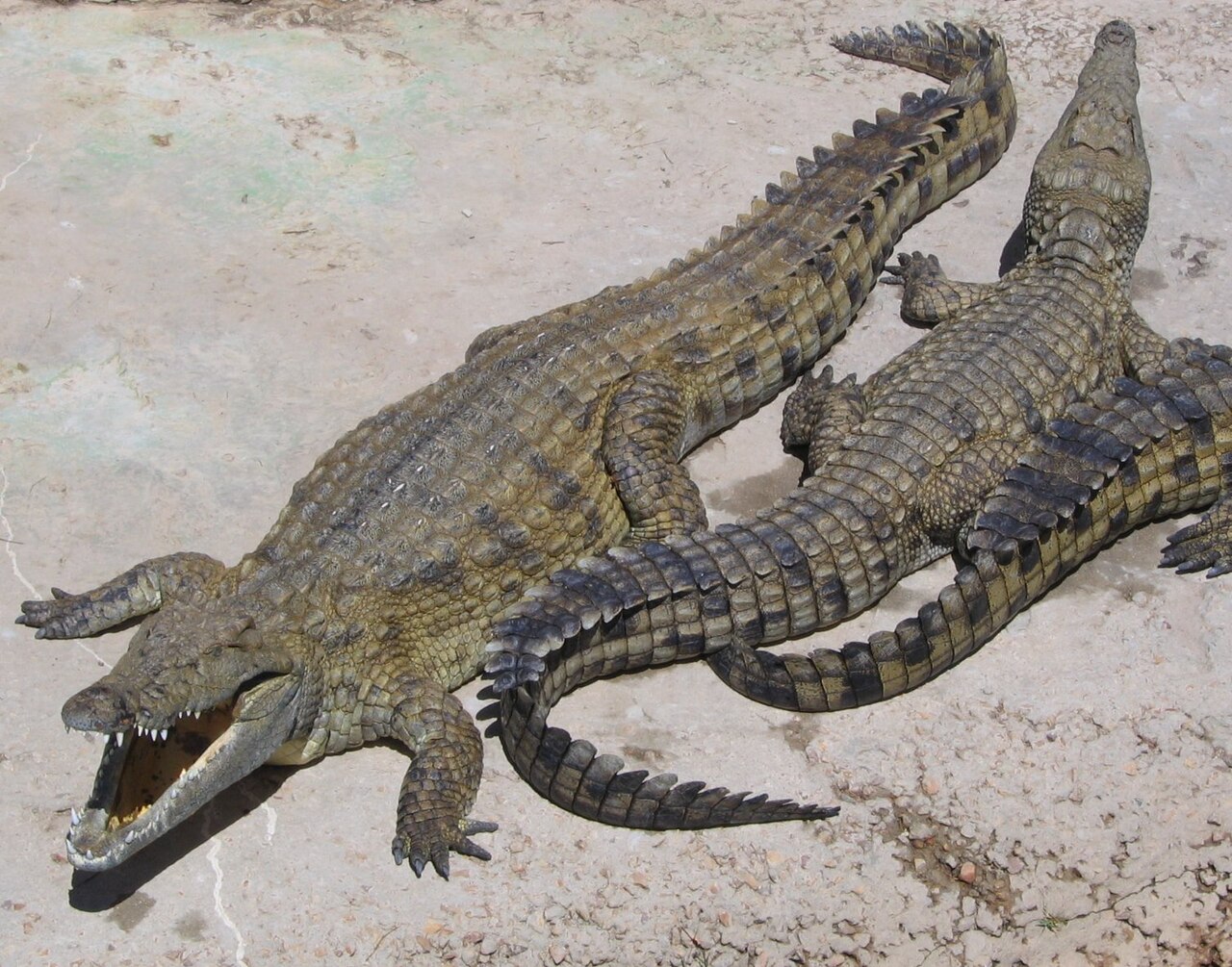
Dewet, Nile crocodile, taken at the Le Bonheur Crocodile Farm near Stellenbosch, South Africa. This file is licensed under the Creative Commons Attribution-Share Alike 2.0 Generic license.
Nile crocodiles are the second largest living reptile (the first is the saltwater crocodile), reaching an average length of between 11 and 16 feet for males, with some specimens on record exceeding 20 feet, and weighing between 500--1600 pounds (females are a bit smaller but still nothing to sneeze at). While it's called the Nile crocodile, it actually has a wider range than along the famous Egyptian river; it's found throughout the sub-Saharan region of Africa and can inhabit both freshwater and brackish (a mix of fresh and salt water) bodies of water, such as lakes, rivers, and deltas. Nile crocodiles share territory peacefully--with other Nile crocodiles, anyway, which is an anomaly for crocs, who tend not to be too social. They eat anything that comes their way, and are ambush hunters. Like all crocodiles, they have an incredible bite force and, once their jaws are closed, are almost impossible to pry open, and they are able to maintain their grip long enough to drown a large animal, if needed. (Ironically, the muscles that are used to open an alligator or crocodile mouth are weak, and a person who knows what they are doing could conceivably hold their mouths shut, but frankly, I don't recommend trying it.) Like sharks, crocodiles can shed and regenerate teeth as needed. They typically bask in the sun with their mouths open a lot during the day, absorbing the heat of the sun. Once threatened with extinction in their natural range, conservation has helped them (like their cousins the alligators) to bounce back to a non-threatened status. They have been released in southern areas of North America and are, in these places, considered invasive.
The would-be prey? The Egyptian plover.

By Steve Garvie from Dunfermline, Fife, Scotland - Egyptian Plover (Pluvianus aegyptius), CC BY-SA 2.0, https://commons.wikimedia.org/w/index.php?curid=11461452
Like all plovers, the Egyptian plover is a wading bird, and hangs out along the shores of rivers; it breeds and nests (eggs are laid in sand) on the shores of the larger rivers. Because they bury the eggs in the sand, and the sand can get quite hot, the birds have a very creative way of cooling the eggs if needed; they will wet their bellies and use them to cool the eggs. In fact, they also provide water to their young in the same way, and if adults feel the very young, still flightless chicks are in danger, they will bury them temporarily in the sand. The birds are seen in pairs or in small groups and do not form large flocks (the largest flocks tend to be around 60 birds). They eat mainly insects and worms, but will indulge in seeds as well. At this point in time, these pretty little birds, while their numbers are slightly in decline, are not declining quickly enough to yet warrant concern, and their population is considered of least concern regarding extinction.
Now for the symbiotic part: The story goes that the crocodile will wait with its mouth open, providing the visual cue inviting the plovers to clean the food from its teeth. Then the plover or plovers will go right up to the crocodile's mouth and start pecking away, grabbing the bits of food stuck between the crocodile's teeth--a relationship so unique that a toothbrush manufacturer that made children's toothbrushes for dentist offices used this team on the (non-bristle side) handle back during my childhood in the 70s. This makes for a great, dramatic "team"--but is it really true? Supposedly, there is no real evidence--no photos or videos depicting this sort of thing that haven't been faked or misinterpreted. Also, skeptics like to point out that it doesn't count as a symbiotic relationship even if birds do eat food bits from crocodile mouths, because that's just birds being scavengers taking advantage of dozing crocs with open mouths (remember their basking technique?), and that crocodiles, since they constantly shed their teeth like land sharks, don't need to worry about keeping their teeth clean.
So what do you think? Has anyone out there actually seen proof that the crocodiles "invite" the birds to clean their teeth? Or is it just plovers unable to resist an easy (albeit dangerous) meal?
Oh, and just FYI, in case you're wondering, here are the relatively quick ways to tell an alligator apart from a crocodile--again, not suggesting this should be tried outside of a zoo....
1. Snout shape: Alligators have shorter, thicker, more rounded (think "U" shape) snouts while crocodiles have longer, narrower, more pointed (think"V" shape) snouts.
2. Teeth: It's not the teeth themselves, but rather it's the way the jaws are shaped. An alligator's top jaw is considerably larger than the lower one, and so the top teeth can be seen when the alligator's mouth is closed, but the bottom ones can't. This means that an alligator's toothy grin is one-way; only the top teeth, pointing down, are visible. With crocodiles, some of both the lower and upper teeth are visible, creating a Jack-o-Lantern-like, jagged-toothed grin.
3. Location: Alligators are native only to North America*, and while there is a small population of crocodiles in the very southern part of the states, chances are pretty good that if you're in the U.S., you're looking at an alligator.
4. Manners: Well, neither particularly have great manners, but generally crocodiles are more aggressive on the whole, and have no problems with attacking unprovoked. Still, both are not to be trusted regarding temperament.
5. Habitat: While both crocodiles and alligators inhabit freshwater, as a general rule, if you find one of these fellows in a brackish or saltwater area, it's much more likely to be a crocodile, since crocs have glands that will secrete out any excess salt taken in, and while alligators do have these glands, they don't function as well.
*Sorry--there is one other place in the world with alligators, but they're much smaller than the American alligators--see >115 CassieBash:.
The predator? The Nile crocodile.
Dewet, Nile crocodile, taken at the Le Bonheur Crocodile Farm near Stellenbosch, South Africa. This file is licensed under the Creative Commons Attribution-Share Alike 2.0 Generic license.
Nile crocodiles are the second largest living reptile (the first is the saltwater crocodile), reaching an average length of between 11 and 16 feet for males, with some specimens on record exceeding 20 feet, and weighing between 500--1600 pounds (females are a bit smaller but still nothing to sneeze at). While it's called the Nile crocodile, it actually has a wider range than along the famous Egyptian river; it's found throughout the sub-Saharan region of Africa and can inhabit both freshwater and brackish (a mix of fresh and salt water) bodies of water, such as lakes, rivers, and deltas. Nile crocodiles share territory peacefully--with other Nile crocodiles, anyway, which is an anomaly for crocs, who tend not to be too social. They eat anything that comes their way, and are ambush hunters. Like all crocodiles, they have an incredible bite force and, once their jaws are closed, are almost impossible to pry open, and they are able to maintain their grip long enough to drown a large animal, if needed. (Ironically, the muscles that are used to open an alligator or crocodile mouth are weak, and a person who knows what they are doing could conceivably hold their mouths shut, but frankly, I don't recommend trying it.) Like sharks, crocodiles can shed and regenerate teeth as needed. They typically bask in the sun with their mouths open a lot during the day, absorbing the heat of the sun. Once threatened with extinction in their natural range, conservation has helped them (like their cousins the alligators) to bounce back to a non-threatened status. They have been released in southern areas of North America and are, in these places, considered invasive.
The would-be prey? The Egyptian plover.

By Steve Garvie from Dunfermline, Fife, Scotland - Egyptian Plover (Pluvianus aegyptius), CC BY-SA 2.0, https://commons.wikimedia.org/w/index.php?curid=11461452
Like all plovers, the Egyptian plover is a wading bird, and hangs out along the shores of rivers; it breeds and nests (eggs are laid in sand) on the shores of the larger rivers. Because they bury the eggs in the sand, and the sand can get quite hot, the birds have a very creative way of cooling the eggs if needed; they will wet their bellies and use them to cool the eggs. In fact, they also provide water to their young in the same way, and if adults feel the very young, still flightless chicks are in danger, they will bury them temporarily in the sand. The birds are seen in pairs or in small groups and do not form large flocks (the largest flocks tend to be around 60 birds). They eat mainly insects and worms, but will indulge in seeds as well. At this point in time, these pretty little birds, while their numbers are slightly in decline, are not declining quickly enough to yet warrant concern, and their population is considered of least concern regarding extinction.
Now for the symbiotic part: The story goes that the crocodile will wait with its mouth open, providing the visual cue inviting the plovers to clean the food from its teeth. Then the plover or plovers will go right up to the crocodile's mouth and start pecking away, grabbing the bits of food stuck between the crocodile's teeth--a relationship so unique that a toothbrush manufacturer that made children's toothbrushes for dentist offices used this team on the (non-bristle side) handle back during my childhood in the 70s. This makes for a great, dramatic "team"--but is it really true? Supposedly, there is no real evidence--no photos or videos depicting this sort of thing that haven't been faked or misinterpreted. Also, skeptics like to point out that it doesn't count as a symbiotic relationship even if birds do eat food bits from crocodile mouths, because that's just birds being scavengers taking advantage of dozing crocs with open mouths (remember their basking technique?), and that crocodiles, since they constantly shed their teeth like land sharks, don't need to worry about keeping their teeth clean.
So what do you think? Has anyone out there actually seen proof that the crocodiles "invite" the birds to clean their teeth? Or is it just plovers unable to resist an easy (albeit dangerous) meal?
Oh, and just FYI, in case you're wondering, here are the relatively quick ways to tell an alligator apart from a crocodile--again, not suggesting this should be tried outside of a zoo....
1. Snout shape: Alligators have shorter, thicker, more rounded (think "U" shape) snouts while crocodiles have longer, narrower, more pointed (think"V" shape) snouts.
2. Teeth: It's not the teeth themselves, but rather it's the way the jaws are shaped. An alligator's top jaw is considerably larger than the lower one, and so the top teeth can be seen when the alligator's mouth is closed, but the bottom ones can't. This means that an alligator's toothy grin is one-way; only the top teeth, pointing down, are visible. With crocodiles, some of both the lower and upper teeth are visible, creating a Jack-o-Lantern-like, jagged-toothed grin.
3. Location: Alligators are native only to North America*, and while there is a small population of crocodiles in the very southern part of the states, chances are pretty good that if you're in the U.S., you're looking at an alligator.
4. Manners: Well, neither particularly have great manners, but generally crocodiles are more aggressive on the whole, and have no problems with attacking unprovoked. Still, both are not to be trusted regarding temperament.
5. Habitat: While both crocodiles and alligators inhabit freshwater, as a general rule, if you find one of these fellows in a brackish or saltwater area, it's much more likely to be a crocodile, since crocs have glands that will secrete out any excess salt taken in, and while alligators do have these glands, they don't function as well.
*Sorry--there is one other place in the world with alligators, but they're much smaller than the American alligators--see >115 CassieBash:.
115CassieBash
>114 fuzzi: I can't help but smile at them; I like the crocodilians. There's a massive alligator at the Potawatami Zoo in South Bend; he's been there forever. The Chinese alligators (the only other alligator species in the world and, for some reason, I always think of them as small crocodiles) seem to no longer be at the zoo, or at least they no longer have a page. Their American alligator could eat any of their Chinese alligators for lunch and probably still have room for more.
I need to find time to go back to the zoo; not only do I like seeing the usual animals but now they have an endangered species carousel. I haven't ridden a carousel in years!
I need to find time to go back to the zoo; not only do I like seeing the usual animals but now they have an endangered species carousel. I haven't ridden a carousel in years!
116fuzzi
So, you like crocodiles? So does Rollin' Wild!
https://www.youtube.com/watch?v=QsRKYN8TeUg
https://www.youtube.com/watch?v=eFYB652Yns8
https://www.youtube.com/watch?v=QsRKYN8TeUg
https://www.youtube.com/watch?v=eFYB652Yns8
117CassieBash
>116 fuzzi: Hee, hee! I'd forgotten about Rollin' Wild! I hadn't seen the zebra one before. :)
Picture time! First, here are my Guardians of the To-Read Piles. They are, from left to right, Quetzie (short for Quetzalcoatl), Chezzie (short for Cheshire, as in cat), and Oculus (Latin for "eye"), since he has five.

The fish seem to have wintered over fine, once again, despite the ice disappearing and reappearing frequently this year:

And since this is a gardening thread, here are some pictures of my garden at this point in time. Remember, February in Indiana is still not conducive to growing, and very few things are up right now, except for the grape hyacinths, which will likely be blooming next month, and a few of the more intrepid wild flowers, like my Shortt's aster and Queen Anne's lace. Oh, and catnip. It never quite seems to die back completely. As you can see, the first thing I need to do is tidy up a bit--get rid of the old stalks and all the oak leaves and pine needles that have fallen.


Queen Anne's lace:

Grape hyacinth:

This should be the Shortt's aster; don't know what else it could be:

We aren't particularly close to a big body of water, and our property is mostly on a hill, so while we received the 5+ inches of rain that everyone in our area got, we escaped any sort of major flood damage. But we now have a nice view of our neighbor's new "lake".


It does this sort of thing, to varying degrees, every year. Sometimes large water and wading birds like cranes, herons, and even wild swans will visit. It's deep enough that there were geese swimming on it this weekend.
Picture time! First, here are my Guardians of the To-Read Piles. They are, from left to right, Quetzie (short for Quetzalcoatl), Chezzie (short for Cheshire, as in cat), and Oculus (Latin for "eye"), since he has five.

The fish seem to have wintered over fine, once again, despite the ice disappearing and reappearing frequently this year:

And since this is a gardening thread, here are some pictures of my garden at this point in time. Remember, February in Indiana is still not conducive to growing, and very few things are up right now, except for the grape hyacinths, which will likely be blooming next month, and a few of the more intrepid wild flowers, like my Shortt's aster and Queen Anne's lace. Oh, and catnip. It never quite seems to die back completely. As you can see, the first thing I need to do is tidy up a bit--get rid of the old stalks and all the oak leaves and pine needles that have fallen.


Queen Anne's lace:

Grape hyacinth:

This should be the Shortt's aster; don't know what else it could be:

We aren't particularly close to a big body of water, and our property is mostly on a hill, so while we received the 5+ inches of rain that everyone in our area got, we escaped any sort of major flood damage. But we now have a nice view of our neighbor's new "lake".


It does this sort of thing, to varying degrees, every year. Sometimes large water and wading birds like cranes, herons, and even wild swans will visit. It's deep enough that there were geese swimming on it this weekend.
118CassieBash
Critter of the Week: I’ve decided that with all the flooding, I wanted to do an unusual water animal for the week. I thought about it on and off throughout the weekend, but most of the animals that I came up with just weren’t unusual enough. Plus, for things I can find around here, like sandhill cranes and Canada geese and whatnot, I want to get my own photos instead of always relying on Wikimedia’s generosity with their Creative Commons files. So I decided to go through my own, old picture files here on LT and lo and behold! I found a creature that seems perfect—a very special lizard from the Central South American rainforests. This family of lizards—there are actually a few different species—are sometimes nicknamed the Jesus or the Jesus Christ lizard for their ability to walk (or rather run) on water, but they’re officially known as basilisk lizards.

These lizards can swim, but find it much faster to run across the surface of the water on two legs, hunting or escaping predators. How do they do it? Specially designed feet create pockets of air beneath them every time they take a step, but the trick is to keep moving. This video does a lot better job of explaining the science. If they stop running, they'll lose the ability to create those pockets, and they'll fall into the water. And they're fast, too, moving about 5 feet per second, for 15 feet or so. The basilisks are part of the iguana family, but they're much smaller, and their length is mostly their counter-balancing tail. Females lay clutches of eggs, up to 20, in a shallow trench they dig, and then leave the babies to fend for themselves. Fortunately, they are born with the ability to run (both on water and land), swim, and climb. Basilisks will eat fruit, vegetation, insects, and even small vertebrates. They can be found in captivity and are sold as pets, and they can be bred in captivity, which helps limit over-harvesting of wild specimens for the pet trade. While they are considered of least concern regarding their conservation status, their is a bit of concern as humans continue to encroach on their habitat.

These lizards can swim, but find it much faster to run across the surface of the water on two legs, hunting or escaping predators. How do they do it? Specially designed feet create pockets of air beneath them every time they take a step, but the trick is to keep moving. This video does a lot better job of explaining the science. If they stop running, they'll lose the ability to create those pockets, and they'll fall into the water. And they're fast, too, moving about 5 feet per second, for 15 feet or so. The basilisks are part of the iguana family, but they're much smaller, and their length is mostly their counter-balancing tail. Females lay clutches of eggs, up to 20, in a shallow trench they dig, and then leave the babies to fend for themselves. Fortunately, they are born with the ability to run (both on water and land), swim, and climb. Basilisks will eat fruit, vegetation, insects, and even small vertebrates. They can be found in captivity and are sold as pets, and they can be bred in captivity, which helps limit over-harvesting of wild specimens for the pet trade. While they are considered of least concern regarding their conservation status, their is a bit of concern as humans continue to encroach on their habitat.
119NorthernStar
>118 CassieBash: - These are cool lizards! I've seen them ( two different types, I think) when on holiday in Costa Rica and Nicaragua. You don't usually know they're there until they take off!
120CassieBash
>119 NorthernStar: Must be startling, but neat! I've never personally seen one running on water but I like the look of them, regardless. Like little dragons...the iguana family is wonderful!
121fuzzi
>118 CassieBash: I've seen videos of those lizards, too cool!
122CassieBash
>121 fuzzi: Lizards are one of the things that I wish we had here in northwest Indiana, but I know our climate's not suitable. Still, it would be cool to have some skinks running around....
123MarthaJeanne
We have little ones in our garden, and I love seeing them. But ours don't run on the water, as far as I know.
124CassieBash
This week's critter has been found in abundance here recently. This happens every spring and sometimes, if it's wet enough, throughout the summer periodically. They are seen just about everywhere in northwest Indiana, spring through fall, close to water or even not-so-close. Some have come from the relatively close body of water called Maxinkuckee Lake in Culver, Indiana, to visit our neighbor's pond...er, field. See all those white things out there? Each one of them is a gull.

They're probably ring billed gulls, which are common in northwest Indiana, although not necessarily. There are 31 species of gull that have been recorded as having been spotted in Indiana. But this widespread gull is likely the most common in the United States, as it has a huge range and is not at all shy about hanging out in places humans frequent.

Mdf, Wikimedia user. Ring-billed Gull -- Toronto, Ontario, Canada -- 2007 April
These gulls are decent-sized birds, with an adult wingspan of over 3 feet. The specific name for this species is from the black band or ring on the beak, seen in the picture from Wikipedia above. They hang out not just on shores but are also commonplace in parking lots, where they can scavenge food. They're everywhere in lots in St. Joseph County, and seem especially prevalent in strip mall lots up in Mishawaka and South Bend. Omnivorous, they'll eat anything from fish and insects to McDonalds french fries. Like many other birds, gulls must be wary of predators like raccoons, dogs, foxes, coyotes, cats, and even other birds like hawks, owls, and eagles. They are good travelers, not only migrating south for the winter but also flying sometimes to western Europe, particularly Britain and Ireland.
They nest in colonies and will return to the same nesting site every year, often an island where human interference is lessened. An interesting nesting story I read was that in some study sites, scientists found nests containing rocks that were the same size and shape of gull eggs; they think the parents mistook the rocks for stray eggs that had rolled from the ground nest and that they simply thought they were returning stray eggs to the nest.

They're probably ring billed gulls, which are common in northwest Indiana, although not necessarily. There are 31 species of gull that have been recorded as having been spotted in Indiana. But this widespread gull is likely the most common in the United States, as it has a huge range and is not at all shy about hanging out in places humans frequent.

Mdf, Wikimedia user. Ring-billed Gull -- Toronto, Ontario, Canada -- 2007 April
These gulls are decent-sized birds, with an adult wingspan of over 3 feet. The specific name for this species is from the black band or ring on the beak, seen in the picture from Wikipedia above. They hang out not just on shores but are also commonplace in parking lots, where they can scavenge food. They're everywhere in lots in St. Joseph County, and seem especially prevalent in strip mall lots up in Mishawaka and South Bend. Omnivorous, they'll eat anything from fish and insects to McDonalds french fries. Like many other birds, gulls must be wary of predators like raccoons, dogs, foxes, coyotes, cats, and even other birds like hawks, owls, and eagles. They are good travelers, not only migrating south for the winter but also flying sometimes to western Europe, particularly Britain and Ireland.
They nest in colonies and will return to the same nesting site every year, often an island where human interference is lessened. An interesting nesting story I read was that in some study sites, scientists found nests containing rocks that were the same size and shape of gull eggs; they think the parents mistook the rocks for stray eggs that had rolled from the ground nest and that they simply thought they were returning stray eggs to the nest.
125fuzzi
>124 CassieBash: I think the gulls are smart to put "eggs" back in their nest!
As a child I'd ride with my dad while he was doing his errands on Saturday mornings, and we used to disturb a cloud of gulls when driving into the garbage dump.
As a child I'd ride with my dad while he was doing his errands on Saturday mornings, and we used to disturb a cloud of gulls when driving into the garbage dump.
126CassieBash
>125 fuzzi: I actually read something about local gull populations dropping when open dumps suddenly were filled in and cleaned up, until they moved onto another site with open garbage. They are great scavengers.
129CassieBash
>127 lesmel: & >128 fuzzi: Well, they do kind of sound and act like that.... I've seen the squabbles over fast food in the parking lots in Mishawaka.
130CassieBash
This week's critter has been inspired by my last read, An Orchard Invisible, which mentions a symbiotic relationship between the yucca plant and a family of moths that feeds on the yucca seeds, the yucca moths. This family has two types of members: those who play by the rules and those who cheat the system.

By J. Arthur Thomson. Public domain, via Wikimedia Commons
For clearer but copyright-protected pictures, see this page on BugGuide.net.
First, to understand this, you have to know what the system is and how it works. Yucca plants produce flowers that are difficult for many pollinators to pollinate, and they have developed a mutually beneficial system to have their flowers pollinated by a specific group of moths in the Prodoxodae family (which also includes other, non-yucca moth members). Unlike most other cases of insect-pollination, yucca moths purposefully pollinate the flowers, laying her eggs at the same time, because their caterpillars will eat from the developing seeds. In order to get pollinated, in other words, the yucca plant is willing to sacrifice a certain number of seeds to the yucca moths, and in order to perpetuate their own species, the caterpillars leave a certain number of seeds untouched. Ah, the balance of nature, eh? It's a bit weird, but it works.
Until the cheats enter. Yucca plants can, within a certain window of time, abort any seed pod that it senses has too many caterpillars in it. In this way, the yucca can control to a certain extent how much predation of its seeds occurs. But after that window of time, it holds onto the seeds no matter how many caterpillars are in it, and this is how the cheats work. They wait until the window of opportunity to abort has passed, and then lay eggs. However, the number of species that follows the rules seem to be greater than the cheats, so at least in theory (and fortunately for the yucca) there are more who play by the system than not.
So there you have it; I can't tell you for sure which pictures on the BugGuide site are the rule breakers without having the scientific names, but I can tell you that Wikipedia says the rule-breaker is Tegeticula intermedia. Unfortunately, Wikipedia didn't have a Creative Commons or public domain picture to go with its page.

By J. Arthur Thomson. Public domain, via Wikimedia Commons
For clearer but copyright-protected pictures, see this page on BugGuide.net.
First, to understand this, you have to know what the system is and how it works. Yucca plants produce flowers that are difficult for many pollinators to pollinate, and they have developed a mutually beneficial system to have their flowers pollinated by a specific group of moths in the Prodoxodae family (which also includes other, non-yucca moth members). Unlike most other cases of insect-pollination, yucca moths purposefully pollinate the flowers, laying her eggs at the same time, because their caterpillars will eat from the developing seeds. In order to get pollinated, in other words, the yucca plant is willing to sacrifice a certain number of seeds to the yucca moths, and in order to perpetuate their own species, the caterpillars leave a certain number of seeds untouched. Ah, the balance of nature, eh? It's a bit weird, but it works.
Until the cheats enter. Yucca plants can, within a certain window of time, abort any seed pod that it senses has too many caterpillars in it. In this way, the yucca can control to a certain extent how much predation of its seeds occurs. But after that window of time, it holds onto the seeds no matter how many caterpillars are in it, and this is how the cheats work. They wait until the window of opportunity to abort has passed, and then lay eggs. However, the number of species that follows the rules seem to be greater than the cheats, so at least in theory (and fortunately for the yucca) there are more who play by the system than not.
So there you have it; I can't tell you for sure which pictures on the BugGuide site are the rule breakers without having the scientific names, but I can tell you that Wikipedia says the rule-breaker is Tegeticula intermedia. Unfortunately, Wikipedia didn't have a Creative Commons or public domain picture to go with its page.
131fuzzi
>130 CassieBash: I've heard of the Yucca moth and Yucca plant's relationship before, but not in such detail, and never heard about the "cheaters" either!
132CassieBash
It snowed enough, on and off (and heavily too, at times) to accumulate a decent layer. Now that the sun's been out for about an hour, it's all melted unless it's in shadow. For those of you who are "Simpsons" fans: lousy Smarch weather.
133CassieBash
Critter of the Week: Yesterday was our first nice day in a long time, actually making it into the 50s (the low 50s, but the 50s, nonetheless). Our earliest crocus are in bloom, and I saw a species of native bee that is common in Indiana but often goes unnoticed. This bee is a laid-back, not likely to sting species, and probably to the untrained or inattentive eye gets mistaken for a honeybee. (The size is a little smaller but not too far off, and the general shape is close, but the color is all wrong--this species is best described as being dull in color, rather than the striking yellow and black of the honeybee, though other species of this family are more brightly hued.) Instead of building hives, it lives in holes. Ever seen those bee houses, the ones with the hollow bamboo tubes arranged in clusters in a frame? These bees (as well as a few other bee and wasp families) use these holes to lay their eggs, providing food for their young ones in the chambers. Like honeybees, they live off pollen and nectar, and so they are great pollinators. Not as likely to sting as a honeybee, these bees are solitary but generally are considered good neighbors if you're a gardener, as they will pollinate like crazy and will stay out of your way as a general rule. You can even pass fairly close to their nests without too much fear, as long as you don't get too nosy and start messing with the mud caps that indicate a brood chamber--this is where they get their name, by building mud-brick walls to seal their brooding nests. This week's critter is the mason bee:

Blue orchard bee: This picture was taken specifically for the Beekeeping Wiki book, but may be used for any purpose for which it is fit.
Now, this particular mason bee isn't the one I saw (though I think we have these; I've seen similar if not identical ones later in the season), but I think what I saw was likely Osmia distincta, a much greyer-looking specimen and not particularly colorful, but beautiful and certainly useful in its own right. Here are the benefits to attracting these bees:
1. Highly active pollinators. Because their young as well as the adults feed on pollen and nectar, they are always visiting flowers. Some speculate that if the North American honeybee should completely collapse, this native pollinator will help pick up the slack. And because these are one of the first bee species on the scene, they pollinate early bloomers, like crocus and daffodils when other pollinators are still in "cold storage". How effective are they? Apparently, two or three industrious females, collecting pollen for their broods, can pollinate an entire mature apple tree on their own.
2. They are calm and are not likely to sting--so you can work in your garden around them with little fear.
3. They use holes in wood, but they don't make holes. They only find existing holes and, unlike paper wasps and some other species of wasps and bees, don't chew up buildings to make their nests.
4. They are hardier in North America than the non-native honeybees, and being solitary, they are less likely to suffer from "hive collapse". It's hard for a hive to collapse if it doesn't exist.
The only thing these bees don't do that the honeybee does is (you may have guessed this) make honey. So while the honey industry struggles, there is at least hope for other agricultural venues regarding pollinators. There are lots of places in North America that not only provide the houses, but sell the bees as well, much like how you can get praying mantis egg cases. (As many praying mantises and their egg cases as I find on our property, I could probably make a little extra money selling the egg cases myself, if I wanted.)
So for all those friends in North America, working in your gardens and orchards and flower beds, keep an eye out for members of this family. They're definitely worth a second look.

Blue orchard bee: This picture was taken specifically for the Beekeeping Wiki book, but may be used for any purpose for which it is fit.
Now, this particular mason bee isn't the one I saw (though I think we have these; I've seen similar if not identical ones later in the season), but I think what I saw was likely Osmia distincta, a much greyer-looking specimen and not particularly colorful, but beautiful and certainly useful in its own right. Here are the benefits to attracting these bees:
1. Highly active pollinators. Because their young as well as the adults feed on pollen and nectar, they are always visiting flowers. Some speculate that if the North American honeybee should completely collapse, this native pollinator will help pick up the slack. And because these are one of the first bee species on the scene, they pollinate early bloomers, like crocus and daffodils when other pollinators are still in "cold storage". How effective are they? Apparently, two or three industrious females, collecting pollen for their broods, can pollinate an entire mature apple tree on their own.
2. They are calm and are not likely to sting--so you can work in your garden around them with little fear.
3. They use holes in wood, but they don't make holes. They only find existing holes and, unlike paper wasps and some other species of wasps and bees, don't chew up buildings to make their nests.
4. They are hardier in North America than the non-native honeybees, and being solitary, they are less likely to suffer from "hive collapse". It's hard for a hive to collapse if it doesn't exist.
The only thing these bees don't do that the honeybee does is (you may have guessed this) make honey. So while the honey industry struggles, there is at least hope for other agricultural venues regarding pollinators. There are lots of places in North America that not only provide the houses, but sell the bees as well, much like how you can get praying mantis egg cases. (As many praying mantises and their egg cases as I find on our property, I could probably make a little extra money selling the egg cases myself, if I wanted.)
So for all those friends in North America, working in your gardens and orchards and flower beds, keep an eye out for members of this family. They're definitely worth a second look.
134CassieBash
A moment of silence, please, for the passing of the last male northern white rhinoceros, Sudan. With the loss of every species, our biodiversity dwindles. Life is fragile, and I think we as a species tend to forget that. Even though there are still southern white rhinos, whose numbers have risen considerably thanks to conservation efforts, the two were genetically different enough to each be their own subspecies.
I really liked the picture on the article above; clearly, Sudan was well-cared for and beloved by his protectors and guards, and he clearly enjoyed human attention, as can be seen here, too. At least he is no longer in pain. May he rest in peace.
In addition, I am praying for those impacted by the tornadoes and other severe weather down south.
I really liked the picture on the article above; clearly, Sudan was well-cared for and beloved by his protectors and guards, and he clearly enjoyed human attention, as can be seen here, too. At least he is no longer in pain. May he rest in peace.
In addition, I am praying for those impacted by the tornadoes and other severe weather down south.
135fuzzi
>134 CassieBash: I saw that, sad. The article I read said they have preserved his sperm and hope to impregnate the two remaining females of his species.
It's severe weather season, unfortunately. We lived along the I-85 corridor in SC for years, never saw a tornado but they were there, their path often following that interstate highway.
I recall seeing the sky turn green once.
It's severe weather season, unfortunately. We lived along the I-85 corridor in SC for years, never saw a tornado but they were there, their path often following that interstate highway.
I recall seeing the sky turn green once.
136CassieBash
>135 fuzzi: I'm fascinated with tornadoes but never want to experience one personally again. Ours was rain-wrapped and at night, and because it did no damage to any major structures like several other tornadoes that came with that storm (Nappanee was hit particularly hard), I don't think ours was ever officially called. But based on the weird damage done to some of the trees in our horse pasture (the horses were in the barn, which fortunately wasn't touched), I'd say tornado. One tree's trunk was literally twisted off, so it seemed like definite rotation. We spent quite some time in the basement with the dogs and as many of our house cats as we could find and stuff in carriers. And yes, it sounded like a train, complete with whistle, actually. I think that was some of the wind howling around the house in a weird way.
Stay safe, everyone.
Stay safe, everyone.
137Lyndatrue
>136 CassieBash: If you were nearby, I'd offer you a cup of some nice hot herb tea, and maybe some cookies. After something like that passes by, it takes a while for it to settle back out of your bones. I'm glad that you seemed to mostly weather it, although the tree trunk being twisted off doesn't sound too good for that tree.
Here's a memory, from the early sixties. The photo was made from a slide, and the streak across it is an artifact of the process, not anything in the sky. Yes, those are a few cattle in the distance.

Here's a memory, from the early sixties. The photo was made from a slide, and the streak across it is an artifact of the process, not anything in the sky. Yes, those are a few cattle in the distance.

138CassieBash
>137 Lyndatrue: The tornado happened a long time ago--about 10 years back or so, but the memory of my family, human and animal, huddled in the basement, wondering what was going to happen to the house, the barn, the horses. We had a weather radio with fully charged batteries--a must--that at least kept us in the loop regarding where all the warnings were, and what ones had expired. I will always have, from spring through fall, a set of 4 fully charged AA batteries for that radio (which I've affectionately named NOAA). Unfortunately, the tornado messed up so many power lines in the area that we were without electricity (and thus also water and heat--which we fortunately didn't need because this happened in August) for a week. We had friends who brought us a big tub of water for the horses to drink, because by the end of the week, they were running very low. Oh, and the tree didn't survive.
My interest in tornadoes is due in part to this historic image from a tornado outbreak (Palm Sunday 1965, Dunlap, Indiana) that happened before I was born; my parents had saved a clipping that I came across when I was a child:

By Paul Huffman for National Oceanic and Atmospheric Administration - http://www.photolib.noaa.gov/htmls/wea00217.htm, Public Domain, https://commons.wikimedia.org/w/index.php?curid=10688893
I don't know--do you think I was a rather disturbed child? I had a fascination for tornadoes, Egyptian mummies, and funeral customs, even at a young age.
My interest in tornadoes is due in part to this historic image from a tornado outbreak (Palm Sunday 1965, Dunlap, Indiana) that happened before I was born; my parents had saved a clipping that I came across when I was a child:

By Paul Huffman for National Oceanic and Atmospheric Administration - http://www.photolib.noaa.gov/htmls/wea00217.htm, Public Domain, https://commons.wikimedia.org/w/index.php?curid=10688893
I don't know--do you think I was a rather disturbed child? I had a fascination for tornadoes, Egyptian mummies, and funeral customs, even at a young age.
139Lyndatrue
>138 CassieBash: No, not disturbed at all. When I was a child, I resented falling asleep, because it meant that I couldn't keep reading. I've always wanted to *know* things, and there's never a time where I don't have something new that I didn't know before.
140fuzzi
>137 Lyndatrue: is there a tornado in that photo? I don't see one...
>138 CassieBash: we have a weather radio, too. Hmm, need to check the batteries, it's almost April.
>139 Lyndatrue: I *still* don't want to fall asleep when I'm reading.
>138 CassieBash: we have a weather radio, too. Hmm, need to check the batteries, it's almost April.
>139 Lyndatrue: I *still* don't want to fall asleep when I'm reading.
141Lyndatrue
>140 fuzzi: Gosh, no, there's no tornado at all. That was the joy in it. Just a beautiful countryside, with the Bitterroot Mountains in the distance. Then again, when I look at it closely, it might be that the Bitterroots are behind the photographer's view, and those mountains are the Rockies. It's lovely, and I'm sure it no longer looks like that, but I can pretend that it does...
I just spent some lost time, looking at places today that I remember from those earlier times, and even though it isn't as built up as many places, I still feel sad and wistful.
Everything changes. Everything.
I just spent some lost time, looking at places today that I remember from those earlier times, and even though it isn't as built up as many places, I still feel sad and wistful.
Everything changes. Everything.
142CassieBash
>139 Lyndatrue: And I was the weird kid who liked to brush my teeth and go to bed when I was tired, even if it was before bedtime. Not so with my sisters.
>140 fuzzi: Yes, definitely check the batteries.
>141 Lyndatrue: It's a peaceful picture. We don't have mountains in Indiana so it's nice to look at the pictures of them. I also like desert scenes. And cows are nice, too (even though we have them in Indiana, my opinion is that you can never see too many pictures of living animals).
>140 fuzzi: Yes, definitely check the batteries.
>141 Lyndatrue: It's a peaceful picture. We don't have mountains in Indiana so it's nice to look at the pictures of them. I also like desert scenes. And cows are nice, too (even though we have them in Indiana, my opinion is that you can never see too many pictures of living animals).
143fuzzi
>141 Lyndatrue: I liked your photo, nice bucolic view, just was wondering if there was a funnel cloud I was missing.
It has been said "You can never go home again, and it's SO true. My childhood town had an off-season population of 3000, it's probably ten times that now. All the old "stomping grounds" are gone, paved over or built upon.
I'd like to see the Rockies sometime.
>142 CassieBash: I was like Harriet the Spy, reading at night by flashlight, under the blankets.
It has been said "You can never go home again, and it's SO true. My childhood town had an off-season population of 3000, it's probably ten times that now. All the old "stomping grounds" are gone, paved over or built upon.
I'd like to see the Rockies sometime.
>142 CassieBash: I was like Harriet the Spy, reading at night by flashlight, under the blankets.
144CassieBash
In honor of Easter, Passover, and March's end, I am honoring the lamb (OK, technically, a lamb is but a young sheep, so in essence we'll honor sheep, but I'm going to focus on how lambs play into this time of year).
Let's start with March's saying, "in like a lion, out like a lamb," which seems pretty straightforward, right? Well, between the three, a bit of research has revealed that it may be more complex than thinking of the fierce lion as bad weather and the gentle lamb as good (and we won't discuss what animal might represent the March weather when it's not quite good or bad--maybe Grumpy Cat?). A few websites I found have suggested that Leo is usually the rising sign in the astrological world, and that by the time March ends, it's Aries the ram. In Christianity Jesus was sacrificed like a lamb, but will return as the Lion of Judah, and perhaps that explains the years when March starts mildly but ends with a roar of bad weather--or maybe it's for those years when March may leave like a lamb, but April sees the return of the bad weather.
Since Passover happened before Jesus's birth, lets start with it--it sets up some background as to the importance of the sacrifice of lambs traditionally in both the Jewish and Christian faiths. Passover is when the Israelites left Egypt, and the firstborn of the Egyptians were killed. To show that the household was an Israelite's home, families sacrificed lambs, put the blood on the doorposts, and cooked and ate the sacrifice (thus why lamb is traditional to eat at Passover). God knew that his faithful lived in houses with the blood of lambs on the doors, and passed over them, and all other houses suffered the loss of their firstborn sons. Lamb is still the traditional meal for Passover, even if only a few ever perform the full sacrificial ritual anymore.
Christianity, of course, often compares Jesus's sacrifice to that of the sacrificial lamb, and that's why lambs have become, along with rabbits and chickens (or at least their eggs), symbols of Easter. Christians see Jesus, the gentle and good Messiah who often used sheep in his parables, as the innocent sacrifice. Lamb is also eaten by Christians, the earliest of whom were Jews, and therefore most theologians feel that the custom simply carried over.
Let's start with March's saying, "in like a lion, out like a lamb," which seems pretty straightforward, right? Well, between the three, a bit of research has revealed that it may be more complex than thinking of the fierce lion as bad weather and the gentle lamb as good (and we won't discuss what animal might represent the March weather when it's not quite good or bad--maybe Grumpy Cat?). A few websites I found have suggested that Leo is usually the rising sign in the astrological world, and that by the time March ends, it's Aries the ram. In Christianity Jesus was sacrificed like a lamb, but will return as the Lion of Judah, and perhaps that explains the years when March starts mildly but ends with a roar of bad weather--or maybe it's for those years when March may leave like a lamb, but April sees the return of the bad weather.
Since Passover happened before Jesus's birth, lets start with it--it sets up some background as to the importance of the sacrifice of lambs traditionally in both the Jewish and Christian faiths. Passover is when the Israelites left Egypt, and the firstborn of the Egyptians were killed. To show that the household was an Israelite's home, families sacrificed lambs, put the blood on the doorposts, and cooked and ate the sacrifice (thus why lamb is traditional to eat at Passover). God knew that his faithful lived in houses with the blood of lambs on the doors, and passed over them, and all other houses suffered the loss of their firstborn sons. Lamb is still the traditional meal for Passover, even if only a few ever perform the full sacrificial ritual anymore.
Christianity, of course, often compares Jesus's sacrifice to that of the sacrificial lamb, and that's why lambs have become, along with rabbits and chickens (or at least their eggs), symbols of Easter. Christians see Jesus, the gentle and good Messiah who often used sheep in his parables, as the innocent sacrifice. Lamb is also eaten by Christians, the earliest of whom were Jews, and therefore most theologians feel that the custom simply carried over.
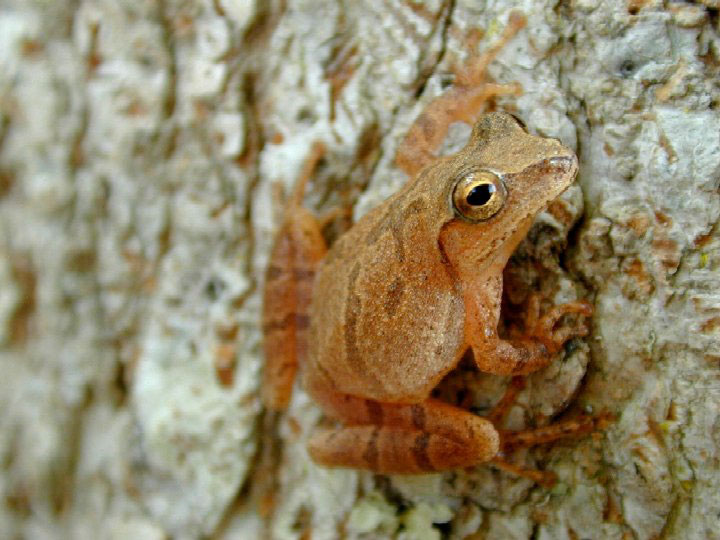
146fuzzi
Peepers!
I enjoyed your lamb/lion article, too.
Here's something I thought would interest you: https://madmimi.com/p/f013fb?fe=1&pact=1377004-144690545-8021961857-a1cb8710...
I enjoyed your lamb/lion article, too.
Here's something I thought would interest you: https://madmimi.com/p/f013fb?fe=1&pact=1377004-144690545-8021961857-a1cb8710...
147CassieBash
>146 fuzzi: And one in every four species of animal (that's 25% of all known animal species!) on the planet is a beetle. Can you imagine how many different species there are? There are 12,000 in the U.S. alone.
One of the books I got from the library sale is a nonfiction on insect/human relationships. After taking out a few more fiction reads, I might have to tackle that one--just in time for gardening season! :)
One of the books I got from the library sale is a nonfiction on insect/human relationships. After taking out a few more fiction reads, I might have to tackle that one--just in time for gardening season! :)
148CassieBash
Now that the weather is teasing us with the occasional spring-like day (often sandwiched between winter-like ones), I've been out to see my garden a few times. Unfortunately, the moles have been busy visiting, too, which seems to me to be an appropriate Critter of the Week:

We all know that moles can be problematic (or, specifically, their tunnels can), undermining plants and pushing up dirt as they dig. But they actually have a beneficial side to them, too, as they eat a lot of insects (they are true insectivores, and don't belong to the omnivorous rodent family) that can be equally damaging to plants: slugs, crickets, beetle and moth larvae, ants, and other invertebrate creatures. And while most of its diet is worms, like its meal ticket, moles also aerate the soil. They often follow worms and will adjust the depths of their tunnels accordingly, so when the ground is damp and worms head for the surface, moles do the same. When it's dry out for a long time, and worms decide to burrow deeper, so too will the moles. And they are exceptional diggers--they can dig 100 feet per day looking for food.
We always hear "blind as a bat", but "blind as a mole" is more fitting. These creatures compensate with excellent senses of smell, hearing, and touch. Male moles are territorial with other males and therefore you probably don't have more than a few moles in the average yard (but because they can dig 100 foot tunnels, it may seem like more). Unless there is a female mole with her litter of 3-5 little ones in your area, that is--the mother will care for them for several weeks before they split up and go their separate ways to find territories of their own. In fact, the only time you may see a mole above ground (like in the photo above) is when the animal is gathering materials for its nest.
Moles, hedgehogs, and shrews are among the other members of the class Insectivora, which has about 400 species. Most common in Indiana is the Eastern mole (as shown in the photo), but up in our part of the state, we also have star-nosed moles.

We all know that moles can be problematic (or, specifically, their tunnels can), undermining plants and pushing up dirt as they dig. But they actually have a beneficial side to them, too, as they eat a lot of insects (they are true insectivores, and don't belong to the omnivorous rodent family) that can be equally damaging to plants: slugs, crickets, beetle and moth larvae, ants, and other invertebrate creatures. And while most of its diet is worms, like its meal ticket, moles also aerate the soil. They often follow worms and will adjust the depths of their tunnels accordingly, so when the ground is damp and worms head for the surface, moles do the same. When it's dry out for a long time, and worms decide to burrow deeper, so too will the moles. And they are exceptional diggers--they can dig 100 feet per day looking for food.
We always hear "blind as a bat", but "blind as a mole" is more fitting. These creatures compensate with excellent senses of smell, hearing, and touch. Male moles are territorial with other males and therefore you probably don't have more than a few moles in the average yard (but because they can dig 100 foot tunnels, it may seem like more). Unless there is a female mole with her litter of 3-5 little ones in your area, that is--the mother will care for them for several weeks before they split up and go their separate ways to find territories of their own. In fact, the only time you may see a mole above ground (like in the photo above) is when the animal is gathering materials for its nest.
Moles, hedgehogs, and shrews are among the other members of the class Insectivora, which has about 400 species. Most common in Indiana is the Eastern mole (as shown in the photo), but up in our part of the state, we also have star-nosed moles.
149CassieBash
This week's critter is the raccoon, God's monkey of North America. OK, so they're not primates, they're carnivora, but these creatures get into the mischief that monkeys do in other parts of the world. Ours are notorious for eating underneath our bird feeders. But right now, in certain places in Ohio, they're apparently also suffering from a disease that all dog owners (and some cat owners) are familiar with, if only via their pets' annual vet vaccinations--distemper. This particular distemper strain is apparently not likely to infect cats, but local vets are warning dog owners to keep their dogs from contact with raccoons.

We have a sick raccoon in our area (that's it in the picture), but we think it's just ancient and nearing the end of its life. It hasn't been exhibiting the signs of the distemper raccoons (standing, literally, on its hind legs and baring its teeth), but rather seems stiff and arthritic. It's been coming out to eat under the bird feeders a bit earlier than the others, and we know where it's daytime hidey-hole is. Still, we do keep an eye out for it before letting the dogs outside off leash (or even on leash, as they will get worked up). No sense taking chances.
Our raccoon, like other raccoons, still likes to live in hollows found in trees:

If you remember the big double-trunked elm out by the bird feeder station where I took all those turkey pictures, out by the horse pasture--the area where the trunks meet have become hollowed out, and the above picture is what we found inside one day. If you look closely, you can see part of the mask and the ear.
Raccoons are known for some interesting behavior, including dousing or the habit of "washing" their food, though wildlife experts say this behavior has less to do with cleansing the food of dirt than it does with removing inedible parts of shellfish or other favorite foods. They're highly intelligent in many, mainly food-gathering and finding ways, that often makes them pests, getting into garbage when it's not secured well or finding out how to get food out of Fido's or Kitty's bowls without too much fuss, particularly if the dog or cat is timid and small. Raccoons can get pretty nasty when they're upset. They're frequently pests in the garden, digging for bugs and worms and sometimes digging up plants. They can get into sheds and out buildings and rummage around until they break things or knock things over. Many people hate their bad habits and wish they would go someplace else--or they hunt them as nuisances.
But come on, you have to admit--they have awfully cute faces. :)

We have a sick raccoon in our area (that's it in the picture), but we think it's just ancient and nearing the end of its life. It hasn't been exhibiting the signs of the distemper raccoons (standing, literally, on its hind legs and baring its teeth), but rather seems stiff and arthritic. It's been coming out to eat under the bird feeders a bit earlier than the others, and we know where it's daytime hidey-hole is. Still, we do keep an eye out for it before letting the dogs outside off leash (or even on leash, as they will get worked up). No sense taking chances.
Our raccoon, like other raccoons, still likes to live in hollows found in trees:

If you remember the big double-trunked elm out by the bird feeder station where I took all those turkey pictures, out by the horse pasture--the area where the trunks meet have become hollowed out, and the above picture is what we found inside one day. If you look closely, you can see part of the mask and the ear.
Raccoons are known for some interesting behavior, including dousing or the habit of "washing" their food, though wildlife experts say this behavior has less to do with cleansing the food of dirt than it does with removing inedible parts of shellfish or other favorite foods. They're highly intelligent in many, mainly food-gathering and finding ways, that often makes them pests, getting into garbage when it's not secured well or finding out how to get food out of Fido's or Kitty's bowls without too much fuss, particularly if the dog or cat is timid and small. Raccoons can get pretty nasty when they're upset. They're frequently pests in the garden, digging for bugs and worms and sometimes digging up plants. They can get into sheds and out buildings and rummage around until they break things or knock things over. Many people hate their bad habits and wish they would go someplace else--or they hunt them as nuisances.
But come on, you have to admit--they have awfully cute faces. :)
150fuzzi
>148 CassieBash: I thought of The Wind in the Willows as I read about moles.
>149 CassieBash: we have raccoons that live in the woods next to our house. They like to eat the feral cat food, and do sometimes get into our garbage. I have baffles on both my bird feeder poles, so they can't access the suet and seed. They also apparently can't do any fishing in my pond as the sides drop down 90 degrees, and raccoons like a gradual entry.
I've got lots of raccoon stories...
>149 CassieBash: we have raccoons that live in the woods next to our house. They like to eat the feral cat food, and do sometimes get into our garbage. I have baffles on both my bird feeder poles, so they can't access the suet and seed. They also apparently can't do any fishing in my pond as the sides drop down 90 degrees, and raccoons like a gradual entry.
I've got lots of raccoon stories...
151CassieBash
>150 fuzzi: I believe they can swim, but they don't dive, and prefer wading to actually swimming. Our fish tend to be safe from raccoons as well, due to the steep sides and depth of the pond. And our garbage bin is this big plastic thing that they can't climb and therefore can't access. I've seen younger, stronger coons climb up the bird feeder pole out front sometimes, but most of the time they just scrounge around on the ground, picking up the easy access leftovers. The opossum in our crib is the same way; we scared him so badly coming home Saturday evening, he was running with his tail in the air, hotfooting it for the crib. The old raccoon tends to ignore you until the last minute, and then sort of ambles off.
152fuzzi
>151 CassieBash: we had Momma bring three babies with her to eat of the feral's food, about a month ago. I did NOT allow my dog to chase, but encouraged her to bark loudly (GSD bark, very scary!) and I imagine the kits learned a lesson about avoiding the house with that big black thing.
153CassieBash
Snow. *Sigh.* When will we be done with snow???
On the other hand, no tornadoes. Stay safe this storm season, everyone.
Critter of the Week:
My sister said that on her drive home the other day, she saw one of the most beautiful birds in Indiana--and one we certainly don't want to see too close to our pond: the belted kingfisher!

Male Belted Kingfisher Megaceryle alcyon, Morro Bay, California. Canon 40D with 300mm f/2.8L IS, 580EX flash with Better Beamer in ETTL mode FEC 0.
By Kevin Cole from Pacific Coast, USA (en:User:Kevinlcole) (Belted Kingfisher (Megaceryle alcyon)) CC BY 2.0 (https://creativecommons.org/licenses/by/2.0), via Wikimedia Commons
There are three distinct subfamilies of kingfishers: tree, water, and river (belted ones are water kingfishers). Water kingfishers like the belted are fish-catching experts and the belted is the only one common throughout the U.S. and Canada, with most other kingfishers in the Americas living much farther south. Reaching measurements up to a little over a foot long and with a wingspan almost up to twice their body size, these crested birds dive to catch fish and crayfish. There is a bit of a difference between the male and female belted's coloration, though both are pretty, with the bright blue of the male below translating into a beautiful, soft grey in the females. They love to nest in burrows along ditches and grades made by roads and gravel pits, close to water where they can find prey, if at all possible, but despite the fact that our creation of these areas throughout Canada and the U.S. may have given them a broader breeding range, recent studies show that the overall population may be slowly declining. Birds are territorial and will defend their area against other kingfishers, so usually only a pair will be in any given space. A male belted kingfisher will help not only with raising the young but with digging the nesting tunnel, which averages 3-6 feet long (that's a lot of digging for a pair of birds). Usually, 6 or so eggs are laid and the young develop quickly, leaving the nest in a little less than a month but sticking around for up to 3 more weeks to still be fed by their parents.
On the other hand, no tornadoes. Stay safe this storm season, everyone.
Critter of the Week:
My sister said that on her drive home the other day, she saw one of the most beautiful birds in Indiana--and one we certainly don't want to see too close to our pond: the belted kingfisher!

Male Belted Kingfisher Megaceryle alcyon, Morro Bay, California. Canon 40D with 300mm f/2.8L IS, 580EX flash with Better Beamer in ETTL mode FEC 0.
By Kevin Cole from Pacific Coast, USA (en:User:Kevinlcole) (Belted Kingfisher (Megaceryle alcyon)) CC BY 2.0 (https://creativecommons.org/licenses/by/2.0), via Wikimedia Commons
There are three distinct subfamilies of kingfishers: tree, water, and river (belted ones are water kingfishers). Water kingfishers like the belted are fish-catching experts and the belted is the only one common throughout the U.S. and Canada, with most other kingfishers in the Americas living much farther south. Reaching measurements up to a little over a foot long and with a wingspan almost up to twice their body size, these crested birds dive to catch fish and crayfish. There is a bit of a difference between the male and female belted's coloration, though both are pretty, with the bright blue of the male below translating into a beautiful, soft grey in the females. They love to nest in burrows along ditches and grades made by roads and gravel pits, close to water where they can find prey, if at all possible, but despite the fact that our creation of these areas throughout Canada and the U.S. may have given them a broader breeding range, recent studies show that the overall population may be slowly declining. Birds are territorial and will defend their area against other kingfishers, so usually only a pair will be in any given space. A male belted kingfisher will help not only with raising the young but with digging the nesting tunnel, which averages 3-6 feet long (that's a lot of digging for a pair of birds). Usually, 6 or so eggs are laid and the young develop quickly, leaving the nest in a little less than a month but sticking around for up to 3 more weeks to still be fed by their parents.
154fuzzi
>115 CassieBash: your links are broken. :(
The latest copy of Bird Watcher's Digest has an article on kingfishers. I learned that the Kookaburra is in the same family as your fellow in >153 CassieBash:
The latest copy of Bird Watcher's Digest has an article on kingfishers. I learned that the Kookaburra is in the same family as your fellow in >153 CassieBash:
155CassieBash
>154 fuzzi: Try the American alligator page now. Apparently, the Chinese alligators are no longer at the zoo, or at least they no longer have a web page. They must have updated their site; they've had a few additions this year.
156CassieBash
Apologies for the slight delay in posting a Critter of the Week, but I did a presentation on Lepidoptera today and had lots to do beforehand (and then afterwards). Now that I have a few moments as my day winds down, allow me to present to you the Critter, one that I saw in abundance this Saturday:

Black carpenter ant from a hunk of our dead tree trunk
We had a three-trunked maple tree in our paddock that one of the horses stripped of bark one year, leaving it open to infestations. Termites and big black ants were inside the third trunk, and had been for some time, when it came down last year (fortunately not on anyone or anything important, including the horses). Guess what? After several months, we finally had dad and one of our friends get out a chain saw and cut it up. Much of it was damaged, and the culprits were still there. Didn't see many termites, but the carpenter ants were everywhere. While they're called carpenter ants and most people think of them as eating the wood, they actually don't--they do burrow through it, but they eat what most people think ants eat (unlike termites, who do eat it). Like us, they use wood for a home, not for food. They prefer moist, rotting or softening wood (it's easier to burrow through, I imagine).
As this is spring, several of the black ants that we found hiding in the rotting trunk had wings--this is the time of year when these lovelies go out and found new colonies--thus the need for wings. However, they only keep their wings until they've mated (both males and females have wings), after which the females shed theirs to go looking for a colony site and the males die (sorry, guys). Once a colony is established, the queen no longer needs to go anywhere and can contentedly create workers until such time as she feels the need to create new queens and kings to establish new colonies. This take awhile, since a colony started by a solitary queen (who raises the first brood by herself; the second brood is left to workers' care) takes 3-6 years to become well established.
These guys don't sting but they do bite and they can produce formic acid, which can irritate the site of the bite still further. Just the bite alone (all ants have powerful mandibles and carpenter ant mandibles are proportionately bigger to start with) is enough to make most people steer clear of them.
Both termites and carpenter ants had a go at this tree; this is towards the undamaged end, but you can still see some damage. The worst areas of damage had much of the core gone, and it was small wonder that it came down during a windstorm.

Now our maple has two trunks--but we have to wonder for how much longer. Who knows what's living inside the other two trunks?

Black carpenter ant from a hunk of our dead tree trunk
We had a three-trunked maple tree in our paddock that one of the horses stripped of bark one year, leaving it open to infestations. Termites and big black ants were inside the third trunk, and had been for some time, when it came down last year (fortunately not on anyone or anything important, including the horses). Guess what? After several months, we finally had dad and one of our friends get out a chain saw and cut it up. Much of it was damaged, and the culprits were still there. Didn't see many termites, but the carpenter ants were everywhere. While they're called carpenter ants and most people think of them as eating the wood, they actually don't--they do burrow through it, but they eat what most people think ants eat (unlike termites, who do eat it). Like us, they use wood for a home, not for food. They prefer moist, rotting or softening wood (it's easier to burrow through, I imagine).
As this is spring, several of the black ants that we found hiding in the rotting trunk had wings--this is the time of year when these lovelies go out and found new colonies--thus the need for wings. However, they only keep their wings until they've mated (both males and females have wings), after which the females shed theirs to go looking for a colony site and the males die (sorry, guys). Once a colony is established, the queen no longer needs to go anywhere and can contentedly create workers until such time as she feels the need to create new queens and kings to establish new colonies. This take awhile, since a colony started by a solitary queen (who raises the first brood by herself; the second brood is left to workers' care) takes 3-6 years to become well established.
These guys don't sting but they do bite and they can produce formic acid, which can irritate the site of the bite still further. Just the bite alone (all ants have powerful mandibles and carpenter ant mandibles are proportionately bigger to start with) is enough to make most people steer clear of them.
Both termites and carpenter ants had a go at this tree; this is towards the undamaged end, but you can still see some damage. The worst areas of damage had much of the core gone, and it was small wonder that it came down during a windstorm.

Now our maple has two trunks--but we have to wonder for how much longer. Who knows what's living inside the other two trunks?
157fuzzi
Interesting about the ants. We occasionally see carpenter ants (lots of trees "down" in the wooded lot next door), and the tiny "sugar" ants come in around our sink, but the ants I absolutely HATE are the fire ants in the yard. If you've never been bitten by one, you've no idea how much it burns, and burns, and burns.
158CassieBash
>157 fuzzi: Fire ants haven't made it to Indiana...yet...so no real idea, but I have heard that they are nasty.
159fuzzi
>158 CassieBash: yep. It feels as if you've been stabbed with a red-hot needle. My dh puts the lawn mower blade very low and removes the top of the mounds. He then goes back and sprays the nest sites, to discourage them. If fire ants weren't so aggressive I'd have more of a live-and-let-live attitude, but they're like yellow jackets/hornets, attack without real provocation!
160CassieBash
>159 fuzzi: It doesn't help that fire ants give you a triple whammy when they attack: a bite, a sting, and poison, all rolled into one tiny but dangerous package. Multiply that package by dozens, of course, and you're in serious trouble.
Sometimes, cold and snow does come in handy. Hopefully it will help keep them at bay at least for a little while longer.
Sometimes, cold and snow does come in handy. Hopefully it will help keep them at bay at least for a little while longer.
161fuzzi
>160 CassieBash: they also like looser soil, sandy is preferred. We have a mix of sand and clay in our yard, so they find the most friable areas to build their colonies.
162CassieBash
>161 fuzzi: We're almost pure sand, so I guess if they do make it up here, we're in trouble.
163fuzzi
>162 CassieBash: the "good thing" about fire ants is that they usually have a tall mound, so it's unlikely you'd step into one, they're noticeable.
164CassieBash
>163 fuzzi: I read that they've made it to southern Kentucky in isolated colonies but no one was sure if the colonies would survive the winter.
Sounds like we at least would be able to identity their nests at least, but I would worry about the animals and visiting kids.
Sounds like we at least would be able to identity their nests at least, but I would worry about the animals and visiting kids.
165CassieBash
Critter of the Week: For some, a sure sign of spring is the sighting of the first robin or bluebird. But I say the first sign of spring is the sighting of the first butterfly. This Sunday, I saw 4 different individuals (2 of which were admirals, one was a member of the white or sulphur family, and one metalmark). But most exciting of all was that I had my first emergence today. Sadly, our low humidity caused it to come out of the chrysalis imperfectly, so it has a rumpled wing that looks like it's going to keep it from flying. But in honor of this emergence, I proudly declare this week to be in honor of the spicebush swallowtail.

This is he, or her. It. I can't gender this species like I can monarchs or those tussock moths were all the females are wingless.
All swallowtails have the distinctive...well, hindwing tails. While there are several black-colored swallowtail butterflies in the eastern U.S., the spicebush can be distinguished from the black, pipevine, and giant swallowtails, as well as other swallowtails, by wing patterns. This Birds & Blooms web page does a great job of showing the differences via pictures, so I won't bother to explain them here. Instead, let's focus on the life of this particular butterfly.
My personal experience with this species goes way back, as it was one of the first I ever raised (along with another common swallowtail, the black). Eggs are laid on members of the laurel family--in our yard, that's usually sassafras trees. The eggs are laid on the underside of the leaf and look like very tiny, perfect balls. When first laid, they will be white or cream, but darken as the caterpillar inside develops. When the caterpillar hatches, it starts out brown, developing quickly white patches that make it look a bit like bird droppings on the leaf. As it matures, the caterpillar will turn green and the eyespots up by its head will become more pronounced. They also develop the habit of rolling up the leaves they're eating, much like some other species of caterpillar (most notably in Indiana the red admiral).

Spicebush swallowtail chrysalises and caterpillar starting to turn yellow--an indication its going to start making a chrysalis.
When the caterpillar is old enough, it will make a chrysalis by attaching itself to something using a mat of silk that the last set of prolegs grips, and a pair of threads up further along its back that anchors it at an angle (unlike red admirals, monarchs, and many other butterfly species, swallowtails don't hang freely upside down). It will change color once again to a yellow or yellow orange before molting one last time to reveal the yellowish-green or brown chrysalis underneath. There are 2 generations usually in Indiana, and the last generation will remain in its chrysalis throughout the winter, emerging in the springtime to eat nectar, mate, and (if female) lay eggs to start the cycle again.
While perhaps not the most striking of the swallowtails in our area (probably most would say the tiger wins that, hands down), it is a very common and prolific species. In fact, it's usually the species of butterfly that's the most numerous for me to have winter over, even though black and tiger swallowtails also spend the winter in chrysalis form. But it also has the highest rate of parasitism from the beautiful wasp that seems to prey almost exclusively on the swallowtail family (I've never had them emerge from another species, anyway). This wasp has an ovipositor so fine that it can lay its eggs inside the caterpillar without any visible sign, so I never know as I raise the caterpillar whether it is healthy or not. There's a 50-50 chance that any give chrysalis will have a wasp instead of a butterfly emerge from it.

This is he, or her. It. I can't gender this species like I can monarchs or those tussock moths were all the females are wingless.
All swallowtails have the distinctive...well, hindwing tails. While there are several black-colored swallowtail butterflies in the eastern U.S., the spicebush can be distinguished from the black, pipevine, and giant swallowtails, as well as other swallowtails, by wing patterns. This Birds & Blooms web page does a great job of showing the differences via pictures, so I won't bother to explain them here. Instead, let's focus on the life of this particular butterfly.
My personal experience with this species goes way back, as it was one of the first I ever raised (along with another common swallowtail, the black). Eggs are laid on members of the laurel family--in our yard, that's usually sassafras trees. The eggs are laid on the underside of the leaf and look like very tiny, perfect balls. When first laid, they will be white or cream, but darken as the caterpillar inside develops. When the caterpillar hatches, it starts out brown, developing quickly white patches that make it look a bit like bird droppings on the leaf. As it matures, the caterpillar will turn green and the eyespots up by its head will become more pronounced. They also develop the habit of rolling up the leaves they're eating, much like some other species of caterpillar (most notably in Indiana the red admiral).

Spicebush swallowtail chrysalises and caterpillar starting to turn yellow--an indication its going to start making a chrysalis.
When the caterpillar is old enough, it will make a chrysalis by attaching itself to something using a mat of silk that the last set of prolegs grips, and a pair of threads up further along its back that anchors it at an angle (unlike red admirals, monarchs, and many other butterfly species, swallowtails don't hang freely upside down). It will change color once again to a yellow or yellow orange before molting one last time to reveal the yellowish-green or brown chrysalis underneath. There are 2 generations usually in Indiana, and the last generation will remain in its chrysalis throughout the winter, emerging in the springtime to eat nectar, mate, and (if female) lay eggs to start the cycle again.
While perhaps not the most striking of the swallowtails in our area (probably most would say the tiger wins that, hands down), it is a very common and prolific species. In fact, it's usually the species of butterfly that's the most numerous for me to have winter over, even though black and tiger swallowtails also spend the winter in chrysalis form. But it also has the highest rate of parasitism from the beautiful wasp that seems to prey almost exclusively on the swallowtail family (I've never had them emerge from another species, anyway). This wasp has an ovipositor so fine that it can lay its eggs inside the caterpillar without any visible sign, so I never know as I raise the caterpillar whether it is healthy or not. There's a 50-50 chance that any give chrysalis will have a wasp instead of a butterfly emerge from it.
166fuzzi
>165 CassieBash: so sorry it came out imperfect. :(
So far this Spring I've seen a yellow & black swallowtail of some sort (too far away to know for sure), a dark-winged (probably duskywing) with white spots (too far away, again), a blue/azure that kept moving (etc), a tentatively identified Fritillary of some sort (it liked my violets), and numerous sightings of a Silver-spotted skipper that hangs around my pond area!
So far this Spring I've seen a yellow & black swallowtail of some sort (too far away to know for sure), a dark-winged (probably duskywing) with white spots (too far away, again), a blue/azure that kept moving (etc), a tentatively identified Fritillary of some sort (it liked my violets), and numerous sightings of a Silver-spotted skipper that hangs around my pond area!
167CassieBash
>166 fuzzi: I've not seen a lot of variety, but the red admirals are flirting with the stinging nettle now, so I think it's about time to start checking them for babies.
I will be posting this week's and last week's Critter tomorrow; I took last week off and therefore didn't have a computer to work with the images, which is a pain in the rear when you're using a phone. So I apologize for the lateness but promise that you amateur ornithologists will appreciate the choices. I also want to post some images of the pond (which got a good, professional cleaning this spring) and of course my garden, but I have to load a bunch of pictures onto Flickr first.
I will be posting this week's and last week's Critter tomorrow; I took last week off and therefore didn't have a computer to work with the images, which is a pain in the rear when you're using a phone. So I apologize for the lateness but promise that you amateur ornithologists will appreciate the choices. I also want to post some images of the pond (which got a good, professional cleaning this spring) and of course my garden, but I have to load a bunch of pictures onto Flickr first.
168CassieBash
So OK, without further ado, the Critter of the Week for last week, and the Critter of the Week for this week. I don't care much which critter you decide belongs to which week; I'm going to cover these fellows together. And yes, I'm kind of being lazy about this, since I got both critters worked into the same photo or two and that's partly why I just went ahead and decided to make these guys the collective critters.
Say hello to the rose breasted grosbeak and the goldfinch!

Since the temps have become more spring and summer like here in Indiana, our bird population has shifted. Gone are the juncos and the large flocks of bluejays (though you still see one or two here and there), and with the arrival of the grosbeak, spring is truly here. The goldfinch is a year-round resident, thanks to the pond and the bird feeders, but of course they do lose their brilliant yellow plumage and adopt more conservative colors.
First, let's look at the resident goldfinch:

An interesting fact about the goldfinch is that it's the only finch to go through a complete molt, which is why they change color from their striking gold to their dull brownish-green coloration that they don during the winter months. But only males get that bright gold color; the females get a slightly brighter color but their plumage still remains fairly unchanged. Unlike the grosbeak, finches tend to flock in large numbers, and when you see one goldfinch, you usually see a small group, at least, especially around feeders, which has been a great advantage to the finch family, who readily eat from feeders. Goldfinches are monogamous. Goldfinches build sturdy nests woven tightly of grass, vines, and weeds, and it can hold water which, if the parents don't shelter the nest during a rainstorm, can cause the nestlings to drown. The 4-6 eggs they lay are bluish white.
Most people are familiar with the wide variety of warbles, trills, and other musical songs of the finch family, and they use these songs for a lot of different reasons beyond just talking to potential mates or fellow flock members, including one call that gathers the flock when a predator is nearby so that they can distract it from nesting sites, and one that's used to settle nestlings down so that they won't attract attention if danger is nearby. And, of course, the male will tell other finches where his territory is by warbling from the perimeter.
Now for the rose breasted grosbeak:

Rose breasted grosbeaks are stout birds that come in two coloration patterns based on gender. The shyer female looks like an overgrown, overweight sparrow but the male, shown here, is where the species gets its common name. As you can see, the striking black and white coloration is highlighted by a beautiful red. They're bigger than finches and sparrows, but smaller than American robins. Their beaks are built for crushing seeds and if you are observant, you might notice that the beak is shaped very much like a cardinal's. There's a reason for that; they're in the same family, which also includes buntings and tanagers. While this family love seeds and fruits, they also will hunt the occasional insect (I actually saw a cardinal at Ball State--very fitting, since that's the mascot--hunting a large, adult grasshopper). Both male and female grosbeaks raise the brood, which averages about 4 per couple, and the eggs are distinctive, being a pale blue-green with red-brown mottling, laid in a loose cup of twigs, grasses, weeds, and leaves, and apparently the nest can be so flimsy that the eggs can be seen through the nesting material when standing beneath it. Males are territorial, which probably explains why I don't tend to see more than one for very long at our house. As you might guess, our rose breasted grosbeak gets fairly used to us, and he let me get a lot closer to him when he was feeding than the goldfinch did. There are lots more photos of the grosbeak on my photostream on Flickr, username cassaundrabash.
This morning on my way to work, I almost took a picture of an eastern painted turtle that I helped cross the road; unfortunately, the place where I had to stop was not really suitable for long-term stopping, and there was a car (with a very patient lady at the wheel) that came up behind me as I was carrying it across. Note to those who help turtles across roads--always put the turtle on the side of the road towards which they were headed, or they will turn around and head back across despite your best intentions. Turtles are territorial and there may be a specific reason it was headed in that direction. One year in the fall, I stopped and picked up a box turtle that had been hit and had a cracked shell, and we took it to a veterinarian clinic in South Bend that works on reptiles. They healed him up and then had us put him back where we found him, because they explained that they have a special place that they hibernate in year after year in their territory, and putting him in a place other than his own territory would hurt his chances of finding a new place in time for the winter. There are some good hints at this web page on the Mid-Atlantic Turtle & Tortoise Society's site.
Now some gardening and pond pictures; I know how much most of you love the pond pictures:
Though the heron took his toll on our fish population, we still have a decent school:

And the green frogs are back in full force as well. I'd been seeing a bullfrog, too, but since the professional pond cleaners have been by, I haven't seen that frog since, which is OK with me.

My whorled milkweed, a native, is up:

As are my other species of native milkweeds:

Our side yard, out by my garden area, is a fritillary caterpillar paradise (they eat violets).

One of last year's native plants acquisitions, the golden Alexander, is up and budded already.

The quince bushes are in bloom:

I'm being proactive with the New England aster this year and caging it before it gets too out of hand. Lowe's has taller fencing pieces; I might invest in a few sections just for it.

Say hello to the rose breasted grosbeak and the goldfinch!

Since the temps have become more spring and summer like here in Indiana, our bird population has shifted. Gone are the juncos and the large flocks of bluejays (though you still see one or two here and there), and with the arrival of the grosbeak, spring is truly here. The goldfinch is a year-round resident, thanks to the pond and the bird feeders, but of course they do lose their brilliant yellow plumage and adopt more conservative colors.
First, let's look at the resident goldfinch:

An interesting fact about the goldfinch is that it's the only finch to go through a complete molt, which is why they change color from their striking gold to their dull brownish-green coloration that they don during the winter months. But only males get that bright gold color; the females get a slightly brighter color but their plumage still remains fairly unchanged. Unlike the grosbeak, finches tend to flock in large numbers, and when you see one goldfinch, you usually see a small group, at least, especially around feeders, which has been a great advantage to the finch family, who readily eat from feeders. Goldfinches are monogamous. Goldfinches build sturdy nests woven tightly of grass, vines, and weeds, and it can hold water which, if the parents don't shelter the nest during a rainstorm, can cause the nestlings to drown. The 4-6 eggs they lay are bluish white.
Most people are familiar with the wide variety of warbles, trills, and other musical songs of the finch family, and they use these songs for a lot of different reasons beyond just talking to potential mates or fellow flock members, including one call that gathers the flock when a predator is nearby so that they can distract it from nesting sites, and one that's used to settle nestlings down so that they won't attract attention if danger is nearby. And, of course, the male will tell other finches where his territory is by warbling from the perimeter.
Now for the rose breasted grosbeak:

Rose breasted grosbeaks are stout birds that come in two coloration patterns based on gender. The shyer female looks like an overgrown, overweight sparrow but the male, shown here, is where the species gets its common name. As you can see, the striking black and white coloration is highlighted by a beautiful red. They're bigger than finches and sparrows, but smaller than American robins. Their beaks are built for crushing seeds and if you are observant, you might notice that the beak is shaped very much like a cardinal's. There's a reason for that; they're in the same family, which also includes buntings and tanagers. While this family love seeds and fruits, they also will hunt the occasional insect (I actually saw a cardinal at Ball State--very fitting, since that's the mascot--hunting a large, adult grasshopper). Both male and female grosbeaks raise the brood, which averages about 4 per couple, and the eggs are distinctive, being a pale blue-green with red-brown mottling, laid in a loose cup of twigs, grasses, weeds, and leaves, and apparently the nest can be so flimsy that the eggs can be seen through the nesting material when standing beneath it. Males are territorial, which probably explains why I don't tend to see more than one for very long at our house. As you might guess, our rose breasted grosbeak gets fairly used to us, and he let me get a lot closer to him when he was feeding than the goldfinch did. There are lots more photos of the grosbeak on my photostream on Flickr, username cassaundrabash.
This morning on my way to work, I almost took a picture of an eastern painted turtle that I helped cross the road; unfortunately, the place where I had to stop was not really suitable for long-term stopping, and there was a car (with a very patient lady at the wheel) that came up behind me as I was carrying it across. Note to those who help turtles across roads--always put the turtle on the side of the road towards which they were headed, or they will turn around and head back across despite your best intentions. Turtles are territorial and there may be a specific reason it was headed in that direction. One year in the fall, I stopped and picked up a box turtle that had been hit and had a cracked shell, and we took it to a veterinarian clinic in South Bend that works on reptiles. They healed him up and then had us put him back where we found him, because they explained that they have a special place that they hibernate in year after year in their territory, and putting him in a place other than his own territory would hurt his chances of finding a new place in time for the winter. There are some good hints at this web page on the Mid-Atlantic Turtle & Tortoise Society's site.
Now some gardening and pond pictures; I know how much most of you love the pond pictures:
Though the heron took his toll on our fish population, we still have a decent school:

And the green frogs are back in full force as well. I'd been seeing a bullfrog, too, but since the professional pond cleaners have been by, I haven't seen that frog since, which is OK with me.

My whorled milkweed, a native, is up:

As are my other species of native milkweeds:

Our side yard, out by my garden area, is a fritillary caterpillar paradise (they eat violets).

One of last year's native plants acquisitions, the golden Alexander, is up and budded already.

The quince bushes are in bloom:

I'm being proactive with the New England aster this year and caging it before it gets too out of hand. Lowe's has taller fencing pieces; I might invest in a few sections just for it.

169CassieBash
OK, so I've spontaneously decided that spring really is here, and have thus created a new thread, complete with a bonus picture.
170fuzzi
I might have asked you this before, but did you lose your blue fish?
My milkweed started blooming yesterday, and I am watching eagerly for Monarchs.
My milkweed started blooming yesterday, and I am watching eagerly for Monarchs.
171CassieBash
>170 fuzzi: Yes, I think she was one of the first he nabbed, probably because she stood out in the crowd.
My milkweed isn't nearly that far up yet--but then the monarchs don't reach us in Indiana until mid-late June.
My milkweed isn't nearly that far up yet--but then the monarchs don't reach us in Indiana until mid-late June.
172fuzzi
Sorry about the fish. :(
We also get Goldfinches, but mainly during the winter. Sometimes I get to see the males in full summer splendor, but only briefly, before they head north.
The Rose-breasted grossbeaks also briefly stop by on their journey to their breeding locations.
This evening I spotted two Monarch caterpillars, each about an inch long!
We also get Goldfinches, but mainly during the winter. Sometimes I get to see the males in full summer splendor, but only briefly, before they head north.
The Rose-breasted grossbeaks also briefly stop by on their journey to their breeding locations.
This evening I spotted two Monarch caterpillars, each about an inch long!
Join to post

