CassieBash's Critters fall 2018 and winter 2019 edition
Talk Gardens & Books
Join LibraryThing to post.
This topic is currently marked as "dormant"—the last message is more than 90 days old. You can revive it by posting a reply.
1CassieBash
Starting a new thread with a new critter; you can see my previous one here.
Happy fall equinox (a couple of days late...)!
I promised on the last thread that there would be turkey pictures, so let there be turkey pictures. We'll make the wild turkey our Critter of the Week, while we're at it.


This handsome fellow (called a tom) was at one of the bird feeding stations yesterday evening. He let me get a little closer than the hens, but then he doesn't have a brood to protect. Right now, the females (called hens, just like female chickens) and their young are still flocking together, while the guys are hanging out either in their bachelor groups or going solo. There were other turkeys nearby when I was taking his picture, so I'm not sure if he was a solo male and the group I saw were the ladies and their young, or if it was a small group of the guys and he was the only one brave enough (or stupid enough, depending on your perspective) to risk feeding close to a group of humans. I suppose scenario 3 could be that he's a young one from this year's brood starting to break off on his own, but he seems a bit big for that yet. You can tell he's a male by the "beard" that hangs from his chest--though in some populations, it's not unusual for some of the females to also have beards.
Turkeys used to have a huge range across North America, going as far south as parts of Mexico and up into Canada; until relatively recently, they'd been extirpated (made extinct in a portion of their range) in Indiana, but in the past 10 or so years, were re-introduced (for hunting reasons, no doubt), and their numbers have soared in places. We have a relatively small but stable flock in our area, and they have been delighting us with almost daily visits, mostly from the ladies and their young, to our back yard bird feeder station, cleaning up the seed that the smaller songbirds drop. Hey, they might as well get it before the raccoons, skunks, and opossums do! They also eat insects, nuts, snails, and berries--many people think that after the farmer has harvested his field that turkeys are out there eating the corn or soybeans, but many specialists think they're probably more likely after the insects that their harvesters have disturbed.
Unlike their domesticated cousins, which are descended from them, wild turkeys can and do fly, sleeping on roosts off the ground. They like mature wooded areas with borders of cleared fields--great for roosting and foraging--and in particular like nut trees. The turkey family includes pheasants, partridge, grouse, prairie chickens, and ptarmigan. The turkey is native to America, but there's a bit of confusion as to how it got it's name, involving several countries. There's an amusing story that Benjamin Franklin actually wanted the turkey to be the national bird, instead of the bald eagle, but technically, that's a half-truth at best. Franklin found the eagle to be a bird of dubious character, commenting in a letter to his daughter that it was a thief who, too lazy at times to do his own fishing, would steal from the industrious fishing hawk. (He also proclaimed the bald eagle a coward, as the smaller birds could drive him away easily, much as sparrows will attack crows and hawks.) He comments further that the eagle design adopted for the U.S. seal looks more like a turkey anyway, and that a turkey would be a better choice, as they, though a bit "vain and silly", are far braver " and would not hesitate to attack a Grenadier of the British Guards”.
Brave, indeed, for he let me get within 8 feet of him and, after retreating a little ways when I came to take the bird feeders down for the night (raccoons will climb up and knock them down for you if you don't), he returned until a low-flying helicopter scared him back into the overgrown grass in the horse pasture. He wasn't gone for long; he came back yet again to enjoy one last snack before bedtime.
Happy fall equinox (a couple of days late...)!
I promised on the last thread that there would be turkey pictures, so let there be turkey pictures. We'll make the wild turkey our Critter of the Week, while we're at it.


This handsome fellow (called a tom) was at one of the bird feeding stations yesterday evening. He let me get a little closer than the hens, but then he doesn't have a brood to protect. Right now, the females (called hens, just like female chickens) and their young are still flocking together, while the guys are hanging out either in their bachelor groups or going solo. There were other turkeys nearby when I was taking his picture, so I'm not sure if he was a solo male and the group I saw were the ladies and their young, or if it was a small group of the guys and he was the only one brave enough (or stupid enough, depending on your perspective) to risk feeding close to a group of humans. I suppose scenario 3 could be that he's a young one from this year's brood starting to break off on his own, but he seems a bit big for that yet. You can tell he's a male by the "beard" that hangs from his chest--though in some populations, it's not unusual for some of the females to also have beards.
Turkeys used to have a huge range across North America, going as far south as parts of Mexico and up into Canada; until relatively recently, they'd been extirpated (made extinct in a portion of their range) in Indiana, but in the past 10 or so years, were re-introduced (for hunting reasons, no doubt), and their numbers have soared in places. We have a relatively small but stable flock in our area, and they have been delighting us with almost daily visits, mostly from the ladies and their young, to our back yard bird feeder station, cleaning up the seed that the smaller songbirds drop. Hey, they might as well get it before the raccoons, skunks, and opossums do! They also eat insects, nuts, snails, and berries--many people think that after the farmer has harvested his field that turkeys are out there eating the corn or soybeans, but many specialists think they're probably more likely after the insects that their harvesters have disturbed.
Unlike their domesticated cousins, which are descended from them, wild turkeys can and do fly, sleeping on roosts off the ground. They like mature wooded areas with borders of cleared fields--great for roosting and foraging--and in particular like nut trees. The turkey family includes pheasants, partridge, grouse, prairie chickens, and ptarmigan. The turkey is native to America, but there's a bit of confusion as to how it got it's name, involving several countries. There's an amusing story that Benjamin Franklin actually wanted the turkey to be the national bird, instead of the bald eagle, but technically, that's a half-truth at best. Franklin found the eagle to be a bird of dubious character, commenting in a letter to his daughter that it was a thief who, too lazy at times to do his own fishing, would steal from the industrious fishing hawk. (He also proclaimed the bald eagle a coward, as the smaller birds could drive him away easily, much as sparrows will attack crows and hawks.) He comments further that the eagle design adopted for the U.S. seal looks more like a turkey anyway, and that a turkey would be a better choice, as they, though a bit "vain and silly", are far braver " and would not hesitate to attack a Grenadier of the British Guards”.
Brave, indeed, for he let me get within 8 feet of him and, after retreating a little ways when I came to take the bird feeders down for the night (raccoons will climb up and knock them down for you if you don't), he returned until a low-flying helicopter scared him back into the overgrown grass in the horse pasture. He wasn't gone for long; he came back yet again to enjoy one last snack before bedtime.
3CassieBash
>2 2wonderY: Well, he was highly cooperative. He seems to not be too concerned around people--a detriment during hunting season. Wish I could tell the critters that visit us that while we may not hurt them, somebody else might, and they need to be careful when they're not on our property, where hunting isn't allowed. And unfortunately, he was standing in deep shade in the evening, so the pictures are a little dark. He'll probably be back again tonight if it's not raining; I've noticed they, like raccoons and foxes, follow a pattern, almost like a ritual.
4CassieBash
The slowdown in emergences as I run out of chrysalises for those who won't sleep through the winter is, of course, normal at this time of year. And the number of emergences will depend on the weather, as cooler temperatures slow development (plus too cool, especially with limited or no sun, and a butterfly can't fly). Yesterday saw 4 monarchs emerge; today I expect maybe one or two at best, as our high is only supposed to be 64F, since we had some rain and storms move through the area with a cold front. Postings will probably start being fewer and farther between because of that--but perhaps I'll focus on sharing photos during slow times. I'm not sure yet how much winterizing of my poor garden--hard hit during our 2+ weeks of virtually no rain--I'll do this season, as I'm working long hours at the library and by the time I get home and do what needs to be done feeding and tending animals, the sun's well on its way down. Weekends have been busy, too, but I'm going to prioritize cleaning some of the empty tanks this weekend (rain possibility permitting) and try to get the section of the barn devoted to my caterpillars and garden statuary cleaned up a bit and tidied.
The asters in my garden, and a couple of stubborn phlox, are all that's left of the blooming flowers, and unfortunately, I think the rain from early yesterday morning and last night, though a good soak, was probably too little, too late.

The asters in my garden, and a couple of stubborn phlox, are all that's left of the blooming flowers, and unfortunately, I think the rain from early yesterday morning and last night, though a good soak, was probably too little, too late.

5CassieBash
Well, that was a surprise: 4 more monarchs and a buckeye butterfly emerged yesterday, despite the cooler temperatures. The temps are supposed to remain cool for a few days, then go back up, and then back down. Welcome to the roller coaster of Indiana fall weather!
6CassieBash
1 monarch and 1 question mark emerged--plus I "caught" a wild buckeye that I found sitting on the grass in the shade.

I suspect it was just cold and therefore didn't mind being picked up by a warm hand and moved out of the way (it was in danger of being stepped on where it was) into what sunlight was left. I can tell we had the equinox; sunset is coming a lot faster now, it seems.
I love all butterflies, of course, and think that they're all pretty, but the buckeye is one of Indiana's more colorful and intricately-marked species.

I suspect it was just cold and therefore didn't mind being picked up by a warm hand and moved out of the way (it was in danger of being stepped on where it was) into what sunlight was left. I can tell we had the equinox; sunset is coming a lot faster now, it seems.
I love all butterflies, of course, and think that they're all pretty, but the buckeye is one of Indiana's more colorful and intricately-marked species.
7CassieBash
I'm down to about 8-10 monarch chrysalises and one or two larvae, a couple of inchworms and a couple of buckeye larvae, one or two question mark chrysalises and maybe half a dozen buckeye chrysalises, and say about 2-3 dozen spicebush swallowtail larvae. Oh, and I collected a few of the oak-eating Juvenal's skipper from the horse pasture, as we'll be cutting it soon (hopefully) to take out the sapling trees (again) and a lot of the weeds. We wanted to wait until the monarchs were pretty much done for the season.
8CassieBash
Let's start our October edition of the Critter with a creature whose name (or at least one of them) is quite fearsome-sounding: the hellbender salamander.

By Ns4571a - Own work, CC BY-SA 4.0, https://commons.wikimedia.org/w/index.php?curid=38538502
The hellbender has a lot of nicknames, including devil dog, water dog (apparently someone thinks it looks a bit like a canine?), mud devil, grampus, snot otter (my personal favorite), and the Allegheny alligator. At least I can see the alligator resemblance, far more than a dog. But the "dog" thing may also come from confusion between the hellbender and a similar species, the mudpuppy. There are some key differences, such as external gills (mudpuppies) and loose, folded skin (hellbenders) due to the different ways they breathe--mudpuppies are aquatic and thus the gills, while hellbenders breathe through their skin, the folds creating more surface area from which to breathe. They are green or brown in color, with wide, flat heads and short, stubby legs ending with clawed toes suited to grasping and holding onto rocks. Their rudder-like tails help them to steer when swimming.
Hellbenders are also much larger; they can easily reach 2 feet, while mudpuppies generally top out at 14 inches. Hellbenders are the third largest salamander in the world, but it can claim to be the largest amphibian in North America--at least for the moment. It has a limited geographic range (select parts of 16 states) that has seen a lot of human encroachment, so its numbers are shrinking and it has become endangered or extinct in many of the states it inhabits--including Indiana (endangered), where it's range has been reduced to the area known as the Blue River Basin along the Ohio River in southern Indiana (it was once widespread across the state). Most feel that pollution, habitat loss, and the pet trade have hurt its numbers across most of its range, and scientists fear that it, being an indicator species (an animal or plant whose decline or rise in number indicates how healthy a habitat is), the declining numbers of hellbenders mean something is wrong in the ecosystem, perhaps water pollution. Purdue University has a repopulation effort underway, with captive breeding and habitat restoration. Part of the issue is that it needs not only clean water, but also moving clean water, with swift, shallow rocky rivers and streams.
Hellbenders are nocturnal, and between their night-time ways and their nasty appearance and slime (they are amphibians, after all) probably gave rise to its name. They are living fossils, basically unchanged for millions of years. During the summer, crayfish tend to make up most of their diet, with fish becoming the more prevalent food source during the winter--probably due to relative activity levels, and thus availability, of its prey. They are territorial and will, once they find a spot they like, stay there unless they need to mate (but only if they're females) or search farther afield for prey. Breeding is in the fall, with the male preparing a nesting site and waiting for the female to come to him, at which point he herds her into the site and keeps her there until she's laid her eggs (up to 200), which he fertilizes externally. Males have been known to do this with more than one female, so that a nest could have the eggs of several females--over 1900 have been counted in at least one nest. It's daddy who takes care of the eggs, protecting them from predators and making sure that the eggs have plenty of oxygen by creating currents of water when needed.
There are a few subspecies, but all are endangered; the Ozark hellbender has under 600 individuals in the wild, and the entire population in Missouri suffer from a disease called chytridiomycosis, a fungus that has had a deadly impact on amphibian populations world-wide.

By Ns4571a - Own work, CC BY-SA 4.0, https://commons.wikimedia.org/w/index.php?curid=38538502
The hellbender has a lot of nicknames, including devil dog, water dog (apparently someone thinks it looks a bit like a canine?), mud devil, grampus, snot otter (my personal favorite), and the Allegheny alligator. At least I can see the alligator resemblance, far more than a dog. But the "dog" thing may also come from confusion between the hellbender and a similar species, the mudpuppy. There are some key differences, such as external gills (mudpuppies) and loose, folded skin (hellbenders) due to the different ways they breathe--mudpuppies are aquatic and thus the gills, while hellbenders breathe through their skin, the folds creating more surface area from which to breathe. They are green or brown in color, with wide, flat heads and short, stubby legs ending with clawed toes suited to grasping and holding onto rocks. Their rudder-like tails help them to steer when swimming.
Hellbenders are also much larger; they can easily reach 2 feet, while mudpuppies generally top out at 14 inches. Hellbenders are the third largest salamander in the world, but it can claim to be the largest amphibian in North America--at least for the moment. It has a limited geographic range (select parts of 16 states) that has seen a lot of human encroachment, so its numbers are shrinking and it has become endangered or extinct in many of the states it inhabits--including Indiana (endangered), where it's range has been reduced to the area known as the Blue River Basin along the Ohio River in southern Indiana (it was once widespread across the state). Most feel that pollution, habitat loss, and the pet trade have hurt its numbers across most of its range, and scientists fear that it, being an indicator species (an animal or plant whose decline or rise in number indicates how healthy a habitat is), the declining numbers of hellbenders mean something is wrong in the ecosystem, perhaps water pollution. Purdue University has a repopulation effort underway, with captive breeding and habitat restoration. Part of the issue is that it needs not only clean water, but also moving clean water, with swift, shallow rocky rivers and streams.
Hellbenders are nocturnal, and between their night-time ways and their nasty appearance and slime (they are amphibians, after all) probably gave rise to its name. They are living fossils, basically unchanged for millions of years. During the summer, crayfish tend to make up most of their diet, with fish becoming the more prevalent food source during the winter--probably due to relative activity levels, and thus availability, of its prey. They are territorial and will, once they find a spot they like, stay there unless they need to mate (but only if they're females) or search farther afield for prey. Breeding is in the fall, with the male preparing a nesting site and waiting for the female to come to him, at which point he herds her into the site and keeps her there until she's laid her eggs (up to 200), which he fertilizes externally. Males have been known to do this with more than one female, so that a nest could have the eggs of several females--over 1900 have been counted in at least one nest. It's daddy who takes care of the eggs, protecting them from predators and making sure that the eggs have plenty of oxygen by creating currents of water when needed.
There are a few subspecies, but all are endangered; the Ozark hellbender has under 600 individuals in the wild, and the entire population in Missouri suffer from a disease called chytridiomycosis, a fungus that has had a deadly impact on amphibian populations world-wide.
9CassieBash
I don't do fish very often, so let's make this week's Critter the witch flounder. Like the hellbender, it also has several other names, including gray sole, pole flounder, and Craig fluke, but nothing nearly as creative as the hellbender's nicknames. (I still like "snot otter.) If you've ever eaten Torbay sole, then you've eaten witch flounder. Someone (I'm guessing someone named Torbay), somewhere, decided this name was more appetizing than any of the fish's other names.

This public domain picture, Glyptocephalus cynoglossus, is from NOAA, the National Oceanic and Atmospheric Administration. It's found in deep sea mud in the North Atlantic and is of interest as an edible fish--though I look at it and wonder how much meat you can get from this or any other flatfish, personally. It's seldom caught in water shallower than 10 fathoms (that's 60 feet) and is commonly caught between 60-150 fathoms (360-900 feet), though the deepest I've found on a reliable source regarding maximum depth for this species is 858 fathoms off Nova Scotia. That's over 1,500 feet deep, so this species can withstand a lot of pressure.
Like all flatfish, the witch flounder is asymmetrical, with both of its eyes on the right side of its head, making it a right-eyed, or dextral, flatfish. It is, like most flatfish, 2.5 to 3.5 times longer than its breadth, which gives it a general oval shape, and its body is covered in smooth scales that make it difficult to hold onto, probably helped along by the mucous pits that are located on its head, on the left side. It has small, sharp teeth and are generally a brown or grey-ish brown with tiny black spots. Their sharp teeth are for catching and eating small crustaceans, molluscs, and worms. They have a long spawning time--May through Septemeber--and the eggs can develop normally between the ranges of 44.96-54.986F (7.2-12.77C). It takes three or four years for the fish to become mature enough to mate, but when they do, watch out. Females can harbor egg clutches numbering in the tens and even the hundreds of thousands, with the size of the fish determining how many (the larger the fish, the larger the clutch of eggs). A 60 cm. specimen can have over 500,000 eggs.

This public domain picture, Glyptocephalus cynoglossus, is from NOAA, the National Oceanic and Atmospheric Administration. It's found in deep sea mud in the North Atlantic and is of interest as an edible fish--though I look at it and wonder how much meat you can get from this or any other flatfish, personally. It's seldom caught in water shallower than 10 fathoms (that's 60 feet) and is commonly caught between 60-150 fathoms (360-900 feet), though the deepest I've found on a reliable source regarding maximum depth for this species is 858 fathoms off Nova Scotia. That's over 1,500 feet deep, so this species can withstand a lot of pressure.
Like all flatfish, the witch flounder is asymmetrical, with both of its eyes on the right side of its head, making it a right-eyed, or dextral, flatfish. It is, like most flatfish, 2.5 to 3.5 times longer than its breadth, which gives it a general oval shape, and its body is covered in smooth scales that make it difficult to hold onto, probably helped along by the mucous pits that are located on its head, on the left side. It has small, sharp teeth and are generally a brown or grey-ish brown with tiny black spots. Their sharp teeth are for catching and eating small crustaceans, molluscs, and worms. They have a long spawning time--May through Septemeber--and the eggs can develop normally between the ranges of 44.96-54.986F (7.2-12.77C). It takes three or four years for the fish to become mature enough to mate, but when they do, watch out. Females can harbor egg clutches numbering in the tens and even the hundreds of thousands, with the size of the fish determining how many (the larger the fish, the larger the clutch of eggs). A 60 cm. specimen can have over 500,000 eggs.
11CassieBash
>10 fuzzi: Have things settled down, weather-wise, in NC? My weather-prayers are with Florida now.
Funny you should mention pictures:
So earlier this week, I came into the College building at my usual time (around 7 AM) and found this fellow just inside the north entrance:


I started herding him, using my book bag and purse, back towards the door, and then I thought, "What am I doing? I have to get pictures!" So I dug out my phone, snapped a few shots, and then proceeded to continue herding him out the door. Presumably, this little fellow has stayed outside since then and hopefully has found a good place to settle down for the winter, as we had our first frost advisory last night and there's already another one set up for tonight. I think he's a Dekay's brown snake, but feel free to correct me if I'm wrong.
I've been so bad about reporting butterfly emergences that it isn't even funny. I did release a few this week here and there: 3-4 monarchs and just as many buckeyes. The only caterpillars left to care for are the Juvenal skippers, eating their oak. This weekend, I have to clean a bunch more tanks, prep them for storage, and put all chrysalises and cocoons into winter storage (aka the basement). I'll be using the tank that has the spicebush swallowtails in it because of practicality--they've made chrysalises on the top and sides, so it'll be faster, easier, and less risky to just use that tank to store them all. Fortunately, this tank had started out as the black swallowtail tank and their chrysalises are along the sides and top, too!
Most monarch chrysalises left show signs of disease or parasites, which is to be expected, since they should be heading down to Mexico in order to make it there around Nov. 1--Dia de los Muertos--that is the height of their return to their winter hibernarium.
Funny you should mention pictures:
So earlier this week, I came into the College building at my usual time (around 7 AM) and found this fellow just inside the north entrance:


I started herding him, using my book bag and purse, back towards the door, and then I thought, "What am I doing? I have to get pictures!" So I dug out my phone, snapped a few shots, and then proceeded to continue herding him out the door. Presumably, this little fellow has stayed outside since then and hopefully has found a good place to settle down for the winter, as we had our first frost advisory last night and there's already another one set up for tonight. I think he's a Dekay's brown snake, but feel free to correct me if I'm wrong.
I've been so bad about reporting butterfly emergences that it isn't even funny. I did release a few this week here and there: 3-4 monarchs and just as many buckeyes. The only caterpillars left to care for are the Juvenal skippers, eating their oak. This weekend, I have to clean a bunch more tanks, prep them for storage, and put all chrysalises and cocoons into winter storage (aka the basement). I'll be using the tank that has the spicebush swallowtails in it because of practicality--they've made chrysalises on the top and sides, so it'll be faster, easier, and less risky to just use that tank to store them all. Fortunately, this tank had started out as the black swallowtail tank and their chrysalises are along the sides and top, too!
Most monarch chrysalises left show signs of disease or parasites, which is to be expected, since they should be heading down to Mexico in order to make it there around Nov. 1--Dia de los Muertos--that is the height of their return to their winter hibernarium.
13CassieBash
Not all that big, really, but he was trying to look bigger than he was. His body was probably between nickel and quarter size in diameter at its widest point. But length wise it was impressive; definitely over a foot. The problem with herding him wasn't his size but his speed; he was darn fast. Plus, his smaller size made it easier for him to try squeezing between the purse and bag.
14CassieBash
Spent most of yesterday morning cleaning out unoccupied caterpillar tanks for the season, and letting them dry for several hours in the sun. I used vinegar--the strongest cleanser/disinfectant that I trust for this job--and sunlight. Many bacteria and viruses don't do well in prolonged exposure to sun, so I'm hoping that between the two of them, I've killed all the nasties that might infect next season's caterpillars. This seems to have worked well so far. Also, I took the chrysalis/cocoon tank to the basement, just in time to avoid tonight's 31 degree temperature. We've had a couple of frost advisories already but have yet to have the frost--but this is almost a given. I still have some buckeyes and one monarch chrysalis that might still be viable, but if we have a hard enough freeze, that will probably kill them, even in the protection of the barn. But I'll give them the chance. That tom turkey has been hanging around the back bird feeders in the evenings still, while the hens and their broods have probably started parting ways. I'd say he was one of the chicks from this last year, but I think he's a bit big for that. He might have been from last year's brood, though.
This week's Critter, in keeping with our "spooky" theme, is the ghost shrimp.

Glass shrimp close, Public Domain, https://en.wikipedia.org/w/index.php?curid=25158152
One thing I've discovered while searching for creatures that fit the whole Halloween theme is that a lot of them are aquatic. These guys, also called glass shrimp for obvious reasons, or the eastern grass shrimp, is a freshwater shrimp found in ponds, lakes, and streams along the eastern U. S., as well as certain areas in the U. S. where it has been introduced. The grass shrimp name probably comes from its preference to reside in aquatic vegetation, enjoying emergent grasses and water hyacinths in particular. They mostly eat algae but will eat other plants and even small aquatic insects, as well as detritus. In turn, they are eaten by fish (primarily bass and sunfish species), water fowl, and wading birds such as the heron. It's thought that their liking for thick grass stands is tied not only to food but to cover and protection from predators as well, and they are seldom found in areas with little or no such vegetation. Because they also feed on detritus, they also play an important role in keeping their ecosystems clean--like aquatic vultures. Some scientists think they may be a keystone species, indicating the health of their ecosystem by their abundance or their absence.
Because they are an important food source, you would think that the females would lay hundreds of eggs, but in fact, they lay only up to 85 eggs per brood--though they may have more than one brood during their one year lifespan. Because these shrimp are transparent, any change in any organ can be observed, and interestingly, ghost shrimp ovaries turn green when the female shrimp is ready to mate. Since these shrimp are sold commercially as aquarium pets, owners may notice the change (and hopefully won't think it's a disease or problem). But owners will have to try to catch this change when the lights are off--ghost shrimp tend to be nocturnal (which considering their name seems fitting), probably to avoid predators.
This week's Critter, in keeping with our "spooky" theme, is the ghost shrimp.

Glass shrimp close, Public Domain, https://en.wikipedia.org/w/index.php?curid=25158152
One thing I've discovered while searching for creatures that fit the whole Halloween theme is that a lot of them are aquatic. These guys, also called glass shrimp for obvious reasons, or the eastern grass shrimp, is a freshwater shrimp found in ponds, lakes, and streams along the eastern U. S., as well as certain areas in the U. S. where it has been introduced. The grass shrimp name probably comes from its preference to reside in aquatic vegetation, enjoying emergent grasses and water hyacinths in particular. They mostly eat algae but will eat other plants and even small aquatic insects, as well as detritus. In turn, they are eaten by fish (primarily bass and sunfish species), water fowl, and wading birds such as the heron. It's thought that their liking for thick grass stands is tied not only to food but to cover and protection from predators as well, and they are seldom found in areas with little or no such vegetation. Because they also feed on detritus, they also play an important role in keeping their ecosystems clean--like aquatic vultures. Some scientists think they may be a keystone species, indicating the health of their ecosystem by their abundance or their absence.
Because they are an important food source, you would think that the females would lay hundreds of eggs, but in fact, they lay only up to 85 eggs per brood--though they may have more than one brood during their one year lifespan. Because these shrimp are transparent, any change in any organ can be observed, and interestingly, ghost shrimp ovaries turn green when the female shrimp is ready to mate. Since these shrimp are sold commercially as aquarium pets, owners may notice the change (and hopefully won't think it's a disease or problem). But owners will have to try to catch this change when the lights are off--ghost shrimp tend to be nocturnal (which considering their name seems fitting), probably to avoid predators.
15fuzzi
I have tried freshwater shrimp in my tanks with no good results so far. I think they need a species-only environment even though none of my community tank denizens are known to be aggressive.
Note to anyone thinking of adding freshwater shrimp in their aquarium: do not mix types, especially ghost shrimp with other varieties, as ghost shrimp attack and eat other shrimp! It happened to me when I bought some Red Cherry shrimp (RCS) and got a ghost shrimp in the bag by mistake. Within a day two of my RCS were ripped to shreds and partly eaten! I returned the ghost shrimp and got an apology and a couple replacement RCS from the pet store.
Note to anyone thinking of adding freshwater shrimp in their aquarium: do not mix types, especially ghost shrimp with other varieties, as ghost shrimp attack and eat other shrimp! It happened to me when I bought some Red Cherry shrimp (RCS) and got a ghost shrimp in the bag by mistake. Within a day two of my RCS were ripped to shreds and partly eaten! I returned the ghost shrimp and got an apology and a couple replacement RCS from the pet store.
16CassieBash
>15 fuzzi: Wonder if the pet store had issues, too, if they were keeping ghost shrimp in with Red Cherries. Thanks for the PSA on shrimp in aquariums. I don't mess with aquatics, outside of helping to care for the naturalized pond outside, so I had no idea about ghost shrimp aggression. But it doesn't surprise me in some ways, as crustaceans in general tend to not be picky regarding their food, and they have a tendency to prey on each other, as well as anything else they can grip in their claws.
Hey, so those of you who have followed me since January of 2017 may remember I've had a health issue that has perplexed my doctors a bit. So for those who have wondered about this, here's a cautiously optimistic update. Guys, female health issues to follow; read (or not) as you see fit.
After the surgery for the cyst and endometriosis, you may remember I had 5 wonderful months of freedom from periods, during which I had nothing worse than some hot flashes. The gynecologist was certain I'd go into menopause and that would keep any possibility of the endo coming back at bay, since it feeds on estrogen. And then in July of that year, I started having regular periods again and my hot flashes waned to the point where I'm not even sure I was having them anymore. My gynecologist and his NP tried putting me on progesterone (without the estrogen, so I wasn't potentially feeding the endo) in hopes of stopping the flow but that only worked for a couple of months, and then it was worse than ever, with an almost non-stop period that dragged out as light flow and spotting between the heavier flows. In May, they took me off that and we have since decided, upon advice from hormone specialists, most of whom said we should take the wait-and-see approach, to simply let things be. The specialists said that somewhere, my body must have had a supply of estrogen stored up and that it needed to burn through the supply. So while it took a little over a year's worth of periods (and about a year and a half since the surgery), I have gone for three entire cycles without so much as a spot of blood, plus my hot flashes are coming back. There's still no sign of cancer (they did the usual test last time I was there) and unless I have something unusual and worrisome happen before next August, I'm good until then. If I can make it without a period until my appointment, I will officially be in menopause (one year since the last cycle)--here's hoping! Do I trust my body not to spring another period on me? Not yet. But it's a start and hopefully, even if I have another cycle, this is a sign of the beginning of the end, if it's not the end already. Other good news--I'm slowly losing weight (I admit to being a little overweight--not obese, but carrying more fat than what's good for me) and am down to 137.5 as of last night. Since fat cells also harbor estrogen, I've got a good motivation to slim down right there. And, of course, I'm still watching my diet for flax, soy, chocolate, alcohol, and caffeine--the 5 top estrogen mimics/phytoestrogen sources.
Hey, so those of you who have followed me since January of 2017 may remember I've had a health issue that has perplexed my doctors a bit. So for those who have wondered about this, here's a cautiously optimistic update. Guys, female health issues to follow; read (or not) as you see fit.
After the surgery for the cyst and endometriosis, you may remember I had 5 wonderful months of freedom from periods, during which I had nothing worse than some hot flashes. The gynecologist was certain I'd go into menopause and that would keep any possibility of the endo coming back at bay, since it feeds on estrogen. And then in July of that year, I started having regular periods again and my hot flashes waned to the point where I'm not even sure I was having them anymore. My gynecologist and his NP tried putting me on progesterone (without the estrogen, so I wasn't potentially feeding the endo) in hopes of stopping the flow but that only worked for a couple of months, and then it was worse than ever, with an almost non-stop period that dragged out as light flow and spotting between the heavier flows. In May, they took me off that and we have since decided, upon advice from hormone specialists, most of whom said we should take the wait-and-see approach, to simply let things be. The specialists said that somewhere, my body must have had a supply of estrogen stored up and that it needed to burn through the supply. So while it took a little over a year's worth of periods (and about a year and a half since the surgery), I have gone for three entire cycles without so much as a spot of blood, plus my hot flashes are coming back. There's still no sign of cancer (they did the usual test last time I was there) and unless I have something unusual and worrisome happen before next August, I'm good until then. If I can make it without a period until my appointment, I will officially be in menopause (one year since the last cycle)--here's hoping! Do I trust my body not to spring another period on me? Not yet. But it's a start and hopefully, even if I have another cycle, this is a sign of the beginning of the end, if it's not the end already. Other good news--I'm slowly losing weight (I admit to being a little overweight--not obese, but carrying more fat than what's good for me) and am down to 137.5 as of last night. Since fat cells also harbor estrogen, I've got a good motivation to slim down right there. And, of course, I'm still watching my diet for flax, soy, chocolate, alcohol, and caffeine--the 5 top estrogen mimics/phytoestrogen sources.
17fuzzi
>16 CassieBash: glad to hear cautiously optimistic good news!
Sometimes "let it be" is the best option, let things settle on their own without outside interference. :)
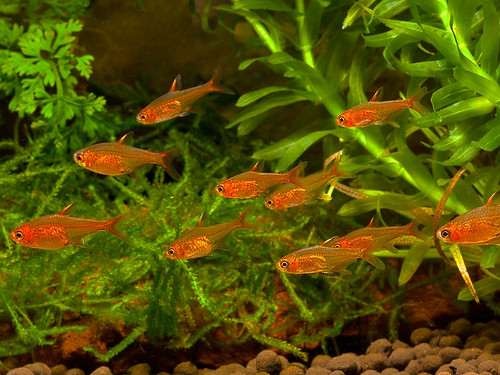
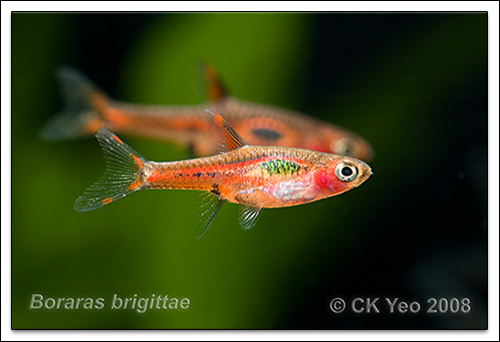
On the waterfront (ha!) I have a 10 gallon aquarium that I've been using as a nursery for the plecos, but I'm down to just five fry that have grown to over 1" long, and which I hope to re-home in the next month or so. Then what?
I am not big on keeping a tank running "just in case" I need a sick/quarantine aquarium, so I'm thinking of going for RCS again, or some small schooling fish.
Some of my possibilities:
Ember tetra
Chilli (aka Mosquito) Rasbora
Phoenix Rasbora
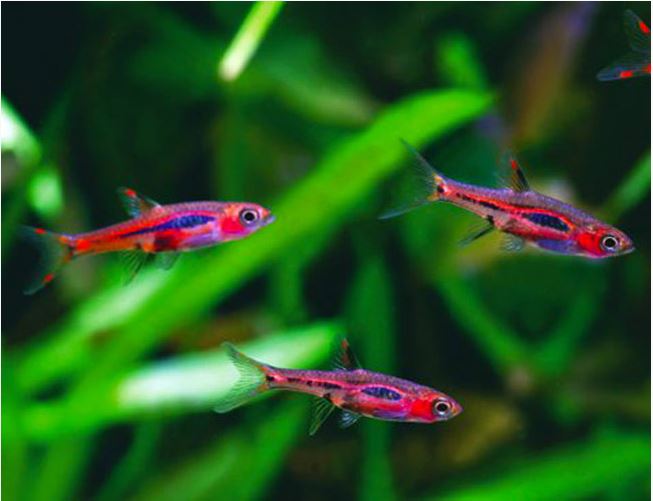
These are all less than 1" in length, and I could have a school of 8 or more happily and healthily (?) living in a 10 gallon.
::dreaming::
Sometimes "let it be" is the best option, let things settle on their own without outside interference. :)
On the waterfront (ha!) I have a 10 gallon aquarium that I've been using as a nursery for the plecos, but I'm down to just five fry that have grown to over 1" long, and which I hope to re-home in the next month or so. Then what?
I am not big on keeping a tank running "just in case" I need a sick/quarantine aquarium, so I'm thinking of going for RCS again, or some small schooling fish.
Some of my possibilities:
Ember tetra
Chilli (aka Mosquito) Rasbora
Phoenix Rasbora
These are all less than 1" in length, and I could have a school of 8 or more happily and healthily (?) living in a 10 gallon.
::dreaming::
18CassieBash
>17 fuzzi: Thanks for the pictures; I personally like the rasboras in appearance, but perhaps that's just because we never had any! I remember we had tetras back when we had an aquarium, though not ember ones. My favorites were the loaches, especially the weather loaches (we also had coolies). I'd name each weather loach after a local weatherman, and they got tame enough that when you fed flakes, they'd "nibble" your fingers if you stuck them in the water, or they'd follow your finger if you drew it across the glass.
19fuzzi
>18 CassieBash: I do have Kuhli/coolie loaches, though I don't see them often. The last time I had to break down the aquarium I counted four (4). They love to snuggle inside the Java fern and anubias.
20CassieBash
This week's Critter has been made famous by Edgar Allan Poe:
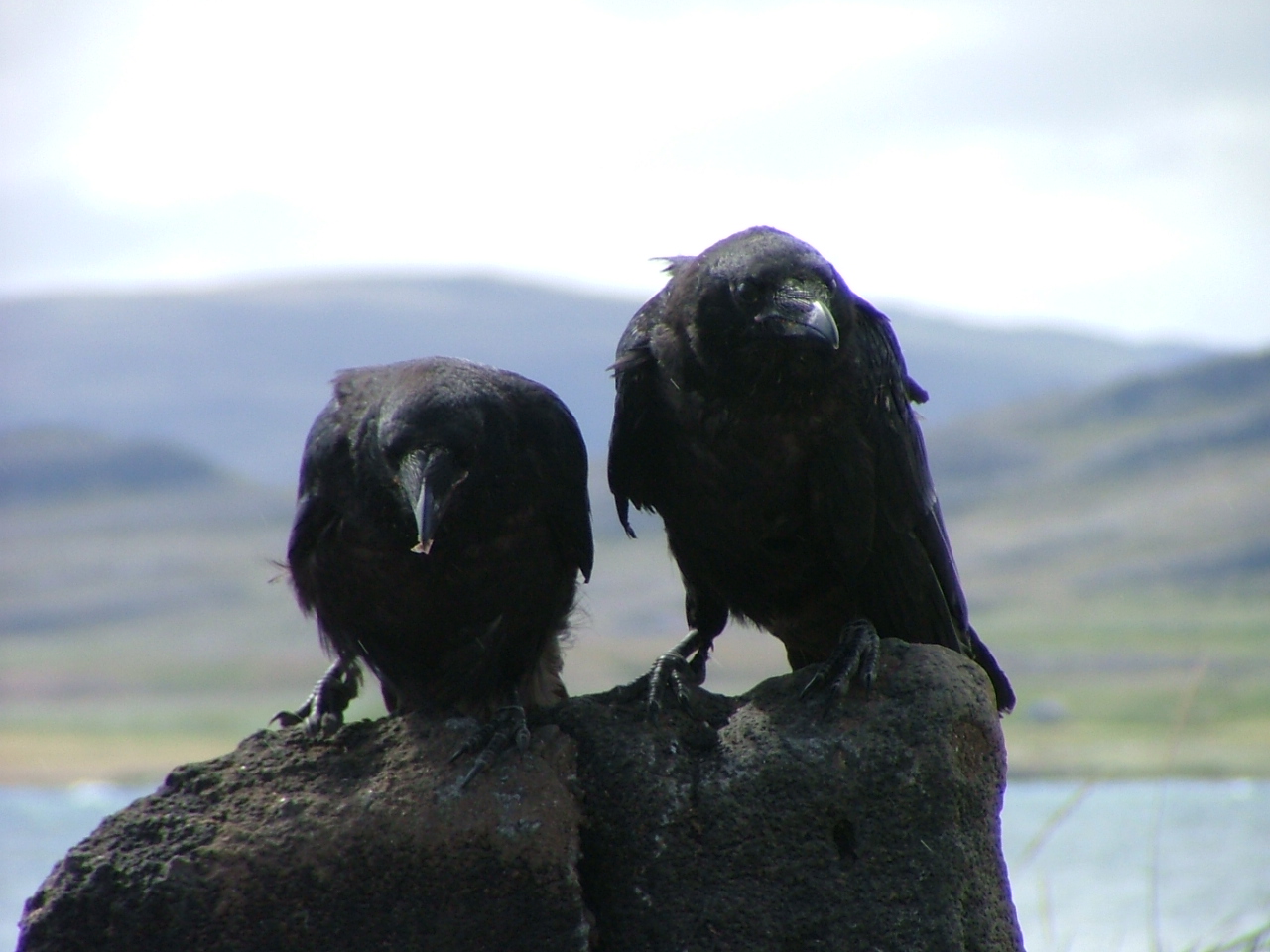
Corvus corax jouveniles by Sigurður Atlason.
The crow family is so common that it is highly recognizable by most people worldwide; most everyone knows what a crow or a raven looks like. Scientists group these birds, along with jackdaws and rooks, into Corvus, and they don't make much distinction between crows and ravens aside from size (crows being a bit smaller than ravens as a general rule). This genus is like the goths of the bird class, wearing mostly black and looking grim. Except for when ravens brought Elijah food, most literary, folkore, mythical, and religious portrayals of crows and ravens are negative, and people who harbor any superstitious feelings about crows and ravens seem to fixate on these. They are associated with war, death, murder (a flock of them is even called a "murder"), and famine. This is probably because they eat carrion, and any body, animal or human, lying around would be fair game for them to eat. So sites such as battlefields, gallows, desolate murder sites and shallow burials...these would all have attracted ravens, crows, vultures, buzzards, and any other scavenger on two wings. Add to this their genus's trademark color of black--a color of ill omen to many superstitious Westerners--and you have quite the sinister creature. And while they do eat carrion, they also eat fresh meat, fruits, nuts, seeds...in fact, they're actually quite omnivorous, and if it's edible and fits in their mouths, it's fair game.
But this genus is also smart; crows can remember human faces, can be trained to find and pick up things, they use tools, and, of course, one of the key signs of intelligence, they play. We don't have ravens in Indiana, but we do have crows--and some pretty big ones at that--and I've always been fond of them, "talking" to them with mimicking caws. And yes, they often answer back.
They're also long-lived, if given the chance; the oldest in captivity was 59 years old when he died. But they aren't always allowed to live unmolested to a ripe old age; they're seen as pests and in many areas are hunted, even eaten (do you suppose they taste like chicken?). American crows are, despite a drop in their population due to West Nile, not considered endangered, but there are two species that fall under the U.S. Endangered Species Act--the Hawaiian crow and the Mariana crow--
Corvus corax jouveniles by Sigurður Atlason.
The crow family is so common that it is highly recognizable by most people worldwide; most everyone knows what a crow or a raven looks like. Scientists group these birds, along with jackdaws and rooks, into Corvus, and they don't make much distinction between crows and ravens aside from size (crows being a bit smaller than ravens as a general rule). This genus is like the goths of the bird class, wearing mostly black and looking grim. Except for when ravens brought Elijah food, most literary, folkore, mythical, and religious portrayals of crows and ravens are negative, and people who harbor any superstitious feelings about crows and ravens seem to fixate on these. They are associated with war, death, murder (a flock of them is even called a "murder"), and famine. This is probably because they eat carrion, and any body, animal or human, lying around would be fair game for them to eat. So sites such as battlefields, gallows, desolate murder sites and shallow burials...these would all have attracted ravens, crows, vultures, buzzards, and any other scavenger on two wings. Add to this their genus's trademark color of black--a color of ill omen to many superstitious Westerners--and you have quite the sinister creature. And while they do eat carrion, they also eat fresh meat, fruits, nuts, seeds...in fact, they're actually quite omnivorous, and if it's edible and fits in their mouths, it's fair game.
But this genus is also smart; crows can remember human faces, can be trained to find and pick up things, they use tools, and, of course, one of the key signs of intelligence, they play. We don't have ravens in Indiana, but we do have crows--and some pretty big ones at that--and I've always been fond of them, "talking" to them with mimicking caws. And yes, they often answer back.
They're also long-lived, if given the chance; the oldest in captivity was 59 years old when he died. But they aren't always allowed to live unmolested to a ripe old age; they're seen as pests and in many areas are hunted, even eaten (do you suppose they taste like chicken?). American crows are, despite a drop in their population due to West Nile, not considered endangered, but there are two species that fall under the U.S. Endangered Species Act--the Hawaiian crow and the Mariana crow--
21Lyndatrue
>20 CassieBash: The crow, and the crow family, are my very favorite. From Blue Jays to Ravens, from Magpies to Crows, they're smart, and filled with joy.
In the long ago times, before the Northridge Quake (in 1994), Ravens nested in the nooks and crannies at the Northridge Mall, and would stalk early arrivals there just in case they had leftover food. After the quake, they vanished, and I never knew what happened to them. It made me sad, to see them disappear.
Magpies are one of the most interesting, and their flight patterns are startling. They fly in geometric arcs, turning on a dime, and are very fond of chasing cats (which seems only fair, considering how many birds are chased by cats).
https://en.wikipedia.org/wiki/1994_Northridge_earthquake
In the long ago times, before the Northridge Quake (in 1994), Ravens nested in the nooks and crannies at the Northridge Mall, and would stalk early arrivals there just in case they had leftover food. After the quake, they vanished, and I never knew what happened to them. It made me sad, to see them disappear.
Magpies are one of the most interesting, and their flight patterns are startling. They fly in geometric arcs, turning on a dime, and are very fond of chasing cats (which seems only fair, considering how many birds are chased by cats).
https://en.wikipedia.org/wiki/1994_Northridge_earthquake
22CassieBash
>21 Lyndatrue: My younger sister likes magpies so much, her art business is called Magpie Dreams. I have a fondness for the crow family, myself, and if I thought I could keep one, I'd so love one as a pet--I'm not a pet bird person as a rule but I might make an exception for a crow!
23CassieBash
Anyone within the natural range of the Isabella tiger moth knows the old saying that you can predict how long and cold the winter will be by the bandings on the caterpillars (known as banded woolly bears). I can tell you from personal experience raising an entire brood, with the same genetic background, that this is crap. That entire family I raised from eggs that came from one female moth, living together (no difference in diet), produced coats that ranged from almost all brown to almost all black. Even just personal observations will tell you this, like these three I found earlier this year:

Now what possible useful prediction can you make from these three? :D
Those who have seen my last thread know that I was both greatly excited and a bit disappointed to get pictures of sandhill cranes--excited because it was my first change to photograph them, disappointed because they stayed so far away from me. Well, yesterday when I left the building, crossed the road to the parking lot with a huge cow pasture along the north border, I saw three sandhill cranes, pretty close to the fence. So here are a few pics that I got, that I think are a bit better than my first opportunity:


Enjoy!

Now what possible useful prediction can you make from these three? :D
Those who have seen my last thread know that I was both greatly excited and a bit disappointed to get pictures of sandhill cranes--excited because it was my first change to photograph them, disappointed because they stayed so far away from me. Well, yesterday when I left the building, crossed the road to the parking lot with a huge cow pasture along the north border, I saw three sandhill cranes, pretty close to the fence. So here are a few pics that I got, that I think are a bit better than my first opportunity:


Enjoy!
24fuzzi
>23 CassieBash: yes!
25CassieBash
So for Halloween week, our Critter is (somewhat) fittingly the Halloween crab!

Gecarcinus quadratus (Halloween crab) at Nosara, Costa Rica, By (Bhny) - http://en.wikipedia.org/wiki/Image:HalloweenCrab.JPG, Public Domain, https://commons.wikimedia.org/w/index.php?curid=5708951
Yes, a crab. In fact, there's also a Halloween hermit crab, but we'll save him for another year. Aside from being nocturnal, coloration is really the only thing that makes this crab "Halloween", with his black body, orange legs, and purple claws. He's hardly scary: 2 inches tops, mostly herbivorous, living in mangrove forests and rainforests, as well as along sand dunes by the ocean, which all crabs will return to in order to breed, since it will lay its eggs in water. Though it can be found in various suitable areas from Mexico to Panama, it's particularly common in Panama, Costa Rica, and Nicaragua.
They are considered land crabs (well, obviously, if they live part of their lives in forests), and like all land crabs, they have special adaptations that allow them to breathe air. While all land crabs also have gills--necessary for when they return to the water to mate and lay eggs--all land crabs also have a special part of their shell--the carapace--that is filled with blood vessels and can inflate like a lung, drawing oxygen from the air and circulating it throughout their bodies.

Gecarcinus quadratus (Halloween crab) at Nosara, Costa Rica, By (Bhny) - http://en.wikipedia.org/wiki/Image:HalloweenCrab.JPG, Public Domain, https://commons.wikimedia.org/w/index.php?curid=5708951
Yes, a crab. In fact, there's also a Halloween hermit crab, but we'll save him for another year. Aside from being nocturnal, coloration is really the only thing that makes this crab "Halloween", with his black body, orange legs, and purple claws. He's hardly scary: 2 inches tops, mostly herbivorous, living in mangrove forests and rainforests, as well as along sand dunes by the ocean, which all crabs will return to in order to breed, since it will lay its eggs in water. Though it can be found in various suitable areas from Mexico to Panama, it's particularly common in Panama, Costa Rica, and Nicaragua.
They are considered land crabs (well, obviously, if they live part of their lives in forests), and like all land crabs, they have special adaptations that allow them to breathe air. While all land crabs also have gills--necessary for when they return to the water to mate and lay eggs--all land crabs also have a special part of their shell--the carapace--that is filled with blood vessels and can inflate like a lung, drawing oxygen from the air and circulating it throughout their bodies.

27CassieBash
And there's a Halloween snake, too. Orange and black critters seem to get named for that particular holiday a lot. :)
28CassieBash
Happy Halloween from the Book Wyrm of Ancilla College!


29Lyndatrue
>28 CassieBash: Whoa! Nice wings, you got there. :-}
30CassieBash
>29 Lyndatrue: Thanks! Next time, maybe I'll have a tail to go with them.
312wonderY
Very nice! Where'd you get the mechanism for opening the wings? I've been looking for something along those lines.
33CassieBash
>31 2wonderY: & >32 fuzzi: No, I didn't make them. I'm not that good a craftsman. I got them through Spirit Halloween last year to use on a skeletal horse covered in panty hose to make a thestral. I have had some mechanical issues with the right wing in particular but can't say whether that's because the wings were outside for about 12 hours--I waited last minute to add them and took them off immediately after the party to limit their exposure to the weather--or if it's just cheap manufacturing as some reviewers suggested. However, so far I've managed to fix everything and I think with a bit of glue and/or duct tape (the wonder tool!), they'll be fine. I think they come in two other colors--all black and red and black. The mechanism for opening the wings comes with it; just pull the strings and the wings extend. My biggest problem with operating the wings--aside from the minor repairs--is remembering that the left cord controls the right wing and the right cord controls the left. You can move them independently and you don't have to fully extend them, so you can have all sorts of fun "flexing" your wings and showing off to people. Students, faculty, and staff loved it! By the next time I use them, I want to have a tail, too!
34CassieBash
Ah, fall is truly here! Despite the rain, I'm going to enjoy the 50 degree day, since by the end of the week, we're supposed to be in the 30s for our highs with a rain/snow mix. Winter is just around the corner, and most are predicting that in my part of the world, we'll be a little below average regarding temperature and, depending on who you ask and where lake effect kicks in, either a little below or a bit above average with snowfall. (For us, lake effect may or may not hit us, depending on prevailing wind directions. Anything from the northwest--a common winter wind direction for us--is likely to push snow our way from Lake Michigan.) Until then, I'll just enjoy the view outside my window:

This week's critter is a two-for-one, since I thought, what with the midterm elections and all the mudslinging going on, I'd throw my hat in the ring and remain independent (as always--no single party always has the best candidates in my mind) by looking at two animals who are unfairly dragged into human politics--the elephant (presumably African) and the donkey.

A female African Bush Elephant in Mikumi National Park, Tanzania. By The making of this document was supported by Wikimedia CH. (Submit your project!)For all the files concerned, please see the category Supported by Wikimedia CH. - Own work, GFDL 1.2, https://commons.wikimedia.org/w/index.php?curid=15925090

A donkey at Clovelly, North Devon, England. Photo taken by: en:User:Adrian Pingstone in July 2004 and released to the public domain. First upload: July 26, 2004 - en:Wikipedia
The donkey was probably the first of the two to be associated with politics, as it was used by Andrew Jackson's detractors as an insult and a slur--basically saying he was a stubborn jackass. But Jackson actually liked the comparison and started using the donkey for his campaign symbol. Thomas Nast, however, is the one credited for solidifying the elephant/donkey thing in his political cartoon that showed a donkey wearing a lion's skin, frightening animals with its "Cesarism" ways--including a large elephant labeled "The Republican Vote". Here is the 1874 Harper's Magazine cartoon by Nast:
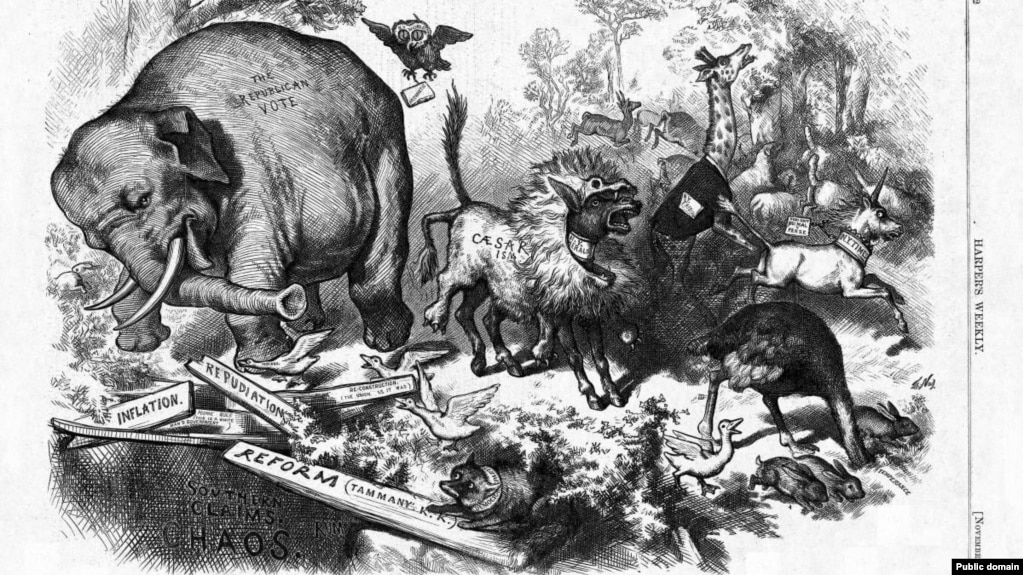
The premise of the cartoon is based on an old Aesop's fable, about a donkey who comes upon a lion's skin and wears it to frighten the other animals and to, in his mind, gain the respect that he never had as a mere ass. Only the fox isn't frightened, as he hears the donkey bray in the joy of the fear he caused; the fox remarks that he, too, would have been frightened--but the donkey's voice betrayed his real self. (The moral, of course, is that however well-dressed a fool may be, once he opens his mouth, he reveals himself, which somehow seems a fitting story for midterm elections. I'm jaded and cynical about politics--can you tell?)
As a side note about Nast, he's also given credit as being the creator of the modern image of Santa Claus.
Sadly, neither creature really deserves the scorn or indignity that comes with being a political symbol. They, of course, couldn't care less about our political grumblings. So let's take a short look at each of them as they would want us to see them: as creatures who, for good or bad, share the planet with us and should have our respect as living beings.
There are actually two divisions of African elephant: forest and bush. The bush variety is the larger of the two and it holds the title of the largest terrestrial animal. (The forest variety is the third largest.) Elephants are social animals that form either family herds (as do, of course, equines such as the donkey) led by an older female known as the matriarch, or bachelor herds made up of mature male elephants. Small family herds can join with each other to become one large herd known as a kinship or bond herd. All adult females in the group help care for the calves, which are born after an almost 2 year gestation period. Elephants are highly intelligent, with very developed neocortexes (as do many primates, including our own species) and massive, 11 pound brains that also take the top prize for terrestrial animals. Some of the traits we associate with intelligence have been observed in elephants: grieving, art, learning, altruism, use of tools, cooperation, memory, compassion, and yes, even self-awareness. The African bush elephant's population, despite continued poaching, is on the rise and the elephant, once considered endangered, is now considered vulnerable. Often, the forest elephant is not given any separate status, so it, too, is considered vulnerable, but while there are plenty of bush elephants in zoos and conservation parks and reserves, there are hardly any forest elephants in captivity. Add to this a slower birht rate and their limited range, mostly in Gabon's forests, and the forest elephant is potentially more vulnerable than even bush elephants.
Donkeys, on the other hand, are hardly in danger of going extinct. A member of the horse family, they've been used by humans for at least 5,000 years, mostly as pack or draft animals. Nowadays, of course, it's mostly in under-developed countries where these animals are still used widely as such; most people in the U.S. keep donkeys merely for pleasure, show, or hobbies if they keep them at all. Donkeys were domesticated from the African wild ass in the area of Egypt and Mesopotamia around 3,000 B.C. Sadly, the wild ass from which they are descended are endangered.
While the stubborness trait that people associate with donkeys (and which led to their association with Andrew Jackson) is widely known, many scientists are re-assessing (no pun intended) this trait in light of new studies which suggest that donkeys might actually have a more heightened sense of self-preservation than horses, and that this may be the reason why trying to force a donkey to do something--especially something that could be seen as dangerous--doesn't work. However, if a donkey learns to completely trust a human to the same extent many horses do, they will be more willing to follow that human's commands. Many who work with donkeys and many who have studied their behaviors say that they are cautious but playful and intelligent.
So whichever party you prefer (or if, like me, you pick and choose your candidates), at least don't slander the good names of these two animals who deserve better than to be seen as the butt of our political cartoons or ire.

This week's critter is a two-for-one, since I thought, what with the midterm elections and all the mudslinging going on, I'd throw my hat in the ring and remain independent (as always--no single party always has the best candidates in my mind) by looking at two animals who are unfairly dragged into human politics--the elephant (presumably African) and the donkey.

A female African Bush Elephant in Mikumi National Park, Tanzania. By The making of this document was supported by Wikimedia CH. (Submit your project!)For all the files concerned, please see the category Supported by Wikimedia CH. - Own work, GFDL 1.2, https://commons.wikimedia.org/w/index.php?curid=15925090

A donkey at Clovelly, North Devon, England. Photo taken by: en:User:Adrian Pingstone in July 2004 and released to the public domain. First upload: July 26, 2004 - en:Wikipedia
The donkey was probably the first of the two to be associated with politics, as it was used by Andrew Jackson's detractors as an insult and a slur--basically saying he was a stubborn jackass. But Jackson actually liked the comparison and started using the donkey for his campaign symbol. Thomas Nast, however, is the one credited for solidifying the elephant/donkey thing in his political cartoon that showed a donkey wearing a lion's skin, frightening animals with its "Cesarism" ways--including a large elephant labeled "The Republican Vote". Here is the 1874 Harper's Magazine cartoon by Nast:
The premise of the cartoon is based on an old Aesop's fable, about a donkey who comes upon a lion's skin and wears it to frighten the other animals and to, in his mind, gain the respect that he never had as a mere ass. Only the fox isn't frightened, as he hears the donkey bray in the joy of the fear he caused; the fox remarks that he, too, would have been frightened--but the donkey's voice betrayed his real self. (The moral, of course, is that however well-dressed a fool may be, once he opens his mouth, he reveals himself, which somehow seems a fitting story for midterm elections. I'm jaded and cynical about politics--can you tell?)
As a side note about Nast, he's also given credit as being the creator of the modern image of Santa Claus.
Sadly, neither creature really deserves the scorn or indignity that comes with being a political symbol. They, of course, couldn't care less about our political grumblings. So let's take a short look at each of them as they would want us to see them: as creatures who, for good or bad, share the planet with us and should have our respect as living beings.
There are actually two divisions of African elephant: forest and bush. The bush variety is the larger of the two and it holds the title of the largest terrestrial animal. (The forest variety is the third largest.) Elephants are social animals that form either family herds (as do, of course, equines such as the donkey) led by an older female known as the matriarch, or bachelor herds made up of mature male elephants. Small family herds can join with each other to become one large herd known as a kinship or bond herd. All adult females in the group help care for the calves, which are born after an almost 2 year gestation period. Elephants are highly intelligent, with very developed neocortexes (as do many primates, including our own species) and massive, 11 pound brains that also take the top prize for terrestrial animals. Some of the traits we associate with intelligence have been observed in elephants: grieving, art, learning, altruism, use of tools, cooperation, memory, compassion, and yes, even self-awareness. The African bush elephant's population, despite continued poaching, is on the rise and the elephant, once considered endangered, is now considered vulnerable. Often, the forest elephant is not given any separate status, so it, too, is considered vulnerable, but while there are plenty of bush elephants in zoos and conservation parks and reserves, there are hardly any forest elephants in captivity. Add to this a slower birht rate and their limited range, mostly in Gabon's forests, and the forest elephant is potentially more vulnerable than even bush elephants.
Donkeys, on the other hand, are hardly in danger of going extinct. A member of the horse family, they've been used by humans for at least 5,000 years, mostly as pack or draft animals. Nowadays, of course, it's mostly in under-developed countries where these animals are still used widely as such; most people in the U.S. keep donkeys merely for pleasure, show, or hobbies if they keep them at all. Donkeys were domesticated from the African wild ass in the area of Egypt and Mesopotamia around 3,000 B.C. Sadly, the wild ass from which they are descended are endangered.
While the stubborness trait that people associate with donkeys (and which led to their association with Andrew Jackson) is widely known, many scientists are re-assessing (no pun intended) this trait in light of new studies which suggest that donkeys might actually have a more heightened sense of self-preservation than horses, and that this may be the reason why trying to force a donkey to do something--especially something that could be seen as dangerous--doesn't work. However, if a donkey learns to completely trust a human to the same extent many horses do, they will be more willing to follow that human's commands. Many who work with donkeys and many who have studied their behaviors say that they are cautious but playful and intelligent.
So whichever party you prefer (or if, like me, you pick and choose your candidates), at least don't slander the good names of these two animals who deserve better than to be seen as the butt of our political cartoons or ire.
35Lyndatrue
>34 CassieBash: As the briefest of notes, your first image requires you to provide access to Google (it actually presented me with a Google Account login when I tried to view it). I don't use this browser with google (yeah, I'm pretty crazy), but the easiest thing to do would be to just upload the image to your account and then display it.
Even Chrome wants me to login in before I can see the image (not going to happen).
Up to you.
Even Chrome wants me to login in before I can see the image (not going to happen).
Up to you.
36CassieBash
>35 Lyndatrue: Crap! I'm trying to find alternatives to Flickr, and I thought Google would work at least temporarily. (It works for me but then I'm always signed in to one Google account or another.) I'm almost at my LT limit and I either need to delete some photos from Flickr to be under their upcoming new 1,000 photo limit or pay for the storage. What can I say, if I can go the cheap, free route, I'm going to do that. Besides, I'm not all that happy with having to edit every single Flickr link, deleting all their extra crap code from the image link, so maybe it's time to see what else is out there anyway. But it looks like Google isn't going to play nice (what a surprise!--that's sarcasm, by the way), so I guess I'll be looking into more options. Any ideas?
Until then, it's back to Flickr, which at least works even if I have to deal with extra coding, so I've fixed the image above for everyone.
And thanks for letting me know it wasn't working, Lyndatrue. I'd rather find out with my first post than my fifteenth.
Until then, it's back to Flickr, which at least works even if I have to deal with extra coding, so I've fixed the image above for everyone.
And thanks for letting me know it wasn't working, Lyndatrue. I'd rather find out with my first post than my fifteenth.
37Lyndatrue
>36 CassieBash: I'm selfishly grateful that you fixed the image, because it's just lovely.
I've been paying for storage at Flickr for years. I'll just be glad when I don't have to use loathsome old Yahoo to log in.
I don't think there's anyone out there that gives you unlimited storage. If there is, they don't last. Photobucket is gone, or at least changed, and that was one of the last.
I've been paying for storage at Flickr for years. I'll just be glad when I don't have to use loathsome old Yahoo to log in.
I don't think there's anyone out there that gives you unlimited storage. If there is, they don't last. Photobucket is gone, or at least changed, and that was one of the last.
38CassieBash
>37 Lyndatrue:. Yeah, and I do see their point; it does cost money to run their business. I think Shutterfly does unlimited free storage but the sharing feature is either nonexistent or doesn't play nice-- I forget which. But they have all those goodies they tempt you to buy that feature your photos because that's primarily what they do--they aren't into the sharing business. I'll probably go ahead and upgrade Flickr because I don't know what else I can do, and it at least seems to be a reasonable price compared with other places.
And it really is lovely most of the year, it just changes with the seasons in how it's lovely.
And it really is lovely most of the year, it just changes with the seasons in how it's lovely.
39CassieBash


LOST....one fall season, chased away by winter. Last seen 11/8/2018. If found, please return to the Michiana* area.
FOUND....one lake effect. Free to anyone that wants it.
*Michiana is the region of southwest Michigan and northwest Indiana--Michigan + Indiana = Michiana.
40fuzzi
>39 CassieBash: we're expecting our first freeze tonight, low will be about 28F.
41CassieBash
>40 fuzzi: We've been having frosts overnight on and off since late October, but Friday was our first real wintry day, with a high just above freezing, a bit of lake effect snow, and wind chills that dropped the "feels like" temperatures to the 20s during the day. Yesterday, at 40 degrees, was a veritable heat wave! More cold and more lake effect is predicted....
Yesterday, I spent a little time outside picking up some sticks to set aside for fireplace kindling for the winter, when I came across this poor, dead fellow, lying on an oak leaf under a huge pine.

For those who might be thinking this is a caterpillar of some sort, I can't blame you. If you've followed my threads with any sort of regularity (shouting out to you, fuzzi!), then you know my obsession with caterpillars. But this isn't the larva of a Lepidoptera, so it's not a caterpillar. It is a larva, though--a sawfly larva. Specifically, this one is a pine sawfly.
Most sawfly larvae eat tree leaves (or, in his case, pine needles)--though there is a sawfly family that is parasitic--and they can be very destructive. People in forestry and logging industries find them quite the bane if they have a good year in terms of their population. Like some butterflies and moths, sawfly females lay their eggs in clusters (called rafts or pods) and therefore, one tree can play host to dozens, even hundreds, of the eating machines. Sawflies are related to bees, ants, and wasps, but if you look below, you'll see that while their face and wings are wasp-like, their waist doesn't narrow as with their bee, wasp, and ant relatives. And, as is the case with so many insects with destructive larvae, the adults are actually beneficial, as they're pollinators, eating nectar and pollen. But they have to pollinate what they can and find mates quickly, because adult sawflies have a life expectancy of 7-9 days.

Name: Tenthredo mesomela. Family: Tenthredinidae. Location: Münster, NRW, Germany
By Guido Gerding - Personal photograph taken by Author, URL: Ex :: Natura - Freies Portal für Umweltbildung (Environmental Education), CC BY-SA 3.0, https://commons.wikimedia.org/w/index.php?curid=1002020
Larvae, on the other hand, can take anywhere from a few months in a season to years, depending on the species, so they can do a lot of damage while growing up. They do have predators--birds, other insects, spiders, and even small mammals such as mice, shrews, and similar. But when the females lay their eggs in clusters of 30-90 within the bark of a tree exposed to a lot of sun (cooling shade slows and can even hinder development), these groups will emerge and start eating, sometimes defoliating smaller, weaker trees. Even worse (from a forester's perspective) is that the females are numerous, because they tend towards being parthenogenetic, where fertilization of eggs isn't necessary and therefore females can lay eggs that will develop without a male to help. So of those 30-90 eggs, a small--very small--number of them might be males--or they might be all females! While predators may eat a few, many people poison them to control them; in our case, it seems Mother Nature took matters into her own hands with our cold, freezing temperatures. While sawfly larvae look like caterpillars, they do have a few clues that a sharp-eyed entomologist, even an amateur one, can look for. While they have the prolegs--the false feet along their bodies--that caterpillars have, the number and location of these feet are different--caterpillars don't have as many prolegs, nor do they start as far up along the body. In addition to this, sawfly prolegs lack the hooks, known as crochets, that caterpillars have. Perhaps the lack of crochets is why sawfly larvae often do odd things with their back ends, that no caterpillar I've ever seen does:

Sawfly (Nematus miliaris) larvae, Greece
Photo by Charles J Sharp - Own work, from Sharp Photography, sharpphotography
They can also curl their rears the other way, tucking them close to their bodies.
Why call them sawflies? It's not like their chopping down the trees, right?--they're just stripping off the leaves. Remember how the female lays her eggs inside bark? Well, the ovipositor--the egg-laying tube--is shaped somewhat like a small saw.
Mystery solved. :)
Yesterday, I spent a little time outside picking up some sticks to set aside for fireplace kindling for the winter, when I came across this poor, dead fellow, lying on an oak leaf under a huge pine.

For those who might be thinking this is a caterpillar of some sort, I can't blame you. If you've followed my threads with any sort of regularity (shouting out to you, fuzzi!), then you know my obsession with caterpillars. But this isn't the larva of a Lepidoptera, so it's not a caterpillar. It is a larva, though--a sawfly larva. Specifically, this one is a pine sawfly.
Most sawfly larvae eat tree leaves (or, in his case, pine needles)--though there is a sawfly family that is parasitic--and they can be very destructive. People in forestry and logging industries find them quite the bane if they have a good year in terms of their population. Like some butterflies and moths, sawfly females lay their eggs in clusters (called rafts or pods) and therefore, one tree can play host to dozens, even hundreds, of the eating machines. Sawflies are related to bees, ants, and wasps, but if you look below, you'll see that while their face and wings are wasp-like, their waist doesn't narrow as with their bee, wasp, and ant relatives. And, as is the case with so many insects with destructive larvae, the adults are actually beneficial, as they're pollinators, eating nectar and pollen. But they have to pollinate what they can and find mates quickly, because adult sawflies have a life expectancy of 7-9 days.

Name: Tenthredo mesomela. Family: Tenthredinidae. Location: Münster, NRW, Germany
By Guido Gerding - Personal photograph taken by Author, URL: Ex :: Natura - Freies Portal für Umweltbildung (Environmental Education), CC BY-SA 3.0, https://commons.wikimedia.org/w/index.php?curid=1002020
Larvae, on the other hand, can take anywhere from a few months in a season to years, depending on the species, so they can do a lot of damage while growing up. They do have predators--birds, other insects, spiders, and even small mammals such as mice, shrews, and similar. But when the females lay their eggs in clusters of 30-90 within the bark of a tree exposed to a lot of sun (cooling shade slows and can even hinder development), these groups will emerge and start eating, sometimes defoliating smaller, weaker trees. Even worse (from a forester's perspective) is that the females are numerous, because they tend towards being parthenogenetic, where fertilization of eggs isn't necessary and therefore females can lay eggs that will develop without a male to help. So of those 30-90 eggs, a small--very small--number of them might be males--or they might be all females! While predators may eat a few, many people poison them to control them; in our case, it seems Mother Nature took matters into her own hands with our cold, freezing temperatures. While sawfly larvae look like caterpillars, they do have a few clues that a sharp-eyed entomologist, even an amateur one, can look for. While they have the prolegs--the false feet along their bodies--that caterpillars have, the number and location of these feet are different--caterpillars don't have as many prolegs, nor do they start as far up along the body. In addition to this, sawfly prolegs lack the hooks, known as crochets, that caterpillars have. Perhaps the lack of crochets is why sawfly larvae often do odd things with their back ends, that no caterpillar I've ever seen does:

Sawfly (Nematus miliaris) larvae, Greece
Photo by Charles J Sharp - Own work, from Sharp Photography, sharpphotography
They can also curl their rears the other way, tucking them close to their bodies.
Why call them sawflies? It's not like their chopping down the trees, right?--they're just stripping off the leaves. Remember how the female lays her eggs inside bark? Well, the ovipositor--the egg-laying tube--is shaped somewhat like a small saw.
Mystery solved. :)
43CassieBash
>42 fuzzi: So do I; I usually have to do a bit of research myself! :)
44CassieBash
Critter time! This week let's celebrate the Eastern Fox Squirrel!

Not to be confused with the smaller American Red Squirrel, which is in a completely different genus, the fox squirrel is the largest native tree-dwelling squirrel in North America. From nose to tail, it can measure a little over a foot and weigh a little over two pounds at its extremes. Unlike the American Red, the Eastern Fox also has no white coloration; it's generally an orange-red with a mix of brown, grey, and yellow hairs lying along most of its back and sides, making it look like it's wearing a blanket or cloak. Notice that I said "generally"; there are color variations in pockets of the U.S. where the Eastern Fox Squirrel can be distinctive colors, such as the black population in Marysville, Kansas. Being tree squirrels, they prefer areas where there are plenty of mature oak and pine trees--they eat the acorns and pine seeds--but where there isn't a lot of dense undergrowth that hinders their on-ground foraging. This is why many fox squirrels like agricultural areas; clear fields and pastures with a large stand of oak and pine trees bordering them are perfect for them. In addition to nuts and seeds, squirrels also habitually eat insects, fungus, roots, bulbs, bird eggs, corn, fruit, and even tree buds. These diurnal creatures harvest and store food, especially ones heavy in fats and oils, in the fall as a winter cache. In turn, they are potential food for hawks, owls, dogs, foxes, and bobcats as adults; these predators often only manage to snag a fox squirrel by chance, doing so when the opportunity arises, as fox squirrels are fast and dexterous, and can, in the case of dogs and foxes, out-climb them. But the young ones not only must fear these, but also certain species of snakes that can climb, in addition to climbing mammals such as raccoons and opossums.

The tails are used for balance and as a stabilizing mechanism when they jump, a rudder if they must swim, a parachute should they fall, an umbrella or parasol when it's rainy or sunny, respectively. It also communicates mood and, just like some lizards and snakes, the skin and even some of the last vertebrae will easily break off, leaving a predator with a mouthful of limp tail. Unfortunately for the squirrel, this trick only works once, since the tail doesn't regrow. They have a wonderful sense of smell, though their senses of touch, hearing, and sight are no slouches. While most don't make it to adulthood, they can live up to 18 years in captivity--though in the wild, an old squirrel might make it to 12.

Not to be confused with the smaller American Red Squirrel, which is in a completely different genus, the fox squirrel is the largest native tree-dwelling squirrel in North America. From nose to tail, it can measure a little over a foot and weigh a little over two pounds at its extremes. Unlike the American Red, the Eastern Fox also has no white coloration; it's generally an orange-red with a mix of brown, grey, and yellow hairs lying along most of its back and sides, making it look like it's wearing a blanket or cloak. Notice that I said "generally"; there are color variations in pockets of the U.S. where the Eastern Fox Squirrel can be distinctive colors, such as the black population in Marysville, Kansas. Being tree squirrels, they prefer areas where there are plenty of mature oak and pine trees--they eat the acorns and pine seeds--but where there isn't a lot of dense undergrowth that hinders their on-ground foraging. This is why many fox squirrels like agricultural areas; clear fields and pastures with a large stand of oak and pine trees bordering them are perfect for them. In addition to nuts and seeds, squirrels also habitually eat insects, fungus, roots, bulbs, bird eggs, corn, fruit, and even tree buds. These diurnal creatures harvest and store food, especially ones heavy in fats and oils, in the fall as a winter cache. In turn, they are potential food for hawks, owls, dogs, foxes, and bobcats as adults; these predators often only manage to snag a fox squirrel by chance, doing so when the opportunity arises, as fox squirrels are fast and dexterous, and can, in the case of dogs and foxes, out-climb them. But the young ones not only must fear these, but also certain species of snakes that can climb, in addition to climbing mammals such as raccoons and opossums.

The tails are used for balance and as a stabilizing mechanism when they jump, a rudder if they must swim, a parachute should they fall, an umbrella or parasol when it's rainy or sunny, respectively. It also communicates mood and, just like some lizards and snakes, the skin and even some of the last vertebrae will easily break off, leaving a predator with a mouthful of limp tail. Unfortunately for the squirrel, this trick only works once, since the tail doesn't regrow. They have a wonderful sense of smell, though their senses of touch, hearing, and sight are no slouches. While most don't make it to adulthood, they can live up to 18 years in captivity--though in the wild, an old squirrel might make it to 12.
46CassieBash
>45 fuzzi: That's an old picture but I love it, too, and I thought it was a good showcase for an animal that can jump so well.
47CassieBash
My little fur baby, Peppa, has been sick and so she's the critter who's mostly been on my mind, but better late than never. This week, I've chosen the barn owl, one of my favorite birds (and certainly my favorite owl species), as our Critter:

The above picture is the barn owl at Potawatomi Zoo, Mrs. Wigglesworth. If I remember correctly, she was injured and rescued but was deemed unable to live on her own in the wild--but I could be thinking of another bird they had. Regardless, she and her kind are quite handsome birds, with the distinct coloration of the white, gold, and grey plumage with the bars and small spots, as well as their heart-shaped faces. Of medium size, they're still fierce hunters of rodents. Their name comes from their habit of using not only natural cavities found in trees but also taking up residences in silos or barns. They have good eyesight but their hearing is excellent, and it allows them to catch mice in completely dark conditions (this has been tested in lab settings). They can be long-lived, too--up to 20 years in captivity. They're also found worldwide, with the exception of Antarctica. Diet varies by location as to specifics--here in North America, voles and shrews are the most common prey--but they will also eat any other small mammal, including bats, small birds, reptiles and amphibians, and even sometimes insects. They hunt by flying low, looking and especially listening for sounds of prey moving about; they can hover for a time over areas where prey may be hidden, or they may sit on a fence post, tree limb, or other perch to watch and listen for prey.
Breeding is year-round for birds living in more tropical climes, but for North America and Europe, it tends to be between March and June as the weather warms. They're monogamous until death, at which point the surviving member of the pair will try to find a new mate. The male will bring food to the female during the breeding ritual, which not only helps them bond but also keeps her fit and fed while nesting. This is also the time when the female owls will start to molt; since the male is bringing her food, she doesn't need to fly and thus can lose feathers without too much problem, but the process is gradual and takes 2 years because the birds require their feathers to hunt.
Despite what one might think, the barn owl is not an apex predator and it has predators of its own. Eagles, hawks, and other owls, including the great horned owl, may top the list because they can take the barn owl in flight, but ground mammals such as raccoons and Virginia opossums in North America and similar carnivorous mammals in other countries will hunt barn owls when given the opportunity, especially the young. Raccoons can climb and raid nests for both young birds and eggs.
In folklore, owls are often associated with other nocturnal evils, such as witches and demons, but this owl in particular seems especially maligned, with nicknames such as "ghost owl" (probably because they can appear to be all-white when flying at night), "lich owl", and "death owl". There are people who still believe that this owl spreads disease (ironic considering that the animals they hunt are far more likely to do so), and there is a mistaken belief that they will hunt and eat farmers' chickens.

The above picture is the barn owl at Potawatomi Zoo, Mrs. Wigglesworth. If I remember correctly, she was injured and rescued but was deemed unable to live on her own in the wild--but I could be thinking of another bird they had. Regardless, she and her kind are quite handsome birds, with the distinct coloration of the white, gold, and grey plumage with the bars and small spots, as well as their heart-shaped faces. Of medium size, they're still fierce hunters of rodents. Their name comes from their habit of using not only natural cavities found in trees but also taking up residences in silos or barns. They have good eyesight but their hearing is excellent, and it allows them to catch mice in completely dark conditions (this has been tested in lab settings). They can be long-lived, too--up to 20 years in captivity. They're also found worldwide, with the exception of Antarctica. Diet varies by location as to specifics--here in North America, voles and shrews are the most common prey--but they will also eat any other small mammal, including bats, small birds, reptiles and amphibians, and even sometimes insects. They hunt by flying low, looking and especially listening for sounds of prey moving about; they can hover for a time over areas where prey may be hidden, or they may sit on a fence post, tree limb, or other perch to watch and listen for prey.
Breeding is year-round for birds living in more tropical climes, but for North America and Europe, it tends to be between March and June as the weather warms. They're monogamous until death, at which point the surviving member of the pair will try to find a new mate. The male will bring food to the female during the breeding ritual, which not only helps them bond but also keeps her fit and fed while nesting. This is also the time when the female owls will start to molt; since the male is bringing her food, she doesn't need to fly and thus can lose feathers without too much problem, but the process is gradual and takes 2 years because the birds require their feathers to hunt.
Despite what one might think, the barn owl is not an apex predator and it has predators of its own. Eagles, hawks, and other owls, including the great horned owl, may top the list because they can take the barn owl in flight, but ground mammals such as raccoons and Virginia opossums in North America and similar carnivorous mammals in other countries will hunt barn owls when given the opportunity, especially the young. Raccoons can climb and raid nests for both young birds and eggs.
In folklore, owls are often associated with other nocturnal evils, such as witches and demons, but this owl in particular seems especially maligned, with nicknames such as "ghost owl" (probably because they can appear to be all-white when flying at night), "lich owl", and "death owl". There are people who still believe that this owl spreads disease (ironic considering that the animals they hunt are far more likely to do so), and there is a mistaken belief that they will hunt and eat farmers' chickens.
48fuzzi
>47 CassieBash: I keep seeing monogamy listed among birds of prey, such as eagles, ospreys, etc. Nice to see owls in that group.
49CassieBash
>48 fuzzi: From what I understand, in some owl species, the monogamy lasts only for the breeding season or for the year. Barn owls and a few others (including tawny owls) form longer bonds. Apparently, migratory species tend to be monogamous for shorter periods of time, while species that don't migrate tend to have a greater chance of staying with each other. Perhaps that's why so many birds of prey, which don't tend to be migrators, are monogamous. But scientists tend to think of monogamy in animal species as being one male and one female pairing for the breeding season, rather than for life--which means that they estimate that 90% of birds are monogamous, since it's rare that the male doesn't stick around long enough to help raise the kids. So while we as humans tend to think of monogamy as a "for life" thing, scientists don't.
50CassieBash
Critter of the Week: Starting with this, the first week of December, I'm going to do something a little different with the Critter. I'm going to look at a Critter from the perspective of a Christmas story. So let's begin with what some may think as an unusual Critter to celebrate at this time of year: the European robin.

Erithacus rubecula with cocked head
By © Francis C. Franklin / CC-BY-SA-3.0, CC BY-SA 3.0, https://commons.wikimedia.org/w/index.php?curid=31367900
As this legend is, I believe, fairly old, I'm going to say this is probably in relation to the European robin, rather than the larger and unrelated American robin, which we here in the states associate generally (at least up north) with the spring, since the American robin is migratory and heads for warmer parts before Christmas as a general rule. The two were originally in the same family--the thrushes--but now the European robin is considered an Old World flycatcher, while the American robin remains a thrush. The European birds are the original robin redbreasts, having been so named since before the Old World discovery of the New World, and when European settlers saw the red breast of the American robin, they simply named it after the original.
These birds are insectivores (as flycatchers, what else would you expect?) and are generally seen as beneficial. Perhaps that's why there are at least three basic Christian stories about the birds that show it in a heroic light. Only one of these is truly a Christmas legend, and one is an Easter tale, but they all focus on how the robin got its red breast:
1. When Jesus was born, the fire in the manger was about to go out, and as the night was very cold, Mary was concerned and called out for help. The robin flew in with some sticks and dropped them on the fire, which flared up and burnt his breast. Despite this, the bird stayed around, fanning the flames and tending to the fire despite the burns, and since that day, all robins have red breasts.
2. The robin was so kind that it once brought water to the tormented souls in Purgatory, but the flames scorched its breast red and it's been that way ever since.
3. When Jesus was dying on the Cross, the robin flew down to sing comfort to Him. I've heard either that the bird was smeared by Jesus's blood as he brushed against Him, or that he was pierced by the crown of thorns and the bloodstains are the bird's blood. Either way, this is the first and only legend I've come across where it wasn't fire, but blood, that stained the bird's breast.
I'm always on the lookout for new folklore and legends of all sorts, so please share if you know of another robin legend (Batman's sidekick doesn't count). :)

Erithacus rubecula with cocked head
By © Francis C. Franklin / CC-BY-SA-3.0, CC BY-SA 3.0, https://commons.wikimedia.org/w/index.php?curid=31367900
As this legend is, I believe, fairly old, I'm going to say this is probably in relation to the European robin, rather than the larger and unrelated American robin, which we here in the states associate generally (at least up north) with the spring, since the American robin is migratory and heads for warmer parts before Christmas as a general rule. The two were originally in the same family--the thrushes--but now the European robin is considered an Old World flycatcher, while the American robin remains a thrush. The European birds are the original robin redbreasts, having been so named since before the Old World discovery of the New World, and when European settlers saw the red breast of the American robin, they simply named it after the original.
These birds are insectivores (as flycatchers, what else would you expect?) and are generally seen as beneficial. Perhaps that's why there are at least three basic Christian stories about the birds that show it in a heroic light. Only one of these is truly a Christmas legend, and one is an Easter tale, but they all focus on how the robin got its red breast:
1. When Jesus was born, the fire in the manger was about to go out, and as the night was very cold, Mary was concerned and called out for help. The robin flew in with some sticks and dropped them on the fire, which flared up and burnt his breast. Despite this, the bird stayed around, fanning the flames and tending to the fire despite the burns, and since that day, all robins have red breasts.
2. The robin was so kind that it once brought water to the tormented souls in Purgatory, but the flames scorched its breast red and it's been that way ever since.
3. When Jesus was dying on the Cross, the robin flew down to sing comfort to Him. I've heard either that the bird was smeared by Jesus's blood as he brushed against Him, or that he was pierced by the crown of thorns and the bloodstains are the bird's blood. Either way, this is the first and only legend I've come across where it wasn't fire, but blood, that stained the bird's breast.
I'm always on the lookout for new folklore and legends of all sorts, so please share if you know of another robin legend (Batman's sidekick doesn't count). :)
51CassieBash
This week's Christmas Critter legend features chickens—one legend for the guys, or roosters, and another for the ladies, or hens—although for the hens, it’s more a custom than a legend.

Legend has it that the rooster, who usually crows only when the sun rises, actually crowed at night when Jesus was born, and that he was the first to announce the birth. He's supposed to have crowed (in Latin, no less) "Christ is born". Because of that, there are certain places that celebrate a special mass at midnight on Christmas called The Mass of the Rooster, and many people once associated the rooster with Christ as the bringer of light and a new figurative day.
Hens are featured not so much in the nativity, but they are used in a Russian Christmas tradition of fortune-telling called the Five Piles of Grain. It’s a simple process, really; the family will make five piles of grain on the kitchen floor on Christmas Eve and at midnight, they take a hen from its roost where it’s been sleeping and set it down. Each of the piles represents a different possible outcome—death, wealth, poverty, marriage, and a blessed life in general. Once the hen wakes up and finds the piles, the one she selects to eat from is the fortune for the person who brought the hen in. The process is repeated for everyone there.
As for chickens themselves, while they are now widespread thanks to their domesticated status, they originate from the red junglefowl of Asia, where it was first domesticated around 5000 years ago, and they are still considered by scientists to be basically just a subspecies, rather than a separate species. Mostly they are raised for meat and eggs, but there has been a movement to keep these birds, which are smarter than what was once thought, as pets. Cockerels are what you call a male chicken that’s less than a year old, roosters or cocks are the names for the males if they are older birds that haven’t been castrated, and a castrated rooster is called a capon. The ladies are hens if they’re over a year and are pullets if they’re over—or, if you’re talking with someone in the egg-laying industry, a pullet is a female chicken of any age that hasn’t started laying eggs yet. This happens usually when the chicken is between 16-20 weeks old, so the industry greatly reduces the length of time in their terminology for a chicken to be a pullet. Very young chickens are just chicks. Different breeds have different life expectancies, but the general age is 5-10 years, provided they aren’t slaughtered for meat or killed once they’ve stopped laying. Guinness’s world record for the oldest known chicken was a hen who died at the age of 16 years. Like people, even when given good care, the males tend to die sooner than the females.
Chickens are social birds with a class system known as a pecking order (this is where the phrase comes from), because any chicken who steps beyond their rank in the hierarchy will get pecked, literally, to put them back in their place. The pecking order changes as old members die and new ones are added, so many people who keep flocks are careful when adding new members. Roosters are often gentlemen when it comes to food; he frequently calls to the ladies to let them know when he’s found some choice food. Hens with chicks will do the same thing, calling to the chicks and encouraging them to eat first. Chickens can recognize each other and can recognize members of their own flock versus strange birds; this is important for the pecking order to work. But they can also recognize, like crows and ravens, human faces. They have excellent memories and have good object permanence--the ability to remember that an object still exists even when it's taken away or otherwise hidden--even when they are chicks. Chickens have around 30 different, distinct calls and vocalizations that are used to communicate everything from "come here" to "danger!"--and they have different sounds for airborne danger than for ground-based dangers.

Legend has it that the rooster, who usually crows only when the sun rises, actually crowed at night when Jesus was born, and that he was the first to announce the birth. He's supposed to have crowed (in Latin, no less) "Christ is born". Because of that, there are certain places that celebrate a special mass at midnight on Christmas called The Mass of the Rooster, and many people once associated the rooster with Christ as the bringer of light and a new figurative day.
Hens are featured not so much in the nativity, but they are used in a Russian Christmas tradition of fortune-telling called the Five Piles of Grain. It’s a simple process, really; the family will make five piles of grain on the kitchen floor on Christmas Eve and at midnight, they take a hen from its roost where it’s been sleeping and set it down. Each of the piles represents a different possible outcome—death, wealth, poverty, marriage, and a blessed life in general. Once the hen wakes up and finds the piles, the one she selects to eat from is the fortune for the person who brought the hen in. The process is repeated for everyone there.
As for chickens themselves, while they are now widespread thanks to their domesticated status, they originate from the red junglefowl of Asia, where it was first domesticated around 5000 years ago, and they are still considered by scientists to be basically just a subspecies, rather than a separate species. Mostly they are raised for meat and eggs, but there has been a movement to keep these birds, which are smarter than what was once thought, as pets. Cockerels are what you call a male chicken that’s less than a year old, roosters or cocks are the names for the males if they are older birds that haven’t been castrated, and a castrated rooster is called a capon. The ladies are hens if they’re over a year and are pullets if they’re over—or, if you’re talking with someone in the egg-laying industry, a pullet is a female chicken of any age that hasn’t started laying eggs yet. This happens usually when the chicken is between 16-20 weeks old, so the industry greatly reduces the length of time in their terminology for a chicken to be a pullet. Very young chickens are just chicks. Different breeds have different life expectancies, but the general age is 5-10 years, provided they aren’t slaughtered for meat or killed once they’ve stopped laying. Guinness’s world record for the oldest known chicken was a hen who died at the age of 16 years. Like people, even when given good care, the males tend to die sooner than the females.
Chickens are social birds with a class system known as a pecking order (this is where the phrase comes from), because any chicken who steps beyond their rank in the hierarchy will get pecked, literally, to put them back in their place. The pecking order changes as old members die and new ones are added, so many people who keep flocks are careful when adding new members. Roosters are often gentlemen when it comes to food; he frequently calls to the ladies to let them know when he’s found some choice food. Hens with chicks will do the same thing, calling to the chicks and encouraging them to eat first. Chickens can recognize each other and can recognize members of their own flock versus strange birds; this is important for the pecking order to work. But they can also recognize, like crows and ravens, human faces. They have excellent memories and have good object permanence--the ability to remember that an object still exists even when it's taken away or otherwise hidden--even when they are chicks. Chickens have around 30 different, distinct calls and vocalizations that are used to communicate everything from "come here" to "danger!"--and they have different sounds for airborne danger than for ground-based dangers.
52fuzzi
>50 CassieBash: that is a GORGEOUS photo! ::envy::
53CassieBash
>52 fuzzi: Note that I can't take credit for it. Be envious of Francis C. Franklin. :)
I did think about shrinking it down a bit but you can see every little piece of every feather on that bird, so I hated doing it. It is a spectacular photo.
I did think about shrinking it down a bit but you can see every little piece of every feather on that bird, so I hated doing it. It is a spectacular photo.
54CassieBash
Because next week we're on shutdown for the holidays, and I'll be sans computer access and limited to my phone for internet connection, I'm going to go ahead and post this week's and next week's Critter. I'll be checking in occasionally to keep up with others' posts and to post book 90 (which will be finished before the end of the year--just not sure yet if it will be my fiction or nonfiction read), but posting photos via the phone has to date proven impossible. And what's a Critter post without pictures?!?
This week's Critter is the camel:

This is a Bactrian camel, used for centuries in caravans in Asia, and it is the largest living camel--around 7 and a half feet tall at the shoulder, and weighing up to over a ton. The camel family includes some very familiar animals, as these are the even-toed ungulates and this includes not only camel but deer and cattle. The camel tribe, which is a narrower classification, includes not only camels but the South American llamas, alpacas, vicunas, and the like.
Even young children, though, can tell you the main, distinguishing feature of a camel--it's hump. Composed of fat (not water), it does help protect the camel from dehydration in that the fat releases water when it's used, but there are other things than the hump that allows the camel to survive long periods of time without drinking. They are able to withstand sudden and extreme fluxes in body temperature that would kill other mammals, their nostrils help trap moisture in their nasal passages for re-absorbtion. The kidneys are also good at re-absorbing water, and the blood cells, instead of being circular, are oval, and this aids in the flow of blood--the narrower shape squeezes through capillaries better and has more flexibility regarding hydration. But the hump is the feature everyone is familiar with, and this is where the camel's Christmas legend comes into play.
As the Wise Men followed the star, they of course used camels to help them carry their supplies. Unfortunately, they didn't have time to pack everything and were going to be short of water. The Wise Men asked the camels if they could make do without their share of the water, and they agreed. Hungry and thirsty, the camels arrived at the manger and, along with everyone else, knelt before the Christ child to worship. But they also thanked God that they had had the strength to go so long without water, and so He blessed them with their humps.
Syria also has its own legend about the smallest camel in the Wise Men's caravan, who exhausted itself getting to the stable with the larger, stronger camels. When Christ saw how determined and faithful the little camel had been, He blessed it with immortality, and now the smallest camel visits good Syrian children and leaves them gifts.
Next week's Critter is one we tend to associate more closely with Halloween than Christmas, and I'm not going to focus on a species because the species isn't given and, frankly, it's not really that important to the legend. Those familiar with Ukrainian and German Christmas lore may already have guessed what animal I'm thinking of, but for those of you who aren't already aware, be forewarned that if you're arachnophobic, you may want to stop reading here. I'm providing some filler before the picture, so stop right now unless you want to see the picture of the spider, but in case you're interested in the legends (I know of 2 different ones) but don't want to see the picture, here's the lowdown on how spiders fit with Christmas:
The most commonly told one is that a poor widow and her children couldn't afford decorations for their Christmas tree. The children were disappointed and went to bed sad--some variants say they cried themselves to sleep. The spiders living in the house felt bad for them and they wove beautiful, delicate webs all over the tree. When the widow and children saw the webs all over the tree, they were pleased--even more so when they opened the curtains and the morning light fell onto them, and God turned the webs into delicate silver and gold threads. (Some variations have St. Nicholas do the deed.) The widow and her children were never poor again. Some variants say the tree was indeed decorated by the family by a fastidious mother, who had cleaned the house thoroughly, and that the spiders were disappointed that they had been shooed to the attic where they couldn't join in the festivities or even see the tree. They went downstairs after everyone went to bed and, determined to see every last inch of the tree, they crawled all over it, leaving the webs behind. The story runs pretty much like the rest of the story above, with their webs transformed to silver and gold.
The other, very different Christmas spider legend says that a spider saved the baby Jesus, Mary, and Joseph from soldiers sent out by King Herod. As they were fleeing from Egypt, they were forced to hide deep in a cave, but the Roman soldiers were searching all the caves in the area thoroughly, and Joseph prayed to God to protect them. While there were no lions, bears, or other dangerous animals in the cave, there was one creature who heard the prayer and responded--a spider (some versions specify that it was a baby spider). Despite how cold the air was close to the entrance--the interior of the cave was much warmer--he wove a huge web across the entrance (I've always pictured an orb weaver type web, the ones with the spiral/circular designs). The cold air quickly caused frost and ice particles to form on the web, freezing it. When the soldiers saw the perfect, beautifully frosted web, they decided that particular cave wasn't worth searching, because clearly no one had gone in or out in ages, or the web wouldn't be there, or it would be in tatters. The web was so magnificent, the leader of the soldiers said it would have taken days for the spider to make. Eventually, the soldiers moved out of the area, leaving the one cave where Joseph, Mary, and Jesus hid unsearched. When it was safe, Joseph carefully removed the web and draped it across a small evergreen bush growing near the cave's entrance and thanked the spider and God. There are lots of variations of this one, too--some say a shepherd brought them to the cave and was the one to remove the web, some don't include the part about draping the web on the bush--which is a shame, because that's what both stories have in common. Ladies and gentlemen--I have given you the (supposed) origins of tinsel!
Wishing you all a merry Christmas, a festive Yule, a happy Hanukah, or a good whatever you celebrate this month! And if you choose not to celebrate anything at all, I wish you a wonderful December, too!
The orb weaver spider picture is below. You have been warned.
This is filler.
This is filler.
This is filler.
This is filler.
This is filler.
This is filler.
This is filler.
This is filler.
This is filler.
This is filler.
This is filler.
This is filler.
This is filler.
This is filler.
This is filler.
This is filler.
This is filler.
This is filler.

This week's Critter is the camel:

This is a Bactrian camel, used for centuries in caravans in Asia, and it is the largest living camel--around 7 and a half feet tall at the shoulder, and weighing up to over a ton. The camel family includes some very familiar animals, as these are the even-toed ungulates and this includes not only camel but deer and cattle. The camel tribe, which is a narrower classification, includes not only camels but the South American llamas, alpacas, vicunas, and the like.
Even young children, though, can tell you the main, distinguishing feature of a camel--it's hump. Composed of fat (not water), it does help protect the camel from dehydration in that the fat releases water when it's used, but there are other things than the hump that allows the camel to survive long periods of time without drinking. They are able to withstand sudden and extreme fluxes in body temperature that would kill other mammals, their nostrils help trap moisture in their nasal passages for re-absorbtion. The kidneys are also good at re-absorbing water, and the blood cells, instead of being circular, are oval, and this aids in the flow of blood--the narrower shape squeezes through capillaries better and has more flexibility regarding hydration. But the hump is the feature everyone is familiar with, and this is where the camel's Christmas legend comes into play.
As the Wise Men followed the star, they of course used camels to help them carry their supplies. Unfortunately, they didn't have time to pack everything and were going to be short of water. The Wise Men asked the camels if they could make do without their share of the water, and they agreed. Hungry and thirsty, the camels arrived at the manger and, along with everyone else, knelt before the Christ child to worship. But they also thanked God that they had had the strength to go so long without water, and so He blessed them with their humps.
Syria also has its own legend about the smallest camel in the Wise Men's caravan, who exhausted itself getting to the stable with the larger, stronger camels. When Christ saw how determined and faithful the little camel had been, He blessed it with immortality, and now the smallest camel visits good Syrian children and leaves them gifts.
Next week's Critter is one we tend to associate more closely with Halloween than Christmas, and I'm not going to focus on a species because the species isn't given and, frankly, it's not really that important to the legend. Those familiar with Ukrainian and German Christmas lore may already have guessed what animal I'm thinking of, but for those of you who aren't already aware, be forewarned that if you're arachnophobic, you may want to stop reading here. I'm providing some filler before the picture, so stop right now unless you want to see the picture of the spider, but in case you're interested in the legends (I know of 2 different ones) but don't want to see the picture, here's the lowdown on how spiders fit with Christmas:
The most commonly told one is that a poor widow and her children couldn't afford decorations for their Christmas tree. The children were disappointed and went to bed sad--some variants say they cried themselves to sleep. The spiders living in the house felt bad for them and they wove beautiful, delicate webs all over the tree. When the widow and children saw the webs all over the tree, they were pleased--even more so when they opened the curtains and the morning light fell onto them, and God turned the webs into delicate silver and gold threads. (Some variations have St. Nicholas do the deed.) The widow and her children were never poor again. Some variants say the tree was indeed decorated by the family by a fastidious mother, who had cleaned the house thoroughly, and that the spiders were disappointed that they had been shooed to the attic where they couldn't join in the festivities or even see the tree. They went downstairs after everyone went to bed and, determined to see every last inch of the tree, they crawled all over it, leaving the webs behind. The story runs pretty much like the rest of the story above, with their webs transformed to silver and gold.
The other, very different Christmas spider legend says that a spider saved the baby Jesus, Mary, and Joseph from soldiers sent out by King Herod. As they were fleeing from Egypt, they were forced to hide deep in a cave, but the Roman soldiers were searching all the caves in the area thoroughly, and Joseph prayed to God to protect them. While there were no lions, bears, or other dangerous animals in the cave, there was one creature who heard the prayer and responded--a spider (some versions specify that it was a baby spider). Despite how cold the air was close to the entrance--the interior of the cave was much warmer--he wove a huge web across the entrance (I've always pictured an orb weaver type web, the ones with the spiral/circular designs). The cold air quickly caused frost and ice particles to form on the web, freezing it. When the soldiers saw the perfect, beautifully frosted web, they decided that particular cave wasn't worth searching, because clearly no one had gone in or out in ages, or the web wouldn't be there, or it would be in tatters. The web was so magnificent, the leader of the soldiers said it would have taken days for the spider to make. Eventually, the soldiers moved out of the area, leaving the one cave where Joseph, Mary, and Jesus hid unsearched. When it was safe, Joseph carefully removed the web and draped it across a small evergreen bush growing near the cave's entrance and thanked the spider and God. There are lots of variations of this one, too--some say a shepherd brought them to the cave and was the one to remove the web, some don't include the part about draping the web on the bush--which is a shame, because that's what both stories have in common. Ladies and gentlemen--I have given you the (supposed) origins of tinsel!
Wishing you all a merry Christmas, a festive Yule, a happy Hanukah, or a good whatever you celebrate this month! And if you choose not to celebrate anything at all, I wish you a wonderful December, too!
The orb weaver spider picture is below. You have been warned.
This is filler.
This is filler.
This is filler.
This is filler.
This is filler.
This is filler.
This is filler.
This is filler.
This is filler.
This is filler.
This is filler.
This is filler.
This is filler.
This is filler.
This is filler.
This is filler.
This is filler.
This is filler.

56CassieBash
>55 fuzzi: Thanks. I believe we had to move the orb weaver because she was in an inconvenient spot. I think that's a bucket turned on its side; the bottom of the bucket is at the top of the photo and she's sitting on the side. It made for a good backdrop; she really stands out, I think.
The camel is at the Potawatomi Zoo in South Bend. He's been there for a long time and I think he thinks he rules the place. He has a big, sandy hill in his enclosure that he's standing on and that gives him a very good view of the passersby. I think that's Dash--he's the male. They also have a female for him named Altain.
The camel is at the Potawatomi Zoo in South Bend. He's been there for a long time and I think he thinks he rules the place. He has a big, sandy hill in his enclosure that he's standing on and that gives him a very good view of the passersby. I think that's Dash--he's the male. They also have a female for him named Altain.
57CassieBash
One last Christmas legend, this one about an animal I already covered as a Critter of the Week this year: the donkey. Specifically, the Nubian donkey, which has a dorsal stripe running along the length of its back and a second stripe that intersects it across the donkey's shoulders. From above, this forms a cross. There are actually 2 different legends I've come across for how the donkey got this cross, one for Christmas and one for Easter.
The Christmas legend says that it was a Nubian donkey who carried the pregnant Mary to Bethlehem, and as a reward, it received the mark. To me, this is a bit morbid as Jesus hasn't even been born yet and no one's thought to crucify him yet. The Easter legend, which makes more sense from a storytelling perspective, says that the donkey wished he could carry the cross for Jesus as he bore it to his crucifixion, but that the sight of Jesus on the cross so saddened and repulsed the donkey that he turned his back on the scene, and the shadow fell across him and stayed with him to this day.
Many claim that the Nubian donkey is the only animal to carry a cross upon its back, but I say this isn't so. The moth, Clymene haploa, has a cross shape upon its back, too:

Although I've never heard a Christmas legend about moths, the Butterfly Conservation has a 12 Moths of Christmas post on their blog.
The Christmas legend says that it was a Nubian donkey who carried the pregnant Mary to Bethlehem, and as a reward, it received the mark. To me, this is a bit morbid as Jesus hasn't even been born yet and no one's thought to crucify him yet. The Easter legend, which makes more sense from a storytelling perspective, says that the donkey wished he could carry the cross for Jesus as he bore it to his crucifixion, but that the sight of Jesus on the cross so saddened and repulsed the donkey that he turned his back on the scene, and the shadow fell across him and stayed with him to this day.
Many claim that the Nubian donkey is the only animal to carry a cross upon its back, but I say this isn't so. The moth, Clymene haploa, has a cross shape upon its back, too:

Although I've never heard a Christmas legend about moths, the Butterfly Conservation has a 12 Moths of Christmas post on their blog.
58CassieBash
Merry (belated) Christmas, everyone!
59CassieBash
Critter this week is the emperor penguin:

Two adult Emperor Penguins with a juvenile on Snow Hill Island, Antarctica.
By Ian Duffy from UK - Animal PortraitsUploaded by Snowmanradio, CC BY 2.0, https://commons.wikimedia.org/w/index.php?curid=9962254
The emperor penguin is aptly named, as it's the largest penguin species currently living--up to 51 inches (over 4 feet) and up to 100 pounds, so these guys aren't lightweights compared to many birds. It's one of the South Pole, Antarctica penguins; most penguins live in the southern hemisphere (one, the Galapagos penguin, does live north of the equator), and in fact, they are the only species to actually breed during the winter, rather than during the spring or summer. While many cartoons have polar bears chasing penguins, this will not happen naturally, as polar bears are northern hemisphere animals. Natural predators of the penguin are mainly seals and killer whales (orcas), which take both adults and chicks entering the water for the first time, and southern giant petrels will prey on chicks. If the chick is healthy, parents do sometimes try to defend it; they are more apathetic towards unhealthy offspring and may allow the predator to take the chick. (Males, by the way, tend the egg and both take turns raising the chick.) Food for emperor penguins are fish, crustaceans (crabs and the like), and cephalopods (think squid and octopi); they hunt in the water.
One of the fascinating things about emperor penguins is how they've adapted to survive the cold and the pressure of hunting deep underwater. Aside from a layer of fat that can be over an inch thick, the feathers, which are a mix of down and dense upper feathers, are designed to trap body heat; feathering accounts for up to 90% of its insulation. Muscles attached to the feathers can allow the penguin to get a bit of insulating air underneath, but allows the waterproof feathers to flatten against its body to keep the water from touching its skin, keeping the animal itself dry. Penguins seldom sit totally still; they will walk, swim, and even shiver to increase heat. They can also adjust their core body temperatures as needed without much impacting their metabolism, thanks in part to their ability to break down fats into glucagon, which increases energy expenditure. To survive deep underwater dives, the birds have solid bones, rather than lightweight, air-filled porous ones like most birds (one reason why penguins can't fly), and it reduces the amount of oxygen it needs, slowing its heartbeat to 15-20 beats/minute and shutting down unnecessary organs, and the haemoglobin and myoglobin in the blood allow the transport of oxygen when there's low concentrations.
Emperor penguins were once thought to be of least concern, but are now considered near threatened, thanks in large part to the disappearing habitat, including loss of sea ice, and human disturbances at breeding sites. Industrial fishing may have reduced the amount of food available as well.

Two adult Emperor Penguins with a juvenile on Snow Hill Island, Antarctica.
By Ian Duffy from UK - Animal PortraitsUploaded by Snowmanradio, CC BY 2.0, https://commons.wikimedia.org/w/index.php?curid=9962254
The emperor penguin is aptly named, as it's the largest penguin species currently living--up to 51 inches (over 4 feet) and up to 100 pounds, so these guys aren't lightweights compared to many birds. It's one of the South Pole, Antarctica penguins; most penguins live in the southern hemisphere (one, the Galapagos penguin, does live north of the equator), and in fact, they are the only species to actually breed during the winter, rather than during the spring or summer. While many cartoons have polar bears chasing penguins, this will not happen naturally, as polar bears are northern hemisphere animals. Natural predators of the penguin are mainly seals and killer whales (orcas), which take both adults and chicks entering the water for the first time, and southern giant petrels will prey on chicks. If the chick is healthy, parents do sometimes try to defend it; they are more apathetic towards unhealthy offspring and may allow the predator to take the chick. (Males, by the way, tend the egg and both take turns raising the chick.) Food for emperor penguins are fish, crustaceans (crabs and the like), and cephalopods (think squid and octopi); they hunt in the water.
One of the fascinating things about emperor penguins is how they've adapted to survive the cold and the pressure of hunting deep underwater. Aside from a layer of fat that can be over an inch thick, the feathers, which are a mix of down and dense upper feathers, are designed to trap body heat; feathering accounts for up to 90% of its insulation. Muscles attached to the feathers can allow the penguin to get a bit of insulating air underneath, but allows the waterproof feathers to flatten against its body to keep the water from touching its skin, keeping the animal itself dry. Penguins seldom sit totally still; they will walk, swim, and even shiver to increase heat. They can also adjust their core body temperatures as needed without much impacting their metabolism, thanks in part to their ability to break down fats into glucagon, which increases energy expenditure. To survive deep underwater dives, the birds have solid bones, rather than lightweight, air-filled porous ones like most birds (one reason why penguins can't fly), and it reduces the amount of oxygen it needs, slowing its heartbeat to 15-20 beats/minute and shutting down unnecessary organs, and the haemoglobin and myoglobin in the blood allow the transport of oxygen when there's low concentrations.
Emperor penguins were once thought to be of least concern, but are now considered near threatened, thanks in large part to the disappearing habitat, including loss of sea ice, and human disturbances at breeding sites. Industrial fishing may have reduced the amount of food available as well.
60CassieBash
Sorry about the delay with this week's Critter; it's been a madhouse at work as we start a new semester. This week, let's say "hi" to the maned wolf--which, by the way, is not a wolf nor a fox, but a canine species entirely its own. One lovely note about its scientific name is that its genus, Chrysocyon, literally means "golden dog". Isn't that pretty!
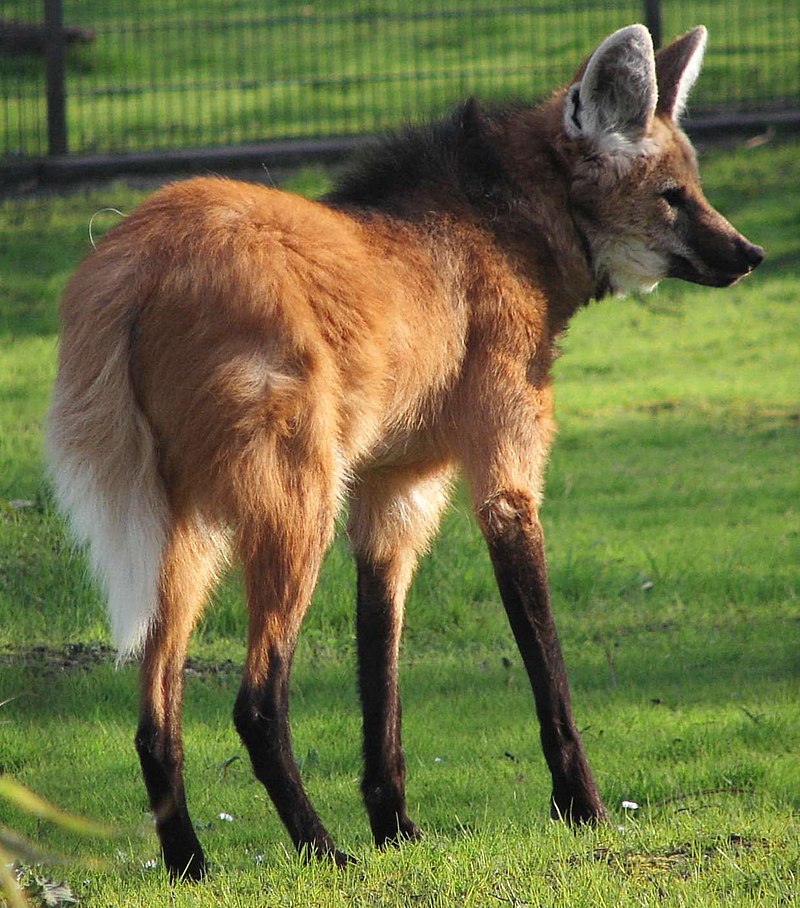
Chrysocyon brachyurus (Maned Wolf) in Cologne Zoo, Germany.
By sarefo - Own work, CC BY-SA 3.0, https://commons.wikimedia.org/w/index.php?curid=718357
As for the common name, it's obvious why it's called "maned". Like the hyena (which isn't a member of the canine family and therefore of no relation), the maned wolf has a crest of hair that sticks up along its neck and shoulders. This South American mammal--the largest canine species in South America at up to 3 feet tall--is a grassland omnivore, its long legs suitable for running down prey, which tends to be small and medium sized mammals, birds, and sometimes even fish--but some studies find that over half their diet may be plant-derived in the form of fruit, vegetables, and even sugarcane. When fed too much meat in zoos, maned wolves developed bladder stones, and so it's now customary to feed them a diet fairly heavy with fruit and vegetables when in captivity. So while they may look like good hunters, these solitary animals may spend more time chowing down at the proverbial salad bar than chowing down on steak. They don't have any predators themselves, though domestic dogs will attack and kill them if they can.
The maned wolf is near threatened due to habitat loss and the contraction of canine diseases from encounters with domestic dog populations. Hunting has historically also led to their decline, as local tribes once thought that the eyes of the maned wolf brought good luck.
There are a couple of interesting facts I've found about these animals regarding their...er...bodily functions. First, apparently, their urine smells like marijuana--enough so that zoos with maned wolves on exhibit have had cops show up trying to find cannabis users on their property. The next is fitting for this group; I know I tend to use my "Gardens & Books" threads more as zoological garden than botanical garden posting grounds, but all life is tied together, as this proves. Any gardener will love the symbiotic relationship between the maned wolf, the leaf cutter ants, and a plant called lobeira plant, the fruit of which is known as a wolf apple, because our friend the maned wolf goes crazy over it. (Not cat/catnip crazy, but it makes up a good part of their diet when in season.) Eating this fruit might help the maned wolf fight off a parasite known as the giant kidney worm--though there's no hard proof of this yet. So we know what the benefit to the wolf--a meal and possibly an anti-parasitical treatment--is. For the benefit to the plant, the maned wolf uses the ants. The maned wolf will defecate on or very close to leaf cutter ant colonies after eating this fruit. The ants use the wolf's waste to fertilize their fungal crop underground (leaf cutter ants "farm" fungus in their nests), but they don't want the plant's seeds. They carry away the seeds and drop them somewhere else--and anywhere the seeds take root, a new lobeira plant grows. So the wolf helps indirectly spread the lobeira plant, and everyone, including the ants, benefit from this relationship. Ah, a beautiful animal involved in a beautiful relationship....
And by the way, maned wolves are also monogamous--although they seldom interact with their mate, preferring a solitary life.
Chrysocyon brachyurus (Maned Wolf) in Cologne Zoo, Germany.
By sarefo - Own work, CC BY-SA 3.0, https://commons.wikimedia.org/w/index.php?curid=718357
As for the common name, it's obvious why it's called "maned". Like the hyena (which isn't a member of the canine family and therefore of no relation), the maned wolf has a crest of hair that sticks up along its neck and shoulders. This South American mammal--the largest canine species in South America at up to 3 feet tall--is a grassland omnivore, its long legs suitable for running down prey, which tends to be small and medium sized mammals, birds, and sometimes even fish--but some studies find that over half their diet may be plant-derived in the form of fruit, vegetables, and even sugarcane. When fed too much meat in zoos, maned wolves developed bladder stones, and so it's now customary to feed them a diet fairly heavy with fruit and vegetables when in captivity. So while they may look like good hunters, these solitary animals may spend more time chowing down at the proverbial salad bar than chowing down on steak. They don't have any predators themselves, though domestic dogs will attack and kill them if they can.
The maned wolf is near threatened due to habitat loss and the contraction of canine diseases from encounters with domestic dog populations. Hunting has historically also led to their decline, as local tribes once thought that the eyes of the maned wolf brought good luck.
There are a couple of interesting facts I've found about these animals regarding their...er...bodily functions. First, apparently, their urine smells like marijuana--enough so that zoos with maned wolves on exhibit have had cops show up trying to find cannabis users on their property. The next is fitting for this group; I know I tend to use my "Gardens & Books" threads more as zoological garden than botanical garden posting grounds, but all life is tied together, as this proves. Any gardener will love the symbiotic relationship between the maned wolf, the leaf cutter ants, and a plant called lobeira plant, the fruit of which is known as a wolf apple, because our friend the maned wolf goes crazy over it. (Not cat/catnip crazy, but it makes up a good part of their diet when in season.) Eating this fruit might help the maned wolf fight off a parasite known as the giant kidney worm--though there's no hard proof of this yet. So we know what the benefit to the wolf--a meal and possibly an anti-parasitical treatment--is. For the benefit to the plant, the maned wolf uses the ants. The maned wolf will defecate on or very close to leaf cutter ant colonies after eating this fruit. The ants use the wolf's waste to fertilize their fungal crop underground (leaf cutter ants "farm" fungus in their nests), but they don't want the plant's seeds. They carry away the seeds and drop them somewhere else--and anywhere the seeds take root, a new lobeira plant grows. So the wolf helps indirectly spread the lobeira plant, and everyone, including the ants, benefit from this relationship. Ah, a beautiful animal involved in a beautiful relationship....
And by the way, maned wolves are also monogamous--although they seldom interact with their mate, preferring a solitary life.
61fuzzi
>60 CassieBash: enjoyed reading about the Maned wolf, thank you.
62CassieBash
This week, let's say hi to the colorful macaws!
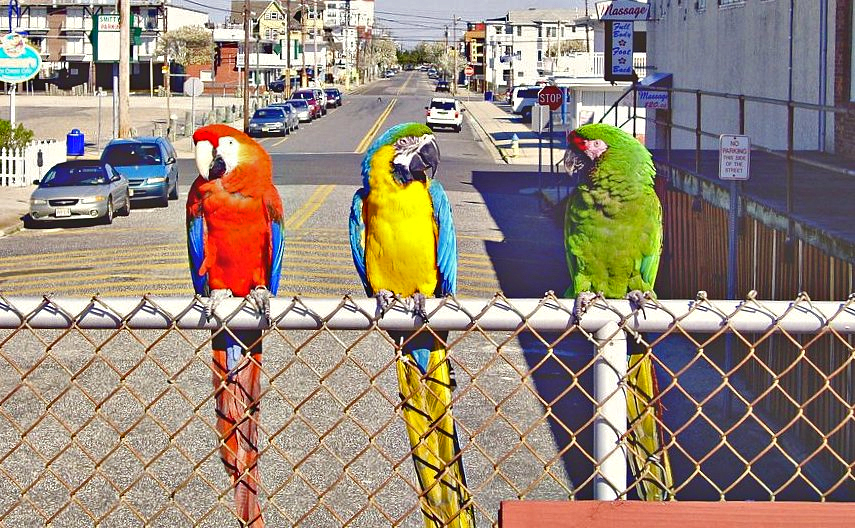
Scarlet Macaw (Ara macao), Blue-and-yellow Macaw (Ara ararauna) and Military Macaw (Ara militaris), Wildwood Boardwalk, Wildwood, New Jersey.
By LancerEvolution ; from New Jersey, United States (USA) - Three Birds on a Boardwalk, CC BY 2.0, https://commons.wikimedia.org/w/index.php?curid=6599047
Peru in January is apparently the best time to watch wild macaws as they binge-eat during the height of their food availability, which is mainly fruit, nuts, seeds, and other plant matter. They also eat clay; one of the theories behind this is that some of the things they eat may contain toxins that are either neutralized by chemicals in the clay or that bond with the clay and thus pass harmlessly through the birds' digestive tracts. However, other studies have shown that the parrots prefer soils with high sodium content and that they are using the clay like deer use salt licks. Consumption of clay increases during the breeding/mating season, and another theory is that female birds in particular may be gaining calcium from the clay as well as salts. Another possible important nutrient that could be had from some clay is B12.
Part of the parrot family, there are 19 species divided into 6 genera (the plural of genus). The scarlet and the blue and yellow species are probably the most well-known. Macaws differ from other parrots by their proportionately large beaks, long tails, and light-colored facial patches around the eyes. Like all parrots (and like woodpeckers and some owls), their first and fourth toes point backwards, allowing them the ability to cling to vertical surfaces like tree trunks. This is called zygodactyly.
Unfortunately, their popularity as pets and their feathers' beautiful color has resulted in excessive hunting and a stark decline in their numbers. Deforestation of their jungle homes hasn't helped, either. Several species are extinct, either completely or at least extinct in the wild, while the rest are endangered.
Scarlet Macaw (Ara macao), Blue-and-yellow Macaw (Ara ararauna) and Military Macaw (Ara militaris), Wildwood Boardwalk, Wildwood, New Jersey.
By LancerEvolution ; from New Jersey, United States (USA) - Three Birds on a Boardwalk, CC BY 2.0, https://commons.wikimedia.org/w/index.php?curid=6599047
Peru in January is apparently the best time to watch wild macaws as they binge-eat during the height of their food availability, which is mainly fruit, nuts, seeds, and other plant matter. They also eat clay; one of the theories behind this is that some of the things they eat may contain toxins that are either neutralized by chemicals in the clay or that bond with the clay and thus pass harmlessly through the birds' digestive tracts. However, other studies have shown that the parrots prefer soils with high sodium content and that they are using the clay like deer use salt licks. Consumption of clay increases during the breeding/mating season, and another theory is that female birds in particular may be gaining calcium from the clay as well as salts. Another possible important nutrient that could be had from some clay is B12.
Part of the parrot family, there are 19 species divided into 6 genera (the plural of genus). The scarlet and the blue and yellow species are probably the most well-known. Macaws differ from other parrots by their proportionately large beaks, long tails, and light-colored facial patches around the eyes. Like all parrots (and like woodpeckers and some owls), their first and fourth toes point backwards, allowing them the ability to cling to vertical surfaces like tree trunks. This is called zygodactyly.
Unfortunately, their popularity as pets and their feathers' beautiful color has resulted in excessive hunting and a stark decline in their numbers. Deforestation of their jungle homes hasn't helped, either. Several species are extinct, either completely or at least extinct in the wild, while the rest are endangered.
64CassieBash
Speaking of beautiful birds, our large friends, the wild turkeys, decided that once the snow fell, the easiest meal to be had was under the bird feeders out back by my garden. What started out as four large males eventually became about the entire 25 member flock.


65fuzzi
>64 CassieBash: wow!
66CassieBash
Yeah, that's a lot of turkey.
I wanted to do something different for the critter this week, something invertebrate but still cold-loving, since we're heading into a below-freezing pattern again here in NW Indiana. I've not been doing too many invertebrates recently, and when I do include one, they tend to be either spiders or insects. Let's branch out and look at the weird and wonderful glass sponges.

Staurocalyptus sp., By NOAA/Monterey Bay Aquarium Research Institute - http://www.photolib.noaa.gov/bigs/expl0951.jpg, Public Domain, https://commons.wikimedia.org/w/index.php?curid=6420026
Glass sponges are actually a class of sponges known as the hexactinellids, and what makes these guys different from most other sponges is that they have a skeleton. Not one made of calcium like ours, however, but of silica. While they are still carbon-based life forms in that only their skeleton is silica-based, it's an unusual setup that most other sponges lack. In fact, one disadvantage to this setup is that, unlike other sponges, glass sponges can't contract their bodies, the soft tissues of which are one massive super-cell with multiple nuclei. But that doesn't mean that they can't respond to stimuli and they still can move, and one advantage that they have that other sponges lack is that they have bodies that allow for fast electrical impulse conduction, meaning that they can react faster to stimuli. Most species are found at depths between 1,480-2,950 feet, but a few are found in deeper or shallower waters. They can be found in and throughout all oceans worldwide, they do seem to prefer it cold, being more common in the Antarctic and Northern Pacific oceans. Some in the Antarctic are found in waters as shallow as 108 feet. Glass sponges are considered uncommon, and the reefs they can make when they colonize are rare now, which is a pity because ecologically, they are a great place for fish and invertebrates to mate and lay eggs and/or raise young. Glass sponges also absorb carbon, leading some scientists to wonder about the potential in encouraging reefs in an effort to fight climate change.
I wanted to do something different for the critter this week, something invertebrate but still cold-loving, since we're heading into a below-freezing pattern again here in NW Indiana. I've not been doing too many invertebrates recently, and when I do include one, they tend to be either spiders or insects. Let's branch out and look at the weird and wonderful glass sponges.

Staurocalyptus sp., By NOAA/Monterey Bay Aquarium Research Institute - http://www.photolib.noaa.gov/bigs/expl0951.jpg, Public Domain, https://commons.wikimedia.org/w/index.php?curid=6420026
Glass sponges are actually a class of sponges known as the hexactinellids, and what makes these guys different from most other sponges is that they have a skeleton. Not one made of calcium like ours, however, but of silica. While they are still carbon-based life forms in that only their skeleton is silica-based, it's an unusual setup that most other sponges lack. In fact, one disadvantage to this setup is that, unlike other sponges, glass sponges can't contract their bodies, the soft tissues of which are one massive super-cell with multiple nuclei. But that doesn't mean that they can't respond to stimuli and they still can move, and one advantage that they have that other sponges lack is that they have bodies that allow for fast electrical impulse conduction, meaning that they can react faster to stimuli. Most species are found at depths between 1,480-2,950 feet, but a few are found in deeper or shallower waters. They can be found in and throughout all oceans worldwide, they do seem to prefer it cold, being more common in the Antarctic and Northern Pacific oceans. Some in the Antarctic are found in waters as shallow as 108 feet. Glass sponges are considered uncommon, and the reefs they can make when they colonize are rare now, which is a pity because ecologically, they are a great place for fish and invertebrates to mate and lay eggs and/or raise young. Glass sponges also absorb carbon, leading some scientists to wonder about the potential in encouraging reefs in an effort to fight climate change.
67Lyndatrue
>66 CassieBash: Leave it to you to inject something strange and new into my day. Sponges with silica for a skeletal structure are an astonishment! Thank you.
68CassieBash
>67 Lyndatrue: You're welcome. And if it's any satisfaction in any way to you, it was strange and new to me, too. I just chose this week's critter by asking myself what I hadn't covered yet, and the simpler animals--sponges, worms, jellyfish, snails and slugs, things like that--came to mind. So I skimmed around with sponges as the search term and came up with this group.
Perhaps silicon life forms aren't that far-fetched after all....
Perhaps silicon life forms aren't that far-fetched after all....
69fuzzi
>66 CassieBash: nifty. Never heard of these critters.
>68 CassieBash: Hortas?
http://www.startrek.com/database_article/devil-in-the-dark-the
That's one of my favorite episodes.
>68 CassieBash: Hortas?
http://www.startrek.com/database_article/devil-in-the-dark-the
That's one of my favorite episodes.
70CassieBash
>69 fuzzi: Perhaps the evolutionary start of them.... The Hortas were intelligent and sentient and sponges aren’t—at least, not that we know of. Maybe they’ the quiet, deep thinkers of the oceans....
This year sees the return of the polar vortex in our area, mid-week. You know you’re in trouble when your local weather persons use the words “stupid cold” (my personal favorite) and “absolutely brutal” literally on their weather maps. Really—this weekend’s forecasters had these words on their weather maps behind the blue line denoting the cold front. They’re talking about record-low highs (if that makes sense to you)—but first the snow, again. At least there’ll be an insulating layer of snow on the ground to help protect our plants. And I’m glad I decided to bring in all the cocoons and chrysalises into the basement this winter.
Speaking of, regular readers may remember that I lamented not having any silkworms this year. Yesterday, mom brought me a Polyphemus moth cocoon she’d found under an oak. It, too, is now in the basement.
This year sees the return of the polar vortex in our area, mid-week. You know you’re in trouble when your local weather persons use the words “stupid cold” (my personal favorite) and “absolutely brutal” literally on their weather maps. Really—this weekend’s forecasters had these words on their weather maps behind the blue line denoting the cold front. They’re talking about record-low highs (if that makes sense to you)—but first the snow, again. At least there’ll be an insulating layer of snow on the ground to help protect our plants. And I’m glad I decided to bring in all the cocoons and chrysalises into the basement this winter.
Speaking of, regular readers may remember that I lamented not having any silkworms this year. Yesterday, mom brought me a Polyphemus moth cocoon she’d found under an oak. It, too, is now in the basement.
71CassieBash
This week, Indiana is going to get another taste of a polar vortex. It's been a few years since this has happened, and this time around, they say we'll be setting all-time coldest highs on record for our area. Polar vortex makes me naturally think of white wastelands on the top of the world, but even wastelands have life.
Critter of the Week:
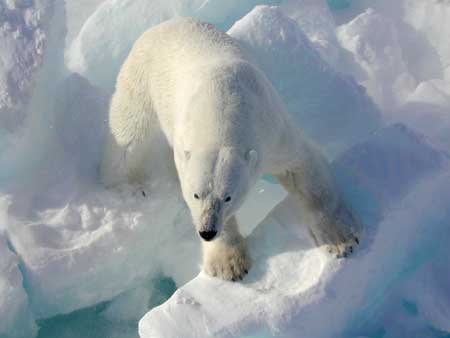
Polar Bear on Ice, by USGS, Public domain, via Wikimedia Commons
This is an iconic animal, synonymous with global warming and climate change, the freedom and savagery of the northern frontier, spiritual guides of native peoples, and Coca-Cola at Christmastime. Two year old children can identify the polar bear. But do you know these quick facts about the polar bear?
They are hypercarnivorous, a word meaning that over 70% of their diet is meat.
Males are called boars, and females are sows--just like with pigs.
They are the largest member in the bear family--Ursus--and their closest relatives are the brown, aka grizzly, bear, and that it's believed that the polar bears became cut off from the rest of the brown bear population over 100,000 years ago and evolved into a new species to survive the cold and ice of their new territory. However, they are still close enough to have offspring together.
We think of only Canada and Alaska having polar bears, but the species is also native to Russia, Norway, and Greenland.
While they are born on land, polar bears actually spend almost all of their lives on sea ice, which is disappearing.
Polar bears live in an area where fresh water is rare; their bodies are able to create water from metabolizing seal blubber; seals make up most of their diet.
Polar bears use a method called still-hunting; they find a hole in the ice and silently wait for a seal to appear, much like cats watching a rodent hole. A bear can find a hole by scent from over half a mile away; they can smell the seals' breaths.
Polar bears do not hibernate as such; females do go into a similar state but it isn't true hibernation. Polar bears have a metabolism that allows their cells to create heat rather than energy under certain dietary or environmental conditions.
Polar bears have paw pads that are like slipper socks with the non-skid buttons; the paws are heavily furred and the pads have great traction for ice and snow.
Their conservation status is vulnerable; shrinking amounts of sea ice, pollution, man's encroachment on their territory, and poaching all contribute to their declining numbers.
Brrr!! You know, I think the polar vortex needs to head back north as soon as possible; the polar bears can have it!
Critter of the Week:
Polar Bear on Ice, by USGS, Public domain, via Wikimedia Commons
This is an iconic animal, synonymous with global warming and climate change, the freedom and savagery of the northern frontier, spiritual guides of native peoples, and Coca-Cola at Christmastime. Two year old children can identify the polar bear. But do you know these quick facts about the polar bear?
They are hypercarnivorous, a word meaning that over 70% of their diet is meat.
Males are called boars, and females are sows--just like with pigs.
They are the largest member in the bear family--Ursus--and their closest relatives are the brown, aka grizzly, bear, and that it's believed that the polar bears became cut off from the rest of the brown bear population over 100,000 years ago and evolved into a new species to survive the cold and ice of their new territory. However, they are still close enough to have offspring together.
We think of only Canada and Alaska having polar bears, but the species is also native to Russia, Norway, and Greenland.
While they are born on land, polar bears actually spend almost all of their lives on sea ice, which is disappearing.
Polar bears live in an area where fresh water is rare; their bodies are able to create water from metabolizing seal blubber; seals make up most of their diet.
Polar bears use a method called still-hunting; they find a hole in the ice and silently wait for a seal to appear, much like cats watching a rodent hole. A bear can find a hole by scent from over half a mile away; they can smell the seals' breaths.
Polar bears do not hibernate as such; females do go into a similar state but it isn't true hibernation. Polar bears have a metabolism that allows their cells to create heat rather than energy under certain dietary or environmental conditions.
Polar bears have paw pads that are like slipper socks with the non-skid buttons; the paws are heavily furred and the pads have great traction for ice and snow.
Their conservation status is vulnerable; shrinking amounts of sea ice, pollution, man's encroachment on their territory, and poaching all contribute to their declining numbers.
Brrr!! You know, I think the polar vortex needs to head back north as soon as possible; the polar bears can have it!
72fuzzi
I just bought a book about your critter of the week, The Polar Bear Twins. I chose it for the illustrations by Kurt Wiese but the story looks good, too.
73CassieBash
>72 fuzzi: Cool! I believe twins are not uncommon for polar bears.
We’re surviving the cold as best we can. We brought in the 3 outside pen cats; they’re in our basement. They do have shelter in their own but the actual temperatures are supposed to be between -15 to -20 or colder for our highs, with wind chills of -45 or lower. Our quarantined cat (he has the feline equivalent of HIV and loves to beat up other toms, thus risking the infection of other cats) is in a large rabbit hutch in the garage. Of the two free-range cats, one is in the garage and the other is in the barn. Our dogs and of course the house cats are safe, while the horses are in the barn, the oldest two with blankets, while the two chickens have heaters. We try to be good critter mommies. At least there is an insulating layer of snow on the ground for the plants, though it’ll be interesting to see if I lose anything this year. This is not anywhere close to normal for us; -2 as a high is seen as freakishly cold.
If you’re someone who’s also being smacked hard with the polar vortex, stay safe and warm!
We’re surviving the cold as best we can. We brought in the 3 outside pen cats; they’re in our basement. They do have shelter in their own but the actual temperatures are supposed to be between -15 to -20 or colder for our highs, with wind chills of -45 or lower. Our quarantined cat (he has the feline equivalent of HIV and loves to beat up other toms, thus risking the infection of other cats) is in a large rabbit hutch in the garage. Of the two free-range cats, one is in the garage and the other is in the barn. Our dogs and of course the house cats are safe, while the horses are in the barn, the oldest two with blankets, while the two chickens have heaters. We try to be good critter mommies. At least there is an insulating layer of snow on the ground for the plants, though it’ll be interesting to see if I lose anything this year. This is not anywhere close to normal for us; -2 as a high is seen as freakishly cold.
If you’re someone who’s also being smacked hard with the polar vortex, stay safe and warm!
74fuzzi
>73 CassieBash: not as bad here, but much colder than normal: lows in the teens, wind chills in the singles. Our pipes, like most in this area, are not insulated, so we'll leave the faucets dripping until the weather warms above freezing.
75CassieBash
>74 fuzzi: Yeah, I saw video of alligators in North Carolina with the tips of their snouts poking out through the ice. They look so serene when they're sleeping. We ran our water a bit and opened the cupboard doors to allow the heat from the house to get under the sink to those pipes. Aside from about half an hour yesterday when we lost our power, we did OK and had very few worries. The pen cats think they're living the life of Riley; they're in for a rude awakening tomorrow when they go back out to their pen. Especially since rain will soon be in the forecast. Today's high of 19 seems balmy; tomorrow's high of 38 is the start of the heat wave, which carries on for a few days. Hope you'll be getting some heat back soon down your way.
76fuzzi
>75 CassieBash: wow, alligators? There are some in NC but not locally!
It's supposed to warm up to the 60s this weekend. There are going to be a ton of sick people...it's been my experience that the extreme swing in temperatures brings on a lot of illnesses.
It's supposed to warm up to the 60s this weekend. There are going to be a ton of sick people...it's been my experience that the extreme swing in temperatures brings on a lot of illnesses.
77CassieBash
>I'm hoping to dodge that sickness bullet myself; our temps are going to swing, too, though maybe not as quickly. Still, we're going from the teens this morning into the mid- to upper-30s later today, followed by upper 40s tomorrow and low 50s (with rain) on Monday. Fun, fun.
I believe that the alligators were along some coastal area somewhere? Obviously, the local TV channels couldn't find enough newsworthy cold-related local stories. It wasn't like we had a polar vortex right over us or anything. (This accompanied by an eye roll!)
We managed to pull everyone through with no issues. We were a bit concerned on Wednesday--the coldest day--about one of the wild doves; we thought for sure he (or she) was going to freeze to death right under our front bird feeder. He (or she) was all hunched up and just letting the other birds walk around it and even peck under it (we presume for seeds). A second dove, we assume its mate, kept going over to it like it was making sure the first was still alive. But about an hour later, it was eating seeds so it must have just been trying to warm up some, and it had left by the end of the day. But the turkeys were conspicuous by their absence; all I can think is that they decided to forage in the woods, where the trees blocked the wind, rather than walking through all the snow and cold.
I believe that the alligators were along some coastal area somewhere? Obviously, the local TV channels couldn't find enough newsworthy cold-related local stories. It wasn't like we had a polar vortex right over us or anything. (This accompanied by an eye roll!)
We managed to pull everyone through with no issues. We were a bit concerned on Wednesday--the coldest day--about one of the wild doves; we thought for sure he (or she) was going to freeze to death right under our front bird feeder. He (or she) was all hunched up and just letting the other birds walk around it and even peck under it (we presume for seeds). A second dove, we assume its mate, kept going over to it like it was making sure the first was still alive. But about an hour later, it was eating seeds so it must have just been trying to warm up some, and it had left by the end of the day. But the turkeys were conspicuous by their absence; all I can think is that they decided to forage in the woods, where the trees blocked the wind, rather than walking through all the snow and cold.
78CassieBash
I'm missing the splashes of color in the pond; despite our warmer weather, there was still a layer of snow on top of the ice over the surface of our pond. I miss seeing the fish, but with today's 50+ temps and some rain, I may be able to see them tonight when I get home. I hope they were well during this vortex; at least we know that the waterfall was working through the nasty cold, keeping water circulating. Goldfish and koi like colder water, so I'm going to designate the koi as our Critter.


Amalthea (white) and Sunny (gold), our two koi
For those of you who may not know, the koi are the big fish--the white and the gold. Both the goldfish and the koi are members of the carp family; this is a large family of fish native to Asia and Central Europe. Koi are Asian and their full name, nishikigoi, means "brocaded carp", due to the lovely patterning of scales found on many individuals. There are many varieties kept for decorative purposes and they are considered domesticated, though originally they were eaten as much as admired. Carp of all kinds tend to be cold water lovers and because koi come in so many colors and patterns, and are highly adaptable to cold climates with fresh water, they became more widespread, gradually becoming a common decorative feature in water gardens (and Chinese buffets). There are clubs for koi lovers just like there are clubs for cat, dog, and even pigeon enthusiasts. You can determine different varieties by color, pattern, scales, and features like fins and tails. For instance, our white koi, Amalthea, is a butterfly koi; she has long, flowing fins and tail because Japanese breeders crossed the traditional koi with wild Indonesian longfin river carp for looks and hardiness. Ghost koi are relatively recently bred varieties that have metallic-looking scales due to the wild carp bred with traditional koi to achieve their look. Some don't consider either of these varieties to be true nishikigoi.
While both koi and goldfish are beautifully colored carp, goldfish tend to be smaller. Koi have similar body shapes and have the little barbels (the "whiskers") on their lips while goldfish can come in all sorts of body shapes (compare ryukin and shubunkin and you'll get an idea of the variety). They are both carp, however, so technically, since we have both living together, we might one spring or summer day, if conditions are right, see hybrids between our goldfish (who have already multiplied) and our koi. The ladies lay the eggs, which sink to the bottom, while the gents fertilize externally. However, many koi offspring will lack the beautiful coloration, and breeders cull these, often feeding them to other fish.
Koi are not, however, well loved by everyone. They can become nuisances and are invasive species when released into the wild--so DON'T DO IT! Once established, they are difficult to eradicate in the wild, and they can overcrowd waterways and make them unfit for swimming or drinking, even by other animals. They are extremely hardy, and those diseases that do effect them can halt breeding in koi farms and may mean draining the water from breeding ponds and a prolonged quarantine. There are predators such as herons, kingfishers, cats, raccoons, foxes, and badgers, that may strip an ornamental pond of its fish, but they are generally not good at controlling a wild breeding population. They are also long-lived, able to reach the age of 200+ years.
Whoever ends up buying our property when the last of us passes on will likely have a ready-stocked koi pond.


Amalthea (white) and Sunny (gold), our two koi
For those of you who may not know, the koi are the big fish--the white and the gold. Both the goldfish and the koi are members of the carp family; this is a large family of fish native to Asia and Central Europe. Koi are Asian and their full name, nishikigoi, means "brocaded carp", due to the lovely patterning of scales found on many individuals. There are many varieties kept for decorative purposes and they are considered domesticated, though originally they were eaten as much as admired. Carp of all kinds tend to be cold water lovers and because koi come in so many colors and patterns, and are highly adaptable to cold climates with fresh water, they became more widespread, gradually becoming a common decorative feature in water gardens (and Chinese buffets). There are clubs for koi lovers just like there are clubs for cat, dog, and even pigeon enthusiasts. You can determine different varieties by color, pattern, scales, and features like fins and tails. For instance, our white koi, Amalthea, is a butterfly koi; she has long, flowing fins and tail because Japanese breeders crossed the traditional koi with wild Indonesian longfin river carp for looks and hardiness. Ghost koi are relatively recently bred varieties that have metallic-looking scales due to the wild carp bred with traditional koi to achieve their look. Some don't consider either of these varieties to be true nishikigoi.
While both koi and goldfish are beautifully colored carp, goldfish tend to be smaller. Koi have similar body shapes and have the little barbels (the "whiskers") on their lips while goldfish can come in all sorts of body shapes (compare ryukin and shubunkin and you'll get an idea of the variety). They are both carp, however, so technically, since we have both living together, we might one spring or summer day, if conditions are right, see hybrids between our goldfish (who have already multiplied) and our koi. The ladies lay the eggs, which sink to the bottom, while the gents fertilize externally. However, many koi offspring will lack the beautiful coloration, and breeders cull these, often feeding them to other fish.
Koi are not, however, well loved by everyone. They can become nuisances and are invasive species when released into the wild--so DON'T DO IT! Once established, they are difficult to eradicate in the wild, and they can overcrowd waterways and make them unfit for swimming or drinking, even by other animals. They are extremely hardy, and those diseases that do effect them can halt breeding in koi farms and may mean draining the water from breeding ponds and a prolonged quarantine. There are predators such as herons, kingfishers, cats, raccoons, foxes, and badgers, that may strip an ornamental pond of its fish, but they are generally not good at controlling a wild breeding population. They are also long-lived, able to reach the age of 200+ years.
Whoever ends up buying our property when the last of us passes on will likely have a ready-stocked koi pond.
79CassieBash
Since Valentine's Day is coming up soon, I'm going to choose an obvious one here for the Critter. I had thought about kissing fish, but since I did koi last week, we'll have a look at lovebirds this time around.

A feral Peach-faced Lovebird (Agapornis roseicollis) also known as the Rosy-faced Lovebird eating grass seeds in Chicago, Illinois, USA.
By David González Romero - originally posted to Flickr as Birdie, CC BY 2.0, https://commons.wikimedia.org/w/index.php?curid=4564382
There are actually nine species of lovebirds, most of which are native to Africa--one is native to Madagascar. These birds are members of the parrot family, which most people could probably guess by their beak and feet shape and their bright colors. As you would hope by their name, they are monogamous in their relationships, mating for life. They are flock birds, highly social and affectionate. Pairs spend most of their time together. Because they are social and bond well, they can become quite attached to humans, but like all parents, they can be aggressive, and you don't want to risk a nip from their sharp, strong beaks. If you do want to get a lovebird, look for captive-bred ones rather than wild ones, because if a pair is split up, the remaining one in the wild will mourn birds missing from the flock, whether it's a mate or not. If you want to have a strong bond with your bird, and you plan on having a lot of time to give it attention, it's best to have just one, because if you do get a pair, it will bond more closely with the other bird. If you aren't going to be around much, however, it is better then to have a pair or to simply not adopt one at this time. They require a lot of attention and affection from someone because they're so social, so think carefully about your lifestyle and whether it's suitable for such birds.
Lovebirds are seed, fruit, and nut eaters predominately, and you'll want to make sure that you research the diet for the species you get if you adopt one, because some have very specific needs, such as requiring a specific type of fruit. They also are, like all birds, sensitive to the chemicals released when heating food in Teflon and other nonstick coated kitchen utensils. They also tend to talk, especially during the start and end of the day. If they escape, they can set up flocks in warmer climates, even in the U.S.--there are feral populations in Austin, Texas and Phoenix, Arizona. The bird in the above picture, taken in Chicago, Illinois, most likely died when the cold weather set in if it didn't migrate. Love birds can live for 10-15 years on average.

A feral Peach-faced Lovebird (Agapornis roseicollis) also known as the Rosy-faced Lovebird eating grass seeds in Chicago, Illinois, USA.
By David González Romero - originally posted to Flickr as Birdie, CC BY 2.0, https://commons.wikimedia.org/w/index.php?curid=4564382
There are actually nine species of lovebirds, most of which are native to Africa--one is native to Madagascar. These birds are members of the parrot family, which most people could probably guess by their beak and feet shape and their bright colors. As you would hope by their name, they are monogamous in their relationships, mating for life. They are flock birds, highly social and affectionate. Pairs spend most of their time together. Because they are social and bond well, they can become quite attached to humans, but like all parents, they can be aggressive, and you don't want to risk a nip from their sharp, strong beaks. If you do want to get a lovebird, look for captive-bred ones rather than wild ones, because if a pair is split up, the remaining one in the wild will mourn birds missing from the flock, whether it's a mate or not. If you want to have a strong bond with your bird, and you plan on having a lot of time to give it attention, it's best to have just one, because if you do get a pair, it will bond more closely with the other bird. If you aren't going to be around much, however, it is better then to have a pair or to simply not adopt one at this time. They require a lot of attention and affection from someone because they're so social, so think carefully about your lifestyle and whether it's suitable for such birds.
Lovebirds are seed, fruit, and nut eaters predominately, and you'll want to make sure that you research the diet for the species you get if you adopt one, because some have very specific needs, such as requiring a specific type of fruit. They also are, like all birds, sensitive to the chemicals released when heating food in Teflon and other nonstick coated kitchen utensils. They also tend to talk, especially during the start and end of the day. If they escape, they can set up flocks in warmer climates, even in the U.S.--there are feral populations in Austin, Texas and Phoenix, Arizona. The bird in the above picture, taken in Chicago, Illinois, most likely died when the cold weather set in if it didn't migrate. Love birds can live for 10-15 years on average.
80CassieBash
Meant to share this yesterday for Valentine's Day but I was up to my eyeballs in an important project at work, and time got away from me. When we had the polar vortex the other week, it froze the water in the dish for the barn cats. When I emptied it of the spherical ice form to refill the bowl, I discarded the chunk of ice in a snow drift that must have just been the right angle to allow the sun, when we had the brief warm-up afterwards, to melt it unevenly and naturally form the heart shape. I wonder what the odds are on that. :)


81fuzzi
>80 CassieBash: too cool.
82CassieBash
I miss butterflies, and the other day, I came across this species on my FaceBook feed. You really have to see them in action to really appreciate them, so I strongly encourage you to view the Center for Biological Diversity's YouTube video of the Green Dragontail Butterfly.

Lamproptera meges (Zinken, 1831), from C.T. Bingham - Fauna of British India - Butterflies (Vol. 2), 1907 (public domain--U.S.--expired).
Found in South and Southeast Asia rainforests, the green dragontail is a member of the Swallowtails; there are actually 10 subspecies. There are a few things that make the dragontail stand out among swallowtails, the most obvious to the casual observer is the rippling flutter of the hind tails in flight. (Click on the link for the YouTube video that shows some excellent footage of this.) The tails are their rudders, and between their fast wing beats and their ability to stop suddenly or make quick turns, they are often mistaken for dragonflies. Some speculate that they are trying to mimic dragonflies in order to avoid being seen as their prey. Another oddity is the clear, glass-like patch on the wings; most swallowtails don't have these clear areas. They're also one of the smallest swallowtails, the largest coming in just shy of two inches, the smallest at under an inch. The males, shown in the video, engage in puddling--a common practice for the males of many species of Lepidoptera, that lets them get minerals that they need to mate. While not threatened or endangered yet, they are considered vulnerable in Malaysia.

Lamproptera meges (Zinken, 1831), from C.T. Bingham - Fauna of British India - Butterflies (Vol. 2), 1907 (public domain--U.S.--expired).
Found in South and Southeast Asia rainforests, the green dragontail is a member of the Swallowtails; there are actually 10 subspecies. There are a few things that make the dragontail stand out among swallowtails, the most obvious to the casual observer is the rippling flutter of the hind tails in flight. (Click on the link for the YouTube video that shows some excellent footage of this.) The tails are their rudders, and between their fast wing beats and their ability to stop suddenly or make quick turns, they are often mistaken for dragonflies. Some speculate that they are trying to mimic dragonflies in order to avoid being seen as their prey. Another oddity is the clear, glass-like patch on the wings; most swallowtails don't have these clear areas. They're also one of the smallest swallowtails, the largest coming in just shy of two inches, the smallest at under an inch. The males, shown in the video, engage in puddling--a common practice for the males of many species of Lepidoptera, that lets them get minerals that they need to mate. While not threatened or endangered yet, they are considered vulnerable in Malaysia.
84NorthernStar
>82 CassieBash: - very cool!
85fuzzi
@CassieBash ...psst. You there??
86CassieBash
Apologies to followers of this thread, but I had a very large and very pressing task at work, one that kept me at my desk for over 10 hours a day, plus weekends, for a long time. I didn’t get a chance to post anything and, in fact, had book postings for my 75 challenge build up (because even with a huge project with a deadline I worked in a little time to read). Things should be back to normal this Monday, when I’ll have a new critter to share.
87Lyndatrue
>86 CassieBash: Aw, shucks. Here's a photo from a couple of years ago, that I've always loved.
Local goose mom (my guess is this was her first brood), heading back in the right direction to find the local pond with her little brood. I think I counted either six or seven. This shot was one I took after heading them AWAY from the road, and along my back yard, and back to the official goose crossing. Awfully cute, and I hope they bring a smile to you.

Get some rest. Sweet dreams.
Local goose mom (my guess is this was her first brood), heading back in the right direction to find the local pond with her little brood. I think I counted either six or seven. This shot was one I took after heading them AWAY from the road, and along my back yard, and back to the official goose crossing. Awfully cute, and I hope they bring a smile to you.

Get some rest. Sweet dreams.
88fuzzi
>87 Lyndatrue: they did make me smile... Make Way For Ducklings!
>86 CassieBash: will be watching for your return.
>86 CassieBash: will be watching for your return.
89CassieBash
>87 Lyndatrue: *smiles* Mission accomplished.
OK, I'm back, and I'm ready to announce this week's Critter. Since St. Patrick's Day is Sunday, I've chosen a green animal. This week's critter (or rather, group of critters, since these are a specialized family within a superfamily) is the green sea slug. And what makes them so green?

Anatomy of the sacoglossan mollusc Elysia chlorotica. Sea slug consuming its obligate algal food Vaucheria litorea. Small, punctate green circles are the plastids located within the extensive digestive diverticula of the animal. By Karen N. Pelletreau et al. - http://journals.plos.org/plosone/article?id=10.1371/journal.pone.0097477, CC BY 4.0, https://commons.wikimedia.org/w/index.php?curid=38619279
The adult slugs absorb and incorporate chloroplasts from the plants they eat, and this gives them the green color. Juveniles tend to be other colors, since only adults seem capable of stealing chloroplasts--a feat known as kleptoplasty. The question that then comes up is whether the slugs use the chloroplasts to derive some of their energy from the sun, and if so, to what extent. Scientists aren't sure if the chloroplasts really provide enough energy for the slugs to survive on sunlight alone while the chloroplasts are alive (they do break down and become absorbed in the slug's digestive tract eventually), or if some photosynthesis occurs. Some scientists think that the slugs simply get their energy from the slow breakdown of the chloroplasts themselves, and that the only thing that photosynthesis does is change the slug's color. (Studies with different species do tend to show that the slugs don't require light to survive, with or without chloroplasts, but this doesn't really answer the question of whether the slugs can live on sunlight if they have the opportunity.) But the green color makes a handy form of camouflage if you're hiding out in your favorite food. Regardless, the incorporation of plant cells into their system make these fellows part plant, which is fitting for a gardening thread, isn't it? Now how cool is that?
While they are "sea" slugs, not all of them are found far out in the ocean as one might expect. In fact, the one shown above--the eastern emerald elysia--can be found in salt and tidal marshes, shallow creeks, and pools in parts of the U.S., including Texas, Florida, New York, and Massachusetts and can be found as far north as Nova Scotia in Canada.

Costasiella kuroshimae, a Sacoglossan sea slug which uses kleptoplasty to create complex patterns on its body; By alif_abdulrahman - Costasiella Kuroshimae, CC BY-SA 2.0, https://commons.wikimedia.org/w/index.php?curid=41894580
We may never truly find out, as these slugs (notably the eastern emerald from the top picture) are becoming rarer as development of their environment and pollution takes its toll.
While you're enjoying your favorite green beer this Sunday, take a moment to wonder what it would be like if that drink were colored by chloroplasts that you could absorb and utilize instead of just food coloring. You'd truly be wearing of the green.
Happy St. Patrick's Day, all!
OK, I'm back, and I'm ready to announce this week's Critter. Since St. Patrick's Day is Sunday, I've chosen a green animal. This week's critter (or rather, group of critters, since these are a specialized family within a superfamily) is the green sea slug. And what makes them so green?

Anatomy of the sacoglossan mollusc Elysia chlorotica. Sea slug consuming its obligate algal food Vaucheria litorea. Small, punctate green circles are the plastids located within the extensive digestive diverticula of the animal. By Karen N. Pelletreau et al. - http://journals.plos.org/plosone/article?id=10.1371/journal.pone.0097477, CC BY 4.0, https://commons.wikimedia.org/w/index.php?curid=38619279
The adult slugs absorb and incorporate chloroplasts from the plants they eat, and this gives them the green color. Juveniles tend to be other colors, since only adults seem capable of stealing chloroplasts--a feat known as kleptoplasty. The question that then comes up is whether the slugs use the chloroplasts to derive some of their energy from the sun, and if so, to what extent. Scientists aren't sure if the chloroplasts really provide enough energy for the slugs to survive on sunlight alone while the chloroplasts are alive (they do break down and become absorbed in the slug's digestive tract eventually), or if some photosynthesis occurs. Some scientists think that the slugs simply get their energy from the slow breakdown of the chloroplasts themselves, and that the only thing that photosynthesis does is change the slug's color. (Studies with different species do tend to show that the slugs don't require light to survive, with or without chloroplasts, but this doesn't really answer the question of whether the slugs can live on sunlight if they have the opportunity.) But the green color makes a handy form of camouflage if you're hiding out in your favorite food. Regardless, the incorporation of plant cells into their system make these fellows part plant, which is fitting for a gardening thread, isn't it? Now how cool is that?
While they are "sea" slugs, not all of them are found far out in the ocean as one might expect. In fact, the one shown above--the eastern emerald elysia--can be found in salt and tidal marshes, shallow creeks, and pools in parts of the U.S., including Texas, Florida, New York, and Massachusetts and can be found as far north as Nova Scotia in Canada.

Costasiella kuroshimae, a Sacoglossan sea slug which uses kleptoplasty to create complex patterns on its body; By alif_abdulrahman - Costasiella Kuroshimae, CC BY-SA 2.0, https://commons.wikimedia.org/w/index.php?curid=41894580
We may never truly find out, as these slugs (notably the eastern emerald from the top picture) are becoming rarer as development of their environment and pollution takes its toll.
While you're enjoying your favorite green beer this Sunday, take a moment to wonder what it would be like if that drink were colored by chloroplasts that you could absorb and utilize instead of just food coloring. You'd truly be wearing of the green.
Happy St. Patrick's Day, all!
90CassieBash
We are so close to starting our (drum roll please!) Spring edition of this thread! Woo-hoo!
The Critter this week is a bird I've been trying to get pictures of ever since I started this honorary weekly spot, but they're not easy to catch. Not because they're rare or anything, but just because when I do see them, they're usually sitting on fences or electric poles at the side of the road, or in a ditch running between the highway (usually U.S. 31) and some farmer's field. Usually, I see them in places where I can't just pull off and take pictures. Red-tailed hawks love hunting in these areas, looking for mice, rabbits, and other small mammalian, avian, amphibian or reptilian prey. They especially love mice, rabbits, and snakes. While it's likely that they prefer fresh meat, they have been spotted eating carrion.


My chance to get pictures of one came just yesterday on my drive home. I was heading down a country road, a stretch of which is surrounded by woods on either side, but with farmers' fields surrounding the woods--perfect for these birds of prey. He'd gotten a squirrel (or a car had and he was just first on the scene), and I slowed down. With no one behind me or in front of me, I had the perfect setup to finally take pictures. Alas, by the time I had my camera, this guy had flown to the trees, showing off his wonderful red tail in the process, but by the time I was ready for the pictures, he refused to turn his back on me, watching me in my car the whole time.
Red-tailed hawks are sight hunters, which is why they love hunting over pastures and fields that have been harvested or just planted; they can easily see the movement of prey animals on the ground. Small prey is taken to a perch for eating, while larger prey is often eaten on the ground. They are monogamous and mate for life, only pairing up with another hawk if something happens to their partner. While the eggs are incubating, both sit on the nest, but once they've hatched, the males bring food to both the females and the chicks, while she stays on the nest. As the young develop, they may take small, short flights but often stay close to their parents for another several weeks as they slowly develop their strength and stamina. The nests are in trees, on cliffs, and even sometimes on man-made structures, and are used year after year. Both mates help to build the nest. They are territorial, with the male defending the broad area and the female aggressively defending the local area around the nest.
These birds are common in Indiana (and most of the rest of the U.S.) year-round, but further north, they may only be seen during the summer breeding months. Unlike many animals, their range has actually increased due to man's clearing of dense forests, though as cities continue to grow, scientists aren't sure if their range will once more shrink. Except for the red tail that gives them their name, the rest of their coloration is highly variable, though their underside tends to be lighter, often cream or white. Not much tackles an adult hawk, but crows and their relatives will eat eggs and nestlings, and great horned owls eat the young, and people still sometimes shoot them (though it's illegal to do so) or they are hit by cars. Lead from bullets in prey animals that they consume can also lead to poisoning.
The Critter this week is a bird I've been trying to get pictures of ever since I started this honorary weekly spot, but they're not easy to catch. Not because they're rare or anything, but just because when I do see them, they're usually sitting on fences or electric poles at the side of the road, or in a ditch running between the highway (usually U.S. 31) and some farmer's field. Usually, I see them in places where I can't just pull off and take pictures. Red-tailed hawks love hunting in these areas, looking for mice, rabbits, and other small mammalian, avian, amphibian or reptilian prey. They especially love mice, rabbits, and snakes. While it's likely that they prefer fresh meat, they have been spotted eating carrion.


My chance to get pictures of one came just yesterday on my drive home. I was heading down a country road, a stretch of which is surrounded by woods on either side, but with farmers' fields surrounding the woods--perfect for these birds of prey. He'd gotten a squirrel (or a car had and he was just first on the scene), and I slowed down. With no one behind me or in front of me, I had the perfect setup to finally take pictures. Alas, by the time I had my camera, this guy had flown to the trees, showing off his wonderful red tail in the process, but by the time I was ready for the pictures, he refused to turn his back on me, watching me in my car the whole time.
Red-tailed hawks are sight hunters, which is why they love hunting over pastures and fields that have been harvested or just planted; they can easily see the movement of prey animals on the ground. Small prey is taken to a perch for eating, while larger prey is often eaten on the ground. They are monogamous and mate for life, only pairing up with another hawk if something happens to their partner. While the eggs are incubating, both sit on the nest, but once they've hatched, the males bring food to both the females and the chicks, while she stays on the nest. As the young develop, they may take small, short flights but often stay close to their parents for another several weeks as they slowly develop their strength and stamina. The nests are in trees, on cliffs, and even sometimes on man-made structures, and are used year after year. Both mates help to build the nest. They are territorial, with the male defending the broad area and the female aggressively defending the local area around the nest.
These birds are common in Indiana (and most of the rest of the U.S.) year-round, but further north, they may only be seen during the summer breeding months. Unlike many animals, their range has actually increased due to man's clearing of dense forests, though as cities continue to grow, scientists aren't sure if their range will once more shrink. Except for the red tail that gives them their name, the rest of their coloration is highly variable, though their underside tends to be lighter, often cream or white. Not much tackles an adult hawk, but crows and their relatives will eat eggs and nestlings, and great horned owls eat the young, and people still sometimes shoot them (though it's illegal to do so) or they are hit by cars. Lead from bullets in prey animals that they consume can also lead to poisoning.
91fuzzi
>90 CassieBash: nice pics!
Check out the book Red Tails in Love, about a pair that nested in NYC.
We have lots of Red Tails and Red Shouldered hawks here, which I try to identify through their calls. I recognize Red Tails by remembering that they like to go shopping for cars, especially a KIA! 😁
Check out the book Red Tails in Love, about a pair that nested in NYC.
We have lots of Red Tails and Red Shouldered hawks here, which I try to identify through their calls. I recognize Red Tails by remembering that they like to go shopping for cars, especially a KIA! 😁
92CassieBash
>91 fuzzi: Yep, that sounds right for them! :D
93CassieBash
Here's a link to the Kia call of a red-tailed hawk, for those interested. It's the top one.
This week's critter is rather quiet, though, making few noises unless upset. (I understand that they hiss.) This week is the chameleon.

Chameleons are extremely cool critters, with lots of interesting abilities. First, there's more than one species of chameleon, and some give live birth to their young, and then others lay eggs. They aren't huge lizards--the largest is just under 2 feet, considerably smaller than the 10 foot Komodo dragon--so it's also pretty amazing that for live birthers, gestation is 4-6 months and for egg-layers, incubation is 4 months to...get this...2 years. Yep, that's right--up to 24 months of incubation. Smaller ones (and the smallest is less than an inch) have 2-4 eggs, while the larger species have up to 100 eggs. Live birthers, depending on the species, have between 8-30 young at a time. Eggs are laid in the ground, and when they hatch, they're self-sufficient, hunting insects down as soon as they emerge. They are excellent climbers, living in trees and bushes, so their feet are designed for gripping, like our hands, and their tails are prehensile, able to wrap around objects to help them with balance and grip.
Among their other interesting features is their eyes, which can move independently, allowing them to focus on two things at once. It also has the ability to swivel their eyes to get a 360 degree view. It can, when it sees prey, focus on the same thing with both eyes to help it catch prey with their sticky-ended tongues, which can be longer than the lizard themselves in some species. When the tongue is shot at prey and hits it, it forms a suction cup, and the tongue recoils the prey into the powerful jaws of the lizard. When not in use, the tongue is bunched up in the back of the mouth, always ready, however, to be sent flinging out to catch prey.
But what most people think about when they hear the word chameleon is how they can change color. While cartoons often show them changing their colors into complex patterns of plaid or stripes, but in life, it's not quite that sophisticated. Each species has set colors and patterns that are within their abilities; four layers of skin actually work together to create color changes. From the inside out, the layers are the nether, which reflects only white, the melanophore, which is responsible for brown and black pigments and reflects blue, the chromatophore, which has the yellow and red pigments, and of course the epidermis, which protects the rest. Working together via nerve impulses and hormone fluxes, the color cells shrink or expand and create a blend of colors and patterns.
Chameleons are Old World lizards, found mainly in Madagascar and Africa. Sadly, loss of habitat has put many species at risk, some critically. In 2014, the Chameleon Specialist Group, part of the Species Survival Commission of the IUCN (International Union for the Conservation of Nature), studied 184 of the 200 known species and found that 36% of them were in danger of extinction.
This week's critter is rather quiet, though, making few noises unless upset. (I understand that they hiss.) This week is the chameleon.

Chameleons are extremely cool critters, with lots of interesting abilities. First, there's more than one species of chameleon, and some give live birth to their young, and then others lay eggs. They aren't huge lizards--the largest is just under 2 feet, considerably smaller than the 10 foot Komodo dragon--so it's also pretty amazing that for live birthers, gestation is 4-6 months and for egg-layers, incubation is 4 months to...get this...2 years. Yep, that's right--up to 24 months of incubation. Smaller ones (and the smallest is less than an inch) have 2-4 eggs, while the larger species have up to 100 eggs. Live birthers, depending on the species, have between 8-30 young at a time. Eggs are laid in the ground, and when they hatch, they're self-sufficient, hunting insects down as soon as they emerge. They are excellent climbers, living in trees and bushes, so their feet are designed for gripping, like our hands, and their tails are prehensile, able to wrap around objects to help them with balance and grip.
Among their other interesting features is their eyes, which can move independently, allowing them to focus on two things at once. It also has the ability to swivel their eyes to get a 360 degree view. It can, when it sees prey, focus on the same thing with both eyes to help it catch prey with their sticky-ended tongues, which can be longer than the lizard themselves in some species. When the tongue is shot at prey and hits it, it forms a suction cup, and the tongue recoils the prey into the powerful jaws of the lizard. When not in use, the tongue is bunched up in the back of the mouth, always ready, however, to be sent flinging out to catch prey.
But what most people think about when they hear the word chameleon is how they can change color. While cartoons often show them changing their colors into complex patterns of plaid or stripes, but in life, it's not quite that sophisticated. Each species has set colors and patterns that are within their abilities; four layers of skin actually work together to create color changes. From the inside out, the layers are the nether, which reflects only white, the melanophore, which is responsible for brown and black pigments and reflects blue, the chromatophore, which has the yellow and red pigments, and of course the epidermis, which protects the rest. Working together via nerve impulses and hormone fluxes, the color cells shrink or expand and create a blend of colors and patterns.
Chameleons are Old World lizards, found mainly in Madagascar and Africa. Sadly, loss of habitat has put many species at risk, some critically. In 2014, the Chameleon Specialist Group, part of the Species Survival Commission of the IUCN (International Union for the Conservation of Nature), studied 184 of the 200 known species and found that 36% of them were in danger of extinction.
94fuzzi
We have anoles living around and under our house, and they do change color. Even though they vary from green to brown, they're not as sophisticated as OW chameleons.
Here's a little information about these cousins to your CotW: https://srelherp.uga.edu/lizards/anocar.htm
Here's a little information about these cousins to your CotW: https://srelherp.uga.edu/lizards/anocar.htm
95CassieBash
>94 fuzzi: Yeah, I love anoles, too. Lizards are one type of animal I wish we had up here but I think our winters tend to keep them from coming up this far. I do believe there is a species or two of lizard that lives further south in the state.
96CassieBash
While there were some who jumped on the news that scientists that said there would be a massive kill-off of pest insects by the polar vortex, including up to 95% of the stink bugs, the fact is that this was only in reference to those that didn't find shelter, and most insects do find shelter (often in our homes) for the winter and would have established themselves securely well before our January vortex hit. Case in point--I found this guy yesterday:

This is the brown marmorated stink bug--one of several species of stink and shield bugs. They are one of many species that also seek shelter in the winter in our homes, going into a hibernation in some secluded spot, only to awaken as the temperatures warm up. This is why you can go all winter without seeing a stink bug or ladybug--but once the temperatures outside rise enough, they seem to somehow sense it and become active again.
Stink bugs (also called shield bugs because of the shape of their bodies) are a superfamily with over a dozen families and about 7,000 distinct species. This superfamily, Pentatomoidea, are true bugs, defined as invertebrate creatures with mouth parts designed to suck liquids from plants or animals. (Not all insects are, strictly speaking, "bugs", and not all "bugs" are insects. Ticks, which are arachnids rather than insects, are bugs, and ladybugs, despite the name, actually eat aphids with strong jaws, so they aren't really true bugs.) Stink bugs suck juices from plants and are considered agricultural pests, especially when found in large groups, and they in particular love to attack fruit, soybeans, cotton, corn, and several other important crops, as well as some ornamentals. This particular species is an invasive non-native from Asia, accidentally introduced in 2001. It looks similar to several other species but it can generally be identified by the white bands on the antennae (you can kind of see them in the photo above) and the rounded, smooth "shoulders" (several similar species have pointed shoulders--which of course aren't shoulders at all but part of the shell). And while many species have the alternating dark/light bands along the bottom edge of the shield, the marmorated's light areas are paler than most, which often have an amber tint. Their U.S. invasion started out east but has since spread into the midwest (obviously, they made it to Indiana) and to the west coast. Eggs are laid in clusters, and the nymphs that hatch out are black and yellowish-orange. As they age, they lose the brighter colors and become more uniformly black, and eventually turning brown. Like many insects, stink bugs go through an incomplete metamorphosis, slowly developing, with each new, successive molt, their wings and adult appearance.
Stink bugs get their name from the foul-smelling secretions from glands located between the first and second sets of legs. This protects them from some predators, as the taste and smell often deter creatures from dining on them. Native species of predators and parasites that eat native stink bugs don't seem to like this invader, and the U.S. has imported an Asian parasitic wasp that uses the marmorated as a host for its young, the samurai wasp, for general release in an effort to try to control the marmorated. Studies in labs showed that the samurai wasp has a preference for the marmorated over our native bugs, so hopefully there won't be a repeat of the gypsy moth/tachnid fly issue that plagues our native silkworms.

This is the brown marmorated stink bug--one of several species of stink and shield bugs. They are one of many species that also seek shelter in the winter in our homes, going into a hibernation in some secluded spot, only to awaken as the temperatures warm up. This is why you can go all winter without seeing a stink bug or ladybug--but once the temperatures outside rise enough, they seem to somehow sense it and become active again.
Stink bugs (also called shield bugs because of the shape of their bodies) are a superfamily with over a dozen families and about 7,000 distinct species. This superfamily, Pentatomoidea, are true bugs, defined as invertebrate creatures with mouth parts designed to suck liquids from plants or animals. (Not all insects are, strictly speaking, "bugs", and not all "bugs" are insects. Ticks, which are arachnids rather than insects, are bugs, and ladybugs, despite the name, actually eat aphids with strong jaws, so they aren't really true bugs.) Stink bugs suck juices from plants and are considered agricultural pests, especially when found in large groups, and they in particular love to attack fruit, soybeans, cotton, corn, and several other important crops, as well as some ornamentals. This particular species is an invasive non-native from Asia, accidentally introduced in 2001. It looks similar to several other species but it can generally be identified by the white bands on the antennae (you can kind of see them in the photo above) and the rounded, smooth "shoulders" (several similar species have pointed shoulders--which of course aren't shoulders at all but part of the shell). And while many species have the alternating dark/light bands along the bottom edge of the shield, the marmorated's light areas are paler than most, which often have an amber tint. Their U.S. invasion started out east but has since spread into the midwest (obviously, they made it to Indiana) and to the west coast. Eggs are laid in clusters, and the nymphs that hatch out are black and yellowish-orange. As they age, they lose the brighter colors and become more uniformly black, and eventually turning brown. Like many insects, stink bugs go through an incomplete metamorphosis, slowly developing, with each new, successive molt, their wings and adult appearance.
Stink bugs get their name from the foul-smelling secretions from glands located between the first and second sets of legs. This protects them from some predators, as the taste and smell often deter creatures from dining on them. Native species of predators and parasites that eat native stink bugs don't seem to like this invader, and the U.S. has imported an Asian parasitic wasp that uses the marmorated as a host for its young, the samurai wasp, for general release in an effort to try to control the marmorated. Studies in labs showed that the samurai wasp has a preference for the marmorated over our native bugs, so hopefully there won't be a repeat of the gypsy moth/tachnid fly issue that plagues our native silkworms.
97CassieBash
This weekend, I had to relocate the biggest dang bullfrog I've ever seen in person. Wow, was he a whopper:


There are many species of bullfrogs--the term covers over a dozen species of large, aggressive frogs--but for this week, the focus will be the American bullfrog, native to eastern North America. Unfortunately, it has been introduced into the western half of the continent, Mexico, parts of Europe and South America, Jamaica, and Japan, where it has become invasive, competing with the native frogs and other wildlife for food. (Ironically, it was sometimes introduced as a way to control other pests, which it might have done, but obviously not without risking the natural balance.) The other concern is that while many frogs suffer from a lethal fungus, Chytridiomycosis, the American bullfrog seems to be immune to its effects, but it can act as a carrier of the fungus, spreading it to other areas with native, likely susceptible, species of frogs. Chytridiomycosis causes anemia and a thickening of the skin, which is important to amphibians as it helps them breathe.
Bullfrogs are voracious eaters, consuming anything and everything that comes across their path and that will reasonably fit inside their mouths. While they may eat what most people think of frogs eating--insects, spiders, worms, snails and slugs, and so forth--they also will eat snakes and lizards, scorpions, crayfish, rodents and other small mammals, small birds, and even other frogs. Yes, they are cannibalistic, eating their own family (Ranidae and even their own species. Fortunately, they are also important food for other animals, including birds like herons and mammals like river otters, as well as fish and reptiles such as snakes and alligators. While they do fall prey to wetland-loving venemous snake species such as copperheads and cottonmouths, they have shown to have at least a partial immunity to the poisons. People, too, eat them, and while there have been attempts to farm them, commercial farms tend to fail due to issues with predation, water quality, and the biggest challenge--providing enough food. Though food pellets are available, frogs tend to refuse them in favor of live prey. When attacked, bullfrog adults can make a squawking sound and can even "scream". When I handled the one I caught, I must have been gentle enough that it didn't feel the need to do this, which was my goal. I wanted to remove it from our pond with as little harm done as possible, so I feel good that it was silent, even while trying to squirm out of my hands.
Not only are they ever-hungry, they're also highly territorial and aggressive. While their first threat is just that--they puff themselves up to make themselves look bigger--and dominant males will display their throats. If threats don't work, dominant males will wrestle for control of a territory. Sometimes, submissive males will be allowed to sit around, but only if they don't attempt to usurp the dominant male or attempt to mate with females. They do form brief choruses (groups of males that call to females) but scientists speculate that they're short-lived in part because of predation risk.
As is the case with most frogs, the females are larger than the males, but there are a few other differences that might make it easier to identify one from another, particularly if you don't have another one for size comparison. The easiest way to tell is by looking at the throat; females have white throats, and males have yellow ones. The nose and head are narrower and the "ear"--called a tympanum--is larger than the frog's eyes on males; females have broader heads and smaller tympanums. As you can see above, the tympanum is very obviously larger than the eye and the nose is relatively small, so I think this fellow was a male (can you imagine how big the females can get???). He was probably trying to establish territory so that he could tempt a female to our pond. Then, after mating, we'd have bullfrog tadpoles for up to three years; in the southern parts of their range, development can take only a season, but here in the north where our colder and longer winters keep water temperatures cooler for longer periods of time, it takes much longer. Wild bullfrogs can live up to 10 years.
And speaking of 10, a bullfrog can jump up to 10 times its length in a single leap.


There are many species of bullfrogs--the term covers over a dozen species of large, aggressive frogs--but for this week, the focus will be the American bullfrog, native to eastern North America. Unfortunately, it has been introduced into the western half of the continent, Mexico, parts of Europe and South America, Jamaica, and Japan, where it has become invasive, competing with the native frogs and other wildlife for food. (Ironically, it was sometimes introduced as a way to control other pests, which it might have done, but obviously not without risking the natural balance.) The other concern is that while many frogs suffer from a lethal fungus, Chytridiomycosis, the American bullfrog seems to be immune to its effects, but it can act as a carrier of the fungus, spreading it to other areas with native, likely susceptible, species of frogs. Chytridiomycosis causes anemia and a thickening of the skin, which is important to amphibians as it helps them breathe.
Bullfrogs are voracious eaters, consuming anything and everything that comes across their path and that will reasonably fit inside their mouths. While they may eat what most people think of frogs eating--insects, spiders, worms, snails and slugs, and so forth--they also will eat snakes and lizards, scorpions, crayfish, rodents and other small mammals, small birds, and even other frogs. Yes, they are cannibalistic, eating their own family (Ranidae and even their own species. Fortunately, they are also important food for other animals, including birds like herons and mammals like river otters, as well as fish and reptiles such as snakes and alligators. While they do fall prey to wetland-loving venemous snake species such as copperheads and cottonmouths, they have shown to have at least a partial immunity to the poisons. People, too, eat them, and while there have been attempts to farm them, commercial farms tend to fail due to issues with predation, water quality, and the biggest challenge--providing enough food. Though food pellets are available, frogs tend to refuse them in favor of live prey. When attacked, bullfrog adults can make a squawking sound and can even "scream". When I handled the one I caught, I must have been gentle enough that it didn't feel the need to do this, which was my goal. I wanted to remove it from our pond with as little harm done as possible, so I feel good that it was silent, even while trying to squirm out of my hands.
Not only are they ever-hungry, they're also highly territorial and aggressive. While their first threat is just that--they puff themselves up to make themselves look bigger--and dominant males will display their throats. If threats don't work, dominant males will wrestle for control of a territory. Sometimes, submissive males will be allowed to sit around, but only if they don't attempt to usurp the dominant male or attempt to mate with females. They do form brief choruses (groups of males that call to females) but scientists speculate that they're short-lived in part because of predation risk.
As is the case with most frogs, the females are larger than the males, but there are a few other differences that might make it easier to identify one from another, particularly if you don't have another one for size comparison. The easiest way to tell is by looking at the throat; females have white throats, and males have yellow ones. The nose and head are narrower and the "ear"--called a tympanum--is larger than the frog's eyes on males; females have broader heads and smaller tympanums. As you can see above, the tympanum is very obviously larger than the eye and the nose is relatively small, so I think this fellow was a male (can you imagine how big the females can get???). He was probably trying to establish territory so that he could tempt a female to our pond. Then, after mating, we'd have bullfrog tadpoles for up to three years; in the southern parts of their range, development can take only a season, but here in the north where our colder and longer winters keep water temperatures cooler for longer periods of time, it takes much longer. Wild bullfrogs can live up to 10 years.
And speaking of 10, a bullfrog can jump up to 10 times its length in a single leap.
98fuzzi
>97 CassieBash: wow, that's a whopper for sure!
A bullfrog ate all my Shibunkin goldfish a few years ago, and then ate all the Killifish I added to my pond, but I finally figured out what had happened when I moved a rock and there he/she was!
Even though I don't want them around my ponds, I don't kill bullfrogs. After capturing them I just drive them a mile or so away and release them by a big pond where they can eat all they want.
A bullfrog ate all my Shibunkin goldfish a few years ago, and then ate all the Killifish I added to my pond, but I finally figured out what had happened when I moved a rock and there he/she was!
Even though I don't want them around my ponds, I don't kill bullfrogs. After capturing them I just drive them a mile or so away and release them by a big pond where they can eat all they want.
99CassieBash
>98 fuzzi: That's what I did, only it was a farmer's drainage ditch, one of those big ones with steep sides. This one has a section where they've left a bunch of trees (good to prevent erosion of the sides) and it has snake grass everywhere so it's got lots of cover for him. I wish him well.
100CassieBash
This week, because of Easter, I'll choose rabbits.
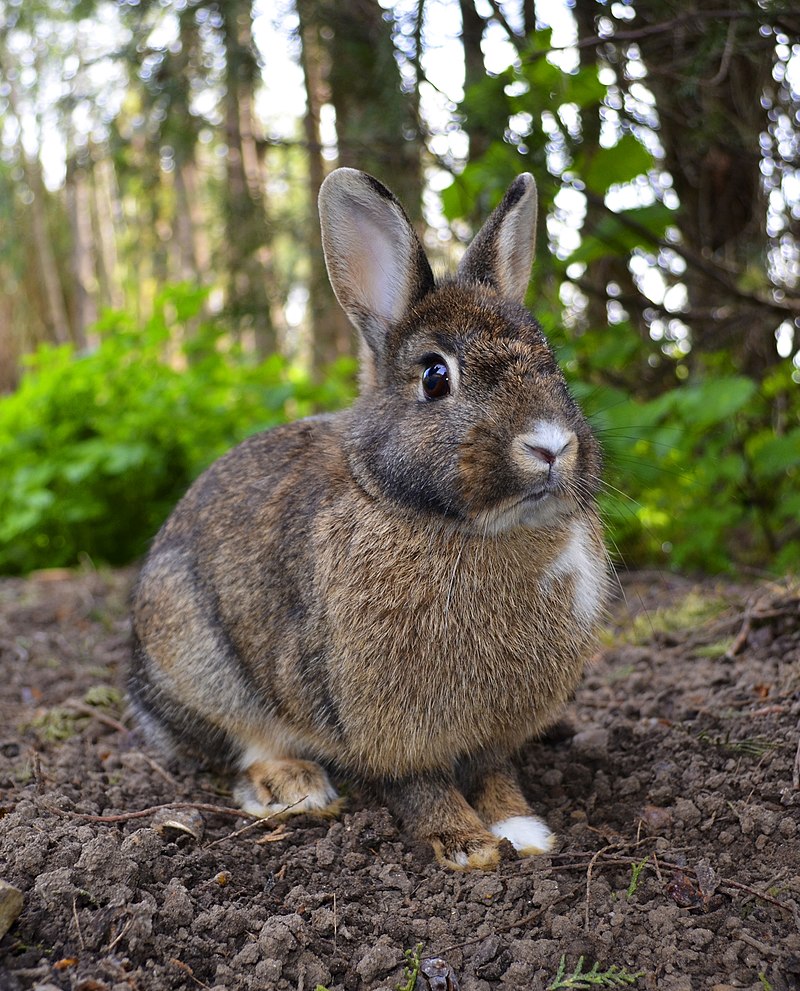
Oryctolagus cuniculus, rabbit
By J Ligero & I Barrios - Own work, CC BY 3.0, https://commons.wikimedia.org/w/index.php?curid=24986245
Thanks to people, rabbits are now on every continent except for Antarctica. Domesticated rabbits were bred from European rabbits. They are used by people not only for pets but also for meat and fur. In the wild, they are important prey animals, which is why they breed pretty much year round.
These creatures, despite what a lot of people think when they see the teeth, aren't rodents, but are lagomorphs, which includes hares and pikas as well as rabbits. While scientists do think that, sometime in the far distant past, they were in the same group, the rabbit family has evolved not one but two sets of incisors, one set behind the other, while rodents only have one set. Because they are a prey animal, they obviously must have a defense, and their first line of defense is speed. They have incredibly long hind legs that lets them push off quickly, and their well-muscled hindquarters and tendency to run on their toes gives them extra power and reach. They also zig-zag when running from predators--though a clever cat, dog, or fox will learn that the trick to chasing one down is to travel in a straight line along the general flight path, until they intersect. (That's how one of my cats, Nocturne, would catch them--and he did so on a regular basis.) The ears are big so that they can catch the sounds of even quiet predators sneaking up on them.
Rabbits are grazers and they can't survive long without plenty of forage. Because they have a high-cellulose diet, they actually pass two types of feces, one of which they promptly eat again as a way to digest the food more thoroughly the second time.
Rabbits' association with Easter probably stems from their old roles as fertility symbols, as the bringers of new life (just as Jesus's death is supposed to bring life to his followers after death). German folklore has stories of an Easter rabbit or hare who was sort of the animal equivalent of St. Nicholas at Christmas, rewarding the good children at Eastertime.
Oryctolagus cuniculus, rabbit
By J Ligero & I Barrios - Own work, CC BY 3.0, https://commons.wikimedia.org/w/index.php?curid=24986245
Thanks to people, rabbits are now on every continent except for Antarctica. Domesticated rabbits were bred from European rabbits. They are used by people not only for pets but also for meat and fur. In the wild, they are important prey animals, which is why they breed pretty much year round.
These creatures, despite what a lot of people think when they see the teeth, aren't rodents, but are lagomorphs, which includes hares and pikas as well as rabbits. While scientists do think that, sometime in the far distant past, they were in the same group, the rabbit family has evolved not one but two sets of incisors, one set behind the other, while rodents only have one set. Because they are a prey animal, they obviously must have a defense, and their first line of defense is speed. They have incredibly long hind legs that lets them push off quickly, and their well-muscled hindquarters and tendency to run on their toes gives them extra power and reach. They also zig-zag when running from predators--though a clever cat, dog, or fox will learn that the trick to chasing one down is to travel in a straight line along the general flight path, until they intersect. (That's how one of my cats, Nocturne, would catch them--and he did so on a regular basis.) The ears are big so that they can catch the sounds of even quiet predators sneaking up on them.
Rabbits are grazers and they can't survive long without plenty of forage. Because they have a high-cellulose diet, they actually pass two types of feces, one of which they promptly eat again as a way to digest the food more thoroughly the second time.
Rabbits' association with Easter probably stems from their old roles as fertility symbols, as the bringers of new life (just as Jesus's death is supposed to bring life to his followers after death). German folklore has stories of an Easter rabbit or hare who was sort of the animal equivalent of St. Nicholas at Christmas, rewarding the good children at Eastertime.
101fuzzi
Hazel!
If you've never read it, I recommend Watership Down. The author did his research before writing this story of a quest for a new home, undertaken by plain rabbits. It shows.
If you've never read it, I recommend Watership Down. The author did his research before writing this story of a quest for a new home, undertaken by plain rabbits. It shows.
102CassieBash
>101 fuzzi: Yep, read it and watched the original animated film. (I used this "unofficial" trailer because the official one is too full of spoilers.)
103CassieBash
Hey, everyone, I've started a new thread for spring! As usual, I have frog pictures to christen it.
Join to post

