This topic is currently marked as "dormant"—the last message is more than 90 days old. You can revive it by posting a reply.
1CassieBash
Hello, all! I'm CassieBash and I welcome you to my thread.
If you've already followed me for the past 4 years (this is my fifth anniversary as a 75er!), you know my usual reads--YA and children's chapter books of all kinds, adult mysteries, historical fiction, horror, science fiction, fantasy, and nonfiction books on the supernatural, the natural (animals and plants mostly), and unsavory topics such as diseases, poisons, pollution, contaminants, death and funeral customs--that sort of thing. And I don't do straight-up romances; it's OK as a B plot for me as long as it doesn't eclipse the A plot but I haven't found the romance genre appealing since a brief attempt as a young teen to like them. I had a hard time liking soap operas, too.... :)
Now if you've never followed me before, and I haven't scared you off with that list of nonfiction interests (yes, I have a dark side as well as a light side), I do set up some rules for myself. I know a lot of you say that I should count children's books of all types and not just chapter books, but that's way too easy for me to meet my goal then. Plus, my to read piles don't have any non-chapter book selections right now, and I'm using this challenge to motivate me to read mostly from that huge mass of books adding additional insulation to my north wall. (That's literally where I stack my overflow.) I prefer print but I do listen to audiobooks, especially on trips to Muncie, Indiana to visit my fiancé who owns a used bookstore just on the south side of Ball State University. (I give a shameless plug to Derek every year on this thread, so I figure I might as well do it now.) I'll probably mostly read youth fiction this year, which is generally a safe bet as that tends to be mostly what I read every year! ;)
After receiving more books for Christmas and after doing an inventory of my collection, I've decided to read some of my "to reads" off the shelves to hopefully free up space. Since the shelves should technically be reserved for the "keepers", I've looked through the selections and have mentally noted several that I'll probably read once and get rid of. I've already started with my first nonfiction read--an historical title about how the ancient Egyptian civilization was discovered and explored. It's a large volume in every physical sense of the term--oversized hardback with over 300 pages--so that should free up some space. The chances of my keeping this book are slim, as it's dealing more with the exploration than the ancient civilization--and the latter is where my interests in Egypt lie. My first fiction read of the year is a YA fantasy. Stay tuned for reviews!
If you've already followed me for the past 4 years (this is my fifth anniversary as a 75er!), you know my usual reads--YA and children's chapter books of all kinds, adult mysteries, historical fiction, horror, science fiction, fantasy, and nonfiction books on the supernatural, the natural (animals and plants mostly), and unsavory topics such as diseases, poisons, pollution, contaminants, death and funeral customs--that sort of thing. And I don't do straight-up romances; it's OK as a B plot for me as long as it doesn't eclipse the A plot but I haven't found the romance genre appealing since a brief attempt as a young teen to like them. I had a hard time liking soap operas, too.... :)
Now if you've never followed me before, and I haven't scared you off with that list of nonfiction interests (yes, I have a dark side as well as a light side), I do set up some rules for myself. I know a lot of you say that I should count children's books of all types and not just chapter books, but that's way too easy for me to meet my goal then. Plus, my to read piles don't have any non-chapter book selections right now, and I'm using this challenge to motivate me to read mostly from that huge mass of books adding additional insulation to my north wall. (That's literally where I stack my overflow.) I prefer print but I do listen to audiobooks, especially on trips to Muncie, Indiana to visit my fiancé who owns a used bookstore just on the south side of Ball State University. (I give a shameless plug to Derek every year on this thread, so I figure I might as well do it now.) I'll probably mostly read youth fiction this year, which is generally a safe bet as that tends to be mostly what I read every year! ;)
After receiving more books for Christmas and after doing an inventory of my collection, I've decided to read some of my "to reads" off the shelves to hopefully free up space. Since the shelves should technically be reserved for the "keepers", I've looked through the selections and have mentally noted several that I'll probably read once and get rid of. I've already started with my first nonfiction read--an historical title about how the ancient Egyptian civilization was discovered and explored. It's a large volume in every physical sense of the term--oversized hardback with over 300 pages--so that should free up some space. The chances of my keeping this book are slim, as it's dealing more with the exploration than the ancient civilization--and the latter is where my interests in Egypt lie. My first fiction read of the year is a YA fantasy. Stay tuned for reviews!
3FAMeulstee
Happy reading in 2019, Cassie!
4PaulCranswick
Happy 2019
A year full of books
A year full of friends
A year full of all your wishes realised
I look forward to keeping up with you, Cassie, this year.
7CassieBash
Book 1: Ravenwood: YA fantasy. Young Ark has been growing up as a young plumber's apprentice in the last place on Earth to have trees. Those trees have been keeping the citizens of Maw--the rest of the world--at bay with their evolutionary defenses. But Ark overhears a plot between one of the high nobles of his kingdom and a citizen of Maw--a plot to overthrow their king and for Maw to seize the wood. Can Ark save the kingdom?
Not stellar, not bad. Enjoyable enough; had fun with the slightly altered words and phrases that reflect generations of lives lived in trees--"holly" instead of "holy", "River Sticks" instead of "Styx", things like that. It also hints at a possible sequel; I haven't investigated this so I'm not sure there is one, but while it doesn't exactly end on a cliffhanger, it suggests that the story could continue.
Not stellar, not bad. Enjoyable enough; had fun with the slightly altered words and phrases that reflect generations of lives lived in trees--"holly" instead of "holy", "River Sticks" instead of "Styx", things like that. It also hints at a possible sequel; I haven't investigated this so I'm not sure there is one, but while it doesn't exactly end on a cliffhanger, it suggests that the story could continue.
8CassieBash
Thanks, by the way, to all who are following me, who've dropped stars, who have wished me well, and also for any lurkers. Go ahead and lurk; I don't mind.
Book 2: The Door Before is the prequel to The 100 Cupboards, which I listened to as an audiobook some time back through OverDrive. I don't remember much about 100 Cupboards except that it was a decent read, but obviously not particularly wonderful or the specifics of the plot would stand out a bit better in my mind. It is the setup of how the space/time doorways that the cupboards are work, how they are created and, more or less, how they operate. While it worked as a standalone rather well, for those new to the quartet of "Cupboard" books, it might be helpful to read it first. It's a typical good v. evil fantasy plot, where the heroine, Hyacinth, meets two young boys on the run from an evil, life-sucking witch who's out to destroy them as the last members of their rather powerful, magic-using family.
I'm not sure if I would consider this a children's chapter or a YA; it's kind of in between those. There are some intense and graphic scenes (which I obviously can't share with you for spoiler reasons) that make me lean a bit towards the YA level, but that would also depend on where you draw the line with YA. (Some say high school/college, some go as low as junior high--I've not found a hard and fast definition of Young Adult, even in the library world.) It will be going to Derek's store in Muncie, along with Ravenwood.
Next up--a YA historical fiction, and I'll probably read a few more small sections in the massive Egyptian nonfiction. I believe I'm up to Napoleon's part. It's supposed to be a snowy weekend here, with 1-3 inches accumulating tomorrow. We were supposed to head to central Indiana, but now we're under a winter weather advisory, and that part of the state has a winter storm warning. I predict that the 80% chance of snow means a 100% chance of sleeping in and extra reading tomorrow.
And cat snuggles. Can't forget the cat snuggles, right, Peppa?

Book 2: The Door Before is the prequel to The 100 Cupboards, which I listened to as an audiobook some time back through OverDrive. I don't remember much about 100 Cupboards except that it was a decent read, but obviously not particularly wonderful or the specifics of the plot would stand out a bit better in my mind. It is the setup of how the space/time doorways that the cupboards are work, how they are created and, more or less, how they operate. While it worked as a standalone rather well, for those new to the quartet of "Cupboard" books, it might be helpful to read it first. It's a typical good v. evil fantasy plot, where the heroine, Hyacinth, meets two young boys on the run from an evil, life-sucking witch who's out to destroy them as the last members of their rather powerful, magic-using family.
I'm not sure if I would consider this a children's chapter or a YA; it's kind of in between those. There are some intense and graphic scenes (which I obviously can't share with you for spoiler reasons) that make me lean a bit towards the YA level, but that would also depend on where you draw the line with YA. (Some say high school/college, some go as low as junior high--I've not found a hard and fast definition of Young Adult, even in the library world.) It will be going to Derek's store in Muncie, along with Ravenwood.
Next up--a YA historical fiction, and I'll probably read a few more small sections in the massive Egyptian nonfiction. I believe I'm up to Napoleon's part. It's supposed to be a snowy weekend here, with 1-3 inches accumulating tomorrow. We were supposed to head to central Indiana, but now we're under a winter weather advisory, and that part of the state has a winter storm warning. I predict that the 80% chance of snow means a 100% chance of sleeping in and extra reading tomorrow.
And cat snuggles. Can't forget the cat snuggles, right, Peppa?

9CassieBash
Book 3: Witch Child is a YA novel set up to look like a nonfiction journal of a teenage girl living in 1659 and 1660, fleeing England with the Puritans to America, though not herself a Puritan. Her grandmother, accused and executed as a witch, left her with the ability to scry (a form of divination) and her knowledge of herbs and healing; these things she must keep secret, or risk being accused by her new Puritan neighbors. Mostly set up as an historical fiction, with the scrying as the only element of fantasy or the supernatural, the story has some parallels with what historically happened with the Salem witch trials. A slow-paced story that readers more fond of fast-paced action will probably find boring, it's a good one for those more interested in character-driven plots and development.
10CassieBash
Book 4: Classic Tales by Famous Authors: volume 4: Wonder, the contents of which are 5 works (really 3 short stories or novellas and two excerpts from an epic poem). If you followed me last year, then you may remember that this set has 20 volumes and that I’m going to read a few volumes each year until I’ve read them all—and then I’ll take them to Derek’s store. Fortunately, I’ve gotten past the first few with themes that I was far from crazy about. This volume covers fantasy legends, I guess you would say. Rip Van Winkle by Washington Irving is an American classic, and the two selections from Idyls of the King, an epic poem about King Arthur by Alfred Tennyson, were the only ones I was familiar with (and of them, I’d only ever read “Rip” before). The other two stories were by Baron De La Motte Fouque and were dark fantasy romance of chivalry and knights: Undine and Sintram, the first being very much like a fairy tale, the latter more like a dark Arthurian legend and more psychological and metaphorical.
This volume was much more to my taste and went quickly. I’ll start the next volume, “ Weird Tales”, in a bit. That one looks to be horror-based, at least in part. I’ve always wanted to read The Strange Case of Dr. Jekyll and Mr. Hyde; this is my chance.
This volume was much more to my taste and went quickly. I’ll start the next volume, “ Weird Tales”, in a bit. That one looks to be horror-based, at least in part. I’ve always wanted to read The Strange Case of Dr. Jekyll and Mr. Hyde; this is my chance.
11CassieBash
Book 5: The Hanging Girl is a YA novel that takes place in Michigan during modern times. (There’s a reference to “Make America Great Again”.) The genre is suspense with a hint of mystery, and I have to admit there were a few twists here and there. Skye has gotten herself involved with the kidnapping of a classmate and can’t see a way out; the more she tries to, the deeper she seems to get involved.
Good teenage characters with very teenage problems, with the focus on girl characters, so probably not a reading-reluctant boy’s choice. There is a bit of swearing including the F bomb at least once but it isn’t overdone. No sex but allusions to it.
Good teenage characters with very teenage problems, with the focus on girl characters, so probably not a reading-reluctant boy’s choice. There is a bit of swearing including the F bomb at least once but it isn’t overdone. No sex but allusions to it.
12CassieBash
Book 6: Wild Life in Woods and Fields was my first audio book of the year, thanks to an unexpected Muncie trip. Because I drove home through heavy snow, I wanted something light and not requiring too much concentration, and this fit the bill. Unfortunately, it is exceedingly short, especially when the road conditions meant that an extra hour was added to my drive. It's a children's nonfiction, written in first person as observations of animals (and one section on plants) typical of a North American wood or field, as observed from the eyes of children. It's actually pretty good for the age group and it might encourage some children to go out into nature and make observations of their own. This was a Librivox recording so it's public domain and free for download, burning to a disc, etc.
Book 7: Lassie: The Secret of the Smelters' Cave was another children's fiction about everyone's favorite collie dog star from stage, screen, and comics. (It's always fun when we go somewhere with our collie mix, who apparently looks enough like Lassie that even small children call her that!) Corey, Lassie's owner from the comics and books, is a U.S. forest ranger who, in this book, has been called in to help negotiate a road through private land to open up public ones for people to enjoy. Plot B is that two boys are looking for a famous, long-lost cave used by smelters in the Gold Rush days. A good G rated read for young boys, if they don't mind the dated-ness.
Book 7: Lassie: The Secret of the Smelters' Cave was another children's fiction about everyone's favorite collie dog star from stage, screen, and comics. (It's always fun when we go somewhere with our collie mix, who apparently looks enough like Lassie that even small children call her that!) Corey, Lassie's owner from the comics and books, is a U.S. forest ranger who, in this book, has been called in to help negotiate a road through private land to open up public ones for people to enjoy. Plot B is that two boys are looking for a famous, long-lost cave used by smelters in the Gold Rush days. A good G rated read for young boys, if they don't mind the dated-ness.
14CassieBash
>13 ronincats: You know me, always the eclectic reader. Right now I'm reading a fantasy, a short story collection, a book on tornadoes (again) and I'm still plugging away at the Egyptian discovery one every so often on the weekends. Peppa-cat says hi to you. Mom snapped that pic right after she got in trouble; that's her "I'm-too-cute-for-you-to-stay-mad" look. It generally works well for her. :)
15CassieBash
Meant to share this yesterday for Valentine's Day, but time got away from me. This is what happens when a polar vortex meets the water in a barn cat bowl and the frozen contents are tossed casually aside in a snowdrift, where a short-lived but intense warm-up with lots of sun happens. I must have dumped the ice chunk into just the right place for the sun to melt the spherical shape unevenly. Enjoy!

I've finished book 8: Storm Warning: The Story of a Killer Tornado, which for those of you who followed me last year, you may see the start of a nonfiction trend here. Last year, one of the last books I read was Storm Kings, which discussed the history of tornado studies and storm chasing. This book is a great follow-up to that, as it focuses more on the modern, picking up (with just a hint of overlap with Fujita and the Tinker Air Force Base) just about where the last one ended. This book looked at the May 3, 1999 event and those actions (and inactions) that led up to it, and the aftermath. Most of the book is an easy read emotionally, but once the tornado happens, it's hard not to feel a little tense, as the narrative starts foreshadowing the loss of life and property, but it was very informative and includes references--a whole lot of references--which is always nice to see in a nonfiction. If storms fascinate you, particularly tornadoes, then these two books are a great choice and complement each other beautifully. I'm glad I read them in this sequence, too, as it's given me a nice chronological overview of the advancements made in American meteorology.

I've finished book 8: Storm Warning: The Story of a Killer Tornado, which for those of you who followed me last year, you may see the start of a nonfiction trend here. Last year, one of the last books I read was Storm Kings, which discussed the history of tornado studies and storm chasing. This book is a great follow-up to that, as it focuses more on the modern, picking up (with just a hint of overlap with Fujita and the Tinker Air Force Base) just about where the last one ended. This book looked at the May 3, 1999 event and those actions (and inactions) that led up to it, and the aftermath. Most of the book is an easy read emotionally, but once the tornado happens, it's hard not to feel a little tense, as the narrative starts foreshadowing the loss of life and property, but it was very informative and includes references--a whole lot of references--which is always nice to see in a nonfiction. If storms fascinate you, particularly tornadoes, then these two books are a great choice and complement each other beautifully. I'm glad I read them in this sequence, too, as it's given me a nice chronological overview of the advancements made in American meteorology.
16CassieBash
Book 9: Ratha’s Creature is a fantasy in which prehistoric cats develop human intelligence and form a society based on herding livestock. The outsider cats raid the Clan’s herds, but they’re getting bolder. When a lightning-struck tree catches fire and Ratha learns the secret of keeping it “alive”, she becomes outcast. The first book in a set, it’s a good adult animal fantasy.
17CassieBash
Book 10: Classic Tales by Famous Authors v. 5: Weird Tales. A collection of short horror and suspense stories: The House and the Brain, Strange Case of Dr. Jekyll and Mr. Hyde, Markheim, The Werewolf, The Wondersmith, and The Rime of the Ancient Mariner. I'd only ever read one of these (the first) before, but a couple of these were on my "to read" list, so it's nice that I was able to proverbially kill the two birds with one stone.* Unlike many of the other volumes, where one or two stories stand out from the others, all of these were wonderful examples of their genre. Like the other volumes, reading the synopses of the stories is a bad move if you're looking to avoid spoilers. Just skip straight to the author bios and/or the stories themselves, and enjoy. None of the horror stories are all that creepy or gory, not in a modern sense, so I don't think most adults will suffer from nightmares after reading these.
*Disclaimer: No real birds were actually harmed during the reading of this book. However, last night while I was finishing the book, I did inconvenience a gnat that was flying around my head by swiping at him a few times.
*Disclaimer: No real birds were actually harmed during the reading of this book. However, last night while I was finishing the book, I did inconvenience a gnat that was flying around my head by swiping at him a few times.
18CassieBash
Book 11: The Red House Mystery is the only detective/mystery fiction written by the famous author of Winnie-the-Pooh books, A. A. Milne. It's a very interesting and fun read for this genre, and rather humorous in a lot of places. There are definitely Sherlock Holmes (albeit a self-admitted amateur) and Watson characters, and if you get a copy with the "new" (meaning in the 1920s) introduction by the author--even better! His views on detective fiction and the fickle demands of readers and publishers are worth reading on their own.
19CassieBash
Book 12: The Discovery of Ancient Egypt: A biographical history of the lives and art of the key persons who ventured to Egypt, mostly from the Middle Ages through the 19th century, and who took great interest in the architecture and antiquities of ancient Egypt. This book doesn't cover any 20th century explorers and archaeologists--in fact, most of who went to Egypt during the time discussed were hardly archaeologists as we think of them today, not being specifically tied to museums, and with questionable ways of handling and obtaining artifacts. The text wasn't really my cup of tea--I'm not much of a biography person, and the biographies are so short as to just give you an introduction to the person--but the illustrations, which are reproductions of these peoples' works, are fantastic, made especially so by the oversize, coffee-table format. Reading the illustration descriptions was more enjoyable for me, but those into biographies and more modern history in that geographical area may find it more to their liking.
But at least it gets another book off my shelves and headed to Derek's shop. :)
But at least it gets another book off my shelves and headed to Derek's shop. :)
20CassieBash
Double entry, despite how much extra time I've been at work. I've had them done for a bit.
Book 13: The Dragon's Eye is a juvenile fantasy based on the original Dragonology book; the "author" is Ernest Drake, the pseudoname given to the author of the original. Drake is supposedly a dragonologist, a person who studies dragons, and Daniel and his sister Beatrice are sent to spend the summer with him, as he's a friend of their parents who are doing mysterious work in India. A good, G-rated book for younger readers, told from Daniel's perspective, so it should appeal to boys. But girls will find the smart and spunky Beatrice as good a reason to read this book, too.
Book 14: Tomorrow Girls: Behind the Gates is a quick YA read. While not physically heavy--it's a very short book for a YA novel--the dystopian future of the world, where there's an obvious terrorist group called the Alliance attempting to take over the world, is hardly a light book in theme. One warning about the ending--it's a cliff-hanger. I'll have to find the other books, because I enjoyed both plot and characters and I do eventually want to find out what happened to the girls. It's partly a book about friendship and trust, but readers will also like the hints of danger.
So February shapes up like this:
Children's Fiction: 3
YA Fiction: 4
Adult Fiction: 4
Adult Nonfiction: 2
Audiobook: 1
Not bad; I'm a little over half-way through book 15, so I'm about on track for reaching 75, maybe even a little ahead, since you have to average 6 1/4 books each month. I've hit 14 and we're just starting the third month, so that's not too bad.

Book 13: The Dragon's Eye is a juvenile fantasy based on the original Dragonology book; the "author" is Ernest Drake, the pseudoname given to the author of the original. Drake is supposedly a dragonologist, a person who studies dragons, and Daniel and his sister Beatrice are sent to spend the summer with him, as he's a friend of their parents who are doing mysterious work in India. A good, G-rated book for younger readers, told from Daniel's perspective, so it should appeal to boys. But girls will find the smart and spunky Beatrice as good a reason to read this book, too.
Book 14: Tomorrow Girls: Behind the Gates is a quick YA read. While not physically heavy--it's a very short book for a YA novel--the dystopian future of the world, where there's an obvious terrorist group called the Alliance attempting to take over the world, is hardly a light book in theme. One warning about the ending--it's a cliff-hanger. I'll have to find the other books, because I enjoyed both plot and characters and I do eventually want to find out what happened to the girls. It's partly a book about friendship and trust, but readers will also like the hints of danger.
So February shapes up like this:
Children's Fiction: 3
YA Fiction: 4
Adult Fiction: 4
Adult Nonfiction: 2
Audiobook: 1
Not bad; I'm a little over half-way through book 15, so I'm about on track for reaching 75, maybe even a little ahead, since you have to average 6 1/4 books each month. I've hit 14 and we're just starting the third month, so that's not too bad.

22CassieBash
>21 fuzzi: Oh, it happens. :) You’re here now, and that’s what counts.
Book 15: Spellbinder is yet another YA novel. (OK, it straddles the line between chapter and YA, depending on your definition of young adult.). Belladonna not only sees and hears ghosts, she talks to them and lives with them. But when the ghosts start disappearing, it’s up to someone called the “Spellbinder” to set things right. Can Belladonna find this “Spellbinder” in time?
Good tween book but be prepared for British words and phrases. You’ll like Belladonna as her character grows and while there are parts that may be predictable to experienced readers familiar with how fantasy plots of this type and for this age works, it’s still quite an enjoyable read, with nods to mythology and folklore. This is the first book, and from the preview of the second, they build on each other, so it’s probably wise to start here.
Book 15: Spellbinder is yet another YA novel. (OK, it straddles the line between chapter and YA, depending on your definition of young adult.). Belladonna not only sees and hears ghosts, she talks to them and lives with them. But when the ghosts start disappearing, it’s up to someone called the “Spellbinder” to set things right. Can Belladonna find this “Spellbinder” in time?
Good tween book but be prepared for British words and phrases. You’ll like Belladonna as her character grows and while there are parts that may be predictable to experienced readers familiar with how fantasy plots of this type and for this age works, it’s still quite an enjoyable read, with nods to mythology and folklore. This is the first book, and from the preview of the second, they build on each other, so it’s probably wise to start here.
23CassieBash
Book 16: The Ring of the Niblung was a book I picked up mostly because I love the illustrator, Arthur Rackham. The work is the poetical half (rather than the musical score) of the musical drama by Richard Wagner. Based heavily on Scandinavian folklore, it's an epic poem about heroes, gods, and quests. There is also a love affair between fraternal twins separated as children who meet later as adults. Aside from the incest and violence themes, it's quite obvious that this is written with adults in mind, however appealing the illustrations, if only because most YA readers would find the language daunting and the dialog, dated and with many words they'd find unfamiliar, difficult to understand. It's like reading a classic translation of Chaucer or Shakespeare--it's in a form of English that's almost modern, but it still retains that classic literature feel. The illustrations are wonderful and typical Rackham, with simple lines but somehow lots of detail, though not much color. His style does lend itself to horror and darker themes such as this, which is why his illustrations of The Legend of Sleepy Hollow remain my favorite rendition. If you don't like play scripts or Shakespeare, skip this one.
24ronincats
>22 CassieBash: Book bullet!
25CassieBash
Book 17: Murder, Magic, and What We Wore is a YA (are you ready for this?) historical fantasy espionage fiction. Yep, it’s all that, and a very good read it was, too. Girls will love the strong female characters with hints of romance and more than hints of danger and fashion. I’m not sure I want to say anything about the plot other than my genre description, since the fun of a book with spies in it is to try to figure out who’s on whose side. The only other thing I will say is that this book takes place in 1818 England, it’s told in first person, and the magic is very subtle. So I think I’ll simply recommend it and leave it at that.
26ronincats
>25 CassieBash: CASSIE! Well, at least the library has them both.
27CassieBash
>26 ronincats: I'm reading another YA novel now that's going fast; it's dystopian. You might want to check that one out, too, when I post it.
I have a lot of YA fantasy stockpiled that I'd never heard of before coming across the books. Spellbinder came from Derek's Muncie, Indiana store (I believe I've already done my obligatory and shameless plug for The White Rabbit Used Books, but in case I haven't, here it is), where thanks in part to Ball State students, faculty, and staff, and the Muncie Public Library, you can come across some very interesting titles. Murder, Magic, and What We Wore came from an overstock store, similar to a Big Lots. I'm not sure what how you could overstock that title unless it's one of those gems that somehow slips under the radar, because I enjoyed it so much that I think I'm keeping it for the time being.
Keep watching this thread, YA fiction lovers!
I have a lot of YA fantasy stockpiled that I'd never heard of before coming across the books. Spellbinder came from Derek's Muncie, Indiana store (I believe I've already done my obligatory and shameless plug for The White Rabbit Used Books, but in case I haven't, here it is), where thanks in part to Ball State students, faculty, and staff, and the Muncie Public Library, you can come across some very interesting titles. Murder, Magic, and What We Wore came from an overstock store, similar to a Big Lots. I'm not sure what how you could overstock that title unless it's one of those gems that somehow slips under the radar, because I enjoyed it so much that I think I'm keeping it for the time being.
Keep watching this thread, YA fiction lovers!
28CassieBash
A two-for-one post—one nonfiction, one fiction. Book 18 is Tornado Alley: Monster Storms of the Great Plains (and my last tornado book for the year—I promise!). This one is more scientific and technical than the other two, and I confess there were some parts that were a bit over my head. Even so, it was still interesting hearing first-hand accounts of storm chasing and the equipment he and his team used to take various measurements. Plus, the photography is excellent (if you like awesome weather and storm photos). And as a good nonfiction should, it included resources for more infrastructure well as references.
Book 19: Stung: Fiona awakens to an unfamiliar world with a strange mark on the back of one hand and to find that she’s no longer a thirteen year old but a young woman—one who could become uncontrollably dangerous at any time. A dystopian story that explores the possibility that sometimes, the cure to a disease is worse than the original problems. With some heavy romance (but no sex scenes), but the intensity of the constant danger balances it nicely so it remains the B plot.
I’m not yet done with the YA fantasy novels; I’ve already started the next. The next nonfiction is going to be a look at where the ingredients of our modern foods come from, so yes. I’m back to morbid nonfiction topics. It sounds like it would have been a good companion book for one I read some time ago called Swindled, which tells about all sorts of nasty food adulteration that went on, from substituting chicory for coffee and adding chalk to flour, to the addition of toxic chemicals to make food look better. Yep, nasty stuff, but very interesting.
Book 19: Stung: Fiona awakens to an unfamiliar world with a strange mark on the back of one hand and to find that she’s no longer a thirteen year old but a young woman—one who could become uncontrollably dangerous at any time. A dystopian story that explores the possibility that sometimes, the cure to a disease is worse than the original problems. With some heavy romance (but no sex scenes), but the intensity of the constant danger balances it nicely so it remains the B plot.
I’m not yet done with the YA fantasy novels; I’ve already started the next. The next nonfiction is going to be a look at where the ingredients of our modern foods come from, so yes. I’m back to morbid nonfiction topics. It sounds like it would have been a good companion book for one I read some time ago called Swindled, which tells about all sorts of nasty food adulteration that went on, from substituting chicory for coffee and adding chalk to flour, to the addition of toxic chemicals to make food look better. Yep, nasty stuff, but very interesting.
29CassieBash
Book 20: The Book of Nature Myths: With a Muncie trip, I finished the audiobook I'd started through Librivox. Read wonderfully by Raybrite, whose voice sounds like a grandfatherly Native American (which is perfect as most of these stories are Native American), it's a collection of how and why stories about animals, plants, the sun and moon, and other things in the natural world. Perfect for young children's bedtime stories.
30ronincats
>25 CassieBash: Had lots of fun reading this today, Cassie.
31CassieBash
>30 ronincats: Great! My current fiction is going quickly; it's about dragons. I can't guarantee you'll add it to your list...but I can't guarantee you won't! :)
For nonfiction readers, I've learned waaayyy more about what goes into enriched flour and where it comes from than probably anyone would want to in Twinkie, Deconstructed. I just finished reading about sugar (as in cane and beet) and am getting ready to start on the corn chapters (and there are three of them) on sweeteners, syrups, and thickeners. Oh, yum!
For nonfiction readers, I've learned waaayyy more about what goes into enriched flour and where it comes from than probably anyone would want to in Twinkie, Deconstructed. I just finished reading about sugar (as in cane and beet) and am getting ready to start on the corn chapters (and there are three of them) on sweeteners, syrups, and thickeners. Oh, yum!
32CassieBash
Book 21: Scorched reminded me a bit of Anne McCaffrey's Pern series, with a human/dragon bonding. There are some unique differences, one of the most obvious being that it takes place not on another planet but here on Earth, and a modern Earth at that. Trinity has been chosen by the last dragon queen, still in her egg, to be her bonded human. Everyone wants the pair, or at least the dragon: our government, other governments, and a group that calls themselves the Dracken. Trinity herself is a strong young girl and resourceful; add to that a dragon hunter and a bit of teenage romance, and you have a good read for older YA girls.
33CassieBash
Book 22: The Holy Thief is yet another Cadfael mystery that I've read out-of-order (I believe the cover said it's the 19th). Once more, there's a murder mystery, with a theft mystery (and the big question is, are the two related and if so, how?), and a bit of romance, of course. I love the history-mysteries, and Cadfael is one of my favorites, since I love the medieval England/Wales thing. I also like how Peters does have some monks that are less than likeable, shall we say, rather than making them all cookie-cutter sweet and gentle men. This makes the story more believable to me; people are people and even monks have faults.
Yesterday's Twinkie lesson learned: breaking an egg in a processing plant is a heck of a lot more involved than breaking one at home.
Yesterday's Twinkie lesson learned: breaking an egg in a processing plant is a heck of a lot more involved than breaking one at home.
34CassieBash
Book 23: Can Such Things Be? is a collection of tales by Ambrose Bierce, the most famous in the collection being The Damned Thing, which I've read in other horror collections. This particular "edition" was a Librivox public domain recording, and the reader, Roger Melin, was good enough, with inflection and a clear voice loud enough to be heard over average road noise (always a must for an audiobook with me, since that's usually when I'm listening). Bierce's horror stories don't tend to be too gory and they rely more on suspense and psychological horror than descriptions of blood, guts, and gore, which are, to me, not as scary as the suspense/psychological kinds. Even though it takes a lot more than these to really scare me, the stories are good, solid, classic horror tales.
Although with my nonfiction lunch read, I'm learning some pretty scary things about Twinkie ingredients--and I've not even gotten to the sections on the chemical preservatives and color additives.
Although with my nonfiction lunch read, I'm learning some pretty scary things about Twinkie ingredients--and I've not even gotten to the sections on the chemical preservatives and color additives.
35CassieBash
Book 24: Here Lies Linc is a chapter book suitable for tweens and young teens and could be used as a read-aloud. When Lincoln (Linc for short) has to pick a grave to research for his American Studies class, he chooses the Black Angel, a mysterious and supposedly cursed monument. This book is not really horror but more of a genealogical mystery, and would be a good way to introduce the study of genealogy to kids. I do have an issue with the cover of my particular edition, as it depicts something that never happened and that makes the book look like the horror story it’s not, but I suppose that it’s good marketing. Also, read the author note because she did a lot of research and the Black Angel really does exist (in Iowa City, where the story takes place). While the book is fiction, the author did thorough research in the monument and incorporated that here. Because I have a thing for funeral customs and this book is so well done, it’s going on my shelves rather than to Derek’s.
36CassieBash
Book 25: Because I Am Furniture is a gritty YA novel about abuse, done in free verse. Not an uplifting read, as the main character (first person book here) is the daughter of the abuser and while her sister and brother are the victims, she is the silent witness. A quick read because of the format, I picked this up at a consignment shop yesterday and finished it just moments ago.
37CassieBash
While not as disturbing as some of those nonfiction books I'm fond of (The Hot Zone, Parasite Rex, Stiff, The Day of St. Anthony's Fire, etc.), Book 26: Twinkie, Deconstructed is probably not for the squeamish foodie, being every bit as disturbing in its own right as any of the others I've read. (OK, maybe not "Parasite Rex" or "The Hot Zone"--probably the two bloodiest, nastiest books I've read to date.) This one looks at how our food is manufactured, and yes, just about every ingredient goes through some sort of manufacturing process. (Water is probably the least processed, most straightforward ingredient--and even it gets some tweaking with filters and treatments.) Even though there is no meat product in a Twinkie, and therefore the author had no trip to a slaughterhouse to worry about, there are still some rather dangerous substances, things we wouldn't think of consuming, that are used in processing even the simplest of ingredients (not to mention the issues of factory farmed eggs, the one ingredient that comes directly from animals). Chlorine gas, petroleum and natural gas, phosphoric acid, benzene, and a host of other chemicals are used to bleach, extract, and form common additives and ingredients. (Just enriching flour is complex and chemical.) Some of the processes and locations of manufacturing plants he couldn't discuss for homeland security reasons. The fact that so much of a Twinkie's ingredients are basically edible rocks (salt, baking powder and soda, etc.) didn't actually disturb me--I knew that, even if I don't stop to think about it every day. But for those who have never considered where their food comes from and would like to know more, this is a highly readable as well as researched (the author contacted and/or visited the sources for each ingredient, visiting farms, mines, and chemical plants all over the place) book that will certainly enlighten you, if you choose to know.
For the rest of you, ignorance may just very well be bliss. :))
For the rest of you, ignorance may just very well be bliss. :))
38CassieBash
Book 27: The Apartment is a horror with a touch of supernatural and a whole lotta psychological. I’m not going to go into details so I can avoid giving spoilers, but it’s general plot is that a couple do a house swap (which in this case is an apartment) to try to recover from a trauma they shared, only the place isn’t quite what it was supposed to be. If you’re ever thinking of doing a house swap, you probably won’t want to read this book.
This was an adult fiction with a decent number of f bombs. FYI.
This was an adult fiction with a decent number of f bombs. FYI.
40CassieBash
>39 fuzzi: That's OK--I'm sure that sooner or later I'll get back to genres you'll appreciate. Right now, I'm reading a Holly Black book, but I think I'm going to tackle another volume in the 20 volume set, and I believe that volume 6 is fairy tales. I'll be skipping three volumes because I've already read them and I don't want to take the time to re-read classic Greek literature that I've already read two or three times before (specifically, The Iliad, The Odyssey, and The Aenid). I want to focus mainly on books I haven't read yet, in an effort to reduce the "to read" pile. I am currently reading a nonfiction on American women in history you might enjoy.
But speaking of what I've read....
Here's the breakdown for the first third of the year (where does the time go?):
Young Adult Fiction: 9
Children's: 4
Adult Fiction: 7
Adult Nonfiction: 4
Audiobooks: 3
Not bad; you have to read 6.25 books every month to meet the minimum 75 books goal, so I'm a little ahead of the game. Not comfortably so, but ahead. Last year at this time, I'd had 33 under my belt--but I'd read a lot less adult and YA fiction, and more chapter books, so I'm guessing the length and reading level averaged lower per month last year.

But speaking of what I've read....
Here's the breakdown for the first third of the year (where does the time go?):
Young Adult Fiction: 9
Children's: 4
Adult Fiction: 7
Adult Nonfiction: 4
Audiobooks: 3
Not bad; you have to read 6.25 books every month to meet the minimum 75 books goal, so I'm a little ahead of the game. Not comfortably so, but ahead. Last year at this time, I'd had 33 under my belt--but I'd read a lot less adult and YA fiction, and more chapter books, so I'm guessing the length and reading level averaged lower per month last year.

41fuzzi
>40 CassieBash: good job!
42CassieBash
>41 fuzzi: Thanks!
Book 28: Doll Bones is a supernatural story; I suppose it's technically horror though the creepy parts are spread out and subtle. (It doesn't actually give concrete proof, but there's definitely some weird things that happen that the kids find hard to explain otherwise.) Mostly, it's a story about growing up, though, and the difficulties of leaving behind childhood, and even growing up at a different rate than your friends. The basic plot is that Zach's father is trying to force him to grow up, and in the course of attempting this, creates a rift between Zach and his friends, Poppy and Alice, with whom he used to play. Their games revolved around the Queen--an old, sinister-looking china doll that sits in a cabinet in Poppy's house--who rules from an inescapable glass tower (the cabinet). But Poppy claims that the doll is made from the ground bones of an crazy potter's daughter, and that the girl's ghost came to her in a dream and threatened to haunt her unless she is returned to her grave. The three children decide to make this one last quest together. This is more a tween book than a YA or younger reader chapter, and is a good story for children who are having problems figuring out how to handle growing up. It was nice to see that there were differences in maturity between the three children, even though they're all about the same age.
Book 28: Doll Bones is a supernatural story; I suppose it's technically horror though the creepy parts are spread out and subtle. (It doesn't actually give concrete proof, but there's definitely some weird things that happen that the kids find hard to explain otherwise.) Mostly, it's a story about growing up, though, and the difficulties of leaving behind childhood, and even growing up at a different rate than your friends. The basic plot is that Zach's father is trying to force him to grow up, and in the course of attempting this, creates a rift between Zach and his friends, Poppy and Alice, with whom he used to play. Their games revolved around the Queen--an old, sinister-looking china doll that sits in a cabinet in Poppy's house--who rules from an inescapable glass tower (the cabinet). But Poppy claims that the doll is made from the ground bones of an crazy potter's daughter, and that the girl's ghost came to her in a dream and threatened to haunt her unless she is returned to her grave. The three children decide to make this one last quest together. This is more a tween book than a YA or younger reader chapter, and is a good story for children who are having problems figuring out how to handle growing up. It was nice to see that there were differences in maturity between the three children, even though they're all about the same age.
43CassieBash
Book 29: Classic Tales by Famous Authors volume 6: Fairyland and Fancy was yet another volume of the 20 volume set, containing William Shakespeare's A Midsummer Night's Dream, a couple of obscure fairy tales by Hans Christian Andersen, the Scandinavian folk talke Kong Tolv, The Culprit Fay, and select poems by various authors on fairies. Also includes Through the Looking Glass by Lewis Carroll, which was the only one of the selections I'd read before. (I've seen interpretations of "Midsummer" but have never actually read the play before.) Good and varied selections, as the few fairy tales are rather obscure these days, even the two choices by Andersen (both were, true to most of his original tales, rather bleak, which is probably why out of all his tales, the most commonly told, without much alteration, is The Ugly Duckling).
Technically, I haven't quite finished it--I have maybe three or four of the shorter poems about fairies to read--but I'll probably finish that up tonight. I'm not sure how often I'll update for awhile. My mom has been diagnosed with cancer; she had a brain scan and PET scan yesterday to determine the extent and/or origins, and we find out the results today.
Technically, I haven't quite finished it--I have maybe three or four of the shorter poems about fairies to read--but I'll probably finish that up tonight. I'm not sure how often I'll update for awhile. My mom has been diagnosed with cancer; she had a brain scan and PET scan yesterday to determine the extent and/or origins, and we find out the results today.
44ronincats
I haven't hosted a series or an author for a while. I'd like to do so this summer, during a month when the most interested folk have the time to do at least the targeted book, which is only 200 pp. long. I'd like to expose as many people as possible to the works of James H. Schmitz, a science fiction author who wrote from the late '40s through the 1970s. He is best known for The Witches of Karres, but imho has written much better works. Here is my bookshelf.

Many of his works, especially his shorter ones, were very hard to find for quite a while, but in 2000 and 2001, Baen published almost all of his oeuvre in a collection of 6 books, seen to the right of the shelf above. The book I would like to feature is Demon Breed, also found in the Baen collection The Hub: Dangerous Territory. Schmitz is known for his kick-ass female protagonists long before they became the current ubiquitous status quo in his stories about Telzey Amberdon, Trigger Argee, and the hero of Demon Breed, Nile Etland.
See my thread for more info if interested!

Many of his works, especially his shorter ones, were very hard to find for quite a while, but in 2000 and 2001, Baen published almost all of his oeuvre in a collection of 6 books, seen to the right of the shelf above. The book I would like to feature is Demon Breed, also found in the Baen collection The Hub: Dangerous Territory. Schmitz is known for his kick-ass female protagonists long before they became the current ubiquitous status quo in his stories about Telzey Amberdon, Trigger Argee, and the hero of Demon Breed, Nile Etland.
See my thread for more info if interested!
45CassieBash
May's reading has taken a hit this month, and I've fallen behind where I want to be. Some of this is probably because I am reading multiple large books simultaneously, and therefore will probably finish several at about the same time next month (thus hopefully helping me catch up), but a lot of it is that I'm not reading as much right now. My mom, who has never smoked in her life, was diagnosed this month with emphysema, stage III lung cancer, and to cap it all off, a touch of pneumonia. My sisters and I have been running her around from one appointment to another and while I've done some reading in waiting rooms, it's not focused, quality reading. I've been spending a lot more time drawing, as I'm the kind of person who likes to do things with their hands when they're nervous, upset, or distracted. So I have been working on a huge art project for an artist I follow; she's into the supernatural, and what started as one fan art last year of a drawing of a monster pumpkin with her two vampires became a whole monster plant pet project of mine spanning multiple drawings and now multiple species of plants. My fiance, Derek, said that I should make a website just to highlight the plant drawings; if I do decide to do this (and I'm heavily leaning towards it), I'll let you all know and provide a link when it's ready to view, if you're interested.
I am doing a fair amount of audiobook listening now, since I can listen to them while driving, doing dishes, laundry, and other household and gardening duties (except for vacuuming, of course--too much noise from the vacuum). So it should be no surprise that book 30 is an audiobook from Librivox: Uncle Tom's Cabin by Harriet Beecher Stowe. Originally, I was going to save this for the fall for my Banned Books Week selection, but the women's history book I've been reading kept making references to it and my curiosity got the better of me. Like fuzzi, I'm interested in tackling more classics than I have in the past, and Librivox is a good way for me to do that, without having to postpone reading the physical books stacked up against the wall. (I don't tend to buy classics unless I know I'll read them multiple times; most are easily obtainable through public domain or inter-library loan, after all.) I have to highly recommend books read by John Greenman, who did a wonderful dramatization of the book, with multiple voices, good inflection during non-dialog narration, and a clear, projecting voice that could generally be heard over the average road noise without amplification. The story itself, written by a famous abolitionist and apparently credited as helping start the Civil War and ultimately emancipation, is a novel that's designed to do just what you would expect it to do--show the horrible plight of African American slaves, both when their masters were cruel and even when they were kind. Even with kind masters, slaves were at the mercy of their owners' whims or financial distresses; many of the characters owned by "good" masters are sold and separated from their families, friends, and homes. Many scenes are based on real events; I won't include spoilers but if you read (or listen to) an edition like the one I heard that included notes on the various true accounts and events that she incorporated into her fictional work, it's well worth it for the historical background. One thing that you can assuredly do in the book is judge who are the villainous people based on their use of one word--the "n" word--as none of the "good" white characters use this racial slur, instead using the (now) un-PC "Negro" (which you must remember was acceptable well into the 20th century). Enjoyable, even if many of the characters were more or less stereotypes and while they weren't completely 2 dimensional, they weren't that far from being so. But it did get its point across and even if it's impact on the start of the Civil War is a bit inflated--many people forget that the Civil War wasn't just about ending slavery--it's still an important anti-slavery work and it did help bring the topic into the forefront of discussion at the time. (At least in the northern states--many states south of the Dixie Line banned the book from even coming into their states, and post offices in the South refused to deliver copies of the book to their destinations.) Highly banned then for the anti-slavery sentiment, it's still challenged and banned for the same reason that Mark Twain's classic The Adventures of Huckleberry Finn is banned--the "n" word. Like Twain's work, Stowe's book is one of those that's been perpetually banned because it was seen in its contemporary day by many as too sympathetic towards African Americans and today is seen as racist.
I am doing a fair amount of audiobook listening now, since I can listen to them while driving, doing dishes, laundry, and other household and gardening duties (except for vacuuming, of course--too much noise from the vacuum). So it should be no surprise that book 30 is an audiobook from Librivox: Uncle Tom's Cabin by Harriet Beecher Stowe. Originally, I was going to save this for the fall for my Banned Books Week selection, but the women's history book I've been reading kept making references to it and my curiosity got the better of me. Like fuzzi, I'm interested in tackling more classics than I have in the past, and Librivox is a good way for me to do that, without having to postpone reading the physical books stacked up against the wall. (I don't tend to buy classics unless I know I'll read them multiple times; most are easily obtainable through public domain or inter-library loan, after all.) I have to highly recommend books read by John Greenman, who did a wonderful dramatization of the book, with multiple voices, good inflection during non-dialog narration, and a clear, projecting voice that could generally be heard over the average road noise without amplification. The story itself, written by a famous abolitionist and apparently credited as helping start the Civil War and ultimately emancipation, is a novel that's designed to do just what you would expect it to do--show the horrible plight of African American slaves, both when their masters were cruel and even when they were kind. Even with kind masters, slaves were at the mercy of their owners' whims or financial distresses; many of the characters owned by "good" masters are sold and separated from their families, friends, and homes. Many scenes are based on real events; I won't include spoilers but if you read (or listen to) an edition like the one I heard that included notes on the various true accounts and events that she incorporated into her fictional work, it's well worth it for the historical background. One thing that you can assuredly do in the book is judge who are the villainous people based on their use of one word--the "n" word--as none of the "good" white characters use this racial slur, instead using the (now) un-PC "Negro" (which you must remember was acceptable well into the 20th century). Enjoyable, even if many of the characters were more or less stereotypes and while they weren't completely 2 dimensional, they weren't that far from being so. But it did get its point across and even if it's impact on the start of the Civil War is a bit inflated--many people forget that the Civil War wasn't just about ending slavery--it's still an important anti-slavery work and it did help bring the topic into the forefront of discussion at the time. (At least in the northern states--many states south of the Dixie Line banned the book from even coming into their states, and post offices in the South refused to deliver copies of the book to their destinations.) Highly banned then for the anti-slavery sentiment, it's still challenged and banned for the same reason that Mark Twain's classic The Adventures of Huckleberry Finn is banned--the "n" word. Like Twain's work, Stowe's book is one of those that's been perpetually banned because it was seen in its contemporary day by many as too sympathetic towards African Americans and today is seen as racist.
46FAMeulstee
Sorry to read about your mom, Cassie, that is so sad.
47CassieBash
>46 FAMeulstee: Thanks. She's just had the lymph nodes in her chest tested and they're already pretty sure that the cancer is there, too--stage 3b.
For those of you wondering when I'll get around to reviewing one of those weird, rather disturbing, often medical books, here you are:
Book 31 is another audiobook from Librivox, The Dancing Mania by Justus Hecker and read by Martin Geeson. It's an historical and religious look at the roots of an odd phenomenon that occurred periodically throughout the middle ages, the most well-known and documented occurring in Germany in 1518. Even now, no one is really sure why so many people seemed to suffer from spontaneous and uncontrollable dancing, but Hecker explores the various historical beliefs, from possession by evil spirits and demons, to the bite of the tarantula (actually a wolf spider species, but the dance tarantella springs from this belief), to a type of religious zealousness, a sort of rapture dance. (Hecker mentions the Methodists, lumping them all together and citing meetings and revivals where the members dance maniacally and uncontrollably. I've been to Methodist churches, but obviously not to the "right" ones, since I've never witnessed this.) Interesting book but not much help if you're looking for a hard, definitive medical reason behind this (more recent studies claim ergot and mass hysteria, perhaps brought on by worries over the Black Death, which had gone through the area not much prior to the episode in Germany), you'll need to find another source. Still, an interesting introduction to a strange medical issue (whether mental or physical) that doesn't get talked about much any more.
Still reading one steampunk novel, a collection of ghost lore, and the women's history, as the mood takes me.
For those of you wondering when I'll get around to reviewing one of those weird, rather disturbing, often medical books, here you are:
Book 31 is another audiobook from Librivox, The Dancing Mania by Justus Hecker and read by Martin Geeson. It's an historical and religious look at the roots of an odd phenomenon that occurred periodically throughout the middle ages, the most well-known and documented occurring in Germany in 1518. Even now, no one is really sure why so many people seemed to suffer from spontaneous and uncontrollable dancing, but Hecker explores the various historical beliefs, from possession by evil spirits and demons, to the bite of the tarantula (actually a wolf spider species, but the dance tarantella springs from this belief), to a type of religious zealousness, a sort of rapture dance. (Hecker mentions the Methodists, lumping them all together and citing meetings and revivals where the members dance maniacally and uncontrollably. I've been to Methodist churches, but obviously not to the "right" ones, since I've never witnessed this.) Interesting book but not much help if you're looking for a hard, definitive medical reason behind this (more recent studies claim ergot and mass hysteria, perhaps brought on by worries over the Black Death, which had gone through the area not much prior to the episode in Germany), you'll need to find another source. Still, an interesting introduction to a strange medical issue (whether mental or physical) that doesn't get talked about much any more.
Still reading one steampunk novel, a collection of ghost lore, and the women's history, as the mood takes me.
48CassieBash
Book 32: The Watchmaker of Filigree Street is a hard-to-define genre book. I'm not even sure if you'd consider it adult or YA; it could go either way. There's some hints of steampunk regarding the clockwork, but not in the way of any fantastical machines (beyond the various clockwork creations of Mori, the watchmaker). There's a bit of romance (both hetero- and homosexual). There's espionage and spying and suspense and mystery, involving terrorist bomb plots. There was even a magical/fantasy element to it, as the main character, Thaniel, could "see" sound as color patterns. It should have wowed me. It didn't. Not that it was a bad read, but I found the plot slow to start, and I just couldn't get into it for some reason. It took most of the book for the plot speed to really pick up and that could have been part of it. Perhaps I just didn't get into the characters. It was OK, but it's going to Derek's as soon as I can work in a trip to Muncie.
Book 33: The 1963 science fiction book Anything You Can Do by Randall Garrett was much more enjoyable. Another Librivox recording, this one read wonderfully by Mark Nelson, it was also published in 1969 under the title of Earth Invader, as noted by the touchstone. An alien creature called the nipe is stranded on Earth when his ship crashes, and its superhuman speed and strength makes it a danger to the people of a post-apocalyptic society. In order to combat the menace, a group of scientists and military men set out to create a superhuman that might be able to stand up to the alien. I can't give out too much of why I liked the plot, except that the alien is different from a lot of other alien monsters, and the book has some great anthropological information and makes you think about what "civilized" and "intelligence" means. So yes, despite this being a work of fiction, it's a thinking required work of fiction, which sometimes makes a nice change from the pure or mostly fluff stories. The reader gets kudos for being expressive and clear with his pronunciation, and loud enough that it was easy to understand him over the average road noise.
Book 33: The 1963 science fiction book Anything You Can Do by Randall Garrett was much more enjoyable. Another Librivox recording, this one read wonderfully by Mark Nelson, it was also published in 1969 under the title of Earth Invader, as noted by the touchstone. An alien creature called the nipe is stranded on Earth when his ship crashes, and its superhuman speed and strength makes it a danger to the people of a post-apocalyptic society. In order to combat the menace, a group of scientists and military men set out to create a superhuman that might be able to stand up to the alien. I can't give out too much of why I liked the plot, except that the alien is different from a lot of other alien monsters, and the book has some great anthropological information and makes you think about what "civilized" and "intelligence" means. So yes, despite this being a work of fiction, it's a thinking required work of fiction, which sometimes makes a nice change from the pure or mostly fluff stories. The reader gets kudos for being expressive and clear with his pronunciation, and loud enough that it was easy to understand him over the average road noise.
49CassieBash
Book 34: Cured is the sequel to book 19, post >28 CassieBash:–Stung. Not to give out too many spoilers, I’ll just say that this book is from the perspective of a girl who’s family is hiding her under the guise of a boy to keep her safe from the raiders, who are known to capture women, rape them, and sell them. She becomes entangled with the cure for the bee virus as she seeks her older brother, who was escorting a woman to safety over a year ago. The book does have some of the characters from the first. Every bit as good as its predecessor.
50ronincats
So sorry to hear about your mom, Cassie. So stressful for everyone--wishing you all the best. I read Uncle Tom's Cabin, probably in my 20s so don't remember a lot about it now. I also thought The Watchmaker of Filigree Street was a disappointment, although I think I thought she didn't pull the ending off. I love Randall Garrett's Lord Darcy series and waded through his Gandalara Cycle but I've never read this one. It goes on my wish list!
Hugs!
Hugs!
51CassieBash
>50 ronincats: The pneumonia has gotten worse, because the surgeon, when he discovered it, did nothing. She went back to our GP and got antibiotics, so hopefully it will be clearing up. The test results for her chest lymph nodes will be given to us by the oncologist this upcoming Tuesday. We'll know more then.
>50 ronincats: And I also thought the ending just sort of happened. It didn't wrap things up as tidily as I would like for a stand-alone book (which I'm assuming it is). I'll have to check out more of Randall Garrett; right now, I'm listening to the science fiction classic, The War of the Worlds (the book version, not the radio one), by H. G. Wells. I have only a few chapters left in Book 1, but I can already see how a radio adaptation of the story could, with no announcements to let people know it's a dramatization, cause panic.
In my attempt to get back on track, more or less, with the 75 books. In order to make the minimum number, by the end of June, I should have 37.5 books covered. I have two more to add, so I'm slowly catching up.
Book 35: America's Women: 400 Years of Dolls, Drudges, Helpmates, and Heroines by Gail Collins: I borrowed this book from our history instructor; it's his desk copy for his class on History of American Women. I highly recommend it if you're into women's culture and studies or American history, because the book is highly readable and covers a huge span of time (excluding the index, notes, and other "extras", the book is a whopping 450 pages). The author also does a good job of following issues with racial minorities' women, and specifically African American women, who often had to choose between fighting for women's rights or fighting for race rights, as white women often segregated or even excluded them from groups fighting for suffrage and other women's issues. Starting with the first colonists arriving on the shores of Virginia and other eastern seaboard states, she follows the westward expansion, using milestone events such as the Revolutionary War and the Civil War at first, and then going by decades in the more recent eras, where changes in women's rights and attitudes progressed much more quickly. I ended up listening to Uncle Tom's Cabin a bit earlier than planned (OK, several months earlier than planned), because Harriet Beecher Stowe kept coming up in the discussion. Despite this book being a more mainstream nonfiction compared to my usual nasty, disgusting topics (don't worry--I'm returning to form and am going to read about pesticides now), it was quite enjoyable and gives you a fresh appreciation for the women who fought so hard for rights we take for granted today.
Book 36: Because I Said So!: The Truth Behind the Myths, Tales & Warnings Every Generation Passes Down to Its Kids by Ken Jennings is a fun look at some of the warnings parents give kids, either validating them (don't feed the dog chocolate) or refuting them ("growing pains" really don't exist), or ranking them into areas of shades of grey (sugar doesn't rot your teeth any faster than any other type of food--mostly false), based on studies and scientific evidence. Does chicken soup really help a cold? What really are the dangers of running with scissors? Is drinking milk on a hot day bad for you? Some of the answers might surprise you if your parents insisted that some of these things were true (unless, of course, science shows that they are), but half the fun, frankly, is Jennings's amusing commentary and comments about the topic; on the 5 second rule of food drops, for instance, he has this to say:
"I'm not sure what mechanism proponents of the rule have in mind for its operation. Is the idea that food in free fall has some force field protecting it, one that stays intact for the first few seconds after impact? Or do we imagine that bacteria are so stunned by the new morsel ("Check it out, everybody! A Cheez-It the size of an aircraft carrier!") that they regard it with five seconds of awe before invading?"
Science and humor combined almost always make for great reading. :))
>50 ronincats: And I also thought the ending just sort of happened. It didn't wrap things up as tidily as I would like for a stand-alone book (which I'm assuming it is). I'll have to check out more of Randall Garrett; right now, I'm listening to the science fiction classic, The War of the Worlds (the book version, not the radio one), by H. G. Wells. I have only a few chapters left in Book 1, but I can already see how a radio adaptation of the story could, with no announcements to let people know it's a dramatization, cause panic.
In my attempt to get back on track, more or less, with the 75 books. In order to make the minimum number, by the end of June, I should have 37.5 books covered. I have two more to add, so I'm slowly catching up.
Book 35: America's Women: 400 Years of Dolls, Drudges, Helpmates, and Heroines by Gail Collins: I borrowed this book from our history instructor; it's his desk copy for his class on History of American Women. I highly recommend it if you're into women's culture and studies or American history, because the book is highly readable and covers a huge span of time (excluding the index, notes, and other "extras", the book is a whopping 450 pages). The author also does a good job of following issues with racial minorities' women, and specifically African American women, who often had to choose between fighting for women's rights or fighting for race rights, as white women often segregated or even excluded them from groups fighting for suffrage and other women's issues. Starting with the first colonists arriving on the shores of Virginia and other eastern seaboard states, she follows the westward expansion, using milestone events such as the Revolutionary War and the Civil War at first, and then going by decades in the more recent eras, where changes in women's rights and attitudes progressed much more quickly. I ended up listening to Uncle Tom's Cabin a bit earlier than planned (OK, several months earlier than planned), because Harriet Beecher Stowe kept coming up in the discussion. Despite this book being a more mainstream nonfiction compared to my usual nasty, disgusting topics (don't worry--I'm returning to form and am going to read about pesticides now), it was quite enjoyable and gives you a fresh appreciation for the women who fought so hard for rights we take for granted today.
Book 36: Because I Said So!: The Truth Behind the Myths, Tales & Warnings Every Generation Passes Down to Its Kids by Ken Jennings is a fun look at some of the warnings parents give kids, either validating them (don't feed the dog chocolate) or refuting them ("growing pains" really don't exist), or ranking them into areas of shades of grey (sugar doesn't rot your teeth any faster than any other type of food--mostly false), based on studies and scientific evidence. Does chicken soup really help a cold? What really are the dangers of running with scissors? Is drinking milk on a hot day bad for you? Some of the answers might surprise you if your parents insisted that some of these things were true (unless, of course, science shows that they are), but half the fun, frankly, is Jennings's amusing commentary and comments about the topic; on the 5 second rule of food drops, for instance, he has this to say:
"I'm not sure what mechanism proponents of the rule have in mind for its operation. Is the idea that food in free fall has some force field protecting it, one that stays intact for the first few seconds after impact? Or do we imagine that bacteria are so stunned by the new morsel ("Check it out, everybody! A Cheez-It the size of an aircraft carrier!") that they regard it with five seconds of awe before invading?"
Science and humor combined almost always make for great reading. :))
52CassieBash
Book 37: The War of the Worlds is the classic book written by H. G. Wells, and is probably best known for causing a panic (though some argue the point) when it was dramatized for the radio, locations updated for American audiences (New Jersey, I believe), and aired on the Mercury Theatre in 1938. Wells came up with the idea for the novel in part, it's said, when he was discussing the invasion and annihilation of the Tasmanians with his brother and wondering what would happen if a race with superior weapons came and invaded and wiped out the British. I confess that I had never before read the book, listened to the broadcast (which is available everywhere online for those interested--just Google War of the Worlds orginal radio broadcast and you'll get plenty of options), nor watched any film adaptations. After listening to the audiobook version of the full novel on Librivox (read very nicely by Rebecca Dittman), I can imagine how people might freak a bit with the concept that aliens with death rays were arriving to wipe us out. While the Martians, their weapons, and other elements clearly make this science fiction, I would argue that it's classic survival fiction as well, as most of the novel centers on a small group of characters trying their best to survive under some pretty harsh conditions.
I'm back on track to meet the goal and probably will actually finish Book 38 before the month's end, as I'm already halfway through, and of course I've started my newest work read nonfiction.
I'm back on track to meet the goal and probably will actually finish Book 38 before the month's end, as I'm already halfway through, and of course I've started my newest work read nonfiction.
53CassieBash
Book 38: The Samurai’s Tale by Erik Christian Haugaard is a chapter/young YA historical fiction read about an orphan boy, son of a samurai, whose family is killed in a war between overlords. His 5 year old self is spared; the book is a first-person retelling of his life. Well written and a good book for boys, especially those smitten with the Japanese culture of ninjas and samurai. I enjoyed it and it went quickly, so now I’m officially half a book ahead of where we need to be to get our minimum goal completed.
I’m currently at the oncology center waiting for yet another scan mom’s having, this one to help them set up the radiation therapy. She’s scheduled to start treatments (both chemo and radiation) next week. So I had brought a second book—my work nonfiction—so I keep a little ahead of the game.
I’m currently at the oncology center waiting for yet another scan mom’s having, this one to help them set up the radiation therapy. She’s scheduled to start treatments (both chemo and radiation) next week. So I had brought a second book—my work nonfiction—so I keep a little ahead of the game.
54CassieBash
As previously mentioned, this is the halfway point and I'm about half a book ahead (37.5 being the exact half of 75). So far, here's the reading level breakdown:
Children's: 6
YA: 10
Adult Fiction: 9
Adult Nonfiction: 6
Audiobooks: 6
It's not helping lower the to read pile very quickly, but this year, with mom's illness, I'm finding myself doing more household chores and running more errands after work, and therefore listening to audiobooks more.
What I should do is skip using the library's books for work reads and just bring a book in from home--but that seems a little silly, since every summer when I do inventory, I see a bunch of books I want to read. (I consider it a kind of job hazard, lol.)
Children's: 6
YA: 10
Adult Fiction: 9
Adult Nonfiction: 6
Audiobooks: 6
It's not helping lower the to read pile very quickly, but this year, with mom's illness, I'm finding myself doing more household chores and running more errands after work, and therefore listening to audiobooks more.
What I should do is skip using the library's books for work reads and just bring a book in from home--but that seems a little silly, since every summer when I do inventory, I see a bunch of books I want to read. (I consider it a kind of job hazard, lol.)
55FAMeulstee
Your mom needs you now, Cassie, so the books can wait.
Reaching 75 this year would be great, considered all.
(((hugs)))
Reaching 75 this year would be great, considered all.
(((hugs)))
56CassieBash
>55 FAMeulstee: Yes, this year isn't going to be about how many I read over the 75 goal. I think I'll get there, thanks to the audiobooks, but I don't picture making it even to 80 this year, let alone pushing 100. And that's OK. And if I fall a little short of the 75 goal, that's OK, too.
57CassieBash
Book 39: David and the Phoenix is another Librivox recorded audiobook, this one a youth book about a young boy, David, whose family moves to the base of a mountain. On the mountain, he meets a phoenix who is being hunted by a scientist. The story is the adventures of David and the phoenix as they visit various mythological creatures and try to foil the scientist's attempts. In places, the story seemed a bit disjointed, jumping from one scene to another abruptly, and this particular reader wasn't as good as others. (Plus, the first few chapters had some background noise issues.) Not the greatest book out there, but suitable for read-aloud bedtime stories.
58CassieBash
Book 40: Peter and Max is a text-based novel (with some wonderful illustrations) based on the Fables graphic novels, using the character of the Pied Piper as the main fairy tale. It's a good stand-alone read that doesn't require familiarity with the graphic novels, which is good, because I don't have that familiarity. If you're a fan of the graphic novels, you'll enjoy this one. If you're not but have wanted to maybe give them a try, this book is a good introduction to the concepts and a few of the characters, so it's also a potential good springboard for the "Fables" storyline. Fantasy fans who love fairy tale adaptations should give this novel, and probably the graphic novels, a try.
59CassieBash
Book 41: The Brass Bottle by F. Anstey and recorded by several persons for Librivox (see note below), is a comedy of errors fantasy about what happens when a modern (meaning 1900 England) man accidentally releases a djinn who feels indebted to the poor architect, who doesn't really ask for anything from the djinn, but who receives more grief than anything when the (relatively) good-natured djinn tries its best to repay him. If you ignore the racial slurs that were commonplace at the time, the story wasn't that bad. I'd read that it was the inspiration for the TV series I Dream of Jeannie, and I can certainly see that, as it's basically the same sort of wish/non-wish thing going on--those idle, passing comments that the djinn takes as a literal wish or command. I guess that the moral of the story would be to watch everything you say around a djinn, because you might get what you wish for--and instantly regret it.
The recording wasn't done in a production way, with a cast, but rather entire chapters were read by different individuals. The first few were read by a man with a British accent, and then suddenly and without warning, it was being read by a woman. The first time it was distracting, but after a couple of switches, I got used to it and it didn't bother me anymore. I do often have issues with productions if they're not done well, though I have heard a few good ones, and I had expected to find this more distracting than what it ended up being. But others may not find it so easy to overlook the changes in voice, inflection, accent, etc. that comes with different readers.
The recording wasn't done in a production way, with a cast, but rather entire chapters were read by different individuals. The first few were read by a man with a British accent, and then suddenly and without warning, it was being read by a woman. The first time it was distracting, but after a couple of switches, I got used to it and it didn't bother me anymore. I do often have issues with productions if they're not done well, though I have heard a few good ones, and I had expected to find this more distracting than what it ended up being. But others may not find it so easy to overlook the changes in voice, inflection, accent, etc. that comes with different readers.
60CassieBash
Book 42: The Mark of the Dragonfly was a YA fantasy/steampunk book that was hard to put down. A book with a hint of romance but mostly focusing on friendship and loyalty, it's a dystopian society novel, with two kingdoms threatening each other. Piper, an orphaned "scrapper"--a person who lives by salvaging junk that arrives in mysterious meteor showers and selling them to the richer classes--finds more than she counted on after one such storm. Amidst the wreckage of a caravan lies a girl who seems to still be alive, although with very little memory of who she is and where she's from. She has the dragonfly tattoo that marks her as a favorite of the rival kingdom's ruler, so Piper decides that this girl is her way towards a huge reward and a better life. But the girl is being hunted by a man she fears, though she doesn't exactly remember why. Lots of action and strong characters, both male and female, should make this an appealing YA read for fantasy fans.
61CassieBash
Book 43: The Garden Behind the Moon by classic children's author Howard Pyle was another Librivox recording. This reader was not one of my favorites--rather monotone, though at least her reading was clear and loud, which you want when driving. But the story wasn't exceptional, either. It was a typical fairy tale where the boy has to rescue the girl, and the hints of mortality and death hidden in metaphors of the moon, though they will probably pass over a young child's head, may be disturbing to some adult readers. There's also a pretty graphic (from modern parents' perspectives regarding fairy tales) scene involving slaves and infanticide. Pyle wasn't particularly creative in putting this story together, as it seems to be basically a cobbled-together collection of elements from classic fairy tales, Greek myths, and even the Bible (there's a not-too-well-cloaked rendition of the fight between David and Goliath, made even more obvious by the hero boy's name, David). Normally, I don't mind these sorts of meldings--some great fiction comes of it--but Pyle's story seems rushed and almost in places disjointed, with characters showing up suddenly and without explanation of how or why they got there. I've read other books by Pyle and have enjoyed them, but this one just didn't do much for me. Unless you're a huge Pyle fan and want to read absolutely everything by him, you can probably skip this one.
With the excessive heat warning for the next two days, I may get some reading in my print books done. I'm certainly not going to go out for anything other than the necessary chores. I also see naps in the near future, too.
With the excessive heat warning for the next two days, I may get some reading in my print books done. I'm certainly not going to go out for anything other than the necessary chores. I also see naps in the near future, too.
62CassieBash
Book 44: Raven Speak--Asa is a young Viking girl, the daughter of her clan's chieftain. During an unusually harsh winter, her father sets off with a group of men to find food, leaving his very ill wife as leader. The storyteller skald, however, has ambitions to take over the clan, and Asa must submit, grow up and claim her rightful place as clan leader, or die. A strong female character and a plot that blends historical reality with a hint of fantasy and magic, plus some Norse mythology, should make this YA novel appealing to fantasy-loving tween and teen girls. The villainous skald is a nasty piece of work, with lustful thoughts (though not described in great detail--just suggestive), and there are some graphic scenes of violence, so I wouldn't recommend this for too young an audience or for a read-aloud to young children, but your typical tween- and teen-aged youth should be able to handle it. Since I'm trying to be selective about keeping books, this one will go to Derek's--but I'm sure it will, sooner or later, find the good home it deserves.
I must confess I was weak yesterday, and when my older sister and I went to Goodwill, I walked out with two bags of books. Granted, some of these I don't intend on reading myself--our local Humane Society has a little free library that they like to stock with animal books, so I did get a few things for that--but still, I didn't really need any more "to read" books. Especially since my younger sister picked up two last week for me at the local public library sale! XD
I must confess I was weak yesterday, and when my older sister and I went to Goodwill, I walked out with two bags of books. Granted, some of these I don't intend on reading myself--our local Humane Society has a little free library that they like to stock with animal books, so I did get a few things for that--but still, I didn't really need any more "to read" books. Especially since my younger sister picked up two last week for me at the local public library sale! XD
63CassieBash
Time to report on another disturbing nonfiction read, Book 45: American Pests: The Losing War on Insects from Colonial Times to DDT. This rather frightening look at how business interests, scientists, and government officials who looked for the easiest, fastest, and most comprehensive chemicals pushed poisons on American farmers without much thought for how it would impact the environment or human health. (These are generalities; there were some businessmen, scientists, and government officials who did express concerns, but the book also looks at the silencing tactics used by the others to reduce or remove the general public's concerns.) From the use of such "safe" compounds such as arsenic, lead, nicotine to, of course, the infamous DDT and related compounds, the book looks at how American farming practices, including monoculture, helped set up a perfect storm for an insect pest population explosion, how farmers tried both natural and chemical methods of control and how the chemical methods slowly took over, how it retained its hold on America through the early and mid 20th century, to the publication of Rachel Carson's Silent Spring and the birth of the modern environmental movement. It also discusses how, like viruses and bacteria, insects can develop resistance to pesticides.
It really is fascinating how we always seem to think we're going to rid the world of some insect pest, and we don't often consider the ecological impacts of constantly poisoning our planet and, through extension, ourselves. Herbicides are much the same way (read the chapter on the potato in The Botany of Desire if you want to scare yourself with herbicide health risks). Sadly, we've become so dependent on chemical warfare against the plants and animals around us that it's impossible for most people to afford to eat anything that doesn't have some sort of possible contaminant in it. We try to eat organic when we can but it's expensive--but this book does a good job of showing why working more organic food into your diet whenever possible might be a good idea.
I'm eyeing a medical/disease book for my next nonfiction lunchtime read, so don't worry--there's still more disturbing titles out there for me to cover, lol.
It really is fascinating how we always seem to think we're going to rid the world of some insect pest, and we don't often consider the ecological impacts of constantly poisoning our planet and, through extension, ourselves. Herbicides are much the same way (read the chapter on the potato in The Botany of Desire if you want to scare yourself with herbicide health risks). Sadly, we've become so dependent on chemical warfare against the plants and animals around us that it's impossible for most people to afford to eat anything that doesn't have some sort of possible contaminant in it. We try to eat organic when we can but it's expensive--but this book does a good job of showing why working more organic food into your diet whenever possible might be a good idea.
I'm eyeing a medical/disease book for my next nonfiction lunchtime read, so don't worry--there's still more disturbing titles out there for me to cover, lol.
64CassieBash
Book 46: Ice Whale is the last book to be written by the naturalist/children's author Jean Craighead George. In fact, this was partially written by two of her children, as she passed before she could finish the work. It's the story of an Eskimo boy, Toozak, and his accidental betrayal of the whales to the white man whalers in 1848. Cursed by this action, he and his descendants must forever protect the whale whose birth Toozak had witnessed, until a Toozak either saves the whale or the whale saves a Toozak. The book's plot progresses through the ages, as bowhead whales can live for a very long time (by human standards, at least) and every generation of this family takes up the mantle from the previous ones. One interesting thing about this book is that you follow the whale, Siku, so some chapters are written from his perspective and in these, his name and the names of the other whales are done in symbols representing the sound waves the whales use for navigation and communication with each other. (It sounds tricky but each one is unique enough and there aren't many individuals picked out for this treatment that it's not that bad keeping the symbols straight.) Typical to George's other works, she does a wonderful job capturing the native lifestyle and their connection with the animals around them. There were a few odd phrasings and such but I'm going to chalk that up to poor editing (though it could just be the difference of her writing style v. her children's, since we have no way of knowing what was hers and what was theirs). Not stellar enough to keep but worth the read to those interested in nature, anthropology, and children's animal fiction--not to mention fans of George.
This month has been full of reads (hot weather is good for staying inside and catching up on reading). I'm actually a little ahead of the average needed to reach the goal--which is good, since I have a feeling that August will be not-to-good for reading. Mom will be having a third round of chemo in a couple of weeks and they want to do some scans/tests to see how the treatment is working and to re-assess treatment. At this point, everyone was in agreement with no surgery until the cancer is gone from the lymph nodes; if that's under control, surgery could be an option. Until then, it's daily radiation treatments.

This month has been full of reads (hot weather is good for staying inside and catching up on reading). I'm actually a little ahead of the average needed to reach the goal--which is good, since I have a feeling that August will be not-to-good for reading. Mom will be having a third round of chemo in a couple of weeks and they want to do some scans/tests to see how the treatment is working and to re-assess treatment. At this point, everyone was in agreement with no surgery until the cancer is gone from the lymph nodes; if that's under control, surgery could be an option. Until then, it's daily radiation treatments.

65CassieBash
A double-header! Woo-oo!
Book 47: Mistborn: The Final Empire was an audiobook from OverDrive, a post-apocalyptic world (not Earth) in which a man-turned-immortal reigns as a despotic dictator-god, where average men are slaves, seen as less than animals to the elite nobles, whose bloodline can spawn Misters or Mistborns--men and women who can "burn" metals in a feat known as allomancy to produce certain effects and powers. The book is the attempt to overthrow the existing government, with a bit of romance and of course a lot of danger in it. Not much in the way of cursing (what there is seems to be taking the dictator-god's name in vain) and no sex scenes, but a lot of violence--but older teens who like a hint of romance in their fantasy will enjoy it, and the characters, including Vin, the lead female, are strong and well-fleshed, the plot well-crafted. I've got a hold on the other two from this trilogy, as I very much enjoyed this one.
Book 48: What Waits in the Woods: This YA book had some nice elements that I liked in this realistic (as in, not supernatural) horror, including the slow building of suspense as mysterious things start happening, but the folklore aficionado in me really liked how they worked in a lovely urban legend-esque story about a man who supposedly skinned his victims in the very woods in which our teenage friends are camping. While not exactly scary by my standards (it takes a lot to scare me), there were some unsettling events and younger readers might find this much more terrifying than I did. The ending seemed a little...dramatic, perhaps?...in a teenage horror movie kind of way, so to some, the ending might seem a little forced and/or predictable. Still, it's not a bad read for the intended audience and the genre.
Book 47: Mistborn: The Final Empire was an audiobook from OverDrive, a post-apocalyptic world (not Earth) in which a man-turned-immortal reigns as a despotic dictator-god, where average men are slaves, seen as less than animals to the elite nobles, whose bloodline can spawn Misters or Mistborns--men and women who can "burn" metals in a feat known as allomancy to produce certain effects and powers. The book is the attempt to overthrow the existing government, with a bit of romance and of course a lot of danger in it. Not much in the way of cursing (what there is seems to be taking the dictator-god's name in vain) and no sex scenes, but a lot of violence--but older teens who like a hint of romance in their fantasy will enjoy it, and the characters, including Vin, the lead female, are strong and well-fleshed, the plot well-crafted. I've got a hold on the other two from this trilogy, as I very much enjoyed this one.
Book 48: What Waits in the Woods: This YA book had some nice elements that I liked in this realistic (as in, not supernatural) horror, including the slow building of suspense as mysterious things start happening, but the folklore aficionado in me really liked how they worked in a lovely urban legend-esque story about a man who supposedly skinned his victims in the very woods in which our teenage friends are camping. While not exactly scary by my standards (it takes a lot to scare me), there were some unsettling events and younger readers might find this much more terrifying than I did. The ending seemed a little...dramatic, perhaps?...in a teenage horror movie kind of way, so to some, the ending might seem a little forced and/or predictable. Still, it's not a bad read for the intended audience and the genre.
66drneutron
Mistborn books are very good! There’s also a follow on set of books set in the same world, just much later in time when things are more like our late 19th century. Those were really good too!
67CassieBash
>66 drneutron: Yep, I noted that they were also available in audio through OverDrive, but I think I'll finish the Mistborn trilogy first. I've put holds on books 2 and 3; once I'm decently through book 3, I'll look into the audio availability of the other set.
Until then, I've done a couple of short audiobooks, both of which were full cast adaptations. I couldn't resist the first, Book 49: Aliens in the Mind, because two of the cast members were Vincent Price and Peter Cushing. I mean, come on! They had me sold with Vincent Price alone, as his voice is just wonderful. And the story was pretty good, too (lol), with "mutants" from a remote island with telepathic powers, and every so often, one of them would be born who would be a controller, capable of telepathically manipulating the other mutants. Originally it was going to be a Dr. Who episode, but the author was asked to make it into a radio drama, so I don't know if you could, in all fairness, call it a "book", but it would I suppose be no different than listening to a script being read aloud by a full cast of people, so unless you all want to dispute it, I'm going to count it. One word of warning--the science fiction sound effects are pretty much the 1970s fare, so they may sound a bit cheesy. Probably more likely to be appreciated by an older audience or those into retro radio productions than those readers more interested in a straightforward reading.
Book 50 is another adaptation with full cast, this one an adaptation of a graphic novel: Nimona. This fantasy has a young shapeshifter pairing up with the evil (?) supervillain Blackheart to work against the Institution of Law Enforcement. Another good cast, with a narrator to explain the relevant action that would otherwise be depicted in the illustrations. Like the above, it comes across as a radio drama and so some listeners might find the different character voices and the narration distracting. Plot was much simpler than "Aliens" but was much more amusing, with plenty of humor.
I had started a non-fiction read at work but had to inter-library loan it (thanks, Plymouth Public Library, for fulfilling my request!) because someone had taken an X-acto knife and had carefully cut out a chapter. Grr... but with the request fulfilled, I can get back on track and I hope to be able to finish it (it's a quick read and not a particularly large book) in a couple of weeks.
Until then, I've done a couple of short audiobooks, both of which were full cast adaptations. I couldn't resist the first, Book 49: Aliens in the Mind, because two of the cast members were Vincent Price and Peter Cushing. I mean, come on! They had me sold with Vincent Price alone, as his voice is just wonderful. And the story was pretty good, too (lol), with "mutants" from a remote island with telepathic powers, and every so often, one of them would be born who would be a controller, capable of telepathically manipulating the other mutants. Originally it was going to be a Dr. Who episode, but the author was asked to make it into a radio drama, so I don't know if you could, in all fairness, call it a "book", but it would I suppose be no different than listening to a script being read aloud by a full cast of people, so unless you all want to dispute it, I'm going to count it. One word of warning--the science fiction sound effects are pretty much the 1970s fare, so they may sound a bit cheesy. Probably more likely to be appreciated by an older audience or those into retro radio productions than those readers more interested in a straightforward reading.
Book 50 is another adaptation with full cast, this one an adaptation of a graphic novel: Nimona. This fantasy has a young shapeshifter pairing up with the evil (?) supervillain Blackheart to work against the Institution of Law Enforcement. Another good cast, with a narrator to explain the relevant action that would otherwise be depicted in the illustrations. Like the above, it comes across as a radio drama and so some listeners might find the different character voices and the narration distracting. Plot was much simpler than "Aliens" but was much more amusing, with plenty of humor.
I had started a non-fiction read at work but had to inter-library loan it (thanks, Plymouth Public Library, for fulfilling my request!) because someone had taken an X-acto knife and had carefully cut out a chapter. Grr... but with the request fulfilled, I can get back on track and I hope to be able to finish it (it's a quick read and not a particularly large book) in a couple of weeks.
68CassieBash
Mom was in the emergency room all morning with difficulty breathing and coughing fits, was transferred to an ICU unit at another hospital with blood clots in her lungs (and later found out that she had a couple in her legs, too). They have her on blood thinner but they hesitate right now to try giving her any meds that will break up the clots because of her platelet count. (Chemo and radiation are hard on those and she's already had at least two units of platelets and a unit of blood.) I was with her all day and eventually managed to finish book 51, The Midnight Charter. In a world where everything is a commodity for sale, including people themselves, Lily and Mark--two friends thrown together by circumstance--find themselves on polar opposites regarding their stance on human dignity. Lily turns to charity--an unheard of thing in this world--while Mark embraces the commerce of the city. A unique dystopian society in which even emotions can be bought and sold, the story was good but I'm not entirely certain I'm satisfied with the ending. It seemed abrupt. I don't want to give spoilers, of course, so that's as far as I can go without giving too much away, I'm afraid, so if you're curious enough about it, you can read it for yourself. This copy will eventually be taken to Derek's Muncie bookstore, so you might find it there in a month or two.
Prayers for mom are appreciated.
Prayers for mom are appreciated.
69ronincats
So sorry to hear about your mom's additional health issues, Cassie--blood clots are nothing to sneeze at. Prayers winging their way in your direction.
70fuzzi
>68 CassieBash: praying specifically for your mom.
71CassieBash
Thanks to all who have been sending prayers. She's home now and has gone back to her radiation treatment. We had a heck of a time getting the blood thinner prescription filled but it's finally done and she can get back on track with that to help keep the clots at bay. We've gotten a yoga DVD specifically designed for people who sit a lot so that she can do some chair exercises to hopefully help that blood flow as well as strengthen muscles.
72CassieBash
Book 52: The Inquisitor's Tale is an historical fantasy about three miraculous and gifted children (and one holy resurrected greyhound) whose paths cross, and they form a friendship and fellowship with each other. The children--William, a young oblate whose strength seems to know no limits; Jeanne, the peasant girl who sees visions of the future; Jacob, the Jewish boy who can heal with a few plants and a prayer--and the greyhound Gwenforte, who gave her life long ago to save Jeanne's, find themselves on the wrong side of King Louis IX, who along with his mother, intend to burn every copy of the Talmud in France in order to "save" the Jews from the "wrong" religion. The book is a wonderful story of friendship, faith, and religious and racial tolerance, worked into real events (Louis IX did really burn thousands of copies of Jewish works). The Inquisitor has paused in his travels as he searches for the children (and dog), and their story is told in chronological order by various people at the inn, with first person narrative tying everything together. Towards the end, the book switches to the Inquisitor's voice only as he catches up with the children's (and dog's) story.
I loved this book. The first 2/3rds of it reminded me of The Canterbury Tales in that each chapter was another story told by a different person (though one person--a strange little nun--gets to tell the lion's share of the story between sections narrated by others). There's an author's note at the end that gives you the historical background of where some of the book's plot comes from--real legends, real events, real people interspersed within a fictional story). I listened to the OverDrive audiobook, and each new character narrating a chapter had a different reader, with the actual author reading the Inquisitor's parts. At the very end, the author included the recording of a medieval ballad, performed and sung in its original language by Benjamin Bagby.
I loved this book. The first 2/3rds of it reminded me of The Canterbury Tales in that each chapter was another story told by a different person (though one person--a strange little nun--gets to tell the lion's share of the story between sections narrated by others). There's an author's note at the end that gives you the historical background of where some of the book's plot comes from--real legends, real events, real people interspersed within a fictional story). I listened to the OverDrive audiobook, and each new character narrating a chapter had a different reader, with the actual author reading the Inquisitor's parts. At the very end, the author included the recording of a medieval ballad, performed and sung in its original language by Benjamin Bagby.
73CassieBash
Book 53: Cryer's Cross is a YA horror about a small town, Cryer's Cross, in Montana. So small, in fact, that Kendall is the only senior girl in the tiny school, where the entire high school fits into one room. The town is just recovering from the disappearance of a young girl, and Kendall's OCD is driving her crazy as she latches on to the grisly possibilities. Her best friend, Nico, then starts acting odd right before he, too, disappears. The only thing in common between the two disappearances is that both sat at the same desk in the school--a desk that seems to reposition itself during the night and to spontaneously generate messages scratched into the work surface.
Some cussing, including one or two uses of the F bomb, and a bit of romance, though nothing beyond some intense kissing. The horror was never truly frightening to me but it was intriguing, because it's almost more a mystery than a horror, as you try to figure out what happened to the two teens who disappeared and how the desk factors in. Is it a supernatural thing? Or is it some psychotic person doing it? While most chapters are told third person but from Kendall's perspective, there are chapters that are first person, and these are messages and thoughts from whatever is responsible. An interesting concept, though again, not much horror there in my opinion. But then I'm not easy to scare, and the end may have just enough to it that someone else might get a little creeped out.
Some cussing, including one or two uses of the F bomb, and a bit of romance, though nothing beyond some intense kissing. The horror was never truly frightening to me but it was intriguing, because it's almost more a mystery than a horror, as you try to figure out what happened to the two teens who disappeared and how the desk factors in. Is it a supernatural thing? Or is it some psychotic person doing it? While most chapters are told third person but from Kendall's perspective, there are chapters that are first person, and these are messages and thoughts from whatever is responsible. An interesting concept, though again, not much horror there in my opinion. But then I'm not easy to scare, and the end may have just enough to it that someone else might get a little creeped out.
74CassieBash
Book 54: The Great American Elephant Chase is a chapter historical fiction about an orphan boy, Tad, who's living with his aunt who treats him worse that the ill-tempered servant, Esther. When an elephant arrives with a snake-oil salesman, Tad accidentally finds himself locked in the train wagon that hauls Khush, the elephant, from one town to the next. The salesman hires Tad on to help care for Khush, but an accident leaves Khush supposedly sold to a shady man who Esther has teamed up with. Tad finds himself helping the daughter of Khush's previous owner, Cissie, in an attempt to get themselves and Khush a friend's house out west, where Cissie is convinced everything will be cleared up. Thus, the "chase" begins, with Tad, Cissie, and Khush trying to outrun Esther and Mr. Jackson.
The story was well-crafted and you really feel for Tad in particular, who cares about Khush for the elephant's sake, always putting Khush's needs first. Khush, in turn, is not anthropomorphized but still shows the intelligence that those who are close to their pets will tell you is inherent in many animals. He shows playfulness, courage, and affection. The only issue I have is that the author said they did research to get a feel for the time period, but didn't include any notes. I would have loved to have learned a bit more beyond what the story included, or had an expansion of it.
The story was well-crafted and you really feel for Tad in particular, who cares about Khush for the elephant's sake, always putting Khush's needs first. Khush, in turn, is not anthropomorphized but still shows the intelligence that those who are close to their pets will tell you is inherent in many animals. He shows playfulness, courage, and affection. The only issue I have is that the author said they did research to get a feel for the time period, but didn't include any notes. I would have loved to have learned a bit more beyond what the story included, or had an expansion of it.
75CassieBash
Book 55: Medical Mysteries: From the Bizarre to the Deadly...the Cases That Have Baffled Doctors is a brief introduction to some of the more unusual maladies that can inflict misery on the human body. And there were some unusual ones, from a man who’s immune system couldn’t fight off a bad case of warts, to a condition that afflicts first time surfers with potential paralysis, to a fatal insomnia that only exists in one family line. Very interesting stuff, probably a little disturbing for some but not nearly so bad as the Ebola outbreak book from a previous year.
I had to borrow the book from Inter-Library Loan because my used copy was missing a chapter. Someone felt the need to use an X-acto knife to remove a chapter on a sexual disorder; my first thought was, “Are we 12?” But the local library conveniently had a copy they could send, so all’s well that ends well.
I had to borrow the book from Inter-Library Loan because my used copy was missing a chapter. Someone felt the need to use an X-acto knife to remove a chapter on a sexual disorder; my first thought was, “Are we 12?” But the local library conveniently had a copy they could send, so all’s well that ends well.
76fuzzi
>75 CassieBash: interesting book.
Maybe the person stole the chapter on a sexual disorder for research? :D
Maybe the person stole the chapter on a sexual disorder for research? :D
77CassieBash
>76 fuzzi: The thing is that this book isn't written to titillate. I didn't find the chapter at all arousing, as it was basically medical reporting, and the condition isn't at all pleasant for the people who suffer from it. So we're back to the "Are we 12?" thing. The only (semi)valid reason I can think for doing this would be if you suffered from the condition yourself and took comfort in the stories of others who also had it--you knew you weren't alone. Since so many of these cases in the book were so rare, there were a lot of chapters that basically said that the people who had these conditions were relieved to find out that they weren't the only ones with these issues. But if you're going to deface a book like that, pulp the rest of it rather than pass it on through the used book market. Better yet, keep the entire thing intact and just keep it around. It's not exactly a massive book that takes up tons of space on a shelf.
78CassieBash
I haven't had the time to devote to much in the way of book reviews, so now I get to post 3! Two books I finished before the end of August, one I finished on Sept. 1. All are YA books, one an audio, the other two print. Here we go!
Book 56: The Clockwork Scarab I like supernatural fantasy. I like steampunk. I like mysteries/suspense. So if you take an alternate, steam-powered England, where vampires once roamed in great numbers, create characters that play on famous existing works and authors, and throw in a little time travel, and you have a wonderful start to a great read! Mina Holmes, niece to the famous detective Sherlock Holmes, and the vampire hunter Evaline Stoker, sister to the famous author of Dracula, Bram Stoker, are tasked to team up and solve the mystery behind the deaths of well-to-do ladies in London, which seem to have something to do with the odd clockwork Egpypian-looking scarabs found with the dead. Can each girl live up to their respective family reputations and solve the mystery, without killing each other in the process? Fans of these genres will go crazy for the well-written plot and characters--but if you like your mysteries more grounded in reality, you probably want to skip this one unless you're looking to branch out.
Book 57: While waiting for the next Mistborn audiobook to become available, I decided to check out other titles, and I came across The Emperor's Soul, again by Brandon Sanderson. While technically the second book of another trilogy, it works well as a standalone title. Not as complex as Mistborn: The Final Empire (or as long), it was still a great story. Instead of working magic through metals, as in the Mistborn world, this world uses blood and stone--fitting, since the main character, Shai, is charged with rebuilding the gravely wounded emperor's soul from scratch--a feat that no one has ever done before. Knowing that she's likely going to die when the ruling faction no longer needs her, the story focuses on both how she goes about her job and how she's planning to escape. On a deeper level, it's a good introspective work on what defines art and humanity. A wonderful fantasy full of rich details regarding how the magic in this world works, though if you're looking for action, this isn't your read; it's more character-driven than plot driven.
Book 58: Red Riding Hood is the novel adaptation of a screenplay by David Leslie Johnson. Valerie's little village is plagued by a Wolf on the nights of the full moon, and the villagers are careful to put out livestock to appease it. But a Blood Moon has risen, and that means that the Wolf--a werewolf--is no longer satisfied with livestock sacrifice. Too much more and I'll be giving away spoilers, so just go ahead and read it if you like YA adaptations of fairy tales with a bit of romance thrown in.
Right now, I'm ahead of the game by a few books; 50 by the end of August sees you on a good track for making the minimum 75 (calculated at the 6.25 average needed), so this is a little wiggle room. Here's the breakdown:
Children's: 9
YA: 18
Adult Fiction: 9
Adult Nonfiction: 8
Audio: 14
Book 56: The Clockwork Scarab I like supernatural fantasy. I like steampunk. I like mysteries/suspense. So if you take an alternate, steam-powered England, where vampires once roamed in great numbers, create characters that play on famous existing works and authors, and throw in a little time travel, and you have a wonderful start to a great read! Mina Holmes, niece to the famous detective Sherlock Holmes, and the vampire hunter Evaline Stoker, sister to the famous author of Dracula, Bram Stoker, are tasked to team up and solve the mystery behind the deaths of well-to-do ladies in London, which seem to have something to do with the odd clockwork Egpypian-looking scarabs found with the dead. Can each girl live up to their respective family reputations and solve the mystery, without killing each other in the process? Fans of these genres will go crazy for the well-written plot and characters--but if you like your mysteries more grounded in reality, you probably want to skip this one unless you're looking to branch out.
Book 57: While waiting for the next Mistborn audiobook to become available, I decided to check out other titles, and I came across The Emperor's Soul, again by Brandon Sanderson. While technically the second book of another trilogy, it works well as a standalone title. Not as complex as Mistborn: The Final Empire (or as long), it was still a great story. Instead of working magic through metals, as in the Mistborn world, this world uses blood and stone--fitting, since the main character, Shai, is charged with rebuilding the gravely wounded emperor's soul from scratch--a feat that no one has ever done before. Knowing that she's likely going to die when the ruling faction no longer needs her, the story focuses on both how she goes about her job and how she's planning to escape. On a deeper level, it's a good introspective work on what defines art and humanity. A wonderful fantasy full of rich details regarding how the magic in this world works, though if you're looking for action, this isn't your read; it's more character-driven than plot driven.
Book 58: Red Riding Hood is the novel adaptation of a screenplay by David Leslie Johnson. Valerie's little village is plagued by a Wolf on the nights of the full moon, and the villagers are careful to put out livestock to appease it. But a Blood Moon has risen, and that means that the Wolf--a werewolf--is no longer satisfied with livestock sacrifice. Too much more and I'll be giving away spoilers, so just go ahead and read it if you like YA adaptations of fairy tales with a bit of romance thrown in.
Right now, I'm ahead of the game by a few books; 50 by the end of August sees you on a good track for making the minimum 75 (calculated at the 6.25 average needed), so this is a little wiggle room. Here's the breakdown:
Children's: 9
YA: 18
Adult Fiction: 9
Adult Nonfiction: 8
Audio: 14
79CassieBash
Book 59: Any Which Wall is a children’s fantasy that takes place in the modern world but has an old-time feel, because it’s a gentle fantasy. As an adult reader, you immediately know instinctively by the tone and voice of the narrative that everything will work out in the end, even if children find the action a little more suspenseful. Susan, Roy, Henry, and Emma find a magical wall that takes them to exciting adventures (though there are rules to the magic that they have to work out). This is a good read-aloud for kids who are old enough to sit still for chapters at bedtime or whenever you read to them, with nothing inappropriate and an ending that will satisfy them.
80CassieBash
Book 60: The Elizabethan Underworld is a nonfiction about...well, pretty much what the title says. Full of stories and research about the ne'er-do-wells (and sometimes just the desperate unfortunate) of Elizabethan England, the author discusses thieves, rogues, vagabonds, gypsies, prostitutes, and other types of criminals, murders, and con men who live on the fringes of society, often because they couldn't find work, either because jobs were scarce or because of prejudices. While we think of the Renaissance in romantic terms, this book provides a counter-balance to the higher end of society. A scholarly work that reads like a popular one, with a glossary and references included. A good read for those history buffs who want a different perspective of the Renaissance times.
81CassieBash
Book 61: As I Lay Dying is the banned book for this year, a classic by William Faulkner. The book starts out with the Bundren family watching their matriarch slide towards death, each member reacting to it in their own way, and each chapter is set up to be from the perspective of different people--mainly members of the family, but some from outside the family, too. After her death, the book follows their seemingly cursed journey to take her to the town where she had been born and raised for burial, the father/husband stubbornly refusing to call it quits even though there is setback after setback.
Tame by today's standards, I would think, and yet it still gets banned for its references, however subtle, to masturbation, abortion, profanity, and obscenity. Honestly, I've read worse; I've come across popular works that describe full sex scenes more explicitly than I like (I find them more boring than offensive, honestly), I've read modern young adult books where the main characters struggle with the concepts of abortion, suicide, drug abuse, bullying, and other gritty and controversial topics, and the "f" word wasn't mentioned once in this book. I'm surprised that it isn't challenged more often for showing a dysfunctional family (books have been banned for "undermining" family values), as each of the Bundrens seem to have some major faults that are only amplified by each other's faults, as if their flaws feed on each other. But the book is a good read; like Ulysses by James Joyce, its intention is to show life not in a glamorous or romanticized way, but as it really was. The only differences between the two, really (aside from page count, as Faulkner's work is much, much shorter), are the amount of grittiness involved (Joyce's is, by far, the more descriptive and detailed regarding its sexual references) and the locations. For Joyce, it was the lower classes in Ireland that were his focus; for Faulkner, it was the poor Americans living in the Deep South.
Tame by today's standards, I would think, and yet it still gets banned for its references, however subtle, to masturbation, abortion, profanity, and obscenity. Honestly, I've read worse; I've come across popular works that describe full sex scenes more explicitly than I like (I find them more boring than offensive, honestly), I've read modern young adult books where the main characters struggle with the concepts of abortion, suicide, drug abuse, bullying, and other gritty and controversial topics, and the "f" word wasn't mentioned once in this book. I'm surprised that it isn't challenged more often for showing a dysfunctional family (books have been banned for "undermining" family values), as each of the Bundrens seem to have some major faults that are only amplified by each other's faults, as if their flaws feed on each other. But the book is a good read; like Ulysses by James Joyce, its intention is to show life not in a glamorous or romanticized way, but as it really was. The only differences between the two, really (aside from page count, as Faulkner's work is much, much shorter), are the amount of grittiness involved (Joyce's is, by far, the more descriptive and detailed regarding its sexual references) and the locations. For Joyce, it was the lower classes in Ireland that were his focus; for Faulkner, it was the poor Americans living in the Deep South.
82CassieBash
Been meaning to post book 62 The Divide and book 63 Back to the Divide which I’m reviewing together, partly because I read them back to back, as they are a duo, and partly because it will be easier to limit spoilers if I just give a broad overview of them both. Felix is a human boy who suffers from an chronic and dangerous heart condition, and he and his parents are always aware that he could die at any time. That doesn’t keep him from accompanying them on a trip to Costa Rica; Felix has always wanted to see the Great Divide. When he ends up going ahead on the trail to the Divide, he passes out and wakes up in another world, populated by “mythological” beings like pixies, dragons, elves, and griffins—and he’s the “mythological” being. The villain of the books is Snakeweed, who is interested only in power and money. Both books ultimately are the good v. evil plot, but the books are surprisingly deep for children’s stories written (judging by the vocabulary) for children around the 5th grade mark (though it is suitable for read-aloud time for younger children who will sit still for chapter books with few pictures). You can use these books as a discussion point for a whole slew of topics: environmental issues, ethical (and unethical) business practices, free will, the health care system, free trade, and facing your own mortality. The tone of the book is grey; it's not heavily dark, as there are lots of good things that happen, but there are some very dark places where some characters die, so be forewarned if your children are sensitive to these kinds of things. There is one rather potentially disturbing scene in the latter part of the second book where Snakeweed is torturing one of the characters (no bloodshed though) by plucking the feathers from a griffin, ultimately killing it . I do recommend for readers mature enough to handle the content and for parents who discuss their read-aloud selections with their children.
October means Halloween reads, so I'm covering vampires (again) for my nonfiction, listening to a Bram Stoker book on Librivox (no, not Dracula), and reading a Neal Shusterman book for my first Halloween fiction. For those not big on horror, you might want to hold off on reading my reviews until after I work out the Halloween mood, so I'll see you in November. Though, of course, I make no guarantees that I won't be reading horror-type topics for my nonfiction picks through the rest of the year; I have some great infectious diseases and ghostly folklore in my piles yet, lol!
October means Halloween reads, so I'm covering vampires (again) for my nonfiction, listening to a Bram Stoker book on Librivox (no, not Dracula), and reading a Neal Shusterman book for my first Halloween fiction. For those not big on horror, you might want to hold off on reading my reviews until after I work out the Halloween mood, so I'll see you in November. Though, of course, I make no guarantees that I won't be reading horror-type topics for my nonfiction picks through the rest of the year; I have some great infectious diseases and ghostly folklore in my piles yet, lol!
83ronincats
>78 CassieBash: I enjoyed the first three Stoker & Holmes books; as you say, fun if not probable. But the library hasn't bought the next one so I've held up there.
Not into horror at all, and haven't been hit with any book bullets on your more recent reads. My traditional Halloween reads are The Face in the Frost and A Night in the Lonesome October, both of which are relatively light on the horror.
Not into horror at all, and haven't been hit with any book bullets on your more recent reads. My traditional Halloween reads are The Face in the Frost and A Night in the Lonesome October, both of which are relatively light on the horror.
84CassieBash
>83 ronincats: Taking note of your suggestions for later.... ;) Perhaps you should try The Halloween Tree by Ray Bradbury; it's a children's book that goes into the historical aspects of Halloween's roots using the narrative of a group of boys traveling back in time with the help of a mysterious guide, as they chase after the wayward spirit of one of their friends, whom they're trying to save. It's a great friendship story and kids learn a little about the roots of Halloween and Day of the Dead without really realizing they're learning anything. The horror level in it sounds about on par with your second suggestion.
85ronincats
That's a great suggestion, especially as that is one of the few Bradburys I haven't read! Thanks.
86CassieBash
>85 ronincats: Bradbury's a fav author of mine, so I recommend him highly--though he writes some pretty scary stuff, usually on a psychological level, which I find more frightening than the slasher-type reads. The October Country, Long After Midnight, and even The Illustrated Man all have some creepy short stories. The Halloween Tree is tame by his standards of horror. It's a short, quick read too, so you should be able to read your traditionals and still squeeze it in. Enjoy!
87CassieBash
Book 64: Everlost by Neal Shusterman isn't quite what I'd pictured; not exactly horror, more like a fantasy involving ghosts. When Nick and Allie are killed, they are both sent to the Everlost, a spirit realm that exists simultaneously within our own world. They must figure out the rules of the realm; Mary Hightower, who has set herself up as a sort of combined mother figure and queen, is there to guide them. But Allie thinks that Mary is hiding something; is it possible she isn't telling the whole story? True to Shusterman's style, there is a bit of a twist at the end (no spoilers here, though). His take on the ghost world--he's created strict rules about who and what can exist there and what can happen to them--is quite unique. Recommend more for YA fantasy readers than YA horror, as there's really no scary content, despite the fact that all the characters are ghosts.
88CassieBash
Book 65: Trick or Treat is a YA horror that I didn’t find all that frightening but which younger readers might. I thought there were some holes here and there—things that to me didn’t add up—but which some readers might overlook. The plot is pretty standard for its type; young girl moves into a new neighborhood (into the local haunted house no less) and starts getting mysterious threatening phone calls and noticing weird, unsettling things happening. As the reader, you’re trying to figure out who’s doing it, and whether it’s supernatural or not. It’s not.
It was OK as pure fluff and a quick read, but certainly nothing outstanding to me. Perhaps a tween or teen girl will find it at Derek’s store in Muncie and enjoy it more.
It was OK as pure fluff and a quick read, but certainly nothing outstanding to me. Perhaps a tween or teen girl will find it at Derek’s store in Muncie and enjoy it more.
89fuzzi
>8 CassieBash: I am not a fan of horror, so I can't comment much on your current reads.
I do agree about psychological horror being much scarier than physical. Years ago I watched the movie Candyman. While I thought it was a good movie, I have never wanted to see it again.
I do agree about psychological horror being much scarier than physical. Years ago I watched the movie Candyman. While I thought it was a good movie, I have never wanted to see it again.
90CassieBash
>89 fuzzi: So far, I haven't been all that bothered by much of what I'm reading currently; the above was too formulaic, at work, my vampire book is non-fiction (and done in a humorous way) and so is not scary at all, and the non-fiction ghost book is written for younger readers and is done less to scare and more to arouse interest in the subject, and the audiobook, even though it's written by Bram Stoker as dark fairy tales, are too moralistic and "gentle" to be scary (by my standards). I should have saved book 27 from >38 CassieBash: for October, since that one was scary, but at least I'm getting some books off the "to read" piles and out the door! :)
91fuzzi
>90 CassieBash: "...I'm getting some books off the "to read" piles and out the door! :) "
That's the goal, isn't it?
I meant to read Dracula this month, but I've been in a reading rut and am only on book #3, so it's not looking likely.
That's the goal, isn't it?
I meant to read Dracula this month, but I've been in a reading rut and am only on book #3, so it's not looking likely.
92CassieBash
>91 fuzzi: Ultimately, yep, that's it. And to do at least 75 this year, which is looking pretty do-able. :D
"Dracula"--maybe next October?
"Dracula"--maybe next October?
93CassieBash
Book 66 was Ghost Hunt: Chilling Tales of the Unknown by famous Ghost Hunters stars Jason Hawes and Grant Wilson. I'd beg to differ with the "chilling" part but then the book was written for a younger, tween-age audience. Most of the stories are of ghosts that turn out to be less spooky and more sympathetic, though I suppose if you're actually living through the haunting, it's probably more traumatic than reading about it. Or perhaps I'm just used to the "ghost" that "haunts" my library and it takes more than lights going on and off, knocking and other strange sounds, and the occasional reported sighting to bother me. (I'm more concerned with what the living might do than the dead, frankly.) Still, younger readers and their parents who are looking for a clean thrill should be OK with this book, since the ending to each case tends towards the positive. (The one exception wasn't a personal residence but was a haunting at an historical site, so it doesn't have quite the same personal narrative that the other cases, which tended to focus on the children impacted by the case, do. It does give at the back the scientific approach to ghost hunting that Jason and Grant have helped make famous--including the emphasis on attempting to debunk as many of the claims as possible--so kids can try their hand at "ghost hunting". (And concerned parents, yes, they do stress that step one is to always get permission from you and any property owner first.) So considering the age target, their aim at educating kids on the scientific method approach, and their general kid-friendly approach and stressing caution, I would say that it's a pretty good book for young ghost-hunter wannabes. Hopefully, someone comes across this copy in Muncie and gives it a good home.
94CassieBash
Book 67: The Everything Vampire Book was a bit...tedious...by the end. I did actually read every chapter from start to finish, and while they do cover the folklore and history, briefly, of vampire lore, the main focus is on movies and, to a lesser degree, TV shows. Five out of the twenty chapters in the book (that's a whopping 1/5, or 20% of the book) were on TV and movie vampires, while more references to the celluloid bloodsuckers slipped into other chapters. For those interested in pop culture vampire references, filmography, etc., this is a gem. For someone looking for a more well-rounded treatment of the subject, this isn't the book for you, unless you merely want a quick introduction to the topic.
95CassieBash
Tried reading The Pines by Robert Dunbar but found myself bored with this gory horror, rather than pleasantly creeped-out. Have dropped reading it and have returned to youth books instead. Not a psychological horror, and if there is anything terrifying in there, it's how dysfunctional the entire cast of characters seem to be. I think that was part of the problem; I didn't like any of the main characters by the end of the third chapter, and I couldn't get myself invested in whether they survive the attacks of the monster or madman or whatever the thing at the end turns out to be. A word of warning; this book does have explicit language and starts with an attempted rape scene, so if you are at all bothered by such things, you'll want to pass on this one, even if you are a gore fan. Otherwise, knock yourself out if you like violent horror. I'll stick with the far more, in my opinion, creepy stories with the slow builds to psychological horror. Obviously, this one is going out the door and back to Muncie.
I didn't get a chance to post much last week, so here's a belated wish for a happy Halloween and/or Dia de los Muertos!

You might want to skip the next picture if you have a fear of spiders. I took this picture some time ago when the orb weavers were out full-force. I've put some extra lines of "filler" in before and after the picture as a buffer.
This is filler.
This is filler.
This is filler.
This is filler.
This is filler.
This is filler.
This is filler.
This is filler.
This is filler.
This is filler.
This is filler.
This is filler.
This is filler.
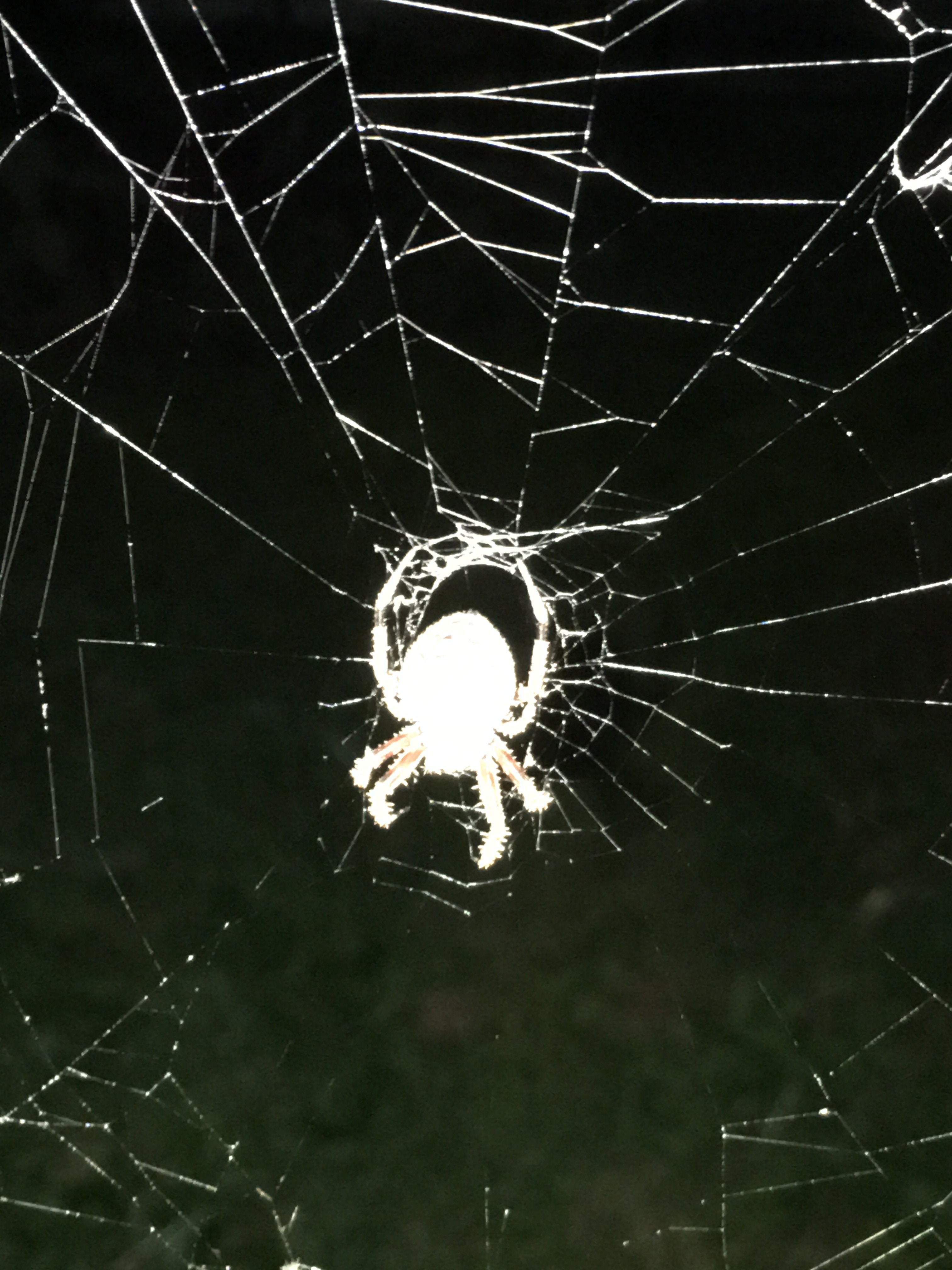
This is filler.
This is filler.
This is filler.
This is filler.
This is filler.
This is filler.
This is filler.
This is filler.
This is filler.
This is filler.
This is filler.
This is filler.
This is filler.
This is filler.
This is filler.
I didn't get a chance to post much last week, so here's a belated wish for a happy Halloween and/or Dia de los Muertos!

You might want to skip the next picture if you have a fear of spiders. I took this picture some time ago when the orb weavers were out full-force. I've put some extra lines of "filler" in before and after the picture as a buffer.
This is filler.
This is filler.
This is filler.
This is filler.
This is filler.
This is filler.
This is filler.
This is filler.
This is filler.
This is filler.
This is filler.
This is filler.
This is filler.
This is filler.
This is filler.
This is filler.
This is filler.
This is filler.
This is filler.
This is filler.
This is filler.
This is filler.
This is filler.
This is filler.
This is filler.
This is filler.
This is filler.
This is filler.
96CassieBash
Book 68: The Robe of Skulls is the first of (apparently) a six book set of children's fantasies. I have the first 3 so I'm just going to go ahead and read them all. They seem to work well as stand-alone plots so I don't think I'll be dying to read all six back to back or will be missing anything from an overarching plot. These, by the way, would make good read-alouds for parents who have kids capable of sitting still for chapter books. There are a few illustrations here and there, and the chapters are mostly fairly short, so there are plenty of opportunities to pause in the reading or to call it quits for the night. In the first, the evil sorceress Lady Lamorna wants to order a special robe of black velvet, red trim, and embroidered silver skulls--but she lacks the funds. She concocts a plan for secretly turning the kingdoms' princes and princesses into frogs so that she can be paid handsomely for their restoration, but not all goes as planned. You're introduced to the hero and heroine of the series in this first book, and a few other key characters that transfer over to the second book, The Bag of Bones, and presumably for the others as well. An amusing and well-written book for the targeted age group, not as intense as the Harry Potter series but still exciting and adventurous enough to capture a child's attention. With both a young hero and heroine, the book is obviously trying to find the balance and to be appealing to as many children as possible. It should, for the most part, succeed.
Due to space issues and considering that I probably wouldn't re-read them again, I'll probably be taking all three of the ones I own back to Derek's store in Muncie, from which they originally came. I'll be keeping an eye out for the others but the series doesn't stand out as one of those "I MUST read these again and again!" things, but someone out there will certainly be happy to get them, I'm sure.
I do need to finish listening to Under the Sunset; the problem is that the reader is very quiet (though not bad otherwise) and I have a hard time hearing her over road noise. Since I do most of my audiobook listening going to and from work, this is an issue. I need to set some time aside this weekend to do something that will allow me to listen to it while still getting something accomplished--maybe some crafting....
Due to space issues and considering that I probably wouldn't re-read them again, I'll probably be taking all three of the ones I own back to Derek's store in Muncie, from which they originally came. I'll be keeping an eye out for the others but the series doesn't stand out as one of those "I MUST read these again and again!" things, but someone out there will certainly be happy to get them, I'm sure.
I do need to finish listening to Under the Sunset; the problem is that the reader is very quiet (though not bad otherwise) and I have a hard time hearing her over road noise. Since I do most of my audiobook listening going to and from work, this is an issue. I need to set some time aside this weekend to do something that will allow me to listen to it while still getting something accomplished--maybe some crafting....
97CassieBash
Book 69: Under the Sunset is a collection of gothic fairy tales written for children by Bram Stoker. True to the time it was written, it wasn’t just moralistic in nature but at times comes across as a bit preachy, which is, as I said, typical of children’s literature of the times. What isn’t as typical is the dark (though not scary) mood, themes, and situations that are intertwined into the plots of each story. Death imagery and metaphor runs rampant—but the last story leaves you with a positive and more upbeat message. Probably more appreciated by an adult audience any more, due in part to archaic language and phrasing. If you like dark fairy tales and don’t mind the religious and moralistic undertones, you’ll probably enjoy this.
98CassieBash
Book 70: The Bag of Bones is book 2 of the series started in >96 CassieBash:, this time focusing on a wicked witch using Deep Magic--what many would call black magic--to try to take over the Five Kingdoms. Gracie and Marcus have to try to stop her. Much of what I said regarding the audience carries over, and once more in the interest of not providing spoilers (and because I'm being brief), I won't go into any more details. If you liked the first book (or your kids did), you (or they) will probably like this one, too.
Book 71: Fool Moon is the second book of the Harry Dresden series by Jim Butcher, whose series is a mystery detective fantasy genre, in which the series title character, Dresden, aids the police in all criminal matters supernatural that occur in the city of Chicago--in this case, werewolves. Based in part on folklore (someone did at least a little research), the series is for adult readers, with violence and sexual matters involved--think of it as an R rating. But Dresden does have some old-style detective in him that makes a modern setting somehow seem to hearken back to the height of Golden Age detective fiction. An enjoyable read for those who love both detective mystery and fantasy and don't mixing it up with the genres.
My 75 goal will be close but I think I can do it yet; only 4 more to go. I'm listening to a Librivox audiobook and have already started the 3rd book in the Vivian French series. I'll probably finish the book I have at work before the end of the year; I still have a third left to go but it's fiction and going fast. I still have some short chapter and YA books, too, plus there will be time off coming up next week, which should allow for some extra reading.
Book 71: Fool Moon is the second book of the Harry Dresden series by Jim Butcher, whose series is a mystery detective fantasy genre, in which the series title character, Dresden, aids the police in all criminal matters supernatural that occur in the city of Chicago--in this case, werewolves. Based in part on folklore (someone did at least a little research), the series is for adult readers, with violence and sexual matters involved--think of it as an R rating. But Dresden does have some old-style detective in him that makes a modern setting somehow seem to hearken back to the height of Golden Age detective fiction. An enjoyable read for those who love both detective mystery and fantasy and don't mixing it up with the genres.
My 75 goal will be close but I think I can do it yet; only 4 more to go. I'm listening to a Librivox audiobook and have already started the 3rd book in the Vivian French series. I'll probably finish the book I have at work before the end of the year; I still have a third left to go but it's fiction and going fast. I still have some short chapter and YA books, too, plus there will be time off coming up next week, which should allow for some extra reading.
99CassieBash
Book 72: Twenty-Two Goblins is translated from the Sanskrit by Arthur W. Ryder but is attributed to Dandin, an Indian (as in India, Indian) author from the late 6th and early 7th century--though this actual edition is a Librivox recording. This book is set up as a collection of riddle stories tied loosely together by a plot. A good and kind king is asked by a monk to retrieve a dead body that's hanging from a tree; the body holds a goblin within it, and the king collects the body. But every time he tries to take it back to the monk, the goblin tells him a story, warning him that a dreadful and deadly curse will destroy him if he answers the riddle wrong. The answers to the riddles sometimes come across as sexist, but one must remember the time and culture of the time it was written, and there are plenty of examples of both good and bad women and men in the stories. The reader was fairly decent though a bit quiet for listening in the car due to road noise.
Book 73: The Heart of Glass is the third of the series by Vivian French involving the Five Kingdoms; this time, Gracie, Marcus, Gubble, and the bats get involved with the problems of the dwarves and the trolls. The innocent romance between Gracie and Marcus is becoming more apparent, even if neither one has really mentioned it as such. As in books one and two, the book should appeal to children and would work well as a bedtime chapter book.
I'm nearly done with the YA chapter book I've been reading at work; this is a short week of work for me (today and tomorrow), so if I don't finish by tomorrow lunch, I'll take it home and finish it there. December is a busy month but I'm going to tackle at least one more adult book--maybe another volume of that 20 volume set--and that may be it for the year.
Book 73: The Heart of Glass is the third of the series by Vivian French involving the Five Kingdoms; this time, Gracie, Marcus, Gubble, and the bats get involved with the problems of the dwarves and the trolls. The innocent romance between Gracie and Marcus is becoming more apparent, even if neither one has really mentioned it as such. As in books one and two, the book should appeal to children and would work well as a bedtime chapter book.
I'm nearly done with the YA chapter book I've been reading at work; this is a short week of work for me (today and tomorrow), so if I don't finish by tomorrow lunch, I'll take it home and finish it there. December is a busy month but I'm going to tackle at least one more adult book--maybe another volume of that 20 volume set--and that may be it for the year.
100PaulCranswick
I am going to be behind you in reaching 75 this year, Cassie, as I can't seem to finish anything at the moment.
I reckon you can make it before November snuffs out its wan and flickering lights.
I reckon you can make it before November snuffs out its wan and flickering lights.
101CassieBash
>100 PaulCranswick: Sorry to hear that, Paul, but some years are like that. I'm a little surprised that I'll be getting to the 75 mark this year myself, but mom's health is much better than it was even just a few months ago, so I've had an easier time concentrating on reading. I've decided to read a longer tome since I'm confident that I'll have enough time to finish a nice, thick book, so I doubt I'll hit 25 in the next few days. But I'll definitely hit the 74 mark by the end of Turkey Day.
Read what you can, enjoy what you read, and remember that ultimately it's quality rather than quantity that really counts.
Read what you can, enjoy what you read, and remember that ultimately it's quality rather than quantity that really counts.
102CassieBash
Book 74: Another Faust is a YA book about 5 teens with extraordinary powers granted to them by a mysterious woman who "adopted" them and who isn't what she seems. Anyone familiar with the name of Faust can guess that this woman isn't a force for good, as she plays mind and power games with them, seemingly giving them what they want--or is it really what she wants? Not enough gore or shock or even psychological chills to be a true horror in the sense of what most think of the genre to be, but there are some disturbing (but thought-provoking) themes on human nature. How far will someone go to get what they want, and what will they sacrifice along the way? Goodreads classifies it as a paranormal fantasy, which I would agree with. (It also says it's a series, though this worked excellently as a stand-alone.) This one was picked up for 75 cents at a consignment shop and is well worth the investment, as it's now going into my budget-crunched library's collection as a donation. It should get some reads, as a few people have already noticed me reading it and showed interest.
103PaulCranswick
Wishing you a splendid weekend, Cassie.
104CassieBash
>103 PaulCranswick: Thanks for the wish, Paul. Unfortunately, not the best weekend--but then again, not the worst, either. Hope yours was wonderful.
105CassieBash
Book 75: The Well of Ascension is book 2 of the Mistborn trilogy by Brandon Sanderson, and another audiobook. This is the 3rd Sanderson book this year, so I think it's safe to say that I like his work! This book focuses on the events that followed the end of the first book, in which the Emperor is overthrown and Vin, who killed him, is seen as the new savior . I find this series to be (and I know I'm opening a can of worms here) reminiscent of Game of Thrones in the political espionage, spying, and vying for power, but I actually like more of the characters in this series, and some of the plot twists are so unexpected, that I personally see this as the better series, though I acknowledge that this is an opinion. I didn't really like most of the Game of Thrones characters, since many were grasping, tyrannical, greedy, self-centered...you get the idea. And yes, there are some of those in here, too; you don't get political intrigue without them--but if most of your series' characters are like that, then it's hard for me to really care. Frankly, by the time I was into the third Game of Thrones book, there were really only two or three people that I had to know what would happen to and I really didn't care who killed off any of the others or how. In contrast, I really cared about 8 or 9 characters in this book, at least.
The audio reader was the same as the first book's, and I'm assuming that the third book, when my hold comes up and I can listen to it, will be the same reader again. I really like him; he does do different voices and accents for different characters. He's not, perhaps, up to the standards of Jim Dale, who read the Harry Potter series, but he is good, and I can easily hear him over most road noise.
I hope to have at least one more book read by the end of the year; I have one of the volumes (11, I think) of that 20 volume set underway, plus a YA fantasy/horror (more fantasy than horror at this point), and a nonfiction read about poisons here at work. I'm going to sum up my reads on Monday, even if I do get another read squeaked in, because that will be the last day of the year where I will be at work in front of a full computer, and I always think it's easier to post on a computer rather than my phone. Someone please tell the state of Indiana to start investing in rural high-speed internet access, please!!!
The audio reader was the same as the first book's, and I'm assuming that the third book, when my hold comes up and I can listen to it, will be the same reader again. I really like him; he does do different voices and accents for different characters. He's not, perhaps, up to the standards of Jim Dale, who read the Harry Potter series, but he is good, and I can easily hear him over most road noise.
I hope to have at least one more book read by the end of the year; I have one of the volumes (11, I think) of that 20 volume set underway, plus a YA fantasy/horror (more fantasy than horror at this point), and a nonfiction read about poisons here at work. I'm going to sum up my reads on Monday, even if I do get another read squeaked in, because that will be the last day of the year where I will be at work in front of a full computer, and I always think it's easier to post on a computer rather than my phone. Someone please tell the state of Indiana to start investing in rural high-speed internet access, please!!!
107FAMeulstee
>105 CassieBash: Congratulations on reaching 75, Cassie!
I loved the Mistborn trilogy :-)
I loved the Mistborn trilogy :-)
108CassieBash
>106 drneutron: & >107 FAMeulstee: Thanks!
>107 FAMeulstee: I'm 7th on the waiting list for the audiobook of the 3rd in the series. Looks like I'll have to post that one in the new year, lol!
Here's the breakdown:
Children's Fiction 15
Children's Nonfiction 1
Young Adult Fiction 21
YA Nonfiction 0
Adult Fiction 11
Adult Nonfiction 10
Audiobooks 17
I might finish another adult fiction, another adult nonfiction, and another YA fiction before the New Year, but maybe not quite. My reading time is going to be very limited until after the day after Christmas, so it's not likely I'll have time to finish all three in the few days' worth of reading I'll have left. The YA fiction is the most likely, so I might hit 76 total, but hey, I reached the ultimate goal of 75 so no real complaints.
I'll see you all next year with another (hopefully) 75!
>107 FAMeulstee: I'm 7th on the waiting list for the audiobook of the 3rd in the series. Looks like I'll have to post that one in the new year, lol!
Here's the breakdown:
Children's Fiction 15
Children's Nonfiction 1
Young Adult Fiction 21
YA Nonfiction 0
Adult Fiction 11
Adult Nonfiction 10
Audiobooks 17
I might finish another adult fiction, another adult nonfiction, and another YA fiction before the New Year, but maybe not quite. My reading time is going to be very limited until after the day after Christmas, so it's not likely I'll have time to finish all three in the few days' worth of reading I'll have left. The YA fiction is the most likely, so I might hit 76 total, but hey, I reached the ultimate goal of 75 so no real complaints.
I'll see you all next year with another (hopefully) 75!
109ronincats
Congratulations on hitting the 75 book mark, Cassie! And with a monster too! (# of pages monster)
110ronincats
Whether you celebrate Christmas, Hanukkah, Solstice, some other tradition or none at all, this is what I wish for you!


111PaulCranswick
Thank you for keeping me company in 2019.......onward to 2020.
112CassieBash
>110 ronincats: & >111 PaulCranswick: Thanks! Hope your holiday season is/was great and wishing you all the best for the new year.
>111 PaulCranswick: Thanks for putting up with all those dark and morbid reads of mine, lol!
Speaking of which, I’m squeezing in at least one more read for this year—book 76: Peeps by Scott Westerfeld, a YA book about vampires that I’m classifying more as fantasy than horror—with one caveat. See, in this book, vampirism is caused by a parasite, and the author uses every other chapter to describe a different parasitic scenario, from malaria to the guinea worm. Before I’d even finished the story and moved onto the bibliography, I was thinking how so many of the parasites mentioned were discussed in that gem I’d read some while back, Parasite Rex. Well, darned if the author hadn’t used that book (and a few others) to write this book. Not anything near as gruesome as “Parasite Rex” but possibly disturbing to some—but it’s more of a gross factor than a scare one. If you can handle medical descriptions of surgical procedures and such, you’re probably good. The vampire parts aren’t really scary as the author handles this with both humor and sympathy, since vampires in this world aren’t really evil, just sick. Plus there is a twist— the vampires may not be so bad after all. As one of the chapter titles explains, “The parasite of my parasite is my friend”....
I may have to keep this one; be warned that while there are no descriptions of sex, the allusion is there as parasites can be transmitted sexually. Also, I think there is some cursing (not a lot but it’s there in a few places) and the “f” bomb was used in this fashion once or twice, so if you’re sensitive to such language you may want to pass this one up. But it’s a unique vampire take...plus parasites! How could I possibly resist a re-read!! XD
>111 PaulCranswick: Thanks for putting up with all those dark and morbid reads of mine, lol!
Speaking of which, I’m squeezing in at least one more read for this year—book 76: Peeps by Scott Westerfeld, a YA book about vampires that I’m classifying more as fantasy than horror—with one caveat. See, in this book, vampirism is caused by a parasite, and the author uses every other chapter to describe a different parasitic scenario, from malaria to the guinea worm. Before I’d even finished the story and moved onto the bibliography, I was thinking how so many of the parasites mentioned were discussed in that gem I’d read some while back, Parasite Rex. Well, darned if the author hadn’t used that book (and a few others) to write this book. Not anything near as gruesome as “Parasite Rex” but possibly disturbing to some—but it’s more of a gross factor than a scare one. If you can handle medical descriptions of surgical procedures and such, you’re probably good. The vampire parts aren’t really scary as the author handles this with both humor and sympathy, since vampires in this world aren’t really evil, just sick. Plus there is a twist— the vampires may not be so bad after all. As one of the chapter titles explains, “The parasite of my parasite is my friend”....
I may have to keep this one; be warned that while there are no descriptions of sex, the allusion is there as parasites can be transmitted sexually. Also, I think there is some cursing (not a lot but it’s there in a few places) and the “f” bomb was used in this fashion once or twice, so if you’re sensitive to such language you may want to pass this one up. But it’s a unique vampire take...plus parasites! How could I possibly resist a re-read!! XD

