Pilgrim continues searching for Enlightenment and Entertainment (2019, Final Quarter)
This is a continuation of the topic Pilgrim is still searching for Enlightenment and Entertainment (2019, Third Quarter).
This topic was continued by Pilgrim continues to search as 2020 begins.
Talk The Green Dragon
Join LibraryThing to post.
3-pilgrim-
Books Read
October
✓1. The Power of the Name: the Jesus Prayer in Orthodox Spirituality by Kallistos Ware
✓2. The Modern Faerie Tales: Tithe; Valiant; Ironside by Holly Black
✓3. Roadside Picnic by Arkady Strugatsky and Boris Strugatsky (trans. by Olena Bormashenko)
✓4. The Armageddon Rag by George R. R. Martin
✓5. Everything I Don't Remember by Jonas Hassen Khemiri (trans. by Rachel Willson-Broyles)
✓6. Southern Honor: Ethics and Behavior in the Old South by Bertram Wyatt-Brown
✓7. The Idylls of the Queen by Phyllis Ann Karr
✓8. Rivers of London by Ben Aaronovitch
✓9. Conflicted Identities: the Jewish Cardinal and the Jesus Believing Orthodox Rabbi by Juan Marcos Bejarano Gutierrez
✓10. The Breast Cancer Survival Manual (6th Edition) by John Link, Shlomit Ein-Gal and Nancy Link
✓11. The Dark Monk by Oliver Plötzsch (trans. by Lee Chadeayne)
✓12. Anti-Cancer Recipes: Important Food Options to Fight Cancer by Sophia Freeman
✓13. Catholic but not Roman, Orthodox but not Eastern by R. Joseph Owles
✓14. Fairy Tales for Adults and Other Substances by Sasha Yurodiver
✓15. The City of Brass by S.A. Chakraborty
Average = 3.13
November
✓1. The Greater Freedom by Alya Mooro
✓2. A Brief History of Pepperoni by Haji Outlaw
✓3. The Burden of Southern History by C. Vann Woodward
✓4. Roadside Picnic Revisited: Seven Articles on the Soviet novel that inspired the film "Stalker" by Michael Andre-Driussi
✓5. Morning and Evening Prayer Rules in the Russian Orthodox Tradition by Sergei Sveshnikov
✓6. Atomic Missions by Michael Andre-Driussi
✓7. St. John's Eve by Nikolai Vasilievich Gogol (trans. by John Cournos)
✓8. The Orthodox Liturgy: the development of the eucharistic Liturgy in the Byzantine rite by Hugh Wybrew
✓9. Sixteen Ways to Defend a Walled City by K. J. Parker
✓10. Religion in the Old South by Donald G. Mathews
✓11. Moon Over Soho by Ben Aaronovitch
✓12. Whispers Under Ground by Ben Aaronovitch
✓13. Roverandom by J.R.R. Tolkien (edited by Wayne G. Hammond and Christina Scull)
✓15. Mafia Life: Love, Death and Money at the Heart of Organised Crime by Federico Varese
December
✓1. Dispel Illusion by Mark Lawrence
✓2. Broken Homes by Ben Aaronovitch
✓3. Foxglove Summer by Ben Aaronovitch
✓4. The Hanging Tree by Ben Aaronovitch
✓5. The Home Crowd Advantage by Ben Aaronovitch
✓6. Reynolds - Florence, Az. 2014 by Ben Aaronovitch
✓7. Nightingale - London 1966 by Ben Aaronovitch
✓8. Tobias Winter - Meckenheim 2012 by Ben Aaronovitch
✓9. Red Sister by Mark Lawrence
✓10. The Doomed City by Arkady and Boris Strugatsky (trans. by Andrew Bromfield)
✓11. The Magistrates of Hell by Barbara Hambly
October
✓1. The Power of the Name: the Jesus Prayer in Orthodox Spirituality by Kallistos Ware
✓2. The Modern Faerie Tales: Tithe; Valiant; Ironside by Holly Black
✓3. Roadside Picnic by Arkady Strugatsky and Boris Strugatsky (trans. by Olena Bormashenko)
✓4. The Armageddon Rag by George R. R. Martin
✓5. Everything I Don't Remember by Jonas Hassen Khemiri (trans. by Rachel Willson-Broyles)
✓6. Southern Honor: Ethics and Behavior in the Old South by Bertram Wyatt-Brown
✓7. The Idylls of the Queen by Phyllis Ann Karr
✓8. Rivers of London by Ben Aaronovitch
✓9. Conflicted Identities: the Jewish Cardinal and the Jesus Believing Orthodox Rabbi by Juan Marcos Bejarano Gutierrez
✓10. The Breast Cancer Survival Manual (6th Edition) by John Link, Shlomit Ein-Gal and Nancy Link
✓11. The Dark Monk by Oliver Plötzsch (trans. by Lee Chadeayne)
✓12. Anti-Cancer Recipes: Important Food Options to Fight Cancer by Sophia Freeman
✓13. Catholic but not Roman, Orthodox but not Eastern by R. Joseph Owles
✓14. Fairy Tales for Adults and Other Substances by Sasha Yurodiver
✓15. The City of Brass by S.A. Chakraborty
Average = 3.13
November
✓1. The Greater Freedom by Alya Mooro
✓2. A Brief History of Pepperoni by Haji Outlaw
✓3. The Burden of Southern History by C. Vann Woodward
✓4. Roadside Picnic Revisited: Seven Articles on the Soviet novel that inspired the film "Stalker" by Michael Andre-Driussi
✓5. Morning and Evening Prayer Rules in the Russian Orthodox Tradition by Sergei Sveshnikov
✓6. Atomic Missions by Michael Andre-Driussi
✓7. St. John's Eve by Nikolai Vasilievich Gogol (trans. by John Cournos)
✓8. The Orthodox Liturgy: the development of the eucharistic Liturgy in the Byzantine rite by Hugh Wybrew
✓9. Sixteen Ways to Defend a Walled City by K. J. Parker
✓10. Religion in the Old South by Donald G. Mathews
✓11. Moon Over Soho by Ben Aaronovitch
✓12. Whispers Under Ground by Ben Aaronovitch
✓13. Roverandom by J.R.R. Tolkien (edited by Wayne G. Hammond and Christina Scull)
✓15. Mafia Life: Love, Death and Money at the Heart of Organised Crime by Federico Varese
December
✓1. Dispel Illusion by Mark Lawrence
✓2. Broken Homes by Ben Aaronovitch
✓3. Foxglove Summer by Ben Aaronovitch
✓4. The Hanging Tree by Ben Aaronovitch
✓5. The Home Crowd Advantage by Ben Aaronovitch
✓6. Reynolds - Florence, Az. 2014 by Ben Aaronovitch
✓7. Nightingale - London 1966 by Ben Aaronovitch
✓8. Tobias Winter - Meckenheim 2012 by Ben Aaronovitch
✓9. Red Sister by Mark Lawrence
✓10. The Doomed City by Arkady and Boris Strugatsky (trans. by Andrew Bromfield)
✓11. The Magistrates of Hell by Barbara Hambly
6pgmcc
>5 -pilgrim-: I never doubted that for a minute. :-)
8pgmcc
>7 -pilgrim-:
I will let you into a little secret. When I did my O-Level Latin exam the grades were 1 to 9. "1" was the best and "9" the worst. I got a 9. I believe that if one is going to fail one should do so definitively.
"I think therefore I am" was no problem. So far "Peregrina est ergo lectitat (pgmcc, 2019)?" is giving me, "Are you a foreigner to reading in 2019, Peter?"
A little aside
When leaving the O-Level Latin examination I was in very good form and believed I might have actually passed. The first inkling I had that something might be wrong was when I mentioned to one of my class-mates that I thought the translation was a bit violent. He asked what I meant. I told him it was about someone murdering someone else with a knife and there being blood everywhere. In a rather flat tone of voice he said, "It was about making wine."
I will let you into a little secret. When I did my O-Level Latin exam the grades were 1 to 9. "1" was the best and "9" the worst. I got a 9. I believe that if one is going to fail one should do so definitively.
"I think therefore I am" was no problem. So far "Peregrina est ergo lectitat (pgmcc, 2019)?" is giving me, "Are you a foreigner to reading in 2019, Peter?"
A little aside
When leaving the O-Level Latin examination I was in very good form and believed I might have actually passed. The first inkling I had that something might be wrong was when I mentioned to one of my class-mates that I thought the translation was a bit violent. He asked what I meant. I told him it was about someone murdering someone else with a knife and there being blood everywhere. In a rather flat tone of voice he said, "It was about making wine."
10pgmcc
>9 hfglen:
Hugh, you are a better Latin scholar than I, but given the content of post #8 that can definitely not be taken as praise indeed.
:-)
Hugh, you are a better Latin scholar than I, but given the content of post #8 that can definitely not be taken as praise indeed.
:-)
11-pilgrim-
>8 pgmcc:
Are you a foreigner to reading in 2019, Peter?
I detect the infamous hand of the Google Translate.
My Latin is rather rusty, but Hugh's output equates to my input.
Well, that will teach me to make jokes in Latin, I suppose... :-/
Are you a foreigner to reading in 2019, Peter?
I detect the infamous hand of the Google Translate.
My Latin is rather rusty, but Hugh's output equates to my input.
Well, that will teach me to make jokes in Latin, I suppose... :-/
13Karlstar
Did I miss the The Armageddon Rag review?
14-pilgrim-
>13 Karlstar: No. I have only just started this thread, so no reviews of books read in October are posted yet.
15-pilgrim-

The Breast Cancer Survival Manual (6th edition) by John Link, Shlomit Ein-Gal and Nancy Link - 3 stars
To be honest, I should probably have read this earlier. However receiving a book with this title (as a gift), immediately after a terminal diagnosis, felt very much like a slap in the face.
I was also concerned as to how applicable it would be to me, given that a lot of the opening chapters are devoted to explaining how to access the US healthcare system. The author runs a chain of clinics in the US, and is writing very much from the perspective of his own work, which is quite understandable, considering that his book originated as a manual intended for his own patients.
I am also used to books which assume a somewhat higher level of general knowledge; I lost count of the number of times that the terms adjuvant and neoadjuvant were defined (every technical term was defined over and over again, usually at each use of it), and I do not need to have explained to me how a clinical trial works (and certainly not every time one is referred to!)
I could not shrug off a slight sense that the writer believes that all women (it maybe just all patients?) are rather stupid - surely these explanations would be better put in a separate section, for those who need to refer to them, rather than operating on the apparent assumption that all breast care patients must be ignorant of basic scientific methodology? I do not know whether his assumptions regarding his intended American readership's education level are justified; but his explanation level tends to be below that of a science GCSE.
I suppose the repetitiveness can be excused in that the author is not writing for a dispassionate reader. Most people reading this book will be, to a greater or lesser extent, in a state of funk. The repetition can therefore be seen as the analogue of the doctor who keeps repeating the same words over and over again, until he is convinced that you have taken them in - and the author is maybe more justified in this behaviour, because he is without the benefit of feedback from the reader.
However the advantage of this style is that the book can be easily skimmed, rather than carefully read; you can find the sections relevant to your cancer and concentrate on those.
It is at this point that the merits of the book stand up: it gives a detailed, clear explanation of the different types of cancer, and why the different types of treatment are justified.
This stands in marked contrast to my own doctors, who responded "you don't need to worry about that", when I asked what triple negative meant on my biopsy result.
However hamfistedly this has been done at times, I have to applaud a doctor whose goal is to promote understanding, rather than demanding meek acquiescence.
Accepting that I am not the target audience - the book refers repeatedly to "we Americans' - means that I cannot complain about the irrelevance of certain sections.
At the end of this book I felt a lot better informed. But I am also furious.
The repeated injunctions to "get a second opinion" - which I was repeatedly denied - and "be involved in the choice of your treatment" - when I was told repeatedly that I have NO choice, except to refuse - made this difficult reading for me.
16-pilgrim-

The Power of the Name by Kallistos Ware
This is written for an Orthodox Christian readership; unlike Metropolitan Kallistos' more famous books, such as The Orthodox Church and The Orthodox Way, it is not aimed at outsiders wishing to learn more about Orthodoxy. It may be of interest to those who wish to understand further the religious context of novels such as Dostoyevsky's. Otherwise, although in no way condemnatory of other traditions, it is probably only of interest to those who wish to learn about a specifically Orthodox practice.
It explains the use of the Jesus Prayer, both for the layperson and within the hesychast tradition.
The latter aroused considerable controversy within Orthodoxy over the last two centuries. It is a method of regulating the breathing to harmonize with that of the prayer so as to achieve "prayer of the whole person" i.e. of both mind and body. As such, it bears considerable resemblances to both Hindu Yogic and Sufi practices.
Metropolitan Kallistos warns emphatically that interfering with the body's natural rhythms in this way can be harmful if not done properly, and so the practice should only be undertaken under the supervision of an experienced starets. He further quotes many saints of the Orthodox church to the effect that the "physical technique" is only an accessory, and not essential to the practice of the Jesus Prayer.
This prayer was recommended to me by my priest. Its goal is to proceed from praying to Jesus ("prayer of the lips"), via "prayer of the mind", to a state where Jesus, as the great High Priest, prays through us ("prayer of the heart").
Metropolitan Kallistos ends by emphasizing that the Jesus Prayer differs from meditational practices in being an invocation of someone - which therefore requires belief, however provisional, in that Person's existence. (I suspect that many, although maybe not all, yogis and Sufis would actually make the same claim.) However the distinction is necessary, because it strongly ressembles them in its emphasis on the avoidance of conscious thought.
This is more than a "how to" manual; it also gives fully the "why". It quotes liberally from both the Bible and Orthodox writers in justification of its arguments.
It discusses both "formal" and "free" use of the Jesus Prayer (the latter being a way of fulfilling the injunction of St Paul in 1Thess. 5:17).
This short book is a text of quite technical theology. It covers a rather specialist subject extremely clearly, and at times rather beautifully.
Despite its brevity, this took me quite a while to read; it is the sort of book where you want to stop and think through each chapter carefully after reading it.
17Sakerfalcon
I'm sorry I missed out on the piffle party in your last thread, it looks to have been a lot of fun! I wish you good reading this quarter.
18-pilgrim-
Thank you, Clare. Being in hospital so much has been bad for getting anything else done, but it has been good for my reading!
19-pilgrim-

Anti-Cancer Recipes: Important Food Options to Fight Cancer by Sophia Freeman - 1/2 star
I know that eating properly whilst in a weakened state is important. And that a few foods can interfere with the action of the chemotherapy.
I have been reading Take Breast Cancer Off the Menu - more about that later - which discusses which food are helpful and which are harmful, with plentiful references to clinical studies. However it contains no recipes.
I am not a cook. My grandmother taught me, and I duly studied Cookery at school, but decades of being unable to chop, peel, slice or stir have left me with few skills in that department.
So I wanted to find a book with some actual recipes in, to put into practice the suggestions in Take Breast Cancer Off the Menu.
A chapter in The Breast Cancer Survival Manual warned against believing that you can either cure or prevent cancer through diet; it also started that there is an industry out there, cynically pandering to sufferer's natural desire to take back some control over their own fate.
However that book, which is co-authored by a dietician, does also have guidelines re which foods are genuinely harmful, and which are nutritionally beneficial, particularly during chemotherapy, whilst debunking myths about many others.
So I was looking for a recipe book that was oriented towards providing the right kind of diet.
I found this nasty, exploitative bit of trash.
It has a long disclaimer at the front states:
This publication is meant as an informational tool. The individual purchaser accepts all liability if damages occur because of following the directions or guidelines set out in this publication....
The content of this publication is solely for entertainment purposes...
Each recipe is them followed by a short section on "Health Benefits".
A couple of examples:
Tomato and oregano should be an important part of diet of a cancer patient. Try this to prevent cancer.
Combination of egg and turkey will be really good for the treatment of cancer.(this refers to a fried sandwich!)
No explanations, no substantiation of claims. Just bald advice that this disk will "prevent cancer", whilst another "kills cancer cells".
The poor grammar confirms my suspicion that this is not the product of someone who is genuine, if misguided. It has been rushed carelessly into publication by an author who cynically wants to take advantage of ill people, and exploit them in the name of making a quick buck.
I know must books have legal disclaimers to protect their author's, but the description of this book as "entertainment", combined with the first paragraph reads to me as: "now I am going to make stuff up, and if you are stupid enough to believe me, that is your fault".
20MrsLee
>19 -pilgrim-: Ugh. Sounds like a good candidate for throwing across the room or burning page by page. Unless it is on your Kindle, which, in my eyes is one of the drawbacks about ebooks. One cannot torture the bad ones.
21Bookmarque
Oh man, that sounds just terrible.
I made a dietary change after my diagnosis - I cut out sugar. I figured that if that's what they feed cancer cells to grow them for research, I'd do my best to starve the little bastards if they ever came back. This was part of some other changes, but the one that I think has the most direct effect on the disease.
I made a dietary change after my diagnosis - I cut out sugar. I figured that if that's what they feed cancer cells to grow them for research, I'd do my best to starve the little bastards if they ever came back. This was part of some other changes, but the one that I think has the most direct effect on the disease.
22-pilgrim-
>20 MrsLee: Kindle, unfortunately. That makes hurling it across the room rather an expensive gesture. Maybe burn it in effigy instead?
>21 Bookmarque: I have been trying to do that, but then my energy levels drop really low (the main chemo side-effect that I have noticed so far). Also there simply is not enough evidence yet regarding whether or not sweeteners are carcinogenic, and they are certainly bad for one in other ways.
Trying to boost my immune system, to compensate for the hot it takes from the chemo, seemed to be a sensible goal.
And giving up processed meats, since there is clear evidence regarding the harmfulness of the processing treatment - even if it means not eating my favourite Polish delicacies. :(
Since both you and @MrsLee are evidently far better cooks than I am, your suggestions would be very welcome.
>21 Bookmarque: I have been trying to do that, but then my energy levels drop really low (the main chemo side-effect that I have noticed so far). Also there simply is not enough evidence yet regarding whether or not sweeteners are carcinogenic, and they are certainly bad for one in other ways.
Trying to boost my immune system, to compensate for the hot it takes from the chemo, seemed to be a sensible goal.
And giving up processed meats, since there is clear evidence regarding the harmfulness of the processing treatment - even if it means not eating my favourite Polish delicacies. :(
Since both you and @MrsLee are evidently far better cooks than I am, your suggestions would be very welcome.
23Bookmarque
MrsL is DEFINITELY the better cook. Not only have I eaten at her bountiful table, but I barely cook at all. That's my husband's job. Always has been. One of the first questions I asked him when we were getting to know each other was 'do you cook? do you like to?' Luckily he had 10+ years commercial kitchen experience and knows his way around a steak. We're all good!
24Karlstar
>19 -pilgrim-: Considering the total and complete failure of the book to deliver what it promised, can you return it? It is actually defective.
25-pilgrim-
>24 Karlstar: Thankfully, I acquired it via Kindle Unlimited, so can easily do so.
I am angry, because I have done enough other reading to be able to easily identify that this is garbage.
Going through chemotherapy is draining. And I appear to be lucky in terms of which side-effects I am experiencing (so far!) Cancer comes to you; you don't get to pick a convenient time in your life to get it. So I have every sympathy with someone who, faced with the bombshell of a diagnosis, simply picks up a book that claims to tell them what to do, without taking the time to check it against other sources of information. And the claims made here are done so confidently that it could lead someone to assume that the lack of explanation/justification is because these are facts that "everyone knows" and are not in doubt.
I have myself made repeated requests for referral to a dietician, because the dietary advice given in the leaflet handed to me by the breast cancer clinic directly contradicts the medical diet that I am currently on to manage my chronic condition - and I have got nowhere. Given the lack of information from authoritative sources, it is hardly surprising that people look elsewhere.
And to cynically exploit people who are already in a bad situation - and attempt to mislead them in ways that may further damage their health and survival chances - simply to make money out of them, is contemptible beyond belief.
This author has published a whole slew of cookbooks. You can be sure that, regardless of how tasty her recipes may be, I will never purchase any of them.
I am angry, because I have done enough other reading to be able to easily identify that this is garbage.
Going through chemotherapy is draining. And I appear to be lucky in terms of which side-effects I am experiencing (so far!) Cancer comes to you; you don't get to pick a convenient time in your life to get it. So I have every sympathy with someone who, faced with the bombshell of a diagnosis, simply picks up a book that claims to tell them what to do, without taking the time to check it against other sources of information. And the claims made here are done so confidently that it could lead someone to assume that the lack of explanation/justification is because these are facts that "everyone knows" and are not in doubt.
I have myself made repeated requests for referral to a dietician, because the dietary advice given in the leaflet handed to me by the breast cancer clinic directly contradicts the medical diet that I am currently on to manage my chronic condition - and I have got nowhere. Given the lack of information from authoritative sources, it is hardly surprising that people look elsewhere.
And to cynically exploit people who are already in a bad situation - and attempt to mislead them in ways that may further damage their health and survival chances - simply to make money out of them, is contemptible beyond belief.
This author has published a whole slew of cookbooks. You can be sure that, regardless of how tasty her recipes may be, I will never purchase any of them.
26MrsLee
>22 -pilgrim-: Here are a couple of links for you to look at. I am no health expert, and I haven't researched food vs. cancer at all.
I found this site very helpful and he gives lots of very simple recipes for incorporating healthy foods. As to all the claims he makes for the foods, I don't know, but I'm pretty sure most of them won't hurt you.
The World's Healthiest Foods, George Mateljan
http://www.whfoods.com/foodstoc.php
This site I don't know about. It is mostly about strengthening your body. I downloaded their free recipe book, but to be honest, I haven't really looked at it.
Girls Gone Strong free recipe book.
https://www.girlsgonestrong.com/072784-free-downloads/
This blog is one I've read a lot of, and appreciated many of her insights. She has a "learning to cook simple and healthy foods" type of cooking course which I bought for my son and his wife. It seems very practical to me, and she has a nice sense of flavor.
Summer Tomato
https://www.summertomato.com/
I believe that anytime you can eliminate the processed foods and stick to ingredients which you can easily identify, vegetables, fruits, meats, nuts, grains, it will improve your energy and overall "feel good" health. It may not cure you, but I think it will feel better.
Simple food, prepared simply is a joy to eat, and joy is precious. Learning how to quickly steam-saute vegetables is wonderful. Takes very little time for lots of delicious flavor. I do not eliminate fat, but only use real fats like butter and olive oil or other natural oils(and bacon fat, which is fudging). They do so much to bring out the flavor. I also use a little salt, and sometimes a little sweet for balance.
I wish you well on your journey of discovery, and may you find joy in seeking health and well-being.
I found this site very helpful and he gives lots of very simple recipes for incorporating healthy foods. As to all the claims he makes for the foods, I don't know, but I'm pretty sure most of them won't hurt you.
The World's Healthiest Foods, George Mateljan
http://www.whfoods.com/foodstoc.php
This site I don't know about. It is mostly about strengthening your body. I downloaded their free recipe book, but to be honest, I haven't really looked at it.
Girls Gone Strong free recipe book.
https://www.girlsgonestrong.com/072784-free-downloads/
This blog is one I've read a lot of, and appreciated many of her insights. She has a "learning to cook simple and healthy foods" type of cooking course which I bought for my son and his wife. It seems very practical to me, and she has a nice sense of flavor.
Summer Tomato
https://www.summertomato.com/
I believe that anytime you can eliminate the processed foods and stick to ingredients which you can easily identify, vegetables, fruits, meats, nuts, grains, it will improve your energy and overall "feel good" health. It may not cure you, but I think it will feel better.
Simple food, prepared simply is a joy to eat, and joy is precious. Learning how to quickly steam-saute vegetables is wonderful. Takes very little time for lots of delicious flavor. I do not eliminate fat, but only use real fats like butter and olive oil or other natural oils(and bacon fat, which is fudging). They do so much to bring out the flavor. I also use a little salt, and sometimes a little sweet for balance.
I wish you well on your journey of discovery, and may you find joy in seeking health and well-being.
27clamairy
>19 -pilgrim-: Best of luck to with the anti-cancer foods.
I have read recently that melatonin has been shown to fight certain cancers, especially breast cancer. I started taking it to help me get to sleep, but I'll probably keep taking it.
I have read recently that melatonin has been shown to fight certain cancers, especially breast cancer. I started taking it to help me get to sleep, but I'll probably keep taking it.
28Sakerfalcon
>19 -pilgrim-: Ugh, that "anti-cancer" recipe book sounds appalling. I hope you can copy and paste your comments into an amazon review to warn others away from it. I have a good friend who is an oncologist in the US and trash like this makes her furious, because she sees the people who believed it and have now left it too late to get treatment. I wish you the best of luck in finding tasty and healthy recipes to make.
29-pilgrim-
>26 MrsLee: Thank you @MrsLee; I will look into those.
>27 clamairy:, >28 Sakerfalcon: I am still reading around, trying to find out what food may genuinely be beneficial, particularly in terms of going through the chemotherapy - and, perhaps more importantly, what is known to be harmful.
I fear my review, as written here, is too long for Amazon, but I will try to do something there.
>27 clamairy:, >28 Sakerfalcon: I am still reading around, trying to find out what food may genuinely be beneficial, particularly in terms of going through the chemotherapy - and, perhaps more importantly, what is known to be harmful.
I fear my review, as written here, is too long for Amazon, but I will try to do something there.
30haydninvienna
>29 -pilgrim-: I think the last 4 or 5 paragraphs would work just fine for Amazon. Having a disclaimer at the front that says it's entertainment, and then "Try this to prevent cancer" fully justify your description of it as a "nasty, exploitative bit of trash". And a fried sandwich??? Words fail me.
31-pilgrim-
>30 haydninvienna: Thanks Richard.
And indeed - basically, you are supposed to make a chicken sandwich, then dip it in the egg, then cook...!!
And indeed - basically, you are supposed to make a chicken sandwich, then dip it in the egg, then cook...!!
32-pilgrim-

Catholic but not Roman, Orthodox but not Eastern by R. Joseph Owles - 2 stars
This is a short introduction by an Old Catholic priest (now listed online as a bishop) to the beliefs of his denomination.
I was looking for something that would define for me the views of this denomination, from the "inside", rather than what those who consider them heretical, or schismatic, claim about them. Fr. Owles Is suitably clear that his book is his personal understanding, rather than an authoritative document, and he does include the doctrinal statements of his denomination in the final chapters, so I did obtain the basic information that I was looking for.
Although he states at one point that his purpose is not to "bash" the Roman Catholic church, the tone is quite polemical.
He opens by positioning himself and his church by comparison to the Roman Catholic church in terms of greater openness (accepting contraception, divorce, ordaining women and LGBT people) and being a "ministry to those who do not have access to a pastor or church ministry". However, in later chapters and footnotes, he acknowledges that not all Old Catholic churches share these views.
He places a lot of emphasises on the fact that his church has Apostolic Succession, and considers the Roman Catholics to be the ones to have "broken away" - to the extent of detailing his personal line of succession in an appendix. I note that the statements of doctrine also state that the Church of England also has Apostolic Succession.
Given the title of the book, I found it odd that it is silent on his denomination's relation to the Orthodox churches, given that they share the Orthodox belief that infallibility rests with the seven Ecumenical Councils. Perhaps unfairly, I got the impression that the author simply knows very little about them.
A lot of the book is spent detailing church history. It covers the three creeds (Nicene, Apostles' and Athanasian) and the doctrines promulgated by those councils, in some detail. These are the statements of faith that an Old Catholic is required to accept.
The claim to Apostolic Succession is via the Catholic Church of the Netherlands, which is stated to have been always autonomous, and that it "was viewed by the church based in Rome as independent, and publicly and officially said so in 1125 when the Bishop of Rome decreed it independent and granted it the right to name and ordain its own bishops, making the Bishop of Utrecht the head", and that this was confirmed by the Fourth Lateran Council in 1215. As more than a national church, it dates from 1854, when many of the bishops who walked out of the First Vatican Council over opposition to the doctrines of the Immaculate Conception and papal infallibility asked to join the Catholic Church of the Netherlands.
The Fourteen Theses of the Old Catholic Union Conference at Bonn (September 14-16, 1874) are given in full, with commentary, as being the defining documents.
The additional points made in the Declaration of Utrecht in 1889 are summarised.
And that is where the history of the Old Catholic Church stops.
I found the whole tone of this book rather odd. An huge amount of a short book is devoted to comparisons with the Roman Catholic church. And the conclusion, the "if you like what you have read" section, is even odder. He exhorts the interested reader not to leave their own church, but to use the Old Catholic position to challenge their local priest (whom he seems to assume to be Roman Catholic) in the hope of influencing the official Ronan Catholic position.
His comments to the effect that he thinks that the Old Catholic position is closer to what American Roman Catholics actually believe, combined with some jibes about resenting being ordered to support a Conservative politician from the pulpit, betray what the actual purpose of this book is. The author is mired in the controversies of American religious politics, and seems to have found in the Old Catholic Church a convenient tool for his purposes.
I am not presuming to comment about the nature of the Old Catholic Church. All I can comment on here is Fr. Owles' attitude towards it.
Perhaps a more objective book is impossible from an American author. Fr. Owles explains that the national Old Catholic churches are autonomous (although they may enter into unions with each other), and do not seek to expand beyond their own national boundaries. This means that the Old Catholic presence in America is fragmented, as a result of mission by national churches among their own immigrant populations. So a more neutral perspective is perhaps Impossible.
Fr. Owles is listed as a priest of the Independent Old Catholic Church. Going to their website, I find that this is an organisation founded in 1991, having at that time two members. Prominent on the site is information on how to become ordained into that church. It has its own seminary, offering theological degrees, which, I note, are the theological qualifications that Fr. Owles possesses (having also an incomplete qualification from the University of Boston).
The Old Catholic Church exists in many countries. I have been aware of it through its influence on the Anglo-Catholic tradition within the Church of England. The book here gives its doctrinal statements.
However in reading this book, I feel I am learning more about the author, and his personal relationship to the Roman Catholic church, than genuinely about the Old Catholic tradition. He writes well, if a little repetitively. But I feel he sees the Old Catholic Church primarily as a suitable repository for his own position.
As I seem to be reading more theology recently, I should probably explain my approach to reviewing it: my reviews may contain a summary of contents. Ratings and comments reflect how well, in my opinion, the author has conveyed the information. My reviews are not affected in any way by the degree to which I agree or disagree with the author's opinions.
33Karlstar
>32 -pilgrim-: Interesting book, thank you! My wife and I were married by an Old Catholic priest, though that is the extent of my relationship with that church. If I remember correctly, Katherine Kurtz, the author of the Deryni books, is or was an Old Catholic priest.
34-pilgrim-
>33 Karlstar: That is interesting to know too.
I think I only ever read one of the Deryni novels, but the setting makes her views on Catholicism relevant to her writing
I think I only ever read one of the Deryni novels, but the setting makes her views on Catholicism relevant to her writing
35-pilgrim-

Fairy Tales for Adults and Other Substances by Sasha Yurodiver - 3 stars
This collection of short stories is a strange book. In each, a traditional fairy story is "updated" to a contemporary situation
It is badly written; often words are used that are clearly not the one that the author meant, and sometimes the English is so mangled that I was not sure what the author meant.
There is also a repetitiveness about it. Everyone uses drugs to get through their day; everything ends badly. In the end, I realised that that was the point.
I can't say that this is a clever book, or a well-written book, but it is written with a sense of genuine desperation that makes it a compelling book.
It is a cry from the heart against the ethics of global capitalism and their impact on southern Europe. The message, if there is one, is socialist, if not communist, but with a a bitter acknowledgement that Communists prove to be a 'cure' as dangerous as the disease. And the underlying sense of hatred for the citizens of northern Europe and America (who are assumed to be all living comfortably) is chilling. (Note: casual jibes against homosexuality also occur.)
The Wizard of Oz - a satire on American politics and against the narcissism of American drug users
Cinderella - about an immigrant in London
The Snow Queen - Ivy Gertra is advised by Papa Legba against passive acceptance, and submission to Baphomet. He equates Voodoo with Vlach magic (a mixture of pagan magic and Orthodoxy), in what appears to be a genuine argument in favour of both.
Sleeping Beauty - is frustrated with having boring sex with Prince Philip, who she fell in love because he represented an escape from he previous life. The Far Away Kingdom is a contemporary parliamentary monarchy, but one can survive there only by "kissing ass".
Peter Pan - is dead. He wrote a brilliant novel called "Growing up and death for dummies". A journalist called Pete K. learns about Peter's life from an old, angry wolf living in Neverland, who has a hammer and sickle on his lighter.
Snow White - lives in what sounds like a South American dictatorship.
Alice in Wonderland - is married to a rabbit, who works for Queen Hertz, and is jealous of her beautiful friend Bella.
Beauty and the Beast - Bella lives in Calandria and wants to be a writer. But her country is bankrupt, so her job in the library has disappeared, so to survive she lets her friend Victor introduce her.
This book is currently available on Kindle Unlimited. It is also available on Smashwords, where a book by the same name, by the same author, is also available in Serbian. However the synopsis is a little different.
37haydninvienna
>31 -pilgrim-: No problem with the idea of a fried sandwich in general. I’ve made croque-monsieur myself in former times. It just struck me as utterly inappropriate in the context.
38-pilgrim-
>37 haydninvienna: I've lived in the land of the fried Mars bar and the battered pizza, but that is still a step I would not have thought of taking.
But, as you say, it was its recommendation as a health food that got to me.
But, as you say, it was its recommendation as a health food that got to me.
39-pilgrim-

The City of Brass: Book 1 of The Daevabad Trilogy by S.A. Chakraborty - 4.5 stars
I've lost count of the number of GD members recommending this; I eventually succumbed to @pgmcc pointing out that it was on sale on Kindle.
And you are all right; I thoroughly enjoyed this. It is a beautifully realised tale with a detailed culture, and plenty of twists and turns in the plot that I did not forsee.
I admit it took a long time for me to have any sympathy for Nahri; I have very little patience for people with her "the world has not been kind to me, so I don't care who I hurt" attitude. Both Dara and Ali were far more sympathetic characters.
The palace politics seems to be loosely based on the Ottoman court. For djinn lore, it has been a long time since I was reading the Thousand Nights And One Night, but it does not contradict anything that I can remember from there. Reading an interview with the author I discovered that she is a convert to Islam, with a historian's fascination with its associated mythology. Apparently she made it a rule to include nothing that she could not find some reference to in a text somewhere. I do appreciate when an author has that sort of faithfulness to her source material. And it pays off, in the internal consistency of her story.
I admit reading this makes me want to go back and read more Islamic folklore. Solomon's seal figures prominently in Judao-Christian folklore about witchcraft; it was a nice touch to see it playing a major role here.
And yes, I now want to read the next book. I notice, however, that the third book will not be published until next June. I am frustrated to have started a series that I am unlikely to see how it concludes.
40pgmcc
>39 -pilgrim-: I am glad you enjoyed The City of Brass. I hope you are proved wrong about seeing its conclusion.
Chakraborty was on course for an academic career in the history of the areas involved in the story when she realised she had a story to tell. She is well qualified to write about the cultures and mythology in her books as she has studied them for years and achieved academic qualifications on that basis. She is following one of the cardinal rules of writing; write about something you know.
Chakraborty was on course for an academic career in the history of the areas involved in the story when she realised she had a story to tell. She is well qualified to write about the cultures and mythology in her books as she has studied them for years and achieved academic qualifications on that basis. She is following one of the cardinal rules of writing; write about something you know.
41-pilgrim-

The Modern Faerie Tales: Tithe, Valiant, Ironside by Holly Black
This is an anthology, consisting of three previously published novellae, plus a short story. Unlike the Folk of the Air novels, these are primarily set in the mortal world, in America. Although the stories are interlinked - and link to, whilst predating, the events in Folk of the Air - I reacted to them very differently, so I am going to review them separately
Tithe - 3 Stars
Holly Black does an excellent job of portraying lives at the bottom of American society. Her heroine, Kaye, is shunted around the country as her mother, a struggling musician, pursues her dream. Although they have a close relationship, it many ways it seems like Kaye is the parent, cleaning up her mother's drunken vomit and dropping out of school to provide a steady income.
As a small child, Kaye played with friends whom she has been told must have been imaginary. Now, as a teenager, she no longer sees such creatures, and lets her childhood best friend, Janet, assume that she was simply making things up. Her life revolves around shoplifting and boys, although inexplicable things still happen. When sudden violence from her mother's latest boyfriend forces them to return to her childhood home and move back in with her grandmother, she meets a gorgeous, but hostile man, who is definitely not human.
This is Roiben, who plays a peripheral role on both The Cruel Prince and The Wicked King. In this story we learn how, and why, he came to rule the Unseelie Court.
I think that this story must have been written before the Folk of the Air sequence, as its main plot twist is a known fact there. All the events in Modern Faerie Tales predate the start of The Cruel Prince.
There are other signs that this is an early work; some of the descriptions are physically impossible. The pattern of beginning each chapter with a verse from poetry about fairies is here too though. The title of the story comes from the ballad of Tam Lin, a verse of which appears as the epigraph.
One thing I liked about this story was that there is no sexual tension emanating from Kaye's friendship with Janet's brother, Corny.
42-pilgrim-
The Modern Faerie Tales: Valiant by Holly Black - 1.5 stars
I found it very hard to like anything about this novella. I had little sympathy for the heroine, or most of the other characters. After an unpleasant experience with her boyfriend, and feeling betrayed by her mother, she runs away to New York.
Valerie is already used to settling her issues by assaulting other girls on her lacrosse team; now she settles into a life of stealing, sleeping in the subway, and doing drugs, having fallen in with a drug-runner who is skimming the supply.
The attractions of drug use are described in detail, and the pattern of behaviour seems plausible, but the attitude of narcissistic entitlement precluded my caring about these characters at all.
I honestly think that the author sees nothing wrong with her characters' behaviour, and that taking petty revenge on innocent people for dissatisfaction with your own life is entirely justifiable in her eyes. Since this extended to cruelty to those obviously worse off, it was sickening to read.
There are home circumstances from which flight is the sane option, but social embarrassment is not one of them. Despite it turning out badly, Val refuses to go home
Since Val steals from a troll, it has consequences (unsurprisingly). Taking the rap for her worthless (and manipulative) new "friend" is the only likeable thing that she does
Roiben features briefly, in regal mode. And Luis, the one-eyed boy with The Sight, is more sympathetic once you realise that he is absolutely terrified by the world in which he operates, but is desperately trying to protect his younger brother.
But overall, although quite well-written, this story spends too long expecting the reader to empathize with vicious, selfish behaviour. And the writing is still careless at times: on the same page, she appears undecided whether Luis is blind in his left eye, or his right.
43-pilgrim-
The Modern Faerie Tales: Ironside by Holly Black - 3 stars
After the disappointment of Valiant, it was a while before I picked up the book again, to read the third novella.
I am glad that I did, because it resolved a lot of loose ends. It brings together characters from the first two novellae, as Corny and Kaye seek Luis' help. There is the inevitable temporary rupture in Kaye and Roiben's relationship, as they navigate the consequences of his kingship
There is a much stronger sense here that actions have consequences. We see exactly how low junkies can sink, and what they will do for the next fix, and abuse is shown as having long-lasting consequences.
44-pilgrim-
The Modern Faerie Tales: The Lament of Lutie-Loo by Holly Black - 4 stars
The three novellae were all set in the mortal world, "Ironside". On the whole, they have had a mortal perspective. The final short story is from the perspective of tiny Lutie-Loo (who we met in Tithe). She gets an adventure of her own, and she gets to be taken seriously. She travels to the High Court, and meets Prince Balekin; this appears to be shortly before the events of The Cruel Prince.
I liked this story. It gave more depth to a character who had been something of a cipher and allowed a "where are they now" moment after the end of the previous books. It also had a resolution that I did not see coming.
I had found these novellae on the whole rather disappointing. This final story makes it more likely that I will, after all, continue to The Queen of Nothing.
45Narilka
>44 -pilgrim-: I'm still interested in the series. Sounds like it's OK to skip the novellas. Good to know. I'm thinking to add them to my audio rotation closer to the 3rd books publication date.
>39 -pilgrim-: City of Brass has also been on my radar for what feels like ages due to all the great reviews. Time to pick up a copy on the next Kindle sale :)
>39 -pilgrim-: City of Brass has also been on my radar for what feels like ages due to all the great reviews. Time to pick up a copy on the next Kindle sale :)
46-pilgrim-
>45 Narilka: They do make Roiben's personality a lot more understandable (and tragic), so are good to read after Jude's story, but I would not recommend starting here.
47-pilgrim-
Herewith the summary of October reading (and yes, I know that I have not reviewed it all yet!):
Average rating: 3.13
8 eBooks; 7 paperbacks
6 purchased in 2019; 2 received as gift; 1 from Mount TBR
5 Kindle Unlimited loans
7 male authors, 4 female authors, 3 both, 1 unknown (probably female)
11 new authors; 4 familiar
9 American, 2 British, 1 Russian, 1 Swedish, 1 German, 1 Serbian
6 non-fiction: 2 cancer ; 3 theology; 1 history
9 fiction: 5 fantasy; 1 science fiction; 1 historical fiction; 1 literary fiction; 1 satire; 2 crime fiction; 2 anthologies
Original language: 1 Russian, 1 Swedish, 1 German, 12 English
Best books: The Power of the Name (non-fiction)
Roadside Picnic
The Armageddon Rag
The City of Brass
Worst books: Anti-Cancer Recipes: Important Food Options to Fight Cancer (not listed as fiction!)
The Dark Monk
So, rather a good month.
Average rating: 3.13
8 eBooks; 7 paperbacks
6 purchased in 2019; 2 received as gift; 1 from Mount TBR
5 Kindle Unlimited loans
7 male authors, 4 female authors, 3 both, 1 unknown (probably female)
11 new authors; 4 familiar
9 American, 2 British, 1 Russian, 1 Swedish, 1 German, 1 Serbian
6 non-fiction: 2 cancer ; 3 theology; 1 history
9 fiction: 5 fantasy; 1 science fiction; 1 historical fiction; 1 literary fiction; 1 satire; 2 crime fiction; 2 anthologies
Original language: 1 Russian, 1 Swedish, 1 German, 12 English
Best books: The Power of the Name (non-fiction)
Roadside Picnic
The Armageddon Rag
The City of Brass
Worst books: Anti-Cancer Recipes: Important Food Options to Fight Cancer (not listed as fiction!)
The Dark Monk
So, rather a good month.
48-pilgrim-

A Brief History of Pepperoni by Haji Outlaw - 1 star
I read this short story as a Kindle Unlimited book, because it kept appearing at the top of Amazon's "recommendations" list.
It was a complete waste of time. A Pepperoni meets Miss Pizza and they spar verbally, in somewhat crude sexual innuendo. Yes, you can add Pepperoni to a pizza. That's it.
I feel vaguely insulted that Amazon's algorithms think that I should be interested in this.
50pgmcc
>49 -pilgrim-:
I have to raise a caveat in relation to your succumbing to a BB from me. I recently bought Melmoth by Sarah Perry on the basis that it is supposedly inspired by Melmoth the Wanderer by Charles Maturin. I read and enjoyed the latter, albeit very long, somewhat repetitive, and very intricate. I want to see what Perry has done with the story in her novel.
One of the reasons I was spurred to buy Perry's Melmoth was her having written the introduction to a recently published edition of Melmoth the Wanderer. I have not read her introduction yet, but I felt that she has at least read Maturin's book and hence her own novel may have elements that attract me. The cynical me thinks, "She has written an introduction to Maturin's work to give the impression that she is steeped in the Gothic and hence promote her new book."
That is just the cynical me, but one of the other mes thinks that I will give her the benefit of the doubt and try her novel.
That is the long way of saying, "I have not read Perry's Melmoth yet, so I cannot recommend it from a position of knowledge, yet." :-)
Having said all that, I hope it is good and that you enjoy it. It will be one of my "sooner" rather than "later" reads.
I have to raise a caveat in relation to your succumbing to a BB from me. I recently bought Melmoth by Sarah Perry on the basis that it is supposedly inspired by Melmoth the Wanderer by Charles Maturin. I read and enjoyed the latter, albeit very long, somewhat repetitive, and very intricate. I want to see what Perry has done with the story in her novel.
One of the reasons I was spurred to buy Perry's Melmoth was her having written the introduction to a recently published edition of Melmoth the Wanderer. I have not read her introduction yet, but I felt that she has at least read Maturin's book and hence her own novel may have elements that attract me. The cynical me thinks, "She has written an introduction to Maturin's work to give the impression that she is steeped in the Gothic and hence promote her new book."
That is just the cynical me, but one of the other mes thinks that I will give her the benefit of the doubt and try her novel.
That is the long way of saying, "I have not read Perry's Melmoth yet, so I cannot recommend it from a position of knowledge, yet." :-)
Having said all that, I hope it is good and that you enjoy it. It will be one of my "sooner" rather than "later" reads.
51-pilgrim-
>50 pgmcc: As an addendum to my own comment, I should add that the original Melmoth the Wanderer has long been on my mental "I must get around to that sometime" list.
53-pilgrim-
>50 pgmcc:, >52 pgmcc: The last time that I got hit by a BB misfire (purchase inspired by an as yet unread purchase), it was @haydninvienna mentioning finding Idylls of the Queen. As I greatly enjoyed that, I shall treat it as a good omen.
54pgmcc
>53 -pilgrim-: That is a good omen. I hope the trend continues.
55-pilgrim-

The Greater Freedom: Life as a Middle Eastern Woman Outside the Stereotypes Alya Mooro - 1.5 stars
I found this book rather hypocritical. Its starting point was the author's anger about a taxi driver assuming that she was not Arab, because she does not wear a hijab, when in reality Arab women are a far more diverse group of people. But then she makes sweeping generalisations from her own experiences.
She justifies this by the fact that she has consulted her female Arab friends and they "all" feel the same/had the same experience; and her Instagram followers concur. She seems to have not to understand that this is not a representative sample: her friends are naturally going to be like-minded people, and people are not going to be her followers unless they agree with her fundamental viewpoint.
I found it extremely offensive when she claimed that "all" girls who come from a more conservative minority culture develop a pattern of lying and systematicallly deceiving their parents, in order to conceal that they are in fact behaving according to the norms of the surrounding culture. I was aware, growing up, that the cultural expectations of my background were very different to those of my classmates, yet I did not choose to rebel against them. Ms Mooro appears to have no comprehension that there are two other possible responses other than the path she herself took: to choose to identify with the minority culture rather than go along with the majority (as she herself did when refusing to fast during Eid when at school in Cairo), or to openly reject her parents' strictures.
She describes rebelling as a teenager against the tense home atmosphere (her parents later divorced). This is a perfectly valid experience, and obviously coloured her life choices, particularly in terms of her sex life. As an autobiography this is a fair account, but to treat her choice to "lose her virginity" at 15 as a rebellion against the culture that told it was her most precious treasure and had to be guarded, is a personal experience, not the universal truth she presents it as. We get a tour of her boyfriends, and what those relationships show about her attitudes towards men. She comes across as a very young woman, very insecure as she navigates the modern dating minefield, and very confused as to what she actually wants, as she rejects the attitudes of traditional Arab culture, but feels more at home amongst Arabs than with other Londoners.
Not really knowing what it is that she does want, she is extremely frustrated with the unlikelihood of actually finding it and achieving fulfillment. She wants a good sex life; since she does not want to fulfill role expectations, and hence she does not want a man in her life - yet she feels uncomfortable with the world of 'hookups' and Tinder.
As an account of the loneliness of being brought up between two cultures, valuing parts of both, but feeling that you belong fully to neither, this works very well.
Actually this is simply the autobiography of a young woman who has not done much yet, and has not sorted out who she is, and what she wants. She is in her early twenties, so there is no real reason why she should not still be experimenting with her life. But this is about Alya Mooro in particular - and really this wannabe journalist is just not that interesting a person.
What irritated me badly was her habit of generalising her personal experience and presenting it as universal. Maybe ALL Arab women really do have an obsession with removing their body hair. But given the glib generalisations that I have already mentioned, I do not trust her other statements that supposedly apply to "all" Arab women.
Many of the chapters are supposedly about such universal experiences as patriarchal oppression. For example, she claims that ALL Western women are less oppressed than ALL women from the Middle East, even as she contradicts this by emphasizing how liberal her own father is (while praising how unusual he is in this). Does she really believe that there are NO violent, abusive fathers or husbands in "the West"?
Her statements are backed by statistics that she has got from the Internet. But she has done no real research, conducted no interviews other than chatting to her cronies. This book is touted as an insight into the diversity of what it can mean to be an Arab woman. But it is not. It replaces the stereotype of the devout, veiled woman, oppressed by her husband and male relatives, with a version that they are all "really" like her and her friends.
She admits that she went through life without plans, bunking off school, and using university as an opportunity to party and do drugs, rather than prepare for a career. Then a boyfriend told her that she could write. So she has written this book.
She has an attitude that I have met before among girls who come from a culture where the gender expectation is that women do not work (outside the home). She rebels against the expectation that she cannot have a career, without realising that the decision entails more than rejecting cultural expectations; she needs to embrace alternative ones i.e. put the effort into her career that she considers the norm on beauty treatments and socialising.
If she chooses a career over preparing to attract the ideal man, she needs to put the same amount of effort into different goals. But she seems to have no ideal of the amount of work required to write a sociology text that says anything useful. Instead she treats book marketing as another popularity contest, and measures her success, and ability, as an author by the number of Instagram peers she has.
I hope that this is not yet really a world where a book is not measured by how factually accurate and insightful it is, but by his popular the author is socially.
56-pilgrim-
The Greater Freedom by Alya Mooro
I realise that my already lengthy review has a distinctly hostile tone; I think I should try to articulate why.
Autobiography is a cruel medium. For those who have achieved something great or unique (like walking on the moon, or developing a classic engine), the comment need not apply, since it is possible to focus on one's own deeds, and feelings about them. But for those who have no such experiences, their autobiography necessarily remains in the realm of personal interactions, and the consequent betrayal of those closest.
A responsible author therefore tends to deal with these topics anonymously, but one who is leveraging her book through a long-established blog has no such recourse. Although she claims to have changed names and background details to give some of her interviewees "anonymity", her family, her previous boyfriends, and her classmates will all be clearly identifiable to anyone who knows her- and I suspect some of the "interviewees" also, since they are all friends of hers.
She has made much of how the Arab culture is a "shane culture", and how oppressed she feels by the way that all of her actions are judged by the wider community, and taken to reflect on the honour and reputation of her whole family, and particularly her parents.
She is perfectly within her rights to reject that cultural pressure, and refuse to let such external judgements affect her choices, or determine how she lives her life - which is the "greater freedom" to which the title refers.
But, as she has repeatedly explained, such the judgmental attitudes do not apply to her alone, they apply judgment to her entire extended family, and her parents in particular. She loves the sense of connectedness that comes from belonging to an extended Arab family; the flip side of this ought to be a sense of connectedness and consequent responsibility towards them.
Sometimes people's behaviour is bad enough to remove their moral right to protection. Does it matter if "Satan", the boy who took her virginity, whilst lying to her that he was only interested in her, but they should keep their relationship secret because it was "special", when he was actually dating her friend and sleeping with a string of other girls, is recognisable, and his behaviour publicised? Not really (although she tries to do this, on the grounds that he may have changed). But what of the others, whose behaviour was not abusive?
She was unhappy as a teenager because
1. her parents' marriage was failing, and so there was friction in the home
2. her parents were stricter than those of most of her London classmates
3. she resented being moved from London to Cairo, then back to London, without being consulted.
It is understandable that she remembers her teenage years as a time of unhappiness (for these reasons, and for others for which she is culpable). But these are the actions of loving, if sometimes misguided parents,, who are trying to do their best for her. They are not abusive; they do not deserve to be shamed.
I am not justifying a culture which denies agency, and holds one's family accountable for one's actions. But that culture exists; her family exists within it. The fact that it is not reasonable for her actions to be held to reflect on her family does not negate the fact that they will.
She admits that her family will have found out about her early sexual activity from this book - how can this not hurt them? She admires that her father repeatedly states that he does not care what others think, but this does not absolve her from a duty to consider the welfare of others, not just the impact on herself.
The fact that her father gave permission for her to write this, shows that he loves her, not that he thinks it will not adversely affect him. (I do not see "seeking permission" here as being to do with "patriarchal authority", simply seeking consent from someone intimately affected by her intended actions.)
One is probably justified in such a betrayal if the resulting book reveals important truths to a wider audience. But to harm the people who love you, and whom you profess to love, in order simply to make some money out of it, is simply extreme narcissm.
A well-written book may have been worth writing, but a lazy, self-indulgent one is indefensible. This is probably why I have judged this book so harshly.
The author wants to "have her cake and eat it". She condemns Western culture for being too isolating - which is the inevitable consequence of ruthless individualism - compared to her Arab heritage. Yet she wants Arab inclusivity, whilst rejecting all family claims on her consideration, in favour of behaving in a ruthlessly individualistic manner herself.
I realise that my already lengthy review has a distinctly hostile tone; I think I should try to articulate why.
Autobiography is a cruel medium. For those who have achieved something great or unique (like walking on the moon, or developing a classic engine), the comment need not apply, since it is possible to focus on one's own deeds, and feelings about them. But for those who have no such experiences, their autobiography necessarily remains in the realm of personal interactions, and the consequent betrayal of those closest.
A responsible author therefore tends to deal with these topics anonymously, but one who is leveraging her book through a long-established blog has no such recourse. Although she claims to have changed names and background details to give some of her interviewees "anonymity", her family, her previous boyfriends, and her classmates will all be clearly identifiable to anyone who knows her- and I suspect some of the "interviewees" also, since they are all friends of hers.
She has made much of how the Arab culture is a "shane culture", and how oppressed she feels by the way that all of her actions are judged by the wider community, and taken to reflect on the honour and reputation of her whole family, and particularly her parents.
She is perfectly within her rights to reject that cultural pressure, and refuse to let such external judgements affect her choices, or determine how she lives her life - which is the "greater freedom" to which the title refers.
But, as she has repeatedly explained, such the judgmental attitudes do not apply to her alone, they apply judgment to her entire extended family, and her parents in particular. She loves the sense of connectedness that comes from belonging to an extended Arab family; the flip side of this ought to be a sense of connectedness and consequent responsibility towards them.
Sometimes people's behaviour is bad enough to remove their moral right to protection. Does it matter if "Satan", the boy who took her virginity, whilst lying to her that he was only interested in her, but they should keep their relationship secret because it was "special", when he was actually dating her friend and sleeping with a string of other girls, is recognisable, and his behaviour publicised? Not really (although she tries to do this, on the grounds that he may have changed). But what of the others, whose behaviour was not abusive?
She was unhappy as a teenager because
1. her parents' marriage was failing, and so there was friction in the home
2. her parents were stricter than those of most of her London classmates
3. she resented being moved from London to Cairo, then back to London, without being consulted.
It is understandable that she remembers her teenage years as a time of unhappiness (for these reasons, and for others for which she is culpable). But these are the actions of loving, if sometimes misguided parents,, who are trying to do their best for her. They are not abusive; they do not deserve to be shamed.
I am not justifying a culture which denies agency, and holds one's family accountable for one's actions. But that culture exists; her family exists within it. The fact that it is not reasonable for her actions to be held to reflect on her family does not negate the fact that they will.
She admits that her family will have found out about her early sexual activity from this book - how can this not hurt them? She admires that her father repeatedly states that he does not care what others think, but this does not absolve her from a duty to consider the welfare of others, not just the impact on herself.
The fact that her father gave permission for her to write this, shows that he loves her, not that he thinks it will not adversely affect him. (I do not see "seeking permission" here as being to do with "patriarchal authority", simply seeking consent from someone intimately affected by her intended actions.)
One is probably justified in such a betrayal if the resulting book reveals important truths to a wider audience. But to harm the people who love you, and whom you profess to love, in order simply to make some money out of it, is simply extreme narcissm.
A well-written book may have been worth writing, but a lazy, self-indulgent one is indefensible. This is probably why I have judged this book so harshly.
The author wants to "have her cake and eat it". She condemns Western culture for being too isolating - which is the inevitable consequence of ruthless individualism - compared to her Arab heritage. Yet she wants Arab inclusivity, whilst rejecting all family claims on her consideration, in favour of behaving in a ruthlessly individualistic manner herself.
57-pilgrim-

Conflicted Identities: the Jewish Cardinal and the Jesus Believing Orthodox Rabbi by Juan Marcos Bejarano-Gutierrez - 3 stars
This is a relatively short book dealing with the question: "who is a Jew?" Since Jewishness is both a religion, which one can convert to, or apostatise from, and an ethnic designation, the answer is not simple and different approaches can have unexpected results.
The purpose of the book is to explore these different definitions, and their consequences.
The Halakhic definition of a Jew, in reference to determining the right of aliyah, is "child of a Jewish mother". But on that basis, Cardinal Lustiger (who converted voluntarily to Catholicism during the Second World War) appears entitled to emigrate to Israel, whereas a convert to Judaism is not.
Or is a Jew someone who is shomer mitzvot, scrupulously observing Jewish law? What if they also believe that Jesus is the Messiah?
Can the status of bring a Jew be surrendered or withdrawn?
This leads to a discussion of what constitutes heresy (holding beliefs outside the established norms of the religious group to which they claim adherence), and apostasy (rejecting the claims of that community e.g. by joining a different religion), and how the Jewish community should deal with heretics and with apostates. The rabbinic literature distinguishes between mumar le-te'avon (apostate out of appetite) and mumar le-hakh'is (apostate out of conviction), which suggests that one can distinguish between limited and full apostasy. And Bible gives examples of the Israelites worshipping other gods, without saying that they ceased to be Israelites - so can Jewishness be lost, even by apostasy?
How do Messianic Jews differ from Lubavitcher Chasidim, who also believe that they have found the Messiah (Rebbe Schneerdon)? If they are heretics, but not apostates, they should still be accepted within the Jewish community (in the expectation of their repentance).
This book was written by an American rabbi. It is a technical book, written in the rabbinic style, supporting each point with reference to scripture, Halakhah, or the opinions of other rabbis. I had to look up a lot of definitions.
The author's publications reflect an interest in Cryptojudaism - the situation where, in the face of persecution, Jews outwardly converted to another faith whilst not personally abandoning their Jewish beliefs. Most usually referencing the situation in Spain during the Reconquista, it is also applicable to responses to the Holocaust.
As an American, he is also concerned with the situation there, where a large percentage of Jews (by the Halakhic definition) are non-observant. A surprising 34% of Americans who describe themselves as Jewish believe that believing in Jesus does not mean that a Jew is not Jewish.
So what appears to be a rather dry legalistic examination of edge cases turns out to have major practical implications for American Judaism.
I found this account to be dispassionate, and carefully referenced and argued. It is obvious that the author is in favour of an inclusive approach - I detected a sense that he is worried that Jew in America will become simply an ethnic designation - but did not feel that he pushed the point.
However, while researching his credentials on the Internet, I came across some quite heated rants against the author. He appears to be a more controversial figure than I was aware of. This book seemed to me to be a balanced account; I do not feel competent to judge whether the author has any underlying agenda that I am failing to detect.
58-pilgrim-

The Burden of Southern History (3rd edition) by C. Vann Woodward - 2.5 stars
The first edition of this book, published in 1960, consisted of a set of 8 essays, written between 1952 and 1960, but mainly in the later 4 years. In the second, 1968, edition, two more essays were added, addressing the Civil Rights Movement and American involvement in Vietnam. The third edition, revised in 1993, adds 3 more essays, of which 2 are eulogies on Southern authors, and the third again revising opinions on, the themes raised in the two thematic essays of the original volume: the nature of Southern identity, and what the Southern historian can teach America about the irony of its current position, through the awareness gained from the South's particular history.
This book is written by an American, so, as usual, it assumes only an American readership. Therefore it assumes, for example, a familiarity with the personalities and political goals of all past presidents, and a knowledge of the sequence, dates and outcomes of the individual battles of the American Civil War. I imagine every American schoolchild is exposed to these fundamentals. However my formal study of the history of the Americas ended with the American War of Independence, and thereafter treated of American politics only insofar as it interfered in the affairs of other nations, completely ignoring it's domestic issues. Nevertheless, despite lacking the background that has obviously been assumed, I had no difficulty in following the arguments of this book.
This is because the author has a very banal and repetitious style. He loves rhetorical flourishes, and so covers the same few points over and over again. It is perhaps significant that as an accredited historian he resorts frequently to examples from American literature - even literature written by Northerners about Southerners - as an authentic portrayal of Southern identity, and source for an answer to the question of what makes a Southerner distinct from all other Americans. I should have been warned by the fact that the praise in the blurb from the novelist Flannery O'Connor (on the back of my copy) praises his style, rather than his content.
The repetition can partially be justified by the book's genesis as a collection of originally independent essays, each of which open by (re)introducing overlapping themes. But I was horrified to realise that this book has a hallowed reputation as "an essential historical text" written by "one of the finest minds... of our time". If that is truly so, then it sets a very poor standard for American scholarship. There are traces of the academic approach in his scrupulous attribution of every fancy phrase that he has borrowed, but I would expect more meat, and far less rhetoric, in a work of serious scholarship.
The main thesis of the book can be summed up thus:
1. The American twin national myths of invincibility (and consequent inevitable progress) and moral innocence are false and dangerous, leading to what he calls "ironies" (a word he seems to use to mean "hypocrisy").
2. The South is distinct from the rest of American experience in having experienced defeat in a cause it believed to be just, and shame and guilt for its history of racial oppression;
and hence the Southern historian is more in accord with the general experience of mankind, whilst it is the "normal" American who is the aberration;
and therefore it is the role of the Southern historian to teach his fellow Americans the error of their presuppositions.
Maybe it is because, as an outsider, I have never bought into either of those myths, that I find the ponderous way that the author belabours the obvious irritating. I have never been swayed by these myths that the author is trying so hard to free his reader from. (My background provides a quite different set of platitudinous clichés!)
The author is due some credit for not excising misguided statements or predictions that his earlier essays contain, instead critiquing them and revising his opinions in later essays. Most of his original essays discuss Negroes. Those written in the nineties refer to America's black population. Dr. Woodward is obviously aware that the earlier terminology is no longer acceptable, but does not attempt to censor his previous use of a term not considered pejorative, in the era in which those essays were written.
Having opened with a diatribe against gullibility for myths, he the refers to the one of the great American legends, the legend of success and invincibility. It is a legend with a foundation in fact... He lets this statement stand, simply adding a later chapter on the effect of the Vietnam War on these myths.
His willingness to abandon central tenets of his original thesis in the face of new evidence, and leave his errors visible to public view, has an intellectual honesty that I respect.
I learnt a certain amount, incidentally, about the basics of American history, in some of the events referred to. The actual thrusts of his essays could, I felt, have been conveyed more concisely. I wish that there had been more meat to this book.
I also felt it rather sad that so much of the book was focused on race relations. Although the South's determination to hold on to the institution of slavery in the nineteen century, and to segregation in the twentieth, caused conflict with other parts of the country and had long-lasting, extremely negative, consequences, as the author points out, that was not its only point of difference. Different climate, an agrarian economy, heritage drawn from different European immigrant populations, are all points touched upon. Yet for an author so determined to value, and preserve, what he sees as Southern cultural distinctiveness, it seems ironic (to use his favourite phrase) to dwell so much on the least defensible of distinctively Southern attitudes.
59-pilgrim-
I have been trying to find out a little more about the author of the last book, C. Vann Woodward. I am coming to the conclusion that I started with the wrong book by him (it was a gift). It seems that I effectively was reading the response to criticism, rather than the positive original contribution.
The Wikipedia summary gives me a much more favourable impression of the man, by placing him in context, than I obtained whilst actually reading his work.
There is still, however, the praise for his style as a writer, of which I am not a fan.
The Wikipedia summary gives me a much more favourable impression of the man, by placing him in context, than I obtained whilst actually reading his work.
There is still, however, the praise for his style as a writer, of which I am not a fan.
60-pilgrim-

Roadside Picnic (SF Masterworks) by Arkady Strugatsky and Boris Strugatsky (trans. Olena Bormashenko) - 4.5 stars
The setting for this novel is sometime in the relatively near future - or rather, the near future of when the book was written, in the seventies. (The USSR exists.) Aliens have visited Earth, and left strange deposits behind. Some of these artifacts have beneficial properties, and some harmful. Some are mixed. These deposits are located in a series of sites, spread all over the world. There are other effects at the alien visitation sites, such as high radiation levels - the description of these zones is remarkable, and acts as a prefiguring of the actual disaster at Chernobyl - which causes the various governments to declare these zones off-limits. Scientists research the artifacts, soldiers guard them - and enterprising scavengers are sneaking in to steal them.
The basic premise may sound familiar to anyone who has played the S.T.A.L.K.E.R video games (which were inspired by this book), but there are significant differences.
The book describes events around a visitation Zone in Canada. It is mentioned in passing that one also exists in the USSR - but the Soviet government has set up an effective 101km exclusion zone around the site, and therefore does not have the social problems described here.* There is considerable international cooperation though; one of the scientists working on this zone - and a major figure in the first story - is Russian.
Although the setting is Canada, in actuality the attitudes of the main characters is distinctively Russian. Redrick Schuhart, the main protagonist, is not a criminal by professional choice. But he is a free spirit, who does not want to work as part of the system (for reasons that become apparent in the course of the story), and so accepts periodic spells in penal labour camps as the inevitable consequence.
The book consists of several interlinked stories, set over a period of years. (The film Stalker by Andrei Tarkovsky is adapted from one of these episodes.) The point of view character changes between stories, but the focus is on Red, a "stalker" i.e. an explorer of the zone. He is the typical Russian hero; he is brave, resilient, and (once married) devoted to his family. He is also desperately poor, and never stands a chance in life.
This is a beautifully crafted novel, one in which it is worth paying attention to every detail. Its mood is grim, but it is an inspiring testimony to the indomitability of the human spirit. The ending is powerful.
I have not read the original, but this translation never jars. It was made by a Russian mathematician, who grew up in Canada and works in the U.S., who was disatisfied with the first English translation that she found.
N.b. Do not read the introduction until after you have read the novel; it discusses the ending in an unforgivable manner.
*There is a fascinating postscript by Boris Strugatsky (the brother who lived to see the fall of communism) about their eight year struggle to get the book published, and the censorship - both external and self-censoring - applied in order to achieve that. Setting the book in the capitalist West was one such example; a dystopian future cannot be envisaged for a Communist state, which (ideologically speaking) must necessarily be heading for the promised "brighter future".
In fact, they discovered afterwards that they had misunderstood the motivations of the official censorship. They thought that it was political implications of the content that offended; in fact it was the style. They were dealing with a literati which believed that it was the role of science fiction to produce beautiful, inspiring, morally uplifting visions of heroes striving manfully to achieve an ideal future. It was dogmatic that the future was going to be a better place. A dystopian vision of flawed human beings, struggling in an incomprehensible new situation, did not meet their criteria of which science fiction was "for".
61Sakerfalcon
Roadside picnic blew me away when I read it for the first time. It's short but packs a lot in. Glad you enjoyed it too.
62-pilgrim-
It was one of the books that got me through a hellish episode in hospital.
It has taken me so long to review it because I am still finding it hard to look back at those days.
It has taken me so long to review it because I am still finding it hard to look back at those days.
63NorthernStar
>60 -pilgrim-: I'll have to look for this one.
64-pilgrim-
>63 NorthernStar: How unusual is a Canadian dystopia written by a non-Canadian? I have noticed several Canadian authors who have set theirs in the USA.
65NorthernStar
>64 -pilgrim-: good question, I have no idea!
66-pilgrim-

Rivers of London by Ben Aaronovitch - 3 stars
I was expecting a lot from this book, and was rather underwhelmed.
The police banter seemed about right, and it is always enjoyable to see places that you are familiar with portrayed well in a novel.
The idea of the genii loci worked well and I enjoyed some of the characterisations there.
However, the conflation of the Irish Traveller, Roma and circus communities seemed a bit odd. Of course, this could be the police-trained ignorance of Peter Grant, but the reference to Skelta, when Shelta is obviously meant, suggests that it is authorial ignorance rather than an intentional misstep of the character's. And wouldn't Romani have been a more likely assumption here anyway?
Minor illogicalities abound,
But the major flaw here for me was the main plot.
If any reader has an explanation for this which I have overlooked, please message me with it.
Even supernatural entities should have motivations. The plot was intricate and interesting, but this fundamental flaw means that I can't really say that I enjoyed this.
It is the first in a long, popular series. Can anyone tell me whether they improve?
67Karlstar
>56 -pilgrim-: That's a very candid and well thought out review! Always glad to hear your very helpful thoughts on all sorts of books.
>58 -pilgrim-: Just based on your review, I would have given that book a lower rating. Sounds like a bunch of justification. This may be getting too close to discussing politics though.
>58 -pilgrim-: Just based on your review, I would have given that book a lower rating. Sounds like a bunch of justification. This may be getting too close to discussing politics though.
68MrsLee
>66 -pilgrim-: I don't think I can help you in any meaningful way. I was on the fence about the series at least until book 3 or 4, and they don't always make sense to me now. I think I read them because I like the idea of the Rivers and I enjoy Peter Grant and Nightingale's interactions. Sometimes (frequently?) if I enjoy the characters, I never notice the plot flaws, or can easily overlook them.
Not much about Mr. Punch makes any sense to me at all, not having been raised around Punch and Judy shows/themes. Also, there are layers of long-term themes through the books, and since I read them sporadically, I don't always keep up. The world seems to be building and expanding a lot in the last 4 books I've read, which interests me to know where the author is heading.
69-pilgrim-
>67 Karlstar: I deleted a lot of my original review before posting, for fear of contravening pub rules!
I think you may have misunderstood what perspective the author is coming from. He is attacking American exceptionalism, and the myths that America is "founded in innocence" and invincible, from the perspective of a part of America that has known both defeat and guilt and therefore carries quite a different set of cultural baggage.
Whereas (apparently) American historians treat the South as the aberration, he is arguing that experience of defeat and acknowledgement of past evils is the norm for most countries' histories (as will be the case for any country with a long history), and therefore it is the arrogance of thinking America is immune to these experiences - and can therefore exercise power (and an imperialist foreign policy) without troubling its collective conscience - that is the peculiar mindset.
He also analyses why Reconstruction failed to give black people equality, and on that basis, was pessimistic about whether the Second Reconstruction would succeed. He is scathing about the gap between initial rhetoric and actual policies.
I found his emphasis on using literature as insight into actual popular attitudes disconcerting, but otherwise his attitude was that a correct understanding of what exactly went wrong before provides a cautionary warning as to what could go wrong again (and, fifty years later, he appears proven right).
Argh. Trying to describe a very political book without making any political comment is not easy.
The content is valid enough (i.e. a reasonablly argued coherent viewpoint); it was the ponderousness with which he got his points over that got to me.
I think you may have misunderstood what perspective the author is coming from. He is attacking American exceptionalism, and the myths that America is "founded in innocence" and invincible, from the perspective of a part of America that has known both defeat and guilt and therefore carries quite a different set of cultural baggage.
Whereas (apparently) American historians treat the South as the aberration, he is arguing that experience of defeat and acknowledgement of past evils is the norm for most countries' histories (as will be the case for any country with a long history), and therefore it is the arrogance of thinking America is immune to these experiences - and can therefore exercise power (and an imperialist foreign policy) without troubling its collective conscience - that is the peculiar mindset.
He also analyses why Reconstruction failed to give black people equality, and on that basis, was pessimistic about whether the Second Reconstruction would succeed. He is scathing about the gap between initial rhetoric and actual policies.
I found his emphasis on using literature as insight into actual popular attitudes disconcerting, but otherwise his attitude was that a correct understanding of what exactly went wrong before provides a cautionary warning as to what could go wrong again (and, fifty years later, he appears proven right).
Argh. Trying to describe a very political book without making any political comment is not easy.
The content is valid enough (i.e. a reasonablly argued coherent viewpoint); it was the ponderousness with which he got his points over that got to me.
70-pilgrim-
>68 MrsLee: Oh no - it was you that I was hoping would be coming to help me out here!
The plot of the traditional Punch & Judy show is
as described in the book - basically Punch beats a lot of characters over the head with his stick whilst shouting "That's the way to do it!" Why? It is rather obscure. But it is relevant to note that "Punch" was also the name of a well-known satirical magazine for lampooning the powerful, dating from the nineteenth century (if not earlier), and that Punch, as illustrated both on its cover, and on the puppet, has a hooked nose curving down and a pointed chin curving up - but it is evident from all the magazine cover depictions of Mr Punch, until very recently, is that he is a prodigiously-endowed fellow... and that what he is holding up in front of him - in the position of the rod we see in the hands of the puppet - well, it used to be a rather intimate portion of his anatomy. So, given his propensity for beating everyone with it, there is probably some sort of symbolism about unrestrained libido going on here. It is an old form of street entertainment; in its origins definitely not aimed at children!
as described in the book - basically Punch beats a lot of characters over the head with his stick whilst shouting "That's the way to do it!" Why? It is rather obscure. But it is relevant to note that "Punch" was also the name of a well-known satirical magazine for lampooning the powerful, dating from the nineteenth century (if not earlier), and that Punch, as illustrated both on its cover, and on the puppet, has a hooked nose curving down and a pointed chin curving up - but it is evident from all the magazine cover depictions of Mr Punch, until very recently, is that he is a prodigiously-endowed fellow... and that what he is holding up in front of him - in the position of the rod we see in the hands of the puppet - well, it used to be a rather intimate portion of his anatomy. So, given his propensity for beating everyone with it, there is probably some sort of symbolism about unrestrained libido going on here. It is an old form of street entertainment; in its origins definitely not aimed at children!
71-pilgrim-
I don't normally include reviews of books that I did not finish in my thread, but this one is relevant to the above discussion:
The Strange Career of C Vann Woodward by M. E. Bradford- 1 star
In trying to find out more about the author of The Southern Burden of History, I can across this little oddity. The title is an obvious pastiche of C Vann Woodward's most famous book: The Strange Career of Jim Crow.
The import of this book appears to be a diatribe against C. Vann Woodward for being a historian with a political agenda (and a "revisionist" one at that). Which might be considered a fair charge, except that its author, M. E. Bradford was, according to Wikipedia, a paleoconservative i.e. himself a historian with a highly politicised perspective on history.
I feel no urge to read further into what seems to be a rather nasty little academic spat.
I prefer my historians to analyse the past, and trust their readers to draw their own conclusions regarding appropriate analogies in the present. But Woodward was at least open about the ways in which his studies influenced his political views. One's research should inform one's politics, not the other way around.
But I am not going to roll my eyes at the politicization of American history studies. It was endemic in that era. If I recall correctly, a Marxist perspective on history was de rigueur at Oxford in the seventies!
The Strange Career of C Vann Woodward by M. E. Bradford- 1 star
In trying to find out more about the author of The Southern Burden of History, I can across this little oddity. The title is an obvious pastiche of C Vann Woodward's most famous book: The Strange Career of Jim Crow.
The import of this book appears to be a diatribe against C. Vann Woodward for being a historian with a political agenda (and a "revisionist" one at that). Which might be considered a fair charge, except that its author, M. E. Bradford was, according to Wikipedia, a paleoconservative i.e. himself a historian with a highly politicised perspective on history.
I feel no urge to read further into what seems to be a rather nasty little academic spat.
I prefer my historians to analyse the past, and trust their readers to draw their own conclusions regarding appropriate analogies in the present. But Woodward was at least open about the ways in which his studies influenced his political views. One's research should inform one's politics, not the other way around.
But I am not going to roll my eyes at the politicization of American history studies. It was endemic in that era. If I recall correctly, a Marxist perspective on history was de rigueur at Oxford in the seventies!
72MrsLee
>70 -pilgrim-: Well, I never. I am speechless. lol
73Karlstar
>69 -pilgrim-: Thanks for explaining, you were correct, I did not understand correctly! Makes a lot more sense now.
74-pilgrim-
>72 MrsLee: Come to think of it, a lot of traditional English folk culture seems to involve men whacking each other with sticks in a suggestive manner!
C.f. https://m.youtube.com/watch?v=2G4Xdy_Nf1A
(Note: this is Border Morris dancing. The blacked-up faces, tattered and dirty clothes are part of the custom of "guising": apprentice boys and young journeymen, when having riotous fun (and possibly a little street begging) in a manner that their masters would not approve of, would disguise themselves in this way so as not to be identified and get in trouble in the morning.)
C.f. https://m.youtube.com/watch?v=2G4Xdy_Nf1A
(Note: this is Border Morris dancing. The blacked-up faces, tattered and dirty clothes are part of the custom of "guising": apprentice boys and young journeymen, when having riotous fun (and possibly a little street begging) in a manner that their masters would not approve of, would disguise themselves in this way so as not to be identified and get in trouble in the morning.)
75hfglen
Is this perhaps the inspiration for Sir pTerry's other Morris described in, IIRC, Wintersmith? That dance performed at night in silence would be terrifying!
76-pilgrim-
I rather think it was. See the live performance of Steeleye Span's "Dark Morris", from their Wintersmith album - which was an authorised collaboration with Sir pTerry.
https://m.youtube.com/watch?v=PzEIB-lxR-E
https://m.youtube.com/watch?v=PzEIB-lxR-E
77MrsLee
>74 -pilgrim-: I was going to say that sometimes a stick is just a stick until a little further in the video when they started holding their sticks in such a suggestive manner...
>76 -pilgrim-: Love that video and song!
>76 -pilgrim-: Love that video and song!
78-pilgrim-
>77 MrsLee: Steeleye Span has been a long term favourite of mine.
79-pilgrim-

Roadside Picnic Revisited: Seven Articles on the Soviet novel that inspired the film"Stalker" by Michael Andre-Driussi - 1 star
Recent discussions had led me to thinking again about Roadside Picnic, so when I spotted this collection of essays about it, I was intrigued. I bought the collection because the sample Kindle chapter provided appeared to "decode" the ambiguity in the ending. I was puzzled, because what he claimed to have found was information in the timeline, which was something that I had followed myself but, not having a copy myself, I trusted his listing.
Once I bought the book, I felt that I had been "sold a pup". Later in the essay, the author admits that he was basing his theory on the 1977 English translation, which he has subsequently found mistranslated years, thus his solution is non-existent.
The blurb also promised a comparison between different translations and editions. Now Roadside Picnic has been translated into many languages, and I already know that significant details in content exist between the English and Finnish translations, so I was looking forward to seeing what has been excised, and where.
However this "comparison" proved to be a comparison between the translations by Antonina W. Bouis and Olena Bormashenko, followed by looking at the Russian editions and Google Translating the passages where there are discrepancies between the English translations, and seeing whether they follow the fuller text or not. On that basis, he "decides" which Russian editions are the most mutilated, and ranks them. Whether the Russian texts differ at any other point does not occur to him to consider, and he has no way of knowing, since he knows no Russian!
As for translations into languages other than English - they are not even mentioned.
To compound this fatuous approach, we learn that the "authoritative" Russian text that he used, when distinguishing between the English translations as to which was "best", was an unattributed version that he found online, such that he has no idea which edition of the source text he was using.
To attempt a detailed textual analysis of a book written in a language that you have zero knowledge of seems a bizarre act of hubris indeed, but it is compounded by the approach taken. To rely on Google Translate of a pirate text of unknown provenance is a strange approach in the 21st century. When my modest Russian does not let me understand a text, I ask a Russian-speaker. The author is American; there is a sufficiently large émigré community there as to make finding one not a difficult task, if he finds the prospect of actually speaking to a foreigner too alien an act to contemplate.
The essay in which he concludes that the Strugatsky brothers are strongly pro-Soviet, and then proceeds to analyse the plot of Roadside Picnic to "prove" that it is Marxist in intent - by all sorts of tenuous symbolism - is laughable in the light of their other works.
He also falls into the false dichotomy of American political dialectic, in assuming that one must desire either capitalism or communism, and that therefore any attack on capitalism must necessarily be Communist in intent. (I would take the Strugatskys' interest to be more in commenting on human nature than on political systems.)
His ignorance of the language appears matched by ignorance of the literary tradition in which they write, and indeed of Russian culture. For example, he sees the way the stalkers have nicknames as indicative of their being gangsters, when in fact it is a common phenomenon in Russian all-male groups, simply because the limited number of forenames available makes it inevitable that a large gathering will have several guys with the same forename. (And although the novel is set in Canada, a lot minor cultural attitudes, as in this instance, are rather Russian.)
He shows no understanding of the coded subtext usual in Soviet era writing in particular, and in Russian literature generally, and analyses on the apparent principle that what is said overtly is what the reader is expected to take as the true message.
And he shows less knowledge of English literature than the average Russian, in considering Stalky and Co. by Rudyard Kipling to be an "obscure 19th century novel". (It was still in print in my childhood, and the author is no younger than I.)
The culmination of this Americo-centric hubris is the essay in which he castigates the Strugatsky's plans to publish Roadside Picnic, Space Mowgli and The Dead Mountaineer's Inn in a single volume, as "moon bat crazy" because he cannot identify a genre label that fits all three works.
Now I can remember a time when marketing was not as aggressively segmented by genre as it currently is in the UK (and it appears to have been so in the US for longer), so it is bizarre (or should I say "moon bat crazy"?) to assume that the Russian reading public are interested in (American) genre labels. The three stories are linked thematically by all dealing with human encounters with the alien, which is a perfectly viable connection for any reader more interested in content than in ticking boxes. The fact that the novels differ in style is only relevant to a readership that chooses to immure itself in a ghetto of demanding "more like this". Moreover, he is misunderstanding the celebrity status of these authors. To their target market - the Russian public - the selling point is the author name.
Reading this collection taught me nothing about the original novel, other than a few reasons to avoid the first English translation. (Apparently the second was made from Boris Strugatsky's own manuscript, and therefore, apart from the question of any errors, has the advantage of starting with his preferred version of the novel's text). I came to the conclusion that, for this critic, Russians are the real aliens - to be wondered about, studied from afar, but never actually approached.
80haydninvienna
>79 -pilgrim-: Stalky & Co is still in print, in Oxford World's Classics, not exactly an obscure publisher. I think I can work out who is moon bat crazy here, and that's a decidedly peculiar expression to use in a presumably serious piece of literary criticism anyway. "To attempt a detailed textual analysis of a book written in a language that you have zero knowledge of seems a bizarre act of hubris indeed": absolutely.
81-pilgrim-
Atomic Missions (a short story) by Michael Andre-Driussi - 1.5 stars
After my reaction to Roadside Picnic Revisited, having found that its author writes science fiction himself, I decided to try this short story (available free online).
The idea itself is quite interesting, exploring the alternate history if the United States had considered the nuclear bombing of civilian population centres too horrible to contemplate, and used its nuclear capability only against Japanese troops, then watching this decision play our through its other, later conflicts, such as Korea and the Cold War.
I think the author's thesis was that the outcome would be a "hot" conflict with the Soviet Union, and hence the end of the world as we know it. The structural form was a time-slip narrative.
But its literary style was amateurish, so that it was somewhat confusing to follow, in ways other than the intentional mystery.
Once I had worked out what the author was doing, there was no real point to reading this.
ETA: Maybe this seems an odd choice, given my previous review. But I was interested to learn what the author of that critique considered to be good writing.
The fact that he considers the bombing of Hiroshima and Nagasaki as indispensable for the 'message' they sent to the Soviet Union, thus preventing a "hot" Cold War and the consequent destruction of America, fits with the conclusions that he forced into his earlier critique.
He reads a book that I see primarily as a discussion of human nature, and our puniness in the face of the possibility of a massively superior culture, as an excellent adventure story, but laced with Marxist propaganda, because he expects SF to be that.
His own writing, which he linked to in that book, turns out to be crude propaganda for America as saviour of the world, and justified in wiping out people (in his various alternative timeslines) for the "greater good".
After my reaction to Roadside Picnic Revisited, having found that its author writes science fiction himself, I decided to try this short story (available free online).
The idea itself is quite interesting, exploring the alternate history if the United States had considered the nuclear bombing of civilian population centres too horrible to contemplate, and used its nuclear capability only against Japanese troops, then watching this decision play our through its other, later conflicts, such as Korea and the Cold War.
But its literary style was amateurish, so that it was somewhat confusing to follow, in ways other than the intentional mystery.
Once I had worked out what the author was doing, there was no real point to reading this.
ETA: Maybe this seems an odd choice, given my previous review. But I was interested to learn what the author of that critique considered to be good writing.
He reads a book that I see primarily as a discussion of human nature, and our puniness in the face of the possibility of a massively superior culture, as an excellent adventure story, but laced with Marxist propaganda, because he expects SF to be that.
His own writing, which he linked to in that book, turns out to be crude propaganda for America as saviour of the world, and justified in wiping out people (in his various alternative timeslines) for the "greater good".
82-pilgrim-

Morning and Evening Prayer Rules in the Russian Orthodox Tradition by Sergei Sveshnikov - 4 stars
This short book reads like an academic paper; it is an attempt to determine the origins and evolution of the Morning and Evening Prayer Rules, which are sets of prayers laid down for use by lay people in the Russian Orthodox Church, and now generally considered obligatory.
The author is a young Russian Orthodox priest, born in the Soviet Union, with a degree from Moscow State University in sociology and psychology, who was ordained in America, after serving in the U.S. navy. This book is his personal view, rather than authoritative teaching, but it appears carefully researched and well-reasoned.
Fr. Sergei was drawn to writing this book from the pastoral concern that the sins of which he heard most often in confession were "failure to perform the Morning and Evening Prayer Rules". He was therefore induced to research their history and how they came to be considered obligatory.
Fr. Sergei's essays on his blog show a recurring concern with legalism in the Church impeding the faith that the rules are supposed to assist. He has written at length on the topic of fasting, and how, whilst the letter of the rules may not always be appropriate in a modern American context (where the permitted foods are more expensive than the forbidden ones, making a mockery of the expectation that money will be saved, which should be given to the poor), yet too often attempts by priests to adjust the rules (often emphasising instead the obligations to abstain from other behaviours, such as quarreling within the community), are taken as indication that fasting is unimportant and optional. And conversely, the traditionall dispensation from fasting whilst travelling involved an expectation of hard physical labour, with limited availability of food to be purchased en route, and therefore should not be used as an excuse for indulging oneself when travelling by aeroplane or car.
The book here studies origins of the obligatory nature of morning and evening prayer, the evolution of the content of this prayer, how the expectation of daily public prayer was changed by pressure of circumstances into private devotions for the laity, with multiple daily services only in major centres of worship, attended mainly by priests. It then looked at how the form of prayers used as daily devotions in monasteries became the norm for the services in cathedrals, through the influence of Metropolitans and bishops who were monks, and thence into the prayer forms used by the laity.
In support of his arguments he quotes the Bible, academic studies on the life of Jewish and Christian communities in the first century of the Christian era, liturgies and commentaries on them written by Fathers of the Church, and assorted theological manuals, from the Byzantine and Slavic traditions.
His conclusions are that the obligation to prayer thrice or twice daily came from the Jewish tradition, with the times set by the rhythms of the Jewish and Roman working day. However the set of prayers envisioned to be said may have originally been extremely brief (analogous to the Jewish Sharma) and have consisted of no more than the Trisagion and the Lord's Prayer, but was amplified in the context of liturgical use.
He shows that the actual contents of the Morning and Evening Prayer Rules was still in flux during the nineteenth century, and that the current form may be no earlier than the beginning of the twentieth century. He hypothesises that it became fixed in its current form only because of the crashing of theological discussion in the context of existing within an atheist empire.
He therefore raises the question of whether failure to complete the Morning and Evening Prayer Rules should be regarded as a sin, or if they should be considered an "advanced" form, to be recommended as helpful to the spiritually mature, rather than obligatory for all.
As an exposition of how religious regulations evolve over time, and come to be taken as part of tradition, this makes interesting reading even for those who are not members of the Russian Orthodox Church.
83-pilgrim-
St John's Eve from Taras Bulba and Other Stories by Nikolai Gogol (trans. by John Cournos - 3.5 stars
I am currently watching the Russian fantasy horror TV show "Gogol", and started to become curious as to how the episodes - each of which is titled after a work of Gogol's - related to the work used. For example, the title "Dead Souls" was very apposite to the episode, but had little relationship to the plot of the novel.
However, the release of "Gogol" was actually rather unusual: it was initially released as three films in the cinema (Gogol: the Beginning, Gogol. Viy and Gogol. Terrible Revenge), with two further chapters interpolated into the middle for the TV series. "Dead Souls" being one of the interpolated chapters, I wondered if the original chapters were any closer to the Gogol stories.
So I looked at the episode that is entitled in English "The Blood Flower" and in Russian "The Enchanted Place", and discovered that the antagonist Badavryuk occurs in St John's Eve - hence my choice of this short story.
What I got was a very nice little horror story, set in a Cossack village, and rooted in the Cossack ethos. It is about love, and greed and how evil can manipulate good intentions.
A poor orphan, Peter, loves his master's daughter, and she him, but her father wants a better match for her. On the eve of her wedding to a man she does not love, she sends Peter a message via her little brother, Ivas, setting that she would rather die than marry this man. Then Basavriuk offers Peter a solution - and there are consequences.
The story is structured as a tale within a tale - the first narrator goes to the sacristan of Dikanka church, and this is the tale that Thoma Grigroovitch tells him.
I am not sure what the purpose of this was, except maybe to distance the respectable, educated author from the embarrassment of telling such a superstitious tale.
The translation takes a literal approach, with plenty of footnotes to explain relevant cultural references. John Cournos was born Ivan Grigorievich Korshun in the Russian Empire, in a Jewish family, who emigrated to the United States at the age of 10. Like Gogol himself, he was born in the Ukraine, and thus in a good position to be familiar with the type of Cossack village life that this story describes. (Dikanka, although currently within Russian borders, was still Cossack territory.) But the translation does have the formality of someone who is translating from a language that he learnt in the schoolroom, rather than ever speaking at home.
I am currently watching the Russian fantasy horror TV show "Gogol", and started to become curious as to how the episodes - each of which is titled after a work of Gogol's - related to the work used. For example, the title "Dead Souls" was very apposite to the episode, but had little relationship to the plot of the novel.
However, the release of "Gogol" was actually rather unusual: it was initially released as three films in the cinema (Gogol: the Beginning, Gogol. Viy and Gogol. Terrible Revenge), with two further chapters interpolated into the middle for the TV series. "Dead Souls" being one of the interpolated chapters, I wondered if the original chapters were any closer to the Gogol stories.
So I looked at the episode that is entitled in English "The Blood Flower" and in Russian "The Enchanted Place", and discovered that the antagonist Badavryuk occurs in St John's Eve - hence my choice of this short story.
What I got was a very nice little horror story, set in a Cossack village, and rooted in the Cossack ethos. It is about love, and greed and how evil can manipulate good intentions.
A poor orphan, Peter, loves his master's daughter, and she him, but her father wants a better match for her. On the eve of her wedding to a man she does not love, she sends Peter a message via her little brother, Ivas, setting that she would rather die than marry this man. Then Basavriuk offers Peter a solution - and there are consequences.
The story is structured as a tale within a tale - the first narrator goes to the sacristan of Dikanka church, and this is the tale that Thoma Grigroovitch tells him.
I am not sure what the purpose of this was, except maybe to distance the respectable, educated author from the embarrassment of telling such a superstitious tale.
The translation takes a literal approach, with plenty of footnotes to explain relevant cultural references. John Cournos was born Ivan Grigorievich Korshun in the Russian Empire, in a Jewish family, who emigrated to the United States at the age of 10. Like Gogol himself, he was born in the Ukraine, and thus in a good position to be familiar with the type of Cossack village life that this story describes. (Dikanka, although currently within Russian borders, was still Cossack territory.) But the translation does have the formality of someone who is translating from a language that he learnt in the schoolroom, rather than ever speaking at home.
84-pilgrim-

The Armageddon Rag by George R. R. Martin - 4.5 stars
Written in the eighties, this is a magnificent homage to the spirit of the sixties.
Sandy is a novelist with writer's block. His first novel was his most successful, and he subconsciously fears that he may never write anything as good again. But back in the sixties, he was a reporter for an avant garde music magazine, until ejected by his former friend, who revamped the magazine into something more commercial. He is amazed at the guy's effontery at phoning him now, to ask him to write a piece about the murder of a record producer, but this was the manager of the seminal rock group - the Nazgûl - who epitomised the sixties for him, so Sandy agrees, extracting a promise that he can do the piece in his own way, and that it will involve a retrospective on the group.
The Nazgûl's success came to an abrupt end when their lead singer was assassinated on stage. When Sandy realises that the producer's murder occurred on the anniversary of that shooting, he decides that the other group members may be involved, either as culprit or potential victim, and sets off across country to find them. As he does so, he takes the opportunity to look up the friends from his student activist days.
One can't actually like Sandy. But I don't think we are meant to. The searing critique that the Vietnam veteran sherriff's deputy gives regarding the irresponsible, and ultimately completely unrealistic, behaviour of the hero of Sandy's first novel - which Sandy evidently thinks of as ideal - applies equally to Sandy himself. He is a true child of the sixties; he sees himself as an idealist, genuinely committed to changing the world for the better, whilst at the same time wandering through life in a completely self-centred manner. His decisions are made purely according to what he wants at a given moment. It is not that he decides to disregard the impact that his decisions have on others, or what hurt he might cause - it simply never crosses his mind to think of them.
The friends that he meets up with all represent the different ways in which the sixties dream soured.
It is a travesty that this book was so poorly received as to wreck George Martin's writing career for a decade or more. Maybe the children of the eighties did not want to read about how they had failed the dreams and expectations of the previous generation.
But the problem may be as banal as a marketing issue. This is not a novel that fits neatly into a particular genre. Is this crime fiction? Or a literary sixties retrospective, with a road trip as the framing device?
Then, as Sandy discovers more about the proposed Nazgûl reunion, it turns into horror. (Not the gory kind.)
This is a novel where the characters may be types, but never deteriorate into cardboard cutouts (with perhaps the exception of Sandy's girlfriend!); there are some really moving moments song the way.
My main problem is with the ending. It seems beyond belief that, even with the pressures on him, Sandy was so confused as to the necessary course of action.
But the real star of this book is the music.
Each chapter is introduced by an apposite quotation from a genuine song of the era - and I suspect it may have taken George R. Martin's current literary stature to finagle all the necessary permissions. But they really help create the ambience of the book.
The Nazgûl themselves are a fictional group. But in the course of the story we become familiar with their discography, the songs of their last album, even the lyrics of those songs. (The Armageddon Rag is the last song on the Nazgûl's last album.) The descriptions of Nazgûl concerts are some of the most lyrical pieces of music journalism that I have read - as one would expect from Sandy, the music journalist - and they are describing songs that in (this) reality have never been sung!
This is fantasy, this is horror even, but above all it is an evocation of the spirit of the sixties - an era when young people really believed that with their music they were changing the world.
85Karlstar
>84 -pilgrim-: Thanks for the review! I'm keeping it on my wish list but bumping up the priority. Totally different from what I normally read, which is good.
86-pilgrim-
>85 Karlstar: It really does not fit any category neatly!
87-pilgrim-

Everything I Don't Remember by Jonas Hassen Khemiri (translated by Rachel Willson-Broyles - 4 stars
This is Swedish contemporary literary fiction, and an intriguing read.
A young man drives his car into a tree. Was it an accident, pour was it suicide?
A writer wants to know the answer, so he goes around interviewing the young man's friends, taking to them about way the mean was like, and trying to build up a picture of the events immediately proceeding the crash.
The book takes the form of the record of a series of interviews, in which only the words of the interviewee are recorded. The writer's questions are never given, so that he remains a blank at the heart of the story. Sometimes the responses are emails, rather than face to face conversations, but the same protocol is observed, we never see the writer's emails, only the replies. So we never see him explain why he is so interested, what connection, if any, he has to the dead young man, and what is motivating him to travel between countries in his search for answers.
We see the young man at the centre of the story only through the eyes of others. And their perspectives differ.
Perhaps most touching is the account of the hired thug (currently incarcerated), who clearly got from his relationship with the dead youth something that he found nowhere else.
But what happened? It is never entirely clear, because everyone's motives are self-serving, in what they say. Even those of the anonymous writer who is compiling this book. At the end we do learn his motivations, which change how we see everything that we have previously read.
This is an intriguing novel, though at times I felt it was rather self-consciously clever, and felt itself to be more profound than it was. Yet it did have something interesting to say about the fact that no one truly has a single identity; our behaviour changes according to the contexts in which we find ourselves, so that different people see different facets.So at what point does being accommodating, and trying to interest and amuse the company you are in - the common definition of good social behaviour - slide over into presenting a fake façade? The accounts are not consistent, but who here is actually lying?
The other point that I found interesting is this: the author, Jonas Hassen Khemiri is the Swedish-born offspring of immigrant parents. So are all the characters in this novel - except those who are immigrants themselves. Is Swedish society really this segregated? Several parties took place in the course of the novel, yet it appears no people without immigrant backgrounds attended. Do none of these characters have any friends who are from the dominant local culture? The degree of ghettoisation implied - whether forced upon them or chosen - was quite startling, and particularly since this is an incidental factor. The stresses of being part of the immigrant community are mentioned, particularly in the gap this causes between parents and their children, but it is not the main focus of the novel.
Rachel Willson-Broyles is also the translator of the popular novels by Jonas Jonasson.
Stray thought - does she only translate authors named Jonas?
88-pilgrim-

The Orthodox Liturgy: the development of the eucharistic Liturgy in the Byzantine rite by Hugh Wybrew - 4 stars
This is an extremely detailed study of one particular aspect of the history of religion: the development over time of the Divine Liturgy - the eucharistic service of the Eastern Orthodox Church.
The author is a priest of the Church of England, who has studied at the Orthodox Theological Institute of St Sergius in Paris and is a member of the Fellowship of St. Albion and St Sergius (the ecumenical organisation that encourages links between Orthodox and Anglican churches). He is well placed to give an informed outsider's perspective; his aim.was to explain Orthodox practice to a Western readership, although the 2013 edition notes that it has been translated into Bulgarian, Georgian, Serbian and Russian for Orthodox readers.
After a brief introductory chapter comparing the Orthodox Liturgy to the Western Eucharist, the book is divided into chapters covering different eras:
2. The Sources of the Tradition
3. The Fourth Century
4. The Eucharist at Constantinople in the time of John Chrysostom
5. The Liturgy in the time of Maximus the Confessor
6. The Liturgy after the Victory of the Icons
7. The Byzantine Liturgy in the Eleventh Century
8. The Completion of the Liturgy.
Each chapter then deals first with church architecture, and then works its way systematically through each stage of the liturgy, describing exactly what was said or done at each point, and how the contemporary commentaries explained the meaning of each action.
The author is meticulous in explaining which ecclesiastical author described which version of the liturgy, how widespread that usage is likely to have been, which extant churches describe the architectural features discussed, and so on.
Whether Catholic or Protestant, the basic form of a Western church service has various common features, even if emphasis, manner and interpretation differ significantly. The Eastern Orthodox service is structured differently, and I wanted to understand why.
This book gave me all the detail I could possibly wish for. It is a book of the history of religion, rather than a theological treatise, although it uses many of those as its sources. It is meticulous in attributing, and evaluating, its source material and covers its field with full academic rigour. As such, I felt I got as objective as possible an account of what happened, without any prejudice from the author, who is an outside observer, regarding why.
Seeing how the Liturgy came to its current form, through a series of gradual changes, whilst appearing to its worshippers that they were simply carrying out a changeless, ancient tradition, is a fascinating study for anyone who belongs to any faith which makes claims to simply be passing on what was ancestrally received.
89-pilgrim-

Sixteen Ways to Defend a Walled City by K. J. Parker - 4 Stars
This was another fortuitous spontaneous purchase. I found out afterwards that K.J. Parker is a pseudonym for Tom Holt, whose early anarchic fantasy novels I thoroughly enjoyed in the nineties, but had not followed subsequently. This story has the same brisk pace and lightness of voice, but overall it is a more serious affair.
The setting is a fantasy version of the Byzantine Empire. There is no magic, but the unreality of the world frees the author from following any particular set of historical events. It also allows a few salient changes.
Orhan of Colonel-in-Chief of the Engineers. He also has, as he puts it, "an unfortunate skin condition": he belongs to the wrong race. Therefore, despite his ability, he is forever a second class citizen. A former slave, he has risen to his current rank on his ability to get things done. And this has required ingenuity, not just in the matter of engineering design, but in working out how to work within, outside and around the system, doing whatever is required.
He has one other innate problem; like a true engineer, he is better with things than with people. He has the ability to drop himself into trouble, by speaking his mind, and his tactlessness with women is superlative.
The book opens with Orhan on his sickbed, dictating the history of the defence of The City - because he is afraid no one else will record it (or at least tell the truth about it).
This is a wonderful celebration of the ingenuity of a born engineer. It is also a study in how a powerful empire becomes corrupt, and weakens itself from within. Why is Orhan so loyal to an Empire that despises him as a "milkface" and work so hard to defend people who often prioritise their own self-interest? The answer is a brilliant portrayal of the soldier's ethic: his loyalty is personal. It is not to his Emperor; it is to first, his friends, then the people he is responsible for... And that gradually extends from the men under his command, to the inhabitants of the City. Orhan cannot clearly explain why he does what he does, but a sense of duty impels him, even when his common sense tells him there are better alternatives. (As he repeats often, he is not a brave man.)
As problems mount, Orhan frantically responds with more and more audacious solutions, the tension increases and the pace becomes frenetic.
The ending was intensely frustrating. But realistically, it was the only conclusion possible.
Two asides: Although Orhan Is not very good around women, that is his awkwardness, not the author's. Two of the strongest supporting characters are extremely competent women, who are some of the best characterised members of 'the supporting cast'.
My one quibble is about the lack of clarity regarding the Imperials. Organ refers to them as "blueskins", and I originally took this as a literal description of their appearance. After all, they are also bald, and physically larger than the "milkfaces", so a comparison between real world races does not seem intended. However he describes his second-in-command, the idealistic Imperial Nico (who is also one of his closest friends), as "has problems with his vision, can't always distinguish between brown and pink", which, from the context, is implying that Nico is not racially prejudiced (this being considered a fault in someone of his class). So are the "blueskins" blue or brown in appearance? It is an extremely minor point that niggled at me!
90pgmcc
>89 -pilgrim-: I found out afterwards that K.J. Parker is a pseudonym for Tom Holt,?
You have educated me once again. I have three K.J. Parker books (Devices and Desires, Evil for Evil and The Escapement) which, you guessed it, I have not read yet. I have read a couple of Holt's books. Your post has caused me to think about digging out the Parker books and getting round to them some time.
>88 -pilgrim-: I found your post on The Orthodox Liturgy very interesting.
You have educated me once again. I have three K.J. Parker books (Devices and Desires, Evil for Evil and The Escapement) which, you guessed it, I have not read yet. I have read a couple of Holt's books. Your post has caused me to think about digging out the Parker books and getting round to them some time.
>88 -pilgrim-: I found your post on The Orthodox Liturgy very interesting.
91haydninvienna
>89 -pilgrim-: A book about a military engineer ... hmm, might be interesting.
I read and enjoyed some of Tom Holt's earlier novels, but I thought some of them got a trifle tired: I gave up on The Management Style of the Supreme Beings, for example. OTOH the J Wellington Wells books were great, and Barking, which, to quote Wikipedia, has "vampires and werewolves transposed into modern day legal firms", didn't seem all that unrealistic.
Edited to fix touchstone.
I read and enjoyed some of Tom Holt's earlier novels, but I thought some of them got a trifle tired: I gave up on The Management Style of the Supreme Beings, for example. OTOH the J Wellington Wells books were great, and Barking, which, to quote Wikipedia, has "vampires and werewolves transposed into modern day legal firms", didn't seem all that unrealistic.
Edited to fix touchstone.
92-pilgrim-
>91 haydninvienna: I think that is why he created the K.J. Parker persona; this book does not have the frantic craziness I associate with Tom Holt's humour.
93-pilgrim-
My previous experience with Tom Holt was Who's Afraid of Beowulf? and Expecting Someone Taller. I am thinking of looking out some more K. J. Parker though. I hope @pgmcc lets us know soon what he thinks of the ones in his TBR pile ;-)
94-pilgrim-

Moon Over Soho (Book 2 of the Rivers of London) by Ben Aaronovitch - 3 stars
Things I liked:
*The way jazz pervaded the book.
* How Peter's family background has been revamped to make it less depressing.
*The fact that events have consequences -
*Peter's staying in touch with Lesley, and attempting to be supportive, even though her current situation sidelines her. He is also not patronising, and respects her insight.
*Peter's attempts to make magical situations fit into a police procedural framework.
* The police "voice" still seems authentic (despite the context!)
Things I disliked:
*In the first book Peter was sleeping with one girl while pursuing another. Having reached an ambiguous situation with the latter (some people regard him as her boyfriend, although her views are not clear), he spent this book having lovingly described sex with another. Not only is this morally disreputable behaviour, but also against police regulations, since she is a major witness in an ongoing investigation into a possible murder. Is Peter deliberately written as being completely shallow, or does the author honestly believe all men are like this? (Is he?? Are they??!)
*Again, Peter describes to Lesley the details of a case that has not happened yet. Well, in this instance, it sort of has - as in the case in the book is the second with this MO. Which raises the question that, given that it is the MO that causes Nightingale's unit to be called in, why were they not investigating the first incident (which was also fatal, and also obviously supernatural) more vigorously (i.e. at all)?
I can't make up my mind whether the author has a rich setting that he is slowly introducing his readers to, or whether he is just making it up as the goes along. The way that it is structured and paced made me wonder if he had worked out how it was going to end when he started writing.
It had some nice touches, but this was not great.
Up to now, I have been reading the books that I don't get time to read otherwise, during my chemotherapy sessions. Given how ill I was over the previous weekend, I thought that I had better take at something lighter this time. Even given the circumstances, I struggled to keep my attention on this.
95MrsLee
>94 -pilgrim-: I struggled with that book as well. I believe the answer to the sex-with-a-witness, infidelity, etc. Is partially the fact that it was a glamour she exerted? Peter isn't your high moral ground type of hero. He's pretty susceptible in a lot of ways, but I think he changes as he matures.
As you said, I'm never sure whether the author has a long-range plan for this series, or lets inspiration carry the day, but the more I read, the more the world unfolds, and I like that.
I can't say that I have a great fondness for the characters. Not like the Dresden series, or some of my murder mystery series, and yet, I enjoy them and their world for a break from other reading.
As you said, I'm never sure whether the author has a long-range plan for this series, or lets inspiration carry the day, but the more I read, the more the world unfolds, and I like that.
I can't say that I have a great fondness for the characters. Not like the Dresden series, or some of my murder mystery series, and yet, I enjoy them and their world for a break from other reading.
96-pilgrim-
>95 MrsLee: I didn't find Peter's behaviour regarding the women in his life particularly acceptable in the first book, but it was obvious there that he was being glamoured. It rather surprised me that in this book, it seemed as if the relationship that I had put down to the glamour was the one he seems to consider genuine.
I don't need to like the characters in a book. I am just not sure whether we are seeing Peter Grant's views - and that he is deliberately being written like this i.e. a cliché copper - or whether Ben Aaronovitch himself thinks like this, and believes all men are "like that".
I originally thought that Simone was glamouring Peter. But the ending suggests that she was oblivious of her true nature, and thus was not pursuing him with any out-of-the-ordinary means (although what happens during physical intimacy is not normal!)
I don't need to like the characters in a book. I am just not sure whether we are seeing Peter Grant's views - and that he is deliberately being written like this i.e. a cliché copper - or whether Ben Aaronovitch himself thinks like this, and believes all men are "like that".
97MrsLee
>96 -pilgrim-: Yeah, I don't know. It's been awhile since I've read that book. I've not met Mr. Aaronovitch, so I can't answer your questions about him, but in later books, Peter seems to have developed and grown in his ideas about women. At least I think so, at least they haven't offended me enough to quit reading them. :)
98-pilgrim-
>97 MrsLee: OK, if it is intended as characterisation, rather than the author promulgating his world view, then fair enough.
Although the next book also made me uncomfortable. (And I bought a set at a discount, and they pack well for the hospital, so I am persisting!)
Although the next book also made me uncomfortable. (And I bought a set at a discount, and they pack well for the hospital, so I am persisting!)
99-pilgrim-

Whispers Under Ground (Book 3 of the Rivers of London) by Ben Aaronovitch - 2.5 stars
Dr. Walid goes back to his dour Presbyterian Scots family to celebrate Christmas. Why? If they really are traditional Scottish Presbyterians, they will barely acknowledge Christmas and will throw all their festivities at the New Year.
Ok, Ben Aaronovitch is not Scottish; he does not remember how Scotland used to be aggressively "business as usual" on December 25th, then shutting down for a wild Hogmanay and extended New Year. But then again, he is not from Sierra Leone either. Given that he has created a folksy but completely implausible background for Dr Walid, is his portrayal of Peter Grant's upbringing accurate, or an equally lazy case of ethnic stereotyping? The author spends a lot of time emphasizing Peter's race, and how it colours every aspect of his background and current life. I felt that his parents in the earlier books came very close to the cliché, but trusted that the author has done his research about his fellow Londoners properly. But given his decision to give Dr Walid a Calvinist upbringing without bothering to look up the first thing about how they behave, makes me lose trust in his accuracy. And if not accurate, the racial stereotypes employed in describing Peter's background become rather offensive.
It is easy to fall into the habit of assuming that, because Peter is telling the story, his descriptions of the cultural milieu that he comes from are accurate. But just because the character would know what he is talking about, it does not follow that the author does.
It may seem that I am overreacting to a relatively small slip. But I commented on the reference to "Skelta" in his first book, and on events happening out of sequence.
Its treatment of the medical response to a patient having swallowed sewer water also appears wildly inaccurate.
The combination of laziness in plotting, and failure to do even basic research, is starting to really irritate me.
Adding race-based stereotypes to the male promiscuity stereotypes already noted... this is getting near my tolerance threshold for lazy writing.
On the plus side, this book was better paced than the previous one.
100-pilgrim-
One other question about Whispers Under Ground: in this book another, rather out of touch, character refers to Peter as half-caste.
Now I can remember hearing that term used (usually by people of either race who were uncomfortable with "mixed" relationships); it refers to the child of a mixed relationship i.e. where the parents are of different races. It was not used of someone who had mixed ancestry.
Now Peter's mother is from Sierra Leone. But I thought Peter's father was also black - or rather, of mixed ancestry. Am I mis-remembering (from Rivers of London)?
Now I can remember hearing that term used (usually by people of either race who were uncomfortable with "mixed" relationships); it refers to the child of a mixed relationship i.e. where the parents are of different races. It was not used of someone who had mixed ancestry.
Now Peter's mother is from Sierra Leone. But I thought Peter's father was also black - or rather, of mixed ancestry. Am I mis-remembering (from Rivers of London)?
1012wonderY
>100 -pilgrim-: I'm pretty sure Peter's father is full Caucasian.
What you might find interesting is that Aaronovitch has a son who is mixed race. He is very private about his family, and images online are scarce. It's my understanding that was the original spark that created the Peter Grant character. I've assumed that Peter's home life mirrors the Aaronovitch household in many ways.
The only sexist issue I had in the Rivers of London books was a toss-away line about a female minor character's looks in the first book. It was nasty and uncalled for.
What you might find interesting is that Aaronovitch has a son who is mixed race. He is very private about his family, and images online are scarce. It's my understanding that was the original spark that created the Peter Grant character. I've assumed that Peter's home life mirrors the Aaronovitch household in many ways.
The only sexist issue I had in the Rivers of London books was a toss-away line about a female minor character's looks in the first book. It was nasty and uncalled for.
102-pilgrim-
>101 2wonderY: That is reassuring to learn. I had just become uncomfortable that I had been unconsciously assuming the portrayal was accurate simply because the character would know; when the author has actually shown himself careless about the cultural background of minor characters.
I am trying to remember why I thought Peter's father was mixed race. I think the repeated comments about "better hair" on his side of the family.
I am trying to remember why I thought Peter's father was mixed race. I think the repeated comments about "better hair" on his side of the family.
103MrsLee
>99 -pilgrim-: His wife's name is Marie Fofana, and I thought I read somewhere that she was from Sierra Leone, but I can't find it now.
1042wonderY
>103 MrsLee: Yeah, I was having similar difficulties with researching his personal life yesterday. Someone has done a really thorough job of lock down.
Ah.
https://twitter.com/ben_aaronovitch/status/920713958071459840
Ah.
https://twitter.com/ben_aaronovitch/status/920713958071459840
105-pilgrim-
>104 2wonderY:, >104 2wonderY: Thank you both for your research, which was more successful than mine.
That does make me feel a lot better about the author. There is a certain style of humour that requires you to be an insider (like Peter), that is rather tacky coming from an outsider. If Ben Aaronovitch is himself part of that community, I feel a lot less uncomfortable about him.
I am still irritated about his lack of research into minor character settings etc. But that is a far less serious issue.
Edited for some particularly spectacular Auto-correct gobbledygook.
That does make me feel a lot better about the author. There is a certain style of humour that requires you to be an insider (like Peter), that is rather tacky coming from an outsider. If Ben Aaronovitch is himself part of that community, I feel a lot less uncomfortable about him.
I am still irritated about his lack of research into minor character settings etc. But that is a far less serious issue.
Edited for some particularly spectacular Auto-correct gobbledygook.
106-pilgrim-

Dispel Illusion (Book 3 of Impossible Times) by Mark Lawrence - 4.5 stars
This is that rare thing: a story told over several volumes that has had no weak points.
Time travel is one of my least favourite science fiction tropes; too often it is used with blatant disregard for the ensuing paradoxes. In this final volume of his trilogy, Mark Lawrence focusses on the theory and potential paradoxes of his version of time travel, tying up the loose ends that were evaded earlier. I was impressed.
This is very much Demus' book. We have observed his actions from Nick's perspective up till now, although the book opens with Nick at twenty-eight, for much of this story, we are finally seeing events from Demus' perspective.
The initial arbitrary switching between nineties (twenty-something Nick) and twenty-first century (Demus) timelines, when used to simply build narrative tension
without any actual time travel involved, irritated me at first, but evolved into a satisfying whole.
D&D remains a continuing theme, with lessons learned from solving puzzles within the game proving applicable to the real world.
Despite its emphasis on resolving the paradoxes of time travel (as Nick is trying to do), this is still a very human story. Nick's cancer may be a distant memory, but now we have Demus facing up to his own imminent death. The themes that raised the other books above simply an adventure story, are still at the fore here - when you know the limits of your own existence, how do you use that time in the most meaningful way?
People often speculate as to what they might do with the last month, week, or day remaining to them, given that they are in good health and know what's coming. The truth is that even though I'd had plenty of time to think about it, I didn't really know what I wanted to do. In an awful way, I just wanted it to hurry up and happen. There's a certain pain associated with doing even things you love and knowing that it is for the last time.
107Karlstar
>106 -pilgrim-: If this is the same Mark Lawrence who wrote Prince of Thorns, you are giving me a good reason to consider his other books. After reading PoT, I wouldn't touch any of them.
108Narilka
>106 -pilgrim-: So glad you enjoyed this series :) Like you, I've never been fond of time travel stories but I think he did it well.
109-pilgrim-
>107 Karlstar: Surprisingly, it is. (I have started his Red Sister several times, but not got into it.)
As a D&D player, I think you would particularly enjoy the Impossible Times sequence, with the interplay between the character's D&D game and their real life problems. (It IS just a game - but the socialising and puzzle-solving are well-portrayed.)
>108 Narilka: Thank you. IIRC, it was your review of One Word Kill that set me off on reading this series.
As a D&D player, I think you would particularly enjoy the Impossible Times sequence, with the interplay between the character's D&D game and their real life problems. (It IS just a game - but the socialising and puzzle-solving are well-portrayed.)
>108 Narilka: Thank you. IIRC, it was your review of One Word Kill that set me off on reading this series.
110-pilgrim-

Broken Homes (Book 4 of the Rivers of London) by Ben Aaronovitch - 3 stars
I would probably have given up on this series by now, if it were not that I had bought the first six volumes at a deal price, and I need something disposable to read whilst at chemotherapy and after.
This is probably the best one yet; it concentrates on a solid blend of plausible police procedural with magical abilities and opponents.
I am coming to the conclusion that it is his character descriptions that tend to make me uncomfortable. In a novel where the focus is on events rather than characterisation, there is a temptation to rely on cliché to get across an impression of the character quickly, and these sometimes have a slightly nasty, patronising flavour. Here the focus is on environment, rather than people; this results in subsidiary characters bring fewer, and thus drawn properly, rather than dealt with solely in stereotypes.
I enjoyed the critique of Modernist architecture running through this book, which encompasses both the genuine idealism of people like Bruno Taut, and the fascist attitudes towards the "lower classes" implicit in the design principles of Le Corbusier.
Authorial carelessness is still irritating me, though. He mentions the building's mass damper several times in discussing its structure, prior to the point where Peter explains what a mass damper is, and why it is necessary, to the reader. If you already knew what one is, that comes across as patronising, whilst if you didn't, he has been talking "over your head" for quite a while.
I have the distinct impression that Mr. Aaronovitch uses one of those "how to write a novel" software programs, which encourage you to write the scenes and information that you want to include as discrete chunks, and then subsequently shuffle them around and sequence them, in order to optimise pacing. It seems that in every book by him that I have read, so far, there has been a reference to something that is introduced later, as if he has not properly worked through all the consequences of a re-sequencing.
More carelessness: despite his amusingly written acknowledgements section, he still has Nightingale, who is unlikely to make such a basic error, translate Nochnye Koldunyi (i.e. Ночные Колдуньи - Night Witches) as "A Night Witch".
He gets bonus points for apposite use of a Russian proverb though.
Why do minor errors get to me? I think it is the authorial arrogance implied: he does not care enough about his work to bother to check these things properly, but considers it "good enough" for us, his readers, to spend time on it nevertheless.
111-pilgrim-

Foxglove Summer (Book 5 of the Rivers of London) by Ben Aaronovitch - 3 stars
This adventure for Peter Grant is set in the countryside, near the Welsh border. It concerns the disappearance of two children.
Maybe because of the setting, maybe because of the type of case, the characterisations here tend less towards stereotype, and are less "catty"; although there are some instinctive, judgmental remarks towards some female characters, the distraught parents are portrayed with sympathy. I am still not sure whether these negative attitudes are the author's, or a deliberate choice to portray the snap characterisations that some police officers do resort to.
I find the workload of the Folly inconsistent. Much of the time, the fact that they have not followed up on something that was logged in the past is explained by the fact that Nightingale has been operating on his own for the past seventy years, and has only just acquired an apprentice. That being the case, it seems inconsistent that Peter is so free from other duties that he is permitted to help out on the child abduction case, even after he has ruled out a magical component. I know he is somewhat traumatised by the betrayal that he experienced at the end of the previous book, but surely he should either be on sick leave, or catching up on the backlog?
Despite the implausibility of the premise, this was actually a more enjoyable read than previous books in the series.
But I am also struck by how ephemeral these books are. One of the factors that I enjoy, and that had kept me reading, is the plethora of pop culture references.The first book had Punch and Judy shows, and Gilbert and Sullivan. Since then there have been Star Wars, multiple Doctor Who, popular memes (such as "A wizard did it"), The Princess Bride, Thunderbirds, the inevitable Harry Potter, and more that I cannot currently think of.
The writing of this is explained by the fact that Peter is a nerd, and the enjoyment comes from beyond roughly the same age as the author, so that we appear to have much of our childhood reading in common. I particularly liked the description of the folklore/magic section of someone's bookshelf, which mirrored pretty exactly what any English folklore-obsessed child was reading in the sixties and seventies. (Or this one, at any rate!)
But I wonder how much obscure nerdy quotes (like Allons-y!) will mean ten years from now.
One other irritation is the fact that this book does not follow directly on from its predecessor. I don't mind the references to cases that I know nothing about, such as the "black mould", but I found it off that the residents of the Folly had changed
Now I don't happen to enjoy graphic novels. I prefer to visualise scenes myself, rather than use an artist's depiction. And the abbreviation of dialogue that goes with this medium also does not appeal. Chacun a son goût. So I resent being forced to either purchase works in a medium that I do not enjoy, or experience plot discontinuity in the medium that I did intend to purchase. To be clear: I have no objection to their being other adventures, in a second medium, that I can choose to include or omit; what I object is their being so much part of the main narrative that the books are incomplete without them. I find this type of aggressive marketing annoying.
112MrsLee
>111 -pilgrim-: "I resent being forced to either purchase works in a medium that I do not enjoy, or experience plot discontinuity in the medium that I did intend to purchase. To be clear: I have no objection to their being other adventures, in a second medium, that I can choose to include or omit; what I object is their being so much part of the main narrative that the books are incomplete without them. I find this type of aggressive marketing annoying."
Hear! Hear! I bought 3 of the aforementioned graphic novels, and about $2-$3 each. They are extremely short, I would say they harken back to the days of comic books purchased off the stand in the grocery store for .25. The quality is good, but I will not spend my hard earned money on teasers. So, I will live with continuity gaps. I feel a bit more satisfied with the novellas, but I doubt my interest in the world will keep up much longer.
Besides, Jim Butcher is publishing another novel in the Dresden series in 2020. I will have to reread all of those, which I find superior in something or other, despite their shortcomings. I am more invested in the Dresden characters. By the way, the graphic novels and short stories of the Dresden files only seem to add details to the world, they are not major plot events. None of them are required to understand what is going on in the books.
Hear! Hear! I bought 3 of the aforementioned graphic novels, and about $2-$3 each. They are extremely short, I would say they harken back to the days of comic books purchased off the stand in the grocery store for .25. The quality is good, but I will not spend my hard earned money on teasers. So, I will live with continuity gaps. I feel a bit more satisfied with the novellas, but I doubt my interest in the world will keep up much longer.
Besides, Jim Butcher is publishing another novel in the Dresden series in 2020. I will have to reread all of those, which I find superior in something or other, despite their shortcomings. I am more invested in the Dresden characters. By the way, the graphic novels and short stories of the Dresden files only seem to add details to the world, they are not major plot events. None of them are required to understand what is going on in the books.
113-pilgrim-
>112 MrsLee: I am glad someone shares my reaction.
To be precise, I don't mind the odd references to black mould etc. it was Varenka disappearing out of the Folly, without a word of explanation, that annoyed me. Which did you get? If you got the Night Witches one, would you mind sending me a summary of the plot, privately please?
I have heard of the Harry Dresden series, but never read any - I take it you would recommend?
To be precise, I don't mind the odd references to black mould etc.
I have heard of the Harry Dresden series, but never read any - I take it you would recommend?
1142wonderY
>113 -pilgrim-: According to the Folly Wiki, she only features in Night Witch #1
https://follypedia.fandom.com/wiki/Varvara_Sidorovna
I tried a couple of the graphic novels, but they were very unsatisfying.
The Harry Dresden books are gory, and I prefer to listen to the audio versions. For some reason, it passes through my brain with less trauma and I can enjoy the characters.
https://follypedia.fandom.com/wiki/Varvara_Sidorovna
I tried a couple of the graphic novels, but they were very unsatisfying.
The Harry Dresden books are gory, and I prefer to listen to the audio versions. For some reason, it passes through my brain with less trauma and I can enjoy the characters.
115-pilgrim-
>114 2wonderY: Thank you for the warning about the Harry Dresden books. However for me it functions the other way: I can skim over unnecessary detail more easily.
Thank you too for the link aboutVarvara Tamonina. But the sentence there summarising "Night Witch'", about her spending time in HMP Holloway raises more questions - after all, she was taken to the Folly specifically because Holloway wouldn't be able to hold her !
Thank you too for the link about
116BookstoogeLT
>115 -pilgrim-: Have you read ANY Butcher? I hate Dresden but have found Butcher's other more straight up fantasy series really appeal to me. Usually I like or dislike an author across the board :-)
117-pilgrim-
>116 BookstoogeLT: No I have not read any Butcher.
And I am having the problem that you mention with Mark Lawrence; his Impossible Times SF series was wonderful, but I am finding his Red Sister far less compelling.
And I am having the problem that you mention with Mark Lawrence; his Impossible Times SF series was wonderful, but I am finding his Red Sister far less compelling.
118BookstoogeLT
>117 -pilgrim-: Well, Dresden is Butcher's most popular creation so I hope it works for you. I have only read Lawrence's first book and it has taken me years(!!!!) to work up the courage to try another one by him.
119Karlstar
>118 BookstoogeLT: Ditto. Only the reviews here may have moved me in the direction of giving him Lawrence) another try. I don't feel quite as strongly about the Dresden stuff, I read one, it wasn't bad.
120-pilgrim-
>118 BookstoogeLT:, >119 Karlstar: Mark Lawrence is the primary carer for a disabled child, and has been a high level research physicist. So, when writing about a teenager with a serious illness, and high level mathematics research, this time he is writing about a world that he knows. The first book is set in the eighties, and so the D&D-playing teenager in Richmond may, I suspect, resemble a younger version of the author.too.
And the Impossible Times books aren't doorstoppers; in fact I usually found them over too soon.
And the Impossible Times books aren't doorstoppers; in fact I usually found them over too soon.
121MrsLee
>113 -pilgrim-: I bought the cars series, or at least the first 3. As for the mold, part of it is explained/not really explained in October Man, a short novella which occurs in Germany with only a passing reference to Peter Grant and Nightingale.
As for Dresden, as seen by >116 BookstoogeLT: & >119 Karlstar:, he is either dearly loved, or a no go for people. I like his snarky wit and never say die/save the world attitude. It surprised/pleased me that Meredy enjoyed the series in spite of the flaws she found in the writing.
I love the use of all the old creatures of fae, and even how he mixes in the Judeo-Christian angels, leaving the whole God thing rather nebulous. There are some very good characters who know who they are and why they do what they do, there are some absolutely evil characters, then there are some characters operating in a gray area, one of which is Dresden. His motives are a mixed bag and he is working through them being somewhat blind to the fact that he has them.
There is a lot of growth in Dresden through the stories. Everyone who loves the stories will tell you that you just have to muscle through the first two novels and trust that they get better, especially the second one which almost made me quit reading the series. "Ridiculous" was a word heard often in our house when I read that one for the first time. Some of the bad writing habits, like repetition of words, continue throughout I believe, but only because Meredy said so. I rarely notice that stuff because I get so caught up in what is happening to the characters. These books are chock-full of action and crazy escalation of danger and imposible scenarios. That may not appeal to some readers, but I enjoyed the outcome of every one of them.
I've read the series four times now. Twice on ebooks, once in the hardcover books I purchased because I knew they would be read again and again, and once on the audio versions, read by James Masterson (who was a masterful reader), which I loved.
As for Dresden, as seen by >116 BookstoogeLT: & >119 Karlstar:, he is either dearly loved, or a no go for people. I like his snarky wit and never say die/save the world attitude. It surprised/pleased me that Meredy enjoyed the series in spite of the flaws she found in the writing.
I love the use of all the old creatures of fae, and even how he mixes in the Judeo-Christian angels, leaving the whole God thing rather nebulous. There are some very good characters who know who they are and why they do what they do, there are some absolutely evil characters, then there are some characters operating in a gray area, one of which is Dresden. His motives are a mixed bag and he is working through them being somewhat blind to the fact that he has them.
There is a lot of growth in Dresden through the stories. Everyone who loves the stories will tell you that you just have to muscle through the first two novels and trust that they get better, especially the second one which almost made me quit reading the series. "Ridiculous" was a word heard often in our house when I read that one for the first time. Some of the bad writing habits, like repetition of words, continue throughout I believe, but only because Meredy said so. I rarely notice that stuff because I get so caught up in what is happening to the characters. These books are chock-full of action and crazy escalation of danger and imposible scenarios. That may not appeal to some readers, but I enjoyed the outcome of every one of them.
I've read the series four times now. Twice on ebooks, once in the hardcover books I purchased because I knew they would be read again and again, and once on the audio versions, read by James Masterson (who was a masterful reader), which I loved.
1222wonderY
>121 MrsLee: Also, I found some philosophical truths once in a while. That keep me coming back to them (Dresden) and absorbing new aspects of the stories each time.
123-pilgrim-
Thank you @MrsLee, @2wonderY, @BookstoogeLT, @Karlstar for giving me altogether a very mixed perspective on whether I should try the Dresden books next. Definitely not a bulk purchase though, I think.
124-pilgrim-

The Hanging Tree (Book 6 of the Rivers of London) by Ben Aaronovitch - 3.5 stars
Now I feel that this series is finally growing into something solid. It has settled as a police procedural dealing with mythological beings native to England. The author is very much a Londoner, in a way that I am not, every district, every street is full of nuance for him.
I appreciated the way that this book started to tie everything together, and dealt with loose ends and questions raised by earlier books in the series.
But there is still something nagging at me. The joy of this series is watching Peter stoically try to apply English law to beings that were presumably not thought of when those laws were made, and protect the "human rights" of people who cannot really be designated as human.
But at the end of the last book, we had an unequivocal declaration about Fleet and how she came to have so many adopted children
Still, that is a criticism of the character's behaviour, not of the writing - and Peter was never the perfect sort of hero.
I am now in something of a quandary. For most of this series I have been vaguely regretting buying in bulk; I have found them interesting and amusing enough to continue reading rather than discard untouched, but sufficiently flawed or irritating that I had no intention of buying more.
Now, with the final book of my purchase, I find something that actually motivates me to continue. The question is: is this an anomaly? Or is the author getting into his stride, and beginning to produce something of some quality?
125MrsLee
>124 -pilgrim-: Gosh, I just read this and can't remember what the plot was that is upsetting you. All I remember is a dissatisfaction with the ending. Dumb brain. Anyway, what do you mean about the Rivers being in human trafficking? I thought that in the beginning of the tale, the "children" came to be in Mama Thames family because they were drowned girls who she made into her daughters by giving them a new life so to speak. In other words, this world had killed them, but they have a second life as Rivers goddesses. Now in the later stories, there seems to be another way for Rivers to get a Spirit, but I don't remember anything about kidnapping or trafficking by the Rivers. By the elves/faeries or other creatures, yes, but not the Rivers.
126-pilgrim-
>125 MrsLee: In reply, about plot of The Hanging Tree:
1. It was played for laughs about the bailiff who came to deliver a summons but never left, as he has been glamoured into being Nana Thames' faithful servant, now called "Uncle Bailiff" because he no longer remembers his own name - but what is that but enslavement? Beverley acquiring a similar servant/slave, Maksim (under circumstances that I assume were explained in the graphic novel Night Witch, since that apparently features Russian gangsters), which brought home to me what is happening here.
2. I was not referring to Mama Thames' daughters, the Rivers; I think you are quite correct about their origins. I was talking about how Fleet acquired her collection of adopted children, as discussed by Beverley when she was suggesting adding to them, as a solution to the problem of what to do with the spare Nicole that Peter retrieved from the Fairies.
Of course, the Uncle Bailiff issue has been there all along, but it was the overt discussion of human trafficking in Foxglove Summer (as a possible reason for the girls'disappearance) that got me thinking along those lines, so that Beverley's casual use of Maksim in The Hanging Tree, and Peter's lack of discomfort over this, jarred.
1. It was played for laughs about the bailiff who came to deliver a summons but never left, as he has been glamoured into being Nana Thames' faithful servant, now called "Uncle Bailiff" because he no longer remembers his own name - but what is that but enslavement? Beverley acquiring a similar servant/slave, Maksim (under circumstances that I assume were explained in the graphic novel Night Witch, since that apparently features Russian gangsters), which brought home to me what is happening here.
2. I was not referring to Mama Thames' daughters, the Rivers; I think you are quite correct about their origins. I was talking about how Fleet acquired her collection of adopted children, as discussed by Beverley when she was suggesting adding to them, as a solution to the problem of what to do with the spare Nicole that Peter retrieved from the Fairies.
Of course, the Uncle Bailiff issue has been there all along, but it was the overt discussion of human trafficking in Foxglove Summer (as a possible reason for the girls'disappearance) that got me thinking along those lines, so that Beverley's casual use of Maksim in The Hanging Tree, and Peter's lack of discomfort over this, jarred.
127-pilgrim-

The Home Crowd Advantage (a Rivers of London short story) by Ben Aaronovitch - 2.5 stars
This is set during the 2012 London Olympics, with a retrospective to Nightingale's actions the previous time that the Olympics were held in London, in 1948.
It is quite a fun little story, of you ignore the French stereotypes and slurs against French sportsmanship.
ETA: There is a slip-up in the chronology, which the author acknowledges in his blog: the chronology had not been finalised when this was written. (Although this is set during the London Olympics of 2012, Peter refers to here, something that does not happen until Moon Over Soho.)
128-pilgrim-

Reynolds - Florence, Az. 2014 (a Rivers of London short story) by Ben Aaronovitch - 2 stars
It is nice to see events having consequences again; Kimberly Reynolds' experiences in London have changed her.
I also found it refreshing to see a portrayal of a character who just happens to be a devout Christian, without her faith either being mocked, or being a major plot point. We have had two characters - Dr Walid and DC Guleed - who just happen to be Muslim; it is nice to see another faith being given the same treatment.
However I found the actual plot, relating the escalating problem of "active shooters" in the USA to supernatural intervention, to be a somewhat tasteless use of a very real social issue.
129-pilgrim-

Nightingale - London 1966 (a Rivers of London short story) by Ben Aaronovitch - 2.5 stars
A likeable little vignette that explains how Nightingale coped with the sixties, and how he came to get his Jaguar.
130-pilgrim-

Tobias Winter - Meckenheim 2012 (a Rivers of London short story) by Ben Aaronovitch - 2 stars
This is the backstory for a character that I have not otherwise met. If he turns up elsewhere, this may make more sense. Otherwise it is simply evidence that the Germans too have maintained a police department, analogous to the Folly, after the war.
1312wonderY
>130 -pilgrim-: Tobias Winter has his own book now, The October Man.
132MrsLee
Wow, you've found a lot of short stories I haven't even heard of! I haven't looked too hard though. :) As to your answer in >126 -pilgrim-:, it is apparent that my brain was otherwise engaged when reading that story. I believe I read it during some of the events of my mom moving into assisted living. I don't even remember Uncle bailiff or Maksim.
1332wonderY
>132 MrsLee: I've added the link to the Folly Moments series page. Aaronovich posts the full contents of three stories.
https://www.benaaronovitch.com/moments/
https://www.benaaronovitch.com/moments/
134-pilgrim-
>132 MrsLee: The Home Crowd Advantage is also available to read on Ben Aaronovitch's blog:
https://temporarilysignificant.blogspot.com/?m=1
Uncle Bailiff: short, shaven-headed white guy; first turns up in Rivers of London and thereafter whenever Mama Thames' wants some heavy lifting done i.e. general factotum.
Maksim: large, "terrrifying" former Russian gangster;, now fulfilling a similar role for Beverley; his sudden appearance in The Hanging Tree was one of those discontinuous "Ah, something must have happened in the graphic novels (probably Night Witch')" moments that were talking about earlier.
And thank you both for keeping me company as I read my way through a sequence that I think you both love somewhat more than I do.
https://temporarilysignificant.blogspot.com/?m=1
Uncle Bailiff: short, shaven-headed white guy; first turns up in Rivers of London and thereafter whenever Mama Thames' wants some heavy lifting done i.e. general factotum.
Maksim: large, "terrrifying" former Russian gangster;, now fulfilling a similar role for Beverley; his sudden appearance in The Hanging Tree was one of those discontinuous "Ah, something must have happened in the graphic novels (probably Night Witch')" moments that were talking about earlier.
And thank you both for keeping me company as I read my way through a sequence that I think you both love somewhat more than I do.
135-pilgrim-

Southern Honor: Ethics and Behavior in the Old South by Bertram Wyatt-Brown - 2 stars
This is apparently a classic of American history: I read it in its 50th anniversary edition - and was horrified at the poor quality of scholarship displayed! The book is based around the author's research for his Ph.D. thesis, and shows every evidence of someone trying to force the evidence that he has accumulated to fit a predetermined hypothesis.
The author's lack of professionalism is vividly displayed in the introduction to the anniversary edition, in which he describes the circumstances under which he researched and wrote this "classic". Although he attended a liberal arts college in Sewanee, and uses this as the basis of his claim to be able to merge a Yankee background with experience of Southern living, in fact his contempt for the South is evident throughout. He studied for his Ph.D. at John Hopkins University (under the supervision of C. Vann Woodward,, whose book, The Burden of Southern History, I reviewed earlier, although I actually read it after this), and the tone throughout is that of a superiot Yankee, sneering at the people he is studying. For a callow graduate student trying to ingratiate himself to his peers this might be understandable, but the attitude remains in his introductory essay when he mocks the appearance of, and casts aspersions on the personal hygiene of, one elderly female curator who assisted him, whilst casting aspersions insinuating cupidity, against a man who likewise aided him. Such discourtesy, ingratitude and petty malice does not sit well with claims to academic professionalism.
The author's thesis consists of two assumptions, neither of which I felt were proven by his book.
The first is that the Old South, by which he means the southern states of America during the slaveholding period, was an "honor culture". The second is that slaveholding was a necessary corollary to this culture, on the grounds that a society that functions on public shaming requires an "out-group" to look down on, and can therefore only exist in an aristocratic, hierarchical society.
He began by stating, without proof, that the Old South was such a society, based on "primitive" codes of honour. His claim is that the manifestations of such a code were demonstrated, not by the duels for which the South was notorious, but the lynch mobs, as representatives of communal will, overriding the codes of law.
For explanations of how am honour-based society functions, his illustrations were oddly selective, and chosen to fit his thesis. On the one hand, he accepts at face value the "Southern gentleman"''s claim that their society was modelled on that of ancient Rome. And as illustrative of how this honour-based society functioned in America in practice, he spends considerable space expounding the fictional account, by a New England writer (Nathaniel Hawthorne) of a tar-and-feathering set in Boston in a period before Hawthorne was born. Quite what a piece of historical fiction by a Yankee author, set in New England, is supposed to prove about the mindset of the inhabitants of the Southern states, I do not know, apart more vague insinuations about how the more"primitive" state of Southern culture renders it analogous to that of New England centuries earlier.
In explaining why the South should suffer from the North (bearing in mind that, according to this thesis, the use of slaves is the result of cultural differences, and not the cause), the author points out how the South was settled by indentured labourers from the "Celtic lands" - he appears completely unaware of the differences between Scottish and Irish history and never distinguishes between them - whilst the North was settled by merchants from England. He then sees this honour society as being brought by these "Celts"; by this he seems to mean the Southern vogue of referencing the works of Sir Walter Scott. Personally I find it doubtful that one novelist could shape the culture of a region, particularly when the majority of its inhabitants were at best semi-literate (if we consider the poor farmers, who made up the majority of the lynch mobs, rather than "plantation culture" - which also did not value education highly). And if Wyatt-Brown is not claiming him as the cause, but as a describer of "Celtic society", it is worth pointing out that Scott was a (very gifted) historical novelist, who was romanticising the culture of the Gael with an agenda of rehabilitating them in the eyes of a hostile English audience, but that he himself was a Lowlander, with no actual connection to, or experience of, the culture that he was describing.
I find Wyatt-Brown's claim that historical fiction, written in each case by outsiders, is somehow more authentic than any historical record, rather bizarre and unconvincing.
But then, a more detailed examination of the honour culture, as prevailing among the Scottish clans at the time of their forced emigration to the Americas in the eighteenth century, would provide evidence that undermined his central presupposition. There was no inferior class, constituting the out-group that Wyatt-Brown considers the necessary concomitant to an honour society; instead there was a structure that was hierarchical, but put considerably more emphasis on the obligations of those in power towards those they ruled, than existed in England, for example (where power was related directly to wealth). Honour was an attribute that could be possessed by all, however materially poor, and manifested in personal behaviour, ia status independent of wealth.
Indeed in his brief introductory section, disparaging societies based on honour as necessarily primitives and violent, Wyatt-Brown himself refers to street gangs as a modern day example of a group structured around an honour system - but he goes no further down that route, since being at the bottom of society rather than the top, they provide another counter-example to his thesis.
Throughout, Wyatt-Brown confines his illustrations to the Anglophone sphere. He writes as if the concept of honour is dead. Having been partly raised in such a culture, I can assure you that it is not. Rather than seeking understanding via his beloved historical novelists, surely it would be better to contact an actual, functioning honour culture, whether in the gangs of modern America, or in rural Pakistan.
I found many of the middle chapters of this book quite interesting. The section on how making a woman the repository of a family's honour both puts her on a pedestal and makes her its most vulnerable point, leading to extreme restriction of her available actions, was well-argued. And also how this idealisation of womanhood prevented any real intimacy between the sexes, particularly within a marriage, where the husband's honour was bound up in his identity as paterfamilias, requiring him to rule over his family, including his spouse, so that a woman was often closer to her brothers and cousins, with whom she has been raised as a child, before gender differences mattered.
Wyatt-Brown also argues that this primal basis of honour requires a rigid hierarchy at all times, even within the family unit, and even when the person with whom authority is supposed to rest is personally inadequate to the task of exercising it effectively. He also ascribes to it the South's lack of interest in education, as being unmanly. He also makes casual mention that the dominant form of Christianity in the South was the hierarchical Episcopalian form (which is completely contradicted in Religion in the Old South by Donald G. Mathews).
His organisation of his material also showed scant regard for relevance. What have photographs of a farmer tarred and feathered in the twentieth century to do with the antebellum South? I often felt the author was attracted to the gory and lurid, rather than to genuinely representative examples.
The author's defensiveness in his introduction suggests that the original audience who heard him defend this thesis were as dissatisfied as I am with its validity. They felt that he was twisting the facts of an isolated, and unusual, murder case, in order to fit his hypothesis, and make unwonted generalisations from it. Apparently it took his supervisor's intervention, saying that the thesis stood on its own, and the case study was merely being used as an illustration.
I remain completely unconvinced. I still tend towards the economic explanations advanced in Many Thousands Gone and that slavery proved essential (and then of course a burden, since it stifled innovation) to the Southern economy, whilst dying out in the North, because the hotter climate led to reliance on a different set of crops, which required a higher ratio of unskilled to skilled labour than those grown further north.
Although lynch mob "justice" was brutal, terrifying and often completely unjust, I found Wyatt-Brown's faith in "justice" as obtained through the courts as amazingly naïve. From his own account, public offices were often sinecures for the wealthy or well-connected, and officials often bribed, or swayed by social conventions. Under such circumstances it could be argued that "mob justice" was a purer expression of "judgment by one's peers" than an aristocratic and corrupt judiciary. Of course the penalties exacted by a frenzied mob were often more barbaric than anything on the statute book. But legal punishments themselves were often pretty brutal. And if you are suffering unjustly, because of a presumption of guilt based, for example, on the colour of your skin, I doubt it matters much to you whether the decision was made in the courtroom or in the street.
I found the connection between lynch law and an honour code tenuous. The contribution that an honour code makes to a society is a situation where "no man is an island"; each person's actions are held accountable to a standard agreed by the community. (Whether those standards are such that modern American society applauds, is a separate issue.)
In a situation of isolated plantations, where the official structures of law were weak, I consider it more likely that the honour codes, such as they were, made a beneficial contribution. In an environment where any official sanction for criminal behaviour may have to wait several months for the arrival of a circuit judge - and who is going to bring a case in behalf of a slave or pay the legal fees of a poor farmer anyway? - the communal sanction of the disapproval of one's peers, and resultant ostracism from the forms of communal entertainment available, would be a far more effective force in limiting the excesses of brutality and arbitrariness otherwise made possible through the abuse of power by plantation elites.
Given this, why have I rated this book as highly as I have? Simply because Wyatt-Brown of at least enough of a scholar to meticulously document his sources (except for his most sweeping assumptions, which he tends to treat as "taken as read"!) I found some of his source material fascinating, so that although this book was infuriating, and had left me with scant respect for its author, there were aspects of it that I enjoyed reading.
136-pilgrim-

Idylls of the Queen by Phyllis Ann Karr - 4 stars
@haydninvienna was very adamant that he was not firing BBs, or recommending this book, since he had only located it, without actually reading it. However I consider it a most serendipitous accidental discharge, as I have thoroughly enjoyed this.
Phyllis Ann Karr thoroughly knows her Arthurian lore. Most chapters are headed by excerpts from Malory (and the rest by quotes from other Arthurian texts). She has taken one episode from Malory - the poisoning of Sir Patrise of Ireland - and turned it into a satisfying murder mystery, with Sir Kay as the protagonist.
I have always had a fondness for Sir Kay. Remembering him as Cei the Fair, first among Arthur's warriors, I always disliked seeing him reduced to the status of court buffoon, under the influence of later French writers. (Seeing that most of the tales about Cei referred to his supernatural capabilities, I understand why the Christianisation of Arthurian legend required the downplaying if his status.) So I really liked how he was portrayed here: blunt, but utterly devoted to his foster brother, Arthur, and to his queen. His motivation for knighthood is service to King and country, giving him short tolerance towards those knights, maybe more skilled than himself, who are obviously motivated by the search for personal glory.
This is a late tale, set after the conclusion of the Grail quest. All the most familiar figures are no longer young, and have adult children of their own. It is good to see a tale of honour and warriorship set among adult, if not necessarily mature, individuals, rather than being treated as the preserve of callow young men. And though the rules of society are stacked against them, the women are far from passive characters. They make their own choices, using the means at their disposal.
The date of the setting means that all the characters involved have long histories with one another; events long past come to bear on the plot. The psychology of Mordred was also one of the best portrayals that I have seen.
Ms Karr stays close to her source material
More importantly, her characters are thoroughly imbued with the mindset of the period. That may seem a strange thing to say, since the lore of Arthur is, at root, a Christianised overlay on Celtic mythic tales based on a warlord who existed centuries earlier. But the "history", and accompanying mindset of courtly Christian knighthood, was real to the minds of the mediaeval tellers if these tales, even though they are set in a world that never existed, where Christian miracles take place alongside the continuing, accepted practice of pagan sorcery, and everyone accepts both as equally genuine. In reading these authors, very little of the thought processes of the protagonists are explained - their motivations would have been obvious to all the first readers, who shared the same courtly ethos (by which I mean that they understood the ideal, whatever they did in practice). The author here does an excellent job of making such motivations real and understandable to a modern audience, even when, as often happens in the old tales, their behaviour at different times appears contradictory.
However this is not a deep psychological study. It was simply a well told, engrossing tale, with plenty of red herrings but no undeserved twists. And all the better for being free of the anachronisms of either thought or language, that jar one out of a good tale. I would like to read more by this author, who obviously loves the Arthurian lore as much as I do.
I am also strongly tempted to go back and revisit Malory; unfortunately my previous copy was the victim of assorted relocations. I have loved Arthurian lore since my introduction, aged 6, via Roger Lancelyn Green's retelling.
One minor caveat: as a note at the end of my copy of Idylls of the Queen, Phyllis Ann Karr notes the revisions that she made to the text in 2012. The most notable was to substitute Ihesu for Jesu, which is used frequently as an exclamation/invocation. She explained that her purpose was to remove the possibility of this being taken as a misspelling of "Jesus". Whilst I am aware that many people nowadays are completely unfamiliar with the retention of the use of the vocative in religious language - it is still used in some of the hymns of my childhood - the substitution of Ihesu seems to me to be a bad solution; it provided the jarring archaism that I noted earlier. A note explaining the vocative in the endnotes would seem a simpler solution, if the author is sufficiently troubled by the possibility of being charged with error by ignorant readers.
137haydninvienna
>136 -pilgrim-: Thanks (I think) for the hat-tip.
I must admit that I'd never actually thought of "Jesu" as a vocative, although I know what a vocative is. But I've been familiar since childhood, like you, with the use of "Jesu" in hymns, and of course in "Jesu, Joy of Man's Desiring", which isn't properly speaking a hymn.
The question of anachronism gets complicated, doesn't it? Ms Karr's characters are taken from Malory, and through him from a mix of mediaeval French, middle and early English, Saxon and Celtic sources. But they are all speaking modern English, not Malory's early modern English. Ms Karr has carefully employed what Fowler calls negative archaism: Fowler suggests that the wise writer who places a story in some former age:
So Ms Karr's use of "Ihesu" has to be regarded as anachronistic because it doesn't fit the surrounding speech, not because it doesn't fit the period of the story. As you said, it's a jarring archaism, and I'm not a big fan of archaism, but on this specific example I'm prepared to cut Ms Karr some slack. There is a vast army now of people whose chief delight is spotting authors' mistakes. In aviation circles they are sometimes called rivet-counters. If you get wrong, say, the precise number and type of the ammunition loading for a particular type of aircraft gun, or put the gun on the wrong aircraft, you will hear about it, and harsh words like "ignorance" will be used. Some ignorant readers will misunderstand if you write "Jesu", and particularly for that specific example, some of them will get nasty about it. I don't blame Ms Karr for substituting something that cannot possibly be misunderstood as a simple misspelling.
Up to a point, I don't care too much about period accuracy. (Said he, carefully refusing to define that point.) For example, one of my favourite books is To Say Nothing of the Dog by Connie Willis. I've seen this book praised for the completeness of her research, but I can see no way that Bain the "butler" could ever have been a butler. Also, at some point Ned the protagonist is at Coventry Cathedral within a day or so of the bombing on 13 November 1940. I have a clear memory of him reflecting that in "a few weeks" Roosevelt would bring the USA into the war, whereas in reality it was more than a year. That's not bad research, that's just a blunder, and correspondingly harder to forgive. (I have to say that nobody else seems to have noticed the error: it's just possible that I'm remembering it wrong. Take what I said with that qualification.)
I must admit that I'd never actually thought of "Jesu" as a vocative, although I know what a vocative is. But I've been familiar since childhood, like you, with the use of "Jesu" in hymns, and of course in "Jesu, Joy of Man's Desiring", which isn't properly speaking a hymn.
The question of anachronism gets complicated, doesn't it? Ms Karr's characters are taken from Malory, and through him from a mix of mediaeval French, middle and early English, Saxon and Celtic sources. But they are all speaking modern English, not Malory's early modern English. Ms Karr has carefully employed what Fowler calls negative archaism: Fowler suggests that the wise writer who places a story in some former age:
... will aim, that is to say, at a certain archaic directness and simplicity; but with the archaic vocabulary, which instead of preserving the illusion only reminds us that there is an illusion to be preserved, he will have little to do. This we may call negative archaism.(pp 207–208 in my copy of the third edition of The King's English). (Incidentally, the text on Bartleby.com appears to have been scanned and then inadequately proof-read.) "Ihesu" or "Iesu" would have been familiar to Malory—the OED On Line doesn't define it, but a quotation search throws up instances of "ihesu" dated as far back as 1199.
So Ms Karr's use of "Ihesu" has to be regarded as anachronistic because it doesn't fit the surrounding speech, not because it doesn't fit the period of the story. As you said, it's a jarring archaism, and I'm not a big fan of archaism, but on this specific example I'm prepared to cut Ms Karr some slack. There is a vast army now of people whose chief delight is spotting authors' mistakes. In aviation circles they are sometimes called rivet-counters. If you get wrong, say, the precise number and type of the ammunition loading for a particular type of aircraft gun, or put the gun on the wrong aircraft, you will hear about it, and harsh words like "ignorance" will be used. Some ignorant readers will misunderstand if you write "Jesu", and particularly for that specific example, some of them will get nasty about it. I don't blame Ms Karr for substituting something that cannot possibly be misunderstood as a simple misspelling.
Up to a point, I don't care too much about period accuracy. (Said he, carefully refusing to define that point.) For example, one of my favourite books is To Say Nothing of the Dog by Connie Willis. I've seen this book praised for the completeness of her research, but I can see no way that Bain the "butler" could ever have been a butler. Also, at some point Ned the protagonist is at Coventry Cathedral within a day or so of the bombing on 13 November 1940. I have a clear memory of him reflecting that in "a few weeks" Roosevelt would bring the USA into the war, whereas in reality it was more than a year. That's not bad research, that's just a blunder, and correspondingly harder to forgive. (I have to say that nobody else seems to have noticed the error: it's just possible that I'm remembering it wrong. Take what I said with that qualification.)
138-pilgrim-
>137 haydninvienna: I wrote about "anachronism" with some trepidation here, since the whole novel is set in an England that never was. But it is firmly the England that Malory envisaged as having existed, rather than the England that the historical Arthur would have known, and so it is Malory, rather than Arthur, who is the reference point.
The problem of how to write the speech in a historical novel has always fascinated me. In a sense, it is an extension of the question of translation theory that we have all been discussing for much of the year. It would, I think, be possible to write a "Victorian" novel, using genuinely authentic language, and still be understood, but any earlier and the shifts in the meaning of words would make it confusing for the general reader. @Sakerfalcon had mentioned the mental disconnect she had to make when Dickens or Collins refers to an intimate; Patrick O'Brian was determinedly forcing his readership to accept the use of shy in its 18th century sense of "cowardly", but realistically he could not keep that up, for more than a few terms, without becoming incomprehensible.
A memorable show that I once saw at the Edinburgh Fringe Festival consisted of a "sequel" to Macbeth -which necessarily involved zombies, witchcraft - and chainsaws ("a magical blade of strange device"). The humour lay in the fact that this ultra-modern plot was performed completely in iambic pentameter, using only authentically Shakespearian vocabulary. It was brilliant, and hilarious, but very much an academic's "in-joke". What made it funny was the reversal of the norm - instead of the trend to tell the traditional play in modern language, it modernised the plot and retained the language.
It rubbed home the point that the more authentic the language, the more its comprehension will be restricted to a minority audience. Thus the true art of the historical novelist lies not in simply reproducing the language of the period that they are describing, but translating it into a form of English modern enough to be accessible to the reader, without introducing anachronisms that jar the reader out of the illusion that this is a voice from an earlier age.
Of course Ihesu is not an anachronism; it would have been comprehensible, and normal, to Malory. But it is an archaism, and the only archaism resorted to in the book. I was saddened that fear of being criticised for an error that she had not made cause the author to break with the tone that she had otherwise achieved so admirably throughout: an English that never sounded artificial, but also never referenced ideas or terminology inappropriate to the novel's setting.
I suspect that I may be a harsher critic of historical anachronism than you. But rather than mistakes of date or fact, it is the import of inappropriate mindsets to the period that annoys me most. If one does not accept that different people think differently, there is no point in visiting another area or culture.
But is the blunder that you mention in To Say Nothing of the Dog (which I have not read) being made by the author or by the character? Just because the author knows better does not mean that a character should be infallible.
The problem of how to write the speech in a historical novel has always fascinated me. In a sense, it is an extension of the question of translation theory that we have all been discussing for much of the year. It would, I think, be possible to write a "Victorian" novel, using genuinely authentic language, and still be understood, but any earlier and the shifts in the meaning of words would make it confusing for the general reader. @Sakerfalcon had mentioned the mental disconnect she had to make when Dickens or Collins refers to an intimate; Patrick O'Brian was determinedly forcing his readership to accept the use of shy in its 18th century sense of "cowardly", but realistically he could not keep that up, for more than a few terms, without becoming incomprehensible.
A memorable show that I once saw at the Edinburgh Fringe Festival consisted of a "sequel" to Macbeth -which necessarily involved zombies, witchcraft - and chainsaws ("a magical blade of strange device"). The humour lay in the fact that this ultra-modern plot was performed completely in iambic pentameter, using only authentically Shakespearian vocabulary. It was brilliant, and hilarious, but very much an academic's "in-joke". What made it funny was the reversal of the norm - instead of the trend to tell the traditional play in modern language, it modernised the plot and retained the language.
It rubbed home the point that the more authentic the language, the more its comprehension will be restricted to a minority audience. Thus the true art of the historical novelist lies not in simply reproducing the language of the period that they are describing, but translating it into a form of English modern enough to be accessible to the reader, without introducing anachronisms that jar the reader out of the illusion that this is a voice from an earlier age.
Of course Ihesu is not an anachronism; it would have been comprehensible, and normal, to Malory. But it is an archaism, and the only archaism resorted to in the book. I was saddened that fear of being criticised for an error that she had not made cause the author to break with the tone that she had otherwise achieved so admirably throughout: an English that never sounded artificial, but also never referenced ideas or terminology inappropriate to the novel's setting.
I suspect that I may be a harsher critic of historical anachronism than you. But rather than mistakes of date or fact, it is the import of inappropriate mindsets to the period that annoys me most. If one does not accept that different people think differently, there is no point in visiting another area or culture.
But is the blunder that you mention in To Say Nothing of the Dog (which I have not read) being made by the author or by the character? Just because the author knows better does not mean that a character should be infallible.
140haydninvienna
>138 -pilgrim-: But is the blunder ... being made by the author or by the character? Fair point. I don't know. Ned is a "historian" so should know, even though the book is set in 2057 and "historian" means something rather different within the confines of the book. I tried to find the passage last night but it's a single sentence in a longish book, so couldn't.
One reason that I don't worry too much about anachronisms is that I'm not really an expert in much, so I probably just don't notice many of them! Yes, I do find inappropriate mindsets a problem sometimes; "the past is a different country, they do things differently there", so we go to the past to find out how and why they do things differently. Making them the same as us deprives the exercise of much of its point.
One reason that I don't worry too much about anachronisms is that I'm not really an expert in much, so I probably just don't notice many of them! Yes, I do find inappropriate mindsets a problem sometimes; "the past is a different country, they do things differently there", so we go to the past to find out how and why they do things differently. Making them the same as us deprives the exercise of much of its point.
141-pilgrim-

The Dark Monk (Book 2 of The Hangman's Daughter) by Oliver Pötzsch (translation by Lee Chadeayne) - 1 star
After reading The Hangman's Daughter in July this year, I was looking forward to the sequel. It was that rare thing - a historical novel that was unafraid of giving its "sympathetic" characters morals very far from modern sensibilities. But: no, no, NO - this was awful. It was everything a historical novel should not be.
The flaws in the first book are repeated: there are endless conversations where characters repeat to each other things that we, the readers, already know. The duties of a hangman are recapitulated in detail, even though they have less relevance to the plot of this novel. And everyone is still obsessing about who is, or is not, dishonourable - despite the fact that such things would have been known, and accepted, from birth by the characters. This is an author who treats his readers with contempt; he assumes that we need to be told everything multiple times, and is determined to demonstrate his research, regardless of whether it is germane to the story that he is telling.
And outside the narrow field that he had researched - namely a hangman's duties - his understanding of his period is appallingly lacking.
Some of the fault - for example, crossbows that fire arrows - may possibly lie with the translation, but much must originate with the author. (I found the use of modern American slang has also increased to a jarring extent, and that is a translation issue.)
I mentioned in my review of The Hangman's Daughter that Oliver Pötzsch appeared to have little understanding of the mindset during the Wars of Religion in Germany - the period in which his novels are set. Whilst this was simply the backdrop against which he was telling his story, then this constitutes a relatively minor flaw, but when he decides to make religious factional conflict the central theme of his story, the results are disastrous.
So he continues to use "priest"and "pastor" as interchangeable terminology, ignoring the importance which Luther's theses placed on the nature of the priesthood, and the consequent loaded nature of the choice of vocabulary here. He has, for example, a religious order noted for its fanatical devotion to the Pope, described as being considered heretical.
Not only does he get the nuances of church politics completely wrong, he has no comprehension of how religious controversy enforced norms of social behaviour in matters of religion (whatever it may have done to damage people's actual personal faith). In an environment where a charge of heresy could condemn you to a grisly fate, then open contempt for the norms of religious behaviour was no light matter. It is therefore inconceivable that a toady such as Simon's father, for whom public opinion is everything, should castigate his son for attending the funeral of a well-loved priest. His own failure to observe the social niceties in this respect would, in fact, severely damage his reputation in the town.
Similarly, the author has an ostensibly respectable, well-educated woman use the word "damned" in a public place, quite casually, with no resulting damage to her reputation. Although it is completely believable that a woman of her background would have no actual personal belief, what is totally implausible is that she could use blasphemous language publicly (in a crowded place) and not damage her reputation for respectability.
It is evident that the author has no personal religious faith, and was raised in a secular society. What he seems incapable of comprehending is that, although it is perfectly plausible for individual characters that he creates to share his lack of belief, the social background is completely different to that in which he was raised. Christian faith was assumed to be universal, and social constructs were based on that premise. To be a "poor Christian" was a common enough charge - by which was meant negligence in church attendance, demonstrable lack of the Christian virtues etc. (And such a charge could be freely levelled by those whose own personal piety was lacking.) Probably many of those who behaved in this way did so because they had no actual religious belief. But to actively espouse non-belief was a very serious matter. It would have been very shocking to a small, relatively rural community, such as is portrayed here. And, as The Hangman's Daughter poignantly illustrated, to outrage public opinion in a small community is a very dangerous thing.
The actual plot itself is a Dan Brown cliché: a hunt for Templar treasure. The mechanics consist of an implausible treasure hunt, causing the protagonists to decipher a sequence of clues for no discernable reason. This makes The Da Vinci Code seem a masterpiece of subtly and erudition, by comparison.
The competent heroine of the previous novel is presented as being irrationally jealous because the man, who braved public disapproval to be with her in the first book, had now casually moved on to a better educated newcomer. We, the readers, are expected to sympathise with him about how inconvenient it is that the girl, whose reputation he has compromised, should be put out by his behaviour.
And in order to set up this "love triangle", Magdalena does completely illogical things, such as happening to go for a drink in the most expensive tavern in a neighbouring town, where she knows she will be least welcome.
Character behaviour and plot are both contrived and ridiculous, and also, thanks to the heavy-handed repetition, extremely predictable. By the end, our "hero" is facing the prospect of execution by the hangman
142-pilgrim-


Red Sister: Book 1 of the Book of the Ancestor by Mark Lawrence - 4 stars
The way this novel opens does itself no favours. A prologue opens in the portentous style favoured by amateurish fantasy writers of nearly half a century ago. However this is only the prologue to the "Red Class" section, and the passage there has no (apparent) connection with what follows. Its story is only taken up at the beginning of the "Grey Class" section (where a link to the main story has become apparent), and then continued at the end of the book (without being resolved). The events of this sequence evidently take part a long time after those of Red Sister, but it is told in the style of a narrator describing ancient history that is passing into legend. (So the style actually does make sense.)
I was also highly irritated by a cheap trick pulled by the author at the end of the first chapter.
These two aspects meant that it was only at this third time of trying that I really got into this novel - which is a pity, since it is actually rather good. (If I had not received it as part of the Amazon Vine programme, and thus felt compelled to persist, I might never have discovered this.)
I was a little wary of yet another story set in a special school for the magically talented, but this is very different. To digress: although the Harry Potter stories are fun, I was always irritated by the fundamental disconnect between the "school story" aspect and the magical aspect. A school, in modern Britain, that casually sends its pupils on life-threatening expeditions as "detention" for infractions of school rules, is frankly ridiculous - and there are a number of other times that the pupil's lives are casually put at risk, for reasons that have nothing to do with the plotting of Voldemort.
This school is far better thought out. The novices are being educated to become Sisters of the Convent of Sweet Mercy, although they are apparently free to leave instead of taking vows. They pay for the excellence of their education. As some will become part of the enforcement arm of the Church (analogous to a mediaeval Christian military order, such as the Templars), a large part of their education is dedicated to combat skills. But they are taught responsibly, if harshly. For example, it is not until the third out of four grades that they handle sharp weapons.
This is not a comfortable world. The sun is dying, and the ice has encroached over most of the surface of this world. Those who attempt to farm, or hunt, on the parts that are covered with ice for the most part of the year, are so near starvation that sometimes they sell their own children in order that the rest of the family can survive. The government is manifestly corrupt. There is a semi-permanent state of war over the resources that remain. In such a world, for such an education to be valued makes perfect sense.
We learn about the world, the races that came to this world, the structure of the convent, and the politics of the world's slowly, through the eyes of a young girl from such a poor farm, sold to a gladiatorial school, then sentenced to hang for murder.
The story starts with her in prison, then jumps back and forward for a while, as she slips back into her memories, but eventually settles down to a steady narrative.
What I liked about this story is that every part of the background seems to have been well thought out; there are no ridiculous discontinuities between aspects, even the economics makes sense.
There are a lot of unexpected twists to the story. I did not see most of them coming, but they were not plucked out of nothing - all were properly foreshadowed (e.g. if someone produces a new form of supposedly impossible magic, one realises that some legends mentioned earlier should have indicated that it was, in fact, possible).
And the main religion of this world is not a disguised rehash of one from our world, but one that makes perfect sense in context: the worship of the Ancestor. There are other religions too; there is the Hope Church, to which our heroine's mother belonged, which is awaiting salvation from a particular star, and is one of the "sanctioned heresies"; there is also worship of the gods of the Missing - the original inhabitants of this planet, before the four races arrived - which is most definitely not.
And the fragments of religious lore that we meet, and especially the little that is said about the Missing, makes me think that we are in Hugh Cook territory here. Although this reads like fantasy, with apparent magical powers, when one starts to consider the nature of the focus moon, and the source of this "magic", there is evidence that this is really a science fiction story.
The only weakness that I found in the latter parts of the book are that there are a lot of lengthy descriptions of fights, which I did not find particularly well choreographed. But that is a minor quibble.
One more frustrating thing was that for me, the identity of the traitor, revealed at the end, had been obvious almost from the start. But although our heroine's blindness to the signs was infuriating, it was also explained by a particular facet of her character. Although this is a case of a relatively clever character being stupid, there was a plausible reason given for this (beyond the simple exigency of "the plot requires it").
By the end of the book, some things have been revealed. But there is much more to explore in this world - I immediately ordered they next volume in the series. Now that I have completed it, my enthusiasm for Mark Lawrence remains undiminished (my earlier comments at >117 -pilgrim-: notwithstanding). This took longer for me to get into than the other novels by him that I have read, but it was worth it.
143-pilgrim-
Aside on Cover Art: My review copy of Red Sister has no cover art, but the version I see in shops is infuriating.

The novices and nuns of the Convert of Sweet Mercy wear habits. These are described as double-sleeved, with smallclothes and underskirts, and are long enough to trip over until you are used to them. When attending Blade Class, they change into blade-habits, which are described as being made of padded leather, and are bulkier, and harder to move athletically in, than the normal habit. Throughout this book, the heroine is in first Red Class, then Grey Class. In the former they learn only unarmed combat; in the latter, they practice only with rounded blades, or wooden ones. She picks up a sharp knife once, but it is small enough for the hilt to be hidden by a child's hand. She takes a sword at one point, but then she is dressed in a "ranging-coat", which is long, thick and well-padded, designed to withstand the ice-winds. At the beginning of the book, she is nine, by the end she is at most fourteen (probably a lot younger). There is one other significant female fighter in the book, an adult who is not a nun, but she is from the ice - and consequently is unlikely to dress less warmly than the others. There are ring-fighters in the city, but they fight wearing only loincloths and chest wraps. So who is the sinister young woman dressed only in skintight leathers with a plunging neckline whom we see on those covers? I suppose she could be one on the Noi-Guin; they are assassins, who are mentioned a couple of times, but never seen, so we have no description of his they dress. Or is she NOTHING to do with this actual novel, representing only the cover artist's fetishisation of women warriors?

The novices and nuns of the Convert of Sweet Mercy wear habits. These are described as double-sleeved, with smallclothes and underskirts, and are long enough to trip over until you are used to them. When attending Blade Class, they change into blade-habits, which are described as being made of padded leather, and are bulkier, and harder to move athletically in, than the normal habit. Throughout this book, the heroine is in first Red Class, then Grey Class. In the former they learn only unarmed combat; in the latter, they practice only with rounded blades, or wooden ones. She picks up a sharp knife once, but it is small enough for the hilt to be hidden by a child's hand. She takes a sword at one point, but then she is dressed in a "ranging-coat", which is long, thick and well-padded, designed to withstand the ice-winds. At the beginning of the book, she is nine, by the end she is at most fourteen (probably a lot younger). There is one other significant female fighter in the book, an adult who is not a nun, but she is from the ice - and consequently is unlikely to dress less warmly than the others. There are ring-fighters in the city, but they fight wearing only loincloths and chest wraps. So who is the sinister young woman dressed only in skintight leathers with a plunging neckline whom we see on those covers? I suppose she could be one on the Noi-Guin; they are assassins, who are mentioned a couple of times, but never seen, so we have no description of his they dress. Or is she NOTHING to do with this actual novel, representing only the cover artist's fetishisation of women warriors?
144Sakerfalcon
I too greatly enjoyed Red sister once I got into it. I appreciated that despite being set in a very brutal world the author always put an emphasis on the values of friendship and loyalty which I found set the book apart from the "grimdark" fantasy I've read. I really need to carry on and read Grey sister.
>143 -pilgrim-: And like you I loathe that cover. The model looks like a petulant modern goth girl and I think your final sentence is the truth.
>143 -pilgrim-: And like you I loathe that cover. The model looks like a petulant modern goth girl and I think your final sentence is the truth.
145-pilgrim-
>144 Sakerfalcon: I agree. Despite the harsh setting, I never really thought of this as "grimdark". I think that is because there are good people as well as bad in this world, and although sometimes terrible choices have to be made, there is never the "grimdark" ambience that claims goodness is impossible and "grey" morality must prevail.
It is probably also noteworthy for having a setting that is all-female, without being in any sense anti-male. There is no particular antagonism between the sexes (monasteries exist as well as convents), it is just a particular set of circumstances that makes female friendships the central theme of the book.
It is probably also noteworthy for having a setting that is all-female, without being in any sense anti-male. There is no particular antagonism between the sexes (monasteries exist as well as convents), it is just a particular set of circumstances that makes female friendships the central theme of the book.
146Narilka
>143 -pilgrim-: That's a horrible cover! I hope you continue to enjoy the series. This is the book that put Mark Lawrence on my radar. Not sure if I'll ever try his Thorns books though.
147-pilgrim-
>146 Narilka: It is. What cover version do you have?
148Narilka
The US cover, which I greatly prefer even if it isn't per the story.
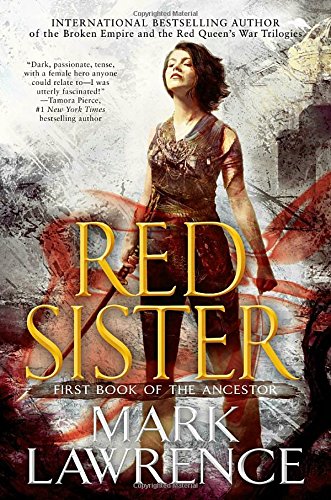
At least Nona looks like a young girl in training leathers.
At least Nona looks like a young girl in training leathers.
149-pilgrim-
>148 Narilka: I agree that it is a great improvement on the one @Sakerfalcon and I were complaining about. It seems to have some idea of the Path, for one thing.
But I would still say that (I) she is too old, (ii) that outfit does not resemble the description of either the blade-habit or the ranging coat. The blade-habit sounds more like a gambeson to me, given that it is heavily padded and bulkier than the normal habit (which, given the multiple underskirts, is not exactly slimline!)
And the only time an edged weapon would be appropriate is at the end, when she should definitely be wearing the heavy ranging-coat.
I do wish cover artists would at least read part of the book that they are illustrating.
But I would still say that (I) she is too old, (ii) that outfit does not resemble the description of either the blade-habit or the ranging coat. The blade-habit sounds more like a gambeson to me, given that it is heavily padded and bulkier than the normal habit (which, given the multiple underskirts, is not exactly slimline!)
And the only time an edged weapon would be appropriate is at the end, when she should definitely be wearing the heavy ranging-coat.
I do wish cover artists would at least read part of the book that they are illustrating.
150Narilka
>149 -pilgrim-: Not sure if it's the artist or publisher at fault really. From author blogs I've read, most authors don't have much say in their covers when they're publishing traditionally.
151-pilgrim-
>150 Narilka: Yes, I know it is not the poor author who is to blame. Mark Lawrence actually had an interesting article on his blog about how the cover for the ARCs for Red Sister were chosen.
152haydninvienna
We were talking about anachronisms. How about this: I’m reading The Second Rider by Alex Beer, translated from German. The book is set in Vienna shortly after the First World War. I found it a little disconcerting when Inspector Emmerich “aborted” a search, but now I see an inexperienced medical examiner referred to as a “newbie”!
ETA the back cover describes the book as Alex Beer’s English-language debut. What it means is that the The Second Rider is the first of her novels to be translated. If she had actually written it in English I might be more ready to forgive the anachronistic language, but not the tin-eared translation.
ETA the back cover describes the book as Alex Beer’s English-language debut. What it means is that the The Second Rider is the first of her novels to be translated. If she had actually written it in English I might be more ready to forgive the anachronistic language, but not the tin-eared translation.
153-pilgrim-
>144 Sakerfalcon:, >146 Narilka:
Continuing my comments on terrible cover art, consider this:
This is from the Barbara Hambly novel (The Magistrates of Hell) that I am currently reading. As you might guess from the title - but NOT from the cover picture! - it is set in 1912 in China.
There are precisely two European-featured vampires in the story.
One has: long, pale hair, and bleached, colourless eyes, that sometimes turn yellow, like a cat's.
The other: is a small man, with dark hair, "sleeked back into a bun on the back of his head, after the fashion of the Chinese" before the Manchu conquest, combined with the long Manchu ch'i-p'ao and ku trousers.
So, who is this tall, pouting teen with the short, bleached blond hair, dark eyebrows and eyes?
He would fit a novel about romantic, goth vampires - but there are none of those in this story.
As to what the eponymous Magistrates of Hell look like? These are the demonic lords of traditional Chinese belief.
ETA: getting Touchstones working
Continuing my comments on terrible cover art, consider this:
This is from the Barbara Hambly novel (The Magistrates of Hell) that I am currently reading. As you might guess from the title - but NOT from the cover picture! - it is set in 1912 in China.
There are precisely two European-featured vampires in the story.
One has: long, pale hair, and bleached, colourless eyes, that sometimes turn yellow, like a cat's.
The other: is a small man, with dark hair, "sleeked back into a bun on the back of his head, after the fashion of the Chinese" before the Manchu conquest, combined with the long Manchu ch'i-p'ao and ku trousers.
So, who is this tall, pouting teen with the short, bleached blond hair, dark eyebrows and eyes?
He would fit a novel about romantic, goth vampires - but there are none of those in this story.
As to what the eponymous Magistrates of Hell look like? These are the demonic lords of traditional Chinese belief.
ETA: getting Touchstones working
154Narilka
>153 -pilgrim-: Yeah, wow. I did a search and that's basically the only cover. At least he's a vampire? LOL
155-pilgrim-
>154 Narilka: As a writer who really cares about the accuracy of her historical settings, Barbara Hambly must have been quietly tearing her hair out over this one. The cover of the previous book in the series, Blood Maidens, is equally schlocky, but, by a stretch of the imagination, at least vaguely relates to the content. This was where the new publisher, Severn House, came in.
I suppose these were actually rather difficult books to get published. The first book in the series was actually published in 1988 (by Del Rey/Unwin), apparently as a stand-alone. Then, in 1995, she wrote a sequel (published by Harper Voyager, then Del Rey).
Then there was nothing, until Severn House published the third book in 2010.
Barbara Hambly tends to revisit old characters when she has new ideas about them, rather than churning out a sequence. And her settings in this sequence will certainly have needed a lot of research. But I imagine that publishers are less than comfortable with books which deal with established characters, when you may have to wait a decade for the next one!
I suppose these were actually rather difficult books to get published. The first book in the series was actually published in 1988 (by Del Rey/Unwin), apparently as a stand-alone. Then, in 1995, she wrote a sequel (published by Harper Voyager, then Del Rey).
Then there was nothing, until Severn House published the third book in 2010.
Barbara Hambly tends to revisit old characters when she has new ideas about them, rather than churning out a sequence. And her settings in this sequence will certainly have needed a lot of research. But I imagine that publishers are less than comfortable with books which deal with established characters, when you may have to wait a decade for the next one!
156-pilgrim-

Religion in The Old South by Donald G. Mathews (from the Chicago History of American Religion series) - 3 stars
I have been complaining about the lack of intellectual rigour in the American history books that I have been reading lately; this is a great improvement on my previous samples.
Unfortunately, it does not really deliver what it says on the cover. In its preface, the author announces that he is going to cover only what he considers the dominant strain of Southern religion: Evangelicalism. He then proceeds to provide a good, systematic study of Evangelicalism in the South, covering both its doctrinal developments and its social context. (This is a history of religion, rather than a book of theology.)
However, I found it a little strange that he considers it so self-evident that only this particular strand of Protestantism is relevant to the history of the American South, that it only need be mentioned within the book, given that the author of Southern Honor considered the dominant religious mode of the slaveholding elites to be Episcopalian/Catholic - and also as a statement sufficiently self-evident as to require no evidence to support it. (Both authors agree that the majority of that group were irreligious, however.) Moreover, in a book with this title, I would have expected to see at least some coverage of the variety of faiths practised by the various waves of immigrants to the New World, and whether they thrived or vanished. Did none of the religious minorities, who emigrated in search of religious freedom, make their way to the South? And given that the earliest unfree labour imported into northern America were the Irish victims of Cromwell's brutal policies, I find the complete omission of Catholicism from the discussion particularly puzzling.
However what this book covers, it covers rather well. In each chapter it covers both what attitudes were common to all Evangelicals and the specific differences between the Presbyterian, Baptist and Methodist denominations. Specific subgroups and internal controversies are also dealt with. As a history of Evangelicalism, this is admirably thorough. Its tone is to trace developments in each group's theology in the light of the social pressures on them, and to what extent Evangelical doctrines shaped Southern society.
It starts with the arrival of the first colonists in Virginia, and how Lord De La Warre instituted a theocracy based on the Church of England. It describes the roots of Evangelicalism amongst those who felt themselves excluded and despised in the rigidly stratified 17th century society.
It then looks at how Evangelical doctrines about "liberty" - referring to the liberation from sin which came with the New Birth - combined with Revolutionary ideals concerning liberty, and how religious revivals in the early period combined with fervour for the evangelisation and liberation of slaves.
It then discusses how the empowering sensation of proving one's seperateness from, and superiority to, the world, by superior morality and self-discipline, mutated into a love of good order, very different from the original revolutionary intent of reshaping the world.
Instead the urge to evangelise, and change society, took the form of seeking respectability, so as to gain the approval of the social elites, and an enthusiasm for education - earlier viewed as elitist - with the intention of becoming the moral arbiters for Southern society. This then led to abandoning those social doctrines that could never be acceptable to the ruling classes, such as abolition.
Pressure from Northern abolitionists is then blamed for forcing Southern Evangelicals to identify with the Southern system, and develop a theology that justified and defended the system of slavery, in order to maintain their influence among the slaveholding classes.
The Mission to Slaves is discussed from the points of view of both its noble and it's self-serving motivations. Revivalism is covered as a search for what had been lost from primitive Evangelicalism, and also the respect felt for the black Christians whose religious experience appeared authentically closer to that original.
The author makes the important point that to consider Southern Evangelicalism only from the perspective of the beliefs of white adherents, and to view their black members only from the perspective of the (mixed) motivations which impelled the Evangelical churches to put so much effort into the conversion of blacks, is to deny the authenticity of black religious experience. Black believers, and black preachers, were capable of taking from the Gospel a theology of liberty and hope, rather then the impulse to docile submission that the Mission to Slaves proposed to inculcate. In its ability to inculcate self-respect, with the promise of an apocalyptic end time, in which all mankind will be equal and the wrongdoers punished, it provided more comfort than traditional African religions (the author says), because they did not offer a change from one's current social status in the afterlife.
He also emphasises how the worshipping community was one of the few ways that non-slaveholding whites encountered slaves on a regular basis, and that the experience of the other race as fellow believers, and fellow recipients of God's grace, as evidenced by their experience of the New Birth, eroded the ability to view the other race as utterly alien (in both directions). Social influence is not solely the preserve of the powerful on the powerless.
His point is valid that if the Evangelical aim of converting all blacks AND whites had been successful (an impossible dream), then their goal of eliminating slavery from within, rather than by legislation, is not itself implausible - the ecclesiastical discipline that held church members to account for immoral behaviour did, in actuality, often discipline masters in response to black complaints. The problem was that it has no influence over masters who were not church members (and who constituted the majority).
However, in his enthusiasm to eulogise the important contribution that black Christians made to Southern Evangelicalism, I felt a rather patronising attitude. Whilst emphasizing that earlier historians were mistaken in their assumption that traditional African religion did not persist under the conditions of slavery, he seemed rather glib in his assertions that it could not provide psychological support for its practitioners. (I know very little about African tribal religions, but the fact that many have co-existed with Christianity for over a hundred years (and with Islam for much longer), suggests that the assumption that they offer nothing to their practitioners seems unwarranted.) Moreover he completely ignores the fact that some African arrivals were Muslims (as cited in case studies in Southern Honor), and that that religion also has an emphasis on the brotherhood (and sisterhood) of all believers, and looks forward to a vindication at an apocalyptic end time; thus it too offers the same claims to giving self-respect and endurance that he attributes to Christianity. It seems that Christianity's veneration of patient endurance of suffering (the white missionary's intended message, which the author wishes to discount), must therefore have some contribution to why Christianity prevailed over Islam. Alternatively, the answer is simply pragmatic: black preachers were able to apply to their masters for passes for travel, which have them a considerable transmission advantage over the representatives of any other faith.
I was also shocked at some of the basic theological errors made (such as some snide remarks made by the author, which assumed that Ham's offence of "uncovering his father's nakedness" refers to nothing more than viewing nudity) - if you are going to mock a religious teaching that you oppose (in this case, the use of Ham's sin as justification for slavery), I feel that you are nevertheless obliged to represent the offensive concept accurately.
The author managed an admirable neutrality in describing the conflict between the different Evangelical denominations, although I felt that he had more innate sympathy with the Methodists. However I had the impression that he was starting from an assumption that it was the Evangelical contribution to the South's history that was uniquely important, on the basis that it is the dominant mode there now. The final chapters, on black religion, were more exhortative than the others, and more inclined to make statements without providing evidence. Without them, I would probably have rated this book higher.
157-pilgrim-

Roverandom by J. R. R. Tolkien (edited by Christina Scull and Wayne G. Hammond)
This is a charming children's story. It is not always consistent, showing signs of its origins, which were in a story told by Tolkien to his children, built around a toy found by his son Michael.
What I found interesting was how many of the images from his Middle Earth writings, such as the Cottage of Lost Play, were already in his imagination here, long before he started to write for an audience other than his family.
The setting is England, but not quite as we know it, because there is a waterfall at the edge of the world, which seems to be a disc.
This is one time when I was really glad to be reading this on a Kindle. The editors have written a long, scholarly introduction, which not only tries to ascertain exactly when which draft of the story was composed, and provide the context for its composition, but also dissect the writing in excruciating detail. However, the line by line text text links are really well constructed, immediately linking to footnotes that elaborate on that line and link it to others, and then to more general discussion in the introduction, so that by using these, it is possible to simply read the story, and get the explanatory details only after you have reached the relevant point.
The editors' linking of parts of this story with themes elsewhere in Tolkien's writing is exhaustive and fascinating.
However I had to laugh at some of their attempts to explain Tolkien's phraseology. It is obvious that they have no comprehension of English euphemistic swearing of Tolkien's era - I mean the sort of exclamations considered acceptable in front of children. So, for example, they explain "jam and pot" as references to archaic terminology for hanging plus a reference to hunting "for the pot". Now I remember relatives metaphorically biting their tongues and exclaiming "Pot it!" in front of me, when I was little, in default of something worse. And "jam" was simply a circumlocution for "damn" (just as "butter" replaced "bugger" and "muddy" replaced "bloody"). I know Tolkien was an erudite man, but I doubt he was thinking beyond using the conventional "in front of children" phrases of his day. Since the relatives that I mentioned were Tolkien's contemporaries, I think their example provides a better guide to Tolkien's word choices than these far-fetched explanations. Other explanations of British customs show these editors to be writing for an American audience; but Christina Scull is British, so I am surprised that she could not find anyone who could explain this speech pattern.
158-pilgrim-
Note: this thread will continue awhile, since I failed miserably in my resolution to complete my reviews of books read in 2019 whilst still in 2029!
159-pilgrim-

The Doomed City by Arkady Strugatsky and Boris Strugatsky (translated by Andrew Bromfield - 5 stars
How to describe this? I was enthusing whilst I was still only a third of the way through; it has taken me so long to finish because, like most great Russian novels, it requires that you have your wits fully about you. I have been too ill for much of December to focus sufficiently. But it was worth the wait.
Like in Doctor Zhivago, there are many characters who recur under changed circumstances - and it is essential to fully understanding this novel to recognise them, and remember what they did the last time that we met.
The other crucial issue is that, although the authors realised from the outset that this book would probably never be publishable in their lifetime, they were still trying to make sure that it contained "nothing that they could put you away for". Like The Master and Margarita, it relies heavily on a theory of plausible deniability. It is obvious who the Great Strategist is - both from the description of his physical appearance and his actions - but of course he is never named. Given the physical description, and what happens to him, I also recognise the general. But I doubt that I recognised everyone in that room that the authors intended I should.
Sometimes names are just a character name - but sometimes they are references to historical figures. And, given that characters were born in a wide range of historical periods, the names that they reference can be drawn from a wide area. When a historical figure appears, the actions that they performed before arriving at the City (i.e. in our history) will be referenced obliquely, if at all, but they should be taken into account, along with their characters as shown as when citizens of the City.
The inhabitants of the City are volunteers drawn from all Earth nations and times, who are taking part in the Experiment. The parameters of the Experiment are never explained to the reader, nor to its participants. Every inhabitant has a Mentor, who is interested in discussing their opinions with them. But they do not answer questions, as that would interfere with the Experiment.
In the City, inhabitants are assigned jobs, which change every six months. They can be literally anything, and no attention appears to be paid to interests, aptitude or relevant previous experience. Why? Who knows - the Experiment is the Experiment. Failure to accept the new assignment, like other infringements in the laws, is punishable by a period of corrective labour in the swamps.
Although the inhabitants of the City are cosmopolitan, the resemblances to the Soviet system are obvious, particularly in terms of how law enforcement functions, and the system of employment by assigned tasks. Although the citizens are supposed to be building utopian society, things are not working as they are supposed to be. (But is this all part of the Experiment too?)
The protagonist, Andrei Voronin, is an astronomer from 1950s Moscow. A former Komsomol member, he is as ideologically committed to his new home as he was previously to Soviet Communism. We follow him through a sequence of jobs (and some rather strange occurrences) and watch how his relationships with other inhabitants develop.
One of these, and someone Andrei had known from Moscow, is the Jew, Izya Katzman. Izya is physically extremely unprepossessing, with personal tics that irritate Andrei intensely, so that he never thinks about Izya without those things being uppermost in his mind. Nevertheless, he considers Izya to be a good friend.
The portrayal of Izya could be considered anti-Semitic, but that ignores the fact that the character is not the author, nor is the protagonist necessarily the hero of a novel. The Strugatsky brothers had a Jewish father, who died as a consequence of the siege of Leningrad. As such any suggestion that they themselves were anti-Semitic is laughable, but they would be familiar with the slurs casually current in Soviet society in the fifties - and Andrei's attitudes are on a par with these. As Boris comments in the Afterward, one of the most subversive aspects of this novel is that it has a Jewish hero - for it is Izya, not Andrei, who works out, correctly, at every turn, what is going on. (He is wise enough to see such things, but not enough to avoid suffering as a consequence.) He is, mannerisms apart, one of the nicest characters in the book.
Sadly the women in the story do not come out so well, although in his behaviour there, and thoughts about them, Andrei is again typical of a man of his background and era. Certainly the underappreciated Amalia is competent, heroic - and taken advantage of or ignored.
This book is subtle, and many-layered. Its criticism of the Soviet system is obvious - making Michael Andre-Driussi's claim that they were Soviet propagandists ridiculous. However, contrary to much American thinking, both past and present (as epitomised by Mr. Andre-Driussi), to be opposed to Soviet Communism does not necessarily entail embracing American capitalism. The Strugatsky's critique of 1960s America is equally condemnatory.
In reality, they appear hostile to any ideology that calls upon its citizens to suffer and endure in the name of a promised future - whether the American Dream or the Bright Future - whilst all the rewards of their efforts go to a self-selected and self-perpetualting elite. This is a novel in praise of "the little guy".
Beyond the politics, the problems that the novel addresses are the deepest and most fundamental that humanity can: what constitutes moral behaviour, and want is the meaning and ultimate purpose of existence?
The denouement is intriguing, to say the least. Optimistic? Hardly - this is Russian literature after all! But it is not totally bleak.
160pgmcc
>159 -pilgrim-: I nearly bought this in the book sale in Books Upstairs yesterday. It was there with Roadside Picnic and a third book by the brothers that I cannot remember the title of.
I think your post has guaranteed a call back to the basement in Books Upstairs on Monday. You have been hitting me quite frequently with your Book Bullets. Did you train as a sniper?
I think your post has guaranteed a call back to the basement in Books Upstairs on Monday. You have been hitting me quite frequently with your Book Bullets. Did you train as a sniper?
161-pilgrim-
>160 pgmcc: Glad to see that my aim is still proving true. I hope you enjoy it as much as I did. I suspect that the third book was Monday Starts on Saturday - a copy of which has just hit my letterbox.
162-pilgrim-

Mafia Life: Love, Death and Money at the Heart of Organised Crime by Federico Varese - 5 stars
Books about organised crime are not uncommon, but this one is rather different. Usually you either get the detailed activities of a particular crime family, which can tend towards hagiography,, or a discussion of organised crime in terms of its socioeconomic impact, and political implications.
The author here, Federico Varese, is a respected Oxford academic, and Professor of Criminology, who has written before about the international impact of organised crime, in Mafias on the Move: How Organized Crime Conquers New Territories. He was also in Russia in the nineties, documenting the rise of the Russian Mafia (in The Russian Mafia: Private Protection in a New Market Economy). In the course of his research he has met and interviewed many mafiosi, and this book is the result of these conversations, combined with further information obtained via such methods as transcripts of wire-taps, or witness testimony, that have appeared in court proceedings.
Farese makes a clear distinction between a gangster and a mafioso, based not on the level of fear engendered or the degree of criminality involved, but on the ritualised structure of the organisation joined, and its subsequent claim to be the primary "family" unit in a member's life, superseding all bonds of blood, including to succeed and children.
He writes in detail about the Mafia of Sicily and their analogues in Naples (and a little about their derivatives in America). He also covers in detail the codes of the modern Russian Mafia (with some comparison to the Soviet era vory v zakone), both in The Russian Federation and in other countries of the former USSR. There are also detailed discussions of Yakuza (distinguished by being legal organisations) and the Triads (but mainly in their manifestations in London and Hong Kong). Each chapter visits in turn all of these groups.
This is a scholarly book, in that all statements are referenced to specific testimony, with notes attached to further sources that corroborate the information. As is obvious, given the sources and nature of some of the information, some names are false, in order to disguise identities; but where this has been done is clearly indicated - false names are always written in italics.
However it is also extremely readable. The author does not intruder his own identity too often into the account, but does make it clear which figures he has personally met, and the circumstances under which they entertained him. At times he does sound a little awestruck, but I suppose that is only natural when in the presence of extremely powerful individuals of undoubted charisma.
Certainly the book never slips over into being a recruiting manifesto, or justification of this way of life. It is exactly what it claims to be: an account of what it is like to live within this world.
The opening chapter is entitled "Birth" and deals with how new mafiosi are recruited, how they are tested, and the induction ceremony, which in all cases has quasi-religious overtones, resembling a baptism into a new life. (The "coronation" ceremony for a new vor requires an Orthodox Bible, for example.) Attention is given to both the origin myths (as passed to new members) and the actual origins of each organisation.
A chapter on "Work" deals with the hierarchies within each organisation, their methods of governance, and the tasks that members may be called upon to perform. The author indicates which rules are actually binding, and which ostensible strictures (such as those involving drugs or prostitution) are breached in practice.
A chapter on "Marriage" deals on the conflicts that arise between loyalty to the organisation and personal ties, and the various outcomes of such conflicts. It also demonstrates how vengeance on relatives is used to punish erring members. In discussing women, it shows how, although all these organisations forbid any female membership, external pressures have sometimes led to women, without actually being members, assuming de facto leadership roles with significant levels of actual power, ostensibly standing in for absent males. Specific examples in both the Italian Mafia and the Yakuza are given.
The final chapter, "Death", debunks the myth promulgated by Hollywood that a mafioso has to kill in order to be "made" - and there is a very interesting section on how the Italian Mafia, Hong Kong Triads and the Yakuza have all tried to manipulate their image through direct involvement in the film industry, whilst American Mafiosi have consciously modelled their behaviour in imitation of their favourite Hollywood films! - whilst making it clear that any member is supposed to kill, when ordered to do so. The rate of inter-factional warfare, and the likelihood of expiring of natural causes, outside of prison, is also discussed - providing a sober corrective to any apparent glamourisation of this career path.
The book ends with an interesting discussion of a mafia as a "state within a state", with its own economy, governmental structures, and diplomatic relations with external bodies. The situation in Somalia is the example analysed in detail here, although the author suggests that a similar situation may pertain to parts of Mexico.
There are a lot of books around about the globalised nature of organised crime; this is a fascinating study about how such organisations function in practice. It is not uniformly gloomy in tone. Whilst not minimising the effectiveness of these quasi-states, it also documents where and how law enforcement organisations have successfully put them under pressure. However his conclusion is that any democracy will be of limited effectiveness in controlling these organisations (in contrast to totalitarian regimes), but that the price is the alternative is too high.
163-pilgrim-

The Magistrates of Hell (Book 4 of the James Asher sequence) by Barbara Hambly - 3 stars
In this fourth book in the series, it is now 1912, and James and Lydia Asher have traveled to China with their infant daughter (plus a nurse for her, and their servant, Ellen), to investigate a report by a missionary in a medical journal, which sounds uncomfortably reminiscent of a phenomenon that James previously encountered in Prague. The trip is not without risk for James, who had worked there before - and not in his guise as a researcher of folklore.
To protect himself from possible repercussions, should anyone in the German delegation in Peking recognise him, he contacts his former student, who became a translator for the British delegation, to request that the latter vouch for him, and affirm that he is indeed an Oxford academic (which is true), who has been in Oxford for the past twenty years (which is most definitely not). Thus, when a young girl from the British delegation is murdered with her fiancé's tie, and this young man is the only son of that translator, James find himself with a second mystery to solve.
And he finds himself not alone in travelling to China to investigate the missionary's report - the vampire Don Ysidro has also read the same journal, and recognised the description of being an Other.
With the Ashers has traveled the elderly Czech Hasid, Rebbe Karlebach, James' former mentor, who travelled to Oxford to personally insist on this expedition. His fanatical hatred of all vampires renders more critical the dilemma that surrounds James and Isabel's relationship with Don Ysidro.
On the one hand, he could be considered a personal friend, who had saved both their lives, at considerable cost to himself, yet he is also a mass murderer, who will continue to kill. James, who has also committed murder for Queen and country, and does not count his own hands clean, is acutely aware that in this too, he is morally compromised. (Don Ysidro himself would find such scruples amusing. He knows perfectly well what he is - do not expect tortured angst from him. He is, however, honourable - in his own way. He has seem too many of his kind lose all interest in whatever motivated them in life. He holds to his honour as being what keeps him in touch with his former, human, self - and his sanity.)
The setting in Nationalist China is beautifully realised. The space between installments in this series is, I suspect, caused by the author's meticulous research into her settings. Within the enclosed world of the Diplomatic Quarter, the stifling social limitations imposed on those European women who have accompanied their husbands is vividly portrayed, whilst outside, the Chinese women either hobble on the bound feet required in order to be considered beautiful and make a socially advantageous marriage, or risk being sold into brothels by their impoverished families.
The attitudes of the times, both Oriental and Western, are accurately portrayed, without anachronistic modern comment. The bespectacled, sword-wielding Japanese diplomat, Count, from an old samurai family, is one of the strongest characters in the book. (There is also some amusement in how the American soldiers at trained in Peking appear to the other diplomats.)
The authenticity of the language used, as well of the setting, is one of the delights of this series to me. One "lies doggo", "goes to ground", and so on (although Ms. Hambly does slip up, and let an American "gotten" appear - a verb form unknown to a Briton of that period). For that reason Wade-Giles, rather than the modern official transcription system, is used throughout for Chinese.
However, I nevertheless found this the weakest book in the series. The Chinese vampires remain a mysterious, threatening presence for most of the book. When they do take action, they prove themselves extremely competent. Those who thought themselves to be acting of their own volition have been manoeuvred skillfully at every turn, by beings ancient and cunning. But although traditional Chinese beliefs play a large part in how they are regarded by the locals, the chiang-shih are disappointingly similar to European vampires in how they function. I had expected them to have more connection to traditional Chinese conceptions of vampires.
The sense of menace, and growing tension, peril and excitement were well handled as usual. But the historical aspects were better than the fantasy, I felt.
I also felt that the main moral dilemma, and plot resolution, was based on several logical fallacies. MAJOR PLOT SPOILER:
1. Don Ysidro may be immortal, but the supply of chlorine gas is finite. It corrodes because it reacts with the water in the human body to create hydrochloric acid. Eventually all the gas will be converted to acid, and all the acid react with tissue and form salts. The vampire's agony may be horrific and prolonged, but it should be finite - after which he will, eventually, regenerate.
His main problem in being sealed in will be starvation. He will have no food that has not been killed by the gas.
2. It is debated repeatedly as to whether the Others can be killed - since severed limbs continue to be propelled by the "hive mind", for example. I do not remember this ever being resolved. So what is the good of exposing them to the gas? I presume they will be too corroded to function, since they have no regenerative capability. That IS horrific.
3. Assuming that Don Ysidro accepts the reasoning that he will be trapped and burning eternally (as the characters seem to believe), why does he wait? He is trapped because he is heavily outnumbered by the Others, and so, if he leaves a certain safe space, he will be eaten. I know that vampires have an extremely strong self-preservation instinct, but, faced with being eternally corroded by acid, why does he not come out of his hiding-place and take his chances with fighting his way through the Others?
A further thought: James and Ysidro are both gentlemen, and are conducting themselves as such, impeccably. But the situation between Ysidro and Lydia cannot continue like this indefinitely.
Note (as posted >153 -pilgrim-:): "The Magistrates of Hell" are the demonic deities that govern the 10 hells of the Chinese afterlife. The cover illustration had nothing to do with anything within the book!
164-pilgrim-
>87 -pilgrim-:
When I read Everything I Don't Remember, I commented that what struck me was how the immigrant characters had no ethnically Nordic Swedes in their social circle.
In browsing Tommy Bengtsson's research work, following his interest in how mortality rates are affected by socioeconomic background, I found this study:
https://www.government.se/49b73c/contentassets/6e57e1d818bb4b289ac512bb7d307fa5/...
So, it appears that Jonas Hassein Khemiri was depicting a genuine facet of Swedish life.
When I read Everything I Don't Remember, I commented that what struck me was how the immigrant characters had no ethnically Nordic Swedes in their social circle.
In browsing Tommy Bengtsson's research work, following his interest in how mortality rates are affected by socioeconomic background, I found this study:
https://www.government.se/49b73c/contentassets/6e57e1d818bb4b289ac512bb7d307fa5/...
In 1998, more than every fifth foreign-born person lived in areas with less than 70 per cent of the population born in Sweden (Socialstyrelsen, 2001). In the Stockholm region, for example, 40 per cent of those born in Ethiopia, Somalia, Lebanon, Syria, Turkey, Iraq, or Iran lived in areas characterized not by a dominance of a single ethnic group but the absence of persons born in Sweden or other Nordic countries.
So, it appears that Jonas Hassein Khemiri was depicting a genuine facet of Swedish life.
This topic was continued by Pilgrim continues to search as 2020 begins.

