The Great Illustrated Private Press Books (TGIPPB) - Book #9
Talk Fine Press Forum
Join LibraryThing to post.
This topic is currently marked as "dormant"—the last message is more than 90 days old. You can revive it by posting a reply.
1dlphcoracl
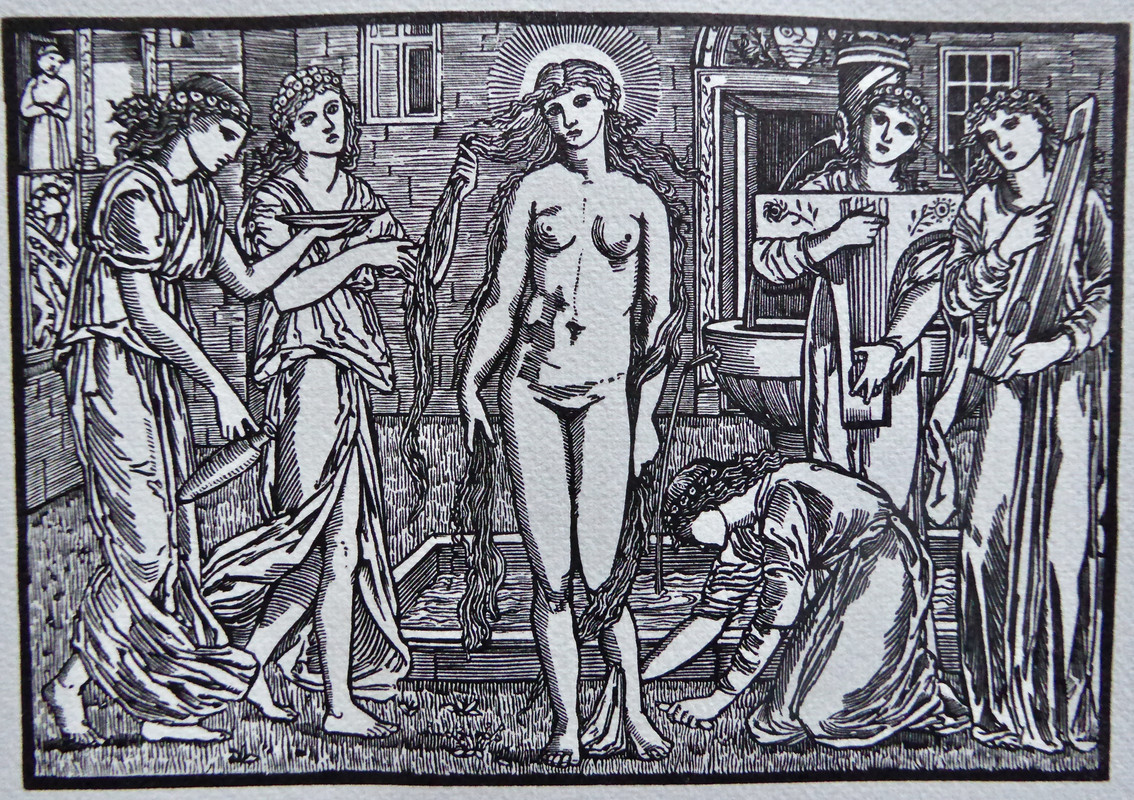
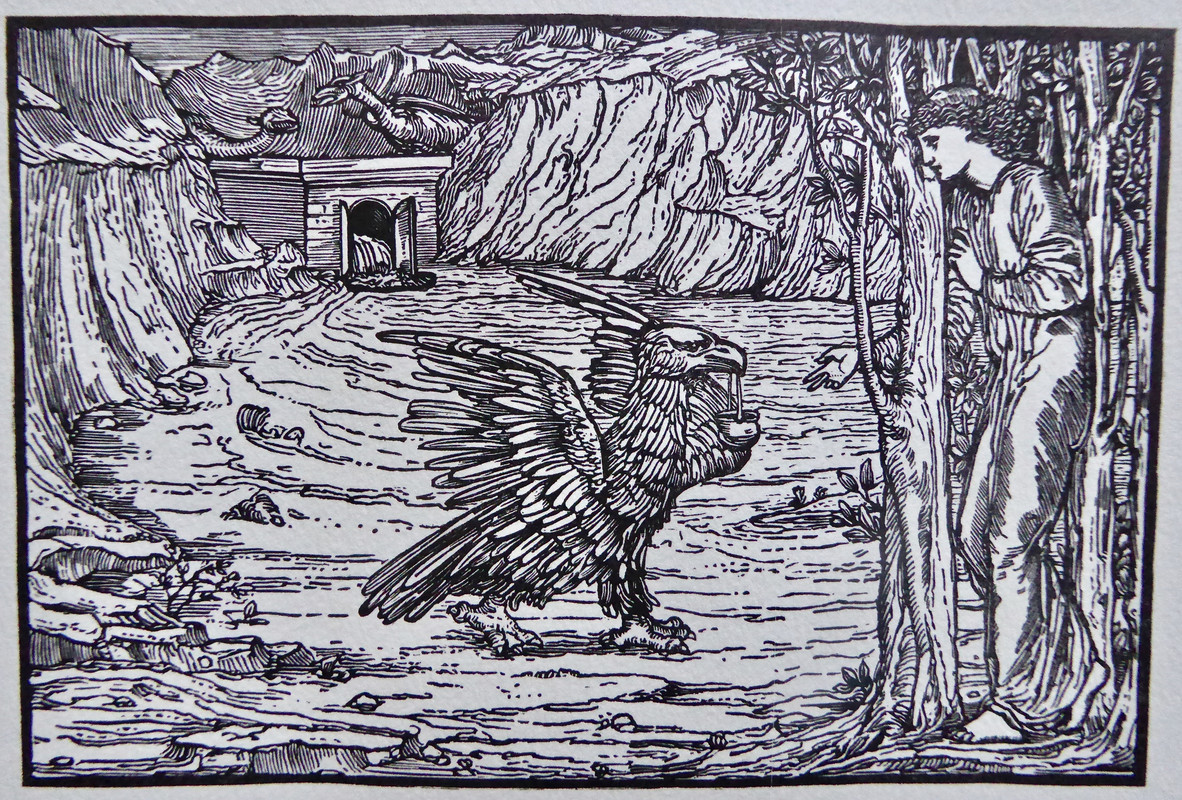
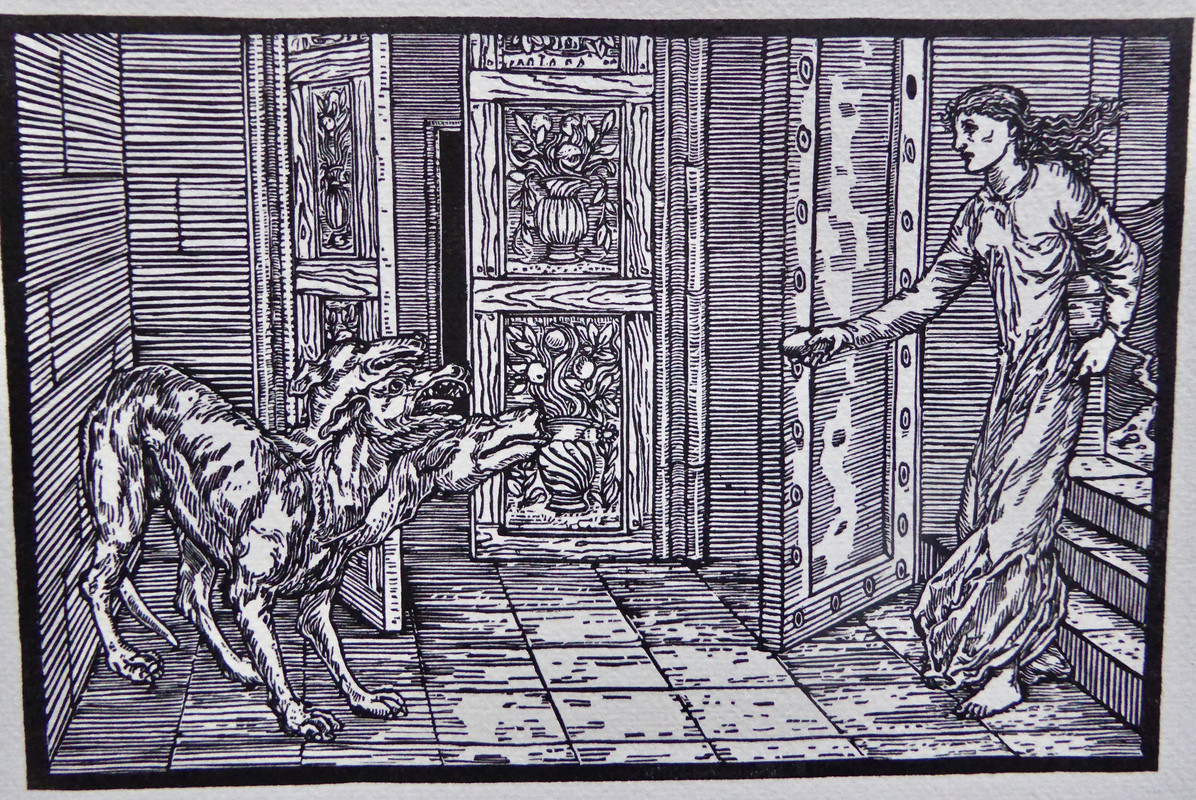
Nearly one year ago (April 2019) I posted an article for the Fine Press Forum entitled: "No More Mr. Nice Guy" in which I challenged the LT Fine Press Forum devotees to guess the identity of eight great illustrated private press books. To my chagrin, this provided little challenge to this stellar forum and nearly all were identified within 24 hours. At a much less frenetic pace, I am going to sporadically resume this series of 'The Great Illustrated Private Press Books' to retest your mettle and modern private press book chops.
Each week, more or less, I will post a series of illustrations from a book in my collection with illustrations I find unusually appropriate and/or pleasing. Some of my choices are classics representing high points in the modern private press movement. Others will be a bit off of the beaten path, lesser known gems worth exploring and acquiring. At the end of the week I will identify the book, if not already been done, and post additional photographs with brief discussion.
Here goes - TGIPPB #9
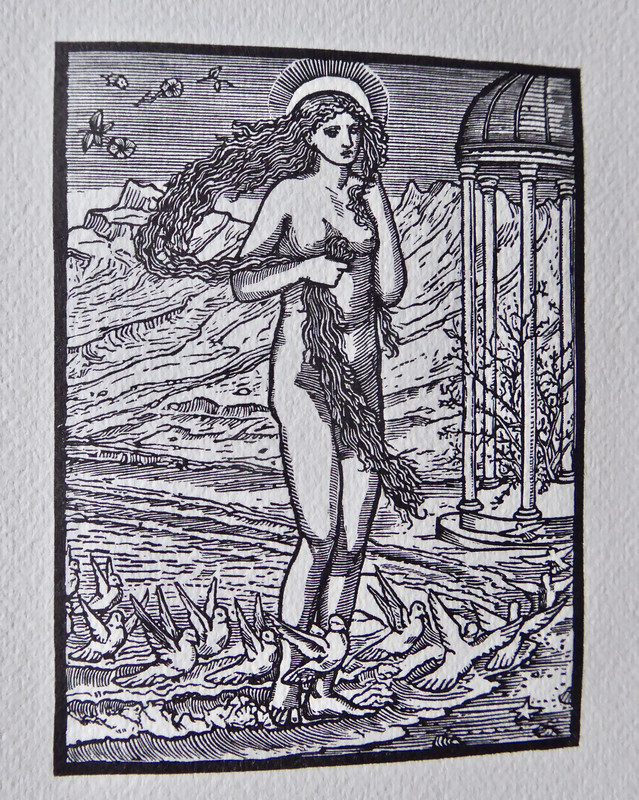
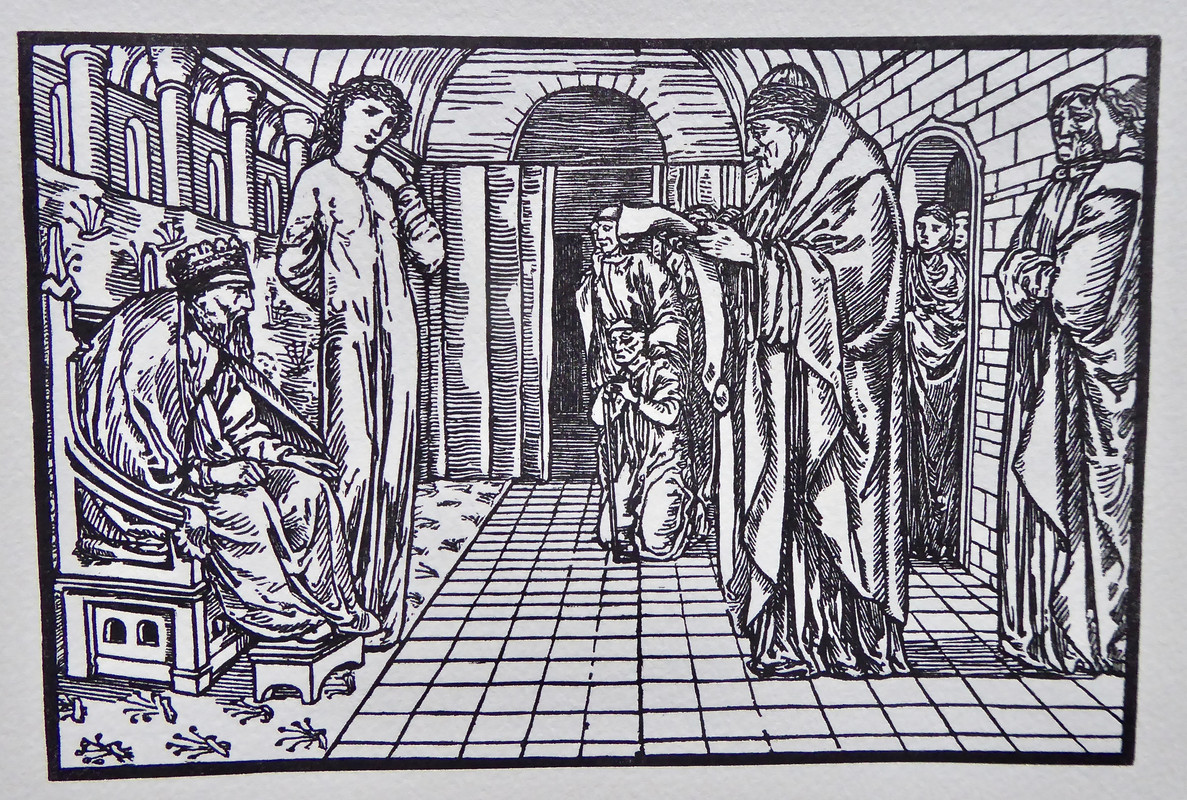
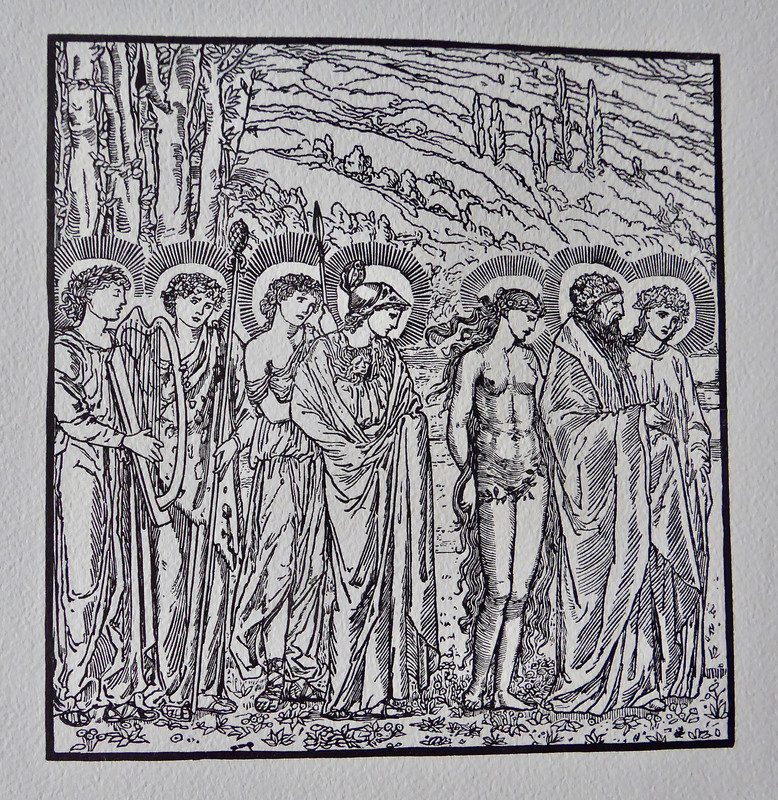
Each week, more or less, I will post a series of illustrations from a book in my collection with illustrations I find unusually appropriate and/or pleasing. Some of my choices are classics representing high points in the modern private press movement. Others will be a bit off of the beaten path, lesser known gems worth exploring and acquiring. At the end of the week I will identify the book, if not already been done, and post additional photographs with brief discussion.
Here goes - TGIPPB #9
2SebRinelli
>1 dlphcoracl: Beautiful! I don't know the book but picture 3 shows Apollon for sure and I suppose that #1 and #2 are showing Venus or Psyche. Illustrations are also quite classic so I would guess it's an early private press book.
Title = Cupid and Psyche?
Thanks for continuing the series.
Title = Cupid and Psyche?
Thanks for continuing the series.
3kronnevik
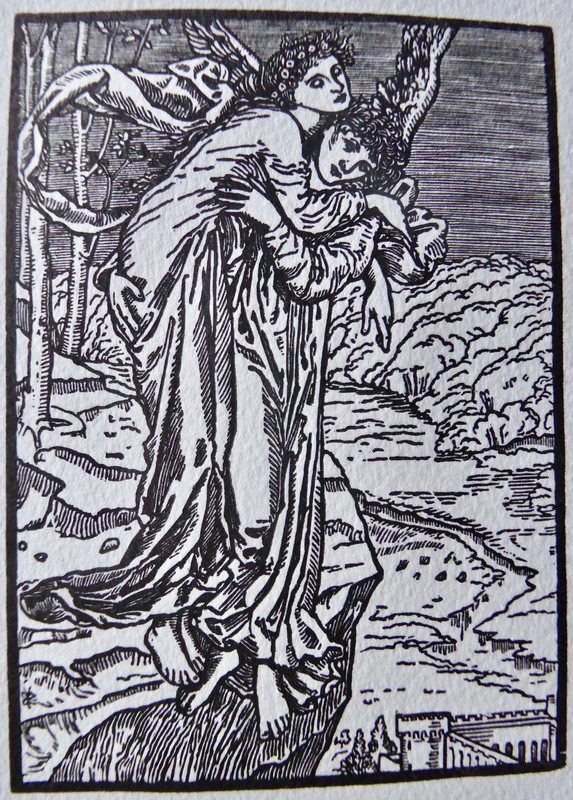
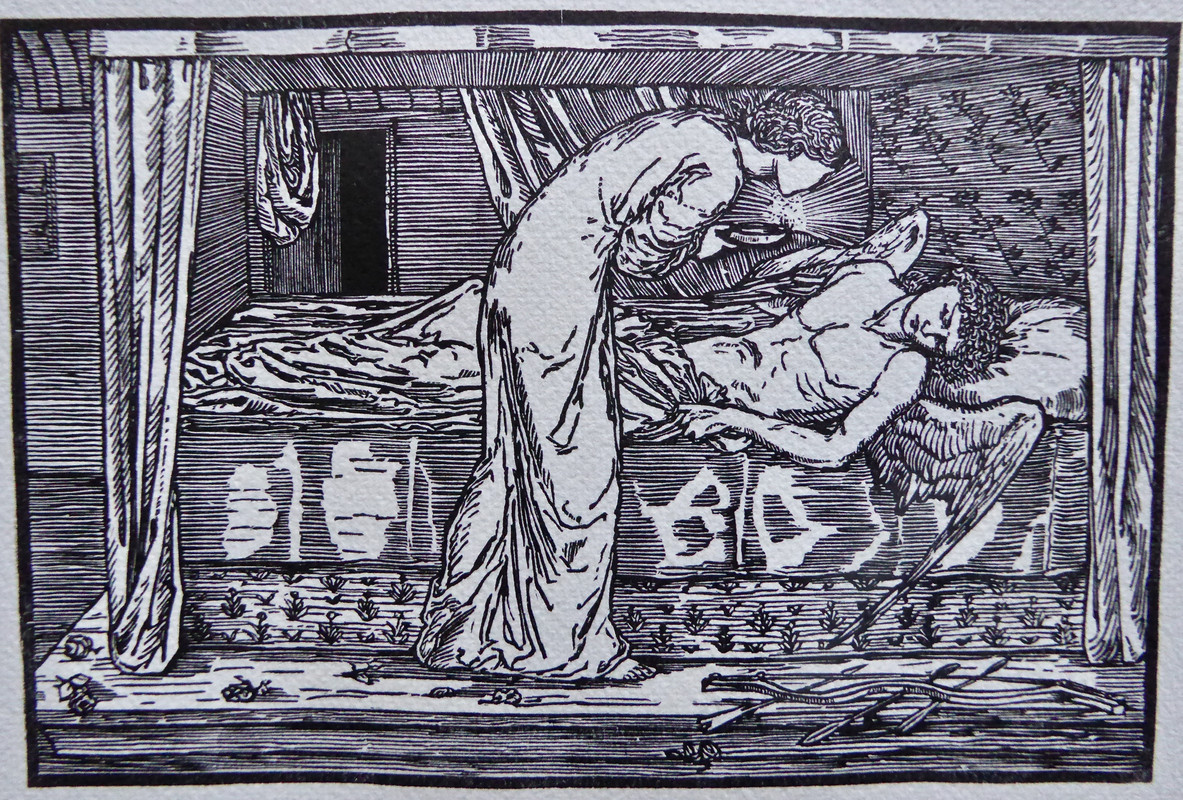
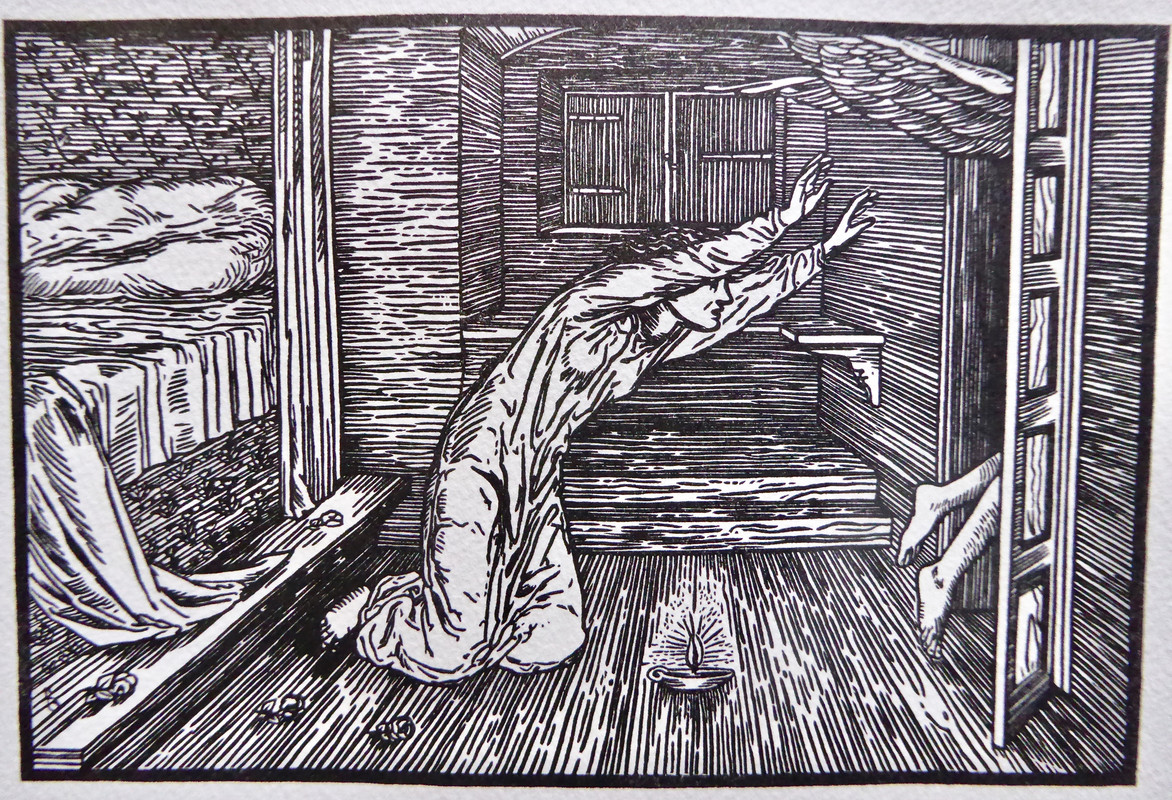
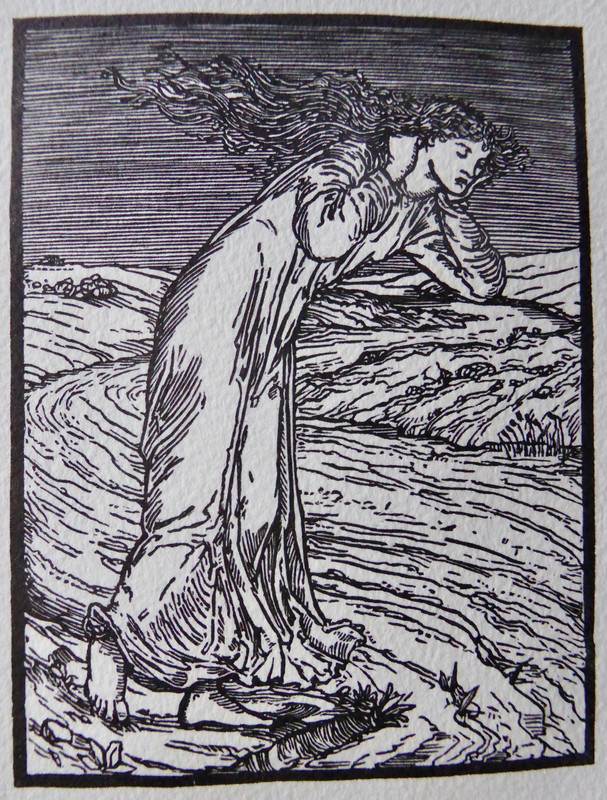
The Story of Cupid and Psyche, 1974, Clover Hill Editions & Rampant Lions Press, Illustrations designed by Edward Bure-Jones, mostly engraved by William Morris
Thanks for posting!
Thanks for posting!
4dlphcoracl
>3 kronnevik: is indeed correct.
The Rampant Lions Press (RLP) was one of the greatest and long-lived of the great private presses in the United Kingdom during the twentieth century, rivaled only by the Golden Cockerel Press in this regard. Founded by Will Carter in 1924 while still a schoolboy and continued by his son, Sebastian Carter in 1966, the RLP operated continuously from 1924 until 2008. The press was renowned for the quality of their handset letterpress printing and Sebastian Carter has a special gift for book and page design, making the RLP books printed under his direction especially pleasing to hold and read. In the opinion of many (myself included) this is their Magnum Opus, an edition of extraordinary quality and historical significance in the realm of The Arts of the Book.
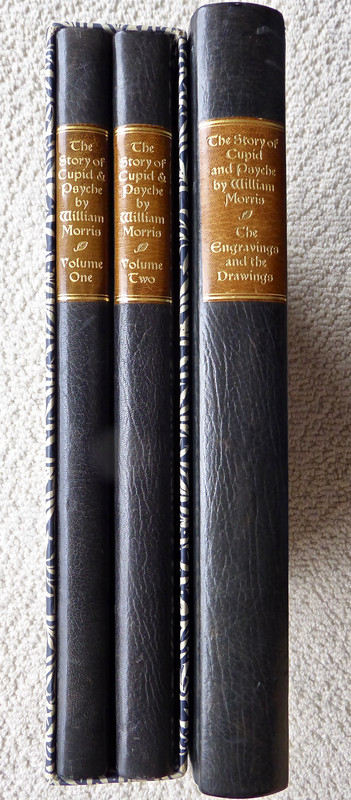
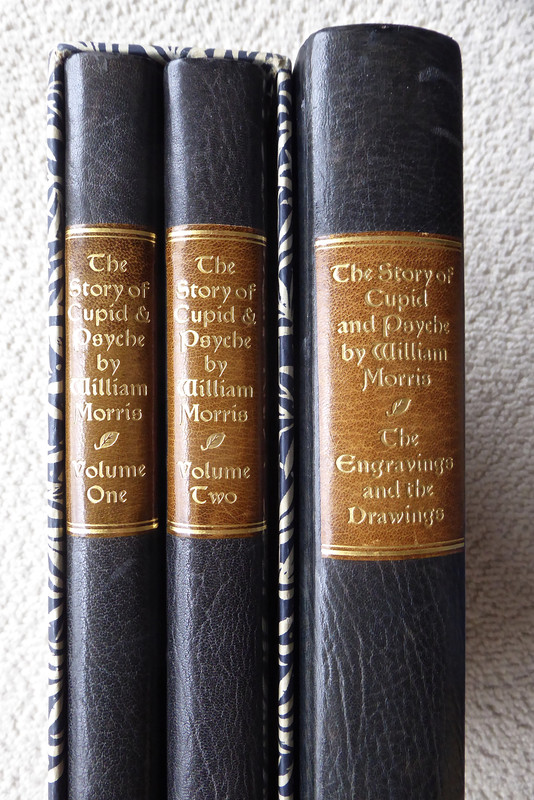
First, a brief word regarding the edition itself because the limitation and numerous formats are quite confusing. This is a two-volume set with the first volume serving as an introductory volume written by A.R. Dufty describing the history of this edition of Cupid and Psyche, the initial plans, sketches, and wood engravings by William Morris and Edward Burne-Jones which began in 1864 (well before Morris founded his Kelmscott Press in 1890) and the second volume is the long poem itself with the complete set of wood engravings. Finally, a clamshell box portfolio with a set of proofs of the 44 wood-engravings was created. The editions are as follows:
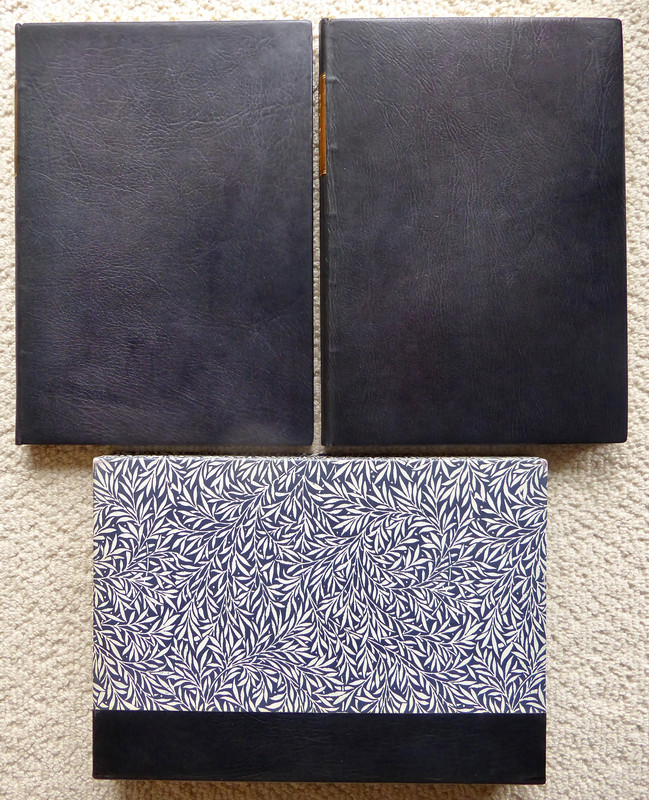
130 copies: 2-volume set (slipcased) bound in full dark blue morocco, with a clamshell-box portfolio with matching 1/4 blue morocco spine containing a set of collotype prints of the 47 original William Morris drawings and a set of proofs of the 44 wood engravings. Numbered I-CXXX.
270 copies: 2-volume set (slipcased) bound in quarter cloth and Morris-patterned paper over boards. Numbered 1-270.
100 clamshell box portfolios containing a set of proofs of the 44 wood-engravings.
To complicate matters, fine booksellers will occasionally offer the standard set with quarter-cloth and patterned paper bindings AND the separate box of portfolios with the 44 wood engravings.
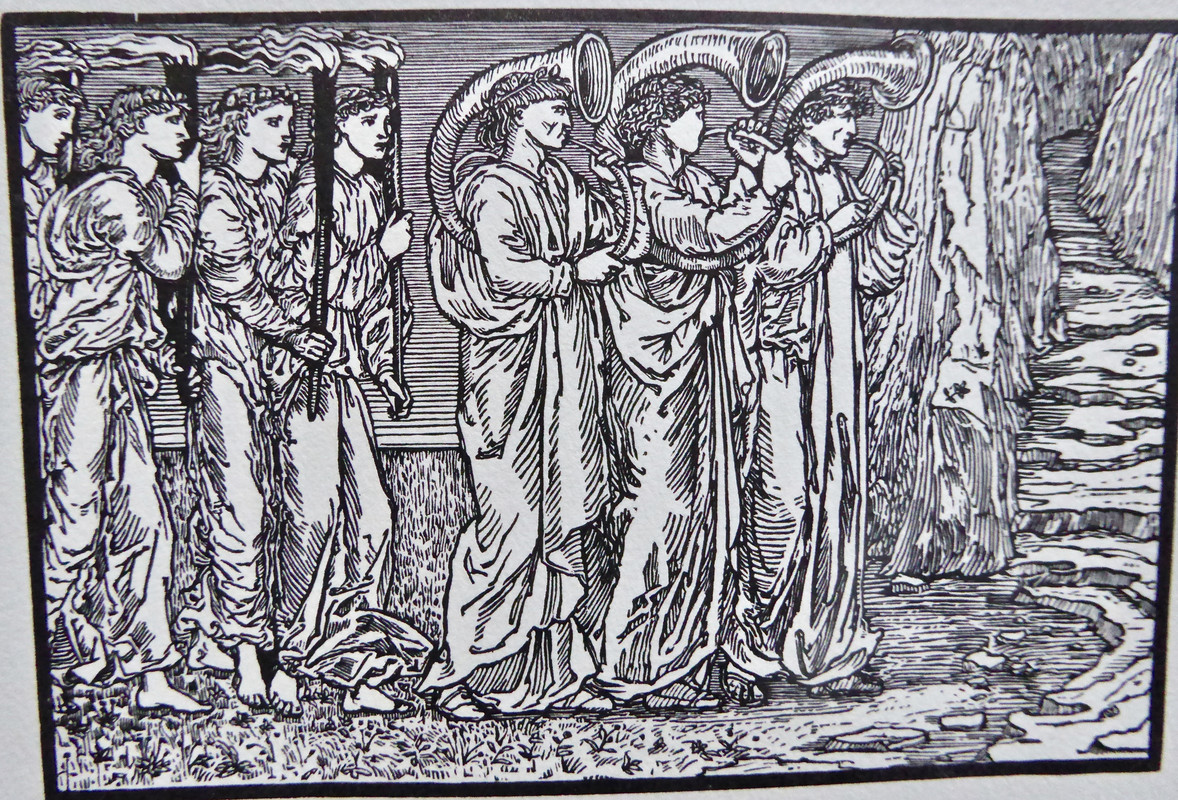
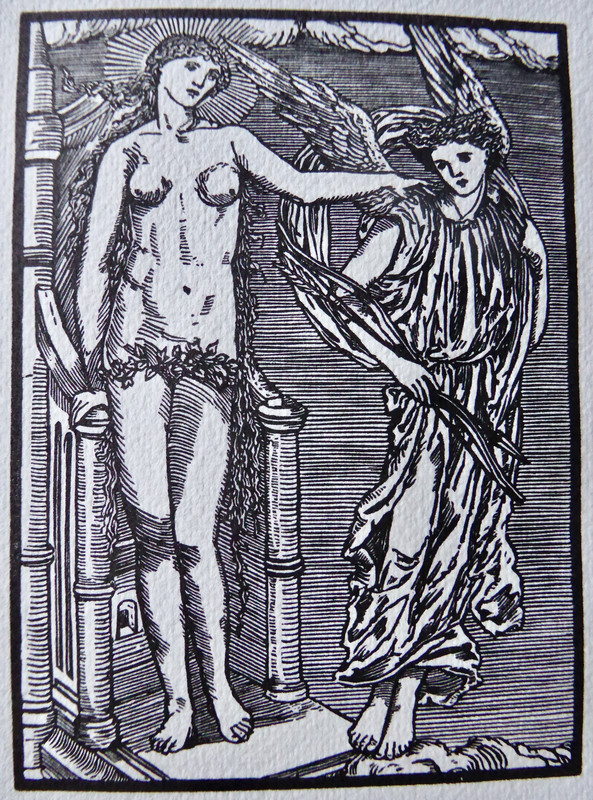
The history of this publication and how it came to fruition is little short of remarkable. As noted above, this initially began as a collaboration between Burne-Jones and William Morris in their younger days roughly a decade after they met and graduated from the University of Oxford. Burne-Jones created a number of finished designs - six were engraved in wood by members of the Morris circle and thirty-eight were engraved by Morris himself. These are the only wood-engravings Morris is known to have worked on. However, Morris could a type-face harmonious with his wood-engravings and the project was abandoned.
After Morris' death in 1896, Sydney Cockerell (then the secretary of the Kelmscott Press) and Burne-Jones conceived the idea of using the Kelmscott Troy type to accompany the engravings and in January 1897 several trial pages were printed. Before the Cupid and Psyche project began, Burne-Jones himself died, and nothing further was done.
After Jane Morris's death in 1914, the wood blocks became the property of her younger daughter May. However, the wood blocks with Morris's engravings were retained by Sydney Cockerel. When the London blitz began in autumn of 1940, the blocks were taken to Burlington House and safely stowed in the basement. They remained there until 1967 when they were inadvertently discovered when the cataloguing of the Kelmscott library was under consideration and their importance was immediately realized. The partners in Clover Hill Editions, Will Carter and Douglas Cleverdon, were present on this occasion and they discussed printing these engravings in a deluxe edition. The Society of Antiquaries of London generously gave permission for them to borrow the wood blocks for this enterprise.
In a fortunate coincidence, A.R. Dufty, formerly the Honorary Secretary of the Societ of Antiquaries, was engaged in writing a monograph concerning Burne-Jones's original illustrations for The Story of Cupid and Psyche. He was persuaded to allow this monograph to be printed in a separate introductory volume for the Clover Hill Edition, the result of several years of original research by Dufty into all aspects of the initial collaboration between Burne-Jones and Morris.
Finally, to bring the new Clover Hill Edition/Rampant Lions Press forth in an edition as William Morris would have intended, the matrices of the Kelmscott Press types were obtained from Cambridge University Press, where they had been deposited in the 1920's. Mr. Brooke Crutchley, the Printer to the University, consented to making them available for casting and Mr. Vivian Ridler, the Printer to the University of Oxford readily agreed to cast a sufficient quantity of type at the University of Oxford foundry. Thus, William Morris's brilliant wood-engraving finally saw light of day nearly a century after he had carved them. This book is justifiably included in the Grolier Club edition 'A Century for the Century - Fine Printed Books 1900-1999' written by Martin Hutner and Jerry Kelly.
Acknowledgement: Most of this material is taken and abridged from the Prospectus for the Clover Hill/Rampant Lions Press edition.
Photos of the deluxe edition with separate clamshell box portfolio and additional wood-engraved illustrations for this remarkable edition will follow.
The Rampant Lions Press (RLP) was one of the greatest and long-lived of the great private presses in the United Kingdom during the twentieth century, rivaled only by the Golden Cockerel Press in this regard. Founded by Will Carter in 1924 while still a schoolboy and continued by his son, Sebastian Carter in 1966, the RLP operated continuously from 1924 until 2008. The press was renowned for the quality of their handset letterpress printing and Sebastian Carter has a special gift for book and page design, making the RLP books printed under his direction especially pleasing to hold and read. In the opinion of many (myself included) this is their Magnum Opus, an edition of extraordinary quality and historical significance in the realm of The Arts of the Book.
First, a brief word regarding the edition itself because the limitation and numerous formats are quite confusing. This is a two-volume set with the first volume serving as an introductory volume written by A.R. Dufty describing the history of this edition of Cupid and Psyche, the initial plans, sketches, and wood engravings by William Morris and Edward Burne-Jones which began in 1864 (well before Morris founded his Kelmscott Press in 1890) and the second volume is the long poem itself with the complete set of wood engravings. Finally, a clamshell box portfolio with a set of proofs of the 44 wood-engravings was created. The editions are as follows:
130 copies: 2-volume set (slipcased) bound in full dark blue morocco, with a clamshell-box portfolio with matching 1/4 blue morocco spine containing a set of collotype prints of the 47 original William Morris drawings and a set of proofs of the 44 wood engravings. Numbered I-CXXX.
270 copies: 2-volume set (slipcased) bound in quarter cloth and Morris-patterned paper over boards. Numbered 1-270.
100 clamshell box portfolios containing a set of proofs of the 44 wood-engravings.
To complicate matters, fine booksellers will occasionally offer the standard set with quarter-cloth and patterned paper bindings AND the separate box of portfolios with the 44 wood engravings.
The history of this publication and how it came to fruition is little short of remarkable. As noted above, this initially began as a collaboration between Burne-Jones and William Morris in their younger days roughly a decade after they met and graduated from the University of Oxford. Burne-Jones created a number of finished designs - six were engraved in wood by members of the Morris circle and thirty-eight were engraved by Morris himself. These are the only wood-engravings Morris is known to have worked on. However, Morris could a type-face harmonious with his wood-engravings and the project was abandoned.
After Morris' death in 1896, Sydney Cockerell (then the secretary of the Kelmscott Press) and Burne-Jones conceived the idea of using the Kelmscott Troy type to accompany the engravings and in January 1897 several trial pages were printed. Before the Cupid and Psyche project began, Burne-Jones himself died, and nothing further was done.
After Jane Morris's death in 1914, the wood blocks became the property of her younger daughter May. However, the wood blocks with Morris's engravings were retained by Sydney Cockerel. When the London blitz began in autumn of 1940, the blocks were taken to Burlington House and safely stowed in the basement. They remained there until 1967 when they were inadvertently discovered when the cataloguing of the Kelmscott library was under consideration and their importance was immediately realized. The partners in Clover Hill Editions, Will Carter and Douglas Cleverdon, were present on this occasion and they discussed printing these engravings in a deluxe edition. The Society of Antiquaries of London generously gave permission for them to borrow the wood blocks for this enterprise.
In a fortunate coincidence, A.R. Dufty, formerly the Honorary Secretary of the Societ of Antiquaries, was engaged in writing a monograph concerning Burne-Jones's original illustrations for The Story of Cupid and Psyche. He was persuaded to allow this monograph to be printed in a separate introductory volume for the Clover Hill Edition, the result of several years of original research by Dufty into all aspects of the initial collaboration between Burne-Jones and Morris.
Finally, to bring the new Clover Hill Edition/Rampant Lions Press forth in an edition as William Morris would have intended, the matrices of the Kelmscott Press types were obtained from Cambridge University Press, where they had been deposited in the 1920's. Mr. Brooke Crutchley, the Printer to the University, consented to making them available for casting and Mr. Vivian Ridler, the Printer to the University of Oxford readily agreed to cast a sufficient quantity of type at the University of Oxford foundry. Thus, William Morris's brilliant wood-engraving finally saw light of day nearly a century after he had carved them. This book is justifiably included in the Grolier Club edition 'A Century for the Century - Fine Printed Books 1900-1999' written by Martin Hutner and Jerry Kelly.
Acknowledgement: Most of this material is taken and abridged from the Prospectus for the Clover Hill/Rampant Lions Press edition.
Photos of the deluxe edition with separate clamshell box portfolio and additional wood-engraved illustrations for this remarkable edition will follow.
5dlphcoracl
The Story of Cupid and Psyche, Clover Hill Editions and Rampant Lions Press, 1974.
6johnaba
I have debated about getting one these but haven't been able to pull the trigger. Question for the Oracle: Do you know if the paper is the same in the deluxe and standard copies? Isn't it Barcham-Green handmade?
8dlphcoracl
>6 johnaba:
The paper in the standard and deluxe editions is identical, a hand-made paper from J. Barcham Green. Additionally, the separate portfolio of William Morris's wood engravings in the clamshell box are printed on the same Barcham Green paper as well.
The paper in the standard and deluxe editions is identical, a hand-made paper from J. Barcham Green. Additionally, the separate portfolio of William Morris's wood engravings in the clamshell box are printed on the same Barcham Green paper as well.
9ultrarightist
>4 dlphcoracl: Thank you. Always a pleasure.
10ultrarightist
>8 dlphcoracl: I have the quarter-cloth edition. I note that the paper of volume 1 is trimmed on all edges (top-edge gilt), whereas the paper of volume 2 is trimmed on the top edge only (also top-edge gilt). I believe it is the same paper, but I wondered when I first obtained the set whether the paper in volume 1 is mould-made and the paper in volume 2 is hand-made. I wonder why they trimmed hand-made paper (other than the top edge).
11dlphcoracl
>10 ultrarightist:
The Barcham Green handmade papers in Volumes 1 and 2 are identical. I believe the decision to trim all edges in Volume 1 and leave the non-gilt edges in Volume 2 uncut are a subtle reflection of Sebastian Carter's genius as a book designer. Volume 1 is a scholarly treatise by A.R. Dufty discussing the history and evolution of this early Edward Burne-Jones and William Morris collaboration - the original intent (it was to be part of a much larger project, the publication of William Morris's long epic poem 'The Earthly Paradise'), the preliminary drawings by Burne-Jones, the decision to abandon the project, and the subsequent fate of William Morris's beautifully carved wood blocks. Befitting a scholarly text, all edges are trimmed to give Volume 1 a business-like, unfussy look.
By contrast, Volume 2 is the publication of the poem itself with the wood-engravings and the intent was to publish an edition that fulfilled and realized the original intent of Burne-Jones and Morris, with a look and feel as close to what William Morris would have done in the latter part of the 19th century. Of note, all of William Morris's Kelmscott Press books are issued in this manner - top edge cut (smooth) with the front and bottom edges of the text block uncut and Volume 2 reflects Morris's tastes.
The Barcham Green handmade papers in Volumes 1 and 2 are identical. I believe the decision to trim all edges in Volume 1 and leave the non-gilt edges in Volume 2 uncut are a subtle reflection of Sebastian Carter's genius as a book designer. Volume 1 is a scholarly treatise by A.R. Dufty discussing the history and evolution of this early Edward Burne-Jones and William Morris collaboration - the original intent (it was to be part of a much larger project, the publication of William Morris's long epic poem 'The Earthly Paradise'), the preliminary drawings by Burne-Jones, the decision to abandon the project, and the subsequent fate of William Morris's beautifully carved wood blocks. Befitting a scholarly text, all edges are trimmed to give Volume 1 a business-like, unfussy look.
By contrast, Volume 2 is the publication of the poem itself with the wood-engravings and the intent was to publish an edition that fulfilled and realized the original intent of Burne-Jones and Morris, with a look and feel as close to what William Morris would have done in the latter part of the 19th century. Of note, all of William Morris's Kelmscott Press books are issued in this manner - top edge cut (smooth) with the front and bottom edges of the text block uncut and Volume 2 reflects Morris's tastes.
12ultrarightist
>11 dlphcoracl: Your explanation makes sense. Thanks.
13johnaba
>8 dlphcoracl: Thank you!
14SebRinelli
>8 dlphcoracl: Thank you for bringing this gem to my attention. The illustrations are captivating.
I started to search a copy and stumbled upon Eros and Psyche of the Gregynog Press (1935) which appears to use the same illustrations but a different text written by Robert Bridges. Do you know this one? The typographical layout looks stunning and I am now torn between these two. Unfortunately, my funds are barely sufficient to buy one of them (in auction, if at all).
https://www.buddenbrooks.com/pages/books/29716/edward-bridges-burne-jones-robert...
I started to search a copy and stumbled upon Eros and Psyche of the Gregynog Press (1935) which appears to use the same illustrations but a different text written by Robert Bridges. Do you know this one? The typographical layout looks stunning and I am now torn between these two. Unfortunately, my funds are barely sufficient to buy one of them (in auction, if at all).
https://www.buddenbrooks.com/pages/books/29716/edward-bridges-burne-jones-robert...
15dlphcoracl
>14 SebRinelli:
Hello, Seb:
I own a copy of the Gregynog Press 'Eros and Psyche' and I will take and post a set of photos for you sometime today or tomorrow. Regarding the Buddenbrooks copy - Buddenbrooks is always on the high end of the price scale for fine & private press booksellers. Their books are usually in exceptional condition, something they pride themselves on, but you will pay dearly for it. I would not purchase their copy for $2,450.
Hello, Seb:
I own a copy of the Gregynog Press 'Eros and Psyche' and I will take and post a set of photos for you sometime today or tomorrow. Regarding the Buddenbrooks copy - Buddenbrooks is always on the high end of the price scale for fine & private press booksellers. Their books are usually in exceptional condition, something they pride themselves on, but you will pay dearly for it. I would not purchase their copy for $2,450.
16dlphcoracl
>14 SebRinelli:
Decisions, decisions, decisions !!!!!!!!!!
I placed both books side by side, made comparisons, and these are my observations regarding the advantages and disadvantages of each edition.
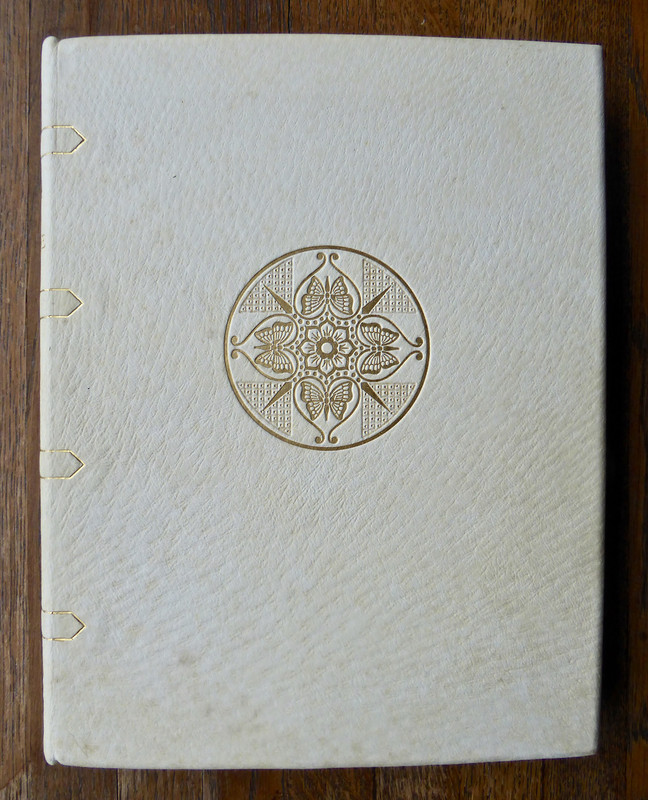
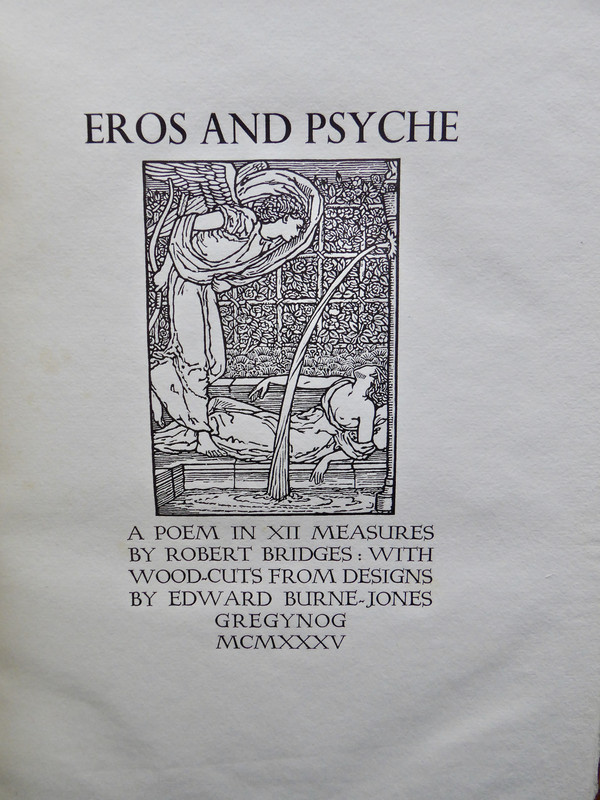
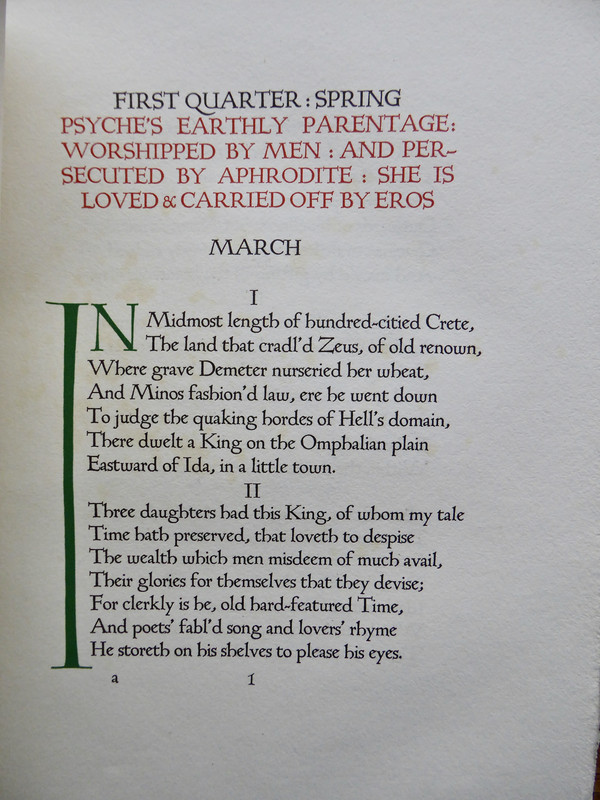
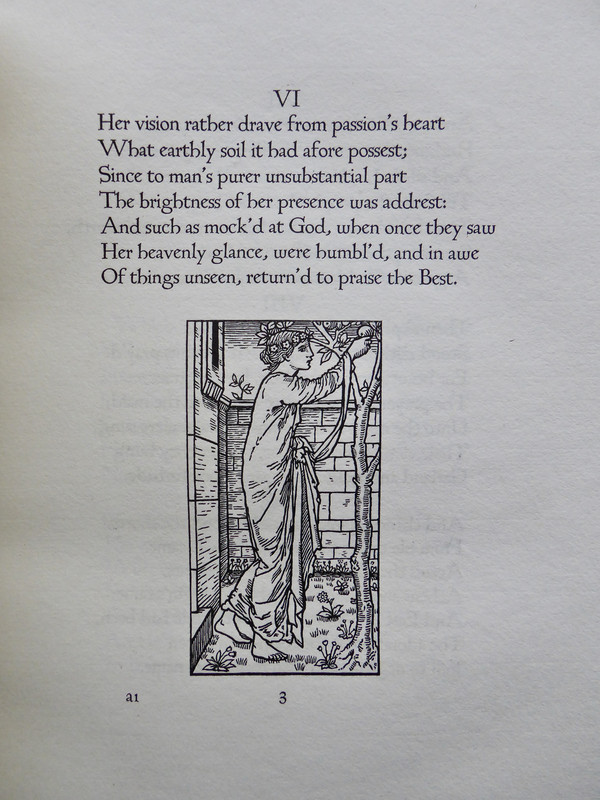
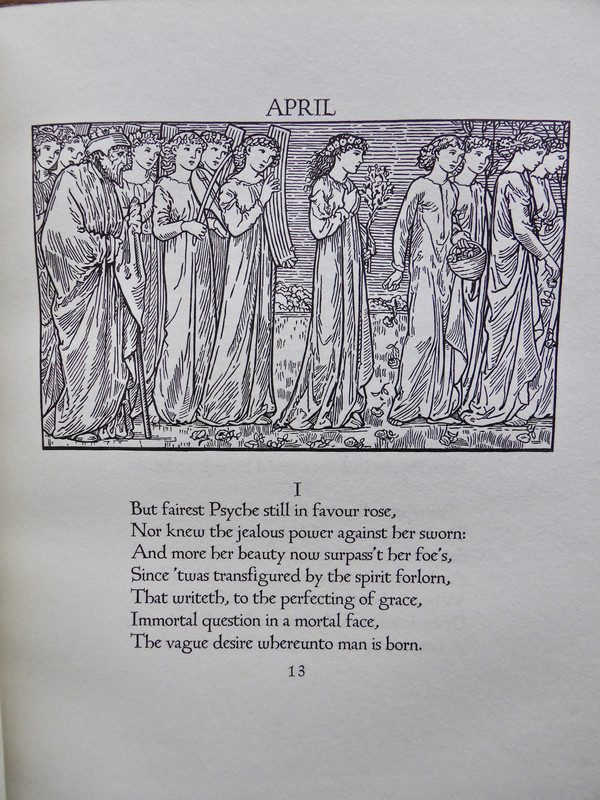
Gregynog Eros and Psyche (11 1/4 x 9 inches): This edition uses only 24 of the original Edward Burne-Jones illustrations found in the Clover Hill Editions copy. The type-face designed by Grailly Hewitt is quite attractive and his initial letters printed in three colors are quite beautiful. Note that this version of Cupid and Psyche uses the Poet Laureate Robert Bridges's narrative poem rewriting of the original poem and it is quite different from the form of the poem used in the Clover Hill Edition. It is important to decide which version of the poem you prefer to read before making your purchase. The Gregynog edition uses a thick white pigskin leather for its binding and this is a wretched choice, as was the Gregynog Press's choice of sheepskin leather for several of their other editions. The white pigskin is very prone to foxing, darkening & yellowing. Additionally, the Gregynog paper is also prone to foxing as well. Finally, the Gregynog binding consists of an open-faced tray in which the book is placed, which then slides into the slipcase. In my copy, this is quite a tight fit and it is a pain in the ass to remove and reinsert the book tray from the slipcase.
Clover Hill Editions/Rampant Lions Press Cupid and Psyche (13 7/8 x 9 3/4 inches): If you choose to purchase this, I have a great preference for the deluxe edition of 130 copies with full dark blue morocco binding done by Sangorski & Sutcliffe which comes with the separate clamshell box of the 47 original drawings and the 44 William Morris wood engravings. First, note that these books are larger than the Gregynog book which shows the wood engravings to much better advantage. Additionally, a huge advantage of this edition over the Gregynog Press edition is that it comes with the separate volume of A.R. Dufty's research into the history of this edition with Edward Burnes-Jones's original preliminary sketches included in Volume 1. The quality of the paper and letterpress printing is on the same par as found in the Gregynog Press edition and both are superb. However, this edition uses William Morris's Kelmscott type-face which, for me, is a better match with the wood engravings, giving the poem more of a medieval feel. Finally, the slipcase is covered with a very attractive patterned paper which was designed by William Morris.
Bottom line: My recommendation is to find and purchase the Clover Hill/Rampant Lions Press deluxe edition as shown above. It will prove to be less problematic over time, includes far more than the Gregynog Press edition, and will hold up better. Again, read excerpts of the poem from each edition because they are quite different!
Photos below.
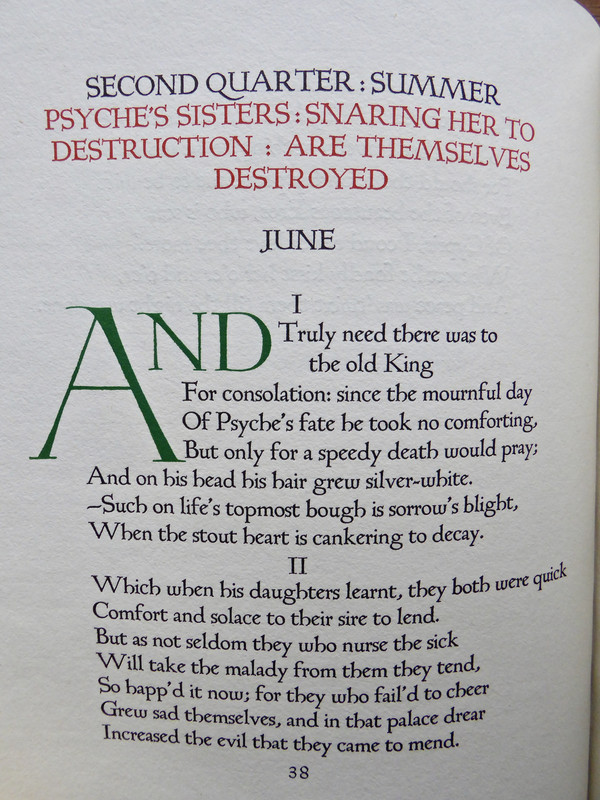
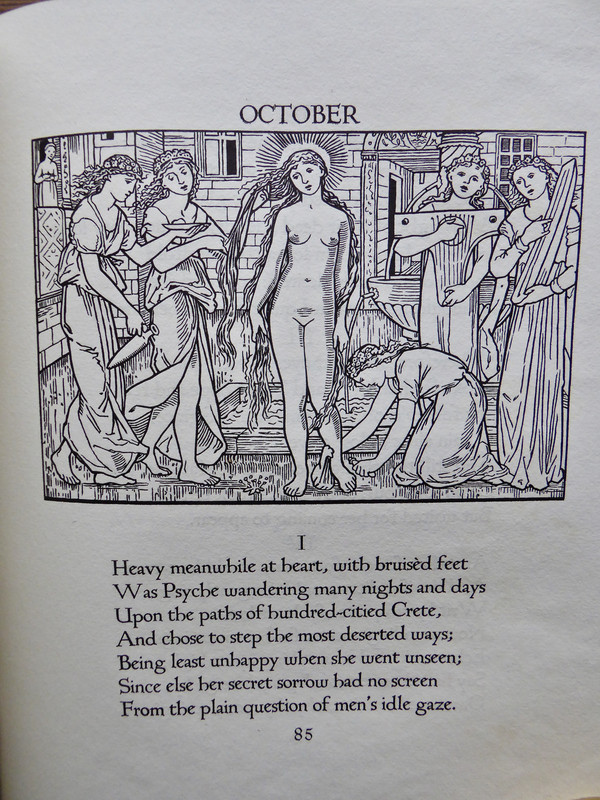
Decisions, decisions, decisions !!!!!!!!!!
I placed both books side by side, made comparisons, and these are my observations regarding the advantages and disadvantages of each edition.
Gregynog Eros and Psyche (11 1/4 x 9 inches): This edition uses only 24 of the original Edward Burne-Jones illustrations found in the Clover Hill Editions copy. The type-face designed by Grailly Hewitt is quite attractive and his initial letters printed in three colors are quite beautiful. Note that this version of Cupid and Psyche uses the Poet Laureate Robert Bridges's narrative poem rewriting of the original poem and it is quite different from the form of the poem used in the Clover Hill Edition. It is important to decide which version of the poem you prefer to read before making your purchase. The Gregynog edition uses a thick white pigskin leather for its binding and this is a wretched choice, as was the Gregynog Press's choice of sheepskin leather for several of their other editions. The white pigskin is very prone to foxing, darkening & yellowing. Additionally, the Gregynog paper is also prone to foxing as well. Finally, the Gregynog binding consists of an open-faced tray in which the book is placed, which then slides into the slipcase. In my copy, this is quite a tight fit and it is a pain in the ass to remove and reinsert the book tray from the slipcase.
Clover Hill Editions/Rampant Lions Press Cupid and Psyche (13 7/8 x 9 3/4 inches): If you choose to purchase this, I have a great preference for the deluxe edition of 130 copies with full dark blue morocco binding done by Sangorski & Sutcliffe which comes with the separate clamshell box of the 47 original drawings and the 44 William Morris wood engravings. First, note that these books are larger than the Gregynog book which shows the wood engravings to much better advantage. Additionally, a huge advantage of this edition over the Gregynog Press edition is that it comes with the separate volume of A.R. Dufty's research into the history of this edition with Edward Burnes-Jones's original preliminary sketches included in Volume 1. The quality of the paper and letterpress printing is on the same par as found in the Gregynog Press edition and both are superb. However, this edition uses William Morris's Kelmscott type-face which, for me, is a better match with the wood engravings, giving the poem more of a medieval feel. Finally, the slipcase is covered with a very attractive patterned paper which was designed by William Morris.
Bottom line: My recommendation is to find and purchase the Clover Hill/Rampant Lions Press deluxe edition as shown above. It will prove to be less problematic over time, includes far more than the Gregynog Press edition, and will hold up better. Again, read excerpts of the poem from each edition because they are quite different!
Photos below.
17SebRinelli
>15 dlphcoracl: Thank you so much.
$2,400 is out of question for sure. I saw that fine copies went for around $600 to $800 in auctions, which is much more within my price range as a PhD student!
$2,400 is out of question for sure. I saw that fine copies went for around $600 to $800 in auctions, which is much more within my price range as a PhD student!
18dlphcoracl
>16 dlphcoracl:
Below are three photographs taken from the Clover Hill/Rampant Lions Press addition which will illustrate the difference in the appearance of the type-faces, how they interact differently with the Burne-Jones illustrations, and how the larger size of the illustrations shows them to better advantage with greater dramatic effect.
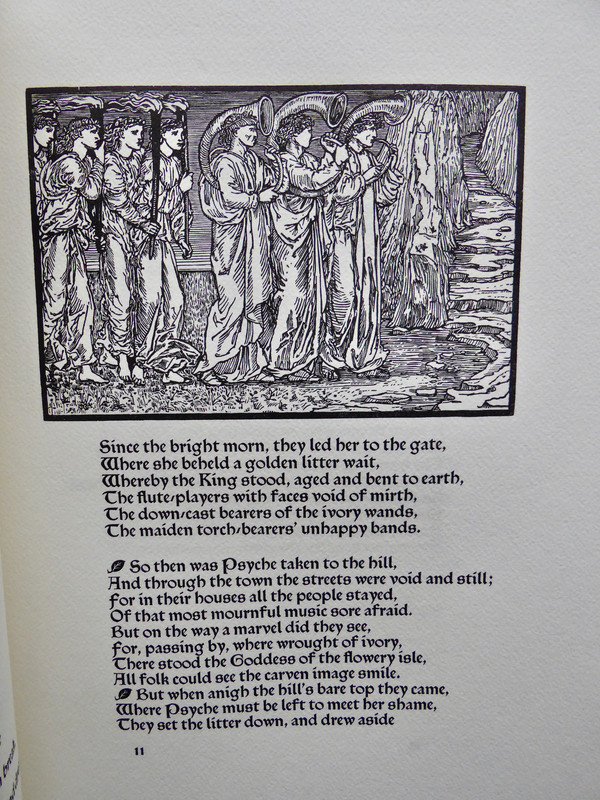
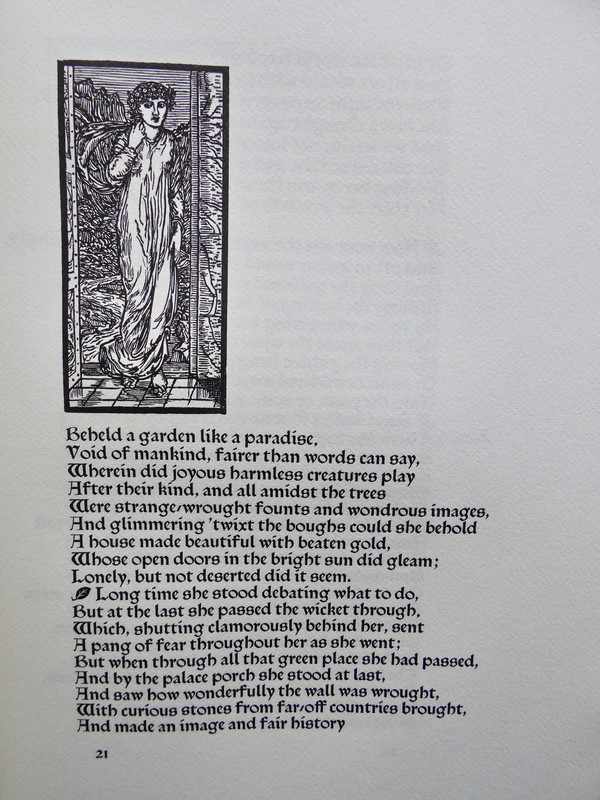
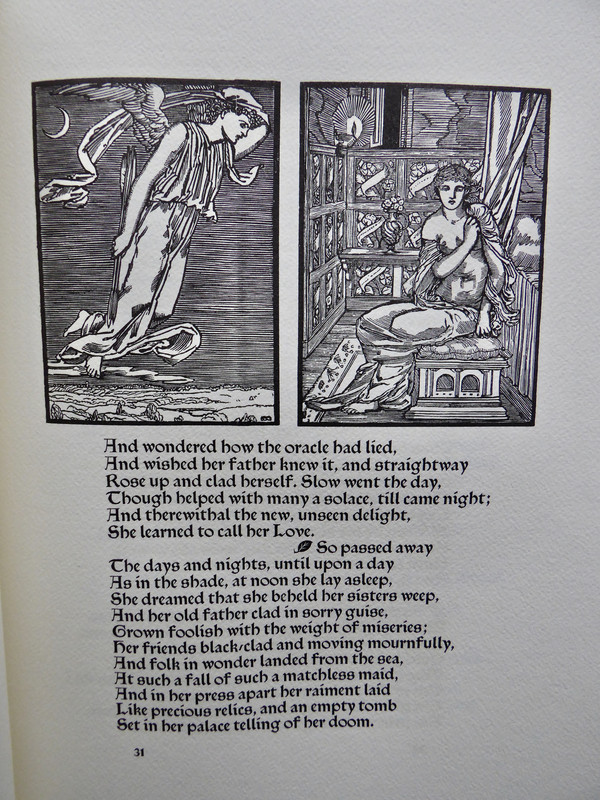
Below are three photographs taken from the Clover Hill/Rampant Lions Press addition which will illustrate the difference in the appearance of the type-faces, how they interact differently with the Burne-Jones illustrations, and how the larger size of the illustrations shows them to better advantage with greater dramatic effect.

