Pilgrim staggers into Summer 2020
This is a continuation of the topic Pilgrim sidles into Spring 2020.
This topic was continued by Pilgrim stumbles into Autumn 2020.
Talk The Green Dragon
Join LibraryThing to post.
1-pilgrim-
July
1. Part-time Gods by Rachel Aaron - 2 stars
2. Night Shift Dragons by Rachel Aaron - 2.5 stars
3. Nice Dragons Finish Last by Rachel Aaron - 2 stars
4. ♪♪ A Rare Book of Cunning Device (short story) by Ben Aaronovitch - 2.5 stars
5. One Good Dragon Deserves Another by Rachel Aaron - 1.5 stars
6. Avengers - Marvel Legacy Primer Pages (Avengers (2016-2018)) by Robbie Thompson (writer) and Daniel Acuña (illustrator) - 1.5 stars
7. Getting Started on Classical Latin (OpenLearn series) by Inga Mantle, James Robson and Jeremy Taylor - 2.5 stars
8. No Good Dragon Goes Unpunished by Rachel Aaron - 1.5 stars
9. Head Case by Ross Armstrong - 3.5 stars
10. Do We Need Economic Inequality? by Danny Dorling - 1.5 stars
August
1. A Dragon of a Different Color by Rachel Aaron - 2 stars
2. A Simple Soul by Vadim Babenko (trans. by Vadim Babenko & Christopher Lovelace) - 4 stars
3. Coronavirus: a book for children by Elizabeth Jenner, Kate Wilson and Nia Roberts (illus. by Axel Scheffler) - 2 stars
4. Last Dragon Standing by Rachel Aaron - 2.5 stars
5. Reporter - a Memoir by Seymour Hersch - 5 stars
6. Storm Front by Jim Butcher - 3 stars
7. Seeking Mr Hare by Maurice Leitch - 2 stars
1. Part-time Gods by Rachel Aaron - 2 stars
2. Night Shift Dragons by Rachel Aaron - 2.5 stars
3. Nice Dragons Finish Last by Rachel Aaron - 2 stars
4. ♪♪ A Rare Book of Cunning Device (short story) by Ben Aaronovitch - 2.5 stars
5. One Good Dragon Deserves Another by Rachel Aaron - 1.5 stars
6. Avengers - Marvel Legacy Primer Pages (Avengers (2016-2018)) by Robbie Thompson (writer) and Daniel Acuña (illustrator) - 1.5 stars
7. Getting Started on Classical Latin (OpenLearn series) by Inga Mantle, James Robson and Jeremy Taylor - 2.5 stars
8. No Good Dragon Goes Unpunished by Rachel Aaron - 1.5 stars
9. Head Case by Ross Armstrong - 3.5 stars
10. Do We Need Economic Inequality? by Danny Dorling - 1.5 stars
August
1. A Dragon of a Different Color by Rachel Aaron - 2 stars
2. A Simple Soul by Vadim Babenko (trans. by Vadim Babenko & Christopher Lovelace) - 4 stars
3. Coronavirus: a book for children by Elizabeth Jenner, Kate Wilson and Nia Roberts (illus. by Axel Scheffler) - 2 stars
4. Last Dragon Standing by Rachel Aaron - 2.5 stars
5. Reporter - a Memoir by Seymour Hersch - 5 stars
6. Storm Front by Jim Butcher - 3 stars
7. Seeking Mr Hare by Maurice Leitch - 2 stars
2-pilgrim-
July Average score = 1.9
August Average score = 2.92
My Rating System
1/2 star - this is vile. I regret ever opening these pages.
1 star - this was a complete waste of my time.
1 1/2 stars - either boring, but with occasional flashes of inspiration; or a 2-star book let down by poor writing.
2 stars - OK. It passed the time pleasantly enough, but I don't feel that my life would have been the poorer if I had never encountered this book. In non-fiction, it is an adequate coverage of a topic, but not a good read.
2 1/2 stars - as for 2, but with occasional flashes of quality.
3 stars - I am glad that I read this but I probably won't want to re-read.
3 1/2 stars - either something disposable, but with real flair, or a book let down by poor writing (or translating).
4 stars - a good, really enjoyable book, but not a great one. I will keep, and may well reread.
4 1/2 stars - a great, but flawed book.
5 stars - a book that reading has changed my life a little.
August Average score = 2.92
My Rating System
1/2 star - this is vile. I regret ever opening these pages.
1 star - this was a complete waste of my time.
1 1/2 stars - either boring, but with occasional flashes of inspiration; or a 2-star book let down by poor writing.
2 stars - OK. It passed the time pleasantly enough, but I don't feel that my life would have been the poorer if I had never encountered this book. In non-fiction, it is an adequate coverage of a topic, but not a good read.
2 1/2 stars - as for 2, but with occasional flashes of quality.
3 stars - I am glad that I read this but I probably won't want to re-read.
3 1/2 stars - either something disposable, but with real flair, or a book let down by poor writing (or translating).
4 stars - a good, really enjoyable book, but not a great one. I will keep, and may well reread.
4 1/2 stars - a great, but flawed book.
5 stars - a book that reading has changed my life a little.
3-pilgrim-
Currently Reading
Kindle:
Discovering Ancient Greek and Latin by Jeremy Taylor
Started: 11/7/2020
Compendium of Orthodox Services - Volume 1 by Charles Harrison
Started: 16/8/2020
Audiobook:
Learn Russian - Word Power 101 - Absolute Beginner Russian #1 by Russianpod101.com
Started: 9/8/2020
Kindle:
Discovering Ancient Greek and Latin by Jeremy Taylor
Started: 11/7/2020
Compendium of Orthodox Services - Volume 1 by Charles Harrison
Started: 16/8/2020
Audiobook:
Learn Russian - Word Power 101 - Absolute Beginner Russian #1 by Russianpod101.com
Started: 9/8/2020
4-pilgrim-
Series in progress
Fiction
Heartstrikers by Rachel Aaron: 1, 2-5 - Bethesda Heartstriker: Mother of the Year
Rivers of London by Ben Aaronovitch: 1-4, 5, 6-7 - The Cockpit; False Value
Dania Gorska by Hania Allen: 1 - Clearing the Dark
Chronicles of Amber by John Gregory Betancourt: P1, 1-10 - Chaos and Amber
The Folk of the Air by Holly Black: P1-3, 1-2 -The Queen of Nothing
Dominion of The Fallen by Aliette de Bodard: 1 - Children of Thorns, Children of Water
Pieter Posthumous by Britta Bolt: 3 - Lonely Graves
Alpha and Omega by Patricia Briggs: 1-2 - Fair Game
Mercy Thompson by Patricia Briggs: 1-8 - Fire Touched
Sianim by Patricia Briggs: 3-4 - Masques
World of the Five Gods by Lois McMasters Bujold: 1.1, 2 -Penric and the Shaman, The Paladin of Souls
Chains of Honor by Lindsay Buroker: P1-P3, 1-2 Snake Heart, Assassin's Bond
Emperor's Edge by Lindsay Buroker: 1-8 - Diplomats and Fugitives
Fallen Empire by Lindsay Buroker: P-3 - Relic of Sorrows
The Dresden Files by Jim Butcher: 1 - Fool Moon
Holly Danger by Amanda Carlson: 1 - Danger's Vice
Spellslinger by Sebastian de Castell: 1-5 - Crownbreaker
Greatcoats by Sebastian de Castell: 1 - Knight's Shadow
The Daevabad Trilogy by S. A. Chakraborty: 1 - The Kingdom of Copper
Chronicles of an Age of Darkness by Hugh Cook: 1 - The Wordsmiths and the Warguild
The Saxon Chronicles by Bernard Cornwell: 1-2 - The Lords of the North
Sharpe by Bernard Cornwell:1, 6, 8-9, 13 - Sharpe's Triumph
Arkady Renko by Martin Cruz Smith: 1 - Polar Star
Marcus Didius Falco by Lindsey Davis: 1-6 - Time to Depart
Flavia Albia by Lindsey Davis: 1-2.5 - Deadly Election
Priya's Shakti by Ram Devineni & Dan Goldman: 1-2 - Priya and the Lost Girls
John Pearce by David Donachie: 1, 14 - A Shot-Rolling Ship
The Privateersman Mysteries by David Donachie: 1-2 - A Hanging Matter
The Marie Antoinette Romances by Alexandre Dumas: 2 - Cagliostro
The Musketeers by Alexandre Dumas: 1-3 - Louise de la Vallière
Cliff Janeway by John Dunning: 1 - The Bookman's Wake
The Beginner's Guide to Necromancy by Hailey Edwards: 1 - How to Claim an Undead Soul
Metro 203x by Dmitry Glukhovsky: 1-1.5 - Metro 2034
The Archangel Project by C Gockel: 1- 1.5 - Noa's Ark
The Earthsea Cycle by Ursula le Guin 1 - The Tombs of Atuan
Forever War by Joe Haldeman: 1 - Forever Free
Benjamin January by Barbara Hambly: 1 - Fever Season
Darwath by Barbara Hambly: 1-3 - Mother of Winter
James Asher by Barbara Hambly: 1-2, 4-5 - Blood Maidens, Darkness on His Bones
Sun Wolf and Star Hawk by Barbara Hambly: 1-3 - Hazard
The Windrose Chronicles by Barbara Hambly: 1-3 - Firemaggot
The Stainless Steel Rat by Harry Harrison 4-5, 9 - The Stainless Steel Rat Is Born
The Paper Magician by Charlie N. Holmberg: 1-2, 4 - The Master Magician
Conqueror by Conn Iggulden: 1 - Lords of the Bow
Alex Verus by Benedict Jacka: 9 - Fated
The Danilov Quintet by Jasper Kent:1 - Thirteen Years Later
The Jane Doe Chronicles by Jeremy Lachlan: 1 - The Key of All Souls
The Book of the Ancestor by Mark Lawrence: 1 - Grey Sister
The Kalle Blomqvist Mysteries by Astrid Lindgren: 3 - Master Detective
Robert Colbeck by Edward Marston: 1 - The Excursion Train
The Raven's Mark by Ed McDonald: 1 - Ravencry
The Psammead by E. Nesbit: 1-3 - The Story of the Amulet
Moonsinger by Andre Norton: 1-2 - Flight in Yiktor
Giordano Bruno by S.J. Parris: 5 - Heresy
Brother Cadfael by Ellis Peters: 1-12 - The Rose Rent
The Gaian Consortium by Christine Pope: 1 - Breath of Life
Discworld by Sir Terry Pratchett: 1-15.5 - Soul Music
The Devices Trilogy by Philip Purser-Hallard: 1-2 - Trojans
Divergent by Veronica Roth: 1, 2.5 - Insurgent
The Witcher by Andrzej Sapkowski: 1 - The Last Wish, Time of Contempt
Old Man's War by John Scalzi: 1 - The Ghost Brigades
The Rhenwars Saga by M. L. Spencer: 1 - Darklands
Merchant Princes by Charles Stross: 2 - The Family Trade
The Dolphin Ring by Rosemary Sutcliff: 1, 3-6, 8 - The Silver Branch
The Ember Quartet by Sabaa Tahir: 2 - An Ember in the Ashes
Jem Flockhart by E. S. Thomson: 2 - Beloved Poison
A Connecticut Yankee at King Arthur's Court by Mark Twain: 1-2 - Part 3
Miss Silver by Patricia Wentworth: 1 - The Case is Closed
Aspects of Power by Charles Williams: 1 - Many Dimensions
The Gestes by P. C. Wren: 1 - Beau Sabreur
Non-fiction
The Spiritual Life by Hieromonk Gregorios: 1 - Be Ready
The History of Middle Earth by Christopher Tolkien: ??
Series Completed in 2020
DFZ by Rachel Aaron: 1-3
Dragon Blood by Lindsay Buroker: P, 1-8
Heritage of Power by Lindsay Buroker: 1-5
Series up to date
Paul Samson by Henry Porter: 1-2 - The Old Enemy
The Hitman's Guide by Alice Winters: 1-2
Tom Mondrian by Ross Armstrong: 1
N.b.
(i) This list is still probably incomplete.
(ii) The named book is the next to be read
(iii) Inclusion of a series does not imply intent to complete it.
(iv) I have read some of the series in bold type during this year (2020), others are outstanding.
(v) I have pruned out of this list some series that I began in 2019, but definitely do not intend to continue.
Fiction
Heartstrikers by Rachel Aaron: 1, 2-5 - Bethesda Heartstriker: Mother of the Year
Rivers of London by Ben Aaronovitch: 1-4, 5, 6-7 - The Cockpit; False Value
Dania Gorska by Hania Allen: 1 - Clearing the Dark
Chronicles of Amber by John Gregory Betancourt: P1, 1-10 - Chaos and Amber
The Folk of the Air by Holly Black: P1-3, 1-2 -The Queen of Nothing
Dominion of The Fallen by Aliette de Bodard: 1 - Children of Thorns, Children of Water
Pieter Posthumous by Britta Bolt: 3 - Lonely Graves
Alpha and Omega by Patricia Briggs: 1-2 - Fair Game
Mercy Thompson by Patricia Briggs: 1-8 - Fire Touched
Sianim by Patricia Briggs: 3-4 - Masques
World of the Five Gods by Lois McMasters Bujold: 1.1, 2 -Penric and the Shaman, The Paladin of Souls
Chains of Honor by Lindsay Buroker: P1-P3, 1-2 Snake Heart, Assassin's Bond
Emperor's Edge by Lindsay Buroker: 1-8 - Diplomats and Fugitives
Fallen Empire by Lindsay Buroker: P-3 - Relic of Sorrows
The Dresden Files by Jim Butcher: 1 - Fool Moon
Holly Danger by Amanda Carlson: 1 - Danger's Vice
Spellslinger by Sebastian de Castell: 1-5 - Crownbreaker
Greatcoats by Sebastian de Castell: 1 - Knight's Shadow
The Daevabad Trilogy by S. A. Chakraborty: 1 - The Kingdom of Copper
Chronicles of an Age of Darkness by Hugh Cook: 1 - The Wordsmiths and the Warguild
The Saxon Chronicles by Bernard Cornwell: 1-2 - The Lords of the North
Sharpe by Bernard Cornwell:1, 6, 8-9, 13 - Sharpe's Triumph
Arkady Renko by Martin Cruz Smith: 1 - Polar Star
Marcus Didius Falco by Lindsey Davis: 1-6 - Time to Depart
Flavia Albia by Lindsey Davis: 1-2.5 - Deadly Election
Priya's Shakti by Ram Devineni & Dan Goldman: 1-2 - Priya and the Lost Girls
John Pearce by David Donachie: 1, 14 - A Shot-Rolling Ship
The Privateersman Mysteries by David Donachie: 1-2 - A Hanging Matter
The Marie Antoinette Romances by Alexandre Dumas: 2 - Cagliostro
The Musketeers by Alexandre Dumas: 1-3 - Louise de la Vallière
Cliff Janeway by John Dunning: 1 - The Bookman's Wake
The Beginner's Guide to Necromancy by Hailey Edwards: 1 - How to Claim an Undead Soul
Metro 203x by Dmitry Glukhovsky: 1-1.5 - Metro 2034
The Archangel Project by C Gockel: 1- 1.5 - Noa's Ark
The Earthsea Cycle by Ursula le Guin 1 - The Tombs of Atuan
Forever War by Joe Haldeman: 1 - Forever Free
Benjamin January by Barbara Hambly: 1 - Fever Season
Darwath by Barbara Hambly: 1-3 - Mother of Winter
James Asher by Barbara Hambly: 1-2, 4-5 - Blood Maidens, Darkness on His Bones
Sun Wolf and Star Hawk by Barbara Hambly: 1-3 - Hazard
The Windrose Chronicles by Barbara Hambly: 1-3 - Firemaggot
The Stainless Steel Rat by Harry Harrison 4-5, 9 - The Stainless Steel Rat Is Born
The Paper Magician by Charlie N. Holmberg: 1-2, 4 - The Master Magician
Conqueror by Conn Iggulden: 1 - Lords of the Bow
Alex Verus by Benedict Jacka: 9 - Fated
The Danilov Quintet by Jasper Kent:1 - Thirteen Years Later
The Jane Doe Chronicles by Jeremy Lachlan: 1 - The Key of All Souls
The Book of the Ancestor by Mark Lawrence: 1 - Grey Sister
The Kalle Blomqvist Mysteries by Astrid Lindgren: 3 - Master Detective
Robert Colbeck by Edward Marston: 1 - The Excursion Train
The Raven's Mark by Ed McDonald: 1 - Ravencry
The Psammead by E. Nesbit: 1-3 - The Story of the Amulet
Moonsinger by Andre Norton: 1-2 - Flight in Yiktor
Giordano Bruno by S.J. Parris: 5 - Heresy
Brother Cadfael by Ellis Peters: 1-12 - The Rose Rent
The Gaian Consortium by Christine Pope: 1 - Breath of Life
Discworld by Sir Terry Pratchett: 1-15.5 - Soul Music
The Devices Trilogy by Philip Purser-Hallard: 1-2 - Trojans
Divergent by Veronica Roth: 1, 2.5 - Insurgent
The Witcher by Andrzej Sapkowski: 1 - The Last Wish, Time of Contempt
Old Man's War by John Scalzi: 1 - The Ghost Brigades
The Rhenwars Saga by M. L. Spencer: 1 - Darklands
Merchant Princes by Charles Stross: 2 - The Family Trade
The Dolphin Ring by Rosemary Sutcliff: 1, 3-6, 8 - The Silver Branch
The Ember Quartet by Sabaa Tahir: 2 - An Ember in the Ashes
Jem Flockhart by E. S. Thomson: 2 - Beloved Poison
A Connecticut Yankee at King Arthur's Court by Mark Twain: 1-2 - Part 3
Miss Silver by Patricia Wentworth: 1 - The Case is Closed
Aspects of Power by Charles Williams: 1 - Many Dimensions
The Gestes by P. C. Wren: 1 - Beau Sabreur
Non-fiction
The Spiritual Life by Hieromonk Gregorios: 1 - Be Ready
The History of Middle Earth by Christopher Tolkien: ??
Series Completed in 2020
DFZ by Rachel Aaron: 1-3
Dragon Blood by Lindsay Buroker: P, 1-8
Heritage of Power by Lindsay Buroker: 1-5
Series up to date
Paul Samson by Henry Porter: 1-2 - The Old Enemy
The Hitman's Guide by Alice Winters: 1-2
Tom Mondrian by Ross Armstrong: 1
N.b.
(i) This list is still probably incomplete.
(ii) The named book is the next to be read
(iii) Inclusion of a series does not imply intent to complete it.
(iv) I have read some of the series in bold type during this year (2020), others are outstanding.
(v) I have pruned out of this list some series that I began in 2019, but definitely do not intend to continue.
5-pilgrim-
I am officially, with regret, retiring from the C.S. Lewis science fiction reads.
It's not that I was not thoroughly enjoying the book, but I was having to rely on a PDF version which could not font expand without ceasing to fit lines to the screen. That was a struggle to read when my eyes were at all tired; adding the visual disturbances provided from last week's vitreous detachment, and it is just too much of a struggle.
I am finding reading more difficult at the moment; I find it tends to lead to headaches. Since it was my primarily source of enjoyment currently, I am a bit narked.
It's not that I was not thoroughly enjoying the book, but I was having to rely on a PDF version which could not font expand without ceasing to fit lines to the screen. That was a struggle to read when my eyes were at all tired; adding the visual disturbances provided from last week's vitreous detachment, and it is just too much of a struggle.
I am finding reading more difficult at the moment; I find it tends to lead to headaches. Since it was my primarily source of enjoyment currently, I am a bit narked.
7Busifer
Yes, what >6 Narilka: says. Audio didn't work well for me until the day I was down with a severe flu and could not open my eyes for days - oversensitivity to light. That was a turning point, though, and now I do appreciate it.
8haydninvienna
>5 -pilgrim-: I see Audible has all 3 books in the Space Trilogy, although the cover art is a bit unpreposessing. Best wishes: I can just about imagine how tough that must be for you.
9BookstoogeLT
>5 -pilgrim-: This is what I'm afraid my future holds for me. I'll be praying for you.
10-pilgrim-
>6 Narilka:, >7 Busifer:, >8 haydninvienna: Thank you all.
My previous ventures into the world of audiobooks have not gone well.
I find that an American accent does not register to me as neutral. It is much a "foreign accent" to me as French or German.
I had to give up on the audiobook version of The Dark Monk because the Americanisms in the text, plus the accent of the reader, completely destroyed any sense of 17th century Bavaria for me. Hearing German names mispronounced in the American fashion (as opposed to being pronounced correctly in German, or mispronounced in the British manner) grated horribly.
Obviously an American narrating a book set in America is not a problem in that way; but that constitutes a rather small fraction of what I normally read. (Fantasy settings that are not on Earth, but where everyone speaks with an American accent grate similarly, even if the author was American, unless there is an in-story reason why the speakers are all American-descended.)
I had to give up on War of the Worlds likewise, when the English protagonist's thoughts were rendered in an American accent.
But even when the narrator has a suitably neutral accent, I still find audiobooks require effort. I listened to The Screwtape Letters read by Ralph Cosham, who, although American, read with an admirable neutral accent. Yet I still found my mind wandering, and had to keep repeating bits because I suddenly realised that I had lost the thread of what he was saying.
I suffered from the same problem in lectures at university. Even when I was completely interested in the subject, my mind would wander off (perhaps in analysing the implications of what had just been said) unless the lecturer also provided visual cues. (Where they did not, I tried to read the textbook simultaneously in order to maintain focus!)
It seems that I am a hopelessly visual person!
My previous ventures into the world of audiobooks have not gone well.
I find that an American accent does not register to me as neutral. It is much a "foreign accent" to me as French or German.
I had to give up on the audiobook version of The Dark Monk because the Americanisms in the text, plus the accent of the reader, completely destroyed any sense of 17th century Bavaria for me. Hearing German names mispronounced in the American fashion (as opposed to being pronounced correctly in German, or mispronounced in the British manner) grated horribly.
Obviously an American narrating a book set in America is not a problem in that way; but that constitutes a rather small fraction of what I normally read. (Fantasy settings that are not on Earth, but where everyone speaks with an American accent grate similarly, even if the author was American, unless there is an in-story reason why the speakers are all American-descended.)
I had to give up on War of the Worlds likewise, when the English protagonist's thoughts were rendered in an American accent.
But even when the narrator has a suitably neutral accent, I still find audiobooks require effort. I listened to The Screwtape Letters read by Ralph Cosham, who, although American, read with an admirable neutral accent. Yet I still found my mind wandering, and had to keep repeating bits because I suddenly realised that I had lost the thread of what he was saying.
I suffered from the same problem in lectures at university. Even when I was completely interested in the subject, my mind would wander off (perhaps in analysing the implications of what had just been said) unless the lecturer also provided visual cues. (Where they did not, I tried to read the textbook simultaneously in order to maintain focus!)
It seems that I am a hopelessly visual person!
11-pilgrim-
>9 BookstoogeLT: Thank you.
The interference with my reading capability should be temporary, as apparently one's brain learns to edit out the extra visual features.
Although frankly having two of these in 5 months is scaring the hell out of me.
The interference with my reading capability should be temporary, as apparently one's brain learns to edit out the extra visual features.
Although frankly having two of these in 5 months is scaring the hell out of me.
12BookstoogeLT
>11 -pilgrim-: I remember about 10 years ago I bumped my head and was seeing double for about a month. I was scared it was going to be permanent until the dr told me it was pretty normal and would sort itself out. Made me a lot more consciencous about wearing a hard hat after that! So I get that "fear"...
13-pilgrim-
>12 BookstoogeLT: Ouch - that sounds painful as well as worrying. What exactly happened?
14Kanarthi
>10 -pilgrim-: I similarly struggle with wandering thoughts and hyperattention to the narrator's quirks while listening to audiobooks. I was forced to come to terms with them because 700 mile solitary roadtrips are intolerable without audiobooks. The following were tricks that helped me enjoy them; maybe they will apply to you, maybe not?
I tend to prefer nonfiction audiobooks (because the affectations of the narrator are less likely to annoy me), and I listen to audiobooks by using my podcast app on my phone, which has a "rewind ten seconds" shortcut that I use frequently without shame. Doing something with my hands (and/or eyes) can also make it easier to concentrate on the audiobook by giving my mind less leeway to wander.
Speaking of podcasts, you could try some podcasts which involve a conversation between two people, such as an interview with an author about a recent book of theirs. I tend to pay more attention to audio that is a conversation. Similarly, the most successful audiobooks for me are not just nonfiction but memoirs, which recount conversations between people.
I hope that you're able to return to reading soon, though, as it is far preferable.
I tend to prefer nonfiction audiobooks (because the affectations of the narrator are less likely to annoy me), and I listen to audiobooks by using my podcast app on my phone, which has a "rewind ten seconds" shortcut that I use frequently without shame. Doing something with my hands (and/or eyes) can also make it easier to concentrate on the audiobook by giving my mind less leeway to wander.
Speaking of podcasts, you could try some podcasts which involve a conversation between two people, such as an interview with an author about a recent book of theirs. I tend to pay more attention to audio that is a conversation. Similarly, the most successful audiobooks for me are not just nonfiction but memoirs, which recount conversations between people.
I hope that you're able to return to reading soon, though, as it is far preferable.
15Busifer
>10 -pilgrim-: >14 Kanarthi: The nonfiction advice is actually a good one, in my experience. I have listened to uncounted hours from The Greater Courses, many of which are practically free with an Audible subscription.
I have bought mine in various sales, at the source, so paid a great deal more than the 1 credit they go for at Audible... I was a bit incensed when I found that one out.
I have bought mine in various sales, at the source, so paid a great deal more than the 1 credit they go for at Audible... I was a bit incensed when I found that one out.
16BookstoogeLT
>13 -pilgrim-: As best as we can figure out, I bonked it on a steel ibeam while doing some survey work on a bridge. Bent down to get under the beam, didn't get through quite far enough and raised my head. Didn't even get an egg on my head. Just started seeing double in one eye in a couple of hours. I had to wear an eyepatch for almost a month. Mrs B made a lot of pirate jokes during that time :-D
17jillmwo
I am by no means an expert in managing these types of challenges, but I would tend to think that the advice offered by @Busifer, @BookstoogeLT and @Kanarthi is sound.
18Narilka
>10 -pilgrim-: That's too bad. You might have to search harder but a British narrator of a British author?
19-pilgrim-
I have been trying BBC radio plays and documentaries.
Unfortunately my eponymous series of radio dramas - Pilgrim by Sebastian Baczkiewicz - has finished, but I enjoyed Stanley Gucci's episodes on the history of California. I had not heard of Leon Lewis' contribution to the fight against fascism - a most enterprising Jewish gentleman who formed his own spy ring, and persuaded the Jewish movie moguls to fund it! (American voices for American history are, of course, fine!)
Unfortunately the Great Courses seem to mostly have American narrators - at least in the samples that I tried.
But the major problem with audio, rather than visual input, is that every time the pain spasms get too bad I miss a bit - and rewind buttons involve using the same body parts as are hurting! (The radiographer insisted on taking blood from my HAND last time, so the neurological did-effects of the chemo are particularly bad there this time through.)
So I am interspersing short spells of reading eBooks that I can expand the font on, with following Richard and Hugh's operatic links, done musicals, and a lot of bayan and ukelele music...
Unfortunately my eponymous series of radio dramas - Pilgrim by Sebastian Baczkiewicz - has finished, but I enjoyed Stanley Gucci's episodes on the history of California. I had not heard of Leon Lewis' contribution to the fight against fascism - a most enterprising Jewish gentleman who formed his own spy ring, and persuaded the Jewish movie moguls to fund it! (American voices for American history are, of course, fine!)
Unfortunately the Great Courses seem to mostly have American narrators - at least in the samples that I tried.
But the major problem with audio, rather than visual input, is that every time the pain spasms get too bad I miss a bit - and rewind buttons involve using the same body parts as are hurting! (The radiographer insisted on taking blood from my HAND last time, so the neurological did-effects of the chemo are particularly bad there this time through.)
So I am interspersing short spells of reading eBooks that I can expand the font on, with following Richard and Hugh's operatic links, done musicals, and a lot of bayan and ukelele music...
20-pilgrim-
>16 BookstoogeLT: As I understand these things, you would have been better off WITH the "duck egg": that would have meant that the swelling was taking place on the OUTSIDE of your head - instead of inside, where it was pressing on either your optic nerves or the visual processing region of your brain.
Glad you made a full recovery.
Glad you made a full recovery.
21BookstoogeLT
>20 -pilgrim-: Yep. At least now I have a hardhat in my gear bag, so I'm never without one! :-D
Talk about learning a lesson the hard way...
Talk about learning a lesson the hard way...
23-pilgrim-
>22 Narilka: Yes, my feelings about the series were mixed - liked the world-building, disliked the protagonists. So I thought I'd give a different family a go.
I am finding it difficult to focus - literally and figuratively - so it is the story of light read that I need right now.
Reviews will follow.
I am finding it difficult to focus - literally and figuratively - so it is the story of light read that I need right now.
Reviews will follow.
24-pilgrim-

Part-time Gods (Book 2 of DFZ) by Rachel Aaron - 2 stars
This sequel to Minimum Wage Magic is a misnomer, since there are no part-time gods apparent here. Whereas the first book resolved the immediate peril whilst leaving a major problem unsolved, this ends on a definite cliffhanger.
My reaction is mixed because it resolved some of the issues that had disappointed me in the first book, but exacerbated others.
There was more world-building, more description of how the different types of magic - draconic, thaumaturgical, shamanic and god-given - work. And I enjoyed this aspect of the book.
But the idea that Nik can be a completely immoral person, but still the "good guy" in Opal's eyes, simply because he is nice to her and she fancies him, is explicitly stated here.
There is a scene where Nik, who has worked as a bit man, is ambushed by someone who wants revenge, because Nik killed his brother. (This is not a city where going to the cops is an option.) Not only does Opal assist Nik in this battle, but she repeatedly refers to the justice-seeker as "the bad guy".
So, in her eyes, murder for money is "understandable" if you are short of cash, but wanting justice is "bad"... It makes all her claims to the moral high ground, and her outrage at the evil she sees around her, a load of hypocritical BS.
Why am I still reading? Because the world seeing is interesting, the adventures are reasonably unpredictable, and this is an unending read that suits my current pain levels and visual problems - both of which militate against reading anything that requires concentration.
But I really dislike these protagonists.
Helmet Reading Challenge: 7
25-pilgrim-

Night Shift Dragons (Book 3 of the DFZ) by Rachel Aaron - 2.5 stars
I enjoyed this much more than the previous two books in the series.
Behaviour seemed much more plausible. The Great Yong was as I expected,
There is also an interesting debate on how free "free market capitalism" should be, with the DFZ bewailing what her citizens have made of her (which is somewhat illogical though, since she should, presumably, approve of whatever her citizens do, given her origins).
I think I liked this more partially because I enjoyed the explanation of the magic system, and partly because Yong reminded me so much of my own father
26Narilka
At least it ended on a good note for you :)
Hopefully Heartstrikers works better for you. Julius is a genuinely nice guy and you'll get a lot more background on the various magics. His mother Bethesda is absolutely horrid!
Hopefully Heartstrikers works better for you. Julius is a genuinely nice guy and you'll get a lot more background on the various magics. His mother Bethesda is absolutely horrid!
27-pilgrim-
>26 Narilka: Yes, I agree about Julius. It's not that I mind a novel with an objectionable protagonist; it is when the author's tone supports their attitudes that I get repelled.
And you were right; a lot of the explanation that I was complaining was lacking seems to be covered there.
And you were right; a lot of the explanation that I was complaining was lacking seems to be covered there.
28-pilgrim-

Nice Dragons Finish Last (Book 1 of Heartstrikers) by Rachel Aaron
Started: 4/7/2020
@Narilka was right that I should have started here; a lot of what I complained about in terms of the lack of explanation for the rules of magic in Minimum Wage Magic is actually covered here.
This is set twenty years before the DFZseries. When magic came back into the world, the Lady of the (Great) Lakes punished the polluters with floods, and currently rules over a rebuilt Detroit. The US government ceded rule of the Detroit Free Zone to her, and it is currently a domain where spirits are supported, humans tolerated, and dragons executed.
Humans flock there nevertheless, drawn by the dual attractions of high ambient magic background and lack of laws.
And to this city is sent Julius, the most despised member of the most recent clutch of hatchlings of Bethesda, the dragoness who rules the Heartstriker clan. His mother has sealed him in human form, and sent him there with nothing, with orders to be successful by the end of the month, or be eaten. Of course, this is all part of complicated draconic plotting.
The storyline was simpler here, but I enjoyed this more, both because of better world explanation and a likeable protagonist: Julius is in trouble with his family because he doesn't like killing, plotting, or otherwise "being draconic". He also likes associating with humans.
The instant romance is plausible (from his side at least), since he falls for the first person who is actually nice to him without obviously trying to get something out of it. And its reciprocation is understandable
The background assumption that abusing others is fine if you are not in a great position yourself is there again though. A large proportion of the problems that both lead characters face stem from this approach to life:
Whilst Julius helps others because it makes him feel good, Marci does so because it "puts them over a barrel" when it comes to negotiating. That is to say, she gets a kick out of exploiting misfortune, despite bring in need of altruistic help when she faces misfortune of her own. In other words, another selfish and hypocritical character.
Seeing these attitudes presented, apparently with approval, in multiple characters written by Rachel Aaron, makes me suspect that this is the genuine worldview of the author, not just her characters.
I was also unimpressed by the fact that, despite claiming to have had an editor AND a copy editor, she still presents a poorly written book for purchase: according to her misuse of the English language, an indebted party is not a debtor (Julius apparently chooses "between" the two states)!! It fits with the same attitude as displayed by her characters - "if I can con you into paying for something that I can't be bothered to write properly, because I am too lazy to use a dictionary, then more fool you, my stupid readers!"
I will probably continue with this series, because I am curious to see whether the author intends to "cure" Julius of his niceness, and make him as vicious and greedy as her "heroine", but only because I am getting these books via Kindle Unlimited, and not paying any money for them.
ETA: I am mildly amused that this appears to be yet another American author who associates blonde hair and height with Russian ethnicity. (Ethnic Russians are shorter than the European average, and I have never yet met a naturally blond one.)
Julius' clan is from Mexico, and his human appearance appears to be a perfected version of the Mexican human average (olive skin, straight black hair). The Russian-speaking dragons from Siberia, however, look nothing like either ethnic Russians nor native Siberians.
Helmet Reading Challenge: 33, 39
29haydninvienna
>28 -pilgrim-: despite claiming to have had an editor AND a copy editor, she still presents a poorly written book for purchase: this has been a persistent underground rumble in a good few places around the Pub. Because of something I've been reading (more on that in a moment), I checked on Amazon to see who publishes Ms Aaron. It's CreateSpace Independent Publishing Platform. This means, I take it, "self-published". None of the poor editing comes as a surprise if that's so. (Yes, I know that editing standards in professional publication seem to be declining.)
The "something" is the blog Miss Snark, the Literary Agent. It's enlightening and often very funny.
The "something" is the blog Miss Snark, the Literary Agent. It's enlightening and often very funny.
30-pilgrim-
>29 haydninvienna: The interesting thing is that she claims Rhonda Helms acted as her editor and copy edited by https://redadeptpublishing.com/.
Following the link provided by Rachel Aaron, in the neck of her book, to "Rhonda Helms" leads to www.rhondaedits.com. The owner of that website claims to have a "Bachelor's" and a "Master's" in English (although I note that she did not state from where) and to teach English "at college level" (again without stating where) as well as having worked as acquisitions editor for a publishing house.
One is therefore led to conclude that either
1. Ms Aaron is the story of arrogant author who insists on putting her errors back into her copy-edited text;
2. the service that she paid for was of doubtful honesty; or
3. the standard of American education is abysmal, even at university level.
(Note: I have only circumstantial evidence that Ms. Helms/Merwath is American. She is nowhere explicit as to where she is from, or where she qualified, but Ms Aaron IS American, and her book is set in America, so it would take a particular kind of stupidity to deliberately seek out someone whose native language was not American English to edit her book.)
Following the link provided by Rachel Aaron, in the neck of her book, to "Rhonda Helms" leads to www.rhondaedits.com. The owner of that website claims to have a "Bachelor's" and a "Master's" in English (although I note that she did not state from where) and to teach English "at college level" (again without stating where) as well as having worked as acquisitions editor for a publishing house.
One is therefore led to conclude that either
1. Ms Aaron is the story of arrogant author who insists on putting her errors back into her copy-edited text;
2. the service that she paid for was of doubtful honesty; or
3. the standard of American education is abysmal, even at university level.
(Note: I have only circumstantial evidence that Ms. Helms/Merwath is American. She is nowhere explicit as to where she is from, or where she qualified, but Ms Aaron IS American, and her book is set in America, so it would take a particular kind of stupidity to deliberately seek out someone whose native language was not American English to edit her book.)
31-pilgrim-
>29 haydninvienna: And thank you for that link.
32haydninvienna
>31 -pilgrim-: Here's another, which Miss Snark links to from time to time: Evil Editor. Haven't read this one yet.
33-pilgrim-

♪♪ A Rare Book of Cunning Device, ( a short story in the Rivers of London sequence) by Ben Aaronovitch - 2.5 stars
This was fairly short, so there was not much room for plot development. The characterisations were good - and I would particularly like to see more of Elsie Winstanley, Specialist Collections Manager at the British Library.
I have not been greatly impressed by Ben Aaronovitch's shorts. It is not that I dislike this form - I find Mark Lawrence's pack a powerful punch (as I described in last year's reviews). But Aaronovitch's main skill is in effective rendering of London ambience, which does not easily compress.
My main pleasure in this was its loving rendering of one of my favourite places: the British Library.
The performance by the narrator, Kobna Holdbrook-Smith, as Peter Grant, is a perfect imitation of an intelligent, world-weary London copper.
Despite this, I found it difficult to keep my concentration, and had to keep re-winding. I really do seem to get in badly with aural material!
34Karlstar
>28 -pilgrim-: Did her writing improve in the later books?
35-pilgrim-
>34 Karlstar: There were repeated instances where her word choice was odd, and gave me the impression that she was using words when she did not actually know what they meant.
But there was nothing so obvious as placing two words that mean the same thing as "alternatives" to each other, so I had been giving her the benefit of the doubt and assuming that she meant what she had actually said.
ETA: I also tend to cut indie authors some slack regarding the sort of grammatical errors that could have been caused by not catching a WP's AutoCorrect. I diisapprove of the carelessness, but when regular publishing houses, with their larger staff, let such things through, it did not seem appropriate to object loudly. I tend to only fume about things that are unequivocally authorial choices.
But there was nothing so obvious as placing two words that mean the same thing as "alternatives" to each other, so I had been giving her the benefit of the doubt and assuming that she meant what she had actually said.
ETA: I also tend to cut indie authors some slack regarding the sort of grammatical errors that could have been caused by not catching a WP's AutoCorrect. I diisapprove of the carelessness, but when regular publishing houses, with their larger staff, let such things through, it did not seem appropriate to object loudly. I tend to only fume about things that are unequivocally authorial choices.
36pgmcc
>33 -pilgrim-: I thought your review interesting, and having visited The British Library for the first time in January, I can understand your liking for it.
What I am struggling with is the irony of A Rare Book of Cunning Device only being available from audible.
What I am struggling with is the irony of A Rare Book of Cunning Device only being available from audible.
37-pilgrim-
>36 pgmcc: Have you listened to the audiobook (which is free from Amazon UK)? It's more appropriate than you may think. MAJOR SPOILER: The book is actually a musical instrument.
38pgmcc
>37 -pilgrim-: Now you are really trying to mess with my head.
39-pilgrim-
>38 pgmcc: What else would you expect? ;-)
40-pilgrim-

One Good Dragon Deserves Another (Book 2 of Heartstrikers) by Rachel Aaron - 1.5 stars
Started: 6/7/2020
I disliked the plot of this more, since our hero spent an inordinate amount of time whining about his situation, even though it is an improvement on anything that he has known before.
Moreover, he spent even more time analysing his relationship to Marci, who he has known for less than a month. A certain amount of mooning around like a lovestruck teenager is understandable, given how badly he has been starved of affection throughout his life, but he is supposed to be intelligent. The degree to which he prioritises this above the level of awareness that experience has taught him is necessary to stay alive in the cutthroat environment of his family's politics is ridiculous.
Marci's own behaviour is even less excusable. She has had experience of what dragons are like, and she knows that she and Julius have serious angered a very powerful one only a month ago. They have also committed serious offences against the rules of the Lady of the Lakes - the powerful spirit in whose domain they live. Furthermore Marci chose to commit a serious crime (
Julius is 24. I don't remember Marci's age ever being stated, but she had been in the last semester of her "highly competitive' doctoral programme, and is not portrayed as younger than Julius. So I assume that she is at least 24, probably somewhat older. To see two adults so consumed with teenage angst that they are putting their lives gratuitously at risk is abysmal.
I nearly wrote "behaving like lovesick teenagers", but that insults the many teenagers in war-torn countries, who are more sensible than to put their lives at risk in such a puerile manner.
Adults selfishly indulging in such self-obsessed patterns of behaviour is a luxury for those from cosseted environments. Neither Marci not Julius have been given such backgrounds, so either their actions are implausible, or indicative of particularly self-centred personalities.
I stated in my review of Nice Dragons Finish Last, that Marci's personal choice of morality disturbed me, and that I suspected it was shared by the author.
Here her abusive morality is explicitly stated:
“I’m a firm believer that when you do the work to get someone over a barrel, it’s your right to shake them as hard as possible...
The author states on her website that she is attempting, through Julius, to demonstrate that "niceness works", but that she actually identifies with Marci.
Julius prefers to work with alliances rather than make enemies, as he does not want the hassle of people fighting back. He makes friends where he can, because he does not like constantly watching his back. That does indeed make him NICE, by dragon standards. But dragon standards on the subject are not exactly high criteria.
The author is now giving me the impression of someone with low ethical standards, preening herself for having at least some.
In regards to the arrogant way that she treats her readers, it may be pertinent that she advertises a book advising fellow writers: 2,000 to 10,000: Writing Better, Writing Faster, and Writing More of What You Love.
It is evident that she associates quantity with being a "better writer", not quality.
And of course, the arrogance of someone who does not even understand the meaning of the vocabulary that she uses, presuming to teach others how to write, is truly stupendous.
Why am I still reading? The print is large, the plot is simple enough for the level of concentration that my pain-addled brain can manage, and I admit to a mild curiosity as to how we get from her to the situation at the beginning of the DFZ series. I am getting these from Kindle Unlimited so I don't have to pay for them.
Helmet Reading Challenge: 33, 39
41-pilgrim-

Avengers - Marvel Legacy Primer Pages (Avengers (2016-2018) series) by Robbie Thompson (writer) and Daniel Acuña (artist) - 1.5 stars
I have watched only some of the "recent" (i.e. from the last two decades!) superhero films, and never read those sort of comics as a child, so I thought this brief introduction might help. (Second reason: checking how my eyesight now copes!)
Not really.
At 5 pages, it seems too short to be really worth reviewing, but it is probably worth mentioning that, although it did give a brief description of the event that caused the Avengers to assemble, none of the figures down in these montages are identified by either name or abilities.
So if you knew nothing about them before, you still don't.
On the plus side, I thought the art was much better than in my previous foray into this genre. On reading about the Spanish artist who illustrated this on the Internet, it was said that he is known for his "European style".
Can anyone tell me what this means?
42-pilgrim-
Re >41 -pilgrim-:: I linked to the cover page image in the same way a normal - does anyone have any idea where it is suddenly so much larger? Or did it only appear that way to me?
43BookstoogeLT
>42 -pilgrim-: Nope, it IS larger. I notice they are both (I'm comparing the previous book) from Amazon, so it is probably on amazon's end.
And I have no idea what "European style" means. I'd make a crack about the BBC and their portrayal of main characters, but that would be Going Too Far. And I definitely wouldn't want to do that *wink*
Hope you're not feeling as bad as earlier this week...
And I have no idea what "European style" means. I'd make a crack about the BBC and their portrayal of main characters, but that would be Going Too Far. And I definitely wouldn't want to do that *wink*
Hope you're not feeling as bad as earlier this week...
44-pilgrim-
>43 BookstoogeLT: I appear to be ill enough to be suffering an ESP failure:
I don't understand what you meant about the BBC "and their portrayal of main characters".
And in more serious answer to your kind question: a little thanks. I currently am not too nauseous whilst lying back against a chair. Trying to sit up, or after eating, are another matter though. Am still having to spend 90% of time horizontal though. (Except for dashes for the toilet!)
And am a little worried that the pain behind my eyes did not appear to be learning any... It's been over a fortnight now.
I don't understand what you meant about the BBC "and their portrayal of main characters".
And in more serious answer to your kind question: a little thanks. I currently am not too nauseous whilst lying back against a chair. Trying to sit up, or after eating, are another matter though. Am still having to spend 90% of time horizontal though. (Except for dashes for the toilet!)
And am a little worried that the pain behind my eyes did not appear to be learning any... It's been over a fortnight now.
45BookstoogeLT
>44 -pilgrim-: Sorry, I was trying to avoid saying outright that the BBC seems to revel in employing ugly people for their movies (not all the time, but enough to be noticeable to me). As much as I love most of the portrayals of the stories by Austen and Dickens, I have a hard time with the actors/actresses :-D
Sorry to hear that the eye thing doesn't seem to be getting any better. I'll head over to your wall....
Sorry to hear that the eye thing doesn't seem to be getting any better. I'll head over to your wall....
46-pilgrim-
>45 BookstoogeLT: Interesting. One of my reasons for preferring BBC productions over American is precisely that they tend to hire on the basis of actual acting abilities rather than good looks.
And Russian films take it a step further...
And Russian films take it a step further...
47BookstoogeLT
>46 -pilgrim-: As much as I rail against Hollywood, even I can tell I've been influenced by a lifetime of "The Beautiful People". sigh, it makes one feel very humble to realize how much influence things have on us, even when we deliberately oppose them.
48Karlstar
>40 -pilgrim-: Thanks for that review, I now am not tempted in the slightest to read that series.
>41 -pilgrim-: The image doesn't show for me at all! Sorry you still aren't feeling well, I hope it improves.
>41 -pilgrim-: The image doesn't show for me at all! Sorry you still aren't feeling well, I hope it improves.
49-pilgrim-
>48 Karlstar: That's odd. I can still see it, and it was reaching @BookstoogeLT.
Can anyone else who possess by please comment if they can't see the images in >41 -pilgrim-:
Can anyone else who possess by please comment if they can't see the images in >41 -pilgrim-:
50hfglen
>49 -pilgrim-: Sorry, all I see is a 'broken picture' icon, whether I'm secured or ordinary.
51-pilgrim-
So 2, can see & 2 can't.
I am using Firefox. How about you guys?
And can you see the images in earlier posts OK?
I am using Firefox. How about you guys?
And can you see the images in earlier posts OK?
54clamairy
>42 -pilgrim-: Something weird has happened with book cover images in the last few days. Including the covers I know are from LT and not from Amazon. They all got HUGE. Not anything I previously posted, just what I tried to post since Thursday or so.
Now I have to post code for the size along with the image info.
Now I have to post code for the size along with the image info.
55jjwilson61
It looks broken to me in Chrome on my Android phone.
A few weeks ago there was a thread somewhere, maybe in the Bugs group, where Chris explained that the way the book cover images are served has changed as part of his site redesign to make it more responsive to different screen sizes. The result is that you'll need to add the size to the img tag from now on if you want to add a cover from LT to your thread.
A few weeks ago there was a thread somewhere, maybe in the Bugs group, where Chris explained that the way the book cover images are served has changed as part of his site redesign to make it more responsive to different screen sizes. The result is that you'll need to add the size to the img tag from now on if you want to add a cover from LT to your thread.
56BookstoogeLT
I'm on Chrome on a windows laptop.
57clamairy
Interesting. I'm using chrome on a tablet and on my desktop, and I see a very large cover on both.
58ScoLgo
>49 -pilgrim-: I can see it. Firefox 78.0.2.
59haydninvienna
I can see it in both Firefox and Safari (Mac) but it's twice the size of the image in the previous post—is that what you were asking?
60-pilgrim-
>59 haydninvienna: I took the image from the book cover image in the usual way, and it appear to me to be much larger than usual in my post.
I wondered if it appeared that way to others: you, >43 BookstoogeLT: and >54 clamairy: confirm that is how it appears to them also (and >54 clamairy: has had the same problem).
>55 jjwilson61: gives the probable explanation.
BUT
>48 Karlstar:, >50 hfglen: and >55 jjwilson61: cannot see the image at all!
Of those, >50 hfglen: uses Firefox (like me) and >55 jjwilson61: uses Chrome. (And >50 hfglen: indicates a longer standing problem.)
Jeff's reply seems to explain the size change.
However in the process I seem to have unearthed a problem regarding seeing the images at all - and that seems to follow no pattern that is visible so far!
I wondered if it appeared that way to others: you, >43 BookstoogeLT: and >54 clamairy: confirm that is how it appears to them also (and >54 clamairy: has had the same problem).
>55 jjwilson61: gives the probable explanation.
BUT
>48 Karlstar:, >50 hfglen: and >55 jjwilson61: cannot see the image at all!
Of those, >50 hfglen: uses Firefox (like me) and >55 jjwilson61: uses Chrome. (And >50 hfglen: indicates a longer standing problem.)
Jeff's reply seems to explain the size change.
However in the process I seem to have unearthed a problem regarding seeing the images at all - and that seems to follow no pattern that is visible so far!
61-pilgrim-
The Open University is a British university that teaches solely by distance learning. It also has no entrance requirements for its undergraduate degrees. Probably because of that, it also provides some free online short courses; their purpose seems to be both to introduce the user to why it would be fascinating to this subject, and to determine that the prospective student is capable of studying this subject before they commit to paying to study for a module that would count towards a degree. (If it is educational background that is lacking, possibly because of a truncated schooling, the OU also provides courses that will cover the gaps and bring a student up to the necessary standard.). These are called. OpenLearn modules.
Unfortunately I do not find the OpenLearn site easy to operate on my phone - it loads too slowly for my low-range device! But I recently discovered that some of these modules are now available as free Kindle books via Amazon.
Meanwhile, I realised that my Latin was getting out of practice. I have been using the app Duolingo to refresh, and possibly extend my vocabulary a little. I have been who wryly amused by
various monoglot Anglophones complaining irritably in the comments section about "why do different words mean the same thing?" and "where was the word for X in that sentence?"
So, feeling particularly brain-dead and unable to concentrate this afternoon, I was curious to see how the latest version of the Open University introductory Latin course explains the concepts that a) grammatical structure is not constant across all languages, b) inflection can take the place of words, and c) one language does not necessarily have a word that directly corresponds to the range of meanings that a particular word has in another:
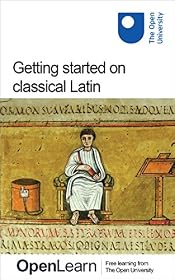
Getting Started on Classical Latin (an Open University course introduction) by Inga Mantle, James Robson and Jeremy Taylor - 2.5 stars
The first section of the book makes suggestions for language learning, and is only really relevant to someone who has never studied a foreign language.
The second is an introduction to the influence of Latin on modern English, both directly and indirectly. It included some examples that I did not know.
The third is on pronunciation, and requires the reader to access the version of the course on the university website, to be able to use the audio links.
The remaining two sections cover the technical vocabulary required to describe English grammar, and then apply this to Latin. This is rather well done, and should be a useful aid to anyone whose English grammar lessons at school went down the route of "naming words", "doing words"and "describing words", rather than teaching the standard terms for the parts of speech.
So this book was rather too basic to even satisfy my curiosity about current methodology. I finished it because it was an incredibly quick read.
However, what it does, it does well. As I said in the introduction, the ethos of the Open University is to plug gaps that might otherwise prevent someone from being able to use their courses. This one is designed to prevent a lack of formalism in how you were taught English from making it harder for you to learn Latin.
Helmet Reading Challenge: 43
Unfortunately I do not find the OpenLearn site easy to operate on my phone - it loads too slowly for my low-range device! But I recently discovered that some of these modules are now available as free Kindle books via Amazon.
Meanwhile, I realised that my Latin was getting out of practice. I have been using the app Duolingo to refresh, and possibly extend my vocabulary a little. I have been who wryly amused by
various monoglot Anglophones complaining irritably in the comments section about "why do different words mean the same thing?" and "where was the word for X in that sentence?"
So, feeling particularly brain-dead and unable to concentrate this afternoon, I was curious to see how the latest version of the Open University introductory Latin course explains the concepts that a) grammatical structure is not constant across all languages, b) inflection can take the place of words, and c) one language does not necessarily have a word that directly corresponds to the range of meanings that a particular word has in another:
Getting Started on Classical Latin (an Open University course introduction) by Inga Mantle, James Robson and Jeremy Taylor - 2.5 stars
The first section of the book makes suggestions for language learning, and is only really relevant to someone who has never studied a foreign language.
The second is an introduction to the influence of Latin on modern English, both directly and indirectly. It included some examples that I did not know.
The third is on pronunciation, and requires the reader to access the version of the course on the university website, to be able to use the audio links.
The remaining two sections cover the technical vocabulary required to describe English grammar, and then apply this to Latin. This is rather well done, and should be a useful aid to anyone whose English grammar lessons at school went down the route of "naming words", "doing words"and "describing words", rather than teaching the standard terms for the parts of speech.
So this book was rather too basic to even satisfy my curiosity about current methodology. I finished it because it was an incredibly quick read.
However, what it does, it does well. As I said in the introduction, the ethos of the Open University is to plug gaps that might otherwise prevent someone from being able to use their courses. This one is designed to prevent a lack of formalism in how you were taught English from making it harder for you to learn Latin.
Helmet Reading Challenge: 43
62clamairy
>55 jjwilson61: & >61 -pilgrim-: Thank you. I have not had time to check the LT Bugs group. Posting the dimensions will be a bit of a PITA (pain in the ass) because the ratio for all covers is not the same, but I guess that's small potatoes, as the old saying goes.
63jillmwo
>61 -pilgrim-: That's an interesting discovery. I will now go rummage about on Amazon to see what other titles Open University may be making available.
64hfglen
>61 -pilgrim-: An idle bit of 'satiable curtiosity: Do they give any biographical details of the Jeremy Taylor who co-authored that book? I ask because a gent of that name taught me Latin in what we then called Standard Six (= form 1, = 8th grade) in Johannesburg in the early '60s, and was brilliant at it. In his spare time he sang folk songs, more than a few of which he wrote himself, in a coffee bar. In the latter capacity he became locally and briefly famous for writing and performing Ag pleez deddy!.
65-pilgrim-
>64 hfglen: That is very interesting. There were no biographical details, other than a by-line of "The Open University".
Because the Open University is a distance learning institution, it employs "associate tutors" to hold tutorials, grade student coursework etc. They are not necessarily working as academics - some are retired from academia, and keeping their hand in, others have the academic background but actually have careers elsewhere. I have met Inga Mantle - she is also a singer, who also produces performances of classical works. (I have attended some at the Edinburgh Festival.)
So your former teacher's profession as a folk singer would not preclude him being an Open University tutor as well.
He seems to be mates with James Robson; they have written several things together. Robson does seem to be a traditional OU academic:
https://www.open.ac.uk/people/jer47.
Note: I would guess Dr Mantle to be about the same age as your guy.
So - no proof (except the negative one of no alternative biography findable). I suspect it may well be your former teacher.
Because the Open University is a distance learning institution, it employs "associate tutors" to hold tutorials, grade student coursework etc. They are not necessarily working as academics - some are retired from academia, and keeping their hand in, others have the academic background but actually have careers elsewhere. I have met Inga Mantle - she is also a singer, who also produces performances of classical works. (I have attended some at the Edinburgh Festival.)
So your former teacher's profession as a folk singer would not preclude him being an Open University tutor as well.
He seems to be mates with James Robson; they have written several things together. Robson does seem to be a traditional OU academic:
https://www.open.ac.uk/people/jer47.
Note: I would guess Dr Mantle to be about the same age as your guy.
So - no proof (except the negative one of no alternative biography findable). I suspect it may well be your former teacher.
66hfglen
>65 -pilgrim-: Your information is even more interesting! Many thanks.
I looked at Robson's publication list; somehow that seems to go with my quondam teacher's reputation in Johannesburg (MEEYOW!). The last I heard, he was living on a smallholding somewhere in the Magaliesberg (though Oxford-educated, which fits with the reputation of the Open University in this distant corner); he'd be about 80 if he's still in the land of the living.
I looked at Robson's publication list; somehow that seems to go with my quondam teacher's reputation in Johannesburg (MEEYOW!). The last I heard, he was living on a smallholding somewhere in the Magaliesberg (though Oxford-educated, which fits with the reputation of the Open University in this distant corner); he'd be about 80 if he's still in the land of the living.
67pgmcc
>66 hfglen: I have followed your comments about your former teacher and I am hoping it is the same person. That sort of coincidence always brings a smile to my face when I hear of it.
68-pilgrim-
>63 jillmwo: The Open University's introductory OpenLearn courses are also available from their own website. There are over 600 of them, all free. Registration for them is both free and optional.
However the Open University is really standing up and putting is money where its mouth is. There are a lit of meaty academic tomes published by them, the Kindle editions of which are currently purchasable free from Amazon UK.
My suspicion is that where the textbooks for courses are published by OUP, they are making them available in this way to compensate for the fact that public and university libraries have been closed due to the coronavirus legislation here.
However the Open University is really standing up and putting is money where its mouth is. There are a lit of meaty academic tomes published by them, the Kindle editions of which are currently purchasable free from Amazon UK.
My suspicion is that where the textbooks for courses are published by OUP, they are making them available in this way to compensate for the fact that public and university libraries have been closed due to the coronavirus legislation here.
69-pilgrim-
>62 clamairy: I have just tried replacing the picture in >41 -pilgrim-:, by exactly the same procedure as before. It now appears (to me) as normal sized.
70BookstoogeLT
>69 -pilgrim-: The picture appears to be the same size as the picture in your previous comment (#40). So it looks normal to me too.
71-pilgrim-
>70 BookstoogeLT: Good to hear. It sounds like whatever LT changed, they have now changed back.
72BookstoogeLT
>71 -pilgrim-: I guess those secret notes to Tim about nuclear destruction worked! ;-)
73-pilgrim-
>72 BookstoogeLT: I see that you are diversifying your criminal portfolio. I suppose extortion was a natural sequitur to your bank robbing career ;-)
74BookstoogeLT
>73 -pilgrim-: If I want to be the King of Crime, I have to keep a diverse portfolio :-D
and mad skillz....
Kings of Crime always need Mad Skillz...
and mad skillz....
Kings of Crime always need Mad Skillz...
75-pilgrim-
>74 BookstoogeLT: I suspect @Maddz' Skills would help too.
(Sorry @Maddz, but I think your database skills would improve our resident wannabe Hacker Robber King's chances! ;-) )
(Sorry @Maddz, but I think your database skills would improve our resident wannabe Hacker Robber King's chances! ;-) )
76BookstoogeLT
<75 Dang, I wish I had thought of that first. That is funny :-D
77Karlstar
>69 -pilgrim-: I'm on Firefox on windows and the image for me in >41 -pilgrim-: still won't show.
78-pilgrim-
>77 Karlstar: How are the other book covers for you Jim? Is it only >41 -pilgrim-: that is a problem?
79-pilgrim-

No Good Dragon Goes Unpunished (Book 3 of the Heartstrikers) by Rachel Aaron - 1.5 stars
Everything that I was complaining of the previous book is here again, just upped a level.
Julius is now responsible for the well-being of his entire clan. He has indentified that some of his siblings have been suffering from a brutal slavery for six hundred years, and only he is in a position to do anything about this. And, this being a dragon clan, having such influence means that other Heartstrikers are now trying to assassinate him on a multiple attempts per day basis.
So, the lad is finally not being ignored, has both power and responsibility and the chance to do some real good, along the lines of the ideals that he is always going on about. But is his priority using that power to help the oppressed? No, if course not. He states clearly that Marci is his priority, over any of that!
This confirms the impression that I have been getting that a lot - although by no means all - of the "niceness" that his siblings castigate Julius for is actually selfishness. He is a completely normal dragon in putting his wants before everything else: it is just that what he desires is not the same thing as most other dragons. While most dragons want gold, treasures and power, Julius wants not be stared at (he seems to have anxiety reactions in public), to have no one expecting anything from him, and to be left alone with HIS treasures: computer games, movie posters etc.
I am not sneering at him at all for having such a different set of desires. But not ruthlessly chasing the things that you don't want is not "being nice". And he is just as selfish about getting the things that he does want as any other dragon. I don't give him as many "brownie points" as the author apparently does for not ferociously murdering people he doesn't actually want to murder!
And is he at least devoting himself to someone who returns his devotion in equal measure? No. Marci is as ruthless as usual. Although she spends quite a lot of time obsessing about Julius, she makes it clear that her intellectual curiosity about magic and her desire for power come first, and she is prepared to take risks to achieve them - and if that causes Julius justifiable anxiety for her safety, then he just has to put up with that.
The supposedly competent ruling princess who spends all her time moping around after her adventurer lover, whilst he blithely goes off and did his thing is a very infuriating trope of bad fantasy/SF. It does not look any better when the genders are switched.
Other points:
This secret is never officially revealed by the end of the book, although the hints are so belaboured as to suggest that the author has a very low opinion of her readers'intelligence.
Apart from that one paragraph of crucial information - part from Chelsie, part from Julius' own knowledge that we have not been told about before - nothing new happened in terms of plot development until I was 48% through the book.
Why am I still reading? Some of the events in the second half of the book actually started to get interesting.
I genuinely have no idea what Bob is up to. I may be hugely disappointed in the reveal, when it comes, or there might be something interesting in here.
Helmet Reading Challenge: 33, 39
81-pilgrim-
>80 BookstoogeLT: There is also, unfortunately, the pain aspect. For much of the time recently, I have barely been able to think straight from the pain; I could not have followed the sort of book that I really enjoy. Something with familiar characters, and banal plot had its uses. (Yes, I could have tried a reread of an old favourite, but knowing what was about to happen would have weakened my focus.)
(There, that was the explanation no one would want to think about.)
(There, that was the explanation no one would want to think about.)
82BookstoogeLT
>81 -pilgrim-: Gotcha. That makes sense and if I had pieced together your various threads I'd probably have arrived at that conclusion. Thanks for the short cut...
83-pilgrim-
>82 BookstoogeLT: I try to keep the thread about my personal life separate from the one about books, because I know s lot of people don't like to think about the realities of what is happening to me, and I don't want them to avoid discussing books with me on that account.
84-pilgrim-

Head Case (Book 1 of Tom Mondrian) by Ross Armstrong - 3.5 stars
In December, Tom Mondrian had a very bad week. First of all, his intended proposal to his girlfriend did not work out as planned, and then his first week in the police - as a Police Community Support Officer, to be precise - ended with him being shot in the head by an unknown gunman.
Tom was not a particularly driven sort of chap; after a variety of jobs he had decided to try being a PCSO to give his life a bit of purpose, but mainly is interested in quiet domesticity and video gaming.
Taking a bullet to the head has consequences. The types of brain damage -
Having worked out that a girl has been abducted, Tom is determined to find her, despite the fact that this is definitely a job for the "real police". He has pushed to go back to work early, and so his superiors pair him with another PCSO, who comes from the London Turkish community.
The story is set in Tottenham, and contains something of the atmosphere of chaos, with gangs and violence summering just beneath the surface. It is the aftermath of the Tottenham riots that is used to justify the main implausibility in the plot: Tom Mondrian and Emre Bartu get away with a lot, without serious repercussions. The explanation is that Tom has been welcomed back, despite the understandable doubts regarding whether he can actually function in the police, by a force desperate to demonstrate how disability-friendly the modern police force is. It certainly does not want to get rid of a local hero, injured in the line of duty, or his ethnic minority partner... Image is important in modern policing.
The author has definitely made a serious attempt to understand how brain damage can affect personality.
Pre-accident Tom was the sort of guy who is sometimes dismissed as "too nice", with no real goals other than comfortable domesticity. The acquired inability to read tenders his previous pastimes obsolete, so that the focus that was previously introverted is now directed towards external things. And he has lost the "filter" that sensitive people apply before speaking: "what consequences will what I am about to say have? Will it hurt someone else? Will it have repercussions for me?"
The new version of Tom is not really a nice person. He is focussed to the point of selfishness - I felt that he was determined to solve the mystery because it angered him that he was not being allowed to, and he felt everyone else was too stupid to be able to, rather than out of sympathy for the victims. He observes emotions, but rather than eliciting empathy, he gleefully seizes on them as facets of character that he can use to manipulate the person he is dealing with.
His actions could be called heroic at times, but they are still all about him. I did not get the sense that other people mattered to him at all, except inasmuch as they could advance or block his plans.
This is rather chilling to watch, but it is an accurate portrayal of personality shifts noticed by those whose loved ones have received brain damage. (Note: I have no reason to believe this happens in every case, but it is a realistic portrayal of what happens in some.)
And to counterbalance that aspect, this was a moving portrayal of someone who has received what the police reports euphemistically call "life changing injuries", as he accepts that the injuries have permanently changed him, but is determined that he will use every opportunity he has to have the career that he now wants.
In contrast to many that I have tackled recently, this is a very well written book. Whilst Tom is now convinced that he is a superior being, who is better than his colleagues, the author lets us see that he actually makes mistakes like everyone else - just different ones.
Most of the subsidiary characters are rather flat - but that is because we are them through Tom's eyes. The mystery, although grim, is never trite - and it is clear that the author has sympathy where his character does not. There is some gore, but it is not there for shock value.
And I became rather fond of the long-suffering Emre Bartu. He is not portrayed as "different" because of his family background
Helmet Reading Challenge: 7, 30
85-pilgrim-
N.B.I believe Head Case has also been published with the title: The Girls Beneath.
I read it under the former title, which I think suits it admirably.
I read it under the former title, which I think suits it admirably.
86-pilgrim-

Do We Need Economic Inequality? (The Future of Capitalism series) by Danny Dorling - 1.5 stars
2/7/2020-28/7/2020
This has taken me a long time to read, because it is an incredibly frustrating book.
On the positive side, the author has gathered together some extremely interesting statistics, some of which I had no idea about:
e.g. life expectancy is falling in the USA.
and
some of which are not surprising, but it was interesting to see quantified:
e.g. there is a direct correlation between levels of income inequality within a country and the tendency for its population to vote for right-wing extremist parties.
But the discussion of the information is incredibly badly written. I have no idea what the audience is that the author thinks he is addressing. He spends some time, in detail, explaining how to read a graph, but then jumps to conclusions from it, with no explanation as to how he reaches them. He points out some outliers of interest, and gives what he thinks is the explanation for them - but completely ignores other, equally distinct, outliers.
And the reasoning that he does make from the data depends on completely unsupported statements. Even where I happen to think that they are probably correct, they are not incontestably so, and require corroboration. And sometimes they are quite obviously WRONG.
Statement: Taking responsibility is essentially enjoyable.
That is demonstrably false. Some people thrive on responsibility because it makes them feel they are achieving something, some enjoy it for the power kick, but there are also people who will do almost anything to avoid having to take responsibility for a decision. I am basing my assertion not just on the personal experience of knowing people who have turned down promotions because they have felt that the increased stress level caused by the greater responsibility was not worth the pay increase, but on the difficulty one experiences whenever one tries to get an official to make their own decision, rather than simply reciting their way through standard protocols: by following a pro forma protocol, even if it is likely to be harmful in this particular patient's case; they are safe in the knowledge that the harm that they do will not be their responsibility, and they find that greatly preferable to taking a decision, that, if something should go wrong, they will be held responsible for.
Of course he is correct in his statement that it is intensely unpleasant to have zero responsibility, and absolutely no control over one's work (although some people do prefer that, and like to switch off their thoughts from their work completely, do that they can concentrate on what is actually important to them, such as the plot of their next novel!) But by focussing on the two extremes, he creates a false contrast, and ignores the reality that for many people the ideal is somewhere in the middle - sufficient autonomy without too grave a responsibility.
Statement: it is the lowly paid nurse who deals with the sobbing patient at night... who have the harder jobs, .not the lauded surgeon... above them in the pecking order.
Obviously false. Snce, according to his previous statement, everyone wants to do the more responsible job, an (again according to him) being a surgeon is both more responsible than being a nurse AND easier (as well as better paid), why is the nurse not working as a surgeon? Why would they choose a job that, according to him, is worse paid, harder work AND less satisfying?
(That said, I wonder when he was last in a hospital. My own experience has been of trying myself to comfort other crying patients, whilst listening to the nurses sitting at their desks and laughing. Nurses nowadays see themselves seem to regard themselves as medical professionals, whose role is to administer medical procedures, not supply emotional support to patients.)
I cannot discuss here the validity of the points that this author makes, as this is definitely a book with a particular political standpoint.
But I do criticise the way in which he makes them. Such illogical reasoning, and demonstrably false symptoms, make poor use of the statistical evidence this book has assembled.
The information, and its discussion, is rambling and disorganised. Chapters ostensibly on the solution spend a third of their pages on more evidence for the problem. He jumps back and forward between discussing inequality between countries, and levels of Inequality within a country, so much that when he comments that such and such a country is particularly "unequal", one does not know what he means by this.
I was particularly interested by the early chapter on "the origins of inequality", but it was a complete disappointment. He points out that in the 18th century the Dutch were the most unequal nation - but then gives no explanation as to why the relative wealth of the Netherlands, compared to other European nations, produced Inequality within that country (which I think is what he is saying), which is the correlation that seems, if true, to be important.
He argues that the inequality between Britain and her former colonies is due to "colonial exploitation", but then cites a report on atrocities committed by the colonial administration in Kenya as "evidence". I have no reason to believe the report to be untrue, but this is a non sequitur. Commission of atrocities does not necessarily result in prosperity for perpetrators - Cambodia did not become richer under Pol Pot! Conversely, some of Britain's former colonies appear to be doing rather well...
The author is British, so the focus appears to be equally on the UK and the USA, but one of its positive aspects is its continued comparisons not only with Europe, but with South America and Asia (coverage on Africa, in contrast, is rather lacking).
This is another of those books written by an author who cannot really conceive of that fact that not everyone thinks like him. He accepts that there are the "greedy rich", who are "psychologically damaged" (because they obviously do not think and feel like him), but they are the demonised Other, and he assumes that amongst the rest of us, everyone is the same.
I think that is the problem with this book. He assumes that everyone already agrees with him - there can be no honest difference of opinion, only the like-minded and the liars. But if he truly believes that, what is the purpose of writing this book?
Nevertheless I actually do recommend reading this book, simply because the factual data collected in it is both interesting and thought-provoking. (I would certainly like to discuss it; but GD terms definitely would preclude that!) It just lacks an awful lot in the competence with which it is written.
Unless anyone can suggest a better discussion of the subject?
Helmet Reading Challenge: 43
87haydninvienna
>86 -pilgrim-: Suggestions (simply because I happen to know of them):The Impact of Inequality by Richard Wilkinson; The Spirit Level by Wilkinson and Kate Pickett; and anything by Ha-Joon Chang. I have (and have read) Economics: The User's Guide by Chang, and have (but have not read) Spirit Level. Might be time for the second one.
88-pilgrim-
>87 haydninvienna: Thank you, Richard. Those look interesting.
I continued with Dorling's book, despite its flaws, because the footnotes and references are excellent.
But the more I think about it, the more I am infuriated by Dorling. He produces the evidence to show that economic inequality correlates with increased numbers voting for ultranationalist parties, yet his tone divides society into "people like him" and "the greedy rich". He makes no attempt to address the people who, by voting for the far right, demonstrate that they do not already think like him, but see immigration control and Brexit as the solutions to economic inequality.
His concluding chapters on "reasons for optimism" seem based on some, not statistically significant, signs that things are changing in the opposite direction, plus the observation that, when things have become too unequal in the past, it results in political instability and violence, which redresses the balance. He obvious hopes that creation of the latter will "inevitably" cause governments and elites to change course. But since he also admits that the short-term aftermath is greater poverty, I hardly categorise this pattern as s positive thing!
I continued with Dorling's book, despite its flaws, because the footnotes and references are excellent.
But the more I think about it, the more I am infuriated by Dorling. He produces the evidence to show that economic inequality correlates with increased numbers voting for ultranationalist parties, yet his tone divides society into "people like him" and "the greedy rich". He makes no attempt to address the people who, by voting for the far right, demonstrate that they do not already think like him, but see immigration control and Brexit as the solutions to economic inequality.
His concluding chapters on "reasons for optimism" seem based on some, not statistically significant, signs that things are changing in the opposite direction, plus the observation that, when things have become too unequal in the past, it results in political instability and violence, which redresses the balance. He obvious hopes that creation of the latter will "inevitably" cause governments and elites to change course. But since he also admits that the short-term aftermath is greater poverty, I hardly categorise this pattern as s positive thing!
89-pilgrim-
July summary
Average rating: 1.9
8 fiction:
Novels: 5 urban fantasy, 1 crime fiction
Novella: 1 urban fantasy
Graphic novels: 1 superhero
2 non-fiction: 1 classics, 1 economics
Original language: 10 English
Earliest date of first publication: 2014 (Nice Dragons Finish Last)
Latest: 2020 (Night Shift Dragons)
7 Kindle, 1 audiobook, 1 softback, 1 paperback
Authors: 7 male, 2 female
Author nationality: 5 British, 2 American, 1 Spanish, 1 South African (?)
New (to me) authors: 7 (2 familiar)
Most popular book on LT: Nice Dragons Finish Last (272)
Least popular: Avengers Marvel Legacy Primer Pages (only me)
No. of books read: 10
From Mount TBR (books owned before 2020): 2
Books owned before joining Green Dragon: 2
No. of books acquired: ??
No. of books disposed of: 5
Best Book of July: Head Case
Worst Book of July: No Good Dragon Goes Unpunished
Average rating: 1.9
8 fiction:
Novels: 5 urban fantasy, 1 crime fiction
Novella: 1 urban fantasy
Graphic novels: 1 superhero
2 non-fiction: 1 classics, 1 economics
Original language: 10 English
Earliest date of first publication: 2014 (Nice Dragons Finish Last)
Latest: 2020 (Night Shift Dragons)
7 Kindle, 1 audiobook, 1 softback, 1 paperback
Authors: 7 male, 2 female
Author nationality: 5 British, 2 American, 1 Spanish, 1 South African (?)
New (to me) authors: 7 (2 familiar)
Most popular book on LT: Nice Dragons Finish Last (272)
Least popular: Avengers Marvel Legacy Primer Pages (only me)
No. of books read: 10
From Mount TBR (books owned before 2020): 2
Books owned before joining Green Dragon: 2
No. of books acquired: ??
No. of books disposed of: 5
Best Book of July: Head Case
Worst Book of July: No Good Dragon Goes Unpunished
90jillmwo
>89 -pilgrim-: Interesting summation of your month!
91-pilgrim-
>90 jillmwo: And my worst reading month average since I started noting these!
In contrast with June, which was a mixture of books I loved with ones that I loathed, equally passionately, July was mainly a stream of mediocrity.
Head Case was not that brilliant, but did stand out as a sort of police procedural that did make a serious attempt at doing something different, inasmuch as it looked seriously on the effects of head injury.
In contrast with June, which was a mixture of books I loved with ones that I loathed, equally passionately, July was mainly a stream of mediocrity.
Head Case was not that brilliant, but did stand out as a sort of police procedural that did make a serious attempt at doing something different, inasmuch as it looked seriously on the effects of head injury.
92BookstoogeLT
>89 -pilgrim-: When a 3.5star book is the best of the month, you know it wasn't a good one :-)
Any chance of August being better or do you think it'll be more of the same?
Any chance of August being better or do you think it'll be more of the same?
93jillmwo
>91 -pilgrim-: *thumbs up* for the details and clarification. Thanks.
94-pilgrim-
>92 BookstoogeLT: I should probably reiterate that 2.50 is average - i.e. a book that I am happy enough to have read, but do not expect to want to do so again.
Am wondering how much my problem was staying in the Anglosphere... but current Russian novel is very strange (even by Russian literary fiction standards!)
Am wondering how much my problem was staying in the Anglosphere... but current Russian novel is very strange (even by Russian literary fiction standards!)
95BookstoogeLT
>94 -pilgrim-: What does it take to get a 5star out of you then? I'm lucky to get a handful or so of 5 stars a year, but I do know that I'm a hard grader. But my average is in the mid to high 3's
96clamairy
>92 BookstoogeLT: & >94 -pilgrim-: Yes, I discovered early on that what one considers a 2.5 varies widely across LT. I actually will rarely finish something that feels like a 2.5 or less unless others that I know have raved about it. In general I won't even start something that I see has an average rating less than (approximately) 3.75 here on LT. I feel like my reading time has gotten more precious as I've gotten older, and I don't want to fritter it away on books I'm not loving or books that aren't teaching me something important. Am I missing some gems? Yup. I can live with that.
97-pilgrim-
>95 BookstoogeLT:, >96 clamairy: To alleviate confusion, I have re-added my rating system to >2 -pilgrim-: (above). I last posted it early in 2019, so it seems worth bringing it forward.
>95 BookstoogeLT:
My 5 star read so far this year was Monday Starts on Saturday by the Strugatsky brothers.
>95 BookstoogeLT:
My 5 star read so far this year was Monday Starts on Saturday by the Strugatsky brothers.
98Karlstar
>97 -pilgrim-: Thanks for the details on your rating system! I probably wouldn't have picked up anything you rated 2 stars or lower anyway, as it would be of questionable quality, but now I know for sure. I thought I was a bit tough on ratings, but you are a better judge of many writing nuances than I am, I go more by 'feel'.
My browser still won't show any of the images in your posts.
My browser still won't show any of the images in your posts.
99-pilgrim-
>98 Karlstar: I would not actually say "don't pick up one of my 2 star ratings". They can be passable - so worth reading if either a poor start, or a mid-series dip in a series that was otherwise better than that. Anything below that is likely to be painful.
I have no idea why you are having browser trouble with my images. I link to the https: pages, and am using Firefox.
FWIW, how do you fare with my Picture Gallery?
I have no idea why you are having browser trouble with my images. I link to the https: pages, and am using Firefox.
FWIW, how do you fare with my Picture Gallery?
100-pilgrim-

A Dragon of a Different Color (Book 4 of the Heartstrikers ) by Rachel Aaron - 2 stars
Started: 16/7/2020
After an adequate start, this series had been fairly poor. I persisted because I had found the second sequence, The DFZ better, and was interested in how this sequence ended to get to that starting position. (Also, @Narilka liked it - which has made me feel bad about trashing it.)
Now the standard has been picking up a bit - perhaps because Marci and Julius are not together for most of it! This is still not a good book; there is still a lot of slowly meandering through people's thoughts, where these are completely predictable. Thankfully Julius the "intelligent' dragon had finally worked out the Great Secret that was blindingly obvious over a book ago - even though numerous others have worked out out first!
But there were some interesting plot developments, and more explanation of the magic and what is actually going on with all the Seer plotting. One thing I do like about this series is its taking seriously the consequences of what happens if you have multiple seers, all viewing the future, and then trying to use their foreknowledge to manipulate it.
The book also did not fall down the
But I am still horrified by Marci -
I admit that my dislike is fuelled by the author's conception of life after death: in her world, the essence of self persists only for as long as that person is remembered, and the size and quality of the space which they then have available to occupy is determined by how deep an impression they made on others. As they are forgotten, the space shrinks, until there is nothing left to protect them from being ripped apart by the raw tides of the Sea of Magic.
I think this rates as one of the nastier concepts regarding what happens after death that I have come across - neither hope nor oblivion, but suffering only limited not by the value of your deeds during your lifetime, but the degree to which you impressed yourself on others. On the one hand, this explains why everyone in these novels is so obsessed with personal fame and reputation, and it also explains the otherwise puzzling concept of the dragon groupies - why would one scramble to be a dragon's "pet human" (at risk of being eaten)? Because dragons live a long time, and so you will have a long afterlife!
But this is a morality scheme which gives Hitler and Genghis Khan the best fate after death - humanity tends to remember its oppressors rather better than it does its heroes!
There is actually a running theme as to whether humanity is getting better or worse, as part of the plot of this book. The author seems to assume that the former is true, but she actually puts more convincing arguments into the mouths of characters who are more pessimistic - until inspired to hope by
The author is finally showing some signs of the level of interest, in plot inventiveness, that persuaded me to start this sequence, having read is successor, The DFZ. But it has been something of a slog to get here.
There was only one egregious example of misuse of language that I picked up this time - a reference to a Chinese cleaning squad, who are efficient but not noticeably suicidal, as "kamikaze". Still it gets bonus points for offensiveness - given how China suffered under the Japanese before and during World War II, applying the term for Japanese suicide pilots to any ethnic Chinese takes a special level of tactlessness!
Helmet Reading Challenge: 24, 33, 39
101Karlstar
>99 -pilgrim-: I can see 7 pictures in your gallery, all of them show just fine.
102BookstoogeLT
>97 -pilgrim-: Great! thanks for adding that :-D
103-pilgrim-
>101 Karlstar: I used the same method there. So it looks like your problem is an incompatibility with accessing the source pages - for the book covers I am using the ones provided by LT, which seem to link to Amazon.com jpg images.
104libraryperilous
Marking so I don't get behind on your thread again.
I am sorry to hear you are in pain and also that the books you've chosen to help you through have been a bit, shall we say, lacking.
I am sorry to hear you are in pain and also that the books you've chosen to help you through have been a bit, shall we say, lacking.
105Narilka
>100 -pilgrim-: Don't feel too bad. It's not like I wrote the books you aren't loving :) I'm more surprised you kept going and didn't dump the series since it didn't seem to really be working for you.
106-pilgrim-
>105 Narilka: Two motivations against dumping:
finding out how the end of this sequence sets up the situation found in The DFZ (I am a sucker for knowing how something ends!)
needing something that was not emotionally involving as counterbalance, whilst reading a probably brilliant, but intensely depressing, Russian novel!
108-pilgrim-

A Simple Soul by Vadim Babenko (trans. by Vadim Babenko and Christopher Lovelace) - 4 stars
Started: 2015; restarted: 23/7/2020
After reading a lot of unsatisfying mediocre writing recently, I have finally completed something with some substance to it; something that will stay in my mind for a while. Unfortunately, it is not cheering.
I have several times been invited to try "the modern American novel", and each time I have been repelled by the world view of the protagonists - they live in a world of constant hustling, where everyone is trying to "get ahead", to "get one over" on someone else, and prove in that way that the fall guy in their life is someone other than themselves. No one is likeable and everyone is doomed to unhappiness by their total selfishness. I have no idea whether it is an accurate portrayal of urban America, but it is a depressing one.
A Simple Soul is a portrayal of modern Russia - and I was struck with how much the country, in the era represented, was trying to to turn itself into America. But America at its worst. Here too, everyone wears a mask, everyone is hustling, and trying to make sure that the fall guy is not them.
But whereas the American selfishness is externally directed towards conspicuous success, as measured in terms of money and fame, the Russians are all obsessing about their inner lives, and the meaning of their existence. The bleakness of Dostoevsky is as prevalent here, except that, having taken God out of the picture, to be replaced with an obsession with fortune-telling, or implacable "higher powers", there are no longer even the offered possibilities of redemption, hinted at in Dostoevsky's implacable and immutable faith.
Most of the characters in this book think of themselves as higher beings; unlike the generality of the population they are concerned with deeper issues. But in pursuit of these, they ruthlessly sacrifice relationships, friendships, and even themselves; they throw away everything that gives life meaning in their search for the meaning of life.
The book follows the main characters in turn. They do not all meet until the end. And half way through, very little had actually happened - apart from Timofey's bizarre approach to winning back the girl that he threw over cruelly, because he got humiliated and hospitalised in an incident that had nothing to do with her. (And his motivation now is purely pragmatic
Then, this being Russia, there is also kidnapping, corruption, extortion, forgery and chaos. But this is all somewhat incidental to the existential crises going on in most of the characters. And it is not exactly correct to call the results of their moral confusion a crisis either when it produces no resolution; they just shrug, drink, have sex, and go on as they did before.
This is the "eternal" nature of Russia; it is so vast, that all events seem insignificant in comparison.
Sometimes the men seem desperate in their "love" for a woman. But that does not involve relating to her as a person, or even attempting to understand her as a person. They worship women as "forces of nature", and the embodiment of some spiritual essence. But they never relate to them as a meeting of minds - even when the women are acknowledged as intelligent, extremely professionally competent, and as interested in the same topics as preoccupy the menfolk, they are never considered as companions in the struggle with life, but simply as objects to be used or discarded depending on whether they appear to be furthering or discouraging the state of mind in the man that will help him achieve his goals. You get a car, you get a woman - what's the difference? This is a world where a man can follow a woman hundreds of miles, because he cannot bear the thought of life without her - yet sleep with a stranger, whilst she is in danger, "to pass the time".
The women expect no better treatment. They revenge themselves by plotting to manipulate the men, or abusing men who appear actually devoted, to give themselves the illusion of agency.
One of the characters is American, whose schooldays were in the Soviet Union. It left him with a love for the country, and a sense of not fitting in in America, so he returns, shyly, to seek his ideal of a Russian woman
The author was a successful Soviet scientist in the field of artificial intelligence, a member of the Soviet Academy of Sciences, who became then became a successful tech entrepreneur in America, but threw it all up to move to Europe and write. An ambivalent attitude to America, of both attraction and disgust, comes through.
In his blog there is a telling story about petty corruption that he encountered in leaving Russia, and his determination never to return. This is a man whose memories are of the Soviet Union as an ailing monolith, rather than an oppressive regime, although with full awareness of the dark fates that can befall you if you took the wrong turning - or simply had bad luck.
Yet the Russia that has replaced it is even more corrupt, and dangerous in unpredictable ways. The hopeless fatalism has been replaced by a soulless striving for the unattainable, and ultimately unsatisfying, in Moscow, "as in all big cities", whilst the provinces are left hopeless and stagnating, as Moscow draws away all that is energetic and hopeful, leaving what remains as vast and unchanging as the Volga.
The last time I encountered a portrayal of modern provincial life was in the film by Aleksei Balabanov, Cargo 200, which was set during the Afghanistan war. This is is three decades later, but the grim futility remains. People are trying to get one over on each other out in the steppes too, just more simply, without the energy and the expectations.
At the end, the character who has retired to the provinces to write (Astakhov) starts a new novel; it is called Semnant - just like Babenko's next novel. ("Semnant" is an invented word, with no meaning in Russian or English.) But the author seems present in his other characters too - particularly in Kramskoy, Astakhov's friends, the Soviet scientist who makes a fortune by selling the results of his colleagues' labours to "gullible Europeans", but then eschews the path of using the money to attempt further advancement, in favour of focussing on the "important issues" of meaning, and purpose.
All the characters here are well-drawn, realistic and plausible. You pity them, until that you see that the petty cruelties that oppress their lives are the same as they themselves inflict.
All are obsessed with goals, except Elizaveta, the central female character. She is the "simple soul", who does not have any of these mad dreams.
In the final pages, two characters leave together for Moscow. Will their desire to do something together give them a chance at happiness? Or is the merry-go-round simply starting again? Who knows.
This is a well- written book, with convincing and compelling characters.
Its bleakness is such that it fills one with an overwhelming urge to drink a huge quantity of vodka, contemplate the essential futility of existence, and then go home and blow one's brains out.
Helmet Reading Challenge: 7, 25, 35
109BookstoogeLT
>107 -pilgrim-: From the fact that you posted this review, I'm guessing you didn't drink huge quantities of vodka and then blow your brains out.
What you described at the beginning about the "american novel" is exactly why I rarely read in the modern "literature" genre. Ugh.
Glad this had some substance, but not glad the substance seemed to be vodka ;-)
What you described at the beginning about the "american novel" is exactly why I rarely read in the modern "literature" genre. Ugh.
Glad this had some substance, but not glad the substance seemed to be vodka ;-)
110-pilgrim-
>109 BookstoogeLT: The option is somewhat foiled by the fact that, not living in Russia, I have neither vodka nor a firearm in my house.
Just as well really.
Just as well really.
111BookstoogeLT
>110 -pilgrim-: I don't know much of anything about alcohol but I was under the impression that vodka could be bought anywhere, kind of like beer? Or is it more related to your specific circumstances?
I'd love to go into the gun side of things, but at least here in the US the subject of gun control is so fraught with politics that is impossible to separate them even when you want to. sigh.
I'd love to go into the gun side of things, but at least here in the US the subject of gun control is so fraught with politics that is impossible to separate them even when you want to. sigh.
112-pilgrim-
>111 BookstoogeLT:
I actually don't drink alcohol (communion wine excepted). It is not a moral prohibition - it just does not go particularly well with medications - so I will consume in circumstances where not to do so would give offence (e.g. a toast) but I don't keep any in the house.
Gun licensing laws here do not have any level of political controversy here. It is relatively simple to apply, providing that you can prove the following:
you have the facilities available to store both weapon and ammunition safely
you can provide certification from GP that you are of sound mind (i.e. not planning to blow your brains out!)
you can provide a valid reason for owning a firearm.
It is the last clause that stops most people from applying. Hunting is a valid reason, as is competitive shooting, but "home defence" is NOT.
Handguns are completely forbidden to members of the public. (After the Dunblane massacre, where a man shot 16 primary school children, and their teacher, using licensed weapons.) So the whole "concealed or open carry" question does not apply here - it is not exactly feasible to conceal carrying a rifle or shotgun!
I realise any discussion of these differences will dump us straight into the political quagmire, but you were expressing interest as to what the situation here actually is, so I thought I would state it.
(Unlike many countries, we also have laws controlling the carrying of knives and other edged weapons - which is worth remembering if you are an outdoors type. The ubiquitous Swiss knife of my childhood is actually no longer a legal carry.)
Incidentally, as I understand it, Russian gun licensing laws are also pretty strict, the number of hunters notwithstanding. The problem is that laxity at military bases during the last years of the Soviet Union means that the quantity of illegal weaponry in circulation far outnumbers the licensed weapons!
I actually don't drink alcohol (communion wine excepted). It is not a moral prohibition - it just does not go particularly well with medications - so I will consume in circumstances where not to do so would give offence (e.g. a toast) but I don't keep any in the house.
Gun licensing laws here do not have any level of political controversy here. It is relatively simple to apply, providing that you can prove the following:
It is the last clause that stops most people from applying. Hunting is a valid reason, as is competitive shooting, but "home defence" is NOT.
Handguns are completely forbidden to members of the public. (After the Dunblane massacre, where a man shot 16 primary school children, and their teacher, using licensed weapons.) So the whole "concealed or open carry" question does not apply here - it is not exactly feasible to conceal carrying a rifle or shotgun!
I realise any discussion of these differences will dump us straight into the political quagmire, but you were expressing interest as to what the situation here actually is, so I thought I would state it.
(Unlike many countries, we also have laws controlling the carrying of knives and other edged weapons - which is worth remembering if you are an outdoors type. The ubiquitous Swiss knife of my childhood is actually no longer a legal carry.)
Incidentally, as I understand it, Russian gun licensing laws are also pretty strict, the number of hunters notwithstanding. The problem is that laxity at military bases during the last years of the Soviet Union means that the quantity of illegal weaponry in circulation far outnumbers the licensed weapons!
113Karlstar
>112 -pilgrim-: Without getting into politics, isn't the restriction of not being able to carry a pocketknife going a bit far? I realize in this day and age, they aren't a daily necessity - unless you routinely get packages that may require a knife to open, for example. Those knives also have other tools that are very useful.
114Kanarthi
>113 Karlstar: I looked it up, and pocketknives seem to be legal in Britain so long as they (1) are less than three inches long and (2) have blades which can't lock into position.
115Karlstar
>114 Kanarthi: That's definitely 3 inches AND not locking? Isn't a blade that short that doesn't lock actually dangerous to the user? Do you think it applies to multi-tools that also have knife blades?
116BookstoogeLT
>112 -pilgrim-: Thanks! I figured if anyone could talk about the subject without getting into the politics, you could. Glad my expectations were justified ;-)
If we're to believe the movies (obviously not, but you know....), briefcase nukes are as plentiful as handguns in Russia. Ahhh, movieland.....
>114 Kanarthi: & >115 Karlstar: I'd assume it applies to anything with a folding blade. And I'm assuming that 3inches applies to the entire knife, not just the blade. I'm guessing it is a rule against concealment?
If we're to believe the movies (obviously not, but you know....), briefcase nukes are as plentiful as handguns in Russia. Ahhh, movieland.....
>114 Kanarthi: & >115 Karlstar: I'd assume it applies to anything with a folding blade. And I'm assuming that 3inches applies to the entire knife, not just the blade. I'm guessing it is a rule against concealment?
117-pilgrim-
>116 BookstoogeLT: If you want some idea of the scale of "leakage" from Soviet military bases during the Chechen wars, I actually heartily recommend the autobiography by Arkady Babchenko, One Soldier's War.
(He is currently persona non grata in his Motherland, for being somewhat outspoken journalist, but his original major theme was the fate of Russia's conscript soldiers - both during their service and in the lack of provision for disabled veterans.)
We have always had laws in the UK against switchblades, flick-knives and swordsticks. So yes, I think concealment is the issue there. The legislation regarding other blades was a rather rushed, high-profile issue in the nineties.
(He is currently persona non grata in his Motherland, for being somewhat outspoken journalist, but his original major theme was the fate of Russia's conscript soldiers - both during their service and in the lack of provision for disabled veterans.)
We have always had laws in the UK against switchblades, flick-knives and swordsticks. So yes, I think concealment is the issue there. The legislation regarding other blades was a rather rushed, high-profile issue in the nineties.
118-pilgrim-
>113 Karlstar: In implementation, the police are usually quite reasonable; there is unofficially something known as "the five minute rule": if a knife is being transported on your person in such a manner that it would take you more than five minutes to free it and engage in combat, it is accepted that you are "transporting" the blade, as opposed to "carrying" it. (That once was explained to me by a mountaineering friend, when explaining how to get one's ice axes to the mountain.)
119Karlstar
>116 BookstoogeLT: >118 -pilgrim-: I'm wondering about the folding blade part. Looking at my swiss army knife (small one) last night vs. my Stanley multitool. Technically, the swiss army knife is a friction folder, the blade does not mechanically lock in place. My Stanley multi-tool is a blocky, awkward thing with a blade shorter than the rest of the tool, but the blade does mechanically lock in place. Note that neither of them would classify as a switchblade or other combat type knife, they are tools.
I wouldn't ever travel with either one, though I think my multi-tool in my car does have a knife blade. Would they really give me trouble about something so cumbersome and so obviously a tool?
I wouldn't ever travel with either one, though I think my multi-tool in my car does have a knife blade. Would they really give me trouble about something so cumbersome and so obviously a tool?
120BookstoogeLT
>117 -pilgrim-: I'll add that book by Babchenko to my amazon wishlist. Otherwise I'll forget about it :-)
121BookstoogeLT
>119 Karlstar: Well, I don't know about in the UK, but they sure would confiscate them at US airports...
122Karlstar
>121 BookstoogeLT: Right, which is why I would never fly with them, but now I'm wondering if I should remove that multi-tool when crossing the Canadian border.
123BookstoogeLT
>122 Karlstar: Eh, pack it away in your luggage. Always better to have it and not need it (and to ask for forgiveness) than not.
Of course, I'm not the one actually making the decision, or being affected, so take the previous statement VERY lightly :-D -D :-D
Of course, I'm not the one actually making the decision, or being affected, so take the previous statement VERY lightly :-D -D :-D
124-pilgrim-

Coronavirus: a book for children by Elizabeth Jenner, Nia Roberts and Kate Wilson (Illus. by Axel Scheffler) - 2 stars
Started: 3/6/2020
Finished: 5/8/2020
This is a book for children, explaining what coronavirus is, what they should do, and why the current restrictions are in place. In terms of the rules and regulations, it is aimed firmly at British children. It does not even address the fact that these vary between the countries of the United Kingdom.
It struck a good balance between indicating that the situation is serious and emphasising that most people who catch the coronavirus do not become seriously ill.
However there were several simplifications that l thought were harmful:
Children have died of the virus. To suggest, by implication, that if they have no vulnerable relatives to protect, there is no reason that they need to be careful, is rather irresponsible.
The illustrations accompanying the explanation about the need to protect those who are particularly vulnerable clearly show only elderly people.
The fallacy that only the elderly fall into the "shielding" category who are particularly vulnerable, and around whom particular precautions are necessary, is dangerous. Autoimmune compromising illnesses, and genetic conditions, v affect all age groups.
It is important that children understand that some of their classmates may also be in the "extremely vulnerable" category - even if their conditions are well-managed and do not normally affect either their appearance or behaviour.
Disability= uses wheelchair or walking aid is an extremely harmful stereotype to perpetuate in this context.
Although this error probably has no practical consequences, I still feel it is unhealthy to give children false statements on scientific matters.
The book makes no mention of the increased risks to the BAME community, although this may be because that knowledge was not yet available when it was written.
I feel that a book like this is probably very helpful for explaining to children what is going on, particularly if the adults in their lives are feeling too overwhelmed by the situation to address the issues properly with them.
But, since this will mainly, I think, be used by children who are not getting sufficient information from the people around them, then the misleading omissions are concerning.
125-pilgrim-

Last Dragon Standing (Book 5 of Heartstrikers) by Rachel Aaron - 2.5 stars
Started: 3/8/2020
This is the last book in the series, and, to a certain extent, it justified my persistence.
I noticed that the previous book was considerably darker than the early ones, in terms of something really horrible being done to one character. This darker tone persisted in this book, as all the machinations of the previous books lead up to a truly apocalyptic climax.
The inventiveness that I enjoyed withThe DFZ series is finally in evidence, although I never found the explanations completely satisfactory (on the other hand, I was running a low fever for most of the time that I was reading this, do the problem may have been partly me!) I had the feeling that the author had not worked out her magic system before starting to write this series, and was pulling "the rules of magic are X, but that can now be broken, because of Y" solutions out of thin air.
I also felt that their was a certain amount of retconning established situations, in order to make all the characters more likeable people. Bethesda Heartstriker, a dragon who EATS her own children when they annoy her, or seem too weak, for example, in this book comes across as self-centred, manipulative and psychologically cruel - but basically àn abusive parent in the human sense, not in the filicidal one! Julius "realises' that siblings who tortured him through his childhood "loved him really", and so on. Marci explicitly repents earlier vicious murderousness.
There is even an overt "message" of how "even the most horrible people would really prefer to get along with each other".
My impression is that as the author starts to mature as a writer, she has also been maturing as a person, and is slightly embarrassed by the "the world is a horrible place, people get by by screwing one another over, and the smart people are the ones who realise this and get with the program" ethos of the earlier books.
However, substituting a selfish ethic with preaching about world harmony does not make the nicer worldview automatically psychologically plausible.
The other ethic that is automatically assumed us that "capitalism is good". That the DFZ now helps people "provided you pay her, of course" is taken s evidence of her current healthy psychological state.
I am not proposing to discuss the ethics of capitalism here; what I wanted to point out was how bizarre it was to listen to an author for whom the "greed is good" Gordon Gecko approach to life is so self-evidently "correct" that she does not think it even warrants debate.
This book is devoted to setting up and discussing "moral questions" about "how the world should be, and how people should behave towards each other" - all in the context of pretty high-powered peril - so noting the base assumptions was fascinating.
The author's comprehension of the English language also seems to be improving - Al though she still send to think that an epitaph is a phrase that people say about a living person (possibly she means epigram?). We are starting from a pretty abysmal standard, after all.
This book, and the The DFZ, give me the impression that the author has sufficient inventiveness and originality to eventually become a reasonably interesting author.
However, to do that, she really needs totake some English lessons herself, rather than making money by presuming to give them
And, despite the overt message in this book, her "selfishness is normal and correct" ethos means I that I probably will not be returning to this author.
I can accept characters who make hard choices in a hard world. But the "and this is what is so wonderful about America!" attitude towards ruthless selfishness was something that I found rather nauseating.
Helmet Reading Challenge: 9, 24, 30, 33, 39
126-pilgrim-

Eastern Orthodox Christianity: A Western Perspective by Daniel B. Clendenin - DNF
Started: 16/8/2020
The subtitle is misleading; this should really be "an American perspective". The preface to the second edition opens with the following:
For far too long Christians generally have thought of our extended family as limited to either Catholic or Protestant communities
That sits very strangely when coming from a Western European country whose state church has been in dialogue with the Orthodox Church since it broke with Rome, and has had formal relations via the Fellowship of St Alban and St Sergius since the early twentieth century.
The Orthodox in Britain are very much a minority, but our religious education covers the Great Schism. We may not, in general, know much about the specifics of Orthodox belief, but the concept of somehow erasing the second largest Christian denomination (worldwide) from Christian history was astounding to me.
Yet, according to the author (who is an American Protestant), Americans, as a whole, are this ignorant. In support of this, he cites the fact that during World War II, American Orthodox soldiers were classified as "Protestant" on their dog-tags! (And this is despite Orthodoxy being the fourth largest Christian denomination in America.)
It is very firmly this audience that the author is addressing, rather than "the Western Church", as he claims. Furthermore, he seems to identify the "us" that he is addressing as American Protestants, and specifically those of the Evangelical persuasion. Often he sees as specifically Orthodox, views that are shared with the Roman Catholic and Anglican traditions.
However, his attitude to Orthodoxy is open-minded; he is sympathetic to the Evangelical Protestants who have converted to Orthodoxy, notably the parish led by Peter Gilquist. Thee author spent several years teaching religious studies in the Department of Scientific Atheism of Moscow State University in the nineties. However this does cause him at times to equate Orthodoxy with the Russian Orthodox Church.
My impression is that this is probably a good introduction to the Orthodox tradition for American Protestants.
Once you realise that his target audience is not what it purports to be - Western Christianity - but rather the specific subset from which he himself comes, then this book does what it sets out to do.
But the neglect of other traditions that are neither Russian Orthodox nor American Protestant limits its value to a wider audience.
For myself, it is the American Protestant tradition that is unfamiliar. But I do not feel confident that the comparisons in this book will teach me the full range of views within this tradition, any more than it addresses the diversity of Orthodox theology.
(Reading The Civil War as a Theological Crisis taught me not to make the mistake of requesting American Protestant churches with equivalently named denominations as they exist in Britain.)
I am not going to give this a star rating, as its value varies depending on your starting point (in terms of background knowledge).
I am also not intending to continue with this myself.
127-pilgrim-
>124 -pilgrim-: I thought it worth mentioning that no one was paid for the creation of this free eBook. Everyone donated their work for free - and that includes Professor Graham Medley, from the British government's SAGE (Scientific Advisory Group for Emergencies) committee on the coronavirus, who read the book for accuracy over a weekend.
128-pilgrim-
The combination of deteriorating health and a plethora of practical issues means that the amount that I have been reading has drastically declined. I still do not get on well with Audiobooks; however I have listened to a few radio plays.
129-pilgrim-
♪♪ Paul Temple and the Conrad Case by Francis Durbridge - 2.5 stars
I listened to this as a serialised BBC radio play. It was originally broadcast in March 1959.
In contrast to the description in the blurb quoted by @RuneFirestar here, I did not find the social class of the protagonist made any impact. Obviously, Paul Temple is of independent means, since the police could ask him to travel to a foreign country for an indefinite period to "look into something", without raising the issue of money, even to the extent of covering his expenses. There is also Charlie, waiting for them back at home, but replace "manservant" with "P. A." and there is really no difference from the modern successful male, who requires a factotum.
I actually found Paul, and his wife, the "glamorous" Steve, to be rather bland and dull. There was nothing distinctive about their personalities; although it made a change to see a happily married couple, who work together as a team, without the author finding it necessary to create "tension" in the relationship.
The plot, set in the world of exclusive finishing schools for young ladies, was satisfyingly complex. My only quibble was that it relied heavily on a lengthy exposition at the end, in the manner of Poirot (although without the assembly of suspects).
I listened to this as a serialised BBC radio play. It was originally broadcast in March 1959.
In contrast to the description in the blurb quoted by @RuneFirestar here, I did not find the social class of the protagonist made any impact. Obviously, Paul Temple is of independent means, since the police could ask him to travel to a foreign country for an indefinite period to "look into something", without raising the issue of money, even to the extent of covering his expenses. There is also Charlie, waiting for them back at home, but replace "manservant" with "P. A." and there is really no difference from the modern successful male, who requires a factotum.
I actually found Paul, and his wife, the "glamorous" Steve, to be rather bland and dull. There was nothing distinctive about their personalities; although it made a change to see a happily married couple, who work together as a team, without the author finding it necessary to create "tension" in the relationship.
The plot, set in the world of exclusive finishing schools for young ladies, was satisfyingly complex. My only quibble was that it relied heavily on a lengthy exposition at the end, in the manner of Poirot (although without the assembly of suspects).
130BookstoogeLT
>128 -pilgrim-: At least you're not still reading those "dragon" books....
.....or are you?
.....or are you?
131-pilgrim-
>130 BookstoogeLT: No, I reviewed the last one at >125 -pilgrim-:.
It did make it worth sticking it out. Well, sort of.
It did make it worth sticking it out. Well, sort of.
132-pilgrim-

The Dresden Files - TV series - 2.5 stars (various writers and directors)
The first 6 episodes of this TV series were a completely banal urban fantasy TV drama. A modern magical practitioner with a set of undefined magical powers, always happens to have one which conveniently solves reach episode's problems, allowing him to have sec with a range of beautiful women, who he then moves on from, in order to "protect them from involvement in his tragic fate".
Meanwhile the tough police officer whom he appears to have a thing for (despite the numerous other women rotating through his life and bred), is completely inconsistent in her vacillations between trusting him and believing that he had powers that she cannot explain, to being extremely sceptical, to the extent of doubting whether he is, in fact, a good guy at all. She sees things that she cannot explain, defend him from her colleagues' scepticism, then good back to suspecting him off being a shyster, or even a suspect.
I stuck with this for 3 reasons:
The series of books on which this is based has been getting a lot of love from the people here at GD;
I like the lead actor, Paul Blackthorne. He has turned in heartfelt, nuanced performances as a troubled, but decent guy, as a supporting actor in a lot of series that I have seen, so it was nice to see him get a lead role. I found his performance here a good as ever; he just was not being given much to work with;
possibly most significantly - I have been feeling pretty rough for most of the past few weeks, and I am not sure my brain could have coped with anything that actually had any complexity or depth!
The 7th Episode, Storm Front, appears to relate to the first book, that shares its name and plot. Apparently it was "originally shown as the pilot". And this was where everything clicked into place: I have been watching yet another TV show ruined by studio executives.
It has obviously been shown out of order.
Murphy's relationship with Dresden evolves over the series, so reordering it makes her behaviour appear irrational and inconsistent.
And that episode, and the ones that follow, lay the back story, and the ground rules of Harry's magic, and the backstory of various relationships.
From then on this is actually quite a good series. It is not a great or groundbreaking one, but it has internal logic and emotional heart, and was enjoyable.
I wish it had continued, but I can see why it did not. Apparently there are some significant changes from the books. And the first episodes shown are so bland that I can see that most casual viewers would have drifted away before the season showed any quality.
133BookstoogeLT
>132 -pilgrim-: If it helps your evaluations any, I hated the Dresden files books and I really tried to like them, reading up through book 11. then I wised up and realized Harry was a whiny pants baby and wasn't ever going to change.
I loved Butcher's Codex Alera series, but Dresden had the hallmarks of everything I dislike about Urban Fantasy and fully displayed all the reasons I tend to stay away from that genre in general.
I loved Butcher's Codex Alera series, but Dresden had the hallmarks of everything I dislike about Urban Fantasy and fully displayed all the reasons I tend to stay away from that genre in general.
134-pilgrim-
>133 BookstoogeLT: I have just finished reading Storm Front (which I picked up in an Amazon sale a while back) for comparison. Details will follow...
136AHS-Wolfy
>132 -pilgrim-: I came to the TV series because I was already invested in the books. Pretty much hated what they turned it into. It will be interesting to see how doing it the other way around informs your viewpoint. I would advise though that the considered opinion (ie. not just mine) is that the book series doesn't really get going until about book 3 or 4.
137Darth-Heather
>134 -pilgrim-: I didn't love Storm Front, and my standards aren't really all that high.... Butcher is a good writer and does a good job of setting the scene, but I just couldn't get interested in any of these characters.
In a similar vein, Sandman Slim by Richard Kadrey was a better adventure.
In a similar vein, Sandman Slim by Richard Kadrey was a better adventure.
138BookstoogeLT
>134 -pilgrim-: Excellent!
139-pilgrim-
>137 Darth-Heather: The comparison that I was thinking of would be Benedict Jacka's series; but I am making a note of your recommendation.
140haydninvienna
Sixteen Ways to Defend a Walled City, which you reviewed last year, turned up on my Amazon recommendations this morning. Since the Kindle version is 99p, I bought it. Maybe I'll actually read it ...
141-pilgrim-
>140 haydninvienna: The sequel, well sort of (same setting, different people), turned up in my recommendations list. So I, too, bought that...
143-pilgrim-

Storm Front: Book 1 of The Dresden Files by Jim Butcher - 3 stars
Started: 26/8/2020
I read this immediately after finished watching the TV series that was spawned by the books, to make the comparison.
The rules of magic were not explicitly expounded, but there was a clear explanation of how Harry does what he does, and how magic works in this setting.
There were definitely dark hints to Harry's past that were never fully explained, but enough background was given to make him a fully rounded character.
In essence, the book is a murder mystery, with a private investigator protagonist, but with supernatural means of both murder and it's investigation.
I found it satisfyingly convoluted, with proper foreshadowing of final results. (The "pulls rabbit out of a hat" aspect that irritated me with the TV show was completely absent here - if Harry uses a skill in an emergency, the reason why he can do this has also appeared in an earlier explanation.)
However, despite all this, I did not fall in love with the book, despite its being well-written.
I think the problem was the mindset of Harry himself.
In the TV series, I was a little put off by Harry's "sex interest of the week" relationships, despite his obvious interest in pursuing a romantic relationship with Lt Murphy. But I put that down to the cinematic convention that whilst it is possible to make your hero a "loser" in society, with respect to money, social status etc., you can never imply that he is a failure with women, without irredeemably undermining his masculinity.
But I found Harry's way of assessing every woman he meets in the book even more unsettling. Of course, as a good, observant investigator, he should note the appearance, and assess the personality of, every person with whom he interacts (although he describes the women's clothes in far more detail than the men - they tend to get a only general delineation of style). But it was his habit of including an assessment of how attractive he, personally, found each woman, that really grated.
I know that the author, having created a down-at-heel, isolated and despised, but at the same time often feared, hero, is going for a detective noir ambience, and a Philip Marlowe style narration. But, in a present-day setting, rather than the 1940s, a "hero" who conceives of women as a distinct species, who can only be interacted in terms of sexual attraction, is naive in a way that can only be detrimental to his profession. I noticed that he describes himself several times as "old-fashioned" in terms of chivalric behaviour. But "old school" courtesy does not necessarily preclude am ability to treat women as people too.
Murphy is a professional, with a different, but complementary, set of investigative skills to his own. Yet not once does he ask her opinion on anything; in fact, out of a misplaced sense of "protectiveness", he deliberately withholds information from her and undermines her ability to function in her job, and by doing so, gets her nearly killed. Although he seems to profess a pronounced preference for "badass" women, he then proceeds to treat them as useless "damsels in distress", whose opinions are worthless and should be overridden by him at every turn (which approach often gets them killed or injured, providing Harry with further opportunities for angst, but not for changing his attitude).
But it was his self-aggrandizing assessment of himself as "the good guy" that really got to me.
After his climatic battle with the bad guy, and having successfully resisted the impulse to turn to the dark side himself, he explicitly states that he was "the good guy", fighting for the principles of the White Council. No he was not. It is made extremely clear, in the course of the novel, how he is forced into this fight, because he will die otherwise. Successfully fighting to stay alive does NOT make you a hero. Neither does not choosing to become a supervillain deserve plaudits. I have never murdered anyone? Do I deserve a round of applause for that? NOT sinking below the basic standards of morality, observed by the majority of humanity, is not grounds for congratulating yourself as outstandingly virtuous!
Harry HAS committed heroic acts earlier in the book, when he has chosen to face what appears to be certain death rather than escape by abandoning one of his "damsels in distress" to certain death. But even here, the "valour" is somewhat mitigated by the fact that they are in danger because of him in the first place, and he nevertheless seriously considers abandoning them anyway!
I am perfectly happy to read novels with flawed and deluded (or even evil, if they are original enough) protagonists. But this arrogant self-delusion, and conviction that following self-interest without falling below basic moral standards makes him a hero, prevents Harry being a likeable character - even if one occasionally feels pity for him. And without likeability of the main character, there is nothing really distinctive to set this apart from other novels of this genre.
Does Harry evolve over the course of the series? @BookstoogeLT implies that he does not, but I would like to also hear the opinion of those who loved the series, as to whether Harry's attitudes change over the course of the books.
There are clear differences between characters in the books and in the TV series:
It is noticeable that the only women Harry speaks with approval of are those he believes to have sexually loose morals. Maybe this is meant to reflect his own self-loathing and therefore an inability to be attracted to a woman that he perceives as good? However,
Although the method of the double murder remains the same, there are two ongoing cases in the book, and only one in the TV episode - and the resultant explanation, although related, is therefore not the same.
Jennifer Stanton is a prostitute, whose madam is Bianca. Whilst this is also related to the alteration of the book's double plotline into a single one (although there are resemblances, they are different enough that one is not a complete spoiler for the other), it is also symptomatic of the way that the book's world is sleazier than the TV show. The latter seems to be set in our world's Chicago, with undercurrents most inhabitants are unaware of, whilst the book seems set in a Chicago already somewhat affected by the greater awareness of magic, and a rather darker and sleazier place. (Never having been to the city myself, I have only limited knowledge of its current actual ambience.)
I actually probably enjoyed Storm Front the TV episode more than Storm Front the book. I think it was Paul Blackthorne that makes the difference; his version of Harry Dresden is likeable, if world-weary, without the posing (repeated references to his height and sweeping leather duster) or delusions of grandeur.
Still, the first episodes of The Dresden Files were not good, and I have only read the first book in The Dresden Filesseries, which @AHS-Wolfy say gets better. My views may well differ if comparing the versions as a whole.
But the TV's Harry was someone whom you could root for; the guy from Storm Front the book was a bit of a pompous jackass. (The anti-Christian T-shirt was another example of this: it seemed to come out of nowhere, just to make the character "cool" to a certain demographic. Harry's actual views, inasmuch as they were expressed, seemed to be more agnostic than atheist.)
I did like his quoting Yeats, though.
Helmet Reading Challenge: 7, 9, 24, 30 33, 34, 39, 45
144Narilka
>143 -pilgrim-: You gave that a higher rating than I expected. I'm 7 books into the series. I think Harry does evolve some in that time. Butcher's writing also gets better. Hopefully @MrsLee chimes in. She's a super fan of the series.
145-pilgrim-
>144 Narilka: I was not that impressed while reading it, but realised that I had been both motivated to finish, and might go back to it. Harry, as seen here, is a jackass, but the story is well-structured, so if both the character and the writing mature, I could see this evolving into something.
I think Patrick O 'Brian's Aubrey/Maturin books, on the whole, are excellent recreations of the period. But in Master and Commander there is the ludicrous episode with the bearskin, and in Post Captain Maturin makes a totally implausible recovery from protracted torture. And I could cheerfully strangle the Jack Aubrey of the first book! So, I am prepared to cut debut authors some slack for finding their feet, provided the writing style is competent.
On my scale, 3 is "keep, may read again". By that standard, Storm Front counts, even though it felt it was going to deserve lower.
I think Patrick O 'Brian's Aubrey/Maturin books, on the whole, are excellent recreations of the period. But in Master and Commander there is the ludicrous episode with the bearskin, and in Post Captain Maturin makes a totally implausible recovery from protracted torture. And I could cheerfully strangle the Jack Aubrey of the first book! So, I am prepared to cut debut authors some slack for finding their feet, provided the writing style is competent.
On my scale, 3 is "keep, may read again". By that standard, Storm Front counts, even though it felt it was going to deserve lower.
146BookstoogeLT
>143 -pilgrim-: Wow, you put a LOT of words into this.
And I'll be the first to admit that I am in no way an unbiased judge when it comes to the series. However, with everything you've stated, I'd guess you would/will have issues with the series. Definitely get another opinion from a fan though.
As I stated to someone else (I think. I lose track of what I said where and to whom), Dresden is a character that I love to hate on, with great gusto even while admitting that a metric ton of other people love him.
And I'll be the first to admit that I am in no way an unbiased judge when it comes to the series. However, with everything you've stated, I'd guess you would/will have issues with the series. Definitely get another opinion from a fan though.
As I stated to someone else (I think. I lose track of what I said where and to whom), Dresden is a character that I love to hate on, with great gusto even while admitting that a metric ton of other people love him.
147-pilgrim-
>146 BookstoogeLT: May I paraphrase Churchill: I wrote a long review because I hadn't time to write a short one...
148-pilgrim-
All the discussion of Harry Dresden has prompted me to go back to Alex Verus (who owns a magic shop in London). I read a late novel from this sequence a while ago, having picked it up at a remaindered books outlet, and then picked up the Kindle version of the first book in the series in an Amazon sale. Now I have actually started reading Fated.
Alex Verus, on the secretive nature of most mages, and the problems facing those who DO want to advertise:
Alex Verus, on the secretive nature of most mages, and the problems facing those who DO want to advertise:
Those of us who do like visitors have to advertise, and it’s tricky to find a way of doing it that doesn’t make you sound crazy.
The majority rely on word of mouth, though younger mages use the internet. I’ve even heard of one guy in Chicago who advertises in the phone book under ‘Wizard’, though that’s probably an urban legend.
149Narilka
>148 -pilgrim-: haha that's great :)
150AHS-Wolfy
>143 -pilgrim-: Harry definitely improves on the likeability stakes as the book series continues. Some of how he (and the other recurring characters) are portrayed in Storm Front are, as surmised, first book syndrome. Butcher's writing improves with each entry imo. Doubt he'll ever win any of the great literature prizes but that's not why we read these kind of stories is it? Some of Harry's character defects are explained a little when you get to explore more of his backstory and then there's also the cast of characters that come into Harry's life that changes him as do the consequences of his actions. I would say that don't expect too great a leap forward if you continue to book 2 but by book 3 if you're still not thinking of boarding the Dresden hype train then the series may not be for you.
151-pilgrim-
>150 AHS-Wolfy: You mentioned that you hated the TV series. How far did you give it?
I found it anodyne until about episode 6, and I can imagine what would irritate anyone who loved the books. But after that, it changed.
I found it anodyne until about episode 6, and I can imagine what would irritate anyone who loved the books. But after that, it changed.
152-pilgrim-
I think what I disliked so much about the Harry Dresden of Storm Front is how cool he thinks he is, and how desperate he is to tell you that he is cool. Really cool guys don't know that they are cool; they are just themselves.
153AHS-Wolfy
>151 -pilgrim-: I watched all 12 episodes but it's been a while since then. It's not that I hated the show outright, just what they turned the characters and story into from the source material. Couldn't get past that so not an unbiased view I'll admit. Most TV/movie adaptations I can treat as separate entities but couldn't do that for this one at the time. Too much hope and expectation I'd guess.
154-pilgrim-
August Summary
Average rating: 2.92
5 fiction:
Novels: 3 urban fantasy, 2 literary fiction
2 non-fiction: 1 children's science, 1 American political history
Original language: 6 English, 1 Russian
Earliest date of first publication: 2000 (Storm Front)
Latest: 2020 (Coronavirus: A Book for Children)
4 Kindle, 2 softback, 1 hardback
Authors: 4 female, 5 male
Author nationality: 3 American, 3 British, 1 German, 1 Irish, 1 Russian
New (to me) authors: 8 (1 familiar)
Most popular book on LT: Storm Front (11,873)
Least popular: A Simple Soul (5)
No. of books read: 7
From Mount TBR (books owned before 2020): 3
Books owned before joining Green Dragon: 3
No. of books acquired: 37 (5 physical, 32 eBooks)
No. of books disposed of: 2
Expenditure on books: £57.39
Best Book of August: Reporter - A Memoir
Worst Book of August: A Dragon of a Different Color
Average rating: 2.92
5 fiction:
Novels: 3 urban fantasy, 2 literary fiction
2 non-fiction: 1 children's science, 1 American political history
Original language: 6 English, 1 Russian
Earliest date of first publication: 2000 (Storm Front)
Latest: 2020 (Coronavirus: A Book for Children)
4 Kindle, 2 softback, 1 hardback
Authors: 4 female, 5 male
Author nationality: 3 American, 3 British, 1 German, 1 Irish, 1 Russian
New (to me) authors: 8 (1 familiar)
Most popular book on LT: Storm Front (11,873)
Least popular: A Simple Soul (5)
No. of books read: 7
From Mount TBR (books owned before 2020): 3
Books owned before joining Green Dragon: 3
No. of books acquired: 37 (5 physical, 32 eBooks)
No. of books disposed of: 2
Expenditure on books: £57.39
Best Book of August: Reporter - A Memoir
Worst Book of August: A Dragon of a Different Color
155MrsLee
I'm at work, so shouldn't be chiming in. I did mention a few of the reasons I love Dresden in my thread. I don't analyze stories near as deep as you do, it is possible you will never like Dresden. I see much of his arrogance as youth and inexperience, coupled with a lot of tongue in cheek wise cracks. He reminds me of Archie Goodwin in the Nero Wolfe stories.
He gets his ass kicked by numerous women throughout the series because he has a mental block which he is aware of but doesn't seem able to change (including Murphy who nearly breaks his jaw). This doesn't bother me, YMMV.
I agree with >150 AHS-Wolfy:, if the series hasn't clicked by book 4, let it go. A surprise fan to me was when Meredy gobbled it down in spite of Butcher's writing habits which annoyed her. You just never know, and you are your own best judge of whether to give a series time or not. No obligation to read it just because others enjoy it.
He gets his ass kicked by numerous women throughout the series because he has a mental block which he is aware of but doesn't seem able to change (including Murphy who nearly breaks his jaw). This doesn't bother me, YMMV.
I agree with >150 AHS-Wolfy:, if the series hasn't clicked by book 4, let it go. A surprise fan to me was when Meredy gobbled it down in spite of Butcher's writing habits which annoyed her. You just never know, and you are your own best judge of whether to give a series time or not. No obligation to read it just because others enjoy it.
156-pilgrim-
>1560 Thank you for coming by to expand on your position, @MrsLee. As @AHS-Wolfy said, not everything needs to be great literature, although I do need a minimum level of literary competence to enjoy a book - which Butcher certainly passes.
But I prefer likeability unless there is originality. At the moment, I don't like Harry (book version), personally. But as I said in >145 -pilgrim-:, I was singing how much this is the problem specifically of the Storm Front being the first of the series. You may remember that I felt a lot of the issues that I had with Rivers of London were retconned out of the series by later books?
@AHS-Wolfy implies this willl improve; you seen ltd encouraging.
A bit lot of people seem puzzled by my persistence with the "Dragon..." books. It was not that I felt that I had to, in the sense of obligation. It was because, having read the second subseries first, I did, in effect, enjoy the originality (although not the writing style!) of book 6. I wanted to know how the plot reached that situation from where I was, to there - and underestimated how many of the intervening books it would take, before the writing improved!
I read a book of literary fiction in August that was both well-written and intriguing. But A Simple Soul was also extremely depressing in its bleakness. It has all the hopelessness of great Russian literature, but without the religious conviction that counterbalances it in Dostoevsky or Tolstoy.
Sometimes something lighter IS what I need.
But I prefer likeability unless there is originality. At the moment, I don't like Harry (book version), personally. But as I said in >145 -pilgrim-:, I was singing how much this is the problem specifically of the Storm Front being the first of the series. You may remember that I felt a lot of the issues that I had with Rivers of London were retconned out of the series by later books?
@AHS-Wolfy implies this willl improve; you seen ltd encouraging.
A bit lot of people seem puzzled by my persistence with the "Dragon..." books. It was not that I felt that I had to, in the sense of obligation. It was because, having read the second subseries first, I did, in effect, enjoy the originality (although not the writing style!) of book 6. I wanted to know how the plot reached that situation from where I was, to there - and underestimated how many of the intervening books it would take, before the writing improved!
I read a book of literary fiction in August that was both well-written and intriguing. But A Simple Soul was also extremely depressing in its bleakness. It has all the hopelessness of great Russian literature, but without the religious conviction that counterbalances it in Dostoevsky or Tolstoy.
Sometimes something lighter IS what I need.
157-pilgrim-
Books from January awaiting review: 2
Books from February awaiting review: 1
Books from March awaiting review: 1
Books from April awaiting review: 2
Books from June awaiting review: 4
Books from August awaiting review: 2
Books from February awaiting review: 1
Books from March awaiting review: 1
Books from April awaiting review: 2
Books from June awaiting review: 4
Books from August awaiting review: 2
158-pilgrim-
>157 -pilgrim-: And looking at which books are missing reviews, it appears that I find it a lot harder to put into words why I love a book than why I hated it.
159BookstoogeLT
>158 -pilgrim-: Join the club. My ranty filled posts of hate of books can go on for paragraphs and paragraphs and paragraphs. But the books I love? 2 sentences, sigh...
160-pilgrim-
♪♪ Busman's Holiday by Dorothy L. Sayers - 2.5 stars
The last radio series detective dramatisation (of a Paul Temple case, from 1959 - see >129 -pilgrim-:) that I followed was enjoyable as a puzzle, but a bit bland. This one changed my impression of a much-loved detective, in a negative manner.
I have a great fondness for Lord Peter Wimsey, derived both from the novels and previous television and radio adaptations. But I had only followed him as far as his decision to marry Harriet Vane (with a brief digression to her investigation of her alma mater in Gaudy Night).
If this 1983 radio adaptation by Alistair Beaton, starring Ian Carmichael, is anything to go by, I appear to have stopped in the right place.
I never warmed to Harriet Vane. I found her hard and unsympathetic. However, given that when we first met her she has been charged with the murder of her lover, and facing the full weight of public disapproval for both the lover and the murder, and in general has to battle the day to day sexism inflicted on a woman trying to follow her own career, I was prepared to consider the more unpleasant and aggressive aspects of her personality understandable.
However marriage to Lord Peter appears to bring our the worst in her. In Busman's Holiday we see the couple on their honeymoon, where they discover the corpse of the previous owner in their future home, where they had somewhat eccentrically decided to also honeymoon. And the new Lady Peter, despite not being born to that social position (where the fault could be laid on her upbringing), demonstrates all the worst condescending, arrogant and patronising attitudes associated with the upper classes. Her sneering at the "little people", and behaving as though she knows that the rules do not apply to her, was distasteful.
When she started laughing to her husband about the unhappiness of a shy spinster who had confided in her,upon finding that her fiancé had only proposed marriage because he expected thus to get money, and on finding none, had viciously described how instructive he really found her , because she thought the woman totally ridiculous for having believed that a younger man could actually genuinely love her, or find her attractive, I loathed her. Coming from a woman who was fortunate enough to be loved by a man who was not dissuaded by her own reputation as a murderess, and who the prevailing social mores would say was beneath this man's consideration, both because of their differences in class, and because she was very publicly shamed as "second hand goods", the level of hypocrisy was nauseating.
She could find happiness with a man whom conventional thinking would say she did not deserve, yet when another woman dares to hope that she has found a man who similarly looks beyond conventional expectations and loves her for herself, this hypocritical, conceited Lady Peter betrays the woman's confidences not out of necessity (as relating to their murder investigation), but simply to regale him with the incident because she finds it hilarious, and needs to mock the "poor, ridiculous little thing" for her temerity in thinking that she could have the same good fortune as herself.
I really do not want to see any more of this Harriet Vane, if this is what marriage makes of her.
In the past books, it was always clear that Lord Peter's "silly upper class ass" persona was an affectation, adopted at first to disguise his PTSD from his experiences in the First World War, and then as a misdirection that assisted his sleuthing. In reality, he was so unaffected that he did not mind making himself look a fool.
Here, Harriet seems to have drawn him into her snobbish ways. He agrees with her assessment of the spinster, although with more sad sympathy than she shows, and shows an expectation that the lower classes, i.e. tradesmen and solicitor's clerks, should bend or break the law for his personal convenience. He is as brilliant as ever, but with a veneer of arrogance and selfishness that I do not remember seeing from him before.
The portrayal of some of the minor characters often descended into caricatures of "rural types". And the perpetrator was clearly signposted by (MAJOR SPOILER)his showing disrespect for "his betters" .
I also found some of Bunter's behaviour a little odd; losing his temper, being flustered and swearing on front of a woman (or, indeed, at all) are not character traits that I remember him ever exhibiting before.
So maybe some of the fault lies with the adaptation. But I found the attitudes unpleasant in a way that I have not previously encountered in a Lord Peter Wimsey story.
As is usual with this genre, the victim was an unpleasant person, so plenty of people had motive, but the method of the murder - which is a "locked room" mystery - is what provided the interest in this story for me.
The last radio series detective dramatisation (of a Paul Temple case, from 1959 - see >129 -pilgrim-:) that I followed was enjoyable as a puzzle, but a bit bland. This one changed my impression of a much-loved detective, in a negative manner.
I have a great fondness for Lord Peter Wimsey, derived both from the novels and previous television and radio adaptations. But I had only followed him as far as his decision to marry Harriet Vane (with a brief digression to her investigation of her alma mater in Gaudy Night).
If this 1983 radio adaptation by Alistair Beaton, starring Ian Carmichael, is anything to go by, I appear to have stopped in the right place.
I never warmed to Harriet Vane. I found her hard and unsympathetic. However, given that when we first met her she has been charged with the murder of her lover, and facing the full weight of public disapproval for both the lover and the murder, and in general has to battle the day to day sexism inflicted on a woman trying to follow her own career, I was prepared to consider the more unpleasant and aggressive aspects of her personality understandable.
However marriage to Lord Peter appears to bring our the worst in her. In Busman's Holiday we see the couple on their honeymoon, where they discover the corpse of the previous owner in their future home, where they had somewhat eccentrically decided to also honeymoon. And the new Lady Peter, despite not being born to that social position (where the fault could be laid on her upbringing), demonstrates all the worst condescending, arrogant and patronising attitudes associated with the upper classes. Her sneering at the "little people", and behaving as though she knows that the rules do not apply to her, was distasteful.
When she started laughing to her husband about the unhappiness of a shy spinster who had confided in her,
She could find happiness with a man whom conventional thinking would say she did not deserve, yet when another woman dares to hope that she has found a man who similarly looks beyond conventional expectations and loves her for herself, this hypocritical, conceited Lady Peter betrays the woman's confidences not out of necessity (as relating to their murder investigation), but simply to regale him with the incident because she finds it hilarious, and needs to mock the "poor, ridiculous little thing" for her temerity in thinking that she could have the same good fortune as herself.
I really do not want to see any more of this Harriet Vane, if this is what marriage makes of her.
In the past books, it was always clear that Lord Peter's "silly upper class ass" persona was an affectation, adopted at first to disguise his PTSD from his experiences in the First World War, and then as a misdirection that assisted his sleuthing. In reality, he was so unaffected that he did not mind making himself look a fool.
Here, Harriet seems to have drawn him into her snobbish ways. He agrees with her assessment of the spinster, although with more sad sympathy than she shows, and shows an expectation that the lower classes, i.e. tradesmen and solicitor's clerks, should bend or break the law for his personal convenience. He is as brilliant as ever, but with a veneer of arrogance and selfishness that I do not remember seeing from him before.
The portrayal of some of the minor characters often descended into caricatures of "rural types". And the perpetrator was clearly signposted by (MAJOR SPOILER)
I also found some of Bunter's behaviour a little odd; losing his temper, being flustered and swearing on front of a woman (or, indeed, at all) are not character traits that I remember him ever exhibiting before.
So maybe some of the fault lies with the adaptation. But I found the attitudes unpleasant in a way that I have not previously encountered in a Lord Peter Wimsey story.
As is usual with this genre, the victim was an unpleasant person, so plenty of people had motive, but the method of the murder - which is a "locked room" mystery - is what provided the interest in this story for me.
161-pilgrim-
Re >160 -pilgrim-: On looking into the background of the writer of the radio adaptation, I find that Alistair Beaton is best known as a political satirist, and speechwriter for the British former Labour Party Prime Minister, Gordon Brown. That seems an odd choice.
I do wonder if the adaptation was intended as a character assassination of the Wimseys.
I do wonder if the adaptation was intended as a character assassination of the Wimseys.
162-pilgrim-

Seeking Mr. Hare by Maurice Leitch - 2 stars
Started:27/8/2020
This is a novel by a prize-winning author - "Ireland's best living novelist", according to the blurb - and I feel, having read it, that it has been a complete waste of my time. I completed it because I received a copy as part of the Amazon Vine programme, and so I felt obliged to assess it fairly.
It switches between an account by William Hare (of Burke and Hare fame) of what transpired with him after his trial, and the letters and diary of a Perceval Speed, who has been apparently hired by an English lord to find Mr Hare, for unspecified scientific purposes.
It was marketed as a psychological study of the criminal mind (which it is not) and a thrilling pursuit (which it is not). The ending is completely anticlimactic.
It seems to be intended as a meander through the situation in Ireland at the time, and an attack on religious hypocrisy. But if the history is meant to be the point of the novel, then it seems to me that the author needs to get this right; and my impression is that he does not. (I would very much like @pgmcc's input here.)
After my repeated discussions with @pgmcc about our shared loathing for authors who take real people and hang their own fictional lives, and distorted representations of their personalities, on them, in order to have a famous name to sell their book, it may seem odd that I was reading this at all.
But (apart from the fact that this book was already on my physical TBR pile, with an obligation to review) this is a situation where relatively little is known about the real, historical, William Hare. He appeared out of obscurity, acquired lasting infamy, and then disappeared again. As facts, we have only the testimony at the trial of William Burke and William Hare, at which he turned King's Evidence and so was subsequently released, whilst Burke confessed and was hanged. The rest of the "historical" evidence come from the contemporary broadsheets, which are quite as much motivated by sensationalism, rather than accuracy, as any novelist. And indeed, this novel appears to stick to the facts, insofar as they are known, up until the last known sighting of William Hare, on a coach heading south.
The author starts Hare's portion of the account in a manner that seems intended to represent vernacular lower class Irish speech. However, it is noticeable that this voice becomes far less distinctive over the course of the novel, so that there is little distinction of style between the sections narrated by Hare and those from the Londoner - even though Hare's entire account is supposedly narrated to a single hearer on a single occasion!
However, although Leitch is scrupulous in making liberal use of the appropriate pejoratives for the period, he appears to lack understanding of what they actually mean. So, for example, he puts the terms "sodomite" and "catamite" into the mouth of the London detective, who is expressing disgust at what he suspects is the relationship between an aristocrat and his servant. However, in a relationship between a professional prizefighter, whose muscular physique is repeatedly remarked on with admiration, and an aristocrat repeated characterised as "effete", it seems unlikely that it is the prizefighter who would be fulfilling the role of catamite (not to mention that I have never actually found the term applied when the recipient was physically fully adult).
He likewise throws the slur "papist" about, without apparently understanding what it actually meant: that (in the opinion of the speaker) the person spoken about has substituted "worship of the Pope" for worship of Jesus Christ, and is, therefore, not Christian. It is therefore inconceivable that such a person would rejoice that Burke died reconciled to the Catholic Church, since, to that particular Presbyterian mindset, that would mean that he died an idolator, and therefore more certainly damned than if he had no obvious faith - which might allow for last minute repentance. (If that seems too extreme to be plausible; I recall vividly Lord Mackay being formally expelled from his own Presbyterian denomination, for entering a Catholic church to attend the funeral of a friend.)
And it is absolutely unthinkable that such a speaker would have a crucifix on his wall (a cross, maybe).
It is also peculiar that the Catholic Hare repeatedly refers to churches of his own religion as "chapels" - a term that in the Roman Catholic and Episcopalian traditions refers to a place of private worship for a particular family or group (which may have been paid for and established within a church), not a place of public worship, open to all.
It is also odd to see the term "heretic" applied to a Catholic. That is more plausible from a Catholic about a Protestant; for the reasons given above, the Protestant condemnation would more likely be "idolator".
Another great oddity is that two Englishmen, traveling through rural Ireland in search of their man, sometimes need assistance with understanding the "brutal" local accent, but it never occurs to them that they might need an actual interpreter. I am more familiar with rural Scotland than Ireland, but in Scotland there are rural communities where the native language, and language of school instruction, is Gaelic; in the early nineteenth century there would be no reason to expect that anyone in such a community, except perhaps the minister, would be able to speak English. Since I understand that Irish Gaelic is more widely spoken than Scottish, I would have thought the same would hold even more there.
Further oddities:
There were other signs too that the book was written by someone who has consulted a few history texts, but has no real understanding of the realities of earlier eras:
Why does the inaccuracy matter? Because the book, insofar as it has any topic, seems to be about the appalling discrimination that the Catholic Irish faced both in Scotland and in their own country.
I found the psychological portrayal of Hare not very plausible, and the motives of the former policeman completely forced. But if the book had any theory of psychological understanding at all, it seemed to be that Hare was in some way justified in being a violent, abusive man by the discriminatory treatment that he had received, and that the response of murdering the Scottish lower classes for money was quite understandable.
The portrayal of the aristocratic classes, whether English or Anglo-Irish, as selfish dilettantes, interested only in their own entertainment, petty in revenge, and easily bored, is probably a perfectly accurate representation of the gentry of the period. But I feel an Irish author ought to have a better knowledge of the situation of the peasantry, given that it is among the lower classes that the majority of the story is set.
The other main target of the book seems to be Methodist Revivalism, since all the practitioners in this story are fakers
But I find this rather odd, since the Ulster Great Revival started in 1859, not in 1828, when this novel is set.
To play fast and loose with the events of Irish history, when the religious controversies and racial divides that existed then still have so much power to incite violence today, seems to me to be irresponsible in the extreme.
I almost felt that the purpose of this book was simply to inflame sectarian hatreds again. If that was truly the author's intention, then this novel is much viler then I am currently rating it.
(Disclaimer: I studied Victorian religion at university, so I am familiar with the authentic voice of both religion and bigotry from that period. I do not expect the general reader to be; but I do expect someone who presumes to describe it to have become so, because any misrepresentation surrounding these volatile topics, particularly in a Northern Irish context, is dangerous.)
163BookstoogeLT
>162 -pilgrim-: Another fictional account of a real life person. With the predictable results it seems like :-(
164-pilgrim-
>163 BookstoogeLT: Since the real life person is known mainly from trial transcripts and broadsheets, I suspect a lot of what is "known" about William Hare is also fiction.
But the theory about authors who use real people seems to hold...
But the theory about authors who use real people seems to hold...
165Karlstar
>162 -pilgrim-: Thanks again for reading that one so we don't have to!
166MrsLee
>160 -pilgrim-: It has been some time since I read Busman's Honeymoon, but I remember nothing of that flavor in it. I recall Harriet getting better and more likeable from Gaudy Night on. I really need to read my Wimsey collection again.
167-pilgrim-
>166 MrsLee: Thank you, Lee. Your reaction, plus the differences in the synopsis that @RuneFirestar posted, are increasing the suspicion that I expressed in >161 -pilgrim-:.
168-pilgrim-

Reporter: a Memoir by Seymour Hersh - 5 stars
Started: 6/8/2020
This was the book I needed. I remember the American troops leaving Vietnam, but was too young to know why they had gone there; I heard of the massacre at My Lai, and other atrocities, but not what happened to their perpetrators; I knew about President Nixon's tapping of the phones of his political rivals, but not the context that would make him think that he needed to. In short, although reasonably informed about the events of American political history, albeit mainly insomuch as it affects other parts of the world, the reportage that I saw lacked a lot of the context.
The problem with reading American authors on the subject of American history or politics is that they assume that their readers are American, and that therefore they are familiar with the manoeuvrings of various local politicians, and that those politicians' names will have resonance. To me they do not; I need their reputations explained.
However foreign authors who write about American politics tend to arrive on the story too late. It only becomes noteworthy for them once it has matured into a major scandal. Therefore they miss a lot of the backstory, the parts that explain why people acted as they did.
For me, this book was superb; it did exactly what I needed. Hersch is meticulous, both in his reporting and in his documentation or what he did, and what information came from where, and how did he verify it - even if, as he frequently mentions, he cannot make his sources. He is scrupulous about protecting the careers of those who helped him. From American behaviour and attitudes in Vietnam, to the atrocities at Abu Ghraib, the illegal activities undertaken, both abroad and at home, by America's officials and representatives, are meticulously catalogued. This book gave all the explanations, and the context, to the events that hit the headlines - and some that never did over here.
To give an example: Hersch was the reporter who broke the news of the atrocities committed at My Lai. But his coverage also includes seeking out, and interviewing, the young men who committed them. He makes it clear that he sees the young Americans sent to Vietnam just as much victims as the huge numbers of murdered Vietnamese civilians.
In today's climate, where political views are so tribalised and divided, I would recommend this to an American readership also. Although Hersch makes no secret of his own political inclinations - he describes his activities as a political activist, when he took a break from journalism to work on Eugene McCarthy's presidential campaign - his reporting is not selective. He records the misdoings under the Kennedys, Johnson, Nixon, Ford, Carter, Reagan, both Bushes, Clinton and Obama. He feels betrayed by the misdeeds of a Democratic president, and so goes after him as assiduously as after a Republican one.
His stated motive is that he accepts lies in normal human relations, but cannot stomach elected representatives who lie to the electorate for their own personal gain. To be honest, I think he is simply motivated by burning curiosity, because he wa quite willing to let some crimes, which he uncovered in the course of his investigations, slide.
He is refreshingly lacking in prurience. Monica Lewinsky is only mentioned in the context that Hersch believes that Clinton authorised certain actions in foreign policy in order to distract public attention from the revelations involving his behaviour with her.
But he takes this too far: having uncovered solid evidence that President Nixon, on more than one occasion, battered his wife severely enough for her to require hospital treatment, he does nothing with the information, because he 'is not interested in writing about the domestic lives of public officials, only their public actions'. So it does not perturb him that his President has committed a crime, as long as he personally, is not the victim! And of course, it never occurs to him to take the evidence and report the crime to the police.
Similarly, much earlier, when, as a junior reporter, he goes to report on a "suspect killed resistingg arrest" and overhears the arresting officer boast to a colleague "no, I just told him to "Beat it!" , then plugged him in the back as he ran off" Hersch simply slinks away and comes back later.
I did not warm to Hersh himself. He tells a story early in the book that when he is seventeen and his father has died, he is visited by an head of the local temple (his family are non-observant Jews), who tells him that he is the man of the house now, and must take over responsibility for the family business. And that the business advice this elderly, Holocaust survivor gives is along the the lines of "Look after your family, and fuck the others before they fuck you"! Hersch comments that he could not get the man out of his host fast enough.
But having sneered at this elderly man, Hersch's own behaviour frequently followed that model: he makes career moves to follow his wife's career, and assiduously keeps her and his children of of his book, and the limelight (to the extent of not even giving names - which is understandable given the number of threats of violence, to himself and them, that he receives). But in the cost of his life, it seems that a lot of people have given him help and opportunities that he did not deserve at the time - and he repays the kindness by dumpling them when something better comes up. He comes across as a ln extremely intelligent (and very aware of this) arrogant hustler - the sort of person he claims to have been horrified at being advised to be.
And his attitude to women is uncomfortable - although very much of his time. It struck me, nearing the end of the book, that it had no women in it, except in the context of wives, mothers and girlfriends - and a good few nudge-nudge moments about finding unnamed women leaving his colleagues rooms - albeit with no suggestion he himself ever contemplated being unfaithful. He does not take "how attractive are they to me" as a vital component of his descriptions. So I assumed that it was just a reflection of the era, and that there are relatively few women working as equals in his profession, or in the military and political circles he researches.
Then I reread a bit. And I realised that for a considerable time he was working for a female editor, who he describes as excellent and supportive - and that just down the corridor there is a female reporter whose work he much admires. Why I missed them is that - unlike every other editor he has worked for - there are no anecdotes about this woman, no stories of camaraderie and socialising, no recounts of useful and interesting conversations with these colleagues. I do not think he is only playing lipservice to how good he thinks these women are at their jobs. He workd in this environment for a long time, and he has a low tolerance for incompetent colleagues or obstructive editors. I think he simply has no idea of how to socialise with s woman he is not flirting with. And too much sense to flirt in the workplace. So he does not discuss things with this editor, or have any social contact. Thus there is simply nothing for him to write about.
But there were a lot of things in this book that horrified me. I was horrified at the degree to which Mafia control of his home city,. Chicago, was accepted as normal in the fifties, sixties and seventies (after which he was living elsewhere). I was horrified at the level of casual racism from both police and reporters. I was horrified at antisemitic remarks being casual and normal within the White House. I was horrified at the degree to which it was accepted that non-American lives counted for so much less than American ones. I was horrified at the degree to which the American government cynically blatantly lied to the public in its press briefings - and how little that public appeared to care when those lies were exposed. And much, much more.
And, as I said, I was frequently horrified by Hersch's own attitudes.
But paradoxically, that is why I recommend this book. Hersch comes out looking bad at times because he allows himself to do so. He describes throwing a tyoewriter out the window in a fit of petulence, just as he describes his successes. He describes being given an opportunity he didn't deserve, then dumping the guy who helped him when a better option comes up.
And it is because he tells the unexpurgated truth about himself, that I trust that it is truth, not muckraking, in the rest of what he says.
He is extremely assiduous to give other people credit where due, both in referencing their work, and in naming the people who have him a helping hand up the ladder. The bibliography of this book is huge, and immensely valuable.
He is also very careful in handling his sources, both in naming them and giving them credit for their bravery and outspokenness, and in concealing their identities where it could put at risk either their safety or their career. When naming officials who have passed him information about illegal government actions, he carefully notes when they retired or died, and their or their family's permission to disclose their actions.
I know he is rather self-congratulatory about this. But so often I have read fascinating articles by journalists, and then immediately worried about the safety of the interviewee, who is clearly identifiable, either by name or by circumstances, and has been simply left to take the consequences. So his hammering home that it is perfectly possibly to win Pullitzer Prizes without screwing over your sources is perhaps a point worth belabouring.
This is a memoir, not an autobiography. There is an important difference. This is about what he did, in the context of the eras through which he lived and worked. There is little about his thoughts and almost nothing about his private life (e.g. he mentions getting married only in the context of him changing job because that meant he would need more money).
But what times! And he really does seem to have had his nose into everything. You may come to dislike the man personally but, you have to respect his work.
A must read.
This topic was continued by Pilgrim stumbles into Autumn 2020.

