1SandDune
Welcome everyone, I'm Rhian, a 60 year old accountant, and after spending most of my career in the City of London, I was until recently the Finance Manager of a local charity which provides support to children and adults with learning disabilities. But at the beginning of 2021 I retired and my husband (aka Mr SandDune) also started working part-time. We live about thirty miles north of London although retirement may take us elsewhere in the U.K. Our 21 year old son Jacob is now at the University of Lancaster in the North of England studying History. We share our home with a 9 year old Staffordshire Bull Terrier, Daisy.
I'm originally from Wales rather than England, so I do have an interest in all things Welsh and I tend to get huffy if people call me English rather than Welsh! I am doing an introductory Welsh class this year to try an improve my grasp of the language. I read mainly literary fiction, classics, science-fiction and fantasy, but I have been trying (and enjoying) some crime fiction. As far as non-fiction goes I’m interested in a number of topics in particular books about the environment and nature.
In the last couple of years I have read many more lighter and feel-good books. (I wonder why that could be - looking at you COVID! ) The number of books I'm reading is also down, although that's more to do with no longer listening to audio books during my commute).
All my family are avid readers. Jacob has inherited a love of reading science-fiction and fantasy from me and a love of reading history from Mr SandDune so our books are frequently shared. I read hardbacks, paperbacks, on kindle and listen to audio books particularly when driving or walking the dog.
Apart from reading I love travelling, eating out, and going to the theatre, when that's actually possible of course. As a lot of those activities haven’t been too feasible recently, I’ve been getting more involved with craft activities, in particular crochet and embroidery. As well as Welsh I'm learning French at an intermediate level, and I enjoy messing about with my family history. I'm also getting more and more concerned about environmental issues and I have been quite involved in campaigning on climate change.
I'm originally from Wales rather than England, so I do have an interest in all things Welsh and I tend to get huffy if people call me English rather than Welsh! I am doing an introductory Welsh class this year to try an improve my grasp of the language. I read mainly literary fiction, classics, science-fiction and fantasy, but I have been trying (and enjoying) some crime fiction. As far as non-fiction goes I’m interested in a number of topics in particular books about the environment and nature.
In the last couple of years I have read many more lighter and feel-good books. (I wonder why that could be - looking at you COVID! ) The number of books I'm reading is also down, although that's more to do with no longer listening to audio books during my commute).
All my family are avid readers. Jacob has inherited a love of reading science-fiction and fantasy from me and a love of reading history from Mr SandDune so our books are frequently shared. I read hardbacks, paperbacks, on kindle and listen to audio books particularly when driving or walking the dog.
Apart from reading I love travelling, eating out, and going to the theatre, when that's actually possible of course. As a lot of those activities haven’t been too feasible recently, I’ve been getting more involved with craft activities, in particular crochet and embroidery. As well as Welsh I'm learning French at an intermediate level, and I enjoy messing about with my family history. I'm also getting more and more concerned about environmental issues and I have been quite involved in campaigning on climate change.
3SandDune
Plans for 2022:
I belong to a RL book club which has been going for 21 years and that meets monthly except for January & August. Our choices so far are as follows:
February: Agent Running in the Field John Le Carre
March: Letters From America Rupert Brooke
April:
May:
June:
July: Small Pleasures Claire Chambers
September:
October:
November:
December:
We are also reading the Costa Novel shortlist over the next couple of months:
The High House Jessie Greengrass
The Fortune Men Nadifa Mohamed
Unsettled Ground Claire Fuller
The Island of Missing Trees Elif Shafak
I have also recently joined another book club with the U3A which also meets monthly. I've only attended one meeting so far, so I'm still testing the waters with this one. Books are as follows:
January: The Muse Jessie Burton
February:
March:
April:
May:
June:
July:
August:
September:
October:
November:
December:
I belong to a RL book club which has been going for 21 years and that meets monthly except for January & August. Our choices so far are as follows:
February: Agent Running in the Field John Le Carre
March: Letters From America Rupert Brooke
April:
May:
June:
July: Small Pleasures Claire Chambers
September:
October:
November:
December:
We are also reading the Costa Novel shortlist over the next couple of months:
The High House Jessie Greengrass
The Fortune Men Nadifa Mohamed
Unsettled Ground Claire Fuller
The Island of Missing Trees Elif Shafak
I have also recently joined another book club with the U3A which also meets monthly. I've only attended one meeting so far, so I'm still testing the waters with this one. Books are as follows:
January: The Muse Jessie Burton
February:
March:
April:
May:
June:
July:
August:
September:
October:
November:
December:
4SandDune
Plans for 2022 (continued)
I have been a member of the 75 Book Challenge for quite a few years, and I'm hoping to participate in a couple of the challenges running in that group:
Asian book challenge (hopefully reading books that are in the house already):
January - Turkey
February - Israeli & Palestinian Authors
March - The Arab World
April - Iran
May - The Stans - There are 7 states all in the same region all ending in "Stan"
June - India, Sri Lanka and Bangladesh
July - China
August - Japan
September - Korea
October - Indo-China
November - The Malay Archipelago - Malaysia, Singapore and Indonesia
December - The Asian Diaspora - Ethnic Asian writers from elsewhere
British Author Challenge:
January: Children's Classics
February: Mary Renault & Timothy Mo
March: The Interwar Period (11 November 1918-1 September 1939)
April: Kamila Shamsie & Clive Barker
May: Comic Books/Graphic Novels & Audiobooks
June: Jackie Kay & E. F. Benson
July: The Georgian Era (1714-1837)
August: Espionage
September: Retellings, Continuations, and Non-Series Prequels & Sequels
October: Aminatta Forna & Lawrence Durrell
November: Arthurian Legend
December: Books about books
I'm also hoping to participate in some of the Victorian readalongs in this group, starting with Lady Audley's Secret and David Copperfield.
I have been a member of the 75 Book Challenge for quite a few years, and I'm hoping to participate in a couple of the challenges running in that group:
Asian book challenge (hopefully reading books that are in the house already):
January - Turkey
February - Israeli & Palestinian Authors
March - The Arab World
April - Iran
May - The Stans - There are 7 states all in the same region all ending in "Stan"
June - India, Sri Lanka and Bangladesh
July - China
August - Japan
September - Korea
October - Indo-China
November - The Malay Archipelago - Malaysia, Singapore and Indonesia
December - The Asian Diaspora - Ethnic Asian writers from elsewhere
British Author Challenge:
January: Children's Classics
February: Mary Renault & Timothy Mo
March: The Interwar Period (11 November 1918-1 September 1939)
April: Kamila Shamsie & Clive Barker
May: Comic Books/Graphic Novels & Audiobooks
June: Jackie Kay & E. F. Benson
July: The Georgian Era (1714-1837)
August: Espionage
September: Retellings, Continuations, and Non-Series Prequels & Sequels
October: Aminatta Forna & Lawrence Durrell
November: Arthurian Legend
December: Books about books
I'm also hoping to participate in some of the Victorian readalongs in this group, starting with Lady Audley's Secret and David Copperfield.
6SandDune
>5 Dilara86: Thank you. Now that I have written them all down my reading plans look just a little ambitious, but I think after a couple of years of COVID as well as changing reading habits (I no longer have a commute in which to listen to audio books) I am ready for something a little bit more meaty.
7majkia
Hi Rhian. Gosh I wish my family were readers. I'm the lone reader in the bunch. Happy New Year and happy reading!
8SandDune
>7 majkia: Mr SandDune reads slightly less than I do, but gets through around 50 books a year. Jacob probably reads more, although he doesn't count them, so I'm not exactly sure how much more. But Jacob is someone who has to have a book with him on a five minute car ride and he can't go away on holiday without at least 8-10 books. If it's a choice between books and clothes, then the books win! My parents were both readers and my mother still is: it was her 100th birthday a few days ago, and while her memory is going, she still enjoys a good read.
9kidzdoc
Happy New Year to you and your family, Rhian! And, congratulations to your mother on her recent celebration of her 100th birthday!
I would be curious to hear about books your son and husband read and are especially fond of.
I would be curious to hear about books your son and husband read and are especially fond of.
10labfs39
I look forward to following along with your reading again this year. Congrats to your mom!
11SandDune
>9 kidzdoc: I have asked Mr SandDune and he gives his top five as:
Hamnet Maggie O'Farrell
Lanny Max Porter
Reservoir 13 Jon McGregor
The Sealwoman's Gift Sally Magnusson
Great Circle Maggie Shipstead
Jacob is thinking about his favourites. But he reads very eclectically, in particular when it comes to non-fiction. The subjects of the various books that were on his Christmas list this year covered such topics as history, economics, science, the environment and architecture. At the moment he's reading A Short History of Islamic Thought, although that is course related I think.
Hamnet Maggie O'Farrell
Lanny Max Porter
Reservoir 13 Jon McGregor
The Sealwoman's Gift Sally Magnusson
Great Circle Maggie Shipstead
Jacob is thinking about his favourites. But he reads very eclectically, in particular when it comes to non-fiction. The subjects of the various books that were on his Christmas list this year covered such topics as history, economics, science, the environment and architecture. At the moment he's reading A Short History of Islamic Thought, although that is course related I think.
12SandDune
>10 labfs39: Thank you! One hundred is such a milestone! She received her card from the Queen which, even as an ardent non-royalist as I am, I got quite sentimental about.
13AlisonY
Following along this year again, and what a fantastic milestone for your mum! I'm kind of on the fence about the royals, but I do have a soft spot for the Queen who really hasn't put a foot wrong throughout her reign (it's a shame the same couldn't be said for her children and grandchildren).
14SandDune
1. The High House Jessie Greengrass ****1/2

The high house stands above a small East Anglian village, protected from the sea by the marshes, dunes and a shingle bank. As the climate crisis deepens, four people make their home within its walls. Sally and her grandfather 'Grandy' had for many years been the only permanent inhabitants of the village as it had become abandoned to second homes and rental cottages. Caro and her young half-brother Pauly find their way to the house following a desperate final phone call from their father. For the high house has been prepared as a refuge for her child by Pauly's mother Francesca, a prominent environmentalist who despite not believing that there was any hope to save the planet, continues to try.
While the collapse of the world around the house forms the background to the book, at its heart is the love felt by one human being for another: Francesca's love for her son, despite her almost constant absences during his childhood; Caro's love for Pauly to whom she has been almost a surrogate mother; Sally's and Grandy's love for each other; and Sally's love for the child Pauly, representing the child that she will never have.
This book deals perfectly with how it is possible to logically know the facts about the climate crisis and yet act on a day to day basis as if those facts didn't exist. These two passages in particular rang very true with me:
This is a beautifully written book that fully deserves its place on the Costa Best Novel shortlist. If I have reservations, it is in some of the practicalities of the growing crisis that do not quite seem to make sense to me at times. But strongly recommended, nevertheless.

The high house stands above a small East Anglian village, protected from the sea by the marshes, dunes and a shingle bank. As the climate crisis deepens, four people make their home within its walls. Sally and her grandfather 'Grandy' had for many years been the only permanent inhabitants of the village as it had become abandoned to second homes and rental cottages. Caro and her young half-brother Pauly find their way to the house following a desperate final phone call from their father. For the high house has been prepared as a refuge for her child by Pauly's mother Francesca, a prominent environmentalist who despite not believing that there was any hope to save the planet, continues to try.
While the collapse of the world around the house forms the background to the book, at its heart is the love felt by one human being for another: Francesca's love for her son, despite her almost constant absences during his childhood; Caro's love for Pauly to whom she has been almost a surrogate mother; Sally's and Grandy's love for each other; and Sally's love for the child Pauly, representing the child that she will never have.
This book deals perfectly with how it is possible to logically know the facts about the climate crisis and yet act on a day to day basis as if those facts didn't exist. These two passages in particular rang very true with me:
She didn’t have the habit that the rest of us were learning of having our minds in two places at once, of seeing two futures – that ordinary one of summer holidays and new school terms, of Christmases and birthdays and bank accounts in an endless, uneventful round, and the other one, the long and empty one we spoke about in hypotheticals, or didn’t speak about at all.
It is so hard to remember, now, what it felt like to live in that space between two futures, fitting our whole lives into the gap between fear and certainty – but I think that perhaps it was most like those dreams in which one struggles to wake but can’t, so that over and over again one slips back against the mattress, lets the duvet fall and shuts one’s eyes. There is a kind of organic mercy, grown deep inside us, which makes it so much easier to care about small, close things, else how could we live? As I grew up, crisis slid from distant threat to imminent probability and we tuned it out like static, we adjusted to each emergent normality and we did what we had always done – the commutes and holidays, the Friday big shops, day trips to the countryside, afternoons in the park. We did these things not out of ignorance, nor through thoughtlessness, but only because there seemed nothing else to do – and we did them as well because they were a kind of fine-grained incantation, made in flesh and time. The unexalted, tedious familiarity of our daily lives would keep us safe, we thought, and even Francesca, who saw it all so clearly – even she who would not let herself be gulled by hope – stood by the open fridge at five o’clock in the afternoon and swore because there was nothing to give the baby for his tea.
This is a beautifully written book that fully deserves its place on the Costa Best Novel shortlist. If I have reservations, it is in some of the practicalities of the growing crisis that do not quite seem to make sense to me at times. But strongly recommended, nevertheless.
16SandDune
>13 AlisonY: I've always been pretty much against the whole idea of monarchy and any form of hereditary aristocracy. These days, if I could wave a magic wand, I'd let the Queen see out her days on the throne and abolish the monarchy thereafter. Not very likely to happen, I know.
17SandDune
>15 Ameise1: Thank you, Barbara!
18raton-liseur
>14 SandDune: You're starting the year with a heavy subject and an interesting novel. I keep this title in mind (she says with more books awaiting to be read than days in the year...).
19SandDune
>18 raton-liseur: It was a short read. But not a cheerful one to be honest.
20raton-liseur
>19 SandDune: Would you recommend it (for someone who does not mind non-cheerful reads...)?
21SandDune
>20 raton-liseur: Oh definitely. We will be discussing it my RL book club in a couple of weeks time, so I will report back on the group view, as well,
22arubabookwoman
I've just put The High House on hold at my library--14 week wait.
23SandDune
>22 arubabookwoman: 14 weeks! Hope you think it’s worth the wait.
24NanaCC
Happy New Year, Rhian. I’ll be following along this year. Congratulations to your mother on her milestone birthday.
25kidzdoc
>11 SandDune: Thanks, Rhian. I've read Lanny and Reservoir 13, both of which I liked, and I have yet to read Hamnet or Great Circle, but I hope to get to them this year.
>14 SandDune: Nice review of The Hill House. I see that the category winners for the Costa Book Awards will be announced tomorrow (although it's already tomorrow in the UK as I'm typing this message).
>14 SandDune: Nice review of The Hill House. I see that the category winners for the Costa Book Awards will be announced tomorrow (although it's already tomorrow in the UK as I'm typing this message).
26BLBera
>14 SandDune: You finished one already! The High House does sound good, Rhian. Good luck with your reading plans for the year.
28SandDune
>25 kidzdoc: I hadn’t realised that the category winners were out today. I will keep an eye out for the winners.
The shortlists are as follows:
Best Novel Shortlist:
The High House Jessie Greengrass
The Fortune Men Nadifa Mohamed
Unsettled Ground Claire Fuller (category winner)
The Island of Missing Trees Elif Shafak
Best First Novel Shortlist:
The Manningtree Witches by A. K. Blakemore
Fault Lines by Emily Itami
Open Water by Caleb Azumah Nelson (category winner)
The Stranding by Kate Sawyer
Best Biography Shortlist:
Consumed: A Sister's Story by Arifa Akbar
The Moth and the Mountain: A True Story of Love, War and Everest by Ed Caesar
Fall: The Mystery of Robert Maxwell by John Preston (category winner)
Free: Coming of Age at the End of History by Lea Ypi
Poetry Shortlist:
All The Names Given by Raymond Antrobus
A Blood Condition by Kayo Chingonyi
Eat Or We Both Starve by Victoria Kennefick
The Kids by Hannah Lowe (category winner)
Children's Shortlist
Maggie Blue and the Dark World by Anna Goodall
The Crossing by Manjeet Mann (category winner)
The Midnight Guardians by Ross Montgomery
The Boy Who Made Everyone Laugh by Helen Rutter
(Edited to add Children's shortlist).
The shortlists are as follows:
Best Novel Shortlist:
The High House Jessie Greengrass
The Fortune Men Nadifa Mohamed
Unsettled Ground Claire Fuller (category winner)
The Island of Missing Trees Elif Shafak
Best First Novel Shortlist:
The Manningtree Witches by A. K. Blakemore
Fault Lines by Emily Itami
Open Water by Caleb Azumah Nelson (category winner)
The Stranding by Kate Sawyer
Best Biography Shortlist:
Consumed: A Sister's Story by Arifa Akbar
The Moth and the Mountain: A True Story of Love, War and Everest by Ed Caesar
Fall: The Mystery of Robert Maxwell by John Preston (category winner)
Free: Coming of Age at the End of History by Lea Ypi
Poetry Shortlist:
All The Names Given by Raymond Antrobus
A Blood Condition by Kayo Chingonyi
Eat Or We Both Starve by Victoria Kennefick
The Kids by Hannah Lowe (category winner)
Children's Shortlist
Maggie Blue and the Dark World by Anna Goodall
The Crossing by Manjeet Mann (category winner)
The Midnight Guardians by Ross Montgomery
The Boy Who Made Everyone Laugh by Helen Rutter
(Edited to add Children's shortlist).
29SandDune
>24 NanaCC: Thank you Colleen!
>26 BLBera: You finished one already - well, The High House is pretty short, so not too difficult!
>27 AlisonY: Mr SandDune has also just read The High House (it was his Christmas present actually) and also rated it very highly.
>26 BLBera: You finished one already - well, The High House is pretty short, so not too difficult!
>27 AlisonY: Mr SandDune has also just read The High House (it was his Christmas present actually) and also rated it very highly.
30Sakerfalcon
Happy new year Rhian! I hope the books continue to be as good as your first read!
31baswood
>14 SandDune: Interesting review of The High House, Jessie Greengrass Is this now considered science fiction? If you are going to write a book about the environmental catastrophe on the horizon its good to have the surname Greengrass.
32SandDune
>31 baswood: In it subject matter The High House officially is clearly sci-fi (or at least cli-fi, if that is a different genre, although it starts in the present day. But in its themes and execution it reads much more as literary fiction. I think an author more focused on the science-fiction elements would have made different decisions as to what to emphasise in the book.
33SandDune
I’ve edited my list in >28 SandDune: above to show the category winners, which were announced last night.
34raton-liseur
>32 SandDune: "cli-fi", that's an interesting category! Maybe not a genre yet, but it might become soon (and unfortunately, it might not be a sub-category of speculative fiction for long...).
35SandDune
>34 raton-liseur: Oh it’s not my invention. I’ve definitely seen things labelled cli-fi!
https://amp.theguardian.com/books/2021/jun/26/stories-to-save-the-world-the-new-...
https://amp.theguardian.com/books/2021/jun/26/stories-to-save-the-world-the-new-...
36baswood
I thought Cli-fi was cling film, which of course we do not use any more because it is plastic based
37MissBrangwen
>14 SandDune: I'm also noting down that one.
Like you I have mostly done comfort reading in the last two years, but now I feel like getting to the more serious books again, too.
Like you I have mostly done comfort reading in the last two years, but now I feel like getting to the more serious books again, too.
38majkia
>another BB for The High House. Cli Fi. I like it.
39raton-liseur
>35 SandDune: I am under the impression that American and English readers create far more categories and genres than we do in France. I've discovered so many genres hanging out with LT members! (unfortunately, none come to mind at the moment).
I don't know if it's only an impression and if it's true. And if it is, no idea why there is such a difference!
Thanks for the article, it's interesting, and I've spotted a few titles I will have to investigate!
I don't know if it's only an impression and if it's true. And if it is, no idea why there is such a difference!
Thanks for the article, it's interesting, and I've spotted a few titles I will have to investigate!
40dchaikin
>14 SandDune: nice review and first book
>28 SandDune: thanks for this! I don’t recognize Unsettled Ground. Wonder if anyone here has read it.
Also, happy 2022 Rhian. I’ll be following.
>28 SandDune: thanks for this! I don’t recognize Unsettled Ground. Wonder if anyone here has read it.
Also, happy 2022 Rhian. I’ll be following.
41NanaCC
>40 dchaikin: Dan, I know that Deborah, Kay and Jennifer have read it along with a few people I follow in the 75 group. I had it on hold at the library, but things got a little crazy in RL so I decided to hold off for a bit. But I will read it soon based upon their recommendations.
42SandDune
>36 baswood: I was going to say that we have given up cling-film as well but then remembered that we do have some in the drawer and I do use it very occasionally. But it was probably bought 2 or 3 years ago and I don’t intend to buy any more when that is done.
>37 MissBrangwen: >38 majkia: Glad to be of service.
>39 raton-liseur: American and English readers create far more categories and genres than we do in France. Do we? I wonder why? My language abilities have never been good enough to read adult books in another language, so I have nothing to compare.
>37 MissBrangwen: >38 majkia: Glad to be of service.
>39 raton-liseur: American and English readers create far more categories and genres than we do in France. Do we? I wonder why? My language abilities have never been good enough to read adult books in another language, so I have nothing to compare.
43arubabookwoman
>40 dchaikin: >41 NanaCC: Yes I read it last year, and liked it a lot!
44WelshBookworm
>8 SandDune: Gosh! Penblwydd hapus i'ch Mam! Llongyfarchiadau!
45AnnieMod
>42 SandDune: I wonder how much it is “more” and how much it is different. I struggle reconciling the English language genres to my other languages but the opposite problem also exists - the borders are just drawn differently between the different genres and especially sub genres.
46raton-liseur
>42 SandDune: and >45 AnnieMod: As I said, finding more categories and genres in English than in French is based only on my perception, it might not be true as I am more exposed to articles from English newspapers than French, due to my presence in LT! And if my perception is right, I could not explain why...
I agree that categories in various languages do not overlap. For example, in France, we do not have a "non-fiction" category. We would not put memoirs and essays in the same category.
Oh, and I vaguely remember how I became aware of all these sub-categories: when I've discovered that there was a sub-genre for The Handmaid's tale or Red clocks. I can't remember the exact wording: something around reproductive dystopia. I had never thought before about creating such a category for those books.
I agree that categories in various languages do not overlap. For example, in France, we do not have a "non-fiction" category. We would not put memoirs and essays in the same category.
Oh, and I vaguely remember how I became aware of all these sub-categories: when I've discovered that there was a sub-genre for The Handmaid's tale or Red clocks. I can't remember the exact wording: something around reproductive dystopia. I had never thought before about creating such a category for those books.
47BLBera
Hi Rhian - I'm making note of the Costa book lists; many look like books I would like. I loved Unsettled Ground.
48SandDune
2. Carrie's War Nina Bawden ****

I did a dreadful thing, the worst thing of my life, when I was twelve and a half years old, or I feel that I did, and nothing can change it …’
At the start of World War II Carrie and her younger brother Nick are evacuated from their home in London to a small Welsh mining village. Their new life in the home of the stern and unsmiling grocer Mr Evans initially seems cold and joyless, and there are so many new rules:
As time goes on the children grow to love Miss Evans, Mr Evans's much younger sister, or Aunty Lou as they call her, but they feel most at home at Druid's Bottom, the household of his estranged elder sister, Mrs Gotobed. Mrs Gotobed married into money, but the money has been spent and gambled away and there are few reminders of it except Mrs Gotobed's twenty-nine silken ball gowns hanging in the wardrobe. At Druid's Bottom the housekeeper Hepzibah cares for the dying Mrs Gotobed as well as the learning disabled Mister Johnny, and welcomes the children as if they were her own. But Carrie's much regretted action causes a train of events which endangers the security of the whole household ...
This is a nuanced book, where, unlike many children's books, people are neither wholly good or wholly evil. It has a strong sense of place, being based on Nina Bawden's own experience as an evacuee in Blaengarw. Recommended.

I did a dreadful thing, the worst thing of my life, when I was twelve and a half years old, or I feel that I did, and nothing can change it …’
At the start of World War II Carrie and her younger brother Nick are evacuated from their home in London to a small Welsh mining village. Their new life in the home of the stern and unsmiling grocer Mr Evans initially seems cold and joyless, and there are so many new rules:
As they went upstairs, Miss Evans rolled up the drugget behind them. ‘Mr Evans doesn’t like to see it down,’ she explained when she caught Carrie’s eye. ‘I just put it there while he’s out to keep the carpet spick and span. It’s a new one, you see, lovely deep pile, and Mr Evans doesn’t want it trodden on.’
‘How are you supposed to get up the stairs, then?’ Nick said. ‘Walk on the ceiling, or fly like a bird?’
‘Well. Well, of course …’ Miss Evans laughed, rather breathlessly. ‘Of course you have to walk on it sometimes but not too often. Mr Evans said twice a day would be quite enough. You see, four of us going up and down twice a day, morning and evening, makes sixteen times altogether, and Mr Evans thinks that’s quite enough traipsing. So if you could try to remember to bring down all the things you’ll want for the day, in the morning …’
'But the bathroom's upstairs,' Nick said in an outraged voice.
As time goes on the children grow to love Miss Evans, Mr Evans's much younger sister, or Aunty Lou as they call her, but they feel most at home at Druid's Bottom, the household of his estranged elder sister, Mrs Gotobed. Mrs Gotobed married into money, but the money has been spent and gambled away and there are few reminders of it except Mrs Gotobed's twenty-nine silken ball gowns hanging in the wardrobe. At Druid's Bottom the housekeeper Hepzibah cares for the dying Mrs Gotobed as well as the learning disabled Mister Johnny, and welcomes the children as if they were her own. But Carrie's much regretted action causes a train of events which endangers the security of the whole household ...
This is a nuanced book, where, unlike many children's books, people are neither wholly good or wholly evil. It has a strong sense of place, being based on Nina Bawden's own experience as an evacuee in Blaengarw. Recommended.
49labfs39
>48 SandDune: This sounds lovely. I wonder if I can find a copy. Trundling off to search.
50SandDune
>41 NanaCC: >43 arubabookwoman: I've seen a lot of good things about Unsettled Ground
>44 WelshBookworm: Diolch! Roedd fy mam yn hoffi ei phenblwydd.
>45 AnnieMod: >46 raton-liseur: I'd never thought if this at all. I've certainly never thought of a reproductive dystopia as a category although I suppose there are a fair number of books that could fit it.
>47 BLBera: The Costa is definitely my favourite of the major prizes.
>44 WelshBookworm: Diolch! Roedd fy mam yn hoffi ei phenblwydd.
>45 AnnieMod: >46 raton-liseur: I'd never thought if this at all. I've certainly never thought of a reproductive dystopia as a category although I suppose there are a fair number of books that could fit it.
>47 BLBera: The Costa is definitely my favourite of the major prizes.
51SandDune
>49 labfs39: I read this for the British Author Challenge in 75 Book Challenge: the January theme is children's classics and this was published in 1973. I didn't read this one as a child but I did have The Witch's Daughter by the same author. The household of Mr Evans reminds me somewhat of the house of my great-aunt who lived in Treorchy in the Rhondda: chapel going, strict, and with the view that children should be seen and not heard!
My grandparents lived in what was a mining village in South Wales and they also had an evacuee in the Second World War, although in that instance I think it was a somewhat more harmonious arrangement. At least, they were invited (and went) to his wedding (coincidentally in the town where I now live), which presumably must have been several years after the war ended.
My grandparents lived in what was a mining village in South Wales and they also had an evacuee in the Second World War, although in that instance I think it was a somewhat more harmonious arrangement. At least, they were invited (and went) to his wedding (coincidentally in the town where I now live), which presumably must have been several years after the war ended.
52AnnieMod
>46 raton-liseur: "reproductive dystopia"? That's... way too precise. I can see why someone used it and it allows more "best of" lists (yes, I am cynical sometimes when people do weird things like that) but I don't think that it is an accepted genre (yet?).
54WelshBookworm
>48 SandDune: I read this years ago, but I don't remember a thing about it....
56Ameise1
>48 SandDune: Great review, Rhian. It just grapped me. O
I've to look out if I can find a copy of it.
I've to look out if I can find a copy of it.
57Sakerfalcon
>48 SandDune: That's a great review of Carrie's war! I read it as a child and remember being fairly unimpressed, but you make me want to read it again. I suspect I may have preferred more "black and white" books back then.
58raton-liseur
>52 AnnieMod: I can't track the source. But the idea struck me, as it's riht that there are many books on this subject. I agree it' a bit extreme. The cli-fi category seems to have more potential as a meaningful genre!
59SandDune
>52 AnnieMod: >53 BLBera: >58 raton-liseur: Personally I don’t think it’s helpful to create so many very rigid categories. Genre to me is really just a helpful indication as to the type of book, nothing more. I find that my favourite books are frequently ones that are quite fluid in what genre they belong to.
>53 BLBera: >54 WelshBookworm: >56 Ameise1: >57 Sakerfalcon: I don’t think Carrie’s war would have been a favourite book had I read it as a child for a number of reasons. Firstly, I always preferred fantasy or if historical, something set in the more distant past. And the setting of the Welsh valleys would have been familiar enough not to engage my interest. While we didn’t actually live in the Valleys we visited often enough for familiarity, and both my grandparents had worked in the coal-mines, one as a miner and one as a stone mason. But now it has the advantage of nostalgia, and I think an older reader probably better appreciates some of the nuances of the family relationships.
>55 karspeak: Happy New Year, too!
>53 BLBera: >54 WelshBookworm: >56 Ameise1: >57 Sakerfalcon: I don’t think Carrie’s war would have been a favourite book had I read it as a child for a number of reasons. Firstly, I always preferred fantasy or if historical, something set in the more distant past. And the setting of the Welsh valleys would have been familiar enough not to engage my interest. While we didn’t actually live in the Valleys we visited often enough for familiarity, and both my grandparents had worked in the coal-mines, one as a miner and one as a stone mason. But now it has the advantage of nostalgia, and I think an older reader probably better appreciates some of the nuances of the family relationships.
>55 karspeak: Happy New Year, too!
60raton-liseur
>59 SandDune: Agreed! I never use those categories to choose a book. They might be fun from time to time and, as the cli fi genre, sometimes say something of our society and its evolution. But a genre will not make me decide to read a book (or not to read it)!
61shadrach_anki
If one is doing literary analysis, I can see how rigid micro-genres might be a useful tool, as they would allow one to focus in on a particular set of story beats for said analysis. But for the general act of choosing what books to read? Hard pass. I mean, I suppose if I were looking for a very specific trope to scratch a specific story itch then I might want to consult a micro-genre type list, but that basically never happens when I'm choosing what to read.
As a marketing tool, the proliferation of micro-genres seems counterproductive. Especially when one considers the fact that even broad genres will get misapplied or missed at times.
As a marketing tool, the proliferation of micro-genres seems counterproductive. Especially when one considers the fact that even broad genres will get misapplied or missed at times.
62Julie_in_the_Library
>61 shadrach_anki: Not to mention the fact that if it's a specific trope you're looking for, there are lists based on tropes that you can consult all over the internet, no microgenre label needed.
I love categorizing, tagging tropes, and making lists, but even I recognize that at a certain point, categories get so small they become functionally useless.
I love categorizing, tagging tropes, and making lists, but even I recognize that at a certain point, categories get so small they become functionally useless.
63AnnieMod
>59 SandDune: Agreed on subgenres.
>61 shadrach_anki: >62 Julie_in_the_Library: Yep. I think that people just like to be in Top 10 lists and genre gets abused as an easy means for that. I can see "climate fiction" as a possible genre (both speculative and not) just because of where we are. But "reproductive dystopia"? Way too much slicing and dicing for me.
>61 shadrach_anki: >62 Julie_in_the_Library: Yep. I think that people just like to be in Top 10 lists and genre gets abused as an easy means for that. I can see "climate fiction" as a possible genre (both speculative and not) just because of where we are. But "reproductive dystopia"? Way too much slicing and dicing for me.
64Julie_in_the_Library
>63 AnnieMod: that makes sense. The smaller the grouping, the more likely that any given example will be in the top 10, after all.
I can see climate fiction as a valid subgenre. There's a lot of it, and from what I understand they all tend to have a lot of structural and thematic things in common, and the climate crisis is usually an important plot driver, which is enough to set those stories apart from other types of speculative fiction. Also I can see people looking for climate fiction specifically, which makes the grouping useful on a practical level.
Reproductive dystopia, not so much. It's not a structural element, theme, or setting that a whole wave of different stories are built around that sets them meaningfully apart from other dystopia stories, nor do I really believe that any significant number of readers go looking for it specifically. It's a trope, not a subgenre.
I can see climate fiction as a valid subgenre. There's a lot of it, and from what I understand they all tend to have a lot of structural and thematic things in common, and the climate crisis is usually an important plot driver, which is enough to set those stories apart from other types of speculative fiction. Also I can see people looking for climate fiction specifically, which makes the grouping useful on a practical level.
Reproductive dystopia, not so much. It's not a structural element, theme, or setting that a whole wave of different stories are built around that sets them meaningfully apart from other dystopia stories, nor do I really believe that any significant number of readers go looking for it specifically. It's a trope, not a subgenre.
65raton-liseur
>61 shadrach_anki:, >62 Julie_in_the_Library:, >63 AnnieMod:, >64 Julie_in_the_Library: I agree with all the above, and I'm not a big fan of genres while thinking about my reading. I just mentionned the "reproductive dystopia" (or equivalent, I can't remember the exact wording) as I've seen it mentionned and at the time it made me smile, partly sarcastical partly amazed by the inventiveness of some people in the book industry...
66rocketjk
Hey there! Just dropping in with a belated Happy New Year. You've started off with a couple of great reviews and lots of interesting conversation. No surprise! Happy reading this year. Cheers!
I don't mind lots of sub-genres, as long as folks don't get lost in the weeds of arguing whether any particular book belongs here or there.
I don't mind lots of sub-genres, as long as folks don't get lost in the weeds of arguing whether any particular book belongs here or there.
67SandDune
>60 raton-liseur: >61 shadrach_anki: >62 Julie_in_the_Library: >63 AnnieMod: >64 Julie_in_the_Library: >65 raton-liseur: >66 rocketjk: I must say I get rather bemused when certain authors get very angsty about the genre that their works fall into. I can’t help but feel that an author loses control of a book as soon as it is published, and then it’s for its readers to ultimately decide what genre the book falls into, whether the author likes it or not.
68rocketjk
>67 SandDune: " and then it’s for its readers to ultimately decide what genre the book falls into, whether the author likes it or not."
Or, sometimes, the publisher. I owned a used bookstore for almost 8 years, selling it (it's still going strong) a few years back. A lot of publishers of paperbacks put the genre on the spine. As examples the spine of a book might include the words "Mystery" or "Science Fiction" or "Paranormal Romance." I would generally shelve each book or series depending upon that publisher's designation. I didn't have time to read each book, sad to say, so went by what the labellng told me. There were quite a few "Paranormal Romance" series that looked to me like they could just as easily be "Science Fiction" or "Urban Fantasy" (which I shelved with the SF). Looked like a strict marketing decision to me. Whether or not the author had any input into that choice I have no idea.
Or, sometimes, the publisher. I owned a used bookstore for almost 8 years, selling it (it's still going strong) a few years back. A lot of publishers of paperbacks put the genre on the spine. As examples the spine of a book might include the words "Mystery" or "Science Fiction" or "Paranormal Romance." I would generally shelve each book or series depending upon that publisher's designation. I didn't have time to read each book, sad to say, so went by what the labellng told me. There were quite a few "Paranormal Romance" series that looked to me like they could just as easily be "Science Fiction" or "Urban Fantasy" (which I shelved with the SF). Looked like a strict marketing decision to me. Whether or not the author had any input into that choice I have no idea.
69SandDune
3. A Bear Called Paddington Michael Bond *****

Everyone knows Paddington Bear and this is the first book in the series. I loved the Paddington books as a child and my son loved them too when he was young. This first book tells the story of how Paddington came to London from his home in Darkest Peru, and how he came to live at number 32 Windsor Gardens with the Brown family.
This is aimed at fairly young children, but it still makes me laugh, and the rating is for the joy the series has given me in the past.

Everyone knows Paddington Bear and this is the first book in the series. I loved the Paddington books as a child and my son loved them too when he was young. This first book tells the story of how Paddington came to London from his home in Darkest Peru, and how he came to live at number 32 Windsor Gardens with the Brown family.
This is aimed at fairly young children, but it still makes me laugh, and the rating is for the joy the series has given me in the past.
“I’m glad I emigrated,” said Paddington, as he reached out a paw and pulled the plate nearer. “Do you think anyone would mind if I stood on the table to eat?” Before Mr Brown could answer he had climbed up and placed his right paw firmly on the bun. It was a very large bun, the biggest and stickiest Mr Brown had been able to find, and in a matter of moments most of the inside found its way on to Paddington’s whiskers. People started to nudge each other and began staring in their direction. Mr Brown wished he had chosen a plain, ordinary bun, but he wasn’t very experienced in the ways of bears. He stirred his tea and looked out of the window, pretending he had tea with a bear on Paddington station every day of his life.
“Henry!” The sound of his wife’s voice brought him back to earth with a start. “Henry, whatever are you doing to that poor bear? Look at him! He’s covered all over with cream and jam.” Mr Brown jumped up in confusion. “He seemed rather hungry,” he answered, lamely.
Mrs Brown turned to her daughter. “This is what happens when I leave your father alone for five minutes.”'
70SandDune
>69 SandDune: A Bear Called Paddington was another read for the British Author Challenge in 75 Book Challenge. It was one that I'd suggested as a classic so I thought I ought to read it. At one stage, just pre-pandemic, I was intending to do an M.A. in children's literature. I'd got as far as going to the open evening at Anglia Ruskin University in Cambridge and starting to fill in the application form, and then I thought how much more I would enjoy it if I was retired first. And then Covid came along so I didn't enrol again. And now they have stopped doing the course. Not many universities do a children's literature course, and none that I can see which are particularly practical to do living where I am. So irritating!
71labfs39
>70 SandDune: How unfortunate, and irritating. I’m sorry to hear that. I know it’s not the same thing, but could you possibly do it online?
72SandDune
>71 labfs39: Unfortunately not. The Anglia Ruskin course was predominantly online - and then there was a couple of weeks which had to be attended pretty much full time. That suited me very well, because even if we moved house to a different area (which we are considering) I could easily stay in Cambridge for the weeks that were required. I can’t find anything else that is predominantly online, and the only course that is within reasonable travelling distance is at Goldsmith’s college in London, but for that I would need to travel into London several times a week. I don’t particularly want to do that as it would be expensive and time-consuming, and although it would be possible now, it wouldn’t be feasible if we moved house.
I may end up doing a straight English Literature M.A. with the Open University. I did my English Literature degree with with the Open University and I would have been happy to continue with them, other than the fact that I did want to study children’s literature.
I may end up doing a straight English Literature M.A. with the Open University. I did my English Literature degree with with the Open University and I would have been happy to continue with them, other than the fact that I did want to study children’s literature.
73raton-liseur
>69 SandDune: Paddington is not part of our cultural background (but things are changing with the films that were issued in the recnt years...), but I've always loved this bear so ready for the rain! Thanks for the review!
>72 SandDune: I would love a dregree in literature. Life is too busy at the moment, but I like playing with the idea from time to time. In France, the exams usually have to be taken at the university at a given date, which is complex as holiday time is not flexible for me.
>72 SandDune: I would love a dregree in literature. Life is too busy at the moment, but I like playing with the idea from time to time. In France, the exams usually have to be taken at the university at a given date, which is complex as holiday time is not flexible for me.
74SandDune
>73 raton-liseur: I did my English Literature degree with the Open University finishing in 2017. Most of the courses were assessed by continuous assessment: only two of the six courses were exam based. When I started I was working part-time and it was much harder in the last couple of years when I was working full-time (an O.U. degree usually takes 6 years on a part-time basis, although you can do it full time in 3 years as at an ordinary university).
75raton-liseur
>74 SandDune: Sounds nice but a real commitment. I'll wait for a few years before starting, and will hope there will be more facilities in France (I can't imagine taking a literature degree in English!).
I hope you'll finally find a course that suits you both in terms of content and practicality.
I hope you'll finally find a course that suits you both in terms of content and practicality.
77labfs39
>72 SandDune: Rats. It sounds like that course was perfect. Any chance they will bring it back?
78SandDune
>77 labfs39: I don't know - I think I went to the open evening in 2019 for the course that would start in 2020, and they certainly didn't mention at the time that it was the last course of that type. It might be COVID related, so I suppose it might be reinstated.
79markon
>48 SandDune: Carrie's war sounds lovely. We don't have this title at my library, though we do have several by this author in the collection. And I want to read Paddington after reading your quotation.
Re the genre conversation - I find genres useful for classifying my reading to myself, but realized after a discussion on my thread that I use literary fiction as a category for things that don't fit the three genres I read most frequently. And then some things that may qualify as, say, a mystery, are well written and worthy of the term literary. So I think genres are a marketing/selling tool, but I may need to rethink how I categorize the books I read next time I set up a thread.
How many of you have heard of solar punk or hope punk? Two subcategories I've become aware of in the last few years that refer to more hopeful climate fiction (as opposed to the dystopian type.)
Re the genre conversation - I find genres useful for classifying my reading to myself, but realized after a discussion on my thread that I use literary fiction as a category for things that don't fit the three genres I read most frequently. And then some things that may qualify as, say, a mystery, are well written and worthy of the term literary. So I think genres are a marketing/selling tool, but I may need to rethink how I categorize the books I read next time I set up a thread.
How many of you have heard of solar punk or hope punk? Two subcategories I've become aware of in the last few years that refer to more hopeful climate fiction (as opposed to the dystopian type.)
80rhian_of_oz
>78 SandDune: If the higher education sector in the UK has been impacted by Covid as badly as in Australia then there has likely been a 'consolidation' of courses offered.
81SandDune
>68 rocketjk: I forgot about the publisher. Although I’ve seen some very creative shelving by booksellers before now… I suspect not all are reading the publisher’s blurb.
>79 markon: How many of you have heard of solar punk or hope punk I haven’t heard of either. I can’t even begin to imagine what those categories might be!
>80 rhian_of_oz: That might well be the case. The course was offered on a part time basis taking two years rather than one, so that it would appeal more to people like me who were doing it for personal or career interest and so were rather more flexible as to when they enrolled in the course than the full-time students doing the course immediately after their first degree.
>79 markon: How many of you have heard of solar punk or hope punk I haven’t heard of either. I can’t even begin to imagine what those categories might be!
>80 rhian_of_oz: That might well be the case. The course was offered on a part time basis taking two years rather than one, so that it would appeal more to people like me who were doing it for personal or career interest and so were rather more flexible as to when they enrolled in the course than the full-time students doing the course immediately after their first degree.
82SandDune
I have too many books on the go at the moment
David Copperfield Charles Dickens - started listening to this on audio, and am enjoying it (sorry Richard) but it has been put on hold for me to listen to The Island of Missing Trees Elif Shafak which is my next Costa book (and extra read for Book Club Number 1).
My Name is Red Orhan Pamuk was my hard copy book which has also been put aside (temporarily) for The Muse by Jessie Burton which I need to finish by next Wednesday for Book Club Number 2.
And then I'm also reading Agent Running in the Field John Le Carre (my bedtime kindle book) which I need to finish by 1st February as the normal book for Book Club Number 1.
AND I felt like something humorous so I also started listening to an old download of Just William, a children's book that always makes me laugh.
David Copperfield Charles Dickens - started listening to this on audio, and am enjoying it (sorry Richard) but it has been put on hold for me to listen to The Island of Missing Trees Elif Shafak which is my next Costa book (and extra read for Book Club Number 1).
My Name is Red Orhan Pamuk was my hard copy book which has also been put aside (temporarily) for The Muse by Jessie Burton which I need to finish by next Wednesday for Book Club Number 2.
And then I'm also reading Agent Running in the Field John Le Carre (my bedtime kindle book) which I need to finish by 1st February as the normal book for Book Club Number 1.
AND I felt like something humorous so I also started listening to an old download of Just William, a children's book that always makes me laugh.
83Julie_in_the_Library
>79 markon: I have heard of both solar punk and hope punk, though I have not actually read any of either yet.
As for genres, I think that they've always been malleable and complicated, rather than the fixed, definite categories we tend to conceptualize them as. Personally, I find them more useful for finding books to read than for classifying books that I have read (though that doesn't stop me trying).
They're a tool, and often a necessary one - for marketing/selling, as you say, but also for readers seeking out certain types of books, and for deciding where to shelve things in a brick and mortar bookstore, and for assessing whether a book qualifies for specific awards, and for making themed recommendation lists, and all sorts of other things - but they're also far from foolproof or simple, and often a source of controversy.
The argument about what makes a book a romance novel - specifically whether they require a happily ever after ending - has been raging on the Nation Novel Writing Month forums for I think going on two years now*. And when I say 'raging,' I'm not exaggerating. That argument often got really ugly.
There are also lots of novels that fit into more than one genre, often equally comfortably. Is Rivers of London a police procedural mystery, or an urban fantasy? It's both.
All of which is to say that genre, like most** taxonomic systems, is imperfect, often frustrating, and constantly changing, but I wouldn't want to try to get by without it. :)
*Possibly that thread has been closed by now. I haven't actually checked in a while.
**I'd say all, but I don't actually know enough about every taxonomic system to be completely sure. But I'd guess that they're all like this.
As for genres, I think that they've always been malleable and complicated, rather than the fixed, definite categories we tend to conceptualize them as. Personally, I find them more useful for finding books to read than for classifying books that I have read (though that doesn't stop me trying).
They're a tool, and often a necessary one - for marketing/selling, as you say, but also for readers seeking out certain types of books, and for deciding where to shelve things in a brick and mortar bookstore, and for assessing whether a book qualifies for specific awards, and for making themed recommendation lists, and all sorts of other things - but they're also far from foolproof or simple, and often a source of controversy.
The argument about what makes a book a romance novel - specifically whether they require a happily ever after ending - has been raging on the Nation Novel Writing Month forums for I think going on two years now*. And when I say 'raging,' I'm not exaggerating. That argument often got really ugly.
There are also lots of novels that fit into more than one genre, often equally comfortably. Is Rivers of London a police procedural mystery, or an urban fantasy? It's both.
All of which is to say that genre, like most** taxonomic systems, is imperfect, often frustrating, and constantly changing, but I wouldn't want to try to get by without it. :)
*Possibly that thread has been closed by now. I haven't actually checked in a while.
**I'd say all, but I don't actually know enough about every taxonomic system to be completely sure. But I'd guess that they're all like this.
84SandDune
4. The Muse Jessie Burton ***

In the London of 1967, Odelle Bastien, a Trinidadian immigrant to the U.K., is delighted to be offered a job at the Skelton art gallery in London. And she is also delighted to meet the desirable Lawrie at the wedding of her friend. But when Lawrie brings a painting owned by his late mother, seemingly by an unknown artist, to the Skelton for valuation Odelle is surprised at the effect its appearance has on Quick, one of the senior employees of the business. But why will Quick not explain why the painting clearly affects her so deeply? And does Laurie really know as little about the painting's origins as he claims?
Thirty years earlier, in a Spain where tensions are building towards the civil war, the art dealer Harold Schloss rents a country house with his rich wife Sarah and dissatisfied daughter Olive. Olive is desperate to become an artist in her own right despite her mother's seeming uninterest and her father's dismissal of the abilities of female painters:
Into the lives of this dysfunctional family come the teenage Teresa and her older brother Isaac, with consequences that will have echoes in Odelle's London so many years later.
This was an enjoyable read without being anything particularly special. I enjoyed the same author's The Miniaturist a few years ago (apart from the ending which I remember I found very dissatisfying ) but now can't really remember very much about it at all. I suspect that this might be the same.

In the London of 1967, Odelle Bastien, a Trinidadian immigrant to the U.K., is delighted to be offered a job at the Skelton art gallery in London. And she is also delighted to meet the desirable Lawrie at the wedding of her friend. But when Lawrie brings a painting owned by his late mother, seemingly by an unknown artist, to the Skelton for valuation Odelle is surprised at the effect its appearance has on Quick, one of the senior employees of the business. But why will Quick not explain why the painting clearly affects her so deeply? And does Laurie really know as little about the painting's origins as he claims?
Thirty years earlier, in a Spain where tensions are building towards the civil war, the art dealer Harold Schloss rents a country house with his rich wife Sarah and dissatisfied daughter Olive. Olive is desperate to become an artist in her own right despite her mother's seeming uninterest and her father's dismissal of the abilities of female painters:
'Her father always said that of course women could pick up a paintbrush and paint, but the fact was, they didn't make good artists. Olive had never quite worked out what the difference was. Since she was a little girl, playing in the corner of his gallery, she would hear Harold discussing the issue with his clients, both men and women – and often the women would agree with him, preferring to put their money behind young men rather than anyone of their own sex. The artist as naturally male was such a widely held presupposition that Olive had at times come to believe in it herself.'
Into the lives of this dysfunctional family come the teenage Teresa and her older brother Isaac, with consequences that will have echoes in Odelle's London so many years later.
This was an enjoyable read without being anything particularly special. I enjoyed the same author's The Miniaturist a few years ago (apart from the ending which I remember I found very dissatisfying ) but now can't really remember very much about it at all. I suspect that this might be the same.
85SandDune
Several new books have made it into the house today.
Firstly, my new Welsh beginner books. These are very short and designed to fit in with the course I am doing:
Blacmêl Pegi Talfryn
Gangsters yn y glaw Pegi Talfryn
Gorau Glas Lois Arnold
Then I've picked up my next book for my U3A book club: Snap by Belinda Bauer, a crime novel that was long listed for the Booker in 2018. I also found One Night, Markovitch by Ayelet Gundar-Goshen in the library which I thought might work for Israel in the February Asian Book challenge. And also picked up The Drowned City by K. J. Maitland, a historical mystery which attracted me in with this sentence in the blurb: "As a devastating tidal wave sweeps the Bristol Channel". As someone who was brought up right on the shores of the Bristol Channel (and I mean right on the shore - we occasionally got sandbagged in a very high tide) I find anything about the tsunami that supposedly hit in the seventeenth century fascinating. I thought the name K. J. Maitland sounded familiar and I've realised that I read her Company of Liars years ago.
Firstly, my new Welsh beginner books. These are very short and designed to fit in with the course I am doing:
Blacmêl Pegi Talfryn
Gangsters yn y glaw Pegi Talfryn
Gorau Glas Lois Arnold
Then I've picked up my next book for my U3A book club: Snap by Belinda Bauer, a crime novel that was long listed for the Booker in 2018. I also found One Night, Markovitch by Ayelet Gundar-Goshen in the library which I thought might work for Israel in the February Asian Book challenge. And also picked up The Drowned City by K. J. Maitland, a historical mystery which attracted me in with this sentence in the blurb: "As a devastating tidal wave sweeps the Bristol Channel". As someone who was brought up right on the shores of the Bristol Channel (and I mean right on the shore - we occasionally got sandbagged in a very high tide) I find anything about the tsunami that supposedly hit in the seventeenth century fascinating. I thought the name K. J. Maitland sounded familiar and I've realised that I read her Company of Liars years ago.
86SandDune
>83 Julie_in_the_Library: I think to me genre serves no more useful purpose than helping readers to decide which book to read next. Arguments about whether a book belongs to this genre or that genre seem pretty meaningless to me. Several authors seem to get very irate as to how people classify their books, an example being Nnedi Okorafor who seems to get very irate about whether her books are classified as 'Africanfuturism' or 'afrofuturism'. I mean I've got a husband that struggles with the definition between science-fiction and fantasy...
87Julie_in_the_Library
>86 SandDune: The arguments are excessively silly, for the most part, especially how seriously some people take them. I sometimes end up reading them the same way one watches the proverbial train wreck.
For me, genre is mostly about finding new books, with a secondary role in trying to decide how to shelve the ones that I own.
I'm also a sucker for discussions about classification systems and taxonomies, and I love making lists and tagging things, though, so the whole subject of genre is of continuing fascination to me.
For me, genre is mostly about finding new books, with a secondary role in trying to decide how to shelve the ones that I own.
I'm also a sucker for discussions about classification systems and taxonomies, and I love making lists and tagging things, though, so the whole subject of genre is of continuing fascination to me.
88SandDune
5. Just William Richmal Crompton *****

I've read Just William several times, but I've never reviewed it, thinking perhaps it was too familiar (at least to British readers). But Just William is a book that makes me laugh out loud consistently, and not just me: I remember we listened to the audio version (wonderfully narrated by Martin Jarvis) on a journey through France many years ago and Mr SandDune having to stop the car because he was laughing so much that he couldn't safely drive. (Incidentally, the story 'The Show' in this book is the one that prompted that.)
William Brown is 11. He is always 11 (despite the first book being written in 1922 and the last in 1970). He lives with his very long-suffering mother, his bewildered father, and his much more grown-up siblings Ethel and Robert (and a cook and a housemaid and a gardener as well) in a small town somewhere in the South of England. William doesn't exactly mean to be bad, at times he has a definite sense of morality, but in practice everything William touches turns to chaos. He just doesn't understand the adult world and the adult world, especially the genteel middle-class world inhabited by the Browns, most definitely does not understand him.
In 'A Question of Grammar' William persuades himself that his father has given permission for him to have a party when his family is out:
Recommended for all ages - as long that is as you don't expect your children's fiction to have an improving quality!
I've read Just William several times, but I've never reviewed it, thinking perhaps it was too familiar (at least to British readers). But Just William is a book that makes me laugh out loud consistently, and not just me: I remember we listened to the audio version (wonderfully narrated by Martin Jarvis) on a journey through France many years ago and Mr SandDune having to stop the car because he was laughing so much that he couldn't safely drive. (Incidentally, the story 'The Show' in this book is the one that prompted that.)
William Brown is 11. He is always 11 (despite the first book being written in 1922 and the last in 1970). He lives with his very long-suffering mother, his bewildered father, and his much more grown-up siblings Ethel and Robert (and a cook and a housemaid and a gardener as well) in a small town somewhere in the South of England. William doesn't exactly mean to be bad, at times he has a definite sense of morality, but in practice everything William touches turns to chaos. He just doesn't understand the adult world and the adult world, especially the genteel middle-class world inhabited by the Browns, most definitely does not understand him.
In 'A Question of Grammar' William persuades himself that his father has given permission for him to have a party when his family is out:
'The party then proceeded.
It fulfilled the expectations of the guests that it was to be a party unlike any other party. At other parties they played "Hide and Seek”—with smiling but firm mothers and aunts and sisters stationed at intervals with damping effects upon one’s spirits, with “not in the bedrooms, dear,” and “mind the umbrella stand,” and “certainly not in the drawing-room,” and “don’t shout so loud, darling.” But this was Hide and Seek from the realms of perfection. Up the stairs and down the stairs, in all the bedrooms, sliding down the balusters, in and out of the drawing-room, leaving trails of muddy boots and shattered ornaments as they went! Ginger found a splendid hiding-place in Robert’s bed, where his boots left a perfect impression of their muddy soles in several places. Henry found another in Ethel’s wardrobe, crouching upon her satin evening shoes among her evening dresses. George banged the drawing-room door with such violence that the handle came off in his hand. Douglas became entangled in the dining-room curtain, which yielded to his struggles and descended upon him and an old china bowl upon the sideboard. It was such a party as none of them had dreamed of; it was bliss undiluted. The house was full of shouting and yelling, of running to and fro of small boys mingled with subterranean murmurs of cook’s rage.
Recommended for all ages - as long that is as you don't expect your children's fiction to have an improving quality!
89Julie_in_the_Library
>88 SandDune: Interestingly, these books are part of the origin story of Good Omens. The Adam character was originally conceived as a William-like figure.
91SandDune
>89 Julie_in_the_Library: I didn’t know that - that would make sense. Of course, William’s gang of outlaws is all male, in line with the times it is written.
>90 labfs39: Me too! But I have a feeling that what Williams’s friends find blissful, us mature adults would look at in absolute horror.
>90 labfs39: Me too! But I have a feeling that what Williams’s friends find blissful, us mature adults would look at in absolute horror.
92AlisonY
>84 SandDune: I was disappointed by The Muse. I enjoyed The Miniaturist a lot more, so her second book was a bit of a let down.
93cindydavid4
>87 Julie_in_the_Library: genres were developed buy publishers and marketing who wants easy ways to pull in people to something they like. I get why they might be on the same shelf, but I have sci fi/ fantasy books that i count amoung my top list of classic reads. Anymore I am finding books from recommendations here and elsewhere, and don't automatically look for the sci fi sheves.
94cindydavid4
>89 Julie_in_the_Library: did not know that! ok, must read (btw the other night I rewatched the sixth episode again of Good Omens. Laughed all over again, the little boy playing Adam is just perfect; hope to see him in something else soon
95SandDune
>92 AlisonY: Unfortunately I didn’t review The Muse so I can’t remember in detail what I felt about it. I gave it a ***1/2 star rating, so I must have been broadly positive. From what I can remember my problem was that I was initially focused on the miniaturist element of the story which at times there seemed to be leading down a supernatural path, but at the end of the book this plot line was just not dealt with. It seemed as if it had just been a hook to draw in people’s interest, which was just thrown away when it wasn’t needed any more. I think it would have been a better and more honest book if the dolls house just hadn’t appeared at all.
>93 cindydavid4: I would agree - there would certainly be science-fiction and fantasy books on my best books of all time list. And I do tend to get my sci-fi recommendations from here as well. Certainly in the U.K. I find bookshops have very unadventurous sci-fi sections.
>93 cindydavid4: I would agree - there would certainly be science-fiction and fantasy books on my best books of all time list. And I do tend to get my sci-fi recommendations from here as well. Certainly in the U.K. I find bookshops have very unadventurous sci-fi sections.
96SandDune
6. Agent Running in the Field John Le Carre ****

At 47 Nat is coming to the end of his career at the 'Office', as the British Intelligence service for which he works is colloquially known. Spying, it seems, is a young man's game. But he is offered one last chance at a London backwater code named the Haven. Nat has spent his career superficially being a minor diplomat around much of Europe, while in practice enticing agents of other countries to work for the British. At the Haven he is offered one last chance to 'run' a seemingly unimportant Russian sleeper agent, who proves to be slightly less unimportant than expected ...
A keen (and pretty good) badminton player, Nat is challenged by the much younger Ed to a match. A friendship of sorts develops, seemingly world's apart from Nat's secretive working life. But the world's collide and Nat is left wondering where his loyalties really lie ...
Apparently, the archetypally English John Le Carre was adamantly opposed to Brexit, to the extent of taking Irish citizenship before he died so that he could remain European. The outspoken Ed is, of course, a character, but the reader can't help thinking that he is a mouthpiece for Le Carré's own views when he rails against the foreign secretary (‘that fucking Etonian narcissistic elitist without a decent conviction in his body bar his own advancement' (hmm, wonder who he could be thinking of)) and rants against Brexit and Donald Trump:
I read quite a few John Le Carré books back in the day, but I haven't read one for years. I think I probably ought to go back and see what I've been missing.

At 47 Nat is coming to the end of his career at the 'Office', as the British Intelligence service for which he works is colloquially known. Spying, it seems, is a young man's game. But he is offered one last chance at a London backwater code named the Haven. Nat has spent his career superficially being a minor diplomat around much of Europe, while in practice enticing agents of other countries to work for the British. At the Haven he is offered one last chance to 'run' a seemingly unimportant Russian sleeper agent, who proves to be slightly less unimportant than expected ...
A keen (and pretty good) badminton player, Nat is challenged by the much younger Ed to a match. A friendship of sorts develops, seemingly world's apart from Nat's secretive working life. But the world's collide and Nat is left wondering where his loyalties really lie ...
Apparently, the archetypally English John Le Carre was adamantly opposed to Brexit, to the extent of taking Irish citizenship before he died so that he could remain European. The outspoken Ed is, of course, a character, but the reader can't help thinking that he is a mouthpiece for Le Carré's own views when he rails against the foreign secretary (‘that fucking Etonian narcissistic elitist without a decent conviction in his body bar his own advancement' (hmm, wonder who he could be thinking of)) and rants against Brexit and Donald Trump:
‘You walk out of Europe with your British noses stuck in the air. “We’re special. We’re British. We don’t need Europe. We won all our wars alone. No Americans, no Russians, no anyone. We’re supermen.” The great freedom-loving President Donald Trump is going to save your economic arses, I hear. You know what Trump is?’ ‘Tell me.’ ‘He’s Putin’s shithouse cleaner. He does everything for little Vladi that little Vladi can’t do for himself: pisses on European unity, pisses on human rights, pisses on NATO.'
I read quite a few John Le Carré books back in the day, but I haven't read one for years. I think I probably ought to go back and see what I've been missing.
97Julie_in_the_Library
>93 cindydavid4: genres were developed buy publishers and marketing who wants easy ways to pull in people to something they like. I get why they might be on the same shelf, but I have sci fi/ fantasy books that i count amoung my top list of classic reads. Anymore I am finding books from recommendations here and elsewhere, and don't automatically look for the sci fi sheves.
The idea of shelving by genre isn't that you'll like everything on the shelf - it's that you have a narrower field than the entire store to search or browse for something that you will like. Of course, if bookstores don't implement it well, it doesn't even work for that, as you've noted.
>95 SandDune: I would agree - there would certainly be science-fiction and fantasy books on my best books of all time list. And I do tend to get my sci-fi recommendations from here as well. Certainly in the U.K. I find bookshops have very unadventurous sci-fi sections.
The thing is, neither of you are wrong. But I don't think that that makes people who find genre useful or valid wrong. It's not an either/or situation. Multiple things, even multiple seemingly (or actually) conflicting things, can be and often are true at the same time, and this is one of those times.
And since this does seem to be a discussion of genre, and I have a lot of thoughts and an allergy to concision, here is an impromptu mini-essay on genre from a dialectical thinking approach, which you should feel free to skip:
It's true that genre labels can be limiting, and that the genre label assigned by a publisher to a book may not reflect what was intended by the author, or how readers would classify it, or even be egregiously wrong. (For instance, fantasy by women is often incorrectly marketed and shelved as YA, which is a market segment and not a genre, but close enough for an example).
It's true that a lot of times genre labels are applied or even invented in retrospect to classify a set of works that seem to belong together or have something important in common - see 'Folk Horror'/'Rural Gothic' and the currently developing genres of 'climate fiction' and 'cli-fi' (climate scifi) for examples.
It's true that a book can fit equally well in more than one genre, or in not fit comfortably in any.
It's also true that many people find genre labels useful for a variety of practical purposes, including but not limited to finding books they'll like, shelving a home, store, or even library fiction collection, classification and academic study of works with significant characteristics in common, and deciding what does and does not qualify for various literary prizes.
It's true that some people think that the term 'genre fiction' is an insult and should not be applied to a book that is a classic and/or of high quality, and that some authors do not want their books classified into a genre for this and other reasons. (I strongly disagree, to be clear. I don't believe that saying a book is "genre" or belongs to a genre is an indictment of its quality. I don't think it says anything about the book's quality either way, but many people do think that, and that can't be denied.)
It is also true that many books whose plots or settings are science fiction, fantasy, or some other genre are either classics, among the best books of all time, or both.
Genre is both good and bad, valid and invalid. It's all dependent on context.
The idea of shelving by genre isn't that you'll like everything on the shelf - it's that you have a narrower field than the entire store to search or browse for something that you will like. Of course, if bookstores don't implement it well, it doesn't even work for that, as you've noted.
>95 SandDune: I would agree - there would certainly be science-fiction and fantasy books on my best books of all time list. And I do tend to get my sci-fi recommendations from here as well. Certainly in the U.K. I find bookshops have very unadventurous sci-fi sections.
The thing is, neither of you are wrong. But I don't think that that makes people who find genre useful or valid wrong. It's not an either/or situation. Multiple things, even multiple seemingly (or actually) conflicting things, can be and often are true at the same time, and this is one of those times.
And since this does seem to be a discussion of genre, and I have a lot of thoughts and an allergy to concision, here is an impromptu mini-essay on genre from a dialectical thinking approach, which you should feel free to skip:
It's true that genre labels can be limiting, and that the genre label assigned by a publisher to a book may not reflect what was intended by the author, or how readers would classify it, or even be egregiously wrong. (For instance, fantasy by women is often incorrectly marketed and shelved as YA, which is a market segment and not a genre, but close enough for an example).
It's true that a lot of times genre labels are applied or even invented in retrospect to classify a set of works that seem to belong together or have something important in common - see 'Folk Horror'/'Rural Gothic' and the currently developing genres of 'climate fiction' and 'cli-fi' (climate scifi) for examples.
It's true that a book can fit equally well in more than one genre, or in not fit comfortably in any.
It's also true that many people find genre labels useful for a variety of practical purposes, including but not limited to finding books they'll like, shelving a home, store, or even library fiction collection, classification and academic study of works with significant characteristics in common, and deciding what does and does not qualify for various literary prizes.
It's true that some people think that the term 'genre fiction' is an insult and should not be applied to a book that is a classic and/or of high quality, and that some authors do not want their books classified into a genre for this and other reasons. (I strongly disagree, to be clear. I don't believe that saying a book is "genre" or belongs to a genre is an indictment of its quality. I don't think it says anything about the book's quality either way, but many people do think that, and that can't be denied.)
It is also true that many books whose plots or settings are science fiction, fantasy, or some other genre are either classics, among the best books of all time, or both.
Genre is both good and bad, valid and invalid. It's all dependent on context.
98cindydavid4
Julie, yes all of this. My comment above was for the people who think genres cant be literature, and put down people who read genres. Thank you for putting it all so well
99Julie_in_the_Library
I'm glad it made sense!
100Linda92007
>96 SandDune: Enjoyed your review of Agent Running in the Field. I like le Carre, but haven't read anything by him in awhile and should really pick one up.
101SandDune
7. The Island of Missing Trees Eli Shafak ****1/2
In Cyprus, in 1974, 17 year old Kostas and 18 year old Dafne fall in love. A relationship between a Greek Cypriot boy and a Turkish Cypriot girl would always be fraught with difficulties, but in the Spring of 1974, when violence between the two communities was spiralling out of control and Turkey was preparing to invade the country, it was impossible.
Jump to London in the late 2010s: Dafne is dead and Kostas struggles to understand his teenage daughter. Ada has never been to Cyprus, but her life has nevertheless been impacted by the effects of a civil war where so many of the dead remain hidden:
Kostas is a botanist who tends the fig tree in his garden, brought as a cutting from Cyprus, with loving care. And as well as the historical events of the novel, via the (surprisingly successful) musings of the fig tree the plants and animals of Cyprus are brought beautifully to life.
This was a beautifully written book which brought to life a period of history that might be unfamiliar to many people.
In Cyprus, in 1974, 17 year old Kostas and 18 year old Dafne fall in love. A relationship between a Greek Cypriot boy and a Turkish Cypriot girl would always be fraught with difficulties, but in the Spring of 1974, when violence between the two communities was spiralling out of control and Turkey was preparing to invade the country, it was impossible.
Jump to London in the late 2010s: Dafne is dead and Kostas struggles to understand his teenage daughter. Ada has never been to Cyprus, but her life has nevertheless been impacted by the effects of a civil war where so many of the dead remain hidden:
Some day the water will rust away the metal and the chains will snap, and the concrete's rigid heart will soften as even the most rigid hearts tend to do with the passing of the years. Only then will the two corpses, finally free, swim towards the chink of sky overhead, shimmering in the refracted sunlight; they will ascend towards that blissful blue, at first slowly, then fast and frantic, like pearl divers ascending for air.
Kostas is a botanist who tends the fig tree in his garden, brought as a cutting from Cyprus, with loving care. And as well as the historical events of the novel, via the (surprisingly successful) musings of the fig tree the plants and animals of Cyprus are brought beautifully to life.
This was a beautifully written book which brought to life a period of history that might be unfamiliar to many people.
102SandDune
>101 SandDune: I was particularly interested in the topic of this book as my sister has lived on Cyprus on and off since 1992 and we have travelled there on a number of occasions. And travelling with a history obsessed husband, and more recently a history obsessed son, it’s impossible to go anywhere without learning at least a little of the history of the places that we visit. Particularly so somewhere like Cyprus where the evidence of its recent history is still very evident. We’ve visited the abandoned Turkish Cypriot villages near Paphos where my sister lives, an area that traditionally had a large Muslim population.
When we first visited Cyprus in around 1992 it was only possible for tourists to visit the North via one checkpoint in Nicosia, and then only for one day - no overnight stays. Later overnight stays were possible but still via Nicosia. At our latest visit in 2017 there were a number of border crossings but the border is still not normalised. The no-man’s land of the green line is still there, several miles wide in some places. The most noticeable indication for a foreign traveller that the border is still anything but normal is that on neither side is the border signposted. Not too tricky to negotiate to find a border crossing in the rural west when really there is only one road that could possibly be going to the border, rather more tricky on the outskirts of Famagusta when any one of a number of roads could be going in the right direction.
We’ve never visited Nicosia, but we have visited a number of other places mentioned in the book: Kyrenia, Famagusta, and and Saint Hilarion Castle. I’ll attach some photos below of the castle, which is very impressive.
When we first visited Cyprus in around 1992 it was only possible for tourists to visit the North via one checkpoint in Nicosia, and then only for one day - no overnight stays. Later overnight stays were possible but still via Nicosia. At our latest visit in 2017 there were a number of border crossings but the border is still not normalised. The no-man’s land of the green line is still there, several miles wide in some places. The most noticeable indication for a foreign traveller that the border is still anything but normal is that on neither side is the border signposted. Not too tricky to negotiate to find a border crossing in the rural west when really there is only one road that could possibly be going to the border, rather more tricky on the outskirts of Famagusta when any one of a number of roads could be going in the right direction.
We’ve never visited Nicosia, but we have visited a number of other places mentioned in the book: Kyrenia, Famagusta, and and Saint Hilarion Castle. I’ll attach some photos below of the castle, which is very impressive.
103SandDune
>97 Julie_in_the_Library: I don't think that that makes people who find genre useful or valid wrong. I don't think I'm saying that they are wrong, apart from the fact that it seems a bit silly to have heated arguments about whether a book belongs to this or that particular genre. I will certainly look at how books are classified in the bookshops before making my decision to purchase. But at home I shelve all fiction by author.
>98 cindydavid4: the people who think genres can't be literature I'm certainly not one of those!
>100 Linda92007: Thank you! This was my February book club read so it wasn't one that I would have probably picked up myself. But I did enjoy it, and it is so well written, that I will definitely be picking up some more of his work. I've certainly read The Spy who came in from the Cold, Tinker, Tailor, Soldier, Spy, The Honourable Schoolboy and Smiley's People, but probably all back in the 1980s.
>98 cindydavid4: the people who think genres can't be literature I'm certainly not one of those!
>100 Linda92007: Thank you! This was my February book club read so it wasn't one that I would have probably picked up myself. But I did enjoy it, and it is so well written, that I will definitely be picking up some more of his work. I've certainly read The Spy who came in from the Cold, Tinker, Tailor, Soldier, Spy, The Honourable Schoolboy and Smiley's People, but probably all back in the 1980s.
104SandDune
>102 SandDune: St.Hilarion Castle:

Actually it's a pretty big castle, but because of its position climbing up the side of a very steep hill, it was impossible to get more than a small part of the castle in view at any time.
Here is the view looking down to the coast and Kyrenia.


Actually it's a pretty big castle, but because of its position climbing up the side of a very steep hill, it was impossible to get more than a small part of the castle in view at any time.
Here is the view looking down to the coast and Kyrenia.

105Julie_in_the_Library
>101 SandDune: Boy is that a gorgeous cover. I think I'm in love! And the prose, from the bit you quote, sounds lovely as well. I don't know anything about the history covered in this book, either. It's not my usual type of story, but between all of that and your persuasive review, I'm adding it to my TBR.
>102 SandDune: And travelling with a history obsessed husband, and more recently a history obsessed son, it’s impossible to go anywhere without learning at least a little of the history of the places that we visit.
That sounds like a dream come true to me. You're so lucky to have traveling partners like that!
>104 SandDune: What amazing photos! Thanks for sharing them with us!
>103 SandDune: I don't think I'm saying that they are wrong, apart from the fact that it seems a bit silly to have heated arguments about whether a book belongs to this or that particular genre.
Oh, I agree. While the arguments do, sometimes, speak to other, larger cultural issues, most of them are incredibly silly in themselves. And I don't think you were saying that they were wrong. I just had a lot of thoughts and this seemed like a place I could share them.
>102 SandDune: And travelling with a history obsessed husband, and more recently a history obsessed son, it’s impossible to go anywhere without learning at least a little of the history of the places that we visit.
That sounds like a dream come true to me. You're so lucky to have traveling partners like that!
>104 SandDune: What amazing photos! Thanks for sharing them with us!
>103 SandDune: I don't think I'm saying that they are wrong, apart from the fact that it seems a bit silly to have heated arguments about whether a book belongs to this or that particular genre.
Oh, I agree. While the arguments do, sometimes, speak to other, larger cultural issues, most of them are incredibly silly in themselves. And I don't think you were saying that they were wrong. I just had a lot of thoughts and this seemed like a place I could share them.
106SandDune
>105 Julie_in_the_Library: You're so lucky to have traveling partners like that! Most of the time it's fine - occasionally they start discussing esoteric points of history that I have no idea about at all. It has been useful though. When Jacob was small it meant we able to travel fairly extensively with him as even from a young age if you provided him with some sort of historical site to visit, or a museum, he was as happy as anything. He would always turn to the 'historical context' section in the back of the guide book to make sure he was up to speed - which could have issues. I remember when he was 7or 8 having to explain to him that when the guide book was talking about 'coffee houses' in Amsterdam (this was when we in the Netherlands) they weren't talking about normal coffee!
I should have said that the photos were taken in the spring of 2017. We'd been staying with my sister in Paphos and then went to Northern Cyprus for a few days, staying in Kyrenia. It wasn't quite a warm as it might look in the pictures - there was a cold wind whistling round those crags!
I should have said that the photos were taken in the spring of 2017. We'd been staying with my sister in Paphos and then went to Northern Cyprus for a few days, staying in Kyrenia. It wasn't quite a warm as it might look in the pictures - there was a cold wind whistling round those crags!
108BLBera
>104 SandDune: Great pictures! I want to go someplace!
The Island of Missing Trees sounds wonderful. I'm waiting for my turn; it shouldn't be too long. Luckily, I do have something to read.
The Island of Missing Trees sounds wonderful. I'm waiting for my turn; it shouldn't be too long. Luckily, I do have something to read.
109AlisonY
>101 SandDune: Enjoyed your review, and now I think about it I'm surprised I've not come across any books previously focused on the Cyprus / Turkey conflict.
I've probably spent around 7 weeks in Cyprus over a few trips in the late 1980s, and remember Famagusta very clearly. Is it still a ghost town, or have tensions thawed sufficiently for it to become inhabited again?
I've probably spent around 7 weeks in Cyprus over a few trips in the late 1980s, and remember Famagusta very clearly. Is it still a ghost town, or have tensions thawed sufficiently for it to become inhabited again?
110SandDune
>107 labfs39: >108 BLBera: Elif Shafak isn't always my thing, but I really liked this one.
>109 AlisonY: I don't think Famagusta was abandoned as a whole, just the resort area of Varosha (which is mentioned in The Island of Missing Trees) and which is still cordoned off I believe. I found Famagusta very interesting - we spent quite a while wandering alone the city walls - and the mosque in the centre that had been adapted from a medieval cathedral was fascinating.
>109 AlisonY: I don't think Famagusta was abandoned as a whole, just the resort area of Varosha (which is mentioned in The Island of Missing Trees) and which is still cordoned off I believe. I found Famagusta very interesting - we spent quite a while wandering alone the city walls - and the mosque in the centre that had been adapted from a medieval cathedral was fascinating.
111cindydavid4
>103 SandDune: the people who think genres can't be literature I'm certainly not one of those!
Oh I never thought you did! and yes, the debates are all very silly. I have other fish to fry
>106 SandDune: very jealous of your trips to cyprus. Did not realize that it was still so divided. I read IMT and ended up liking it quite a bit. Even tho it ends in 2000 with it still divided I somehow thought it was better now; Yeah right.
Oh I never thought you did! and yes, the debates are all very silly. I have other fish to fry
>106 SandDune: very jealous of your trips to cyprus. Did not realize that it was still so divided. I read IMT and ended up liking it quite a bit. Even tho it ends in 2000 with it still divided I somehow thought it was better now; Yeah right.
112SandDune
>111 cindydavid4: As I said we were last there in 2017 so it may have changed since but I don’t think it’s changed much. We crossed into Northern Cyprus via a very small country road which even so had a pretty serious customs point. And there was a very definite no-man’s land before the customs post. Things are complicated by the fact that the Republic of Northern Cyprus is only recognised by Turkey. So you can’t get a direct flight from the U.K. or probably anywhere else apart from Turkey. Before the borders relaxed somewhat, people who wanted to travel there had to go via Turkey, but now tourists can fly to Larnaca in the South and then travel onwards by road. Many hire car companies won’t let you take a car across the border - we were lucky when we travelled as we could borrow my sister’s car.
113SandDune
I started One Night, Markovitch by Ayelet Gundar-Goshen and have pearl-ruled it at page 90. Actually it was quite a struggle to get to page 90! I don't like the style of the book, which repeats everyone's name in full several times a paragraph. I don't like the characters: one of whom is apparently irresistible to women because of his impressive moustache and one of whom is so forgettable as to not be noticeable at all. I don't like the constant fetishisation of women's bodies - I don't think I'm particularly prudish but it just goes on and on and it's boring. And having just read The Island of Missing Trees, a book which deals with the repercussions of conflict in a nuanced, sensitive and above all reconciliatory way, I think the supposedly humorous references to how many Arabs someone has shot is crass and offensive.
An example of the prose:
It goes on like that for page after page ...
An example of the prose:
But then something strange happened: the more he conjured up Rachel’s plump breasts, the more they looked to him like Sonya’s breasts. And even though Rachel’s breasts were more beautiful than Sonya’s—plump and sweet and very, very firm—the image of Sonya’s breasts made him so happy that he didn’t want to drive them away. So it happened that he described Rachel’s breast to the deputy commander of the Irgun while he was seeing Sonya’s breasts in his mind’s eye, until he was suddenly seized by the fear that he might get confused and begin describing Sonya’s breasts to his friend, not Rachel’s, and that was something he did not want to do.
It goes on like that for page after page ...
114BLBera
>113 SandDune: Oh my.
115cindydavid4
>113 SandDune: Oh my indeed, think ill stay far away from that book
116labfs39
>113 SandDune: Yikes. I wouldn't feel regretful about 86ing that one. How did you choose it? What do you have lined up next?
117SandDune
>114 BLBera: >115 cindydavid4: Yes, not great!
>116 labfs39: I am now reading Unholy Land by Lavie Tidhar which I am enjoying a great deal. It belongs to Jacob, and he told me a while ago that he thought I would like it and he was right.
>116 labfs39: I am now reading Unholy Land by Lavie Tidhar which I am enjoying a great deal. It belongs to Jacob, and he told me a while ago that he thought I would like it and he was right.
118labfs39
>117 SandDune: Unholy Land sounds much more entertaining. Enjoy! (FYI your touchstone goes to a different book)
119AnnieMod
>113 SandDune: A woman wrote that? I mean... even if you like women, talking about their anatomy that way is just... weird. I went to see how old the writer is (and expected a male author) and got a real surprise...
120SandDune
>118 labfs39: Fixed it! I happened upon One Night, Markovitch purely by chance. I was at the information desk at the library waiting for the librarian to fetch my book club book and it was on the shelf immediately next to the desk. And I needed an Israeli book for the Asian Book Challenge although it turned out there were some at home: we had Scenes from Village Life by Amos Oz as well as Unholy Land. To be honest I think there might be some more by Lavie Tidhar hidden in the depths of my son's bedroom, but exploring in there is always a dangerous occupation. Never quite know what you are going to find!
>119 AnnieMod: It is surprising isn't it?
>119 AnnieMod: It is surprising isn't it?
121dianeham
>120 SandDune: I liked her Waking Lions.
122rachbxl
I’m sorry about your MA in Children’s Literature. I had squirrelled away in a corner of my mind the fact that you were going to do it (I think because in a parallel life it’s maybe something I’d like to do), and your lovely review of Carrie’s War (an old favourite of mine which I recently acquired again at a book sale) reminded me. I was going to ask you about it, but no need; I got my answer a couple of posts later. What a shame!
The Guardian article you linked to in >35 SandDune: has provided me with some good books over the last few months (I think my favourite so far is The Stranding). One I still have on my wishlist from there is the Greengrass, which your review has just nudged back to the top.
Great review of The Island of Missing Trees, too. I haven’t read anything by Elif Shafak and I kind of feel I should have by now. You’ve made me want to read this one.
The Guardian article you linked to in >35 SandDune: has provided me with some good books over the last few months (I think my favourite so far is The Stranding). One I still have on my wishlist from there is the Greengrass, which your review has just nudged back to the top.
Great review of The Island of Missing Trees, too. I haven’t read anything by Elif Shafak and I kind of feel I should have by now. You’ve made me want to read this one.
123ursula
>104 SandDune: Great photos! I wonder if I might get to Cyprus one day.
124SandDune
8. Unholy Land Lavie Tidhar ****

Lior Tirosh is returning to his Jewish homeland for the first time in many years to visit his sick father. But it is not the state of Israel to which he returns, but to a land-locked African country bordering Uganda and Lake Victoria. For in this alternative version of the world at the beginning of the twentieth century a piece of land in central Africa was given by the British to be a Jewish homeland. Initially British Judaea, it has been the independent country of Palestina for many years. But this is not a normal homecoming. Why are Tirosh's memories of his life outside Palestina, as a moderately successful writer of detective fiction living in Berlin, starting to fade. And why does an old school friend end up dead within an hour of tracking Tirosh to his hotel in Ararat City? And just how many people are trailing Tirosh's movements?
I loved the way that this novel mixed the true and the fake and the might-have beens. The idea of Palestina itself is not so far-fetched: Joseph Chamberlain the British Chancellor actually offered land for this purpose in 1902. But it can be a puzzle sorting out the truthful the make-believe:
So which of that is true and which false?
But there are problems in fictitious Palestina. The displaced Nandi people, who were there before the settlers, want their country back. And as the novel develops, it is clear that the world is much more complicated than it first appears...
This is the first Lavie Tidhar novel that I've read and it won't be the last. Recommended.

Lior Tirosh is returning to his Jewish homeland for the first time in many years to visit his sick father. But it is not the state of Israel to which he returns, but to a land-locked African country bordering Uganda and Lake Victoria. For in this alternative version of the world at the beginning of the twentieth century a piece of land in central Africa was given by the British to be a Jewish homeland. Initially British Judaea, it has been the independent country of Palestina for many years. But this is not a normal homecoming. Why are Tirosh's memories of his life outside Palestina, as a moderately successful writer of detective fiction living in Berlin, starting to fade. And why does an old school friend end up dead within an hour of tracking Tirosh to his hotel in Ararat City? And just how many people are trailing Tirosh's movements?
I loved the way that this novel mixed the true and the fake and the might-have beens. The idea of Palestina itself is not so far-fetched: Joseph Chamberlain the British Chancellor actually offered land for this purpose in 1902. But it can be a puzzle sorting out the truthful the make-believe:
'There's good coffee grown in Palestina, the climate is ideal, and it was Baron Rothschild's initiative that financed the first plantations back in the 1920s. It was the English Baron of that name, not the French one who invested his efforts futilely in Ottoman Palestine. This one, Lionel Rothschild, was a keen zoologist. The Rothschild Zoo in Ararat City, as well, of course, as the Rothschild Game Reserve, are named in his honour, as is our local species of giraffe, the five-horned Giraffa camelopardis rothschildi, or the Rothschild giraffe. He once rode a carriage pulled by six zebras to Buckingham Palace, both to prove their suitability for being tamed and to publicise the efforts of the settlers in the newly formed British Jude. He is buried near Lake Nakuru, close to his beloved giraffes.'
So which of that is true and which false?
But there are problems in fictitious Palestina. The displaced Nandi people, who were there before the settlers, want their country back. And as the novel develops, it is clear that the world is much more complicated than it first appears...
This is the first Lavie Tidhar novel that I've read and it won't be the last. Recommended.
125SandDune
Not so nice news this morning - Mr SandDune tested positive for COVID. Unfortunately Jacob’s girlfriend came around yesterday afternoon so I hope she hasn’t caught it. I’ve done a lateral flow test this morning and it came up negative. He has to do twice weekly routine lateral flow tests for school and yesterday morning’s was negative but he started feeling woozy last night and did another test this morning.
In better news we gave Jacob’s girl friend her highland cow for her birthday and she loved it.
In better news we gave Jacob’s girl friend her highland cow for her birthday and she loved it.
127SandDune
>126 labfs39: Oops I hadn’t posted about my highland cow on here. Here is is - it is only the second thing of its type that I have made so I was very proud of it.


128labfs39
>127 SandDune: LOL. I was imagining her living on a farm, or else it was through Heifer International. Your cow is adorable!
129rhian_of_oz
>127 SandDune: Your cow is both adorable and amazing.
Fingers crossed that Mr SandDune's case is mild and doesn't spread.
Fingers crossed that Mr SandDune's case is mild and doesn't spread.
130Sakerfalcon
>127 SandDune: That is wonderful! You're very talented!
Hope Mr SD's covid is a mild case and over quickly.
Hope Mr SD's covid is a mild case and over quickly.
131SandDune
9. Topo, Uccello, Serpente, Lupo David Almond Dave McKean
Harry, Sue and Ben live in a world where the gods have become fat and lazy and there are still many places that are just empty and many things that still need to be created. Rather than finishing the job, they spend their time drinking tea and eating sandwiches and sleeping. Then Ben, the youngest of the children, discovers that it is possible to create things themselves. The creation of the mouse, the bird and the snake proceed without problems, but what will happen when they try to create a wolf?
This children's picture book reminds me of all the reasons why I would have liked to do an M.A. in Children's Literature, not just for the books aimed at older children but to look at picture books in a more academic way . The illustrations here are lovely and emphasise the contrast between the colourful world of the humans:

and the grey mist-like abode of the gods in the clouds:

And there are so many questions that are raised by a short and seemingly simple book aimed at younger children.
This is actually the Italian version of the book, which I bought in Rome some years ago. It's just about my level of Italian - I don't understand every single word but I do understand most of it, so with a dictionary I can get though it pretty well.
Harry, Sue and Ben live in a world where the gods have become fat and lazy and there are still many places that are just empty and many things that still need to be created. Rather than finishing the job, they spend their time drinking tea and eating sandwiches and sleeping. Then Ben, the youngest of the children, discovers that it is possible to create things themselves. The creation of the mouse, the bird and the snake proceed without problems, but what will happen when they try to create a wolf?
This children's picture book reminds me of all the reasons why I would have liked to do an M.A. in Children's Literature, not just for the books aimed at older children but to look at picture books in a more academic way . The illustrations here are lovely and emphasise the contrast between the colourful world of the humans:

and the grey mist-like abode of the gods in the clouds:

And there are so many questions that are raised by a short and seemingly simple book aimed at younger children.
This is actually the Italian version of the book, which I bought in Rome some years ago. It's just about my level of Italian - I don't understand every single word but I do understand most of it, so with a dictionary I can get though it pretty well.
132SandDune
>121 dianeham: I have seen good things about her other books. This one seems a bit divisive.
>122 rachbxl: It is a shame about the M.A. If nothing suitable becomes available post-pandemic I think I will probably do a more general English literature M.A. with the Open University. The Stranding is one that I like the look of as well.I've got The Overstory and Leave the World Behind on the shelves as well, but not got around to them yet.
>123 ursula: There's a lot to see in Cyprus. I have to admit that if I had to choose, I'd choose some of the quieter parts of Greece for a summer holiday, but we do go to Cyprus quite often with my sister living there.
>128 labfs39: A little bit smaller than a real cow!
>129 rhian_of_oz: >130 Sakerfalcon: Thank you. He doesn't seem to bad at the moment. As a teacher I suppose it was fairly inevitable that he would have got it sonner or later.
>122 rachbxl: It is a shame about the M.A. If nothing suitable becomes available post-pandemic I think I will probably do a more general English literature M.A. with the Open University. The Stranding is one that I like the look of as well.I've got The Overstory and Leave the World Behind on the shelves as well, but not got around to them yet.
>123 ursula: There's a lot to see in Cyprus. I have to admit that if I had to choose, I'd choose some of the quieter parts of Greece for a summer holiday, but we do go to Cyprus quite often with my sister living there.
>128 labfs39: A little bit smaller than a real cow!
>129 rhian_of_oz: >130 Sakerfalcon: Thank you. He doesn't seem to bad at the moment. As a teacher I suppose it was fairly inevitable that he would have got it sonner or later.
133BLBera
Your highland cow is adorable.
I hope Mr. SandDune isn't really sick and that you don't get it.
Unholy Land sounds like one I would like. I'll look for it.
>131 SandDune: This looks great.
I hope Mr. SandDune isn't really sick and that you don't get it.
Unholy Land sounds like one I would like. I'll look for it.
>131 SandDune: This looks great.
135lisapeet
>127 SandDune: Oh I love the coo! I hope your husband's case is a mild one. It's still such a weird and unpredictable thing.
Also enjoying your reviews, now that I'm caught up. I think I'll stay away from the breasts travelogue too, nothing against breasts. I have her Waking Lions as well—a reading buddy sent it to me so I'll give it a go at some point.
Also enjoying your reviews, now that I'm caught up. I think I'll stay away from the breasts travelogue too, nothing against breasts. I have her Waking Lions as well—a reading buddy sent it to me so I'll give it a go at some point.
136ursula
>127 SandDune: That is one of the most adorable amigurumi I've ever seen!
137SandDune
>133 BLBera: >135 lisapeet: >136 ursula: This is the second amigurumi I have made. The first one was a hippo which I gave to my great-nephew for Christmas.

I started crocheting about a year ago during lockdown, and I've got a bit obsessed!

I started crocheting about a year ago during lockdown, and I've got a bit obsessed!
138SandDune
>133 BLBera: >135 lisapeet: >136 ursula: The copy of Unholy Land belonged to my son, and he was convinced I would like it. He compared it to some of China Miéville's work and there are definite similarities.
>133 BLBera: >135 lisapeet: >136 ursula: He wasn't feeling great yesterday, but he was up and eating properly which is probably a good sign. He doesn't seem as bad as when he had flu a couple of years ago.
>133 BLBera: >135 lisapeet: >136 ursula: He wasn't feeling great yesterday, but he was up and eating properly which is probably a good sign. He doesn't seem as bad as when he had flu a couple of years ago.
139Sakerfalcon
>131 SandDune: I love Dave McKean's work! His collaborations with Neil Gaiman are great. I especially liked the film Mirrormask (which was rather overshadowed by Coraline).
140Julie_in_the_Library
>124 SandDune: I loved the way that this novel mixed the true and the fake and the might-have beens.
The work that I've read by Lavie Tidhar, Osama, which I read for a science fiction literature class in college, has that quality too. That one also focused on an alternate reality/might-have-been type situation. It was very well done, but not the sort of story that I would pick up for leisure reading rather than for an assignment, so I haven't read anything else by him since.
>127 SandDune: I love that so much!!!! So cute! And I love the colors!
>137 SandDune: I had never heard of amigurumi before. I think I'm in love.
>138 SandDune: I hope he recovers soon and fully.
The work that I've read by Lavie Tidhar, Osama, which I read for a science fiction literature class in college, has that quality too. That one also focused on an alternate reality/might-have-been type situation. It was very well done, but not the sort of story that I would pick up for leisure reading rather than for an assignment, so I haven't read anything else by him since.
>127 SandDune: I love that so much!!!! So cute! And I love the colors!
>137 SandDune: I had never heard of amigurumi before. I think I'm in love.
>138 SandDune: I hope he recovers soon and fully.
141cindydavid4
>139 Sakerfalcon: oh I thought that name was familiar I read Coraline and liked it, then saw the movie and was blown away by the design (even got a bit frightening in part) I did not see Mirrormask, was that another Gaiman book?
142raton-liseur
>138 SandDune: The comparison between Unholy Land and China Mieville's work caught my eye, as I really liked The City and the City and M'sieur Raton has read a fair number of his book. Would you mind expanding a bit on how they would compare, I'm intrigued?
143rocketjk
>124 SandDune: Your description of Unholy Land put me in mind somewhat of Michael Chablon's The Yiddish Policeman's Union. In that book, the alternate reality Jewish State had been established in Alaska. It's part "what if?" and part detective mystery, with a more humorous tone than the Tidhar book, I'd think. I'd guess that the themes of the two books are quite different. I only really thought of it as another alternate reality Jewish state novel. It's actually my favorite Chabon, not that I've read that many.
144SandDune
>140 Julie_in_the_Library: I had never heard of amigurumi before. Me neither, until I started crocheting! But it's a really big subset of what people crochet these days.
>139 Sakerfalcon: >141 cindydavid4: I hadn't realised that Dave McKean was connected with Neil Gaiman at all, or that he'd done anything other than children's book illustration. But I see now that he's done a lot of really interesting stuff, some of which I've seen and some of which I haven't. I've never seen Mirrormask but I have seen Coraline. I've also noticed that he directed the film version of The Gospel of Us with Michael Sheen which is filmed just down the road from my home town and which I have been meaning to watch for ever.
>142 raton-liseur: How they would compare.... It was really The City and the City that I was thinking of when I said that Unholy Land reminded me of China Miéville. They have both created fictitious countries that are totally believable - they don't exist in our world but they almost could... But more particularly the way that they both trick the reader into making assumptions about the way that their alternative world works, which are then upended as their book progresses. At the beginning of Unholy Land it seems a straightforward alternative history - it's not.
>143 rocketjk: I've not read any Michael Chabon - not sure why not as several have appealed and we certainly have some of his books around the house somewhere. Unholy Land starts off as an alternative history but it ends up much more as SFF. Unholy Land certainly isn't a particularly cheerful book.
>139 Sakerfalcon: >141 cindydavid4: I hadn't realised that Dave McKean was connected with Neil Gaiman at all, or that he'd done anything other than children's book illustration. But I see now that he's done a lot of really interesting stuff, some of which I've seen and some of which I haven't. I've never seen Mirrormask but I have seen Coraline. I've also noticed that he directed the film version of The Gospel of Us with Michael Sheen which is filmed just down the road from my home town and which I have been meaning to watch for ever.
>142 raton-liseur: How they would compare.... It was really The City and the City that I was thinking of when I said that Unholy Land reminded me of China Miéville. They have both created fictitious countries that are totally believable - they don't exist in our world but they almost could... But more particularly the way that they both trick the reader into making assumptions about the way that their alternative world works, which are then upended as their book progresses. At the beginning of Unholy Land it seems a straightforward alternative history - it's not.
>143 rocketjk: I've not read any Michael Chabon - not sure why not as several have appealed and we certainly have some of his books around the house somewhere. Unholy Land starts off as an alternative history
145raton-liseur
>144 SandDune: This book is more and more interesting... Thanks for unpacking your thoughts on this Mievill/Unholy Land comparison.
146AnnieMod
Mieville and Tidhar have somewhat similar styles (in the "weird and different with almost every book but with some kind of unified thing going on" kind of way but not just that). I can never put my finger on why and how exactly but I cannot think of one of them without books from the other coming up as a next idea.
147raton-liseur
>146 AnnieMod: Another voice to support the Mieville/Tidhar comparison. And I like the way you put it!
148Sakerfalcon
>141 cindydavid4: Mirrormask originated as a film, I believe, and then a picture book by Gaiman was released which included art from the film.
149Julie_in_the_Library
>144 SandDune: But it's a really big subset of what people crochet these days. I totally get why. Especially with the pandemic, and everything else going on in the world these last few years - we all need little cuddly things more than ever, I think.
starts off as an alternative history... That's true of Osama as well. I think that may be a Lavie Tidhar thing (trope? trademark? habit? not sure what to call it).
starts off as an alternative history... That's true of Osama as well. I think that may be a Lavie Tidhar thing (trope? trademark? habit? not sure what to call it).
150SandDune
I have been battling with my two language classes for the last couple of days.
In French we have been doing fairly complex examples of how to use pronouns - such as how to turn a sentence such as ‘we didn’t give the present to our parents in the restaurant’ to ‘we didn’t give it to them there’. First I was fairly confident that I’d mastered the basics. First time I tried my homework I got 0/10. So I read it all again, looked at the book, looked at YouTube videos on the topic, and then did the homework again and got 3/10. I don’t think pronouns and me are a natural fit.
And then this morning I had Welsh. Sometimes I feel Welsh grammar likes to be overly complicated. We were learning that numbers one to four have feminine forms (fine we’ve done that before - I can cope with that). And if you’re counting feminine nouns then some of the following nouns mutate (i.e the first letter changes) after certain of the numbers. But not all the numbers -only some of them. But this doesn’t happen with masculine nouns. Oh, except apparently it does if you are counting two things. I mean why? I know you aren’t really supposed to ask ‘why’ with grammar - just go with the flow - but still …
In French we have been doing fairly complex examples of how to use pronouns - such as how to turn a sentence such as ‘we didn’t give the present to our parents in the restaurant’ to ‘we didn’t give it to them there’. First I was fairly confident that I’d mastered the basics. First time I tried my homework I got 0/10. So I read it all again, looked at the book, looked at YouTube videos on the topic, and then did the homework again and got 3/10. I don’t think pronouns and me are a natural fit.
And then this morning I had Welsh. Sometimes I feel Welsh grammar likes to be overly complicated. We were learning that numbers one to four have feminine forms (fine we’ve done that before - I can cope with that). And if you’re counting feminine nouns then some of the following nouns mutate (i.e the first letter changes) after certain of the numbers. But not all the numbers -only some of them. But this doesn’t happen with masculine nouns. Oh, except apparently it does if you are counting two things. I mean why? I know you aren’t really supposed to ask ‘why’ with grammar - just go with the flow - but still …
151ursula
>150 SandDune: I can relate to language battles. I’ve felt like I’ve been struggling through this latest Turkish class. We had to tell a legend about a natural wonder and boy, I was not really sure how to say things like “they fought over who would marry her”. Also, reading texts in our book has become a struggle because they’re more newspaper-style.
Your French pronoun issues remind me of the problems my husband has had in language learning. (Not saying they’re the same, just that pronouns like that were a sticking point for him too.) For him, he never learned the grammar terms in English and they stress him out. So when I would try to tell him he needed a different form because it’s an indirect object for example, he would shut down. Luckily he’s getting over it.
Your French pronoun issues remind me of the problems my husband has had in language learning. (Not saying they’re the same, just that pronouns like that were a sticking point for him too.) For him, he never learned the grammar terms in English and they stress him out. So when I would try to tell him he needed a different form because it’s an indirect object for example, he would shut down. Luckily he’s getting over it.
152cindydavid4
>144 SandDune: my favorite Chabon is The adventures of Kavalier and Clay about two young men who start up a comic during WWII.
153cindydavid4
>148 Sakerfalcon: thanks for that, I need to read the book!
154SandDune
>145 raton-liseur: >146 AnnieMod: >147 raton-liseur: >148 Sakerfalcon: >149 Julie_in_the_Library: >152 cindydavid4: I spoke to my son last night and yes, apparently there are more Lavie Tidhar books lurking in his bedroom somewhere. He’s assured me that his books are in alphabetical order on the shelves so they should be easy to find …. if of course they are not part of the very large pile of books that exists under his bed! So I will read some more in the not too distant future.
>151 ursula: I’ve done enough language learning to know which is the direct object and which is the indirect object. But then in French there are so many other rules about which pronoun you use when it is an indirect object. And then you have to think about the word order and placement around the verb and what happens in the imperative … . I can usually get the right answer for more formal sentences, given enough time to think about it (absolutely no way I can use more than one pronoun at the same time in speech). But in more colloquial examples I come completely unstuck!
>152 cindydavid4: i really need to read some Chabon so I might try that one, or I might try The Yiddish Policeman’s Union.
>151 ursula: I’ve done enough language learning to know which is the direct object and which is the indirect object. But then in French there are so many other rules about which pronoun you use when it is an indirect object. And then you have to think about the word order and placement around the verb and what happens in the imperative … . I can usually get the right answer for more formal sentences, given enough time to think about it (absolutely no way I can use more than one pronoun at the same time in speech). But in more colloquial examples I come completely unstuck!
>152 cindydavid4: i really need to read some Chabon so I might try that one, or I might try The Yiddish Policeman’s Union.
155Julie_in_the_Library
>150 SandDune: >151 ursula: I definitely sympathize. I've never been good at language learning, personally. In high school, I did Latin specifically because it didn't require any conversation - though that was more about limiting forced group work/interaction with classmates than any language learning thing, really - and I was actually pretty good at that.* But when it comes to learning a living, spoken language with the goal of conversing or reading fluently rather than translating Catullus?** That's where I really start struggling.
When I did Ulpan in Israel as part of my study abroad program at Tel Aviv University, that was a nightmare. Six weeks of intensive Modern Hebrew and I still can't carry on a basic conversation, or even read without the vowels/diacritics. (I do know a few important sentences and plenty of vocabulary words. And I can read with the vowels, but that I learned as a kid in Hebrew school).
*I also had something of an advantage in Latin. Where some kids took Latin hoping that it would help with their English, I was able to use my knowledge of English to figure out the Latin.
**We used the Ecce Romani! books for the first two years. We did Catullus in year three with a different teacher. I can't remember anymore if we were still doing Ecce Romani as well.
I know you aren’t really supposed to ask ‘why’ with grammar - just go with the flow - but still …
This could be entirely off base - I'm no linguist - but think the grammar can be the hardest part of language learning because it's something that we don't typically think about, at least on a conscious level, when we talk, read, write, etc in our first language on a day to day basis.
Once we reach adulthood, especially, we continue to learn new words, and we think about word choice, to a larger or smaller degree depending on context, but the grammar is almost intuitive, at least in most cases. We've stopped really thinking about it or noticing how it works. So learning the vocabulary of a new language is still a familiar idea and a skill we've kept in practice with, but learning a new set of grammar feels strange, and requires skills we haven't practiced since early childhood.
Good luck with the language learning! I hope it gets easier as you go.
When I did Ulpan in Israel as part of my study abroad program at Tel Aviv University, that was a nightmare. Six weeks of intensive Modern Hebrew and I still can't carry on a basic conversation, or even read without the vowels/diacritics. (I do know a few important sentences and plenty of vocabulary words. And I can read with the vowels, but that I learned as a kid in Hebrew school).
*I also had something of an advantage in Latin. Where some kids took Latin hoping that it would help with their English, I was able to use my knowledge of English to figure out the Latin.
**We used the Ecce Romani! books for the first two years. We did Catullus in year three with a different teacher. I can't remember anymore if we were still doing Ecce Romani as well.
I know you aren’t really supposed to ask ‘why’ with grammar - just go with the flow - but still …
This could be entirely off base - I'm no linguist - but think the grammar can be the hardest part of language learning because it's something that we don't typically think about, at least on a conscious level, when we talk, read, write, etc in our first language on a day to day basis.
Once we reach adulthood, especially, we continue to learn new words, and we think about word choice, to a larger or smaller degree depending on context, but the grammar is almost intuitive, at least in most cases. We've stopped really thinking about it or noticing how it works. So learning the vocabulary of a new language is still a familiar idea and a skill we've kept in practice with, but learning a new set of grammar feels strange, and requires skills we haven't practiced since early childhood.
Good luck with the language learning! I hope it gets easier as you go.
156SandDune
>155 Julie_in_the_Library: I would say that I’m generally OK at language learning. I lived in Italy for a year when I finished university and picked it up fairly quickly from scratch to the extent that I could think in Italian and I could cope with an Italian film without subtitles quite easily. (In fact most of the big films of 1982-83 I saw in Italian as I was at the cinema frequently). But of course that was a long time ago and I can’t do that now at all. Although I still can launch into an Italian sentence rather quicker than I can a French one!
With Welsh, although I’m pretty much a beginner I do have an advantage that I was brought up in an environment where I heard Welsh frequently. My grandparents were native Welsh speakers and there was a lot of Welsh songs and hymns in my childhood, both at home and school. Welsh is a language that mutates a lot, and certainly even though I’m a beginner, it frequently happens that the mutated words just sound better to my ears, probably because of that early exposure.
With Welsh, although I’m pretty much a beginner I do have an advantage that I was brought up in an environment where I heard Welsh frequently. My grandparents were native Welsh speakers and there was a lot of Welsh songs and hymns in my childhood, both at home and school. Welsh is a language that mutates a lot, and certainly even though I’m a beginner, it frequently happens that the mutated words just sound better to my ears, probably because of that early exposure.
157cindydavid4
I lived 130 miles north of the mexico boarder;was taught Spanish by my second grade teacher, been teaching in schools with majority of kids were hispanic. did this for 40 years and still my Spanish is atrocious. .I can understand, if the go slowly,and I can give simple directions to the kids. I can read it so if someone sends me a note Im good to go. But conversation? Nope
Same experience with Hebrew. Learned to read and write in Hebrew school, and learned some conversation to use in Israel. But even understanding it now is useless. I envied the European volunteers to the Kibbutz who could speak 8 languages, my brain just doesn't work for me that way
Same experience with Hebrew. Learned to read and write in Hebrew school, and learned some conversation to use in Israel. But even understanding it now is useless. I envied the European volunteers to the Kibbutz who could speak 8 languages, my brain just doesn't work for me that way
158lisapeet
I have Tidhar's A Man Lies Dreaming, picked up because the description sounded fascinating, but haven't read it. His Central Station was making the rounds of my office a few years back, and I'd read that too.
Re Chabon, I've only read his The Amazing Adventures of Kavalier and Clay and liked it a lot.
We lived in Israel for a couple of years when I was little, 4 and 5, and I refused to use the language because I couldn't stand the gutturals. I was a bit of a snowflakey kid—super picky eater, etc.—and my parents ended up putting me in an Anglican preschool/kindergarten because they spoke only English there. Kind of a rude awakening for a little heathen child raised without religion, but that's another story.
Re Chabon, I've only read his The Amazing Adventures of Kavalier and Clay and liked it a lot.
We lived in Israel for a couple of years when I was little, 4 and 5, and I refused to use the language because I couldn't stand the gutturals. I was a bit of a snowflakey kid—super picky eater, etc.—and my parents ended up putting me in an Anglican preschool/kindergarten because they spoke only English there. Kind of a rude awakening for a little heathen child raised without religion, but that's another story.
159SandDune
10. Snap Belinda Bauer ***1/2

On a hot summer day in 1998 Eileen Bright leaves her three children in her broken-down car on the hard shoulder of the M5 while she goes to phone for break-down assistance, 11 year old Jack nominally in charge. Two years after that their father went out to get milk and never returned, unable to cope with the death of his wife, and so Jack, now 14, is still in charge.
Heavily pregnant Catherine While is alone in bed when she hears a noise downstairs. Investigating, she reassures herself that any burglar must have fled, but returns to bed to find a note pinned to her bedside table by a large knife: 'I could have killed you' it says.
Meanwhile D.C.I. John Marvel is on his first day in the Somerset Police Force, after a forced transfer from the Met, and is disgusted to find that the most interesting crimes that the locality has to offer ate the so-called 'Goldilocks' burglaries, a string of unsolved crimes distinguished by the burglar sleeping in the beds and eating the (healthy) food of the absent householders.
These three strands weave together to form a page-turning crime novel that is a little different from the norm and which was long listed for the Booker Prize in 2018.
Don't get me wrong, I enjoyed this novel. It's a real page-turner, and the impact that the mother's murder and the father's abandonment of them has on the Bright children is very well done. Jack is a great character and there are some great minor ones too, such as Smooth Louis Bridge, one-time burglar turned full-time fence:
But it's a complete mystery to me why this should have been long-listed for the Booker. I've no objection to crime novels being listed for the Booker in principle, just mystified why this one should be. It's an enjoyable page turner with a plot that doesn't stand up to too much scrutiny and which maybe has a rather less formulaic approach than many. But it's not Booker prize material.

On a hot summer day in 1998 Eileen Bright leaves her three children in her broken-down car on the hard shoulder of the M5 while she goes to phone for break-down assistance, 11 year old Jack nominally in charge. Two years after that their father went out to get milk and never returned, unable to cope with the death of his wife, and so Jack, now 14, is still in charge.
Heavily pregnant Catherine While is alone in bed when she hears a noise downstairs. Investigating, she reassures herself that any burglar must have fled, but returns to bed to find a note pinned to her bedside table by a large knife: 'I could have killed you' it says.
Meanwhile D.C.I. John Marvel is on his first day in the Somerset Police Force, after a forced transfer from the Met, and is disgusted to find that the most interesting crimes that the locality has to offer ate the so-called 'Goldilocks' burglaries, a string of unsolved crimes distinguished by the burglar sleeping in the beds and eating the (healthy) food of the absent householders.
These three strands weave together to form a page-turning crime novel that is a little different from the norm and which was long listed for the Booker Prize in 2018.
Don't get me wrong, I enjoyed this novel. It's a real page-turner, and the impact that the mother's murder and the father's abandonment of them has on the Bright children is very well done. Jack is a great character and there are some great minor ones too, such as Smooth Louis Bridge, one-time burglar turned full-time fence:
A few minutes after they hadn't answered the door, the little window over their heads had rattled and scraped and then somehow opened - and to their utter astonishment - a young man with no eyebrows had slithered through the crack. He'd stopped when he'd found himself face to face with the three frightened children looking up at him, and hung there, folded in the middle and with his legs still outside the house.
'Ahoy there' he'd saluted and they'd all giggled.
Within minutes of dropping hands-first into the front room Louis Bridge had bypassed the meter and got the lights back on. Then he'd left and come back with cheeseburgers.
While they had filled their bellies to drum skins, Smooth Louis had searched the house with a burgler's eye and found an envelope with three hundred pounds in it in the toe of a tennis shoe in their father's wardrobe, and a folder containing household bills and bank statements. He'd spent an hour running through what needed to be paid every month, and made a list for Jack.
'We've taken care of the electric,' he'd said, as if Jack had somehow been involved in that cleverness. 'You think you can handle the rest?'
But it's a complete mystery to me why this should have been long-listed for the Booker. I've no objection to crime novels being listed for the Booker in principle, just mystified why this one should be. It's an enjoyable page turner with a plot that doesn't stand up to too much scrutiny and which maybe has a rather less formulaic approach than many. But it's not Booker prize material.
160SandDune
>157 cindydavid4: I think with languages, immersion in the language is key. When I learnt Italian, I was surrounded by people speaking Italian, and the people I lived with didn't speak great English. So I had to learn.
>158 lisapeet: I refused to use the language because I couldn't stand the gutturals. And there was me thinking that little kids are natural linguists! I've never been to Israel. I have been to Jordan and I have a vague recollection that you could see Israel on the other side of the Dead Sea, but I can't be 100% sure. That's the nearest I've been, whatever. My son went to an Anglican school - it certainly didn't have the effect of making him religious!
>158 lisapeet: I refused to use the language because I couldn't stand the gutturals. And there was me thinking that little kids are natural linguists! I've never been to Israel. I have been to Jordan and I have a vague recollection that you could see Israel on the other side of the Dead Sea, but I can't be 100% sure. That's the nearest I've been, whatever. My son went to an Anglican school - it certainly didn't have the effect of making him religious!
161rhian_of_oz
>159 SandDune: I had the same response. My comments from when I read it: "One really needs to suspend disbelief to finish this. What kept me reading through the eye-rolling was Jack. I'm surprised it made the longlist of any prize, let alone the Man Booker."
162arubabookwoman
>124 SandDune: I read another book by Tidhar a few years ago, A Man Lies Dreaming and had issues with it, but it was innovative and interesting enough I'd read more by him. So I've checked Unholy Land out of the library. BTW, A Man Lies Dreaming is also an alternate history of sorts, involving Hitler, and a Britain that goes/verges on Fascism.
>159 SandDune: I've read and enjoyed several of Bauer's crime novels, including this one, but I too was puzzled as to how this ended up on the Booker nominee list.
>159 SandDune: I've read and enjoyed several of Bauer's crime novels, including this one, but I too was puzzled as to how this ended up on the Booker nominee list.
163BLBera
Great discussion about language learning, Rhian. It gets harder as we get older. I wish we would teach a second language starting in preschool here in the US. Familiarity with grammar rules helps, I think, but your description of Welsh sounds like maybe it is best not to question too much. :) Pronouns are tough.
I also see that I need to add Tidhar to the list of authors to explore.
I also see that I need to add Tidhar to the list of authors to explore.
164SandDune
>161 rhian_of_oz: One really needs to suspend disbelief to finish this I find that with a lot if psychological thriller or crime type books. The plot bowls you along when you are reading it but I frequently feel that they really don't bear too much thinking about.
>162 arubabookwoman: I've discovered that we have The Bookman upstairs but that really doesn't seem to be one of Lavie Tidhar's better books so I might look out for Central Station as my second read.
>163 BLBera: I suppose all languages have their quirks for a learner and at least the spelling in Welsh is more consistent than English. One quirk that Welsh does have (that apparently it shares with other Celtic languages) which is strange for an English speaker, is that there are no consistent words for yes and no. How you say yes or no very much depends on what the question was, and what tense it was in and who is answering the question!
>162 arubabookwoman: I've discovered that we have The Bookman upstairs but that really doesn't seem to be one of Lavie Tidhar's better books so I might look out for Central Station as my second read.
>163 BLBera: I suppose all languages have their quirks for a learner and at least the spelling in Welsh is more consistent than English. One quirk that Welsh does have (that apparently it shares with other Celtic languages) which is strange for an English speaker, is that there are no consistent words for yes and no. How you say yes or no very much depends on what the question was, and what tense it was in and who is answering the question!
165avaland
Hi Rhian. Can't believe it's taken me this long to get over to your thread here. Club Read is amazingly busy this year. Congrats on the retirement. Will be stopping by from time to time to see what you are reading and what you have to say about it :-) note: perhaps you can post Mr. SandDune's reading via you?
166Julie_in_the_Library
>163 BLBera: I absolutely agree, re languages. I learned to read (and write, theoretically) Hebrew when I was a kid in Hebrew School, and I can still do it. Trying to learn to actually speak Modern Hebrew in college while studying abroad in Israel did not go nearly so well. I think it's actually proven science that young children have an easier time learning languages than adults, though I can't name sources off the top of my head.
167SandDune
>165 avaland: Welcome Lois. Mr SandDune is getting through some great books at the moment. He has reduced his working hours to four days a week (from five and a half as it is a boarding school) and has reduced his level of responsibility, so he just has more reading time. His favourites over the last few months have been The Promise (Damon Galgut), The Island of Missing Trees (Eli Shafak) and The Song of Simon de Montfort: England's First Revolutionary (Sophie Thérèse Ambler. The last one was a Christmas present from Jacob: apparently the author is one of his history lecturers.
>166 Julie_in_the_Library: Trying to learn to actually speak Modern Hebrew in college while studying abroad in Israel did not go nearly so well. You're not the first person who's said that. I wonder if there's a problem with the methodology? Was it very immersive? It can't be just children who can learn languages, although I know it's easier for them to learn. I suppose Hebrew isn't a Indo-European language so is probably more difficult for English speakers to learn. I read somewhere that Norwegian or Dutch are probably the easiest language for English speakers to learn. But they're probably not so very useful as pretty much all Norwegians and Dutch people speak great English.
My son speaks pretty good German (he's doing German as a subsidiary subject to history). But they did immersion teaching at his school from year 7 (that's age 11) and for two years he had History taught in German. As well as several German exchange trips including one as work experience in a primary school.
>166 Julie_in_the_Library: Trying to learn to actually speak Modern Hebrew in college while studying abroad in Israel did not go nearly so well. You're not the first person who's said that. I wonder if there's a problem with the methodology? Was it very immersive? It can't be just children who can learn languages, although I know it's easier for them to learn. I suppose Hebrew isn't a Indo-European language so is probably more difficult for English speakers to learn. I read somewhere that Norwegian or Dutch are probably the easiest language for English speakers to learn. But they're probably not so very useful as pretty much all Norwegians and Dutch people speak great English.
My son speaks pretty good German (he's doing German as a subsidiary subject to history). But they did immersion teaching at his school from year 7 (that's age 11) and for two years he had History taught in German. As well as several German exchange trips including one as work experience in a primary school.
168Julie_in_the_Library
>167 SandDune: I mean, in my case, Hebrew school was two or three days a week for several years, whereas the Ulpan intensive Modern Hebrew was every weekday for six weeks, with a half-day on Fridays, so there's that. And learning to understand a language and learning to recognize an alphabet and sound out words in it are different skills, as well.
It's also true that by college, or even middle school, kids/adults have a lot more on their minds and a lot more responsibilities crowding for attention than young children, which would also affect how easily or well they learn a language.
And obviously older kids, teens, and adults can learn languages.
But young children do have an advantage. I only skimmed this article from the University of Melbourne but it seems to echo what I've heard on the linguistics podcast I listen to, and in other places where linguistics is discussed.
It's also true that by college, or even middle school, kids/adults have a lot more on their minds and a lot more responsibilities crowding for attention than young children, which would also affect how easily or well they learn a language.
And obviously older kids, teens, and adults can learn languages.
But young children do have an advantage. I only skimmed this article from the University of Melbourne but it seems to echo what I've heard on the linguistics podcast I listen to, and in other places where linguistics is discussed.
169cindydavid4
>168 Julie_in_the_Library: I mean, in my case, Hebrew school was two or three days a week for several years, whereas the Ulpan intensive Modern Hebrew was every weekday for six weeks, with a half-day on Fridays, so there's that. And learning to understand a language and learning to recognize an alphabet and sound out words in it are different skills, as well.
I remember the texts we used in Hebrew school were so childish and repetitive even when we were starting to learn the prayers and chants for bar/batmitzvah, and I dont ever remember us conversing with another student, But this was 50 years ago so maybe things have changed?
>168 Julie_in_the_Library: And learning to understand a language and learning to recognize an alphabet and sound out words in it are different skills, as well.
yes, in fact a few years back we were told to concentrate on teaching the sounds of letters while teaching names of letters
I remember the texts we used in Hebrew school were so childish and repetitive even when we were starting to learn the prayers and chants for bar/batmitzvah, and I dont ever remember us conversing with another student, But this was 50 years ago so maybe things have changed?
>168 Julie_in_the_Library: And learning to understand a language and learning to recognize an alphabet and sound out words in it are different skills, as well.
yes, in fact a few years back we were told to concentrate on teaching the sounds of letters while teaching names of letters
170SandDune
>168 Julie_in_the_Library: Oh yes, it’s certainly much easier for young children. I remember we went to Tenerife when my son was just two. He started saying ‘Hola’ to people after we’d been there a few days. Obviously, he’d no idea that Spanish was a different language, he was just repeating back what people said to him. And then he said it more because he got a reaction And I suppose that’s how children learn.
171SandDune
>169 cindydavid4: we were starting to learn the prayers and chants for bar/batmitzvah, and I dont ever remember us conversing with another student That’s why I was wondering about the teaching methods. I went to Japan on business once and had real difficulties communicating with a couple of my associates. English seemed to be taught in schools there in a very formal way, with the emphasis on the written word. They could read and write English pretty well, but they could barely speak it.
172SandDune
We are battening down the hatches for Storm Eunice. Winds of up to 70 mph are forecast which is almost unheard of where we live. The Met Office has just issued a Red Warning for our area which is extremely rare, especially for the low-lying inland area where we live. It’s forecast to be even worse where my Mum lives, with a storm surge up the Bristol Channel, but although she lives very close to the sea she should be just a little bit too high up to be affected.
173ursula
I definitely think one of the major advantages for kids (mentioned in the article linked in >168 Julie_in_the_Library:) is that they just speak - and they make mistakes, lots of them. Then they get corrected, and make different mistakes based on that, etc. Adults tend to want to be more sure that they're saying something at least approximating "right", and it keeps us from talking as much as we should. On the other hand, people we talk with are also less likely to correct us as much as they would correct a child. That doesn't help either!
>172 SandDune: Hopefully the storm is not as severe as predicted!
>172 SandDune: Hopefully the storm is not as severe as predicted!
174SandDune
>103 SandDune: The scene a couple of minutes walk from where my Mum lives - I got this from the BBC website. Apparently the highest wind speed there so far this morning has been 87mph.


175labfs39
>174 SandDune: Yikes, stay safe. And who are all those people out there?!
176cindydavid4
>174 SandDune: whoa! stay safe!
177SandDune
>175 labfs39: who are all those people out there? Storm watchers and photographers. Current advice is to stay away from the coast but I suppose that there's no law saying that they can't stand where they're standing. And the waves don't break on that particular part where they are standing. Portcawl pier in a storm in beloved by photographers: if you google 'Porthcawl Pier storm' you will see some very impressive photos taken over the years. At the moment the pier is being repaired (you can see all the scaffolding in the picture). I'm not sure that I'd give that scaffolding much chance of still being there by the end of today. Apparently it's blown down once already this winter.
178Julie_in_the_Library
>169 cindydavid4: I remember the texts we used in Hebrew school were so childish and repetitive even when we were starting to learn the prayers and chants for bar/batmitzvah, and I dont ever remember us conversing with another student, But this was 50 years ago so maybe things have changed?
We learned to read and write, not to translate or converse. And this was technically Biblical or Liturgical Hebrew, though the differences, as far as I can tell, are mostly grammatical - Modern Hebrew uses a different word order than Liturgical, I believe - and vocabulary-related, rather than in the actual phonics.
So we learned the Aleph-Bet, and what sounds all the letters make, and all of the diacritics and how they changed the pronunciation, and the different final letters, and all of that. And we got some, limited, vocabulary - we called our teachers morah, for instance - and we learned that rosh was head. (I seem to recall learning the 'head, shoulders, knees, and toes' song in Hebrew, but that doesn't mean it actually happened.)
We also learned all of the prayers for the Shabbat evening service, and then later on for the Shabbat morning service. We did Bar and Bat Mitzvah lessons separately, since we all had different portions.
>171 SandDune: That’s why I was wondering about the teaching methods. I went to Japan on business once and had real difficulties communicating with a couple of my associates. English seemed to be taught in schools there in a very formal way, with the emphasis on the written word. They could read and write English pretty well, but they could barely speak it.
They weren't trying to teach us to speak Hebrew in Hebrew School. I don't know if I made that clear or not. I grew up in a Reform synagogue, and the goal of Hebrew School at the younger levels was teaching us to read the words and follow along and participate in the prayer services, and then as we got older, to prepare for Bar and Bat Mitzvah.
Which is a pretty big goal for a two or three day a week after school program to begin with, given that Hebrew uses an entirely different alphabet, uses diacritics instead of having vowels in the alphabet, has special versions of some letters that only get used when they appear at the end of a word, includes sounds that don't exist in the English alphabet, just to name a few key differences from English just in the phonics alone.
The six week intensive course I took in Israel, Ulpan, was designed to teach us to speak, and converse, in Modern Hebrew, and didn't have a religious focus at all.
>172 SandDune: We are battening down the hatches for Storm Eunice. Winds of up to 70 mph are forecast which is almost unheard of where we live.
Good luck to you and your mum!
>173 ursula: That lack of self-consciousness is definitely an advantage that kids have in learning in all subjects, not just languages. Non-learning pursuits like writing and art, too, come to think of it. My guess is that being unafraid to make mistakes is a boon in a lot of things, though obviously not everything.
>174 SandDune: That is an amazing picture. I hope everyone stays safe through the storm.
We learned to read and write, not to translate or converse. And this was technically Biblical or Liturgical Hebrew, though the differences, as far as I can tell, are mostly grammatical - Modern Hebrew uses a different word order than Liturgical, I believe - and vocabulary-related, rather than in the actual phonics.
So we learned the Aleph-Bet, and what sounds all the letters make, and all of the diacritics and how they changed the pronunciation, and the different final letters, and all of that. And we got some, limited, vocabulary - we called our teachers morah, for instance - and we learned that rosh was head. (I seem to recall learning the 'head, shoulders, knees, and toes' song in Hebrew, but that doesn't mean it actually happened.)
We also learned all of the prayers for the Shabbat evening service, and then later on for the Shabbat morning service. We did Bar and Bat Mitzvah lessons separately, since we all had different portions.
>171 SandDune: That’s why I was wondering about the teaching methods. I went to Japan on business once and had real difficulties communicating with a couple of my associates. English seemed to be taught in schools there in a very formal way, with the emphasis on the written word. They could read and write English pretty well, but they could barely speak it.
They weren't trying to teach us to speak Hebrew in Hebrew School. I don't know if I made that clear or not. I grew up in a Reform synagogue, and the goal of Hebrew School at the younger levels was teaching us to read the words and follow along and participate in the prayer services, and then as we got older, to prepare for Bar and Bat Mitzvah.
Which is a pretty big goal for a two or three day a week after school program to begin with, given that Hebrew uses an entirely different alphabet, uses diacritics instead of having vowels in the alphabet, has special versions of some letters that only get used when they appear at the end of a word, includes sounds that don't exist in the English alphabet, just to name a few key differences from English just in the phonics alone.
The six week intensive course I took in Israel, Ulpan, was designed to teach us to speak, and converse, in Modern Hebrew, and didn't have a religious focus at all.
>172 SandDune: We are battening down the hatches for Storm Eunice. Winds of up to 70 mph are forecast which is almost unheard of where we live.
Good luck to you and your mum!
>173 ursula: That lack of self-consciousness is definitely an advantage that kids have in learning in all subjects, not just languages. Non-learning pursuits like writing and art, too, come to think of it. My guess is that being unafraid to make mistakes is a boon in a lot of things, though obviously not everything.
>174 SandDune: That is an amazing picture. I hope everyone stays safe through the storm.
179Julie_in_the_Library
>171 SandDune: I went to Japan on business once and had real difficulties communicating with a couple of my associates. English seemed to be taught in schools there in a very formal way, with the emphasis on the written word. They could read and write English pretty well, but they could barely speak it.
Just thought of this:
English has sounds that Japanese doesn't (and vice versa, I think). Once you hit a certain age, it's much harder to even hear/distinguish sounds that you haven't heard before, let alone figure out how to produce them.
I got curious, so I did a little googling. The common consensus seems to be that the differences between the sound library, so to speak, of English, and the way that those sounds are combined to make words, versus Japanese make it very difficult for Japanese speakers to learn to pronounce English (as opposed to read or write it.)
Japanese does not have the "r" sound that is so prevalent in English. (They do have *an* "r" sound, but theirs is formed differently in the mouth, and is very close to the English "L" sound, apparently. Rhotics are a Thing in linguistics. My favorite linguistics podcast, Lingthusiasm, did a whole episode about them.)
Japanese also does not have consonant clusters, also prevalent in English, and many Japanese speakers will insert vowels into them when learning or speaking English. In Japanese, every sound ends in a vowel, save for one- the ‘n’ sound. Ending words on hard consonants as so many English words do is difficult to get used to.
I don't doubt that cultural expectations, norms, and other factors also contribute to some of the difficulties. See the discussion about self-consciousness in the face of possible mistakes, above, for instance.
And I don't disagree that pedagogy probably plays a role, too, of course, though the problem does seem to persist even in ESL classes taught by native English speakers in Japan, and even to immigrants from Japan here in the States.
But I think a lot of it is that going from Japanese to English, especially for adults, is a larger, more difficult leap than going from, say, English to French. (Or even English to Hebrew, if you've grown up in a cultural and religious community that uses Hebrew and Yiddish around you from a young enough age).
Just thought of this:
English has sounds that Japanese doesn't (and vice versa, I think). Once you hit a certain age, it's much harder to even hear/distinguish sounds that you haven't heard before, let alone figure out how to produce them.
I got curious, so I did a little googling. The common consensus seems to be that the differences between the sound library, so to speak, of English, and the way that those sounds are combined to make words, versus Japanese make it very difficult for Japanese speakers to learn to pronounce English (as opposed to read or write it.)
Japanese does not have the "r" sound that is so prevalent in English. (They do have *an* "r" sound, but theirs is formed differently in the mouth, and is very close to the English "L" sound, apparently. Rhotics are a Thing in linguistics. My favorite linguistics podcast, Lingthusiasm, did a whole episode about them.)
Japanese also does not have consonant clusters, also prevalent in English, and many Japanese speakers will insert vowels into them when learning or speaking English. In Japanese, every sound ends in a vowel, save for one- the ‘n’ sound. Ending words on hard consonants as so many English words do is difficult to get used to.
I don't doubt that cultural expectations, norms, and other factors also contribute to some of the difficulties. See the discussion about self-consciousness in the face of possible mistakes, above, for instance.
And I don't disagree that pedagogy probably plays a role, too, of course, though the problem does seem to persist even in ESL classes taught by native English speakers in Japan, and even to immigrants from Japan here in the States.
But I think a lot of it is that going from Japanese to English, especially for adults, is a larger, more difficult leap than going from, say, English to French. (Or even English to Hebrew, if you've grown up in a cultural and religious community that uses Hebrew and Yiddish around you from a young enough age).
180SandDune
>179 Julie_in_the_Library: I suppose I'm going on what I was told by the Japanese people that I interacted with who did speak a English well. They hadn't learnt as children but they had often lived abroad for some time, so they had the chance to practice their spoken English. It was their their view that it was the way English was taught in Japanese schools that was a major problem: very formal and old-fashioned grammatical teaching with no focus on speech. It's always going to be more difficult going from Japanese to English, rather than from English to Spanish say, but I don't think the educational system helps.
With Italian I now have the problem that I tend to just start speaking with little or no thought of what I am going to say exactly, because I used to be able to do that. But now I peter out half-way through because I have started a complicated sentence that I have absolutely no idea how to finish!
>176 cindydavid4: >177 SandDune: No damage around the house so far, thank goodness, although there have been trees blown down locally.
With Italian I now have the problem that I tend to just start speaking with little or no thought of what I am going to say exactly, because I used to be able to do that. But now I peter out half-way through because I have started a complicated sentence that I have absolutely no idea how to finish!
>176 cindydavid4: >177 SandDune: No damage around the house so far, thank goodness, although there have been trees blown down locally.
181rocketjk
Re: the Hebrew School discussions. I, too, went three days a week. Two days a week after public school and then on Saturday mornings. First a service, then a class. We learned reading, pronunciation and then conversation. It was five years, leading up to Bar Mitzvah. Bar Mitzvah lessons were basically memorization of one's Torah portion and also something called the Haftorah, with I think was a Mishnah (commentary) reading. My Torah portion was about the battle of Jericho, and my Bar Mitzvah teacher, an old, traditional fellow (whom I liked) named Mr. Hollander, made me skip over the Hebrew word for "harlot" in the text. When I was 17 I spent the summer in Israel, but it was with a touring group of 30 American kids, and we essentially isolated ourselves against improving our Hebrew (because we were idiot 17-year-olds). I still retain about a 25-word Hebrew vocabulary, maybe a bit more. These words sometimes filter up unbidden when I am trying to think of a word in some other language (such as my equally meager French and the Spanish I'm endlessly starting over from scratch because I have so many Spanish-speaking neighbors). The Hebrew for ball is kadour. The Hebrew for table is schulhan. Don't ask me why I remember those two in particular. Everybody who's been to Hebrew school will remember that the Hebrew for quiet is sheckett!!!!!
One thing that does make Hebrew a manageable language to learn is that, other than the Jewish liturgy, it was basically a dead language, revived more or less for political purposes during the Zionist movement (I'm not entirely sure of my history, here, and am open to correction). In being revived, it was somewhat streamlined, so that, for instance, there are no irregular verbs. Once you learn the conjugation and tenses, you're good to go in that respect.
One thing that does make Hebrew a manageable language to learn is that, other than the Jewish liturgy, it was basically a dead language, revived more or less for political purposes during the Zionist movement (I'm not entirely sure of my history, here, and am open to correction). In being revived, it was somewhat streamlined, so that, for instance, there are no irregular verbs. Once you learn the conjugation and tenses, you're good to go in that respect.
182cindydavid4
>181 rocketjk: in our bnai brith youth group we always used 'sheckit bavakasha! to tell people to be quiet.
there were plenty of people speaking hebrew in the holy land, tho most people who came from east Europe used yiddish. there was a huge fight over which one would win out as the language of Israel. Im still amazed they didn't choose yiddish; had a very long history with lots of vocabulary. When they chose Hebrew they did have to make many chages from the liturgical. Would't have had that fus if they used yiddish
there were plenty of people speaking hebrew in the holy land, tho most people who came from east Europe used yiddish. there was a huge fight over which one would win out as the language of Israel. Im still amazed they didn't choose yiddish; had a very long history with lots of vocabulary. When they chose Hebrew they did have to make many chages from the liturgical. Would't have had that fus if they used yiddish
183rocketjk
>182 cindydavid4: I haven't read up on the all the ins and outs of the decision to use Hebrew, but my belief is that it came down to wanting to create a welcoming environment for Jews from everywhere, rather than from Eastern Europe only. That would also have put everybody on the same level: whether you were from Poland or Yemen, everybody had to learn a new language. (And think about how everything might have been different if they had chosen Arabic!)
As I'm sure you're well aware, there was also a fairly vibrant movement in the U.S. of Jewish socialist/communist farming communes. My wife's mother was born on one. Evidently the debates were ubiquitous: Yiddish, Hebrew or English? Communism or Socialism? Family units or collective living? Sewer systems or septic tanks? My wife has even found a book about the commune her grandparents helped set up and one or two others about the movement as a whole.
As I'm sure you're well aware, there was also a fairly vibrant movement in the U.S. of Jewish socialist/communist farming communes. My wife's mother was born on one. Evidently the debates were ubiquitous: Yiddish, Hebrew or English? Communism or Socialism? Family units or collective living? Sewer systems or septic tanks? My wife has even found a book about the commune her grandparents helped set up and one or two others about the movement as a whole.
184MissBrangwen
>174 SandDune: I have seen the images of Eunice on TV, wow! The storm is where we are right now (it's called Zeynep here), but it is not as strong as it was in the UK. It's very impressive nonetheless and I am glad to be safe inside.
185Julie_in_the_Library
>180 SandDune: I suppose I'm going on what I was told by the Japanese people that I interacted with who did speak a English well.
They would know best, of course. And an education system that doesn't focus on speaking obviously isn't going to turn out good speakers.
>181 rocketjk: Haftorah, with I think was a Mishnah (commentary) reading It's actually a reading from the Nevi'im or Prophets -the "N" in TANAKH. The Mishna is in the the Talmud, which is not in the TANAKH.
One thing that does make Hebrew a manageable language to learn is that, other than the Jewish liturgy, it was basically a dead language, revived more or less for political purposes during the Zionist movement
That's basically right. The revivification movement started near the end of the 19th century, as did the start of the Zionist movement, and the two were closely entwined.
>182 cindydavid4: in our bnai brith youth group we always used 'sheckit bavakasha! to tell people to be quiet. We did that in Hebrew School, too. There was even a call and response chant involving the extra word "Hey!"
Im still amazed they didn't choose yiddish
>183 rocketjk: my belief is that it came down to wanting to create a welcoming environment for Jews from everywhere, rather than from Eastern Europe only.
there was a big push to create a "New Jew" that defied the stereotypes of the Jew in eastern Europe, especially post-Holocaust and once the official state was created. The "New Jew," or Sabra, would be athletic, strong, active, rather than bent over, physically weak, ect. I learned a lot about this in the class on modern Jewish history I took at Tel Aviv University. I'm staying at my parents' house right now - dog-sitting while they're away - so I can't dig out any of my old class material right now, so I'm going by a ten year old memory, but that idea probably played into the language decision.
There was also a thread of a single, Jewish language for an undivided Jewish nation. Yiddish, and Ladino, and other Jewish languages were mixtures of Hebrew and local languages like Spanish or German and Russian. Hebrew was the Original Jewish Language, which was important conceptually and and ideologically for the movement to establish and then define a Jewish nation.
>183 rocketjk: there was also a fairly vibrant movement in the U.S. of Jewish socialist/communist farming communes.
I was not aware. (Or I was and I've since forgotten, always a possibility). I knew that there were strong socialist and communist Jewish communities in the US, but I never knew we had kibbutzim here.
They would know best, of course. And an education system that doesn't focus on speaking obviously isn't going to turn out good speakers.
>181 rocketjk: Haftorah, with I think was a Mishnah (commentary) reading It's actually a reading from the Nevi'im or Prophets -the "N" in TANAKH. The Mishna is in the the Talmud, which is not in the TANAKH.
One thing that does make Hebrew a manageable language to learn is that, other than the Jewish liturgy, it was basically a dead language, revived more or less for political purposes during the Zionist movement
That's basically right. The revivification movement started near the end of the 19th century, as did the start of the Zionist movement, and the two were closely entwined.
>182 cindydavid4: in our bnai brith youth group we always used 'sheckit bavakasha! to tell people to be quiet. We did that in Hebrew School, too. There was even a call and response chant involving the extra word "Hey!"
Im still amazed they didn't choose yiddish
>183 rocketjk: my belief is that it came down to wanting to create a welcoming environment for Jews from everywhere, rather than from Eastern Europe only.
there was a big push to create a "New Jew" that defied the stereotypes of the Jew in eastern Europe, especially post-Holocaust and once the official state was created. The "New Jew," or Sabra, would be athletic, strong, active, rather than bent over, physically weak, ect. I learned a lot about this in the class on modern Jewish history I took at Tel Aviv University. I'm staying at my parents' house right now - dog-sitting while they're away - so I can't dig out any of my old class material right now, so I'm going by a ten year old memory, but that idea probably played into the language decision.
There was also a thread of a single, Jewish language for an undivided Jewish nation. Yiddish, and Ladino, and other Jewish languages were mixtures of Hebrew and local languages like Spanish or German and Russian. Hebrew was the Original Jewish Language, which was important conceptually and and ideologically for the movement to establish and then define a Jewish nation.
>183 rocketjk: there was also a fairly vibrant movement in the U.S. of Jewish socialist/communist farming communes.
I was not aware. (Or I was and I've since forgotten, always a possibility). I knew that there were strong socialist and communist Jewish communities in the US, but I never knew we had kibbutzim here.
186SandDune
Well, we are all fine after the big storm. Nothing damaged around our house, although my son’s girlfriend’s house had its fence blown down. There are a quite a few trees down around the town and a tree fell on the electrical cables for the railway and brought them down and caused a fire in the process, so the trains still aren't running. And the picture I posted up above made the front page of The Guardian, so my home town is famous!
Mr SandDune has now had two negative tests in a row so is well and truly clear of the COVID, so we went out to celebrate. We just had a potter about Maldon, which is (almost) on the coast.

I should have taken my binoculars and bird book as there were lots of birds poking about on the mudflats as the tide was out.
It has one of those bookshops that are tiny but have lots of books that you want to read, so I did some shopping:
The Man who Saw Everything Deborah Levy
Wivenhoe Samuel Fisher
The Goshawk T.H. White
In other booky news, I just bought tickets to see Abdulrazak Gurnah and Rose Tremain at the Cambridge Literary Festival in April.
Mr SandDune has now had two negative tests in a row so is well and truly clear of the COVID, so we went out to celebrate. We just had a potter about Maldon, which is (almost) on the coast.

I should have taken my binoculars and bird book as there were lots of birds poking about on the mudflats as the tide was out.
It has one of those bookshops that are tiny but have lots of books that you want to read, so I did some shopping:
The Man who Saw Everything Deborah Levy
Wivenhoe Samuel Fisher
The Goshawk T.H. White
In other booky news, I just bought tickets to see Abdulrazak Gurnah and Rose Tremain at the Cambridge Literary Festival in April.
187labfs39
>186 SandDune: So the festival will be in-person again? Nice!
Glad you are all well. That is quite a picture.
Glad you are all well. That is quite a picture.
188SandDune
>182 cindydavid4: >183 rocketjk: >185 Julie_in_the_Library: Is learning Hebrew obligatory for the bar/bat mitzvah? Or is it more that you need to learn to recite by rote? (Thinking about it I can still recite several Welsh hymns, as well as the Lord's Prayer, that I learnt at school, with very little idea what the words actually meant!) I've never really lived anywhere with a large Jewish community and most of the Jewish people I've known haven't seemed particularly observant, so I'm not very well up on this sort of thing.
>182 cindydavid4: We have Storm Franklin now. Its not as bad as Storm Eunice but I've just seen on Facebook that it's brought down a big tree on one of the main rounds into town. It's all supposed to calm down tomorrow though.
>182 cindydavid4: We have Storm Franklin now. Its not as bad as Storm Eunice but I've just seen on Facebook that it's brought down a big tree on one of the main rounds into town. It's all supposed to calm down tomorrow though.
189SandDune
>187 labfs39: Yes, it's going to be in person again this year. We've been a couple of times frequently, rather unsuccessfully in 2019 when we bought tickets but because of some travel issues never actually got to see the talk.
190rocketjk
>188 SandDune: "Is learning Hebrew obligatory for the bar/bat mitzvah? Or is it more that you need to learn to recite by rote?"
It all depends on the congregation you belong to. For a Reform (the most secular of the three main types of synagogues) congregation you would need to know a minimum of Hebrew. At least that's my memory of the bar mitzvah's I've attended at Reform synagogues. I think you only need to learn to recite a minimum of basic prayers in Hebrew and the rest would be done in the vernacular.
My family belonged to a Conservative synagogue (the middle road between Orthodox {most traditional/observant} and Reformed). Many of the prayers I recited at my Bar Mitzvah were prayers I'd been saying in Hebrew from the age of around 8 years old, though I couldn't say I knew what every word meant in English. Over the previous five years I'd learned to read the Hebrew alphabet, and so I could look at the words and say them aloud, though my vocabulary (that is, the number of words I actually understood) was not that robust. I could read and mostly understand more basic Hebrew books. To get back to your actual question, though, in my case I was mostly able to read and pronounce most of what I had to chant, though I had to memorize the melody. My bar mitzvah was in 1968. My bar mitzvah teacher was an old gentleman, as I've mentioned above, definitely of European birth. He actually went to one of those now long defunct recording booths and created a long-play record for me to listen to at home to learn the chanting melody. I'd sing along with the record and actually invented a symbol system for myself to mark up the Hebrew text I was working from to help me remember how to sing the portion. It was a lot of work, and that was more or less the point of it, I guess. So, to again attempt to return to your actual question (digressions are evidently my sole super power), given the length of the passages we were expected to read/chant for our Bible portions, etc., it would have been basically impossible for me to do it if I didn't have a pretty good handle on reading and pronouncing the language. But an ability to translate the whole thing into English was not required. So that was at Temple B'Nai Abraham in Newark, NJ, a Conservative congregation. Sorry for the trip down memory lane. I think the answer to your question is in there somewhere! And this is all, of course, only my own experience. The other folks you asked will likely have different answers.
It all depends on the congregation you belong to. For a Reform (the most secular of the three main types of synagogues) congregation you would need to know a minimum of Hebrew. At least that's my memory of the bar mitzvah's I've attended at Reform synagogues. I think you only need to learn to recite a minimum of basic prayers in Hebrew and the rest would be done in the vernacular.
My family belonged to a Conservative synagogue (the middle road between Orthodox {most traditional/observant} and Reformed). Many of the prayers I recited at my Bar Mitzvah were prayers I'd been saying in Hebrew from the age of around 8 years old, though I couldn't say I knew what every word meant in English. Over the previous five years I'd learned to read the Hebrew alphabet, and so I could look at the words and say them aloud, though my vocabulary (that is, the number of words I actually understood) was not that robust. I could read and mostly understand more basic Hebrew books. To get back to your actual question, though, in my case I was mostly able to read and pronounce most of what I had to chant, though I had to memorize the melody. My bar mitzvah was in 1968. My bar mitzvah teacher was an old gentleman, as I've mentioned above, definitely of European birth. He actually went to one of those now long defunct recording booths and created a long-play record for me to listen to at home to learn the chanting melody. I'd sing along with the record and actually invented a symbol system for myself to mark up the Hebrew text I was working from to help me remember how to sing the portion. It was a lot of work, and that was more or less the point of it, I guess. So, to again attempt to return to your actual question (digressions are evidently my sole super power), given the length of the passages we were expected to read/chant for our Bible portions, etc., it would have been basically impossible for me to do it if I didn't have a pretty good handle on reading and pronouncing the language. But an ability to translate the whole thing into English was not required. So that was at Temple B'Nai Abraham in Newark, NJ, a Conservative congregation. Sorry for the trip down memory lane. I think the answer to your question is in there somewhere! And this is all, of course, only my own experience. The other folks you asked will likely have different answers.
191cindydavid4
>186 SandDune: gosh I havent read a Tremain novel in years, didn't realize she was still writing. Need to catch up with her.
192cindydavid4
>188 SandDune: In my day, it was just to learn the hebrew by rote and repeat during bar/bat mitzvah service. this inclued learning the prayers during the service, and learning their section of the Torah* for the week, I was in a conservative synagogue however, this would probaby be different in an orthodox,or reform congregation. This was 45 years ago, so i am assuming things have changed.
*the torah contains the 5 books of moses, and is separated into 52 sections so one is read each week
Used to be only boys got mitzvahed; in my time girls were included too. Now we have women who never got the chance take lessons and take their part in the service. My mom was 65 when she did this, joined by 8 other seniors including a 90 year old!
*the torah contains the 5 books of moses, and is separated into 52 sections so one is read each week
Used to be only boys got mitzvahed; in my time girls were included too. Now we have women who never got the chance take lessons and take their part in the service. My mom was 65 when she did this, joined by 8 other seniors including a 90 year old!
193cindydavid4
>190 rocketjk: He actually went to one of those now long defunct recording booths and created a long-play record for me to listen to at home to learn the chanting melody. I'd sing along with the record and actually invented a symbol system for myself to mark up the Hebrew text I was working from to help me remember how to sing the portion.
Heh our cantor did this as well. But he also wanted us to at least know what the section was about, and be able to write an essay that we read aftre the reading to the congregation to show we had some understanding of what the passage meant And year, dif congregations did things differently and they probably still do. (thanks so much for asking! please feel free to ask more, always enjoy passing the knowledge around!)
Heh our cantor did this as well. But he also wanted us to at least know what the section was about, and be able to write an essay that we read aftre the reading to the congregation to show we had some understanding of what the passage meant And year, dif congregations did things differently and they probably still do. (thanks so much for asking! please feel free to ask more, always enjoy passing the knowledge around!)
194SandDune
>190 rocketjk: >192 cindydavid4: >192 cindydavid4: Thanks! It's something that I have no knowledge of at all
>192 cindydavid4: How nice that the older women of the congregation got a chance to fully participate.
>191 cindydavid4: didn't realize she was still writing Oh yes, the last thing I've read of hers was The Gustav Sonata written in 2016, which wasn't my favourite of her books, but still worth reading. Her latest book, Lily: A Tale of Revenge, was published this year.
>192 cindydavid4: How nice that the older women of the congregation got a chance to fully participate.
>191 cindydavid4: didn't realize she was still writing Oh yes, the last thing I've read of hers was The Gustav Sonata written in 2016, which wasn't my favourite of her books, but still worth reading. Her latest book, Lily: A Tale of Revenge, was published this year.
195cindydavid4
thanks, actually I think i started Gustav Sonata; probably still have it somewhere
196Sakerfalcon
>186 SandDune: Maldon is lovely! I was there a couple of years ago to ring the bells at the church.
As a former student at the University of Essex, Wivenhoe caught my eye! Adding it to my wish list!
As a former student at the University of Essex, Wivenhoe caught my eye! Adding it to my wish list!
198rocketjk
>193 cindydavid4: "But he also wanted us to at least know what the section was about, and be able to write an essay that we read aftre the reading to the congregation to show we had some understanding of what the passage meant"
Yes, it was the same with us. I didn't mean to suggest that we weren't taught what our sections were about, just that I wouldn't have been able to discern the meaning of mine via my own Hebrew comprehension skills. We, also, had to deliver short "sermons" about our Torah portions. Since my portion was about the Battle of Jericho, I would assume my talk was about persevering against great odds or something along those lines.
Yes, it was the same with us. I didn't mean to suggest that we weren't taught what our sections were about, just that I wouldn't have been able to discern the meaning of mine via my own Hebrew comprehension skills. We, also, had to deliver short "sermons" about our Torah portions. Since my portion was about the Battle of Jericho, I would assume my talk was about persevering against great odds or something along those lines.
199cindydavid4
>198just that I wouldn't have been able to discern the meaning of mine via my own Hebrew comprehension skills
Understood. Gosh I cant even remember my haftorah portion.....
Understood. Gosh I cant even remember my haftorah portion.....
200SandDune
>196 Sakerfalcon: I’ve never been to Wivenhoe but Caroline, Jacob’s girlfriend, was at the University of Essex, and I remember they went there several times.
>198 rocketjk: >199 cindydavid4: My own knowledge of normal Jewish practice is very limited. When I was at school Religious Education was purely Christian, so I didn’t learn anything there. (That’s changed now, I remember my son covering other religions including Judaism in primary school.) My entire knowledge has come from TV or films which tend to focus on the very Orthodox.
We are very much losing our own traditional religious & cultural ceremonies. When I was a child it seemed the norm to have a child christened whether the parents were particularly religious or not, whereas now it’s around 1 in 10. I wouldn’t expect parents to have their child christened if they are not religious of course, but it does seem a shame that these ceremonies which have persisted for centuries as a right of passage are coming to an end, with nothing to replace them.
>198 rocketjk: >199 cindydavid4: My own knowledge of normal Jewish practice is very limited. When I was at school Religious Education was purely Christian, so I didn’t learn anything there. (That’s changed now, I remember my son covering other religions including Judaism in primary school.) My entire knowledge has come from TV or films which tend to focus on the very Orthodox.
We are very much losing our own traditional religious & cultural ceremonies. When I was a child it seemed the norm to have a child christened whether the parents were particularly religious or not, whereas now it’s around 1 in 10. I wouldn’t expect parents to have their child christened if they are not religious of course, but it does seem a shame that these ceremonies which have persisted for centuries as a right of passage are coming to an end, with nothing to replace them.
201AlisonY
>200 SandDune: My kids are now studying Religious Education at secondary school and it's so different to when I studied it in the 1980s. They spend a lot of time studying different types of religion, and my son got to visit different types of churches in his first year - Protestant, Catholic, mosque, synagogue. I thought that was just a fantastic idea. He's now in the fourth year and has half his RE GCSE this year which is very much bible focused (Mark's gospel), but in the 5th year the course is focused on ethics and issues such as abortion.
I've only been to a Jewish synagogue once for my good friend's father's funeral. Sad as it was I have to admit it was quite fascinating as I'd never taken part in a Jewish service before. I found the washing outside before you went in very respectful, but was surprised that men and women still stand separately inside. My friend and her husband don't actively practice their faith, but I remember her being so blown away that her husband had learned a very long passage in Hebrew off by heart for the funeral (and it really was pretty long - I was impressed too even though I'd no idea what anyone was saying through most of the service).
I've only been to a Jewish synagogue once for my good friend's father's funeral. Sad as it was I have to admit it was quite fascinating as I'd never taken part in a Jewish service before. I found the washing outside before you went in very respectful, but was surprised that men and women still stand separately inside. My friend and her husband don't actively practice their faith, but I remember her being so blown away that her husband had learned a very long passage in Hebrew off by heart for the funeral (and it really was pretty long - I was impressed too even though I'd no idea what anyone was saying through most of the service).
202rocketjk
>201 AlisonY: "but was surprised that men and women still stand separately inside."
That's in orthodox synagogues, only. In Conservative and Reform congregations everybody sits together.
That's in orthodox synagogues, only. In Conservative and Reform congregations everybody sits together.
203SandDune
>201 AlisonY: Jacob did a full GCSE R.E., despite not being religious in the slightest. There was an element of philosophy in there which he enjoyed and the focus on the different religions tied in with his history. I can't remember where they visited exactly - certainly the big Hindu temple in North London was one. I've never actually been in a synagogue - not that I remember anyway.
204BLBera
I'm glad you didn't have any storm damage, Rhian.
>174 SandDune: That is an amazing photo.
Research shows that kids do pick up second languages more easily than adults although there are a number of theories as to why that is. My daughter teaches in a Spanish immersion program, and when she taught first grade, by the end of the school year, her students were fluent, and these were kids who didn't speak Spanish at home.
>174 SandDune: That is an amazing photo.
Research shows that kids do pick up second languages more easily than adults although there are a number of theories as to why that is. My daughter teaches in a Spanish immersion program, and when she taught first grade, by the end of the school year, her students were fluent, and these were kids who didn't speak Spanish at home.
205SandDune
>204 BLBera: I absolutely accept that children learn languages more easily. One of the people on my Welsh course is an American lady originally from Chicago who is now married to a Welsh man and lives a couple of miles from where I grew up. She has young children who attend a Welsh language school who clearly pick up the language so much quicker than she does, despite coming from an English speaking home (and living in a very English speaking area).
My only proviso is that adults rarely get (or take advantage of) the sort of immersion course that children can get. If you put the adults in an immersive teaching environment for six hours every day I would imagine that they would be able to speak the language pretty well by the end. But even if adults do live in another country it’s so easy to stick to speakers of the same language. After spending ten months in Italy as an adult I was pretty fluent (if not always fully grammatical) despite not have known a word of Italian before I went, but that was really because after the first month or so I spoke in Italian about 90% of the time. My friend, who had studied Italian as part of a languages degree but who did not speak Italian at home, got along much less well, because of the lack of immersion.
My only proviso is that adults rarely get (or take advantage of) the sort of immersion course that children can get. If you put the adults in an immersive teaching environment for six hours every day I would imagine that they would be able to speak the language pretty well by the end. But even if adults do live in another country it’s so easy to stick to speakers of the same language. After spending ten months in Italy as an adult I was pretty fluent (if not always fully grammatical) despite not have known a word of Italian before I went, but that was really because after the first month or so I spoke in Italian about 90% of the time. My friend, who had studied Italian as part of a languages degree but who did not speak Italian at home, got along much less well, because of the lack of immersion.
206SandDune
I think a target for my reading in March will be Shadow State: Murder, Mayhem and Russia’s remaking of the West by Luke Harding. He is a journalist who writes for the Guardian and who has written several books about Russia. He was expelled from Russia in 2011 and is in Kiev at the moment. I have felt for some time that I really ought to read one of his books - our sons were friends at school (and are still friends) and Mr SandDune taught both his children -but I have never got around to it. I know him well enough to say hello to and exchange pleasantries in the supermarket, no more, but he’s someone we know ‘about’ via Jacob. Given the situation in Ukraine it seems very timely.
207labfs39
Although I still think there are some people who can learn foreign languages more easily than others, the TED talk by Gabriel Wyner was fascinating. It's called Why We Struggle Learning Languages. I learned about it on Nickelini's thread last year when we had a huge and inspiring conversation about learning languages. There's also a YouTube channel by Steve Kaufmann which was very inspiring. He is a a retiree from Vancouver who speaks something like 20 languages and most of which he taught himself after he was 60.
208Julie_in_the_Library
>189 SandDune: >190 rocketjk:
That pretty much mirrors my experience. I was given a cassette recording of my portion being chanted to study between tutoring sessions with the Bat Mitzvah tutor.
I grew up in a Reform synagogue, but nowadays I practice and attend a Conservative one. (note that "conservative" in this sense bears absolutely no relation to the word's political meaning, especially in the US.)
I will note that these different types of congregations - Reform, Conservative, Orthodox - are an Ashkenazi thing. (Ashkenazi = German and Eastern European. The Jews in Fiddler are Ashkenazi. Also the Jews in Yentl. And on Friends. And The West Wing. And most of pop culture Jews in general)
The Sephardim ("Spanish" Jews, though since Spain expelled their Jews in 1492, these communities actually also have many other cultural influences and are found/from varied places like Amsterdam, Greece (Thessolniki's community was Sephardic), Turkey, Morocco, other places in northern Africa, and many other places where the Jews fleeing Spain went to, or ended up after being kicked out of wherever they went to, and this is a highly simplified explanation), and the Mizrahim ("Arab" Jews, including those Jewish communities that never left what is now Israel or the middle east generally, and including the Jewish communities of Iraq, Iran, etc. again way oversimplified) do things differently. So do other communities, like Beta Israel, etc.
In addition, some places in Europe (also Israel) don't have conservative, but they do have Masorti, which is very, very similar in practice and philosophy.
>198 rocketjk: Same here.
>200 SandDune: My entire knowledge has come from TV or films which tend to focus on the very Orthodox.
They also tend to be either pretty inaccurate, and biased to a greater or lesser degree. I definitely wouldn't rely on mainstream media depictions to learn anything about Jews or Judaism.
If you're really interested in learning more, I'd try as a place to start.
We are very much losing our own traditional religious & cultural ceremonies.
That's really sad. I'm sorry to hear that.
>202 rocketjk: >201 AlisonY: AlisonY: "but was surprised that men and women still stand separately inside."
That's in orthodox synagogues, only. In Conservative and Reform congregations everybody sits together.
Generally speaking this is true. Again, only for Ashkenazi congregations. I don't know enough to speak for Sephardim or Mizrahim, or Beta Israel, or anyone else I forgot to list, but I would guess that it varies by community.
There are also tons of different types of Orthodox communities, from ultra-Orthodox Haredi communities to Modern Orthodox communities, and that's not getting into Chabad, which is yet a different community with its own philosophical basis, history, and customs.
Conservative synagogues vary in practice, and so do Reform, to a lesser degree. And of course there's also Reconstructionist. And that's all still just Ashkenazim.
Judaism is very varied.
That pretty much mirrors my experience. I was given a cassette recording of my portion being chanted to study between tutoring sessions with the Bat Mitzvah tutor.
I grew up in a Reform synagogue, but nowadays I practice and attend a Conservative one. (note that "conservative" in this sense bears absolutely no relation to the word's political meaning, especially in the US.)
I will note that these different types of congregations - Reform, Conservative, Orthodox - are an Ashkenazi thing. (Ashkenazi = German and Eastern European. The Jews in Fiddler are Ashkenazi. Also the Jews in Yentl. And on Friends. And The West Wing. And most of pop culture Jews in general)
The Sephardim ("Spanish" Jews, though since Spain expelled their Jews in 1492, these communities actually also have many other cultural influences and are found/from varied places like Amsterdam, Greece (Thessolniki's community was Sephardic), Turkey, Morocco, other places in northern Africa, and many other places where the Jews fleeing Spain went to, or ended up after being kicked out of wherever they went to, and this is a highly simplified explanation), and the Mizrahim ("Arab" Jews, including those Jewish communities that never left what is now Israel or the middle east generally, and including the Jewish communities of Iraq, Iran, etc. again way oversimplified) do things differently. So do other communities, like Beta Israel, etc.
In addition, some places in Europe (also Israel) don't have conservative, but they do have Masorti, which is very, very similar in practice and philosophy.
>198 rocketjk: Same here.
>200 SandDune: My entire knowledge has come from TV or films which tend to focus on the very Orthodox.
They also tend to be either pretty inaccurate, and biased to a greater or lesser degree. I definitely wouldn't rely on mainstream media depictions to learn anything about Jews or Judaism.
If you're really interested in learning more, I'd try as a place to start.
We are very much losing our own traditional religious & cultural ceremonies.
That's really sad. I'm sorry to hear that.
>202 rocketjk: >201 AlisonY: AlisonY: "but was surprised that men and women still stand separately inside."
That's in orthodox synagogues, only. In Conservative and Reform congregations everybody sits together.
Generally speaking this is true. Again, only for Ashkenazi congregations. I don't know enough to speak for Sephardim or Mizrahim, or Beta Israel, or anyone else I forgot to list, but I would guess that it varies by community.
There are also tons of different types of Orthodox communities, from ultra-Orthodox Haredi communities to Modern Orthodox communities, and that's not getting into Chabad, which is yet a different community with its own philosophical basis, history, and customs.
Conservative synagogues vary in practice, and so do Reform, to a lesser degree. And of course there's also Reconstructionist. And that's all still just Ashkenazim.
Judaism is very varied.
209cindydavid4
>205 SandDune: If you put the adults in an immersive teaching environment for six hours every day I would imagine that they would be able to speak the language pretty well by the end. But even if adults do live in another country it’s so easy to stick to speakers of the same language.
Totally agree; there was a The Spanish Studio, started by a multilingual young woman with a passion for teaching.. She had daily classes that were all in spanish using themes and props and our own experiences. I used to go a few days a week and loved it, but like other attempts, I didn't get very far. Probably would have if I didn't have to work. Unfortunately it closed up in a year, but it was a great idea.
Totally agree; there was a The Spanish Studio, started by a multilingual young woman with a passion for teaching.. She had daily classes that were all in spanish using themes and props and our own experiences. I used to go a few days a week and loved it, but like other attempts, I didn't get very far. Probably would have if I didn't have to work. Unfortunately it closed up in a year, but it was a great idea.
210cindydavid4
>208 Julie_in_the_Library: ("Arab" Jews, including those Jewish communities that never left what is now Israel or the middle east generally, and including the Jewish communities of Iraq, Iran, etc. again way oversimplified)
Ill be reading Memories of Eden about the Jewish community in Iraq for next months Asian challengetheme. Always been fascinated with those communitys, as was as the Sephardic;they are indeed widespread and Id love to go to a synagogue to visit their services. Anyone know any books that would be good?
Yes Judaism is very varied. Another group I was involved with for a while was Humanistic Judaism. "founded in 1963 in Detroit, Michigan by Rabbi Sherwin Wine, offers a non-theistic alternative in contemporary Jewish life. Humanistic Jews believe in creating a meaningful Jewish life free from supernatural 1authority and in reviving the secular roots of Judaism." Very similar to Unitarian congregations really. I went to some services when I first moved here, and thought they were interesting, till the time they asked me to say the blessings for shabbath candles and I used the traditional prayer. they were not happy. Ah ok, maybe I am just a bit too tradtional!
Ill be reading Memories of Eden about the Jewish community in Iraq for next months Asian challengetheme. Always been fascinated with those communitys, as was as the Sephardic;they are indeed widespread and Id love to go to a synagogue to visit their services. Anyone know any books that would be good?
Yes Judaism is very varied. Another group I was involved with for a while was Humanistic Judaism. "founded in 1963 in Detroit, Michigan by Rabbi Sherwin Wine, offers a non-theistic alternative in contemporary Jewish life. Humanistic Jews believe in creating a meaningful Jewish life free from supernatural 1authority and in reviving the secular roots of Judaism." Very similar to Unitarian congregations really. I went to some services when I first moved here, and thought they were interesting, till the time they asked me to say the blessings for shabbath candles and I used the traditional prayer. they were not happy. Ah ok, maybe I am just a bit too tradtional!
211rocketjk
>208 Julie_in_the_Library: "Judaism is very varied."
Hence the expression, "Ask two Jews and you'll get three opinions." More seriously, thanks for adding all those erudite details about the various forms/branches of Judaism.
Hence the expression, "Ask two Jews and you'll get three opinions." More seriously, thanks for adding all those erudite details about the various forms/branches of Judaism.
212rocketjk
>210 cindydavid4: You might be interested in From the Land of Sheba: Tales of the Jews of Yemen.
Interesting story about your interactions with Humanistic Judaism. After my father died (a long and difficult and painful procedure), my mother decided she was mad at God but she didn't want to give up her religion entirely. She'd come across a brochure about Humanistic Judaism and showed it to me, asking what I thought. I said, "Whatever brings you comfort and a feeling of belonging is of course OK with me. For myself, I don't really even know whether I believe in God, myself, but when I go to services, I at least like knowing that the rabbi's talking to God."
Interesting story about your interactions with Humanistic Judaism. After my father died (a long and difficult and painful procedure), my mother decided she was mad at God but she didn't want to give up her religion entirely. She'd come across a brochure about Humanistic Judaism and showed it to me, asking what I thought. I said, "Whatever brings you comfort and a feeling of belonging is of course OK with me. For myself, I don't really even know whether I believe in God, myself, but when I go to services, I at least like knowing that the rabbi's talking to God."
213cindydavid4
>211 rocketjk: ha, yes indeed!
214cindydavid4
>212 rocketjk: thanks for the rec
my mother decided she was mad at God but she didn't want to give up her religion entirely.
I did that a while back, and a friend suggested I visit her Unitarian service. Oh my thats what i was looking for and didn't need to worry about traditional. I could still be Jewish, and find meaning thereas well
my mother decided she was mad at God but she didn't want to give up her religion entirely.
I did that a while back, and a friend suggested I visit her Unitarian service. Oh my thats what i was looking for and didn't need to worry about traditional. I could still be Jewish, and find meaning thereas well
215arubabookwoman
>206 SandDune: I read Collusion by Luke Harding a few years ago and found it to be extremely well researched and written. How interesting that you know him. Will look for Shadow State. It seems appropriate at this time.
216SandDune
>207 labfs39: I watched the Ted Talk that you suggested and found it very interesting. I suppose that's the point of view that I'm suggesting, that an adults learning experience is so frequently so very different from a child's, and much less likely to be conducive to successful learning.
>208 Julie_in_the_Library: I knew the difference between Ashkenazi Jews and Sephardic Jews, but I think I'd equated Conservative and Orthodox as more or less the same thing, purely because of what the words mean in ordinary speech.
>209 cindydavid4: When I first went to Italy i did not speak a word of Italian. I had a month long course of beginners Italian, mornings only, to start me off. But after that I had to speak Italian every day for quite considerable amounts of time every day. And I was watching Italian TV and going to Italian cinema, and reading Italian newspapers, so I was pretty much immersed. And by the end of nine months I could speak it pretty confidently.
>214 cindydavid4: Unitarianism! That's something I know nothing about as well!
>215 arubabookwoman: That's good to know - I have seen on Twitter that he has now left Kyiv, probably a sensible choice as he is persona non grata to the Russians.
>208 Julie_in_the_Library: I knew the difference between Ashkenazi Jews and Sephardic Jews, but I think I'd equated Conservative and Orthodox as more or less the same thing, purely because of what the words mean in ordinary speech.
>209 cindydavid4: When I first went to Italy i did not speak a word of Italian. I had a month long course of beginners Italian, mornings only, to start me off. But after that I had to speak Italian every day for quite considerable amounts of time every day. And I was watching Italian TV and going to Italian cinema, and reading Italian newspapers, so I was pretty much immersed. And by the end of nine months I could speak it pretty confidently.
>214 cindydavid4: Unitarianism! That's something I know nothing about as well!
>215 arubabookwoman: That's good to know - I have seen on Twitter that he has now left Kyiv, probably a sensible choice as he is persona non grata to the Russians.
217Julie_in_the_Library
>216 SandDune: I think I'd equated Conservative and Orthodox as more or less the same thing, purely because of what the words mean in ordinary speech.
That's the trouble with words that have common meanings that differ from or even contradict their meaning in a specific field. The difference between the botanical and culinary definitions of the word fruit is the source of a bunch of jokes and probably some genuine misunderstandings for the same reason.
It doesn't help that the conservative movement in Judaism was named before the word conservative became what it is today politically speaking. (It already meant right on the political spectrum, I believe, but nowadays there's a connotation of extremism and far-right that wouldn't have been the case back then).
Also, a lot of the English-language terms we use to describe Judaism don't quite fit right. Christianity is so fundamentally different to Judaism, from its basic premises and mindset on up, that a lot of the religion-related words that developed in English specifically to describe/work within Christianity just don't match up nicely when adapted for use with Judaism.
It also doesn't help that what defines Orthodox movements I'm familiar with is less their level of orthodoxy than their level of orthopraxy - what makes them Orthodox is their level of practice, rather than, necessarily, belief.
All of the Jewish movements, including all of the Orthodox movements, have philosophies behind them as well, of course, but broadly speaking, what defines and separates them from one another is level how (and how much) they practice rather than belief in Gd.
>210 cindydavid4: Another group I was involved with for a while was Humanistic Judaism. "founded in 1963 in Detroit, Michigan by Rabbi Sherwin Wine, offers a non-theistic alternative in contemporary Jewish life. Humanistic Jews believe in creating a meaningful Jewish life free from supernatural 1authority and in reviving the secular roots of Judaism." Very similar to Unitarian congregations really.
I forgot about them! I've had interactions with Humanistic Judaism through Limmud conferences. I'll admit, this one weirds me out a little bit. It's not like Judaism, as traditionally practiced, actually requires belief in Gd to begin with. There are plenty of Orthodox Jews who don't believe in Gd as a literal, existing deity. I'm also not sure what they mean by "the secular roots of Judaism." I suppose I can see how some people might be uncomfortable with all of the Gd-centered language if they don't believe, I guess. It's not for me, but to each their own. *shrugs*
That's the trouble with words that have common meanings that differ from or even contradict their meaning in a specific field. The difference between the botanical and culinary definitions of the word fruit is the source of a bunch of jokes and probably some genuine misunderstandings for the same reason.
It doesn't help that the conservative movement in Judaism was named before the word conservative became what it is today politically speaking. (It already meant right on the political spectrum, I believe, but nowadays there's a connotation of extremism and far-right that wouldn't have been the case back then).
Also, a lot of the English-language terms we use to describe Judaism don't quite fit right. Christianity is so fundamentally different to Judaism, from its basic premises and mindset on up, that a lot of the religion-related words that developed in English specifically to describe/work within Christianity just don't match up nicely when adapted for use with Judaism.
It also doesn't help that what defines Orthodox movements I'm familiar with is less their level of orthodoxy than their level of orthopraxy - what makes them Orthodox is their level of practice, rather than, necessarily, belief.
All of the Jewish movements, including all of the Orthodox movements, have philosophies behind them as well, of course, but broadly speaking, what defines and separates them from one another is level how (and how much) they practice rather than belief in Gd.
>210 cindydavid4: Another group I was involved with for a while was Humanistic Judaism. "founded in 1963 in Detroit, Michigan by Rabbi Sherwin Wine, offers a non-theistic alternative in contemporary Jewish life. Humanistic Jews believe in creating a meaningful Jewish life free from supernatural 1authority and in reviving the secular roots of Judaism." Very similar to Unitarian congregations really.
I forgot about them! I've had interactions with Humanistic Judaism through Limmud conferences. I'll admit, this one weirds me out a little bit. It's not like Judaism, as traditionally practiced, actually requires belief in Gd to begin with. There are plenty of Orthodox Jews who don't believe in Gd as a literal, existing deity. I'm also not sure what they mean by "the secular roots of Judaism." I suppose I can see how some people might be uncomfortable with all of the Gd-centered language if they don't believe, I guess. It's not for me, but to each their own. *shrugs*
218qebo
>208 Julie_in_the_Library: there's also Reconstructionist
I hadn't been aware of this until I lived in Philadelphia. There's a rabbinical college just outside the city, and a number of congregations in the city.
>214 cindydavid4: Two (agnostic-atheist) Jewish friends (opposite coasts, didn't know either other) chose Unitarian congregations when raising kids, though both have since drifted away. Quaker meetings (in the northeastern US, dunno about other regions) also attract a fair number of Jews; as one such noted in conversation it gets kind of Jesus-y at Easter and Christmas, but otherwise the emphasis is ethical/spiritual. Then there's Ethical Culture but it doesn't seem to have much of a presence beyond the northeastern US.
I hadn't been aware of this until I lived in Philadelphia. There's a rabbinical college just outside the city, and a number of congregations in the city.
>214 cindydavid4: Two (agnostic-atheist) Jewish friends (opposite coasts, didn't know either other) chose Unitarian congregations when raising kids, though both have since drifted away. Quaker meetings (in the northeastern US, dunno about other regions) also attract a fair number of Jews; as one such noted in conversation it gets kind of Jesus-y at Easter and Christmas, but otherwise the emphasis is ethical/spiritual. Then there's Ethical Culture but it doesn't seem to have much of a presence beyond the northeastern US.
219cindydavid4
there's also Reconstructionist oh I totally forgot about them!
The Reconstructionist movement began as a school of thought within Conservative Judaism. While we have common origins, Reconstructionism diverges from Conservative Judaism in terms of willingness to reconsider basic assumptions in light of contemporary social conditions. While Conservative Judaism sees itself as operating within a framework of halakha (Jewish law), Reconstructionists believe that “the past has a vote, but not a veto.” We differ specifically on the issue of how far one may go in amending Jewish law and who has the right to be involved in that process. We believe that rabbis and scholars should work together with committed lay members of the Jewish community formulating guides to Jewish practice for our time. These guides should reflect a desire to protect and preserve tradition as well as an openness to creativity and evolution as we face a new age in Jewish society.
Reconstructionism differs from Reform Judaism, however, concerning how much of the tradition needs to be preserved. While Reform Judaism has historically questioned the relevance of personal ritual observance, Reconstructionists encourage Jews to give honest consideration to a wider range of traditional practice. We believe that Judaism is more than ethical monotheism. Judaism is the historic, unique and most satisfying way by which the Jewish people can find ongoing meaning in the great moments in our history and the special moments in our individual lives
the above comes from https://www.reconstructingjudaism.org/article/who-reconstructionist-jew
Confused? me too. so its sorta more orthadox than reform, and less traditional than conservative. And I don't know how they compare to Humanistic Judaism but to me it feels closer than to the others. But I bet each ones teaching depends on the rabbi and congregation, so its all just mixed up.
The Reconstructionist movement began as a school of thought within Conservative Judaism. While we have common origins, Reconstructionism diverges from Conservative Judaism in terms of willingness to reconsider basic assumptions in light of contemporary social conditions. While Conservative Judaism sees itself as operating within a framework of halakha (Jewish law), Reconstructionists believe that “the past has a vote, but not a veto.” We differ specifically on the issue of how far one may go in amending Jewish law and who has the right to be involved in that process. We believe that rabbis and scholars should work together with committed lay members of the Jewish community formulating guides to Jewish practice for our time. These guides should reflect a desire to protect and preserve tradition as well as an openness to creativity and evolution as we face a new age in Jewish society.
Reconstructionism differs from Reform Judaism, however, concerning how much of the tradition needs to be preserved. While Reform Judaism has historically questioned the relevance of personal ritual observance, Reconstructionists encourage Jews to give honest consideration to a wider range of traditional practice. We believe that Judaism is more than ethical monotheism. Judaism is the historic, unique and most satisfying way by which the Jewish people can find ongoing meaning in the great moments in our history and the special moments in our individual lives
the above comes from https://www.reconstructingjudaism.org/article/who-reconstructionist-jew
Confused? me too. so its sorta more orthadox than reform, and less traditional than conservative. And I don't know how they compare to Humanistic Judaism but to me it feels closer than to the others. But I bet each ones teaching depends on the rabbi and congregation, so its all just mixed up.
220SandDune
12. Letters From America Rupert Brooke *1/2
In 1913 Rupert Brooke, the famous poet of the First World War, undertook a year long journey around the U.S.A. and Canada. These letters, which he wrote for publication in the Westminster Gazette, form a record of his trip. In them he describes the scenes which he encounters as well the people he meets. And for a twenty-first century reader it is the latter that is the problem, for Brooke can't describe anyone without falling back on hackneyed stereotypes, whether of nationality, class or race. I'm a great believer that you should read books in the context of the times in which they are read, but once you have taken the stereotypes away from this book there really isn't much left.
An example:
Both on this trip, and between Quebec and Montreal, we touched at many little French villages, by day and by night. Their habitants, the French-Canadian peasants, are a jolly sight. They are like children in their noisy content. They are poor and happy, Roman Catholics; they laugh a great deal; and they continually sing. They do not progress at all. As a counter to these admirable people we had on our boat a great many priests. They diffused an atmosphere of black, of unpleasant melancholy. Their faces had that curiously unwashed look, and were for the most part of a mean and very untrustworthy expression. Their eyes were small, shifty, and cruel, and would not meet the gaze…. The choice between our own age and mediaeval times is a very hard one.
This was chosen for my next RL book group meeting - I am somewhat mystified as to why. I am also somewhat mystified why anyone decided to republish these letters. I can't imagine them being of interest to anyone other than a Rupert Brooke completist. As for me, the book has greatly reduced my opinion of Rupert Brooke.
In 1913 Rupert Brooke, the famous poet of the First World War, undertook a year long journey around the U.S.A. and Canada. These letters, which he wrote for publication in the Westminster Gazette, form a record of his trip. In them he describes the scenes which he encounters as well the people he meets. And for a twenty-first century reader it is the latter that is the problem, for Brooke can't describe anyone without falling back on hackneyed stereotypes, whether of nationality, class or race. I'm a great believer that you should read books in the context of the times in which they are read, but once you have taken the stereotypes away from this book there really isn't much left.
An example:
Both on this trip, and between Quebec and Montreal, we touched at many little French villages, by day and by night. Their habitants, the French-Canadian peasants, are a jolly sight. They are like children in their noisy content. They are poor and happy, Roman Catholics; they laugh a great deal; and they continually sing. They do not progress at all. As a counter to these admirable people we had on our boat a great many priests. They diffused an atmosphere of black, of unpleasant melancholy. Their faces had that curiously unwashed look, and were for the most part of a mean and very untrustworthy expression. Their eyes were small, shifty, and cruel, and would not meet the gaze…. The choice between our own age and mediaeval times is a very hard one.
This was chosen for my next RL book group meeting - I am somewhat mystified as to why. I am also somewhat mystified why anyone decided to republish these letters. I can't imagine them being of interest to anyone other than a Rupert Brooke completist. As for me, the book has greatly reduced my opinion of Rupert Brooke.
221SandDune
11. The Doctor Will See You Now: The Highs and Lows of Life as an NHS GP Amir Khan ***

Dr Amir Khan is a G.P. in a poor area of Bradford, West Yorkshire as well as being a regular on Breakfast TV. To be honest, I've never seen him on the television (not a Breakfast TV watcher) but I follow him on Twitter (although that's as much for his comments about feeding birds and animal welfare as anything medical). This book very much does what the title suggests - a series of anecdotes (some humorous , some sad) about his life as a GP, up to and including the impact of the pandemic. It didn't really tell me very much that I didn't know already, although it did remind me to be more appreciative of my own G.P.
A pleasant enough book, but nothing to get too excited about.

Dr Amir Khan is a G.P. in a poor area of Bradford, West Yorkshire as well as being a regular on Breakfast TV. To be honest, I've never seen him on the television (not a Breakfast TV watcher) but I follow him on Twitter (although that's as much for his comments about feeding birds and animal welfare as anything medical). This book very much does what the title suggests - a series of anecdotes (some humorous , some sad) about his life as a GP, up to and including the impact of the pandemic. It didn't really tell me very much that I didn't know already, although it did remind me to be more appreciative of my own G.P.
A pleasant enough book, but nothing to get too excited about.

223SandDune
>217 Julie_in_the_Library: >218 qebo: >219 cindydavid4: I was in Heffers in Cambridge yesterday and I Looked at A History of Judaism by Martin Goodman. I decided in the end that it was too detailed and I needed something more like Judaism: A Very Short Introduction!
224cindydavid4
mmm, the only one I have in my bookshelf that might work is Harold Kushners To Life! a celebration of Jewish being and thinking. He wrote why bad things happen to good people Hes a good writer but tends to go off on tangents that can make things confusing. You need something simpler. there is a web site Jewish Learning that has some suggestions but I don't know how good or bad they are
https://www.myjewishlearning.com/article/the-10-best-introduction-to-judaism-boo...
.
https://www.myjewishlearning.com/article/the-10-best-introduction-to-judaism-boo...
.
225SandDune
13. The Man who Saw Everything Deborah Levy ****

Abbey Road in London, on the zebra crossing made famous by the Beatles.
It's 1988 and Saul Adler is halfway across Abbey Road when he is knocked over by a car driven by a man called Wolfgang. Not much hurt, he continues to the house of his girlfriend and prepares for his upcoming trip to East Germany where, as a historian of communist Eastern Europe, he has permission to view various historical archives. It's before the fall of the Berlin Wall, Stasi informants are everywhere, and relationships are difficult, but Saul falls hopelessly in love with his translator Walter Müller. But why does Saul have a seemingly prescient knowledge of what the future will hold for the G.D.R?
It's 2016 and Saul Adler is halfway across Abbey Road when he is knocked over by a car driven by a man called Wolfgang ....
The Man who Saw Everything starts as a seemingly linear and straightforward story, albeit one interspersed with slightly jarring facts which seem to make little sense. Saul's story at first did not appeal but gradually the different threads of the story came together in a very satisfying conclusion. This is the third Deborah Levy book that I have read, after Swimming Home and Hot Milk, and they have all been worth the read.

Abbey Road in London, on the zebra crossing made famous by the Beatles.
It's 1988 and Saul Adler is halfway across Abbey Road when he is knocked over by a car driven by a man called Wolfgang. Not much hurt, he continues to the house of his girlfriend and prepares for his upcoming trip to East Germany where, as a historian of communist Eastern Europe, he has permission to view various historical archives. It's before the fall of the Berlin Wall, Stasi informants are everywhere, and relationships are difficult, but Saul falls hopelessly in love with his translator Walter Müller. But why does Saul have a seemingly prescient knowledge of what the future will hold for the G.D.R?
It's 2016 and Saul Adler is halfway across Abbey Road when he is knocked over by a car driven by a man called Wolfgang ....
The Man who Saw Everything starts as a seemingly linear and straightforward story, albeit one interspersed with slightly jarring facts which seem to make little sense. Saul's story at first did not appeal but gradually the different threads of the story came together in a very satisfying conclusion. This is the third Deborah Levy book that I have read, after Swimming Home and Hot Milk, and they have all been worth the read.
226SandDune
>224 cindydavid4: Thank you! I will definitely get something to deal with my woefully lacking knowledge!
227SandDune
Last weekend we went up to see our son Jacob who's currently studying history at the University of Lancaster. It's about a four and a half hour drive from here, which might not sound too far from a U.S. perspective but is very much at the limit of how far I'm prepared to drive for a long weekend! We worked out it was the furthest he could go and still be in England. (I don't think he was trying to tell us anything, he seems happy to see us, but they gave him an unconditional offer and a scholarship).
On Sunday we had a day trip from Lancaster to the Lake District (Grasmere, to be precise) which was very pretty. Jacob and Mr SandDune were a little frustrated that we just walked around the lake rather than going up any hills, but then they are a lot fitter than I am).


And another day we had a brief wander around Lancaster including its castle. The older buildings in Lancaster have quite a Scottish feel to them - they remind me of parts of Edinburgh. You can see the back of Mr SandDune and Jacob in the last one.


On Sunday we had a day trip from Lancaster to the Lake District (Grasmere, to be precise) which was very pretty. Jacob and Mr SandDune were a little frustrated that we just walked around the lake rather than going up any hills, but then they are a lot fitter than I am).


And another day we had a brief wander around Lancaster including its castle. The older buildings in Lancaster have quite a Scottish feel to them - they remind me of parts of Edinburgh. You can see the back of Mr SandDune and Jacob in the last one.


228Sakerfalcon
Beautiful photos! I've never been to Lancaster (other than passing through on a coach) but it looks well worth a visit.
229Julie_in_the_Library
Lovely photos!
230SandDune
14. Penric's Mission Lois McMaster Bujold ***1/2
15. Mira's Last Dance Lois McMaster Bujold ***1/2
16. The Prisoner of Limnos Lois McMaster Bujold ***1/2
17. The Orphans of Raspay Lois McMaster Bujold ***1/2


These novellas are books 5, 6, 7, 8 in the Penric & Desdemona series. I read these in quick succession as they are very short and, the first three in particular, flow on from one another very closely.
In Penric's Mission Penric and the demon Desdemona have left their mountainous homeland far behind, and are now officially employed by the Archdivine of Lodi. Unofficially they are acting as a courier for his cousin the Duke of Adria, ruler of Lodi, to make contact with the supposedly disaffected General Arisaydia of the Empire of Cedonia. But virtually as soon as he sets foot on Cedonian soil, Penric is arrested and thrown into prison while the apparently blameless General Arisaydia suffers the traditional Cedonian punishment of blinding - after all, a blind general is a threat to no one. Penric must use all his wits, and Desdemona's demonic powers, to escape, and to ensure that Arisaydia (and his very attractive widowed sister Nikys) both get to safety.
Mira's Last Dance and The Prisoner of Limnos follow on very closely after Penric's Mission and are really a continuation of the same story, while The Orphans of Raspay takes place a couple of years later but involves the same characters.
I enjoy all of Lois McMaster Bujold's books and this is a fun series. I enjoy equating her fictional countries with their real equivalents: Lodi is very much like Venice while Cedonia for me is the failing Byzantine empire. This doesn't always work, but I find it fun when it does. And I very much like the theology that she has created for her World of the Five Gods. So many fantasy writers create seemingly medieval worlds with no apparent religion, or at least not one that people take seriously. Whereas in fact religious belief seems to be a feature of all pre-modern societies, so it makes sense to me that fantasy works should reflect this too.
15. Mira's Last Dance Lois McMaster Bujold ***1/2
16. The Prisoner of Limnos Lois McMaster Bujold ***1/2
17. The Orphans of Raspay Lois McMaster Bujold ***1/2


These novellas are books 5, 6, 7, 8 in the Penric & Desdemona series. I read these in quick succession as they are very short and, the first three in particular, flow on from one another very closely.
In Penric's Mission Penric and the demon Desdemona have left their mountainous homeland far behind, and are now officially employed by the Archdivine of Lodi. Unofficially they are acting as a courier for his cousin the Duke of Adria, ruler of Lodi, to make contact with the supposedly disaffected General Arisaydia of the Empire of Cedonia. But virtually as soon as he sets foot on Cedonian soil, Penric is arrested and thrown into prison while the apparently blameless General Arisaydia suffers the traditional Cedonian punishment of blinding - after all, a blind general is a threat to no one. Penric must use all his wits, and Desdemona's demonic powers, to escape, and to ensure that Arisaydia (and his very attractive widowed sister Nikys) both get to safety.
Mira's Last Dance and The Prisoner of Limnos follow on very closely after Penric's Mission and are really a continuation of the same story, while The Orphans of Raspay takes place a couple of years later but involves the same characters.
I enjoy all of Lois McMaster Bujold's books and this is a fun series. I enjoy equating her fictional countries with their real equivalents: Lodi is very much like Venice while Cedonia for me is the failing Byzantine empire. This doesn't always work, but I find it fun when it does. And I very much like the theology that she has created for her World of the Five Gods. So many fantasy writers create seemingly medieval worlds with no apparent religion, or at least not one that people take seriously. Whereas in fact religious belief seems to be a feature of all pre-modern societies, so it makes sense to me that fantasy works should reflect this too.
231SandDune
>228 Sakerfalcon: I like Lancaster. It's not a particularly big town but it's got a bit of a buzz about it: lots of street food options and some nice restaurants, and decent enough shops. (Although Jacob is annoyed that one of the branches of Waterstones has closed, but to be honest I don't know why it had two in the first place - it doesn't seem anywhere near big enough to support two branches of the same bookshop.) There's some nice old stone buildings in the centre (including the castle) and some renovated industrial buildings along the river, and lovely walks along the canal that runs right through the centre of town.
>229 Julie_in_the_Library: Thank you!
>229 Julie_in_the_Library: Thank you!
232BLBera
Thanks for sharing the photos. I've been adding lots of places to my WL. Lancaster does sound lovely.
233dchaikin
>225 SandDune: (re The Man Who Saw Everything - looks like you caught on. Did you read it twice? (I had to. I was confused, then looked up info, which was impressively discreet, and was consistently advised to read it twice. So I restarted the audio - and, once it clicked, I had like a completely different book.)
Enjoyed your pictures. And that’s funny about Ruport Brooke. Maybe he just took a nice vacation and wrote up some descriptions based on postcards.
Enjoyed your pictures. And that’s funny about Ruport Brooke. Maybe he just took a nice vacation and wrote up some descriptions based on postcards.
234SandDune
>233 dchaikin: I didn’t read it twice, but I can see how it would benefit from a reread. But I did come away thinking that it ended up as quite a moving book.
>233 dchaikin: Both myself and Mr SandDune felt that the essays very much seemed dashed off in a hurry to fulfil a deadline, and would have been very unlikely to have been republished if Rupert Brooke hadn’t become a famous war poet a little later. The person who picked the books for our book club had a family connection with some of the places mentioned in Canada during the same period, and I think was very interested for that reason, but most of our group didn’t like it at all.
>233 dchaikin: Both myself and Mr SandDune felt that the essays very much seemed dashed off in a hurry to fulfil a deadline, and would have been very unlikely to have been republished if Rupert Brooke hadn’t become a famous war poet a little later. The person who picked the books for our book club had a family connection with some of the places mentioned in Canada during the same period, and I think was very interested for that reason, but most of our group didn’t like it at all.
235SandDune
I have finished David Copperfield! At 36 hours, 31 minutes it wins the prize for the longest book I have listened to on Audible, just beating Middlemarch.
236markon
Congratulations on finishing David Copperfield! And thanks for posting your pics from Lancaster. Deborah Levy's book sounds quite interesting.
237SandDune
>232 BLBera: It’s not a major tourist attraction but it’s an attractive town. It probably gets missed out as people head for the extremely popular Lake District three quarters of an hour further north.
>236 markon: I think interesting is a word that can be applied to all of Deborah Levy’s books. Of the three that I have read, all of them have either been long- or short-listed for the Booker.
>236 markon: I think interesting is a word that can be applied to all of Deborah Levy’s books. Of the three that I have read, all of them have either been long- or short-listed for the Booker.
238SandDune
18. David Copperfield Charles Dickens ****

I won't do a review of David Copperfield because it is so well known, just some thoughts. I knew most of the plot in outline before I started, as I suspect most people do.
Please note SPOILERS below for anyone who is not familiar with the book..
My first encounter with David Copperfield was at a very young age, when I was given it to read by my class teacher at 6 or 7 because I had read all the other books in the class. I think the idea was it would keep me quiet for some considerable time, but I can't remember how far I got. Definitely not to the end! I'm not 100% sure why there were no other books, but it was a brand new school so maybe they hadn't got around to kitting out the library? And since that early introduction there have been any number of T.V. series and films, most recently Armando Iannucci's 'The Personal History of David Copperfield' which I enjoyed a lot. Anyone else see that one?
Anyway some thoughts on the book. One of the reasons that I do enjoy reading older books (apart from the fact that they have stood the test of time) is for the light they shine on what it was like to actually live during the period. What comes over very, very strongly to me in David Copperfield is the importance of choosing the right marriage partner. David's mother gives an extreme example of what can happen to a woman who marries the wrong man, and even such a strong character as David's Aunt Betsy Trotwood can never truly extract herself from the claims of her separated husband. But for the men too, in an economic sense, marrying the right woman is essential. A married couple form an economic unit and there is no safety net if things go wrong. The complete inability of David's wife Dora to manage the household could have reduced them to penury if David's career had not progressed so well, and it is difficult to see how David's friend Traddles, who married on pretty much the minimum for a middle-class life, would have progressed in his career if he'd been married to someone similar, rather than the capable Sophy. I can't help thinking that even Mr Micawber would have got on a great deal better had he been married to a more managing woman than Mrs Micawber, especially to someone who would not have encouraged him in his more fanciful schemes. (And I absolutely don't believe that Mr Micawber would have prospered in Australia - he'd have been up to his ears in debt in no time, just like in London!)
Reading such a long book takes a different attitude. It's perhaps best approached like a soap opera, dipped into on a regular basis, rather then read from cover to cover in one fell swoop. And I suppose that's how the original readers would have experienced it, in instalments. Once I'd got into a more relaxed way of reading I found that its length didn't worry me too much.
So all in all, I enjoyed this quite a lot. I believed in the characters and got emotional about them at all the requisite moments, and even though I knew the outline of the plot, the details kept me interested. I think that I'm coming to appreciate Dickens more as get older.
ETA I should have mentioned that the narrator for this audiobook was Richard Armitage, who is excellent.

I won't do a review of David Copperfield because it is so well known, just some thoughts. I knew most of the plot in outline before I started, as I suspect most people do.
Please note SPOILERS below for anyone who is not familiar with the book..
My first encounter with David Copperfield was at a very young age, when I was given it to read by my class teacher at 6 or 7 because I had read all the other books in the class. I think the idea was it would keep me quiet for some considerable time, but I can't remember how far I got. Definitely not to the end! I'm not 100% sure why there were no other books, but it was a brand new school so maybe they hadn't got around to kitting out the library? And since that early introduction there have been any number of T.V. series and films, most recently Armando Iannucci's 'The Personal History of David Copperfield' which I enjoyed a lot. Anyone else see that one?
Anyway some thoughts on the book. One of the reasons that I do enjoy reading older books (apart from the fact that they have stood the test of time) is for the light they shine on what it was like to actually live during the period. What comes over very, very strongly to me in David Copperfield is the importance of choosing the right marriage partner. David's mother gives an extreme example of what can happen to a woman who marries the wrong man, and even such a strong character as David's Aunt Betsy Trotwood can never truly extract herself from the claims of her separated husband. But for the men too, in an economic sense, marrying the right woman is essential. A married couple form an economic unit and there is no safety net if things go wrong. The complete inability of David's wife Dora to manage the household could have reduced them to penury if David's career had not progressed so well, and it is difficult to see how David's friend Traddles, who married on pretty much the minimum for a middle-class life, would have progressed in his career if he'd been married to someone similar, rather than the capable Sophy. I can't help thinking that even Mr Micawber would have got on a great deal better had he been married to a more managing woman than Mrs Micawber, especially to someone who would not have encouraged him in his more fanciful schemes. (And I absolutely don't believe that Mr Micawber would have prospered in Australia - he'd have been up to his ears in debt in no time, just like in London!)
Reading such a long book takes a different attitude. It's perhaps best approached like a soap opera, dipped into on a regular basis, rather then read from cover to cover in one fell swoop. And I suppose that's how the original readers would have experienced it, in instalments. Once I'd got into a more relaxed way of reading I found that its length didn't worry me too much.
So all in all, I enjoyed this quite a lot. I believed in the characters and got emotional about them at all the requisite moments, and even though I knew the outline of the plot, the details kept me interested. I think that I'm coming to appreciate Dickens more as get older.
ETA I should have mentioned that the narrator for this audiobook was Richard Armitage, who is excellent.
239raton-liseur
>238 SandDune: I won't read your review on David Copperfield now as I am reading it (slowly) at the moment and am affraid of spoilers, but will come back to it in a month or two when I'm through!
I had not realised it was so long (>235 SandDune: 35 hours!). Good to know it's longer than Middlemarch as I plan to read that one in a near future as well!
I had not realised it was so long (>235 SandDune: 35 hours!). Good to know it's longer than Middlemarch as I plan to read that one in a near future as well!
240SandDune
>239 raton-liseur: I hate to say it but it’s only very slightly longer than Middlemarch!
241Nickelini
>227 SandDune:
Love the pictures from your mini-vacation. A 4.5 hour drive is long for a weekend away for this Canadian. Farther distances are best saved for longer vacations.
Love the pictures from your mini-vacation. A 4.5 hour drive is long for a weekend away for this Canadian. Farther distances are best saved for longer vacations.
242SandDune
>241 Nickelini: We've had a few longer journeys recently. Four and a half hours to see Jacob in Lancaster a few weeks ago and another 4 hours to see my mother in South Wales last weekend. (We were originally going to combine the two trips over Mr SandDune's half term but it was when Mr SandDune had COVID and also when we had the mega storm, so it didn't work out. And in another few weeks we're going back down to West Wales, but for a week's holiday this time.
243SandDune
19. The Fortune Men Nadifa Mohamed

Mahood Mattan, a onetime merchant seaman, has washed up in Tiger Bay, the rough and ready dockland area of Cardiff, a long way away from his native Somalia. He is separated from his wife Laura, a local girl with who he has three children, but he's convinced that one day he'll persuade her to take him back. In the meantime he makes a living by petty theft and betting on the horses and dogs. But one night in 1952 shopkeeper Violet Volacki, a pillar of the local community, is brutally murdered in her own shop while her sister and niece practise their dancing in the next room. Both say that they saw a Somali man in the doorway as Violet went to open up the shop to a customer out of hours. And with Mahood's criminal record he is the Somali man that the police immediately turn to when they are looking for a suspect, despite the fact that he has no record of violent behaviour.
In The Fortune Men Nadifa Mohamed paints a wonderful picture of Tiger Bay. From the mid-nineteenth century onwards this dockland area was the site of one of Britain's oldest multi-cultural communities, with inhabitants of over 50 nationalities:
Initially, the novel seems to focus more on the Volacki family rather than Mahood, whose characterisation seems a little distant. Gradually though, the focus turns ever more closely to him, as his confidence that the criminal justice system will recognise his innocence starts to waver.
This is an evocative and thought-provoking book that illustrates both the vibrancy of the Tiger Bay community and the institutional racism which surrounds it. However, several people in my book club felt that the structure of the novel suffered from being a close novelisation of actual events, and thought that the story would have been better told in a non-fiction format, and I think I agree with this. Despite this, it was a rewarding and engrossing read and I'll certainly be looking out for more by this author.
In 1952 Mahood Mattan was in reality the last man to be hanged in Cardiff prison, in what was clearly a blatant miscarriage of justice depending on extremely circumstantial evidence. His conviction was quashed, 46 years after his execution.

Mahood Mattan, a onetime merchant seaman, has washed up in Tiger Bay, the rough and ready dockland area of Cardiff, a long way away from his native Somalia. He is separated from his wife Laura, a local girl with who he has three children, but he's convinced that one day he'll persuade her to take him back. In the meantime he makes a living by petty theft and betting on the horses and dogs. But one night in 1952 shopkeeper Violet Volacki, a pillar of the local community, is brutally murdered in her own shop while her sister and niece practise their dancing in the next room. Both say that they saw a Somali man in the doorway as Violet went to open up the shop to a customer out of hours. And with Mahood's criminal record he is the Somali man that the police immediately turn to when they are looking for a suspect, despite the fact that he has no record of violent behaviour.
In The Fortune Men Nadifa Mohamed paints a wonderful picture of Tiger Bay. From the mid-nineteenth century onwards this dockland area was the site of one of Britain's oldest multi-cultural communities, with inhabitants of over 50 nationalities:
'Diana's earliest memories were of exploring the maze of nine rooms upstairs and looking down at the carnival life of Bute Street from the sash windows. A parade of hulking great Vikings with blond beards and ripped shirts bloodied from brawls, of Salvation Army bands looking for drunks to save, of robed Yemenis and Somalis marching to celebrate Eid, of elaborate funeral cortèges for the last of the rich captains of Loudon Square, of Catholic children clad in white on Corpus Christi, led by a staff-twirling drum major, of makeshift calypso bands busking to raise enough money to tour the country, of street dice games descending into happy laughter or nasty threats, of bird like whores preening their feathers to catch a passing punter. What an education for a young girl it had been.'
Initially, the novel seems to focus more on the Volacki family rather than Mahood, whose characterisation seems a little distant. Gradually though, the focus turns ever more closely to him, as his confidence that the criminal justice system will recognise his innocence starts to waver.
This is an evocative and thought-provoking book that illustrates both the vibrancy of the Tiger Bay community and the institutional racism which surrounds it. However, several people in my book club felt that the structure of the novel suffered from being a close novelisation of actual events, and thought that the story would have been better told in a non-fiction format, and I think I agree with this. Despite this, it was a rewarding and engrossing read and I'll certainly be looking out for more by this author.
244SandDune
As I was presenting The Fortune Men for our book group's Costa shortlist meeting, I collected together some photos of the Tiger Bay of the period, so that people could get a feel for the area. I know a number of people in the Group have read The Fortune Men, so I'm including some of the photos here.


One of the reasons for including the photos is that Tiger Bay no longer exists. Many of the houses were demolished in slum clearance in the 1960's and 1970's and the whole area was redeveloped at the start of this century. The whole area is now Cardiff Bay and the dockland area is almost unrecognisable- only the most iconic buildings remain.
I particularly like the first photo by the way, as she has the baby wrapped in a nursing shawl. It's a traditional Welsh way of carrying the baby - my grandmother would carry a baby like that.


One of the reasons for including the photos is that Tiger Bay no longer exists. Many of the houses were demolished in slum clearance in the 1960's and 1970's and the whole area was redeveloped at the start of this century. The whole area is now Cardiff Bay and the dockland area is almost unrecognisable- only the most iconic buildings remain.
I particularly like the first photo by the way, as she has the baby wrapped in a nursing shawl. It's a traditional Welsh way of carrying the baby - my grandmother would carry a baby like that.
246rocketjk
Wow, great evocative photos. So was has been lost to "improvement" projects in the U.S., too.
247cindydavid4
One thing that stood out to me one my fist overseas visit to Israel was the age. I live in a place that tears down building after 50 years or so. Walking those streets touching the stone made me long for that permanence
Makes me sad to hear about its loss in other places
Makes me sad to hear about its loss in other places
248SandDune
>245 Yells: I will certainly look out for more of her books.
>246 rocketjk: >247 cindydavid4: In the 1960s and 1970s a lot of this sort of housing was torn down. In Cardiff, it wouldn't have been that old - I doubt if any of it was older than the second half of the nineteenth century - but that sort of housing wasn't much valued then. Cardiff has some really nice buildings from that time period, but not much that is older (apart from the castle) as it was a fairly unimportant town until its boom years of the nineteenth century.
The Cardiff Bay Area regeneration project is generally considered one of the more successful regeneration projects (although not from the perspective of its previous community, I suspect). And not from the perspective of the thousands of wading birds that used to enjoy the muddy expanse of the Cardiff Docks when the tide went out. These days there is a barrage across the mouth of the bay which keeps the water in at all times: more aesthetically pleasing, but less so if you are a bird.
Here is the current day waterfront.

The big red building is the Pierhead Building built in 1897, but as far as I can see everything else in this picture is modern (although other older buildings do exist). Behind the Pierhead building the curved building clad in copper is the Wales Millennium Centre, a large arts complex (home of the Welsh National Opera) and the vaguely pagoda shaped building on the right is the Sennedd building, home of the Welsh Parliament.
Here's a close up of the Wales Millennium Centre which I took when we were last in Cardiff Bay in 2019.

>246 rocketjk: >247 cindydavid4: In the 1960s and 1970s a lot of this sort of housing was torn down. In Cardiff, it wouldn't have been that old - I doubt if any of it was older than the second half of the nineteenth century - but that sort of housing wasn't much valued then. Cardiff has some really nice buildings from that time period, but not much that is older (apart from the castle) as it was a fairly unimportant town until its boom years of the nineteenth century.
The Cardiff Bay Area regeneration project is generally considered one of the more successful regeneration projects (although not from the perspective of its previous community, I suspect). And not from the perspective of the thousands of wading birds that used to enjoy the muddy expanse of the Cardiff Docks when the tide went out. These days there is a barrage across the mouth of the bay which keeps the water in at all times: more aesthetically pleasing, but less so if you are a bird.
Here is the current day waterfront.

The big red building is the Pierhead Building built in 1897, but as far as I can see everything else in this picture is modern (although other older buildings do exist). Behind the Pierhead building the curved building clad in copper is the Wales Millennium Centre, a large arts complex (home of the Welsh National Opera) and the vaguely pagoda shaped building on the right is the Sennedd building, home of the Welsh Parliament.
Here's a close up of the Wales Millennium Centre which I took when we were last in Cardiff Bay in 2019.

250SandDune
19. Days Without End Sebastian Barry ****

Escaping from a famine ridden Ireland, teenageThomas McNulty meets his lifelong partner John Cole as they both shelter in a ditch from the rain. From being the dancing partners of lead miners starved of affection, to enlisting in the U.S. army fighting against the Sioux, to the American Civil War, Thomas and John do what they must to get by. And much of that is very violent indeed and throws an unblinking eye on the realities of the American expansion westwards in the nineteenth century. But despite the brutality of the events this is essentially a book about love, about Thomas and John's love for each other, and their joint love for Winona, the young Sioux girl who they have rescued.
This is a beautifully written and lyrical book, and also a thoughtful one, comparing the events that Thomas McNulty has escaped in Ireland with those with which he is complicit in America:
Some of the violence in this is hard to read but it does not seem gratuitous. Recommended.

Escaping from a famine ridden Ireland, teenageThomas McNulty meets his lifelong partner John Cole as they both shelter in a ditch from the rain. From being the dancing partners of lead miners starved of affection, to enlisting in the U.S. army fighting against the Sioux, to the American Civil War, Thomas and John do what they must to get by. And much of that is very violent indeed and throws an unblinking eye on the realities of the American expansion westwards in the nineteenth century. But despite the brutality of the events this is essentially a book about love, about Thomas and John's love for each other, and their joint love for Winona, the young Sioux girl who they have rescued.
This is a beautifully written and lyrical book, and also a thoughtful one, comparing the events that Thomas McNulty has escaped in Ireland with those with which he is complicit in America:
The other silent creature is Winona. I keeping her stuck close to me. I don't trust anyone. What we walked through was the strike-out of her kindred. Scrubbed off with a metal brush like the dirt and dried blood on a soldier's jacket. Metal brush of strange and implacable hatred. Even the major. Same would be if soldiers fell on my family in Sligo and cut out our parts. When that old ancient Cromwell come to Ireland he said he would leave nothing alive. Said the Irish were vermin and devils. Clean out the country for good people to step into. Make a paradise. Now we make this America a paradise I guess. Guess it be strange so many Irish boys doing this work. Ain't that the way of the world. No such item as a virtuous people.
Some of the violence in this is hard to read but it does not seem gratuitous. Recommended.
251kidzdoc
Happy Birthday, Rhian! I'll be back to comment on your reviews of The Fortune Men and Days Without End later today or tomorrow.
252Nickelini
I commented on several of your posts above about Cardiff history and Days Without End but LT blipped. Just wanted to say those were very interesting posts.
LT doesn't like HTML code tonight
LT doesn't like HTML code tonight
255SandDune
>251 kidzdoc: Interested in your thoughts Darryl. I remember you really liked The Fortune Men?
>252 Nickelini: It's such a pain when that happens, isn't it?
>253 labfs39: Thank you!
>252 Nickelini: It's such a pain when that happens, isn't it?
>253 labfs39: Thank you!
256kidzdoc
>255 SandDune: Yes, I was quite fond of The Fortune Men, as it was one of my favorites from last year's Booker Prize longlist.
257SandDune
>256 kidzdoc: Have you read any of her other books Darryl?
258BLBera
Great comments on The Fortune Men, Rhian, and I love the photos. I have it on my shelf and hope to get to it this year.
The Barry book also sounds good.
The Barry book also sounds good.
259SandDune
Slightly disappointing day. What we should be doing is going into London to see Small Island at the National, and having a meal out to celebrate my birthday as well. What we are in fact doing is staying at home. Mr SandDune is suffering from a combination of a post-COVID cough combined with bad hay-fever (actually mainly hay fever I think) which is making him cough a lot. It seems to be tree pollen that he's susceptible to and it's been very nice weather here the last few days and the blossom on a lot of trees has come out.
They have given us a credit for the tickets which is good as it was pretty short notice.
They have given us a credit for the tickets which is good as it was pretty short notice.
260SandDune
>258 BLBera: When I was researching the Tiger Bay photos I also came across this one, which reminded me of a little bit of a story from my family history.

This is a children's arts club from Tiger Bay visiting H.M.S. Tiger when it was moored in Cardiff Docks in 1966. (I think the same names are purely coincidental). My grandfather was a stoker on an earlier H.M.S. Tiger in the First World War and when the replacement ship was in Cardiff at that time he went over to see her. It was something that he spoke about frequently, as as a First World War veteran he was invited to eat in the officers' mess, which he was not expecting, and which gave him a huge amount of pleasure. He was presented with a H.M.S. Tiger plaque, like the one the woman is holding in the picture, and it had pride of place on my grandparents' wall.
I wonder if he was there the same day as these children?

This is a children's arts club from Tiger Bay visiting H.M.S. Tiger when it was moored in Cardiff Docks in 1966. (I think the same names are purely coincidental). My grandfather was a stoker on an earlier H.M.S. Tiger in the First World War and when the replacement ship was in Cardiff at that time he went over to see her. It was something that he spoke about frequently, as as a First World War veteran he was invited to eat in the officers' mess, which he was not expecting, and which gave him a huge amount of pleasure. He was presented with a H.M.S. Tiger plaque, like the one the woman is holding in the picture, and it had pride of place on my grandparents' wall.
I wonder if he was there the same day as these children?
261kidzdoc
>257 SandDune: Yes. I read her Orange Prize longlisted novel Black Mamba Boy, which earned 4 stars from me.
>258 BLBera: I'm sorry that you weren't able to go to the National Theatre to see Small Island today. I saw it at the NT in May 2019, and it was both superb, and true to Andrea Levy's great novel.

I wonder how many of the cast members are left over from three years ago.
>260 SandDune: That's a nice memory of your grandfather. I love this photo!
>258 BLBera: I'm sorry that you weren't able to go to the National Theatre to see Small Island today. I saw it at the NT in May 2019, and it was both superb, and true to Andrea Levy's great novel.

I wonder how many of the cast members are left over from three years ago.
>260 SandDune: That's a nice memory of your grandfather. I love this photo!
262SandDune
>261 kidzdoc: I’ve rebooked to see Small Island on 30th April now. I was very pleased that they gave us a credit note - according to the terms and conditions you really need to give 24 hours notice to get a credit note and we only gave them about 3 hours notice!
263kidzdoc
>262 SandDune: Excellent!
264SandDune
21. Death is Hard Khaled Khalifa ***1/2

Abdel Latif al-Salim's dying wish is to be buried next to his sister Layla in his childhood home of Anabiya. And in a moment of uncharacteristic decisiveness his adult son Bolbol assures him that his wishes will be carried out. Under normal circumstances this would not present too much difficulty, Anabiya being no more than an few hours drive from Damascus. But these are not normal times: the Syrian civil war is raging, and the journey to Anabiya, undertaken by Bobol and his siblings Hussein and Fatima (and of course the ever deteriorating body), is fraught with difficulties. And to complicate matters further Abdel Latif had been wanted by the government for some time:
As the journey continues, it takes on an even more nightmarish quality, and Bobol reflects on how his family, and his country, have arrived at this situation.
This is not a cheerful read by any stretch of the imagination. But it conveys the sheer chaos of the civil war very effectively, when even the normal act of grieving for a dead parent is almost impossible.

Abdel Latif al-Salim's dying wish is to be buried next to his sister Layla in his childhood home of Anabiya. And in a moment of uncharacteristic decisiveness his adult son Bolbol assures him that his wishes will be carried out. Under normal circumstances this would not present too much difficulty, Anabiya being no more than an few hours drive from Damascus. But these are not normal times: the Syrian civil war is raging, and the journey to Anabiya, undertaken by Bobol and his siblings Hussein and Fatima (and of course the ever deteriorating body), is fraught with difficulties. And to complicate matters further Abdel Latif had been wanted by the government for some time:
'Bolbol saw Hussein coming back, escorted by an agent waving his gun and gesturing to the rest of the family to get out of the van. Hussein stood next to Bolbol and whispered "They're going to arrest the body". Bolbol assumed there must have been some mistake, but no, when the agent led them to a tiled, windowless room, opened the door, and pushed them roughly inside, he understood that things were serious. It was true: they had placed the corpse under arrest. Their father had been wanted by more than one branch of the Mukhabarat for more than two years now.'
As the journey continues, it takes on an even more nightmarish quality, and Bobol reflects on how his family, and his country, have arrived at this situation.
This is not a cheerful read by any stretch of the imagination. But it conveys the sheer chaos of the civil war very effectively, when even the normal act of grieving for a dead parent is almost impossible.
265cindydavid4
>262 SandDune: oh I loved that book, will have to see if its playing in my area
266SandDune
>265 cindydavid4: I've never read the novel, although it's one I've meant to read on a number of occasions. We're planning more theatre going now. I'm also booking to see Ralph Fiennes in Straight Line Crazy at the Bridge Theatre in June.
267dianeham
>250 SandDune: Do you know there is a sequel? I just saw it when I was looking at Barry’s books - A Thousand Moons. Looks like it’s about Winona.
268BLBera
>264 SandDune: This does sound good, Rhian.
>260 SandDune: That is a great photo.
How lucky that you get to see Small Island; it's been on my shelf for years and I keep meaning to read it.
I also am allergic to tree pollen so I sympathize. It has been so cold here that we don't have any flowering trees quite yet.
>260 SandDune: That is a great photo.
How lucky that you get to see Small Island; it's been on my shelf for years and I keep meaning to read it.
I also am allergic to tree pollen so I sympathize. It has been so cold here that we don't have any flowering trees quite yet.
269SandDune
>267 dianeham: Mr SandDune has read the sequel so I’m assuming that we have the book around somewhere as he’s not one for going to the library.
>268 BLBera: It has been warm weather here for the last week or so and all the trees have come out into bloom. But from today the weather has turned and it is due to be very cold for the rest of the week, including possibly snow on Thursday. So the pollen count should decrease.
>268 BLBera: It has been warm weather here for the last week or so and all the trees have come out into bloom. But from today the weather has turned and it is due to be very cold for the rest of the week, including possibly snow on Thursday. So the pollen count should decrease.
270lisapeet
I loved Small Island—that staging looks wonderful.
And I've got a galley of The Fortune Men in my virtual pile—everyone's comments, here and elsewhere, have me eager to read it.
And I've got a galley of The Fortune Men in my virtual pile—everyone's comments, here and elsewhere, have me eager to read it.
271SandDune
>270 lisapeet: Pre-Covid we used to go to the theatre quite a lot, but have only been once in the last 2 years. I'm looking forward to it being more of a regular occurrence again.
Most people in my book group liked The Fortune Men but of the Costa Shortlist novels we have read so far, The Island of Missing Trees is most people's favourite. But we have yet to read the winner Unsettled Ground.
Most people in my book group liked The Fortune Men but of the Costa Shortlist novels we have read so far, The Island of Missing Trees is most people's favourite. But we have yet to read the winner Unsettled Ground.
272SandDune
22. The Thursday Murder Club Richard Osman ****

This was the book that everyone was reading last year (or was it the year before), but I managed to miss it. To be honest, I didn't really think it was my sort of thing. But we had Book 2 in the series given us for Christmas (The Man who Died Twice) which sort of required me to read Book 1 first. And somewhat to my own surprise I really enjoyed it.
Joyce (a retired nurse), Ron (a retired hell-raising trade union leader), Ibrahim (a retired psychiatrist) and Elizabeth (well nobody is supposed to know what Elizabeth retired from, far too secretive) all live at the Coopers Chase Retirement Village, an upmarket retirement complex for well-heeled pensioners. The first luxury retirement village in the U.K., says its slightly dodgy owner Ian Ventham, the seventh says Ibrahim, rather more addicted to the truth. But a nice place to live nevertheless: You can’t move here until you’re over sixty-five, and the Waitrose delivery vans clink with wine and repeat prescriptions every time they pass over the cattle grid'
Together the friends form the Thursday Murder Club, poring over cold-cases from information originally provided by Elizabeth's friend Penny, an inspector in the police for many years. When Ian Ventham's business partner is found murdered they are in their element, with a real life crime to investigate. And then Ian Ventham himself drops dead under very suspicious circumstances ...
This was such fun with some astute comments about British society. (In my experience well-heeled British pensioners in their seventies can knock back the booze like nobody else). I'll definitely be reading the next in the series.

This was the book that everyone was reading last year (or was it the year before), but I managed to miss it. To be honest, I didn't really think it was my sort of thing. But we had Book 2 in the series given us for Christmas (The Man who Died Twice) which sort of required me to read Book 1 first. And somewhat to my own surprise I really enjoyed it.
Joyce (a retired nurse), Ron (a retired hell-raising trade union leader), Ibrahim (a retired psychiatrist) and Elizabeth (well nobody is supposed to know what Elizabeth retired from, far too secretive) all live at the Coopers Chase Retirement Village, an upmarket retirement complex for well-heeled pensioners. The first luxury retirement village in the U.K., says its slightly dodgy owner Ian Ventham, the seventh says Ibrahim, rather more addicted to the truth. But a nice place to live nevertheless: You can’t move here until you’re over sixty-five, and the Waitrose delivery vans clink with wine and repeat prescriptions every time they pass over the cattle grid'
Together the friends form the Thursday Murder Club, poring over cold-cases from information originally provided by Elizabeth's friend Penny, an inspector in the police for many years. When Ian Ventham's business partner is found murdered they are in their element, with a real life crime to investigate. And then Ian Ventham himself drops dead under very suspicious circumstances ...
This was such fun with some astute comments about British society. (In my experience well-heeled British pensioners in their seventies can knock back the booze like nobody else). I'll definitely be reading the next in the series.
273SandDune
23. The Good Doctor Damon Galgut ****
Shortlisted for the Booker Prize in 2003, The Good Doctor was Mr SandDune's choice for our RL book club meeting this month.
In post-apartheid South Africa, Frank Eloff works as a doctor in a dilapidated hospital in an almost abandoned town that has no real purpose in the post-apartheid world:
Escaping a broken marriage and betrayal by his best friend and partner, Frank has come to terms with the futility of his role, but his life is shaken when newly qualified doctor Lawrence comes to the hospital on a community placement scheme. Lawrence has idealistic ideas about making the world a better place, but has little idea of the impact of his actions on those around him. Martyrs, it seems, are very difficult to work with, and Frank's life is turned upside down. But in the end who is really shows himself the good doctor?
This is a beautifully written and multi-faceted book where Frank and Lawrence's conflicts seem to echo those of South Africa at large.
Shortlisted for the Booker Prize in 2003, The Good Doctor was Mr SandDune's choice for our RL book club meeting this month.
In post-apartheid South Africa, Frank Eloff works as a doctor in a dilapidated hospital in an almost abandoned town that has no real purpose in the post-apartheid world:
You came expecting a busy modern hospital – rural maybe, and small, but full of activity – in a town where things were happening. This was the capital of what used to be one of the homelands, so whatever the morality of the politics that gave rise to it, you expected a place full of administration and movement, people coming and going. And when you’d turned off the main route to the border and were coming in on the one minor road that led here, it might still look – when you saw the place from a distance – like what you’d expected. There was the main street, leading to the centre where the fountain and the statue stood, the shop-fronts and pavements and streetlights, and all the buildings beyond. It looked neat and calibrated and exact. Not a bad place to be.
And then you arrived and you saw. Maybe the first clue was a disturbing detail; a crack that ran through an otherwise pristine wall, or a set of broken windows in an office you passed. Or the fact that the fountain was dry and full of old sand at the bottom. And you slowed down, looking around you with vague anxiety, and suddenly it all came into clear focus. The weeds in the joints of the pavements and bricks, the grass growing at places in the street, the fused lamps and the empty shops behind their blank glass fronts and the mildew and damp and blistered paint and the marks of rain on every surface and the slow tumbling down of solid structures, sometimes grain by grain, sometimes in pieces. And you were not sure any more of where you were.
Escaping a broken marriage and betrayal by his best friend and partner, Frank has come to terms with the futility of his role, but his life is shaken when newly qualified doctor Lawrence comes to the hospital on a community placement scheme. Lawrence has idealistic ideas about making the world a better place, but has little idea of the impact of his actions on those around him. Martyrs, it seems, are very difficult to work with, and Frank's life is turned upside down. But in the end who is really shows himself the good doctor?
This is a beautifully written and multi-faceted book where Frank and Lawrence's conflicts seem to echo those of South Africa at large.
274SandDune
24. Arabella Georgette Heyer *****

I first read Arabella when I was 15 or so and fell head over heels in love with its hero, Mr Beaumaris. Although I've grown out of that (slightly) he's still pretty much the most appealing of Georgette Heyer's heroes and Arabella herself is definitely one of the most likeable of her heroines, so this is just a delightful read.
The daughter of an impecunious clergyman, the beautiful Arabella Tallent's only chance of a brilliant marriage is in the London season offered by her rich godmother. But when her carriage breaks down outside the rich Mr Beaumaris's hunting lodge, he assumes that she is yet another gold-digging young lady tempted by his wealth. Affronted, the normally scrupulously honest Arabella announces that she is 'the rich Miss Tallent', owner of untold riches in the North of England. She swears Mr Beaumaris and his friend Lord Fleetwood to secrecy, not realising that Lord Fleetwood is known for being the worst gossip in London. Within days, most of the impecunious unmarried men in London are beating a path to Arabella's door, as well as some more eligible suitors, but she can't marry any of them without disclosing her lack of fortune...
Mr Beaumaris has always guessed the truth about Arabella, and in his position as leader of London fashion could spoil her marriage chances in a moment. But his motives seem a little confused ....
I first read Arabella when I was 15 or so and fell head over heels in love with its hero, Mr Beaumaris. Although I've grown out of that (slightly) he's still pretty much the most appealing of Georgette Heyer's heroes and Arabella herself is definitely one of the most likeable of her heroines, so this is just a delightful read.
The daughter of an impecunious clergyman, the beautiful Arabella Tallent's only chance of a brilliant marriage is in the London season offered by her rich godmother. But when her carriage breaks down outside the rich Mr Beaumaris's hunting lodge, he assumes that she is yet another gold-digging young lady tempted by his wealth. Affronted, the normally scrupulously honest Arabella announces that she is 'the rich Miss Tallent', owner of untold riches in the North of England. She swears Mr Beaumaris and his friend Lord Fleetwood to secrecy, not realising that Lord Fleetwood is known for being the worst gossip in London. Within days, most of the impecunious unmarried men in London are beating a path to Arabella's door, as well as some more eligible suitors, but she can't marry any of them without disclosing her lack of fortune...
Mr Beaumaris has always guessed the truth about Arabella, and in his position as leader of London fashion could spoil her marriage chances in a moment. But his motives seem a little confused ....
275SandDune
25. Sylvester Georgette Heyer ***1/2

When Sylvester, the Duke of Sale, decides that it is time that he marries, he approaches the business in a methodical and businesslike way by making a list of suitable brides. But Phoebe, the first lady on his list, is far from grateful when she discovers that she is to receive his proposal, and Sylvester, used to getting his own way, is not impressed. Running away from home in a snowstorm to avoid the Duke would seem to be a recipe for disaster, and so it proves when Phoebe's friend and conspirator Tom breaks his leg in a carriage accident. Far from escaping Sylvester, Phoebe and Tom then find themselves trapped by the snow in the same inn.
This isn't my favourite Heyer (Sylvester isn't a patch on Mr Beaumaris) but it's a fun romp, as the lives of of Sylvester and Phoebe become ever more entwined in unexpected ways.
I should add that this is a particularly inappropriate cover for Syvester as the heroine divides her time between attending to her horses in the stables and writing a satirical novel, rather than gazing wistfully at flowers.

When Sylvester, the Duke of Sale, decides that it is time that he marries, he approaches the business in a methodical and businesslike way by making a list of suitable brides. But Phoebe, the first lady on his list, is far from grateful when she discovers that she is to receive his proposal, and Sylvester, used to getting his own way, is not impressed. Running away from home in a snowstorm to avoid the Duke would seem to be a recipe for disaster, and so it proves when Phoebe's friend and conspirator Tom breaks his leg in a carriage accident. Far from escaping Sylvester, Phoebe and Tom then find themselves trapped by the snow in the same inn.
This isn't my favourite Heyer (Sylvester isn't a patch on Mr Beaumaris) but it's a fun romp, as the lives of of Sylvester and Phoebe become ever more entwined in unexpected ways.
I should add that this is a particularly inappropriate cover for Syvester as the heroine divides her time between attending to her horses in the stables and writing a satirical novel, rather than gazing wistfully at flowers.
276SandDune
26. The Thief Megan Whalen Turner ***1/2
Gen is a thief who can steal anything, or at least so he says. He's been languishing in the prison of the king of Sounis for several months after too much boasting to the wrong people in a bar about his exploits...
Released into the keeping of the Magus, the king's chief counsellor, he's told he can win his freedom if he can steal Hamiathes Gift, a near mythical artefact belonging to a neighbouring kingdom. But before they even reach the temple where the Gift is said to be held, there is the hostile kingdom of Attolia to be traversed ...
This young adult book set in a world vaguely reminiscent of Ancient Greece (or at least what Ancient Greece might have been like if it had continued to develop until medieval times) was a present from Jacob's girlfriend, as the first in her favourite series. And I enjoyed it quite a lot, even though very little seems to happen for the first half. The character of Gen (or Eugenides, to give him his full name) is an entertaining one, and I'm looking forward to reading the next in the series. Luckily she's lent me the next three books in the series, as they seem pretty impossible to get hold of in the U.K. at the moment.
Gen is a thief who can steal anything, or at least so he says. He's been languishing in the prison of the king of Sounis for several months after too much boasting to the wrong people in a bar about his exploits...
The cell door was a gate of bars. The guards looked in at me as they passed on their rounds, a tribute to my reputation. As part of my plans for greatness, I had bragged without shame about my skills in every wine store in the city. I had wanted everyone to know that I was the finest thief since mortal men were made, and I must have come close to accomplishing the goal. Huge crowds had gathered for my trial.
Released into the keeping of the Magus, the king's chief counsellor, he's told he can win his freedom if he can steal Hamiathes Gift, a near mythical artefact belonging to a neighbouring kingdom. But before they even reach the temple where the Gift is said to be held, there is the hostile kingdom of Attolia to be traversed ...
This young adult book set in a world vaguely reminiscent of Ancient Greece (or at least what Ancient Greece might have been like if it had continued to develop until medieval times) was a present from Jacob's girlfriend, as the first in her favourite series. And I enjoyed it quite a lot, even though very little seems to happen for the first half. The character of Gen (or Eugenides, to give him his full name) is an entertaining one, and I'm looking forward to reading the next in the series. Luckily she's lent me the next three books in the series, as they seem pretty impossible to get hold of in the U.K. at the moment.
277SandDune
28. Unsettled Ground Claire Fuller ****
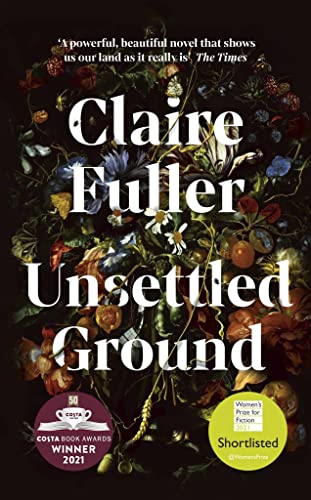
At 51 years old, twins Jeanie and Julius have always lived with their mother Dot in a run-down cottage in rural England. Because of a childhood illness, Jeanie has never worked, instead helping her mother cultivate vegetables in their large garden, while Julius has only ever had a succession of casual jobs. When one day they find their mother dead on the kitchen floor, their lives start to spiral out of control, and it becomes apparent that their mother’s life was not such an open book as they had always imagined. Why had their mother never told them that she was ill, when all the rest of the village seemed to know? Why do they owe rent on their cottage when their mother had always told them it was rent free in perpetuity, as compensation for their father’s death in a horrific accident? And how will they ever pay for their mother’s funeral when there is no money?
This is a beautifully written book, which demonstrates how easily some people’s lives can get thrown off track and how safety nets can be frequently inaccessible to those on the fringes of society. In particular, the character of Jeanie, as she struggles to navigate a world that she has always avoided and doesn’t understand, is wonderfully drawn. A couple of reservations though. For me, it read as being set in an earlier period than it actually was. And the character of the mother, as it is revealed throughout the book, just didn’t add up to a person that I really believed in. But overall a very good book. Recommended
At 51 years old, twins Jeanie and Julius have always lived with their mother Dot in a run-down cottage in rural England. Because of a childhood illness, Jeanie has never worked, instead helping her mother cultivate vegetables in their large garden, while Julius has only ever had a succession of casual jobs. When one day they find their mother dead on the kitchen floor, their lives start to spiral out of control, and it becomes apparent that their mother’s life was not such an open book as they had always imagined. Why had their mother never told them that she was ill, when all the rest of the village seemed to know? Why do they owe rent on their cottage when their mother had always told them it was rent free in perpetuity, as compensation for their father’s death in a horrific accident? And how will they ever pay for their mother’s funeral when there is no money?
As she works, she wonders again why Dot didn’t tell her and Julius that she’d been ill. She was stubborn and proud, it was true. She’d taught them not to take anything from anyone, because as night turns to day, they – especially if it was the government – would come knocking and asking for it back, or more. Jeanie isn’t surprised that her mother hadn’t claimed her free prescription, neither is she too shocked that there’s so little money in the tin, but she still can’t help calculating expenses in her head: the funeral or cremation, a coffin, funeral directors, a hearse and flowers. What are you supposed to do if you can’t afford any of it – bury your mother in the garden?
This is a beautifully written book, which demonstrates how easily some people’s lives can get thrown off track and how safety nets can be frequently inaccessible to those on the fringes of society. In particular, the character of Jeanie, as she struggles to navigate a world that she has always avoided and doesn’t understand, is wonderfully drawn. A couple of reservations though. For me, it read as being set in an earlier period than it actually was. And the character of the mother, as it is revealed throughout the book, just didn’t add up to a person that I really believed in. But overall a very good book. Recommended
278SandDune
28. The Girls Emma Cline *1/2

Emma Cline's first novel is a fictionalised account loosely based on the Manson killings in 1969. I really shouldn't have read this. I'm not interested in the Manson killings (or true crime generally), I have absolutely no interest in cults, and I'm not very interested in the 1960's much either! But it was a book club selection so I thought I'd give it a go. And I hated it. Absolutely hated it.
Evie is a neglected 14 year old whose parents have gone through a messy divorce, and whose mother is too busy finding herself to provide even a minimum of parental supervision to Evie. Struggling with the transition between childhood and adulthood, and alone after quarrelling with her only friend, Evie is enthralled to meet a group of rebellious older girls, led by the charismatic Suzanne:
Gradually, Evie is drawn more and more to the girls' life with the enigmatic Russell. But the cult-like nature of the group becomes more and more apparent and the novel moves towards its inevitable violent conclusion.
So why didn't I like it? Well, I didn't like anyone in it for a start, not even Evie. But I read lots of books where I don't like anyone and where I still like the book. The problem here was that I wasn't interested in any of the characters either - they were all deeply unpleasant, deeply boring people. And I didn't like the way it saw girls as a homogeneous mass. It was all 'girls do this' and 'girls do that' as if girls were a homogeneous mass with only a couple of brain cells to rub between them.
Definitely not recommended.

Emma Cline's first novel is a fictionalised account loosely based on the Manson killings in 1969. I really shouldn't have read this. I'm not interested in the Manson killings (or true crime generally), I have absolutely no interest in cults, and I'm not very interested in the 1960's much either! But it was a book club selection so I thought I'd give it a go. And I hated it. Absolutely hated it.
Evie is a neglected 14 year old whose parents have gone through a messy divorce, and whose mother is too busy finding herself to provide even a minimum of parental supervision to Evie. Struggling with the transition between childhood and adulthood, and alone after quarrelling with her only friend, Evie is enthralled to meet a group of rebellious older girls, led by the charismatic Suzanne:
'"You ever hear anything about Russell?"
The question didn't make sense to me. I didn't understand that she was trying to gauge how many of the rumours I'd heard: about orgies, about frenzied acid trips and teen runaways forced to service older men. Dogs sacrificed on moonlit beaches, goat heads rotting in the sand. If I'd had friends besides Connie, I might've heard chatter of Russell at parties, some hushed gossip in the kitchen. Might've known to be wary.'
Gradually, Evie is drawn more and more to the girls' life with the enigmatic Russell. But the cult-like nature of the group becomes more and more apparent and the novel moves towards its inevitable violent conclusion.
So why didn't I like it? Well, I didn't like anyone in it for a start, not even Evie. But I read lots of books where I don't like anyone and where I still like the book. The problem here was that I wasn't interested in any of the characters either - they were all deeply unpleasant, deeply boring people. And I didn't like the way it saw girls as a homogeneous mass. It was all 'girls do this' and 'girls do that' as if girls were a homogeneous mass with only a couple of brain cells to rub between them.
Definitely not recommended.
279SandDune
I’ve been very remiss at posting recently, but I’ve updated all my book reviews now. Just seem to have been pretty busy!
280BLBera
>278 SandDune: Sounds pretty awful, Rhian. I hope your next read is better.
281AlisonY
Loved The Good Doctor when I read it many moons ago. It's still one of my favourite Galgut's.
282SandDune
>280 BLBera: The Girls had some great reviews but it certainly didn’t do it for me. I wouldn’t have finished it if it hadn’t been my RL book club read, but I do try to finish those if at all possible.
>281 AlisonY: The Good Doctor was also a book club choice. Mr SandDune (whose in the same book club) chose it as he loved Galgut’s The Promise. He didn’t enjoy this one quite as much but still thought it was a rewarding read. The Good Doctor is the only one I’ve read.
>281 AlisonY: The Good Doctor was also a book club choice. Mr SandDune (whose in the same book club) chose it as he loved Galgut’s The Promise. He didn’t enjoy this one quite as much but still thought it was a rewarding read. The Good Doctor is the only one I’ve read.
283labfs39
>278 SandDune: I received a copy of The Girls as a gift, but got rid of it unread. Not my cuppa
284WelshBookworm
>276 SandDune: I quite enjoyed that series. Loved her world building, with lots of interesting twists and turns.
285SandDune
>283 labfs39: Really wasn't my up of tea either!
>284 WelshBookworm: I've just finished The Queen of Attolia as well, which also went in a direction I wasn't expecting. Looking forward to rest of series.
>284 WelshBookworm: I've just finished The Queen of Attolia as well, which also went in a direction I wasn't expecting. Looking forward to rest of series.

