1AnnieMod
Our July 2022 author is Sir Arthur Conan Doyle (22 May 1859 – 7 July 1930).
He probably does not need introduction: Sherlock Holmes has become part of the shared culture of the Western world in a way that makes it almost impossible for someone to not recognize the name (even if they never read any of the stories or novels). But that is not all he wrote - and exploring his non-Holmes stories usually surprises people.
So... what are you reading?
He probably does not need introduction: Sherlock Holmes has become part of the shared culture of the Western world in a way that makes it almost impossible for someone to not recognize the name (even if they never read any of the stories or novels). But that is not all he wrote - and exploring his non-Holmes stories usually surprises people.
So... what are you reading?
2mnleona
I have The Original Illustrated Sherlock Holmes by Arthur Conan Doyle and I read when I want a short story.
3john257hopper
Conan Doyle's oeuvre is very wide ranging. I've read the whole Sherlock Holmes canon multiple times, so I will probably read another of his historical novels or maybe a collection of short stories in July.
4kac522
For a look at Conan Doyle's early life, I'd recommend this book that I read in May:
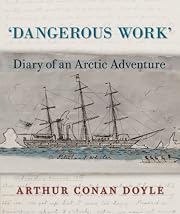
Cover shows Arthur Conan Doyle's sketch of the S. S. Hope, 1880
Dangerous Work: Diary of an Arctic Adventure, by Arthur Conan Doyle, published in 2012.
In 1880 during his 3rd year of medical school, Arthur Conan Doyle had the opportunity to join an arctic whaling expedition as the ship's medical officer. His diary of this experience on the S. S. Hope has been held privately by the Conan Doyle family. This 2012 oversize hardcover book provides a facsimile of the diary, a printed transcription, an introduction, afterword and four selections of Conan Doyle's later works showing the influence of his whaling experience. I found this a fascinating book, which I read slowly over the month of May. Included are Conan Doyle's numerous sketches that he made during the trip. As medical officer, he was able to treat some patients, but was unable to save others, given the limitations on a whaling ship. He eagerly participated in the whaling work, and was affectionately dubbed the "northern diver" by his fellow seamen, for his several falls into the icy waters. The writings include 2 articles about his whaling experience and 2 short stories that involve whalers.
Cover shows Arthur Conan Doyle's sketch of the S. S. Hope, 1880
Dangerous Work: Diary of an Arctic Adventure, by Arthur Conan Doyle, published in 2012.
In 1880 during his 3rd year of medical school, Arthur Conan Doyle had the opportunity to join an arctic whaling expedition as the ship's medical officer. His diary of this experience on the S. S. Hope has been held privately by the Conan Doyle family. This 2012 oversize hardcover book provides a facsimile of the diary, a printed transcription, an introduction, afterword and four selections of Conan Doyle's later works showing the influence of his whaling experience. I found this a fascinating book, which I read slowly over the month of May. Included are Conan Doyle's numerous sketches that he made during the trip. As medical officer, he was able to treat some patients, but was unable to save others, given the limitations on a whaling ship. He eagerly participated in the whaling work, and was affectionately dubbed the "northern diver" by his fellow seamen, for his several falls into the icy waters. The writings include 2 articles about his whaling experience and 2 short stories that involve whalers.
5john257hopper
I have read The Mystery of Cloomber and Beyond the City, both gems of novellas that should probably be better known, and reflect the breadth of Conan Doyle's writing.
6john257hopper
Considering Conan Doyle's fame and the breadth of his work, disappointing not to see much engagement with it this month...
8MissWatson
There's far too much going on elsewhere in summer, and I am so glad to be able to go to concerts again after two years...
9john257hopper
>8 MissWatson: Fair enough :)
10MissWatson
>9 john257hopper: I have downloaded Sir Nigel for my lunchtime reading, though, just to see what kind of historical fiction he wrote.
11john257hopper
>10 MissWatson: I read that years ago, it's quite good in a swashbuckling sort of way. The Refugees is probably my favourite of his historical fiction that I have read, though it is longer.
12MissWatson
>11 john257hopper: Oh, swashbuckling is great!
13marell
I finished The Lost World, and now am anxious to read The Poison Belt. A superbly written adventure-fantasy about two scientists, a lord and adventurer, and a young newspaperman who go on a quest to a hidden place in South America inhabited by creatures no longer living in the modern world. I loved every minute of it.
Dangerous Work sounds like one I would like to read as well.
Dangerous Work sounds like one I would like to read as well.
14john257hopper
The Lost World is good. The Poison Belt is a fantastically gripping and creepy short story/novella, I certainly recommend it.
15marell
>14 john257hopper: The book had so much humor in it, one of its charms. Thanks for the heads up on The Poison Belt. I’ll be sure to read it in the daytime!
16MissWatson
I'm going to need August to finish Sir Nigel, too much going on in RL.
17john257hopper
>16 MissWatson: hope your busy-ness is good busy, not stressful busy :)
18MissWatson
>17 john257hopper: Very pleasant busy-ness, as in having friends and family visiting!
19MissWatson
I have now finished Sir Nigel and while I appreciate that Doyle read up on the times and is apparently very knowledgeable about chivalry, hawking and archery, it still reflects the Victorian view of the Middle Ages, which is vastly different from ours. Frankly, the notions of knightly honour sit uneasily with me. And the endless descriptions of battles and coats of arms were tedious.
20john257hopper
>19 MissWatson: I don't think it's one of his best historical fictions. And as you say, it reflects a dated view of aspects of the Middle Ages.
21MissWatson
>20 john257hopper: Well, one positive effect of the book is that I have pulled a biography of Edward III from the shelf just to read up on the times. Some time later this month.
22john257hopper
>21 MissWatson: which biography is that, out of interest?
23MissWatson
>22 john257hopper: The perfect king. It's lying on the table, to be read after I am done with A place of greater safety, so it will be some time until I get round to it.
By the way, my present lunch break book at work is Uncle Bernac, which is promising to be much more entertaining than Sir Nigel.
By the way, my present lunch break book at work is Uncle Bernac, which is promising to be much more entertaining than Sir Nigel.
24john257hopper
>23 MissWatson: I read The Perfect King. And yes, A Place of Greater Safety will take you a while! Worth it though. Uncle Bernac is good fun :).
25MissWatson
I have finished Uncle Bernac where Louis de Laval, an aristocratic emigré, is invited by his uncle to return to France despite the proscription on his family. The uncle promises that his close connections to the Emperor can help, and on his arrival Louis gets instantly embroiled in a plot to assassinate Bonaparte.
The preface states that the novel is much longer than the previous serialised version, and it feels like it. There is much repetitive padding, and the scenes with Napoleon weigh down the story, but without these it would be just a feeble romance. I'm not sure what Doyle was trying to do here, especially as Louis' opinions and feelings seem so strongly influenced by his upbringing in England. His reactions to the French officers especially read like an Englishman's. Read so soon after Sir Nigel, my impression is that Doyle (and the English?) regard France as we Germans in my youth regarded the "Wild West": a playground where you could have exciting adventures that would be impossible in our boring homeland.
However, I was surprised to meet Brigadier Gérard here, as a lieutenant, and that he will marry Louis' cousin. So that's the next project.
The preface states that the novel is much longer than the previous serialised version, and it feels like it. There is much repetitive padding, and the scenes with Napoleon weigh down the story, but without these it would be just a feeble romance. I'm not sure what Doyle was trying to do here, especially as Louis' opinions and feelings seem so strongly influenced by his upbringing in England. His reactions to the French officers especially read like an Englishman's. Read so soon after Sir Nigel, my impression is that Doyle (and the English?) regard France as we Germans in my youth regarded the "Wild West": a playground where you could have exciting adventures that would be impossible in our boring homeland.
However, I was surprised to meet Brigadier Gérard here, as a lieutenant, and that he will marry Louis' cousin. So that's the next project.

