2L.Bloom
>1 Glacierman: A true work of art.
3jsg1976
>1 Glacierman: one sold at auction this morning for $3500 (+ premium), so quite a steal compared to Oak Knoll’s listing
4Glacierman
>3 jsg1976: Asking price is not always selling price!
5ultrarightist
>4 Glacierman: Does Oak Knoll entertain offers?
7Randman111
Bruce Rogers was a heavy influence on many fine press printers, including the Grabhorn brothers, who were linked to the origins behind Arion Press. Roger's Odyssey is indeed a beautiful book. When found in great condition, you can still smell the faint aroma of pepper due to the special ink he used.
8Sport1963
>7 Randman111: Indeed, that very pleasant aroma is present in my copy.
9FvS
Roger's Odyssey is one of the most beautiful books of all time. The gold and black rondels are incredible.
10astropi
Honestly, it reminds me of some LEC volumes such as the LEC Epicurus, although the latter is just a fraction of the cost of the Odyssey.
11DenimDan
>10 astropi: I agree whole-heartedly about this and a LOT of the other monetarily valuable books Rogers designed (excepting the Oxford Bible and Fra Luca di Pacioli): there's much cheaper ways to appreciate his design work. In addition to his LEC titles, he also did some nice designs for Riverside, Rudge, and Oxford that cost a fraction of Lawrence's Odyssey. This one has lots of built in associations, to be sure, and the materials here are superlative.
12Lukas1990
A fresh looking copy from Pirages.
https://www.biblio.com/book/odyssey-homer-lawrence-e-translator-bruce/d/15917586...
https://www.biblio.com/book/odyssey-homer-lawrence-e-translator-bruce/d/15917586...

14DenimDan
>12 Lukas1990: While I've only ever bought from him once, I deeply admire Pirages' consistency in only offering (modern) books in absolutely immaculate condition. Of course, his books often seem over-priced (and sometimes they are) compared to others on the market. But there can be no doubt about the quality you're getting buying from him. I could be wrong, but I think the regular asking price on a fine copy of the Rogers/Lawrence "Odyssey" was even higher a few years ago!
15laotzu225
I continue to hope that a publisher will do a facsimile of this book. Yes, it won't be quite the same (including the aroma from the ink) but it will give intense pleasure to many book lovers.
I am not at all ashamed to own some facsimiles of some classics of bookmaking. Folio has done some excellent ones.
I am not at all ashamed to own some facsimiles of some classics of bookmaking. Folio has done some excellent ones.
17Lukas1990
A unicorn for sale on Ebay! Very interesting. I'll copy the info here so nothing is lost when the book is sold.
link: https://www.ebay.com/itm/167429470516?mkcid=16&mkevt=1&mkrid=711-127632-...
Description:
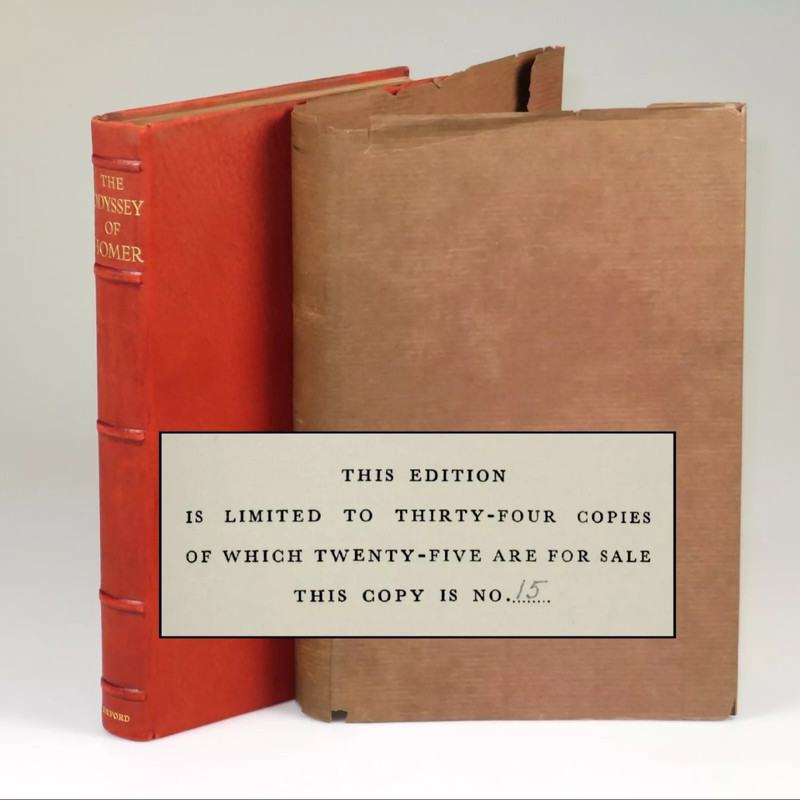
The Odyssey, copy #15 of the limited issue of the first U.S. edition
Homer, translated by T. E. Lawrence
New York: Oxford University Press, 1932
Condition: Near Fine
This genuine rarity is the limited, numbered, and finely bound issue of the first American edition, extraordinary thus, in the original dust jacket.
In 1932, T. E. Lawrence “of Arabia” published a translation of Homer’s The Odyssey designed by celebrated American typographer and type designer Bruce Rogers (1870-1957). Bibliophiles know that the finely-bound British first edition of Lawrence’s Odyssey – of which there were 500 copies – was a masterpiece, an aesthetically magnificent book and a highly regarded translation.
Less known but extravagantly scarcer is this first limited American edition of 1932, limited to 34 hand-numbered copies, of which only 25 were for sale. Hence the commercially available number of U.S. first and limited editions for sale was just 5% of those available for its British counterpart. And it appears that despite being incredibly few in number, these 25 varied considerably in appearance. Duval reports “23 copies bound in full calf; 11 copies in full crushed morocco.” O’Brien reports one of the first 11 in full blue Morocco, with “blue and white head and tail bands” but also notes a binding that is “brown” with top edges gilt and “gold and red head and tail bands.” Neither bibliographer noted a dust jacket. The contents of all 34 copies were printed on white, laid, watermarked paper with untrimmed fore and bottom edges, trimmed and gilt top edges, and bound with head and tail bands.
We are aware of a copy among the first 11 in full blue Morocco goatskin, corroborating Duval and O’Brien. However, we are aware of three binding variants of the 25 offered for sale in, respectively, brown, red, and a distinctive dark orange – all bound by the publisher in what one of our colleagues has noted as “an attractive and rather unusual class of leather”, this having the soft, smooth feel of calf, but nonetheless featuring a distinct, tactile grain pattern.
Our copy – hand-numbered “15” on the limitation statement – is the handsome dark orange binding featuring red and gold head and tail bands and, remarkably, still protected beneath the publisher-issued undecorated laid paper dust jacket. This is one of only two jacketed copies known to us, and the better of the two. Condition is near fine. The binding is square and tight, the leather supple and unfaded, the corners sharp. We note only light wear to the spine bands, and minor shelf wear to the extremities. This is remarkable given the softness of the leather and doubtless attributable to lifelong protection beneath the dust jacket. The contents are beautifully clean, with no spotting or previous ownership marks. The top edge gilt remains bright. The dust jacket is pardonably age-toned and brittle, but nonetheless substantially complete, with small, shallow chip losses confined to the spine ends and edges. The jacket is protected beneath a clear, removable, archival cover.
Of Lawrence’s translation, it has been observed that "...when we set his translation against others, two qualities... give it a special distinction. The first is that he enjoys the story for its own sake and spares nothing to keep it clear and lively, to make the details illuminate and strengthen the whole effect... The second is that he sees the whole Homeric world with a clear vision as Homer himself saw it." (Introduction by Sir Maurice Bowra to the 1955 edition of Lawrence’s Odyssey)
"Although Lawrence translated the Odyssey long after he completed Seven Pillars, Homer's vision plays a major role in the character of Lawrence as we see him in his book, and influences the view that Lawrence as author takes of his characters... Homer was a lifelong study with Lawrence and he emerges as one of his finest translators." (Tabachnick, T. E. Lawrence, p.52) That Lawrence's Arabs are so acutely Homeric in their characteristics, codes, conduct, and fates - as was Lawrence himself during his sojourn in Arabia – has been widely observed and defies coincidence.
Reference: O’Brien A148, Duval
link: https://www.ebay.com/itm/167429470516?mkcid=16&mkevt=1&mkrid=711-127632-...
Description:
The Odyssey, copy #15 of the limited issue of the first U.S. edition
Homer, translated by T. E. Lawrence
New York: Oxford University Press, 1932
Condition: Near Fine
This genuine rarity is the limited, numbered, and finely bound issue of the first American edition, extraordinary thus, in the original dust jacket.
In 1932, T. E. Lawrence “of Arabia” published a translation of Homer’s The Odyssey designed by celebrated American typographer and type designer Bruce Rogers (1870-1957). Bibliophiles know that the finely-bound British first edition of Lawrence’s Odyssey – of which there were 500 copies – was a masterpiece, an aesthetically magnificent book and a highly regarded translation.
Less known but extravagantly scarcer is this first limited American edition of 1932, limited to 34 hand-numbered copies, of which only 25 were for sale. Hence the commercially available number of U.S. first and limited editions for sale was just 5% of those available for its British counterpart. And it appears that despite being incredibly few in number, these 25 varied considerably in appearance. Duval reports “23 copies bound in full calf; 11 copies in full crushed morocco.” O’Brien reports one of the first 11 in full blue Morocco, with “blue and white head and tail bands” but also notes a binding that is “brown” with top edges gilt and “gold and red head and tail bands.” Neither bibliographer noted a dust jacket. The contents of all 34 copies were printed on white, laid, watermarked paper with untrimmed fore and bottom edges, trimmed and gilt top edges, and bound with head and tail bands.
We are aware of a copy among the first 11 in full blue Morocco goatskin, corroborating Duval and O’Brien. However, we are aware of three binding variants of the 25 offered for sale in, respectively, brown, red, and a distinctive dark orange – all bound by the publisher in what one of our colleagues has noted as “an attractive and rather unusual class of leather”, this having the soft, smooth feel of calf, but nonetheless featuring a distinct, tactile grain pattern.
Our copy – hand-numbered “15” on the limitation statement – is the handsome dark orange binding featuring red and gold head and tail bands and, remarkably, still protected beneath the publisher-issued undecorated laid paper dust jacket. This is one of only two jacketed copies known to us, and the better of the two. Condition is near fine. The binding is square and tight, the leather supple and unfaded, the corners sharp. We note only light wear to the spine bands, and minor shelf wear to the extremities. This is remarkable given the softness of the leather and doubtless attributable to lifelong protection beneath the dust jacket. The contents are beautifully clean, with no spotting or previous ownership marks. The top edge gilt remains bright. The dust jacket is pardonably age-toned and brittle, but nonetheless substantially complete, with small, shallow chip losses confined to the spine ends and edges. The jacket is protected beneath a clear, removable, archival cover.
Of Lawrence’s translation, it has been observed that "...when we set his translation against others, two qualities... give it a special distinction. The first is that he enjoys the story for its own sake and spares nothing to keep it clear and lively, to make the details illuminate and strengthen the whole effect... The second is that he sees the whole Homeric world with a clear vision as Homer himself saw it." (Introduction by Sir Maurice Bowra to the 1955 edition of Lawrence’s Odyssey)
"Although Lawrence translated the Odyssey long after he completed Seven Pillars, Homer's vision plays a major role in the character of Lawrence as we see him in his book, and influences the view that Lawrence as author takes of his characters... Homer was a lifelong study with Lawrence and he emerges as one of his finest translators." (Tabachnick, T. E. Lawrence, p.52) That Lawrence's Arabs are so acutely Homeric in their characteristics, codes, conduct, and fates - as was Lawrence himself during his sojourn in Arabia – has been widely observed and defies coincidence.
Reference: O’Brien A148, Duval
18SebRinelli
>17 Lukas1990: interesting! I wonder whether Bruce Rogers designed this edition of the Oxford University Press, too. It lacks the elegant grandeur of the edition published by Walker, Merten, and Rogers that is justly considered one of the most beautiful books ever printed.
19astropi
>17 Lukas1990: I appreciate you pointing this out, I enjoy looking at these rare and sought-after books. In my mind, this looks decent. But, honestly not remarkable. That is to say, if I were paying a premium for a copy of The Odyssey, especially anywhere near that price, I would want much more. First, better typography. Second, beautiful illustrations. Third, a far more attractive binding.
20chase.donaldson
>19 astropi: agree. The price is purely an issue of scarcity and I continue my hunt for the 1932 UK printing in the black Morocco. I have Rogers' Roland and Inferno and they are beautiful in their book design. The Roland is particularly impressive.

