1BrettFeinstein
Not sure if this is the right place to ask this but could not find a more appropriate forum on LT.
I want to become better informed on how to properly grade the condition of used books. I know that there are some short paragraphs on each of the various conditions at sites from Amazon to antiquarian book organizations, but nothing really specific and in the weeds.
Where do people learn how to grade books professionally and properly?
I want to become better informed on how to properly grade the condition of used books. I know that there are some short paragraphs on each of the various conditions at sites from Amazon to antiquarian book organizations, but nothing really specific and in the weeds.
Where do people learn how to grade books professionally and properly?
2anglemark
By reading those descriptions you will become a decent grader, some of them are very specific explaining how to look for tears, browning, foxing, frayed binds, etc. To get so good that you can confidently grade books worth $100 or more without risking misgrading them and making buyers unhappy, you have to work together with someone who works with antiquarian books and grades them as part of their job.
3BrettFeinstein
>2 anglemark: So there are no courses or other in depth materials on the subject? Not able to leave my day job to apprentice with an antiquarian bookseller unfortunately...
4terebinth
I find the grades assigned by even highly experienced individual booksellers vary so much - especially in the matter of how much leniency is extended on grounds of a book's age - that, if the book is listed with a full and plausible account of its main defects, the actual grade isn't of much interest. Can it be worth attempting to attain a studied precision in using a very imprecise measure, on which no two booksellers and no two customers will be always and dependably in agreement?
For myself, I'm not a real collector as such, I often seek to buy editions and even texts of which few copies are available worldwide: hence or otherwise I've never returned a book on grounds of its condition or initiated a dispute on those grounds; life, to me, is too short. Still, I've learned that some sellers are to my mind habitually harsh in their grading, which encourages me to buy from them again: and there are others I try to avoid once they sell me a book or two that seem too favourably described, or too favourably graded and not described at all. It may of course sometimes be that without their rose-tinted descriptions I would never have given them my custom in the first place.
For myself, I'm not a real collector as such, I often seek to buy editions and even texts of which few copies are available worldwide: hence or otherwise I've never returned a book on grounds of its condition or initiated a dispute on those grounds; life, to me, is too short. Still, I've learned that some sellers are to my mind habitually harsh in their grading, which encourages me to buy from them again: and there are others I try to avoid once they sell me a book or two that seem too favourably described, or too favourably graded and not described at all. It may of course sometimes be that without their rose-tinted descriptions I would never have given them my custom in the first place.
5Keeline
I have been both an advanced collector and an antiquarian bookseller for about 35 years, since 1988. For the first dozen years (1988-2000) I was the manager of a large bookstore that specialized in old children's books in San Diego. Since 2000 I have sold items at book and antique fairs, from cases in antique malls, and occasionally online.
Remote transactions of uncommon items requires communication and trust to prevent disappointments and needless expense. A big part of this is condition grading that helps the browser visualize the condition of a book and make comparisons with other copies. I note that eBay requires photos in listings (though sometimes they are stock or photos stolen from another seller). The used book databases don't require or even encourage this, even when the books are $100 and up. The ABAA.org has a database and despite their goal of promoting best practices in the antiquarian book trade, they don't require photos on their listings. If they did, it could go a long way towards providing more photos in the other databases since sellers often list an item in more than one. ABAA members are a small portion of the trade and the books in it but they can be leaders. Today it is much easier to take good photos with a phone than it was in the 1990s when film was the norm. There is little excuse to not have photos some 25 years later.
Naturally we would have people call the store to offer books to us. We needed ways to get a sense of the condition to determine if the books were even worth bringing in. Children's books routinely have condition issues. We often said "you only hurt the ones you love and this goes double for children and books." Since non-book people have no idea what "fine", "very good", and "good" condition means to a book collector or seller, we needed another method so this is what I would say to them:
This caused them to think critically in terms they could understand and respond to. It usually worked. Upon further conversation we explained:
This conversation on the phone or in person, before the books were at hand, saved us some time.
Of course the book and dust jacket have to be graded separately and age is not an excuse for condition. The condition is a measure that is supposed to be independent of age. But age and/or fragility might affect what kind of condition is acceptable to a buyer.
Amazon either invented or heavily promoted the use of "acceptable" as a book grade. It was not in use before and it is a hint that the book is just a "reading copy." All the pages are there but that is all you can really say about it. It is not going to enthuse a collector, particularly if they feel they will have to buy another copy as an upgrade down the road.
Another thing we did to illustrate condition to people who visited was to have half a dozen copies of the first printing of The Yearling by Rawlings in jacket. Despite being a Pulitzer Prize winner, it was not a book that sold strongly for us. The Scribner Illustrated Classic edition did better for us. These copies had a range of conditions of the jacket so we could put a book in people's hands and say this is a "Good", "Very Good", and "Fine" jacket. It was helpful.
Around the same time (about 2000) FIRSTS magazine ran a series of photo essays about condition showing different copies of the same title and pointing out the condition issues that placed it in one grade or another. This was an education to the book trade and helped to make descriptions more consistent among the readers of the series. However, a generation later, that is largely forgotten.
There's more to say but this is long so I'll stop now and we'll see where the conversation goes. Once a condition grade is established, then there is the business of determining an asking price. Of course there is a relationship between condition and value but not everyone understands it in a specific way. They rely too much on finding a similar listing of an unsold copy online to provide advice on how they should price their copy (if they also want to keep it for the long term instead of selling it).
James
Remote transactions of uncommon items requires communication and trust to prevent disappointments and needless expense. A big part of this is condition grading that helps the browser visualize the condition of a book and make comparisons with other copies. I note that eBay requires photos in listings (though sometimes they are stock or photos stolen from another seller). The used book databases don't require or even encourage this, even when the books are $100 and up. The ABAA.org has a database and despite their goal of promoting best practices in the antiquarian book trade, they don't require photos on their listings. If they did, it could go a long way towards providing more photos in the other databases since sellers often list an item in more than one. ABAA members are a small portion of the trade and the books in it but they can be leaders. Today it is much easier to take good photos with a phone than it was in the 1990s when film was the norm. There is little excuse to not have photos some 25 years later.
Naturally we would have people call the store to offer books to us. We needed ways to get a sense of the condition to determine if the books were even worth bringing in. Children's books routinely have condition issues. We often said "you only hurt the ones you love and this goes double for children and books." Since non-book people have no idea what "fine", "very good", and "good" condition means to a book collector or seller, we needed another method so this is what I would say to them:
Imagine a perfect like new copy of the book that is fresh from the bookstore. On a scale of 1 to 10, that would be a 10. What number would you associate with your copy?
This caused them to think critically in terms they could understand and respond to. It usually worked. Upon further conversation we explained:
A perfect copy (10) is "Fine" condition. An "8" would be called "Very Good." A "6" is "Good." Generally collectors are only interested in an 8 or better condition. Lower grades are slow to sell and may never sell at any price.
This conversation on the phone or in person, before the books were at hand, saved us some time.
Of course the book and dust jacket have to be graded separately and age is not an excuse for condition. The condition is a measure that is supposed to be independent of age. But age and/or fragility might affect what kind of condition is acceptable to a buyer.
Amazon either invented or heavily promoted the use of "acceptable" as a book grade. It was not in use before and it is a hint that the book is just a "reading copy." All the pages are there but that is all you can really say about it. It is not going to enthuse a collector, particularly if they feel they will have to buy another copy as an upgrade down the road.
Another thing we did to illustrate condition to people who visited was to have half a dozen copies of the first printing of The Yearling by Rawlings in jacket. Despite being a Pulitzer Prize winner, it was not a book that sold strongly for us. The Scribner Illustrated Classic edition did better for us. These copies had a range of conditions of the jacket so we could put a book in people's hands and say this is a "Good", "Very Good", and "Fine" jacket. It was helpful.
Around the same time (about 2000) FIRSTS magazine ran a series of photo essays about condition showing different copies of the same title and pointing out the condition issues that placed it in one grade or another. This was an education to the book trade and helped to make descriptions more consistent among the readers of the series. However, a generation later, that is largely forgotten.
There's more to say but this is long so I'll stop now and we'll see where the conversation goes. Once a condition grade is established, then there is the business of determining an asking price. Of course there is a relationship between condition and value but not everyone understands it in a specific way. They rely too much on finding a similar listing of an unsold copy online to provide advice on how they should price their copy (if they also want to keep it for the long term instead of selling it).
James
6Glacierman
From >5 Keeline: above.... They rely too much on finding a similar listing of an unsold copy online to provide advice on how they should price their copy
The point here is that asking price is not necessarily a clue to a book's value. What gives indication of value is what a book actually sold for. An experienced antiquarian bookseller, when evaluating a book, will think in terms of a price range and then, based upon his experience and understanding of his clientele, price the book somewhere w/in that range.
Regarding description itself: describing a book is part of the cataloguing process, and I have always tried to over describe a book I'm selling and if the medium allows it, some pertinent photos are very helpful. I got used to describing books in detail in the era prior to the internet and the ability to include photos in my listings as I often sold through the pages of the the long defunct AB/Bookman's Weekly which was the "bible" of the antiquarian trade back in the day. Photos sure do help, but an accurate & detailed written description is still needed.
>1 BrettFeinstein: As for courses in learning how to describe books, well, the Rare Book School is offering a course in cataloguing, but I think that is more than you're looking for.
This page gives the definitions (Fine, Very Good, etc.) I always used, but always as a summary of the overall conditions and accompanied by a thorough description of the book's condition. I described the book and d/j (if present) separately. A decent description takes time, and volume sellers don't have the time to take. The one 'condition' description I abhor is "acceptable." Acceptable to whom? The dustman? I avoid any book so described. It is likely junk.
One term often used with antiquarian books in less than decent shape is "binding copy" which indicates that while the text block is OK, it needs a new binding and will be priced accordingly. I have seen books wherein the text block is actually in VG or better shape, but the binding is either in pieces or missing completely.
The point here is that asking price is not necessarily a clue to a book's value. What gives indication of value is what a book actually sold for. An experienced antiquarian bookseller, when evaluating a book, will think in terms of a price range and then, based upon his experience and understanding of his clientele, price the book somewhere w/in that range.
Regarding description itself: describing a book is part of the cataloguing process, and I have always tried to over describe a book I'm selling and if the medium allows it, some pertinent photos are very helpful. I got used to describing books in detail in the era prior to the internet and the ability to include photos in my listings as I often sold through the pages of the the long defunct AB/Bookman's Weekly which was the "bible" of the antiquarian trade back in the day. Photos sure do help, but an accurate & detailed written description is still needed.
>1 BrettFeinstein: As for courses in learning how to describe books, well, the Rare Book School is offering a course in cataloguing, but I think that is more than you're looking for.
This page gives the definitions (Fine, Very Good, etc.) I always used, but always as a summary of the overall conditions and accompanied by a thorough description of the book's condition. I described the book and d/j (if present) separately. A decent description takes time, and volume sellers don't have the time to take. The one 'condition' description I abhor is "acceptable." Acceptable to whom? The dustman? I avoid any book so described. It is likely junk.
One term often used with antiquarian books in less than decent shape is "binding copy" which indicates that while the text block is OK, it needs a new binding and will be priced accordingly. I have seen books wherein the text block is actually in VG or better shape, but the binding is either in pieces or missing completely.
7terebinth
>6 Glacierman: A decent description takes time, and volume sellers don't have the time to take. The one 'condition' description I abhor is "acceptable." Acceptable to whom?
These days I rarely travel to anywhere with a bookshop, so to compensate in some measure for not having shelves to browse I often comb through recent arrivals at what used to be World of Rare Books, now a division of "Wob": a volume seller if ever there was one. "Good" and "Acceptable" are the only categories they use, but their descriptions aren't too bad, and much of the time an "Acceptable" book from them would be G, or even VG-, from many another seller. Then again I've seen "Acceptable" books that are minus backstrip, which I'd have to be pretty desperate to consider.
These days I rarely travel to anywhere with a bookshop, so to compensate in some measure for not having shelves to browse I often comb through recent arrivals at what used to be World of Rare Books, now a division of "Wob": a volume seller if ever there was one. "Good" and "Acceptable" are the only categories they use, but their descriptions aren't too bad, and much of the time an "Acceptable" book from them would be G, or even VG-, from many another seller. Then again I've seen "Acceptable" books that are minus backstrip, which I'd have to be pretty desperate to consider.
8Keeline
In the 1990s we joked about some of the euphemistic phrases used by booksellers such as "with all faults" and "boards sent under separate cover."
Meanwhile, the individuals who had books to sell might say "good condition for its age" or "all of the pages are there." These are usually an indication that the books are not worth bringing in.
On a Facebook group called Vintage, Rare & Antique Books, it is amazing what people think will be valuable and they hope to sell. Sometimes they look like books that have been buried under a house for a couple decades. Most often it is an early-20th-century reprint of a book published 50-150 years earlier. The group has rules (frequently ignored) that they have to post pictures to show the cover, spine, title, and copyright page so that people can help with identification and perhaps values. They also expect people to do some initial searches on the used book databases.
This question was focused on grading but evaluating is usually the second part of the question so that is why we are mentioning it. The unsold listings on the used book databases, Amazon, or even eBay tell you only that these are prices for which a given book won't sell in the market that sees it because of the asking price, condition, and printing.
Getting prices realized is harder. The used book databases don't show it even though they should. This is especially the case for something like ABAA.org which has a mission of improving the antiquarian book community. When a book sells through a database, they know it. They could reveal this to everyone or subscribers. They do not. The main reason for this is that the listing sites make their money based on the cost of the item and the length of time it is listed. Higher prices that don't sell for a long time actually make them more money than books that sell quickly at a low price. So this is why they don't make prices realized available.
On eBay you can search for a book and then apply the "Completed Listings" filter to see copies from the past couple months that actually sold. It only searches titles, not the content of the listing. But this can be done for free. Other sites like WorthPoint.com charge a significant subscription fee for eBay archive listings.
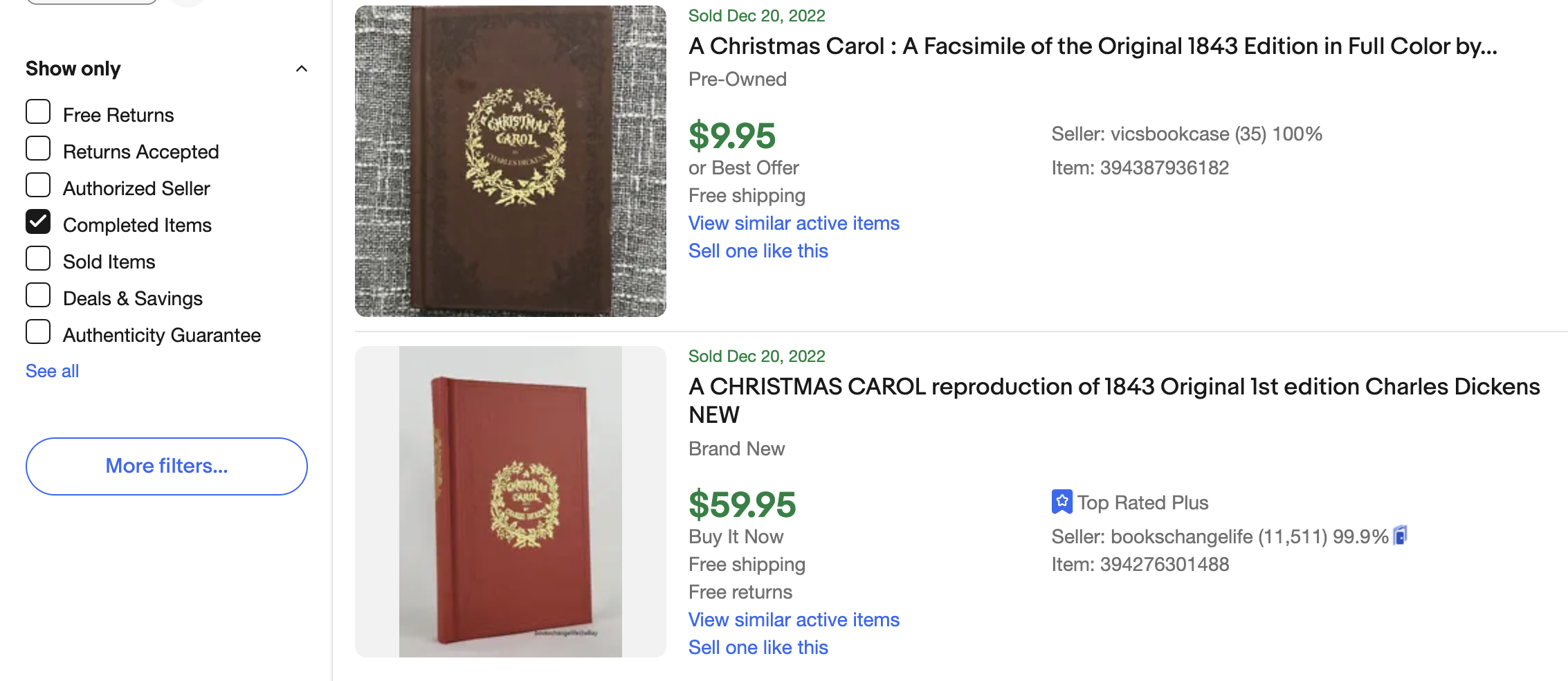
It is easy to be too harsh in grading and talk yourself out of sales, if that is the goal. Nevertheless, the more you say, the less back-and-forth Q&A. That can be a time saver but it also may miss an opportunity to connect with a client.
The online nature of most bookselling now causes an emphasis on the lowest price for a condition and/or printing. It skips past the time-honored tradition of establishing a relationship between a collector and a seller. As the seller learns the interests of a collector, it can affect what they buy and offer. There is also a great deal of learning that goes back and forth. The relative anonymity of Internet sales discourages this in many cases and does not encourage repeat transactions with a given seller. While we have gained more books available, we've lost some of the humanity of bookselling that makes it interesting. It's not just about the money. The books and the people who love them are a greater part of it. That's why it is unfortunate so many stores have closed entirely or just in favor of online selling.
James
Meanwhile, the individuals who had books to sell might say "good condition for its age" or "all of the pages are there." These are usually an indication that the books are not worth bringing in.
On a Facebook group called Vintage, Rare & Antique Books, it is amazing what people think will be valuable and they hope to sell. Sometimes they look like books that have been buried under a house for a couple decades. Most often it is an early-20th-century reprint of a book published 50-150 years earlier. The group has rules (frequently ignored) that they have to post pictures to show the cover, spine, title, and copyright page so that people can help with identification and perhaps values. They also expect people to do some initial searches on the used book databases.
This question was focused on grading but evaluating is usually the second part of the question so that is why we are mentioning it. The unsold listings on the used book databases, Amazon, or even eBay tell you only that these are prices for which a given book won't sell in the market that sees it because of the asking price, condition, and printing.
Getting prices realized is harder. The used book databases don't show it even though they should. This is especially the case for something like ABAA.org which has a mission of improving the antiquarian book community. When a book sells through a database, they know it. They could reveal this to everyone or subscribers. They do not. The main reason for this is that the listing sites make their money based on the cost of the item and the length of time it is listed. Higher prices that don't sell for a long time actually make them more money than books that sell quickly at a low price. So this is why they don't make prices realized available.
On eBay you can search for a book and then apply the "Completed Listings" filter to see copies from the past couple months that actually sold. It only searches titles, not the content of the listing. But this can be done for free. Other sites like WorthPoint.com charge a significant subscription fee for eBay archive listings.
It is easy to be too harsh in grading and talk yourself out of sales, if that is the goal. Nevertheless, the more you say, the less back-and-forth Q&A. That can be a time saver but it also may miss an opportunity to connect with a client.
The online nature of most bookselling now causes an emphasis on the lowest price for a condition and/or printing. It skips past the time-honored tradition of establishing a relationship between a collector and a seller. As the seller learns the interests of a collector, it can affect what they buy and offer. There is also a great deal of learning that goes back and forth. The relative anonymity of Internet sales discourages this in many cases and does not encourage repeat transactions with a given seller. While we have gained more books available, we've lost some of the humanity of bookselling that makes it interesting. It's not just about the money. The books and the people who love them are a greater part of it. That's why it is unfortunate so many stores have closed entirely or just in favor of online selling.
James
9anglemark
>3 BrettFeinstein: You've received some good replies now, but I can also add that this is of course an iterative process, even on your own. If you grade books and sell them, based on the feedback you get from buyers, you will get better and better at grading.
10Keeline
The type of book, market, and desired asking price can make a difference on the nature of the description of defects.
For example, on hyper modern first printings, if the book is not a first printing in Fine/Fine condition, it may not sell if there are others on the market. Sometimes an author signature is important. Anything less becomes more of a reading copy or placeholder for a later upgrade. These need to be priced accordingly if there is going to be a chance of a sale in a reasonable period of time.
With older books, it becomes more important to collate the book. This means carefully checking for all signatures (groups of pages) present.
If it is a color plate book like an illustrated classic, checking to ensure that all plates are present is vital. This is what the collectors are looking for. Often later printings have fewer plates so this is also important.
James
For example, on hyper modern first printings, if the book is not a first printing in Fine/Fine condition, it may not sell if there are others on the market. Sometimes an author signature is important. Anything less becomes more of a reading copy or placeholder for a later upgrade. These need to be priced accordingly if there is going to be a chance of a sale in a reasonable period of time.
With older books, it becomes more important to collate the book. This means carefully checking for all signatures (groups of pages) present.
If it is a color plate book like an illustrated classic, checking to ensure that all plates are present is vital. This is what the collectors are looking for. Often later printings have fewer plates so this is also important.
James
11varielle
I need to rant. I’ve typically found from some book selling consortiums (??the correct name doesn’t spring to mind) that anything listed as Good condition is invariably Fair to Poor when it arrives. I’ve stepped it up to only go after something listed as Very Good or better. I got in a first edition today of Alberto Manguel’s The Library at Night which I’d been looking for for quite a while. It was a library discard. I’m kicking myself. When I went back to check that fact was in the fine print. I never in a million years would have believed any decent bookseller would list an ex-library book as Very Good when it’s covered in stickers and tape. Is that standard? I feel like a dolt for getting suckered. End of rant. 🤯
12Keeline
>11 varielle:, as I wrote, “Good” is a euphemism. It is perhaps a 6/10. It is below the grade that will appeal to a collector.
When a book is identified as an ex-library copy, it is common for it to include the branding marks that librarians put on books to claim them for their library. They have no thought that it will be owned by anyone else. Stamps, pockets, stickers are all common. As a seller, you can’t list them all. Photos would help.
James
When a book is identified as an ex-library copy, it is common for it to include the branding marks that librarians put on books to claim them for their library. They have no thought that it will be owned by anyone else. Stamps, pockets, stickers are all common. As a seller, you can’t list them all. Photos would help.
James
13mr.philistine
As a buyer, some of my most pleasant acquisitions have been conservatively graded books that were found to exceed their grades upon receipt. In order to avoid disappointment and claims, it helps to take into account BOTH the grading definitions (Like New, Very Good, Acceptable etc) provided by the market platforms (like eBay, Amazon, Abebooks et al) AND the seller's description for that listing. If a seller's description is found to contradict the item condition, a claim can be raised regardless of the assigned grade.
14Andy_Dingley
As a buyer (low budget and not fussy, admittedly!), I've _never_ been upset by library marks. Pockets, stamps, jackets – I don't mind. I see these as "reasonable things to do to a book". The things I don't like are covers falling off and loose text blocks, damp or foxing across every page so that it can't be read easily, or (worst of all!) underlining or highlighting (by psychopath exam swots?).
15terebinth
>14 Andy_Dingley:
Yes, you've listed my bêtes noires there, to which I'd add most marginal comments whether functional (to their writer), opinionated or just inane - book owners are of course entitled to make them, just as they're entitled to put their books face down in puddles and jump on them, but the rest of us are entitled to avoid the books thereafter. Ex-library books are on a case-by-case basis with me, one factor being how they present themselves on the shelf: I'd rather not be constantly seeing classification numbers etc., and library rebindings vary from baldly functional to borderline exquisite.
Yes, you've listed my bêtes noires there, to which I'd add most marginal comments whether functional (to their writer), opinionated or just inane - book owners are of course entitled to make them, just as they're entitled to put their books face down in puddles and jump on them, but the rest of us are entitled to avoid the books thereafter. Ex-library books are on a case-by-case basis with me, one factor being how they present themselves on the shelf: I'd rather not be constantly seeing classification numbers etc., and library rebindings vary from baldly functional to borderline exquisite.
16cindydavid4
>8 Keeline: I agree with you completely. this is why I try to frequent our book gallery in Phx. Mike has been there for years selling in store and online., hes always thre to answer questions to find me books I might like. and to show me his new acquisitions. I do trust his prices and have learned lots frome him when I am trying to buy on line.
17cindydavid4
>15 terebinth: I don't mind x library if its just a book I want to read. do not like them at all if I want to include it in my collection. they do affect the value and for me waste of money (that being said Im usually firt in line at the local library sale, but then Im not trying to sell the book later)
18terebinth
>17 cindydavid4:
Well, resale value doesn't bother me, that's for my executors to worry about if they want to. There probably wouldn't be much to interest me even if, perish the thought, our small town's library closed its doors, but I've a fair few books that started out in assorted public or institutional libraries and were the best value propositions when I came to be looking for used copies. I'm not often confident I will want to read a book just once and not go back to it, so I try to avoid any books that are in a condition I wouldn't want to live with. But some institutional library bindings are just lovely -

- and sometimes ex-library copies are the only copies of any sort available on the planet, for instance most of

Well, resale value doesn't bother me, that's for my executors to worry about if they want to. There probably wouldn't be much to interest me even if, perish the thought, our small town's library closed its doors, but I've a fair few books that started out in assorted public or institutional libraries and were the best value propositions when I came to be looking for used copies. I'm not often confident I will want to read a book just once and not go back to it, so I try to avoid any books that are in a condition I wouldn't want to live with. But some institutional library bindings are just lovely -

- and sometimes ex-library copies are the only copies of any sort available on the planet, for instance most of

19lcl999
One of my hobbies is bookbinding. So, assuming a book has been well re-bound, how does that affect its value?
20mr.philistine
>19 lcl999: In a nutshell, the value of any commodity or service is informed by demand and supply.
What has been added to or taken away from the original work - in this case the binding? Have premium materials like animal hide or custom designed gold tooling been incorporated? Has it been rebound by a well known bookbinder in limited numbers or perhaps as a unique example commissioned by a private client? Is this client a celebrity and have they inscribed the book? Is the bookbinder or bookbinding house still in business or defunct? Age? Condition? The list is endless...
What has been added to or taken away from the original work - in this case the binding? Have premium materials like animal hide or custom designed gold tooling been incorporated? Has it been rebound by a well known bookbinder in limited numbers or perhaps as a unique example commissioned by a private client? Is this client a celebrity and have they inscribed the book? Is the bookbinder or bookbinding house still in business or defunct? Age? Condition? The list is endless...
21terebinth
>20 mr.philistine:
It is indeed. Add to it whether the binding style is one with general appeal, or (if its character is very individual) how it's felt by prospective buyers to be suited to the character of the book. What's good for Gentlemen Prefer Blondes may well not be good for Dante.
It is indeed. Add to it whether the binding style is one with general appeal, or (if its character is very individual) how it's felt by prospective buyers to be suited to the character of the book. What's good for Gentlemen Prefer Blondes may well not be good for Dante.
22mr.philistine
>21 terebinth: First, I must apologize for my late response - the reason for which I try to justify below.
I thought of style/ suitability but remembered that 'there is no accounting for taste'. Here is an example of a re-binding job that IMHO pales in comparison to the original, and yet one that I hoped to purchase before replying to your post despite already owning a copy of the Folio Society standard edition. But alas, the seller is non-responsive to my many messages requesting a shipping quote.
The Essays of Sir Francis Bacon, 1944 LEC (signed by a 'Brian Rogers' and numbered #567 of 1100); for £35 with a 'Make Offer' option! Even the clamshell case has been replaced with a fluorescent blue slipcase. Complete sets with the original binding, clamshell case, monthly newsletter and prospectus are often listed above £100.
https://www.ebay.co.uk/itm/354313784746
I have a few questions:
1. Why no one bothered to snap it up at that price or lower since 04 October 2022, even though the listing was not very clear!
2. What possessed the bookbinder to rebind the original? Or was it a trial binding by the LEC or a personal copy of one of the publishers?
ETA: The above item is sold... hopefully to a buyer on the right side of the pond :)
I thought of style/ suitability but remembered that 'there is no accounting for taste'. Here is an example of a re-binding job that IMHO pales in comparison to the original, and yet one that I hoped to purchase before replying to your post despite already owning a copy of the Folio Society standard edition. But alas, the seller is non-responsive to my many messages requesting a shipping quote.
The Essays of Sir Francis Bacon, 1944 LEC (signed by a 'Brian Rogers' and numbered #567 of 1100); for £35 with a 'Make Offer' option! Even the clamshell case has been replaced with a fluorescent blue slipcase. Complete sets with the original binding, clamshell case, monthly newsletter and prospectus are often listed above £100.
https://www.ebay.co.uk/itm/354313784746
I have a few questions:
1. Why no one bothered to snap it up at that price or lower since 04 October 2022, even though the listing was not very clear!
2. What possessed the bookbinder to rebind the original? Or was it a trial binding by the LEC or a personal copy of one of the publishers?
ETA: The above item is sold... hopefully to a buyer on the right side of the pond :)
23terebinth
>22 mr.philistine:
That's a curiosity indeed, I'm sorry to hear your efforts to purchase it have drawn a blank. Anything mentioned on LT tends to be claimed pretty quickly by someone if favourably priced and at all interesting, so I expect it will vanish pretty quickly now and........... oh, what the heck, I seem to have bought it myself ;) The seller is only some 35 miles from me, so shipping shouldn't be an issue. If you're in the US I could just about understand them not wanting to look into the matter, if not the discourtesy of sending no reply: I've seen quotes of around £60 lately for sending even books of about the size of the Folio Society version from there to here. I know the approximate proportions of that one but have never owned it, the upgrade from my little 1899 Macmillan Golden Treasuries reprint never seemed worthwhile, but this looks as though it will be a delight to read.
Not sure where you get "Brian Rogers" from, unless you're unfamiliar enough with the LEC - I don't know them that well, with only around a dozen of their books plus the Shakespeare - not to have come across Bruce, it looks like his usual signature to me. And, yes, how the binding came about and why there's a not very recent looking slipcase too are complete mysteries.
For sure "there is no accounting for taste" - but in, say, auction conditions at least two people have to want something for it to fetch any price at all, and I'm sure we could come up with bindings so discordant with their contents that ordinary sensibilities would shun them, without their being quite grotesque enough to attract those of us apt to revel in such things...
That's a curiosity indeed, I'm sorry to hear your efforts to purchase it have drawn a blank. Anything mentioned on LT tends to be claimed pretty quickly by someone if favourably priced and at all interesting, so I expect it will vanish pretty quickly now and........... oh, what the heck, I seem to have bought it myself ;) The seller is only some 35 miles from me, so shipping shouldn't be an issue. If you're in the US I could just about understand them not wanting to look into the matter, if not the discourtesy of sending no reply: I've seen quotes of around £60 lately for sending even books of about the size of the Folio Society version from there to here. I know the approximate proportions of that one but have never owned it, the upgrade from my little 1899 Macmillan Golden Treasuries reprint never seemed worthwhile, but this looks as though it will be a delight to read.
Not sure where you get "Brian Rogers" from, unless you're unfamiliar enough with the LEC - I don't know them that well, with only around a dozen of their books plus the Shakespeare - not to have come across Bruce, it looks like his usual signature to me. And, yes, how the binding came about and why there's a not very recent looking slipcase too are complete mysteries.
For sure "there is no accounting for taste" - but in, say, auction conditions at least two people have to want something for it to fetch any price at all, and I'm sure we could come up with bindings so discordant with their contents that ordinary sensibilities would shun them, without their being quite grotesque enough to attract those of us apt to revel in such things...
24mr.philistine
>23 terebinth: Congratulations! My loss is your gain. Anything signed by Bruce Rogers is a worthy addition to one's library. Out of curiosity, how much did you pay for shipping? Or was it free !?
If you scroll down to 'Item description from the seller', you will find the lines 'Limited Edition #567 and Signed by Brian Rogers' and '...Signed to the limitation page by Designer Brian Rogers who designed the original binding.'
George Macy's LEC and HP were the most logical alternative when looking for titles not part of the Folio Society anthology; and more recently for me the Imprint Society.
In matters of purchase for the financially constrained, one must sometimes resort to filling one's library with the grotesque, misidentified and rejected specimens since the only alternative is not being able to afford pristine examples. I frequently fit into this category when prices go up! But I have never once regretted it. :)
ETA:
>23 terebinth: The seller is only some 35 miles from me, so shipping shouldn't be an issue.
So at £35, it amounts to £1 per mile plus shipping! (sorry, I could not resist!)
If you scroll down to 'Item description from the seller', you will find the lines 'Limited Edition #567 and Signed by Brian Rogers' and '...Signed to the limitation page by Designer Brian Rogers who designed the original binding.'
George Macy's LEC and HP were the most logical alternative when looking for titles not part of the Folio Society anthology; and more recently for me the Imprint Society.
In matters of purchase for the financially constrained, one must sometimes resort to filling one's library with the grotesque, misidentified and rejected specimens since the only alternative is not being able to afford pristine examples. I frequently fit into this category when prices go up! But I have never once regretted it. :)
ETA:
>23 terebinth: The seller is only some 35 miles from me, so shipping shouldn't be an issue.
So at £35, it amounts to £1 per mile plus shipping! (sorry, I could not resist!)
25terebinth
>24 mr.philistine:
Ah, I should have thought of scrolling down: that puzzle at least is quickly solved! Shipping from Thetford was £4.35, Royal Mail second class signed-for: a flat rate for the UK and pretty much par for the course. A rather good quartet of buskers that occasionally visits our little town has a version of Take the "A" train with a heckler who interjects "But I don't want to go to Harlem, I'm trying to get to Thetford". Anyways...
So probably the sellers aren't very familiar with Bruce Rogers, which depending on their section of the market is just about understandable here as LEC and other American fine press books are of fairly rare occurrence. Their reluctance to provide you with a shipping quote becomes only more mysterious in view of https://www.ebay.co.uk/itm/404336824052 , a Victorian photograph album of probably rather similar size and weight, which sold to, and is the subject of recent enthusiastic feedback from, a chap in Minneapolis, but tastes aren't the only part of folks for which there's no accounting.
I love what I can see of the book's internal design, and look forward to reading it: grateful thanks, then, and Bruce Rogers' signature is an enhancement indeed. I think I only currently have it in the two-volume Shakespeare Poems I bought not so long ago to complete my LEC Shakespeare set.
Ah, I should have thought of scrolling down: that puzzle at least is quickly solved! Shipping from Thetford was £4.35, Royal Mail second class signed-for: a flat rate for the UK and pretty much par for the course. A rather good quartet of buskers that occasionally visits our little town has a version of Take the "A" train with a heckler who interjects "But I don't want to go to Harlem, I'm trying to get to Thetford". Anyways...
So probably the sellers aren't very familiar with Bruce Rogers, which depending on their section of the market is just about understandable here as LEC and other American fine press books are of fairly rare occurrence. Their reluctance to provide you with a shipping quote becomes only more mysterious in view of https://www.ebay.co.uk/itm/404336824052 , a Victorian photograph album of probably rather similar size and weight, which sold to, and is the subject of recent enthusiastic feedback from, a chap in Minneapolis, but tastes aren't the only part of folks for which there's no accounting.
I love what I can see of the book's internal design, and look forward to reading it: grateful thanks, then, and Bruce Rogers' signature is an enhancement indeed. I think I only currently have it in the two-volume Shakespeare Poems I bought not so long ago to complete my LEC Shakespeare set.
26Glacierman
As for the re-bind, perhaps the original was in sorry shape, but who knows, really?
27terebinth
>26 Glacierman:
Yes - that it met early with some ghastly accident seems among the more plausible hypotheses given its mid-sequence limitation number. If I didn't know better I'd have said the binding looks at least as old as the book.
Yes - that it met early with some ghastly accident seems among the more plausible hypotheses given its mid-sequence limitation number. If I didn't know better I'd have said the binding looks at least as old as the book.
28Keeline
I have one book that was published in 1904 and then rebound for the Chicago Public Library after the original binding did not survive the circulation.
Not long afterward (April 1907) it was discarded by the library (and stamped "CONDEMNED") in what might be called "quarter-leather" or perhaps "half-leather" with marbled boards. It is an interesting example since libraries were not fans of popular series books like this.

Some larger libraries either contracted with binderies or had in-house binding departments to rebind books to make them serviceable.
Another book I bought is a leather rebind of an X Bar X Boys volume.

This was probably a bookbinder's student project. It is not as polished as a professional job. The bookstore where I found it had several similar books but this was the only juvenile series book so the only one I cared to buy.
These are just a couple examples of rebindings of books that are a bit curious. They are interesting variants but not more valuable than a fine condition trade binding, particularly with dust jacket for the latter book. Both were purchased for less than it would cost to have such a binding made today.
When a book is a family heirloom, you can understand why someone might have it rebound to keep the particular copy intact.
James
Not long afterward (April 1907) it was discarded by the library (and stamped "CONDEMNED") in what might be called "quarter-leather" or perhaps "half-leather" with marbled boards. It is an interesting example since libraries were not fans of popular series books like this.

Some larger libraries either contracted with binderies or had in-house binding departments to rebind books to make them serviceable.
Another book I bought is a leather rebind of an X Bar X Boys volume.

This was probably a bookbinder's student project. It is not as polished as a professional job. The bookstore where I found it had several similar books but this was the only juvenile series book so the only one I cared to buy.
These are just a couple examples of rebindings of books that are a bit curious. They are interesting variants but not more valuable than a fine condition trade binding, particularly with dust jacket for the latter book. Both were purchased for less than it would cost to have such a binding made today.
When a book is a family heirloom, you can understand why someone might have it rebound to keep the particular copy intact.
James
29terebinth
>28 Keeline:
Disposing of the Captain Bonehill book within three years of its publication, after rebinding it in a durable style in the meantime, would seem strange behaviour for a library: looking at the ticket, I'd say "Received 4-1-07" means that the library acquired it then, or perhaps received it back on that date from the in-house or other bindery, and that the "Condemned" stamp was applied on some probably much later date when the book was discarded.
Such half-leather bindings were much used here in the UK too. I bought my copy of Herbert Spencer's Principles of Biology, an 1884 printing, from the City of Lincoln Library in 1984, finally no longer wanted there, stoutly bound in half dark blue leather with the library's gilt armorial crest on each front board.
Disposing of the Captain Bonehill book within three years of its publication, after rebinding it in a durable style in the meantime, would seem strange behaviour for a library: looking at the ticket, I'd say "Received 4-1-07" means that the library acquired it then, or perhaps received it back on that date from the in-house or other bindery, and that the "Condemned" stamp was applied on some probably much later date when the book was discarded.
Such half-leather bindings were much used here in the UK too. I bought my copy of Herbert Spencer's Principles of Biology, an 1884 printing, from the City of Lincoln Library in 1984, finally no longer wanted there, stoutly bound in half dark blue leather with the library's gilt armorial crest on each front board.
30Keeline
>29 terebinth:, 1907 being the date after rebinding might work. The publisher only handled Stratemeyer books for 1904 and 1905. The two titles were repackaged with new titles in 1908 by another publisher.
Not long after this libraries started to circulate lists of books for young people with headings like “Not to Be Circulated”. Librarians practice their own kind of censorship by selecting what to buy and what to retain, even if donated. Series books were routinely disparaged for 125 years among librarians trying to impress other librarians. The books were judged not by their cover or contents but rather by the publisher and genre. Series books like Nancy Drew were banned by some libraries but never seem to make it on the “banned book week” lists when librarians are trying to set themselves up as chanpions.
James
Not long after this libraries started to circulate lists of books for young people with headings like “Not to Be Circulated”. Librarians practice their own kind of censorship by selecting what to buy and what to retain, even if donated. Series books were routinely disparaged for 125 years among librarians trying to impress other librarians. The books were judged not by their cover or contents but rather by the publisher and genre. Series books like Nancy Drew were banned by some libraries but never seem to make it on the “banned book week” lists when librarians are trying to set themselves up as chanpions.
James
31BrettFeinstein
I apologize for reopening a thread I started almost two years ago, but reviewing it again today got me thinking about the original question.
>7 terebinth: mentions a grade of VG-. Now I have heard of VG and VG+, but never VG-, although existance of the term makes sense--if you are going to offer a plus on a grade, you might also offer a minus version. But that gets back to me original issue. What would warrant something being graded VG vs. VG- or VG+? How big a difference does their need to be?
The whole grading process feels somewhat subjective, but subjectivity is unhelpful here if the grade is to be a commonly understood shorthand for the underlying description of the condition. If I see a book that in my perception is VG but your perception is VG+ or NF--and both of us are putting these grades on the book in good faith, who is grading it accurately.
I know that if I go to two reputable jewelers who are certified gemologists with a diamond and ask each of them to grade it, those grades are will almost certainly be very close to each other because I know they have received the same training (most likely at GIA) and will have learned the same grading rubric. In books it seems that two graders may come up with different grades and the buyer has to learn the seller's grading standards by experience. Not only does that make it nearly impossible for a buyer to compare apples to apples when comparing two volumes from two sellers, especially if both volumes are graded the same, but it adds subjectivity to attempts to appraise a book or collection. And appraisal is important if your collection is valuable, simply for insurance purposes.
I reached out to the Rare Book School which, as it turns out, is only about an hour from my home at my (graduate school) alma mater. I had no idea they were there before now. After a little back and forth, they basically sent me here:
https://www.abebooks.com/books/rarebooks/collecting-guide/understanding-rare-boo...
It's helpful, but I would like to believe there is something more definitive and thorough.
>7 terebinth: mentions a grade of VG-. Now I have heard of VG and VG+, but never VG-, although existance of the term makes sense--if you are going to offer a plus on a grade, you might also offer a minus version. But that gets back to me original issue. What would warrant something being graded VG vs. VG- or VG+? How big a difference does their need to be?
The whole grading process feels somewhat subjective, but subjectivity is unhelpful here if the grade is to be a commonly understood shorthand for the underlying description of the condition. If I see a book that in my perception is VG but your perception is VG+ or NF--and both of us are putting these grades on the book in good faith, who is grading it accurately.
I know that if I go to two reputable jewelers who are certified gemologists with a diamond and ask each of them to grade it, those grades are will almost certainly be very close to each other because I know they have received the same training (most likely at GIA) and will have learned the same grading rubric. In books it seems that two graders may come up with different grades and the buyer has to learn the seller's grading standards by experience. Not only does that make it nearly impossible for a buyer to compare apples to apples when comparing two volumes from two sellers, especially if both volumes are graded the same, but it adds subjectivity to attempts to appraise a book or collection. And appraisal is important if your collection is valuable, simply for insurance purposes.
I reached out to the Rare Book School which, as it turns out, is only about an hour from my home at my (graduate school) alma mater. I had no idea they were there before now. After a little back and forth, they basically sent me here:
https://www.abebooks.com/books/rarebooks/collecting-guide/understanding-rare-boo...
It's helpful, but I would like to believe there is something more definitive and thorough.
32GraceCollection
This is a very interesting conversation! I once ordered a book online in 'very good' condition and received a library castoff. If it weren't for the ugly and unremoveable labels and all the stamps with the library's name, I might agree, but I would never grade a book with those features present VG.
I also have different expectations for a 100+ year old book graded VG than I do a more recent book with the exact same grade.
I also have different expectations for a 100+ year old book graded VG than I do a more recent book with the exact same grade.
33Keeline
>31 BrettFeinstein:, as stated before in this thread, book grading his highly subjective. A given book is sold far fewer times than a mid-range diamond so the idea of having a single value for a book in a certain edition and printing and condition simply won't work. Even if there was a super-exacting standard that was used by 1 in 1,000 sellers, it would not be used by the rest so any comps you might hope to find among unsold asking prices and sold prices realized are not going to apply. Indeed, most online and catalog-based lived auctions do not include any condition summary. So if you look at American Book Prices Current (auction records) you are going to be hard-pressed to find condition statements with reliable detail and consistency to make a very good determination.
You don't say WHICH rare book school. There are ones in California, Colorado, and Virginia. The first and latter are focused on library special collections and they are not interested in the details that affect commercial collectible balue. Sure they may buy from that market but it is not their primary area of interest. The Colorado Rare Book School is more oriented to booksellers and advanced collectors. I attended in 1991 when it was in Denver. It is elsewhere now. The Colorado school basically advocated for the minimal guidance given in AB Weekly (long since defunct though the grading terms remain).
The scale of 1 to 10 for the book and jacket I mentioned long ago in this thread is as close as you will find. These numbers can be translated into bookseller grading terms (10/10 = Fine; 8/10 = Very Good; 6/10 = Good) with plusses and minuses (never a Fine+, Very Fine, Extra Fine or Mint from responsible booksellers).
When getting an appraisal, there are two large reasons to do so.
One is if you are donating books and want a tax write-off. In that case it is a question of how much you'd get if you tried to sell them in a short period of time (say 3 months tops).
But if you are looking for insurance, you are mainly interested in replacement value. How much would you have to pay on the current market to get a similar copy in a similar short period of time.
An appraisal is a professional service with hourly rates. It should never be based on the value of the collection though some collections are not worth appraising and the appraiser should provide that advice if that becomes obvious at some point. The two appraisals may not reflect what you'd really get in selling teh books. They are merely designed to satisfy entities like the IRS (in the U.S.) or an insurance company.
One thing that is really hard for people to understand is that there is no single price for the value of a book. The same identical book could sell at dozens of different prices with values of up to 100x from high to low in teh range. We are all at different points in the food chain. The library sale or thrift store should not expect to get the same price as a high-end auction house or major antiquarian bookseller who is a member of a trade organization like the ABAA.
The cost to get a professional appraisal can be reduced if you provide a detailed bibliography of what you have. If it is a certain printing, state that and note how it is identified. If you have seen sold (better) or asking prices, note not just the amount, but when and where it was seen. The appraiser can use this list to confirm the books, along with their own experience and research. If the appraiser has to compile the list, it adds a lot the cost of the written appraisal.
Some fields of collecting have had grading agencies that do have a rubric for grading standards. Comic books and coins are famous for this but it is creeping into other fields like dime novels and pulp magazines. The item is encapsulated (in a non-archival plastic, ironically) and the number is visible in bold. But what if it costs $100 to $200 per item to get this grading? Is it worth it. How do you feel about never being able to touch the book directly again? These services feed the investor-collector and not the typical bibliophile.
Around 2000 FIRSTS magazine had a series of articles that showed photos of the same title in different conditins to help document what should be a Fine, Very Good, or Good condition book. In the 1990s we had a row of copies of the first printing of The Yearling by Rawlings with different conditions of jacket to show clients the little bit of damage that caused a big change in values.
James
You don't say WHICH rare book school. There are ones in California, Colorado, and Virginia. The first and latter are focused on library special collections and they are not interested in the details that affect commercial collectible balue. Sure they may buy from that market but it is not their primary area of interest. The Colorado Rare Book School is more oriented to booksellers and advanced collectors. I attended in 1991 when it was in Denver. It is elsewhere now. The Colorado school basically advocated for the minimal guidance given in AB Weekly (long since defunct though the grading terms remain).
The scale of 1 to 10 for the book and jacket I mentioned long ago in this thread is as close as you will find. These numbers can be translated into bookseller grading terms (10/10 = Fine; 8/10 = Very Good; 6/10 = Good) with plusses and minuses (never a Fine+, Very Fine, Extra Fine or Mint from responsible booksellers).
When getting an appraisal, there are two large reasons to do so.
One is if you are donating books and want a tax write-off. In that case it is a question of how much you'd get if you tried to sell them in a short period of time (say 3 months tops).
But if you are looking for insurance, you are mainly interested in replacement value. How much would you have to pay on the current market to get a similar copy in a similar short period of time.
An appraisal is a professional service with hourly rates. It should never be based on the value of the collection though some collections are not worth appraising and the appraiser should provide that advice if that becomes obvious at some point. The two appraisals may not reflect what you'd really get in selling teh books. They are merely designed to satisfy entities like the IRS (in the U.S.) or an insurance company.
One thing that is really hard for people to understand is that there is no single price for the value of a book. The same identical book could sell at dozens of different prices with values of up to 100x from high to low in teh range. We are all at different points in the food chain. The library sale or thrift store should not expect to get the same price as a high-end auction house or major antiquarian bookseller who is a member of a trade organization like the ABAA.
The cost to get a professional appraisal can be reduced if you provide a detailed bibliography of what you have. If it is a certain printing, state that and note how it is identified. If you have seen sold (better) or asking prices, note not just the amount, but when and where it was seen. The appraiser can use this list to confirm the books, along with their own experience and research. If the appraiser has to compile the list, it adds a lot the cost of the written appraisal.
Some fields of collecting have had grading agencies that do have a rubric for grading standards. Comic books and coins are famous for this but it is creeping into other fields like dime novels and pulp magazines. The item is encapsulated (in a non-archival plastic, ironically) and the number is visible in bold. But what if it costs $100 to $200 per item to get this grading? Is it worth it. How do you feel about never being able to touch the book directly again? These services feed the investor-collector and not the typical bibliophile.
Around 2000 FIRSTS magazine had a series of articles that showed photos of the same title in different conditins to help document what should be a Fine, Very Good, or Good condition book. In the 1990s we had a row of copies of the first printing of The Yearling by Rawlings with different conditions of jacket to show clients the little bit of damage that caused a big change in values.
James
34BrettFeinstein
>33 Keeline: First of all, thank you for your considered response. I realize I may not have been totally clear in my latest post as to my goals.
First, the rare book school I checked was at the University of Virginia. I will check the Colorado school.
Second, in my post I used a diamond appraisal, but I meant it strictly as a metaphor to clarify how two graders should come up with the same grading and condition information. I am not, currently, seeking to get my collection appraised. In fact, I probably have one of the deepest databases (currently over 52,000 completed sales in the US compiled from a broad set of sources) of sold pricing in my specific collecting niche--books on magic, illusion, sleight of hand and variety arts. While no insurer wouid accept a self-appraisal, I have a very good idea as to the value of the collection.
My problem, and I should have stated this upfront, is that I am sitting on about 1,000 duplicates of items in my personal collection. For reasons of space, if nothing else, I have no desire to keep multiple editions or copies of any given title. I am trying to sell off the duplicates through channels where my niche generally transacts. I want to make sure I am grading the books accurately so as to provide sellers with the best possible information if, for no other reason, maintaining my reputation for integrity--in that space of my life in particular as I am often a source of accurate market data, and in life in general--is important to me. While no one I have sold to has (to my knowledge) questioned my attempts at grading, I am more interested in knowing for my own peace of mind that I am doing it accurately and fairly, and that I am adhering to the highest standards that may exist in the industry. This is all about me being able to sleep at night knowing I have done this both to the best of my ability and have meticulously followed the highest standards.
First, the rare book school I checked was at the University of Virginia. I will check the Colorado school.
Second, in my post I used a diamond appraisal, but I meant it strictly as a metaphor to clarify how two graders should come up with the same grading and condition information. I am not, currently, seeking to get my collection appraised. In fact, I probably have one of the deepest databases (currently over 52,000 completed sales in the US compiled from a broad set of sources) of sold pricing in my specific collecting niche--books on magic, illusion, sleight of hand and variety arts. While no insurer wouid accept a self-appraisal, I have a very good idea as to the value of the collection.
My problem, and I should have stated this upfront, is that I am sitting on about 1,000 duplicates of items in my personal collection. For reasons of space, if nothing else, I have no desire to keep multiple editions or copies of any given title. I am trying to sell off the duplicates through channels where my niche generally transacts. I want to make sure I am grading the books accurately so as to provide sellers with the best possible information if, for no other reason, maintaining my reputation for integrity--in that space of my life in particular as I am often a source of accurate market data, and in life in general--is important to me. While no one I have sold to has (to my knowledge) questioned my attempts at grading, I am more interested in knowing for my own peace of mind that I am doing it accurately and fairly, and that I am adhering to the highest standards that may exist in the industry. This is all about me being able to sleep at night knowing I have done this both to the best of my ability and have meticulously followed the highest standards.
35Keeline
>34 BrettFeinstein: , whether you grade strictly or optimistically, there will be someone who will disagree with you. It is subjective. Booksellers and collectors are iconoclasts to the point that any attempt to apply a standard beyond what we have is bound to lack traction.
As you sell items and show photos, people can look at your summary abbreviations and see how it correlates with what is seen.
In the 1990s one often wanted to describe the condition of a book in a single line so many abbreviations for features and flaws and the condition summery were adopted.
Now the listings can be much more generous. Photos can be attached to a listing though many sellers don't bother. The eBay and Etsy systems require photos and this helps them some. They could do better if they ran OCR on the images to make that content searchable since most indolent sellers don't type up much of a description.
I would say don't overthink this. The scale of 1 to 10 with translations to common abbreviations used will go a long way. Naturally describe the condition of the book and jacket separately.
Perhaps a bigger issue is proper identification of printing / vintage. In the Facebook groups I admin I run into a lot of people who look at a copyright date and stop thinking because the publisher did not blatantly identify the printing date there as well. Books are offered as "first editions" which can be a couple decades later.
These problems with printing identification and condition (and some auction sources which don't summarize condition) mean that prices realized are of minimal help.
As I wrote before, if a 10/10 is worth $100, an 8/10 might go for $50. A 6/10 would not appeal to collectors even at $25.
So not having good condition information in the prices realized listings can swing the potential value by a large degree.
There is no single price around the world for a given book in a certain printing and condition. It still comes down to who is selling, who is buying, where it is offered, and how it is presented.
It is really not like graded coins or diamonds.
On diamonds, how does condition come into the factor? There are issues like color, cut, and carat weight. I can imagine clarity being another factor. But what happens ifi there is a scratch or chip? Probably the value drops to a tiny percentage of a gem quality diamond.
James
As you sell items and show photos, people can look at your summary abbreviations and see how it correlates with what is seen.
In the 1990s one often wanted to describe the condition of a book in a single line so many abbreviations for features and flaws and the condition summery were adopted.
Now the listings can be much more generous. Photos can be attached to a listing though many sellers don't bother. The eBay and Etsy systems require photos and this helps them some. They could do better if they ran OCR on the images to make that content searchable since most indolent sellers don't type up much of a description.
I would say don't overthink this. The scale of 1 to 10 with translations to common abbreviations used will go a long way. Naturally describe the condition of the book and jacket separately.
Perhaps a bigger issue is proper identification of printing / vintage. In the Facebook groups I admin I run into a lot of people who look at a copyright date and stop thinking because the publisher did not blatantly identify the printing date there as well. Books are offered as "first editions" which can be a couple decades later.
These problems with printing identification and condition (and some auction sources which don't summarize condition) mean that prices realized are of minimal help.
As I wrote before, if a 10/10 is worth $100, an 8/10 might go for $50. A 6/10 would not appeal to collectors even at $25.
So not having good condition information in the prices realized listings can swing the potential value by a large degree.
There is no single price around the world for a given book in a certain printing and condition. It still comes down to who is selling, who is buying, where it is offered, and how it is presented.
It is really not like graded coins or diamonds.
On diamonds, how does condition come into the factor? There are issues like color, cut, and carat weight. I can imagine clarity being another factor. But what happens ifi there is a scratch or chip? Probably the value drops to a tiny percentage of a gem quality diamond.
James
36GraceCollection
If customer satisfaction/your own reputation is of paramount importance, I would recommend leaning on specific descriptions moreso than grading. Things like, 'foxing on edges', 'significant creasing of dustjacket', 'discoloured spine', or 'ink inscription on inside front cover' are far more valuable information for a potential buyer to know than a numerical score. Photos, especially close-ups on wear, markings, and damage, are also incredibly helpful.
37BrettFeinstein
>35 Keeline: James,
Thanks as always for the thoughtful reply.
I actually worked for a jeweler a long time ago so I remember some of this. A scratch or a chip would be handled under "cut" if memory serves me. Since the brilliance of a diamond is mathematically impacted by its cut geometry, a chip would impact the shape and brilliance of the stone. But you may be able to restore some value if you can remove the chip and restore the geometry at the expense of carat weight. After all, the diamond starts as raw, rough material that was cut to that shape by the lapidary. Unlike in books, where a new binding is likely obvious, in diamonds, other than the jeweler/lapidary who did it, no one really pays attention to the history of the stone beyond its source (for sanctioning purposes if it is a blood diamond for example) unless it is some famous stone that is well known to have been reworked like the Cross of Asia. 99.99% of the time a reworked stone is just a stone and is graded on its current merits without regard to its history.
In my niche, collector behavior is, overall, a little different than in the larger world of collecting. Many people are buying for content in my niche. Many books, even cheap ones, are printed in small runs (1,000 or less) and fall out of print. Most never get a second run.
Printings don't generally matter to folks, unless there is any change to the content or the presentation (dustjacket in one printing vs. pictorial boards in the next). First, so few books get a second printing. Second, many of the books do not have any notation of printing or even an ISBN number (if newer). There are the occasional deluxe editions of books with limitation pages that can fetch a premium over the standard edition, but even that gets loosey goosey with some publishers where stated limitations seem to understate what ended up getting sold.
As an example, in my niche, a first printing of Guy Hollingworth's DRAWING ROOM DECEPTIONS (one of the biggest sellers in my niche in the past few decades) has no meaningful difference in value versus a later printing. All of them will sell for about $90 if VG+ or NF. From magic book collector's perspective, the printings look exactly the same and the content is exactly the same. And should the publisher reprint again, all of the printings will fall below the new copy retail price until they are absorbed by the market.
In my descriptions, I always note edition and printing if I can confirm the information. I am awaiting my copy of a 4-volume bibliography of magic books that was released last week that will help in terms of identifying different versions (the niche has a lot of issues with UK vs US versions of the book) so I can be even more accurate. There have been many other bibliographies, but they have been relatively limited in scope.
Anyway, more than you wanted to know, but I appreciate the clarity you have added to this.
Thanks as always for the thoughtful reply.
I actually worked for a jeweler a long time ago so I remember some of this. A scratch or a chip would be handled under "cut" if memory serves me. Since the brilliance of a diamond is mathematically impacted by its cut geometry, a chip would impact the shape and brilliance of the stone. But you may be able to restore some value if you can remove the chip and restore the geometry at the expense of carat weight. After all, the diamond starts as raw, rough material that was cut to that shape by the lapidary. Unlike in books, where a new binding is likely obvious, in diamonds, other than the jeweler/lapidary who did it, no one really pays attention to the history of the stone beyond its source (for sanctioning purposes if it is a blood diamond for example) unless it is some famous stone that is well known to have been reworked like the Cross of Asia. 99.99% of the time a reworked stone is just a stone and is graded on its current merits without regard to its history.
In my niche, collector behavior is, overall, a little different than in the larger world of collecting. Many people are buying for content in my niche. Many books, even cheap ones, are printed in small runs (1,000 or less) and fall out of print. Most never get a second run.
Printings don't generally matter to folks, unless there is any change to the content or the presentation (dustjacket in one printing vs. pictorial boards in the next). First, so few books get a second printing. Second, many of the books do not have any notation of printing or even an ISBN number (if newer). There are the occasional deluxe editions of books with limitation pages that can fetch a premium over the standard edition, but even that gets loosey goosey with some publishers where stated limitations seem to understate what ended up getting sold.
As an example, in my niche, a first printing of Guy Hollingworth's DRAWING ROOM DECEPTIONS (one of the biggest sellers in my niche in the past few decades) has no meaningful difference in value versus a later printing. All of them will sell for about $90 if VG+ or NF. From magic book collector's perspective, the printings look exactly the same and the content is exactly the same. And should the publisher reprint again, all of the printings will fall below the new copy retail price until they are absorbed by the market.
In my descriptions, I always note edition and printing if I can confirm the information. I am awaiting my copy of a 4-volume bibliography of magic books that was released last week that will help in terms of identifying different versions (the niche has a lot of issues with UK vs US versions of the book) so I can be even more accurate. There have been many other bibliographies, but they have been relatively limited in scope.
Anyway, more than you wanted to know, but I appreciate the clarity you have added to this.
38BrettFeinstein
>36 GraceCollection: Thanks for your reply.
I try to note any defects in my listings for each book, plus a place a general caveat at the top of every ad stating that typical flaws commonly found in used books like minor bumps, shelfwear. Even with that blanket caveat, I make every effort to note any flaw I see in each individual listing.
On, FB, where I tend to have the greatest success selling, because of the number of items I need to sell combined with the limits some groups place on the number of active ads you can have running at once, I need to limit my photos to one per item. Of course, if a buyer contacts me asking for additional photos, I provide them. I am fortunate in that my reputation in that world is pretty good and most find they can rely on my descriptions and few now ask for photos.
I try to note any defects in my listings for each book, plus a place a general caveat at the top of every ad stating that typical flaws commonly found in used books like minor bumps, shelfwear. Even with that blanket caveat, I make every effort to note any flaw I see in each individual listing.
On, FB, where I tend to have the greatest success selling, because of the number of items I need to sell combined with the limits some groups place on the number of active ads you can have running at once, I need to limit my photos to one per item. Of course, if a buyer contacts me asking for additional photos, I provide them. I am fortunate in that my reputation in that world is pretty good and most find they can rely on my descriptions and few now ask for photos.
39Keeline
>37 BrettFeinstein: , it makes sense that a nonfiction specialty would focus on edition over printing. In some cases of nonfiction reference books, you want the latest edition for the most complete information and corrections made.
On fiction, there is a mystique about having a copy that is the earliest book version (prior magazine serials often do not have the extra cachet that the timing and differences in content would be expected) that was available to the public. It is like pretending that you bought the book new when it first came out and before it became famous.
On top of this the zeal for top condition, including dust jackets, is to create the illusion that it was a one- or two-book owner that was well cared for over its entire life.
In my field of juvenile series books, if there is a bibliography like FARAH'S GUIDE, 12th Ed for Nancy Drew, then people want to go by those descriptions of format and advertisements to estimate the "printings" or "issue." In these cases, the investor-collectors will chase after a first printing with all of the "points of issue" and pay more than they would for a second or later printing.
In a series like Tom Swift where there is no bibliography, the format is the main consideration. We will consider when the jackets or cloth changed and the advertisements on the jackets and inside the book (just not on the copyright page since those don't change). Some combinations are especially hard to find like the 1910 brown plain paper dust jacket for a Tom Swift book that I got last year. The books written from that year were printed many times into the mid-1930s. They are not that hard to find. But an intact 1910 jacket is extra special since it was a plain uncoated paper that is not very durable. A typical copy of one of these titles in a later edition with a jacket might top out around $100. Without a jacket, it might be a $20 book on a good day. But with this earliest jacket, I know of one that sold for $2,000.
In the 1990s we worked hard to have any Tom Swift books to offer for sale. I was in the process of collecting the series so I took the best items that came in. We had a group at a book fair and one of the self-important booksellers came to the booth and demanded to know which of those offered were first printings. When I explained that collectors of Tom Swift sought format and condition, he insisted that he had a buyer who wanted first printings. My feeling was that he wouldn't have bought them anyways but he'd be happy to steal the information from me about how the books were identified as a first printing other than just generalizations of the technique.
Condition and completeness are key factors in a book being of interest and value. So you are right to focus on that. It is something that a lot of people don't get.
But the identification of printing (beyond just edition) is also important in most areas of collecting.
Among the juvenile series books is a series that the Stratemeyer Syndicate produced starting in 1916. The Joe Strong series features a boy who has adventures as he works in different stage performances. Part of the goal is to reveal how many stage illusions are performed. Earlier Edward Stratemeyer had a couple books he wrote that have a stage theme. One potboiler romance involves hypnotism on the stage (1895 serial, 1900 book) as by "Edna Winfield." He also wrote an 1890s dime novel about "Vasco, the Magician Detective" in the Old Cap. Collier Library as "Ed Strayer." I haven't read this one to know if it has a lot of secrets that are purportedly revealed but it would fit his interests and personality. The Syndicate books have a very long tradition that the ghosts are never real (think the original Scooby-Doo).
I would expect that the market for books on magic and performance illusion is focused on the historians and performers. So the prices in the regular book market may be surpassed by people in the field.
There are other areas of juvenile series books where the people outside the book world tend to pay more than those in the book world. Vintage radio and motorcycles are two such areas. I know of one seller who is trying to make that so for series books related to the motion picture industry. He will buy at top of the market from the book world and try to sell them to Hollywood performers and producers who may have more dollars than sense for a conversation piece.
James
On fiction, there is a mystique about having a copy that is the earliest book version (prior magazine serials often do not have the extra cachet that the timing and differences in content would be expected) that was available to the public. It is like pretending that you bought the book new when it first came out and before it became famous.
On top of this the zeal for top condition, including dust jackets, is to create the illusion that it was a one- or two-book owner that was well cared for over its entire life.
In my field of juvenile series books, if there is a bibliography like FARAH'S GUIDE, 12th Ed for Nancy Drew, then people want to go by those descriptions of format and advertisements to estimate the "printings" or "issue." In these cases, the investor-collectors will chase after a first printing with all of the "points of issue" and pay more than they would for a second or later printing.
In a series like Tom Swift where there is no bibliography, the format is the main consideration. We will consider when the jackets or cloth changed and the advertisements on the jackets and inside the book (just not on the copyright page since those don't change). Some combinations are especially hard to find like the 1910 brown plain paper dust jacket for a Tom Swift book that I got last year. The books written from that year were printed many times into the mid-1930s. They are not that hard to find. But an intact 1910 jacket is extra special since it was a plain uncoated paper that is not very durable. A typical copy of one of these titles in a later edition with a jacket might top out around $100. Without a jacket, it might be a $20 book on a good day. But with this earliest jacket, I know of one that sold for $2,000.
In the 1990s we worked hard to have any Tom Swift books to offer for sale. I was in the process of collecting the series so I took the best items that came in. We had a group at a book fair and one of the self-important booksellers came to the booth and demanded to know which of those offered were first printings. When I explained that collectors of Tom Swift sought format and condition, he insisted that he had a buyer who wanted first printings. My feeling was that he wouldn't have bought them anyways but he'd be happy to steal the information from me about how the books were identified as a first printing other than just generalizations of the technique.
Condition and completeness are key factors in a book being of interest and value. So you are right to focus on that. It is something that a lot of people don't get.
But the identification of printing (beyond just edition) is also important in most areas of collecting.
Among the juvenile series books is a series that the Stratemeyer Syndicate produced starting in 1916. The Joe Strong series features a boy who has adventures as he works in different stage performances. Part of the goal is to reveal how many stage illusions are performed. Earlier Edward Stratemeyer had a couple books he wrote that have a stage theme. One potboiler romance involves hypnotism on the stage (1895 serial, 1900 book) as by "Edna Winfield." He also wrote an 1890s dime novel about "Vasco, the Magician Detective" in the Old Cap. Collier Library as "Ed Strayer." I haven't read this one to know if it has a lot of secrets that are purportedly revealed but it would fit his interests and personality. The Syndicate books have a very long tradition that the ghosts are never real (think the original Scooby-Doo).
I would expect that the market for books on magic and performance illusion is focused on the historians and performers. So the prices in the regular book market may be surpassed by people in the field.
There are other areas of juvenile series books where the people outside the book world tend to pay more than those in the book world. Vintage radio and motorcycles are two such areas. I know of one seller who is trying to make that so for series books related to the motion picture industry. He will buy at top of the market from the book world and try to sell them to Hollywood performers and producers who may have more dollars than sense for a conversation piece.
James
40BrettFeinstein
>39 Keeline: An apology for the delayed response. Again, thank you for both the thoughtgful reply and the entertaining discussion of your niche. I had no idea of what it took to really value those kinds of books. Fascinating!

