Group read: Nina Balatka by Anthony Trollope
Talk 75 Books Challenge for 2024
Join LibraryThing to post.
1lyzard

Nina Balatka by Anthony Trollope (1867)
Nina Balatka was a maiden of Prague, born of Christian parents, and herself a Christian---but she loved a Jew; and this is her story...
2lyzard
Welcome to the group read of Anthony Trollope's Nina Balatka.
This short novel was originally published in Blackwood's Magazine, from June 1866 - January 1867, appearing in two-volume book form later the latter year.
It represents one of several attempts by Trollope around this time to shake up his career, being set outside of the UK and dealing with subject matter that might not have been particularly welcome to his middle-class English readers. The serialisation was also published anonymously---though I can't imagine that any regular reader of Trollope would have had any difficulty in identifying the author.
Nina Balatka was not well-received at the time---although whether this was due to its content or its quality is something we need to discuss.
This short novel was originally published in Blackwood's Magazine, from June 1866 - January 1867, appearing in two-volume book form later the latter year.
It represents one of several attempts by Trollope around this time to shake up his career, being set outside of the UK and dealing with subject matter that might not have been particularly welcome to his middle-class English readers. The serialisation was also published anonymously---though I can't imagine that any regular reader of Trollope would have had any difficulty in identifying the author.
Nina Balatka was not well-received at the time---although whether this was due to its content or its quality is something we need to discuss.
3lyzard
Nina Balatka is a much shorter work than we're used to dealing with from Trollope, about 200 pages in most formats these days. Because of this, it is hard to fins a standalone copy of the novel: it is usually reissued with a second shorter work by Trollope, Linda Tressel*, which is about the same length.
(*Please see post below regarding Linda Tressel.)
However, both the Folio Society and the Arno Press have issued it on its own, the latter reproducing the original two volumes (see thread-topper).
Either way, Nina Balatka is available through the usual sources: the Oxford University Press and Penguin in book format, and through Project Gutenberg if you need an ebook.
In its original format, Nina Balatka was divided as follows:
Volume I: Chapters 1 - 8
Volume II: Chapters 9 - 16
Consequently we can take our time with this, although generally I will still be aiming at two chapters a day.
In most editions the chapters are numbered sequentially, but please let me know if you have a variant.
(*Please see post below regarding Linda Tressel.)
However, both the Folio Society and the Arno Press have issued it on its own, the latter reproducing the original two volumes (see thread-topper).
Either way, Nina Balatka is available through the usual sources: the Oxford University Press and Penguin in book format, and through Project Gutenberg if you need an ebook.
In its original format, Nina Balatka was divided as follows:
Volume I: Chapters 1 - 8
Volume II: Chapters 9 - 16
Consequently we can take our time with this, although generally I will still be aiming at two chapters a day.
In most editions the chapters are numbered sequentially, but please let me know if you have a variant.
4lyzard
For this group read, the usual guidelines will apply:
1. Whenever commenting, always start by listing the chapter to which you are referring in bold.
2. Be mindful of others: use spoiler tags if you have read the book before, or get ahead of other readers.
3. If your edition has an introduction, or end- or footnotes, please don't read them before you read the book!
4. If you have a question, a comment or just a thought, please post it! The more contributions we get, the better and more rewarding this group read will be.
1. Whenever commenting, always start by listing the chapter to which you are referring in bold.
2. Be mindful of others: use spoiler tags if you have read the book before, or get ahead of other readers.
3. If your edition has an introduction, or end- or footnotes, please don't read them before you read the book!
4. If you have a question, a comment or just a thought, please post it! The more contributions we get, the better and more rewarding this group read will be.
5lyzard
I will put this up-front so that we can begin to think about it; we can discuss it when we're done:
It has been suggested that we bring forward the future group read of Linda Tressel to April, to coincide with Trollope's scheduling in the British Author Challenge (and his birthday).
This is as I say another shorter work, so it wouldn't be too much of a burden to tackle it early and so close to this group read. However, this would impact our Virago group reads, so those of you who might be interested in both should consider that.
Please think about this and we will make a decision when we finish Nina Balatka. I am happy to do this if there is sufficient interest, or conversely we can stick to our usual alternating group-read schedule.
It has been suggested that we bring forward the future group read of Linda Tressel to April, to coincide with Trollope's scheduling in the British Author Challenge (and his birthday).
This is as I say another shorter work, so it wouldn't be too much of a burden to tackle it early and so close to this group read. However, this would impact our Virago group reads, so those of you who might be interested in both should consider that.
Please think about this and we will make a decision when we finish Nina Balatka. I am happy to do this if there is sufficient interest, or conversely we can stick to our usual alternating group-read schedule.
6lyzard
Nina Balatka: cast of characters:
Nina Balatka - a maiden of Prague
Josef Balatka - her father
Karil Zamenoy - a businessman
Sophie Zamenoy - his wife; Josef Balatka's sister-in-law
Ziska Zamenoy - their son
Stephen Trendellsohn - a Jewish businessman
Anton Trendellsohn - his son
Ruth Jacobi - Stephen Trendellsohn's granddaughter
Rebecca Loth - the daughter of Stephen's business colleague
Father Jerome - a Catholic priest, Nina's confessor
Souchey - the Balatkas' servant
Lotta Luxa - Madame Zamenoy's maid
Nina Balatka - a maiden of Prague
Josef Balatka - her father
Karil Zamenoy - a businessman
Sophie Zamenoy - his wife; Josef Balatka's sister-in-law
Ziska Zamenoy - their son
Stephen Trendellsohn - a Jewish businessman
Anton Trendellsohn - his son
Ruth Jacobi - Stephen Trendellsohn's granddaughter
Rebecca Loth - the daughter of Stephen's business colleague
Father Jerome - a Catholic priest, Nina's confessor
Souchey - the Balatkas' servant
Lotta Luxa - Madame Zamenoy's maid
8cbl_tn
I'm in! I have the Project Gutenberg version. I read part of the first chapter last night. I wanted to finish the chapter, but my dog had other plans for me.
I do have a general question. Do you know if Trollope visited Prague and spent enough time there to be familiar with the city? Or was his knowledge of Prague dependent on what others had written about it? It's not the first time that Trollope has taken readers outside the UK, so I guess the bigger question is did Trollope ever set novels or parts of novels in places he'd never been?
I do have a general question. Do you know if Trollope visited Prague and spent enough time there to be familiar with the city? Or was his knowledge of Prague dependent on what others had written about it? It's not the first time that Trollope has taken readers outside the UK, so I guess the bigger question is did Trollope ever set novels or parts of novels in places he'd never been?
9NinieB
I'm at least lurking, having read Nina Balatka a couple of years ago and not being sure I want to reread.
10kac522
I'm in; it is a re-read for me.
>8 cbl_tn: I believe Trollope did visit Prague, as well as Nuremberg (the setting for Linda Tressel). He also spent time in Switzerland and Alsace-Lorraine, the setting for The Golden Lion of Granpère (1872).
>8 cbl_tn: I believe Trollope did visit Prague, as well as Nuremberg (the setting for Linda Tressel). He also spent time in Switzerland and Alsace-Lorraine, the setting for The Golden Lion of Granpère (1872).
11CDVicarage
I have the Project Gutenberg ebook and will be following along.
13lyzard
>8 cbl_tn:, >9 NinieB:, >10 kac522:, >11 CDVicarage:
Welcome, Carrie, Ninie, Kathy and Kerry! :)
>8 cbl_tn:
Yes, as Kathy says Trollope did visit Prague earlier in the 1860s, as George Eliot also had earlier again (referenced in The Lifted Veil). The more eastern parts of Europe became interesting and fashionable in England after the various revolutions of 1848, apparently because - which seems a bit odd in a tourist sense - many of them were going through fights for independence.
At the time of Nina Balatka, Prague was the capital of Bohemia, under the Hapsburgs, and there are mentions of barracks of Austrian troops early on. An independence movement began there in 1848 as elsewhere, but at the time the Czech nationalists were defeated and suppressed. Subsequently the city would be caught in the power struggles associated with the Austro-Prussian War of 1866 (so post-Trollope's visit).
Welcome, Carrie, Ninie, Kathy and Kerry! :)
>8 cbl_tn:
Yes, as Kathy says Trollope did visit Prague earlier in the 1860s, as George Eliot also had earlier again (referenced in The Lifted Veil). The more eastern parts of Europe became interesting and fashionable in England after the various revolutions of 1848, apparently because - which seems a bit odd in a tourist sense - many of them were going through fights for independence.
At the time of Nina Balatka, Prague was the capital of Bohemia, under the Hapsburgs, and there are mentions of barracks of Austrian troops early on. An independence movement began there in 1848 as elsewhere, but at the time the Czech nationalists were defeated and suppressed. Subsequently the city would be caught in the power struggles associated with the Austro-Prussian War of 1866 (so post-Trollope's visit).
14lyzard
Listen, guys: something has come up and today looks like being a write-off for me, so I will do a bit extra tomorrow to make up for it and get us properly started.
That said, please feel free to talk amongst yourselves. :D
That said, please feel free to talk amongst yourselves. :D
16cbl_tn
>10 kac522: >13 lyzard: Thanks! I thought Trollope travelled a lot, but I didn't want to assume.
>14 lyzard: I hope things resolve well for you. No pressure, especially with such a short book!
>14 lyzard: I hope things resolve well for you. No pressure, especially with such a short book!
17lyzard
>15 drneutron:
Thank you, Jim!
>16 cbl_tn:
Thanks, it's okay, just something that had to be taken care of.
Thank you, Jim!
>16 cbl_tn:
Thanks, it's okay, just something that had to be taken care of.
18lyzard
Okay---
Trollope states the premise of Nina Balatka very baldly in his opening sentence:
Chapter 1:
Nina Balatka was a maiden of Prague, born of Christian parents, and herself a Christian---but she loved a Jew; and this is her story...
As we have seen in many of our group reads of 19th century English novels, casual - and not-so-casual - antisemitism was rife to the point of being an accepted part of English life.
Many novelists of the time were guilty of ugly stereotyping and verbal slurs; and all of them resorted to the use of the bald term the Jew---as if that was the be-all and end-all of a Jewish person (as indeed it was held to be).
But a measure of pushback finally occurred: a number of novelists were called out for their negative depictions of Jewish people---and tended to react with astonishment at discovering that anyone could have taken offence. However, most of them took the criticism to heart and responded by incorporating more positive characterisations into their work---though rarely without a sense of "making an effort"; rarely by offering up a positive character who also just happened to be Jewish: the Jewishness tended to remain the point.
Trollope was amongst these---though as we have seen in The Eustace Diamonds and The Prime Minister, his particular anathema was Jewish people "passing" as non-Jewish, or being ambiguous about their background.
In any event, with exceptions such as George Eliot's Daniel Deronda, English novelists rarely put Jewish characters front-and-centre in their novels---not least because doing so was unwelcome to their largely middle-class readers, and by extension to their publishers.
But of course, in Nina Balatka Trollope does exactly that. What he intended, and how he handled this material, is a large part of what we need to consider here.
Trollope states the premise of Nina Balatka very baldly in his opening sentence:
Chapter 1:
Nina Balatka was a maiden of Prague, born of Christian parents, and herself a Christian---but she loved a Jew; and this is her story...
As we have seen in many of our group reads of 19th century English novels, casual - and not-so-casual - antisemitism was rife to the point of being an accepted part of English life.
Many novelists of the time were guilty of ugly stereotyping and verbal slurs; and all of them resorted to the use of the bald term the Jew---as if that was the be-all and end-all of a Jewish person (as indeed it was held to be).
But a measure of pushback finally occurred: a number of novelists were called out for their negative depictions of Jewish people---and tended to react with astonishment at discovering that anyone could have taken offence. However, most of them took the criticism to heart and responded by incorporating more positive characterisations into their work---though rarely without a sense of "making an effort"; rarely by offering up a positive character who also just happened to be Jewish: the Jewishness tended to remain the point.
Trollope was amongst these---though as we have seen in The Eustace Diamonds and The Prime Minister, his particular anathema was Jewish people "passing" as non-Jewish, or being ambiguous about their background.
In any event, with exceptions such as George Eliot's Daniel Deronda, English novelists rarely put Jewish characters front-and-centre in their novels---not least because doing so was unwelcome to their largely middle-class readers, and by extension to their publishers.
But of course, in Nina Balatka Trollope does exactly that. What he intended, and how he handled this material, is a large part of what we need to consider here.
19lyzard
I'm going to state my main issue with Nina Balatka here (as far as I have read)---and I'll be interested to see how the rest of you feel.
As I said up top, this short novel was originally published anonymously---but I can't imagine any reader not recognisising the authorship, not least because we open with the eternal Trollope situation of a young woman determined to stick to the man she loves come hell or high water---in conjunction with a sense that the man in question hardly deserves her devotion. :)
This was always intended to be a short work, of course, and its point is the fallout from this situation---but in this context I find it unsatisfying that there is so little consideration of HOW this situation could have come about, between two people presented as equally products of and devoted to their own social and religious milieu. Propinquity, and Nina's loneliness, don't quite explain it. How could either one of them - particularly the cautious Anton - have allowed matters to go this far? I really struggle to imagine Anton getting to the point of a declaration, let alone a proposal.
As I said up top, this short novel was originally published anonymously---but I can't imagine any reader not recognisising the authorship, not least because we open with the eternal Trollope situation of a young woman determined to stick to the man she loves come hell or high water---in conjunction with a sense that the man in question hardly deserves her devotion. :)
This was always intended to be a short work, of course, and its point is the fallout from this situation---but in this context I find it unsatisfying that there is so little consideration of HOW this situation could have come about, between two people presented as equally products of and devoted to their own social and religious milieu. Propinquity, and Nina's loneliness, don't quite explain it. How could either one of them - particularly the cautious Anton - have allowed matters to go this far? I really struggle to imagine Anton getting to the point of a declaration, let alone a proposal.
20cbl_tn
>19 lyzard: If I were doing 19th century reader's advisory, I'd be suggesting the author of Nina Balatka as a read-alike for Trollope.
>18 lyzard: I have only read the first two chapters, but given Trollope's physical description of Anton in Chapter 1, I'm finding it hard to think that Trollope intended to portray Anton in a positive light.
>18 lyzard: I have only read the first two chapters, but given Trollope's physical description of Anton in Chapter 1, I'm finding it hard to think that Trollope intended to portray Anton in a positive light.
21lyzard
>20 cbl_tn:
Yes! :)
I'm inclined to agree at this point: we need to decide if/how our feelings on that change going forward.
Yes! :)
I'm inclined to agree at this point: we need to decide if/how our feelings on that change going forward.
22lyzard
The geography of Prague is an important aspect of Nina Balatka. At the time there was a Jewish ghetto---which perversely became a tourist attraction, although the non-Jewish residents strictly avoided it.
Trollope spends some time at the outside describing to us what were obviously the most striking features of Prague to him. These descriptions help to underscore that Nina is literally caught between two worlds---or three worlds, if we include the distinctions drawn between the residences of the Balatkas and the Zamenoys.
Chapter 1:
Josef Balatka and his daughter were very, very poor; but, poor as they were, they lived in a large house, which, at least nominally, belonged to old Balatka himself, and which had been his residence in the days of his better fortunes. It was in the Kleinseite, that narrow portion of the town, which lies on the other side of the river Moldau---the further side, that is, from the so-called Old and New Town, on the western side of the river, immediately under the great hill of the Hradschin. The Old Town and the New Town are thus on one side of the river, and the Kleinseite and the Hradschin on the other. To those who know Prague, it need not here be explained that the streets of the Kleinseite are wonderful in their picturesque architecture, wonderful in their lights and shades, wonderful in their strange mixture of shops and palaces---and now, alas! also of Austrian barracks---and wonderful in their intricacy and great steepness of ascent.
Trollope spends some time at the outside describing to us what were obviously the most striking features of Prague to him. These descriptions help to underscore that Nina is literally caught between two worlds---or three worlds, if we include the distinctions drawn between the residences of the Balatkas and the Zamenoys.
Chapter 1:
Josef Balatka and his daughter were very, very poor; but, poor as they were, they lived in a large house, which, at least nominally, belonged to old Balatka himself, and which had been his residence in the days of his better fortunes. It was in the Kleinseite, that narrow portion of the town, which lies on the other side of the river Moldau---the further side, that is, from the so-called Old and New Town, on the western side of the river, immediately under the great hill of the Hradschin. The Old Town and the New Town are thus on one side of the river, and the Kleinseite and the Hradschin on the other. To those who know Prague, it need not here be explained that the streets of the Kleinseite are wonderful in their picturesque architecture, wonderful in their lights and shades, wonderful in their strange mixture of shops and palaces---and now, alas! also of Austrian barracks---and wonderful in their intricacy and great steepness of ascent.
23lyzard
It has long been suggested that Trollope intended to make his readership confront their own prejudices via Nina Balatka. Certainly we must pay attention to the way he uses the word Christian throughout. He does so with irony, noting the distinct lack of the usual Christian virtues in his Christian characters, and where conversely his Jewish characters conduct themselves on those principles.
There is, I think, a distinct sense of people using their Christianity as an excuse for their antisemitism---and very little actual Christianity besides.
Trollope is at home here, but there is some sense of strain or effort in his depiction of his Jewish characters. He is depicting something alien to himself and it shows. Occasionally he also falls into stereotyping himself---not, perhaps, with the usual novelistic ugliness, but still in a way that reveals that he is pushing against his own assumptions.
I may say that I have no idea what this means:
Chapter 1:
Anton Trendellsohn was decidedly a handsome man; but his eyes were somewhat too close together in his face, and the bridge of his aquiline nose was not sharply cut, as is mostly the case with such a nose on a Christian face. The olive oval face was without doubt the face of a Jew, and the mouth was greedy, and the teeth were perfect and bright, and the movement of the man's body was the movement of a Jew.
What I do think is that Trollope intended Anton to be, as it were, confrontingly Jewish---inescapably Jewish---take that, he's Jewish. This is fine in terms of his purpose, but it rubs uneasily against such phrases as, his mouth was greedy.
At the same time, this is where Trollope's ironies kick in:
...he behaved with Christian forbearance to his Christian debtor, Josef Balatka, and with Christian chivalry to Balatka's daughter...
There is, I think, a distinct sense of people using their Christianity as an excuse for their antisemitism---and very little actual Christianity besides.
Trollope is at home here, but there is some sense of strain or effort in his depiction of his Jewish characters. He is depicting something alien to himself and it shows. Occasionally he also falls into stereotyping himself---not, perhaps, with the usual novelistic ugliness, but still in a way that reveals that he is pushing against his own assumptions.
I may say that I have no idea what this means:
Chapter 1:
Anton Trendellsohn was decidedly a handsome man; but his eyes were somewhat too close together in his face, and the bridge of his aquiline nose was not sharply cut, as is mostly the case with such a nose on a Christian face. The olive oval face was without doubt the face of a Jew, and the mouth was greedy, and the teeth were perfect and bright, and the movement of the man's body was the movement of a Jew.
What I do think is that Trollope intended Anton to be, as it were, confrontingly Jewish---inescapably Jewish---take that, he's Jewish. This is fine in terms of his purpose, but it rubs uneasily against such phrases as, his mouth was greedy.
At the same time, this is where Trollope's ironies kick in:
...he behaved with Christian forbearance to his Christian debtor, Josef Balatka, and with Christian chivalry to Balatka's daughter...
24lyzard
Chapter 1 also introduces the specific point of conflict beyond the narrative's cross-faith romance: the struggle for possession of the title deeds to the houses - including the house he lives in - sold by Josef Balatka to the Trendellsohns, which are in the possession of Karil Zamenoy...supposedly:
"Karil Zamenoy has the papers, which are in truth mine---or my father's---which should be here in my iron box." And Trendellsohn, as he spoke, put his hand forcibly on the seat beside him, as though the iron box to which he alluded were within his reach.
"I know they are yours," said Nina.
"Yes; and without them, should your father die, I could not claim my property. The Zamenoys might say they held it on your behalf---and you my wife at the time! Do you see, Nina? I could not stand that---I would not stand that."
"I understand it well, Anton."
"The houses are mine---or ours, rather. Your father has long since had the money, and more than the money. He knew that the houses were to be ours."
"He knows it well. You do not think that he is holding back the papers?"
"He should get them for me. He should not drive me to press him for them. I know they are at Karil Zamenoy's counting-house; but your uncle told me, when I spoke to him, that he had no business with me; if I had a claim on him, there was the law. I have no claim on him. But I let your father have the money when he wanted it, on his promise that the deeds should be forthcoming. A Christian would not have been such a fool."
I may say I have difficulty imagining how / why the Trendellsohns ever agreed to such an arrangement; that Anton was being a Jewish fool hardly seems to explain it, particularly before Nina entered the picture.
However, this becomes an escalatingly nasty situation, with the Zamenoys seeing possession of the papers, and therefore the houses in question, their best weapon in their crusade to separate Nina and Anton.
"Karil Zamenoy has the papers, which are in truth mine---or my father's---which should be here in my iron box." And Trendellsohn, as he spoke, put his hand forcibly on the seat beside him, as though the iron box to which he alluded were within his reach.
"I know they are yours," said Nina.
"Yes; and without them, should your father die, I could not claim my property. The Zamenoys might say they held it on your behalf---and you my wife at the time! Do you see, Nina? I could not stand that---I would not stand that."
"I understand it well, Anton."
"The houses are mine---or ours, rather. Your father has long since had the money, and more than the money. He knew that the houses were to be ours."
"He knows it well. You do not think that he is holding back the papers?"
"He should get them for me. He should not drive me to press him for them. I know they are at Karil Zamenoy's counting-house; but your uncle told me, when I spoke to him, that he had no business with me; if I had a claim on him, there was the law. I have no claim on him. But I let your father have the money when he wanted it, on his promise that the deeds should be forthcoming. A Christian would not have been such a fool."
I may say I have difficulty imagining how / why the Trendellsohns ever agreed to such an arrangement; that Anton was being a Jewish fool hardly seems to explain it, particularly before Nina entered the picture.
However, this becomes an escalatingly nasty situation, with the Zamenoys seeing possession of the papers, and therefore the houses in question, their best weapon in their crusade to separate Nina and Anton.
25kac522
>22 lyzard: The geography of Prague is an important aspect of Nina Balatka.
My edition has a map of "Nina Balatka's Prague." Please excuse my terrible scanning, but it might be useful to visualize the action in the novel:
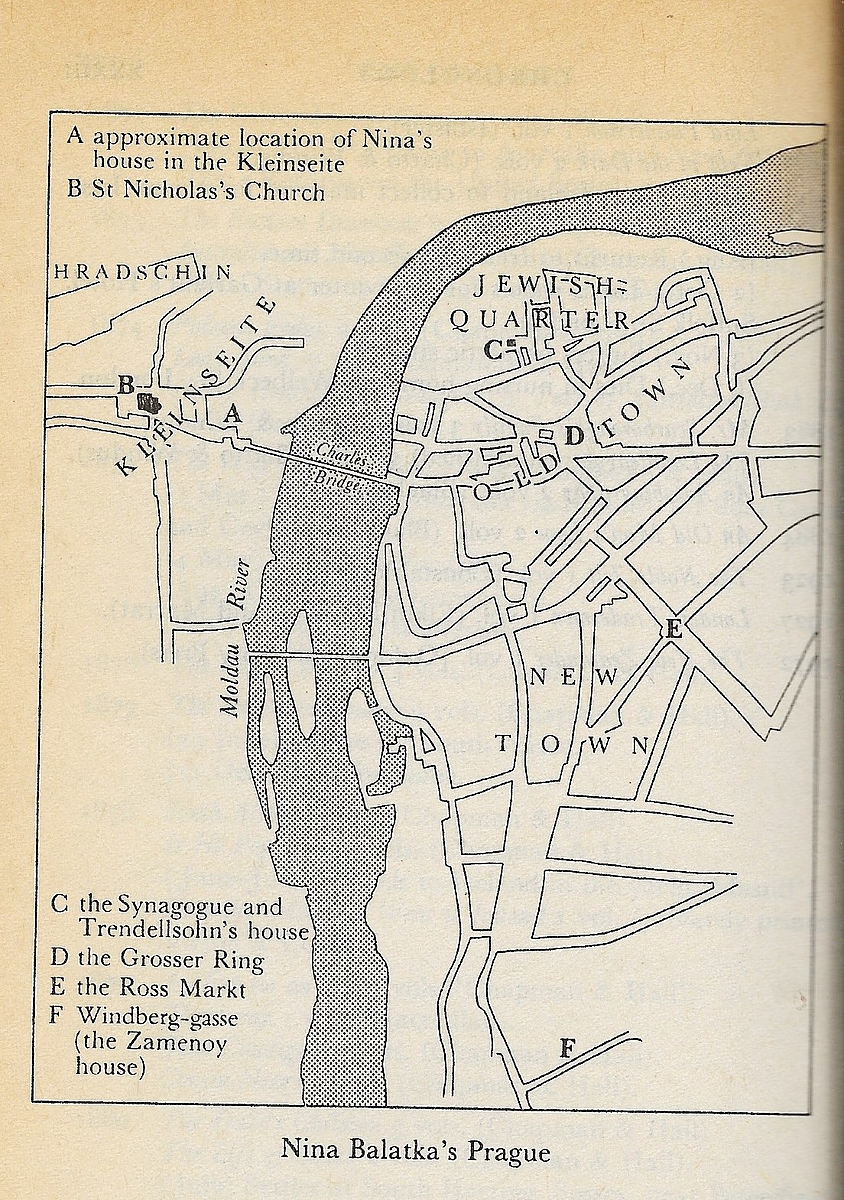
My edition has a map of "Nina Balatka's Prague." Please excuse my terrible scanning, but it might be useful to visualize the action in the novel:
27lyzard
Ugh. Sorry, people, some stuff has flared up; but I should be able to knuckle back down this afternoon.
29lyzard
Chapter 2 introduces the figure of John of Nepomuk, or St John Nepomucene, which is one of a number of statues placed along the balustrade of the Charles Bridge, and which becomes important both literally and symbolically over the narrative:

The statue, and the little ritual to ward off danger, become the first impetus for Nina to really stop and consider what she is doing:
Nina, as a child, had always touched the stone, and then touched her lips, and did the act without much thought as to the saving power of St John Nepomucene. But now, as she carried her hand up to her face, she did think of the deed. Had she, who was about to marry a Jew, any right to ask for the assistance of a Christian saint? And would such a deed that she now proposed to herself put her beyond the pale of Christian aid?
Trollope presents Nina as rather unthinking about both her religion; she certainly thinks little about her faith as faith; and it finishes a poor second compared with her passion for Anton. The implications of a cross-faith marriage only slowly become of importance to her (and how Trollope handles her thinking is an interesting touch).
Nina, we note along the way, as - equally unthinkingly - internalised some of the anti-Jewish prejudices of those around her: they emerge at moments of crisis, when she falls into the trap of thinking that Anton is doing something not because he is Anton, but because he is Jewish.
Though we might expect religion to play a critical part in this narrative, it is rather religious hypocrisy - the way that people use their religion as a weapon, in violation of the very tenets of that religion - that occupies Trollope here.
(Another interesting touch is the actual behaviour of Father Jerome, with whom Nina is darkly threatened from the moment she announces her engagement...)

The statue, and the little ritual to ward off danger, become the first impetus for Nina to really stop and consider what she is doing:
Nina, as a child, had always touched the stone, and then touched her lips, and did the act without much thought as to the saving power of St John Nepomucene. But now, as she carried her hand up to her face, she did think of the deed. Had she, who was about to marry a Jew, any right to ask for the assistance of a Christian saint? And would such a deed that she now proposed to herself put her beyond the pale of Christian aid?
Trollope presents Nina as rather unthinking about both her religion; she certainly thinks little about her faith as faith; and it finishes a poor second compared with her passion for Anton. The implications of a cross-faith marriage only slowly become of importance to her (and how Trollope handles her thinking is an interesting touch).
Nina, we note along the way, as - equally unthinkingly - internalised some of the anti-Jewish prejudices of those around her: they emerge at moments of crisis, when she falls into the trap of thinking that Anton is doing something not because he is Anton, but because he is Jewish.
Though we might expect religion to play a critical part in this narrative, it is rather religious hypocrisy - the way that people use their religion as a weapon, in violation of the very tenets of that religion - that occupies Trollope here.
(Another interesting touch is the actual behaviour of Father Jerome, with whom Nina is darkly threatened from the moment she announces her engagement...)
30lyzard
Another familiar Trollopean touch is Nina's feeling of uneasy guilt over her engagement being kept from her family; her belief that by not speaking, she is being deceitful.
Even so, she is provoked to her general declaration - somewhat against Anton's own wishes - by the realisation that the servant, Souchey, is aware of her situation and going to make it public unless she gets there first.
It is not, however, to her father that Nina first speaks, but to her aunt:
"You are bold and brazen. Marry a Jew! It is the worst thing a Christian girl could do."
"No, it is not. There are things ten times worse than that."
"How you could dare to come and tell me!"
"I did dare, you see. If I had not told you, you would have called me sly."
"You are sly."
"I am not sly. You tell me I am bad and bold and brazen."
"So you are."
"Very likely. I do not say I am not. But I am not sly. Now, will you let me go, aunt Sophie?"
"Yes, you may go---you may go; but you may not come here again till this thing has been put an end to. Of course I shall see your father and Father Jerome, and your uncle will see the police. You will be locked up, and Anton Trendellsohn will be sent out of Bohemia. That is how it will end. Now you may go."
Madame Zapenoy is the novel's face of Ugly Christianity: her prejudice is violent and unthinking, and she soon shows that there is little that is cruel or dishonest that she will not stoop to, in order to get her own way.
Trollope makes Aunt Sophie as unappealing as he can, including bestowing his most despised of female traits, slovenliness, upon her, presumably to make his readers stop and consider just how far they care to ally themselves with her---even if, perhaps, they agree with her stance on the engagement.
However, Aunt Sophie's abuse of Nina carries with it the fact that, historically, it was not so very long ago that all the power of the church and the law could have been brought to bear upon Nina and Anton: that such marriages as theirs were illegal, and that the individuals involved could have suffered dire consequences even for the contemplation.
Trollope mines irony even here---repeatedly holding up England as a haven of broadmindedness and legal protection in comparison, and so rubbing his readers' noses in the gap between their theory and practice. The laws were changing, but the attitudes were not: England, Trollope suggests, was in reality a nation of Aunt Sophies.
(There was one crucial difference of course, in that England was not a Catholic country; so that the "authority of the church" posed less of a threat.)
Even so, she is provoked to her general declaration - somewhat against Anton's own wishes - by the realisation that the servant, Souchey, is aware of her situation and going to make it public unless she gets there first.
It is not, however, to her father that Nina first speaks, but to her aunt:
"You are bold and brazen. Marry a Jew! It is the worst thing a Christian girl could do."
"No, it is not. There are things ten times worse than that."
"How you could dare to come and tell me!"
"I did dare, you see. If I had not told you, you would have called me sly."
"You are sly."
"I am not sly. You tell me I am bad and bold and brazen."
"So you are."
"Very likely. I do not say I am not. But I am not sly. Now, will you let me go, aunt Sophie?"
"Yes, you may go---you may go; but you may not come here again till this thing has been put an end to. Of course I shall see your father and Father Jerome, and your uncle will see the police. You will be locked up, and Anton Trendellsohn will be sent out of Bohemia. That is how it will end. Now you may go."
Madame Zapenoy is the novel's face of Ugly Christianity: her prejudice is violent and unthinking, and she soon shows that there is little that is cruel or dishonest that she will not stoop to, in order to get her own way.
Trollope makes Aunt Sophie as unappealing as he can, including bestowing his most despised of female traits, slovenliness, upon her, presumably to make his readers stop and consider just how far they care to ally themselves with her---even if, perhaps, they agree with her stance on the engagement.
However, Aunt Sophie's abuse of Nina carries with it the fact that, historically, it was not so very long ago that all the power of the church and the law could have been brought to bear upon Nina and Anton: that such marriages as theirs were illegal, and that the individuals involved could have suffered dire consequences even for the contemplation.
Trollope mines irony even here---repeatedly holding up England as a haven of broadmindedness and legal protection in comparison, and so rubbing his readers' noses in the gap between their theory and practice. The laws were changing, but the attitudes were not: England, Trollope suggests, was in reality a nation of Aunt Sophies.
(There was one crucial difference of course, in that England was not a Catholic country; so that the "authority of the church" posed less of a threat.)
31lyzard
Trollope is oblique in the details, but throughout Nina Balatka there is the suggestion that it was association with Karil Zamenoy that ruined Josef Balatka in the first place---setting up yet another irony, as the Zamenoys repeatedly accuse the Trendellsohns of having "bled him dry"---when in fact their concessions in terms of the rent on the house are the only thing standing between the Balatkas and utter destitution:
Chapter 3:
"But of course he should see that those who have been good to him are not---are not injured because of their kindness."
"You mean those Jews---the Trendellsohns."
"Yes, those Jews the Trendellsohns! You would not rob a man because he is a Jew," said she, repeating the old words.
"They know how to take care of themselves, Nina."
"Very likely."
"They have managed to get all your father's property between them."
"I don't know how that is. Father says that the business which uncle and you have was once his, and that he made it. In these matters the weakest always goes to the wall. Father has no son to help him, as uncle Karil has---and old Trendellsohn."
Granted Nina has increasingly refused their help, but the fact remains that the Zamenoys have allowed her and her father to approach actual starvation without intervening---and Ziska, supposedly in love with Nina, doesn't even know it; though it is her poverty that has held him off to date:
All this was a new light to Ziska. He knew that his uncle and cousin were very poor, and had halted in his love because he was ashamed of their poverty; but he had never thought of them as people hungry from want of food, or cold from want of clothes. It may be said of him, to his credit, that his love had been too strong for his shame, and that he had made up his mind to marry his cousin Nina in spite of her poverty...
****
Now Ziska was told that the girl he loved was to marry a Jew because she was starving, and the tidings threw a new light upon him. Why had he not offered assistance to Nina? It was not surprising that Nina should be so hard to him---to him who had as yet offered her nothing in her poverty but a few cold compliments.
Josef isn't much of a father to Nina, but we do get this one final burst of passion - and pragmatism - from him, when Ziska confronts him over Nina's engagement:
"Among you all the poor girl is a beggar. If some one does not take pity on her, she will starve soon."
"Take pity on her! Do not we all take pity on her?"
"No," said Josef Balatka, turning angrily against his nephew; "not a scrap of pity---not a morsel of love. You cannot rid yourself of her quite---of her or me---and that is your pity."
"You are wrong there."
"Very well; then let me be wrong. I can understand what is before my eyes. Look round the house and see what we are coming to. Nina at the present moment has not got a florin in her purse. We are starving, or next to it, and yet you wonder that she should be willing to marry an honest man who has plenty of money."
"But he is a Jew!"
"Yes; he is a Jew. I know that."
"And Nina knows it."
"Of course she does. Do you go home and eat nothing for a week, and then see whether a Jew's bread will poison you."
And there is this, of course: even Ziska doesn't think Ziska is much of a bargain:
"Would you not like to have me for a son-in-law better than a Jew, uncle Josef?" said Ziska, pleading for himself as best he knew how to plead.
Chapter 3:
"But of course he should see that those who have been good to him are not---are not injured because of their kindness."
"You mean those Jews---the Trendellsohns."
"Yes, those Jews the Trendellsohns! You would not rob a man because he is a Jew," said she, repeating the old words.
"They know how to take care of themselves, Nina."
"Very likely."
"They have managed to get all your father's property between them."
"I don't know how that is. Father says that the business which uncle and you have was once his, and that he made it. In these matters the weakest always goes to the wall. Father has no son to help him, as uncle Karil has---and old Trendellsohn."
Granted Nina has increasingly refused their help, but the fact remains that the Zamenoys have allowed her and her father to approach actual starvation without intervening---and Ziska, supposedly in love with Nina, doesn't even know it; though it is her poverty that has held him off to date:
All this was a new light to Ziska. He knew that his uncle and cousin were very poor, and had halted in his love because he was ashamed of their poverty; but he had never thought of them as people hungry from want of food, or cold from want of clothes. It may be said of him, to his credit, that his love had been too strong for his shame, and that he had made up his mind to marry his cousin Nina in spite of her poverty...
****
Now Ziska was told that the girl he loved was to marry a Jew because she was starving, and the tidings threw a new light upon him. Why had he not offered assistance to Nina? It was not surprising that Nina should be so hard to him---to him who had as yet offered her nothing in her poverty but a few cold compliments.
Josef isn't much of a father to Nina, but we do get this one final burst of passion - and pragmatism - from him, when Ziska confronts him over Nina's engagement:
"Among you all the poor girl is a beggar. If some one does not take pity on her, she will starve soon."
"Take pity on her! Do not we all take pity on her?"
"No," said Josef Balatka, turning angrily against his nephew; "not a scrap of pity---not a morsel of love. You cannot rid yourself of her quite---of her or me---and that is your pity."
"You are wrong there."
"Very well; then let me be wrong. I can understand what is before my eyes. Look round the house and see what we are coming to. Nina at the present moment has not got a florin in her purse. We are starving, or next to it, and yet you wonder that she should be willing to marry an honest man who has plenty of money."
"But he is a Jew!"
"Yes; he is a Jew. I know that."
"And Nina knows it."
"Of course she does. Do you go home and eat nothing for a week, and then see whether a Jew's bread will poison you."
And there is this, of course: even Ziska doesn't think Ziska is much of a bargain:
"Would you not like to have me for a son-in-law better than a Jew, uncle Josef?" said Ziska, pleading for himself as best he knew how to plead.
32lyzard
Trollope makes draws a couple of contrasts in Chapter 4: he makes it progressively clear that Mr Trendellsphn is just as opposed to the marriage as the Zamenoys, but his behaviour is entirely different; there is nothing of the Ugly Jew in his ongoing reception of Nina:
Nina and the elder Trendellsohn had always hitherto been friends. Before her engagement with his son they had been affectionate friends, and since that had been made known to him there had been no quarrel between them. But the old man had hardly approved of his son's purpose, thinking that a Jew should look for the wife of his bosom among his own people, and thinking also, perhaps, that one who had so much of worldly wealth to offer as his son should receive something also of the same in his marriage. Old Trendellsohn had never uttered a word of complaint to Nina---had said nothing to make her suppose that she was not welcome to the house; but he had never spoken to her with happy, joy-giving words, as the future bride of his son. He still called her his daughter, as he had done before; but he did it only in his old fashion, using the affectionate familiarity of an old friend to a young maiden.
The other contrast lies in this:
He was scrupulously clean in his person, and seemed, even at his age, to take a pride in the purity and fineness of his linen.
---as opposed to the description of Aunt Sophie, in Chapter 2:
But of a morning she was accustomed to go about the house in a pale-tinted wrapper, which, pale-tinted as it was, should have been in the washing-tub much oftener than was the case with it---if not for cleanliness, then for mere decency of appearance.
And the mode in which she carried her matutinal curls, done up with black pins, very visible to the eye, was not in itself becoming. The handkerchief which she wore in lieu of cap, might have been excused on the score of its ugliness, as Madame Zamenoy was no longer young, had it not been open to such manifest condemnation for other sins. And in this guise she would go about the house from morning to night on days not made sacred by the use of the carriage. Now Lotta Luxa was clean in the midst of her work; and one would have thought that the cleanliness of the maid would have shamed the slatternly ways of the mistress...
Sometimes with Trollope this sort of stuff can just be a cheap shot, but I think he means something a bit deeper here: he's talking about levels of self-respect, with cleanliness of person linked to cleanliness of mind---or not.
Nina and the elder Trendellsohn had always hitherto been friends. Before her engagement with his son they had been affectionate friends, and since that had been made known to him there had been no quarrel between them. But the old man had hardly approved of his son's purpose, thinking that a Jew should look for the wife of his bosom among his own people, and thinking also, perhaps, that one who had so much of worldly wealth to offer as his son should receive something also of the same in his marriage. Old Trendellsohn had never uttered a word of complaint to Nina---had said nothing to make her suppose that she was not welcome to the house; but he had never spoken to her with happy, joy-giving words, as the future bride of his son. He still called her his daughter, as he had done before; but he did it only in his old fashion, using the affectionate familiarity of an old friend to a young maiden.
The other contrast lies in this:
He was scrupulously clean in his person, and seemed, even at his age, to take a pride in the purity and fineness of his linen.
---as opposed to the description of Aunt Sophie, in Chapter 2:
But of a morning she was accustomed to go about the house in a pale-tinted wrapper, which, pale-tinted as it was, should have been in the washing-tub much oftener than was the case with it---if not for cleanliness, then for mere decency of appearance.
And the mode in which she carried her matutinal curls, done up with black pins, very visible to the eye, was not in itself becoming. The handkerchief which she wore in lieu of cap, might have been excused on the score of its ugliness, as Madame Zamenoy was no longer young, had it not been open to such manifest condemnation for other sins. And in this guise she would go about the house from morning to night on days not made sacred by the use of the carriage. Now Lotta Luxa was clean in the midst of her work; and one would have thought that the cleanliness of the maid would have shamed the slatternly ways of the mistress...
Sometimes with Trollope this sort of stuff can just be a cheap shot, but I think he means something a bit deeper here: he's talking about levels of self-respect, with cleanliness of person linked to cleanliness of mind---or not.
33lyzard
Chapter 4:
"Anton spoke to me the other day about some deeds which should belong to you."
"They do belong to me," said Trendellsohn.
"But you have them not in your own keeping."
"No, we have not. It is, I believe, the creed of a Christian that he may deal dishonestly with a Jew, though the Jew who shall deal dishonestly with a Christian is to be hanged. It is strange what latitude men will give themselves under the cloak of their religion!"
"Anton spoke to me the other day about some deeds which should belong to you."
"They do belong to me," said Trendellsohn.
"But you have them not in your own keeping."
"No, we have not. It is, I believe, the creed of a Christian that he may deal dishonestly with a Jew, though the Jew who shall deal dishonestly with a Christian is to be hanged. It is strange what latitude men will give themselves under the cloak of their religion!"
34lyzard
Out of the mouths of babes:
Chapter 4:
"But I should like a lover who would laugh and be gay. Uncle Anton is never gay. My lover shall be only two years older than myself. Uncle Anton must be twenty years older than you, Nina."
"Not more than ten---or twelve at the most."
"He is too old to laugh and dance."
"Not at all, dear; but he thinks of other things."
"I should like a lover to think of the things that I think about. It is all very well being steady when you have got babies of your own; but that should be after ever so long. I should like to keep my lover as a lover for two years. And all that time he should like to dance with me, and to hear music, and to go about just where I would like to go."
"And what then, Ruth?"
"Then? Why, then I suppose I should marry him, and become stupid like the rest..."
Chapter 4:
"But I should like a lover who would laugh and be gay. Uncle Anton is never gay. My lover shall be only two years older than myself. Uncle Anton must be twenty years older than you, Nina."
"Not more than ten---or twelve at the most."
"He is too old to laugh and dance."
"Not at all, dear; but he thinks of other things."
"I should like a lover to think of the things that I think about. It is all very well being steady when you have got babies of your own; but that should be after ever so long. I should like to keep my lover as a lover for two years. And all that time he should like to dance with me, and to hear music, and to go about just where I would like to go."
"And what then, Ruth?"
"Then? Why, then I suppose I should marry him, and become stupid like the rest..."
35cbl_tn
In the description of Zamenoy's servant Lotta Luxa in Chapter 2, it says that in the back of her hair she still carried that Diana's dart which maidens wear in those parts when they are not only maidens unmarried, but maidens also disengaged.
I'm wondering what is a Diana's dart? My guess would be a long hair pin. Am I close?
I'm wondering what is a Diana's dart? My guess would be a long hair pin. Am I close?
36cbl_tn
>34 lyzard: That was exactly my thought!
37kac522
>35 cbl_tn: My (OUP) edition has this note:
So your guess sounds pretty close to this description.
Diana's dart: Apparently an arrow-shaped hair ornament, worn in Bohemia by unmarried women. The goddess Diana, usually portrayed as a huntress, with bow and arrows, was the patroness of virginity.
So your guess sounds pretty close to this description.
38lyzard
>35 cbl_tn:, >37 kac522:
I'm quite sure that's right, though I haven't been able to find an appropriate image, only of much fancier, higher-social-set examples (usually called Cupid's Arrow instead, which is a lot less specifically symbolic).
For what it's worth:

(Though I did find this in John Dryden:
My mother, who the royal sceptre swayed,
Was captive to the cruel victor made,
And hither led; but, hence redeemed with gold,
Her native country did again behold,
And but beheld; for soon Diana's dart,
In an unhappy chace, transfixed her heart...)
I'm quite sure that's right, though I haven't been able to find an appropriate image, only of much fancier, higher-social-set examples (usually called Cupid's Arrow instead, which is a lot less specifically symbolic).
For what it's worth:

(Though I did find this in John Dryden:
My mother, who the royal sceptre swayed,
Was captive to the cruel victor made,
And hither led; but, hence redeemed with gold,
Her native country did again behold,
And but beheld; for soon Diana's dart,
In an unhappy chace, transfixed her heart...)
39lyzard
Chapter 5:
The more Madame Zamenoy thought of the terrible tidings which had reached her, the more determined did she become to prevent the degradation of the connection with which she was threatened. She declared to her husband and son that all Prague were already talking of the horror, forgetting, perhaps, that any knowledge which Prague had on the subject must have come from herself...
:D
Nina has already been roundly threatened with Father Jerome, but when introduced in the text, he is hardly the personification of religious wrath we have been led to expect. Rather, he displays an oddly secular pragmatism:
Nor did she get much more comfort from Father Jerome. His reliance was placed chiefly on operations to be carried on with the Jew; and, failing them, on the opposition which the Jew would experience among his own people. "They think more of it than we do," said Father Jerome.
"How can that be, Father Jerome?"
"Well, they do. He would lose caste among all his friends by such a marriage, and would, I think, destroy all his influence among them. When he perceives this more fully he will be shy enough about it himself. Besides, what is he to get?"
"He will get nothing."
"He will think better of it. And you might manage something with those deeds. Of course he should have them sooner or later, but they might be surrendered as the price of his giving her up. I should say it might be managed."
The more Madame Zamenoy thought of the terrible tidings which had reached her, the more determined did she become to prevent the degradation of the connection with which she was threatened. She declared to her husband and son that all Prague were already talking of the horror, forgetting, perhaps, that any knowledge which Prague had on the subject must have come from herself...
:D
Nina has already been roundly threatened with Father Jerome, but when introduced in the text, he is hardly the personification of religious wrath we have been led to expect. Rather, he displays an oddly secular pragmatism:
Nor did she get much more comfort from Father Jerome. His reliance was placed chiefly on operations to be carried on with the Jew; and, failing them, on the opposition which the Jew would experience among his own people. "They think more of it than we do," said Father Jerome.
"How can that be, Father Jerome?"
"Well, they do. He would lose caste among all his friends by such a marriage, and would, I think, destroy all his influence among them. When he perceives this more fully he will be shy enough about it himself. Besides, what is he to get?"
"He will get nothing."
"He will think better of it. And you might manage something with those deeds. Of course he should have them sooner or later, but they might be surrendered as the price of his giving her up. I should say it might be managed."
40lyzard
It is left to Aunt Sophie to bring the wrath, though in this instance Nina not only holds her ground, she gives as good as she gets:
Chapter 5:
"Aunt Sophie," said Nina, "now that you are here, you can say what you please to me; but you might as well spare father."
"I will not spare him. I am ashamed of him---thoroughly ashamed of him. What can I think of him when he will lie there and not say a word to save his daughter from the machinations of a filthy Jew?"
"Anton Trendellsohn is not a filthy Jew."
"He is a robber. He has cheated your father out of everything."
"He is no robber. He has cheated no one. I know who has cheated father, if you come to that."
"Whom do you mean, hussey?"
"I shall not answer you; but you need not tell me any more about the Jews cheating us. Christians can cheat as well as Jews, and can rob from their own flesh and blood too. I do not care for your threats, aunt Sophie, nor for your frowns. I did care for them, but you have said that which makes it impossible that I should regard them any further."
"And this is what I get for all my trouble---for all your uncle's generosity!" Again Nina smiled...
Chapter 5:
"Aunt Sophie," said Nina, "now that you are here, you can say what you please to me; but you might as well spare father."
"I will not spare him. I am ashamed of him---thoroughly ashamed of him. What can I think of him when he will lie there and not say a word to save his daughter from the machinations of a filthy Jew?"
"Anton Trendellsohn is not a filthy Jew."
"He is a robber. He has cheated your father out of everything."
"He is no robber. He has cheated no one. I know who has cheated father, if you come to that."
"Whom do you mean, hussey?"
"I shall not answer you; but you need not tell me any more about the Jews cheating us. Christians can cheat as well as Jews, and can rob from their own flesh and blood too. I do not care for your threats, aunt Sophie, nor for your frowns. I did care for them, but you have said that which makes it impossible that I should regard them any further."
"And this is what I get for all my trouble---for all your uncle's generosity!" Again Nina smiled...
41lyzard
This is all very well---
Chapter 6:
"For her sake I would not yield, for I know she loves me. Neither for my own would I yield; for as truly as I worship God, I love her better than all the world beside. She is to me my cup of water when I am hot and athirst, my morsel of bread when I am faint with hunger. Her voice is the only music which I love. The touch of her hand is so fresh that it cools me when I am in fever. The kiss of her lips is so sweet and balmy that it cures when I shake with an ague fit. To think of her when I am out among men fighting for my own, is such a joy, that now, methinks now, that I have had it belonging to me, I could no longer fight were I to lose it. No. father; she shall not be taken from me. I love her, and I will keep her."
---but it is made clear again that while Anton may speak like this *of* Nina, he rarely if ever speaks like this *to* her---and my original question of how exactly these two came together remains.
I'm still struggling to believe that Anton could ever have been so oblivious to the likely consequences as to let himself fall for Nina in the first place, let alone formalise the relationship. He is hardly a man to be carried away by his feelings, or to commit himself unthinkingly; literally to risk everything for a woman.
Trollope goes on to examine Anton's thinking about the future and his marriage and while that has authenticity about it, it is still rationalisation after the event---and the event itself remains unpersuasive:
But again he shaped his dreams aright---so far aright that he could still build the castles of his imagination to his own liking. Nina should be his wife. It might be that she would follow the creed of her husband, and then all would be well. In those far cities to which he would go, it would hardly in such case be known that she had been born a Christian; or else he would show the world around him, both Jews and Christians, how well a Christian and a Jew might live together. To crush the prejudice which had dealt so hardly with his people---to make a Jew equal in all things to a Christian — this was his desire; and how could this better be fulfilled than by his union with a Christian? One thing at least was fixed with him — one thing was fixed, even though it should mar his dreams. He had taken the Christian girl to be part of himself, and nothing should separate them.
Chapter 6:
"For her sake I would not yield, for I know she loves me. Neither for my own would I yield; for as truly as I worship God, I love her better than all the world beside. She is to me my cup of water when I am hot and athirst, my morsel of bread when I am faint with hunger. Her voice is the only music which I love. The touch of her hand is so fresh that it cools me when I am in fever. The kiss of her lips is so sweet and balmy that it cures when I shake with an ague fit. To think of her when I am out among men fighting for my own, is such a joy, that now, methinks now, that I have had it belonging to me, I could no longer fight were I to lose it. No. father; she shall not be taken from me. I love her, and I will keep her."
---but it is made clear again that while Anton may speak like this *of* Nina, he rarely if ever speaks like this *to* her---and my original question of how exactly these two came together remains.
I'm still struggling to believe that Anton could ever have been so oblivious to the likely consequences as to let himself fall for Nina in the first place, let alone formalise the relationship. He is hardly a man to be carried away by his feelings, or to commit himself unthinkingly; literally to risk everything for a woman.
Trollope goes on to examine Anton's thinking about the future and his marriage and while that has authenticity about it, it is still rationalisation after the event---and the event itself remains unpersuasive:
But again he shaped his dreams aright---so far aright that he could still build the castles of his imagination to his own liking. Nina should be his wife. It might be that she would follow the creed of her husband, and then all would be well. In those far cities to which he would go, it would hardly in such case be known that she had been born a Christian; or else he would show the world around him, both Jews and Christians, how well a Christian and a Jew might live together. To crush the prejudice which had dealt so hardly with his people---to make a Jew equal in all things to a Christian — this was his desire; and how could this better be fulfilled than by his union with a Christian? One thing at least was fixed with him — one thing was fixed, even though it should mar his dreams. He had taken the Christian girl to be part of himself, and nothing should separate them.
42cbl_tn
>38 lyzard: That portrait is different than I imagined!
>41 lyzard: Trollope needs readers to buy into Nina and Anton's relationship since it is central to the novel, but the way he's written their characters it's all but impossible to believe in it.
>41 lyzard: Trollope needs readers to buy into Nina and Anton's relationship since it is central to the novel, but the way he's written their characters it's all but impossible to believe in it.
43lyzard
?42
I don't think that's right, just the best I could find.
Yes, he's skipped over the difficult bit - "Here it is, deal with it" - and I find their coming together impossible to imagine.
I don't think that's right, just the best I could find.
Yes, he's skipped over the difficult bit - "Here it is, deal with it" - and I find their coming together impossible to imagine.
44lyzard
But whatever we make of the central relationship, I find the business of the documents credible in an extremely nasty way.
Trollope uses this situation on two different levels; perhaps three. This is another place where he rubs his Christian readers' noses in their own attitudes, with the constant insistence that there is no dishonour in behaving dishonestly towards a Jew; that the usual rules don't apply. Deceit is permissible; broken promises are permissible. Being a cheat and a liar yourself - even while accusing the Jews of being so inherently - is perfectly fine. The Trendellsohns' efforts to acquire what no-one, not even the Zamenoys, denies is their own property are repeatedly met with lies and prevarication.
Even readers who might have subscribed to that philosophy must have been discomforted to find themselves represented by the Zamenoys: Karil giving himself plausible deniability by leaving the details to Sophie and Ziska, and Lotta being the one to actually get her hands dirty (with inside help).
The documents become the wedge by which the Zamenoys hope to drive Nina and Anton apart---by offering them in exchange for Anton giving Nina up or, when that fails, by using them as the means to sow doubt in Anton's mind...which doesn't.
All this overtly in the cause of "saving Nina's soul", perhaps the worst of all the lies told here.
Trollope uses this situation on two different levels; perhaps three. This is another place where he rubs his Christian readers' noses in their own attitudes, with the constant insistence that there is no dishonour in behaving dishonestly towards a Jew; that the usual rules don't apply. Deceit is permissible; broken promises are permissible. Being a cheat and a liar yourself - even while accusing the Jews of being so inherently - is perfectly fine. The Trendellsohns' efforts to acquire what no-one, not even the Zamenoys, denies is their own property are repeatedly met with lies and prevarication.
Even readers who might have subscribed to that philosophy must have been discomforted to find themselves represented by the Zamenoys: Karil giving himself plausible deniability by leaving the details to Sophie and Ziska, and Lotta being the one to actually get her hands dirty (with inside help).
The documents become the wedge by which the Zamenoys hope to drive Nina and Anton apart---by offering them in exchange for Anton giving Nina up or, when that fails, by using them as the means to sow doubt in Anton's mind...which doesn't.
All this overtly in the cause of "saving Nina's soul", perhaps the worst of all the lies told here.
45lyzard
What we might question here is why the Trendellsohns ever allowed the documents to stay with the Zamenoys in the first place. And really, the moment that Josef became so ill, or so incapable, that Nina had to take over his business should have been the cue for action in securing the papers.
Be that as it may, Trollope reserves some of his very ugliest writing for this confrontation between Anton and his Christian antagonists---presumably, again, with the goal of making his readers hear their own thoughts out loud, naked:
Chapter 6:
"I would have told him nothing," said the elder Zamenoy when they were left alone.
"My dear, you don't understand; indeed you do not," said his wife. "No stone should be left unturned to prevent such a horrid marriage as this. There is nothing I would not say---nothing I would not do."
"But I do not see that you are doing anything."
"Leave this little thing to me, my dear---to me and Ziska. It is impossible that you should do everything yourself. In such a matter as this, believe me that a woman is best."
"But I hate anything that is really dishonest."
"There shall be no dishonesty---none in the world. You don't suppose that I want to get the dirty old tumble-down houses. God forbid! But you would not give up everything to a Jew! Oh, I hate them! I do hate them! Anything is fair against a Jew."
But the key passage, alas, is this:
"What a fool the man is!" said Madame Zamenoy. "He comes to us for what he calls his property because he wants to marry the girl, and she is deceiving him all the while. Go to Nina Balatka, Trendellsohn, and she will tell you who has the document. She will tell you where it is, if it suits her to do so."
"She has told me, and she knows that it is here."
"She knows nothing of the kind, and she has lied. She has lied in order that she may rob you. Jew as you are, she will be too many for you. She will rob you, with all her seeming simplicity."
"I trust her as I do my own soul," said Trendellsohn.
"Very well; I tell you that she, and she only, knows where these papers are."
Anton ought to know Nina, and he ought to know the Zamenoys, but he allows a seed of doubt to be planted.
Be that as it may, Trollope reserves some of his very ugliest writing for this confrontation between Anton and his Christian antagonists---presumably, again, with the goal of making his readers hear their own thoughts out loud, naked:
Chapter 6:
"I would have told him nothing," said the elder Zamenoy when they were left alone.
"My dear, you don't understand; indeed you do not," said his wife. "No stone should be left unturned to prevent such a horrid marriage as this. There is nothing I would not say---nothing I would not do."
"But I do not see that you are doing anything."
"Leave this little thing to me, my dear---to me and Ziska. It is impossible that you should do everything yourself. In such a matter as this, believe me that a woman is best."
"But I hate anything that is really dishonest."
"There shall be no dishonesty---none in the world. You don't suppose that I want to get the dirty old tumble-down houses. God forbid! But you would not give up everything to a Jew! Oh, I hate them! I do hate them! Anything is fair against a Jew."
But the key passage, alas, is this:
"What a fool the man is!" said Madame Zamenoy. "He comes to us for what he calls his property because he wants to marry the girl, and she is deceiving him all the while. Go to Nina Balatka, Trendellsohn, and she will tell you who has the document. She will tell you where it is, if it suits her to do so."
"She has told me, and she knows that it is here."
"She knows nothing of the kind, and she has lied. She has lied in order that she may rob you. Jew as you are, she will be too many for you. She will rob you, with all her seeming simplicity."
"I trust her as I do my own soul," said Trendellsohn.
"Very well; I tell you that she, and she only, knows where these papers are."
Anton ought to know Nina, and he ought to know the Zamenoys, but he allows a seed of doubt to be planted.
46lyzard
Christians:
Chapter 7:
Touching that piece of parchment as to which so much anxiety had been expressed, he only knew that he had, at his wife's instigation, given it into her hand in order that she might use it in some way for putting an end to the foul betrothal between Nina and the Jew. The elder Zamenoy no doubt understood that Anton Trendellsohn was to be bought off by the document; and he was not unwilling to buy him off so cheaply, knowing as he did that the houses were in truth the Jew's property; but Madame Zamenoy's scheme was deeper than this. She did not believe that the Jew was to be bought off at so cheap a price; but she did believe that it might be possible to create such a feeling in his mind as would make him abandon Nina out of the workings of his own heart... Madame Zamenoy, could she have had her own will, would have rescued Nina from the Jew---firstly, because Nina was known all over Prague to be her niece---and, secondly, for the good of Christianity generally; but the girl herself, when rescued, she would willingly have left to starve in the poverty of the old house in the Kleinseite...
Chapter 7:
Touching that piece of parchment as to which so much anxiety had been expressed, he only knew that he had, at his wife's instigation, given it into her hand in order that she might use it in some way for putting an end to the foul betrothal between Nina and the Jew. The elder Zamenoy no doubt understood that Anton Trendellsohn was to be bought off by the document; and he was not unwilling to buy him off so cheaply, knowing as he did that the houses were in truth the Jew's property; but Madame Zamenoy's scheme was deeper than this. She did not believe that the Jew was to be bought off at so cheap a price; but she did believe that it might be possible to create such a feeling in his mind as would make him abandon Nina out of the workings of his own heart... Madame Zamenoy, could she have had her own will, would have rescued Nina from the Jew---firstly, because Nina was known all over Prague to be her niece---and, secondly, for the good of Christianity generally; but the girl herself, when rescued, she would willingly have left to starve in the poverty of the old house in the Kleinseite...
47lyzard
However, Chapter 7 also gives us the striking interlude of Ziska seeking out Anton in the Jewish district.
While he does use this incident to get in a couple of more jabs, generally this is much more subtle on Trollope's part, with the Jewish residents presented on their festival day simply as people enjoying themselves. There is an emphasis upon the attractiveness and cleanliness of people often stereotyped as ugly and dirty.
And what he also does is depict young Jewish people as just being young people, like any others:
As he made his way across the bottom of the Kalowrat-strasse and through the centre of the city to the narrow ways of the Jews' quarter, his heart somewhat misgave him as to the result of his visit. He knew very well that a Christian was safe among the Jews from any personal ill-usage; but he knew also that such a one as he would be known personally to many of them as a Christian rival, and probably as a Christian enemy in the same city, and he thought that they would look at him askance. Living in Prague all his life, he had hardly been above once or twice in the narrow streets which he was now threading. Strangers who come to Prague visit the Jews' quarter as a matter of course, and to such strangers the Jews of Prague are invariably courteous. But the Christians of the city seldom walk through the heart of the Jews' locality...
****
As Ziska went on, he became aware that the throng of people was unusually great, and that the day was in some sort more peculiar than the ordinary Jewish Sabbath. That the young men and girls should be dressed in their best clothes was, as a matter of course, incidental to the day; but he could perceive that there was an outward appearance of gala festivity about them which could not take place every week. The tall bright-eyed black-haired girls stood talking in the streets, with something of boldness in their gait and bearing, dressed many of them in white muslin, with bright ribbons and full petticoats, and that small bewitching Hungarian hat which they delight to wear. They stood talking somewhat loudly to each other, or sat at the open windows; while the young men in black frock-coats and black hats, with crimson cravats, clustered by themselves, wishing, but not daring so early in the day, to devote themselves to the girls, who appeared, or attempted to appear, unaware of their presence...
But perhaps in context the most daring bit of writing is the description of the Jewish men inside the synagogue---simply because this was something almost unprecedented in English novels of the time. Trollope is certainly writing here as an eyewitness:
"He is in the synagogue," said Ruth. "You will find him there if you will go in."
"But they are at worship there," said Ziska, doubtingly.
"They will be at worship all day, because it is our festival," said Rebecca, with her eyes fixed upon the ground; "but if you are a Christian they will not object to your going in. They like that Christians should see them. They are not ashamed."
****
Ziska would have escaped now from the project could he have done so without remark; but he was ashamed to seem afraid to enter the building, as the girls seemed to make so light of his doing so. He therefore followed Rebecca's brother, and in a minute or two was inside the narrow door.
The door was very low and narrow, and seemed to be choked up by men with short white surplices, but nevertheless he found himself inside, jammed among a crowd of Jews; and a sound of many voices, going together in a sing-song wail or dirge, met his ears. His first impulse was to take off his hat, but that was immediately replaced upon his head, he knew not by whom; and then he observed that all within the building were covered. His guide did not follow him, but whispered to some one what it was that the stranger required. He could see that those inside the building were all clothed in muslin shirts of different lengths, and that it was filled with men, all of whom had before them some sort of desk, from which they were reading, or rather wailing out their litany. Though this was the chief synagogue in Prague, and, as being the so-called oldest in Europe, is a building of some consequence in the Jewish world, it was very small. There was no ceiling, and the high-pitched roof, which had once probably been coloured, and the walls, which had once certainly been white, were black with the dirt of ages. In the centre there was a cage, as it were, or iron grille, within which five or six old Jews were placed, who seemed to wail louder than the others. Round the walls there was a row of men inside stationary desks, and outside them another row, before each of whom there was a small movable standing desk, on which there was a portion of the law of Moses. There seemed to be no possible way by which Ziska could advance, and he would have been glad to retreat had retreat been possible. But first one Jew and then another moved their desks for him, so that he was forced to advance, and some among them pointed to the spot where Anton Trendellsohn was standing. But as they pointed, and as they moved their desks to make a pathway, they still sang and wailed continuously, never ceasing for an instant in their long, loud, melancholy song of prayer...
While he does use this incident to get in a couple of more jabs, generally this is much more subtle on Trollope's part, with the Jewish residents presented on their festival day simply as people enjoying themselves. There is an emphasis upon the attractiveness and cleanliness of people often stereotyped as ugly and dirty.
And what he also does is depict young Jewish people as just being young people, like any others:
As he made his way across the bottom of the Kalowrat-strasse and through the centre of the city to the narrow ways of the Jews' quarter, his heart somewhat misgave him as to the result of his visit. He knew very well that a Christian was safe among the Jews from any personal ill-usage; but he knew also that such a one as he would be known personally to many of them as a Christian rival, and probably as a Christian enemy in the same city, and he thought that they would look at him askance. Living in Prague all his life, he had hardly been above once or twice in the narrow streets which he was now threading. Strangers who come to Prague visit the Jews' quarter as a matter of course, and to such strangers the Jews of Prague are invariably courteous. But the Christians of the city seldom walk through the heart of the Jews' locality...
****
As Ziska went on, he became aware that the throng of people was unusually great, and that the day was in some sort more peculiar than the ordinary Jewish Sabbath. That the young men and girls should be dressed in their best clothes was, as a matter of course, incidental to the day; but he could perceive that there was an outward appearance of gala festivity about them which could not take place every week. The tall bright-eyed black-haired girls stood talking in the streets, with something of boldness in their gait and bearing, dressed many of them in white muslin, with bright ribbons and full petticoats, and that small bewitching Hungarian hat which they delight to wear. They stood talking somewhat loudly to each other, or sat at the open windows; while the young men in black frock-coats and black hats, with crimson cravats, clustered by themselves, wishing, but not daring so early in the day, to devote themselves to the girls, who appeared, or attempted to appear, unaware of their presence...
But perhaps in context the most daring bit of writing is the description of the Jewish men inside the synagogue---simply because this was something almost unprecedented in English novels of the time. Trollope is certainly writing here as an eyewitness:
"He is in the synagogue," said Ruth. "You will find him there if you will go in."
"But they are at worship there," said Ziska, doubtingly.
"They will be at worship all day, because it is our festival," said Rebecca, with her eyes fixed upon the ground; "but if you are a Christian they will not object to your going in. They like that Christians should see them. They are not ashamed."
****
Ziska would have escaped now from the project could he have done so without remark; but he was ashamed to seem afraid to enter the building, as the girls seemed to make so light of his doing so. He therefore followed Rebecca's brother, and in a minute or two was inside the narrow door.
The door was very low and narrow, and seemed to be choked up by men with short white surplices, but nevertheless he found himself inside, jammed among a crowd of Jews; and a sound of many voices, going together in a sing-song wail or dirge, met his ears. His first impulse was to take off his hat, but that was immediately replaced upon his head, he knew not by whom; and then he observed that all within the building were covered. His guide did not follow him, but whispered to some one what it was that the stranger required. He could see that those inside the building were all clothed in muslin shirts of different lengths, and that it was filled with men, all of whom had before them some sort of desk, from which they were reading, or rather wailing out their litany. Though this was the chief synagogue in Prague, and, as being the so-called oldest in Europe, is a building of some consequence in the Jewish world, it was very small. There was no ceiling, and the high-pitched roof, which had once probably been coloured, and the walls, which had once certainly been white, were black with the dirt of ages. In the centre there was a cage, as it were, or iron grille, within which five or six old Jews were placed, who seemed to wail louder than the others. Round the walls there was a row of men inside stationary desks, and outside them another row, before each of whom there was a small movable standing desk, on which there was a portion of the law of Moses. There seemed to be no possible way by which Ziska could advance, and he would have been glad to retreat had retreat been possible. But first one Jew and then another moved their desks for him, so that he was forced to advance, and some among them pointed to the spot where Anton Trendellsohn was standing. But as they pointed, and as they moved their desks to make a pathway, they still sang and wailed continuously, never ceasing for an instant in their long, loud, melancholy song of prayer...
48MissWatson
Hi all! I just wanted to let you know that I haven't forgotten about this group read, but when I got back from my trip my notebook developed technical troubles. I'll start reading tonight.
50lyzard
Chapter 7 also contains the confrontation between Anton and Ziska, which is satisfying in some ways, disturbing in others.
This is all very well, given the Zamenoys' general neglect and occasional conditional support (plus the fact that they're almost certainly the reason the Balatkas need support in the first place)---
"And why should we not take Nina's part---we who are her friends?"
"Have you taken her part? Have you comforted her when she was in sorrow? Have you wiped her tears when she wept? Have you taken from her the stings of poverty, and striven to make the world to her a pleasant garden? She has no mother of her own. Has yours been a mother to her? Why is it that Nina Balatka has cared to receive the sympathy and the love of a Jew? Ask that girl whom you saw at the door for some corner in her heart, and she will scorn you. She, a Jewess, will scorn you, a Christian. She would so look at you that you would not dare to repeat your prayer. Why is it that Nina has not so scorned me? We are lodged poorly here, while Nina's aunt has a fine house in the New Town. She has a carriage and horses, and the world around her is gay and bright. Why did Nina come to the Jews' quarter for sympathy, seeing that she, too, has friends of her own persuasion? Take Nina's part, indeed! It is too late now for you to take her part. She has chosen for herself, and her resting-place is to be here." Trendellsohn, as he spoke, put his hand upon his breast, within the fold of his waistcoat; but Ziska hardly understood that his doing so had any special meaning. Ziska supposed that the "here" of which the Jew spoke was the old house in which they were at that moment talking to each other.
---and interesting in its way, particularly Anton's assumption / admission that Nina would never have looked at him if things had been different with her and her father; though possibly just because they would never have been thrown together as they were.
But once again we find ourselves in the discomforting Trollopean space in which, having given herself up to a man, a woman is then forced to just wait until he decides to make a move---in this case, with the Balatkas living in poverty and in fact on the verge of starvation. Anton must know that, surely, but the documents are nevertheless allowed to become an insuperable obstacle to any real assistance.
And they remain so since, despite Ziska's self-evident manoeuvring and prevarication---despite this, too---
Anton spoke again in a low voice---so low that it was almost a whisper, but the words seemed to fall direct into Ziska's ears, and to hurt him. "What are you to say? You called yourself just now a Christian gentleman. Neither the one name nor the other goes for aught with me. I am neither the one nor the other. But I am a man; and I ask you, as another man, whether it be true that Nina Balatka has that paper in her possession — in her own possession, mind you, I say." Ziska had hesitated before, but his hesitation now was much more palpable. "Why do you not answer me?" continued the Jew. "You have made this accusation against her. Is the accusation true?"
"I think she has it," said Ziska. "Indeed I feel sure of it."
"In her own hands?"
"Oh yes; in her own hands. Of course it must be in her own hands."
"Christian gentleman," said Anton, rising again from his seat, and now standing opposite to Ziska, "I disbelieve you. I think that you are lying to me. Despite your Christianity, and despite your gentility---you are a liar..."
---he achieves what he set out to do, and plants a seed of doubt in Anton's mind.
This is all very well, given the Zamenoys' general neglect and occasional conditional support (plus the fact that they're almost certainly the reason the Balatkas need support in the first place)---
"And why should we not take Nina's part---we who are her friends?"
"Have you taken her part? Have you comforted her when she was in sorrow? Have you wiped her tears when she wept? Have you taken from her the stings of poverty, and striven to make the world to her a pleasant garden? She has no mother of her own. Has yours been a mother to her? Why is it that Nina Balatka has cared to receive the sympathy and the love of a Jew? Ask that girl whom you saw at the door for some corner in her heart, and she will scorn you. She, a Jewess, will scorn you, a Christian. She would so look at you that you would not dare to repeat your prayer. Why is it that Nina has not so scorned me? We are lodged poorly here, while Nina's aunt has a fine house in the New Town. She has a carriage and horses, and the world around her is gay and bright. Why did Nina come to the Jews' quarter for sympathy, seeing that she, too, has friends of her own persuasion? Take Nina's part, indeed! It is too late now for you to take her part. She has chosen for herself, and her resting-place is to be here." Trendellsohn, as he spoke, put his hand upon his breast, within the fold of his waistcoat; but Ziska hardly understood that his doing so had any special meaning. Ziska supposed that the "here" of which the Jew spoke was the old house in which they were at that moment talking to each other.
---and interesting in its way, particularly Anton's assumption / admission that Nina would never have looked at him if things had been different with her and her father; though possibly just because they would never have been thrown together as they were.
But once again we find ourselves in the discomforting Trollopean space in which, having given herself up to a man, a woman is then forced to just wait until he decides to make a move---in this case, with the Balatkas living in poverty and in fact on the verge of starvation. Anton must know that, surely, but the documents are nevertheless allowed to become an insuperable obstacle to any real assistance.
And they remain so since, despite Ziska's self-evident manoeuvring and prevarication---despite this, too---
Anton spoke again in a low voice---so low that it was almost a whisper, but the words seemed to fall direct into Ziska's ears, and to hurt him. "What are you to say? You called yourself just now a Christian gentleman. Neither the one name nor the other goes for aught with me. I am neither the one nor the other. But I am a man; and I ask you, as another man, whether it be true that Nina Balatka has that paper in her possession — in her own possession, mind you, I say." Ziska had hesitated before, but his hesitation now was much more palpable. "Why do you not answer me?" continued the Jew. "You have made this accusation against her. Is the accusation true?"
"I think she has it," said Ziska. "Indeed I feel sure of it."
"In her own hands?"
"Oh yes; in her own hands. Of course it must be in her own hands."
"Christian gentleman," said Anton, rising again from his seat, and now standing opposite to Ziska, "I disbelieve you. I think that you are lying to me. Despite your Christianity, and despite your gentility---you are a liar..."
---he achieves what he set out to do, and plants a seed of doubt in Anton's mind.
51kac522
I have finished. At this time, I will hold my comments, except to respond to Liz's comment in >19 lyzard::
I find it unsatisfying that there is so little consideration of HOW this situation could have come about
This doesn't bother me so much; Trollope states at the outset that they are in love, and we know this is a short book. Trollope's story is fairly typical for him: the struggles of lovers once families get involved. Here the difference is religion (and to a lesser extent wealth) instead of class. The story begins as the relationship becomes known to the families, and goes on from there. The small amount of back-story was enough for me; it's the reality that the lovers and their families have to deal with, and that's his focus.
I have small issues with a couple of other things, but will hold those for later.
I find it unsatisfying that there is so little consideration of HOW this situation could have come about
This doesn't bother me so much; Trollope states at the outset that they are in love, and we know this is a short book. Trollope's story is fairly typical for him: the struggles of lovers once families get involved. Here the difference is religion (and to a lesser extent wealth) instead of class. The story begins as the relationship becomes known to the families, and goes on from there. The small amount of back-story was enough for me; it's the reality that the lovers and their families have to deal with, and that's his focus.
I have small issues with a couple of other things, but will hold those for later.
52lyzard
>51 kac522:
And that's a perfectly valid response---and nor of course is this the only romance in Trollope that requires some explaining away! I do find the cross-faith relationship harder to just accept than the usual social and economic stumbling-blocks, but the post-engagement troubles are compelling.
And that's a perfectly valid response---and nor of course is this the only romance in Trollope that requires some explaining away! I do find the cross-faith relationship harder to just accept than the usual social and economic stumbling-blocks, but the post-engagement troubles are compelling.
53lyzard
Chapter 8 - and therefore Volume I - climaxes with the disturbing scene between Anton and Nina, in which he forces her to act on his own suspicions regarding the document, which in spite of the Zamenoys' best efforts have focused themselves upon Josef rather than Nina---so far.
The demands made here upon Nina - that she choose Anton over her father - than her obedience to a man not yet her husband be absolute - that, in effect, she prove her devotion to Anton by doing as he insists - are troubling, particularly in light of what we know of the Balatkas' desperate circumstances and Nina's dependence upon the eventual generosity of Anton---which here, it becomes very clear, is conditional.
This is more serious than Nina being asked to "prove her love", though that is discomforting enough. What choice has she, when at this point she and her father are facing starvation without intervention from Anton?
Nina does do her best to hold her ground and negotiate her way between Anton's demands and her belief in her father (and honestly, Josef's obvious weakness of character should have negated any idea that he is holding out against Nina: remember how she succeeds in taking from him the money given by Ziska); but Anton is uncompromising in his demands and his belief that he has the right to make them:
"You must prove your love."
"Am I not ready to prove it? Would I not give up anything, everything, for you?"
"Then you must assist me in this thing, as I am desiring you." As he said this they had reached the corner from whence the street ran in the direction of the bridge, and into this he turned instead of continuing their walk round the square. She said nothing as he did so; but accompanied him, still leaning upon his arm. He walked on quickly and in silence till they came to the turn which led towards Balatka's house, and then he stopped. "It is late," said he, "and you had better go home."
"May I not cross the bridge with you?"
"You had better go home." His voice was very stern, and as she dropped her hand from his arm she felt it to be impossible to leave him in that way. Were she to do so, she would never be allowed to speak to him or to see him again. "Good-night," he said, preparing to turn from her.
"Anton, Anton, do not leave me like that."
"How then shall I leave you? Shall I say that it does not matter whether you obey me or not? It does matter. Between you and me such obedience matters everything. If we are to be together, I must abandon everything for you, and you must comply in everything with me."
(I can't help envisaging a future moment in which Anton demands that Nina change her faith...)
The demands made here upon Nina - that she choose Anton over her father - than her obedience to a man not yet her husband be absolute - that, in effect, she prove her devotion to Anton by doing as he insists - are troubling, particularly in light of what we know of the Balatkas' desperate circumstances and Nina's dependence upon the eventual generosity of Anton---which here, it becomes very clear, is conditional.
This is more serious than Nina being asked to "prove her love", though that is discomforting enough. What choice has she, when at this point she and her father are facing starvation without intervention from Anton?
Nina does do her best to hold her ground and negotiate her way between Anton's demands and her belief in her father (and honestly, Josef's obvious weakness of character should have negated any idea that he is holding out against Nina: remember how she succeeds in taking from him the money given by Ziska); but Anton is uncompromising in his demands and his belief that he has the right to make them:
"You must prove your love."
"Am I not ready to prove it? Would I not give up anything, everything, for you?"
"Then you must assist me in this thing, as I am desiring you." As he said this they had reached the corner from whence the street ran in the direction of the bridge, and into this he turned instead of continuing their walk round the square. She said nothing as he did so; but accompanied him, still leaning upon his arm. He walked on quickly and in silence till they came to the turn which led towards Balatka's house, and then he stopped. "It is late," said he, "and you had better go home."
"May I not cross the bridge with you?"
"You had better go home." His voice was very stern, and as she dropped her hand from his arm she felt it to be impossible to leave him in that way. Were she to do so, she would never be allowed to speak to him or to see him again. "Good-night," he said, preparing to turn from her.
"Anton, Anton, do not leave me like that."
"How then shall I leave you? Shall I say that it does not matter whether you obey me or not? It does matter. Between you and me such obedience matters everything. If we are to be together, I must abandon everything for you, and you must comply in everything with me."
(I can't help envisaging a future moment in which Anton demands that Nina change her faith...)
54cbl_tn
I finished the book this morning.
>53 lyzard: I was troubled by the same things in Chapter 8, especially the you must comply in everything with me bit.
>53 lyzard: I was troubled by the same things in Chapter 8, especially the you must comply in everything with me bit.
55lyzard
>54 cbl_tn:
Well done!
Yes, it's hard to know how to take this---how Trollope expected his readers to view this aspect of the situation. Did he think this was reasonable behaviour on Anton's part?
It's put in terms of exactly how committed to one another he and Nina will have to be for their marriage to survive, but while Anton puts his father's threat of turning him out penniless on his own side of the ledger, it's hard not to feel that the real sacrifice is coming from Nina.
I'll be honest: all I see is the ginormous red flags all over the relationship. :D
Well done!
Yes, it's hard to know how to take this---how Trollope expected his readers to view this aspect of the situation. Did he think this was reasonable behaviour on Anton's part?
It's put in terms of exactly how committed to one another he and Nina will have to be for their marriage to survive, but while Anton puts his father's threat of turning him out penniless on his own side of the ledger, it's hard not to feel that the real sacrifice is coming from Nina.
I'll be honest: all I see is the ginormous red flags all over the relationship. :D
56lyzard
And even when Nina does what Anton wants, this is all she gets for it:
Chapter 9:
"I told him nothing about it. He gave me the key, and desired me to fetch him all the papers. He wanted to find a letter which uncle Karil wrote him ever so long ago. In that letter uncle Karil acknowledges that he has the deed."
"I do not doubt that in the least."
"And what is it you do doubt, Anton?"
"I do not say I doubt anything."
"Do you doubt me, Anton?"
There was a little pause before he answered her---the slightest moment of hesitation. But had it been but half as much, Nina's ear and Nina's heart would have detected it. "No," said Anton, "I am not saying that I doubt any one."
Chapter 9:
"I told him nothing about it. He gave me the key, and desired me to fetch him all the papers. He wanted to find a letter which uncle Karil wrote him ever so long ago. In that letter uncle Karil acknowledges that he has the deed."
"I do not doubt that in the least."
"And what is it you do doubt, Anton?"
"I do not say I doubt anything."
"Do you doubt me, Anton?"
There was a little pause before he answered her---the slightest moment of hesitation. But had it been but half as much, Nina's ear and Nina's heart would have detected it. "No," said Anton, "I am not saying that I doubt any one."
57lyzard
Chapter 10:
For herself, she was becoming painfully anxious that some day should be fixed for her marriage. She knew that she was, herself, ignorant in such matters; and she knew also that there was no woman near her from whom she could seek counsel. Were she to go to some matron of the neighbourhood, her neighbour would only rebuke her, because she loved a Jew. She had boldly told her relatives of her love, and by doing so had shut herself out from all assistance from them. From even her father she could get no sympathy; though with him her engagement had become so far a thing sanctioned, that he had ceased to speak of it in words of reproach. But when was it to be? She had more than once made up her mind that she would ask her lover, but her courage had never as yet mounted high enough in his presence to allow her to do so. When he was with her, their conversation always took such a turn that before she left him she was happy enough if she could only draw from him an assurance that he was not forgetting to love her. Of any final time for her marriage he never said a word. In the mean time she and her father might starve! They could not live on the price of a necklace for ever. She had not made up her mind---she never could make up her mind---as to what might be best for her father when she should be married; but she had made up her mind that when that happy time should come, she would simply obey her husband. He would tell her what would be best for her father. But in the mean time there was no word of her marriage; and now she had been ten days in the Kleinseite without once having had so much as a message from her lover. How was it possible that she should continue to live in such a condition as this?
For herself, she was becoming painfully anxious that some day should be fixed for her marriage. She knew that she was, herself, ignorant in such matters; and she knew also that there was no woman near her from whom she could seek counsel. Were she to go to some matron of the neighbourhood, her neighbour would only rebuke her, because she loved a Jew. She had boldly told her relatives of her love, and by doing so had shut herself out from all assistance from them. From even her father she could get no sympathy; though with him her engagement had become so far a thing sanctioned, that he had ceased to speak of it in words of reproach. But when was it to be? She had more than once made up her mind that she would ask her lover, but her courage had never as yet mounted high enough in his presence to allow her to do so. When he was with her, their conversation always took such a turn that before she left him she was happy enough if she could only draw from him an assurance that he was not forgetting to love her. Of any final time for her marriage he never said a word. In the mean time she and her father might starve! They could not live on the price of a necklace for ever. She had not made up her mind---she never could make up her mind---as to what might be best for her father when she should be married; but she had made up her mind that when that happy time should come, she would simply obey her husband. He would tell her what would be best for her father. But in the mean time there was no word of her marriage; and now she had been ten days in the Kleinseite without once having had so much as a message from her lover. How was it possible that she should continue to live in such a condition as this?
58lyzard
On a lighter note (we could do with one!), I found this, which I think gives an indication of what Trollope means when he describes Rebecca's "coronet-like" Hungarian hat; these girls are wearing traditional Hungarian costumes:


59lyzard
The proper introduction of Rebecca in Chapter 10 may make us wonder at first what Anton doesn't see in her; but is it unreasonable to conclude that she has a bit too much strength of character and independence for his taste?
All that Rebecca had said to her had come to her as though it were gospel. She did believe that Trendellsohn, as a Jew, would injure himself greatly by marrying a Christian. She did believe that the Jews of Prague would treat him somewhat as the Christians would treat herself. For herself such treatment would be nothing, if she were but once married; but she could understand that to him it would be ruinous. And Nina believed also that Rebecca had been entirely disinterested in her mission---that she came thither, not to gain a lover for herself, but to save from injury the man she loved, without reference to her own passion. Nina knew that Rebecca was strong and good, and acknowledged also that she herself was weak and selfish. She thought that she ought to have been persuaded to make the sacrifice, and once or twice she almost resolved that she would follow Rebecca to the Jews' quarter and tell her that it should be made. But she could not do it. Were she to do so, what would be left to her? With him she could bear anything, everything. To starve would hardly be bitter to her, so that his arm could be round her waist, and that her head could be on his shoulder. And, moreover, was she not his to do with as he pleased? After all her promises to him, how could she take upon herself to dispose of herself otherwise than as he might direct?
All that Rebecca had said to her had come to her as though it were gospel. She did believe that Trendellsohn, as a Jew, would injure himself greatly by marrying a Christian. She did believe that the Jews of Prague would treat him somewhat as the Christians would treat herself. For herself such treatment would be nothing, if she were but once married; but she could understand that to him it would be ruinous. And Nina believed also that Rebecca had been entirely disinterested in her mission---that she came thither, not to gain a lover for herself, but to save from injury the man she loved, without reference to her own passion. Nina knew that Rebecca was strong and good, and acknowledged also that she herself was weak and selfish. She thought that she ought to have been persuaded to make the sacrifice, and once or twice she almost resolved that she would follow Rebecca to the Jews' quarter and tell her that it should be made. But she could not do it. Were she to do so, what would be left to her? With him she could bear anything, everything. To starve would hardly be bitter to her, so that his arm could be round her waist, and that her head could be on his shoulder. And, moreover, was she not his to do with as he pleased? After all her promises to him, how could she take upon herself to dispose of herself otherwise than as he might direct?
60cbl_tn
>59 lyzard: I think Ruth may have hit the nail on the head regarding Anton's preference for Nina over Rebecca when she says to Nina in Chapter 1:
"Anton says that away in Palestine our girls are as fair as the girls in Saxony."
"And does not Anton like girls to be dark?"
"Anton likes fair hair--such as yours--and bright grey eyes such as you have got."
"Anton says that away in Palestine our girls are as fair as the girls in Saxony."
"And does not Anton like girls to be dark?"
"Anton likes fair hair--such as yours--and bright grey eyes such as you have got."
61MissWatson
Well, I have finished chapter VIII and there are some things that strike me.
First off, I find that the writing style is different from his series books: the sentences are mostly shorter and the conversations feel stiff and stilted to me. Especially Madame Zamenoy comes across as a caricature from a third-rate melodrama.
Second, why do Anton and Stephen Trendellsohn have non-Jewish names? All the other Jewish characters so far have biblical names. "Stephen", which is English, looks very odd in a novel set in Prague.
Then, his enthusiasm and admiration for Prague as a city come across, but I don't feel that he can give us a sense of people's life, a sense of living in the place. There's no time-frame; after the 1848 Revolution, I assume, but before Königgrätz? He is skirting around the issues of German-speakers versus Czech-speakers, so when he states somewhere that the Zamenoys have "a Bohemian girl" as a servant, I wonder what exactly he wants to convey here?
But maybe this doesn't matter for the story he wants to tell here, which is Catholic prejudice against the Jews?
First off, I find that the writing style is different from his series books: the sentences are mostly shorter and the conversations feel stiff and stilted to me. Especially Madame Zamenoy comes across as a caricature from a third-rate melodrama.
Second, why do Anton and Stephen Trendellsohn have non-Jewish names? All the other Jewish characters so far have biblical names. "Stephen", which is English, looks very odd in a novel set in Prague.
Then, his enthusiasm and admiration for Prague as a city come across, but I don't feel that he can give us a sense of people's life, a sense of living in the place. There's no time-frame; after the 1848 Revolution, I assume, but before Königgrätz? He is skirting around the issues of German-speakers versus Czech-speakers, so when he states somewhere that the Zamenoys have "a Bohemian girl" as a servant, I wonder what exactly he wants to convey here?
But maybe this doesn't matter for the story he wants to tell here, which is Catholic prejudice against the Jews?
62MissWatson
I finished the book last night and then read the introduction included in the ebook from Project Gutenberg which makes some interesting points and made me look at my reading experience in a different light. I'll save those comments for later.
63lyzard
>61 MissWatson:
I agree with you about the style, though the voice is still unmistakable. I would think Trollope was probably trying to convey a sense of non-English dialogue, "translated" and therefore striking the reader as unfamiliar. You're right that he doesn't engage with the inherent issues of language and nationality, but he probably thought there was enough "foreignness" for his readers to be going on with.
Yes, the timing is a bit strange but either that was accidental or perhaps Trollope was moved to write this in the first place by the events of 1866? He might have wanted to capture the city that he remembered from his own visit, anticipating the possible consequences of the war. The timing of publication would suggest that he began writing during the last phase of the war---so that the Peace of Prague was signed three months into Nina Balatka's serial run in Blackwood's. Perhaps that's why Blackwood's agreed to run it, in spite of the Jewish content?
"Anton" actually does have history as a Jewish name, although it's more associated with Germanic Judaism; "Stephen" is odd, though. (Stefan? - though that's also more Germanic.)
I don't think the Catholics here are really Catholics: I think they're stand-ins for Trollope's middle-class English readers and simply meant as a reflection of the prejudice found in that group. In that respect, Aunt Sophie's job is to say the quiet part out loud.
I may say that none of the relevant characters strike me as genuine Catholics, including Nina---maybe Trollope didn't want to pile that on on top of his Jewish characters? The lack of religious conviction from anyone is unconvincing (of course in Nina's case, her faith can't be stronger than her love), while the lassez-faire reaction to the engagement by Father Jerome feels more like broadchurch-y Protestantism than Catholicism.
>62 MissWatson:
Please do hold those thoughts! :)
I agree with you about the style, though the voice is still unmistakable. I would think Trollope was probably trying to convey a sense of non-English dialogue, "translated" and therefore striking the reader as unfamiliar. You're right that he doesn't engage with the inherent issues of language and nationality, but he probably thought there was enough "foreignness" for his readers to be going on with.
Yes, the timing is a bit strange but either that was accidental or perhaps Trollope was moved to write this in the first place by the events of 1866? He might have wanted to capture the city that he remembered from his own visit, anticipating the possible consequences of the war. The timing of publication would suggest that he began writing during the last phase of the war---so that the Peace of Prague was signed three months into Nina Balatka's serial run in Blackwood's. Perhaps that's why Blackwood's agreed to run it, in spite of the Jewish content?
"Anton" actually does have history as a Jewish name, although it's more associated with Germanic Judaism; "Stephen" is odd, though. (Stefan? - though that's also more Germanic.)
I don't think the Catholics here are really Catholics: I think they're stand-ins for Trollope's middle-class English readers and simply meant as a reflection of the prejudice found in that group. In that respect, Aunt Sophie's job is to say the quiet part out loud.
I may say that none of the relevant characters strike me as genuine Catholics, including Nina---maybe Trollope didn't want to pile that on on top of his Jewish characters? The lack of religious conviction from anyone is unconvincing (of course in Nina's case, her faith can't be stronger than her love), while the lassez-faire reaction to the engagement by Father Jerome feels more like broadchurch-y Protestantism than Catholicism.
>62 MissWatson:
Please do hold those thoughts! :)
64lyzard
>60 cbl_tn:
Oops, sorry, Carrie!
I think you're right---but I also think Nina's "softer" beauty is meant to reflect her softer nature. Rebecca's got too much backbone for Anton's liking. :)
Oops, sorry, Carrie!
I think you're right---but I also think Nina's "softer" beauty is meant to reflect her softer nature. Rebecca's got too much backbone for Anton's liking. :)
65MissWatson
>63 lyzard: You have actually addressed some of them, like the text having the feel of a translation, or the Catholics here depicted standing in for Trollope's English middle-class readers.
The rest can wait.
The rest can wait.
67lyzard
In Chapter 11, the poison of the Zamenoys' plot spreads to Mr Trendellsohn, and from there it infects Anton still further. For all his avowed faith in Nina's honesty, and despite her passing of his first "test", he cannot bring himself simply to trust her: she must be tested again:
He knew that he had been stern, exacting, and sometimes harsh. All that should be mended. He had learned her character, and perceived how absolutely she fed upon his love; and he would take care that the food should always be there, palpably there, for her sustenance. But---but he must try her yet once more before all this could be done for her. She must pass yet once again through the fire; and if then she should come forth as gold, she should be to him the one pure ingot which the earth contained. With how great a love would he not repay her in future days for all that she would have suffered for his sake?
But she must be made to go through the fire again. He would tax her with the possession of the missing deed, and call upon her to cleanse herself from the accusation which was made against her. Once again he would be harsh with her---harsh in appearance only---in order that his subsequent tenderness might be so much more tender! She had already borne much, and she must be made to endure once again.
He knew that he had been stern, exacting, and sometimes harsh. All that should be mended. He had learned her character, and perceived how absolutely she fed upon his love; and he would take care that the food should always be there, palpably there, for her sustenance. But---but he must try her yet once more before all this could be done for her. She must pass yet once again through the fire; and if then she should come forth as gold, she should be to him the one pure ingot which the earth contained. With how great a love would he not repay her in future days for all that she would have suffered for his sake?
But she must be made to go through the fire again. He would tax her with the possession of the missing deed, and call upon her to cleanse herself from the accusation which was made against her. Once again he would be harsh with her---harsh in appearance only---in order that his subsequent tenderness might be so much more tender! She had already borne much, and she must be made to endure once again.
68lyzard
Nina's response to this is fairly devastating, and so is the context in which it is placed.
Always there are reminders that Nina and her father are literally facing starvation, while Anton is dragging his heels and doubting. Planning on "testing" her once again, I find the return of her necklace here particularly distasteful. She has taken nothing from him before - and he has offered nothing - and this gesture feels not like generosity or kindness, but placing her under an obligation---with a note of cruelty built in, since of course she wants her mother's necklace back. But the price is a little high:
Chapter 12:
"Do you think it impossible," said he, "that you should have it among your own things?"
"What! without knowing that I have it?" she asked.
"It may have come to you with other papers," he said, "and you may not quite have understood its nature."
"There, in that desk, is every paper that I have in the world. You can look if you suspect me. But I shall not easily forgive you for looking." Then she threw down the key of her desk upon the table. He took it up and fingered it, but did not move towards the desk. "The greatest treasure there," she said, "are scraps of your own, which I have been a fool to value, as they have come from a man who does not trust me."
He knew that it would be useless for him to open the desk. If she were secreting anything from him, she was not hiding it there. "Might it not possibly be among your clothes?" he asked.
"I have no clothes," she answered...
Always there are reminders that Nina and her father are literally facing starvation, while Anton is dragging his heels and doubting. Planning on "testing" her once again, I find the return of her necklace here particularly distasteful. She has taken nothing from him before - and he has offered nothing - and this gesture feels not like generosity or kindness, but placing her under an obligation---with a note of cruelty built in, since of course she wants her mother's necklace back. But the price is a little high:
Chapter 12:
"Do you think it impossible," said he, "that you should have it among your own things?"
"What! without knowing that I have it?" she asked.
"It may have come to you with other papers," he said, "and you may not quite have understood its nature."
"There, in that desk, is every paper that I have in the world. You can look if you suspect me. But I shall not easily forgive you for looking." Then she threw down the key of her desk upon the table. He took it up and fingered it, but did not move towards the desk. "The greatest treasure there," she said, "are scraps of your own, which I have been a fool to value, as they have come from a man who does not trust me."
He knew that it would be useless for him to open the desk. If she were secreting anything from him, she was not hiding it there. "Might it not possibly be among your clothes?" he asked.
"I have no clothes," she answered...
69MissWatson
The whole situation of Nina is claustrophobic with no escape offering itself, so I think it's small wonder that her thoughts are running in circles round her faith (or lack of it). She's almost stir-crazy, I think.
Anton, on the other hand, is a very cold fish, maybe he really doesn't feel very deeply. But this repeated "testing" is cruel, reminds me of a Grimm fairytale, König Drosselbart (is that King Thrushbeard in English?).
Anton, on the other hand, is a very cold fish, maybe he really doesn't feel very deeply. But this repeated "testing" is cruel, reminds me of a Grimm fairytale, König Drosselbart (is that King Thrushbeard in English?).
70lyzard
>69 MissWatson:
Yes, that's a very good way of putting it; it's like the walls of her life keep closing in.
This is a recurring point through 18th and 19th century literature, the suggestion that to be proper wife material a woman essentially has to be "perfect".
I can't remember if you were with us for the group read of Burney's Camilla?---which deals explicitly with such a situation---with Camilla being considered too "imperfect" to marry---when she's only seventeen!
Of course there we're given a female author's view of the situation---while in Chapter 13, Trollope gives us this:
She began to tell herself, in the weariness of her sorrow, that men were different from women, and, of their nature, more suspicious; that no woman had a right to expect every virtue in her lover, and that no woman had less of such right than she herself, who had so little to give in return for all that Anton proposed to bestow upon her. She began to think that she could forgive him, even for his suspicion, if he would only come to be forgiven...
---although we should note in Trollope's defence the phrase "the weariness of her sorrow", which puts Nina's contemplated capitulation in context.
Anton's testing of Nina seems particularly cruel because she is so powerless. She only has the choice of doing as he demands or condemning her father and herself to slow starvation.
King Thrushbeard, yes! :)
Yes, that's a very good way of putting it; it's like the walls of her life keep closing in.
This is a recurring point through 18th and 19th century literature, the suggestion that to be proper wife material a woman essentially has to be "perfect".
I can't remember if you were with us for the group read of Burney's Camilla?---which deals explicitly with such a situation---with Camilla being considered too "imperfect" to marry---when she's only seventeen!
Of course there we're given a female author's view of the situation---while in Chapter 13, Trollope gives us this:
She began to tell herself, in the weariness of her sorrow, that men were different from women, and, of their nature, more suspicious; that no woman had a right to expect every virtue in her lover, and that no woman had less of such right than she herself, who had so little to give in return for all that Anton proposed to bestow upon her. She began to think that she could forgive him, even for his suspicion, if he would only come to be forgiven...
---although we should note in Trollope's defence the phrase "the weariness of her sorrow", which puts Nina's contemplated capitulation in context.
Anton's testing of Nina seems particularly cruel because she is so powerless. She only has the choice of doing as he demands or condemning her father and herself to slow starvation.
King Thrushbeard, yes! :)
71lyzard
There is a disturbing note in Chapter 12 when Nina seems to place the blame for Anton's behaviour on his being Jewish. She retracts and shifts the blame to his character soon enough - she realises her own injustice - but we do see from this that she has imbibed some of the prejudices of her own people: the thought comes too readily to mind; and it comes again later:
"I do trust you."
"Yes---with a half trust---with one eye closed, while the other is watching me. You think you have so conquered me that I will be good to you, and yet cannot keep yourself from listening to those who whisper that I am bad to you. Sir, I fear they have been right when they told me that a Jew's nature would surely shock me at last."
The dark frowning cloud, which she had so often observed with fear, came upon his brow; but she did not fear him now. "And do you too taunt me with my religion?" he said.
"No, not so---not with your religion, Anton; but with your nature."
"And how can I help my nature?"
"I suppose you cannot help it, and I am wrong to taunt you. I should not have taunted you. I should only have said that I will not endure the suspicion either of a Christian or of a Jew."
****
What they had told her of her lover was after all true. That was the first idea that occurred to her as she sat in her chair, stunned by the sorrow that had come upon her. They had dinned into her ears their accusations, not against the man himself, but against the tribe to which he belonged, telling her that a Jew was, of his very nature, suspicious, greedy, and false. She had perceived early in her acquaintance with Anton Trendellsohn that he was clever, ambitious, gifted with the power of thinking as none others whom she knew could think; and that he had words at his command, and was brave, and was endowed with a certain nobility of disposition which prompted him to wish for great results rather than for small advantages. All this had conquered her, and had made her resolve to think that a Jew could be as good as a Christian. But now, when the trial of the man had in truth come, she found that those around her had been right in what they had said...
The only positive here is that Nina is no longer letting herself be cowed by Anton's dark moods.
"I do trust you."
"Yes---with a half trust---with one eye closed, while the other is watching me. You think you have so conquered me that I will be good to you, and yet cannot keep yourself from listening to those who whisper that I am bad to you. Sir, I fear they have been right when they told me that a Jew's nature would surely shock me at last."
The dark frowning cloud, which she had so often observed with fear, came upon his brow; but she did not fear him now. "And do you too taunt me with my religion?" he said.
"No, not so---not with your religion, Anton; but with your nature."
"And how can I help my nature?"
"I suppose you cannot help it, and I am wrong to taunt you. I should not have taunted you. I should only have said that I will not endure the suspicion either of a Christian or of a Jew."
****
What they had told her of her lover was after all true. That was the first idea that occurred to her as she sat in her chair, stunned by the sorrow that had come upon her. They had dinned into her ears their accusations, not against the man himself, but against the tribe to which he belonged, telling her that a Jew was, of his very nature, suspicious, greedy, and false. She had perceived early in her acquaintance with Anton Trendellsohn that he was clever, ambitious, gifted with the power of thinking as none others whom she knew could think; and that he had words at his command, and was brave, and was endowed with a certain nobility of disposition which prompted him to wish for great results rather than for small advantages. All this had conquered her, and had made her resolve to think that a Jew could be as good as a Christian. But now, when the trial of the man had in truth come, she found that those around her had been right in what they had said...
The only positive here is that Nina is no longer letting herself be cowed by Anton's dark moods.
72lyzard
Mind you, those passages are immediately countered by this:
Chapter 12:
She knew well that if she would separate herself from the Jew, the pocket of her aunt would be opened to relieve the distress of her father---would be opened so far as to save the old man from perishing of want. Aunt Sophie, if duly invoked, would not see her sister's husband die of starvation. Nay, aunt Sophie would doubtless so far stretch her Christian charity as to see that her niece was in some way fed, if that niece would be duly obedient...
Chapter 12:
She knew well that if she would separate herself from the Jew, the pocket of her aunt would be opened to relieve the distress of her father---would be opened so far as to save the old man from perishing of want. Aunt Sophie, if duly invoked, would not see her sister's husband die of starvation. Nay, aunt Sophie would doubtless so far stretch her Christian charity as to see that her niece was in some way fed, if that niece would be duly obedient...
73lyzard
And here is our other good Christian:
Chapter 12:
"But, Souchey, she will never fall out with him. We must contrive that he shall quarrel with her. If she had a thing about her that he did not want her to have, couldn't you contrive that he should know it?"
"What sort of thing? Do you mean another lover, like?"
"No, you gander. If there was anything of that sort I could manage it myself. But if she had a thing locked up---away from him, couldn't you manage to show it to him?..."
Then she put her face very close to his, so that her lips touched his ear, and she laid her hand heavily upon his arm, and she was very confidential. Souchey listened to the whisper till his face grew longer and longer. "'Tis for her soul," said Lotta---"for her poor soul's sake..."
Chapter 12:
"But, Souchey, she will never fall out with him. We must contrive that he shall quarrel with her. If she had a thing about her that he did not want her to have, couldn't you contrive that he should know it?"
"What sort of thing? Do you mean another lover, like?"
"No, you gander. If there was anything of that sort I could manage it myself. But if she had a thing locked up---away from him, couldn't you manage to show it to him?..."
Then she put her face very close to his, so that her lips touched his ear, and she laid her hand heavily upon his arm, and she was very confidential. Souchey listened to the whisper till his face grew longer and longer. "'Tis for her soul," said Lotta---"for her poor soul's sake..."
74lyzard
Ruth again:
Chapter 13:
"I think him greater and better than all men; but, Ruth, you must not tell him what I say---not now, at least---for a reason."
"What reason, Nina?"
"Well; I will tell you, though I would not tell anyone else in the world. When we parted last I was angry with him---very angry with him."
"He had been scolding you, perhaps?"
"I should not mind that---not in the least. He has a right to scold me."
"He has a right to scold me, I suppose; but I mind it very much."
Chapter 13:
"I think him greater and better than all men; but, Ruth, you must not tell him what I say---not now, at least---for a reason."
"What reason, Nina?"
"Well; I will tell you, though I would not tell anyone else in the world. When we parted last I was angry with him---very angry with him."
"He had been scolding you, perhaps?"
"I should not mind that---not in the least. He has a right to scold me."
"He has a right to scold me, I suppose; but I mind it very much."
75lyzard
I have said up above in >63 lyzard: that I don't find Trollope's Catholics very convincing in Nina Balatka, and that includes Father Jerome.
BUT---we should consider here how very unusual it still was at this time to find anything resembling a positive characterisation of a Catholic priest in English fiction; though to his credit, Trollope was one of the few who broke that embargo, clearly having carried different views on the subject away from his time in Ireland.
Father Jerome, with whom Nina is threatened from the beginning of her engagement, proves to be a much gentler and kinder man than we have been led to expect (and therefore, I'm inclined to add, a better priest):
Chapter 13:
Father Jerome came, and she received him in the parlour. She received him with downcast eyes and a demeanour of humility, though she was resolved to flare up against him if he should attack her too cruelly. But the man was as mild to her and as kind as ever he had been in her childhood, when he would kiss her, and call her his little nun, and tell her that if she would be a good girl she should always have a white dress and roses at the festival of St Nicholas. He put his hand on her head and blessed her, and did not seem to have any abhorrence of her because she was going to marry a Jew. And yet he knew it.
He asked a few words as to her father, who was indeed better on this morning than he had been for the last few days, and then he passed on into the sick man's room. And there, after a few faintest words of confession from the sick man, Nina knelt by her father's bedside, while the priest prayed for them both, and forgave the sinner his sins, and prepared him for his further journey with such preparation as the extreme unction of his Church would afford...
Father Jerome does consider Nina's intended marriage a sin, and tells her so; but there is no anger, no rancour, no deceit in his words...except perhaps in his reluctance to reveal how much right Nina might actually have on her side:
"And when I am a Jew's wife, may I not go to mass?"
"Yes; you may go to mass. Who can hinder you?"
"And if I pray devoutly, will not the saints hear me?"
"It is not for me to limit their mercy. I think that they will hear all prayers that are addressed to them with faith and humility."
"And you, Father, will you not give me absolution if I am a Jew's wife?"
"I would ten times sooner give it you as the wife of a Christian, Nina. My absolution would be nothing to you, Nina, if the while you had a deep sin upon your conscience." Then the priest went, being unwilling to endure further questioning, and Nina seated herself in a glow of triumph. And this was the worst that she would have to endure from the Church after all her aunt's threatenings---after Lotta's bitter words, and the reproaches of all around her! Father Jerome---even Father Jerome himself, who was known to be the strictest priest on that side of the river in opposing the iniquities of his flock---did not take upon himself to say that her case as a Christian would be hopeless, were she to marry the Jew!
BUT---we should consider here how very unusual it still was at this time to find anything resembling a positive characterisation of a Catholic priest in English fiction; though to his credit, Trollope was one of the few who broke that embargo, clearly having carried different views on the subject away from his time in Ireland.
Father Jerome, with whom Nina is threatened from the beginning of her engagement, proves to be a much gentler and kinder man than we have been led to expect (and therefore, I'm inclined to add, a better priest):
Chapter 13:
Father Jerome came, and she received him in the parlour. She received him with downcast eyes and a demeanour of humility, though she was resolved to flare up against him if he should attack her too cruelly. But the man was as mild to her and as kind as ever he had been in her childhood, when he would kiss her, and call her his little nun, and tell her that if she would be a good girl she should always have a white dress and roses at the festival of St Nicholas. He put his hand on her head and blessed her, and did not seem to have any abhorrence of her because she was going to marry a Jew. And yet he knew it.
He asked a few words as to her father, who was indeed better on this morning than he had been for the last few days, and then he passed on into the sick man's room. And there, after a few faintest words of confession from the sick man, Nina knelt by her father's bedside, while the priest prayed for them both, and forgave the sinner his sins, and prepared him for his further journey with such preparation as the extreme unction of his Church would afford...
Father Jerome does consider Nina's intended marriage a sin, and tells her so; but there is no anger, no rancour, no deceit in his words...except perhaps in his reluctance to reveal how much right Nina might actually have on her side:
"And when I am a Jew's wife, may I not go to mass?"
"Yes; you may go to mass. Who can hinder you?"
"And if I pray devoutly, will not the saints hear me?"
"It is not for me to limit their mercy. I think that they will hear all prayers that are addressed to them with faith and humility."
"And you, Father, will you not give me absolution if I am a Jew's wife?"
"I would ten times sooner give it you as the wife of a Christian, Nina. My absolution would be nothing to you, Nina, if the while you had a deep sin upon your conscience." Then the priest went, being unwilling to endure further questioning, and Nina seated herself in a glow of triumph. And this was the worst that she would have to endure from the Church after all her aunt's threatenings---after Lotta's bitter words, and the reproaches of all around her! Father Jerome---even Father Jerome himself, who was known to be the strictest priest on that side of the river in opposing the iniquities of his flock---did not take upon himself to say that her case as a Christian would be hopeless, were she to marry the Jew!
76lyzard
Unfortunately, however, Nina's "triumph" over Father Jerome leads to Souchey being drawn into the Zamenoys' plot to have Anton discover the contentious document in Nina's possession.
Chapter 14:
After some fashion Souchey told his tale, and the Jew listened to him without a word of interruption. More than once Souchey had paused, hoping that the Jew would say something; but not a sound had fallen from Trendellsohn till Souchey's tale was done.
"And it is so---is it?" said the Jew when Souchey ceased to speak. There was nothing in his voice which seemed to indicate either sorrow or joy, or even surprise.
"Yes, it is so," said Souchey.
"And how much am I to pay you for the information?" the Jew asked.
"You are to pay me nothing," said Souchey.
"What! you betray your mistress gratis?"
"I do not betray her," said Souchey. "I love her and the old man too. I have been with them through fair weather and through foul. I have not betrayed her."
"Then why have you come to me with this story?"
The whole truth was almost on Souchey's tongue. He had almost said that his sole object was to save his mistress from the disgrace of marrying a Jew. But he checked himself, then paused a moment, and then left the room and the house abruptly. He had done his commission, and the fewer words which he might have with the Jew after that the better...
In fact Souchey offers no explanation at all for his revelation---leaving us to think very poorly of Anton's perspicacity, in failing to see through such an evident plot.
But so it is, with the inevitable result:
"Souchey has told you that I have got it?"
"He says that it is in that desk," and the Jew pointed to the old depository of all the treasures which Nina possessed.
"He is a liar."
"I think he is so, though I cannot tell why he should have so lied; but I think he is a liar; I do not believe that it is there; but in such a matter it is well that the fact should be put beyond all dispute. You will not object to my looking into the desk?" He had come there with a fixed resolve that he would demand to search among her papers. It was very unpleasant to him, and he knew that his doing so would be painful to her; but he told himself that it would be best for them both that he should persevere.
"Will you open it, or shall I?" he said; and as he spoke, she looked into his face, and saw that all tenderness and love were banished from it, and that the hard suspicious greed of the Jew was there instead.
"I will not unlock it," she said; "there is the key, and you can do as you please." Then she flung the key upon the table, and stood with her back up against the wall, at some ten paces distant from the spot where the desk stood...
(If Anton reverts, Nina also reverts: the hard suspicious greed of the Jew...)
Chapter 14:
After some fashion Souchey told his tale, and the Jew listened to him without a word of interruption. More than once Souchey had paused, hoping that the Jew would say something; but not a sound had fallen from Trendellsohn till Souchey's tale was done.
"And it is so---is it?" said the Jew when Souchey ceased to speak. There was nothing in his voice which seemed to indicate either sorrow or joy, or even surprise.
"Yes, it is so," said Souchey.
"And how much am I to pay you for the information?" the Jew asked.
"You are to pay me nothing," said Souchey.
"What! you betray your mistress gratis?"
"I do not betray her," said Souchey. "I love her and the old man too. I have been with them through fair weather and through foul. I have not betrayed her."
"Then why have you come to me with this story?"
The whole truth was almost on Souchey's tongue. He had almost said that his sole object was to save his mistress from the disgrace of marrying a Jew. But he checked himself, then paused a moment, and then left the room and the house abruptly. He had done his commission, and the fewer words which he might have with the Jew after that the better...
In fact Souchey offers no explanation at all for his revelation---leaving us to think very poorly of Anton's perspicacity, in failing to see through such an evident plot.
But so it is, with the inevitable result:
"Souchey has told you that I have got it?"
"He says that it is in that desk," and the Jew pointed to the old depository of all the treasures which Nina possessed.
"He is a liar."
"I think he is so, though I cannot tell why he should have so lied; but I think he is a liar; I do not believe that it is there; but in such a matter it is well that the fact should be put beyond all dispute. You will not object to my looking into the desk?" He had come there with a fixed resolve that he would demand to search among her papers. It was very unpleasant to him, and he knew that his doing so would be painful to her; but he told himself that it would be best for them both that he should persevere.
"Will you open it, or shall I?" he said; and as he spoke, she looked into his face, and saw that all tenderness and love were banished from it, and that the hard suspicious greed of the Jew was there instead.
"I will not unlock it," she said; "there is the key, and you can do as you please." Then she flung the key upon the table, and stood with her back up against the wall, at some ten paces distant from the spot where the desk stood...
(If Anton reverts, Nina also reverts: the hard suspicious greed of the Jew...)
77lyzard
Chapter 14:
She would never see him again---never willingly. It was not only that he would never forgive her, but that she could never now be brought to forgive him. He had stabbed her while her words of love were warmest in his ear. His foul suspicions had been present to his mind even while she was caressing him. He had never known what it was to give himself up really to his love for one moment. While she was seated on his knee, with her head pressed against his, his intellect had been busy with the key and the desk, as though he were a policeman looking for a thief, rather than a lover happy in the endearments of his mistress. Her vivid mind pictured all this to her, filling her full with every incident of the insult she had endured. No. There must be an end of it now...
She would never see him again---never willingly. It was not only that he would never forgive her, but that she could never now be brought to forgive him. He had stabbed her while her words of love were warmest in his ear. His foul suspicions had been present to his mind even while she was caressing him. He had never known what it was to give himself up really to his love for one moment. While she was seated on his knee, with her head pressed against his, his intellect had been busy with the key and the desk, as though he were a policeman looking for a thief, rather than a lover happy in the endearments of his mistress. Her vivid mind pictured all this to her, filling her full with every incident of the insult she had endured. No. There must be an end of it now...
78lyzard
Chapter 14:
My father is dead, and the house will be empty to-morrow. You may come and take your property without fear that you will be troubled by
NINA BALATKA.
My father is dead, and the house will be empty to-morrow. You may come and take your property without fear that you will be troubled by
NINA BALATKA.
79lyzard
We've seen Trollope deal with suicide before but what he attempts in Nina Balatka is something very different: to trace the thoughts and emotions of someone working towards taking their own life.
There is some brave and striking writing in Chapter 15, with Nina driven to trying to fulfill Lotta's prophecy. Her despair, her determination, her fear, her doubts - secular and religious - and her inability to see a future for herself otherwise chase each other through her mind as she crouches over the dark waters of the Vltava River...
It was very dark at this moment, and now was the time for her to climb upon the stone-work and hide herself behind the drapery of the saint's statue. More than once, as she had crossed the bridge, she had observed the spot, and had told herself that if such a deed were to be done, that would be the place for doing it... She had known that she must crouch, and pause, and think of it, and look at it, and nerve herself with the memory of her wrongs. Then, at some moment in which her heart was wrung to the utmost, she would gradually slacken her hold, and the dark, black, silent river should take her. She climbed up into the niche, and found that the river was very far from her, though death was so near to her and the fall would be so easy. When she became aware that there was nothing between her and the great void space below her, nothing to guard her, nothing left to her in all the world to protect her, she retreated, and descended again to the pavement. And never in her life had she moved with more care, lest, inadvertently, a foot or a hand might slip, and she might tumble to her doom against her will...
She was very cold, so cold that she pressed herself against the stone in order that she might save herself from the wind that whistled round her. But the water would be colder still than the wind, and when once there she could never again be warm. The chill of the night, and the blackness of the gulf before her, and the smooth rapid gurgle of the dark moving mass of waters beneath, were together more horrid to her imagination than even death itself. Thrice she released herself from her backward pressure against the stone, in order that she might fall forward and have done with it, but as often she found herself returning involuntarily to the protection which still remained to her...
(Noting that the stature in >29 lyzard: is the actual statue involved, which helps us to picture exactly what Nina is doing here.)
I wonder whether this was in fact a popular suicide spot? - whether Trollope was drawing upon something he saw or heard while he was in Prague, or whether the positioning of the statue over the river was enough to put the thought into his mind.
There is some brave and striking writing in Chapter 15, with Nina driven to trying to fulfill Lotta's prophecy. Her despair, her determination, her fear, her doubts - secular and religious - and her inability to see a future for herself otherwise chase each other through her mind as she crouches over the dark waters of the Vltava River...
It was very dark at this moment, and now was the time for her to climb upon the stone-work and hide herself behind the drapery of the saint's statue. More than once, as she had crossed the bridge, she had observed the spot, and had told herself that if such a deed were to be done, that would be the place for doing it... She had known that she must crouch, and pause, and think of it, and look at it, and nerve herself with the memory of her wrongs. Then, at some moment in which her heart was wrung to the utmost, she would gradually slacken her hold, and the dark, black, silent river should take her. She climbed up into the niche, and found that the river was very far from her, though death was so near to her and the fall would be so easy. When she became aware that there was nothing between her and the great void space below her, nothing to guard her, nothing left to her in all the world to protect her, she retreated, and descended again to the pavement. And never in her life had she moved with more care, lest, inadvertently, a foot or a hand might slip, and she might tumble to her doom against her will...
She was very cold, so cold that she pressed herself against the stone in order that she might save herself from the wind that whistled round her. But the water would be colder still than the wind, and when once there she could never again be warm. The chill of the night, and the blackness of the gulf before her, and the smooth rapid gurgle of the dark moving mass of waters beneath, were together more horrid to her imagination than even death itself. Thrice she released herself from her backward pressure against the stone, in order that she might fall forward and have done with it, but as often she found herself returning involuntarily to the protection which still remained to her...
(Noting that the stature in >29 lyzard: is the actual statue involved, which helps us to picture exactly what Nina is doing here.)
I wonder whether this was in fact a popular suicide spot? - whether Trollope was drawing upon something he saw or heard while he was in Prague, or whether the positioning of the statue over the river was enough to put the thought into his mind.
80cbl_tn
>79 lyzard: I wondered the same thing. Prague isn't terribly far from Vienna, which was known for its suicides around the turn of the 20th century, but that's still several decades away.
81lyzard
But what Nina might finally have done is left to our imaginations:
Chapter 15:
On a sudden, at the very moment that Souchey and Rebecca were in the act of passing beneath the feet of the saint, the clouds swept by from off the disc of the waning moon, and the three faces were looking at each other in the clear pale light of the night. Souchey started back and screamed. Rebecca leaped forward and put the grasp of her hand tight upon the skirt of Nina's dress, first one hand and then the other, and, pressing forward with her body against the parapet, she got a hold also of Nina's foot. She perceived instantly what was the girl's purpose, but, by God's blessing on her efforts, there should be no cold form found in the river that night; or, if one, then there should be two. Nina kept her hold against the figure, appalled, dumbfounded, awe-stricken, but still with some inner consciousness of salvation that comforted her. Whether her life was due to the saint or to the Jewess she knew not, but she acknowledged to herself silently that death was beyond her reach, and she was grateful...
Chapter 15:
On a sudden, at the very moment that Souchey and Rebecca were in the act of passing beneath the feet of the saint, the clouds swept by from off the disc of the waning moon, and the three faces were looking at each other in the clear pale light of the night. Souchey started back and screamed. Rebecca leaped forward and put the grasp of her hand tight upon the skirt of Nina's dress, first one hand and then the other, and, pressing forward with her body against the parapet, she got a hold also of Nina's foot. She perceived instantly what was the girl's purpose, but, by God's blessing on her efforts, there should be no cold form found in the river that night; or, if one, then there should be two. Nina kept her hold against the figure, appalled, dumbfounded, awe-stricken, but still with some inner consciousness of salvation that comforted her. Whether her life was due to the saint or to the Jewess she knew not, but she acknowledged to herself silently that death was beyond her reach, and she was grateful...
82lyzard
Trollope probably thought he was writing positively here but, oh dear, red flags!
I'm very sure, though, that he never would have written this way about an Englishwoman's faith (whatever he might secretly have thought):
Chapter 15:
Yes; she was a weak woman---very weak; but she had that one strength which is sufficient to atone for all feminine weakness---she could really love; or rather, having loved, she could not cease to love. Anger had no effect on her love, or was as water thrown on blazing coal, which makes it burn more fiercely. Ill usage could not crush her love. Reason, either from herself or others, was unavailing against it. Religion had no power over it. Her love had become her religion to Nina. It took the place of all things both in heaven and earth. Mild as she was by nature, it made her a tigress to those who opposed it. It was all the world to her. She had tried to die, because her love had been wounded; and now she was ready to live again because she was told that her lover---the lover who had used her so cruelly---still loved her.
I'm very sure, though, that he never would have written this way about an Englishwoman's faith (whatever he might secretly have thought):
Chapter 15:
Yes; she was a weak woman---very weak; but she had that one strength which is sufficient to atone for all feminine weakness---she could really love; or rather, having loved, she could not cease to love. Anger had no effect on her love, or was as water thrown on blazing coal, which makes it burn more fiercely. Ill usage could not crush her love. Reason, either from herself or others, was unavailing against it. Religion had no power over it. Her love had become her religion to Nina. It took the place of all things both in heaven and earth. Mild as she was by nature, it made her a tigress to those who opposed it. It was all the world to her. She had tried to die, because her love had been wounded; and now she was ready to live again because she was told that her lover---the lover who had used her so cruelly---still loved her.
83lyzard
But perhaps this is what we should take away from Nina Balatka:
Chapter 15:
Nina, as she heard this, pressed her head and shoulders close against Rebecca's body. As it was not to be allowed to her to escape from all her troubles, as she had thought to do, she would prefer the neighbourhood of the Jews to that of any Christians. There was no Christian now who would say a kind word to her...
Chapter 16:
She never afterwards had any clear conception, though she very often thought of it all, how it came to be a settled thing among the Jews around her, that she was to be Anton's wife, and that Anton was to take her away from Prague. But she knew that her lover's father had come to her, and that he had been kind, and that there had been no reproach cast upon her for the wickedness she had attempted. Nor was it till she found herself going to mass all alone on the third Sunday that she remembered that she was still a Christian, and that her lover was still a Jew.
Chapter 15:
Nina, as she heard this, pressed her head and shoulders close against Rebecca's body. As it was not to be allowed to her to escape from all her troubles, as she had thought to do, she would prefer the neighbourhood of the Jews to that of any Christians. There was no Christian now who would say a kind word to her...
Chapter 16:
She never afterwards had any clear conception, though she very often thought of it all, how it came to be a settled thing among the Jews around her, that she was to be Anton's wife, and that Anton was to take her away from Prague. But she knew that her lover's father had come to her, and that he had been kind, and that there had been no reproach cast upon her for the wickedness she had attempted. Nor was it till she found herself going to mass all alone on the third Sunday that she remembered that she was still a Christian, and that her lover was still a Jew.
84lyzard
I will leave it there.
Sorry this has taken longer than intended, a few unavoidable interruptions.
Final thoughts?
Sorry this has taken longer than intended, a few unavoidable interruptions.
Final thoughts?
85kac522
>79 lyzard: I completely agree that the writing here is very compelling, and out of the ordinary for Trollope (particularly for a female).
I do have a hard time with the portrait of Rebecca, which seems over the top to me....way too good, in a Dickensian sort of way.
I do have a hard time with the portrait of Rebecca, which seems over the top to me....way too good, in a Dickensian sort of way.
86MissWatson
Sorry, I have been busy myself.
>82 lyzard: This description was over the top and preachy in my view, it put me instantly in mind of that letter to the Corinthians.
I am agreeably surprised by the positive image he gives to the Jews in this story, but the constant use of "the Jew" whenever Anton is mentioned or named was grating, like he was rubbing our nose in it that he was writing an educational tale: the editor of my ebook quotes his autobiography where he says that he sees it as his duty to write sermons for his readers. Given this, it was a bit of a cop-out to set his tale abroad.
One thing that struck me is how often he refers to the Hradschin palace windows, how they seem to speak to Nina. And who was meant by the "former emperor"? The only one who comes to mind is Rudolf II...
>82 lyzard: This description was over the top and preachy in my view, it put me instantly in mind of that letter to the Corinthians.
I am agreeably surprised by the positive image he gives to the Jews in this story, but the constant use of "the Jew" whenever Anton is mentioned or named was grating, like he was rubbing our nose in it that he was writing an educational tale: the editor of my ebook quotes his autobiography where he says that he sees it as his duty to write sermons for his readers. Given this, it was a bit of a cop-out to set his tale abroad.
One thing that struck me is how often he refers to the Hradschin palace windows, how they seem to speak to Nina. And who was meant by the "former emperor"? The only one who comes to mind is Rudolf II...
87lyzard
(Usual apologies.)
>85 kac522:
Yes, and in fact suicidal women are rarely encountered in 19th century English literature, until we encounter the sensation novels---which were more likely to have female villains. Of course they're not uncommon in European literature: I'm sure we can think of a couple of famous examples!
Except that I find Rebecca a bit too strong a character to be really Dickensian. :)
I think she also suffers from the brevity of the text: there isn't room to develop or consider the process by which she has to give up on her hopes of Anton, it's just another thing we have to take as presented. Consequently she seems improbably resigned and self-sacrificing.
>85 kac522:
Yes, and in fact suicidal women are rarely encountered in 19th century English literature, until we encounter the sensation novels---which were more likely to have female villains. Of course they're not uncommon in European literature: I'm sure we can think of a couple of famous examples!
Except that I find Rebecca a bit too strong a character to be really Dickensian. :)
I think she also suffers from the brevity of the text: there isn't room to develop or consider the process by which she has to give up on her hopes of Anton, it's just another thing we have to take as presented. Consequently she seems improbably resigned and self-sacrificing.
88lyzard
>86 MissWatson:
Oh I know, it's awful---though probably intended as a compliment, which makes it worse. Hadn't thought of Corinthians but there might be an echo.
The difficulty is that the ordinary usage of that term in English fiction is dismissive, even bigoted, so that even though Trollope was probably trying to use it to convey the opposite, it almost undermines the point of his narrative. It's jarring here, as it always is.
The former emperor seems to have been Ferdinand I, who abdicated during the troubles of 1848. He lived in the Hradschin palace for the rest of his life, nearly 30 years.
Oh I know, it's awful---though probably intended as a compliment, which makes it worse. Hadn't thought of Corinthians but there might be an echo.
The difficulty is that the ordinary usage of that term in English fiction is dismissive, even bigoted, so that even though Trollope was probably trying to use it to convey the opposite, it almost undermines the point of his narrative. It's jarring here, as it always is.
The former emperor seems to have been Ferdinand I, who abdicated during the troubles of 1848. He lived in the Hradschin palace for the rest of his life, nearly 30 years.
89lyzard
We didn't touch on this but the Hradschin palace is now known simply as Prague Castle, and is the official residence and official offices of the President of the Czech Republic.
This picture shows both the endless windows and the bridge over the river, complete with statues:

This picture shows both the endless windows and the bridge over the river, complete with statues:

90MissWatson
>88 lyzard: Oh, somehow I missed that when I looked up my genealogy tables. High time I read up on that period.
91lyzard
Anyway! - thank you to all who participated, and apologies for dragging this short work out to almost a month in spite of my (sigh) good intentions: I ended up having some unanticipated disruptions.
Please do continue to add questions and comments if you have them.
Meanwhile, as per >5 lyzard:, how do people feel about scheduling Linda Tressel for April? Or would you rather just go on with our next Virago read in May? I am happy to go with the majority.
Please do continue to add questions and comments if you have them.
Meanwhile, as per >5 lyzard:, how do people feel about scheduling Linda Tressel for April? Or would you rather just go on with our next Virago read in May? I am happy to go with the majority.
92kac522
>91 lyzard: Thanks as always, Liz. I think I would prefer moving on to Virago in May, but will do whatever is decided.
93MissWatson
>91 lyzard: What is the Virago for May? April will be busy for me because of the Easter holidays.
94lyzard
>92 kac522:
Noted, thanks Kathy.
>93 MissWatson:
It's Charlotte Yonge, technically The Daisy Chain but there was also some discussion of tackling The Heir Of Redclyffe first. So I need a call on that too. :)
Noted, thanks Kathy.
>93 MissWatson:
It's Charlotte Yonge, technically The Daisy Chain but there was also some discussion of tackling The Heir Of Redclyffe first. So I need a call on that too. :)
95MissWatson
>94 lyzard: I'm good with either and will just check in to see what's been decided.

