The Death of Ivan Ilyich by Leo Tolstoy - NO REPLY PRESS 2024
Talk Fine Press Forum
Join LibraryThing to post.
1wcarter
The Death of Ivan Ilyich by Leo Tolstoy - NO REPLY PRESS 2024
A PICTORIAL REVIEW
LIMITED EDITION
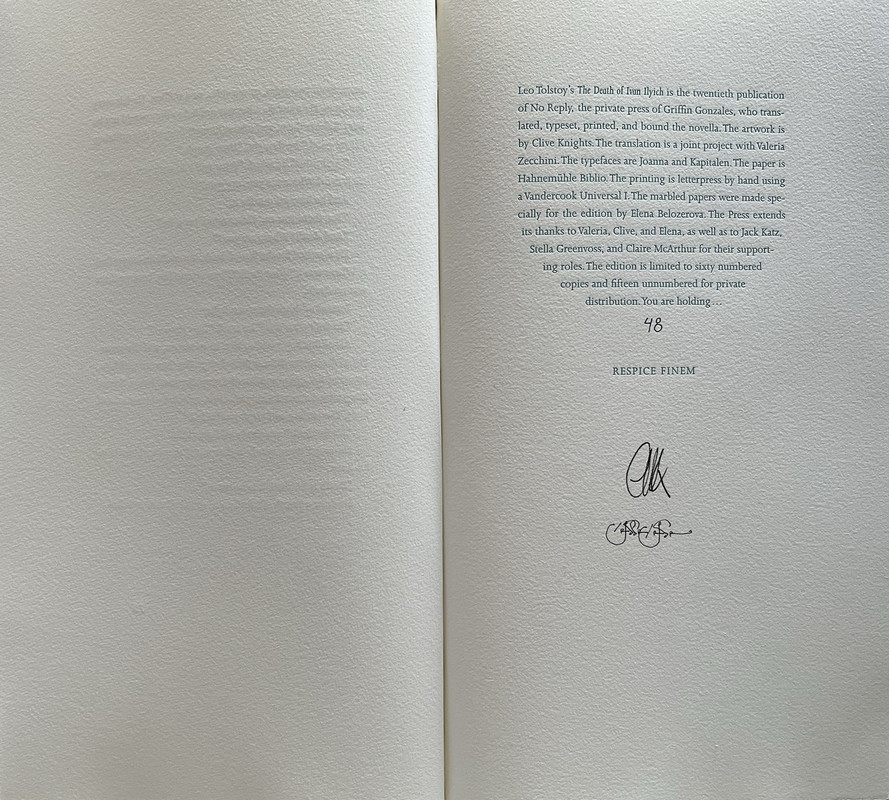
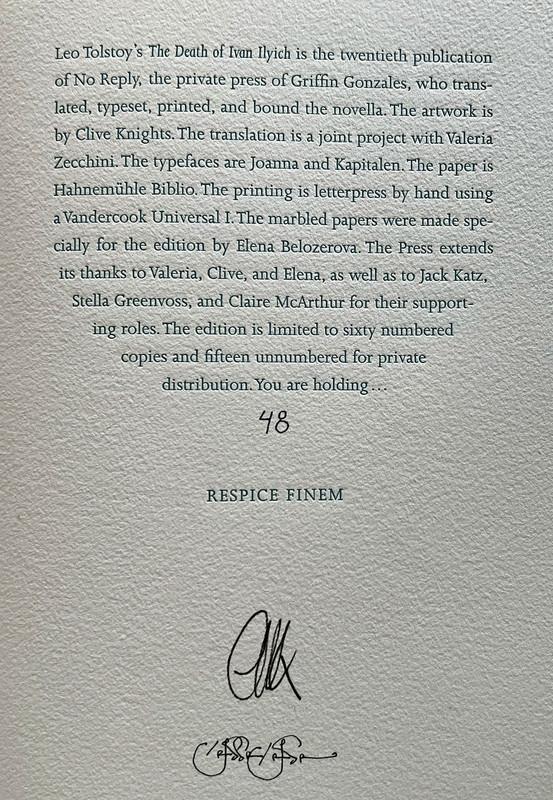
No. 48 of 60 copies.
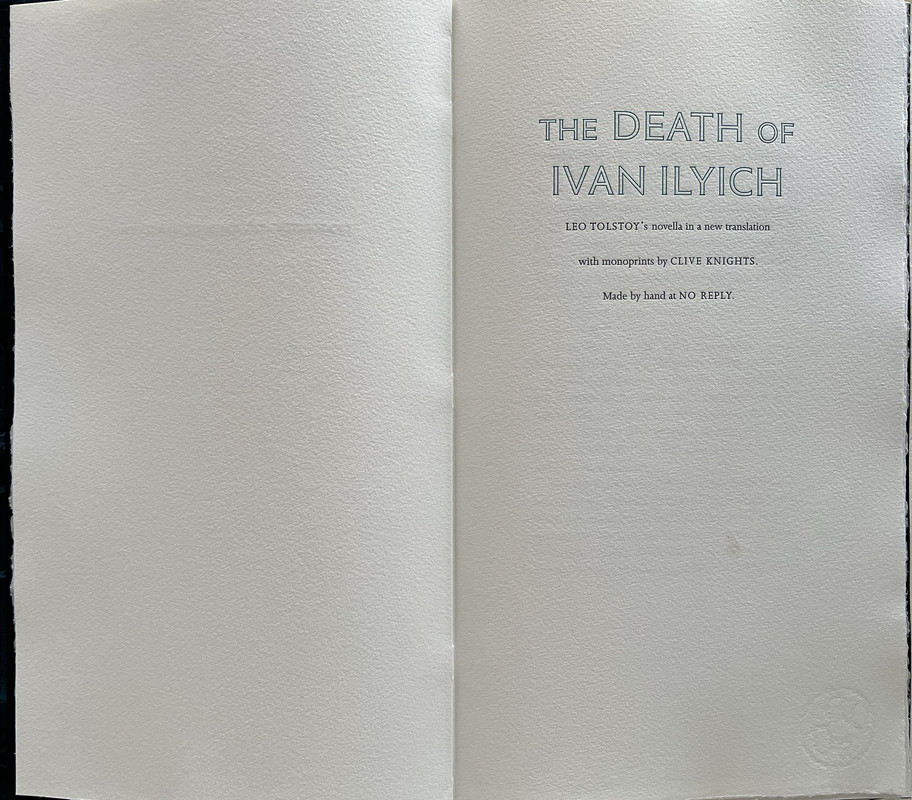
Translated by Valeria Zecchini and Griffin Gonzales specifically for this edition.
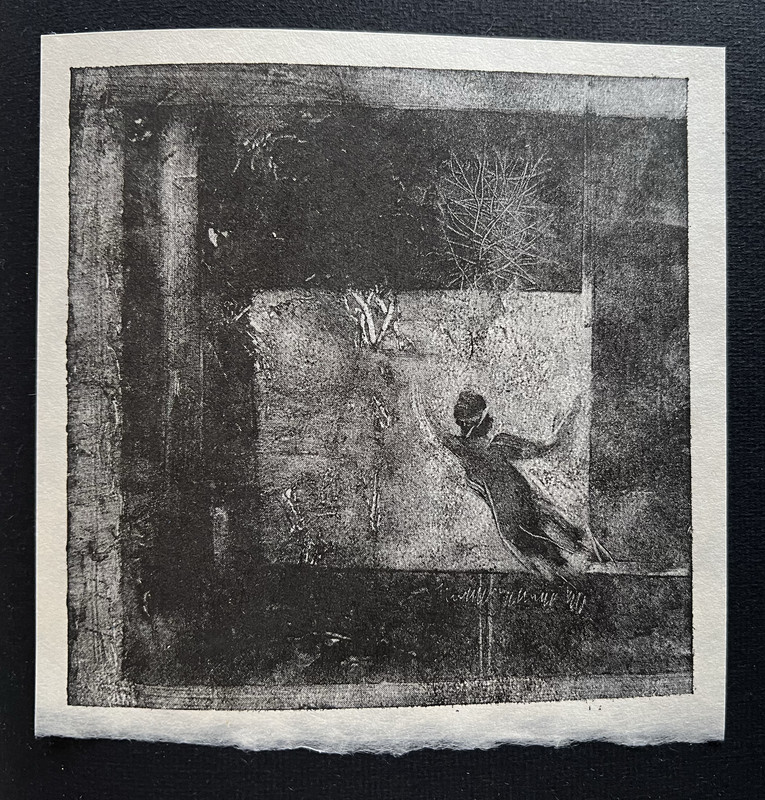
Ten monoprints by Clive Knights individually tipped-in.
Signed by Griffin Gonzales and Clive Knights.
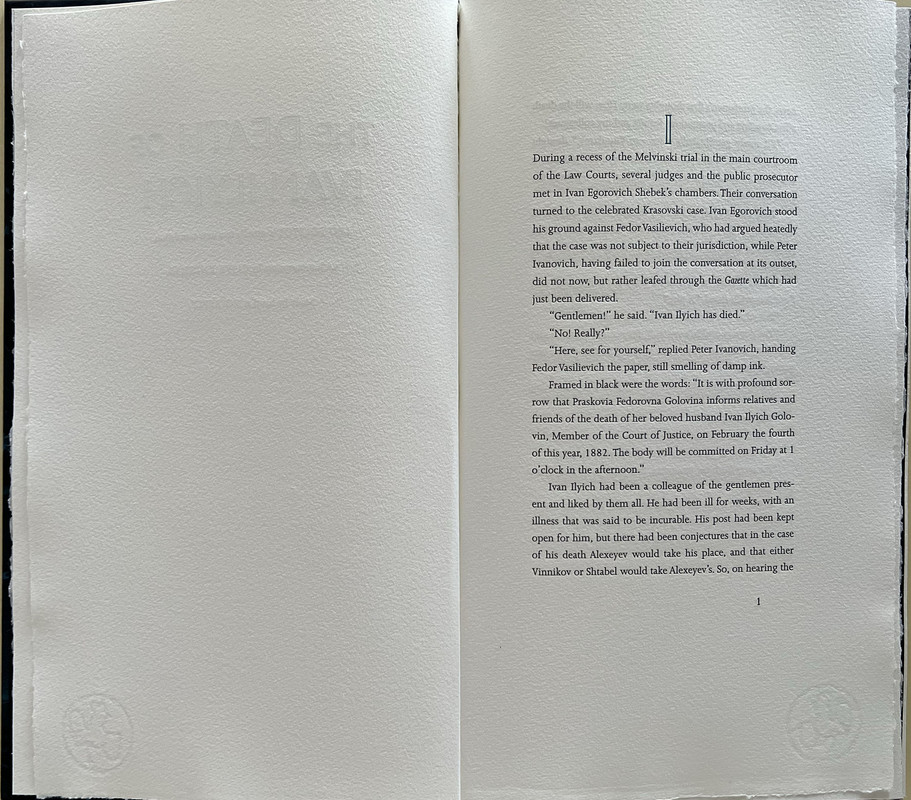
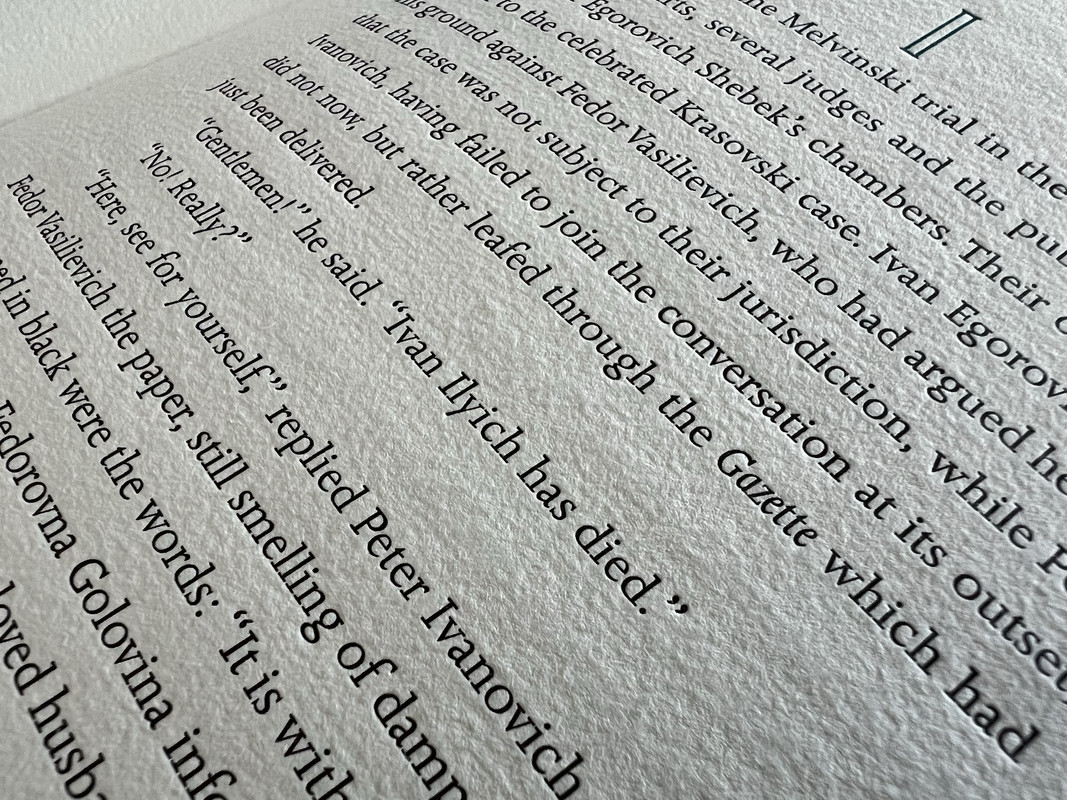
Printed on Hahnemühle mould-made paper using a hand-operated Vandercook Universal I cylinder press.
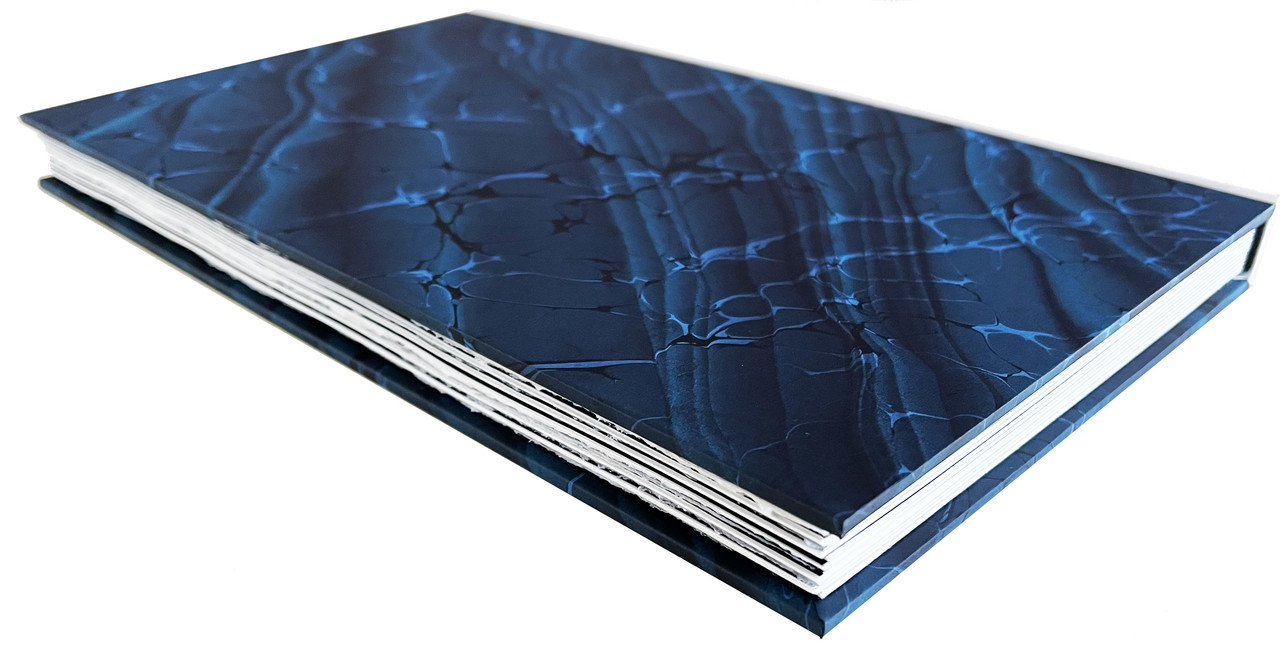
Ragged outer page edges.
Black endpapers.
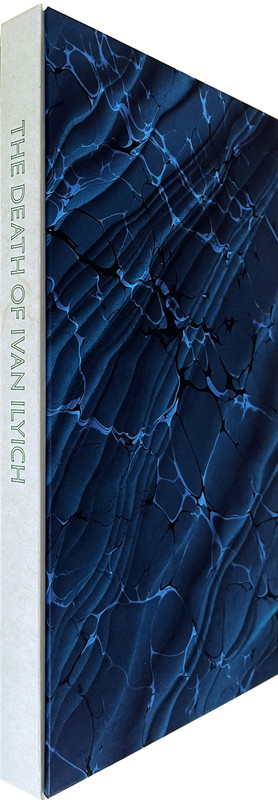
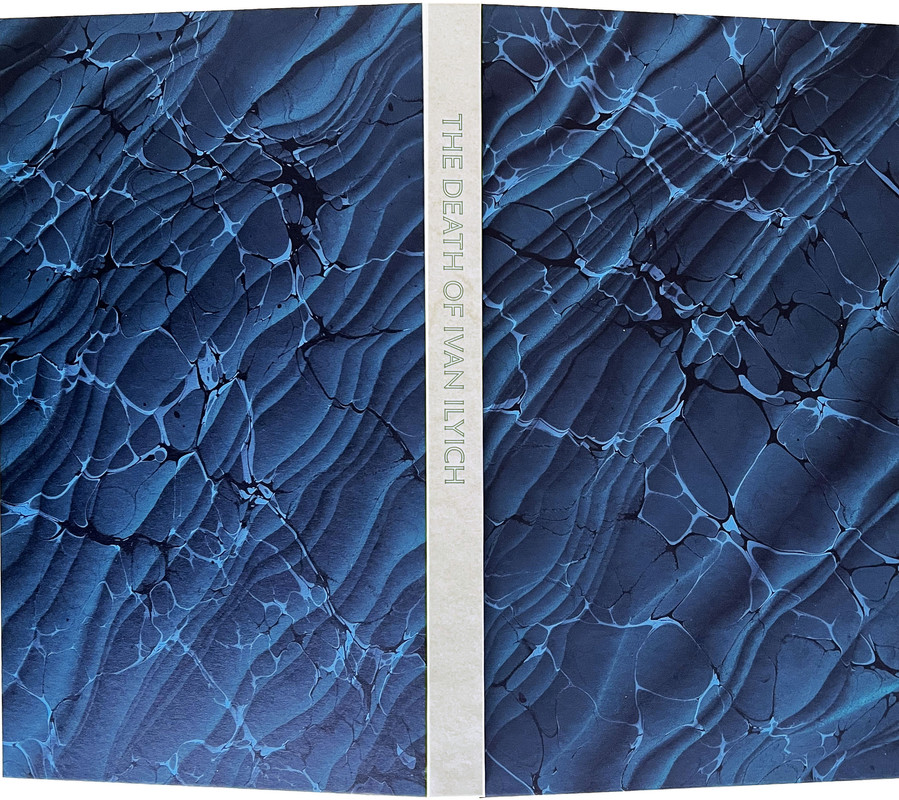
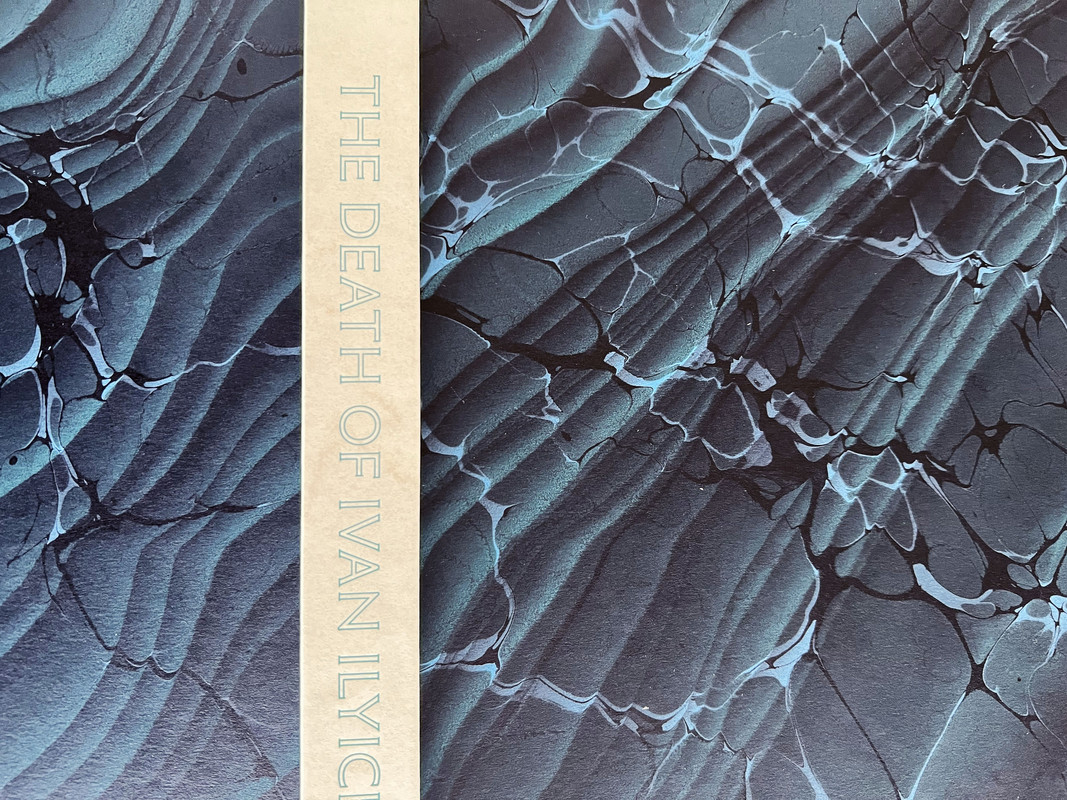
Bradel-bound in off-white handmade Cave paper by Zoë Goehring, blue-toned marbled paper covers by Elena Belozerova.
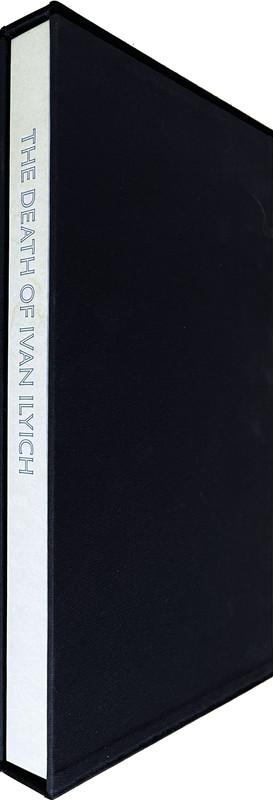
Housed in a heavy black slipcase with black caps.
Bookmaker’s Note laid-in.
32x18.8cm.
79 pages
US$785
The book is surrounded by a Mylar dust-jacket which was removed for photography.
The first private press edition of Leo Tolstoy’s late masterpiece, one of the great literary dealings with death – a story of life’s hollowness, when meritocratic ambitions go unchecked by life’s deeper facets. It is a story incredibly relevant today, when many find themselves dissatisfied in their chosen rat race.
This book is the Magnum Opus of No Reply Press – so far!



An index of the other illustrated reviews in the this series can be viewed here.
The text of the Bookmaker’s Note that was emailed to purchasers follows:-
Bookmaker's Note
I had hoped to typeset this “Bookmaker’s Note” and print it letterpress to accompany The Death of Ivan Ilyich. The year, however, has been a great challenge. So, rather than further delay this edition (and those in line behind it) I am including the note digitally. The downside, of course, is that pixels can never compare to ink. The upside is that I can write a little more expansively than physical constraints would have allowed.
There really can be no such thing as a bad year when you are a professional bookmaker, working in the neighborhood where you grew up, surrounded by friends and family. Still, if such a thing exists, this has been it. I thought the year’s headline fiasco would be a pipe bursting in my workshop during Portland’s worst winter storm in decades. If only! In January, I experienced a severe ocular occlusion (an eye stroke, the main vein to my left retina bursting). For several months I was nearly blind in the left eye, necessitating frequent injections right through the lens, one of which caused a major infection. To borrow the queen’s phrase, an “annus horribilis.” Then, just as Ivan Ilyich began to ship in earnest, my grandmother died! Her passing took me out of the workshop again. While sad, it is no tragedy. Growing up in Sherkieville Indiana with close to nothing, I think she would have considered herself blessed to live to ninety, the mother of five happy and healthy children, as well as several dozen grandchildren, great-grandchildren, nieces, nephews, great nieces and nephews.
It has been wonderful, actually, to process her death in the presence of Ivan Ilyich. Hers was the polar opposite of his. She was a person (my grandfather was the same) who valued family and friends first – never work – and lived her life accordingly. It even seems inaccurate to say “family and friends” because, to her, the former would suffice for all. In her house, there were no distinctions made. A hundred people attend each family reunion, and I couldn’t tell you who is blood related, who is an in-law, who is a step-something, who is a friend of a step-something, etc. In fact, though I spent two weeks each year with my grandmother, I never actually learned what she or my grandfather did for a living, though I know they both worked for four decades. They never talked about work, nor do their children. None of my relatives really know what I do, either. Why talk about work when you can talk about plants, the dogs, the family gossip, what you overheard at Starbucks that morning. Ivan Ilyich wouldn’t have known what to do in this family – even his tasks away from work he treats as work. He arranges his house in secrecy, bringing his family in as admiring guests. The pantomime of a house for the pantomime of a family.
So, here then is your book. I want to put down a few thoughts on the novella itself, the artwork, and – most essentially to me – the translation. These will not by any means exhaust my thoughts on each, but they might help you (who have paid a hefty price and have waited a long time for the book) better understand it.
The Death of Ivan Ilyich is a masterpiece novella, plain and simple. But it is a subtle masterpiece which can slip through your fingers. It reminds me a bit of Munch’s The Scream. It’s easy to look at the painting and be utterly transformed by it. It’s also easy to look at the painting and think, “Huh? Isn’t this a bit ‘on the nose’?” So too this novella. Perhaps more so than any literature I’ve read, it repays repeated readings, for the wells of despair in it run very deep.
I would like to offer a word of caution, however. Many readers (even you!) will find the first third of the novella quite “boring”. My erstwhile proofreader, who is retired after a storied career as an editor at a major publishing house, who worked with titans, couldn’t proofread this one. “It’s so damn boring.” The first few chapters, indeed, recount the petty lives of petty people in a pretty draining manner. But this is of course the point. More than the point, this is the purpose. While the first-time reader is inevitably drawn to the later chapters, where Tolstoy shows his subject in the throes of death, the quieter early chapters are actually, I believe, the real treasure of this novella. Indeed, having read the novella front to back nearly fifty times now I find that the first few chapters have become my favorites. Notice the burlesque, the satire. Notice the hollowness and falsity which causes us to chuckle in the beginning, but which literally tortures Ivan Ilyich in the end. Study how the minutiae of life when death is distant and abstract become not minutiae, but actual life, when death comes. No slasher or creepy dystopia could capture actual horror as Leo Tolstoy does in this novella, because he depicts the banality of it – the presence of it in your life. Reader beware.
The novella is pretty easy reading and much of the cultural milieu can be surmised by context. Any reader can catch right away, for example, that Vint is a Russian card game somewhat akin to Bridge. (We momentarily considered translating “Vint” as “Bridge” to demystify it for the reader, but that seemed a step too far. Besides, perhaps the reader doesn’t know Bridge either.) There are a few things, however, which even the sharpest reader likely won’t surmise without simply knowing.
First, the notorious Russian naming. If you are not already familiar with it, the short version is this: given name, gendered patronymic, gendered surname. Ivan’s father was Ilya, thus “Ivan Ilyich.” Praskovia’s father was Fedor, thus “Praskovia Federovna.” Praskovia Federovna’s maiden surname was Mikhel – an uncommon Russian name, which therefore is ungendered. When she married Ivan Ilyich Golovin, however, she becomes Praskovia Fedorovna Golovina. Referring to somebody by just their given name would have been very intimate; most occasions would call for given name and patronymic. For example, I would refer to Valeria’s uncle, with whom I have a perfectly friendly relationship, as Vladimir Nikolaievitch but never just Vladimir. (You can imagine the suppressed chuckles as, each time, I bungle my way through the eight syllables.)
If you have read Tolstoy’s novels or other stories, you will know that he had a fascination and admiration for the simple lives of peasants. His works extol the virtues of simplicity, innocence, ambitionlessness, honesty – in other words, all of the things which a well-meaning Graf Tolstoy might have associated with peasantry. Gerasim is typical in this regard. He is not Tolatoy’s first nor last such character. In fact, Gerasim and Ivan Ilyich’s schoolboy son are the only two characters who recognize what is really happening, who give Ivan Ilyich what he craves – sympathy, pity, honesty. There is a condescension here, the similarity between a peasant adult and a well-to-do boy. As anglophone readers, it is easy to overlook what would be obvious to us if, say, the novella were set in the 1880s in Alabama, not Russia.
You will notice that much of the novella is infused with German, English, and French cultural “invasion” – the fine tailor Scharmer’s, the fine restaurant Donan’s, the French actress, and Praskovia Fedorovna taking to calling her husband “Jean” rather than “Ivan.” (Such falsity!) These associations are nearly always sensual and, ultimately, in Ivan Ilyich’s revelation, the wrong life.
Most readers in Tolstoy’s day would have known Zola, the French novelist who was the progenitor of naturalism in literature – the rejection of romanticism and the embrace of objectivity and determinism. The moment when Ivan Ilyich then picks up and puts down a novel by Zola would have had obvious implication, then.
One moment is pregnant with meaning but will pass the reader by, since the cultural references are by now 150 years gone. Most contemporary readers would have known Sarah Bernhardt, a hugely celebrated actress who was controversial among the Russian intelligentsia. When Ivan Ilyich’s wife, daughter, and future son-in-law sit around his deathbed to discuss “the elegance and realism of her acting” this is the height of falsity. Ivan Turgenev reviews Bernhardt’s acting thusly: “All she has is a marvelous voice. The rest is cold, false, and affected; the worst kind of repulsive chic Parisienne!” Chekhov said that her roles were “smothered in artifice.” Moreover, they discuss the play Adrienne Lecouvreur, which is about an actress. An artificial actress playing an actress. Tolstoy heaps on the layers of falsity with gusto. These are shallow, false people, who take the artificial acting of a foreigner to be the height of realism. They, too, are artificial. They, too, are acting.
Aside from these few cultural elements, I think the novella has a universalism to it which makes it timeless and easily understood.
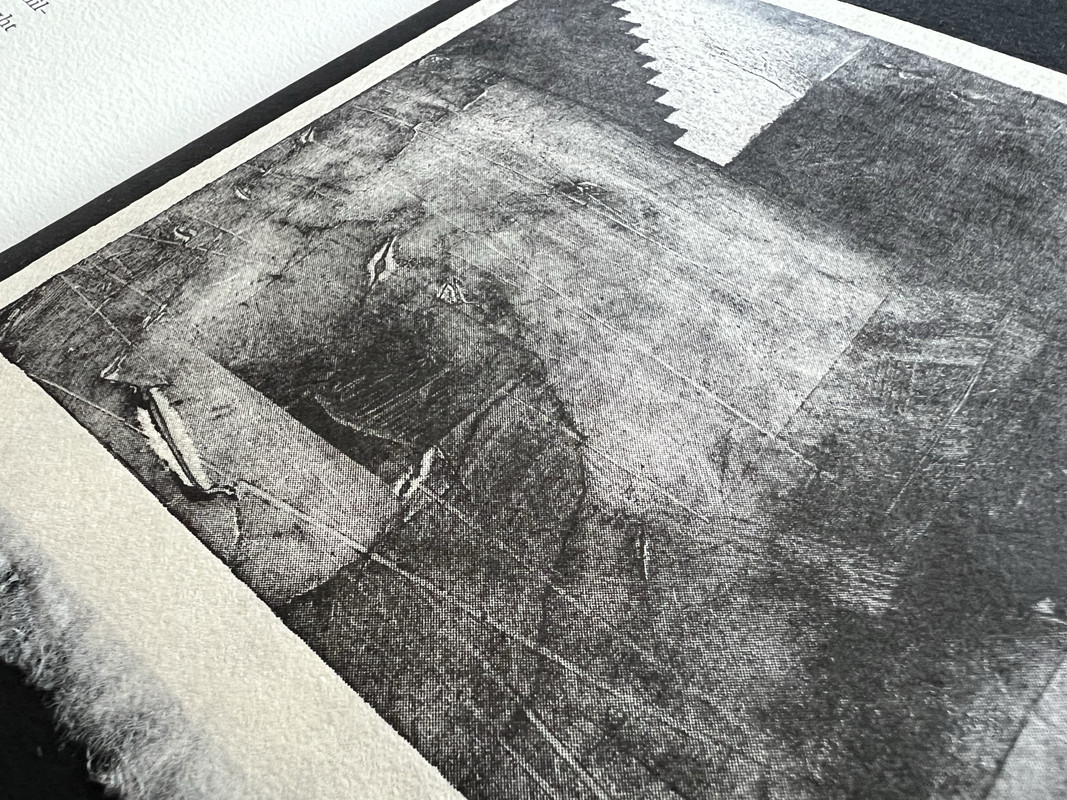
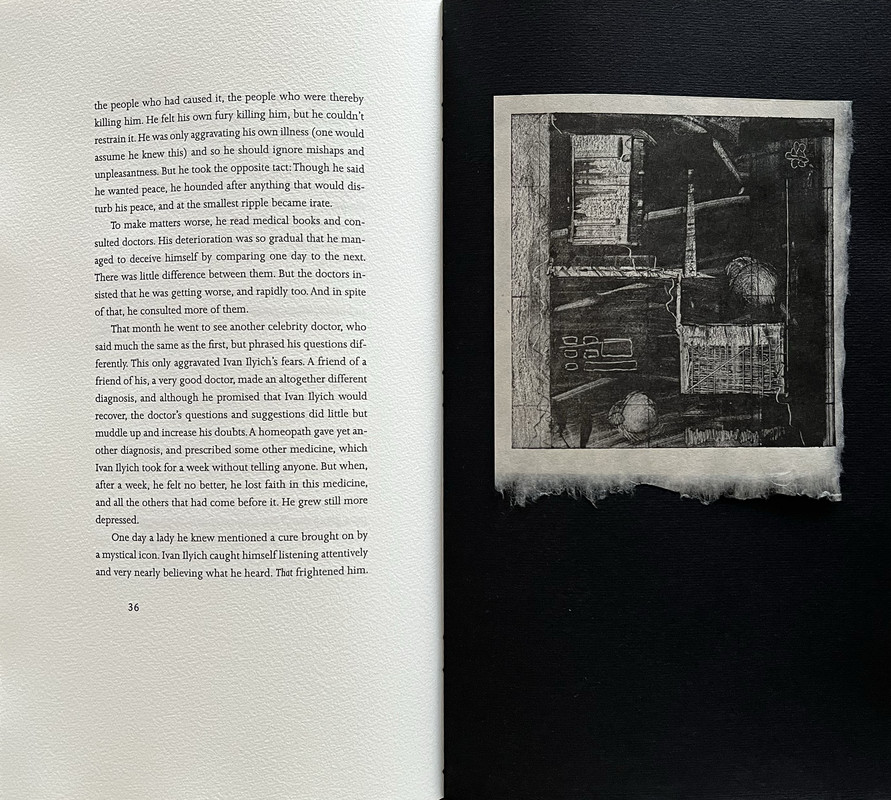
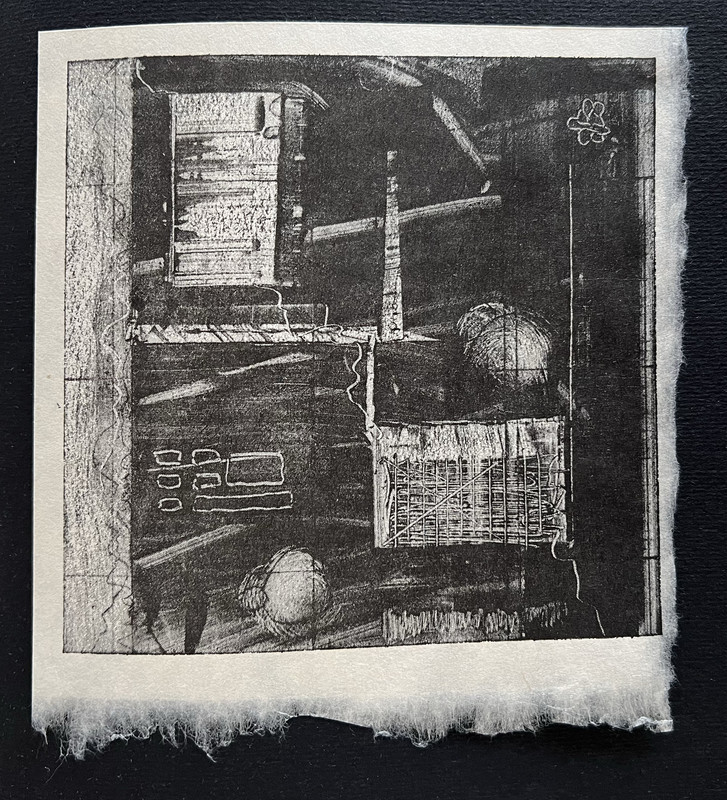
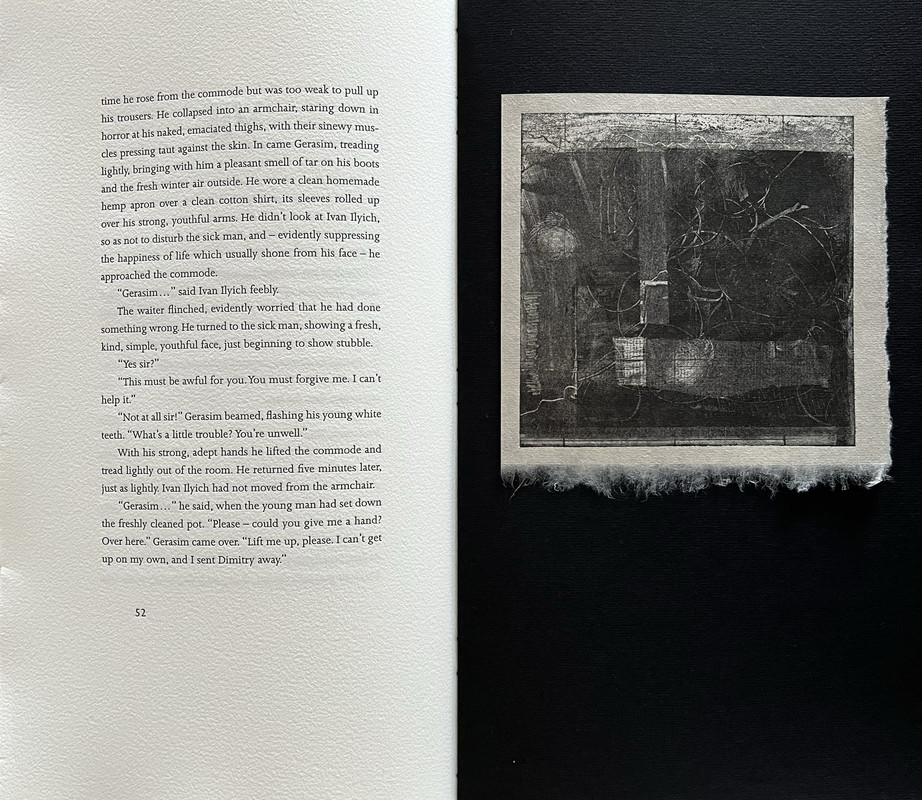
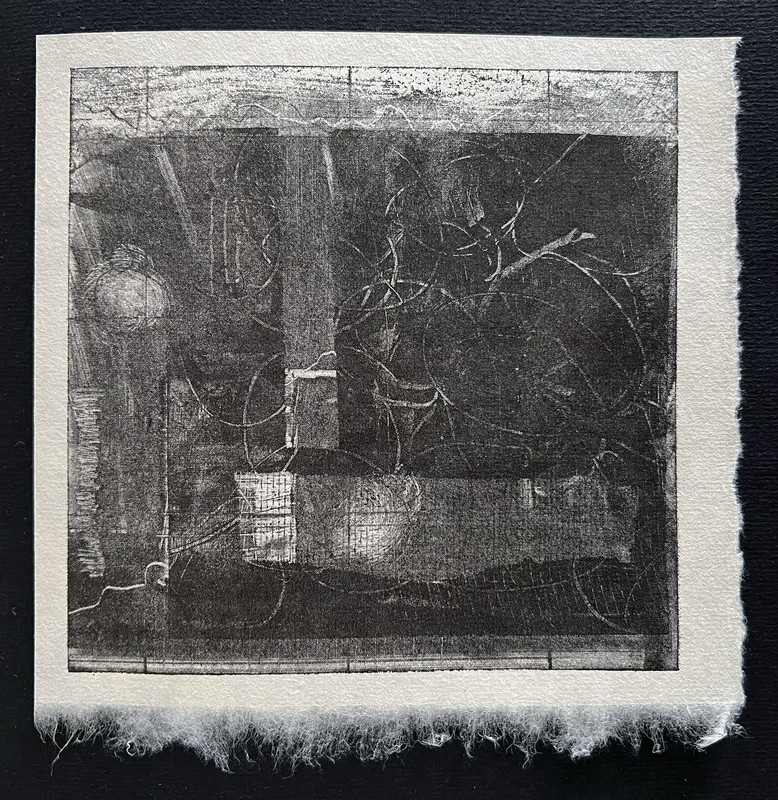
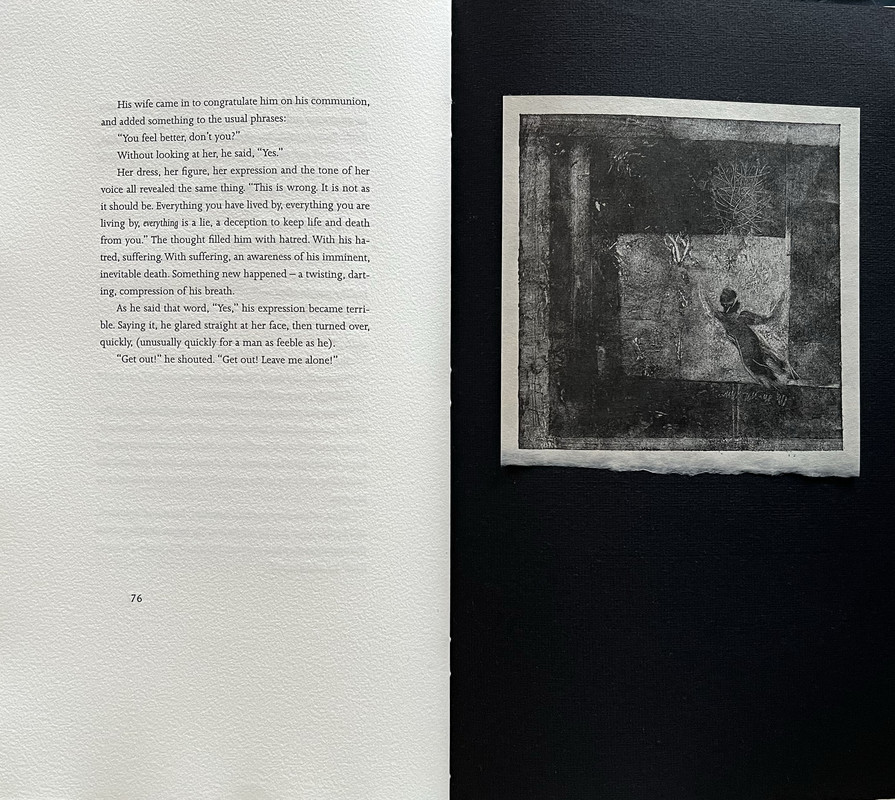
I feel actually blessed to have worked with Clive Knights on this edition. I cannot imagine artwork more sublimely suited to The Death of Ivan Ilyich than his suite of monoprints. Simple line, woodlock, or painted illustrations would have cheapened it. Something purely abstract would have failed to capture its particularity. Clive’s monoprints achieve both – they capture the raw emotions of the novella and its scenes. They could be discussed and explored for hours (as I have done!). They took three attempts to print right. It wasn’t until the third attempt, after reams of paper spent and weeks of effort, that we were happy. They are printed by hand using magnesium plates and a technique similar to, but not exactly, photogravure. The paper is Japanese handmade, meant to evoke both the Japanese trinkets with which Ivan Ilyich furnishes his house, and the photo albums which he meticulously curates. They are hand-mounted on black paper in a manner to mimic in large the imagery of the artworks themselves – the lightness within darkness within light within dark.
While I feel the sublimity of these artworks, I recognize that abstract art often invites mixed reaction. Some will think, “This is striking! This is perfect!” (This, I am glad, was the response I received from the few who had an early peek.) Others will think, “Huh…?” Abstract art also has the tendency to bring out the worst in us as critics. Those who are drawn in become haughty and condescending. “You just don’t get it!” (read: “You are a rube.”) Those who aren’t drawn in become testy and overly critical. “This is low effort! It doesn’t actually depict anything!” If you find yourself in the former camp, then I am happy to leave things there, and am glad you see what I see. If you find yourself in the latter camp, I ask for your trust. Trust me: I spent two years of my life on this book, I would never have used artwork which wasn’t perfect.
The first common criticism is that abstract art can be low-effort. This clearly is not. Monoprints require a technical skill which few possess, and a thoughtfulness. Clive publishes extensively on art theory and is a leading advocate of the monoprint medium (as well as collage, his other passion). Everything is intentional, careful.
The second common criticism is that abstract art doesn’t actually depict anything. It does in the sense that it depicts human emotion, much in the manner of instrumental music. But Clive’s suite also actually does depict this novella literally. It somewhat spoils the challenge and magic of finding scenes depicted with abstraction, but if you find yourself staring at the artworks and thinking, “I really don’t get it…” let me share what I see. I could go on and on, but I’ll share only a few thoughts to leave space for yours. Moreover, though Clive has not titled the artworks for this novella, I have given them my own personal titles. After all, I must refer to them somehow!
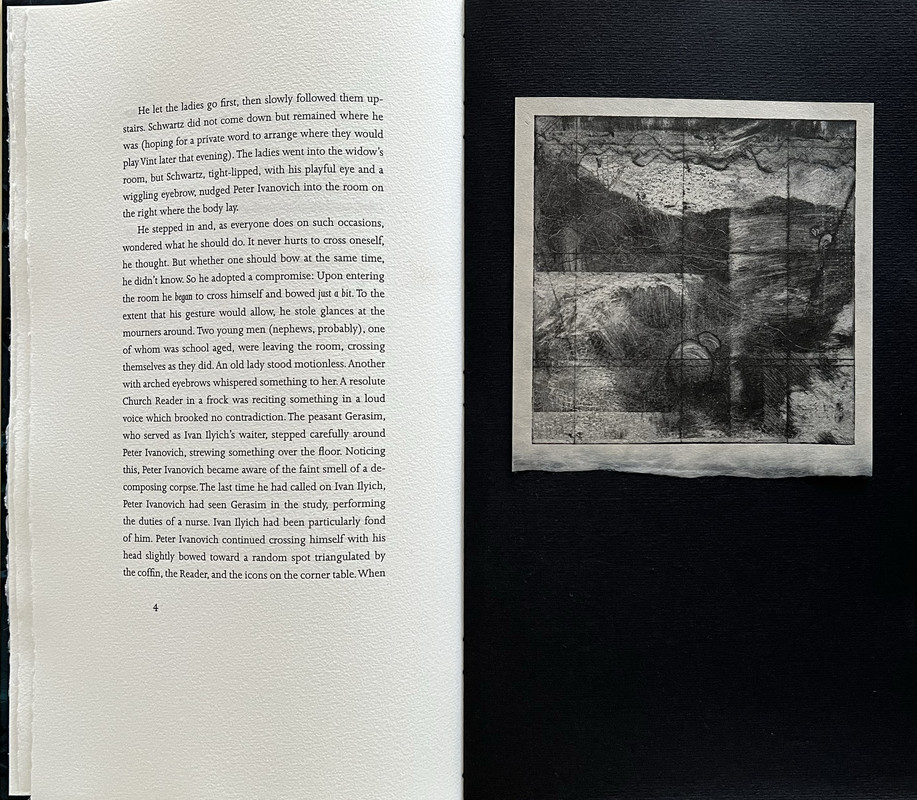
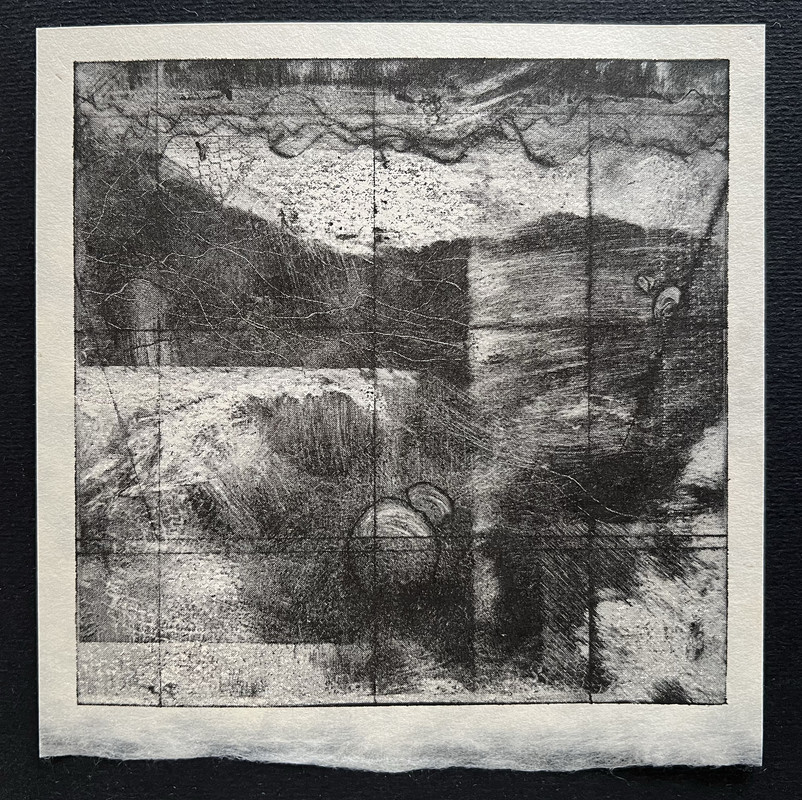
The first piece: “A false wake.” I see a wake which should be solemn but is not, which should be quiet but is loud. An empty presence rests over the frenetic activity. It takes a moment, even, to recognize the laying body – its closed eye, its nose, its chin. I see the rebellious pouffe below.
The second piece: “The proper life.” The pieces of Ivan Ilyich’s proper life are clear and arranged. They are actually pieces of a cage. They obscure a darkness – the black hole into which he eventually struggles.
The third piece: “The arrangement of a house.” As Ivan climbs the social ladder, he arranges a house to his liking. Human forms, his family, are totally absent.
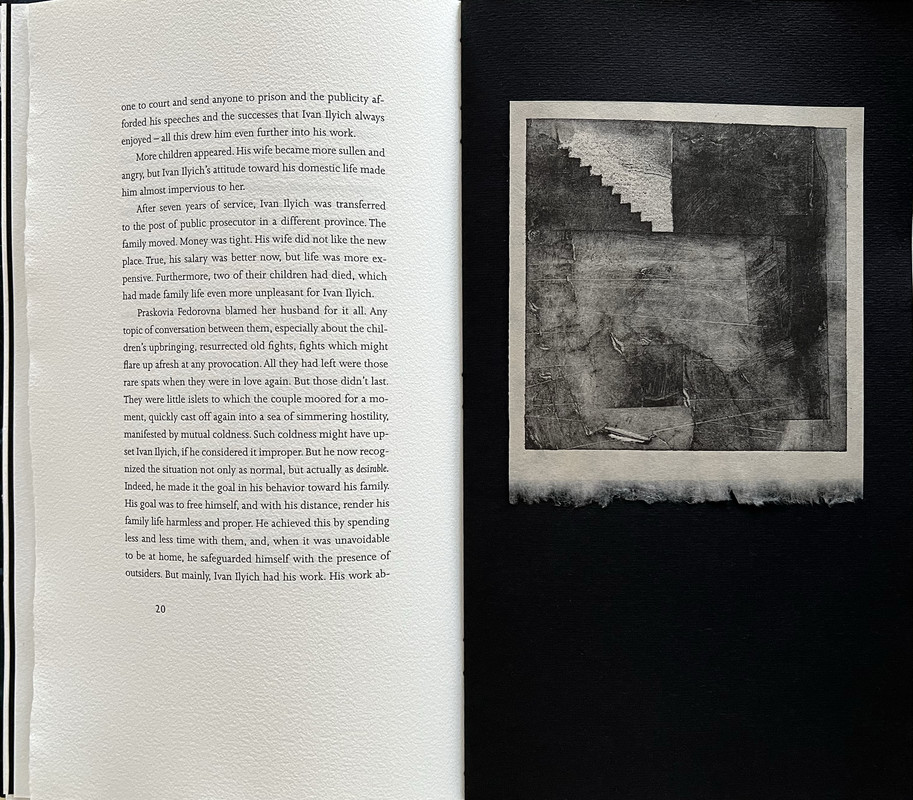
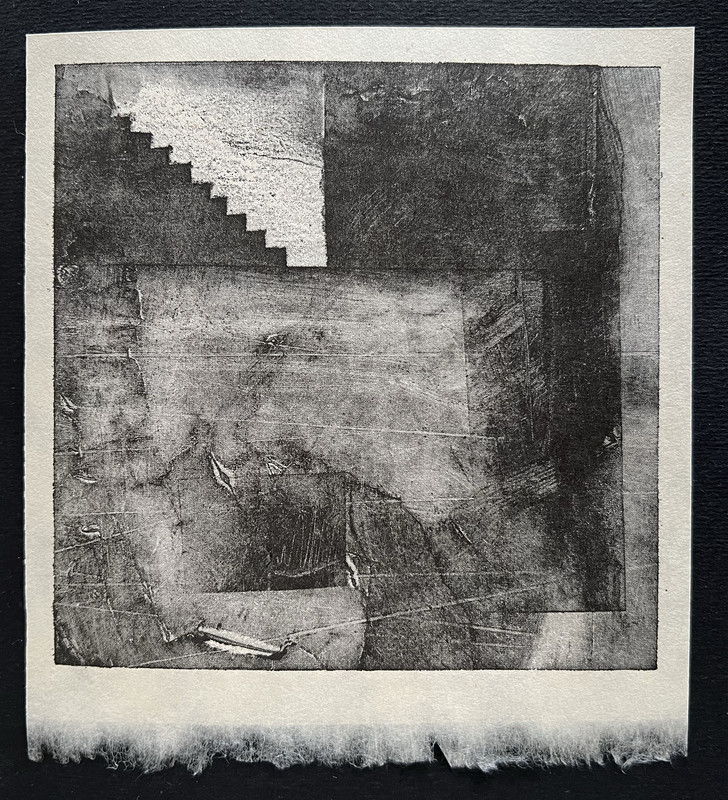
The fourth piece: “The fall.” Ivan Ilyich’s fall from the stepladder (steps are a repeated motif in the artworks) for which he comes to credit his death. He calls himself an acrobat. Here we see the tumbling which turns his life from pleasantness to horror.
The fifth piece: “Diagnosis after diagnosis.” The prodings and prognostications. the checkboxes and formulas and lists used to explain what is happening, but which totally miss the point. I see medical charts, again, obscuring a darkness. I note the two organs examined – the blind gut and the kidney.
The sixth piece: “The house darkens.” An echoing of the third piece. The house which Ivan Ilyich arranged has darkened. It is unpleasant and chaotic.
The seventh piece: “Hope and denial.” An irritating and random noise begins to appear, obscuring the net (or cage) which had been so solid before and now begins to resemble a tomb. I see an effort to put structure to chaos and a repeated vacillation between “the right thing” and truth’s disruption. For the third image in a row, “it” is an unignorable presence on the left-hand side (the same side where Ivan Ilyich feels such discomfort) – somehow the clearest thing depicted but also the most unknowable.
The eighth piece: “The appearance of the black hole.” The black hole into which Ivan Ilyich struggles appears mostly unobscured for the first time. It is surrounded by noise, falsity, and chaos which attempts but fails to distract from it.
The ninth piece: “Remembrance of the past.” The linear sight into the past, and the simplicity which attends it. The ball. The feeling of joy and relief.
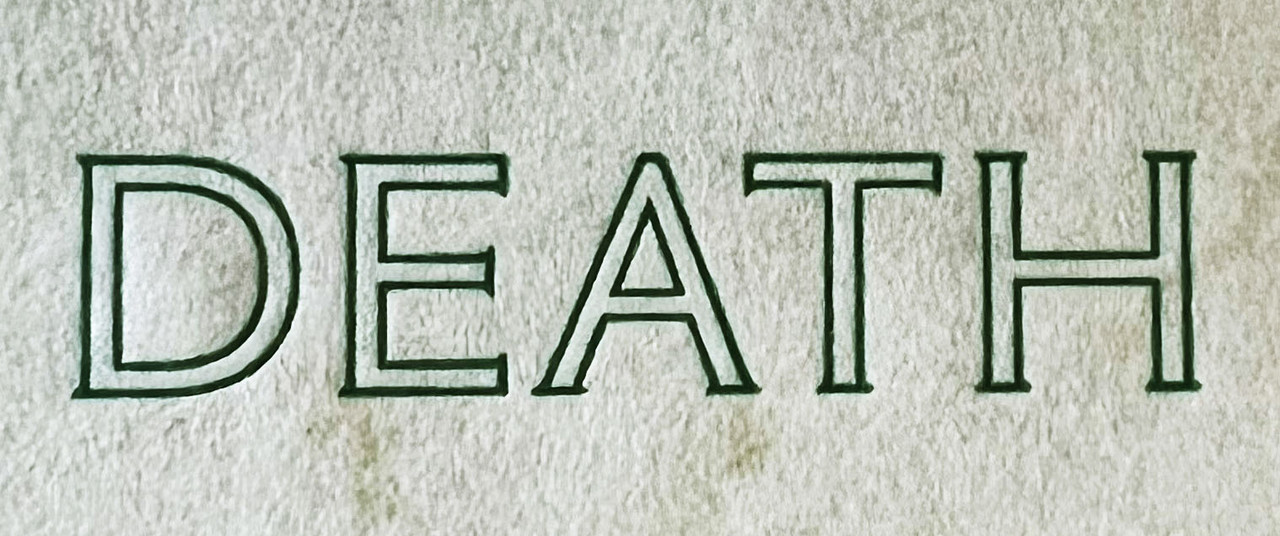
The tenth piece: “Death.” I’ll put down a bit more here, as this is my favorite piece. Ivan Ilyich finally falls into the black hole, but finds within it not darkness, but light. He is falling not downward, but upward. The thing which leads him is something eerily akin to a heart, for in the moment he no longer demands pity for himself, but pities his own family, he finds the way into the hole. Above him there is chatter and activity. The words he tries to communicate, but which prove incomprehensible, are depicted below him. The black hole has loomed to nearly encompass the scene, but still, we see life proceeding around the margins. There is a definitively human figure, the first depicted since the beginning of the suite, showing that Ivan Ilyich only achieves self-awareness at his end and in death. Its motion is much like that of a person falling from a ladder. I could go on and on. If you can believe it, I am actually choking up a bit as I think about the piece! The tragedy of it is just unbearable.
Here, then, is what I see at a glance. A wonderful thing about abstract art, however, is that you may see them differently and your sight is as legitimate as mine. Claire, who tipped in the artworks and therefore spent days with them, has a different understanding of some. We have put down the work several times to simply debate it. Thus is the joy of abstract art. Whatever the case, I earnestly hope that these artworks move you as they move me. If they do not, I hope you will put aside taste for trust, and attempt to see them as I do, as I think the challenge is boundlessly rewarding.
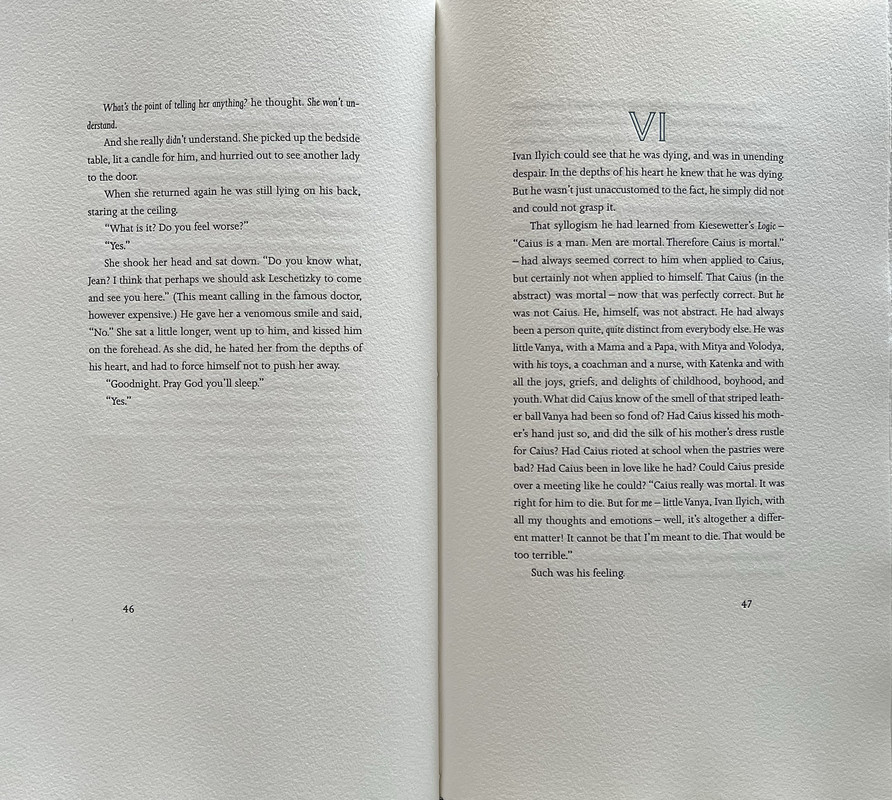
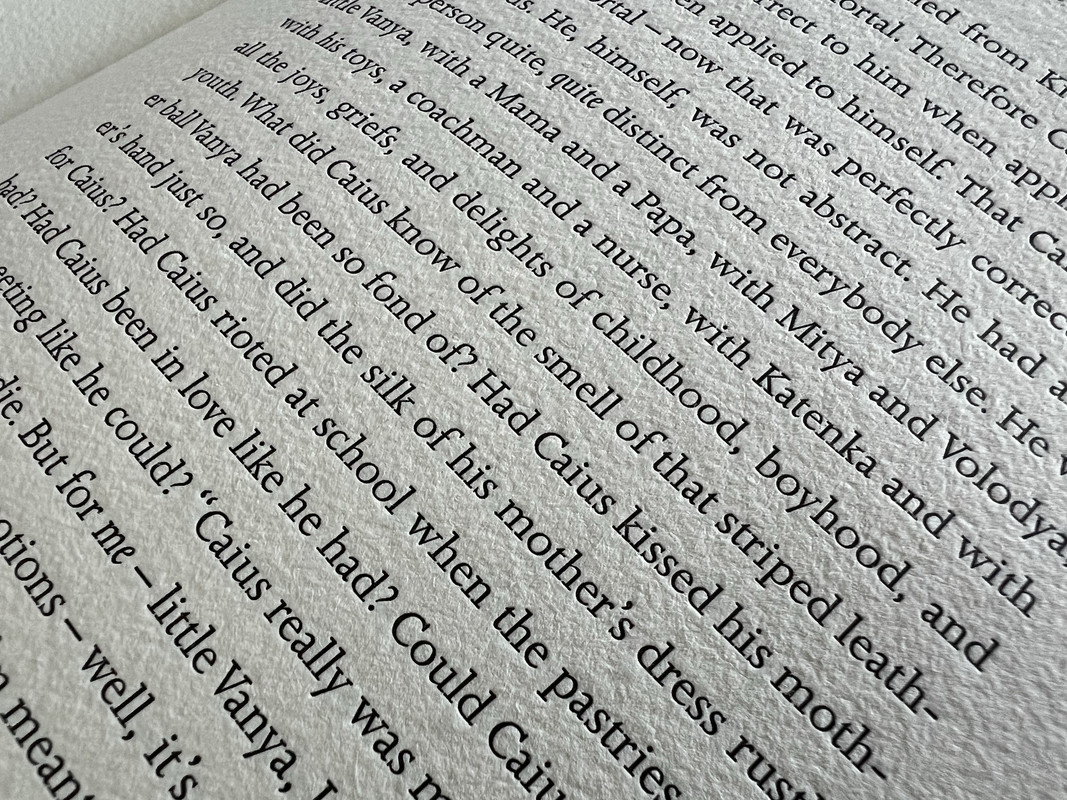
The No Reply edition of The Death of Ivan Ilyich contains an original translation of the novella, composed for it. The joys of private presswork are usually expressed with that second word, “presswork.” The care, the craftsmanship, the materials, the beauty of the object which honors the literature it carries. But that first word, “private,” contains a certain joy as well. It is a matter of real satisfaction to read something in such low circulation. The greatest joy I take in this work is reading yet-unpublished manuscripts, being the first to read and appreciate nascent, still private literature. You will be among only a handful of people ever to read this translation, the work of many months. While you might have ordered this edition with any translation, and while your attention is probably more immediately captured by its physical form than the words it carries, its entire value to me lies in its translation and art. The rest is pomp.
Why not simply use a well-established translation? The hundreds of hours we spent composing our own was not strictly necessary. The reason is simple: Valeria and I love Tolstoy, and love working together. This, then, was the exemplar of a passion project. Valeria is a native Russian speaker (native, also, in three other languages, and conversational in a couple more) who professionally translates in her work for the European Union. She is a careful reader in all of her languages but, importantly, not one who dismisses the project of translation out of hand. “How could you ever convey this in another language?” is the complaint of many who hold their own language dear. Valeria certainly does, but she is not precious about it. Our method is similar to that of other “translating teams” (see, quite famously, Richard Pevear and Larissa Volokhonsky) wherein Valeria approaches the Russian word by word, then together we craft the English which best captures the meaning conveyed. On occasion we checked our work against four other translations at our disposal, and with dictionaries both of our time and of Tolstoy’s.
Our philosophy of translation is simple: The right words in the right order to convey the feeling of the original. This is a far more subjective approach than the more typical The closest words in the closest order (see P&V), or the ultra-conservative The same words in the same order approach (see Nabokov). If I were to recommend a translation for studying Tolstoy, or for studying Russian literature, I would not recommend ours. Ours has literary aspiration, in the vein of, say, Constance Garnett, who was the first conveyor of so much Russian literature into English. As Vladimir Nabokov put it in Pnin, these translations can be read as “Mrs Garnett impersonating somebody.” Indeed, you will often hear bilingual Russian and English speakers praise a Pevear and Volokhonsky, say, for being “close to the original.” (Embarrassingly, you will also hear monolingual English readers give this praise.) But what does “close to the original” mean? If it preserves words and syntax, but decimates verve and humor and drama, how close is it really? Though their approach cannot be criticized as overly interpretive, as ours can, it risks missing the forest for the trees. This perennial tug-of-war over the “right” approach to translation is interesting and important. Luckily, however, we are able to choose the route which feels best to us because private presswork allows us to. I make this book myself, therefore I translate how I want, with no other justification than that I believe our method – the right words in the right order – is a bit more joyful and makes for better reading. I think Tolstoy himself, and even those staunchly opposed to our method, would agree that in the best case scenario we have striven for something of some literary merit, and in the worst case scenario we have done no harm.
In short, we are proud of this translation and confident in the contribution it makes to the literary corpus surrounding Leo Tolstoy. However, the reader should understand that the freedoms of private presswork have empowered us to take a liberal approach. This is not the approach we would have taken, for example, if this translation had been commissioned by, say, Penguin Random House.
We have been careful to hew closely to Tolstoy’s words and, importantly, meaning. However, we have been flexible (though not exactly inventive) in word order and punctuation. While nineteenth century writers did often take care with their punctuation, it was not quite considered as inextricably a part of one’s writing as it is now. (We have the modernists to thank for this. T. S. Eliot after all, a relatively modest poet, took pains to praise his own careful punctuation.) It is common to read the same nineteenth century novel in different editions and find, though the words remain the exact same, the punctuation changes to the liking of the editor or publisher. See, for an outrageous example, Emily Dickinson. While we have taken some care to preserve Tolstoy’s punctuation, we have largely used punctuation as an asset in capturing Russian sentiments in English. A good friend of ours, a Russian, has described Tolstoy’s writing as falling slabs of stone. Different readers have different sensibilities as to what writing evokes what sense. A Russian sentence which rolls on and on in a cascade of commas might read, in Russian, as quite weighty. Slabs of stone. In English, the opposite. We tend to read paragraph-long sentences as drawn out, sleepy, and thin. Sometimes a drawn-out sentence can read like a rising tension. But often it reads as simply overlong. Our most liberal intervention, then, has been not in the words themselves, but in the punctuation used to pace those words.
We have sacrificed consistency in the transliteration of names. In every case, we have translated names in the way which we thought might best aid ease in reading. So, “Praskovia” rather than “Praskovya,” simply because “via” is more familiar to the English reader than “vya” and this potential stumbling block lay right in the middle of a potentially daunting many-syllabled Russian name which appears often. Perhaps we underestimate our readers. But it certainly interrupts my reading, and I am not a bad reader. Vasya, whose name is short and appears only once, remains “Vasya”.
Here, then, is the No Reply edition of The Death of Ivan Ilyich. I hope it finds a place in your collection and home. In my estimation, it is the best from No Reply yet and, though far from perfect, a real step forward for the press. Though I am notoriously slow to respond to correspondence, I am always open to it, so please don’t hesitate if you have any questions.
A PICTORIAL REVIEW
LIMITED EDITION
No. 48 of 60 copies.
Translated by Valeria Zecchini and Griffin Gonzales specifically for this edition.
Ten monoprints by Clive Knights individually tipped-in.
Signed by Griffin Gonzales and Clive Knights.
Printed on Hahnemühle mould-made paper using a hand-operated Vandercook Universal I cylinder press.
Ragged outer page edges.
Black endpapers.
Bradel-bound in off-white handmade Cave paper by Zoë Goehring, blue-toned marbled paper covers by Elena Belozerova.
Housed in a heavy black slipcase with black caps.
Bookmaker’s Note laid-in.
32x18.8cm.
79 pages
US$785
The book is surrounded by a Mylar dust-jacket which was removed for photography.
The first private press edition of Leo Tolstoy’s late masterpiece, one of the great literary dealings with death – a story of life’s hollowness, when meritocratic ambitions go unchecked by life’s deeper facets. It is a story incredibly relevant today, when many find themselves dissatisfied in their chosen rat race.
This book is the Magnum Opus of No Reply Press – so far!
An index of the other illustrated reviews in the this series can be viewed here.
The text of the Bookmaker’s Note that was emailed to purchasers follows:-
Bookmaker's Note
I had hoped to typeset this “Bookmaker’s Note” and print it letterpress to accompany The Death of Ivan Ilyich. The year, however, has been a great challenge. So, rather than further delay this edition (and those in line behind it) I am including the note digitally. The downside, of course, is that pixels can never compare to ink. The upside is that I can write a little more expansively than physical constraints would have allowed.
There really can be no such thing as a bad year when you are a professional bookmaker, working in the neighborhood where you grew up, surrounded by friends and family. Still, if such a thing exists, this has been it. I thought the year’s headline fiasco would be a pipe bursting in my workshop during Portland’s worst winter storm in decades. If only! In January, I experienced a severe ocular occlusion (an eye stroke, the main vein to my left retina bursting). For several months I was nearly blind in the left eye, necessitating frequent injections right through the lens, one of which caused a major infection. To borrow the queen’s phrase, an “annus horribilis.” Then, just as Ivan Ilyich began to ship in earnest, my grandmother died! Her passing took me out of the workshop again. While sad, it is no tragedy. Growing up in Sherkieville Indiana with close to nothing, I think she would have considered herself blessed to live to ninety, the mother of five happy and healthy children, as well as several dozen grandchildren, great-grandchildren, nieces, nephews, great nieces and nephews.
It has been wonderful, actually, to process her death in the presence of Ivan Ilyich. Hers was the polar opposite of his. She was a person (my grandfather was the same) who valued family and friends first – never work – and lived her life accordingly. It even seems inaccurate to say “family and friends” because, to her, the former would suffice for all. In her house, there were no distinctions made. A hundred people attend each family reunion, and I couldn’t tell you who is blood related, who is an in-law, who is a step-something, who is a friend of a step-something, etc. In fact, though I spent two weeks each year with my grandmother, I never actually learned what she or my grandfather did for a living, though I know they both worked for four decades. They never talked about work, nor do their children. None of my relatives really know what I do, either. Why talk about work when you can talk about plants, the dogs, the family gossip, what you overheard at Starbucks that morning. Ivan Ilyich wouldn’t have known what to do in this family – even his tasks away from work he treats as work. He arranges his house in secrecy, bringing his family in as admiring guests. The pantomime of a house for the pantomime of a family.
So, here then is your book. I want to put down a few thoughts on the novella itself, the artwork, and – most essentially to me – the translation. These will not by any means exhaust my thoughts on each, but they might help you (who have paid a hefty price and have waited a long time for the book) better understand it.
The Death of Ivan Ilyich is a masterpiece novella, plain and simple. But it is a subtle masterpiece which can slip through your fingers. It reminds me a bit of Munch’s The Scream. It’s easy to look at the painting and be utterly transformed by it. It’s also easy to look at the painting and think, “Huh? Isn’t this a bit ‘on the nose’?” So too this novella. Perhaps more so than any literature I’ve read, it repays repeated readings, for the wells of despair in it run very deep.
I would like to offer a word of caution, however. Many readers (even you!) will find the first third of the novella quite “boring”. My erstwhile proofreader, who is retired after a storied career as an editor at a major publishing house, who worked with titans, couldn’t proofread this one. “It’s so damn boring.” The first few chapters, indeed, recount the petty lives of petty people in a pretty draining manner. But this is of course the point. More than the point, this is the purpose. While the first-time reader is inevitably drawn to the later chapters, where Tolstoy shows his subject in the throes of death, the quieter early chapters are actually, I believe, the real treasure of this novella. Indeed, having read the novella front to back nearly fifty times now I find that the first few chapters have become my favorites. Notice the burlesque, the satire. Notice the hollowness and falsity which causes us to chuckle in the beginning, but which literally tortures Ivan Ilyich in the end. Study how the minutiae of life when death is distant and abstract become not minutiae, but actual life, when death comes. No slasher or creepy dystopia could capture actual horror as Leo Tolstoy does in this novella, because he depicts the banality of it – the presence of it in your life. Reader beware.
The novella is pretty easy reading and much of the cultural milieu can be surmised by context. Any reader can catch right away, for example, that Vint is a Russian card game somewhat akin to Bridge. (We momentarily considered translating “Vint” as “Bridge” to demystify it for the reader, but that seemed a step too far. Besides, perhaps the reader doesn’t know Bridge either.) There are a few things, however, which even the sharpest reader likely won’t surmise without simply knowing.
First, the notorious Russian naming. If you are not already familiar with it, the short version is this: given name, gendered patronymic, gendered surname. Ivan’s father was Ilya, thus “Ivan Ilyich.” Praskovia’s father was Fedor, thus “Praskovia Federovna.” Praskovia Federovna’s maiden surname was Mikhel – an uncommon Russian name, which therefore is ungendered. When she married Ivan Ilyich Golovin, however, she becomes Praskovia Fedorovna Golovina. Referring to somebody by just their given name would have been very intimate; most occasions would call for given name and patronymic. For example, I would refer to Valeria’s uncle, with whom I have a perfectly friendly relationship, as Vladimir Nikolaievitch but never just Vladimir. (You can imagine the suppressed chuckles as, each time, I bungle my way through the eight syllables.)
If you have read Tolstoy’s novels or other stories, you will know that he had a fascination and admiration for the simple lives of peasants. His works extol the virtues of simplicity, innocence, ambitionlessness, honesty – in other words, all of the things which a well-meaning Graf Tolstoy might have associated with peasantry. Gerasim is typical in this regard. He is not Tolatoy’s first nor last such character. In fact, Gerasim and Ivan Ilyich’s schoolboy son are the only two characters who recognize what is really happening, who give Ivan Ilyich what he craves – sympathy, pity, honesty. There is a condescension here, the similarity between a peasant adult and a well-to-do boy. As anglophone readers, it is easy to overlook what would be obvious to us if, say, the novella were set in the 1880s in Alabama, not Russia.
You will notice that much of the novella is infused with German, English, and French cultural “invasion” – the fine tailor Scharmer’s, the fine restaurant Donan’s, the French actress, and Praskovia Fedorovna taking to calling her husband “Jean” rather than “Ivan.” (Such falsity!) These associations are nearly always sensual and, ultimately, in Ivan Ilyich’s revelation, the wrong life.
Most readers in Tolstoy’s day would have known Zola, the French novelist who was the progenitor of naturalism in literature – the rejection of romanticism and the embrace of objectivity and determinism. The moment when Ivan Ilyich then picks up and puts down a novel by Zola would have had obvious implication, then.
One moment is pregnant with meaning but will pass the reader by, since the cultural references are by now 150 years gone. Most contemporary readers would have known Sarah Bernhardt, a hugely celebrated actress who was controversial among the Russian intelligentsia. When Ivan Ilyich’s wife, daughter, and future son-in-law sit around his deathbed to discuss “the elegance and realism of her acting” this is the height of falsity. Ivan Turgenev reviews Bernhardt’s acting thusly: “All she has is a marvelous voice. The rest is cold, false, and affected; the worst kind of repulsive chic Parisienne!” Chekhov said that her roles were “smothered in artifice.” Moreover, they discuss the play Adrienne Lecouvreur, which is about an actress. An artificial actress playing an actress. Tolstoy heaps on the layers of falsity with gusto. These are shallow, false people, who take the artificial acting of a foreigner to be the height of realism. They, too, are artificial. They, too, are acting.
Aside from these few cultural elements, I think the novella has a universalism to it which makes it timeless and easily understood.
I feel actually blessed to have worked with Clive Knights on this edition. I cannot imagine artwork more sublimely suited to The Death of Ivan Ilyich than his suite of monoprints. Simple line, woodlock, or painted illustrations would have cheapened it. Something purely abstract would have failed to capture its particularity. Clive’s monoprints achieve both – they capture the raw emotions of the novella and its scenes. They could be discussed and explored for hours (as I have done!). They took three attempts to print right. It wasn’t until the third attempt, after reams of paper spent and weeks of effort, that we were happy. They are printed by hand using magnesium plates and a technique similar to, but not exactly, photogravure. The paper is Japanese handmade, meant to evoke both the Japanese trinkets with which Ivan Ilyich furnishes his house, and the photo albums which he meticulously curates. They are hand-mounted on black paper in a manner to mimic in large the imagery of the artworks themselves – the lightness within darkness within light within dark.
While I feel the sublimity of these artworks, I recognize that abstract art often invites mixed reaction. Some will think, “This is striking! This is perfect!” (This, I am glad, was the response I received from the few who had an early peek.) Others will think, “Huh…?” Abstract art also has the tendency to bring out the worst in us as critics. Those who are drawn in become haughty and condescending. “You just don’t get it!” (read: “You are a rube.”) Those who aren’t drawn in become testy and overly critical. “This is low effort! It doesn’t actually depict anything!” If you find yourself in the former camp, then I am happy to leave things there, and am glad you see what I see. If you find yourself in the latter camp, I ask for your trust. Trust me: I spent two years of my life on this book, I would never have used artwork which wasn’t perfect.
The first common criticism is that abstract art can be low-effort. This clearly is not. Monoprints require a technical skill which few possess, and a thoughtfulness. Clive publishes extensively on art theory and is a leading advocate of the monoprint medium (as well as collage, his other passion). Everything is intentional, careful.
The second common criticism is that abstract art doesn’t actually depict anything. It does in the sense that it depicts human emotion, much in the manner of instrumental music. But Clive’s suite also actually does depict this novella literally. It somewhat spoils the challenge and magic of finding scenes depicted with abstraction, but if you find yourself staring at the artworks and thinking, “I really don’t get it…” let me share what I see. I could go on and on, but I’ll share only a few thoughts to leave space for yours. Moreover, though Clive has not titled the artworks for this novella, I have given them my own personal titles. After all, I must refer to them somehow!
The first piece: “A false wake.” I see a wake which should be solemn but is not, which should be quiet but is loud. An empty presence rests over the frenetic activity. It takes a moment, even, to recognize the laying body – its closed eye, its nose, its chin. I see the rebellious pouffe below.
The second piece: “The proper life.” The pieces of Ivan Ilyich’s proper life are clear and arranged. They are actually pieces of a cage. They obscure a darkness – the black hole into which he eventually struggles.
The third piece: “The arrangement of a house.” As Ivan climbs the social ladder, he arranges a house to his liking. Human forms, his family, are totally absent.
The fourth piece: “The fall.” Ivan Ilyich’s fall from the stepladder (steps are a repeated motif in the artworks) for which he comes to credit his death. He calls himself an acrobat. Here we see the tumbling which turns his life from pleasantness to horror.
The fifth piece: “Diagnosis after diagnosis.” The prodings and prognostications. the checkboxes and formulas and lists used to explain what is happening, but which totally miss the point. I see medical charts, again, obscuring a darkness. I note the two organs examined – the blind gut and the kidney.
The sixth piece: “The house darkens.” An echoing of the third piece. The house which Ivan Ilyich arranged has darkened. It is unpleasant and chaotic.
The seventh piece: “Hope and denial.” An irritating and random noise begins to appear, obscuring the net (or cage) which had been so solid before and now begins to resemble a tomb. I see an effort to put structure to chaos and a repeated vacillation between “the right thing” and truth’s disruption. For the third image in a row, “it” is an unignorable presence on the left-hand side (the same side where Ivan Ilyich feels such discomfort) – somehow the clearest thing depicted but also the most unknowable.
The eighth piece: “The appearance of the black hole.” The black hole into which Ivan Ilyich struggles appears mostly unobscured for the first time. It is surrounded by noise, falsity, and chaos which attempts but fails to distract from it.
The ninth piece: “Remembrance of the past.” The linear sight into the past, and the simplicity which attends it. The ball. The feeling of joy and relief.
The tenth piece: “Death.” I’ll put down a bit more here, as this is my favorite piece. Ivan Ilyich finally falls into the black hole, but finds within it not darkness, but light. He is falling not downward, but upward. The thing which leads him is something eerily akin to a heart, for in the moment he no longer demands pity for himself, but pities his own family, he finds the way into the hole. Above him there is chatter and activity. The words he tries to communicate, but which prove incomprehensible, are depicted below him. The black hole has loomed to nearly encompass the scene, but still, we see life proceeding around the margins. There is a definitively human figure, the first depicted since the beginning of the suite, showing that Ivan Ilyich only achieves self-awareness at his end and in death. Its motion is much like that of a person falling from a ladder. I could go on and on. If you can believe it, I am actually choking up a bit as I think about the piece! The tragedy of it is just unbearable.
Here, then, is what I see at a glance. A wonderful thing about abstract art, however, is that you may see them differently and your sight is as legitimate as mine. Claire, who tipped in the artworks and therefore spent days with them, has a different understanding of some. We have put down the work several times to simply debate it. Thus is the joy of abstract art. Whatever the case, I earnestly hope that these artworks move you as they move me. If they do not, I hope you will put aside taste for trust, and attempt to see them as I do, as I think the challenge is boundlessly rewarding.
The No Reply edition of The Death of Ivan Ilyich contains an original translation of the novella, composed for it. The joys of private presswork are usually expressed with that second word, “presswork.” The care, the craftsmanship, the materials, the beauty of the object which honors the literature it carries. But that first word, “private,” contains a certain joy as well. It is a matter of real satisfaction to read something in such low circulation. The greatest joy I take in this work is reading yet-unpublished manuscripts, being the first to read and appreciate nascent, still private literature. You will be among only a handful of people ever to read this translation, the work of many months. While you might have ordered this edition with any translation, and while your attention is probably more immediately captured by its physical form than the words it carries, its entire value to me lies in its translation and art. The rest is pomp.
Why not simply use a well-established translation? The hundreds of hours we spent composing our own was not strictly necessary. The reason is simple: Valeria and I love Tolstoy, and love working together. This, then, was the exemplar of a passion project. Valeria is a native Russian speaker (native, also, in three other languages, and conversational in a couple more) who professionally translates in her work for the European Union. She is a careful reader in all of her languages but, importantly, not one who dismisses the project of translation out of hand. “How could you ever convey this in another language?” is the complaint of many who hold their own language dear. Valeria certainly does, but she is not precious about it. Our method is similar to that of other “translating teams” (see, quite famously, Richard Pevear and Larissa Volokhonsky) wherein Valeria approaches the Russian word by word, then together we craft the English which best captures the meaning conveyed. On occasion we checked our work against four other translations at our disposal, and with dictionaries both of our time and of Tolstoy’s.
Our philosophy of translation is simple: The right words in the right order to convey the feeling of the original. This is a far more subjective approach than the more typical The closest words in the closest order (see P&V), or the ultra-conservative The same words in the same order approach (see Nabokov). If I were to recommend a translation for studying Tolstoy, or for studying Russian literature, I would not recommend ours. Ours has literary aspiration, in the vein of, say, Constance Garnett, who was the first conveyor of so much Russian literature into English. As Vladimir Nabokov put it in Pnin, these translations can be read as “Mrs Garnett impersonating somebody.” Indeed, you will often hear bilingual Russian and English speakers praise a Pevear and Volokhonsky, say, for being “close to the original.” (Embarrassingly, you will also hear monolingual English readers give this praise.) But what does “close to the original” mean? If it preserves words and syntax, but decimates verve and humor and drama, how close is it really? Though their approach cannot be criticized as overly interpretive, as ours can, it risks missing the forest for the trees. This perennial tug-of-war over the “right” approach to translation is interesting and important. Luckily, however, we are able to choose the route which feels best to us because private presswork allows us to. I make this book myself, therefore I translate how I want, with no other justification than that I believe our method – the right words in the right order – is a bit more joyful and makes for better reading. I think Tolstoy himself, and even those staunchly opposed to our method, would agree that in the best case scenario we have striven for something of some literary merit, and in the worst case scenario we have done no harm.
In short, we are proud of this translation and confident in the contribution it makes to the literary corpus surrounding Leo Tolstoy. However, the reader should understand that the freedoms of private presswork have empowered us to take a liberal approach. This is not the approach we would have taken, for example, if this translation had been commissioned by, say, Penguin Random House.
We have been careful to hew closely to Tolstoy’s words and, importantly, meaning. However, we have been flexible (though not exactly inventive) in word order and punctuation. While nineteenth century writers did often take care with their punctuation, it was not quite considered as inextricably a part of one’s writing as it is now. (We have the modernists to thank for this. T. S. Eliot after all, a relatively modest poet, took pains to praise his own careful punctuation.) It is common to read the same nineteenth century novel in different editions and find, though the words remain the exact same, the punctuation changes to the liking of the editor or publisher. See, for an outrageous example, Emily Dickinson. While we have taken some care to preserve Tolstoy’s punctuation, we have largely used punctuation as an asset in capturing Russian sentiments in English. A good friend of ours, a Russian, has described Tolstoy’s writing as falling slabs of stone. Different readers have different sensibilities as to what writing evokes what sense. A Russian sentence which rolls on and on in a cascade of commas might read, in Russian, as quite weighty. Slabs of stone. In English, the opposite. We tend to read paragraph-long sentences as drawn out, sleepy, and thin. Sometimes a drawn-out sentence can read like a rising tension. But often it reads as simply overlong. Our most liberal intervention, then, has been not in the words themselves, but in the punctuation used to pace those words.
We have sacrificed consistency in the transliteration of names. In every case, we have translated names in the way which we thought might best aid ease in reading. So, “Praskovia” rather than “Praskovya,” simply because “via” is more familiar to the English reader than “vya” and this potential stumbling block lay right in the middle of a potentially daunting many-syllabled Russian name which appears often. Perhaps we underestimate our readers. But it certainly interrupts my reading, and I am not a bad reader. Vasya, whose name is short and appears only once, remains “Vasya”.
Here, then, is the No Reply edition of The Death of Ivan Ilyich. I hope it finds a place in your collection and home. In my estimation, it is the best from No Reply yet and, though far from perfect, a real step forward for the press. Though I am notoriously slow to respond to correspondence, I am always open to it, so please don’t hesitate if you have any questions.
2GardenOfForkingPaths
>1 wcarter: Wow! Thank you for posting these pictures. What an exceptional book. It would be an amazing achievement at the best of times but especially so under challenging circumstances. The printing looks beautifully crisp.
I regret not subscribing. At the time I couldn't imagine spending that sum of money on a single novella. With hindsight and two more years of fine press collecting behind me, I can see that this was actually brilliant value, especially when you factor in all the work involved in the translation. Lesson learned.
It's surprising to hear that people often find the first part of the novella boring. When I first read it, I was gripped from start to finish. It's such an impressive and captivating piece of writing. Perhaps the only reason I haven't re-read it yet is because I'm afraid to break the spell from the first reading.
I regret not subscribing. At the time I couldn't imagine spending that sum of money on a single novella. With hindsight and two more years of fine press collecting behind me, I can see that this was actually brilliant value, especially when you factor in all the work involved in the translation. Lesson learned.
It's surprising to hear that people often find the first part of the novella boring. When I first read it, I was gripped from start to finish. It's such an impressive and captivating piece of writing. Perhaps the only reason I haven't re-read it yet is because I'm afraid to break the spell from the first reading.
3thiscuriousthing
A stunning production. I am new to the press and to fine presses in general - will any leftover copies become available for sale?
4abysswalker
>3 thiscuriousthing: highly unlikely, though it can't hurt to reach out to Griffin and ask.
The limitation is only 60, and a substantial proportion of those copies went to institutional subscriptions I believe.
The limitation is only 60, and a substantial proportion of those copies went to institutional subscriptions I believe.
5EdmundRodriguez
There were three copies remaining at $1,785 late last year. No idea if they have since been sold however.
It's a fantastic edition. My expectations before receiving it were very high, but they were still comfortably exceeded when it turned up!
It's a fantastic edition. My expectations before receiving it were very high, but they were still comfortably exceeded when it turned up!
6grifgon
Thank you for sharing Doc! There's no feeling that compares to the glow of knowing your work is living happily across the world!
Thanks to all who have sent such nice remarks! My inbox is chalk full of them, so I apologize for the wait in responding. And there are still some copies to ship (very shortly!).
I must have fifty emails now asking if any copies remain. I'll get back to everybody one-by-one, but the answer is probably not. There might be one or two when everything is sorted, but there's no telling until the very last reservation has been delivered. If any remain, I'll hold a lottery.
Thanks to all who have sent such nice remarks! My inbox is chalk full of them, so I apologize for the wait in responding. And there are still some copies to ship (very shortly!).
I must have fifty emails now asking if any copies remain. I'll get back to everybody one-by-one, but the answer is probably not. There might be one or two when everything is sorted, but there's no telling until the very last reservation has been delivered. If any remain, I'll hold a lottery.
7gmacaree
I can't wait for mine to arrive. For reasons that seem inscrutable even to them, UPS doesn't seem very keen on delivering my copy ...
8BrittanyBrookss
Wow, I love the book. Cover is so beautiful.
9mmarty164
I think I read this book during my cancer chemotherapy treatments, and Tolstoy's descriptions of pain echoed mine quite well.
10Glacierman
Having had, at last, the opportunity to physically handle this marvelous book, I can say it is, indeed, a masterpiece in which the whole is much more than merely the sum of its parts, a true gestalt.
Having had the experience of translating Russian into English myself, I can doubly appreciate this one. It is no easy task to render the complexities and subtleties of Russian into English especially when some things do not translate so readily. They have, I think, done a superb job of it.
The art here is in perfect balance to the text and compliments it fully. It is what I like to see in an "illustrated" book. The art does not overwhelm the text which is as it should be.
As for production, the design is balanced, the printing quite beautifully executed (love the bite) and the binding is very nicely done.
Well done, Griffin! Well done!
Having had the experience of translating Russian into English myself, I can doubly appreciate this one. It is no easy task to render the complexities and subtleties of Russian into English especially when some things do not translate so readily. They have, I think, done a superb job of it.
The art here is in perfect balance to the text and compliments it fully. It is what I like to see in an "illustrated" book. The art does not overwhelm the text which is as it should be.
As for production, the design is balanced, the printing quite beautifully executed (love the bite) and the binding is very nicely done.
Well done, Griffin! Well done!
11ChestnutPress
>10 Glacierman: It really is a very special edition indeed, isn’t it, and I echo your ‘Well done, Griffin!’
12Redshirt
I'll join the chorus singing this book's praises. I was lucky enough to get the opportunity to purchase a copy in the Holiday Lottery. It made its way to me yesterday and it is every bit as wonderful as others have stated. I'm looking forward to sitting down and reading it this weekend. And thanks to Warwick for including the text of the email in his review. I think I will print it out and keep it with my book.

