In which Keith reads some books 2025: part 1
This topic was continued by In which Keith reads some books 2025: part 2.
Talk Club Read 2025
Join LibraryThing to post.
1KeithChaffee

(Images in these intro posts are all works of crochet, one of my favorite hobbies. This is the only one where the work is done by me, from a pattern by Dot Drake. I think of it as symbolic of looping together a variety of things into one piece, which is what this topic will do for my reading.)
What am I reading this year?
As ever, I'm tackling four of the Category Challenge Kits and Dogs: MysteryKit, SFFKit, AlphaKit, and Bingo Dog.
I'm continuing my survey of award-nominated short science fiction. I'm working through it sort of chronologically -- I try to knock off the earliest two or three unread years each year -- but supplemented with occasional "best of" volumes for specific authors, randomly chosen anthologies, or other "that just caught my fancy this week" choices.
And while it's not going to be a major priority, I am adding one other relatively small personal project, which I'll say more about below.
2KeithChaffee
MysteryKit monthly themes
January: winter mysteries -- Dead Men Don't Ski, Patricia Moyes
February: vintage mysteries -- Bodies from the Library, Tony Medawar, ed.
March: espionage -- The Director, David Ignatius
April: paranormal -- The Quests of Simon Ark, Edward D. Hoch
May: mysteries not set in my country -- The Decagon House Murders, Yukito Ayatsuji (Ho-Ling Wong, translator)
June: LGBTQ+ detectives -- Rough Cut, Stan Cutler
July: series sleuths
August: legal thrillers
September: silver age mysteries
October: police procedurals
November: psychological mysteries and thrillers
December: cozies
3KeithChaffee
 (pattern by Paola Navarro)
SFFKit monthly themes
JAN: Cozy Fantasy -- Legends & Lattes, Travis Baldree
FEB: The Art of SFF -- The Arts & Beyond, Thomas F. Monteleone, ed.
MAR: Magical Realism -- Lessons in Magic and Disaster, Charlie Jane Anders
APR: Women Authors -- Magic for Beginners, Kelly Link; Thornhedge, T. Kingfisher; The Ministry of Time, Kaliane Bradley
MAY: Authors of Global South -- A Fledgling Abiba, Dilman Dila
JUN: Anthologies and Collections -- The Locus Awards, Charles N. Brown & Jonathan Strahan, eds.; Stories of Your Life and Others, Ted Chiang; Exhalation, Ted Chiang
JUL: Alternative History
AUG: Space
SEP: Back to School SFF
OCT: Mysterious Artifacts
NOV: The Day After
DEC: disabled main character
4KeithChaffee
 (pattern by homeartist crochet)
AlphaKit monthly letters
JAN:
O: The Evolution of the Gospelettes, Tammy Oberhausen
S: The New Voices of Science Fiction, Hannu Rajaniemi & Jacob Weisman, eds.; Everyone This Christmas Has a Secret, Benjamin Stevenson; Dead Men Don't Ski, Patricia Moyes; Fritz Leiber: Selected Stories, Fritz Leiber; Cue the Sun, Emily Nussbaum
FEB:
G: Scorched Grace, Margot Douaihy
L: Bodies from the Library, Tony Medawar, ed.; Every Tom, Dick & Harry, Elinor Lipman; Black Water Rising, Attica Locke
MAR:
A: Lessons in Magic and Disaster, Charlie Jane Anders; Women Writing Musicals, Jennifer Ashley Tepper
U:The Best of Uncanny, Lynne M. Thomas & Michael Damian Thomas, eds.
APR:
E: The Quests of Simon Ark, Edward D. Hoch
K: Magic for Beginners, Kelly Link; The Bump, Sidney Karger; Thornhedge, T. Kingfisher; The Ministry of Time, Kaliane Bradley
MAY:
D: A Fledgling Abiba, Dilman Dila; The Decagon House Murders, Yukito Ayatsuji (Ho-Ling Wong, translator); The Talent, Daniel D'Addario
I: Immortality Inc., Robert Sheckley
JUN:
C: The Corsican Brothers, Alexandre Dumas; The Four Queens of Crime, Rosanne Limoncelli; Rough Cut, Stan Cutler; Adrift in Currents Clean and Clear, Seanan McGuire; Stories of Your Life and Others, Ted Chiang; Exhalation, Ted Chiang
Q: The Four Queens of Crime, Rosanne Limoncelli
JUL: T/W
AUG: J/N
SEP: B/M
OCT: F/P
NOV: H/Y
DEC: R/V
YEARLONG:
X: Anita de Monte Laughs Last, Xochitl Gonzalez
Z:
5KeithChaffee
 (pattern by It's So Crochet)
BingoDog
1. Sun on cover or in title: Cue the Sun, Emily Nussbaum
2. Profession in title: A Fledgling Abiba, Dilman Dila
3. Author shares name w/you or family member: Magic for Beginners, Kelly Link (my sister's name is Kelly)
4. Long title (5+ words): The New Voices of Science Fiction, Hannu Rajaniemi & Jacob Weisman, eds.
5. Hollywood: The Talent, Daniel D'Addario
6. Fire: Scorched Grace, Margot Douaihy
7. Medical topic: Immortality Inc., Robert Sheckley
8. Travel: When the Moon Hits Your Eye, John Scalzi
9. Features child character: Adrift in Currents Clean and Clear, Seanan McGuire
10. Features winged creatures: Anita de Monte Laughs Last, Xochitl Gonzalez
11: Set in your favorite season (autumn): Lessons in Magic and Disaster, Charlie Jane Anders
13: Read a CAT: May CoverCat: cover with more than one element: The Asking: New and Selected Poems, Jane Hirshfield
14: Features a birth: The Bump, Sidney Karger
16. Writing about writers: Women Writing Musicals, Jennifer Ashley Tepper
18. A place you've never been: Dead Men Don't Ski, Patricia Moyes (Italy)
19. Totally random: The Sirens' Call, Chris Hayes
20. Holiday in title: Everyone This Christmas Has a Secret, Benjamin Stevenson
21. Furniture on the cover: Legends & Lattes, Travis Baldree
22. Originally published in a language not your own: The Rabbit Factor, Antti Tuomainen (translated from Finnish by David Hackston)
23. Nontraditional family: The Ministry of Time, Kaliane Bradley
24. "Library" or "thing" in title: Bodies from the Library, Tony Medawar, ed.
6KeithChaffee
 (pattern by Monica McKirdy)
Award-nominated short SF (short stories, novellas, novelettes -- anything shorter than full-length novel)
I focus mostly on the Hugo and Nebula Awards, but my list also includes the Aurora (Canadian), Aurealis and Ditmar (Australian), BSFA (British), Ignyte (POC authors), Nommo (African), Eugie, Otherwise (SF/fantasy exploring gender issues; formerly known as the Tiptree Award), and Sturgeon awards. While I don't hold with the theory that all alternate history is by definition science fiction, I do add to my list those titles from the Sidewise Awards that seem to me to have sufficient SF content to be worth looking at.
JANUARY
1. "Our Lady of the Open Road," Sarah Pinsker -- 2016 Nebula novelette winner, Sturgeon nominee
2. "Son of the Morning," Phyllis Gotlieb -- 1973 Nebula novella nominee
3. "Cold Hands," Jeff Duntemann -- 1981 Hugo short story nominee
4. "Dramatic Mission," Anne McCaffrey -- 1970 Hugo/Nebula novella nominee
5. "Guardian," Jeff Duntemann -- 1981 Hugo short story nominee
6. "Nix Olympica," William Walling -- 1975 Hugo novelette nominee
7. "Brainchild," Joseph H. Delaney -- 1983 Hugo novella nominee
8. "Melancholy Elephants," Spider Robinson -- 1983 Hugo short story winner
9. "A Snark in the Night," Gregory Benford -- 1978 Hugo novella nominee
10. "A Deskful of Girls," Fritz Leiber -- 1959 Hugo novelette nominee
11. "Four Ghosts in Hamlet," Fritz Leiber -- 1966 Nebula novelette nominee
12. "Coming Attraction," Fritz Leiber -- 1951 Retro Hugo short story nominee
13. "Gonna Roll the Bones," Fritz Leiber -- 1968 Hugo/Nebula novelette winner
14. "Midnight by the Morphy Watch," Fritz Leiber -- 1975 Hugo novelette nominee
15. "Catch That Zeppelin!," Fritz Leiber -- 1976 Hugo/Nebula short story winner
16. "Horrible Imaginings," Fritz Leiber -- 1983 Nebula novella nominee
17. The Dream-Quest of Unknown Kadath, H. P. Lovecraft -- 1944 Retro Hugo novella nominee
18. "City," Clifford D. Simak -- 1945 Retro Hugo novelette winner
19. "Huddling Place," Clifford D. Simak -- 1945 Retro Hugo short story nominee
20. "Desertion," Clifford D. Simak -- 1945 Retro Hugo short story nominee
21. "When the Bough Breaks," C. L. Moore & Henry Kuttner (as Lewis Padgett) -- 1945 Retro Hugo novelette nominee
22. "The Changeling," A. E. van Vogt -- 1945 Retro Hugo novella nominee
23. "Lauralyn," Randall Garrett -- 1978 Hugo short story nominee
24. "Dog Day Evening," Spider Robinson -- 1978 Hugo short story nominee
25. "The Wonderful Secret," Keith Laumer -- 1978 Hugo novella nominee
FEBRUARY
26. "Camera Obscura," Thomas F. Monteleone -- 1978 Nebula short story nominee
27. "Patron of the Arts," William Rotsler -- 1973 Hugo/Nebula novelette nominee
28. "The Children's Hour," C. L. Moore & Henry Kuttner (as Lawrence O'Donnell) -- 1945 Retro Hugo novelette nominee
29. "Sea Changeling," Mildred Downey Broxon -- 1982 Nebula novelette nominee
30. "Mars Masked," Frederik Pohl -- 1980 Nebula novella nominee
31. "The Ink Imp," R. M. Lemming -- 1981 BSFA nominee
32. "Savage Planet," Barry Longyear -- 1981 Hugo novelette nominee
33. "Burning Bright," K. D. Wentworth -- 1998 Nebula short story nominee
MARCH
34. "The Fire When It Comes," Parke Godwin -- 1982 Hugo/Nebula novelette nominee
35. "The Thermals of August," Edward Bryant -- 1982 Hugo/Nebula novelette nominee
36. "The Bone Flute," Lisa Tuttle -- 1982 Nebula short story winner
37. "The Killing Thought," Edward Shaver -- 1982 BSFA nominee
38. "Our Talons Can Crush Galaxies," Brooke Bolander -- 2017 Hugo/Nebula short story nominee
39. "Folding Beijing," Hao Jingfang (Ken Liu, translator) -- 2016 Hugo novelette winner, Sturgeon nominee
40. "Fandom for Robots," Vina Jie-Min Prasad -- 2018 Hugo/Nebula short story nominee, Sturgeon nominee
41. "You'll Surely Drown Here If You Stay," Alyssa Wong -- 2017 Hugo/Nebula novelette nominee, Eugie nominee
42. "Sun, Moon, Dust," Ursula Vernon -- 2018 Hugo short story nominee
43. "Clearly Lettered in a Mostly Steady Hand," Fran Wilde -- 2018 Hugo/Nebula short story nominee/Eugie winner
44. "Small Changes Over Long Periods of Time," K. M. Szpara -- 2018 Hugo/Nebula novelette nominee
45. "Children of Thorns, Children of Water," Aliette de Bodard -- 2018 Hugo novelette nominee
46. "And Then There Were (N-One)," Sarah Pinsker -- 2018 Hugo/Nebula novelette nominee, Sturgeon nominee
47. "Rory," Steven Gould -- 1985 Hugo short story nominee
48. "Kitemaster," Keith Roberts -- 1983 BSFA winner
49. "The Assistant Self," F. L. Wallace -- 1956 Hugo novelette nominee
50. "The Geometry of Narrative," Hilbert Schenck -- 1984 Hugo/Nebula short story nominee
APRIL
51. "Contact," Jerry Oltion & Lee Goodkind -- 1993 Nebula novella nominee
52. "Man Opening a Door," Paul Ash -- 1992 Nebula novella nominee
53. "Eternity, Baby," Andrew Weiner -- 1991 Aurora nominee
54. "The Eskimo Invasion," Hayden Howard -- 1967 Hugo/Nebula novelette nominee
55. "A Few Kindred Spirits," John Christopher -- 1966 Nebula short story nominee
56. "The Peacock King," Larry McCombs and Ted White -- 1966 Nebula short story nominee
57. "Come to Venus Melancholy," Thomas M. Disch -- 1966 Nebula short story nominee
58. "When I Was Miss Dow," Sonya Dorman -- 1995 Otherwise Retrospective Honor List
59. "Stone Animals," Kelly Link -- 2005 Sturgeon nominee
60. "The Faery Handbag," Kelly Link -- 2005 Hugo novelette winner/BSFA nominee; 2006 Nebula novelette winner
61. "Fool to Believe," Pat Cadigan -- 1991 Hugo/Nebula novella nominee
62. "A Braver Thing," Charles Sheffield -- 1991 Hugo novelette nominee
63. "The World Outside," Robert Silverberg -- 1971 Hugo novella nominee
64. "The Final Fighting of Fion Mac Cumhall," Randall Garrett -- 1976 Nebula novelette nominee
65. "Magic for Beginners," Kelly Link -- 2006 Hugo novella nominee, Nebula novella winner, Sturgeon nominee; 2005 BSFA winner
66. "To Jorslem," Robert Silverberg -- 1970 Hugo/Nebula novella nominee
67. "Fast Cars," Kristine Kathryn Rusch -- 1990 Nebula novelette nominee
68. "Flaw on Serendip," J. Brian Clarke -- 1990 Aurora nominee
69. "Eifelheim," Michael F. Flynn -- 1987 Hugo novella nominee
70. "Do Ya, Do Ya, Wanna Dance?," Howard Waldrop -- 1989 Hugo/Nebula novelette nominee, Sturgeon nominee
71. "The Color Winter," Steven Popkes -- 1989 Nebula short story nominee, Sturgeon nominee
72. "Cyclops," David Brin -- 1985 Hugo novella nominee
73. Thornhedge, T. Kingsolver -- 2024 Hugo novella winner, Nebula novella nominee
MAY
74. A Fledgling Abiba, Dilman Dila -- 2021 Nommo novella nominee
75. "Ta O'Reva," Muthi Nhlema -- 2017 Nommo novella nominee
76. "Of One Mind," James A. Durham -- 1966 Nebula short story nominee
77. "A Leader for Yesteryear," Mack Reynolds -- 1966 Nebula short story nominee
78. "Research Alpha," A. E. van Vogt & James H. Schmitz -- 1966 Nebula novella nominee
79. "In Our Block," R. A. Lafferty -- 1966 Nebula short story nominee
80. "The Death of Doctor Island," Gene Wolfe -- 1974 Hugo novella nominee, Nebula novella winner
81. "The Persistence of Vision," John Varley -- 1979 Hugo/Nebula novella winner
82. "The Way of Cross and Dragon," George R. R. Martin -- 1980 Hugo short story winner, Nebula short story nominee
83. "Souls," Joanna Russ -- 1983 Hugo novella winner, Nebula novella nominee
84. "Bloodchild," Octavia E. Butler -- 1985 Hugo/Nebula novelette winner
85. "The Only Neat Thing to Do," James Tiptree, Jr. -- 1986 Hugo/Nebula novella nominee
86. "Rachel in Love," Pat Murphy -- 1988 Hugo novelette nominee, Nebula novelette winner, Sturgeon winner
87. "The Scalehunter's Beautiful Daughter," Lucius Shepard -- 1989 Hugo/Nebula novella nominee
88. "Buffalo," John Kessel -- 1992 Hugo/Nebula short story nominee, Sturgeon winner
JUNE
89. "Even the Queen," Connie Willis -- 1993 Hugo/Nebula short story winner, Sturgeon nominee
90. "Gone," John Crowley -- 1997 Hugo short story nominee, Sturgeon nominee
91. "Maneki Neko," Bruce Sterling -- 1999 Hugo short story nominee, Sturgeon nominee
92. "Border Guards," Greg Egan -- 2000 Hugo novelette nominee
93. "Hell Is the Absence of God," Ted Chiang -- 2002 Hugo novelette winner, Sturgeon nominee; 2003 Nebula novelette winner
94. "Nanny's Day," Leah Cypess -- 2012 Nebula short story nominee
95. "Far Centaurus," A. E. van Vogt -- 1945 Retro Hugo short story nominee
96. "Correspondence Course," Raymond F. Jones -- 1946 Retro Hugo short story nominee
97. "Giant Killer," A. Bertram Chandler -- 1946 Retro Hugo novella nominee
98. "Small One," E. Clayton McCarty -- 1965 Nebula novelette nominee
99. "Inside Man," H. L. Gold -- 1965 Nebula short story nominee
100. "The Shipwrecked Hotel," James Blish & Norman L. Knight -- 1965 Nebula novelette nominee
101. "At the Institute," Norman Kagan -- 1965 Nebula novelette nominee
102. "Cyclops," Fritz Leiber -- 1965 Nebula short story nominee
103. "Understand," Ted Chiang -- 1992 Hugo novelette nominee
104. "Story of Your Life," Ted Chiang -- 1999 Hugo novella nominee, Nebula novella winner
105. "Liking What You See: A Documentary," Ted Chiang -- 2003 Sturgeon nominee, 2002 Otherwise nominee
106. "Seventy-Two Letters," Ted Chiang -- 2001 Hugo novella nominee, Sturgeon nominee
107. "The Merchant and the Alchemist's Gate," Ted Chiang -- 2008 Hugo, Sturgeon/BSFA nominee; 2007 Nebula novelette winner
108. "Exhalation," Ted Chiang -- 2009 Hugo/BSFA short story winner
109. "The Truth of Fact, the Truth of Feeling," Ted Chiang -- 2014 Hugo novelette nominee
110. "The Lifecycle of Software Objects," Ted Chiang -- 2011 Hugo novella winner, 2010 Nebula novella nominee
111. "Omphalos," Ted Chiang -- 2020 Hugo novelette nominee, Sturgeon nominee, Ignyte novelette nominee
112. "Anxiety Is the Dizziness of Freedom," Ted Chiang -- 2018 Nebula novella nominee; 2020 Hugo novella nominee
113. "What You Need," Henry Kuttner (as Lewis Padgett -- 1946 Retro Hugo short story nominee
7KeithChaffee
 (pattern by Sharon Carter)
Here's the other little personal project I mentioned earlier. I chose pencils to represent it, because it's rooted in something I wrote.
For the last three years I worked at the Los Angeles Public Library, I wrote weekly posts for the library's blog. My assignment was to point people towards our electronic collections, and I tied each week's posts into something from that week on the calendar -- a holiday, a National Something-or-Other Day, a famous person's birthday.
(The library clears out its oldest blog posts periodically, and I have been retired long enough that none of my posts are still there, or I'd point you to them. Don't worry, you aren't missing much. They were basically artfully condensed Wikipedia pages.)
A lot of those people were authors. I wrote about 90 posts surveying the life and career of some author or another. They were chosen with some attempt at diversity, not only in gender and ethnic background, but in genre as well. (Though my own favorite genres are probably over-represented.) Beyond that, they had to be have a significant and interesting enough life and career that there would be something to write.
I thought it would be an interesting project to read at least one book by each of the authors I wrote about. I probably won't get to more than three or four of these each year, and it is, like all of my projects, probably larger than my lifespan will allow me to complete. But a man's reach should exceed his grasp yada yada yada.
I've already read some of the authors on my list: Margaret Atwood, Lawrence Block, Ray Bradbury, Arthur C. Clarke, Beverly Cleary, Joseph Conrad, Dave Eggers, Neil Gaiman, Thomas Hardy, Frank Herbert, Nick Hornby, P. D. James, Ursula K. Le Guin, Madeleine L'Engle, Jonathan Lethem, George R. R. Martin, China Mieville, Edgar Allan Poe, Beatrix Potter, Thomas Pynchon, Mary Roach, Dr. Seuss, Jane Smiley, Harry Turtledove, Kurt Vonnegut, Laura Ingalls Wilder, and Tom Wolfe.
But that leaves still to be read: Louisa May Alcott, Isabel Allende, Eric Ambler, Jeffrey Archer, Lester Bangs, J. M. Barrie, L. Frank Baum, Michael Bond, Rita Mae Brown, James M. Cain, Truman Capote, Raymond Chandler, Mary Higgins Clark, Philip K. Dick, Emily Dickinson, W. E. B. du Bois, Ralph Ellison, Louise Erdrich, Ian Fleming, Richard Ford, Dick Francis, Gabriel Garcia Marquez, Henry Louis Gates, Jr., Nikolai Gogol, Stephen Jay Gould, Graham Greene, W. E. B. Griffin, Lorraine Hansberry, Ernest Hemingway, Zora Neale Hurston, Pauline Kael, Rudyard Kipling, Mark Kurlansky, Mercedes Lackey, John le Carre, Elmore Leonard, Debbie Macomber, Naguib Mahfouz, Cormac McCarthy, Ian McEwan, Haruki Murakami, Iris Murdoch, Walter Dean Meyers, Vladimir Nabokov, Joyce Carol Oates, Eugene O'Neill, Dorothy Parker, Mary Renault, Ruth Rendell, Nora Roberts, Oliver Sacks, Dorothy L. Sayers, Rex Stout, Alfred, Lord Tennyson, Studs Terkel, Leo Tolstoy, Barbara W. Tuchman, Evelyn Waugh, Edith Wharton, and P. G. Wodehouse.
Read in 2025: Alexandre Dumas, H. P. Lovecraft.
8KeithChaffee
And with that, hello, 2025!
9WelshBookworm
>7 KeithChaffee: That's a lot of great authors there! Ambitious project. The crochet makes an interesting photo statement. The first one that you did is quite a striking pattern. Is it a table runner or something else?
10KeithChaffee
>9 WelshBookworm: That's a blanket. That's what most of my crochet has been over the years. I've just been getting into making sweaters for myself recently; I'm not yet good enough at it to dare making them for other people. So many complicated isues of getting the thing to fit properly. A blanket just needs to be a big ol' rectangle; an inch too long or short here or there doesn't matter much. An inch too long or short on a sweater, and the thing is useless.
11WelshBookworm
>10 KeithChaffee: Okay. I couldn't really tell the size from the photo. Anyway, nice work!
13jjmcgaffey
>7 KeithChaffee: A lot of good authors in your TBR list! (and in your read list - though fewer of my favorites). Enjoy!
14KeithChaffee
>11 WelshBookworm: >12 LolaWalser: Thank you for the kind words!
>13 jjmcgaffey: It is an interesting hodgepodge of talent, isn't it? I have Ambler, Bond, and Lovecraft already tentatively pencilled in to meet specific challenges in '25, and hope to squeeze in one or two of the others as well.
>13 jjmcgaffey: It is an interesting hodgepodge of talent, isn't it? I have Ambler, Bond, and Lovecraft already tentatively pencilled in to meet specific challenges in '25, and hope to squeeze in one or two of the others as well.
15janoorani24
Your crochet work is beautiful, and your TBR list is daunting! Several of the authors on your not-read list are among my favorites. Dick Francis, Rex Stout, Dorothy Sayers, Barbara Tuchman and Mary Renault, especially.
16lisapeet
That’s near project, Keith—also, I didn’t know you worked for LAPL (I’m sure you’ve said so—I just have a lousy memory). And I like the crochet patterns. I’d love to learn how to knit or sew or needle felt someday, but that’ll have to wait until I retire, I think.
18ursula
Oh how fun that you crochet! I love learning new things about people. I crochet and knit as well, although I'm just starting to get back to it after a while of having set both aside for other things.
19KeithChaffee

1: The New Voices of Science Fiction, Hannu Rajaniemi and Jacob Weisman, eds.
And we begin 2025 pretty much where we ended 2024, with a survey of early 21st-century SF. The Hartwell/Hayden anthology that I read in December was published in 2013; this one in 2019. In the introduction, Weisman says that the editors have chosen writers they believe "will become increasingly important in the years to come," and their success rate is impressive. They've chosen some of the fastest-rising talents in the field: Rebecca Roanhorse, Sam J. Miller, Amal El-Mohtar, Sarah Pinsker, Nino Cipri.
Both books are excellent collections. On the average, the stories in this book hit a little harder for me; this is a strong A- collection compared to Hartwell/Hayden's B+.
High points for me included Cipri's "The Shape of My Name," a story of a family dealing with time travel's impact on very contemporary issues; David Erik Nelson's "In the Sharing Place," a very creepy tale of a society recovering from deep trauma; Suzanne Palmer's "The Secret Life of Bots," a comedy in which an outdated worker bot must find a way to save its spaceship; Miller's "Calved," about a father's increasingly desperate attempts to connect with his teenaged son; and Sarah Pinsker's "Our Lady of the Open Road," which finds touring musicians coping with the changes brought about by plague and technology (later expanded into the novel A Song for a New Day.)
Together, the two books made an excellent overview of the new century in SF, and they were a terrific reading bridge from the old year to the new.
20dchaikin
I read your 2013 review and paused. But this 2019 collection sounds really good. You’re my 1st review of 2025. 🙂
21KeithChaffee
>20 dchaikin: My hunch is that my reviews have probably exaggerated the qualitative difference between the two books. They're both quite good, and it'll just be a matter of which batch of authors/stories happen to land just a little more solidly for any given reader.
23KeithChaffee
>22 dchaikin: I'm certainly not astute enough to catch trends developing in the short time between the two books, but there are certainly common themes in these books that would have been scarce 20 years ago. A lot of fiction assumes some sort of climate disaster in its past/our future; even if that's not the primary subject of the story, it's implicit in the descriptions of the setting. The impact of social media and its imagined descendants is a frequent topic, and that impact is usually assumed to be negative. And as is true in literary fiction, the increased rights and visibility of the LGBT community means that LGBT authors are freer to write about their lives and concerns; as with climate, even when gender issues aren't the focus, the changes in values mean that the society against which the story takes place feels noticably different.
More broadly, I think that a sense of community, the idea that we're all in this together, is a stronger part of current SF. Fewer lone heroes, more found/chosen families. A lot of today's SF takes for granted that we cannot survive the current trends unless we learn to work together and accept one another. And unlike the SF of earlier generations, which generally assumed that an alien threat was the thing that would finally force humanity to get beyond the comparatively small differences between people, I think contemporary SF is generally less interested in aliens in general. We need to learn to delight in our shared humanity not because doing so will save us from external threat, today's writers argue, but because it's the only way we can ever realize our full potential.
In terms of literary style, there's an increasing willingness (and ability) to be funny; I'd suggest that the success of Connie Willis and John Scalzi (there are others, but those two come to mind first) has had an enormous impact in that regard. And the literary lessons of the late 1960s "new wave" in SF -- related to what the non-SF world called postmodernism -- have been thoroughly absorbed by the genre. FIfty years ago, those stylistic experiments still felt experimental, a little self-consciously so; one was aware that authors were showing off the fancy new tools in their literary kit. Today's authors take that stuff for granted; shifting narrative points of view and fragmented narratives are simply tools to be used when they are the best way to tell a story, and neither the author nor the reader thinks much of it.
And of course, the genre is far more open to diverse voices than it used to be. As noted above, that includes gender/sexuality, but there's a remarkable geographical and cultural diversity, too. We've had enormous increases in the number of authors from East Asia and Africa (or who are children of immigrants from those places), and I think we're starting to see some growth in South Asian and Pacific Islander authors. Here in the States, we have yet to see much SF from Central and South America (though there is a growing coterie of American Latino authors), and relatively little is published in translation from European countries.
More broadly, I think that a sense of community, the idea that we're all in this together, is a stronger part of current SF. Fewer lone heroes, more found/chosen families. A lot of today's SF takes for granted that we cannot survive the current trends unless we learn to work together and accept one another. And unlike the SF of earlier generations, which generally assumed that an alien threat was the thing that would finally force humanity to get beyond the comparatively small differences between people, I think contemporary SF is generally less interested in aliens in general. We need to learn to delight in our shared humanity not because doing so will save us from external threat, today's writers argue, but because it's the only way we can ever realize our full potential.
In terms of literary style, there's an increasing willingness (and ability) to be funny; I'd suggest that the success of Connie Willis and John Scalzi (there are others, but those two come to mind first) has had an enormous impact in that regard. And the literary lessons of the late 1960s "new wave" in SF -- related to what the non-SF world called postmodernism -- have been thoroughly absorbed by the genre. FIfty years ago, those stylistic experiments still felt experimental, a little self-consciously so; one was aware that authors were showing off the fancy new tools in their literary kit. Today's authors take that stuff for granted; shifting narrative points of view and fragmented narratives are simply tools to be used when they are the best way to tell a story, and neither the author nor the reader thinks much of it.
And of course, the genre is far more open to diverse voices than it used to be. As noted above, that includes gender/sexuality, but there's a remarkable geographical and cultural diversity, too. We've had enormous increases in the number of authors from East Asia and Africa (or who are children of immigrants from those places), and I think we're starting to see some growth in South Asian and Pacific Islander authors. Here in the States, we have yet to see much SF from Central and South America (though there is a growing coterie of American Latino authors), and relatively little is published in translation from European countries.
25RidgewayGirl
>23 KeithChaffee: Oh, I really like the idea of books showcasing fewer lone wolves and instead emphasizing the necessity of community. I feel we need that in our lives right now, that sense that our neighbors are part of our survival strategy, whether or not there's a dystopian novel going on or not.
26mabith
Good luck with all your goals this year! That circular pattern crochet blanket in your first post is glorious.
28WelshBookworm
>23 KeithChaffee: This is terrific. Enjoyed reading it. Thank you!
29WelshBookworm
>25 RidgewayGirl: I've often thought this is why SF, more than any other genre, speaks to current events and social justice issues. The necessity of community is going to be huge in the coming years in our growth as human beings. And working together for the good of everyone, instead of the individual. I'm all for it!
30rhian_of_oz
>23 KeithChaffee: This is an excellent summary, some of which I'd been conscious of (increased diversity and climate disaster) and the rest I recognised as I read your thoughts.
31rasdhar
Happy New Year! As a big mystery fan, I'm very excited to see your project. Also, as a newbie to crochet, I'm so impressed by the precision and detail of your work. Beautiful!
32KeithChaffee

2: Everyone This Christmas Has a Secret, Benjamin Stevenson
(AlphaKit: S; BingoDog: holiday in title)
The third volume in Stevenson's series about mystery writer/amateur detective Earnest Cunningham is a novella rather than a full-length novel. In his usual meta-commentary way, Earnest describes it as a "holiday special," and adds to his usual list of rules that must be followed in a fair-play mystery a few supplemental holiday rules ("The detective must, at some point, learn the true meaning of the word Christmas.").
And once again, Earnest's own friends and family are involved in the case. This time, it's his ex-wife Erin, who is the prime suspect when she wakes up covered with blood to find her fiance's body on the floor. He's an ex-actor turned philanthropist, and the crime-solving centers on his staff as they put on his annual holiday fund-raising event.
In shortening the story from a novel -- and there's certainly enough material here that this could have been a novel -- Stevenson has mostly condensed Earnest's investigation into a series of one-on-one interrogations. Those scenes are nicely written, but I miss the interactions among the cast of suspects that are one of Stevenson's strengths.
But I do enjoy the meta-ness of this series, with Earnest frequently commenting on the rules of the genre and telling us things like "that was an important clue." He's not above bending his own rules, but is scrupulous in telling us when he's doing so; in this volume, that most conspicuously involves a pair of identical twin suspects. And those rules play out in delightful and unexpected ways; the "true meaning of Christmas" is especially clever.
If this sometimes feels like a rush job, something quickly cranked out to cash in on the holiday, well, to some extent that's part of the "holiday special" genre, isn't it? Stevenson's charm and skill were enough to carry me through, despite the patchiness, but I do hope he'll return to novel length for Earnest's next adventure.
(Edited for a correction: I had originally marked this as satisfying the January MysteryKit theme of winter mysteries. Imagine how foolish I felt when I was reminded that Christmas in the southern hemisphere is in the middle of summer, not winter.)
33KeithChaffee

3: Legends & Lattes, Travis Baldree
(SFFKit: cozy fantasy; BingoDog: furniture on the cover)
How cozy is this book?
There's a scene in which a small business owner, reluctant to pay protection money, meets with the local crime lord. The crime lord busies herself during that conversation by crocheting doilies.
That is how cozy this book is, and that is just a little too cozy for me. To be fair, it's right there on the back cover of the book: "A novel of high fantasy and low stakes."
Our protagonist is Viv. She's an orc, and after 20-some years of raiding, marauding, and battling, she's tired and longing for a simpler life. She abruptly leaves her fellow raiders and moves to a small city to open a coffee shop.
And that is the principal action of the novel. We watch as Viv finds a location, hires a carpenter to renovate the building, adds a barista and a baker to her staff (a baker who will apparently invent cinnamon rolls, biscotti, and chocolate croissants), and becomes a pillar of the local business community.
There is minimal drama (low stakes, remember?) involving the aforementioned crime lord and a former marauding colleague of Viv's, but there's never any real sense of peril. Everything is sweet and gentle and anachronistically (*) cutesy to the point that I wanted to throw the book against the wall. I was reminded of Dorothy Parker's review of The House at Pooh Corner: "Tonstant Weader fwowed up."
(* -- Oh, I know, I know; it's a fantasy world, so how can anything really be anachronistic. I'm not buying that argument. The version of a coffee shop presented in this novel is so late-20th-century American that the place might as well be called Starbucks, and it feels jarringly out of place in an otherwise blandly generic high-fantasy universe.)
It's a book in which even when something finally happens, nothing seems to be happening. It's precious and twee and so syrupy that I felt I might have to double up on my diabetes meds. Yuck.
35KeithChaffee
>34 dchaikin: I dunno. Crochet hooks are so non-threatening that you're still allowed to take them on an airplane.
36dchaikin
>35 KeithChaffee: you have begun a plot. The needle hijak?
37KeithChaffee

4: Dead Men Don't Ski, Patricia Moyes
(MysteryKit: winter mystery; AlphaKit: S; BingoDog: place you've never been)
Between 1959 and 1993, Moyes wrote nineteen novels featuring Inspector Henry Tibbett, who solves mysteries with the occasional assistance of his wife, Emmy. This is the first.
The Tibbetts are on vacation at Santa Chiara, an Italian ski resort on the Austrian border. While Henry's not formally on assignment, the English police have reason to believe that someone in Santa Chiara is involved in smuggling drugs into London, and if he should happen to learn anything about that while he's there, his superiors would be happy. Of course, several of the other guests will turn out to play a role in that smuggling ring, and there will be at least one murder to be solved.
Henry is on the bland side as protagonists go, and the final "I've gathered you all here" speech is an unusually graceless exposition dump. The solution is a fair and clever one, and the other characters are an interesting assortment of guests/suspects, with crisper personalities than Henry is given.
Modestly competent, but not so skillful or interesting that I'll be going back for more.
38labfs39
>23 KeithChaffee: Such an informative post. Thanks for this. I also like your crochet pictures. I knit and have done cross-stitch, but never crocheted. Crochet lends itself to more of a variety of projects than I suspected.
39KeithChaffee
>38 labfs39: Crochet lends itself to more of a variety of projects than I suspected.
It tends to get stereotyped as afghans and doilies, and in the last decade or so, amigurumi (cutesy little stuffed animals/figurines, like the robot pictured upthread). And it's true that the individual stitches are larger and chunkier than knit stiches made with similarly sized needles, so there are some things that are harder to do in crochet. But if you choose the right sized yarn and hooks, anything that can be done in knitting can be done in crochet.
It tends to get stereotyped as afghans and doilies, and in the last decade or so, amigurumi (cutesy little stuffed animals/figurines, like the robot pictured upthread). And it's true that the individual stitches are larger and chunkier than knit stiches made with similarly sized needles, so there are some things that are harder to do in crochet. But if you choose the right sized yarn and hooks, anything that can be done in knitting can be done in crochet.
40KeithChaffee

5: The Evolution of the Gospelettes, Tammy Oberhausen
(AlphaKit: O)
Family drama set against the backdrop of Southern fundamentalist Christianity.
The Holliman children -- twins Jeannie and Junior, Debbie, and Patty -- are all still teenagers in 1972 when their father Garland decides to form a family gospel act. Oberhausen follows the family through the next forty years, principally through Jeannie's eyes.
The Gospelettes begin by singing for free in local churches and rise to being the featured musicians on a daily TV show. Along the way, they'll discover the temptations and flaws of "prosperity gospel" ministry and learn that religious leaders are no less prone to sin and corruption than anybody else.
The gospel/religious background is the most distinctive thing about the novel, but it's not really a novel about religion. This is mostly a family soap opera about the shifting relationships among the Holliman family, which keeps getting larger as the kids age into marriages and families of their own. Yes, there are crises of faith, but even those are rooted in personal relationships, and the novel could just as easily have been set at a family restaurant, farm, or bookstore; the details would change a bit, but the emotional thrust of the story would remain.
And it's a pretty good book. The characters are vivid and colorful; the family dynamics are believable; the big emotional moments land solidly. I don't know that there's anything genuinely special about it, nothing that would elevate it from "pretty good" to "oh my gosh, you have to read this!," but there's nothing glaringly wrong with it, either. It was a pleasant read.
41KeithChaffee
The year's first batch of "orphaned" SF stories. If you're new to my threads, those are award-nominated stories that haven't been anthologized since their original magazine publication (or have only been collected in books now OP and difficult to obtain). I'm tracking down those magazines on the used book market or online.
"Son of the Morning," Phyllis Gotlieb -- 1973 Nebula novella nominee
"Cold Hands," Jeff Duntemann -- 1981 Hugo short story nominee
"Dramatic Mission," Anne McCaffrey -- 1970 Hugo/Nebula novella nominee
"Guardian," Jeff Duntemann -- 1981 Hugo short story nominee
"Nix Olympica," William Walling -- 1975 Hugo novelette nominee
"Brainchild," Joseph H. Delaney -- 1983 Hugo novella nominee
"Melancholy Elephants," Spider Robinson -- 1983 Hugo short story winner
"A Snark in the Night," Gregory Benford -- 1978 Hugo novella nominee
The McCaffrey story eventually became part of the fix-up novel The Ship Who Sang, and Benford's story is introduced as an excerpt from his then-forthcoming novel In the Ocean of Night, explaining why they're harder to find in their original form. Like a lot of people my age, I went through a McCaffrey phase in high school, though I stuck to the Pern books and never got to the Ship stories; this one is amiable and pleasant, but not so much so that I'm moved to seek out the rest. I think the Benford is probably suffering from being removed from its larger narrative.
Wallling's "Nix Olympica" and Duntemann's "Cold Hands" are well crafted, but feel somewhat old-fashioned, the sort of "we must solve this scientific puzzle to save the space mission" stories that were most popular fifteen or twenty years earlier.
There is some good stuff in this batch, though. Gotlieb's story is a fine piece about an alien visit to a 19th century Jewish village in Poland; the Delaney story, though its secondary romance plot is painfully dated, is an early look at some of the issues that might be raised by genetic engineering; and Robinson presents in entertaining fashion a legal/philosophical argument about the dangers of over-extending copyright.
"Son of the Morning," Phyllis Gotlieb -- 1973 Nebula novella nominee
"Cold Hands," Jeff Duntemann -- 1981 Hugo short story nominee
"Dramatic Mission," Anne McCaffrey -- 1970 Hugo/Nebula novella nominee
"Guardian," Jeff Duntemann -- 1981 Hugo short story nominee
"Nix Olympica," William Walling -- 1975 Hugo novelette nominee
"Brainchild," Joseph H. Delaney -- 1983 Hugo novella nominee
"Melancholy Elephants," Spider Robinson -- 1983 Hugo short story winner
"A Snark in the Night," Gregory Benford -- 1978 Hugo novella nominee
The McCaffrey story eventually became part of the fix-up novel The Ship Who Sang, and Benford's story is introduced as an excerpt from his then-forthcoming novel In the Ocean of Night, explaining why they're harder to find in their original form. Like a lot of people my age, I went through a McCaffrey phase in high school, though I stuck to the Pern books and never got to the Ship stories; this one is amiable and pleasant, but not so much so that I'm moved to seek out the rest. I think the Benford is probably suffering from being removed from its larger narrative.
Wallling's "Nix Olympica" and Duntemann's "Cold Hands" are well crafted, but feel somewhat old-fashioned, the sort of "we must solve this scientific puzzle to save the space mission" stories that were most popular fifteen or twenty years earlier.
There is some good stuff in this batch, though. Gotlieb's story is a fine piece about an alien visit to a 19th century Jewish village in Poland; the Delaney story, though its secondary romance plot is painfully dated, is an early look at some of the issues that might be raised by genetic engineering; and Robinson presents in entertaining fashion a legal/philosophical argument about the dangers of over-extending copyright.
42cindydavid4
we read The Ship Who Sang in my sci fi fan book group.. most liked the beginning then it got a little weird, would like to read dramatic mission
interesting perspective "I have no idea why some ppl have trouble with the portrayal of disability. But I have seen that complaint only among ppl who did not finish the book, and I do admit that the first few pages are a bit hard to stomach as McCaffrey shows us what the world she's building does with infants with birth defects. Consider, though, that these stories were almost certainly written as a response to the thalidomide tragedy, and that at the time the first was written McCaffrey did not know that a new drug was to blame and likely feared a wider & more persistent problem. In any case, Helva's character and the others' interactions with her do get more nuanced as the story goes along."Cheryl_in_CC_NV
interesting perspective "I have no idea why some ppl have trouble with the portrayal of disability. But I have seen that complaint only among ppl who did not finish the book, and I do admit that the first few pages are a bit hard to stomach as McCaffrey shows us what the world she's building does with infants with birth defects. Consider, though, that these stories were almost certainly written as a response to the thalidomide tragedy, and that at the time the first was written McCaffrey did not know that a new drug was to blame and likely feared a wider & more persistent problem. In any case, Helva's character and the others' interactions with her do get more nuanced as the story goes along."Cheryl_in_CC_NV
43KeithChaffee
DNF: A Season with the Witch, J. W. Ocker.
Ocker and his family spend an October in Salem, Massachusetts, to look at the ways in which the town has transformed the memory of the 1692-93 witch trials into commercial tourist kitsch. That's a marvelous premise for a book, and it lends itself to dark, ironic comedy. But we are dealing with a historical atrocity here, and there needs to be a balance between that irony and respect for the victims. Ocker doesn't find that balance. I'm not convinced he's even looking for it, as his tone is consistently that of a smirking punster. Dial that back a few notches, and this could be a great book; as it is, I overloaded on "ain't I clever" after two chapters.
Ocker and his family spend an October in Salem, Massachusetts, to look at the ways in which the town has transformed the memory of the 1692-93 witch trials into commercial tourist kitsch. That's a marvelous premise for a book, and it lends itself to dark, ironic comedy. But we are dealing with a historical atrocity here, and there needs to be a balance between that irony and respect for the victims. Ocker doesn't find that balance. I'm not convinced he's even looking for it, as his tone is consistently that of a smirking punster. Dial that back a few notches, and this could be a great book; as it is, I overloaded on "ain't I clever" after two chapters.
44KeithChaffee

6: Selected Stories, Fritz Leiber
(AlphaKit: S)
Seventeen stories, originally published between 1941 and 1983, from a mid-century master of genre fiction. The mix is fairly evenly distributed among fantasy, SF, and horror, all of which Leiber wrote well.
And in an era when the lines between those genres were more rigidly drawn and policed than they are today, Leiber was well enough respected that he received major SF award nominations for stories that (to me, at least) land quite clearly on the horror side of the line. "A Deskful of Girls" (1958) and "Four Ghosts in Hamlet" (1965) are very different ghost stories; where "Deskful" is unnervingly creepy, "Hamlet" is more of a charmingly scary campfire story. Also at the horror end of the spectrum is "Gonna Roll the Bones" (1967), a terrific tale of gambling with the devil.
We get two stories inspired by the Holocaust. "Catch That Zeppelin!" (1975) is the more successful of the two, getting away with an unusually difficult narrative perspective; "Belsen Express" (1975) doesn't work as well, too muddled to make its points clearly.
Of the straight-forward SF gathered here, I most enjoyed "A Pail of Air" (1951), a beautifully detailed story of a struggle for post-apocalyptic survival under extreme circumstances.
I confess to being one of the hidebound old-fashioned readers who occasionally wishes those genre lines were a bit less blurry than they've gotten these days. I prefer SF to fantasy, and have relatively little interest in horror. It is good for me to be reminded that good writing is good writing, whatever its genre, and Leiber provides exactly that reminder.
45AnnieMod
>44 KeithChaffee: You and me both on the genre lines. I vastly prefer SF to anything else in the speculative genres (and horror tends to be very low on my list of things to read outside of a few authors). I do not mind people mixing genres but I need an occasional straight SF story :)
46valkyrdeath
>44 KeithChaffee: Leiber is one of those authors I've always meant to get to but somehow never have other than the very occasional story. This collection sounds a tempting starting point.
47KeithChaffee
>46 valkyrdeath: Yes, I think it would be a good introduction to the range of his work.
48Jim53
>7 KeithChaffee: That sounds like a great project. You won't have to worry about running out of authors for quite a while. I hope 2025 is good to you.
49KeithChaffee

7: The Dream-Quest of Unknown Kadath, H. P. Lovecraft
I am aware that my prose style leans a touch to the long-winded and formal. I like a nice parenthetical phrase; I enjoy setting asides between dashes; I am fond of the semi-colon. And I am not averse to the occasional bit of precisely-chosen obscure vocabulary.
But even I have my limits, and I have met them in H. P. Lovecraft.
Lovecraft died in 1937, but this novella was published posthumously in 1943, making it eligible for the 1944 Retro Hugo awards, which were given in 2019. I have to assume that it was chosen by the voters mostly on name recognition and reputation, because I find it hard to believe that very many 2019 readers actually plowed through the thing, much less enjoyed it.
But it's on the list, and I am a completist about my silly projects, so plow through I did, though I confess that it was more of a skim/slog than an actual read. Had I attempted to actually read every word of this thing, I fear I'd have sunk so deep into a sea of subordinate clauses and esoteric adjectives that I'd never have found my way home again.
I got enough to get the gist of the story. Randolph Carter, who is able to wander through the dream lands, dreams of a majestically beautiful city, but can only see it from a distance. Wanting the entire "Frommer's Majestic Dream City on $5 a Day" experience, he prays to the dream-gods to allow him to visit the city, but his prayers go unanswered. Determined to see the place, he sets out to visit the dream-gods and make his entreaties in person.
That means he must go to Kadath, where the dream-gods live, and that won't be easy, because no mere mortal knows exactly where it is. Gods being big on privacy, their home is always referred to as "unknown Kadath," as if the adjective were part of the name, like "South Bend" or "Little Rock." And so, Carter sets off on a picaresque series of creepy, eerie sub-quests to find unknown Kadath.
He has run-ins with other gods and demons, most prominently the evil Nyarlathotep -- Lovecraftian god-names often sound like a frightened kitten coughing up its first hairball, unsure it will survive the ordeal; see also "Cthulhu" -- all of them to building to a terrifying climax, from which Carter escapes by remembering that this is all a dream and waking himself up.
If only that option had been available to me!
50labfs39
>49 KeithChaffee: Fantastic review. You have a way with words. Lovecraftian god-names often sound like a frightened kitten coughing up its first hairball, unsure it will survive the ordeal is a riot.
51dchaikin
Huh. I knew Loveceaft was dark, but i didn’t know he was difficult to read. Very interesting review
52KeithChaffee
>50 labfs39: Oh, thank you. I was rather happy with that one myself.
>51 dchaikin: I think it's not just that it's archaic. I mean, Dickens and Austen are just as archaic, maybe even more so, but I can read them reasonably easily. (I don't very often, but that's a different question.) It's that Lovecraft is so painfully dense and turgid; he seems to be deliberately trying to say everything as impenetrably as possible.
>51 dchaikin: I think it's not just that it's archaic. I mean, Dickens and Austen are just as archaic, maybe even more so, but I can read them reasonably easily. (I don't very often, but that's a different question.) It's that Lovecraft is so painfully dense and turgid; he seems to be deliberately trying to say everything as impenetrably as possible.
53ursula
When I've read Lovecraft my main complaint has been the way he has to find 800 different ways to say that the thing they're all looking at/afraid of cannot be described, is too horrible to contemplate, is incomprehensible to the human mind, etc. because he won't just freaking tell you what it is.
54valkyrdeath
>49 KeithChaffee: That was a fun review, and surely much better to read than the book. I've not read much Lovecraft, mostly because what I have read hasn't inspired me to seek more. I think he's one of those authors who was more influential than actually good. That awkward archaic writing style is clearly affected given the age of the books too.
55KeithChaffee
>54 valkyrdeath: Yes! It hadn't struck me before, but I think the affectation is a large part of why reading it felt like such a slog. Austen, Dickens, etc. weren't trying to be archaic; their prose was, by the standards of their time, vibrant and contemporary. Lovecraft is imitating a style that was already archaic when he was writing, and imitating it poorly by exaggerating all of its most irritating features.
56KeithChaffee

8: Cue the Sun, Emily Nussbaum
(AlphaKit: S; BingoDog: sun on cover or in title)
A history of reality television. Fairly thorough, though certain types of show are mostly ignored.
It's a hard genre to define. Nussbaum argues that "reality programs are shows that merge documentary techniques with some more rigid, easily repeatable approach to storytelling, like the game show or the the soap opera, the talent contest or the sports competition.... Cast real people, in other words -- then put a tight frame around them, and squeeze."
Her overview goes back to the genre's predecessors in radio, beginning with The Original Good Will Hour in the early 1930s. In that show, listeners wrote in with their problems; the "lucky" ones were invited to be come to the studio and appear on the show, sharing their problems with the country. At its peak, the show aired on more than 700 stations; it lasted until 1953.
The narrative is divided into three eras. The pre-modern (anything before roughly 1990) highlights include Candid Camera, PBS's landmark An American Family, the insanity of producer Chuck Barris, and the birth of the video clip show.
The 1990s mark the beginning of the modern reality era with The Real World, the Fox trash explosion (Who Wants to Marry a Multi-Millionaire?, for instance), and the twin behemoths of Survivor and Big Brother.
In the twenty-first century, we get the explosion of romance shows, the Bravo family of docu-reality and celebreality shows (the Real Housewives franchise), and of course, The Apprentice and all that it has unleashed upon us.
Nussbaum acknowledges that the genre has a disreputable reputation:
Reality has often been treated as a substance sold under the counter, less an art form than a drug, powerful because it was forbidden. As Marshall McLuhan once put it, art is anything you can get away with. But the discomfort that has always radiated around these shows -- their nosiness, their brutality -- isn't an argument for looking away from them. It's a reason to look closer.
She notes that a dispoportionate share of the genre's creators and producers, and several of its breakout personalities, have been gay men. Whether as creators, participants, or audience, they understand better than most the extent to which everyone's personality is a performative act. And if it's all a show anyway, why not put it on TV?
What's missing from the book? There's not much attention to international reality programming, except for the shows that served as templates for American shows; the original versions of Survivor and Big Brother get some attention, but that's about it. And Nussbaum focuses almost exclusively on the reality sub-genres that create the most drama -- the social competitions (Survivor) and the docu-soaps (The Real Housewives). The talent competition shows -- Project Runway, Top Chef -- get relatively little attention. (How does one write about the history of reality TV and barely mention the phenomenon that was American Idol, for heaven's sake?)
But with those caveats, this is a smartly observant look at a genre that is too often condemned as a whole for the worst sins of its most reckless producers and programs.
57dchaikin
Sounds fascinating. I’ve never been into reality tv, but it really pulls in a lot of people.
58cindydavid4
the only 'reality' show we watched was "pawn stars" which was fun when they described the history of what ever they were talking about,, but then the three started arguing, turning it into a soap opera, so we turned it off
59ursula
>56 KeithChaffee: I like the idea of a book that actually takes an even-handed approach to reality tv. So many people dismiss it, but there are reasons it’s popular (with audiences, not just with production companies because of the lower costs!).
60KeithChaffee
>59 ursula: Absolutely. To be sure, there is a lot of sludge to be found in the genre, as there is in any creative endeavour; Sturgeon's Law has not yet been repealed. And at the bottom end of the quality/ethics scale, there is some dishonest manipulation of actual events to create narratives that are, shall we say, less than perfectly honest.
I think, though, that the harshest critics of the genre underestimate the extent to which the audience understands that. No one is mistaking even the best examples of reality TV for cinema verite; the viewers know that it is necessary to shape events for dramatic purposes. If you don't do that, an episode of Survivor is going to be 20 minutes of people sitting at the campsite in silence, trying to conserve their remaining energy for that day's challenge.
But that shaping doesn't have to be (and isn't) inherently unethical or unfair. There's a difference between slightly massaging things that actually happened to create a more coherent and interesting narrative, and creating things that never happened. After thirty years of the modern reality era, viewers have learned to understand the difference, and to know it when they see it.
I think, though, that the harshest critics of the genre underestimate the extent to which the audience understands that. No one is mistaking even the best examples of reality TV for cinema verite; the viewers know that it is necessary to shape events for dramatic purposes. If you don't do that, an episode of Survivor is going to be 20 minutes of people sitting at the campsite in silence, trying to conserve their remaining energy for that day's challenge.
But that shaping doesn't have to be (and isn't) inherently unethical or unfair. There's a difference between slightly massaging things that actually happened to create a more coherent and interesting narrative, and creating things that never happened. After thirty years of the modern reality era, viewers have learned to understand the difference, and to know it when they see it.
61KeithChaffee

9: Isaac Asimov Presents the Great SF Stories 6 (1944), Isaac Asimov & Martin H. Greenberg, eds.
If you've been following my progress through this series of books, you may remember that I generally find the stories by A. E. van Vogt to be the most difficult slogs in each volume. So it is a delightful surprise to report that the stories in the 1944 volume are so good that even the van Vogt story isn't half bad.
It's called "Far Centaurus," and it's the story of three astronauts finishing a 500-year journey to a new world, most of which they've spent in suspended animation. What they find there is such a shock (*) that it threatens their mental and emotional stability; van Vogt's solution to that problem is something of an easy copout, perhaps, but at this stage in SF history, having one terrific idea was all a story needed. The ability and desire to follow the consequences of that idea was (mostly) still some years away.
(* -- In another recurring theme of this series, the shock that van Vogt's astronauts face wouldn't be that shocking today, after 80 years of authors riffing on and developing similar ideas. But it was new then.)
This year also gives us the breakthrough of Clifford D. Simak, who published the first four stories in his "City" series, exploring the fallout when humanity largely abandons urban life; three of those stories are included here. The best of them is "Huddling Place," which suggests that such a societal change might change us more deeply than we imagine.
We've also got "When the Bough Breaks" from Lewis Padgett, a pseudonym for married writers Henry Kuttner and C. L. Moore. It's a nice story, but pales in comparison to their earlier "Mimsy Were the Borogoves," which covers similar territory. Moore is also represented here with her solo story "No Woman Born," in which the brain of a famous actress is returned to life in a robot body; it ends with a welcome touch of ambivalence.
John R. Pierce's "Invariant" is a classic one-good-idea vignette; not much plot to speak of, but that one idea is a smart one. Leigh Brackett's "The Veil of Astellar" is typical of Brackett's romantic space opera, and doesn't hold up as well as some of her work.
Cleve Cartmill's "Deadline" is of interest these days mostly as an odd historical footnote. It's a rather clunky WWII allegory (the warring sides are the "Seilla" and the "Sixa" -- read those backwards), but Cartmill's speculation on how an atomic bomb might work was so eerily accurate that U. S. intelligence officers visited the offices of Astounding, which had published the story, fearing that someone had been leaking secrets from the Manhattan Project. They warned editor John W. Campbell not to publish any similar stories; sources differ as to how polite Campbell's response to that warning was, but he did convince them that an abrupt stop to such stories might give away more to the enemy than any author's informed speculation could.
We have, I think, reached the point in this series, and in the devlopment of the genre, where we can reasonably expect to find more good stories than clunkers in each volume going forward.
62valkyrdeath
>61 KeithChaffee: I read the first volume of this series many years ago, when it was the only one I had access to. I need to get back to them at some point. I don't think I've read any of the stories you mentioned in this one.
64arubabookwoman
>56 KeithChaffee: I have that book out of the library now and hope to get to it soon, even though I don't watch much TV (and I think, no reality TV, other than the occasional HGTV episode, usually while waiting in a doctor's office). For some reason, the topic intrigued me enough to want to check it out. I do recall the huge cultural impact made in the 1970's by PBS's airing of An American Family, and that was one I did watch then.
65KeithChaffee
Another batch of SF stories plucked from various books and magazines to end the month:
"Dog Day Evening," Spider Robinson
"The Wonderful Secret," Keith Laumer
"Yours Truly, Jack the Ripper," Robert Bloch
"The Changeling," A. E. van Vogt
Nothing particularly memorable here. The Robinson story, part of his Callahan's Bar series of pun-filled shaggy dog stories, is amusing and warm-hearted, as Robinson's work generally is. Laumer's novella meanders through an interesting premise before racing through its climax much too quickly. The impact of Bloch's story has been diluted by many, many, many imitations of the idea to the point where you might guess the punchline after reading the first paragraph.
The van Vogt is notable mostly for what is, I think, the most sexist subplot I've ever come across. The story, written in the mid-1940s, is set in the then-distant future of 1972, and it imagines that some women have taken "equalizing" medication, which makes them the physical and intellectual equals of men. But these equalized women, known colloquially (and pejoratively) as "Amazons," are all terribly unhappy, because they are resented by "normal" women and rejected by men. Good grief!
"Dog Day Evening," Spider Robinson
"The Wonderful Secret," Keith Laumer
"Yours Truly, Jack the Ripper," Robert Bloch
"The Changeling," A. E. van Vogt
Nothing particularly memorable here. The Robinson story, part of his Callahan's Bar series of pun-filled shaggy dog stories, is amusing and warm-hearted, as Robinson's work generally is. Laumer's novella meanders through an interesting premise before racing through its climax much too quickly. The impact of Bloch's story has been diluted by many, many, many imitations of the idea to the point where you might guess the punchline after reading the first paragraph.
The van Vogt is notable mostly for what is, I think, the most sexist subplot I've ever come across. The story, written in the mid-1940s, is set in the then-distant future of 1972, and it imagines that some women have taken "equalizing" medication, which makes them the physical and intellectual equals of men. But these equalized women, known colloquially (and pejoratively) as "Amazons," are all terribly unhappy, because they are resented by "normal" women and rejected by men. Good grief!
66KeithChaffee
January reading summary:
1. The New Voices of Science Fiction, Hannu Rajaniemi and Jacob Weisman, eds.
2. Everyone This Christmas Has a Secret, Benjamin Stevenson
3. Legends and Lattes, Travis Baldree
4. Dead Men Don't Ski, Patricia Moyes
5. The Evolution of the Gospelettes, Tammy Oberhausen
6. Fritz Leiber: Selected Stories, Fritz Leiber
7. The Dream-Quest of Unknown Kadath, H. P. Lovecraft
8. Cue the Sun, Emily Nussbaum
9. Isaac Asimov Presents the Great SF Stories 6 (1944), Isaac Asimov & Martin H. Greenberg, eds.
Pages read: 3,381; total: 3,381
Cats, Kits, and Dogs completed: AlphaKit (2/26); MysteryKit (1/12); SFFKit (1/12); BingoDog (5/25).
Award-winning short SF: 23 stories.
Tentative plans for February:
The Arts and Beyond, Thomas F. Monteleone, ed. (SFFKit: the art of SFF)
Scorched Grace, Margot Douaihy (AlphaKit: G; BingoDog: fire)
Bodies in the Library, Tony Medawar, ed. (MysteryKit: vintage mysteries; AlphaKit: L; BingoDog: has "library" or "thing" in title)
1. The New Voices of Science Fiction, Hannu Rajaniemi and Jacob Weisman, eds.
2. Everyone This Christmas Has a Secret, Benjamin Stevenson
3. Legends and Lattes, Travis Baldree
4. Dead Men Don't Ski, Patricia Moyes
5. The Evolution of the Gospelettes, Tammy Oberhausen
6. Fritz Leiber: Selected Stories, Fritz Leiber
7. The Dream-Quest of Unknown Kadath, H. P. Lovecraft
8. Cue the Sun, Emily Nussbaum
9. Isaac Asimov Presents the Great SF Stories 6 (1944), Isaac Asimov & Martin H. Greenberg, eds.
Pages read: 3,381; total: 3,381
Cats, Kits, and Dogs completed: AlphaKit (2/26); MysteryKit (1/12); SFFKit (1/12); BingoDog (5/25).
Award-winning short SF: 23 stories.
Tentative plans for February:
The Arts and Beyond, Thomas F. Monteleone, ed. (SFFKit: the art of SFF)
Scorched Grace, Margot Douaihy (AlphaKit: G; BingoDog: fire)
Bodies in the Library, Tony Medawar, ed. (MysteryKit: vintage mysteries; AlphaKit: L; BingoDog: has "library" or "thing" in title)
67KeithChaffee
>64 arubabookwoman: I wish I’d been around to see An American Family, but I was still a tiny tot at the time. And even if I’d been old enough for it, living out in rural Vermont in the era of rooftop antennas, PBS reception at my house was an iffy thing.
68bragan
>33 KeithChaffee: You have no idea how pleased I am to find someone else for whom Legends and Lattes was just freaking annoying. Even people I know who don't seem like the types to be into relentless coziness seemed to think it was at least kind of charming, and I do not get the appeal.
>49 KeithChaffee: And this Lovecraft review made me laugh, thank you. :)
>49 KeithChaffee: And this Lovecraft review made me laugh, thank you. :)
69Charon07
I had to add >49 KeithChaffee: to my favorite messages. I’ll never again be able to read “Ph'nglui mglw'nafh Cthulhu R'lyeh wgah'nagl fhtagn” without thinking of that poor kitten.
70KeithChaffee

10: Scorched Grace, Margot Douaihy
(AlphaKit: G; BingoDog: fire)
St. Sebastian's is a private Catholic school in New Orleans, located across the street from its small associated church and convent. Our narrator, Sister Holiday, is the newest of the four sisters -- she hasn't yet taken her permanent vows -- and the youngest by 30 years or more.
She's not your typical nun. She's a lesbian with tattoos and a gold tooth who used to play in a rock band. She's also something of a self-styled sleuth, solving minor mysteries for other members of the St. Sebastian family. But when the school is hit by an arsonist, Sister Holiday's small-time detective skills are stretched further than she's used to.
The biggest problem with this one is that Douaihy waits much too long to explain what led to the drastic change in Holiday's life. How did she go from rebellious rock'n'roll chick to nun, and why is she still at St. Sebastian's when she seems so uncomfortable in her new role? Without any context for how she got to St. Sebastian's, I found it impossible to believe in the character. And when that answer finally did come, it was too late and too big an explanation, too much of a deus ex machina; surely Holiday would have mentioned something that significant earlier, especially given the ways in which it connects to the story. Yes, characters and authors hide key events from us all the time, but that hiding has to be done more gracefully than this.
On the other hand, I liked the cast of supporting characters -- the other nuns and teachers, the students, the cops and fire investigators -- and I am somewhat curious about how (or if) Sister Holiday continues at St. Sebastian's under the changed circumstances at the end of the book. Right now, my annoyance with the clumsy timing of that key reveal is outweighing the positives; six months from now, perhaps that annoyance will have faded enough that my curiosity will lead me to pick up the second volume in the series.
71rasdhar
>49 KeithChaffee: I don't think I will read this book, but I enjoyed reading your review!
>56 KeithChaffee: Thanks for this review, I've been curious about the book and enjoyed reading this.
>56 KeithChaffee: Thanks for this review, I've been curious about the book and enjoyed reading this.
72KeithChaffee

11: Bodies from the Library, Tony Medawar, ed.
(AlphaKit: L; BingoDog: "library" or "thing" in title; MysteryKit: vintage mysteries)
Mystery stories from Golden Age authors that haven't been collected anywhere since their original publication. Most of those original sources were fairly obscure, and there are a couple of stories here that were genuinely lost and are being published for the first time.
There are authors who are still read today -- Christie, Heyer, Brand, Milne, Berkeley -- along with authors who have fallen into relative obscurity in the 21st century, but were major names in their day -- Freeman Willis Crofts, Cyril Hare, H. C. Bailey.
The most striking thing about the stories as a group is how bare-bones they are. The facts of the case are presented, often in the form of one lawyer/policeman/detective talking to another, with no embellishment, followed without delay by the solution. There's no time wasted on red herrings, character development, subplots, or misdirection.
There are a lot of wills. A. A. Milne and Cyril Hare come at similar "who's in the will" stories from opposite angles in (respectively) "Bread Upon the Waters" and "The Euthanasia of Hilary's Aunt;" Hare pulls off his twist more effectively.
Clothing is integral to both Leo Bruce's "The Inverness Cape" and Freeman Willis Crofts's "Dark Waters." Two of the selections are actually short plays, Ernest Bramah's "Blind Man's Bluff" and Nicholas Blake's "Calling James Braithwaite," the latter written for radio.
Some of the stories carry introductory warning notes about the less enlightened social attitudes of the era. The worst offender here is Arthur Upfield's "The Fool and the Perfect Murder," featuring his series character Napoleon Bonaparte. No, not that Napoleon; this one is a mixed-race Aboriginal Australian detective, and there's a lot of unfortunate racial essentialism about how he has both "the white man's gift for reason and the black man's bush-tracking skills." A shame, because taken strictly as a mystery, it's one of the cleverer stories in the book.
Other highlights: Anthony Berkeley's "The Man with the Twisted Thumb," which starts with a mixup of identical handbags and becomes the book's most narratively complex story; J. J. Connington's "Before Insulin," the best of the collected stories about wills; and Georgette Heyer's "Linckes' Great Case," which gives us better character development than most of these stories.
Medawar has unearthed enough "lost" Golden Age stories that there are now six volumes in the Bodies from the Library series, with a seventh due this fall. I didn't love the first volume so much that I'll instantly rush out for more, but the next time I'm in the mood for more old-fashioned mystery, I might grab another.
73mabith
Cue the Sun!: The Invention of Reality TV sounds interesting, if limited in scope. My exposure to all of that is largely limited to the cooking/sewing/etc competition shows and even with those it's mostly British ones where the prize is a trophy and sense of accomplishment so everyone's nice to each other and don't quite fit in the 'reality' genre as we think of it. Though saying that, the people on Masterchef Australia are also lovely to each other, even in the final, despite there being quite a large cash prize (as compared to the couple seasons of Top Chef I watched when it was new).
74KeithChaffee
>73 mabith: Oh, I very much think of the craft/competition shows as part of reality TV. If (for instance) Project Runway was nothing but the creation of the clothes, I might think of it as something else. But a significant part of the show is about the relationships and interpersonal drama among the contestants, some of which is encouraged by the show through (among other things) team competitions. Even when there’s less drama among the contestants, as in Great British Bakeoff, the contestants are given time to develop as people, largely through their conversations with the judges and hosts. Getting to know them as people, seeing real behavior caught on film, even in an unreal or unusual situation — that is, Nussbaum argues (and I would agree), the heart of reality TV.
75KeithChaffee
Just spent much of the afternoon planning a vacation for early April. I'll fly to Denver, then take the train back to Los Angeles, with stops of 3 or 4 days each in Denver, Salt Lake City, and San Francisco. No specific plans in any of those places; I like to just wing it and see what looks interesting when I get there. I know San Francisco fairly well, and have visited several times, but Denver and SLC will be new to me. Any suggestions? I certainly need to do the Tattered Cover while I'm in Denver, and I'll probably make reservations for the US Mint tour.
76mabith
>74 KeithChaffee: Oh, they absolutely are, I worded myself a bit poorly. Some are them are just SO different that they feel like they need their own category within the reality umbrella (particularly with the various scripted reality shows muddying the waters). It's very annoying to sift through websites for them through a sea of things I have zero interest in to find a random new not well publicized show of people making things.
77kjuliff
>74 KeithChaffee: Is the Great British Bakeoff the one in the big white tent? I really liked the early ones but the comedy guys are getting increasingly unfunny with sexual innuendos in every second sentence. British humor at its worst.
78cindydavid4
>75 KeithChaffee: In SLC Wellers book works is a must; third generation owner with a large selection of used and rare reads. also The Kings English has a good selection of fiction. not sure if you hike, but the the little and big cottonwood canyons are great walks but you can drive them as well. natural history museum is good Red Butte Gardens is a botanical garden with nice walks. If you would like to tune in to one of the best community radio station in the country, KRCL (aka Radio free Zion) has a great selection of music all day long. Ruths Diner is a great place to eat
this is new to me but it looks cool take a nice walk along the Bonnevile Shoreline Trail (BST) between the natural history museum and red butte gardens. stop in red butte gardens while you're at it. trying to think of where to stay, its been a while since I was there hope that helps
this is new to me but it looks cool take a nice walk along the Bonnevile Shoreline Trail (BST) between the natural history museum and red butte gardens. stop in red butte gardens while you're at it. trying to think of where to stay, its been a while since I was there hope that helps
79dudes22
>75 KeithChaffee: - I used to travel to Denver about every 2 years for work (a conference) and the Tattered Cover was always a place I visited while there. I always recommend it if I know someone is traveling there. Maybe I should think about a trip there.
80ursula
The Colorado state capitol building is pretty nice, and the 13th step marks elevation 5.280 feet above sea level (the number is on the riser). Take it easy when you arrive, drink lots of water and pace yourself. I don't know where you're coming from but the elevation is no joke.
81FlorenceArt
>41 KeithChaffee: (Sorry, I’m late catching up with your thread!)
"Robinson presents in entertaining fashion a legal/philosophical argument about the dangers of over-extending copyright."
Hey, I think I read that one, way back when I was buying back issues of a French magazine called Univers. It's one of the three or four that I actually remember, as I was struck by its argument. It's about the widow of a musician who committed suicide, who is lobbying against an extension of copyright, right? I still think about that story from time to time. But maybe it’s another one. I don’t remember it as entertaining, but I probably forgot most of it.
"Robinson presents in entertaining fashion a legal/philosophical argument about the dangers of over-extending copyright."
Hey, I think I read that one, way back when I was buying back issues of a French magazine called Univers. It's one of the three or four that I actually remember, as I was struck by its argument. It's about the widow of a musician who committed suicide, who is lobbying against an extension of copyright, right? I still think about that story from time to time. But maybe it’s another one. I don’t remember it as entertaining, but I probably forgot most of it.
82KeithChaffee
>81 FlorenceArt: Yes, that's the one.
83FlorenceArt
>82 KeithChaffee: Wow! I tracked it down on Wikipedia, it was in Univers 1984 (the magazine was on a yearly schedule by then, as opposed to quarterly in the beginnings). I must have read it quite close to its publication.
84KeithChaffee

12: The Arts & Beyond, Thomas M. Monteleone, ed.
(SFFKit: the art of science fiction)
1977 anthology containing 12 stories (4 original, 8 reprint) about possible futures of art. Some stories imagine the future of existing art forms, some create new forms.
The book's most distinctive feature is that Monteleone has recruited eight young artists to create an artwork/illustration to accompany each story; those twelve illustrations are bunched together in three sets of four throughout the book, rather than next to the story they accompany.
The illustrations aren't terribly interesting. They're all in black and white, and it seems clear that the artists hadn't given much thought to the fact that their art would be shrunk to the size of a book. Fine details are lost at the smaller scale.
Highlights among the stories: "The Ghost Writer" by George Alec Effinger imagines a world in which writing has died out, and literature exists only as fragments captured by the handful of people who are able to connect with the ghosts of dead writers; "With These Hands" by C. M. Kornbluth, in which technology has made the work of the last traditional sculptor obsolete; and "Ultimate Melody" by Arthur C. Clarke, a shaggy dog story in which mankind is saved from a deadly earworm by dumb luck. Other recogizable names among the authors: Gordon R. Dickson, Roger Zelazny, and Harlan Ellison.
Everything here is pleasantly readable; nothing is outstanding.
85KeithChaffee
Another batch of SF stories from sources scattered hither and yon:
"The Children's Hour," Lawrence O'Donnell (pseudonym for C. L. Moore & Henry Kuttner) -- The least interesting story I've read by Moore, Kuttner, or Moore/Kuttner. A soldier struggles to overcome amnesia and remember a romance with a woman who is Not What She Seems.
"Sea Changeling," Mildred Downey Broxon -- Not bad. A doctor resorts to risky, unauthorized surgery in an attempt to help her mentally disabled son have a normal life. Tone and mood are more important here than usual.
"Mars Masked," Frederik Pohl -- A shaggy dog story about a minister recruited for a vague undercover mission, in which the buildup promises something more interesting than the climax we actually get. That buildup is a lot of fun, though.
"The Ink Imp," R. M. Lemming -- A writer is slowly driven mad by visions of a mysterious demon living in his inkwell (or is it real?). Meh.
"Burning Bright," K. D. Wentworth -- A fairly familiar story -- the exploratory team on a strange planet is slowly falling prey to an unknown, unseen force -- but written with enough skill and brevity that it doesn't outstay its welcome.
"Savage Planet," Barry Longyear -- The most interesting of this bunch. Again, a familiar SF trope -- alien corporation plots to take over a new planet despite the presence of sentient, intelligent life -- but the mechanism of the attempte takeover is novel. Some aspects of the story haven't dated well over forty-plus years, particularly the gender dynamics of the alien race
"The Children's Hour," Lawrence O'Donnell (pseudonym for C. L. Moore & Henry Kuttner) -- The least interesting story I've read by Moore, Kuttner, or Moore/Kuttner. A soldier struggles to overcome amnesia and remember a romance with a woman who is Not What She Seems.
"Sea Changeling," Mildred Downey Broxon -- Not bad. A doctor resorts to risky, unauthorized surgery in an attempt to help her mentally disabled son have a normal life. Tone and mood are more important here than usual.
"Mars Masked," Frederik Pohl -- A shaggy dog story about a minister recruited for a vague undercover mission, in which the buildup promises something more interesting than the climax we actually get. That buildup is a lot of fun, though.
"The Ink Imp," R. M. Lemming -- A writer is slowly driven mad by visions of a mysterious demon living in his inkwell (or is it real?). Meh.
"Burning Bright," K. D. Wentworth -- A fairly familiar story -- the exploratory team on a strange planet is slowly falling prey to an unknown, unseen force -- but written with enough skill and brevity that it doesn't outstay its welcome.
"Savage Planet," Barry Longyear -- The most interesting of this bunch. Again, a familiar SF trope -- alien corporation plots to take over a new planet despite the presence of sentient, intelligent life -- but the mechanism of the attempte takeover is novel. Some aspects of the story haven't dated well over forty-plus years, particularly the gender dynamics of the alien race
86KeithChaffee

13: One Pot, One Portion, Eleanor Wilkinson
A good idea for a cookbook: Simple recipes that don't call for any esoteric ingredients, designed to be prepared as a single serving, usually in a single pot. There are plenty of college students in need of basics-for-one, widows and widowers who need to cook for one, and other singles who would appreciate a solid set of basic recipes.
And for the most part, the recipes are appealing. They are basic things -- mac & cheese, apple cobbler, rice salad -- but those things are staple recipes for a reason. Who can't use a simple mac & cheese recipe?
But -- and this is a big but for a cookbook aimed in large part at inexperienced cooks -- the recipes are badly written. If a recipe uses the oven, the first instruction should almost always be "preheat the oven to X degrees." Wilkinson never does that; instead, the chef is suddenly told "bake for 30 minutes at X degrees" and has to waste five minutes waiting for the oven to heat mid-stream.
Even worse is the omission of important steps. Several of her recipes use whole spices to flavor broths and sauces. Cinnamon sticks and whole star anise provide a great deal of flavor, but they can't actually be eaten, and any recipe that uses them must tell the cook to remove them. Wilkinson never does.
For those reasons, I wouldn't give this book to any cook who wasn't experienced enough to know how to fill in Wilkinson's gaps, and any cook who is that experienced probably doesn't need a cookbook this basic.
87KeithChaffee

14: Every Tom, Dick & Harry, Elinor Lipman
(AlphaKit: L)
When her parents retire and move to Cape Cod, Emma Adams is left with both the family house and the family business. The business is estate sales, and it doesn't quite bring in enough to make ends meet, so Emma takes in a boarder, Frank, one of her father's old friends from their days teaching at the local high school.
Frank cheerfully jumps in to help with the estate sale business, and Emma lands what is by far the biggest sale of her young career, selling the furniture and other accumulated property in a large house that was a popular local B&B. She is shocked to learn that it was simultaneously a popular local brothel, with separate stairways leading to the luxurious B&B bedrooms and the less glamorous bedrooms in which ladies entertained gentleman callers.
This causes Emma a lot more stress than seems strictly necessary. Selling the contents of a brothel isn't even remotely illegal, but she's worried that it will give her company a bad name.
So the stakes are low here, despite everything Lipman tries to drum up drama. The romantic subplots are bland, with the course of true love running unusually smooth. There's an overly elaborate subplot about the family of her boarder and their legal problems, but even when someone is arrested, there's none of the manic energy I've come to expect from Lipman.
As usual, her characters are sharply drawn and it's fun to spend time with them. But she usually does a better job of building interesting events around them. This isn't her worst novel, but it's near the bottom of the list.
88KeithChaffee
A week of DNFs so far. None of them bad books, just not clicking with me for various reasons.
The Secret Public by Jon Savage is a broad look at the presence of gay men in pop music. The focus is principally on the UK, and Savage concentrates on a handful of specific people as illustrative, rather than give the more comprehensive history I wanted.
The Path to Paradise by Sam Wasson is a deep dive into the career of Francis Ford Coppola. I'm learning that while I sometimes enjoy a very focused showbiz story -- how movie X or album Y was made, for instance -- this sort of "and then he wrote..." bio doesn't do much for me.
Relinquished by Gretchen Sisson -- a look at the state of adoption in the US, primarily from the point of view of the relinquishing mothers. (There's a long note at the beginning of the book on terminology; every term you might choose for the women who give birth to adopted children will upset some of those women.) A worthy subject, but a bit more academic than I was in the mood for.
The Secret Public by Jon Savage is a broad look at the presence of gay men in pop music. The focus is principally on the UK, and Savage concentrates on a handful of specific people as illustrative, rather than give the more comprehensive history I wanted.
The Path to Paradise by Sam Wasson is a deep dive into the career of Francis Ford Coppola. I'm learning that while I sometimes enjoy a very focused showbiz story -- how movie X or album Y was made, for instance -- this sort of "and then he wrote..." bio doesn't do much for me.
Relinquished by Gretchen Sisson -- a look at the state of adoption in the US, primarily from the point of view of the relinquishing mothers. (There's a long note at the beginning of the book on terminology; every term you might choose for the women who give birth to adopted children will upset some of those women.) A worthy subject, but a bit more academic than I was in the mood for.

92labfs39
FYI: I have alerted LT to remove this member from LT and to block their posts. I've also flagged their profile page as well as these messages.
93KeithChaffee

15: The Pardon: The Politics of Presidential Mercy, Jeffrey Toobin
I include the subtitle above, which I don't generally do, because I think it is somewhat misleading as to the book's subject and scope. The broad generality of "The Politics of Presidential Mercy" led me to expect a broad overview of the history of presidential pardons. But this is not a book about the pardon in general; it is almost entirely about the pardon that dominates the history of presidential pardons: Gerald Ford's blanket pardon of Richard Nixon for any crimes he might have committed during his presidency.
There are a few brief chapters at each end of the book that give us an overview of the pardon before and after Ford/Nixon, but they are perfunctory fly-overs, zipping through decades of history and making only the broadest observations about the landscape. Roughly 80% of the book is a minutely detailed tick-tock of the thinking, political concerns, and decisions that went into the Watergate pardon.
Goodness knows there's no shortage of books on Watergate. It was only a bit more than a year ago that Garrett Graff's Watergate: A New History was published, and it seems to have almost immediately been accepted as the definitive book on the scandal. So if you want to write something more on Watergate, Toobin's approach may be all that's left: Pick one small piece of the story and dive deeply into it.
And as Toobin presents it, the story of the pardon is a reasonably interesting one. It does make one question his subtitle even further, though, since "mercy" appears to have been a relatively small part of Ford's thinking. He wasn't nearly as concerned with what the pardon would do for Nixon as he was with what it would do for the nation and for himself. He believed that as long as the question of Nixon's potential prosecution was unresolved, it was all the press would ever ask him about and he'd never be able to focus on the many other problems facing his administration. Ford was wrong in believing that a pardon would end the public's focus on the case; instead, the public outrage over the pardon was overwhelming, and hung over him for the rest of his brief presidency.
The question of how to deal with Nixon's crimes, and the way in which it was resolved, has echoes in our recent politics, of course. It was during the Nixon presidency that the Department of Justice first formulated its still-controlling policy that a sitting president could not be criminally indicted. It is notable that after Nixon's resignation, there is no suggestion that anyone ever questioned the possible indictment of a former president for his criminal behavior; the idea that post-resignation Nixon was immune from prosecution was so obviously absurd (until Donald Trump and John Roberts came along) that it wasn't even worth raising it.
So if you want a minute-by-minute look at this small piece of the Watergate story, Toobin has given us a good one. I'm still mildly annoyed that the book wasn't as broadly focused as its subtitle seemed to promise, but you have to evaluate the book you're given, not the book you wanted.
94KeithChaffee

16: Black Water Rising, Attica Locke
(AlphaKit: L)
Over the last fifteen years, Locke has become a hugely popular crime/thriller novelist. This was her first novel, published in 2009.
I had heard the author's name many times, but weirdly enough, had not realized that she was a woman. You'd think that would have been obvious; most names that end in "-a" are female, and there's a reasonably well-known male form of the name (and in particular, anyone who enjoys crime and legal novels has almost certainly heard of at least one "Atticus"). Maybe the prison overtones of the name triggered male associations for me? (And Attica Locke was indeed named for the prison, after the 1971 uprising there.) Perhaps because her protagonists are usually male?
This novel is set in Houston in 1981, where Jay Porter is an attorney, barely making ends meet with his solo practice. He and his wife are celebrating her birthday with a low-rent moonlight river cruise when they hear gunshots and the sound of someone falling into the river. Jay saves the woman from drowning, which gets him caught up in a complicated legal and political scandal.
How complicated a mess has Jay gotten into? By the time it's over, it will have sprawled to involve a potential dockworkers' strike, the Houston oil industry, political corruption, and Jay's own past as a college civil rights activist in the early 1970s. The last few chapters added a few too many twists for my liking, overcomplicating the story to the point where I struggled to keep up with who had done what to whom and why.
But an ending with a little too much ambition is a forgiveable sin when the rest of the book is as good as this. The characters are vivid, with even the one-scene bit players snapping to life in sharp detail. For most of the book's length, Locke juggles multiple threads of the plot quite well, slowly revealing the connections among them. And while I'm not generally a fan of flashbacks, they are effectively used here to establish Jay's character and motivations.
A very good first novel, and I look forward to reading more of Locke's work.
95kjuliff
>94 KeithChaffee: Thanks for this review. I’ve not heard of Attica Locke and am noting her name. I don’t read many crime novels but good ones are always a treat.
96mabith
>93 KeithChaffee: I'm glad to know the subtitle is inaccurate on The Pardon. I did enough reading about Watergate and the aftermath last year so I'd have been very disappointed to find that the singular focused.
97KeithChaffee
February reading summary:
10. Scorched Grace, Margot Douaihy
11. Bodies from the Library, Tony Medawar, ed.
12. The Arts and Beyond, Thomas F. Monteleone, ed.
13. One Pot, One Portion, Eleanor Wilkinson
14. Every Tom, Dick & Harry, Elinor Lipman
15. The Pardon, Jeffrey Toobin
16. Black Water Rising, Attica Locke
Pages read: 2,499; total: 5,880.
Cats, Kits, and Dogs completed: AlphaKit (4/26); MysteryKit (2/12); SFFKit (2/12); BingoDog (7/25).
Award-winning short SF: 8 stories, for a total of 33.
Tentative plans for March:
Lessons in Magic and Disaster, Charlie Jane Anders (AlphaKit: A; SFFKit: magical realism)
A Coffin for Dimitrios, Eric Ambler (AlphaKit: A; MysteryKit: espionage)
Best of Uncanny, Lynne M. Thomas, ed. (AlphaKit: U)
10. Scorched Grace, Margot Douaihy
11. Bodies from the Library, Tony Medawar, ed.
12. The Arts and Beyond, Thomas F. Monteleone, ed.
13. One Pot, One Portion, Eleanor Wilkinson
14. Every Tom, Dick & Harry, Elinor Lipman
15. The Pardon, Jeffrey Toobin
16. Black Water Rising, Attica Locke
Pages read: 2,499; total: 5,880.
Cats, Kits, and Dogs completed: AlphaKit (4/26); MysteryKit (2/12); SFFKit (2/12); BingoDog (7/25).
Award-winning short SF: 8 stories, for a total of 33.
Tentative plans for March:
Lessons in Magic and Disaster, Charlie Jane Anders (AlphaKit: A; SFFKit: magical realism)
A Coffin for Dimitrios, Eric Ambler (AlphaKit: A; MysteryKit: espionage)
Best of Uncanny, Lynne M. Thomas, ed. (AlphaKit: U)
98rasdhar
>94 KeithChaffee: Great review. I've also heard of Locke but haven't read her work. This sounds interesting.
>97 KeithChaffee: looks like you had a good reading month!
>97 KeithChaffee: looks like you had a good reading month!
99KeithChaffee

17: Lessons in Magic and Disaster, Charlie Jane Anders
(AlphaKit: A; SFFKit: magical realism; BingoDog: Set in your favorite season{autumn})
Read in galleys; due to be published in August.
Jamie is worried about her mother, Serena. It's been seven years since her other mother, Mae, died, and Serena still hasn't been able to move forward. Serena lives in an isolated one-room shack, which she rarely leaves. Perhaps, Jamie thinks, learning a new skill will help Serena get back to living, so she plans to give Serena lessons.
That story alternates with flashbacks to the 1990s, when Serena and Mae are a young couple caught up in lesbian activism, love, and motherhood.
Our third major narrative strand is Jamie's dissertation research. She's attempting to figure out who wrote the 18th-century novel Emily, published only as "by A Lady," and her discoveries will have unexpected relevance to her current relationships. (The literary figures Jamie comes across in her research are real people, but I believe that Emily is a fictional novel. As is so often true when authors use historical figures in their fiction, a "here's what real, here's what I made up" note would have been appreciated.)
So far, this sounds like a mainstream literary novel -- explorations of relationships between mother and daughter, between spouses; how to move on from grief, and the consequences of not doing so; balancing the demands made on you by the people in your life so that none of them feel neglected, while also finding time for the things that matter to you. But the skill that Jamie is attempting to teach her mother is magic, and that sends us into fantasy/magical realism territory.
It's a fairly gentle version of magic, basically wishing with a bit of cosmic oomph behind it, but any power is subject to abuse, especially by novice practitioners. Serena, who is by nature both more ambitious and more impatient than Jamie, dives eagerly into exploring her new skills, and her explorations are not always well thought out, causing problems for both women.
If there's a throughline in Anders's work, I think it's that secrets will fuck us up faster than anything else. She does not advocate for the sort of cruelty that some emotional sadists like to dress up in the guise of "radical honesty" -- kindness is also an important value in her work -- but her characters are repeatedly stalled in life by their refusal (or inability) to tell the truth, and honesty to one's self is just as important as honesty to others.
A fine novel. The emotional progressions of the characters are credible and convincing; the story is involving; and the prose is a pleasure to read. Highly recommended.
100KeithChaffee

18: Women Writing Musicals, Jennifer Ashley Tepper
(AlphaKit: A; BingoDog: writing about writers)
Brief career sketches, ranging from a short paragraph to a few pages, of women who have written for New York musical theater. Arranged chronologically, with the first chapter devoted to the 18th and 19th centuries, and each successive chapter devoted to a decade from the 1900s through the 2010s. Each sketch is located in the decade in which that woman's career began, so a few post-2019 musicals get mentioned in the later chapters if that writer's career began in an earlier decade.
Tepper acknowledges that in the earliest years she's covering, there was nothing like our modern concept of "Broadway" or "off-Broadway," but she has attempted to cover those women who were writing for the contemporary equivalent of professional theater in their day. Similarly, the modern "musical" doesn't exist until the 20th century, but Tepper includes the women who were writing for the musical theater forms of earlier eras (operetta or revue, mostly).
Not everyone here is a songwriter; Tepper also includes book writers. (If you're not into musical theater, you might not be familiar with that world's specialized use of "book." The book of a musical is everything in the script that isn't song lyrics -- the spoken dialogue, stage directions, and so on -- and it's not unusul for a musical's book to be written by someone other than the composer and/or lyricist.) She also includes some people better known as directors or choreographers who had credits as creators/conceivers of revues or jukebox musicals.
The book ends with a summary list, again organized by decade, of the musicals mentioned in the book. That list would have been more helpful if it had also listed the creators of each musical, or indicated which shows got cast recordings.
Not a book for casual reading unless you're really obsessed with musical theater, but a valuable reference source.
101KeithChaffee
DNF: Back After This, Linda Holmes. I really enjoy Holmes as a host of NPR's Pop Culture Happy Hour podcast, but her sense of humor doesn't work for me at all here. It's smug, smirky, mean, and condescending. Her protagonist seems to dislike or be annoyed by everyone she works with, dates, is related to, or meets on the street. Intensely unpleasant reading.
102rasdhar
>99 KeithChaffee: I'm looking forward to reading this. I enjoyed Charlie Jane Anders' All the Birds in the Sky and The City in the Middle of the Night too.
103ursula
>101 KeithChaffee: I didn't realize she had a podcast. I remember her as Miss Alli on Television without Pity, for me most notably for writing the recaps of The Amazing Race. I always enjoyed those, and found her humor often matched mine. But she was considered pretty draconian as a moderator of the forums so I guess it doesn't surprise me that another side showed up in this book. Sorry it was such an unpleasant, if wisely short, read for you.
104cindydavid4
>102 rasdhar: oh I didnt catch the name; another fan of all the birds in the sky; havent read her other, and want to read Keiths book sounds really interesting added both to the list
105KeithChaffee
The percentage of SF stories that get enough praise and attention to be nominated for awards is low. The average issue of an SF magazine won't have any such stories. One is an accomplishment, two is a miracle. So all hail the May 1981 issue of The Magazine of Fantasy & Science Fiction, which includes four award nominees:
"The Fire When It Comes," Parke Godwin
"The Thermals of August," Edward Bryant
"The Bone Flute," Lisa Tuttle
"The Killing Thought," Edward Shaver
Godwin's ghost story is my favorite of the bunch, marred only by the protagonist's frequent use of homophobic slurs (at just about the last moment when a character could use such language and still be broadly considered sympathetic).
Shaver's story develops tension well, but the reveal -- "we have misinterpreted the alien's attempt to communicate with us" -- feels stale, even for 1981. Tuttle gives us a warning about romantic entanglements with someone from a culture you don't fully understand; nicely atmospheric, but the ending is murky, and it's unclear what's meant to be literal and what's metaphor. Bryant's alien sporting festival, a mix of hang gliding and kite fighting, is weak on actual story.
"The Fire When It Comes," Parke Godwin
"The Thermals of August," Edward Bryant
"The Bone Flute," Lisa Tuttle
"The Killing Thought," Edward Shaver
Godwin's ghost story is my favorite of the bunch, marred only by the protagonist's frequent use of homophobic slurs (at just about the last moment when a character could use such language and still be broadly considered sympathetic).
Shaver's story develops tension well, but the reveal -- "we have misinterpreted the alien's attempt to communicate with us" -- feels stale, even for 1981. Tuttle gives us a warning about romantic entanglements with someone from a culture you don't fully understand; nicely atmospheric, but the ending is murky, and it's unclear what's meant to be literal and what's metaphor. Bryant's alien sporting festival, a mix of hang gliding and kite fighting, is weak on actual story.
106KeithChaffee
>103 ursula: Holmes's Pop Culture Happy Hour is a terrific podcast. She's one of four rotating hosts; each episode is devoted to a single pop culture item (usually a movie or a TV show, occasionally a book or an album) or trend. Daily episodes Monday through Friday, running 20-30 minutes; each episode features at least one of the "core four" hosts, usually joined by other critics. The four hosts occasionally come together for an episode, most often for major cultural events (the post-Oscars chat, for instance) or for a group recommendations show ("our favorite TV binges you haven't seen" or some such).
>104 cindydavid4: If you liked All the Birds in the Sky, then I think you'll enjoy Lessons in Magic and Disaster. The new book is closer in tone to Birds than anything else she's written.
>104 cindydavid4: If you liked All the Birds in the Sky, then I think you'll enjoy Lessons in Magic and Disaster. The new book is closer in tone to Birds than anything else she's written.
107cindydavid4
>106 KeithChaffee: thanks!
108dchaikin
>94 KeithChaffee: i very much enjoyed your review of Black Water Rising. I own this because it’s Houston and because i have imagined myself getting into mysteries. But i haven’t tried to read it yet.
109KeithChaffee

19: The Best of Uncanny, Lynne M. Thomas & Michael Damian Thomas, eds.
(AlphaKit: U)
The SF magazine Uncanny was founded in 2014; this 2019 anthology collects highlights from its first few years. It's a generous sampling, at nearly 700 pages, containing 34 stories and 10 poems. And it's superb. I didn't find more than two or three stories here that clunked so badly I couldn't finish them, and the best stories are working at the very top of the genre.
The authors are young, which isn't surprising for a new magazine; established authors already have relationships with existing publishers, so are less likely to submit to an unknown new outlet. They're overwhelmingly female, at least based on this sampling. One hesitates to make assumptions about such things these days, but is you count the pronouns in the 42 author bio paragraphs at the back of the book, you get 31 she/her, 6 he/him, and 5 they/them.
Some of the highlights:
•Brooke Bolander's "Our Talons Can Crush Galaxies," the shortest, and the best, of several stories dealing with sexual harrassment and abuse. I suspect those two adjectives aren't unrelated. Fury, no matter how justified, is difficult to sustain for long, for both reader and writer; it can be exhausting at length.
•Caroline M. Yoachim's "The Words on My Skin" finds a lovely way to explore the extent to which parents can (or should) take responsibility for shaping who their children will become.
•Arkady Martine's "The Hydraulic Emperor" is about a film collector who might finally get to see a long-lost film; I suspect that its themes of artistic obsession would resonate with many here at LT.
•A pair of stories re-imagine the history of very different cultural icons: Sam J. Miller's "The Heat of Us: Notes Toward an Oral History," on the Stonewall riots, and Maria Dahvana Headley's "If You Were a Tiger, I'd Have to Wear White," about Leo, the MGM lion.
•Best-in-book honors go to Sarah Pinsker's ingenious "And Then There Were (N-One)," which as you might guess from the title, is an SF variation on a theme by Agatha Christie.
You might have noticed that the Uncanny editors like their titles to be long and poetically evocative. See also "I Frequently Hear Music in the Very Heart of Noise" (Pinsker again), "You'll Surely Drown Here if You Stay" (Alyssa Wong), and "Clearly Lettered in a Mostly Steady Hand" (Fran Wilde).
These stories are so good, so consistent, and so closely in line with my own taste in SF that as soon as I hit the "post message" button, I'm going to the Uncanny website to order myself a subscription.
ETA: Sadly, Uncanny is not available as a print magazine, only in e-book formats, and not in Kindle format, which is the only e-book format I find bearable.
110bragan
>109 KeithChaffee: Well, that one's going on the wishlist. I don't feel like I'm keeping up with what the bright young things are doing in science fiction these days nearly as well as I should.
111FlorenceArt
>109 KeithChaffee: Sounds very interesting. Strangely enough, The best of Uncanny does not seem to be available on Kobo, even though the magazine itself is free with the Kobo Plus subscription. I have downloaded three of them, but haven’t read them yet.
112AnnieMod
>111 FlorenceArt: It is available online for free as well if you want to try it: https://www.uncannymagazine.com/
The only catch is that half of the issue is published on a delayed schedule (if you subscribe/buy, you get the complete issue on the day of publication; if you read online for free, you get the second part a month later). But all older issues are available at all times.
The only catch is that half of the issue is published on a delayed schedule (if you subscribe/buy, you get the complete issue on the day of publication; if you read online for free, you get the second part a month later). But all older issues are available at all times.
113KeithChaffee
Turns out that you can get Uncanny for the Kindle as part of a Kindle Unlimited subscription, which I'd been meaning to try out anyway. The KU sub includes access to the full back run of the magazine, as well as the full run of Lightspeed, another newer SF magazine I've been meaning to try out. So I will probably be catching up on the backlog of award-nominated stories from those two magazines (and there are quite a few of them) over the next few months.
114valkyrdeath
>109 KeithChaffee: This sounds like a great collection, and I see some good authors in the highlights you mentioned. I think I'll look into this one.
115KeithChaffee

20: The Director, David Ignatius
(MysteryKit: espionage)
Graham Weber is the newly appointed director of the CIA. He's mostly an outsider to the world of intelligence, coming from corporate leadership. He's still adjusting to the new job when he faces his first crisis: A young Swiss hacker walks into the American consulate in Hamburg and demands a face-to-face meeting with the director; he needs to explain to Weber, he says, how the computer systems of American intelligence have been seriously compromised. Weber is forced to improvise his way through this situation. He doesn't really know the other major players within the government, and is by nature suspicious of them all.
Ignatius has published a dozen spy thrillers, and damned if I can figure out who's reading them, because this one is dreadful. The prose clomps awkwardly across the page; the plotting is barely coherent; and none of the characters have a consistent personality, shifting from brilliant to clueless from chapter to chapter. And Ignatius is unduly fond of the chapter-ending rug pull, letting us know that the character we had thought was a good guy is not to be trusted or vice versa. To be sure, espionage thrillers call for a certain amount of moral ambiguity, but when character X has gone from hero to villain and back again six times already, it's hard to be too shocked, or to give a damn, when he's revealed to be the bad guy after all in the final pages.
I am also wary of putting much trust in the accuracy of anything Ignatius tells us about how things work within government, espionage, hacking, or international finance. I don't know much about those things, so whatever errors he has made would likely slip by me, but I do know a fair amount about music, and Ignatius makes two glaring errors in that field. (The Motown group was never known as "Smokey and the Miracles;" the Philip Glass opera The Making of the Representative for Planet 8 was never commercially recorded.) Neither is at all relevant to the story -- they're minor character traits -- but if Ignatius is that careless about the little things, I can't trust him on the big things, either.
116labfs39
>115 KeithChaffee: Good review of a book (and author) I now know to avoid, despite my liking of espionage novels.
117KeithChaffee
DNF: Random, Penn Jillette. Mr. Jillette is an extraordinarily gifted magician. He should stick to his day job.
118KeithChaffee

21: The Rabbit Factor, Antti Tuomainen (translated from Finnish by David Hackston)
(BingoDog: originally published in a language other than yours)
Henri Koskinen is an actuary, a perfect job for a man who revels in the simple beauty and honesty of numbers and mathematics. He likes the predictable routines of his life, and longs for no more companionship than that of his beloved cat. But predictable routines don't make for very interesting novels, so all of Henri's routines are quickly disrupted. Unable to cope with his manager's increasing fondness for corporate emotional teambuilding exercises, he loses his job; shortly after that, his brother dies.
Henri's inheritance is the children's adventure park that his brother had owned and operated for years. The brothers weren't especially close, so Henri doesn't even have much anecdotal experience of how Juhani ran the place. He also has no idea that Juhani had a serious gambling problem and massive debts. And the thugs who hold Juhani's debt expect Henri to pay it.
That's the setup for a comic crime caper in which Henri must adjust to running his own business, supervising an eccentric staff, and dealing with violent criminals. And if that's not enough, one of his new employees is a charming artist who triggers in Henri feelings and emotions that are completely new, and entirely outside any of his predictable routines.
Strictly as a crime novel, this isn't bad. I would have liked a bit more personality from the bad guys, who rarely rise above the level of Generic Thugs #1 and #2, but the mechanics of the plot work and the confrontations and set pieces are effective.
What I liked a lot less was the presentation of Henri's personality. Tuomainen never uses the words "neurodiversity" or "autism," but Henri is clearly somewhere on that spectrum. And while the characters within the novel don't seem bothered by the ways in which Henri's reactions are a bit outside the norm, Tuomainen presents them to us readers as cutesy quirks which we're meant to find laughable. The author reduces his protagonist to an object of amusement for his readers. That becomes especially uncomfortable in the depiction of Henri's first romance; he's written as so intensely awkward and clueless that he begins to feel inhuman.
It's a good thing that authors are more frequently giving us characters who land outside the "normal" range of neurological processing; representation matters, just as it matters for any other group of people who fall outside the mainstream. But whatever good those authors are hoping to achieve is lost when neurodiversity is presented as a never-ending series of punchlines for the amusement of the neurotypical.
119KeithChaffee

22: The Sirens' Call, Chris Hayes
(BingoDog: totally random)
Hayes explores the economy of attention, which he calls the "most endangered resource" of the information age. There's some interesting stuff to be found here, but ultimately, despite Hayes' protestations to the contrary, this is just another piece of the current moral panic surrounding social media.
It's not a new phenomenon. We've gone through it with the printing press, recorded music, radio, television, movies, comic books, video games -- any revolution in communication, especially one that appeals to young people, stirs fears that it's going to destroy the minds of a generation and be the ruin of society. Hayes acknowledges the phenomenon, pointing out that it goes back at least to Socrates, who fretted about the dangers of that newfangled "writing" nonsense, which he was sure would destroy the human ability to remember anything.
And sure, there are growing pains and a period of adjustment when a new technology changes the world. But eventually, we figure out how to absorb the new tech into our lives and our society, and the cries of the Cassandras never do come true. Twenty years from now, we'll be saying the same about social media, and in our conversations about whether new thing is making folks clutch their pearls, Hayes' book will be remembered along Fredric Wertham's Seduction of the Innocent as another reminder that this panic, too, shall pass.
120KeithChaffee
Another batch of scattered SF award-nominated stories:
"Rory," Steven Gould
"Kitemaster," Keith Roberts
"The Assistant Self," F. L. Wallace
"The Geometry of Narrative," Hilbert Schenck
In ascending order of interest:
The Roberts story is part of a series, and seems clearly to be a mid-series entry. I felt like I didn't have nearly enough context to understand what was going on. And since it was published as a stand-alone, that makes it a bad story; anything published on its own should be comprehensible on its own.
Gould gives us a fairly routine spaceship-in-crisis story. His portrayal of the title character's intellectual disability probably read as sympathetic and enlightened in 1984, but feels a bit simplistic and condescending today.
Wallace's story is a reasonably entertaining tale of a low-level bureaucrat forced by circumstance to impersonate his new boss. The ending is something of a copout, avoiding any real resolution of the conflicts that have been developed, but the mechanism by which the impersonation is made possible is novel.
Schenck's story is by far the best of this bunch. The central character is a grad student in literature who proposes that stories and plot devices can be mapped onto geometric figures, and is challenged to write a story in the form of a Moebius strip; the resulting story is, of course, the story we are reading. I haven't read any of the other Hugo/Nebula nominees in its category from 1984, but I am certainly curious about what might have beaten this one. And I am much more surprised than usual with these stories that this has only been anthologized once (in French) since its original appearance.
"Rory," Steven Gould
"Kitemaster," Keith Roberts
"The Assistant Self," F. L. Wallace
"The Geometry of Narrative," Hilbert Schenck
In ascending order of interest:
The Roberts story is part of a series, and seems clearly to be a mid-series entry. I felt like I didn't have nearly enough context to understand what was going on. And since it was published as a stand-alone, that makes it a bad story; anything published on its own should be comprehensible on its own.
Gould gives us a fairly routine spaceship-in-crisis story. His portrayal of the title character's intellectual disability probably read as sympathetic and enlightened in 1984, but feels a bit simplistic and condescending today.
Wallace's story is a reasonably entertaining tale of a low-level bureaucrat forced by circumstance to impersonate his new boss. The ending is something of a copout, avoiding any real resolution of the conflicts that have been developed, but the mechanism by which the impersonation is made possible is novel.
Schenck's story is by far the best of this bunch. The central character is a grad student in literature who proposes that stories and plot devices can be mapped onto geometric figures, and is challenged to write a story in the form of a Moebius strip; the resulting story is, of course, the story we are reading. I haven't read any of the other Hugo/Nebula nominees in its category from 1984, but I am certainly curious about what might have beaten this one. And I am much more surprised than usual with these stories that this has only been anthologized once (in French) since its original appearance.
121jjmcgaffey
Apparently it was Speech Sounds by Octavia Butler that won over The Geometry of Narrative. It sounds very interesting, I'll have to see if I can find the story.
And apparently the Roberts was the _first_ of the series. The review I found does mention that it's an odd one to start the series with, but that reader seemed to like it. Doesn't appeal to me. https://sfshortstories.com/?p=2070
And apparently the Roberts was the _first_ of the series. The review I found does mention that it's an odd one to start the series with, but that reader seemed to like it. Doesn't appeal to me. https://sfshortstories.com/?p=2070
122KeithChaffee
And I won't finish any more books this month, so the March reading summary:
17. Lessons in Magic & Disaster, Charlie Jane Anders
18. Women Writing Musicals, Jennifer Ashley Tepper
19. The Best of Uncanny, Lynne M. Thomas & Michael Damian Thomas, eds.
20. The Director, David Ignatius
21. The Rabbit Factor, Antti Tuomainen (David Hackston, translator)
22. The Sirens' Call, Chris Hayes
Pages read: 2,859; total: 8,739.
Cats, Kits, and Dogs completed: AlphaKit (6/26); MysteryKit (3/12); SFFKit (3/12); BingoDog (11/25).
Award-winning short SF: 17 stories, for a total of 50.
Tentative plans for April:
The Quests of Simon Ark, Edward D. Hoch (AlphaKit: E; MysteryKit: paranormal)
Magic for Beginners, Kelly Link (AlphaKit; K; SFKit; women authors; BingoDog: author shares name w/a family member)
17. Lessons in Magic & Disaster, Charlie Jane Anders
18. Women Writing Musicals, Jennifer Ashley Tepper
19. The Best of Uncanny, Lynne M. Thomas & Michael Damian Thomas, eds.
20. The Director, David Ignatius
21. The Rabbit Factor, Antti Tuomainen (David Hackston, translator)
22. The Sirens' Call, Chris Hayes
Pages read: 2,859; total: 8,739.
Cats, Kits, and Dogs completed: AlphaKit (6/26); MysteryKit (3/12); SFFKit (3/12); BingoDog (11/25).
Award-winning short SF: 17 stories, for a total of 50.
Tentative plans for April:
The Quests of Simon Ark, Edward D. Hoch (AlphaKit: E; MysteryKit: paranormal)
Magic for Beginners, Kelly Link (AlphaKit; K; SFKit; women authors; BingoDog: author shares name w/a family member)
123KeithChaffee
There are likely to be more of these scattered story posts for the next couple of weeks. I'm on vacation, traveling from place to place by train with 3-4 day stops in a few cities, and I like to carry magazines with me for reading on the train. They can easily be tossed away when I finish with them, so I know I'll have a little space to pick up any small souvenirs that might catch my eye without having to overstuff my luggage. From today's LAX-Denver flight:
"Contact," Jerry Oltion & Lee Goodkind -- 1993 Nebula novella nominee
"Man Opening a Door," Paul Ash -- 1992 Nebula novella nominee
"Eternity, Baby," Andrew Weiner -- 1991 Aurora nominee
"Paul Ash" is a pseudonym used by the British author Pauline Whitby. Not unusual for female authors in SF to use male pseuds, but in Whitby's case, it was not only about hiding her gender. It was also about hiding how prolific she was. Editors were reluctant to publish too many stories by the same author, so Whitby published as both "Paul Ash" and "Pauline Ashwell." Not a lot of heavy code-breaking needed to solve that puzzle. In any event, this story is a pleasant entertainment in which the Space Force solves its long-distance communication problem by training telepaths; we follow one young cadet's training, which takes him from mildly troubled rebel to determined soldier.
Oltion & Goodkind give us a first contact story, in which a human science team arrives at a planet that is about to be destroyed hoping to save some of its biological diversity, not knowing that there is intelligent life also in need of saving.
Weiner's story is not quite a ghost story, but it leans in that direction as it follows the songwriter for a one-hit-wonder 60s band, and his obsession with the girl who inspired the one hit. Solid work, but not likely to be an enduring classic.
"Contact," Jerry Oltion & Lee Goodkind -- 1993 Nebula novella nominee
"Man Opening a Door," Paul Ash -- 1992 Nebula novella nominee
"Eternity, Baby," Andrew Weiner -- 1991 Aurora nominee
"Paul Ash" is a pseudonym used by the British author Pauline Whitby. Not unusual for female authors in SF to use male pseuds, but in Whitby's case, it was not only about hiding her gender. It was also about hiding how prolific she was. Editors were reluctant to publish too many stories by the same author, so Whitby published as both "Paul Ash" and "Pauline Ashwell." Not a lot of heavy code-breaking needed to solve that puzzle. In any event, this story is a pleasant entertainment in which the Space Force solves its long-distance communication problem by training telepaths; we follow one young cadet's training, which takes him from mildly troubled rebel to determined soldier.
Oltion & Goodkind give us a first contact story, in which a human science team arrives at a planet that is about to be destroyed hoping to save some of its biological diversity, not knowing that there is intelligent life also in need of saving.
Weiner's story is not quite a ghost story, but it leans in that direction as it follows the songwriter for a one-hit-wonder 60s band, and his obsession with the girl who inspired the one hit. Solid work, but not likely to be an enduring classic.
125KeithChaffee
Three highlights from today's visit to the Denver Art Museum -- Harvey K. Littleton's glass piece "Rocker" (about a foot high); Susan Cooper's "Circles" ensemble, and Laura Kishimoto's "Yumi Chair." For some reason, these photos all rotated 90 degrees when I imported them into my gallery for posting here, and I can't get the LT edit function to work, so y'all will have to turn your heads.


126labfs39
>125 KeithChaffee: Beautiful photos. I love the shadows created by the chair.
One thing I've found about posting pics on LT: either do it from my phone or make some tiny edit (cropping a smidge for example) and then uploading from my laptop. For some reason, the photo then comes out the proper way.
One thing I've found about posting pics on LT: either do it from my phone or make some tiny edit (cropping a smidge for example) and then uploading from my laptop. For some reason, the photo then comes out the proper way.
127KeithChaffee
Haven't had much time for reading during my week in Denver (but I'll be on a train all day Sunday, so I should get a lot of reading in then!), but I'm enjoying the visit. I've hit all of the major museums, went to the Denver Center for the Performing Arts (a complex of several theaters of different sizes/uses) to see Gutenberg! The Musical! last night and back again to hear the Colorado Symphony. They played a Haydn symphony and Orff's Carmina Burana, of which I had had never heard anything beyond the ubiquitous "O Fortuna." Turns out you don't need to hear anything else; it's a rather boring piece. It's a good orchestra, and they played it well, but my! how much work they must have put in for so little reward!
128KeithChaffee
SF stories from a day of train travel:
"The Eskimo Invasion," Hayden Howard
"A Few Kindred Spirits," John Christopher
"The Peacock King," Larry McCombs and Ted White
"Come to Venus Melancholy," Thomas M. Disch
"When I Was Miss Dow," Sonya Dorman
These are all stories from the mid-1960s, and it shows. Howard gives us a white scientist going through racialized panic, terrified that the Eskimos (sic) he's living among might be aliens; Christopher looks at a group of British authors so tightly bonded that even death cannot separate them, with a healthy dose of narrative homophobia; McCombs and White propose that Buddhism and LSD will solve the neurological problems caused by hyperspace travel.
Even Disch's story, the best of this bunch, is marred by sexist tropes, as a woman whose mind has been transferred to a cyborg/computer in a Venus research lab goes slowly mad over her love for the lone scientist stationed there with her.
Dorman's story gives us the chance to talk about the Otherwise Award, one of the smaller awards on my list. Founded in 1991 as the James Tiptree Jr. Award, it focuses specifically on SFF dealing with issues of gender. ("James Tiptree Jr." was a successful SF writer from the mid-60s through the mid-80s; the name was eventually revealed to be a pseudonym for Alice Sheldon.) The award changed its name in 2019, after some unsavory revelations about the relationship between Sheldon and her husband; she seems to have (at the very least) abused him badly during his dying years, and what was presented as a murder/suicide pact between the two may not have been quite so consensual on his part.
In 1995, for the fifth anniversary of the award, the organizers decided to create a retrospective honors list for work published before the award's existence. They chose eighteen works, all novels save one anthology and Dorman's short story. And it's easy to see why they picked it; it's from the point of view of an alien from a genderless species who takes on human/female form as part of the aliens' exploration of humanity. Nothing in it is terribly surprising by 2025 standards, but in 1966, it probably bent a few minds.
"The Eskimo Invasion," Hayden Howard
"A Few Kindred Spirits," John Christopher
"The Peacock King," Larry McCombs and Ted White
"Come to Venus Melancholy," Thomas M. Disch
"When I Was Miss Dow," Sonya Dorman
These are all stories from the mid-1960s, and it shows. Howard gives us a white scientist going through racialized panic, terrified that the Eskimos (sic) he's living among might be aliens; Christopher looks at a group of British authors so tightly bonded that even death cannot separate them, with a healthy dose of narrative homophobia; McCombs and White propose that Buddhism and LSD will solve the neurological problems caused by hyperspace travel.
Even Disch's story, the best of this bunch, is marred by sexist tropes, as a woman whose mind has been transferred to a cyborg/computer in a Venus research lab goes slowly mad over her love for the lone scientist stationed there with her.
Dorman's story gives us the chance to talk about the Otherwise Award, one of the smaller awards on my list. Founded in 1991 as the James Tiptree Jr. Award, it focuses specifically on SFF dealing with issues of gender. ("James Tiptree Jr." was a successful SF writer from the mid-60s through the mid-80s; the name was eventually revealed to be a pseudonym for Alice Sheldon.) The award changed its name in 2019, after some unsavory revelations about the relationship between Sheldon and her husband; she seems to have (at the very least) abused him badly during his dying years, and what was presented as a murder/suicide pact between the two may not have been quite so consensual on his part.
In 1995, for the fifth anniversary of the award, the organizers decided to create a retrospective honors list for work published before the award's existence. They chose eighteen works, all novels save one anthology and Dorman's short story. And it's easy to see why they picked it; it's from the point of view of an alien from a genderless species who takes on human/female form as part of the aliens' exploration of humanity. Nothing in it is terribly surprising by 2025 standards, but in 1966, it probably bent a few minds.
129valkyrdeath
>128 KeithChaffee: Were there ever any actual revelations about Sheldon, as opposed to just random allegations? As I understood it, all the actual family and friends of both husband and wife were aware of the suicide pact, and I never heard of any indication of abuse from them, but I haven't kept up with if there's any more recent evidence come to light.
130KeithChaffee
>129 valkyrdeath: It's all very murky. Their friends insist it was a suicide pact, and I don't know there was ever any specific evidence to suggest otherwise.
As much as anything, I think the Tiptree/Otherwise Award got caught up in a fury within SF that started when Jeanette Ng delivered a furious acceptance speech after winning what was then known as the John W. Campbell Award for Best New Writer. Campbell had been a major editor within the genre, and even by the standards of his era, was a viciously racist man; as Ng put it in her speech, he was "a fucking fascist." That speech led to the renaming of the Campbell Award as the Astounding Award (Astounding was the original name of the magazine which Campbell edited for many years; it's been called Analog since 1960).
And the renaming of the Campbell Award led to other SF awards (and to a lesser extent, literary awards more broadly) that were named after people to examine their namesakes' lives to be sure they weren't going to be caught up in a similar mess some years down the road. There was just enough doubt surrounding the circumstances of the Sheldons' deaths that the Tiptree board decided to be on the safe side and change the name.
As much as anything, I think the Tiptree/Otherwise Award got caught up in a fury within SF that started when Jeanette Ng delivered a furious acceptance speech after winning what was then known as the John W. Campbell Award for Best New Writer. Campbell had been a major editor within the genre, and even by the standards of his era, was a viciously racist man; as Ng put it in her speech, he was "a fucking fascist." That speech led to the renaming of the Campbell Award as the Astounding Award (Astounding was the original name of the magazine which Campbell edited for many years; it's been called Analog since 1960).
And the renaming of the Campbell Award led to other SF awards (and to a lesser extent, literary awards more broadly) that were named after people to examine their namesakes' lives to be sure they weren't going to be caught up in a similar mess some years down the road. There was just enough doubt surrounding the circumstances of the Sheldons' deaths that the Tiptree board decided to be on the safe side and change the name.
131KeithChaffee
Another batch of SF stories from another day on the train:
"Fool to Believe," Pat Cadigan
"A Braver Thing," Charles Sheffield
"The World Outside," Robert Silverberg
"The Final Fighting of Fion Mac Cumhall," Randall Garrett
Silverberg's 1970 novella serves largely as a reminder that the "free love" ethos of the era was freer for some than for others; in particular, not much thought was given to the freedom of women to say "no." Not all stories about sex from this era are as explicitly rape-y as this one, but lord, there was a lot of that going on.
Cyberpunk as a movement never did much for me, but Cadigan was one of its better practitioners, and "Fool to Believe" is among her best work. A police officer investigating an illegal mindsuck gets a temporary personality implant in order to work undercover, and struggles to maintain control as the imp becomes more dominant.
Garrett's charming Irish fantasy finds a powerful warrior caught up in the ultimate war. Written in the sort of faux-Irish lilting dialect that can become insufferably twee if not handled well; fortunately, Garrett handles it very well indeed.
Sheffield's novelette is the best of this bunch, and finds a British scientist preparing to make his Nobel acceptance speech and looking back on the life and the people who have brought him to this point.
"Fool to Believe," Pat Cadigan
"A Braver Thing," Charles Sheffield
"The World Outside," Robert Silverberg
"The Final Fighting of Fion Mac Cumhall," Randall Garrett
Silverberg's 1970 novella serves largely as a reminder that the "free love" ethos of the era was freer for some than for others; in particular, not much thought was given to the freedom of women to say "no." Not all stories about sex from this era are as explicitly rape-y as this one, but lord, there was a lot of that going on.
Cyberpunk as a movement never did much for me, but Cadigan was one of its better practitioners, and "Fool to Believe" is among her best work. A police officer investigating an illegal mindsuck gets a temporary personality implant in order to work undercover, and struggles to maintain control as the imp becomes more dominant.
Garrett's charming Irish fantasy finds a powerful warrior caught up in the ultimate war. Written in the sort of faux-Irish lilting dialect that can become insufferably twee if not handled well; fortunately, Garrett handles it very well indeed.
Sheffield's novelette is the best of this bunch, and finds a British scientist preparing to make his Nobel acceptance speech and looking back on the life and the people who have brought him to this point.
132KeithChaffee
And hey, I finished a whole book for the first time in weeks!
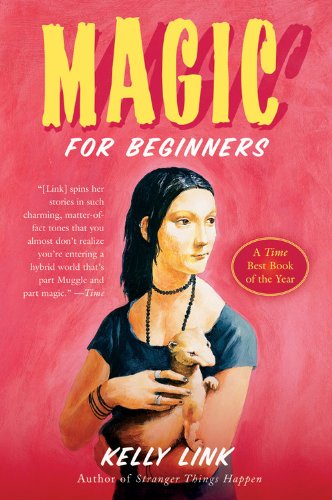
23: Magic for Beginners, Kelly Link
(AlphaKit: K; SFFKit: women authors; BingoDog: shares a name with a family member/my sister Kelly)
Link still feels somehow like a rising star of the genre, but she's been a critically acclaimed author for nearly 30 years now, with five volumes of short stories to her credit. Perhaps the fact that she has specialized in shorter fiction has kept her somewhat under the radar; when her first novel came out last year, there was a lot of "look at this marvelous new author we've discovered" from the "literary" critics.
Her stories are hard to pigeonhole. They sit at the intersection of SF/fantasy and literary fiction, with a heavy dose of magical realism (not a phrase I love, I confess, largely because I've yet to see a really good explanation of what exactly it means); she's often labeled with the even more nebulous word "slipstream."
Whatever you call it, I'm afraid it's mostly a little too weird and eccentric for my taste. There's a lot of surrealism; stories have touches of strangeness that don't add up to much. Why is the family in 'Stone Animals" finding its new home in the suburbs plagued by giant herds of rabbits on the front lawn? What's up with the two guys who seem to live at a convenience store near the canyon where the zombies live ("The Hortlak")? And are any of the nesting "let's fuck with the arrow of time" stories in "Lull" ever going to get to a point?
On the plus side, the better stories in the book are the longest ones. In "The Faery Handbag," a young woman explains how she managed to lose her grandmother's handbag, in which is hidden not only her grandmother's entire Eastern European village, but her own boyfriend. (And kudos to Link for coming with the spectacular country name "Baldeziwurlekistan.") "Magic for Beginners" feels like a forerunner to last year's film I Saw the TV Glow in its exploration of how teens can bond over, and find identity in, specific works of art; like the move, Link's story blurs narrative levels: Are her characters fans of a TV show, or are they characters in it? And I was amused by the conceit of "The Great Divorce," which pushes the idea of mixed marriages one step further by letting the living marry the dead.
I didn't hate these stories, and if I squint at them hard enough, I can sort of see why she's so popular. But Link and I are, for the most part, not on the same wavelength.
23: Magic for Beginners, Kelly Link
(AlphaKit: K; SFFKit: women authors; BingoDog: shares a name with a family member/my sister Kelly)
Link still feels somehow like a rising star of the genre, but she's been a critically acclaimed author for nearly 30 years now, with five volumes of short stories to her credit. Perhaps the fact that she has specialized in shorter fiction has kept her somewhat under the radar; when her first novel came out last year, there was a lot of "look at this marvelous new author we've discovered" from the "literary" critics.
Her stories are hard to pigeonhole. They sit at the intersection of SF/fantasy and literary fiction, with a heavy dose of magical realism (not a phrase I love, I confess, largely because I've yet to see a really good explanation of what exactly it means); she's often labeled with the even more nebulous word "slipstream."
Whatever you call it, I'm afraid it's mostly a little too weird and eccentric for my taste. There's a lot of surrealism; stories have touches of strangeness that don't add up to much. Why is the family in 'Stone Animals" finding its new home in the suburbs plagued by giant herds of rabbits on the front lawn? What's up with the two guys who seem to live at a convenience store near the canyon where the zombies live ("The Hortlak")? And are any of the nesting "let's fuck with the arrow of time" stories in "Lull" ever going to get to a point?
On the plus side, the better stories in the book are the longest ones. In "The Faery Handbag," a young woman explains how she managed to lose her grandmother's handbag, in which is hidden not only her grandmother's entire Eastern European village, but her own boyfriend. (And kudos to Link for coming with the spectacular country name "Baldeziwurlekistan.") "Magic for Beginners" feels like a forerunner to last year's film I Saw the TV Glow in its exploration of how teens can bond over, and find identity in, specific works of art; like the move, Link's story blurs narrative levels: Are her characters fans of a TV show, or are they characters in it? And I was amused by the conceit of "The Great Divorce," which pushes the idea of mixed marriages one step further by letting the living marry the dead.
I didn't hate these stories, and if I squint at them hard enough, I can sort of see why she's so popular. But Link and I are, for the most part, not on the same wavelength.
133kjuliff
>131 KeithChaffee: Are these short stories in an anthology? I can’t see how to get them other than buying four books. But they do sound interesting.
134KeithChaffee
>133 kjuliff: Sorry, should have been more complete. These are stories from my long-term project of reading all of the short SF that's been nominated for the major awards in the genre. Some of those stories haven't been anthologized anywhere (at least, not in English) since their original magazine publication, so to cross those off my list, I shop for back issues on the used book market. These stories are all from assorted old SF magazines, as are those listed in >123 KeithChaffee: and >128 KeithChaffee:. There will probably be one more similar batch from this round of vacation reading, since I'll be taking the bus and train home from SF to LA on Tuesday.
135kjuliff
>134 KeithChaffee: Thanks. I see now. I remember now about your short story project
136KeithChaffee
And a final batch (for this vacation trip, at any rate) of on-the-train reading from the SF award nominee projects, gathered from scattered issues of SF magazines:
"To Jorslem," Robert Silverberg -- You may be able to guess from the title that this is one of those post-apocalyptic stories in which the passage of time is reflected in altered spellings of place names: Talya, Afreek, Jorslem. Not a particularly interesting example of its type.
"Fast Cars," Kristine Kathryn Rusch -- A group of high school kids do an unauthorized experiment meant to alter their brain chemistry in (they hope) beneficial ways; a decade later, they gather to consider who they've become. Lovely writing, particularly good at creating a specific mood.
"Flaw on Serendip," J. Brian Clarke -- A mysterious force is doing something to the members of a small colony on an alien world; the ending is an anticlimactic "the power was inside you all along" dribble.
"Eifelheim," Michael F. Flynn -- Later expanded into the novel of the same name. A medieval historian and a physicist find that their current projects are entangled in unexpected ways, leading to breakthroughs for both. The expansion was probably a good idea; at the shorter length, the story feels a bit cramped and rushed.
"Do Ya, Do Ya, Wanna Dance?," Howard Waldrop -- Another high school reunion story, with the class of '69 gathering for its 20th. The character studies are nicely done, and the final paragraphs get a bit trippy, but I'm not sure where the SF is to be found here.
"The Color Winter," Steven Popkes -- A WWII refugee now manages a parking garage with the assistance of a very different refugee. Gently evocative character study.
"Cyclops," David Brin -- Sequel to the original version of "The Postman," and later included in the novel-length expansion. Not sure why the sequel/expansion were necessary -- all of the ideas were pretty well expressed in the original -- but it's a nicely written bit of entertainment.
"To Jorslem," Robert Silverberg -- You may be able to guess from the title that this is one of those post-apocalyptic stories in which the passage of time is reflected in altered spellings of place names: Talya, Afreek, Jorslem. Not a particularly interesting example of its type.
"Fast Cars," Kristine Kathryn Rusch -- A group of high school kids do an unauthorized experiment meant to alter their brain chemistry in (they hope) beneficial ways; a decade later, they gather to consider who they've become. Lovely writing, particularly good at creating a specific mood.
"Flaw on Serendip," J. Brian Clarke -- A mysterious force is doing something to the members of a small colony on an alien world; the ending is an anticlimactic "the power was inside you all along" dribble.
"Eifelheim," Michael F. Flynn -- Later expanded into the novel of the same name. A medieval historian and a physicist find that their current projects are entangled in unexpected ways, leading to breakthroughs for both. The expansion was probably a good idea; at the shorter length, the story feels a bit cramped and rushed.
"Do Ya, Do Ya, Wanna Dance?," Howard Waldrop -- Another high school reunion story, with the class of '69 gathering for its 20th. The character studies are nicely done, and the final paragraphs get a bit trippy, but I'm not sure where the SF is to be found here.
"The Color Winter," Steven Popkes -- A WWII refugee now manages a parking garage with the assistance of a very different refugee. Gently evocative character study.
"Cyclops," David Brin -- Sequel to the original version of "The Postman," and later included in the novel-length expansion. Not sure why the sequel/expansion were necessary -- all of the ideas were pretty well expressed in the original -- but it's a nicely written bit of entertainment.
137KeithChaffee

24: The Quests of Simon Ark, Edward D. Hoch
(AlphaKit: E; MysteryKit: paranormal mysteries)
Edward D. Hoch wrote a small number of novels, but he was principally a writer of short stories. In 2001, he was named a Grand Master by the Mystery Writers of America, the first writer given that honor who was not primarily a novelist.
His most enduring relationship was with Ellery Queen's Mystery Magazine; between May 1973 and May 2007, Hoch had a story appear in every issue of the magazine, with the occasional issue featuring a second Hoch story published under a pseudonym.
Part of how he managed to be so prolific was that he created multiple series characters of different types, working in different settings. Whatever idea for a story he came up, there was probably an existing character into whose milieu the story could easily be fit.
This collection features stories about Simon Ark, a mysterious figure who investigates events with mystical, occult, or religious overtones. While Ark never comes out and directly says very much about his history, it is frequently implied that he is older than Christ and possibly immortal. It appears that he has been cursed by God to wander the earth in search of Satan.
That's as far as the occult elements go in these mysteries, though, since they all have mundane solutions with no supernatural explanations required. And that makes all of the "ooh, he's immortal, ooh, cursed by God" stuff seem a bit silly; if it's not going to have anything to do with the mysteries, why bother?
Simon Ark is a potentially interesting character, but based on these stories, which Hoch selected himself as the best of roughly 40 Ark stories, Hoch never came up with any mysteries that would justify his particular set of quirks and oddities.
138KeithChaffee
So, a shopping report from my recent vacation: I visited bookstores in Denver (Tattered Cover, Capital Hill Books, and the Public Library's Red Chair Bookstore), Salt Lake City (The King's English and the Legendarium), and San Francisco (City Lights and Borderlands Books), buying at least one book at every stop. (As if I needed more books...)
I came home with:
Some Desperate Glory, Emily Tesh
The Big Over Easy, Jasper Fforde
Thornhedge, T. Kingfisher
The Ministry of Time, Kaliane Bradley
Witnesses for the Dead, Gary Phillips and Gar Anthony Haywood, eds.
Solaris Rising, Ian Whates, ed.
Rediscovery: Scence Fiction by Women (1958-1963) (anthology with no credited editor; no touchstone comes up)
Glimpses, Lewis Shiner
Him, Geoff Ryman
The Unraveling, Benjamin Rosenbaum
A Marvellous Light, Freya Marske
Cities in Flight, James Blish
I came home with:
Some Desperate Glory, Emily Tesh
The Big Over Easy, Jasper Fforde
Thornhedge, T. Kingfisher
The Ministry of Time, Kaliane Bradley
Witnesses for the Dead, Gary Phillips and Gar Anthony Haywood, eds.
Solaris Rising, Ian Whates, ed.
Rediscovery: Scence Fiction by Women (1958-1963) (anthology with no credited editor; no touchstone comes up)
Glimpses, Lewis Shiner
Him, Geoff Ryman
The Unraveling, Benjamin Rosenbaum
A Marvellous Light, Freya Marske
Cities in Flight, James Blish
139RidgewayGirl
>138 KeithChaffee: I'm glad that it's not just me out there supporting independent bookstores!
140cindydavid4
Howd you like SLC? Ive not heard of Legendarium
141KeithChaffee
I loved Salt Lake! I was astonished, even when I got downtown, at how tidy the place is. I'm sure it has its rundown neighborhoods -- what city doesn't? -- but at least in the parts of town I saw, even the buildings that had clearly been abandoned for a while weren't hideous eyesores. And I liked the coziness of the place; it felt like a very large small town with all the cultural amenities of a larger city. Were it not for the winters -- I don't enjoy the cold and snow -- I could imagine living there very happily.
The Legendarium is an sf/fantasy/horror bookstore, with a small cafe, that also hosts a lot of role-playing game nights. A little cramped, in the way that indie bookstores often are, but a very welcoming atmosphere. Their website says they're a trans-owned business.
The Legendarium is an sf/fantasy/horror bookstore, with a small cafe, that also hosts a lot of role-playing game nights. A little cramped, in the way that indie bookstores often are, but a very welcoming atmosphere. Their website says they're a trans-owned business.
142cindydavid4
that was always my idea of SLC as a big city in a small town (same way I look at Tucson)It has changed since I left; downtown was really run down but when I was there last year I saw how much better it was. Also thrilled by the number of protesters this month. glad you enjoyed it. ill have to check out that bookstore next time im there
143KeithChaffee

25: The Bump, Sidney Karger
(AlphaKit: K; BingoDog: features a birth)
Biz and Wyatt are a Brooklyn couple who set out on a road trip to California to be present when their surrogate gives birth to their first child. They're calling it their "babymoon" trip, and they plan to visit a few of their favorite gay resorts on the way.
It's a tense trip from the beginning. Both men are worried about whether they're up to being a father, and their refusal to admit or talk about that is putting a lot of stress on their relationship. And stress keeps being heaped upon them, as a variety of personal, family, and work crises pop up that keep detouring them from their planned destinations.
This isn't exactly a romantic comedy -- it's about the stresses and challenges within an existing relationship rather than the process of two people finding one another -- but it's in the same tonal area. The problem is that Karger's attempt at light, fizzy comedy never quite takes off; it falls short of the crackling sparkle that it needs. Biz and Wyatt are both so consistently grumpy and unhappy that it's difficult to understand what drew them together in the first place, much less to root for their happiness.
It's not a terrible book; some of the supporting characters are entertaining, and an occasional punchline lands sharply. But the story is too meandering and episodic, and the problems in the central relationship aren't a compelling enough throughline to hold the bits together. The high points are too few and far between to make up for the novel's general flatness.
144KeithChaffee
I've decided to tackle a shelf-clearing project. In addition to the random back issues of assorted SF magazines that I've been buying to catch up with never-anthologized award-nominated stories, I have been a regular subscriber to both Asimov's and Analog for many years -- Asimov's since fairly close to its creation in 1977, when I was in junior high;and Analog for at least 20 years -- but I have not done a good job of keeping up with the new issues as they come in, and they have piled up on my shelves. I've got a 15-year backlog of Asimov's and an 8-year backlog of Analog to work through.
It was easy enough to let them pile up. It's fiction, after all. It's not timely in the way that the latest issue of The New Yorker might be; a good story is still worth reading whenever you get around to it. But looking at two full shelves of back issues is starting to be a little embarrassing. (I really should consider letting the subscriptions expire when they next come up for renewal. Both magazines still publish good stuff, but neither is at the top of the genre in the way they once were.)
So the new goal is to tackle at least one issue from the backlog every week. I won't necessarily read every story in the issue -- even when I was keeping up with them as they came in, I didn't read every story -- but I'll at least give everything a look.
It was easy enough to let them pile up. It's fiction, after all. It's not timely in the way that the latest issue of The New Yorker might be; a good story is still worth reading whenever you get around to it. But looking at two full shelves of back issues is starting to be a little embarrassing. (I really should consider letting the subscriptions expire when they next come up for renewal. Both magazines still publish good stuff, but neither is at the top of the genre in the way they once were.)
So the new goal is to tackle at least one issue from the backlog every week. I won't necessarily read every story in the issue -- even when I was keeping up with them as they came in, I didn't read every story -- but I'll at least give everything a look.
145RidgewayGirl
>144 KeithChaffee: I subscribe to Book Forum, which publishes only 4 issues a year and I've only subscribed for a few years now and back issues are already making themselves an issue.
146labfs39
I used to subscribe to the Economist, as a way to learn more about Central Asian and other regional politics. They built up at such an alarming rate that I bailed after six months.
147KeithChaffee

26: Thornhedge, T. Kingfisher
(AlphaKit: K; SFFKit: women authors)
A "Sleeping Beauty" variation, this one from the point of view of the fairy who placed the sleeping curse in the first place. Except it wasn't really a curse, or at least it wasn't meant to be. And Toadling isn't exactly a fairy, though she's not entirely human any more, either.
But whatever was supposed to happen, what has happened is that Toadling has been guarding this abandoned tower surrounded by brambles for a few hundred years now, doing everything in her power to keep some well-intentioned but clueless knight from waking the sleeper. And everything was going just fine until Halim showed up.
I have a soft spot for "from another point of view" retellings -- I think of them as "the literature of parallax" -- and this is a good one. The narrative is perhaps fractured into too many flashbacks, but Kingfisher's twists on the original story are clever, providing answers to some of the questions left hanging by the original story. Toadling and Halim are a charming pair, and it's fun to watch the growth of their uneasy friendship.
148RidgewayGirl
>147 KeithChaffee: I was lucky enough to meet Ursula Vernon at a book festival and she was delightful.
149AnnieMod
>146 labfs39: >145 RidgewayGirl: >144 KeithChaffee:
I think we should form a "read your own magazines" support group :)
I think we should form a "read your own magazines" support group :)
150cindydavid4
>147 KeithChaffee: oh that sounds like a good addition to my fractured fairy tales shelves!
151KeithChaffee
SF magazine shelf-clearing: Asimov's, July 2011.
The feature story, Paul Cornell's Hugo-nominated novella "The Copenhagen Interpretation," is a sporadically interesting bit of alt-history espionage, but ultimately bogs down in too many murky complications.
Chris Beckett's "Day 29" is better, exploring how people might respond if they knew that they would have no memory of the next month of their lives. Best of this bunch is Leah Cypess's "Twelvers," a reminder that the adolescent capacity for bullying is unlimited, and that kids will turn anything into an excuse to beat up on someone.
The feature story, Paul Cornell's Hugo-nominated novella "The Copenhagen Interpretation," is a sporadically interesting bit of alt-history espionage, but ultimately bogs down in too many murky complications.
Chris Beckett's "Day 29" is better, exploring how people might respond if they knew that they would have no memory of the next month of their lives. Best of this bunch is Leah Cypess's "Twelvers," a reminder that the adolescent capacity for bullying is unlimited, and that kids will turn anything into an excuse to beat up on someone.
152KeithChaffee

27: The Ministry of Time, Kaliane Bradley
(AlphaKit: K; SFFKit: women authors; BingoDog: unconventional family)
In a future near enough to be basically the present day, the British government has brought five people from various eras of the past to the present, and assigned each of them a "bridge," whose job is to live with them and help acclimate them to their new temporal home.
The five have all been chosen because they were about to die, which means that their disappearance from their own eras will have no effect on history. One of the five is Graham Gore, a naval officer who was part of John Franklin's 1845 Arctic expedition, which had no survivors. (There actually was a Graham Gore, and Bradley has built his character from the little we know of him from military documents.)
Our protagonist and narrator is Gore's bridge, who is never named. While she's not fond of the word, she has some understanding of the refugee experience herself, as the daughter of a Cambodian immigrant mother, and her superior officers think this will help her relate to a temporal refugee.
Here we find the first "oh, come on" moment in which Bradley makes it extraordinarily difficult to suspend disbelief. A naval officer from the 1840s would not complacently accept being housed with a single woman to whom he is not related. And Gore does object, but when the narrator tells him that such living arrangements are unremarkable these days, he simply accepts that with implausible ease and grace.
And I didn't buy it. Not only is Gore's immediate acceptance absurd, but so is the idea that the British government would have asked him to accept such an arrangement in the first place. He would have been assigned a male living companion, probably another naval officer.
Similar "oh, come on" moments are scattered throughout the book, moments that defy common sense or wallow in the most obvious time-travel cliches. And it's a shame, because there is a lot to like here. The characters are well drawn, and Gore's fellow displaced time travelers are a charming assortment; it's fun watching them develop into a sort of chosen (well, "forced by circumstance" would be more accurate) family. Bradley's not afraid to be funny, even occasionally silly, which is still all too rare in SF. But I was never convinced by the inevitable romance between the narrator and Gore, or by the increasingly convoluted time-traveling espionage story.
This is a promising first novel, and I look forward to seeing what Bradley does next; Wikipedia says she's working on a retelling of Greek mythology in a neo-noir setting. But its flaws are significant, and I would only recommend the book with strong reservations.
153rasdhar
>152 KeithChaffee: I had reservations about this book when I read it as well, and I think your characterization of them as "oh, come on" moments is spot on.
154KeithChaffee
SF magazine shelf clearing: Asimov's, August 2011.
On the whole, only a so-so issue, with nothing that really landed for me. Best of the bunch is Robert Silverberg's novelette "The End of the Line," part of his Majipoor series, and the first thing I've read from the series. It seems to be somewhat generic high fantasy -- lords and ladies, castles, political intrigue -- but with various alien races living on the planet more or less taking the place of elves, orcs, dragons, etc. This novelette is the story of one of the king's underlings doing the advance work for the king's visit to a small remote village.
Also of some interest: Philip Brewer's "Watch Bees," a dystopian future in which specially-bred bees take the place of guard dogs, protecting their farms from roving gangs of bandits; and Will Ludwigsen's "We Were Wonder Scouts," a somewhat Bradbury-esque bit of horror-tinged nostalgia.
And while the story didn't do much for me, I adore Michael Swanwick's title "For I Have Lain Me Down on the Stone of Loneliness and I'll Not Be Back Again." As you might recall from my comments on the Uncanny anthology (>109 KeithChaffee:) a few weeks back, I am something of a sucker for an evocatively poetic title.
On the whole, only a so-so issue, with nothing that really landed for me. Best of the bunch is Robert Silverberg's novelette "The End of the Line," part of his Majipoor series, and the first thing I've read from the series. It seems to be somewhat generic high fantasy -- lords and ladies, castles, political intrigue -- but with various alien races living on the planet more or less taking the place of elves, orcs, dragons, etc. This novelette is the story of one of the king's underlings doing the advance work for the king's visit to a small remote village.
Also of some interest: Philip Brewer's "Watch Bees," a dystopian future in which specially-bred bees take the place of guard dogs, protecting their farms from roving gangs of bandits; and Will Ludwigsen's "We Were Wonder Scouts," a somewhat Bradbury-esque bit of horror-tinged nostalgia.
And while the story didn't do much for me, I adore Michael Swanwick's title "For I Have Lain Me Down on the Stone of Loneliness and I'll Not Be Back Again." As you might recall from my comments on the Uncanny anthology (>109 KeithChaffee:) a few weeks back, I am something of a sucker for an evocatively poetic title.
155KeithChaffee

28: Woodworking, Emily St. James
(AlphaKit: E)
Erika is a trans woman. No one else knows that yet, of course, since Erika's only just acknowledged it herself, and is still resisting the idea of coming out to others and beginning the process of transition. But part of accepting herself is the growing need to tell someone, and since there aren't a lot of options in small-town South Dakota, she chooses to tell the only trans woman she knows -- Abigail, one of the 17-year-old students in the high school literature class Erika teaches.
Abigail is initially horrified, as most teenagers would be, that one of her teachers is turning to her for support and advice. Neither woman wants to think of the their relationship as a friendship, but that's what it slowly develops into. That's fraught for both women, and since everyone else still sees and thinks of Erika as a man, her growing closeness with a female student is nearly as risky to her career as she expects that coming out will be.
This is an excellent first novel, with a large cast of well-developed supporting characters and relationships. There are perhaps too many characters with big emotional secrets to be revealed, and each new secret has less impact near the end of the book, but those revelations are well and fairly prepared, so they never seem to come entirely out of the blue.
Highly recommended, and I look forward to seeing what St. James does next.
156KeithChaffee
April reading summary:
23. Magic for Beginners, Kelly Link
24. The Quests of Simon Ark, Edward D. Hoch
25. The Bump, Sidney Karger
26. Thornhedge, T. Kingfisher
27. The Ministry of Time, Kaliane Bradley
28. Woodworking, Emily St. James
Pages read: 2,600; total: 11,339. A relatively light month for me, mostly because I was on vacation the first two weeks, and did a lot less reading those days.
Cats, Kits, and Dogs completed: AlphaKit (8/26); MysteryKit (4/12); SFFKit (4/12); BingoDog (14/25).
Award-winning short SF: 23 stories, for a total of 73.
Tentative plans for May:
The Asking, Jane Hirshfield
A Fledgling Abiba, Dilman Dila (AlphaKit: D; SFFKit: authors from the Global South)
Immortality Inc., Robert Sheckley (AlphaKit: I; BingoDog: medical topic)
Three Bags Full, Leonie Swann (MysteryKit: set in a country other than your own; Bingo: Read a CAT/May CoverCat -- more than one element on cover)
The Talent, Daniel D'Addario (AlphaKit: D; Bingo: Hollywood)
23. Magic for Beginners, Kelly Link
24. The Quests of Simon Ark, Edward D. Hoch
25. The Bump, Sidney Karger
26. Thornhedge, T. Kingfisher
27. The Ministry of Time, Kaliane Bradley
28. Woodworking, Emily St. James
Pages read: 2,600; total: 11,339. A relatively light month for me, mostly because I was on vacation the first two weeks, and did a lot less reading those days.
Cats, Kits, and Dogs completed: AlphaKit (8/26); MysteryKit (4/12); SFFKit (4/12); BingoDog (14/25).
Award-winning short SF: 23 stories, for a total of 73.
Tentative plans for May:
The Asking, Jane Hirshfield
A Fledgling Abiba, Dilman Dila (AlphaKit: D; SFFKit: authors from the Global South)
Immortality Inc., Robert Sheckley (AlphaKit: I; BingoDog: medical topic)
Three Bags Full, Leonie Swann (MysteryKit: set in a country other than your own; Bingo: Read a CAT/May CoverCat -- more than one element on cover)
The Talent, Daniel D'Addario (AlphaKit: D; Bingo: Hollywood)
157KeithChaffee
DNF: Three Bags Full, Leonie Swann. A flock of sheep attempt to solve the murder of George, their shepherd, despite their limited comprehension of humans and their motives. Too cutesy and cloying for my taste.
158KeithChaffee

29: The Asking: New and Selected Poems, Jane Hirshfield
(BingoDog: Read a Cat -- May CoverCat: cover has more than one element)
I have a longstanding policy of not publicly reviewing books by people I know. While Jane and I aren't best buds or anything, we hang out in the same online community and have exchanged friendly conversation on a variety of topics. So this book is simply noted here for the purpose of having a complete list of my reading.
159KeithChaffee
SF magazine shelf clearing: Asimov's, September 2011
The cover story is Allen M. Steele's "The Observation Post," a time-travel story centered on a naval ensign assigned to the Caribbean during the Cuban Missile Crisis. No classic, but a solidly constructed story.
Alan Wall's "Burning Bridges" starts with this idea: If there's any truth to the idea that in people who don't have the use of one sense, other senses will be hyperdeveloped to compensate, then might we expect in people who have lost multiple senses that a theoretical sixth sense -- ESP -- might develop in a way that it never does in most people? Admittedly, it's a somewhat silly idea, but it's silly in ways that could allow an interesting story to be spun out. Sadly, Wall wastes the idea of a rather drab tale of arson fraud.
Best of the shorter stories is R. Neube's "Grandma Said," about a young man working as a plague cleanser on a frontier planet.
The cover story is Allen M. Steele's "The Observation Post," a time-travel story centered on a naval ensign assigned to the Caribbean during the Cuban Missile Crisis. No classic, but a solidly constructed story.
Alan Wall's "Burning Bridges" starts with this idea: If there's any truth to the idea that in people who don't have the use of one sense, other senses will be hyperdeveloped to compensate, then might we expect in people who have lost multiple senses that a theoretical sixth sense -- ESP -- might develop in a way that it never does in most people? Admittedly, it's a somewhat silly idea, but it's silly in ways that could allow an interesting story to be spun out. Sadly, Wall wastes the idea of a rather drab tale of arson fraud.
Best of the shorter stories is R. Neube's "Grandma Said," about a young man working as a plague cleanser on a frontier planet.
160kjuliff
>159 KeithChaffee: Thanks for this review. I’m sorely tempted though I haven’t been into SF for some years. Some good short stories might do the trick.
161KeithChaffee
>160 kjuliff: Oh, I'm glad to know that these old magazine comments are useful to someone. While my main purpose in keeping this list is so that I have a record of my own reading, I am aware that it's read by others, and I do try not to be too boring. And commenting on 15-year-old magazines that others aren't likely to have on their shelves or have ready access to does at least have the potential to be boring self-indulgence.
162KeithChaffee

30: When the Moon Hits Your Eye, John Scalzi
(BingoDog: travel; a trip to the moon is an important subplot)
John Scalzi has never been afraid to be silly. His last book featured a criminal empire run largely by talking cats and foul-mouthed dolphins who demanded the right to unionize; an earlier novel begins with an interstellar incident caused by a fart. But this is surely his goofiest premise yet: What if the moon suddenly, inexplicably, turned to cheese?
Do not look for too much scientific rigor as Scalzi lays out the consequences of that change. As he says in his afterword, "the science in this book is, and here is an obscure technical term, extremely loosey-goosey." But even as the back of your mind is aware that this is completely wackadoo, it all feels plausible and convincing in the moment.
We follow the reaction to the change through 30 days -- one lunar cycle -- moving to a new place and new characters almost every day (a few characters come back for a second appearance). The tones of the chapters vary wildly, from the genuinely moving crisis of faith of a Midwestern evangelical pastor to the raucous Slack chat of a group of gay men trying to plan an eclipse party. We get reactions from the people you'd expect to see in a story like this -- the President, NASA astronauts whose moon mission is suddenly put on hiatus, journalists and science authors trying to explain things to the public -- but from odd side angles as well -- a pair of feuding brothers who own competing cheese shops, a Hollywood executive who finds that every pitch she hears is suddenly cheese-themed.
The final chapters get unexpectedly deep and philosophical, and if the ending is a bit too deus ex machina, well, it's no less absurd than the idea of the moon turning to cheese in the first place. The novel is a big ol' ball of goofy, nutty -- dare I say cheesy? -- fun, and I had an ever-widening grin on my face throughout.
163KeithChaffee

31: A Fledgling Abiba, Dilman Dila
(AlphaKit: D; SFFKit: authors from the Global South; BingoDog: profession in title)
This is, I believe, the first time I've read a nominee for the Nommo Award, which is presented by the African Speculative Fiction Society. The ASFS was founded in 2016, and gave its first awards in 2017.
I am at something of a loss to respond to this book. Imagine reading Snow White without knowing the cultural significance and symbolic history of apples, mirrors, stepmothers, or witches. You would be able to follow the plot easily enough -- it's not a complicated story -- but you would miss a lot of what's going on. It's not mere chance that the Queen attempts to poison Snow White with an apple instead of a banana or a lychee, and if you don't understand that apples are associated with good and evil, with temptation, with betrayal (and specifically female betrayal at that), then you're going to have at best a superficial understanding of the story's emotional resonance.
And that is what's happening to me with this Ugandan author. The story is full of various types and tiers of African gods, spirits, and demons. Dila does a good job of explaining and translating along the way, but I don't have the instinctive emotional understanding of these beings that I imagine many African readers would have. And I also get the sense that I am not entirely getting the full symbolic import (or perhaps understanding that import differently) of things like fire or birds/flight.
The story itself is interesting. Kuri had begun training to be an abiba -- the closest American term would probably be "witch doctor," though as Dila explains in his introduction, that is a problematic phrase in a lot of ways -- but her training ended when her mother died. Now she's 11 or 12 years old, and her powers are strengthening, but she doesn't have very good control over them.
Kuri thinks a lot about her father. Her mother never said much about him, aside from once suggesting that he might have been a demigod. Her curiosity about her father is a vulnerability which various evil spirits take advantage of, using it as a lever to try and gain control over Kuri and her power.
But I always felt that I was skimming along the surface of the story, that my own ignorance and the cultural gap were too wide to allow me to sink completely into it.
164labfs39
>163 KeithChaffee: But I always felt that I was skimming along the surface of the story, that my own ignorance and the cultural gap were too wide to allow me to sink completely into it.
I feel that way a lot, but I hold out the hope that if I read enough from a particular region I'll start to get a feel for it. Your analogy with Snow White is very good.
I feel that way a lot, but I hold out the hope that if I read enough from a particular region I'll start to get a feel for it. Your analogy with Snow White is very good.
165KeithChaffee

32: The Decagon House Murders, Yukito Ayatsuji (Ho-Ling Wong, translator)
(AlphaKit: D; MysteryKit: not set in my country)
Ayatsuji explicitly acknowledges that he's writing a variation on Agatha Christie's And Then There Were None; seven college students, members of the school's Mystery Club, are spending several days on a remote island -- no phone, no wi-fi, no boat -- where four people were famously murdered a year earlier. The trip is a combination of youthful exuberance -- "maybe we can solve the case the police couldn't" -- and creepy murder tourism. The creepy quickly takes over when someone starts killing the members of the group.
In a parallel narrative, Ayatsuji follows a small group of amateur crime solvers on the mainland whose attention has been brought to the same year-old murder case; one of them, a friend of the Mystery Club members, begins to fear that someone has lured them to the island with nefarious intentions.
I thought Wong's translation felt a little stiff, but I've had a similar reaction to other translations of Japanese novels, so maybe Japanese prose is naturally a bit more formal than English and the translators are just accurately reflecting that difference.
Ayatsuji is a leader of the "new traditionalist" movement in Japanese mystery writing. About a third of his novels have been translated into English, including the first four of the nine "Bizarre House" novels, of which this is the first. The Golden Age influence is clear, and Ayatsuji has written a very nice imitation of that style and era. He never transcends the limitations of imitation and homage, though, to reach the point that his book feels like a genuinely original contribution to the literature.
Still, I liked this enough that I might someday pick up the second in the series in hopes that Ayatsuji might have chosen a more original storyline. I'd like to see what he's like when not so tightly bound by someone else's ideas.
166RidgewayGirl
>155 KeithChaffee: Yay, I'm glad you liked this novel, but not surprised. It's fun and probably the people who would most benefit from reading this novel won't. I'm also eager for what St. James writes next.
>157 KeithChaffee: The author of this book is German, and so I read it in German (it came out when I was still living there) and it really doesn't feel cutesy in German, but I'm not sure it is possible to sound twee in that language.
>157 KeithChaffee: The author of this book is German, and so I read it in German (it came out when I was still living there) and it really doesn't feel cutesy in German, but I'm not sure it is possible to sound twee in that language.
167KeithChaffee
>164 labfs39: I think you're right that the more African SFF I read, the more the references will become familiar. And there are a lot of African authors getting published in the US market place these days, which is a good thing.
>166 RidgewayGirl: I dunno, I suspect that even the Germans would have a hard time de-tweeing a flock of crime-solving sheep.
>166 RidgewayGirl: I dunno, I suspect that even the Germans would have a hard time de-tweeing a flock of crime-solving sheep.
168KeithChaffee
SF magazine shelf clearing: Asimov's, December 2011
The cover story is "All About Emily," one of Connie Willis's Christmas stories. You might guess from the title that this is a story about (possibly) rival actresses, centered on an android who dreams of being a Rockette. I like Willis's holiday stories, and this one is charming.
It's a mostly strong issue from front to back. Suzanne Palmer's "Surf" gives us rival scientists forced to work on the same mission, but with very different agendas. Pamela Sargent's "Strawberry Birdies" is a story about time-travelers on a rescue mission of sorts; notable for being better than most in its handling of neurodiversity. Also sensitive in that regard is Ken Liu's "The Countable," which makes the often-confusing mathematics of infinity (and mulitple infinities) comprehensible as it tells a tale of family tragedy.
Tim McDaniel's "The List" is a flimsy holiday joke, but it's only a page long; and the idea behind Ferrett Steinmetz's "'Run,' Bakri Says" -- transferring repeated attempts to complete a dangerous mission from video games to the real world -- is better than the execution.
The cover story is "All About Emily," one of Connie Willis's Christmas stories. You might guess from the title that this is a story about (possibly) rival actresses, centered on an android who dreams of being a Rockette. I like Willis's holiday stories, and this one is charming.
It's a mostly strong issue from front to back. Suzanne Palmer's "Surf" gives us rival scientists forced to work on the same mission, but with very different agendas. Pamela Sargent's "Strawberry Birdies" is a story about time-travelers on a rescue mission of sorts; notable for being better than most in its handling of neurodiversity. Also sensitive in that regard is Ken Liu's "The Countable," which makes the often-confusing mathematics of infinity (and mulitple infinities) comprehensible as it tells a tale of family tragedy.
Tim McDaniel's "The List" is a flimsy holiday joke, but it's only a page long; and the idea behind Ferrett Steinmetz's "'Run,' Bakri Says" -- transferring repeated attempts to complete a dangerous mission from video games to the real world -- is better than the execution.
169KeithChaffee

33: Immortality Inc., Robert Sheckley
(AlphaKit: I; BingoDog: medical topic)
At the moment of his death in 1958, Thomas Blaine is yanked into the year 2110 by a 22nd-century corporation. Or, to be precise, his mind is brought to 2110, because a major scientific discovery of the intervening 152 years is that the mind and body are indeed separate; minds can now be transferred relatively easily from one body to another, giving the very wealthy a form of immortality.
The other big discovery that Blaine has to adjust to is that the existence of an afterlife has been scientifically proven. Not everyone is naturally able to make the transition to that afterlife, but there is technology (again, available mostly to the rich) that will make success nearly certain.
Sheckley's novel is a rather episodic look at the social changes that have come about because of those discoveries. it was originally published as a magazine serial, and it feels more like a series of short stories than a cohesive novel. Every two or three chapters, a new set of supporting characters pop up as featured players for an exploration of one of those social changes.
(One of those episodes was loosely adapted into the 1992 movie Freejack, which featured the improbable combination of Emilio Estevez, Anthony Hopkins, and Mick Jagger; it is reportedly not very good.)
The episodes are entertaining, and Sheckley has come up with a series of clever "what might happen if..." moments from his original premise. I would have liked more of a solid throughline, but as a series of linked stories, this was pleasant reading.
170rasdhar
>165 KeithChaffee: Ayatsuji was part of the Japanese honkaku mystery movement, and they tend to write around very strict rules for murder mysteries. So even his other books (such as The Mill House Murders) have that slightly formulaic feel to them. One of the movement's key principles was 'fair play to the reader', i.e. the mystery should be written in a way that allows the reader to put together the pieces of the puzzle themselves. I'm curious: did you figure out the mystery in The Decagon House Murders? I did not!
171KeithChaffee
>170 rasdhar: No, but I almost never figure out the mystery before the author reveals the solution.
172KeithChaffee
Another batch of award-nominated SF stories gathered from assorted old magazine issues:
"Ta O'Reva," Muthi Nhlema
"Of One Mind," James A. Durham
"A Leader for Yesteryear," Mack Reynolds
"Research Alpha," A. E. van Vogt & James H. Schmitz
"In Our Block," R. A. Lafferty
Four of these are 1966 Nebula nominees. That was the first year of the Nebulas, and the organizers hadn't quite figured out that a nominee list should be fairly short. Instead of the now-standard five nominees per category, there were about twenty. So a lot of that year's nominees list -- including these four -- are pleasant enough, but not really what I would think of as awards-quality.
Durham's story of a project to allow astronauts to mind-meld plays with a fairly familiar mid-60s theme -- drugs and metaphysical oneness will save us all -- but with an refreshingly unexpected bleak ending. Reynolds gives us a clunky time travel/Hitler story. Van Vogt and Schmitz offer an attempt to medically rush human evolution, with a central female character, still a novelty in this era; given my history with van Vogt's writing, I have to assume that part of the story came from Schmitz. Lafferty is a writer who I like very much -- if you were one of the folks who read some Avram Davidson last year, Lafferty is like a folksier, less urbane Davidson -- but this story of a city neighborhood dealing with unusual immigrants is minor Lafferty.
Nhlema's novella is ambitious, cramming a lot of ideas -- too many ideas -- into one story. It's an alternate history in which Nelson Mandela decides to leave politics after his release from prison; that sets into motion a series of disastrous events for South Africa, leading scientists to send an older Mandela back in time to convince his younger self to stay politically active in order to save his country. It would be too much even in the hands of a more talented author, but given Nhlema's clomping prose and fondness for the most offensive South African racial epithet, it was a hard slog.
"Ta O'Reva," Muthi Nhlema
"Of One Mind," James A. Durham
"A Leader for Yesteryear," Mack Reynolds
"Research Alpha," A. E. van Vogt & James H. Schmitz
"In Our Block," R. A. Lafferty
Four of these are 1966 Nebula nominees. That was the first year of the Nebulas, and the organizers hadn't quite figured out that a nominee list should be fairly short. Instead of the now-standard five nominees per category, there were about twenty. So a lot of that year's nominees list -- including these four -- are pleasant enough, but not really what I would think of as awards-quality.
Durham's story of a project to allow astronauts to mind-meld plays with a fairly familiar mid-60s theme -- drugs and metaphysical oneness will save us all -- but with an refreshingly unexpected bleak ending. Reynolds gives us a clunky time travel/Hitler story. Van Vogt and Schmitz offer an attempt to medically rush human evolution, with a central female character, still a novelty in this era; given my history with van Vogt's writing, I have to assume that part of the story came from Schmitz. Lafferty is a writer who I like very much -- if you were one of the folks who read some Avram Davidson last year, Lafferty is like a folksier, less urbane Davidson -- but this story of a city neighborhood dealing with unusual immigrants is minor Lafferty.
Nhlema's novella is ambitious, cramming a lot of ideas -- too many ideas -- into one story. It's an alternate history in which Nelson Mandela decides to leave politics after his release from prison; that sets into motion a series of disastrous events for South Africa, leading scientists to send an older Mandela back in time to convince his younger self to stay politically active in order to save his country. It would be too much even in the hands of a more talented author, but given Nhlema's clomping prose and fondness for the most offensive South African racial epithet, it was a hard slog.
173KeithChaffee

34: The Talent, Daniel D'Addario
(AlphaKit: D; BingoDog: Hollywood)
D'Addario takes us through one (fictional) Best Actress Oscar campaign through the points of view of the five nominees. They're a diverse bunch:
• a former child star making her bid to be taken seriously in a Black-cast version of The Glass Menagerie
• a woman plagued by sex-and-booze scandals, playing the young Lady Bird Johnson
• a British theater legend who's breaking into Hollywood in a Shakespeare adaptation
• a three-time winner who has used her clout to inappropriately shove her younger co-star into the Supporting race
• another legendary veteran who hopes that playing Maria Callas will finally win her the elusive award
We get glimpses into the backstories and relationships among these actresses, but there's not really a lot of plot here; it's more an interlocking set of five character studies focused mostly on the insecurities and neuroses of these women.
It's tempting to read this as a roman à clef and try to figure out who are the real-life models for D'Addario's characters, but while you might spot similarities to real actors, each character is different enough from any real person that you can't really say "oh, that's Zendaya and that's Meryl Streep."
D'Addario knows his way around an awards season; he's a writer at Variety and one of the hosts of that magazine's annual "Actors on Actors" video series. (The opening chunk of the novel is set at the photo/video shoot for a very similar series.) He cleverly writes his way around copyright restrictions; he never uses the words "Oscar" or "Academy Award." And in a section of the book set at a different awards show, it's clear that we're at the Golden Globes even without actually saying so.
This is the literary equivalent of a popcorn movie; it's a well-crafted piece of light entertainment that doesn't ask anyone to think too hard. While it occasionally makes mild gestures in the direction of real issues -- abusive directors, alcoholism, racism -- it never dives deeply enough into them to risk making the reader uncomfortable. It will make lots of people happy on beaches and airplanes over the next few months.
I enjoyed the book. D'Addario has shown that he can create and write interesting characters; I look forward to seeing what he can do when he gives those characters a stronger story to tell.
174cindydavid4
oh this looks fun; bet my sis would like it too a double BB
175janoorani24
>162 KeithChaffee: Funny, I just finished Starter Villain by John Scalzi -- the one you reference as about a "criminal empire run largely by talking cats and foul-mouthed dolphins who demanded the right to unionize," and that's such a great description. I may have to read this one too. It sounds pretty good. Thanks for the review.
176KeithChaffee
SF magazine shelf clearing: Asimov's, January 2012
Another strong issue.
The cover story is Elizabeth Bear's "In the House of Aryaman, a Lonely Signal Burns," a murder mystery set among tech workers in a future version of India. Best in issue honors to Paul McAuley's "Bruce Springsteen," in which a recently settled planet takes the place of the American frontier for a story of a young couple on a crime spree.
Katherine Marzinsky's "Recyclable Material" and Eric Del Carlo's "Friendlessness" are both aiming for poignance; the latter is more successful.
"Maiden Voyage" is a prequel to Jack McDevitt's novels about space pilot Priscilla Hutchins that stands on its own reaasonable well, and Zachary Jernigan's "The War Is Over and Everyone Wins'' suggests that even if you take white people out of the picture, racism and tribal differences will always find a way to flourish.
Another strong issue.
The cover story is Elizabeth Bear's "In the House of Aryaman, a Lonely Signal Burns," a murder mystery set among tech workers in a future version of India. Best in issue honors to Paul McAuley's "Bruce Springsteen," in which a recently settled planet takes the place of the American frontier for a story of a young couple on a crime spree.
Katherine Marzinsky's "Recyclable Material" and Eric Del Carlo's "Friendlessness" are both aiming for poignance; the latter is more successful.
"Maiden Voyage" is a prequel to Jack McDevitt's novels about space pilot Priscilla Hutchins that stands on its own reaasonable well, and Zachary Jernigan's "The War Is Over and Everyone Wins'' suggests that even if you take white people out of the picture, racism and tribal differences will always find a way to flourish.
177KeithChaffee

35: The Worst Trickster Story Ever Told, Keith Richotte, Jr.
First, a note on terminology: Richotte is writing about the people and tribes who are variously known as Native Americans, American Indians, and Indigenous Americans; each of those terms will delight some and annoy others within those communities. He doesn't specifically address his choice of terms, but he's writing about the law, and US law has almost always used the term "Indians." So while Richotte occasionally uses other terminology, he mostly sticks to "Indians," and that's what I'll do here.
Richotte's subject is the history of federal Indian law in the United States. He starts by noting that the federal government has always claimed to have plenary power -- that is, virtually absolute power -- over Indians living in America, and asks where in the Constitution that power is to be found. To find his answer, he looks at the history of Supreme Court rulings on Indian affairs.
In the beginning, the Court didn't really bother to look very hard for Constitutional justification for American claims of power over Indians; they just resorted to blunt racism. "We" had to take charge of "them," because Indians were uncivilized savages who couldn't possibly govern themselves or take responsibility for their own affairs.
But by the middle of the 20th century, with Indians and others beginning to organize in demanding their civil rights, the Court had at least enough sense to recognize that undisguised racism wasn't going to work anymore. So over the course of several decades, they gradually settled on the Constitution's Indian Commerce Clause as the legal basis for plenary power.
That was not, Richotte argues, a very sound argument, and served only to put a paper-thin veneer of defensible judicial logic on the racism that continued (and continues) to underlie federal Indian law. He suggests that a better place to look for the source of federal power is in the Treaty Clause, which has largely been ignored since the age of treaties ended.
To see the Treaty Clause at the heart of the relationship between the US government and Indians would require, he says, would call for a radical rethinking of that relationship. The two sides would be obliged to deal with one another as equals, and the change would benefit both. Making such a radical change will, of course, take time, and Richotte urges Indian advocates to begin the process now, arguing at every opportunity, both legally and politically, for this rethinking of Indian law.
All of that probably sounds horribly dry and stodgy, but Richotte's style, without sacrificing legal or academic rigor, is accessible and entertaining for the non-lawyer. His prose is more casual than that of most legal books, even those written for the layman.
Given that Indian law is a specialized corner of legal knowledge, I imagine that the audience for this book will also include lawyers who aren't experts in the field and want a good overview. While I am not a lawyer, I think Richotte has pulled off the trick of being accessible to the layman without so oversimplifying as to be of no use to the broader legal community.
I would not have expected a book on federal Indian law to be fun, and this one is. Richotte's central metaphor of Indian law as a horrible trickster story is effective, and this is a masterful overview of a complicated history. Strongly recommended.
178KeithChaffee
SF magazine shelf clearing: Asimov's, February 2012
Not a great issue. Only one really good story, Robert Reed's "Murder Born," which explores how our relationship with capitol punishment might change if executing murderers restored their victims to life.
Two collaborations, which one doesn't often see in SF (*): Rudy Rucker & Eileen Gunn's "Hive Mind Man," another piece of social media paranoia; and Bruce McAllister & Barry Malzberg's "Going Home," in which an author dreams of writing SF in the Golden Age style, upsetting our hidden alien overlords.
(* -- I imagine that we have our share of authors writing collaboratively and publishing under a shared pseudonym, but overt collabs with two credited authors are unusual.)
Not a great issue. Only one really good story, Robert Reed's "Murder Born," which explores how our relationship with capitol punishment might change if executing murderers restored their victims to life.
Two collaborations, which one doesn't often see in SF (*): Rudy Rucker & Eileen Gunn's "Hive Mind Man," another piece of social media paranoia; and Bruce McAllister & Barry Malzberg's "Going Home," in which an author dreams of writing SF in the Golden Age style, upsetting our hidden alien overlords.
(* -- I imagine that we have our share of authors writing collaboratively and publishing under a shared pseudonym, but overt collabs with two credited authors are unusual.)
179FlorenceArt
>178 KeithChaffee: But do you think collaborations are more frequent in other genres? I can think of 3 couples who write or wrote together in SFF. Or maybe you were thinking of more occasional collabs?
180KeithChaffee
I feel like I see more of them in other genres, but I'm no scholar on the subject. My perception could well be off. Maybe the rise of "collaborations" like the James Patterson fiction sweatshop is distorting my view of things.
181KeithChaffee
Not particularly book related, but one of my favorite bits of US history trivia came to an end this week with the death of Harrison Ruffin Tyler. He was the last surviving grandson of John Tyler (1790-1862), the 10th US president. Harrison (1928-2025) was born when his father, Lyon Gardiner Tyler (1853-1935) was 75. When Lyon was born, his father, the former President Tyler was 63. Sadly, Harrison did not continue the family tradition of fathering a child in the next century from his own birth; his youngest child was born in 1961, when he was a mere child of 32.
182mabith
>181 KeithChaffee: It does feel a shame to break that chain! Fascinating to have that close a relation. James Madison was about forty years older than Tyler but generation-wise he's still seven away from me (first cousin seven times removed). And here we all thought it noteworthy that my paternal grandfather was 48 when my dad was born.
183KeithChaffee
I won't finish my current book today, so the May reading summary:
29. The Asking: New and Selected Poems, Jane Hirshfield
30. When the Moon Hits Your Eye, John Scalzi
31. A Fledgling Abiba, Dilman Dila
32. The Decagon House Murders, Yukito Ayatsuji (Ho-Ling Wong, translator)
33. Immortality Inc., Robert Sheckley
34. The Talent, Daniel D'Addario
35. The Worst Trickster Story Ever Told, Keith Richotte , Jr.
Pages read: 2,400; total: 13,739.
Cats, Kits, and Dogs completed: AlphaKit (10/26); MysteryKit (5/12); SFFKit (5/12); BingoDog (19/25).
Award-winning short SF: 15 stories, for a total of 88.
Tentative plans for June:
The Locus Awards, Charles N. Brown & Jonathan Strahan, eds. (AlphaKit C; SFFKit: anthologies and collections)
Rough Cut, Stan Cutler (AlphaKit C; MysteryKit: LGBT+ detectives)
The Corsican Brothers, Alexandre Dumas (AlphaKit C)
The Shadow of the Empire, Qiu Xiaolong (AlphaKit Q/X)
River of Shadows, Rebecca Solnit
29. The Asking: New and Selected Poems, Jane Hirshfield
30. When the Moon Hits Your Eye, John Scalzi
31. A Fledgling Abiba, Dilman Dila
32. The Decagon House Murders, Yukito Ayatsuji (Ho-Ling Wong, translator)
33. Immortality Inc., Robert Sheckley
34. The Talent, Daniel D'Addario
35. The Worst Trickster Story Ever Told, Keith Richotte , Jr.
Pages read: 2,400; total: 13,739.
Cats, Kits, and Dogs completed: AlphaKit (10/26); MysteryKit (5/12); SFFKit (5/12); BingoDog (19/25).
Award-winning short SF: 15 stories, for a total of 88.
Tentative plans for June:
The Locus Awards, Charles N. Brown & Jonathan Strahan, eds. (AlphaKit C; SFFKit: anthologies and collections)
Rough Cut, Stan Cutler (AlphaKit C; MysteryKit: LGBT+ detectives)
The Corsican Brothers, Alexandre Dumas (AlphaKit C)
The Shadow of the Empire, Qiu Xiaolong (AlphaKit Q/X)
River of Shadows, Rebecca Solnit
184KeithChaffee

36: The Locus Awards, Charles N. Brown & Jonathan Strahan, eds.
(AlphaKit: C; SFFKit: anthologies and collections)
Since 1968, Locus has been the trade magazine of SFF publishing. It's the place to go for news of publishing deals, reviews of new fiction, and comprehensive lists of what's been published each month. In 1971, they began the Locus Awards, honoring the best fiction of each year. This anthology was published in 2004, and includes selected winners from the first 30 (ish) years of the award.
I don't closely follow the Locus Awards in my SF award nominee project, mostly because it would be largely redundant to do so. Of the 19 stories gathered here, only one was not at least a nominee for either the Hugo or Nebula awards. (That lone story is Neil Gaiman's "October in the Chair," which really is the weakest story in the book, but the Locus voters have long had a soft spot for Gaiman that none of the other awards bodies share.)
With so vague a theme, this collection does feel a little shapeless. There's no unifying authorial voice, no thematic similarities, not even a "here's what the genre looks like at this specific moment" snapshot. The only thing these stories share is excellence, and on that level, Brown and Strahan have assembled a terrific collection.
There are four stories here good enough to make my personal list of all-time classics: Harlan Ellison's "Jeffty Is Five," which starts as Bradbury-esqe nostalgia, then rips your heart out in the final paragrahps; John Varley's "The Persistence of Vision," about a man who stumbles into happiness at an unusual desert commune; Octavia E. Butler's "Bloodchild," about an alien race who establish a violently symbiotic relationship with humanity; and Ted Chiang's "Hell Is the Absence of God," in which despite angelic visitations and other visible signs of God's existence, one man simply cannot bring himself to accept or love God.
Chiang's is the best of the three stories on religious themes, but the others are also quite good. In "The Way of Cross and Dragon," George R. R. Martin sends a cleric, representing a future Inquisition, to a distant planet to wipe out a dangerous new heresy; Joanna Russ's "Souls" gives us a medieval abbey run by an extraordinary abbess.
And the rest of the authors here are like an all-star team of these three decades: Ursula K. Le Guin, Connie Willis, John Varley, James Tiptree Jr., Bruce Sterling, Greg Egan. There are a couple of stories that didn't do much for me, but both are by authers to whom I've never quite connected; Gene Wolfe and Lucius Shepard both write prose that's too ornate for my taste, though I certainly understand why so many do like them.
A strong, solid collection of late-20th century SF. If you enjoy the genre at all, there will be something here, and probably several somethings, that will delight you.
185KeithChaffee

37: Anita de Monte Laughs Lasts, Xochitl Gonzalez
(AlphaKit: X; Bingo: features winged creatures)
We begin in 1985, on the night that Anita de Monte will die. She's a rising star in the art world, but people are beginning to wonder how much longer she can continue being "rising" without doing something that lives up to her early promise. That growing disappointment is only strengthened when she's compared to her husband, Jack Martin, one of the world's most respected sculptors. (Anita's story is inspired by the life and death of Cuban-American artist Ana Mendieta.)
In 1998, Raquel Toro is an art history student at Brown. Her thesis advisor specializes in the work of Jack Martin, and Raquel is trying to find a new angle on Martin for her honors thesis. It's not that she's particularly interested in his work, but she doesn't have anything else that she feels strongly about, and surely Professor Temple's connections and resources that will help her come up with something interesting.
Gonzalez jumps back and forth between these two women, drawing increasingly ham-fisted parallels between them, most obviously in their romantic lives. Both are involved with white men who seem to think of them mostly as beautiful, exotic accessories, and who treat them in ways that at least border on the abusive.
This isn't bad writing; Gonzalez's prose flows gracefully; her characters are, though somewhat stereotypical, fairly vivid creations; and it's easy enough to keep turning the pages from chapter to chapter. But ultimately, the story doesn't add up to much, and while I'm certainly not going to argue that racism isn't a thing, Gonzalez comes awfully close to reducing the problem to "POC good, white people bad." And I really disliked the supernatural twist that dominates the second half of the novel, which comes out of nowhere and drastically changes the tone.
Didn't hate the book, didn't love it. A resounding meh.
186KeithChaffee

38: The Corsican Brothers, Alexandre Dumas (Andrew Brown, translator)
(AlphaKit: C)
Dumas writes himself into this novella, narrating the story in the first person as if had actually happened to him. It's an effective choice, because the story is a bit slight, and Dumas gives it the flavor of an entertaining long anecdote told by the neighborhood raconteur.
Dumas tells of his visit to Corsica, where he meets Lucien de Franchi. Lucien asks Dumas to deliver a message, on his return to Paris, to Louis de Franchi, his identical twin. The de Franchi brothers are not merely identical twins; they were conjoined at birth, and surgically separated shortly thereafter. That has left them with an even stronger version of the psychic bond that twins are sometimes said to have.
A lot happens, but it's a succession of events rather than a plot. The only real throughline is "how odd that these brothers are so closely connected!" But Dumas' narration of those events is so charming, so gracefully readable that it's easy to imagine yourself sitting with him as he tells the story over a long, relaxing dinner. (Credit here must, of course, be shared with translator Andrew Brown.)
187KeithChaffee

39: Rough Cut, Stan Cutler
(AlphaKit: C; MysteryKit: LGBT+ detectives)
Published in 1994; the fourth and last of Cutler's series about detective team Rayford Goodman and Mark Bradley.
They're an odd couple, and we get enough background hear to understand how they came together. Ray's in his mid-50s, and used to be known as Hollywood's "private eye to the stars." When his license was suspended, he needed some way to earn a living, and thought there might be a book in his career of investigating celebrity scandals. The publisher paired him with Mark Bradley, a successful author of "as told to" biographies who's not only a quarter-century younger than Goodman, but also gay. Despite the culture clash -- Ray isn't quite full-out homophobic, but he's deeply ignorant about gay people and wildly insensitive -- the two make a good team, and every time they decide to dig into a new case for a book, they wind up solving it. As this book opens, that success has them attending the Lambda Literary Awards, where their last book is up for an award.
That's where we get the first of two murders at the heart of the story, when a gunman kills an aide to the mayor of Los Angeles. The other murder, apparently unrelated (but we know better than that, don't we?), is of Ray's neighbor, an aging call girl who's spent decades on the fringes of show business, managing to become mildly famous simply for being not quite famous for such a long time.
Cutler's very good at characterization. Chapters alternate between Goodman and Bradley, both narrating in first person, and they're sharply defined characters. The large array of suspects are unusually well drawn, especially given how few pages any of them actually get, and it never becomes difficult to keep track of who's done what, even as the plot gets more complex. The mystery itself is also a good one, centered on a shady land deal at the northern edge of West Hollywood, and bringing in suspects from the worlds of politics, industry, and Hollywood.
And as someone who lives in the neighborhood where most of the book is set, I enjoyed the precision of Cutler's geography. Travel takes the right length of time, and is done along the correct streets. Cutler is so thorough in detailing his characters' routes, in fact, that it sometimes reads like a hyper-localized parody of Saturday Night Live's "The Californians" sketches.
But the problem, and it's a tough one, is that Goodman's insensitivity to his gay partner is awfully hard to take. Barely a chapter goes by without one or two "I'm just kidding" jokes, mostly cheap sexual innuendo. You would think that a man who's career has been film industry-adjacent for decades, and who lives blocks away from West Hollywood, would be a little bit more comfortable with the existence of homosexuality, even in 1994. (West Hollywood is an independent city, surrounded almost entirely by Los Angeles; it has a very large LGBT+ population.)
As I neared the end of the book, the strengths were outweighing Goodman's ignorance, though not by much. But on the very last page, there's a really ugly prison rape joke in which all of the central characters take great delight, and that left me with such a sour taste in my mouth that I can't recommend the book, despite Cutler's many strengths as a writer.
188cindydavid4
>186wow they were separating cojoined infants back then! cannt even imagine. i do like dumas so that could be good
189KeithChaffee
>188 cindydavid4: Yes, I was surprised by that, too!
190cindydavid4
just checked WIKI and lists quite a long histiory of the procedure. The first recorded separation of conjoined twins took place in the Byzantine Empire in the 900s.. The next recorded case of separating conjoined twins was several centuries later, in Germany, in 1689.2122 The first recorded successful separation of conjoined twins was performed in 1689 by Johannes Fatio.23
warniing, the rest of the article is hard reading
warniing, the rest of the article is hard reading
191rocketjk
I've enjoyed catching up on your last couple of dozen posts here.
>158 KeithChaffee: I like Jane Hirshfield's poetry, although I have to admit I haven't read any of her recent collections. I should remedy that. I met her a few times back in my San Francisco grad school days and shortly thereafter (late 1980s and early to mid 1990s). We had a mutual friend, the poet Kim Addonizio, and so I would see and talk with Hirshfield at events sometimes. Good memories.
>177 KeithChaffee: The Worst Trickster Story . . . looks particularly interesting. Thanks for the review.
>158 KeithChaffee: I like Jane Hirshfield's poetry, although I have to admit I haven't read any of her recent collections. I should remedy that. I met her a few times back in my San Francisco grad school days and shortly thereafter (late 1980s and early to mid 1990s). We had a mutual friend, the poet Kim Addonizio, and so I would see and talk with Hirshfield at events sometimes. Good memories.
>177 KeithChaffee: The Worst Trickster Story . . . looks particularly interesting. Thanks for the review.
192KeithChaffee
>191 rocketjk: While I haven't read a ton of Jane's work, I think The Asking is a good sampling of it. And I'll be curious to hear what you think of The Worst Trickster Story Ever Told if you do get around to it.
193KeithChaffee

40: The Four Queens of Crime, Rosanne Limoncelli
(AlphaKit: C/Q)
Our setting is London in 1938, and Hursley House is the site of a great fund-raising ball to help the nation prepare for what now seems to be an inevitable war. The official hosts of the event are, we are often told, Britain's four best-selling authors of the era, the "four queens of crime" -- Margery Allingham, Agatha Christie, Ngaio Marsh, and Dorothy L. Sayers.
Hursley House itself is quite a draw; Sir Henry Heathcote hasn't opened the place for any public event since the death of his wife several years earlier. And the ball is a great success, marred only when Sir Henry is discovered dead the next morning in the library.
Two detectives are called in from Scotland Yard, and one of them is, like the four authors, a historical figure. Lilian Wyles was one of the first women in the British police, and the first to become a ranking officer in the Criminal Investigation Division of Scotland Yard. She believes that they should take advantage of the expertise of the four queens to help them gather information; when her (male) partner is hostile to the suggestion, she goes behind his back and recruits the authors to help her anyway. It should be noted that his aversion to the idea isn't rooted in sexism; for the most part, he treats Wyles as an equal and respects her ideas. He's just unsure that it's wise to recruit witnesses and potential suspects as unofficial deputies.
There's no shortage of suspects -- a fiancee, three children, their spouses and friends, the deputy home minister -- and Limoncelli does a fine job of giving them distinctive personalities and motives. They are, to be frank, more interesting characters than the four authors who will be the selling point for many readers; they are limited to being auxiliary investigators, with only the barest attempts to sketch any sort of individual personality for each of them. There's not much sense, for instance, that their approaches to investigation differ in ways that might reflect their literary approach to crime.
As assistant investigators, the authors are useful characters; the family members and other suspects are less guarded around them than they are with the police, and they can get away with tactics (like eavesdropping) that the police can't.
This is a solid mystery; the reveal of the killer is satisfying and fairly prepared. It reads easily, and Limoncelli acknowledges the prejudices of the era without dwelling on them unduly. But if you pick it up expecting to learn much about the titular "four queens," you may be disappointed.
194RidgewayGirl
>185 KeithChaffee: I liked this novel more than you did -- Ana Mendieta is far less well-known than she should be and she should have had a long career -- but the supernatural twist at the end was a terrible choice.
195KeithChaffee
SF magazine shelf clearing: Asimov's, March 2012
Best in show here, by a long shot, is Leah Cypess's short story "Nanny's Day," a Nebula nominee. It imagines a world in which a child's bonds of affection for the adults in their life can be scientifically measured, and those bonds are now legally the basis for custody decisions, even to the exclusion of biological bonds. Cypess focuses on one effect of that idea: Most parents switch nannies every three or four months, lest their child should become too devoted to a particular nanny who might then seek custody of their child.
I also liked James Van Pelt's "Mrs. Hatcher's Evaluation," in which the students of one teacher seem to be learning despite her defiance of the school's teaching policies, though I would have liked a bit less coy ambiguity as to whether Mrs. Hatcher is an unusually gifted teacher or engaged in some sort of supernatural/alien mind control. Tom Purdom's "Golva's Ascent" is a story of human scientists encountering the indigenous life form, told mostly from the indigene's point of view; it's a lively adventure story with pleasantly retro vibes.
Best in show here, by a long shot, is Leah Cypess's short story "Nanny's Day," a Nebula nominee. It imagines a world in which a child's bonds of affection for the adults in their life can be scientifically measured, and those bonds are now legally the basis for custody decisions, even to the exclusion of biological bonds. Cypess focuses on one effect of that idea: Most parents switch nannies every three or four months, lest their child should become too devoted to a particular nanny who might then seek custody of their child.
I also liked James Van Pelt's "Mrs. Hatcher's Evaluation," in which the students of one teacher seem to be learning despite her defiance of the school's teaching policies, though I would have liked a bit less coy ambiguity as to whether Mrs. Hatcher is an unusually gifted teacher or engaged in some sort of supernatural/alien mind control. Tom Purdom's "Golva's Ascent" is a story of human scientists encountering the indigenous life form, told mostly from the indigene's point of view; it's a lively adventure story with pleasantly retro vibes.
196KeithChaffee

41: Adrift in Currents Clean and Clear, Seanan McGuire
(AlphaKit: C; BingoDog: features child character)
This had been one of my favorite series, but this is the third disppointing installment in a row, and I'm beginning to think that McGuire has run out of stories to tell in this world.
The Wayward Children series gives us stories of children, unhappy in their own worlds for various reasons, who are given the opportunity to travel through Doors into other worlds that will suit them better. The novellas usually alternate between adventures of those children in other worlds, and stories set at the boarding school where the children are helped to readjust to the "real" world when they have been returned to it.
This is an other-world volume, centered on Nadya, a Russian orphan who is adopted by a Colorado family that is primarily interested in her as an accessory, a way to display their virtue for all to see. She travels to Belyyreka, an underwater world that has been mentioned in earlier volumes -- McGuire's epigram to this volume is a paragraph from Beneath the Sugar Sky -- and nothing much happens.
Oh, there are events and a life -- Nadya grows up, chooses her turtle companion (in Belyyreka, a turtle is for some a mixture of pet, best friend, and work partner), finds a husband, begins a career -- but there's no story. Nadya's time in Belyyreka ends when she accidentally passes through a Door that takes her back to Colorado, and back to being the eleven-year-old she was when she left.
Even McGuire doesn't seem very interested in Nadya. There's an interesting moment shortly after the arrival in Belyyreka, when Nadya -- a shortened form of her full name, Nadezhda -- is meeting a new character, who asks for her name.
"My name is Nadezhda," said Nadya, because here, it still could be, she had the feeling that no one in this vast and flooded forest would care what she called herself, or if that name felt foreign on their tongues.
So even as we're being told by the character, both in direct dialogue and in indirect narrative, that she prefers the name Nadezhda over the Americanized Nadya, McGuire's narrative chooses to continue calling her Nadya. That's a weird choice, especially from an author and a series that is usually deeply sensitive to the happiness of its child characters.
I suppose that we'll get an actual story for Nadya (if there is one to be told) in the next volume, which will probably follow her to Miss West's Home for Wayward Children. That will continue the pattern followed in the preceding two volumes, and I much preferred the earlier part of the series, in which each volume told a complete and distinct story that wasn't directly tied to another book. If the second half of Nadya's story isn't a vast improvement over these last few books, it may, sadly, be time to abandon this series
197KeithChaffee

42: Every Day a Little Death, Josh Pachter, ed.
Pachter has edited several collections with the subtitle "crime fiction inspired by the songs of" a particular artist. His previous volumes have been built around, broadly speaking, classic rock and pop artists -- Billy Joel, Joni Mitchell, the Grateful Dead. This volume is a departure, turning for the first time to musical theater, with stories inspired by Stephen Sondheim.
It's a marvelous choice, and there's certainly plenty of crime in Sondheim to be inspired by. Assassins and Sweeney Todd are nothing but crime; Road Show is largely built around real-life real estate scams; "Chrysanthemum Tea" from Pacific Overtures actually is a murder mystery in song form, complete with a dramatic confession from the killer.
There's one story for each of Sondheim's twenty musicals, sharing a title with a song from that show. In most cases, the stories aren't nearly as closely connected to the song or the musical as the phrase "inspired by" suggests. The "inspiration" is generally limited to using the names of characters or performers from the original production for the story's characters, and slipping as many phrases from the show's lyrics into the dialogue as possible, turning each story into an "I understood that reference!" hunt for Easter eggs.
There are three exceptions, in which the show's characters are placed directly into a crime story. Jeffrey Marks puts Gypsy Rose Lee and Mama Rose in a Chicago dive bar in "Together, Wherever We Go;" Cheryl A. Head imagines a possible ending for Road Show's Mizner brothers in "Brotherly Love;" and Pachter's own contribution is "Every Day a Little Death," which places the women from A Little Night Music into a tale of -- what else? -- romantic infidelities.
Beyond those three, though, we have here a collection of miscellaneous crime stories in which the frequent Sondheim allusions, since they aren't really relevant to the story, become a distraction. And most of those stories are, meh, fine, I guess.
I would point to four stories as rising above the general meh-ness of it all. Joseph S. Walker's "Bargaining" is the story of a Broadway director attempting to make a comeback and the no-talent movie star he's been saddled with as a leading man; in "If You Can Find Me, I'm Here," Jeffrey Sweet focuses on an actress who keeps returning to the true-crime role of a famous burglar; Kristofer Zgorski's "Losing My Mind" gives us a barista/customer flirtation gone hellishly wrong; and David Spencer's "The Advantages of Floating in the Middle of the Sea" is a lively maritime heist caper. (The source shows for those titles are Do I Hear a Waltz?, Evening Primrose, Follies, and Pacific Overtures, respectively.)
A fine idea for a collection that, unfortunately, rarely rises to true inspiration.
198KeithChaffee

43: Isaac Asimov Presents the Great SF Stories 7 (1945), Isaac Asimov & Martin H. Greenberg, eds.
Because I'm hopscotching through my "best of SF history" project, bouncing from "year's best" volumes to single-author overviews to random stories grabbed from assorted anthologies, there's going to be a certain amount of overlap; the very best stories tend to be reprinted in a lot of places. And that's happening here, as five of these fourteen stories are ones that I've already come across in the few years that I've devoted to the project.
And those five really are the best in the book. Fredric Brown's got two of them -- pastoral nostalgia in "The Waveries" and a comic take on advertising excess in "Pi in the Sky." "The Piper's Son" is an effective look at the human affinity for hatred from Lewis Padgett (a pseudonym for husband-wife team Henry Kuttner and C. L. Moore), and Lester del Rey's "Into Thy Hands" is a pretty good robot story. Best of all is Murray Leinster's "First Contact," which still works beautifully, even after 80 years.
Kuttner and Leinster are both represented by two additional stories, of which Kuttner's are better. "What You Need" comes from the subgenre of stories about mysterious little men running mysterious little shops, and "Camouflage" is a brain-in-a-box tale, in which (unusually for the era, I think) the protagonist entirely rejects the idea that his friend is still a person post-brain-boxing.
Two other stories from the book, new to me, made the Retro Hugo nominee list when those awards were given fifty years after publication; neither impressed me much. A. Bertram Chandler tells a fairly mundane story in "Giant Killer," presenting his ordinary characters as if they were more exotically alien than they actually are; the story might actually work better on a second reading (and Asimov suggests as much in his introduction to the story) when you know the gimmick and can look more closely as how he's "translating" the ordinary into the alien. "Correspondence Course," by Raymond F. Jones, is the story of a disabled veteran whose search for a new career takes him farther than he'd expected.
Nothing here is terrible or unreadable; it's all at least pleasant entertainment. But there's a giant gap between that background level of pleasant and the quality of the book's best stories, which are very fine.
199KeithChaffee
And speaking of hopscotching, here's another batch of award-nominated stories from old magazines. These are all from 1965, which was the first year of the Nebulas, and the nomination ballots were absurdly long that year, so it's perhaps not surprising that this is, on the whole, a rather drab assortment.
"Small One," E. Clayton McCarty
"Inside Man," H. L. Gold
"The Shipwrecked Hotel," James Blish & Norman L. Knight
"At the Institute," Norman Kagan
"Cyclops," Fritz Leiber
Gold's story is the best of the batch, a light comedy about a man who develops a sort of telepathy in which he can hear what's wrong with machines. The Leiber story feels old-fashioned even in 1965, as a group of astronauts pass the time by speculating about a far-fetched possible type of alien life, then discover precisely that thing.
Had it arrived ten years later, the disaster adventure from Blish & Knight might have been the source material for a big-budget Hollywood movie in the mold of The Poseidon Adventure; an oceanic hotel breaks loose from its moorings and begins to sink. McCarty handles his retro material more gracefully than Leiber handled his, with a tale about an astronaut who encounters an alien who looks scary, but is just a friendly kid.
Kagan's novelette is sort of a scientific Mad Libs, in which a presidential envoy visits an institute devoted to theoretical science; Kagan tosses together buzzwords from every area of science to come up with the goofiest possible fields of study for the researchers the envoy meets.
"Small One," E. Clayton McCarty
"Inside Man," H. L. Gold
"The Shipwrecked Hotel," James Blish & Norman L. Knight
"At the Institute," Norman Kagan
"Cyclops," Fritz Leiber
Gold's story is the best of the batch, a light comedy about a man who develops a sort of telepathy in which he can hear what's wrong with machines. The Leiber story feels old-fashioned even in 1965, as a group of astronauts pass the time by speculating about a far-fetched possible type of alien life, then discover precisely that thing.
Had it arrived ten years later, the disaster adventure from Blish & Knight might have been the source material for a big-budget Hollywood movie in the mold of The Poseidon Adventure; an oceanic hotel breaks loose from its moorings and begins to sink. McCarty handles his retro material more gracefully than Leiber handled his, with a tale about an astronaut who encounters an alien who looks scary, but is just a friendly kid.
Kagan's novelette is sort of a scientific Mad Libs, in which a presidential envoy visits an institute devoted to theoretical science; Kagan tosses together buzzwords from every area of science to come up with the goofiest possible fields of study for the researchers the envoy meets.
200KeithChaffee


44: Stories of Your Life and Others, Ted Chiang
45: Exhalation, Ted Chiang
(SFFKit: anthologies and collections; AlphaKit: C)
Ted Chiang is not a prolific writer; he's published only 18 stories since 1990, the first 17 of which are gathered in these two collections. But those 18 stories have had a massive impact. Eleven of them have been nominated for either the Hugo or the Nebula (or both) -- the two major SF awards -- and he's won each award four times. I don't think it's an exaggeration to say that he's the most important short fiction writer the genre has seen in the last 40 years, and you could make a good case for eliminating that "genre" qualifier. He's an important writer, period.
Even if you don't follow SF, you may be familiar with one of his stories. "Story of Your Life" was adapted into the 2016 movie Arrival, in which Amy Adams played a xenolinguist trying to learn an alien language.
It's easier to spot some of Chiang's recurring themes when you read his (almost) complete works in one go. Technological and scientific upheaval are common, and that change often severely challenges the world views of his characters. In "Division by Zero," a mathematician proves that mathematics is not internally consistent; "What's Expected of Us" imagines a proof that free will does not exist. In both "Exhalation" and "Omphalos," characters are forced to change their understanding of their entire cosmos.
It's not unusual for the world view that is challenged in a Chiang story to be explicitly based in religious faith, and it's notable that his characters do not reject the new science; when faith and science conflict, it is faith that must adapt and find a way to incorporate the new knowledge.
Chiang is also fascinated by various types of robots and automata. "The Lifecycle of Software Objects" is a "learning to parent" story in which the "children" are digital entities; "Seventy-Two Letters" is a marvelous golem story set in the Victorian era.
There's not a clunker to be found in either book, but to pick a couple of favorites from each book: The highlights of Stories of Your Life and Others are "Hell Is the Absence of God" (which I mentioned in an anthology I read a few weeks back), about a man who clings to atheism despite the fact that angels visit the Earth with some regularity; and "Liking What You See: A Documentary," a look at a college campus debate over new technology that makes it impossible to make aesthetic judgments about the appearance of other people. From Exhalation, I particularly like "The Merchant and the Alchemist's Gate," a set of nested narratives that feels like The Arabian Knights with time travel; and "The Truth of Fact, the Truth of Feeling," which explores the impact of technology on cultural memory in two very different societies.
Absolutely essential reading for the SF fan; strongly recommended even if you're not a big SF reader.
201KeithChaffee
I won't get to another book before the day ends, so the June reading summary:
36. The Locus Awards, Charles N. Brown & Jonathan Strahan, eds.
37. Anita de Monte Laughs Last, Xochitl Gonzalez
38. The Corsican Brothers, Alexandre Dumas
39. Rough Cut, Stan Cutler
40. The Four Queens of Crime, Rosanne Limoncelli
41. Adrift in Currents Clean and Clear, Seanan McGuire
42. Every Day a Little Death, Josh Pachter, ed.
43. Isaac Asimov Presents the Great SF Stories 7 (1945), Isaac Asimov & Martin H. Greenberg, eds.
44. Stories of Your Life and Others, Ted Chiang
45. Exhalation, Ted Chiang
Pages read: 3,448; total: 17,187.
Cats, Kits, and Dogs completed: AlphaKit (13/26); MysteryKit (6/12); SFFKit (6/12); BingoDog (21/25).
Award-winning short SF: 25 stories, for a total of 113.
Tentative plans for June:
Gilligan's Wake, Tom Carson (AlphaKit: T/W)
The Crime at Black Dudley, Margery Allingham (MysteryKit: series sleuths; BingoDog: newly in public domain)
Cahokia Jazz, Francis Spufford (SFFKit: alternate history)
The Murderbot Diaries, vol. 1, Martha Wells(BingoDog: non-human narrator)
36. The Locus Awards, Charles N. Brown & Jonathan Strahan, eds.
37. Anita de Monte Laughs Last, Xochitl Gonzalez
38. The Corsican Brothers, Alexandre Dumas
39. Rough Cut, Stan Cutler
40. The Four Queens of Crime, Rosanne Limoncelli
41. Adrift in Currents Clean and Clear, Seanan McGuire
42. Every Day a Little Death, Josh Pachter, ed.
43. Isaac Asimov Presents the Great SF Stories 7 (1945), Isaac Asimov & Martin H. Greenberg, eds.
44. Stories of Your Life and Others, Ted Chiang
45. Exhalation, Ted Chiang
Pages read: 3,448; total: 17,187.
Cats, Kits, and Dogs completed: AlphaKit (13/26); MysteryKit (6/12); SFFKit (6/12); BingoDog (21/25).
Award-winning short SF: 25 stories, for a total of 113.
Tentative plans for June:
Gilligan's Wake, Tom Carson (AlphaKit: T/W)
The Crime at Black Dudley, Margery Allingham (MysteryKit: series sleuths; BingoDog: newly in public domain)
Cahokia Jazz, Francis Spufford (SFFKit: alternate history)
The Murderbot Diaries, vol. 1, Martha Wells(BingoDog: non-human narrator)
202KeithChaffee
Time to roll this over, I think. Won't you join me in the continuation topic?
This topic was continued by In which Keith reads some books 2025: part 2.

