icepatton plumbs the depths
This topic was continued by icepatton plumbs the depths II.
Talk Club Read 2025
Join LibraryThing to post.
1icepatton

We [autistics] just want to go back. To the distant, distant past. To a primeval era, in fact, before human beings even existed ... In the water it's so quiet and I'm so free and happy there. Nobody hassles us in the water, and it's as if we've got all the time in the world. Whether we stay in one place or whether we're swimming about, when we're in the water we can really be at one with the pulse of time. ーNaoki Higashida, The Reason I Jump
Last year, I joined LT for the first time in mid-February. Perhaps due to selfishness, or laziness, I tend not to follow much of what other readers are doing, though I'm glad I can use this space to keep a journal of sorts. I like to read about many things based on my understanding of autism, Christianity, philosophy, art, history, traveling, language, and many other things. These things describe who I am, where I come from, and where I'm going as a human being. I admit to being deeply flawed yet resolute enough to try to do better for myself and others. Reading books has been a way for me to understand how this process will continue until I die.
Here I quote Higashida, who is autistic, not only because he is another flawed human being like myself, but because as an autistic he is my brother, which means that not even autistics should feel they are alone in the world. Reading books like his has shown me how we are all connected in ways we hardly recognize in this age of distraction and confusion. I believe we all want the same things at a basic level, even as we create and participate in seemingly incompatible societies and cultures.
So what I'm setting out to do this year is basically the same as what I hope to do whenever I read: make connections. For someone who has learned to ask questions, books raise still more questions, which means I can never really run out of books to read, and I'll never have all the answers. It may be difficult for people to follow what I mean by choosing to read this book or that book. I don't even know exactly what books I will read this year, but LT has helped me practice the good habit of organizing things. It's always encouraging to hear from people who have read the same books I've read, or who can suggest other books based on their own experiences. Whether we can agree on something or not, I pray that we will each find the answers we're looking for.
Here's to another year of sanity in the form of reading!
2icepatton
For context, here is an overview of the books I read in 2024, listed by category.
Also, I include these symbols to point out the books that were my Top Reads, Honorable Mentions, or simply not worth my time: ★, ☆, ✕.
* R-E-A-D * I-N * 2-0-2-4 *
ーChildren & Young Adultー
・★ Aesop's Fables
・Limu: The Blue Turtle by Kimo Armitage
・Pua Polū: The Pretty Blue Hawaiian Flower by Winona Desha Beamer
In the Discover America State by State series:
→ A is for Aloha: A Hawai’i Alphabet
→ A is for America: An American Alphabet
→ T is for Tar Heel: A North Carolina Alphabet
In the Discover the World series:
→ K is for Kabuki: A Japan Alphabet
・☆ Every Autumn Comes the Bear by Jim Arnosky
・Sammy the Seal by Syd Hoff
・A is for Activist by Innosanto Nagara
・I'll Always Love You by Hans Wilhelm
・Say It in Hawaiian: Nā Hua 'Ōlelo by Wren and Maile
ーEssays & Criticismー
・★ They Can't Kill Us until They Kill Us: Essays by poet Hanif Abdurraqib
・Know What I Mean?: Reflections on Hip-Hop by hip-hop intellectual Michael Eric Dyson
・✕ A Woman Looking at Men Looking at Women: Essays on Art, Sex, and the Mind by novelist Siri Hustvedt
・★ Obey, Not Know: Essays on Japanese Law and Society by business lawyer Colin PA Jones
・Lost Japan & ★ Dogs and Demons by Japanologist Alex Kerr
・Volcanoes, Palm Trees & Privilege: Essays on Hawai'i by Liz Prato
・★ The Question of Palestine by professor Edward Said
・Kūhaku & Other Accounts from Japan by various authors
・Religion in Japanese Culture: Where Living Traditions Meet a Changing World by various
・Wildlife & 19 Ways of Looking at Wang Wei by translator Eliot Weinberger
ーHistoryー
・Between Heaven and Earth: A History of Chinese Writing by Bo Shi
・☆ Believe Me: the Evangelical Road to Donald Trump by John Fea
・★ Genesis by Eduardo Galeano
・Another Kyoto by Alex Kerr
・☆ American Zion: A New History of Mormonism by Benjamin E. Park
・Histories of Nations: How Their Identities Were Forged by various
Started the previous year:
・Not Even Wrong: Adventures in Autism by Paul Collins
・Debt: The First 5000 Years by David Graeber
・☆ Detours: A Decolonial Guide to Hawai'i by various
ーJournalismー
・The Prodigal Tongue: Dispatches from the Future of English by Mark Abley
・✕ Porn: An Oral History by Polly Barton
・☆ #Bars: the Evolution of Battle Rap in the Internet Age by Ryan O'Leary
・★ New Yorkers: A City and Its People in Our Time by Craig Taylor
・☆ Too Much and Never Enough: How My Family Created the World's Most Dangerous Man by Mary L. Trump
・A Day in the Life of Hawaii by various
Started the previous year:
・Getting Wet: Adventures in the Japanese Bath by Eric Talmadge
Started earlier:
・Capitalism: A Ghost Story by Arundhati Roy
ーMemoirー
・★ So Can You by lawyer and speaker Mitsuyo Ohira
・Silver Screen Fiend: Learning about Life from an Addiction to Film by actor and comedian Patton Oswalt
ーPoetryー
・☆ Be Smaller than Flowers: Paintings, Poems, and Essays by Tomihiro Hoshino
・Selected Poems by John Keats
・★ Zen Poems of the Five Mountains by David Pollack
Started the previous year:
・☆ A Literary Bible: An Original Translation by David Rosenberg
・Ryōkan: Zen Monk-Poet of Japan & Saigyō: Poems of a Mountain Home by Burton Watson
ーReligion & Philosophyー
・Mythology: An Illustrated Journey into Our Imagined Worlds by Christopher Dell
・Echoes from the Bottomless Well by Frederick Franck
・The Art of War by Sun Tzu
・Who Can Stop the Wind? Travels in the Borderland between East and West by Notto R. Thelle
・★ Revolution of Values: Reclaiming the Public Faith for the Common Good by Jonathan Wilson-Hartgrove
Started the previous year:
・☆ Living Life as It Comes: Post-Disaster Reflections of a Zen Priest in Fukushima by Gen'yu Sokyu
・Flowers, Birds, Wind, and Moon: the Phenomenology of Japanese Culture by Seigo Matsuoka
・No Man Is an Island by Thomas Merton
ーScience & Mathー
・★ Things to Make and Do in the Fourth Dimension by Matt Parker
・Nothing: From Absolute Zero to Cosmic Oblivion, Amazing Insights into Nothingness by various
ーMiscellaneous (Uncategorized)ー
In the Color Book series about Japan:
→ Kyoto
→ Nara
→ Osaka
・Illusion Confusion: The Wonderful World of Optical Deception by Paul M. Baars
・The Joys of Engrish by Steve Caires
・How Happy Became Homosexual: And Other Mysterious Semantic Shifts by Howard Richler
・100 Beautiful Words In The Way Of Tea by Bruce Hamana Sosei
・★ 27 Views of Raleigh: The City of Oaks in Prose & Poetry by various
・A Guide to Kobe and Foreign Culture by various
・An Illustrated Guide to Japanese Traditional Architecture and Everyday Things by Seiichiro Yamamoto
Started the previous year:
・Legends of Nara by Kenji Inui
・A Modest Proposal and Other Writings by Jonathan Swift
Also, I include these symbols to point out the books that were my Top Reads, Honorable Mentions, or simply not worth my time: ★, ☆, ✕.
* R-E-A-D * I-N * 2-0-2-4 *
ーChildren & Young Adultー
・★ Aesop's Fables
・Limu: The Blue Turtle by Kimo Armitage
・Pua Polū: The Pretty Blue Hawaiian Flower by Winona Desha Beamer
In the Discover America State by State series:
→ A is for Aloha: A Hawai’i Alphabet
→ A is for America: An American Alphabet
→ T is for Tar Heel: A North Carolina Alphabet
In the Discover the World series:
→ K is for Kabuki: A Japan Alphabet
・☆ Every Autumn Comes the Bear by Jim Arnosky
・Sammy the Seal by Syd Hoff
・A is for Activist by Innosanto Nagara
・I'll Always Love You by Hans Wilhelm
・Say It in Hawaiian: Nā Hua 'Ōlelo by Wren and Maile
ーEssays & Criticismー
・★ They Can't Kill Us until They Kill Us: Essays by poet Hanif Abdurraqib
・Know What I Mean?: Reflections on Hip-Hop by hip-hop intellectual Michael Eric Dyson
・✕ A Woman Looking at Men Looking at Women: Essays on Art, Sex, and the Mind by novelist Siri Hustvedt
・★ Obey, Not Know: Essays on Japanese Law and Society by business lawyer Colin PA Jones
・Lost Japan & ★ Dogs and Demons by Japanologist Alex Kerr
・Volcanoes, Palm Trees & Privilege: Essays on Hawai'i by Liz Prato
・★ The Question of Palestine by professor Edward Said
・Kūhaku & Other Accounts from Japan by various authors
・Religion in Japanese Culture: Where Living Traditions Meet a Changing World by various
・Wildlife & 19 Ways of Looking at Wang Wei by translator Eliot Weinberger
ーHistoryー
・Between Heaven and Earth: A History of Chinese Writing by Bo Shi
・☆ Believe Me: the Evangelical Road to Donald Trump by John Fea
・★ Genesis by Eduardo Galeano
・Another Kyoto by Alex Kerr
・☆ American Zion: A New History of Mormonism by Benjamin E. Park
・Histories of Nations: How Their Identities Were Forged by various
Started the previous year:
・Not Even Wrong: Adventures in Autism by Paul Collins
・Debt: The First 5000 Years by David Graeber
・☆ Detours: A Decolonial Guide to Hawai'i by various
ーJournalismー
・The Prodigal Tongue: Dispatches from the Future of English by Mark Abley
・✕ Porn: An Oral History by Polly Barton
・☆ #Bars: the Evolution of Battle Rap in the Internet Age by Ryan O'Leary
・★ New Yorkers: A City and Its People in Our Time by Craig Taylor
・☆ Too Much and Never Enough: How My Family Created the World's Most Dangerous Man by Mary L. Trump
・A Day in the Life of Hawaii by various
Started the previous year:
・Getting Wet: Adventures in the Japanese Bath by Eric Talmadge
Started earlier:
・Capitalism: A Ghost Story by Arundhati Roy
ーMemoirー
・★ So Can You by lawyer and speaker Mitsuyo Ohira
・Silver Screen Fiend: Learning about Life from an Addiction to Film by actor and comedian Patton Oswalt
ーPoetryー
・☆ Be Smaller than Flowers: Paintings, Poems, and Essays by Tomihiro Hoshino
・Selected Poems by John Keats
・★ Zen Poems of the Five Mountains by David Pollack
Started the previous year:
・☆ A Literary Bible: An Original Translation by David Rosenberg
・Ryōkan: Zen Monk-Poet of Japan & Saigyō: Poems of a Mountain Home by Burton Watson
ーReligion & Philosophyー
・Mythology: An Illustrated Journey into Our Imagined Worlds by Christopher Dell
・Echoes from the Bottomless Well by Frederick Franck
・The Art of War by Sun Tzu
・Who Can Stop the Wind? Travels in the Borderland between East and West by Notto R. Thelle
・★ Revolution of Values: Reclaiming the Public Faith for the Common Good by Jonathan Wilson-Hartgrove
Started the previous year:
・☆ Living Life as It Comes: Post-Disaster Reflections of a Zen Priest in Fukushima by Gen'yu Sokyu
・Flowers, Birds, Wind, and Moon: the Phenomenology of Japanese Culture by Seigo Matsuoka
・No Man Is an Island by Thomas Merton
ーScience & Mathー
・★ Things to Make and Do in the Fourth Dimension by Matt Parker
・Nothing: From Absolute Zero to Cosmic Oblivion, Amazing Insights into Nothingness by various
ーMiscellaneous (Uncategorized)ー
In the Color Book series about Japan:
→ Kyoto
→ Nara
→ Osaka
・Illusion Confusion: The Wonderful World of Optical Deception by Paul M. Baars
・The Joys of Engrish by Steve Caires
・How Happy Became Homosexual: And Other Mysterious Semantic Shifts by Howard Richler
・100 Beautiful Words In The Way Of Tea by Bruce Hamana Sosei
・★ 27 Views of Raleigh: The City of Oaks in Prose & Poetry by various
・A Guide to Kobe and Foreign Culture by various
・An Illustrated Guide to Japanese Traditional Architecture and Everyday Things by Seiichiro Yamamoto
Started the previous year:
・Legends of Nara by Kenji Inui
・A Modest Proposal and Other Writings by Jonathan Swift
4icepatton
>3 dchaikin: Thank you!
5icepatton
Here are books that I'm currently reading, or trying to read:
・By Way of the Desert: 365 Daily Readings by Bernard Bangley
・Words by Baye, Art by Miki: Crafting a Life Together with Affection, Creativity, and Resilience by Baye & Miki McNeil
・Tales of Mystery & Imagination by Edgar Allan Poe
Here are books that have been on my radar recently:
・Cultures in Conflict: Encounters Between European and Non-European Cultures, 1492-1800 by Urs Bitterli
・How to They/Them: A Visual Guide to Nonbinary Pronouns and the World of Gender Fluidity by Stuart Getty
・The Mana of Translation: Translational Flow in Hawaiian History from the Baibala to the Mauna by Bryan Kamaoli Kuwada
・Falling Into the Fire: A Psychiatrist's Encounters with the Mind in Crisis by Christine Montross
・ʻŌlelo Noʻeau: Hawaiian Proverbs & Poetical Sayings by Mary Kawena Pukui
・The I Ching or Book of Changes: A Guide to Life's Turning Points by Brian Browne Walker
・By Way of the Desert: 365 Daily Readings by Bernard Bangley
・Words by Baye, Art by Miki: Crafting a Life Together with Affection, Creativity, and Resilience by Baye & Miki McNeil
・Tales of Mystery & Imagination by Edgar Allan Poe
Here are books that have been on my radar recently:
・Cultures in Conflict: Encounters Between European and Non-European Cultures, 1492-1800 by Urs Bitterli
・How to They/Them: A Visual Guide to Nonbinary Pronouns and the World of Gender Fluidity by Stuart Getty
・The Mana of Translation: Translational Flow in Hawaiian History from the Baibala to the Mauna by Bryan Kamaoli Kuwada
・Falling Into the Fire: A Psychiatrist's Encounters with the Mind in Crisis by Christine Montross
・ʻŌlelo Noʻeau: Hawaiian Proverbs & Poetical Sayings by Mary Kawena Pukui
・The I Ching or Book of Changes: A Guide to Life's Turning Points by Brian Browne Walker
6icepatton

This isn't really a post about books. I just wanted to share my abiding interest in aloha shirts, which have come a long way since their inception in the 1930s.
Well, going straight back to Japan in midwinter from Christmas in Hawaii is pretty jarring. I don't even have a chance to wear these lovely (and expensive) aloha shirts I bought until May or so. In one of the stores I visited, there was even a book for sale, The Aloha Shirt, which I could have bought for another stupendously high price (sorry, it's just that when you go to Hawaii, especially from a country with a weak exchange rate, it's hard to move past the cost of the very things you came to enjoy: the food, the accommodations, the souvenirs, and what not), but then I would have had to forgo buying an actual shirt due to budget constraints. I bought two shirts this time aroundーone with a Japanese pufferfish motif, the other with that of the elegant Hawaiian crowーand I regret nothing.
7labfs39
What a lovely start to your thread. I love the photos, the quote, your lists, but most of all your thoughts in >1 icepatton:. I'm very glad you have decided to make Club Read your LT home, and I look forward to following you for another year.
8icepatton
>7 labfs39: Thank you, Lisa. I'll stop by your thread as well.
9lisapeet
>6 icepatton: I love aloha shirts—had a nice little collection in my 20s, when they could be found for cheap in downtown thrift shops. Happy New Year, happy reading sanity!
10rasdhar
>6 icepatton: Happy New Year. I love the colourful shirts. I see you're reading (or re-reading?) Poe: looking forward to any thoughts you might have.
11rhian_of_oz
>6 icepatton: I love aloha shirts, they make smile when I see them "out in the wild". Is the photo of your collection? It looks amazing.
My state library has The Aloha Shirt which I've requested so thanks for the BB.
My state library has The Aloha Shirt which I've requested so thanks for the BB.
12icepatton
>9 lisapeet: Thank you for the comment and Happy New Year to you as well. It doesn't matter to me where aloha shirts are sold, as long as the price is reasonable!
13icepatton
>10 rasdhar: Thank you and Happy New Year to you as well. You just reminded me that I need to finish reading Tales of Mystery and Imagination.
14icepatton
>11 rhian_of_oz: No, this is not a photo of my collection. It's actually from a travel website. I'm glad to hear your library has a copy of The Aloha Shirt.
15cindydavid4
>1 icepatton: I so agree with that Heres to finding the answers!
16icepatton
>15 cindydavid4: Thank you for your comment!
17icepatton

The remains of the Hiroshima Prefectural Commerce Exhibition Hall, gutted by the atomic blast over the city in 1945, now left standing as a peace memorial.
My wife and I are spending the rest of our winter vacation in the San'yo region of Japan, which stretches along the Seto Inland Sea and its cluster of islands. We visited Onomichi, a sleepy town between Okayama and Hiroshima known for its community cat population and hole-in-the-wall establishments (a kind of city I would love to live in, if you ask me). This whole region actually has a lot to offer by way of the arts and literature. The novelist Fumiko Hayashi grew up in Onomichi, for example, and installation art by Yayoi Kusama can be seen on the island of Naoshima, off the coast of Okayama.
The highlight of this trip, however, was our visit to Hiroshimaーnot the first time for either of us, but our first time as a couple. The city has a complicated history, to say the least. I remember once having my picture taken at the spot where the atomic bomb was purported to explodeーan atomic bomb devised by people of my country. It's a peculiar development that Americans and Japanese have become such good pals since this unspeakable crime. I am American and my wife is Japanese, for crying out loud.
On an individual level, we often have different ideas about what to do when going to a place like Hiroshima, which is a lovely city with great food and scenery. There are plenty of historical sites and markers throughout the city that could teach us a lot of important lessons as well, but most people who visit, including my wife, seem most interested in doing what can be done in every other postindustrial cityーgo shopping. I honestly couldn't care less about that. As for me, I want to imagine what Hiroshima was like before American scientists and engineers saw fit to unleash the most destructive weapon in the history of the world on a population that included women and children. That's why I've come to read books like Black Rain and Letters from the End of the World.
Anyway, at the end of the day we paid a visit to the Peace Memorial Park, something we had done by ourselves on different occasions before. And since we visited the Memorial Hall for the Atomic Bomb Victims in Nagasaki last year, it was only right that we went to the Memorial Hall in Hiroshima as well. As in Nagasaki, there is a space for visitors to leave comments about the memorial or messages of hope and peace for other people to read. All I could think to write in this case was a quote by American historian and peace activist Howard Zinn, who once said, "There is no flag large enough to cover the shame of killing innocent people."
A disillusioned WWII veteran, Zinn is a good source for antiwar reading. There is still so much for me to read, however gloomy it may be. I know I have The Crazy Iris: And Other Stories of the Atomic Aftermath and A Song for Nagasaki somewhere on my to-read list. With that being said, I would appreciate anyone's recommendations.
18labfs39
That's a beautiful photo of the memorial.
I've done some reading in this area in recent years. Besides Black Rain and The Crazy Iris, which are both excellent, I would recommend these three:
Hiroshima diary : the journal of a Japanese physician, August 6-September 30, 1945 by Michihiko Hachiya
Hiroshima by John Hershey
Fallout : the Hiroshima cover-up and the reporter who revealed it to the world by Lesley Blume
And for general WWII from a Japanese perspective, I would recommend two books by Shōhei Ōoka:
Fires on the plain, a novel based on his time as a soldier in the Philippines
Taken captive : a Japanese POW's story, about his time as a prisoner of the American Army
and Kamikaze by Yasuo Kuwahara.
I'm adding A Song for Nagasaki and Letters from the End of the World to my wishlist.
I've done some reading in this area in recent years. Besides Black Rain and The Crazy Iris, which are both excellent, I would recommend these three:
Hiroshima diary : the journal of a Japanese physician, August 6-September 30, 1945 by Michihiko Hachiya
Hiroshima by John Hershey
Fallout : the Hiroshima cover-up and the reporter who revealed it to the world by Lesley Blume
And for general WWII from a Japanese perspective, I would recommend two books by Shōhei Ōoka:
Fires on the plain, a novel based on his time as a soldier in the Philippines
Taken captive : a Japanese POW's story, about his time as a prisoner of the American Army
and Kamikaze by Yasuo Kuwahara.
I'm adding A Song for Nagasaki and Letters from the End of the World to my wishlist.
19raton-liseur
Happy New Year icepatton! Glad to have you on CR and looking forward to following your reading and your thread!
>17 icepatton: What a powerful photo!
I have not read a lot about Hiroshima (still have Burnt Shadows and Mother and Son: The Wartime Correspondence of Isoko and Ichiro Hatano on my shelves and unread).
However, a few months ago, I read The Bells of Nagasaki by Takashi Nagai. If you've not read it you might be interested (I suspect the author is the main character in A Song for Nagasaki that you've mentionned). Takashi Nagai was a radiologist working at the hospital of Nagasaki during the war. He is also a Catholic. The books mixs his experience of the bombing and his scientific and religious look and path of action in the following weeks. Not great from a literary point of view, but really interesting from a human point of view.
>17 icepatton: What a powerful photo!
I have not read a lot about Hiroshima (still have Burnt Shadows and Mother and Son: The Wartime Correspondence of Isoko and Ichiro Hatano on my shelves and unread).
However, a few months ago, I read The Bells of Nagasaki by Takashi Nagai. If you've not read it you might be interested (I suspect the author is the main character in A Song for Nagasaki that you've mentionned). Takashi Nagai was a radiologist working at the hospital of Nagasaki during the war. He is also a Catholic. The books mixs his experience of the bombing and his scientific and religious look and path of action in the following weeks. Not great from a literary point of view, but really interesting from a human point of view.
20kidzdoc
>17 icepatton: Thank you for your very interesting description of your visit to Japan, particularly Hiroshima. I'll never go there, but you've taught me a nice bit about it.
21icepatton
>18 labfs39: Thank you for all these recommendations! I'll have to read Hershey's book, for sure. I do have a copy of Fires on the Plain, but I haven't read that or knew about Taken Captive. I appreciate you recommending things from both sides of the war. Kamikaze looks pretty good, too.
22icepatton
>19 raton-liseur: I appreciate it! Thank you for stopping by.
Yes, A Song for Nagasaki does seem to be an invaluable source about the life of Takashi Nagai. Also, I like the extra subtitle of Mother and Son: the wisdom of a parent used to guide but never to command the inexperience of youth. I see that Hatano was a psychologist. For that reason alone, I think I'll give the book a try. Thank you for sharing!
Yes, A Song for Nagasaki does seem to be an invaluable source about the life of Takashi Nagai. Also, I like the extra subtitle of Mother and Son: the wisdom of a parent used to guide but never to command the inexperience of youth. I see that Hatano was a psychologist. For that reason alone, I think I'll give the book a try. Thank you for sharing!
23icepatton
>20 kidzdoc: You're welcome!
24icepatton
The problem with being a minority in the US and here in Japan, as well, is that the majority like to pretend you don’t exist except when it suits them. For instance, here, the country maintains this narrative of homogeneity. One people, one language, one culture, blah blah blah, despite there being millions of non-traditional Japanese here. How do you think that makes the Ainu, the Okinawans, and the so-called ha-fu feel? Invisible, right? Same in the US. Black people are invisible, just the dregs on the fringes of white society, until there’s an uprising. Once the protests, boycotts, burning, and looting begin, that’s when we get attention. That’s when we become visible. Japanese people like to quote Martin Luther King talking about having a dream. But there’s another quote from him that is more relevant now. Dr. King said, “A riot is the language of the unheard!" ... Not to justify rioting but to explain why they occur, and how they demand attention to a problem.
New Year's is for Japanese what Christmas is for Americansーfamilies gathering from afar, eating special meals together, receiving gifts, getting time off from work and school. As per custom, Japanese people are fond of celebrating the first of something at the start of the yearーthe First Shrine Visit, the First Sunrise, the First Sale, the First Delivery, and so onーsort of as a way to declare that everything will be alright this year. So it's only right that the first book I finished reading this year is Words by Baye, Art by Miki, a collaboration between expat writer Baye McNeil and his Japanese wife, Miki, an artist who did illustrations for the book.
Baye (pronounced bah-yeh) got a pretty late start in Japanーage 38ーhaving lived in his native Brooklyn until 2004. In that regard, McNeil's career is quite unusual. He seems to be a whirlwind of a characterーauthor, speaker, blogger, teacher, and activist for racial minorities in Japanーno doubt, a force to be reckoned with, given that Japanese society isn't exactly the most accommodating to international residents (like McNeil, I hesitate to use the prickly word, "foreigner"), particularly people of color like himself. The relationship McNeil has to Japan is therefore complicated, certainly a love-hate relationship, yet this book demonstrates the power of love in the relationships he has with his wife and friends to overcome the "bureaucratic nonsense and xenophobic foolishness" that often turn people away from Japan. It is also a testament of McNeil's strength and courage.
As a fellow resident in Japan, I was looking forward to reading this book when I heard the news of its publication on his Instagram last December. I had already read his first book, Hi! My Name is Loco and I am a Racist a few years ago, and now I feel like I should read Loco in Yokohama as well. It's arguably the fact that McNeil had minimal exposure to so-called Cool Japan, or Japanese pop culture, that has allowed him to talk about Japan with such candor. It's been rather easy for people outside Japan to get so enchanted with "anime or manga or J-pop or ninjas or Nintendo or geishas or kimonos or Godzilla," perhaps due to government propaganda, that they develop an intolerance to any criticism that educated writers like McNeil bring to the table. But let books like Words by Baye, Art by Miki be a lens by which to see Japanese society in all its complexity and textures.
25kidzdoc
>24 icepatton: Black people are invisible, just the dregs on the fringes of white society, until there’s an uprising. Once the protests, boycotts, burning, and looting begin, that’s when we get attention. That’s when we become visible.
Yikes. When was that written, the early 1960s?! As an African American I take offense to his tone deaf and highly uninformed description of my people. Clearly he doesn't know much about Black people in the United States.
ETA: *not a dreg*
Yikes. When was that written, the early 1960s?! As an African American I take offense to his tone deaf and highly uninformed description of my people. Clearly he doesn't know much about Black people in the United States.
ETA: *not a dreg*
26icepatton
>25 kidzdoc: "When was that written, the early 1960s?!"
I mean, he has been living in Japan for over 20 years. But judging from your strong reaction, maybe that's too long with respect to the current discussion of black people in America.
"I take offense..."
I apologize for my choice of quote. I came in believing McNeil to be a good spokesperson on race relations in Japan, where black people and other racial minorities have undoubtedly been in the margins. But I didn't think enough of how such descriptions as "dregs" would be received in the American context.
"Clearly he doesn't know much about Black people in the United States."
Maybe he does, maybe he doesn't. I just know there are very few who have done what he has done to raise awareness of racism and xenophobia in Japan. Before anything else, I think he should be viewed as such.
I mean, he has been living in Japan for over 20 years. But judging from your strong reaction, maybe that's too long with respect to the current discussion of black people in America.
"I take offense..."
I apologize for my choice of quote. I came in believing McNeil to be a good spokesperson on race relations in Japan, where black people and other racial minorities have undoubtedly been in the margins. But I didn't think enough of how such descriptions as "dregs" would be received in the American context.
"Clearly he doesn't know much about Black people in the United States."
Maybe he does, maybe he doesn't. I just know there are very few who have done what he has done to raise awareness of racism and xenophobia in Japan. Before anything else, I think he should be viewed as such.
27kidzdoc
>26 icepatton: Apology accepted.
28icepatton
So there are a few books I've been wanting to start the year with. One was McNeil's new book, which I liked, another is Falling into the Fire: A Psychiatrist's Encounters with the Mind in Crisis, which I'm reading now. Both of these were e-book purchases, and lately I've been doing more of that than usual. The other books I've purchased in the past month alone:
・Believe Me: The Evangelical Road to Donald Trump by John Fea (finished)
・By Way of the Desert: 365 Daily Readings by Bernard Bangley (now reading)
・The Dawn of Everything: A New History of Humanity by David Graeber & David Wengrow (put on hold)
・How Happy Became Homosexual: And Other Mysterious Semantic Shifts by Howard Richler (finished)
・Volcanoes, Palm Trees & Privilege: Essays on Hawai'i by Liz Prato (finished)
I've been forced to buy these because no digital copies are available to borrow on the Internet Archive, or they once were but no longer, due to legal action by publishers. Other books are just too new to be put on the archive. At any rate, the yen is still weak against the Almighty Dollar, and my wallet has been smarting. It's still quite possible to read texts in the public domain, such as Tales of Mystery & Imagination, but contemporary authors have always been more appealing to me.
I'm reading Falling into the Fire because I struggle with anxiety and depression, and I believe Dr. Montross asks some needful questions about how we care for the mentally ill.
・Believe Me: The Evangelical Road to Donald Trump by John Fea (finished)
・By Way of the Desert: 365 Daily Readings by Bernard Bangley (now reading)
・The Dawn of Everything: A New History of Humanity by David Graeber & David Wengrow (put on hold)
・How Happy Became Homosexual: And Other Mysterious Semantic Shifts by Howard Richler (finished)
・Volcanoes, Palm Trees & Privilege: Essays on Hawai'i by Liz Prato (finished)
I've been forced to buy these because no digital copies are available to borrow on the Internet Archive, or they once were but no longer, due to legal action by publishers. Other books are just too new to be put on the archive. At any rate, the yen is still weak against the Almighty Dollar, and my wallet has been smarting. It's still quite possible to read texts in the public domain, such as Tales of Mystery & Imagination, but contemporary authors have always been more appealing to me.
I'm reading Falling into the Fire because I struggle with anxiety and depression, and I believe Dr. Montross asks some needful questions about how we care for the mentally ill.
29kidzdoc
>28 icepatton: I look forward to your comments about Falling into the Fire, Corey.
30icepatton
As I'm reading Falling into the Fire, for some reason a shopping arcade that I often walked through comes to mind. A stone's throw away from the train station, this shopping arcade soon became part of the main route on the way to my former workplace. I guess one could see it as the difference between the sanity of life outside and the insanity of that particular jobーbeing holed up in a playpen dressed up as an after-school English immersion facility, which seemed to make it a business to attract caregivers of some of the most poorly behaved, spoiled children I had ever seen. My mental health was easily the worst during the second of my two years struggling to babysit these kids, all with the word "Teacher" officially tacked to my name. My recruiter lied to me when she told me I would be an excellent fit for the jobーshe, like so many others in the eikaiwa industry, can only seem to see dollar signs whenever they look at candidates for these so-called schools.
I'd like to say I wasn't totally unqualified for the job, but I wasn't a good fit, either. I can't say whether my autistic tendencies got in the way, but my anxiety and depression sure did. There were a few times when I even contemplated suicide. But such real-world stuff was hardly accounted for in the job description: I had to have the smarmiest of smiles on my face for these kids at all times. The company was terrible; the people, and even the kids I spent time with, not so much. I just thank God for teaching me the maturity and presence of mind I needed to learn how to get involved in some way in these children's lives. I never really looked forward to seeing them after school, but I knew they were still children at the end of the day, worthy of whatever I could give them as an English-speaking adult with a sense of wonder. The environment I had to work in was simply not right for me; I would have much rather been with these same kids alongside more serious teachers at an actual day school. I don't hate them. I can't hate these kids because I know as a Christian that everyone is capable of growth, no matter how old or young, and often in ways we never expect.
So all of that is to say, I'm glad I could finally get to a book like Dr. Montross'sーbecause mental health is something that needs to be taken seriously. There are very good questions being raised in this book besides, and I'm getting a closer look at what psychiatrists do, which seems to take them on the frontline in the battle for mental health. I'm enjoying the book so far.
I'd like to say I wasn't totally unqualified for the job, but I wasn't a good fit, either. I can't say whether my autistic tendencies got in the way, but my anxiety and depression sure did. There were a few times when I even contemplated suicide. But such real-world stuff was hardly accounted for in the job description: I had to have the smarmiest of smiles on my face for these kids at all times. The company was terrible; the people, and even the kids I spent time with, not so much. I just thank God for teaching me the maturity and presence of mind I needed to learn how to get involved in some way in these children's lives. I never really looked forward to seeing them after school, but I knew they were still children at the end of the day, worthy of whatever I could give them as an English-speaking adult with a sense of wonder. The environment I had to work in was simply not right for me; I would have much rather been with these same kids alongside more serious teachers at an actual day school. I don't hate them. I can't hate these kids because I know as a Christian that everyone is capable of growth, no matter how old or young, and often in ways we never expect.
So all of that is to say, I'm glad I could finally get to a book like Dr. Montross'sーbecause mental health is something that needs to be taken seriously. There are very good questions being raised in this book besides, and I'm getting a closer look at what psychiatrists do, which seems to take them on the frontline in the battle for mental health. I'm enjoying the book so far.
31kidzdoc
>30 icepatton: Wow. That school teacher position sounds nightmarish. I'm sorry that you had to go through that trauma, Corey.
32icepatton
>31 kidzdoc: I appreciate your comments, Darryl!
33icepatton

As someone commented on Facebook, "The way global warming is gonna play out, is that you'll keep seeing this kind of image online from someone else's camera until it reaches your own home."
Around the time I heard of the wildfires in southern California, I was already certain that We Are the Middle of Forever: Indigenous Voices from Turtle Island on the Changing Earth would be worth a read. Just as the impassioned writings of Derrick Jensen and other activists have raised my awareness over the years, it's clear from images like the one above that industrial civilization is creating a hell on earth. Having read the introduction to this book, I can tell it is in keeping with the indigenous tradition of caring for the landbaseーand fighting for itーas one would for one's kin. I look forward to reading more on this urgent topic. There is still so much in the world worth fighting for and we still have time to act in whatever ways we can.
34icepatton
[We] all live beneath a veil of invulnerability. For the most part, we act as if we and our loved ones will live forever. And then there are earthshaking moments in our lives—a diagnosis, an accident, some unforeseen catastrophe—when the veil is pulled back and we see with clarity that we are all in fact perched upon a precipice. Mental illness pierces the veil, and those who suffer from it dwell with their fragility in plain view. My role as a psychiatrist is not to try to repair the veil but to strengthen my patients so that they can live, so that they can suffer less, so that they can hope.
I have more respect for psychiatrists now that I've read this book, Falling into the Fire. I believe Dr. Montross has a good heart and works hard to understand her patients, five of whom she devotes chapters to in an attempt to get to the bottom of their various illnesses and to foster an honest discussion about psychiatric care. I admit to not having heard of body integrity identity disorder (BIID), for example. I myself was diagnosed with generalized anxiety disorder toward the end of high school, and over the years I have had my own share of mental health problems. But I digress.
For people to get a sense of Dr. Montross's approach to psychiatry, I submit another quote:
The French philosopher and Christian mystic Simone Weil wrote that to understand affliction one must accept our total human vulnerability. “I may lose at any moment,” she wrote, “through the play of circumstance over which I have no control, anything whatsoever I possess, including those things which are so intimately mine that I consider them as being myself.” Standing on the edge with my patients—abiding with them—means that I must harbor a true awareness that I, too, could lose my child through the play of circumstance over which I have no control. I could lose my home, my financial security, my safety. I could lose my mind. Any of us could.
While I respect Dr. Montross for taking the literary route, as this manifests in her powers of empathy and humility, I wasn't satisfied with how the book ended. The initial discussion in the final chapter of psychogenic non-epileptic seizures (as opposed to epileptic seizures, which are neurological in origin) and the double imposter scenario (in which patients' non-epileptic seizures are deemed to be fake, leading them to dislike their doctors for making them question their own validity as patients, which in turn leads to doctors disliking their patients for calling their authority as doctors into question) was intriguing, but it soon trailed off into strange territory, and before I knew it I was reading about the origins of mass hysteria and the invention of the vibrator (with Dr. Montross's interest in the work of Rachel Maines being rather suspect, considering how Maines herself maintains that the whole idea of Victorian physicians using vibrators to stimulate female patients to orgasm as a treatment for hysteria should be taken as hypothesis rather than historical fact).
As I'm sure Dr. Montross would agree, the sort of questions raised in this book about who we are as flawed creatures, and how we should treat one another, call for answers that no scientific analysis can contain. She is right to look to the humanities for answers, but there was a point when I just couldn't get what she was trying to say between her experiences with patients and her research on various themes in psychiatry. Overall, not a bad book, but certainly not without its flaws.
35kidzdoc
>34 icepatton: Fabulous review of Falling into the Fire, Corey.
36icepatton
Ultimately the solution to the crisis lies in our values, and we’ve proven that simply by existing today, regardless of how we had the most powerful country in the world try to destroy us, terminate us, and assimilate us. We lived under great pain and suffering. They carried out murder and genocide and attempted full-scale annihilation, but they never could stop that drumbeat in our heart. One could either just wither away like paper, or be like steel that just grows stronger and stronger. When the most powerful country in four hundred years can’t stop you, you know it is because of our resources, prayers, and blessings, and everything that has been across this land since time began. And we not only have survived, but we are now emerging even stronger.
ーFawn Sharp, former president of the National Congress of American Indians
I've only read the introduction to the anthology, We Are the Middle of Forever: Indigenous Voices from Turtle Island on the Changing Earth, but the quote above goes to show why this book will be an important read. At the risk of sounding overly political, I mentioned this book in response to the wildfires in California because anyone should be able to connect the dots between the capitalist economy of the First World, in which the US under climate change deniers like Drumpf takes center stage, the ongoing destruction of the planet, of which rampant wildfires are but one of the signs, and the indignation of environmental activists, who can easily be found among indigenous peoples.
Of course, I don't mean to downplay the devastation suffered by those who have lost their homes and loved ones in the fires, but one should be able to see a pattern emerging as California and similar places in the world get drier and drier, and the global system as a whole gets more and more unstable. As someone living in the First World, I haven't seen or heard much about sea level rise, but it's haunting to see where any of the most populous cities are located on a world map. I have heard a lot about record-breaking years of heat, not to mention the tragic loss of culture and history in the Maui wildfires in 2023.
One of the best books I've ever read about the kind of world we're living in was Fire, Flood, and Plague: Australian Writers Respond to 2020, in which the writers lay out a dispiriting scene of a country in the throes of COVID-19 and devastating wildfires and widespread floodsーa seemingly unimaginable mix for people like myself, who have only had to deal with one or the other at different times, if at all. I admired the resilience of these writers in depicting the horrors of this moment in Australia and then coming through with a portrait of a fascinating country that I would like to visit someday.
The two books I mention here may only be distantly related, but it's always encouraging to get the stories of people whose worlds have gone to hell and back.
37kidzdoc
>36 icepatton: That is a powerful quote from We Are the Middle of Forever, Corey. I'll add this clearly very important book to my library wish list.
38icepatton
>35 kidzdoc: >37 kidzdoc: Thank you, Darryl.
39icepatton
I had been wanting to get started on the monograph, The Mana of Translation: Translational Flow in Hawaiian History from the Baibala to the Mauna, since I came back from my Christmas trip to Hawaii last year. I admit that a book about the Hawaiian language and its place in history has more appeal to me than a book about other places in the world I've never visited. But I do plan on reading We Are the Middle of Forever, which takes readers across North America, sometime soon.
So far I've read the first chapter of The Mana of Translation, which presents a fascinating history of the introduction of the Bible to Native Hawaiians by American missionaries, and how the latter basically used the former to translate the Scriptures into Hawaiian, never giving them the credit they deserved. Kuwada gives a pretty good explanation of the power dynamics at work here:
It's one of the biggest stains on my religion: Christianity as an agent of imperialism. The arrogance and smugness behind the translation effort. The racism of missionaries. I'd like to say I know better than they do, but this was the 19th century, and they were certainly not uneducated or irreligious. They were probably looked up to as pillars of American Christianity at that time. I, for one, am all for being seen as a "foreign curiosity" if it means people of other cultures and religions are treated with respect.
So far I've read the first chapter of The Mana of Translation, which presents a fascinating history of the introduction of the Bible to Native Hawaiians by American missionaries, and how the latter basically used the former to translate the Scriptures into Hawaiian, never giving them the credit they deserved. Kuwada gives a pretty good explanation of the power dynamics at work here:
[The]missionaries enfolded the natives within a teleological model of development that was (and still is) so prevalent in the Western understanding of the world. Hawaiians and other Indigenous peoples were situated in a hierarchy of peoples that defined them as lesser-developed humans who could aspire to the telos of enlightened European and American society. [Hiram Bingham's]smug "Yes" [to the question of whether Hawaiians could be saved]therefore testifies to his certainty that the Bible, and through it Christianity, would move Hawaiians up this developmental ladder. The barbarous and savage Hawaiians and other peoples under the threat of colonization therefore could not possess epistemically different ways of relating to each other and to the world, since a self-sufficient, culturally complete people with their own proud traditions and practices ... would have no need to be saved through the Bible. Even if Christianity managed to gain a foothold, it would be only as a foreign curiosity. (Emphasis added.)
It's one of the biggest stains on my religion: Christianity as an agent of imperialism. The arrogance and smugness behind the translation effort. The racism of missionaries. I'd like to say I know better than they do, but this was the 19th century, and they were certainly not uneducated or irreligious. They were probably looked up to as pillars of American Christianity at that time. I, for one, am all for being seen as a "foreign curiosity" if it means people of other cultures and religions are treated with respect.
40icepatton
The second chapter of The Mana of Translation is about how Hawaiian and English were used in legal contexts during the years when Hawaii was still a kingdom. As more and more foreign settlers moved in to Hawaii, English-speaking judges like George Morison Robertson basically elbowed their way to the position of English being the deciding factor in legal disputes with Native Hawaiians, who increasingly lost their land to foreign plaintiffs. Kuwada shows how legal constructions of traditional Hawaiian words about home and hearth, or of the Hawaiians' ancestral connection to their land, eventually led to English literally becoming the law of the land, with the Hawaiian language losing its authority to settle disputes. Not as interesting to me as the first chapter, but still highly informative.
41icepatton
The elders have been telling us for a very long time, 'There's a big problem here,' with major issues in what we're seeing in the landscape, in the weather, in the animals, in the trees, in the atmosphere, and it's really bad, and they've been ignored. And it's hard to make it right now because people are still looking for the two-hour Hallmark movie version to make it right, that we might have some hardships, but in the end the sun will break through and we'll all hold hands and we'll be fine. And, there's a great possibility that this won't happen.
ーGregg Castro, former tribal chair of the Salinan people of California
There is so much I can take from my initial encounter with this great anthology, We are the Middle of Forever, that it's hard to limit what I have already to the quote I submit above. I've been reading this book briefly on the side, and I'm already getting so much hard-hitting wisdom from several Indigenous people who have borne witness to the insanity (and stupidity) of modern culture. Castro is just one among many whom I'll meet in this collection of interviews, and I expect each person to have something searing to say about my Anglo-American heritage. To quote Castro in his interview once more:
"[When it comes to climate disruption and the surrounding society's response to it, some people] think, 'Oh, no, everything's fine.' They think their God is going to fix it for them, so they can do whatever they want. That's a typical two-year-old, in a sandbox being a bully. And in their short understanding of their existence, their version of permanence is eternity to them..." but "it's not eternity. Our stories tell us, very specifically tell us, there was a time before us ... when the first people, the real first people, were here taking care of the place ... to prepare it for us," and "a lot of the stories talk about us being last. Not first, we were the last. And it was an incredibly beautiful place."
Here, Castro is juxtaposing the cosmology of much of the Western world with what I suppose Castro means is much of Indigenous cosmology, which he goes on to emphasize as being basically the opposite:
We have end of the world stories. And it doesn't end well. In some cases it gets completely remade. The world survives, but everything in it does not. It gets transformed, and life begins anew, maybe with a whole new set of players who'll get it right this time, and maybe they'll survive ... The world itself is not fragile, it's fragile for people ... Even the most forward-thinking of them are still human-centered. 'How do we save the world for us?' they ask. When we sing, the Earth enjoys that, and it gives us a blessing because of that, but it doesn't need it. We need it. And now we have it upside down. We're at the top, at the pinnacle. But no, we're at the bottom. If humans want to survive, it's not too late, but it's going to be on a drastically different level. (Emphasis added.)
I could go on about how my own religious views as a Christian might compare with those of people like Castro, but there is still so much for me to read in this volume, and I need more time to think.
42icepatton
I finished the third chapter of The Mana of Translation, which tells a history of Hawaiian newspapers, or nūpepa, as they were published by and for Hawaiians in their own language, ʻōlelo Hawaiʻi. I can't say I've ever read about the history of newspapers in general, but it totally makes sense, to quote E. G. Hitchcock, who was Marshal of the short-lived Republic of Hawaii in the late 19th century, that "revolutions are not started these days without the aid of newspapers." The nūpepa of his time were understandably critical of the American interests steadily encroaching on Hawaiian land. Hawaiian editors who wished to "unsettle" Americans, or as Kuwada explains, to "forestall or eliminate the future project of overthrowing and annexing Hawai'i to the United States," relied on the anti-colonialist practice of what historian Anna Brickhouse calls "motivated mistranslation," or what Kuwada refers to in the Hawaiian context as the use of koana, "a foundational feature of ʻōlelo Hawaiʻi by which different audiences receive different messages from the same words or sentences depending on whether they are meant to know." He goes on to explain that, while the prevalence of koana in Hawaiian makes it "a nightmare for translators today," it "proved a blessing for those seeking to evade, outwit, and unsettle the [American]provisional government's and the republic's clumsy legal system." A great look into little known history!
43icepatton
Book news: I'm looking forward to reading either Tales of Plague and Pestilence: A History of Disease in Japan or Exploring Japanese Thought (or both) this year, seeing as both are new additions to the catalog of JPIC International, which is the international arm of the Japan Publishing Industry Foundation for Culture (JPIC). I highly recommend this publisher.
44icepatton
I finished the fourth chapter of The Mana of Translation, which is basically a lamentation of the fact that Hawaiian language and culture are treated as bygone relics to be put up in a museum, with native Hawaiians all going and gone. The key word here is treated, as Kuwada and his associates would strongly attest that Hawaiian culture is not dead, though the dominant American civilization would have you believe that it is. I sure believed that until I actually visited Hawaii and made it a practice to read about the places in the world I visit. If the work of such authors as Mary Kawena Pukui and Haunani-Kay Trask means anything today, native Hawaii and Hawaiians are very much not dead, though they're certainly fighting for survival more than a century after their government was overthrown by American elites.
In this chapter, Kuwada, who is Hawaiian himself, goes over what has happened to the business of translation from or to ʻōlelo Hawaiʻi since the dawn of the 20th century, when Hawaii was already set on the path to eventual statehood in 1959. He writes:
Or, as Kuwada puts it more succinctly at the beginning of the chapter, "translations shifted from being primarily by Hawaiians to being primarily about Hawaiians."
As a non-native, I'm really getting schooled by this book.
In this chapter, Kuwada, who is Hawaiian himself, goes over what has happened to the business of translation from or to ʻōlelo Hawaiʻi since the dawn of the 20th century, when Hawaii was already set on the path to eventual statehood in 1959. He writes:
As the political sovereignty of the lāhui Hawai'i waned and the kingdom seemed increasingly a thing of the past, literary sovereignty declined as well. Hawaiians had little control over what stories were told about them, or how these stories were circulatedーwhether in advertisements offering willing brown hula maidens, or in the sensationalistic news coverage of the Massie case, warning America about lurking bestial savages. Mana unuhi [i.e. the power of translation]was equally out of Hawaiian hands, as for nearly a century, extractive models would become the norm. No longer for other Hawaiians or even citizens of the kingdom, these translations were almost exclusively directed at foreign scholars, social scientists, and researchers. Though many of these Hawaiian-to-English products were eventually made available to the general public, and therefore to Hawaiians themselves, these audiences did not ask for nor shaped these translations.
Or, as Kuwada puts it more succinctly at the beginning of the chapter, "translations shifted from being primarily by Hawaiians to being primarily about Hawaiians."
As a non-native, I'm really getting schooled by this book.
45icepatton
Truly revolting stuff coming out of the US.
Here is a quote for the day, and certainly for the next four years, since we don't seem to remember, or want to remember, anything from history:
Here is a quote for the day, and certainly for the next four years, since we don't seem to remember, or want to remember, anything from history:
I mentioned a while back some remarks by anti‐Semites, all of them absurd: "I hate Jews because they make servants insubordinate, because a Jewish furrier robbed me, etc." Never believe that anti‐Semites are completely unaware of the absurdity of their replies. They know that their remarks are frivolous, open to challenge. But they are amusing themselves, for it is their adversary who is obliged to use words responsibly, since he believes in words. The anti‐Semites have the right to play. They even like to play with discourse for, by giving ridiculous reasons, they discredit the seriousness of their interlocutors. They delight in acting in bad faith, since they seek not to persuade by sound argument but to intimidate and disconcert. If you press them too closely, they will abruptly fall silent, loftily indicating by some phrase that the time for argument is past. It is not that they are afraid of being convinced. They fear only to appear ridiculous or to prejudice by their embarrassment their hope of winning over some third person to their side.
ーJean-Paul Sartre, Anti-Semite and Jew (1946)
46dchaikin
>45 icepatton: yes. Predictable but revolting and scary. Very interesting quote.
47icepatton
Philip Deere, a Muskogee activist, once delivered a speech entitled "An Understood Law" to the United Nations in 1978. I was moved when I read these excerpts at the beginning of We are the Middle of Forever, which I have yet to read in full. I found his cultural commentary on the US to be rather incisive and prescient:
The last words in this quote are particularly resonant. In these dark and disturbing times, we can hardly afford to be confused about what really matters. Whether we believe in a higher power or not, I think we can all agree that life is worth living, and just to be alive is a gift we ought to show gratitude for by living to the fullest.
The other excerpt from Deere's speech gives quite a contrast to the current state of intolerance and division in the US:
Indigenous societies in the Americas are certainly not the only ones to have ever shown respect for others like this (I'm reminded of Medieval Iberia, for example). I believe there are societies in the world today that live by an understood law (the Zapatistas, for example). And I think that's the point of what sane people like Deere are trying to get across: no one society and culture should have a monopoly on practicing sane choices and living well.
The jailhouses, the prisons of this country, are no more than four hundred years old. Prior to the coming of Columbus, more than four hundred tribes, speaking different languages, having different ways, having different religions, lived here. None of these tribes had jailhouses. They had no prison walls. They had no insane asylums. No country today can exist without them! Why did we not have any prisons? Because we lived by an understood law. We understood what life is all about. To this day, we are not confused. (Emphasis added.)
The last words in this quote are particularly resonant. In these dark and disturbing times, we can hardly afford to be confused about what really matters. Whether we believe in a higher power or not, I think we can all agree that life is worth living, and just to be alive is a gift we ought to show gratitude for by living to the fullest.
The other excerpt from Deere's speech gives quite a contrast to the current state of intolerance and division in the US:
We do not disagree on our religion. I have never tried to convert the Lakota people into Muskogee ways. We respect one another's religion ... We respect one another's visions. That is our only way of existing in this country hereーthat is our survival. This is our strength. Even though we are greatly outnumbered, our ideas will overcome those numbers! (Emphasis added.)
Indigenous societies in the Americas are certainly not the only ones to have ever shown respect for others like this (I'm reminded of Medieval Iberia, for example). I believe there are societies in the world today that live by an understood law (the Zapatistas, for example). And I think that's the point of what sane people like Deere are trying to get across: no one society and culture should have a monopoly on practicing sane choices and living well.
48Jim53
>1 icepatton: I love the idea of reading as a source of shared sanity. Hope 2025 is good to you!
49LolaWalser
it's clear from images like the one above that industrial civilization is creating a hell on earth.
This is incontestable, it's what happened, but I think capitalism rather than "industrial civilization" per se is responsible for our problems. One example--the commercial push for private cars in the US (and then everywhere) had nothing "inevitable" about it. Urban railways existed for nearly a century, supporting an industrial civilization, before their orchestrated destruction and final replacement post-WWII by highways and parking lots.
Also, the implication that "non-industrial" civilizations are somehow better is extremely uncertain. I for one would not choose to live in any of the past societies. All the more so as I can't afford gender blindness...
Indigenous societies in the Americas are certainly not the only ones to have ever shown respect for others like this (I'm reminded of Medieval Iberia, for example).
What about the respect for women? Granted that Native Americans weren't "all the same". For example, "matrilinearity" in some tribes is usually mentioned as a feature that supposedly means women were more "important" than in patrilineal tribes (not that matrilinearity seems to do anything for the rights of Jewish women...) Nevertheless, whatever those exceptions might entail, systemic misogyny and mistreatment of women seem to have been the rule more often than not. The same goes for medieval Iberia, and likely even more so. I just don't see how any society can be extolled for its "tolerance" and "respect" of others when half its humanity is relegated to the status of cattle, property, slaves.
This is incontestable, it's what happened, but I think capitalism rather than "industrial civilization" per se is responsible for our problems. One example--the commercial push for private cars in the US (and then everywhere) had nothing "inevitable" about it. Urban railways existed for nearly a century, supporting an industrial civilization, before their orchestrated destruction and final replacement post-WWII by highways and parking lots.
Also, the implication that "non-industrial" civilizations are somehow better is extremely uncertain. I for one would not choose to live in any of the past societies. All the more so as I can't afford gender blindness...
Indigenous societies in the Americas are certainly not the only ones to have ever shown respect for others like this (I'm reminded of Medieval Iberia, for example).
What about the respect for women? Granted that Native Americans weren't "all the same". For example, "matrilinearity" in some tribes is usually mentioned as a feature that supposedly means women were more "important" than in patrilineal tribes (not that matrilinearity seems to do anything for the rights of Jewish women...) Nevertheless, whatever those exceptions might entail, systemic misogyny and mistreatment of women seem to have been the rule more often than not. The same goes for medieval Iberia, and likely even more so. I just don't see how any society can be extolled for its "tolerance" and "respect" of others when half its humanity is relegated to the status of cattle, property, slaves.
50icepatton
>49 LolaWalser: First of all, thank you for your comment.
Urban railways existed...
I don't see from this example how capitalism is distinct from industrial civilization. How do we get the coal to power the trains? Where do we get the steel to build the railways? Have these technologies really been replaced, or has one form of despoliation of the earth simply been added to another with the advent of gas-driven vehicles?
... the implication that "non-industrial" civilizations are somehow better is extremely uncertain.
It may seem uncertain because it involves thinking outside the box. But that just means there are any number of ways to answer the question, how do we be kinder to the living earth we all depend on? I've been reading books like this one because I want to know what to do on my end.
What about the respect for women?
Well, what about respect for women? Are you suggesting that women have always been treated so poorly, no matter what culture or time in history? Granted, one need not look to medieval Europe for a shining example. But I bring up Iberia under Muslim rule because Christians and Jews were able to coexist with Muslims there for centuries. It's not clear to me whether this stability depended on women being abused and mistreated. I'm not even talking about that. I'm talking about how people of one religion choose to behave toward others who insist on disagreeing with them. In the US, you have Christians killing off Native Americans and destroying their connection to the land.
Urban railways existed...
I don't see from this example how capitalism is distinct from industrial civilization. How do we get the coal to power the trains? Where do we get the steel to build the railways? Have these technologies really been replaced, or has one form of despoliation of the earth simply been added to another with the advent of gas-driven vehicles?
... the implication that "non-industrial" civilizations are somehow better is extremely uncertain.
It may seem uncertain because it involves thinking outside the box. But that just means there are any number of ways to answer the question, how do we be kinder to the living earth we all depend on? I've been reading books like this one because I want to know what to do on my end.
What about the respect for women?
Well, what about respect for women? Are you suggesting that women have always been treated so poorly, no matter what culture or time in history? Granted, one need not look to medieval Europe for a shining example. But I bring up Iberia under Muslim rule because Christians and Jews were able to coexist with Muslims there for centuries. It's not clear to me whether this stability depended on women being abused and mistreated. I'm not even talking about that. I'm talking about how people of one religion choose to behave toward others who insist on disagreeing with them. In the US, you have Christians killing off Native Americans and destroying their connection to the land.
51icepatton
>48 Jim53: Thank you, Jim. Likewise!
52AlisonY
Thoroughly enjoyed catching up on your thread. So many interesting thoughts and conversation points.
53icepatton
Reading the fifth and final chapter of The Mana of Translation, I'm taken to the mighty slopes of Mauna Kea, where Native Hawaiians protested against the construction of the Mauna Kea Observatories. A holy site to Native Hawaiians, the mountain was thus an ideological battleground between so-called anti-science and science, though as Kuwada explains:
Now that I've read the whole book, I'll have more to say about it in a separate post.
This narrowing of Hawaiians' deep connection to 'āina [i.e. the land]into a single English word [i.e. "sacred"]with much less cultural weightーor weight and history in the wrong places, perhapsーhas contributed greatly to reducing these struggles to the false dichotomies of science versus culture, or superstition versus progress. For Hawaiians, what Westerners distinguish as science and culture cannot be separated. We therefore had to invent a word for science, not because we could not comprehend the concept before Westerners arrived, but because our word 'ike [i.e. the word for seeing, or knowing]enfolded what Westerners call science within our connections to land, our ancestors, the seen and unseen around usーeverything of the world. (Emphasis added.)
Now that I've read the whole book, I'll have more to say about it in a separate post.
54icepatton
>52 AlisonY: I appreciate it!
55icepatton
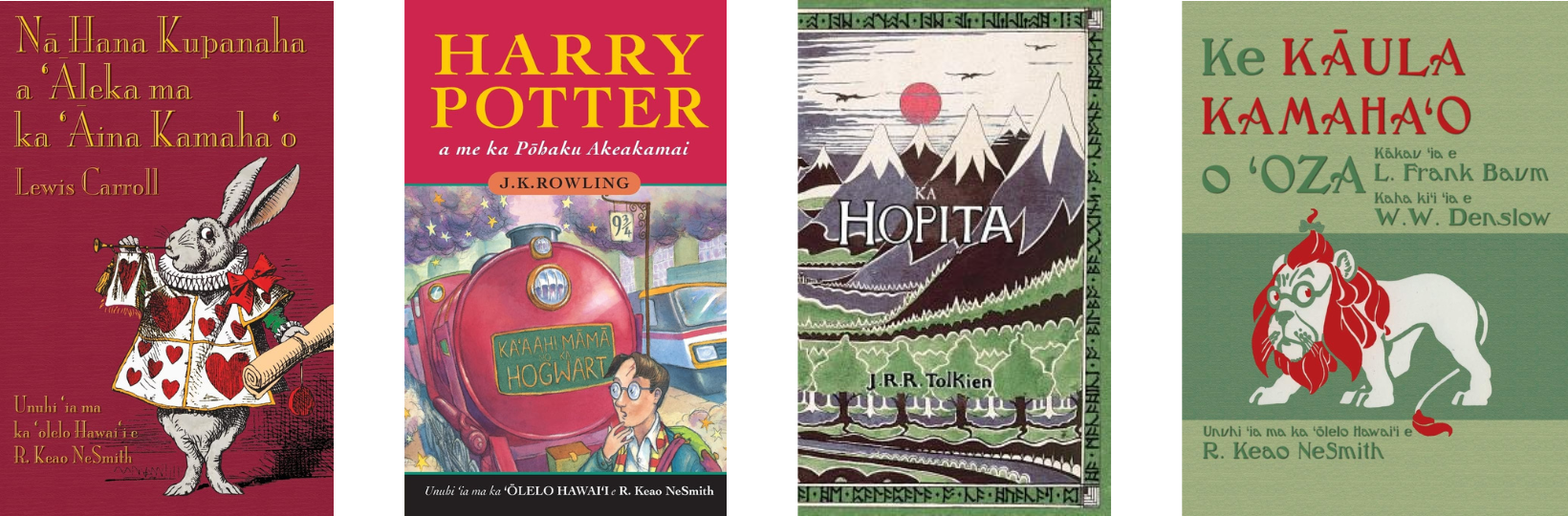
Examples of English-language classics translated into Hawaiian.
mana \'mä-nə\ n 1 : the power of the elemental forces of nature embodied in an object or person 2 : moral authority : PRESTIGE ーMerriam-Webster
One of our most important and oft-quoted proverbs is, "I ka 'ōlelo nō ke loa, i ka 'ōlelo nō ka make," usually translated as, "In language there is life, and in language there is death." The entirety of our lives and deaths, and how we see the world, is contained in our 'ōlelo. When we look carefully at how language entwines with culture, we see that the loss of language leads to cultural death, but also that within the language is the capacity for cultural life. ーBryan Kamaoli Kuwada
Aole na ka malihini e ao ia'u i ka moolelo o k'ou lahui, na'u e ao aku i ka moolelo i ka malihini. ーSamuel Kamakau
The last quote here Kuwada himself translates as, "It is not the foreigner/outsider/neophyte who shall teach me the history of my people/nation, I am the one who shall teach it to them." With his own experience as a translator and the legacy of Native Hawaiians like Kamakau in mind, Kuwada presents mana as the central concept of his highly perceptive book about translation, or the politically fraught task of translating between Hawaiian and English, or even between the language of any local population and that of an occupying nation. That is to say, the survival of Hawaiian in the 21st century depends on the mana of the people using it, but also of the language itself in its stages of adaptation to a changing world.
In this book, The Mana of Translation, Kuwada presents five such stages in which Hawaiians and the Hawaiian language confront US imperialismーnamely, the introduction of Christianity and the Bible by Western missionaries; the imposition of English-based laws on Hawaiians and their land; the success of Hawaiian-based newspapers (or, nūpepa) in vitalizing the language and introducing its community of speakers to the wider world; the struggle to keep the language alive in the 20th century as US interests promote Hawaiians and their culture as mere tourist attractions; and current efforts by Hawaiians to protect the sanctity of their land and language in the legal arena. A lot of what Kuwada presents here is grounded in larger discussions of postcolonial studies, making this book of interest not only to other translators, but to historians, teachers, and political activists.
I came away from this book not only knowing more about the Hawaiian language and culture, as I had hoped, but also feeling convicted as someone living in the Anglo-American tradition. I've visited Hawaii twice now, and each time I have been nothing more than a tourist. Despite my efforts to be more inclusive, I reckon I still have more culturally in common with the first missionaries to Hawaii than to someone like Kuwada, Kamakau, or Pukui. Hawaii continues to be a fascinating place to me, and not only because of the vibrant culture and history Kuwada presents. Another way to put this is that, books written in English have been the primary means for me to learn about Hawaii, though it's kind of reassuring to see translations of modern books like The Hobbit and Harry Potter and the Sorcerer's Stone in Hawaiian!
56LolaWalser
>50 icepatton:
I don't see from this example how capitalism is distinct from industrial civilization. How do we get the coal to power the trains? Where do we get the steel to build the railways? Have these technologies really been replaced, or has one form of despoliation of the earth simply been added to another with the advent of gas-driven vehicles?
Note that mining (getting coal, steel etc.), industry, construction, development of technology and so on have nothing as such to do with capitalism--all of these activities began long ago in human history AND they take place in capitalist and non-capitalist countries alike. Capitalism certainly affected industry (the scale, type, intensity of resource exploitation etc.) but so did other systems where they existed. What makes a difference is that capitalism stokes infinite consumerism.
My point with the urban railways vs. private car example was to highlight that this was a change made by choice--for the sake of private profit--and not because there was some physical inevitability about it. So, we can make choices about industrial manufacture and uses of technology. As for pollution, it's true the problem of pollution existed from the beginning, but in the example given it skyrocketed with the introduction of the gas-combustible engine. When zero pollution is impossible, less pollution is better than more.
The greenhouse effect was discovered already in the 19th century, by which time there were already many people concerned about ecology (as we would put it today) and nature preservation. Proposals for limiting destruction and developing sustainable industry have been made time and again, and time and again meaningful reform was made impossible by capitalists. (Industry in Communist countries also had a problem with ecological devastation, but there were also some mitigating factors, such as the anti-consumerist trend and relative lack of over-development.)
While we may yet bomb ourselves back into the Bronze Age or out of existence altogether, it is highly unlikely that we can (would ever agree to) just give up all our tech. We need electricity, medicine, contraceptives, and much more food than would be available without industrial agriculture. What is feasible, at least in theory, are modifications to the scale, type, nature of our industry.
But as we see with the failure of one climate agreement after another, our rich overlords are still not ready to give up their money-making mechanisms.
It may seem uncertain because it involves thinking outside the box.
I'm open to hearing about alternatives to industrial civilization, but our pre-industrial history is informative as well. At least in the sense (in my opinion) that we don't want to "go back"--we must find a way forward.
Well, what about respect for women? Are you suggesting that women have always been treated so poorly, no matter what culture or time in history?
Women are half the humanity, women ARE humanity in the same sense that men are humanity--I hope this much can be assumed in agreement. The way they are treated is therefore as important to consider as the way men are treated. As far as I know there has indeed never been a time and place in history in which women were treated with the same regard as men, enjoying the same rights and so on. This is demonstrably true for the regions dominated by Jews, Christians, Muslims etc. (coincidentally, I've been posting on this topic elsewhere so don't want to belabour the topic here as well.)
Medieval Iberia, no less than any number of other places, seems to have placed rigorous patriarchal, misogynistic, restrictions on women, treating them as always subservient to some man or other, segregating them and placing them in a sort of domestic prison. Women, it seems, had no place and function in public, no voice, no space in politics and culture. I'm not expert on the literature of this period so I may be missing something; suffice it to say that of several anthologies of poetry etc. from that place/period, I haven't come across a single woman writer.
These are just typical indications of limited opportunities. At about the same time in China and Japan some well-born ladies wrote poetry, novels, diaries, but women in general were no less subject to patriarchal oppression.
To answer your question directly, yes, I think there was never a time and place where women were treated well, i.e. as human beings in the same sense and way that men are generally seen as human beings, and I'm surprised that anyone might be surprised by this idea. If you could travel in the past, is there any period and time where you would risk existing as a woman rather than a man? Even if you could magically spare yourself from outright violence, would you put up with the sheer hassle of having no authority, no credibility, no entrance to the myriad networks sustained by boys' clubs?
Beyond the perennial problem of the historical treatment of women, medieval Iberia was a slave society and I could raise similar questions about the value of "tolerance" regarding class and/or caste.
TL;DR--everything depends on whose point of view one adopts.
I don't see from this example how capitalism is distinct from industrial civilization. How do we get the coal to power the trains? Where do we get the steel to build the railways? Have these technologies really been replaced, or has one form of despoliation of the earth simply been added to another with the advent of gas-driven vehicles?
Note that mining (getting coal, steel etc.), industry, construction, development of technology and so on have nothing as such to do with capitalism--all of these activities began long ago in human history AND they take place in capitalist and non-capitalist countries alike. Capitalism certainly affected industry (the scale, type, intensity of resource exploitation etc.) but so did other systems where they existed. What makes a difference is that capitalism stokes infinite consumerism.
My point with the urban railways vs. private car example was to highlight that this was a change made by choice--for the sake of private profit--and not because there was some physical inevitability about it. So, we can make choices about industrial manufacture and uses of technology. As for pollution, it's true the problem of pollution existed from the beginning, but in the example given it skyrocketed with the introduction of the gas-combustible engine. When zero pollution is impossible, less pollution is better than more.
The greenhouse effect was discovered already in the 19th century, by which time there were already many people concerned about ecology (as we would put it today) and nature preservation. Proposals for limiting destruction and developing sustainable industry have been made time and again, and time and again meaningful reform was made impossible by capitalists. (Industry in Communist countries also had a problem with ecological devastation, but there were also some mitigating factors, such as the anti-consumerist trend and relative lack of over-development.)
While we may yet bomb ourselves back into the Bronze Age or out of existence altogether, it is highly unlikely that we can (would ever agree to) just give up all our tech. We need electricity, medicine, contraceptives, and much more food than would be available without industrial agriculture. What is feasible, at least in theory, are modifications to the scale, type, nature of our industry.
But as we see with the failure of one climate agreement after another, our rich overlords are still not ready to give up their money-making mechanisms.
It may seem uncertain because it involves thinking outside the box.
I'm open to hearing about alternatives to industrial civilization, but our pre-industrial history is informative as well. At least in the sense (in my opinion) that we don't want to "go back"--we must find a way forward.
Well, what about respect for women? Are you suggesting that women have always been treated so poorly, no matter what culture or time in history?
Women are half the humanity, women ARE humanity in the same sense that men are humanity--I hope this much can be assumed in agreement. The way they are treated is therefore as important to consider as the way men are treated. As far as I know there has indeed never been a time and place in history in which women were treated with the same regard as men, enjoying the same rights and so on. This is demonstrably true for the regions dominated by Jews, Christians, Muslims etc. (coincidentally, I've been posting on this topic elsewhere so don't want to belabour the topic here as well.)
Medieval Iberia, no less than any number of other places, seems to have placed rigorous patriarchal, misogynistic, restrictions on women, treating them as always subservient to some man or other, segregating them and placing them in a sort of domestic prison. Women, it seems, had no place and function in public, no voice, no space in politics and culture. I'm not expert on the literature of this period so I may be missing something; suffice it to say that of several anthologies of poetry etc. from that place/period, I haven't come across a single woman writer.
These are just typical indications of limited opportunities. At about the same time in China and Japan some well-born ladies wrote poetry, novels, diaries, but women in general were no less subject to patriarchal oppression.
To answer your question directly, yes, I think there was never a time and place where women were treated well, i.e. as human beings in the same sense and way that men are generally seen as human beings, and I'm surprised that anyone might be surprised by this idea. If you could travel in the past, is there any period and time where you would risk existing as a woman rather than a man? Even if you could magically spare yourself from outright violence, would you put up with the sheer hassle of having no authority, no credibility, no entrance to the myriad networks sustained by boys' clubs?
Beyond the perennial problem of the historical treatment of women, medieval Iberia was a slave society and I could raise similar questions about the value of "tolerance" regarding class and/or caste.
TL;DR--everything depends on whose point of view one adopts.
57icepatton
>56 LolaWalser:
Note that mining (getting coal, steel etc.), industry, construction, development of technology and so on...
It seems like you know more about this than I do, so I'll just leave the floor to you.
If you could travel in the past, is there any period and time where you would risk existing as a woman rather than a man?
I'm not sure if this question is bait, or if you mean it rhetorically. I just know there are things I can do here and now to deconstruct any harmful biases I might have.
Even if you could magically spare yourself from outright violence, would you put up with the sheer hassle of having no authority, no credibility, no entrance to the myriad networks sustained by boys' clubs?
The book I'm reading now, We are the Middle of Forever, does feature at least one Indigenous woman, a Cree person, who speaks positively about the role of women in her society. My impression of Native American societies in general is that women were highly respected (whether they were actually treated as equals, though, I cannot say) or, in the very least, not treated like cattle. I don't think it's much of a stretch to assume that they were treated as human beings, moreover, with increasing levels of stature in their communities as they got older and wiser.
Note that mining (getting coal, steel etc.), industry, construction, development of technology and so on...
It seems like you know more about this than I do, so I'll just leave the floor to you.
If you could travel in the past, is there any period and time where you would risk existing as a woman rather than a man?
I'm not sure if this question is bait, or if you mean it rhetorically. I just know there are things I can do here and now to deconstruct any harmful biases I might have.
Even if you could magically spare yourself from outright violence, would you put up with the sheer hassle of having no authority, no credibility, no entrance to the myriad networks sustained by boys' clubs?
The book I'm reading now, We are the Middle of Forever, does feature at least one Indigenous woman, a Cree person, who speaks positively about the role of women in her society. My impression of Native American societies in general is that women were highly respected (whether they were actually treated as equals, though, I cannot say) or, in the very least, not treated like cattle. I don't think it's much of a stretch to assume that they were treated as human beings, moreover, with increasing levels of stature in their communities as they got older and wiser.
58icepatton
And divided tongues as of fire appeared to them and rested on each one of them [when the Holy Spirit arrived on Pentecost.]ーActs 2:3 (ESV)
Abba Lot visited Abba Joseph and summarized his religious life this way: "Abba, I recite the liturgy the best I can, sometimes I fast, I pray and meditate, I try to live peacefully with others, and I attempt to cleanse my thoughts. What more can I do?"
The old man Joseph stood up, stretching his hands toward heaven. His fingers seemed to be ten lamps of fire. He said to Lot, "If you will, you can become all flame." (Emphasis added.)
This is a post I'll be writing at the end of each month, as I choose my favorite daily reading from each month in the devotional, By Way of the Desert, and comment on it here. "If you will, you can become all flame," is this reading in a nutshell.
The imagery of holy flame is what makes it my favorite. The story of Pentecost is referred to here, when Jesus' disciples received the Holy Spirit to begin their ministry after Jesus' ascension to heaven. Like Abba Joseph, they must have seemed like people animated by a mysterious power. Even when they were beat back by unbelievers, like flames, their ministry spread. The imagery is provocative because the disciples did much of their work with their hands and fingers: praying, healing, teaching, and so on. As a Christian, I took inspiration from this reading.
59icepatton
I'm about halfway through this riveting anthology, We are the Middle of Forever: Indigenous Voices from Turtle Island on the Changing Earth, and so far the words of Lyla June Johnston, who is Navajo and Cheyenne, have stuck with me the most. For one thing, she isn't particularly fond of the Anglo-American Christian heritage of the US (that is, my own heritage). I have to admit, her overview of the historical foundations of US imperialism under the sign of the cross is stark and unsettling:
It's oddly reassuring how many critics of Christianity have learned to separate the teachings of Christ from the political ideologies of Christians in the US. I hope I don't need to be the one to say that there is a difference between someone like the president of the US and the person of Jesus Christ. It's just that the moral authority of Christianity in the US is not only found wanting at the outset due to the history Johnston brings up, but White insecurity has advanced so much in the past few election cycles that any moral character that a Christian US may have possessed has gone out the window.
I wouldn't say I ever agreed with imperialism or dominion theology, but then again, I never really challenged it in the way Johnston does here.
"Constantine was the first Roman emperor to begin conquering people in the name of Christ. This was in the years around 300 A.D. So they [the European colonists in America]had actually been appropriating Christ for conquest for over a thousand years before they came here and started doing that to us. That's cultural appropriation at its most perverse level. To take Christ and his teachings and his love and distort it, twist it, destroy it, and the use it to justify the slaughter of other people. That's all a part of the mechanism of White insecurity, to say, 'My religion is so high and so holy and so great, and so wonderful that if you don't have it you aren't even human, and I have a right to destroy you in the name of my religion.' And that happened." (Emphasis added.)
It's oddly reassuring how many critics of Christianity have learned to separate the teachings of Christ from the political ideologies of Christians in the US. I hope I don't need to be the one to say that there is a difference between someone like the president of the US and the person of Jesus Christ. It's just that the moral authority of Christianity in the US is not only found wanting at the outset due to the history Johnston brings up, but White insecurity has advanced so much in the past few election cycles that any moral character that a Christian US may have possessed has gone out the window.
I wouldn't say I ever agreed with imperialism or dominion theology, but then again, I never really challenged it in the way Johnston does here.
60dchaikin
Ties into Hawaii too - Christianity to justify taking everything. It’s a key part of the colonial tradition
61kidzdoc
>59 icepatton: Very well said. I agree completely.
62icepatton
>60 dchaikin: Right!
63icepatton
>61 kidzdoc: Thank you.
64icepatton
In light of my recent post about JPIC International, the book entitled Making Xavier's Dream Real: Vernacular Writings of Christian Missionaries in Modern Japan will be another one I read this year, for sure. I actually bought the e-book a while ago, but I had trouble understanding how to access it on my device, and I put it aside. Now that I know I can access it, it's about time I started reading past the introductionーa bit of a late homework assignment. The context of me wanting to read this is everything from my own experiences as a Christian in Japan to the history of Christianity in places like Nagasaki, which I visited for the first time with my wife in 2023. Although I'm not Catholic, I believe there is a lot to read about in this book to put my own faith in perspective.
65icepatton
As I'm nearing the end of We are the Middle of Forever, I'm realizing that most of the voices in this anthology are from tribal leaders in the western and southwestern USーnot all of Turtle Island, as the subtitle implies. Being from North Carolina, I guess I'm not going to be hearing from a Lumbee or a Cherokee (with the exception, perhaps, of Stan Rushworth, one of the editors)ーthough this is a minor complaint. I'm learning a lot from this book about how Native Americans think, or at least the ones active in California and thereabouts.
66icepatton
Another quote for our own times, from journalist Milton Mayer's collection of interviews, They Thought They Were Free: The Germans, 1933-45, which was published a decade or so after WWII:
"Uncertainty is a very important factor, and, instead of decreasing as time goes on, it grows. Outside, in the streets, in the general community, ‘everyone’ is happy. One hears no protest, and certainly sees none. You know, in France or Italy there would be slogans against the government painted on walls and fences; in Germany, outside the great cities, perhaps, there is not even this. In the university community, in your own community, you speak privately to your colleagues, some of whom certainly feel as you do; but what do they say? They say, ‘It’s not so bad’ or ‘You’re seeing things’ or ‘You’re an alarmist.’
"And you are an alarmist. You are saying that this must lead to this, and you can’t prove it. These are the beginnings, yes; but how do you know for sure when you don’t know the end, and how do you know, or even surmise, the end? On the one hand, your enemies, the law, the regime, the Party, intimidate you. On the other, your colleagues pooh-pooh you as pessimistic or even neurotic. You are left with your close friends, who are, naturally, people who have always thought as you have.
"But your friends are fewer now. Some have drifted off somewhere or submerged themselves in their work. You no longer see as many as you did at meetings or gatherings. Informal groups become smaller; attendance drops off in little organizations, and the organizations themselves wither. Now, in small gatherings of your oldest friends, you feel that you are talking to yourselves, that you are isolated from the reality of things. This weakens your confidence still further and serves as a further deterrent to—to what? It is clearer all the time that, if you are going to do anything, you must make an occasion to do it, and then you are obviously a troublemaker. So you wait, and you wait.
"But the one great shocking occasion, when tens or hundreds or thousands will join with you, never comes. That’s the difficulty. If the last and worst act of the whole regime had come immediately after the first and smallest, thousands, yes, millions would have been sufficiently shocked—if, let us say, the gassing of the Jews in ’43 had come immediately after the ‘German Firm’ stickers on the windows of non-Jewish shops in ’33. But of course this isn’t the way it happens. In between come all the hundreds of little steps, some of them imperceptible, each of them preparing you not to be shocked by the next. Step C is not so much worse than Step B, and, if you did not make a stand at Step B, why should you at Step C? And so on to Step D.
"And one day, too late, your principles, if you were ever sensible of them, all rush in upon you. The burden of self-deception has grown too heavy, and some minor incident, in my case my little boy, hardly more than a baby, saying ‘Jewish swine,’ collapses it all at once, and you see that everything, everything, has changed and changed completely under your nose. The world you live in—your nation, your people—is not the world you were born in at all. The forms are all there, all untouched, all reassuring, the houses, the shops, the jobs, the mealtimes, the visits, the concerts, the cinema, the holidays. But the spirit, which you never noticed because you made the lifelong mistake of identifying it with the forms, is changed. Now you live in a world of hate and fear, and the people who hate and fear do not even know it themselves; when everyone is transformed, no one is transformed. Now you live in a system which rules without responsibility even to God. The system itself could not have intended this in the beginning, but in order to sustain itself it was compelled to go all the way." (Emphasis added.)
67kidzdoc
>66 icepatton: Damn...
68icepatton
You're going to lose a lot of sleep, and you're going to cause yourself a lot of stress if you think that you're going to fix everything. We want to be in that place of fixing it all, but we need to remember to become interdependent with each other again, that we have to live in reciprocity with each other and this Earth again ... And what does that mean? That means doing it at home. That means learning how to take care of plants so that they can take care of you. It means having a relationship with even the smallest little beings ... It means planting food enough to share with your neighbor, and learning those relationships with neighbors again ... It means creating community gardens and sharing food with people. (Emphasis added.)
ーCorrina Gould, activist and co-founder of Indian People Organizing for Change (IPOC)
Now that I've read We Are the Middle of Forever: Indigenous Voices from Turtle Island on the Changing Earth, I'm all for making phrases like "make relationships with neighbors again" a political slogan. And Gould states here what I take to be the central wisdom of this book: that we care for the Earth by first caring for each other, which is by no means limited to humans. In fact, I'm confident that everyone interviewed in this massive volume would agree that such care is just as much for our non-human relatives as it is for humans, if not more so.
With that being said, I'm easily the last person someone would contact for wisdom about living well with the Earth; I'm just as embedded as the next guy in what Melina Laboucan-Massimo, one of those interviewed, calls "the Western capitalist industrial complex"ーthough I like to think I'm at least able to ask the right questions and pursue investigations. Books like A Language Older than Words and Life Is a Miracle: An Essay Against Modern Superstition have led me to books like this one. As I'm Christian, I also believe there is more to learn about caring for the Earth in my own tradition, so I'm going to read The Sermon of All Creation: Christians on Nature sometime soon.
But more about this book: it's a collection of interviews done by journalist Dahr Jamail and college professor Stan Rushworth soon before and during the pandemic, with a great variety of perspectives from indigenous people, mostly from the American West, being brought to bear on the greater problem of human destruction of the earth. Jamail and Rushworth, the editors, seem to consciously put all these voices together in one long conversation, with no intention to place anybody in restrictive categories. The overall effect makes for somewhat of a daunting read, though I could never say I stepped away from it without gaining insight.
For one thing, I'm drawn to the proverbial statement by the late John Trudell as quoted by the anonymous medicine man in the final interview: "We cannot destroy the earth. We can only destroy our ability to live on it." That is, we ought to know that the earth is entirely capable of moving on, with or without us. Another way to put it is that, to paraphrase Derrick Jensen, life wants to live. Indeed, the question of whether the future may include human life or not is what each person in this book gives due consideration, based on their respective traditions as Mojave, Cree, Ohlone, and many others, whose creation myths often tell of the rise and fall of civilizations.
This leads to another point: the imminent destruction of this world, as sad and gloomy as that seems, should come as no surprise to anyone rooted in these traditions. As Melissa K. Nelson, an Anishinaabe/Métis from Canada, explains in her interview:
Our people have gotten through it before. Not only the climate change example that we talked about[with the forced relocation of various tribes to unfamiliar climes], but with epidemics. Maybe not the pandemic scale we're at right now [with COVID-19]but our people went through epidemics of extreme proportions. Dying left and right. Whole families, whole tribes, full clans, smallpox, and all of that.
Of course, she isn't saying that COVID-19 or climate change is anything to make light of, but in this connection she brings up a concept I had never heard of called survivance, which was first propounded by Gerald Vizenor, a Chippewa writer and scholar. As Jamail explains, "the concept highlights a Native sense of presence, which supersedes a colonial history of Native erasure and oblivion." Nelson adds that keeping a sense of humor alive in the midst of crises is part of this concept.
Another noteworthy concept from Vizenor is "trickster consciousness," which is "another way to get out of the habit of thought about projection and assumptions and to bust out of those patterns of thought that are often self-destructive and harmful to others," and this is because, as Nelson explains further:
... trickster is always waiting in the wings: Raven or Coyote, reminding us things may not be as they seem, and that we need to maintain humility and a really deep openness to what's happening so that those learning spirits can keep guiding us from our gut and from our heart, and from our other sources of knowing, not just from the mind knowing.
I won't get into detail here about "our other sources of knowing," but by "learning spirit," Nelson basically means one's ability "to look freshly" at other creatures in the world around us and "really take them in."
Now, there is a lot more I could discuss, but suffice to say this book is a must-read for our times, and I'm glad it was published.
69icepatton
It's hard to find a good follow-up to the cry from the heart that was We are the Middle of Forever, but now I'm changing gears by reading Making Xavier's Dream Real on a four-day weekend. I've read books about Christianity in Japan before, and if I had to choose a book to recommend, it would be The Christian Century in Japan, 1549-1650 by C. R. Boxer. But with this book by Nanyan Guo, I'm getting more of an idea of the contemporary scene.
70labfs39
>66 icepatton: I had to check when Milton Mayer wrote They Thought They were Free because I thought maybe the author was writing about the Germans with the current American situation in mind, but no. It was written in 1955. Never has "history repeats itself" felt so immediate.
71icepatton
>70 labfs39: Absolutely!
72icepatton
I don't know much about Nanyan Guo or her work, but what I'm getting from Making Xavier's Dream Real is a kind of hagiography of several Catholic missionaries who were active in Japan in the 20th century. Besides St. Francis Xavier, who first planted the seeds of Christianity in Japan, I've read about the lives of Aimé Villion and Sauveur Candou, both of whom were from France. Apparently, everyone knew about Xavier and his dream of evangelizing Japan.
73icepatton
As someone on the spectrum, I'm just wondering if I should read any of John Elder Robinson's books. I learned that he is the older brother of Augusten Burroughs, who wrote the memoir Running with Scissors, and that he published his own memoir Look Me in the Eye at the ripe age of 49! It's already encouraging to know that someone like Robinson can be a successful author at such an age. He seems to have a compelling testimony.
74icepatton

Snow country, Japan.
To celebrate our second anniversary, my wife and I visited the northern part of a neighboring prefecture, which is known for its snowy winters and hot spring towns. I started reading Making Xavier's Dream Real in earnest then, but I also came across several English-language children's books at a local childcare support centerーsomething I wasn't expecting. The support center was located in one of those concrete eyesores called shopping malls that tend to pop up by train stations in the Japanese countryside, not far from even uglier pachinko parlors.
Still, there was little to nothing else for people without a car to see within walking distance of the hotel we were staying at. I read three children's books with my wife and added them to my list. The first was No, David! by David Shannon, the second was Lemons are Not Red by Laura Vaccaro Seeger, and the third was Presents through the Window by Taro Gomiーeasily my favorite of the three. Everything from the illustrations to the story itself was so endearing. I believe authors like Gomi have something to say to the child inside all of us, so I would like to read his other books.
75labfs39
>74 icepatton: Snowy winters and hot spring towns reminds me of Kawabata's Snow Country. Have you read it?
I have several of Laura Vaccaro Seeger's books, Lemons are Not Red, Black? White! Day? Night!, and First the Egg. They are wonderful for teaching very young children about colors, opposites, and sequence. I think they are also visually interesting, even for adults.
I have several of Laura Vaccaro Seeger's books, Lemons are Not Red, Black? White! Day? Night!, and First the Egg. They are wonderful for teaching very young children about colors, opposites, and sequence. I think they are also visually interesting, even for adults.
76icepatton
>75 labfs39: Have you read it?
Yes, I have. It's been such a long time since I read it, but I can clearly see how Kawabata was inspired to write that novel. And the Japanese title, Yukiguni, is actually a term used for those parts of Japan that typically get heavy snow, kind of like the English word, "snowbelt."
They are wonderful...
I can see what you mean!
Yes, I have. It's been such a long time since I read it, but I can clearly see how Kawabata was inspired to write that novel. And the Japanese title, Yukiguni, is actually a term used for those parts of Japan that typically get heavy snow, kind of like the English word, "snowbelt."
They are wonderful...
I can see what you mean!
77icepatton

The luminous interior of the Church of Light, designed by world-renowned architect Tadao Ando in Japan. A photo of it is used as the cover art for this book by literature professor Nanyan Guo.
According to recent statistics, in 2016 about 1,914,196 people, 1.5 percent of the Japanese population (126,706,000 in 2017) are registered as Christians. Many Japanese people today practice three religious faiths during their life cycle─Shinto for birth, Christianity for marriage, and Buddhism for funerals─without committing to a single one . . . . [They may] treasure religious faith, even though most of them disavow belonging to any religious organization.
Here is the complicated background that Nanyan Guo gives in Making Xavier's Dream Real, a hagiographical study of four modern Catholic missionaries in Japan: Aimé Villion (1843 - 1932), Sauveur Candou (1897 - 1955), Hermann Heuvers (1890 - 1977), and Georges Neyrand (1920 - 2011). With the exception of Heuvers, who was German, all came from France. By dint of their Catholic faith and strivings in Japan, all four missionaries are seen by Nanyan to have carried on the legacy of St. Francis Xavier, who first propagated Christianity in Japan in the 16th century.
The background is complicated due to the historical ambivalence of Japan toward outsiders and toward destabilizing imports like religion, particularly Christianity, which posed a threat to the feudal order of Japanese society in Xavier's time. Nonetheless, as Nanyan points out, Xavier believed that Japan was "well fitted and prepared to receive the Gospel." He goes on to say, "If we all knew the language, I do not doubt but that a great many Japanese would become Christians." He believed this is due to the "natural goodness" of the Japanese, who are "of a kindly disposition, not at all given to cheating, wonderfully desirous of honour and rank," and who have "an extreme eagerness to learn," among other qualities.
With this assessment in mind, Nanyan claims that, although the ultimate goal of these four missionaries was "to convey Christian messages and convert the people," as Xavier had done, "they often opted not to try to impose Christianity, as the men and women they got to know seemed to be 'Christian enough' already." To be sure, Villion and the others did their part to engender "a strong trust in and respect for Christian culture in Japan" as priests and teachers in a conventional sense, though Nanyan makes it a point that they took on many other roles in ongoing Christian efforts "to improve medical care, social welfare, and educational systems" in Japan, and that they did so out of genuine love for Japan and Japanese people.
I appreciate this summary by Nanyan, that
Villion awakened Japan to its bloody history of Kirishitan persecution[in the 16th and 17th centuries], Candau opened the eyes of the people with his superb Japanese and philosophical instruction, Heuvers enchanted Japanese readers with his poetic expression, and Neyrand successfully transformed a bar[in Tokyo]into a place for evangelization.
Indeed, each missionary seems to have been larger than life. Although I'm Christian, I had never heard of any of them before reading this book. Then again, I'm not Catholic, and I don't believe being Protestant precludes me from experiencing the same love and joy that people like Xavier seemed to have felt for Japan. Having read this book, I want to learn more about the legacy of other Christian denominations in Japan, though Catholicism is certainly the most prevalent. Overall, this was a decent read.
78icepatton
A temporal alignment of the individual with the functioning of markets, two centuries in developing, has made irrelevant distinctions between work and non-work time, between public and private, between everyday life and organized institutional milieus. Under these conditions, the relentless financialization of previously autonomous spheres of social activity continues unchecked. Sleep is the only remaining barrier, the only enduring “natural condition” that capitalism cannot eliminate.
In this book, 24/7: Late Capitalism and the Ends of Sleep, I got a closer look at the wicked engine that is behind everything, from the mass commodification of humans and other creatures, to the emergence of fascism in the US, to the destruction of life on the planetーin short, what Crary calls 24/7, a sleepless, ageless, omnipresent construct that demands the unconditional surrender of life itself in order to be realized. As he implies here, everything from wild nature to the choices people have in liberal societies can theoretically be co-opted by 24/7 for economic and military gain, regardless of the permanent damage it causes to life on this planet.
I admit, it was hard to read this book due to its density (I put it aside a few times over the past year), but Crary knows what he's talking about, and this book is a well-composed essay of the kind you would see in academic spaces, though with writing that is a lot more cogent than what you would get from most scholars, I believe. An art critic, Crary has certainly done his homework, referring to many of the great thinkers of ideas current in postmodern studies, from Sigmund Freud to Hannah Arendt to Guy Debord to Michel Foucault.
I found myself agreeing with what he said, with the exception of Debord's embarrassing use of the word "autism" when referring to The Society of the Spectacle:
[Debord] is hardly alone in emphasizing the link between the words “community” and “communication,” where communication is not the transmission of messages but in some way an ethos of sharing. Spectacle, he writes, is the expropriation of that possibility; it is the production of a one-way communication that he characterizes as “a generalized autism.” Debord saw that by the 1960s capitalism had produced a systematic breakdown in the faculty of encounter (rencontre), and “the replacement of that faculty by a social hallucination, an illusion of encounter.”
As someone on the spectrum, I can't help but dwell on this point despite the insightful work Crary is doing otherwise. The word even comes up in a different discussion of a seemingly credible study that poses the outrageous question, "Does Television Cause Autism?" What Crary means by this is:
Regardless of what future research may prove or disprove concerning a link between television and autism, the Cornell study foregrounded crucial experiential features of the apparatus. For one, it indicated the obvious: that in growing numbers, television and screens of many kinds are becoming part of the waking environment of younger and younger children. More importantly, it bypassed the notion that television is something one watches in some attentive manner, and instead provisionally treated it as a source of light and sound to which one is exposed. Given the fragility and vulnerability of very young children who were the object of the study, it means reconsidering exposure in terms of lasting physical damage to the nervous system.
Obviously, autism is not the focus of this book, but Crary has unfortunately made it so for me, due to subterfuge like this. I just can't sit here and read about who I am by someone who doesn't seem to be autistic or knows anyone who is, and come into agreement that I'm autistic because of damage to my nervous system by television. This is when I would worry for so many children and families if someone like Crary was not an essayist but a child psychologist.
As unseemly as that was, I rather liked Crary's defense of sleep as an everlasting bulwark against the death march of 24/7 capitalism. I appreciate the positive note he ends the book with:
One of the many reasons human cultures have long associated sleep with death is that they each demonstrate the continuity of the world in our absence ... It is an interval into which glimpses of an unlived life, of a postponed life, can edge faintly into awareness ... Located somewhere on the border between the social and the natural, sleep ensures the presence in the world of the phasic and cyclical patterns essential to life and incompatible with capitalism ... Because capitalism cannot limit itself, the notion of preservation or conservation is a systemic impossibility. Against this background, the restorative inertness of sleep counters the deathliness of all the accumulation, financialization, and waste that have devastated anything once held in common.
It is with this in mind that Crary concludes:
It is possible that—in many different places, in many disparate states, including reverie or daydream—the imaginings of a future without capitalism begin as dreams of sleep. These would be intimations of sleep as a radical interruption, as a refusal of the unsparing weight of our global present, of sleep which, at the most mundane level of everyday experience, can always rehearse the outlines of what more consequential renewals and beginnings might be.
Overall, this was a highly perceptive and rigorous essay; I just found the implication that autistic people are nothing more than pawns in the machinery of 24/7 to be rather disgusting and offensive.
79labfs39
>78 icepatton: Fantastic review
80icepatton
Lately I've been in search mode again for new books to read. I came across several titles about Zen Buddhism after checking out book reviews on tricycle.org and doing my own searches on Google Scholar. I'm reminded that a book I read a few years ago, Reports from the Zen Wars, was really good, and trying to find others like it has been difficult. I'm not interested in just any old book about Zen or Buddhism, which has the author photographed on the cover smiling and looking high. No-nonsense accounts like Antinoff's have shown me that Zen practice in particular can be very hard workーand often painful.
With that being said, I might read The Circle of the Way: A Concise History of Zen from the Buddha to the Modern World when I get the chance. I've read a few other books about Buddhist history, namely The Story of Buddhism by Donald S. Lopez, Jr. and Japanese Buddhism: A Cultural History by Yoshiro Tamura, though this history by Barbara O'Brien seems to be about Zen specifically.
Also, the somewhat stressful environment at the school I work at has conduced me to start reading the essay anthology, The Edge of the Precipice: Why Read Literature in the Digital Age?, in order to be reminded that I'm not crazy for being interested in art and other things that tend to be labeled "irrelevant" or "useless." I also checked out Peter Orner's essay collection, Am I Alone Here? Notes on Reading to Live and Living to Read, thinking I could find some solace in the words of someone who cares about literacy. While I love the quote by Bohumil Hrabal at the beginning, I'm not so interested in literary criticism, which is what this whole book seems to be about.
With that being said, I might read The Circle of the Way: A Concise History of Zen from the Buddha to the Modern World when I get the chance. I've read a few other books about Buddhist history, namely The Story of Buddhism by Donald S. Lopez, Jr. and Japanese Buddhism: A Cultural History by Yoshiro Tamura, though this history by Barbara O'Brien seems to be about Zen specifically.
Also, the somewhat stressful environment at the school I work at has conduced me to start reading the essay anthology, The Edge of the Precipice: Why Read Literature in the Digital Age?, in order to be reminded that I'm not crazy for being interested in art and other things that tend to be labeled "irrelevant" or "useless." I also checked out Peter Orner's essay collection, Am I Alone Here? Notes on Reading to Live and Living to Read, thinking I could find some solace in the words of someone who cares about literacy. While I love the quote by Bohumil Hrabal at the beginning, I'm not so interested in literary criticism, which is what this whole book seems to be about.
81icepatton
>79 labfs39: Thank you!
82rocketjk
I just came upon and read through your fascinating, perceptive and thought-provoking thread. Thank you for all the great reading and reporting.
Going all the way back to >41 icepatton:
"And it's hard to make it right now because people are still looking for the two-hour Hallmark movie version to make it right, that we might have some hardships, but in the end the sun will break through and we'll all hold hands and we'll be fine. And, there's a great possibility that this won't happen."
I heard a scientist being interviewed on a couple of years back who was saying that we have a tendency to think of global warming in terms Normandy, that a great alliance will finally be put together that will attack and defeat climate change once and for all. But, this person said, the metaphor we should really be using for global warming is not D-Day, but Dunkirk.
>66 icepatton:
"The forms are all there, all untouched, all reassuring, the houses, the shops, the jobs, the mealtimes, the visits, the concerts, the cinema, the holidays. But the spirit, which you never noticed because you made the lifelong mistake of identifying it with the forms, is changed. Now you live in a world of hate and fear, and the people who hate and fear do not even know it themselves; when everyone is transformed, no one is transformed. Now you live in a system which rules without responsibility even to God. The system itself could not have intended this in the beginning, but in order to sustain itself it was compelled to go all the way."
Heartbreaking and true.
Going all the way back to >41 icepatton:
"And it's hard to make it right now because people are still looking for the two-hour Hallmark movie version to make it right, that we might have some hardships, but in the end the sun will break through and we'll all hold hands and we'll be fine. And, there's a great possibility that this won't happen."
I heard a scientist being interviewed on a couple of years back who was saying that we have a tendency to think of global warming in terms Normandy, that a great alliance will finally be put together that will attack and defeat climate change once and for all. But, this person said, the metaphor we should really be using for global warming is not D-Day, but Dunkirk.
>66 icepatton:
"The forms are all there, all untouched, all reassuring, the houses, the shops, the jobs, the mealtimes, the visits, the concerts, the cinema, the holidays. But the spirit, which you never noticed because you made the lifelong mistake of identifying it with the forms, is changed. Now you live in a world of hate and fear, and the people who hate and fear do not even know it themselves; when everyone is transformed, no one is transformed. Now you live in a system which rules without responsibility even to God. The system itself could not have intended this in the beginning, but in order to sustain itself it was compelled to go all the way."
Heartbreaking and true.
83labfs39
>80 icepatton: I really like Bohumil Hrabal. Too Loud a Solitude is a favorite book of mine. Would you mind sharing the quote you liked?
84icepatton
>82 rocketjk: Thank you...
My pleasure!
But, this person said, the metaphor we should really be using for global warming is not D-Day, but Dunkirk.
That's an apt metaphor. Thank you for sharing.
My pleasure!
But, this person said, the metaphor we should really be using for global warming is not D-Day, but Dunkirk.
That's an apt metaphor. Thank you for sharing.
85icepatton
>83 labfs39: Sure. It actually comes from that book you mention:
My education has been so unwitting I can't quite tell which of my thoughts come from me and which from my books, but that's how I've stayed attuned to myself and the world around me for the past thirty-five years. Because when I read, I don't really read; I pop a beautiful sentence in my mouth and suck it like a fruit drop, or I sip it like a liqueur until the thought dissolves in me like alcohol, infusing brain and heart and coursing on through the veins to the root of each blood vessel.
86labfs39
>85 icepatton: Thanks!
87icepatton
I went ahead and bought a digital copy of Look Me in the Eye: My Life with Asperger's and started reading. I mean, it's pretty good so far. I was already sure it would be worth reading based on Robison's living testimony. I referred to Higashida at the start of this thread, but Robison comes across as the jovial uncle in the family with funny stories. (Now that I think of it, sometime I need to finish reading All the Weight of Our Dreams: On Living Racialized Autism, an anthology that is more serious in tone.)
88icepatton
The other day, my wife and I watched an episode of Chef's Table on Netflix, which presents the story of Kwame Onwuachi, the owner of a restaurant in Manhattan called Tatiana, where people are served what the website describes as "Afro-Caribbean-by-way-of-the-Bronx"ーreferring to such dishes as oxtail and crab rangoon, shawarma roasted chicken, and honeynut piri piri salad. After watching (and salivating), I found out on Wikipedia that Onwuachi wrote a memoir, Notes from a Young Black Chef. While hearing him tell his story was a profound experience, I'm more interested in going to New York to try some of the food he talks aboutーor, better yet, Tatiana itselfーthan reading his book. New York continues to have a strong pull on my imagination, and I felt that his restaurant was a good illustration of the various cultures one would encounter in the city.
89kidzdoc
>88 icepatton: That sounds very interesting. I'll look for that episode of Chef's Table and watch it this week.
90ELiz_M
>88 icepatton: Tatiana is delicious!
91rocketjk
>88 icepatton: We will have to try Tatiana. I feel like I also saw a NY Times article on the same subjects recently.
>90 ELiz_M: Of course I could easily look this up, but where is it?
>90 ELiz_M: Of course I could easily look this up, but where is it?
92ELiz_M
>91 rocketjk: Lincoln Center, in the same building as NY Philharmonic. Reservations are difficult to get, but a friend and I have had luck by showing up at 5 pm and waiting to see if they have any walk-ins available. Presumably, an after-8pm reservation would also be easier to get.
93kjuliff
>92 ELiz_M: And the restaurant there is great to visit and cocktail while waiting- if rather pricey.
94icepatton
So far, I've read the first part of the anthology, The Edge of the Precipice, and there is an essay by writer and editor Drew Nelles that challenges the very notion of social cataloging sites like LibraryThing and Goodreads. In "Solitary Reading in the Age of Compulsive Sharing," he writes that:
He writes this in response to Adam Sternbergh, a journalist who once opined that "this fascination with book clubs–forming them, joining them, chronicling them–is both antithetical to the enjoyment of reading, and perfectly in keeping with our modern conviction that nothing is worth doing that isn’t immediately shared." It's actually arguments like these that have drawn me away from Goodreads and most social media. Yet here I am quoting someone who would probably not see much of a difference between LibraryThing and Goodreadsーspaces that seem to help us connect with each other through books but tend to distract us from actually reading them.
So what am I doing then? I believe, as Nelles does, that reading is basically a solitary activity, meaning that reading should be done whether or not one uses social media. Then again, his argument is not that "reading was somehow better before the disruptive advent of the Internet." He goes on to say:
So here I am sharing a point of view that may upset some people, but it's certainly true that LibraryThing allows us to connect with people we may not have otherwise. In my case, it's been hard for me to find books to read, and people who read them, as someone living overseas. So while I found Goodreads useful for a while, I found LibraryThing to be a better resource for people who actually want to read and share ideas. It could be a challenge for me to keep my eyes on the page, but I guess it all depends on one's motives.
Talking about books with your friends doesn’t do much to improve your reading experience, in part because ... you rarely wind up talking about the books in question. Instead, book clubs are just another opportunity to hang out. That’s hardly blameworthy, but let’s stop kidding ourselves. If you’d like to spend more time with your friends, then spend more time with your friends. When it comes to books, you’re better off alone.
He writes this in response to Adam Sternbergh, a journalist who once opined that "this fascination with book clubs–forming them, joining them, chronicling them–is both antithetical to the enjoyment of reading, and perfectly in keeping with our modern conviction that nothing is worth doing that isn’t immediately shared." It's actually arguments like these that have drawn me away from Goodreads and most social media. Yet here I am quoting someone who would probably not see much of a difference between LibraryThing and Goodreadsーspaces that seem to help us connect with each other through books but tend to distract us from actually reading them.
So what am I doing then? I believe, as Nelles does, that reading is basically a solitary activity, meaning that reading should be done whether or not one uses social media. Then again, his argument is not that "reading was somehow better before the disruptive advent of the Internet." He goes on to say:
The democratizing power of the Web has enriched us in ways we’re only beginning to understand, and writers and readers are better off now than we have ever been. We learn about news earlier and faster, we have more options about what to read and where to publish, and a global army of online fact-checkers now pressures writers to be more accurate. In short, we have more choice, more accountability, and more opportunities.
So here I am sharing a point of view that may upset some people, but it's certainly true that LibraryThing allows us to connect with people we may not have otherwise. In my case, it's been hard for me to find books to read, and people who read them, as someone living overseas. So while I found Goodreads useful for a while, I found LibraryThing to be a better resource for people who actually want to read and share ideas. It could be a challenge for me to keep my eyes on the page, but I guess it all depends on one's motives.
95icepatton
>93 kjuliff: >91 rocketjk: >90 ELiz_M: >89 kidzdoc:
By the way, I don't mean the post above as a response to your comments. Thank you all for stopping by!
By the way, I don't mean the post above as a response to your comments. Thank you all for stopping by!
96rocketjk
>94 icepatton: That's a really interesting perspective. If I comment on it instead of going off somewhere to read, I'm just making Nelles' point for him, though, right?
"If you’d like to spend more time with your friends, then spend more time with your friends. When it comes to books, you’re better off alone."
And what may we do, my friends and I, during this precious time together? What's on the approved list? In my view, when it comes to books, I'm better off doing whatever I want. :)
Hey, listen, Nelles' point of view does not really upset me, and mostly I'm just enjoying poking fun at it. For a long time I demurred when invited to join book clubs, joking that I would only join a club if I got to choose the book every month. Then, during Covid, some friends of mine decided that a zoom bookclub would be a good thing and invited me to join. I joined in order to say yes to these friends who had, I thought, basically honored me with their invitation (they had all known each other for much longer than they had known me, a relative newcomer among them). Being in the group was a bit of a mixed blessing, reading-wise and even discussion-wise, even after the pandemic eased and we switched to in-person monthly meetings. But, socially, I enjoyed the engagement and I never considered dropping out as long as my wife and I lived in that community. I guess all this just serves to more or less reinforce Nelles' hypothesis.
Now we live in an NYC apartment building. Just last week, my wife and I took part in this month's meeting of a 7-year-old book group here in our building. The discussion was, indeed, an interesting and pretty darn focused talk about the month's book, The Seven Moons of Maali Almeida by Shehan Karunatilaka. So the meeting itself was a pleasurable book lover's experience, even though we were among relative strangers.
So, in the final analysis, where I come down on Nelles' analysis is, "It depends."
"If you’d like to spend more time with your friends, then spend more time with your friends. When it comes to books, you’re better off alone."
And what may we do, my friends and I, during this precious time together? What's on the approved list? In my view, when it comes to books, I'm better off doing whatever I want. :)
Hey, listen, Nelles' point of view does not really upset me, and mostly I'm just enjoying poking fun at it. For a long time I demurred when invited to join book clubs, joking that I would only join a club if I got to choose the book every month. Then, during Covid, some friends of mine decided that a zoom bookclub would be a good thing and invited me to join. I joined in order to say yes to these friends who had, I thought, basically honored me with their invitation (they had all known each other for much longer than they had known me, a relative newcomer among them). Being in the group was a bit of a mixed blessing, reading-wise and even discussion-wise, even after the pandemic eased and we switched to in-person monthly meetings. But, socially, I enjoyed the engagement and I never considered dropping out as long as my wife and I lived in that community. I guess all this just serves to more or less reinforce Nelles' hypothesis.
Now we live in an NYC apartment building. Just last week, my wife and I took part in this month's meeting of a 7-year-old book group here in our building. The discussion was, indeed, an interesting and pretty darn focused talk about the month's book, The Seven Moons of Maali Almeida by Shehan Karunatilaka. So the meeting itself was a pleasurable book lover's experience, even though we were among relative strangers.
So, in the final analysis, where I come down on Nelles' analysis is, "It depends."
97icepatton
>96 rocketjk: Thank you for describing your experience with book clubs. I agree that they are a mixed blessing when it comes to reading. It's great if you can make friends, though.
...joking that I would only join a club if I got to choose the book every month.
I'm sure you can do this, but you'll have to win at rock-scissors-paper with another club member!
Now we live in an NYC apartment building...
Indeed, New York just seems like a great place for books in general. I'm kind of jealous.
...joking that I would only join a club if I got to choose the book every month.
I'm sure you can do this, but you'll have to win at rock-scissors-paper with another club member!
Now we live in an NYC apartment building...
Indeed, New York just seems like a great place for books in general. I'm kind of jealous.
98RidgewayGirl
>94 icepatton: I've been in book clubs of various kinds for years and sometimes they're an excuse to get together and sometimes they are focused on the books. I've enjoyed both varieties, and have a hard time considering it a waste of time to spend time with others who like reading. It's fine if book clubs aren't your thing but a little odd that Nelles is so bothered that others enjoy them.
In a book club I'm in now, the reading list is used by several people who never attend, but who read all the books, using it as a way to find out what to read.
In a book club I'm in now, the reading list is used by several people who never attend, but who read all the books, using it as a way to find out what to read.
99icepatton
>98 RidgewayGirl: Thank you for sharing. I've never really been to a book club in person, but I do believe it has its merits. People like Nelles may have had a bad experience and, as an introvert, I can see why. But people like yourself seem to be why someone would want to come back to a meeting!
100icepatton
Should a multitude of words go unanswered, and a man full of talk be judged right? ーJob 11:2 (ESV)
A brother, in conversation with Abba Theodore, talked about religious matters beyond his personal experience. Theodore commented, "You are looking for a ship, but you have not found one. You have not put your luggage on board, and you have not put out to sea. But as you talk with me, you seem already to be at the city you intend to reach. If you make some effort to do the things you talk about, then you can discuss them with comprehension."
For this month, I've chosen this reading in the devotional, By Way of the Desert, for reflection and comment. The main point is, "Make some effort to do the things you talk about." I'm reminded of the words of Jesus in Matthew 7:20, "Thus you will recognize them by their fruits." I guess another way to express this sentiment by Jesus and Abba Theodore is, "Don't put the cart before the horse." Once again, I found this reading memorable due to the metaphor Theodore gives of a voyage one presumes to have made to another city, though it soon becomes clear that one never actually went through the process. So it is with our common inclination to talk a big talk without walking the walk, if you will. There are any number of more worldly phrases that come to mindー"Put your money where your mouth is," for example. I know this applies to my life, and there are any number of ways I could still do better as a person and as a Christian.
101icepatton
... One day, having known me about ten years, [my friend TR] decided to tell me about his observations. He deliberated about telling me for quite a while, though. He was worried about how I’d react. After all, I looked pretty normal most of the time. I had founded a successful business. I was able to talk to people, and people got along with me, although some found me odd. I had a wife and a son. I wasn’t in trouble with the law, I didn’t drink, and I didn’t do drugs.
TR had taken to coming down to visit me at lunchtime every now and then. One day he said, “Therapists learn not to analyze their friends if they want to have friends. But there is a condition in this book that fits you to a T. I’d like you to read this and see what you think.” And he handed me a book: Asperger’s Syndrome, by Tony Attwood.
I picked it up. Warily. “What the hell is this?”
I thought, Ten seconds ago, I was telling him what I had just read about Caterpillar’s newest D10 bulldozers and how they plan to compete with Komatsu in Asia, and now he hands me this?
Seeing my wariness, he quickly continued, “I’m sorry to spring this on you like this. I’ve thought about it a lot. This book describes you exactly. You could be the poster boy for this condition. Your fascination with trains and bulldozers … it’s in here. The way you talk. The way you look at people, and how hard it is for you to make eye contact. The way you think.”
“So is there a cure?” I asked.
“It’s not a disease,” he explained. “It doesn’t need curing. It’s just how you are.” (Emphasis added.)
I finished reading Robison's memoir, Look Me in the Eye: My Life with Asperger's, and the excerpt above describes the moment of "revelation" he has about himself before being officially diagnosed at the age of 40. In my case, I was diagnosed in my teens, having had the benefit of increased public awareness of autism since the publication of books like Attwood's in the '80s and '90s. But Robison was born in 1957, at a time when our identity as "Aspergians," to borrow his term, was unnamed and more likely to be associated with mental illness or criminality.
Needless to say, Robison has lived a tough life, but he wrote this book having reached the light at the end of the tunnel. And he's funny! I loved the stories he tells of him and his son, Cubby, and of the various pranks he pulled on his younger brother, Chris, who later changed his name and wrote a best-selling book about their discordant family, Running with Scissors. I could tell that Robison's sense of humor and playful spirit were needed for him to be able to achieve as much in life as he has. There were times when I thought this book would be worth reading even if Robison weren't autistic. His eventful career as an electrical engineer is a story in itself.
As an autistic, I would say this book is definitely worth a read. I didn't learn so much as I understood the things Robison and I have in commonーthe plasticity of our brains as we learn to navigate the social terrain of adulthood, for oneーand the experience was comforting. With that being said, I'm not sure if I'll read Robison's other books anytime soon. I'm looking forward to Tammet's new book, Nine Minds: Inner Lives on the Spectrum.
102rasdhar
>88 icepatton: oh, that sounds fascinating. I will look for the episode as well.
>94 icepatton: I think about this a lot: this is my second on Club Read, and I am still trying to assess whether it has changed the way or the amount that I read.
>94 icepatton: I think about this a lot: this is my second on Club Read, and I am still trying to assess whether it has changed the way or the amount that I read.
103icepatton
>102 rasdhar: I think about this a lot: this is my second on Club Read, and I am still trying to assess whether it has changed the way or the amount that I read.
I see what you mean. I think it has actually helped me respond to the books I read by keeping a journal. And my reading habits may have also changed for the better.
I see what you mean. I think it has actually helped me respond to the books I read by keeping a journal. And my reading habits may have also changed for the better.
104icepatton
As a Christian who has encountered Latter-day Saints and the LDS Church, I've never read The Book of Mormon, but I'm interested in what LDS Church members have to say about themselves and their faith. I haven't read much by Latter-day Saint writers; I don't think that one time I read Ender's Game in high school counts. I did get a chance to read American Zion: A New History of Mormonism last year, and it was the kind of book I had wanted to read for a while. It answered a lot of questions. Over Christmas vacation, I discovered an older book, The Voice of My Servants: Apostolic Messages of Learning, Teaching, and Scripture, which seems to have more to say about what Latter-day Saints believe. It doesn't seem to be mere ramblings by lily-white old men who call themselves prophetsーthough I'm not holding my breath.
105icepatton
I remember being assigned the second edition of The Rhetorical Tradition: Readings from Classical Times to the Present, in part or in full, as a textbook for a rhetoric course when I was in grad school. By scrolling through the table of contents in the latest edition, a bunch of names sound familiarーIsocrates, Cicero, Longinus, Quintilian, not to mention Plato and Aristotle. I admit, this subject became boring to me after a while, but it seems I would get to hear from a more diverse range of people in this edition. As it is well over a thousand pages, though, it's not exactly high on my to-read list.
106icepatton
It's been well over a year now, and it may seem random, but I've decided to get back to reading The Land We Saw, the Times We Knew: An Anthology of Zuihitsu Writing from Early Modern Japan. According to the introduction, the word "zuihitsu" refers to "a Japanese literary genre often translated as 'essay,' 'fragmentary prose,' 'sketches,' 'random jottings,' 'dispersed meditations,' 'literary miscellany,' or something similar." In Japanese, the word literally means "following the writing brush," implying that "the scribe has relegated all agency to the writing instrument, an object firmly rooted in the very world being revealed in the text." The world being written about in this collection is various travel destinations in Japan during the Edo period, among other subject matter that I had a hard time reading with interest when I first picked it up. It's becoming much easier now that I've read the chapter about the dealings of the Japanese with Chinese sojourners in Nagasaki, a place I have visited myself. The following chapter is about life in Kyoto, which is interesting if only because I've visited that city many times and can easily picture the scenes that the author is describing. I'm looking forward to the final chapter, which is an account of life in Osaka, where I happen to reside.
107icepatton
This has already been talked about in THE GREENHOUSE thread, but I would very much like a copy of nature writer Robert MacFarlane's book, The Lost Words. It's curious that no digital copies of the book are available. Then again, it makes sense given the whole premise of the book, which is "the growing gulf between childhood and the natural world," as seen by the fact that such words as "acorn, adder, bluebell, dandelion, fern, heron, kingfisher, newt, otter, and willow" have been overwritten by "attachment, blog, broadband, bullet-point, cut-and-paste, and voice-mail" in the updated Oxford Junior Dictionary, a dictionary for kids that is "widely used in schools around the world," according to the book description. Anyway, I have this book on my Wishlist and will be ordering it from the US if it really comes to that.
108icepatton
The Land We Saw, the Times We Knew made for pretty dry reading, and I wouldn't recommend it unless you are a serious Japanese history buff. I reckon no one in this group is, so I don't have anything more to say about it other than that I thought it was OK. Now I'm going back to reading The Edge of the Precipice: Why Read Literature in the Digital Age? I've gone past the first part, "Technology, Science, and the Book," and I've read the first essay by German literature professor Stephen Brockmann in the next part, "Literature and the World," which is itself separated into two parts. I appreciate his defense of literature as "relevant" and "useful"ーtwo words that may well be used to describe what literature is not. I'm getting a lot of encouragement from this book so farーthough it is somewhat dense.
109kjuliff
>108 icepatton: Love your first sentence. Definitely not for me. :)
110icepatton
>109 kjuliff: Thank you.
111icepatton
Well, despite my better judgment to give no mention of his name, I've found a little book to read about Drumpf, which is Trump Talking: The Donald, in His Own Words by British author Al Cimino. I'm only a few chapters in, but I can tell everything is going to be put on display: the contradictions, the lies, the hypocrisyーall in all, the bleatings of a sick man who has somehow managed to be both the laughingstock of the world and the biggest threat to American civility. I also plan to read Empty the Pews: Stories of Leaving the Church to educate myself on the bitter fact that white people who call themselves Christians elected the current president, seemingly because, as the editors in the introduction put it, "right-wing Christians—evangelicals, radical traditionalist Catholics, and Mormons—are authoritarians who will dismantle democracy before they will give up power." Looks like a head-spinning ride ahead for me, reading-wise!
112icepatton
Something that strikes me as I'm reading this satire, Trump Talking, on the side:
Looking at these words and all but dropping my jaw to the floor, I'm reminded of Colin PA Jones, whose book about Japanese politics and society I read last year, when he writes, "People often use words to mask their areas of insecurity. If you have ever found yourself at a party trying politely to disengage from someone who insistently describes himself (or herself) as 'emotionally stable,' it’s probably because the very need to do so suggests they have issues."
Or, perhaps it's because they would make a good candidate for President of the United States.
But then Donald is not one to hide his light under a bushel.
'I'm intelligent. Some people would say I'm very, very, very intelligent,' he told Fortune magazine in April 2000.
Then he told Time magazine in April 2011: 'I am a really smart guy.'
By comparison, he said in Las Vegas: 'Our leaders are stupid. They are stupid people. It's just very, very sad.'
To ram home the message, he tweeted in May 2013: 'Sorry losers and haters, but my I.Q. is one of the highest − and you all know it! Please don't feel stupid or insecure. It's not your fault.' I guess I will just have to live with it, then.
Looking at these words and all but dropping my jaw to the floor, I'm reminded of Colin PA Jones, whose book about Japanese politics and society I read last year, when he writes, "People often use words to mask their areas of insecurity. If you have ever found yourself at a party trying politely to disengage from someone who insistently describes himself (or herself) as 'emotionally stable,' it’s probably because the very need to do so suggests they have issues."
Or, perhaps it's because they would make a good candidate for President of the United States.
113icepatton
'The worst things in history have happened when people stop thinking for themselves, especially when they allow themselves to be influenced by negative people. That's what gives rise to dictators. Avoid that at all costs. Stop it first on a personal level, and you will have contributed to world sanity as well as your own,' he wrote in both his books Real Estate 101 and Think Like a Champion. Wise words, Donald.
It is with quotes like this one by Drumpf, which I verified on my own, that I came to the realization that his supporters don't read. I mean, really know what it means to read something and understand the kind of person who stated itーto apply some critical thinking, perhaps. A country of sane people who read would have voted such a man out of office a long time agoーand maybe sent him to jail. It's so easy to get riled up in the face of the mass insanity and delusion we're seeing in the US now, but I'll try to limit what I'm going to say to my thoughts on this book, Trump Talking: The Donald, in His Own Words, which took me on a little detour.
First of all, the way Cimino entitles each chapter is cleverーa tongue-in-cheek spin on the Trump name or a barbed reference to things in American culture he seems to think he is "best" at:
Chapter 1, "Trumpery" (himself)
Chapter 2, "Tycoonery" (business)
Chapter 3, "Mein Trumpf" (politics)
Chapter 4, "Trumpadour" (grooming)
Chapter 5, "Blowing Your Own Trumpet" (self-promotion)
Chapter 6, "We Shall Overcomb" (race relations)
Chapter 7, "Hot Air" (climate science)
Chapter 8, "Raging Bull" (foreign policy)
Chapter 9, "Hung Like a Trumpette" (sex appeal)
Chapter 10, "Fat Pigs, Dogs, Slobs and Disgusting Animals" (female celebrities)
Chapter 11, "The Art of the Insult" (name-calling)
While these are all topical, I'm wondering why Cimino didn't include a chapter about how great a man of God Drumpf says he is (what would the title of that be?). This book was published in 2016, when the MAGA movement was taking hold and white evangelical voters were frothing at the mouth. I'm sure there are plenty of quotes to choose from as Drumpf was campaigning in the Bible Belt. John Fea takes this up to an extent in his book, Believe Me, about the relationship between Christians and presidential politics under Drumpf. But the con game that Drumpf and his associates have played on American Christians is simply not touched on by Cimino, which is a bit of a letdown. Still, his book is an elegant work of satire that may just convince readers that the current US president is reprobate.
The most I can say about Drumpf, and that I will ever say about this man, is that he is a good actorーnot a good salesperson, not a good spokesperson, not even a good "person" to speak of, let alone a good presidentーbut an actor, which by definition is someone who plays a part but can never really be that part. The only purpose anyone can say he has had in his life, if that were possible, is to get good TV ratings and put his ugly face on things. He is acting like a Christian, he is acting like a president, he is acting like a leader, when he is really none of these things to any thinking person. His career would be as laughable and stupid as it seems if it didn't end up being such a threat to common decency. Look at the dangerous, unfeeling people he surrounds himself with. Look at the clowns who call themselves Christians kissing his **s. I can't help but get a bit loud and personal about this because I am in the very demographic that has totally lost its spine, so to speak, and gave in to its fear and hatred of others by boosting such a failure of a person.
114icepatton
I am writing this essay because I would like somebody to be halfway honest about what it takes to live as a writer, in air clear from the fumes of pompous incense. The first job of a writer is to write. The second job is to persevere. If you want to write, or if you want to know what it's like to write, you're going to have to walk away from the paths of glory into the dark wilderness. Because that's where it is. (Emphasis added.)
I normally don't read books less than 100 pages. It's a kind of superstition I have. But I do think Stephen Marche has something here in his long essay, On Writing and Failure: Or, On the Peculiar Perseverance Required to Endure the Life of a Writer. Just by reading this introduction, I'm already hooked. I'm reminded of David Mitchell, who once wrote something to the effect of, "Writing is a damn lonely sickness." It's actually encouraging to see the publication of an essay like this; it looks like it isn't so much about failure and rejection as it is about endurance through pain, which I like to hear about in a writer. I think I'll give this a read once I finish up The Edge of the Precipice.
115rocketjk
>114 icepatton: "The first job of a writer is to write. The second job is to persevere"
As one of my teachers told our seminar early on in my Creative Writing MA program, the first rule of writing is: "Ass in chair."
As one of my teachers told our seminar early on in my Creative Writing MA program, the first rule of writing is: "Ass in chair."
117icepatton
Close to thirty years into a career commenting on literature, as a graduate student and then a professor, and I realize I have never written simply about reading. It feels strange, it feels wrong, it feels exciting. I don’t know how to do this. My own engagement with books is my only guide. “Why I read” and not “why should others read." (Emphasis added).
ーLori Saint-Martin, "Fragments from an Entirely Subjective Story of Reading"
Why read, indeed? Reading this collection of essays, The Edge of the Precipice: Why Read Literature in the Digital Age?, I'm thrown back to my years as an undergrad and grad student in the English department at NCSU, where, despite the insistence on STEM education all around me, I was taught how to approach a literary text, both for research purposes and pleasure. I took advantage of the fact that I could borrow any book I could think of through the interlibrary loan system and visit used bookstores throughout the city. I was then the most interested in reading novels than I had ever been: Thomas Pynchon, Steve Erickson, Joseph McElroy, Don DeLillo, Milan Kundera, Orhan Pamuk, Haruki Murakami, Karen Tei Yamashita, Jean Rhys, among others. After reading this book, I gained back some interest in reading fiction that I had lost since moving to Japan. Not only do I still have so many English classics to read, I think I'll add Chekhov's stories as well.
I quote Saint-Martin here because I feel that she expresses the urgency felt by each contributor toward the question posed by the subtitleーand it seems everyone is taken aback by the effects of internet technology on reading. Not everyone is in agreement on whether it is a boon or a curse. I'm mostly an e-book reader myself, though I wish for a future library of hard copies of all the books I've read. My impression is that all contributors came of age reading hard copies and they can hardly do without them. I don't think I'm so much younger than they that I can't sympathize with them over the loss of reading that seems to define the current generation.
By "reading," I mean how Alberto Manguel defines it in his contribution, "The End of Reading." To wit, reading is "the ability to enter a text and explore it to one’s fullest individual capacities, repossessing it in the act of reinvention." While he believes, as many writers do, that reading has historically been the privilege of a few, I think it's more important to mention that, to quote him again:
Precisely because of the power that reading grants the reader, the various political, economic, and religious systems that govern us fear such imaginative freedom. Reading at its best may lead to reflection and questioning, and reflection and questioning may lead to objection and change. That, in any society, is a dangerous enterprise. (Emphasis added.)
Rather than blaming young people for their foolishness, I'm led to believe rather in the failure of the American neoliberal system of education to teach young people how to read, think, ask questions, and thereby raise objections to the established order. I'm tempted to say, more than any novelist, people like Chomsky, Hedgesーheck, even Hitchensーhave converted me to this belief and to the world of fact-reportingーthat is, away from the privilege of reading literary fiction.
That's not to say that contemporary novels are all fluff and no facts (Mason & Dixon is still one of my favorite novels, and the authors I just mentioned all esteem literature), but I find myself leaning toward non-fiction even as I've read this particular defense of literature. And that's because, to paraphrase Socrates, all I know at the end of the day is that I know next to nothing about the worldーand I'm not sure how much I can learn about current affairs by reading fiction. Then again, essays like "How Molière and Co. Helped Me Get My Students Hooked on Literature" have taught me the importance of keeping seemingly antiquated works alive in the 21st centuryーdue to the persuasive power of literature to speak to our innermost selves.
So while there are different perspectives to consider in this book, it seems that all contributors are in agreement that before anyone can answer the question why read, it behooves one to answer the question for oneself first.
118labfs39
I apologize for being late to the discussion but I wanted to respond to the author quote: Talking about books with your friends doesn’t do much to improve your reading experience... When it comes to books, you’re better off alone.. It seems to imply that reading in a vacuum is the goal. For me, I learn so much from discussions with my friends about books and reading, both in person and online. Through the exchange of ideas and opinions, I both learn from others things which would never have occurred to me about a text, and I clarify my own thoughts. There is nothing like having to explain or defend your ideas to hone them. I wonder what the author thinks of literature classes? Aren't they structured book clubs in a sense? In fact, my book club sometimes takes that model, with one knowledgeable person leading the discussion. For instance, a biologist who actually worked down the hall from James Watson led the discussion of The Double Helix. Some book clubs are much more of the drink-wine-and-talk variety, but as Jerry says, is there anything wrong with getting together with fellow readers and chatting? I've certainly never know book-readers get together and the conversation not touch on books. Altogether I feel like the author was either trying to rouse a reaction or was reflecting on his own negative experiences. As there are many types of book clubs as there are readers, I would have encouraged him to seek out another, or if he would prefer to never discuss what he reads, perhaps he should stop writing about it :-)
Your thread is a perfect example of the benefits I derive from LibraryThing. We would never have encountered each other otherwise, and I benefit greatly from the book-related (and other) discussions happening here. You have brought to my attention books I would not have found otherwise, and you have broadened my outlook on books of common interest. Thanks, and I hope you don't give up on sharing your book talk.
Your thread is a perfect example of the benefits I derive from LibraryThing. We would never have encountered each other otherwise, and I benefit greatly from the book-related (and other) discussions happening here. You have brought to my attention books I would not have found otherwise, and you have broadened my outlook on books of common interest. Thanks, and I hope you don't give up on sharing your book talk.
119icepatton
>118 labfs39: Thanks, and I hope you don't give up on sharing your book talk.
Thank you for your compliment! I'll do my best.
Altogether I feel like the author was either trying to rouse a reaction or was reflecting on his own negative experiences.
My impression is that he despises the social media aspect of reading books. It doesn't seem like he is against people actually coming together for constructive conversation. His point is that people who want to read or meet other people who read have to deal with a corporate model of book clubs and such that trivializes their reading experience.
I wonder what the author thinks of literature classes? Aren't they structured book clubs in a sense?
I don't know, but your experience suggests there are plenty of ways to organize book clubs around having intelligent discussions. As someone who has never really been a part of anything offline, I appreciate that.
Thank you for your compliment! I'll do my best.
Altogether I feel like the author was either trying to rouse a reaction or was reflecting on his own negative experiences.
My impression is that he despises the social media aspect of reading books. It doesn't seem like he is against people actually coming together for constructive conversation. His point is that people who want to read or meet other people who read have to deal with a corporate model of book clubs and such that trivializes their reading experience.
I wonder what the author thinks of literature classes? Aren't they structured book clubs in a sense?
I don't know, but your experience suggests there are plenty of ways to organize book clubs around having intelligent discussions. As someone who has never really been a part of anything offline, I appreciate that.
120RidgewayGirl
>119 icepatton: Is his argument somewhat elitist? He may shudder at the aesthetics of a group of women reading books suggested by Jenna Bush or Reese Witherspoon, and how it makes him feel like a book club is lowbrow, but that bookclub is just as valuable to those women and the future of books as a group of Very Serious Men gathering to discuss Plato or Aquinas. Maybe moreso, since they probably have kids for whom they are setting the example that reading is fun.
121icepatton
>120 RidgewayGirl: He may shudder at the aesthetics of a group of women reading books...
No, I don't think that's what he's about at all. He's simply saying that the solitary experience of reading, for one's own sense of joy and fulfillment, is ultimately how reading a book, as opposed to relying on others for validation of one's reading, should be defined.
No, I don't think that's what he's about at all. He's simply saying that the solitary experience of reading, for one's own sense of joy and fulfillment, is ultimately how reading a book, as opposed to relying on others for validation of one's reading, should be defined.
122icepatton
So anyone who tells you that you have to be a certain way to be a writer, that you have to live a certain life, that you have to see the world or that you have to lock yourself away, that you have to abandon your people or that you have to love your people, that you have to suffer or that you have to forget your suffering, whatever, it's all bullshit. You have to write. You have to submit. You have to persevere. You have to throw yourself against the door. That's it. (Emphasis added).
ーStephen Marche, On Writing and Failure
Human speech is like a cracked kettle on which we tap crude rhythms for bears to dance to, while we long to make music that will melt the stars.
ーGustave Flaubert, Madame Bovary
This essay by Marche was a kind of bonus level for me after reading The Edge of the Precipice, in which he is cited a few times. There wasn't anything in particular that drew me to Marche at first, but sometimes I like to check the "Bibliography" or "Suggested Reading" section of a book. And if authors have a Wikipedia page, I like to see what they've published (and who published them). Anyway, that's how I found out about On Writing and Failure, which presents a rather candid take on the other side of reading. Marche refers to this brilliant quote by Flaubert when talking about the consequences of someone choosing to become a writer, and Marche does a lot to express the frustration of artists in general:
Writing itself is failure. Even the successes are failures. In the best work, the intentions of the author fall away, leaving an open field for readers to play in, and they create meanings that may have nothing to do with the author's .... Nobody knows what they're writing. Intention never aligns with result. You never know how readers will react. You never see how readers will react ... The[writerly]spirit, and its daemon language, live in failure. (Emphasis added.)
To shore up his argument, Marche refers to the legacies of historical figures, from Confucius to Samuel Johnson to Hemingway to F. Scott Fitzgerald and many others up to the present, whom he casts in a less glamorous light than people commonly assume. Samuel Johnson, for example, is lauded today as the father of the English dictionary, though Marche relates that he was "broke as f*ck" by the time he was 30, and moreover, his wife "needed more money than he could earn," thereby setting a scene that sounds all too familiar to struggling writers today:
A friend who knew him at the time claimed that Johnson "subsisted himself for a considerable space of time upon the scanty pittance of fourpence halfpenny a day." The hackwork was brutal. He took every assignment[as a writer for The Gentleman's Magazine].... Johnson did the shit work, like judging poetry prizes. He classed the magazine up a bit by writing Latin verses. He translated The History of the Council of Trent, told hooker life stories, spread gossip. Anything that could be printed that there might be the slightest market for he sold or tried to sell. It was never enough. It never is.
So why did Marche write this essay then? He even admits to being a published writer himself, so he can only go so far in dissuading anyone from following Hemingway's or J. K. Rowling's example. But he makes himself pretty clear with the intention to be "halfway honest" about the writer's life, since the other half can be gleaned from the writer's desire for "music that will melt the stars," or as Marche puts it, "the booming resonance of the Word to the horizon of being."
The main takeaway for me is that, as Marche asserts, there are much better ways for someone to make a living than by writing, though it certainly takes a writer to tell another writer that you need to be able to take life on the chin.
123icepatton
Prayer is not ostentation, unctuous phrases, outward show, burdensome repetition, penitence, and the mumbling and mouthing of empty words. At its best it is a technique not only of praise and thanksgiving but for training and ordering our attitudes and thoughts.
Before I get to Empty the Pews, I want to read Give Us This Day: The Story of Prayer, which I quote here. Although I'm Christian, I actually don't know very much about praying. Of course, I see other Christians praying all the time, and I have many examples to go by, but for the longest time I haven't really understood what it means to pray. Aren't I just going through the motions? Or talking to myself? Do I really think I can talk to God? Isn't that what prayer is after all? Maybe this book will be an answer to my prayer, so to speak. I still have much to learn and I need to do better.
124AlisonY
>123 icepatton: Interesting. I'm reading a Christian book currently as part of my Lent commitment, and a couple of things spring to mind on the author's perspective on prayer (the book is focused on taking God into your heart and generally unburdening the heart). One is that he suggests praying out loud (in private prayer), and also that you practice praying without asks and requests (i.e. praying without an agenda) and focus instead on simply listening.
I agree - it's not easy in practice.
I agree - it's not easy in practice.
125icepatton
>124 AlisonY: Yes, there seems to be a method of less talking and more listening. I totally get it. Thank you for sharing! I hope Lent is going well for you.
126cindydavid4
>50 icepatton: in African history of Africa, the author notes many time periods where Christians, Jews and Moslems co existed;
127icepatton
>126 cindydavid4: Yes, I thought so. Thank you for confirming.
128icepatton
To describe the current war on nature as "stewardship" is to forsake the teachings of the Bible. In Genesis, men and women are made in the image of God, who just created and blessed all creatures and their ability to multiply. Adam is placed in Eden merely "to dress it and keep it," and Noah takes enormous pains to preserve Earth's God-given biological diversity from the God-sent Flood .... In the Psalms, "the Earth is the Lord's, and the fullness thereof." Then in the gospels we meet, in Jesus, a leader who refuses political power and defines dominion as, "Thy will be done, on earth as it is in heaven"—a king of kings whose life is characterized throughout by sensitivity to the meek, the weak, the poor, the voiceless, field lilies, the fowls of the air, and all other forms of life.
I found yet another book that will help me ease into Empty the Pews, and that is God Laughs & Plays: Churchless Sermons in Response to the Preachments of the Fundamentalist Right by David James Duncan, a self-described "pew-poor, river-rich itinerant storyteller, writing teacher, and churchless preacher." I appreciate this summary of the Bible he gives in the introduction. While I'm pretty sure that much of Empty the Pews will take a negative view of the Bible, I believe it is crucial that people like Duncan use the same Bible to point out the wolves in sheep's clothing among the flock. Just as Satan himself used Scripture to tempt Jesus in the wilderness, Jesus' followers today must bring the Gospel into the fight against what Duncan calls the "Americanized God." Whether Duncan is actually Christian or not hardly matters to me; I'm looking forward to reading this book.
129icepatton
What people remember has apparently not been forgotten and what they have forgotten they must be unable to remember. Forgetting is the minus sign applied to remembering. But this is an instance of being bewitched by our own metaphors. In reality, forgetting exists within remembering like yeast in dough. Our memories of ‘first times’ of various sorts remind us of all the forgotten times that followed. The handful of dreams we recall point to the hundreds of dreams remembered on waking that quickly evaporated. Even people with good memories for faces have bad memories for the history of faces. Which of us can honestly claim to recall, without recourse to photographs, what the people close to us looked like 10 years ago? In our lazy dichotomy of remembering and forgetting, where do we place the memory of an event that we realise we remember differently now from the way we once did? The relationship between memory and forgetting is more like the shared outline in a gestalt drawing: we can see this figure or that in it at will.
The Dutch psychologist Douwe Draaisma takes up an interesting topic here in his book, Forgetting: Myths, Perils and Compensations. It's interesting because of the association we have of forgetting with oblivion or nothingness, as opposed to something existing or being remembered. I've always found the concept of nothingness interesting, and last year I remember reading the anthology, Nothing: From Absolute Zero to Cosmic Oblivion, Amazing Insights into Nothingness. But I forget things all the time, and I wonder if Draaisma can help me understand some things about the relationship between remembering and forgetting. He lays the groundwork for the book in the passage I quote here, more or less. I don't know when I'll get to this book, but I think I'll take my time with it if I do.
130icepatton
Before electric lights, the media, our modern houses and lives, when the sunrises and sunsets were still alive, when we still lived with the rhythm of the animals, and consciousness itself was a greater marvel than today, sleep itself had an air of holiness and mystery about it that we have lost. We can regain this with a moment's recollection in the dark, a moment of consideration about the mystery of life and death, sleep and waking.
Reading this bit in Give Us This Day: The Story of Prayer by Rufus Goodwin, I'm reminded of the essay I read a while ago, 24/7: Late Capitalism and the Ends of Sleep, an essay with a similar view as expressed here. Whereas the underlying question of the latter is How can anyone find time to sleep? the question of the former is How can anyone find time to pray? which is important if you happen to be religious in this age of turmoil. I'm not particularly religious, but I also don't think that religion is going to disappear anytime soon. Every so often, I see Jehovah's Witnesses standing outside of train stations with their invitational pamphlets on display. I met people of various religions even when I was still living in the States. Christianity is the cultural force behind the election of numerous US presidents. But I digress.
Give Us This Day caught my interest because it is a book about prayer, because the title being taken from the Lord's Prayer appeals to me as a Christian, and because I wanted to learn how to pray more consistently. Now that I've read the book—apart from the two appendices at the end, which I more or less skimmed through—I have a better idea of what I could do to pray better, and just as I had thought, a lot of it has to do with the kind of world described in this quote. I believe I can only really pray when it is dark, either in early morning or at night, when the outside world of distractions is minimal and I can most easily focus on the words in my digital Bible or devotional. That means I can be on my smartphone when I pray, as bizarre as that may seem.
I appreciate Goodwin's explanation of the process of breathing during prayer or meditation, and how important it is to ground oneself with what he calls "seed words" when setting out to pray—words that don't even have to be religious, but nonetheless refer to objects of contemplation in the world (an example he gives is the word ocean, though it could be anything else as simple as that which allows one to focus on breathing). Goodwin does a good job of describing such words as the building blocks of prayers that we may be familiar with, such as the Jesus Prayer, or the Shahada of Islam.
I think this is a good book for Christians, since it focuses on Christian prayer and its history, but that may be one of the book's faults. No doubt, some form of prayer is important to people of all faiths, and Goodwin does well to stress the basic utility of prayer. However, a more inclusive story of prayer would take up a much longer book, and I honestly don't think I would have the time for it.
131icepatton
Another example of how literature has been forced into a dissident position is[George W.]Bush's presumption (stated in the 2002 National Security Strategy on page 5) that America's "clear responsibility to history" is to "rid the world of evil." As a lifelong student of the world's Wisdom literature, it is my duty to inform students that "ridding the world of evil" is a goal very different from any recommended by Jesus, Buddha, or Muhammad, though not so different from some recommended by the Josephs Stalin and McCarthy and by Mao Tse-tung. In Wisdom literature the principal evil to be attacked by the person of faith is the evil in oneself, and a secondary evil to be opposed is the power of anyone who victimizes the weak ... Regardless of what we think of this as "patriots," those of us who maintain a politically unfashionable love for the world's scriptures can't help but notice that this document[The National Security Strategy]is a hell of a step down in the canon of literature by which people of faith direct their lives. (Emphasis added.)
Most Americans who were there may have already learned to forget the unpunished evil that was the Dubbya era. I was in elementary school when the World Trade Center was attacked. Fast forward more than two decades later, and I'm reading this remarkable essay by David James Duncan in his collection, God Laughs & Plays—a prophetic book, really, since it speaks volumes about the current situation in the US. As the saying goes, the more things change, the more they stay the same. Just substitute one president's name for another and you get the idea.
In this essay, "When Compassion Becomes Dissent," written just as Bush and Co. were setting out to obliterate Iraq, Duncan takes a stand for truth, which he maintains is not the sole property of any particular religion—least of all American Christianity. And he clearly senses the existential threat that the Bush administration posed for the world at that time. Lest anyone think to compare the wild fictions of a president's speech with those of a published author like himself, he has this to say:
As a novelist, I daily concoct speeches destined to emerge from the mouths of fictitious characters. This practice compels me to point out that every time he speaks formally (which is to say, reads), the president is a fictitious construct pretending to think thoughts placed in his mouth by others. Thus we see, for example, Bush confusing the words "region" and "regime" as he stands before the United Nations pretending to think thoughts that necessitate war ... The good thing about this lack of authenticity is that Bush may not be such a fool as to believe he can "rid the world of evil"; the horrific thing about it is that U.S. military might and foreign policy are being deployed as if he can. This massive pretense does not imply that Bush is a liar. It implies, far more seriously, that the presidency itself has become a pretense, hence a lie. (Emphasis added.)
That is to say, even a novelist like Duncan, whose very job is to deal in fiction and fabrication, has enough of a moral stance based on his love for the world and its living traditions to conclude that the Bush presidency was rotten to the core. He elaborates:
A lie is also an imaginative invention, but only on the part of the liar. In hearing a lie we can't share in its creativity. Only the liar knows he's lying. The only "gift" a lie therefore gives anyone is belief in something that doesn't exist. This is the cruelty of all lies. There is no corresponding cruelty in fiction. To lie is to place upon the tongue, page, or TV screen words designed to suppress or distort the truth, usually for the sake of some self-serving agenda.
As someone who has distanced himself from reading fiction for various reasons, I was quite moved by Duncan's justification of Tolstoy as a moral figure:
As a voluntary professional fiction writer and involuntary amateur liar, I'm here to tell you that fiction making and lying are two different things. To write War and Peace required imaginative effort. To embezzle money from a bank does, too. It should not be necessary to explain even to Jesse Helms that this does not make Tolstoy a bank robber. War and Peace is an imaginative invention but also, from beginning to end, a truth telling and a gift giving. We know before reading a sentence that Tolstoy "made it all up," but this making is as altruistic and disciplined as the engineering of a cathedral. It uses mastery of language, spectacular acts of empathy, and meticulous insight into a web of individuals and a world to present a man's vast, haunted love for his Russian people. And we as readers get to recreate this love in ourselves. We get to reenter the cathedral. (Emphasis added.)
So it's with both despair and hope that I'm reading this brilliant collection of essays—despair that good humans like Duncan are kept at the margins of American politics and hope that people today still believe that we should care about each other and that telling lies is evil.
132icepatton
To be a Christian, a Buddhist, a Muslim, is to immerse oneself in unstinting fiction making. Jesus' words "Love thy neighbor as thyself," to cite a famously ignored example, demand an arduous imaginative act. This deceptively simple line orders me, as I look at you, to imagine that I am seeing not you, but me, and then to treat this imaginative me, alias you, as if you are me. And for how long? Till the day I die! Jesus orders anyone who's serious about Him to commit the "Neighbor = Me" fiction until they forget for good which of the two of themselves to cheat in a business deal or abandon in a crisis or smart-bomb in a war—at which point their imaginative act, their fiction making, will have turned Christ's bizarre words into a reality and they'll be saying with Mother Teresa, "I see Christ in every woman and man." (Emphasis added.)
I just can't keep the words of this book to myself. Here is another excerpt from the aforementioned essay by Duncan. For me, it has become a go-to explanation for the Golden Rule as articulated by Jesus. I see Duncan applying it in his dealings with people on the other side of the political aisle, as he writes in another essay, "'No Great Things...'," about people who seemed to treat him as their worst ideological enemy. No matter how much they may have hated being told by the likes of him about the terrible things George W. Bush was doing as president, he resolved to tell them anyway, just as he would not want to be lied to about the person he votes for. As he explains:
I don't claim to own the high ground on this quandary, but I do go on telling. I do so because I don't feel that Jesus was just gratuitously trashing humanity when He warned that the fruits of our deeds shall save or condemn us. I believe He was giving us guidelines for the soul's salvation. This makes it my responsibility, in the attempt to love a neighbor named Bush and his followers, to point out the horrific consequences of his administration's actions—dead three-year-old boys in raped coal valleys, disease and death due to mercury poisoning, and extinct salmon, to reiterate today's three examples. (Emphasis added.)
A remarkable thing about contemporary American life is that it has taken people like Duncan, who are not even Christian in the traditional sense, to set a Christlike example for others. Indeed there are so few Christians worth mentioning who could hold a candle to someone like Duncan. If you ask me, it's a mark of just how depraved and deluded American Christianity has become. But what other demographic could possibly benefit more from reading books like this one?
133labfs39
It's interesting to compare Christian praying with Jewish. Although there are Jewish prayers that individuals say at set times, the highest form of prayer is communal, and there are even some prayers that can only be said in a minyan (quorum of at least ten adult Jews). These prayers are sung/chanted in unison, led by the cantor. Some of them, such as Kol Nidrei, are incredibly beautiful and moving. The idea that the entire community combines their voices to better reach G-d emphasizes the importance of community over the individual in Jewish thought.
134cindydavid4
uh we never sang the kol nidre, always left it for the cantor; but you could see people standing and rocking themselves to the rhythm ane humming along ( I came from a conservitive Jewish congregation so it probably depends on the community. but you are right its mostly in unison or at least back and fourth chanting. (there is another word for that that escapes me just now)the Morners Kaddish is sang by the congregation and again at home.
135icepatton
>133 labfs39: >134 cindydavid4: Now that I think of it, Jewish prayer wasn't really touched on in the book. Thank you both for chiming in!
136icepatton
But the words "pine tree, backlit by evening sunlight" are neither the tree nor the light: they are signals telling the imagination to create an imaginary tree and light. The difference between actual tree and signal tree is the reason I prefer the way it feels to write fiction to the way it feels to write so-called nonfiction. Fiction writing feels more honest to me. The whole notion of so-called nonfiction—of a form of writing that does not involve making a tree, the light, and everything else, up—strikes me as, well, a fiction. The aims of fact-based writing are as noble as those of fiction writing. But to write prose that goes by the name "nonfiction" is to be tempted to forget that one is writing imaginatively, like everyone else, while refusing to admit it. (Emphasis added.)
More insight as I'm reading the essay, "Nonfiction vs. Fiction vs. Cosmic Illusion," in God Laughs & Plays. Now I feel a lot less self-conscious for not choosing to read the same things as most other people seem to be reading. But I understand clearly where Duncan is coming from as a writer and storyteller. Maybe I would spend more time reading works of fiction if there were more visionary writers like him (maybe they're already out there and I'm just being ignorant). I very much agree with his belief that "the literary impulse ... is better fed by poetry and myth than by contemporary novels" ("Christian Matters II"). That's something I would look for in a writer's work, absolutely. Are people just slavishly copying other writers? Or is there something powerful in their own lives that moved them to take up writing as a profession?
Because of what has happened in my own life, I'd say I've become very choosy about what to read. Even as I tell myself I should read more classic stuff, I'm more or less stuck in the 21st century when it comes to searching for new books. Reading Duncan's testimony, I realize I need to exercise my imagination more to be able to reenter the worlds built in novels and other literature. But I'm uneasy about it because my daydreaming and fantasizing have gotten me in trouble numerous times. To better understand the world and face reality, I need to be reading nonfiction, right? Thanks to the essay I quote above, however, Duncan blurs the lines I see between such neat distinctions as "fiction" and "nonfiction," or "myth" and "reality." I learned that it all comes down to the stories that people tell each other in order to live well on this earth. Might I give "fiction" another try?
I feel like Duncan would have been a great teacher if I took a creative writing class with him in college. But I think I'll take the following prompt as the only one worth writing to if I ever set out to be a writer:
Assignment: find out. Sit down and see whether you can improvise, jazz- or raga-style, a series of cosmological riffs based on what is materially and spiritually perceptible here and now; what is moving through time and space with you; what you see, hear, feel, dream, and intuit, this day and always, to be true.
137icepatton
The joy of all saints and angels together amounts to as little as a bean when compared to the joy of God at play.
—Meister Eckhart (attributed)
There are many kinds of fundamentalists. Precious few are devoted earth stewards, but many are big-hearted people. To judge by the conservation voting records of those the Christian Right supports in Congress, however, the majority of fundamentalists see Mother Earth as a trampoline upon which we must stomp, the harder we stomp the more proud of us God will be, for Earth is fleeting, and only here to launch us toward heaven, so why not blow mountains up and dump them as rubble on top of streams, and why not support, from the pulpits of our so-called houses of God, so-called conservative candidates who conserve nothing but corporate profits reaped through our Armageddon-aimed Earth-stomping agenda? (Emphasis added.)
—David James Duncan, God Laughs & Plays
What a wonderful, illuminating book of essays this turned out to be! I found out about Duncan after casually looking through Wendell Berry's bibliography on openlibrary.org, which features Duncan as co-author of a book I might want to read, Citizens Dissent. But what drew me to Duncan was the book I quote here, with the mystical vision of Eckhart and other religious figures as a subtext. In fact, as Duncan testifies in the essay, "Christian Matters II," Eckhart was who inspired him to become a writer. He writes:
While waiting in the food stamp office one day, I happened to open my new used Eckhart book to a sermon titled "God Laughs and Plays." I don't recall what scripture the Meister quoted in defense of this truth. And I refuse to look it up. There's too much dead text and too little living intuition in American spirituality these days! "God Laughs and Plays . . ." The title alone hooked me.
With this, the premise of Duncan's book soon becomes obvious. It was there and then that he sought to live in "spiritual poverty," like Jesus or Buddha, but as "an American rendition" of them. And yet it is clear from his formative experience of Eckhart that, given the choice between Catholicism and Protestantism, "I slightly prefer the former, but happily choose Comedy, such as you are reading, over either." And it is comedy in the dramatic sense that informs much of Duncan's sense of self in his work, which he never takes too seriously.
To be sure, Duncan calls himself "a Jesus-loving, ex-Adventist non-Christian novelist," alluding to the fact that he grew up in the Seventh-day Adventist Church but knew early on that he didn't belong. As someone who was also "churched" as a kid, I totally understand where he's coming from. And I too have since learned to move on from any particular denomination by heeding Jesus' words in the Sermon on the Mount, which doesn't take people to a claustrophobic church building or Earth-stomping agenda, but to "the lilies of the field" and "the fowls of the air." (Unlike Duncan, however, my track record as a conservationist is pretty much nonexistent.)
For me, this book was really just a big, deep breath of fresh air from the likes of rugged Montana, where I have never been but where Duncan calls home. Hearing about the loving connection a writer has to such a place of wild nature, I can see why.
138labfs39
>134 cindydavid4: My apologies, Cindy, I was conflating two thoughts without being clear. Kol Nidrei is my favorite prayer as it is so beautiful, but Viddui would have been a better example for a communal prayer.
139cindydavid4
>138 labfs39: oh no apologies needed! I was just comparing how different synagogues function. But I agree Kol Nidre is beautiful and just right for the High Holy Days. Wondering who wrote it and when it started to be part of the service. need to look
>137 icepatton: what a wonderful jouney you are taking through books; "To better understand the world and face reality, I need to be reading nonfiction, right" I think both fiction and non walk hand in hands to better understand the world. One of my fav reading challenges to do is to read a great fiction, and look for a nonfiction with the same theme then another fiction..... and on and on Your comments make me want to add Duncan to my list thanjs for introducing him to us. and remember there is no have to, should, need to in reading. you read what your mind or heart are wanting to. looking forward to reading more of your thoughts
>137 icepatton: what a wonderful jouney you are taking through books; "To better understand the world and face reality, I need to be reading nonfiction, right" I think both fiction and non walk hand in hands to better understand the world. One of my fav reading challenges to do is to read a great fiction, and look for a nonfiction with the same theme then another fiction..... and on and on Your comments make me want to add Duncan to my list thanjs for introducing him to us. and remember there is no have to, should, need to in reading. you read what your mind or heart are wanting to. looking forward to reading more of your thoughts
140rocketjk
>139 cindydavid4: "I think both fiction and non walk hand in hands to better understand the world."
So true. One of my favorite examples of this is the historian/journalist David Halberstam, who won a Pulitzer Prize for his reporting on the Vietnam War. He wrote one novel about the war, One Very Hot Day. The book was written in 1966. In the introduction to a later (1984) publication of this novel, Halberstam stated that although he was proud of his reporting on the war, in order to accurately portray the day to day experiences of the soldiers taking part in the war, he had to write a novel. Here is the direct quote from that intro:
". . . after I left in 1964, I wrote a non fiction book, The Making of a Quagmire. That was, as they say, a lot of words on Vietnam. But even so there was a part of me which wanted to tell something more, what, for lack of a better description, the war felt like on a given day. I wanted to portray the frustrations, and the emptiness, of this war. It was after all a smaller and, I think, less tidy war than Americans were accustomed to, and almost nothing that happened in it fit the preconceptions of Westerners. So, starting in 1966, I sat down and wrote One Very Hot Day."
So true. One of my favorite examples of this is the historian/journalist David Halberstam, who won a Pulitzer Prize for his reporting on the Vietnam War. He wrote one novel about the war, One Very Hot Day. The book was written in 1966. In the introduction to a later (1984) publication of this novel, Halberstam stated that although he was proud of his reporting on the war, in order to accurately portray the day to day experiences of the soldiers taking part in the war, he had to write a novel. Here is the direct quote from that intro:
". . . after I left in 1964, I wrote a non fiction book, The Making of a Quagmire. That was, as they say, a lot of words on Vietnam. But even so there was a part of me which wanted to tell something more, what, for lack of a better description, the war felt like on a given day. I wanted to portray the frustrations, and the emptiness, of this war. It was after all a smaller and, I think, less tidy war than Americans were accustomed to, and almost nothing that happened in it fit the preconceptions of Westerners. So, starting in 1966, I sat down and wrote One Very Hot Day."
141icepatton
>139 cindydavid4: what a wonderful jouney you are taking through books
Thank you for the compliment!
One of my fav reading challenges to do is to read a great fiction, and look for a nonfiction with the same theme then another fiction
I see. For me, it's more like nonfiction leading to more nonfiction and on and on. But your approach seems more enriching.
thanjs for introducing him to us. and remember there is no have to, should, need to in reading. you read what your mind or heart are wanting to. looking forward to reading more of your thoughts
My pleasure. And thank you for your encouragement.
Thank you for the compliment!
One of my fav reading challenges to do is to read a great fiction, and look for a nonfiction with the same theme then another fiction
I see. For me, it's more like nonfiction leading to more nonfiction and on and on. But your approach seems more enriching.
thanjs for introducing him to us. and remember there is no have to, should, need to in reading. you read what your mind or heart are wanting to. looking forward to reading more of your thoughts
My pleasure. And thank you for your encouragement.
142icepatton
>140 rocketjk: I respect Halberstam for that decision. Thank you for sharing!
143icepatton
Christianity teaches that everything good comes from Almighty God, but that same all-powerful God exercises no power over the bad. We are responsible for the bad. Or if not us, those first humans who imbued us with their badness—those original people, whose Original Sin was curiosity. As it is written into the origin story, nothing is more dangerous for our relationship with God than a thirst for knowledge.
—Sara Nović, "Remission"
I had seen one utopia fail. Why did I try to create another? But then, that is the model of the Christian God. Creating a heaven. Then an Eden. And when Eden failed, he opened the rest of the world. “This time it will be good,” he said to himself, before erasing humanity with a flood and starting over. And he will try again, or so Christians believe. The promise of Revelation is that God will set up a new heaven and a new earth. I can’t wait to see how those fail too.
—Lyz Lenz, "Cottonwood Creek"
No matter how much we learn, the vision science offers—of ourselves and of the universe—will always be incomplete and consequently imperfect. Stories of gods, angels, and rainbow horses will persist in the gaps.
—Maud Newton, "My Son Went to Heaven, and All I Got Was a No. 1 Best Seller"
If I were a pastor, I would have all the work ahead of me to try to convince the writers in this book, Empty the Pews, that God is good. The quote from Nović is something I have heard leveled against Christianity before, but I admit that Lenz's take on the Fall struck me as novel. Then again, the humility behind Newton's words is something I'm more drawn to as a searching Christian.
To me, the problem of evil (i.e. How does a good God allow evil and suffering?) is so far the most interesting topic addressed in this book. It is something I have struggled with in my own walk of faith. Yet despite what Hitchens or Dawkins would have you believe about Genesis and everything that followed, I prefer the more nuanced description that the atheist philosopher John Gray gives in his book, The Silence of Animals: On Progress and Other Modern Myths:
In comparison with the Genesis myth, the modern myth in which humanity is marching to a better future is mere superstition. As the Genesis story teaches, knowledge cannot save us from ourselves. If we know more than before, it means only that we have greater scope to enact our fantasies. But—as the Genesis myth also teaches—there is no way we can rid ourselves of what we know. If we try to regain a state of innocence, the result can only be a worse madness. The message of Genesis is that in the most vital areas of human life there can be no progress, only unending struggle with our own nature.
144icepatton
I remember reading something recently about how the philosophical novel Zen and the Art of Motorcycle Maintenance became such a hit because Pirsig was able to tap in to what people were thinking at the time—the zeitgeist, if you will—despite Pirsig's initial series of rejections by publishers, and for the life of me I can't figure out where that came from.
It could have been somewhere in On Writing and Failure, but it wasn't. I mean, I learned about many writers in that essay, but Pirsig was just not there. Where was he? Oh, well. Going back through the essay, I do remember that I ought to read the work of the Stalin-era poet Akhmatova, based on the chilling story Marche tells about the composition of her most famous poem, Requiem. He writes:
Marche goes into stark detail about the likelihood she and her friends would have been arrested for daring to write poems in secret, particularly the agonizing method they had to use to memorize the lines. Apparently using The Akhmatova Journals as a source, he quotes Lydia Chukovskaya, one of her friends at the time:
These could easily be the worst conditions for any aspiring writer to have to work under for the sake of art, but Marche's critical assessment was what made me want to read Requiem:
It could have been somewhere in On Writing and Failure, but it wasn't. I mean, I learned about many writers in that essay, but Pirsig was just not there. Where was he? Oh, well. Going back through the essay, I do remember that I ought to read the work of the Stalin-era poet Akhmatova, based on the chilling story Marche tells about the composition of her most famous poem, Requiem. He writes:
During the purges, Akhmatova lived on the charity of others in the "cesspit of communal homes," after having been expelled from the writers' union and forgoing her food ration card. Surveillance by the state was so total that she would place a hair in her notebooks to see if anyone had entered her house to read them ... While she survived barely, cooking in borrowed pots, cobbling together borrowed mittens and borrowed boots to equip her son for the gulag, she continued to write. She persevered even though she could literally not put words down on paper.
Marche goes into stark detail about the likelihood she and her friends would have been arrested for daring to write poems in secret, particularly the agonizing method they had to use to memorize the lines. Apparently using The Akhmatova Journals as a source, he quotes Lydia Chukovskaya, one of her friends at the time:
Suddenly in mid-conversation, she[Akhmatova] would fall silent, and signaling me with her eyes at the ceiling and walls, she would get a scrap of paper and a pencil; then she would loudly say something very mundane, "Would you like some tea?" then she would cover the scrap in hurried handwriting and pass it to me. I would read the poems, and having memorized them, would hand them back to her in silence. "How early the autumn came this year," Anna Andreevna would say loudly and, striking a match would burn the paper over an ashtray.
These could easily be the worst conditions for any aspiring writer to have to work under for the sake of art, but Marche's critical assessment was what made me want to read Requiem:
Editing the text was as impossible as writing it. Akhmatova had to call her friends back in and have them re-memorize passages. She would insist on her precise wording. Old versions were to be forgotten. The technique, necessary to prevent any record of any kind that any secret policeman could abuse, fused oral and print modes of composition to produce a unique masterpiece ... The lines had to be memorable to survive. Any changes, since they were so painful, had to be essential and final. Which is why every word of Requiem is perfect. The words fit together like the stones in the Machu Picchu walls that need no mortar because of the precision of their carving and placement. It was the worst possible way to write. It was also the best possible way to write. (Emphasis added.)
145icepatton
The Bible says to love your neighbor as you love yourself, but what if Christianity has taught you not to love yourself? Then you hate your neighbor as you hate yourself—impotently, in despair.
—Lauren O'Neal, "A Glutton and a Drunkard"
If you and I were meeting in person, instead of on this page, I would be scanning your body language and subtext, gauging how safe it was to come out of two closets: ex-Mormon and lesbian. Instead, all you have are my words as black-and-white marks on the page. Ex-Mormon. Lesbian. How innocuous it all seems on paper. How much safer I feel.
—Mel Wells, "Burden of Proof"
People wonder why so many believers need to impose their views on others. Why can’t you have yours and I have mine? Why can’t we “coexist”? Because the more people are playing your game, the more real it becomes. Your imagined reality is reinforced by every person who plays along. If you’re the only one pretending your bike is a dragon, it’s a sad and lonely game. But what if everyone in your school is doing it? What if everyone in the world is doing it? If everyone in the world agreed to pretend bikes were dragons, they kind of would be.
—Isaac Marion, "A Better Dream"
More resonant quotes as I finish reading Empty the Pews. I'll have more to say about the book itself in another post.
146icepatton
I want to hear a lot more apologizing from the faith-based communities for the evil that they've done before anyone can clear their throats and tell me I wouldn't know right from wrong without their permission. I'm sorry—I can't be, won't be, spoken to in that tone of voice, and nor should any of you.
—Christopher Hitchens (attributed)
There will always be many paradoxical things I hold in tension, things I don’t understand, things I don’t have precise language to explain. But that’s what faith is, I think. It’s trusting in something unknown, unsure, uncertain. I decided that I still want to go on this journey.
—Rooney Wynn, "Cracks"
So much to take from this book, Empty the Pews—because it speaks directly to my experiences growing up in a Christian household. It'll be hard for me to talk about this book without getting personal. So I'll do my best to keep things brief. The many themes touched on in this book may even be the subject of subsequent posts—because this book speaks to serious issues that seem to have only gained in intensity since it was published.
This quote from Hitchens has always stuck with me since my more rebellious days, when I was getting more and more curious of the wider world of ideas—I mean, when I was about to enter college and establish myself in a world that in many respects has moved on from God. I have never really thought of becoming atheist, but I guess one might say I was pretty close as a result of going to a secular university. If I had been able to read this book at that time I would at least have been more willing to challenge my fellow Christians over the idea of Truth, which I saw endlessly debated between atheists like Hitchens and other theists.
Each writer in this book has something heavy to bring to the table as a result of their own fateful decisions to leave God or at least the Church—what with their damning stories of ministerial and parental abuse or just plain dissatisfaction with the answers they were given to their persistent questions about reality. As a Christian, I believe each writer has valid reasons for disassociating themselves with Christians or other theists—because I do believe there is plenty of abuse, hatred, and head-in-the-sand ignorance in the Church—and that such things are reprehensible. Moreover, the Church can easily be, seemingly by design, a barrier rather than a gateway to people seeking salvation from a bleak, unforgiving world.
With that being said, I find myself most in alignment with Wynn, whom I also quote here. I agree that faith is a journey, albeit with many sharp turns and rough spots. Even with the Bible, as thinking creatures we don't have all the answers. I don't know why God should have made us if it is true that most of us will go to hell. I don't even know why there should be a heaven or hell, or why such concepts should dominate our thinking. I don't know why God is so jealous, or why He is a He who needs our worship. I do believe that the Bible is a book about Redemption, not Science. I do believe Jesus, not Mammon, is Lord. But I digress.
Isaac Marion writes in his essay what I take to be an apt summary of the attitudes expressed in this book: "Religion will never be provable, so all we can ask is for it to be meaningful." Amen to that. Indeed, each writer has so much more to say than anything I may quote from them, so in closing I'll just say that this book is a massive eye-opener, most necessary for the very people who saw fit to discourage and disenfranchise these thoughtful, dignified writers—writers who have nonetheless taught me to be a better Christian.
147icepatton
As Muslim immigration into Europe has grown in recent years, the issue has resurfaced in the case of great cathedrals—Toledo, Seville, Córdoba, Palermo—that stand on the sites of ancient mosques. Even moderate Muslim groups in Spain and Italy have expressed an interest in reclaiming such properties, or at least gaining the right for prayer space, but the Catholic response has been chilly. Responding to such requests, the president of the Pontifical Commission for Inter-religious Dialogue noted tactfully that “the Vatican has always been very careful not to ask for similar rights with regard to mosques which once were churches.” No Christian realistically expects that great mosques in Damascus or Constantinople will ever revert to churches, at least not this side of the Day of Judgment.
Well, I've decided to go back to reading The Lost History of Christianity: The Thousand-Year Golden Age of the Church in the Middle East, Africa, and Asia—and How It Died, a book I started but left behind about a year ago. It dovetails pretty well with the admittedly religious reading I've been doing lately. I had stopped reading this book because I wasn't so keen about getting to a long, gloomy chapter about what seemed to be the Armenian Genocide, but it turns out that Jenkins includes many other things in order to present a genuinely fascinating story about churches and mosques, which I quote here. While the book is a bit long and tells of the many religious horrors of history, Jenkins is doing a pretty good job of presenting it.
148RidgewayGirl
>146 icepatton: I've followed Chrissy Stroop's blog and on social media and so I'm familiar with her work, but it was good to hear about the book she shepherded into existence.
149icepatton
>148 RidgewayGirl: Thank you. Stroop has one of the best essays in the book.
150icepatton
I asked[my friend]BJ to describe God. BJ began to describe a magnificent cosmic dance, with all the planets, suns, galaxies, angels, and demons spinning around in a seemingly chaotic but endlessly ornate choreography. Only humankind had forgotten how to dance, and our various faith traditions are our attempts to learn the steps again and rejoin the cosmic shindig. It was the most marvelous and intuitive explanation I had ever heard. Everything in me cried “Aha!” and I wept for two days. I realized that Christianity was my tradition—my place in the Dance—and that I must learn to dance again.
While I loved this definition of religion in the introduction of The Monster God: Coming to Terms with the Dark Side of Divinity, a book seemingly written in response to maltheism, it's probably better that I read Paradoxology: Why Christianity Was Never Meant to Be Simple, a book that seems to cover more ground by presenting God's very nature as paradoxical. Not only does Kandiah dare to ask why God would allow evil, he also characterizes him as "inactively active" and Jesus in particular as "divinely human," among other contradistinctions. While the sermonizing tone of the book is a bit off-putting, I look forward to getting a better idea of who God is and what that means for Christian faith.
151icepatton
At the beginning of each new semester, I hold up the Bible and say to my class: “This is a book that has changed the lives of millions of people. It has inspired, comforted, and sustained generations through the countless challenges of life. But, it has also been used as a way to justify hatred, war, and every imaginable social injustice under the sun, all in the name of God. It is my hope that by the end of the semester, you will be able to read and understand the Bible, to discuss it intelligently with others, and to recognize when others abuse it.” This is also my hope for everyone who reads What the Bible Really Tells Us.
Now this book I found, What the Bible Really Tells Us: The Essential Guide to Biblical Literacy, is something I really need to read—like, drop-everything-I'm-doing-and-read-it-right-now kind of read. Wray, a religious studies professor, coolly tells me why I should read it in the quote I present here. And I've already read the first two chapters. I can already tell this book will be worth my while from the seemingly unflappable manner of Wray's approach:
This is not ... a “how to read the Bible” book. There are plenty of those and most are pedantic, preachy, or mired in scholarly jargon that often seems to dismiss the primacy of the Bible for the millions of people who “take it very seriously.” This book will certainly disappoint those readers for whom the Bible is beyond analysis, a divine document to be trusted and obeyed but never subjected to interpretation. Likewise, this book will also disappoint those who wish to see the Bible exposed as an antiquated and primitive text that has little bearing on modern life. The Bible cannot be relegated to either of these extreme views.
Indeed, the matter-of-factness of the writing and presentation is what I really like about the book so far. But I'll try to pace myself. Wray advises that readers open up their Bibles to read alongside this book, since the objective is better literacy of the Bible itself, which she argues is severely lacking in modern culture—and not only in the general public, but particularly among so-called Christians themselves.
152icepatton
Only very recently, in historical terms, Christians were quite as familiar a part of the Middle Eastern scene as Jews are in the modern United States, or indeed Muslims in contemporary western Europe. Middle Eastern Christians in 1900 actually represented a much larger part of the overall population (some 11 percent) than do American Jews today (2 percent) or European Muslims (4.5 percent). The removal or destruction of that community represented a historic transformation for the region, no less than for the Christian world.
I first got to this book, The Lost History of Christianity, a year or two ago thinking I would learn more about the historical Church of the East, which had Christians advancing overland as far as China, which I thought was fascinating. Modern-day relics like the Xi'an Stele continue to fascinate me with the story of what could have been. While Jenkins actually doesn't talk much about this advance into China, perhaps due to scant documentation, he lays out an otherwise fascinating (I know I use that word a lot, but it's sincere) scene of Christianity in the Middle East and North Africa during the first millennium, CE. I learned a lot about the complicated relations between Muslims and Christians during this time.
Needless to say, it didn't go well for Christians. But the survival of Coptic Christianity in modern Egypt is something that Jenkins ascribes to the geography of the region, which serves as a kind of bottleneck to any invading forces. Moreover, because much of Iraq and other historically Christian lands are not mountainous, any Christian refuge in these places simply could not last against the tide of Islam. Of course, Jenkins offers other reasons for Christian survival and decline in these places, but geography was the easiest for me to visualize when it comes to the last bastions of Eastern Christianity in modern Egypt, Armenia, or Ethiopia. Overall, this was a good book, but a bit long (I had put it aside once out of boredom).
153icepatton
Lately, I've been sitting at my desk at work with nothing at all to do. The school year is over and all the students have gone home. But teachers like myself are still here making preparations for the next school year, whether at this school or for another school of future assignment. I have to at least pretend to be busy even though I don't have much information to go by to prepare for my new assignment at what's going to be a high school far outside of my current district. As far as I know, no one here can give me information about the high school or if any of my graduated students will be there. It's going to be a big step for me into the unknown—my first job at the high school level in Japan. I'm excited but pretty nervous.
Sitting here and trying to sneak my reading, I find myself drifting back to the state of mind I must have been in while playing World of Warcraft in my high school days. Unfortunately, two years or so of my life was stolen by what has been the most successful game by Blizzard Entertainment—a massive multiplayer online roleplaying game (MMORPG) that dangerously blurs the lines between reality and fantasy for many people. About twenty years ago, around the time when the game was first released, I found a means of escape from the drab world around me in the heroic adventures of avatars that players customize and "level up" by journeying through a virtual world of dragons, monsters, and magic. Players embark on quests, fight each other on battlefields, and raid various high-level dungeons for loot. Two years of almost complete absorption in a pay-to-play fantasy, when I should have been able to find a more meaningful path in the world outside. But I guess the world I lived in then was lacking in meaning.
With that being said, I can't help but feel some nostalgia over the game. There is almost zero literary quality to it, but the worlds of Tolkien and much of fantasy fiction are an obvious influence. And I was really into world-building and fantasy concept art. As fun as the game often was, there was just no way for me to connect an MMORPG like WoW, with all its obsessive players and expanded realms, to serious literary pursuits and creativity in the real world. So at some point I just had to pull the plug and, as they say, get a life. But now I'm momentarily back in that state of mind such that the world around me sort of fades away and I give in to fantasies of heroically fighting dragons or something. It could just be a coping mechanism I have when dealing with change.
Sitting here and trying to sneak my reading, I find myself drifting back to the state of mind I must have been in while playing World of Warcraft in my high school days. Unfortunately, two years or so of my life was stolen by what has been the most successful game by Blizzard Entertainment—a massive multiplayer online roleplaying game (MMORPG) that dangerously blurs the lines between reality and fantasy for many people. About twenty years ago, around the time when the game was first released, I found a means of escape from the drab world around me in the heroic adventures of avatars that players customize and "level up" by journeying through a virtual world of dragons, monsters, and magic. Players embark on quests, fight each other on battlefields, and raid various high-level dungeons for loot. Two years of almost complete absorption in a pay-to-play fantasy, when I should have been able to find a more meaningful path in the world outside. But I guess the world I lived in then was lacking in meaning.
With that being said, I can't help but feel some nostalgia over the game. There is almost zero literary quality to it, but the worlds of Tolkien and much of fantasy fiction are an obvious influence. And I was really into world-building and fantasy concept art. As fun as the game often was, there was just no way for me to connect an MMORPG like WoW, with all its obsessive players and expanded realms, to serious literary pursuits and creativity in the real world. So at some point I just had to pull the plug and, as they say, get a life. But now I'm momentarily back in that state of mind such that the world around me sort of fades away and I give in to fantasies of heroically fighting dragons or something. It could just be a coping mechanism I have when dealing with change.
154icepatton
All the time I was thinking about the future ... How am I going to find my voice, to express what I've lived through, and to make people understand, perhaps, also the potential of their own minds? And I thought back to my earliest years, to the idea of snow, seeing snow, seeing the number 89, how I felt shy as being like the number 4, and the shape that I saw for this, or the shape of the lantern for the number 11, the light—and I said to myself, "My first language is numbers," and it just came to me that I should use the most famous number in the world, which is the number pi ... because for me this is like a poem, like the Iliad or the Odyssey, a wonderful poem ... written in numbers, the number pi, and it's an infinite number. It goes on forever and ever. Even if you had paper as big as this room, which is very big, or even as big as the whole of Abu Dhabi, or even as big as Europe or the world, or the universe, you would never have enough paper to write all the numbers of pi.
—Daniel Tammet, speaking at Ideas Abu Dhabi (2019)
Pretty soon, I'll be able to purchase and read Tammet's new book, Nine Minds: Inner Lives on the Spectrum. I've been looking forward to a book like this for a while now. Since Tammet emigrated to France, I had been wondering if he would ever publish in English again (I can't understand French). Although he did recently publish a short book, How to be ‘Normal’ – Notes on the Eccentricities of Modern Life, and I was wondering if I should read it, this new book seems to be an expansion of that book at first glance. I wonder whose lives he'll be talking about? It's neat that it'll be just in time for World Autism Awareness Day.
155labfs39
>154 icepatton: I'll look forward to your thoughts on Tammet's new work. I found his book, Born on a Blue Day, quite interesting, but haven't read anything else by him.
156icepatton
Some things I'm learning as I read What the Bible Really Tells Us:
・"Hebrew Bible" is a more respectful term than "Old Testament."
・People tend to follow what others say about the Bible than what the Bible actually says.
・Neither the heaven nor hell that Christians believe in exists as such in the Hebrew Bible.
・The Bible teaches that, while being rich is not bad, being greedy and lacking generosity is.
・While homosexual acts are condemned in the Bible, "homosexuality is a sin" is never quite spelled out.
・"Hebrew Bible" is a more respectful term than "Old Testament."
・People tend to follow what others say about the Bible than what the Bible actually says.
・Neither the heaven nor hell that Christians believe in exists as such in the Hebrew Bible.
・The Bible teaches that, while being rich is not bad, being greedy and lacking generosity is.
・While homosexual acts are condemned in the Bible, "homosexuality is a sin" is never quite spelled out.
157icepatton
>155 labfs39: Thank you. I'm looking forward to it as well.
158icepatton
I will most gladly spend and be spent for your souls. If I love you more, am I to be loved less?
—Paul the Apostle, 2 Corinthians 12:15 (ESV)
Two brothers took some craft items they had made to town in order to sell them. They separated once they got to town, and one of them had sexual relations with a woman. When the other brother found him at the end of the day and said it was time to return to their cells, the fornicator said he did not want to go.
"Why, brother?"
"Because I succumbed to temptation when you left me. I am guilty of fornication."
Though it was not true, the brother responded, "So did I. After we parted, I was also tempted and fell into fornication. Let's return to our cells and do penance. God will pardon us, sinners that we are."
Arriving at their cells, they reported what they had done and received directions for penance. The innocent brother did not do penance for himself, but for the other, as though he himself had sinned. He laid down his soul for his brother. (Emphasis mine.)
For March, I've chosen this reading from the devotional, By Way of the Desert. The main idea put forth is, as Paul writes to the church in Corinth, "I will most gladly spend and be spent," emphasizing the selfless attitude one needs for Christian living. The peculiar reaction of the innocent brother toward the guilty brother highlighted for me that one's innocence of a sin is no grounds for thinking oneself more highly than others. So much of Christianity, and religion in general, seems to be about how much greater people think they are than everyone else. I'm sure I would have reacted to the guilty brother with holier-than-thou statements, as if I were any more deserving of grace than he is. But I've put emphasis on what I take to be the proper spirit of humility in the words of the innocent brother. Even as I may still point the finger at others, I ought to examine myself in light of stories like this.
159icepatton
I finished reading What the Bible Really Tells Us: The Essential Guide to Biblical Literacy. Now, if I had actually sat down with a study Bible and a Bible commentary, as Wray recommends, it would have taken me much longer to read this book. While I didn't do much of what she expects from her students in her Bible classes at college, I very much appreciate her taking on some thorny topics in this book and defending Biblical literacy, whether her readers are religious or not.
With that being said, I would gladly take a Bible class with her if I were still in college. But now it's up to me to revisit the Bible on my own, particularly the passages that Wray brings up when discussing the Bible and the environment, the Bible and the problem of evil, and so on, while acknowledging that I may not always get the answers that people are looking for. I understand that the Bible is silent about certain things, often in a way that doesn't suit those with ulterior political motives. I understand that this is how people who are Biblically illiterate may come to support a demagogue who makes the Bible mean whatever he wants it to mean. I understand that people may also come to reject what the Bible teaches, regardless of who is president. Such people may even think that the Bible is outrageous nonsense, whether they grew up in a religious household or not.
I always knew that all kinds of people must live together in a society, and that diversity is a good thing for the US. I don't think the fact that the US is a diverse place will change anytime soon, though the rise of denialist fascism is deeply concerning. I'm glad there are still people like Wray to clear the air by reminding us that the Bible, even as people keep misusing it, is a foundational text for an educated citizenry.
With that being said, I would gladly take a Bible class with her if I were still in college. But now it's up to me to revisit the Bible on my own, particularly the passages that Wray brings up when discussing the Bible and the environment, the Bible and the problem of evil, and so on, while acknowledging that I may not always get the answers that people are looking for. I understand that the Bible is silent about certain things, often in a way that doesn't suit those with ulterior political motives. I understand that this is how people who are Biblically illiterate may come to support a demagogue who makes the Bible mean whatever he wants it to mean. I understand that people may also come to reject what the Bible teaches, regardless of who is president. Such people may even think that the Bible is outrageous nonsense, whether they grew up in a religious household or not.
I always knew that all kinds of people must live together in a society, and that diversity is a good thing for the US. I don't think the fact that the US is a diverse place will change anytime soon, though the rise of denialist fascism is deeply concerning. I'm glad there are still people like Wray to clear the air by reminding us that the Bible, even as people keep misusing it, is a foundational text for an educated citizenry.
160icepatton
Miaow has ordered many posters and slogans to be created that demonstrate the[Marxist-Leninist]values of our future nation. These posters have also been used to expose the rabid rantings and evil influences of President Woof and purge his decadent doggy influence from our society.
I stumbled across this little book, The Thoughts of Chairman Miaow, that lampoons Mao Zedong by replacing his face with a cat's and putting faces of other cats on various propaganda posters from Maoist China (or, rather, Miaowist China). I'm not sure why this book was published, but the concept is pretty cute (and I like cats, so why not?).
Basically, the author takes real Maoist propaganda and mixes it here and there with feline humor. Some of it has to do with feline behavior, or things pertaining to cats:
"Scratching a chair is the highest form of resolving contradictions."
"Burn down the edifices of capitalism, then have a long nap in a warm spot."
"You can also use Miaow's Little Red Book to make notes of important revolutionary activities, such as street parties and worming."
In other places, readers get some pithy feline one-liners that deflate the original statements:
"Political power grows out of a barrel of fish."
"Wise is the man who has two loaves and sells one to buy a squeaky mouse."
The casting of dogs as anticommunist spies is also pretty funny:
"The easiest way to catch a Woofian spy is to throw a stick."
While I found all of this funny, I don't think the book went far enough to counteract the underlying Maoist themes. Again, a great concept for a book, but a bit weakly executed, in my opinion.
This topic was continued by icepatton plumbs the depths II.

