1hnau
Ten years ago, I did a random reading project. Some of these books still resonate with me. Is it because I have tried some new genres? Or is it because of the additional reflection, writing down my thoughts, and re-reading my comments years later?
This time, I am going to report about my quest to learn a new language by reading: Danish. And probably a few other reading adventures.
Books read
• Skammerens datter / The Shamer's Daughter by Lene Kaaberbøl
• Vulcans smedje / Vulcan's Forge / The Forge of Vulcan by Roger Leloup
• Café Martinica by Cinzia Ghigliano and Marco Tomatis
• La Frontière de la vie / On the Edge of Life by Roger Leloup
• Van Goghs hævnere by Didier Savard
• Anmerkungen zu Hitler / The Meaning of Hitler by Sebastian Haffner
• Besat af begær / The Reprieve by Jean-Pierre Gibrat
• Manden paa stranden by Paul A. Kring
• Prudence by Gail Carriger
• Operation "Stilhed" by Franquin
Ideas about Learning Languages
• Lýdia Machová - things polyglots do differently
• Chris Conkling - a Novel approach
• Etymology as memory aid
• Streaming services
• David James and Lýdia Machová - the Goldlist Method
Dictionaries
• Dansk-engelsk ordbog and Engelsk-dansk ordbog by Jens Axelsen
• Dansk-tysk ordbog and Tysk-dansk ordbog by Egon Bork
• Dansk etymologisk ordbog by Niels Åge Nielsen
• Den Danske Ordbog by Ebba Hjorth
• Den Danske Begrebsordbog by Sanni Nimb
• Tysk - svensk visuell ordbok / dansk visuel ordbog / norsk visuell ordbok by Per Schou
Links to Online Dictionaries
• Glosbe (international)
• DeepL (AI translation)
• Den Danske Ordbog (modern Danish)
• Ordbog over det danske Sprog (1700-1950)
• Holbergordbog (~1750)
• Moths Ordbog (~1700)
• Kalkars Ordbog (1300-1700)
• Gammeldansk Ordbog (1100-1550)
• ISLEX (Icelandic)
• Ordbokene (Norwegian)
• Folkets lexikon (Swedish-English)
• Svenska Akademiens Ordbok (Swedish)
Flags
🇩🇰 Denmark · 🇫🇴 Faroe Islands · 🇫🇮 Finland · 🇮🇸 Iceland · 🇳🇴 Norway · 🇸🇪 Sweden · 🇬🇧 UK · 🇫🇷 France · 🇩🇪 Germany · 🇳🇱 Netherlands
This time, I am going to report about my quest to learn a new language by reading: Danish. And probably a few other reading adventures.
Books read
• Skammerens datter / The Shamer's Daughter by Lene Kaaberbøl
• Vulcans smedje / Vulcan's Forge / The Forge of Vulcan by Roger Leloup
• Café Martinica by Cinzia Ghigliano and Marco Tomatis
• La Frontière de la vie / On the Edge of Life by Roger Leloup
• Van Goghs hævnere by Didier Savard
• Anmerkungen zu Hitler / The Meaning of Hitler by Sebastian Haffner
• Besat af begær / The Reprieve by Jean-Pierre Gibrat
• Manden paa stranden by Paul A. Kring
• Prudence by Gail Carriger
• Operation "Stilhed" by Franquin
Ideas about Learning Languages
• Lýdia Machová - things polyglots do differently
• Chris Conkling - a Novel approach
• Etymology as memory aid
• Streaming services
• David James and Lýdia Machová - the Goldlist Method
Dictionaries
• Dansk-engelsk ordbog and Engelsk-dansk ordbog by Jens Axelsen
• Dansk-tysk ordbog and Tysk-dansk ordbog by Egon Bork
• Dansk etymologisk ordbog by Niels Åge Nielsen
• Den Danske Ordbog by Ebba Hjorth
• Den Danske Begrebsordbog by Sanni Nimb
• Tysk - svensk visuell ordbok / dansk visuel ordbog / norsk visuell ordbok by Per Schou
Links to Online Dictionaries
• Glosbe (international)
• DeepL (AI translation)
• Den Danske Ordbog (modern Danish)
• Ordbog over det danske Sprog (1700-1950)
• Holbergordbog (~1750)
• Moths Ordbog (~1700)
• Kalkars Ordbog (1300-1700)
• Gammeldansk Ordbog (1100-1550)
• ISLEX (Icelandic)
• Ordbokene (Norwegian)
• Folkets lexikon (Swedish-English)
• Svenska Akademiens Ordbok (Swedish)
Flags
🇩🇰 Denmark · 🇫🇴 Faroe Islands · 🇫🇮 Finland · 🇮🇸 Iceland · 🇳🇴 Norway · 🇸🇪 Sweden · 🇬🇧 UK · 🇫🇷 France · 🇩🇪 Germany · 🇳🇱 Netherlands
2hnau
From the POV of someone who speaks German (native) and English (1st foreign language), Danish is ... cute ... drolly ... funny: it appeals to my peculiar sense of dad humor. About a third of the Danish words are somehow related to English, and another third are related to German. But with time, the meaning might have shifted in different directions. E.g. "gammel" in German is always something negative, mostly as in "Gammelfleisch" (rotten meat). In Danish, "gammel" also means "old", as in "10 years old". Now imagine buying some jam from "den gamle fabrik" (which is not at all a rotten factory).
Stand Still, Stay Silent has a nice family tree of languages.
Stand Still, Stay Silent has a nice family tree of languages.
3clamairy
>2 hnau: I love that language tree! Thank you for sharing. (I'm saving that image.)
The best of luck with your quest. I'll be tagging along.
The best of luck with your quest. I'll be tagging along.
4Sakerfalcon
>2 hnau: That is a thing of beauty! I look forward to following your progress this year.
5haydninvienna
>2 hnau: Best of luck with your project. I love the language tree too. But skip back a post and you find a comparative table of some words from English and four of the Nordic languages, which conclusively demonstrates why Finnish is hard for English speakers!
7hnau
>5 haydninvienna: Yes, I like that table, too. For completeness, here is the column for German:
English GermanWhen you delve into Danish, you will sooner or later encounter at least some material in other Nordic languages. Sometimes there is a word that never found its way into the Danish-German or Danish-English online dictionaries, only the Norwegian ones. Sometimes you find a historical text side by side in different languages. And sometimes, there is the odd book in Norwegian that was never translated into Danish.
-------- --------
home Heim
language Sprache
north Norden
island Insel
strong stark
weak schwach
day Tag
night Nacht
snow Schnee
wind Wind
fire Feuer
troll Troll
cat Katze
8hnau
Lene Kaaberbøl
🇩🇰 Skammerens datter
🇬🇧 The Shamer's Daughter
🇩🇪 Die Hüterin der Wahrheit: Dinas Bestimmung
🇩🇪 Dina in der Drachenburg

Translation of the German titles: The Guardian of Truth: Dina's destiny / Dina in the dragon castle
First words:
🇩🇰 Strengt taget var det vel ikke Cillas skyld, at jeg blev bidt i armen af en drage.
🇬🇧 Strictly speaking, it wasn't really Cilia's fault that I was bitten [in the arm*] by a dragon.
🇩🇪 Streng genommen war es wohl nicht Cillas Schuld, dass ich von einem Drachen in den Arm gebissen wurde.
*) The English translation omits that she was bitten in the arm, but it is implied in one of the following sentences.
This was the first interesting-looking book I bought in a Danish bookshop, without knowing much more than the genre. In this post, I will talk about the book. My experiences in learning Danish will follow later.
Dina's mother is a shamer: she is called to determine the guilt of someone accused of a crime. Whoever looks in her eyes will see his own guilt and be ashamed of himself. Dina has inherited her mother's gift, and it makes her an outcast among the children of her village.
When they are called to investigate the murder of the royal family, Dina learns to use her gift in a loving and caring way.
In this first book in the series, there seem to be only two kinds of magic: the shamer's gift, and the poisonous and healing properties of dragon blood.
The story is set in a more or less standard Western medieval fantasy world. Although religion does not play a role in this book, we can see some cultural influences of Christianity.
You see, in a culture based purely on shame, you might not strife to be morally good. You strife to not be caught. When you are caught, you will be shamed. When you are not caught, who cares? E.g. a man and a woman, both married but not to each other, walk through the jungle together. Everyone will assume that they have sex, simply because no one is watching. They have to invite another person to come along.
In a culture shaped by Chritianity, we assume that people usually behave. Yes, we know (mostly from binge reading or watching crime series) that some are having affairs, and that some are deranged criminals. But our Western culture was shaped by the idea of absolute moral standards, as defined by an ominscient God. We think that, when God confronts us about our sins, it is a good thing, because it is a chance to be forgiven and to change ourselves for the better.
When Dina looks in the eyes of the murderer,he is not even ashamed . But when she looks in the eyes of an innocent suspect, he regrets the follies of his youth and grows to be more mature.
(
 )
)
🇩🇰 Skammerens datter
🇬🇧 The Shamer's Daughter
🇩🇪 Die Hüterin der Wahrheit: Dinas Bestimmung
🇩🇪 Dina in der Drachenburg

Translation of the German titles: The Guardian of Truth: Dina's destiny / Dina in the dragon castle
First words:
🇩🇰 Strengt taget var det vel ikke Cillas skyld, at jeg blev bidt i armen af en drage.
🇬🇧 Strictly speaking, it wasn't really Cilia's fault that I was bitten [in the arm*] by a dragon.
🇩🇪 Streng genommen war es wohl nicht Cillas Schuld, dass ich von einem Drachen in den Arm gebissen wurde.
*) The English translation omits that she was bitten in the arm, but it is implied in one of the following sentences.
This was the first interesting-looking book I bought in a Danish bookshop, without knowing much more than the genre. In this post, I will talk about the book. My experiences in learning Danish will follow later.
Dina's mother is a shamer: she is called to determine the guilt of someone accused of a crime. Whoever looks in her eyes will see his own guilt and be ashamed of himself. Dina has inherited her mother's gift, and it makes her an outcast among the children of her village.
When they are called to investigate the murder of the royal family, Dina learns to use her gift in a loving and caring way.
In this first book in the series, there seem to be only two kinds of magic: the shamer's gift, and the poisonous and healing properties of dragon blood.
The story is set in a more or less standard Western medieval fantasy world. Although religion does not play a role in this book, we can see some cultural influences of Christianity.
You see, in a culture based purely on shame, you might not strife to be morally good. You strife to not be caught. When you are caught, you will be shamed. When you are not caught, who cares? E.g. a man and a woman, both married but not to each other, walk through the jungle together. Everyone will assume that they have sex, simply because no one is watching. They have to invite another person to come along.
In a culture shaped by Chritianity, we assume that people usually behave. Yes, we know (mostly from binge reading or watching crime series) that some are having affairs, and that some are deranged criminals. But our Western culture was shaped by the idea of absolute moral standards, as defined by an ominscient God. We think that, when God confronts us about our sins, it is a good thing, because it is a chance to be forgiven and to change ourselves for the better.
When Dina looks in the eyes of the murderer,
(

 )
)9haydninvienna
>1 hnau: A while back I started re-learning French by reading French novels (starting of course with Le Petit Prince). That went well enough to convince me that the idea of learning another language by reading it is at least not foolish.
11hnau
>9 haydninvienna:
I had 9 years of English lessons at school, and 5 years of French. But I did not like memorizing vocabulary, I was much more interested in mathematics and physics.
Learning languages started to be fun when I had no more lessons. In the last weeks, our French teacher simply sat in front of the class and read aloud from Albert Camus in French, with simultaneous translation into German. That was fun. But a few years later, I could not even ask for the way to the Youth Hostel in French.
English was different, because I had a computer, and I was frustrated with the overly bureaucratic German translations of the manuals. Some of these monster words are still in use today:
(I sincerely hope that most of the others are forgotten by now.)
Then I discovered Star Trek in English in our book shop, and I have preferred the English original to a German translation ever since.
A few years ago, I stumbled upon a TED Talk by Lýdia Machová on the secrets of learning a new language, and her much more detailed presentation on things polyglots do differently. In a nutshell, she recommends to do what you like, just do it in the language you want to learn. That way, you are not only motivated by the goal of mastering a language, there is the additional motivation of your very interests.
Obviously, we like to read, so that's the way to go.
I had 9 years of English lessons at school, and 5 years of French. But I did not like memorizing vocabulary, I was much more interested in mathematics and physics.
Learning languages started to be fun when I had no more lessons. In the last weeks, our French teacher simply sat in front of the class and read aloud from Albert Camus in French, with simultaneous translation into German. That was fun. But a few years later, I could not even ask for the way to the Youth Hostel in French.
English was different, because I had a computer, and I was frustrated with the overly bureaucratic German translations of the manuals. Some of these monster words are still in use today:
English     German
----------  ---------------------------
prompt      Eingabeaufforderung
batch file  Stapelverarbeitungsprogramm
(I sincerely hope that most of the others are forgotten by now.)
Then I discovered Star Trek in English in our book shop, and I have preferred the English original to a German translation ever since.
A few years ago, I stumbled upon a TED Talk by Lýdia Machová on the secrets of learning a new language, and her much more detailed presentation on things polyglots do differently. In a nutshell, she recommends to do what you like, just do it in the language you want to learn. That way, you are not only motivated by the goal of mastering a language, there is the additional motivation of your very interests.
Obviously, we like to read, so that's the way to go.
12hfglen
>9 haydninvienna: >11 hnau: You may enjoy a laugh at my attempts to learn German (at which I am still awful). At school I opted for it as an extra. This was a disaster. There were four of us: two final-year seniors, who sat in a corner with the teacher discussing Brecht and communism endlessly; an 8th-grader who made it quite clear he hated the whole idea, and me. I gave up after a term of getting nowhere. Then the Uni decided that for Science Honours (in this country, an add-on year after the 3-year B degree) Thou Shalt Present A Certificate Of Proficiency In French, German or Russian; only German fitted my timetable. This time it was the lecturer that hated the whole idea. So we had a few hours' grammar and the same three paragraphs of high-school chemistry for translation, over and over again. My saving grace was a parcel of plants I'd collected in what is now Namibia in the summer vac. The standard work for identifying them was and still is Prodromus einer Flora von Südwestafrika, then still being published in Munich. And in Windhoek I acquired a copy of Einführung in die Pflanzenwelt Südwestafrikas, which I still think has one of the coolest identification aids ever. Then a few years later I scored a week at Berlin herbarium, to discover that in (West) Berlin in 1973 the rule was very simple: speak German or starve. I didn't starve, but I did learn fast. One of the things I learned was that there was a basic flaw in the design of the "German for Scientists" course I'd been subjected to. What does a scientist actually need from a foreign language course? Tourist command, with some extra vocabulary you can get from a good dictionary. What did I need in Berlin? To get through immigration, hail a taxi and tell the driver the address of my B&B, find my way to the herbarium (and the loo!) and make small talk with the boss. No high-school chemistry anywhere.
13pgmcc
I am enjoying your thread and your posts are encouraging me to do what I have been saying I will do; read books in French to improve my French.
By the way, my experience of learning languages at school was much like yours. I was also stronger on the maths and science side.
By the way, my experience of learning languages at school was much like yours. I was also stronger on the maths and science side.
14hnau
There is a novel approach (pun intended by the authors) for learning languages, where you learn new words the way you learn synonyms.
You start to read a well-known novel in English. Every page, a few words are replaced by Spanish translations, until the last page is in Spanish only: A Novel Approach to Spanish, Level 1: Pride y Prejuicio: Read a Novel, Learn a Language.
They also have a book about the theory: Outsmart Your Logical Brain by Chris Conkling, and a presentation, and a website. They plan to do more languages, but I don't expect any Danish soon.
You start to read a well-known novel in English. Every page, a few words are replaced by Spanish translations, until the last page is in Spanish only: A Novel Approach to Spanish, Level 1: Pride y Prejuicio: Read a Novel, Learn a Language.
They also have a book about the theory: Outsmart Your Logical Brain by Chris Conkling, and a presentation, and a website. They plan to do more languages, but I don't expect any Danish soon.
15hnau
>12 hfglen: :-)
Every Danish course I know of starts with everyday life: introduction, where do you come from, how to order at a restaurant, etc.
Well, I prefer to learn these things in a science fiction or fantasy setting, if I won't need it now. I might cause some laughter at a real life restaurant, or get a thumbs up at a fantasy festival. But most of the Danes know English from school and from watching TV - many movies are not synchronized, just subtitled. In tourist areas, they often speak German. So it's not the end of the world if I get stuck.
Every Danish course I know of starts with everyday life: introduction, where do you come from, how to order at a restaurant, etc.
Well, I prefer to learn these things in a science fiction or fantasy setting, if I won't need it now. I might cause some laughter at a real life restaurant, or get a thumbs up at a fantasy festival. But most of the Danes know English from school and from watching TV - many movies are not synchronized, just subtitled. In tourist areas, they often speak German. So it's not the end of the world if I get stuck.
16hnau
Lene Kaaberbøl
🇩🇰 Skammerens datter
(part 2)
Above, I said that I chose my first book by genre. There was one more condition: I wanted to read a native author, not a translation, because it was going to be the foundation for anything beyond the vocabulary: structure, feeling, grammar, cultural assumptions, etc.
When I started learning Danish, I knew nearly nothing about the language. My wife had just started an online course, and I sometimes listened in. So I knew how to say "My name is Hnau" in Danish, and that the Danes usually append the definitive article. E.g. in the first sentence of the book, the word "armen" is composed of "arm" (arm) and "-en" (the).
For the first two pages, I did an interlinear translation to German. I'll try to do the first sentence in English here:
I soon realized that free online tools are not enough, at least for Danish. There are very good online dictionaries for German, but the Danish ones have a limited vocabulary, and often just one of serveral possible translations.
It's the same for AI translation. E.g. DeepL is useful to get the gist of a Danish text, but (at least for now) it often uses popular opinion instead of an accurate translation. For English/German, it is pretty good by now, but still not completely reliable.
I prefer the "Røde Ordbøger" series (formerly by Gyldendal, now by Ordbogen):
🇬🇧 🇩🇰 Dansk-engelsk ordbog and Engelsk-dansk ordbog by Jens Axelsen
🇩🇪 🇩🇰 Dansk-tysk ordbog and Tysk-dansk ordbog by Egon Bork
One of my favourite dictionaries is the etymological one:
🇩🇰 Dansk etymologisk ordbog by Niels Åge Nielsen
You look up a word and you find a paragraph of gibberish, but often with a gem hidden inside: a related English or German word. That is not only a great memory aid ("Eselsbrücke" in German). It also helps to learn the patterns of the language tree. From these patterns I can now often deduct the meaning of a new word.
Here's a picture of the series, Ikea Expedit for scale:

🇩🇰 Skammerens datter
(part 2)
Above, I said that I chose my first book by genre. There was one more condition: I wanted to read a native author, not a translation, because it was going to be the foundation for anything beyond the vocabulary: structure, feeling, grammar, cultural assumptions, etc.
When I started learning Danish, I knew nearly nothing about the language. My wife had just started an online course, and I sometimes listened in. So I knew how to say "My name is Hnau" in Danish, and that the Danes usually append the definitive article. E.g. in the first sentence of the book, the word "armen" is composed of "arm" (arm) and "-en" (the).
For the first two pages, I did an interlinear translation to German. I'll try to do the first sentence in English here:
Danish   English
-------  --------
Strengt  Strictly
taget    taken
var      was
det      it
vel      probably
ikke     not
Cillas   Cillas
skyld,   fault
at       that
jeg      I
blev     was
bidt     bitten
i        in
armen    the arm
af       by
en       a
drage.   dragon.
I soon realized that free online tools are not enough, at least for Danish. There are very good online dictionaries for German, but the Danish ones have a limited vocabulary, and often just one of serveral possible translations.
It's the same for AI translation. E.g. DeepL is useful to get the gist of a Danish text, but (at least for now) it often uses popular opinion instead of an accurate translation. For English/German, it is pretty good by now, but still not completely reliable.
I prefer the "Røde Ordbøger" series (formerly by Gyldendal, now by Ordbogen):
🇬🇧 🇩🇰 Dansk-engelsk ordbog and Engelsk-dansk ordbog by Jens Axelsen
🇩🇪 🇩🇰 Dansk-tysk ordbog and Tysk-dansk ordbog by Egon Bork
One of my favourite dictionaries is the etymological one:
🇩🇰 Dansk etymologisk ordbog by Niels Åge Nielsen
You look up a word and you find a paragraph of gibberish, but often with a gem hidden inside: a related English or German word. That is not only a great memory aid ("Eselsbrücke" in German). It also helps to learn the patterns of the language tree. From these patterns I can now often deduct the meaning of a new word.
Here's a picture of the series, Ikea Expedit for scale:

17hnau
Skammerens datter took a long time to read, as expected. I have cheated a little and read the second half in German, because I did not want to loose interest in the series. There are still the other 3 volumes waiting on my shelf, and there is no German translation to fall back to for those.
I am going to read some Belgian graphic novels next, most in Danish but also a few in the original French.
I am going to read some Belgian graphic novels next, most in Danish but also a few in the original French.
18hnau
Roger Leloup
🇩🇰 Vulcans smedje (Yoko Tsuno 4)
🇬🇧 The Forge of Vulcan (Yoko Tsuno 9)
🇬🇧 Vulcan's Forge (Yoko, Vic & Paul 1)
🇫🇷 La Forge de Vulcain (Yoko Tsuno 3)
🇩🇪 Die Vulkanschmiede (Yoko Tsuno 3)

I have discovered Yoko Tsuno as a student, and have read all of her adventures in German that were published up to that time. Now I've found this volume second hand in Danish, and also in the original French.
Yoko has a background in electronics, and often works as a pilot or test pilot. Together with Vic and Pol (who is called Knut in the German translation), she encounters mysteries on Earth, in space, or in time. Here, they meet the Vineans again. The Vineans had to leave their home planet due to catastrophic events and have found a new secret home on Earth. With most of the population still in hibernation, they now want to create their own continent to live on. Unfortunately, the project is endangered by an oil rig drilling into one of the magma pipes.
I found the Danish translation to be better than the German one, but that might also be due to the fact that I already knew the story. It seems that translators of graphic novels often use a more dynamic approach, instead of simply translating one speech bubble at a time.
E.g. here, they travel underground through a series of caves with fossils and giant mushrooms -

- and Pol (Knut) says:
🇫🇷 "Pas fâché de revoir cette bestique!" (Not sad to see this beast again!)
🇩🇪 "Schön, die Biester wiederzusehen!" (Good to see the beasts again!)
🇩🇰 "Så er vi tilbage i svampeskoven!" (So we are back in the mushroom forest!)
In other panels, the Danish translation is much closer to the original, and the German one goes astray.
()
🇩🇰 Vulcans smedje (Yoko Tsuno 4)
🇬🇧 The Forge of Vulcan (Yoko Tsuno 9)
🇬🇧 Vulcan's Forge (Yoko, Vic & Paul 1)
🇫🇷 La Forge de Vulcain (Yoko Tsuno 3)
🇩🇪 Die Vulkanschmiede (Yoko Tsuno 3)

I have discovered Yoko Tsuno as a student, and have read all of her adventures in German that were published up to that time. Now I've found this volume second hand in Danish, and also in the original French.
Yoko has a background in electronics, and often works as a pilot or test pilot. Together with Vic and Pol (who is called Knut in the German translation), she encounters mysteries on Earth, in space, or in time. Here, they meet the Vineans again. The Vineans had to leave their home planet due to catastrophic events and have found a new secret home on Earth. With most of the population still in hibernation, they now want to create their own continent to live on. Unfortunately, the project is endangered by an oil rig drilling into one of the magma pipes.
I found the Danish translation to be better than the German one, but that might also be due to the fact that I already knew the story. It seems that translators of graphic novels often use a more dynamic approach, instead of simply translating one speech bubble at a time.
E.g. here, they travel underground through a series of caves with fossils and giant mushrooms -

- and Pol (Knut) says:
🇫🇷 "Pas fâché de revoir cette bestique!" (Not sad to see this beast again!)
🇩🇪 "Schön, die Biester wiederzusehen!" (Good to see the beasts again!)
🇩🇰 "Så er vi tilbage i svampeskoven!" (So we are back in the mushroom forest!)
In other panels, the Danish translation is much closer to the original, and the German one goes astray.
(
)19Sakerfalcon
>18 hnau: My friend reads Yoko Tsuno in English! It's such a great series. Female scientists for the win!
20hnau
The Danes love second hand shops, called loppemarked or genbrug (which is also used for recycling centers). Often, you will find several in a town, run by charities or privately owned.
Beware, book lovers, these shops are highly addictive! I have already filled about 3 meters of shelf space with Danish books. Lots of reference works, fiction, church history.
Today I am going to present the ultimate Danish dictionary: 🇩🇰 Den Danske Ordbog by Ebba Hjorth of Det Danske Sprog- og Litteraturselskab. (Ikea Expedit for scale.)

This one is completely in Danish, so it's not for beginners, but I'm already at a level where I can use it. There is also a free online version and an app.
I prefer the books as I also profit from seeing the adjacent entries at a glance. Cost was 120 kr (16 Eur) for this slightly used edition.
Beware, book lovers, these shops are highly addictive! I have already filled about 3 meters of shelf space with Danish books. Lots of reference works, fiction, church history.
Today I am going to present the ultimate Danish dictionary: 🇩🇰 Den Danske Ordbog by Ebba Hjorth of Det Danske Sprog- og Litteraturselskab. (Ikea Expedit for scale.)

This one is completely in Danish, so it's not for beginners, but I'm already at a level where I can use it. There is also a free online version and an app.
I prefer the books as I also profit from seeing the adjacent entries at a glance. Cost was 120 kr (16 Eur) for this slightly used edition.
21hnau
Cinzia Ghigliano and Marco Tomatis
🇩🇰 Café Martinica (Solange 1)
🇫🇷 Solange (Solange 1)

This series features Solange, a strong independent woman, who just wants to find a quiet, peaceful place to live. Instead, she finds uproar, revolt, or war wherever she goes.
In the first volume, we find Solange running a café in a small town in Venezuela, before the 1908 coup d'état. An old woman is found dead nearby. Then, Solange witnesses a burglary and almost ends up dead herself. The investigation leads her to Caracas and back, to confront the culprit.
I liked that Solange is no Sherlock Holmes: instead of logic, she relies on intuition. There are no men she can fully rely on. There is no Scotland Yard to just give the evidence to. Instead, she has to present the evidence to the public, so it can be neither discarded nor ignored.
According to an eBay listing, the French edition has an introduction to the historical background, which is missing in the Danish translation.
()
🇩🇰 Café Martinica (Solange 1)
🇫🇷 Solange (Solange 1)

This series features Solange, a strong independent woman, who just wants to find a quiet, peaceful place to live. Instead, she finds uproar, revolt, or war wherever she goes.
In the first volume, we find Solange running a café in a small town in Venezuela, before the 1908 coup d'état. An old woman is found dead nearby. Then, Solange witnesses a burglary and almost ends up dead herself. The investigation leads her to Caracas and back, to confront the culprit.
I liked that Solange is no Sherlock Holmes: instead of logic, she relies on intuition. There are no men she can fully rely on. There is no Scotland Yard to just give the evidence to. Instead, she has to present the evidence to the public, so it can be neither discarded nor ignored.
According to an eBay listing, the French edition has an introduction to the historical background, which is missing in the Danish translation.
(
)22Karlstar
I admire your work at learning languages. Like >12 hfglen:, I also took German in school, but while the teacher tried, I retained very little. A few years ago, prior to a trip to Italy, I attempted to learn Italian via software, but did not get very far.
23hnau
>22 Karlstar: Thanks.
The main rule of learning languages should be: just have fun! Learning is, essentially, proportional to the time we spend with the language, no matter what we do. Why not have fun?
As children, we did not learn the language from teachers. We just spent a lot of time with people speaking the language, and we learned from that. Today, we can get that at home in many languages. We can just re-watch a favorite TV series in French or German, maybe with subtitles. Netflix, Amazon, Disney, they have all the major languages.
According to theory, we will retain about 30% of the vocabulary we look up. For myself, I have decided against writing it down (for now), because I will encounter all the important words again anyway. But later, I can see myself trying the Goldlist Method (The Goldlist Method in a Nutshell by Lýdia Machová, got it from the author's website).
The main rule of learning languages should be: just have fun! Learning is, essentially, proportional to the time we spend with the language, no matter what we do. Why not have fun?
As children, we did not learn the language from teachers. We just spent a lot of time with people speaking the language, and we learned from that. Today, we can get that at home in many languages. We can just re-watch a favorite TV series in French or German, maybe with subtitles. Netflix, Amazon, Disney, they have all the major languages.
According to theory, we will retain about 30% of the vocabulary we look up. For myself, I have decided against writing it down (for now), because I will encounter all the important words again anyway. But later, I can see myself trying the Goldlist Method (The Goldlist Method in a Nutshell by Lýdia Machová, got it from the author's website).
24hnau
Roger Leloup
🇫🇷 La Frontière de la vie (Yoko Tsuno 7)
🇬🇧 On the Edge of Life (Yoko Tsuno 1)
🇩🇰 Vampyren fra Rothenburg (Yoko Tsuno 6)
🇩🇪 Zwischen Leben und Tod (Yoko Tsuno 7)
🇩🇪 Das Wunder der Lebenskugel (Yoko Zuno, das Karate Girl)
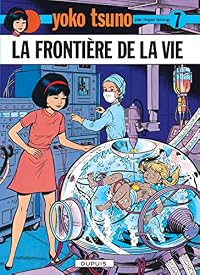
I recently got my hands on the original French edition, but I also have the German Zwischen Leben und Tod translation in my library for many years now. Reading it in French was somehow more intense. In German, I tend to read fast and just glance at the graphics, but my reading in French is slower, and so the graphics were more present, too. My French vocabulary is (after 5 years at school) at a similar level as my Danish is now, but I already knew the story very well, so I only occasionally consulted the German edition. It seems that, as German usually needs more space, the dialog there was sometimes shortened a bit.
Yoko's friend Ingrid is sick, and it looks like it is caused by a vampire. One night, Yoko manages to confront the blood sucker, who seems to be human after all, and chases him through the streets of Rothenburg ob der Tauber.
This is probably the most popular volume of the Yoko Tsuno series. Not only for the story, but also for the beautifiul drawings of Rothenburg. Several fans have visited the city and posted photos of the locations featured in the story, e.g. 1, 2, 3, 4. I've been to Rothenburg myself a few times, and it is still as charming as depicted.
I have realized that this work has become some kind of a comfort book to me. In addition to the mystery and the art, the story is also a story of love, and life, and redemption.
()
🇫🇷 La Frontière de la vie (Yoko Tsuno 7)
🇬🇧 On the Edge of Life (Yoko Tsuno 1)
🇩🇰 Vampyren fra Rothenburg (Yoko Tsuno 6)
🇩🇪 Zwischen Leben und Tod (Yoko Tsuno 7)
🇩🇪 Das Wunder der Lebenskugel (Yoko Zuno, das Karate Girl)
I recently got my hands on the original French edition, but I also have the German Zwischen Leben und Tod translation in my library for many years now. Reading it in French was somehow more intense. In German, I tend to read fast and just glance at the graphics, but my reading in French is slower, and so the graphics were more present, too. My French vocabulary is (after 5 years at school) at a similar level as my Danish is now, but I already knew the story very well, so I only occasionally consulted the German edition. It seems that, as German usually needs more space, the dialog there was sometimes shortened a bit.
Yoko's friend Ingrid is sick, and it looks like it is caused by a vampire. One night, Yoko manages to confront the blood sucker, who seems to be human after all, and chases him through the streets of Rothenburg ob der Tauber.
This is probably the most popular volume of the Yoko Tsuno series. Not only for the story, but also for the beautifiul drawings of Rothenburg. Several fans have visited the city and posted photos of the locations featured in the story, e.g. 1, 2, 3, 4. I've been to Rothenburg myself a few times, and it is still as charming as depicted.
I have realized that this work has become some kind of a comfort book to me. In addition to the mystery and the art, the story is also a story of love, and life, and redemption.
(
)25hnau
Another treasure I've found at a second hand shop:
🇩🇰 Den Danske Begrebsordbog by Sanni Nimb of Det Danske Sprog- og Litteraturselskab. Ikea Expedit for scale.

This thesaurus was compiled from Den Danske Ordbog (see above).
The left column of the edge index features the 22 main categories, around 500 pages. The right column has all 29 Danish characters, A-Å, for 900 pages of word index.
E.g., you want to learn words related to photography, so you go to
• category 14 Kunst og kultur (art and culture)
• subcategory 14.9 Fotografi (photography)
and you will find half a page or more full of words and synonyms, starting with:

An interesting word I've lerned here is fotoudstyr (photo equipment) in the bottom line, composed of foto + ud + styr.
• foto = photo.
• ud = out, in German aus.
• styr = handlebar, e.g. of a bicycle. Related to English to steer and to German Steuer (steering wheel, tax) and Stütze (support). Tax is how we support the state.
• udstyr = equipment. Related to German Aussteuer (dowry), the equipment or support of a newlywed woman.
So, as a memory aid, I could say that fotoudstyr is the dowry or equipment I need to support photography. (But my wife might not be amused when she finds out that I am going to marry my hobby.)
🇩🇰 Den Danske Begrebsordbog by Sanni Nimb of Det Danske Sprog- og Litteraturselskab. Ikea Expedit for scale.

This thesaurus was compiled from Den Danske Ordbog (see above).
The left column of the edge index features the 22 main categories, around 500 pages. The right column has all 29 Danish characters, A-Å, for 900 pages of word index.
E.g., you want to learn words related to photography, so you go to
• category 14 Kunst og kultur (art and culture)
• subcategory 14.9 Fotografi (photography)
and you will find half a page or more full of words and synonyms, starting with:

An interesting word I've lerned here is fotoudstyr (photo equipment) in the bottom line, composed of foto + ud + styr.
• foto = photo.
• ud = out, in German aus.
• styr = handlebar, e.g. of a bicycle. Related to English to steer and to German Steuer (steering wheel, tax) and Stütze (support). Tax is how we support the state.
• udstyr = equipment. Related to German Aussteuer (dowry), the equipment or support of a newlywed woman.
So, as a memory aid, I could say that fotoudstyr is the dowry or equipment I need to support photography. (But my wife might not be amused when she finds out that I am going to marry my hobby.)
26hnau
Didier Savard
🇩🇰 Van Goghs hævnere (Dick Herrison 2)
🇫🇷 Les voleurs d'oreilles (Dick Herrison 2)
🇩🇪 Der geheimnisvolle Ohrendieb (Dick Herrison 2)

Translation of titles: Van Gogh's avengers / The ear thieves / The mysterious ear thief.
Arles. A certain painter we all know from Doctor Who S05 E10 once lived there for some time. Now, in 1930, there is a series of murders, and every victim is missing an ear - hence the Danish title, Van Gogh's avengers. Detective Dick Herrison and journalist Jerome Doutendieu are called from Paris to investigate.
First words: Langloisbroen, en septembermorgen i 1930 ... "Nå Honorine, går det bedre med din datter?" (Langlois bridge, a September morning in 1930 ... ‘Well, Honorine, is your daughter doing better?’)
This is a classic crime story with lots of victims, lots of suspects, andlots of suspects being guilty of at least something . Usually not my cup of tea, but I'll give it four stars for the Van Gogh connection.
()
🇩🇰 Van Goghs hævnere (Dick Herrison 2)
🇫🇷 Les voleurs d'oreilles (Dick Herrison 2)
🇩🇪 Der geheimnisvolle Ohrendieb (Dick Herrison 2)

Translation of titles: Van Gogh's avengers / The ear thieves / The mysterious ear thief.
Arles. A certain painter we all know from Doctor Who S05 E10 once lived there for some time. Now, in 1930, there is a series of murders, and every victim is missing an ear - hence the Danish title, Van Gogh's avengers. Detective Dick Herrison and journalist Jerome Doutendieu are called from Paris to investigate.
First words: Langloisbroen, en septembermorgen i 1930 ... "Nå Honorine, går det bedre med din datter?" (Langlois bridge, a September morning in 1930 ... ‘Well, Honorine, is your daughter doing better?’)
This is a classic crime story with lots of victims, lots of suspects, and
(
)27hnau
Sebastian Haffner
🇩🇪 Anmerkungen zu Hitler
🇬🇧 The Meaning of Hitler

I have read this one in the original German. Foreign in time, but not in space.
First words:
🇩🇪 Adolf Hitlers Vater war ein Aufsteiger. Der uneheliche Sohn einer Dienstmagd brachte es zu einer gehobenen Beamtenstellung und starb geehrt und angesehen. Der Sohn begann als Absteiger.
🇬🇧 Adolf Hitler's father made a success of life. The illegimite son of a servant girl, he rose to become a state official of administrative rank and died honoured ad respected. His son began by making a mess of his life.
We all know of Hitler's atrocities, the war, the concentration camps, the gas chambers. But we have not learned very much at school about his national socialist views, how he managed to sway the masses, or about his disastrous commands in the last days of the war.
Haffner has seen the rise and fall of Hitler himself, first living in Germany, then from exile in the UK. In this book, he presents a systematic overview in 7 chapters:
• Life
• Achievments
• Successes
• Misconceptions
• Mistakes
• Crimes
• Betrayal
I have learned a lot from this excellent introduction.
Before Hitler started the war, things were going really well for Germany: the economy flourished again, and Germany even had their army back. The bad things were mostly happening behind the scenes, sometimes seen as a small price for all the good things, sometimes excused as being done without Hitler's knowledge. With Hitler's growing power, freedom of speech was more and more restricted. You could no longer criticize him without fear of harsh consequences, and that also played a role in the overall impression that things were going well.
Of course, we know that Hitler had other plans.
The Meaning of Hitler was first published in 1978, nearly 50 years ago. Hitler and WW2 have since shaped our cultures in different ways, depending on nationality.
West Germany effectively banned Mein Kampf using copyright. The East German regime declared themselves the good ones - and built a wall to defend against a West Germany allegedly full of Nazis. Denmark simply left all the German concrete bunkers at the beach, and hordes of German tourists explore them every summer for fun.
There is a long tradition of making fun of your political opponents. In the U.S., Charlie Chaplin did so with The Great Dictator. Many movies, including the Blues Brothers, have made fun of Nazis ever since.
The Danes have a peculiar sense of humor. Germans living in Denmark might find a Hitler snowman greeting them, or their children occasionally being heil hitlered at school.
We Germans simply can't do that. There is still a generational trauma from the atrocities committed by our fathers and grandfathers and grandgrandfathers. One coping mechanism is to see Hitler as absolute evil. It's deadly serious. Elsewhere, someone calling you a Nazi might just poke fun at you (see also list of other terms). In Germany, it's a false accusation that can ruin your life.
Now I'm looking for a similar book about East Germany. Any suggestions?
()
🇩🇪 Anmerkungen zu Hitler
🇬🇧 The Meaning of Hitler
I have read this one in the original German. Foreign in time, but not in space.
First words:
🇩🇪 Adolf Hitlers Vater war ein Aufsteiger. Der uneheliche Sohn einer Dienstmagd brachte es zu einer gehobenen Beamtenstellung und starb geehrt und angesehen. Der Sohn begann als Absteiger.
🇬🇧 Adolf Hitler's father made a success of life. The illegimite son of a servant girl, he rose to become a state official of administrative rank and died honoured ad respected. His son began by making a mess of his life.
We all know of Hitler's atrocities, the war, the concentration camps, the gas chambers. But we have not learned very much at school about his national socialist views, how he managed to sway the masses, or about his disastrous commands in the last days of the war.
Haffner has seen the rise and fall of Hitler himself, first living in Germany, then from exile in the UK. In this book, he presents a systematic overview in 7 chapters:
• Life
• Achievments
• Successes
• Misconceptions
• Mistakes
• Crimes
• Betrayal
I have learned a lot from this excellent introduction.
Before Hitler started the war, things were going really well for Germany: the economy flourished again, and Germany even had their army back. The bad things were mostly happening behind the scenes, sometimes seen as a small price for all the good things, sometimes excused as being done without Hitler's knowledge. With Hitler's growing power, freedom of speech was more and more restricted. You could no longer criticize him without fear of harsh consequences, and that also played a role in the overall impression that things were going well.
Of course, we know that Hitler had other plans.
The Meaning of Hitler was first published in 1978, nearly 50 years ago. Hitler and WW2 have since shaped our cultures in different ways, depending on nationality.
West Germany effectively banned Mein Kampf using copyright. The East German regime declared themselves the good ones - and built a wall to defend against a West Germany allegedly full of Nazis. Denmark simply left all the German concrete bunkers at the beach, and hordes of German tourists explore them every summer for fun.
There is a long tradition of making fun of your political opponents. In the U.S., Charlie Chaplin did so with The Great Dictator. Many movies, including the Blues Brothers, have made fun of Nazis ever since.
The Danes have a peculiar sense of humor. Germans living in Denmark might find a Hitler snowman greeting them, or their children occasionally being heil hitlered at school.
We Germans simply can't do that. There is still a generational trauma from the atrocities committed by our fathers and grandfathers and grandgrandfathers. One coping mechanism is to see Hitler as absolute evil. It's deadly serious. Elsewhere, someone calling you a Nazi might just poke fun at you (see also list of other terms). In Germany, it's a false accusation that can ruin your life.
Now I'm looking for a similar book about East Germany. Any suggestions?
(
)28hnau
🇩🇪 🇸🇪 🇩🇰 🇳🇴 Tysk - svensk visuell ordbok / dansk visuel ordbog / norsk visuell ordbok by Per Schou

Part of a series of visual dictionaries, so you can also get an English or Spanish version. About 6000 German words with pictures and translations, arranged by subject.
E.g., here is the page for "Das Café", Euro coin for scale:

This book is mostly intended for Scandinavians learning German. Therefore, it provides only the German articles (der/die/das), not the Swedish (en/et), Danish (en/et), and Norwegian (en/ei/et) ones. In many Norwegian dialects and in German, words can be male, female or neutral. Swedish ans Danish have merged male and female, which makes things easier, but you still have to learn - or guess - the case. (Of course, there are some local variations.)
Otherwise, this is a fun way to learn some basic vocabulary.

Part of a series of visual dictionaries, so you can also get an English or Spanish version. About 6000 German words with pictures and translations, arranged by subject.
E.g., here is the page for "Das Café", Euro coin for scale:

This book is mostly intended for Scandinavians learning German. Therefore, it provides only the German articles (der/die/das), not the Swedish (en/et), Danish (en/et), and Norwegian (en/ei/et) ones. In many Norwegian dialects and in German, words can be male, female or neutral. Swedish ans Danish have merged male and female, which makes things easier, but you still have to learn - or guess - the case. (Of course, there are some local variations.)
Otherwise, this is a fun way to learn some basic vocabulary.
29Karlstar
>28 hnau: That does look like a fun way to learn. I can't help on your request for a book about East Germany, that isn't a subject I've read on, yet.
30hnau
Jean-Pierre Gibrat
🇩🇰 Besat af begær (1+2)
🇬🇧 The Reprieve (1+2)
🇫🇷 Le Sursis (1+2)
🇩🇪 Der Aufschub (1+2)
 .
.
The story is told in 2 volumes, but there are also omnibus editions. The Reprieve is a faithful translation of the original French title. The Danish title is a bit misleading and ... lurid: Obsessed with desire.
I love the vivid drawing style.
A small French village during WW2. Due to lucky circumstances, Julien is declared dead, and he escapes forced labor for the Germans. Hoping that his reprieve will last until the Germans are defeated, he hides in a vacant house in the center of his village, watching life going on around him. Some people collaborate with the Germans. Some help the resistance. And then, there is Cecile, whom he is in love with, working in the village inn across the street.
We see the story unfold through Julien's eyes, watching from the house, or wandering around at night. He is quite a cynical young man, and still a bit immature. Some of his thoughts require some puzzling over to understand, at least when reading in a foreign language.
I am going to think about the story for a while. About taking an active or a passive role in life. About the illusion of normality until some small tendril of war happens to come by. About neighbors choosing different sides. About ...
()
🇩🇰 Besat af begær (1+2)
🇬🇧 The Reprieve (1+2)
🇫🇷 Le Sursis (1+2)
🇩🇪 Der Aufschub (1+2)
 .
.
The story is told in 2 volumes, but there are also omnibus editions. The Reprieve is a faithful translation of the original French title. The Danish title is a bit misleading and ... lurid: Obsessed with desire.
I love the vivid drawing style.
A small French village during WW2. Due to lucky circumstances, Julien is declared dead, and he escapes forced labor for the Germans. Hoping that his reprieve will last until the Germans are defeated, he hides in a vacant house in the center of his village, watching life going on around him. Some people collaborate with the Germans. Some help the resistance. And then, there is Cecile, whom he is in love with, working in the village inn across the street.
We see the story unfold through Julien's eyes, watching from the house, or wandering around at night. He is quite a cynical young man, and still a bit immature. Some of his thoughts require some puzzling over to understand, at least when reading in a foreign language.
I am going to think about the story for a while. About taking an active or a passive role in life. About the illusion of normality until some small tendril of war happens to come by. About neighbors choosing different sides. About ...
(
)31hnau
Paul A. Kring
🇩🇰 Manden paa stranden

Translated title: The Man at the Beach
A crime story. Bolette and her friend Mathilde meet a man at the beach. When Mathilde is kidnapped, Bolette decides to investigate herself. Shurely, it can't be that hard when you are already a crime author.
First words: Altsaa Thilde! Kom nu! Skal du ikke med i vandet? Der er deiligt varmt. (Hey, Thilde! Come on! Won't you also come into the water? It's delightfully warm.)
()
🇩🇰 Manden paa stranden

Translated title: The Man at the Beach
A crime story. Bolette and her friend Mathilde meet a man at the beach. When Mathilde is kidnapped, Bolette decides to investigate herself. Shurely, it can't be that hard when you are already a crime author.
First words: Altsaa Thilde! Kom nu! Skal du ikke med i vandet? Der er deiligt varmt. (Hey, Thilde! Come on! Won't you also come into the water? It's delightfully warm.)
(
)32jillmwo
>30 hnau: I am regretting that I don't speak or read French. These stories sound as if they would be very worthwhile.
33hnau
Gail Carriger
🇬🇧 Prudence
🇫🇷 Prudence

The Parasol Protectorate series (starting with Soulless) is featuring adults. Solid fantasy, 4 stars.
The Finishing School series (Etiquette & Espionage) is featuring children. So much fun to read, 5 stars.
The Custard Protocol series is featuring young adults. I love some parts, and hate some others.
You probably know those warning signs: "Teenager in the house. Brain under construction"? In this coming of age story, Rue initially makes some careless decisions, and those are the reason for some of the initial confusion about the story's mysteries. I did not like that part so much, but she learns and grows, and we get to know more of her world and of the supernatural creatures living in the colonies.
In the 1st volume, she gets her own dirigible and is sent to India on tea business. By the 2nd volume, she is ready to help her aging parents settle in Egypt.
Another central part of the story is her sexual awakening. That's just not my cup of tea, and it felt a bit like injecting too much of modern views into the assumed time period. On the other hand, some of the humor in these books comes from putting the characters into awkward or inappropriate situations.
The following books explore other parts of the world as well as other sexual preferences. Books 3 and 4 are written from the POVs of Primrose and Percy, respectively.
In the end, I'm glad that I have not given up on the series. The last boook is the best by far.
Magic system: same as in the other Parasol Universe novels. Rue is a metanatural, she can borrow the supernatural part from werewolves and vampires and become one of those herself, rendering her victim mortal for the time.
() – books 1-3
() – book 4
🇬🇧 Prudence
🇫🇷 Prudence

The Parasol Protectorate series (starting with Soulless) is featuring adults. Solid fantasy, 4 stars.
The Finishing School series (Etiquette & Espionage) is featuring children. So much fun to read, 5 stars.
The Custard Protocol series is featuring young adults. I love some parts, and hate some others.
You probably know those warning signs: "Teenager in the house. Brain under construction"? In this coming of age story, Rue initially makes some careless decisions, and those are the reason for some of the initial confusion about the story's mysteries. I did not like that part so much, but she learns and grows, and we get to know more of her world and of the supernatural creatures living in the colonies.
In the 1st volume, she gets her own dirigible and is sent to India on tea business. By the 2nd volume, she is ready to help her aging parents settle in Egypt.
Another central part of the story is her sexual awakening. That's just not my cup of tea, and it felt a bit like injecting too much of modern views into the assumed time period. On the other hand, some of the humor in these books comes from putting the characters into awkward or inappropriate situations.
The following books explore other parts of the world as well as other sexual preferences. Books 3 and 4 are written from the POVs of Primrose and Percy, respectively.
In the end, I'm glad that I have not given up on the series. The last boook is the best by far.
Magic system: same as in the other Parasol Universe novels. Rue is a metanatural, she can borrow the supernatural part from werewolves and vampires and become one of those herself, rendering her victim mortal for the time.
(
) – books 1-3(
) – book 434hnau
>32 jillmwo: I try to list the title of the English translation, if there is one. Here, the English title is "The Reprieve".
35pgmcc
>34 hnau:
You can chalk up a Book Bullet hit for The Reprieve by Jean-Paul Sartre. I am a great fan of existential works.
You can chalk up a Book Bullet hit for The Reprieve by Jean-Paul Sartre. I am a great fan of existential works.
36hnau
>35 pgmcc: Argh. Thanks, removed Sartre again.
37hnau
Franquin
🇩🇰 Operation "Stilhed"
🇬🇧 Pirates of Silence
🇫🇷 Les pirates de silence
🇩🇪 Tiefschlaf für die ganze Stadt

The Danish title says "operation silence", the German one "deep sleep for the whole city".
We also get some creative translations of character names:
🇫🇷 Spirou - 🇩🇰 Splint - 🇳🇴 Sprint - 🇫🇮 Piko - 🇳🇱 Robbedoes
🇫🇷 Fantasio - 🇩🇰 Kvik - 🇳🇴 Kvikk - 🇸🇪 Nicke - 🇳🇱 Kwabbernoot
🇫🇷 Spip - 🇩🇪 Pips
🇫🇷 Marsupilami - 🇩🇰 Spiril - 🇳🇴 Spiralis
🇫🇷 Champignac - 🇳🇴 Sieninevan - 🇩🇪 Rummelsdorf - 🇳🇱 Rommelgem
Splint and Kvik work as reporters. This time, they want to investigate Incognito city, a retreat for the wealthy and famous where no cameras are allowed. But even on the way there, some things don't seem quite right, and in the end they foil a crime. The get some help from Spip the squirrel and Spiril the marsupilami.
This is one of the earlier Spirou comics (#10), and we find already the typical kind of humour where several people are talking at the same time about diffrent things.
My edition also has a short story 🇩🇰 "Kvik kører quick" (Fantasio drives fast) / 🇫🇷 "La Quick super" / 🇬🇧 "Superquick".
()
🇩🇰 Operation "Stilhed"
🇬🇧 Pirates of Silence
🇫🇷 Les pirates de silence
🇩🇪 Tiefschlaf für die ganze Stadt

The Danish title says "operation silence", the German one "deep sleep for the whole city".
We also get some creative translations of character names:
🇫🇷 Spirou - 🇩🇰 Splint - 🇳🇴 Sprint - 🇫🇮 Piko - 🇳🇱 Robbedoes
🇫🇷 Fantasio - 🇩🇰 Kvik - 🇳🇴 Kvikk - 🇸🇪 Nicke - 🇳🇱 Kwabbernoot
🇫🇷 Spip - 🇩🇪 Pips
🇫🇷 Marsupilami - 🇩🇰 Spiril - 🇳🇴 Spiralis
🇫🇷 Champignac - 🇳🇴 Sieninevan - 🇩🇪 Rummelsdorf - 🇳🇱 Rommelgem
Splint and Kvik work as reporters. This time, they want to investigate Incognito city, a retreat for the wealthy and famous where no cameras are allowed. But even on the way there, some things don't seem quite right, and in the end they foil a crime. The get some help from Spip the squirrel and Spiril the marsupilami.
This is one of the earlier Spirou comics (#10), and we find already the typical kind of humour where several people are talking at the same time about diffrent things.
My edition also has a short story 🇩🇰 "Kvik kører quick" (Fantasio drives fast) / 🇫🇷 "La Quick super" / 🇬🇧 "Superquick".
(
)
