
Sibylline's (Lucy's) 2025: The Second Half
This is a continuation of the topic Sibylline's (Lucy's) 2025: The First.
Talk 75 Books Challenge for 2025
Join LibraryThing to post.


2sibylline
Currently reading in December


 ♬
♬
Reading in December
new The Tainted Cup Robert Jackson Bennett fantasy
✔ John Keats W. Jackson Bate bio
✔ Lord Byron: Selected Letters and Journals Leslie A. Marchand bio
new A Family History: 1688-1837 (2) H.A. Wyndham history british
new Metaphysics as a Guide to Morals Iris Murdoch philosophy, morals
♬Childe Harold's Pilgrimage Lord Byron
Read in December
106. lib Clown Town Mick Herron mys british, mi5 ****1/2
107. lib Starter Villain John Scalzi sort of urban fantasy?***1/2
108. ♬ The Prelude William Wordsworth (audio) Poetry 19th *****
109. new Witch King (1) Martha Wells fantasy ****
110. ✔ Cuckoo's Egg C.J. Cherryh *****
111. new The Impossible Fortune (5) Richard Osman mys british
Paused: bbg new Portrait of an Unseen Woman Roberta Harold hist fict 19th
new Finding Margaret Fuller Allison Pataki fic hist 19th


DNF ♬ A Darker Shade of Magic V.E. Schwab magic urban
♬ audio
lib library
new - new in 2025
✔ on shelf for over a year
RR reread
bbg Bridgeside Book Group
wbg Wally Book Group
DNF 100 pages attentively. If less, not counted


 ♬
♬
Reading in December
new The Tainted Cup Robert Jackson Bennett fantasy
✔ John Keats W. Jackson Bate bio
✔ Lord Byron: Selected Letters and Journals Leslie A. Marchand bio
new A Family History: 1688-1837 (2) H.A. Wyndham history british
new Metaphysics as a Guide to Morals Iris Murdoch philosophy, morals
♬Childe Harold's Pilgrimage Lord Byron
Read in December
106. lib Clown Town Mick Herron mys british, mi5 ****1/2
107. lib Starter Villain John Scalzi sort of urban fantasy?***1/2
108. ♬ The Prelude William Wordsworth (audio) Poetry 19th *****
109. new Witch King (1) Martha Wells fantasy ****
110. ✔ Cuckoo's Egg C.J. Cherryh *****
111. new The Impossible Fortune (5) Richard Osman mys british
Paused: bbg new Portrait of an Unseen Woman Roberta Harold hist fict 19th
new Finding Margaret Fuller Allison Pataki fic hist 19th


DNF ♬ A Darker Shade of Magic V.E. Schwab magic urban
♬ audio
lib library
new - new in 2025
✔ on shelf for over a year
RR reread
bbg Bridgeside Book Group
wbg Wally Book Group
DNF 100 pages attentively. If less, not counted
3sibylline
Read in July
66. lib The House on Vesper Sands Paraic O'Donnell mys british victorian *****
67. a. ✔ The Game of Courts Victoria Goddard fantasy
b. ✔ The Bride of the Blue Wind Victoria Goddard fantasy
68. bbg new Smoke and Ashes Amitav Ghosh history world ****
69. wbg RR The Bell Iris Murdoch contemp fic *****
70. RR ♬ First Rider's Call Kristen Britain fantasy *** 3/4
71. lib The Naming of Birds Paraic O'Donnell mys 19th *****
72. newThe Wizard Hunters (Ile Rien 3) Martha Wells fantasy ****1/2
73. e-book The Ships of Air (Ile Rien 4) Martha Wells fantasy ****1/2
74. e-book The Gate of Gods (Ile Rien 5) Martha Wells
Read in August
75. RR bbg The Songlines Bruce Chatwin autofic, travel, philosophy *****
76. ✔ Blindness Jose Saramago apoc? *****
77. lib A Rising Man Abir Mukherjee hist mys india ****
78. new Death at the Sign of the Rook Kate Atkinson mys ****1/2
79. RR ♬ The High King's Tomb (2 GR) Kristen Britain fantasy ***1/2
80. RR King's Dragon (1 Cos)Kate Elliott fantasy ***1/2
81. ♬ The Locked Room Elly Griffiths mys british ****
66. lib The House on Vesper Sands Paraic O'Donnell mys british victorian *****
67. a. ✔ The Game of Courts Victoria Goddard fantasy
b. ✔ The Bride of the Blue Wind Victoria Goddard fantasy
68. bbg new Smoke and Ashes Amitav Ghosh history world ****
69. wbg RR The Bell Iris Murdoch contemp fic *****
70. RR ♬ First Rider's Call Kristen Britain fantasy *** 3/4
71. lib The Naming of Birds Paraic O'Donnell mys 19th *****
72. newThe Wizard Hunters (Ile Rien 3) Martha Wells fantasy ****1/2
73. e-book The Ships of Air (Ile Rien 4) Martha Wells fantasy ****1/2
74. e-book The Gate of Gods (Ile Rien 5) Martha Wells
Read in August
75. RR bbg The Songlines Bruce Chatwin autofic, travel, philosophy *****
76. ✔ Blindness Jose Saramago apoc? *****
77. lib A Rising Man Abir Mukherjee hist mys india ****
78. new Death at the Sign of the Rook Kate Atkinson mys ****1/2
79. RR ♬ The High King's Tomb (2 GR) Kristen Britain fantasy ***1/2
80. RR King's Dragon (1 Cos)Kate Elliott fantasy ***1/2
81. ♬ The Locked Room Elly Griffiths mys british ****
4sibylline
Read in September
82.RR audio Blackveil (GR 4) Kristen Britain fantasy ***1/2
83. lib A Necessary Evil (2) Abir Mukherjee mys ***1/2
84. RR The Burning Stone (CoS4) Kate Elliott (CoS4) fantasy ****
85. RR audio Mirror Sight (GR5) Kristen Britain fantasy ****
Read in October
86. RR Child of Flame (CoS4) Kate Elliott fantasy
****
87. RR The Gathering Storm (Cos5) Kate Elliott fantasy
****
88. wbg Loved and Missed Susie Boyt contemp fic ****
89. lib Smoke and Ashes(3) Abir Mukherjee mys ***1/2
90. RR In the Ruins (CoS6) Kate Elliott fantasy ****
91. RR Crown of Stars (CoS7) Kate Elliott fantasy ****
92. RR audio Firebrand (GR6) Kristen Britain fantasy ****
93. lib Death in the East (4) Abir Mukherjee mys ****
82.RR audio Blackveil (GR 4) Kristen Britain fantasy ***1/2
83. lib A Necessary Evil (2) Abir Mukherjee mys ***1/2
84. RR The Burning Stone (CoS4) Kate Elliott (CoS4) fantasy ****
85. RR audio Mirror Sight (GR5) Kristen Britain fantasy ****
Read in October
86. RR Child of Flame (CoS4) Kate Elliott fantasy
****
87. RR The Gathering Storm (Cos5) Kate Elliott fantasy
****
88. wbg Loved and Missed Susie Boyt contemp fic ****
89. lib Smoke and Ashes(3) Abir Mukherjee mys ***1/2
90. RR In the Ruins (CoS6) Kate Elliott fantasy ****
91. RR Crown of Stars (CoS7) Kate Elliott fantasy ****
92. RR audio Firebrand (GR6) Kristen Britain fantasy ****
93. lib Death in the East (4) Abir Mukherjee mys ****
5sibylline
Read in November
94. wbg new Signs Preceding the End of the World contemp fic ****1/2
95. new A Family History: 1410-1688 Hugh Archibald Wyndham history british 15-17th (can't rate)
96. new Derring Do For Beginners Victoria Goddard ****
97. new The Dream Gatherer (GR 6.5) Kristen Britain
fantasy ***1/2
98. new Till Human Voices Wake Us Victoria Goddard fantasy ***
99. RR audio Winterlight (GR7 Kristen Britain fantasy ****
100. library The Shadows of Men (5) Abir Mukherjee mys india 20th ****
101. library The Buried Giant Kazuo Ishiguro historical magic realism? ***1/2
102. new Death on Site (2) Janet Neel ***1/2
103. newDeath's Bright Angel (1) Janet Neel ***1/2
104. wbg The Lights of Earth Gina Berriault ****
105. ♬Falling in a Sea of Stars (GR8) Kristen Britain ***
Read in December
106. lib Clown Town Mick Herron mys british, mi5 ****1/2
107. lib Starter Villain John Scalzi sort of urban fantasy?***1/2
108. ♬ The Prelude William Wordsworth (audio) Poetry 19th *****
109. new Witch King (1) Martha Wells fantasy ****
110. ✔ Cuckoo's Egg C.J. Cherryh *****
111. new The Impossible Fortune (5) Richard Osman mys british *****
112. ✔ Metaphysics as a Guide to Morals Iris Murdoch philosophy *****
94. wbg new Signs Preceding the End of the World contemp fic ****1/2
95. new A Family History: 1410-1688 Hugh Archibald Wyndham history british 15-17th (can't rate)
96. new Derring Do For Beginners Victoria Goddard ****
97. new The Dream Gatherer (GR 6.5) Kristen Britain
fantasy ***1/2
98. new Till Human Voices Wake Us Victoria Goddard fantasy ***
99. RR audio Winterlight (GR7 Kristen Britain fantasy ****
100. library The Shadows of Men (5) Abir Mukherjee mys india 20th ****
101. library The Buried Giant Kazuo Ishiguro historical magic realism? ***1/2
102. new Death on Site (2) Janet Neel ***1/2
103. newDeath's Bright Angel (1) Janet Neel ***1/2
104. wbg The Lights of Earth Gina Berriault ****
105. ♬Falling in a Sea of Stars (GR8) Kristen Britain ***
Read in December
106. lib Clown Town Mick Herron mys british, mi5 ****1/2
107. lib Starter Villain John Scalzi sort of urban fantasy?***1/2
108. ♬ The Prelude William Wordsworth (audio) Poetry 19th *****
109. new Witch King (1) Martha Wells fantasy ****
110. ✔ Cuckoo's Egg C.J. Cherryh *****
111. new The Impossible Fortune (5) Richard Osman mys british *****
112. ✔ Metaphysics as a Guide to Morals Iris Murdoch philosophy *****
8sibylline
Thank you Roni -- I'm trying to put in a third photograph up top and having some problems. First two went into the gallery no problem.
Wait, just found it! Weird!
Wait, just found it! Weird!
9RebaRelishesReading
Middle photo is a cat laying claim to you -- right?
Happy new thread! Looking forward to hearing about your second half reading.
Happy new thread! Looking forward to hearing about your second half reading.
13RebaRelishesReading
>10 sibylline: Love it :)
14sibylline
66.  mys gothic 19th
The House on Vesper Sands Pariac O'Donnell
Not one thing not to love about O'Donnell's mystery novel. Everything, characters, story, the language, setting is done superbly, lovingly, meticulously well! It's, um, Bliss! (a pun you'll get when you read it!). You might have to be a fan of 19th century lit so you can marvel over the dialogue and descriptions, so so evocative of the times, but without the prolixity (ahem, except for one character) so characteristic of the time. But it is the 1890's and times are a'changin', so some people are moving on, moving faster. The plot, well, it's just a little bit spooky, and that is well done too, you can take it as a suggestion or even a metaphor, or you can take it literally--but whichever way, as the story-driver the choice is utterly appropriate for that time. I'm not giving anything away. Enjoy! And I'm off to the library where I've reserved Book 2! *****
 mys gothic 19th
The House on Vesper Sands Pariac O'Donnell
Not one thing not to love about O'Donnell's mystery novel. Everything, characters, story, the language, setting is done superbly, lovingly, meticulously well! It's, um, Bliss! (a pun you'll get when you read it!). You might have to be a fan of 19th century lit so you can marvel over the dialogue and descriptions, so so evocative of the times, but without the prolixity (ahem, except for one character) so characteristic of the time. But it is the 1890's and times are a'changin', so some people are moving on, moving faster. The plot, well, it's just a little bit spooky, and that is well done too, you can take it as a suggestion or even a metaphor, or you can take it literally--but whichever way, as the story-driver the choice is utterly appropriate for that time. I'm not giving anything away. Enjoy! And I'm off to the library where I've reserved Book 2! *****
15LizzieD
>14 sibylline: You got me again, Lucy. Off to chase it down!!! -------------- And done! Soon on the way from ThriftBooks.
Oh! Have you read the first two in the Mukherjee trilogy? I haven't, and I see that I don't own the middle book. (Your Touchstone, btw, goes to the Tanya Huff of the same title.)
Oh! Have you read the first two in the Mukherjee trilogy? I haven't, and I see that I don't own the middle book. (Your Touchstone, btw, goes to the Tanya Huff of the same title.)
17sibylline
>15 LizzieD: I haven't read any Mukherjee, well, maybe I have, must check but I don't have any Mukherjee's around the house. Amitav Ghosh has written a fictional trilogy set in the 19th century--haven't read that either. I'll be finishing HIS book Smoke and Ashes that is the history of the opium trade in the next day or two for my local book group. Fascinating and sobering.
18sibylline
67.  fantasy *****
  fantasy *****
a. The Game of Courts Victoria Goddard
b. ✔ The Bride of the Blue Wind Victoria Goddard fantasy
Except for the ridiculousness of publishing these wee slivers of books, the stories within are, as ever, wonderfully satisfying. Filling in the details. . . in the case of book a) about Conju, the Last Emperor's valet (Groom of the Chamber, officially)--his beginnings in that office and his growing love for the Emperor and his friendship with Cliopher, all very satisfying, and b) a rather horrific story about the youngest of the three sisters (Sardeet) Avramapul, two of whom (maybe all three?) end up in the Red Company.
 fantasy *****
  fantasy *****
a. The Game of Courts Victoria Goddard
b. ✔ The Bride of the Blue Wind Victoria Goddard fantasy
Except for the ridiculousness of publishing these wee slivers of books, the stories within are, as ever, wonderfully satisfying. Filling in the details. . . in the case of book a) about Conju, the Last Emperor's valet (Groom of the Chamber, officially)--his beginnings in that office and his growing love for the Emperor and his friendship with Cliopher, all very satisfying, and b) a rather horrific story about the youngest of the three sisters (Sardeet) Avramapul, two of whom (maybe all three?) end up in the Red Company.
19sibylline
68. 
bbg new Smoke and Ashes Amitav Ghosh history world
Ghosh challenges the western reader to imagine the existence of powers well outside of the human ones, by presenting the idea that a plant can be, to put it a little ambiguously but pointedly, a contender. By that I mean potent, dangerous, insidious, irresistible, consuming, alluring, voracious . . . in its quest to prosper. He is putting forth that the poppy has evolved along with us and offers a temptation that is powerful enough to destroy mankind. I have a somewhat crackpot theory anyway, that many of the things happening around us from ticks to floods are Gaia's response to human interference. The poppy fits right in. Ghosh explores the history of the poppy, the drugs made from the poppy, the cultivation and distribution of the poppy . . . and the biggest temptation of all: the fabulous sums of money to be made from the poppy. He puts the OxyContin scandal into this context, horrific similarities to the behaviour of the British East India Company in the 19th century, the effect of the drug on the governance and the people of the Far East. The drug overpowers everyone, by what it offers to both the user and the provider. Ecstasy and money. Worth reading. ****

bbg new Smoke and Ashes Amitav Ghosh history world
Ghosh challenges the western reader to imagine the existence of powers well outside of the human ones, by presenting the idea that a plant can be, to put it a little ambiguously but pointedly, a contender. By that I mean potent, dangerous, insidious, irresistible, consuming, alluring, voracious . . . in its quest to prosper. He is putting forth that the poppy has evolved along with us and offers a temptation that is powerful enough to destroy mankind. I have a somewhat crackpot theory anyway, that many of the things happening around us from ticks to floods are Gaia's response to human interference. The poppy fits right in. Ghosh explores the history of the poppy, the drugs made from the poppy, the cultivation and distribution of the poppy . . . and the biggest temptation of all: the fabulous sums of money to be made from the poppy. He puts the OxyContin scandal into this context, horrific similarities to the behaviour of the British East India Company in the 19th century, the effect of the drug on the governance and the people of the Far East. The drug overpowers everyone, by what it offers to both the user and the provider. Ecstasy and money. Worth reading. ****
20sibylline
69.  fiction british 20th *****
The Bell Iris Murdoch
I'm a little overwhelmed by The Bell -- there are books that achieve a level of complexity and mastery that I find hard to even begin to take apart. I've been reading Murdoch's book on philosophy and morals and that has made a difference. She is examining the gap (the never-to-be-bridged abyss) between belief (value) and fact (the measurable world, shall we say?). Religion has performed the function of giving people a sense of meaningful structures for behaviour. What happens when you cannot believe in anything? The facts are (ha ha) that people cannot function without a measure of believing things that are likely not in the least bit true in the factual sense -- but are nonetheless 'necessary'. And no one really holds the same beliefs, some hold almost none, some far too many and religious orders tend toward rule-making (which is frankly preposterous, no? . . . given that humans are, well, human and have urges that scan from almost infinitely good or bad and desires tend to conflict with any hardbound 'rules' that are put out on the belief side--made worse by tension and conflict. The characters in this novel have collected in a great old mansion in Gloucestershire with a Benedictine Abbey (Anglican and nuns) next door hoping to form a religious retreat community only . . . . well . . . flawed, each one, in some way or another and some more than most, all to do with love both profane and sacred, so inevitably things go sideways. There is a bell, actually there are two bells, one has been lost since the Dissolution and the other is newly purchased and is to go, with great ceremony, to hang in the tower of the Abbey. At the same time a young woman at the mansion plans to enter the Abbey as a postulant. The word 'clash' comes to mind, a dissonance, the crashing boom of opposing realities. Murdoch is an effing genius. Second reading blew me away as entirely as the first one did.*****
 fiction british 20th *****
The Bell Iris Murdoch
I'm a little overwhelmed by The Bell -- there are books that achieve a level of complexity and mastery that I find hard to even begin to take apart. I've been reading Murdoch's book on philosophy and morals and that has made a difference. She is examining the gap (the never-to-be-bridged abyss) between belief (value) and fact (the measurable world, shall we say?). Religion has performed the function of giving people a sense of meaningful structures for behaviour. What happens when you cannot believe in anything? The facts are (ha ha) that people cannot function without a measure of believing things that are likely not in the least bit true in the factual sense -- but are nonetheless 'necessary'. And no one really holds the same beliefs, some hold almost none, some far too many and religious orders tend toward rule-making (which is frankly preposterous, no? . . . given that humans are, well, human and have urges that scan from almost infinitely good or bad and desires tend to conflict with any hardbound 'rules' that are put out on the belief side--made worse by tension and conflict. The characters in this novel have collected in a great old mansion in Gloucestershire with a Benedictine Abbey (Anglican and nuns) next door hoping to form a religious retreat community only . . . . well . . . flawed, each one, in some way or another and some more than most, all to do with love both profane and sacred, so inevitably things go sideways. There is a bell, actually there are two bells, one has been lost since the Dissolution and the other is newly purchased and is to go, with great ceremony, to hang in the tower of the Abbey. At the same time a young woman at the mansion plans to enter the Abbey as a postulant. The word 'clash' comes to mind, a dissonance, the crashing boom of opposing realities. Murdoch is an effing genius. Second reading blew me away as entirely as the first one did.*****
21sibylline
70. ♬ fantasy ***3/4
First Rider's Call(GR 2) Kristen Britain
Listening this time around. The story is entertaining. Good characters, good world-building. Kerrigan is maddeningly herself, if that makes any sense, often bad tempered, blundering into situations, misinterpreting things -- but that is realistic, eh? Ellen Archer is a decent reader. There are more than a few derivative moments, but there is enough that is original and the occasional surprise to keep me listening and enjoying. On to book 3 ***3/4
 fantasy ***3/4
First Rider's Call(GR 2) Kristen Britain
Listening this time around. The story is entertaining. Good characters, good world-building. Kerrigan is maddeningly herself, if that makes any sense, often bad tempered, blundering into situations, misinterpreting things -- but that is realistic, eh? Ellen Archer is a decent reader. There are more than a few derivative moments, but there is enough that is original and the occasional surprise to keep me listening and enjoying. On to book 3 ***3/4
22BLBera
Happy new thread, Lucy.
>14 sibylline: I've had The House on Vesper Sands on my shelf for a while. It's good to see your favorable comments. I know where to go when I feel like a good Gothic mystery. It's part of a series?
>14 sibylline: I've had The House on Vesper Sands on my shelf for a while. It's good to see your favorable comments. I know where to go when I feel like a good Gothic mystery. It's part of a series?
23atozgrl
Hello Lucy. My apologies that I haven't visited your threads before. @LizzieD sent me over to you after I mentioned on my own thread that my DH and I are planning a trip to the eastern Adirondacks area and were looking for suggestions of things we should go see. If you have any recommendations, please do let me know! Thanks!
24sibylline
>23 atozgrl: No worries, Irene -- I don't have deep knowledge of the ADK's but I can give you some ideas. I'll pop over to messages.
25atozgrl
>24 sibylline: Thank you, Lucy, I appreciate the information!
26sibylline
71.  mys british victorian *****
The Naming of the Birds Paraic O'Donnell
O'Donnell did it again -- treading that fine line too, realistic with just this soupçon of the eerie. Capturing something essential too about that era without overdoing it. In the 1870's powerful and wicked men have come up with the idea of training assassins from a young age, drawing their candidates from the abundant abandoned children filling orphanages of the late 19th century - - - and . . . you can guess . . . twenty years later old semi-retired men of the Home Office are being viciously murdered. What will Inspector Cutter and Sergeant Bliss do? It's a tricky one to solve, and do they want to solve it, and why does Cutter have such a guilty conscience? *****
 mys british victorian *****
The Naming of the Birds Paraic O'Donnell
O'Donnell did it again -- treading that fine line too, realistic with just this soupçon of the eerie. Capturing something essential too about that era without overdoing it. In the 1870's powerful and wicked men have come up with the idea of training assassins from a young age, drawing their candidates from the abundant abandoned children filling orphanages of the late 19th century - - - and . . . you can guess . . . twenty years later old semi-retired men of the Home Office are being viciously murdered. What will Inspector Cutter and Sergeant Bliss do? It's a tricky one to solve, and do they want to solve it, and why does Cutter have such a guilty conscience? *****
27sibylline
72. fantasy ****1/2
The Wizard Hunters (Ile Rien 3)Martha Wells
This is a second review -- I had to abandon a terrible audio-recording and buy the book. Tremaine Valiarde, Nicholas' daughter from the previous book is in despair as the 'Gardier' this enemy out of nowhere that is destroying not just Ile Rien but everything and everyone else, seem to be winning. Her father disappeared with the wizard Arisilde ten years ago, all she has is the magical device/toy he made for her as a child. Gerard, one of her guardians turns up at Coldcourt and want her to bring the device to a secret hideaway where he and the other wizards are working on a way to thwart these Gardier. And so the adventure begins. In no time Tremaine is whisked away to a Gardier island in another world where they are staging the attack of her world and . . . it's fun and I'm engaged. Off to book 2. ****1/2
 fantasy ****1/2
The Wizard Hunters (Ile Rien 3)Martha Wells
This is a second review -- I had to abandon a terrible audio-recording and buy the book. Tremaine Valiarde, Nicholas' daughter from the previous book is in despair as the 'Gardier' this enemy out of nowhere that is destroying not just Ile Rien but everything and everyone else, seem to be winning. Her father disappeared with the wizard Arisilde ten years ago, all she has is the magical device/toy he made for her as a child. Gerard, one of her guardians turns up at Coldcourt and want her to bring the device to a secret hideaway where he and the other wizards are working on a way to thwart these Gardier. And so the adventure begins. In no time Tremaine is whisked away to a Gardier island in another world where they are staging the attack of her world and . . . it's fun and I'm engaged. Off to book 2. ****1/2
28sibylline
73.  fantasy ****1/2
The Ships of Air (Ile Rien 4) Martha Wells
The Gardier have have also learned how to move into other world and, as well, they have dirigibles and can wield magic, somehow, albeit more clumsily than Ile Rien wizards. Something about them is just wrong, but hard to put a finger on. Meanwhile on this new world there are a different people, Syprians, for whom any use of magic is taboo. The have Chosen Ones whose job is to ferret out and kill wizards because in their home world wizards are invariably practitioners of evil . . . but Tremaine has met Ilias, who works with one of the chosen, his half-brother Giliead, but has been 'cursed' by his people for having had magic worked on him and survived. But well . . . there's some kind of other magic working there between Ilias and Tremaine. . . By the end of this fourth novel, 2nd in the Tremaine grouping, some things have come clear: Who the Gardier are, where they are from. Why they are so intent on destroying other worlds, why they are so arrogant is still a mystery. Onward! ****1/2
 fantasy ****1/2
The Ships of Air (Ile Rien 4) Martha Wells
The Gardier have have also learned how to move into other world and, as well, they have dirigibles and can wield magic, somehow, albeit more clumsily than Ile Rien wizards. Something about them is just wrong, but hard to put a finger on. Meanwhile on this new world there are a different people, Syprians, for whom any use of magic is taboo. The have Chosen Ones whose job is to ferret out and kill wizards because in their home world wizards are invariably practitioners of evil . . . but Tremaine has met Ilias, who works with one of the chosen, his half-brother Giliead, but has been 'cursed' by his people for having had magic worked on him and survived. But well . . . there's some kind of other magic working there between Ilias and Tremaine. . . By the end of this fourth novel, 2nd in the Tremaine grouping, some things have come clear: Who the Gardier are, where they are from. Why they are so intent on destroying other worlds, why they are so arrogant is still a mystery. Onward! ****1/2
29sibylline
74.  fantasy ****1/2
The Gate of Gods (Ile Rien 5) Martha Wells
The concluding book of the Ile-Rien series -- satisfying and surprising enough to continue to the end. Wells is good at characters evolving along with making up a credible (by fantasy standards!) situation. ****
 fantasy ****1/2
The Gate of Gods (Ile Rien 5) Martha Wells
The concluding book of the Ile-Rien series -- satisfying and surprising enough to continue to the end. Wells is good at characters evolving along with making up a credible (by fantasy standards!) situation. ****
30sibylline
75.  autofic, travel, philosophy *****
(bbg, reread) The Songlines Bruce Chatwin
These are my notes from the reading in the 1980's. They still apply perfectly: Ideas: 1. defensiveness as opposed to aggression fundamental to human nature. 2. Humans are naturally migratory, thrive on movement, stimulation. Once essential to survival for 2.5 million years. Strong instinctual restlessness. 3. The journey is the 'way'. In the case of the indigenous australian, that is LITERALLY the case.
Curiously #3 this echoes the thinking of hosts of metaphysicians -- -- Even Derrida, whom I personally often find . . . just plain silly (seriously? a novel is nothing: it is the critic who reveals its 'real basis' and is more important . . ?) falls into line with the idea that the human singing the landscape as they walk = creates the reality (for the human, anyway), for us the landscape and our words are entwined.
I think I used to be smarter than I am now! *****
 autofic, travel, philosophy *****
(bbg, reread) The Songlines Bruce Chatwin
These are my notes from the reading in the 1980's. They still apply perfectly: Ideas: 1. defensiveness as opposed to aggression fundamental to human nature. 2. Humans are naturally migratory, thrive on movement, stimulation. Once essential to survival for 2.5 million years. Strong instinctual restlessness. 3. The journey is the 'way'. In the case of the indigenous australian, that is LITERALLY the case.
Curiously #3 this echoes the thinking of hosts of metaphysicians -- -- Even Derrida, whom I personally often find . . . just plain silly (seriously? a novel is nothing: it is the critic who reveals its 'real basis' and is more important . . ?) falls into line with the idea that the human singing the landscape as they walk = creates the reality (for the human, anyway), for us the landscape and our words are entwined.
I think I used to be smarter than I am now! *****
31sibylline
76. 
✔Blindness Jose Saramago
Excruciating read, all the more so as you know this is the human condition at its most basic. People start going blind, only what they 'see' is pure whiteness. The government decides to quarantine and Saramago takes us on the 'journey' of the first group to become infected who end up in an abandoned mental asylum as the first group detained there. As you read you think, how can it get worse? Then it gets worse. I won't describe any of it. I read quickly, stopping to read some passages, skimming others, but now and then I feel it necessary to read a book that takes you to where humans go when desperate. There is light, however, this first group (and others, it is implied) form a tiny tribe and inside it, they treat each other respectfully and protect one another, forgive one another, support one another throughout. It's a virus, so . . . it does relent, I'll let you in on that. (I cheated almost immediately on that score and so will you.)
Why read such books? Cautionary tale, perhaps? Don't allow yourself to be 'blinded' to 'the worst that can happen' because it is very very bad? Something like that. Saramago doesn't try to imagine if anything will be learned from the experience. We all know better. *****

✔Blindness Jose Saramago
Excruciating read, all the more so as you know this is the human condition at its most basic. People start going blind, only what they 'see' is pure whiteness. The government decides to quarantine and Saramago takes us on the 'journey' of the first group to become infected who end up in an abandoned mental asylum as the first group detained there. As you read you think, how can it get worse? Then it gets worse. I won't describe any of it. I read quickly, stopping to read some passages, skimming others, but now and then I feel it necessary to read a book that takes you to where humans go when desperate. There is light, however, this first group (and others, it is implied) form a tiny tribe and inside it, they treat each other respectfully and protect one another, forgive one another, support one another throughout. It's a virus, so . . . it does relent, I'll let you in on that. (I cheated almost immediately on that score and so will you.)
Why read such books? Cautionary tale, perhaps? Don't allow yourself to be 'blinded' to 'the worst that can happen' because it is very very bad? Something like that. Saramago doesn't try to imagine if anything will be learned from the experience. We all know better. *****
32sibylline
77.  hist mys india ****
lib A Rising Man Abir Mukherjee
Set in 1919, Captain Sam Wyndham, a veteran of ww1 has been hired by the .... to be the DCI (in essence) in Calcutta (now Kolkata). No sooner has he arrived than he is faced with an ugly murder that refuses to be solved simply and seems to have tentacles in all directions, involving the high and mighty. Not a great start for a new man in town--risking offending right and left. As ever the strength in detective novels are the relationships between the main character, Sergeant 'Surrender-Not' Bannerjee, Sam's partner and an Indian-born Englishman, who both resents not having been given Sam's post and also exhibits all the prejudices of the time--and is yet an efficient officer. A good start. Sam, having faced death's levelling effect so intimately, is not inclined to such nonsense, nor is his immediate boss. In their ambivalence as to their role and presence in India you can sense the first rumblings of 'the end' and independence from the British side, a crumbling of confidence in innate white superiority. (We could use a bit more of that here in the US these days.) The setting is what raises the novel into something special, Mukherjee knows the time and the place. The novel resonated all the more from my having read the book on the opium trade so recently. I'm already into book 2.
***3/4
 hist mys india ****
lib A Rising Man Abir Mukherjee
Set in 1919, Captain Sam Wyndham, a veteran of ww1 has been hired by the .... to be the DCI (in essence) in Calcutta (now Kolkata). No sooner has he arrived than he is faced with an ugly murder that refuses to be solved simply and seems to have tentacles in all directions, involving the high and mighty. Not a great start for a new man in town--risking offending right and left. As ever the strength in detective novels are the relationships between the main character, Sergeant 'Surrender-Not' Bannerjee, Sam's partner and an Indian-born Englishman, who both resents not having been given Sam's post and also exhibits all the prejudices of the time--and is yet an efficient officer. A good start. Sam, having faced death's levelling effect so intimately, is not inclined to such nonsense, nor is his immediate boss. In their ambivalence as to their role and presence in India you can sense the first rumblings of 'the end' and independence from the British side, a crumbling of confidence in innate white superiority. (We could use a bit more of that here in the US these days.) The setting is what raises the novel into something special, Mukherjee knows the time and the place. The novel resonated all the more from my having read the book on the opium trade so recently. I'm already into book 2.
***3/4
33LizzieD
Ile Rien - maybe someday; I can't foresee a time when I'll need extra fantasy, but that doesn't mean anything. Probably not rereading Songlines, but you can never tell. (Do you read S. Schama, namely Landscape and Memory? Another one on the shelf unread. Blindness? Maybe but no time soon; ditto on the Kindle. A Rising Man --- now that one interests me since I have two of the three but have resisted the call so far. I'll look forward to what you have to say when you come back to it, Lucy.
Read on my friend, read on!
Read on my friend, read on!
34sibylline
78. 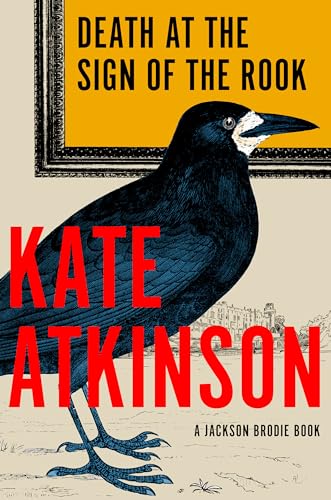 mys british ****
Death at the Sign of the Rook Kate Atkinson
Took me a little while to get hooked, but then I was off and running.
Jackson Brodie is just one of those fictional characters you badly want to exist for real, like Francis Crawford of Lymond (see Dorothy Dunnett. Jackson is a grandfather and slowing down now (I suspect Kate has had him age along with the rest of us) but I sense a worthy new character in Ben, the veteran of Afghanistan. One of the fun elements are the sly 'homages' to other mystery writers--I'm not hugely read in the genre but enough to get many of them. This is Atkinson in a playful mood and I love it. ****1/2
 mys british ****
Death at the Sign of the Rook Kate Atkinson
Took me a little while to get hooked, but then I was off and running.
Jackson Brodie is just one of those fictional characters you badly want to exist for real, like Francis Crawford of Lymond (see Dorothy Dunnett. Jackson is a grandfather and slowing down now (I suspect Kate has had him age along with the rest of us) but I sense a worthy new character in Ben, the veteran of Afghanistan. One of the fun elements are the sly 'homages' to other mystery writers--I'm not hugely read in the genre but enough to get many of them. This is Atkinson in a playful mood and I love it. ****1/2
35sibylline
79.♬ rr fantasy
The High King's Tomb (3 GR) Kristen Britain
There is nothing easy about Karigan's path. Like Lil Ambrioth she has been tapped to travel into time and 'the shadows'--essentially a close cousin to death. What engages me most this time is the fact that Karigan can be totally self-absorbed, irritated by others, annoying, presumptuous, impetuous and many other qualities that are not exactly stellar, but the other side of her characters is unflagging loyalty, innate kindness, courage (also to face herself), curiosity, . . . and those qualities, good and bad, seem very much united and necessary to create someone 'big' enough to take on what she has been asked to take on.
Reread as a listen -- I've become accustomed to Ellen Archer's voice.
Rereading the GR series (listening actually)--Karrigan is beginning to settle in to being a Green Rider but her impulsiveness and outspokenness both help and hinder . . . She's caught King Zachary's attention and the attention of others, more in the spirit world. Very enjoyable! ****
 fantasy
 The High King's Tomb (3 GR) Kristen Britain
There is nothing easy about Karigan's path. Like Lil Ambrioth she has been tapped to travel into time and 'the shadows'--essentially a close cousin to death. What engages me most this time is the fact that Karigan can be totally self-absorbed, irritated by others, annoying, presumptuous, impetuous and many other qualities that are not exactly stellar, but the other side of her characters is unflagging loyalty, innate kindness, courage (also to face herself), curiosity, . . . and those qualities, good and bad, seem very much united and necessary to create someone 'big' enough to take on what she has been asked to take on.
Reread as a listen -- I've become accustomed to Ellen Archer's voice.
Rereading the GR series (listening actually)--Karrigan is beginning to settle in to being a Green Rider but her impulsiveness and outspokenness both help and hinder . . . She's caught King Zachary's attention and the attention of others, more in the spirit world. Very enjoyable! ****
36LizzieD
Holy Moly, Lucy! I just looked at your current books: I. Murdoch on metaphysics AND Wordsworth!?!?!?!?! You are a brave, brave woman. I'd say that you need a lot of fantasy at this point.
37sibylline
Don't get too excited -- I read somewhere around 5 pages of the Murdoch a night. It is fascinating and she is tactfully skeptical of the 'structuralists' and their motives and their understanding of human needs and nature. I loathe Derrida and all of that school, so I have been enjoying her.
As for Wordsworth, that goes in fits and starts but I have gotten as far as *The Prelude* and found, on youtube a young man poet/actor Arthur Wood reading it and he is lovely to hear.
No doubt in my mind that the first part of the poem is at least some of the inspiration for Thoreau's Walden.
As for Wordsworth, that goes in fits and starts but I have gotten as far as *The Prelude* and found, on youtube a young man poet/actor Arthur Wood reading it and he is lovely to hear.
No doubt in my mind that the first part of the poem is at least some of the inspiration for Thoreau's Walden.
38sibylline
80. rr fantasy ****
The King's Dragon (1 CoS) Kate Elliott
Another reread -- I just loved this series the first time around and I think I'm approaching that 'time of life' when I'd rather reread something I enjoyed than spend time on things iffy. I still try new things, but I never used to have such a strong longing to revisit.
CoS--the whole series--is terrifically complex, parallel worlds and dimensions, suspicion, intolerance, ambition, it's all there and more plus very appealing characters, from Alain a young man of mysterious birth who turns out to probably be the son of the local count to Liathano, a beautiful young woman, also of mysterious birth, whose father was a sorcerer and who falls prey to the ambitions of a frater (priest in this world), a vulnerable king who has to decide between three legitimate children or his bastard son as his heir--and the bastard son himself, Sanglant, yet a third of mysterious birth, at least, as far as who his mother was, and the king prefers his bastard son who is a great warrior. There are others, as I said, complex! Some not human, or sort of? In this culture men and women have different roles, different sources of power, but some things don't change, like lust (not just for sex either, but power). On to book 2! ****
 fantasy ****
The King's Dragon (1 CoS) Kate Elliott
Another reread -- I just loved this series the first time around and I think I'm approaching that 'time of life' when I'd rather reread something I enjoyed than spend time on things iffy. I still try new things, but I never used to have such a strong longing to revisit.
CoS--the whole series--is terrifically complex, parallel worlds and dimensions, suspicion, intolerance, ambition, it's all there and more plus very appealing characters, from Alain a young man of mysterious birth who turns out to probably be the son of the local count to Liathano, a beautiful young woman, also of mysterious birth, whose father was a sorcerer and who falls prey to the ambitions of a frater (priest in this world), a vulnerable king who has to decide between three legitimate children or his bastard son as his heir--and the bastard son himself, Sanglant, yet a third of mysterious birth, at least, as far as who his mother was, and the king prefers his bastard son who is a great warrior. There are others, as I said, complex! Some not human, or sort of? In this culture men and women have different roles, different sources of power, but some things don't change, like lust (not just for sex either, but power). On to book 2! ****
39sibylline
81. Prince of Dogs (2 CoS) Kate Elliott
40sibylline
e-book fantasy
Prince of Dogs (2CoS) Kate Elliott
Sanglant, King Henry's bastard son and the former Captain of his guards, the King's Dragons, is now the prisoner of Bloodheart, of 'the rock people, the Eika' -- is chained in the Cathedral of fallen Gent. Henry believe him dead and is being pressured to choose his heir. Alain is stepping up to his 'new' father's expectations, Liath has joined the Eagles, the king's messengers and, for now, is free of Hugh, but he is always lurking in the background. The challenge here for Elliott was to portray Sanglant's suffering and gradual identification with the 'Eika' dogs that he masters. It's so well done and one of the things that drew me back to rereading. Sanglant's mother laid a geas on him that he could not be killed by anything 'earthly' -- so even after receiving death wounds, he lives and suffers.
Another reread -- I just loved this series the first time around and I think I'm approaching that 'time of life' when I'd rather reread something I enjoyed than spend time on things iffy. I still try new things, but I never used to have such a strong longing to revisit.
CoS--the whole series--is terrifically complex, parallel worlds and dimensions, suspicion, intolerance, ambition, it's all there and more plus very appealing characters, from Alain a young man of mysterious birth who turns out to probably be the son of the local count to Liathano, a beautiful young woman, also of mysterious birth, whose father was a sorcerer and who falls prey to the ambitions of a frater (priest in this world), a vulnerable king who has to decide between three legitimate children or his bastard son as his heir--and the bastard son himself, Sanglant, yet a third of mysterious birth, at least, as far as who his mother was, and the king prefers his bastard son who is a great warrior. In this culture men and women have different but important, crucial roles to play, different sources of power, but some things don't change, like lust (not just for sex either, but power). On to book 3! ****
 fantasy
Prince of Dogs (2CoS) Kate Elliott
Sanglant, King Henry's bastard son and the former Captain of his guards, the King's Dragons, is now the prisoner of Bloodheart, of 'the rock people, the Eika' -- is chained in the Cathedral of fallen Gent. Henry believe him dead and is being pressured to choose his heir. Alain is stepping up to his 'new' father's expectations, Liath has joined the Eagles, the king's messengers and, for now, is free of Hugh, but he is always lurking in the background. The challenge here for Elliott was to portray Sanglant's suffering and gradual identification with the 'Eika' dogs that he masters. It's so well done and one of the things that drew me back to rereading. Sanglant's mother laid a geas on him that he could not be killed by anything 'earthly' -- so even after receiving death wounds, he lives and suffers.
Another reread -- I just loved this series the first time around and I think I'm approaching that 'time of life' when I'd rather reread something I enjoyed than spend time on things iffy. I still try new things, but I never used to have such a strong longing to revisit.
CoS--the whole series--is terrifically complex, parallel worlds and dimensions, suspicion, intolerance, ambition, it's all there and more plus very appealing characters, from Alain a young man of mysterious birth who turns out to probably be the son of the local count to Liathano, a beautiful young woman, also of mysterious birth, whose father was a sorcerer and who falls prey to the ambitions of a frater (priest in this world), a vulnerable king who has to decide between three legitimate children or his bastard son as his heir--and the bastard son himself, Sanglant, yet a third of mysterious birth, at least, as far as who his mother was, and the king prefers his bastard son who is a great warrior. In this culture men and women have different but important, crucial roles to play, different sources of power, but some things don't change, like lust (not just for sex either, but power). On to book 3! ****
41sibylline
81.
The Locked Room Elly Griffiths mys british
A new neighbour and covid take center stage here . . . the dance between Harry and Ruth continues. Michelle is stuck up north visiting family and by the time she returns, subtle but telling changes are grumbling like a big storm approaching. Oh and there's murders going on that look like suicides . . . it's a pretty good twist, if not terribly subtle . . . the psychological angle. You'll see. I delayed reading this and I see the next book is out! Yippee! Supposedly the last, I gather. ****

The Locked Room Elly Griffiths mys british
A new neighbour and covid take center stage here . . . the dance between Harry and Ruth continues. Michelle is stuck up north visiting family and by the time she returns, subtle but telling changes are grumbling like a big storm approaching. Oh and there's murders going on that look like suicides . . . it's a pretty good twist, if not terribly subtle . . . the psychological angle. You'll see. I delayed reading this and I see the next book is out! Yippee! Supposedly the last, I gather. ****
42sibylline
82. 
Blackveil (GR4) Kristen Britain
The reread continues! Twelve enter Blackveil, six Eletians and six Sacoridians, including three Green Riders, Kerigan, Lynx (new) and Yates. The Eletians are determined to see what remains of Argenthyne, their centre of their former lands, ruined by Mornhavon. (Kerigan kicked him into the future in Book 2, so for now he is still off-stage.) Other things are going on, of course, Alton continues to struggle to heal the wall. A new visitor to the wall, Estral Andovian arrives, the icky second empire 'grandmother' continues to conspire (really she is just unbearably horrible). Oh and the first part of the book Kerigan is home and confronts her father with all his sins of pirating and his connections to a brothel she discovered in the last book.( Sometimes Kerigan's naivete is a little tedious.) And so it goes, on to Book 5! ****

Blackveil (GR4) Kristen Britain
The reread continues! Twelve enter Blackveil, six Eletians and six Sacoridians, including three Green Riders, Kerigan, Lynx (new) and Yates. The Eletians are determined to see what remains of Argenthyne, their centre of their former lands, ruined by Mornhavon. (Kerigan kicked him into the future in Book 2, so for now he is still off-stage.) Other things are going on, of course, Alton continues to struggle to heal the wall. A new visitor to the wall, Estral Andovian arrives, the icky second empire 'grandmother' continues to conspire (really she is just unbearably horrible). Oh and the first part of the book Kerigan is home and confronts her father with all his sins of pirating and his connections to a brothel she discovered in the last book.( Sometimes Kerigan's naivete is a little tedious.) And so it goes, on to Book 5! ****
43sibylline
DNF DNF
DNF
I stopped listening because it became apparent to me that there would be little character development -- the book is in the manner of the games people play on the internet, d&d etc. You make up a place and then make up the conflict and then the players, good and bad, go from task to task, problem to problem. There's no there there for me. My interest does not hold.
 DNF
DNFI stopped listening because it became apparent to me that there would be little character development -- the book is in the manner of the games people play on the internet, d&d etc. You make up a place and then make up the conflict and then the players, good and bad, go from task to task, problem to problem. There's no there there for me. My interest does not hold.
44sibylline
83.  mystery India 1920
A Necessary Evil(2) Abir Mukherjee
I'll keep reading this series for the setting (superb) and the character of Surrender-Not (wonderful) but . . . Captain Wyndham has yet to fully engage me although, no, wait, that's not quite true, his addiction to opium does pique interest, as in, how is he going to deal with this? It is even possible that Mukherhjee is on purpose giving him the numbed quality of many men from WW1 who spent time in the trenches, exhibited, among others, little fear of death. Be that as it may, the plot was ok but I did figure it out. ***1/2
 mystery India 1920
A Necessary Evil(2) Abir Mukherjee
I'll keep reading this series for the setting (superb) and the character of Surrender-Not (wonderful) but . . . Captain Wyndham has yet to fully engage me although, no, wait, that's not quite true, his addiction to opium does pique interest, as in, how is he going to deal with this? It is even possible that Mukherhjee is on purpose giving him the numbed quality of many men from WW1 who spent time in the trenches, exhibited, among others, little fear of death. Be that as it may, the plot was ok but I did figure it out. ***1/2

46sibylline
85. ♬ ♬
♬
Mirror Sight (GR5) Kristen Britain
This fifth instalment is different in that Karigan is thrust into the future into an almost unrecognisable world -- except that it is physically very much her own world fallen under the sway of a mad dictator. Her qualities, the good and the problematical, are very much in evidence as she struggles to come to terms with a world where women are second class citizens in every way and half the population is literally enslaved and only a few at the very top, 'the Preferred' are remotely 'safe'. She realises that Westrion (god of death) brought her here to experience this future and that she must find a way to return to her time, so as to bring back . . . enough knowledge to shift the future?? Another person from her time, Lhean and Eletian is also trapped in the future and she is determined to free him. She also meets Cade Harlow . . . . at last someone both worthy of her and in classic Karigan fashion she is 100%.I like this wrinkle -- it shifts and changes Karigan vis a vis King Zachary -- he has had to marry someone he likes but doesn't love, but she has known real love now . . . ****
 ♬
♬Mirror Sight (GR5) Kristen Britain
This fifth instalment is different in that Karigan is thrust into the future into an almost unrecognisable world -- except that it is physically very much her own world fallen under the sway of a mad dictator. Her qualities, the good and the problematical, are very much in evidence as she struggles to come to terms with a world where women are second class citizens in every way and half the population is literally enslaved and only a few at the very top, 'the Preferred' are remotely 'safe'. She realises that Westrion (god of death) brought her here to experience this future and that she must find a way to return to her time, so as to bring back . . . enough knowledge to shift the future?? Another person from her time, Lhean and Eletian is also trapped in the future and she is determined to free him. She also meets Cade Harlow . . . . at last someone both worthy of her and in classic Karigan fashion she is 100%.
47sibylline
86.  fantasy
Child of Flame (CoS4) Kate Elliott
Two central stories in book 4, first Liath's discovery of who she really is and second, Alain's journey into the past.
 fantasy
Child of Flame (CoS4) Kate Elliott
Two central stories in book 4, first Liath's discovery of who she really is and second, Alain's journey into the past.
49LizzieD
I am in NOW WHAT? mode. I can't reply to any PMs. I click on "Reply", and the next post down moves down a line. No box for typing. So, I'm replying here and hoping that it's a bug they can fix and not in my computer.
We're fine. I finished *PoD* and we got a bit over an inch of rain since last night. That's my big news.
We're fine. I finished *PoD* and we got a bit over an inch of rain since last night. That's my big news.
50sibylline
>49 LizzieD: It isn't a bug, someone has come in and trampled on the messaging 'to make it better'. It's not broken, so we'd better break it. Happening right from the top down.
Since nobody but you visits my thread why don't you just come here - I can post my comments about books publicly on the book page, after all, not that it matters.
Since nobody but you visits my thread why don't you just come here - I can post my comments about books publicly on the book page, after all, not that it matters.
51sibylline
I suppose I can make a private group that we can all make threads on for each other, a sort of honour system? I know I wouldn't read your notes to Roni and v versa.
53RebaRelishesReading
>50 sibylline: Hi Lucy -- Just wanted to let you know that I do visit your thread -- hope you and the puppies (and family too of course) are well.
54LizzieD
I left one last pm to you since Tim did fix reply.
Good Night, Irene sounds great to me. You know me; I would want the comma.
Since I often copy what I write for Roni or you, whichever I happen to do first, I'm fine without an honor system unless you both want one. We can figure it out as we go along.
Good Night, Irene sounds great to me. You know me; I would want the comma.
Since I often copy what I write for Roni or you, whichever I happen to do first, I'm fine without an honor system unless you both want one. We can figure it out as we go along.
55sibylline
>53 RebaRelishesReading: Hi Reba! I'm so pleased that anyone stops in. I've been utterly ruthless about the internet generally and LT socialising has really suffered,
56laytonwoman3rd
I lost you somehow, Lucy, but I promise I'll be stopping in regularly now.
57bell7
*waving* hello, Lucy, and sorry it's been so long since I've visited/posted. Also sorry to see from an earlier thread that Posey has passed away. *Hugs* to you and your family.
58sibylline
I put this on my 2024 thread, shows you where my head is(n't)
Miss Posey, Dec 2010 to Oct 5 2025

The painting is courtesy of my daughter.
Miss Posey, Dec 2010 to Oct 5 2025

The painting is courtesy of my daughter.
59laytonwoman3rd
How lovely to have that special portrait of her.
60RebaRelishesReading
I saw your 2024 thread first so commented there but I'll repeat that you have my deepest sympathy. From all of your posts I know that Posey was a beautiful, sweet, loving, good girl and will be deeply missed. The portrait is lovely and I'm sure it will bring comfort through the years reminding you of your dear Posey.
61sibylline
Thank you twice, Reba!
>59 laytonwoman3rd: That portrait is so alive. I will cherish it -- and I rarely use that word.
>59 laytonwoman3rd: That portrait is so alive. I will cherish it -- and I rarely use that word.
62lauralkeet
Oh dear, like Reba I saw your 2024 post first. I'm so very sorry to see this, Lucy. I love the portrait. Hugs to you and your family.
63sibylline
>62 lauralkeet: Thank you Laura.
64qebo
>58 sibylline: Oh no! I'm so sorry. Posey has been such a presence.
65sibylline
87.  fantasy ****
The Gathering Storm (CoS5) Kate Elliott
On the eve of the anticipated return of the Aioi land form to Earth the factions continue to either ignore the portents or pretend it isn't happening, or that it will be a great success. A few urge others to prepare (hopeless task). Sanglant has to rout the Qumans, Henry is bespelled, the baddies, Anne in particular, are in full pursuit of their aims.
 fantasy ****
The Gathering Storm (CoS5) Kate Elliott
On the eve of the anticipated return of the Aioi land form to Earth the factions continue to either ignore the portents or pretend it isn't happening, or that it will be a great success. A few urge others to prepare (hopeless task). Sanglant has to rout the Qumans, Henry is bespelled, the baddies, Anne in particular, are in full pursuit of their aims.
66sibylline
88.  fiction british
*****
Loved and Missed Susie Boyt
Reminder: I do not write 'reviews' - I write what the book made me think about or feel or whatever.
A study, in a way, of four generations of single mothers with one child, a daughter. A landscape devoid of men in any intimate way--which in my view is not all that significant in terms of what Boyt is driving at. For all the supposed 'norm' we all cling to, the truth is, so many families, like this one ARE the norm because there is no norm. (One could say the same for all men dyad families, btw and any other combo you want to think up). The protagonist, Ruth, is the second of the four generations and is daughter (through memory here) /mother/grandmother. I think what emerged for me were two major threads -- one that such families are incredibly fragile -- if one person 'leaves' (literally through death or refusing to be part of the pair) the whole thing falls apart, both people are left untethered; in that vein it is also all too easy for one person to overwhelm the other with need. At the core of 'why' Boyt seems to be calmly demonstrating that at the core of how some thrive and some do not is emotional resilience- the grandchild 'kidnapped' (not really) and raised by her grandmother is just such a person: born inherently resilient. I've read of studies about resilience -- that in the same family children who experience almost identical trauma and then receive the same care, do not recover similarly. Some move on, some are destroyed -- most are probably somewhere in between. In a family this small, consequences of even smaller losses and problems, are magnified, in a larger one I suspect that those 'in-between' can be greatly helped if they have supportive family members and feel loved. At the core is a mystery, a painful one at that. I could go on and on but I'll stop and say that Boyt weaves the story beautifully, some recollections here, the present moment there . . . much wit as well, often very wry. Much is left opaque and unsaid. A painful read but worthwhile *****
 fiction british
*****
Loved and Missed Susie Boyt
Reminder: I do not write 'reviews' - I write what the book made me think about or feel or whatever.
A study, in a way, of four generations of single mothers with one child, a daughter. A landscape devoid of men in any intimate way--which in my view is not all that significant in terms of what Boyt is driving at. For all the supposed 'norm' we all cling to, the truth is, so many families, like this one ARE the norm because there is no norm. (One could say the same for all men dyad families, btw and any other combo you want to think up). The protagonist, Ruth, is the second of the four generations and is daughter (through memory here) /mother/grandmother. I think what emerged for me were two major threads -- one that such families are incredibly fragile -- if one person 'leaves' (literally through death or refusing to be part of the pair) the whole thing falls apart, both people are left untethered; in that vein it is also all too easy for one person to overwhelm the other with need. At the core of 'why' Boyt seems to be calmly demonstrating that at the core of how some thrive and some do not is emotional resilience- the grandchild 'kidnapped' (not really) and raised by her grandmother is just such a person: born inherently resilient. I've read of studies about resilience -- that in the same family children who experience almost identical trauma and then receive the same care, do not recover similarly. Some move on, some are destroyed -- most are probably somewhere in between. In a family this small, consequences of even smaller losses and problems, are magnified, in a larger one I suspect that those 'in-between' can be greatly helped if they have supportive family members and feel loved. At the core is a mystery, a painful one at that. I could go on and on but I'll stop and say that Boyt weaves the story beautifully, some recollections here, the present moment there . . . much wit as well, often very wry. Much is left opaque and unsaid. A painful read but worthwhile *****
67sibylline
89. 
Smoke and Ashes (3) Abir Mukherjee
Book Three takes off -- the plot is good and Sam Wyndham is struggling with his demon--his addiction to opium brough about by having been given morphine for his WW1 injuries. 1921 and Ghandi's campaign is taking root. Prince Edward is sent to tour India. Peaceful protests are planned, but . . . there is reason to believe that something dangerous is afoot. On to book 4!

Smoke and Ashes (3) Abir Mukherjee
Book Three takes off -- the plot is good and Sam Wyndham is struggling with his demon--his addiction to opium brough about by having been given morphine for his WW1 injuries. 1921 and Ghandi's campaign is taking root. Prince Edward is sent to tour India. Peaceful protests are planned, but . . . there is reason to believe that something dangerous is afoot. On to book 4!
69LizzieD
Hmmmm. I haven't taken up the first Mukherjee yet although I want to...... I thought I had all 4, but it turns out that the 4th is by a Neel Mukherjee. Oh well. It looks pretty good too.
71sibylline
90.  fantasy ****
In the Ruins (CoS6) Kate Elliott
The cataclysm has happened and rumours abound--few understand the contribution Liath made. No one knows who lives or dies. Chance meetings of survivors begin to draw a picture of the potential for new configurations and centers of power. The Ashioi are back and eager for revenge (on literally anyone not Ashioi). It is clear Sanglant is going to have a hard time convincing anyone who wasn't there that he did not kill his father, on the contrary, saved him even if only at the last minute which will interfere with his ability to lead. It is apparent that unless Sanglant can pull everyone together the Ashioi will massacre everyone else -- and the Eika with Stronghand leading them, will get all the rest. Elliott excels here at demonstrating the consequences of refusing to consider 'the bigger picture', of factions stubbornly clinging to what they have. Can't blame them exactly, but the exceptions stand out. Alain's story begins to 'straighten out' although wanting to unravel the mystery of his parentage is a continual itch -- but perhaps he is meant to be a mystery, the unknowable element. We'll see. There was, somewhere in an earlier book a reference to the dogs being a gift from . . . . one of the 'gods'? I wish I had marked it better. Impossible to find now. Things move slowly in this volume. ****
 fantasy ****
In the Ruins (CoS6) Kate Elliott
The cataclysm has happened and rumours abound--few understand the contribution Liath made. No one knows who lives or dies. Chance meetings of survivors begin to draw a picture of the potential for new configurations and centers of power. The Ashioi are back and eager for revenge (on literally anyone not Ashioi). It is clear Sanglant is going to have a hard time convincing anyone who wasn't there that he did not kill his father, on the contrary, saved him even if only at the last minute which will interfere with his ability to lead. It is apparent that unless Sanglant can pull everyone together the Ashioi will massacre everyone else -- and the Eika with Stronghand leading them, will get all the rest. Elliott excels here at demonstrating the consequences of refusing to consider 'the bigger picture', of factions stubbornly clinging to what they have. Can't blame them exactly, but the exceptions stand out. Alain's story begins to 'straighten out' although wanting to unravel the mystery of his parentage is a continual itch -- but perhaps he is meant to be a mystery, the unknowable element. We'll see. There was, somewhere in an earlier book a reference to the dogs being a gift from . . . . one of the 'gods'? I wish I had marked it better. Impossible to find now. Things move slowly in this volume. ****
72sibylline
91.  fantasy ****
Crown of Stars Kate Elliott
The final book of the saga is reached at long last! Some fiddling goes on to secure a 'happy' ending, but that's ok. I loved Alain's story! ****
 fantasy ****
Crown of Stars Kate Elliott
The final book of the saga is reached at long last! Some fiddling goes on to secure a 'happy' ending, but that's ok. I loved Alain's story! ****

74sibylline
93.  mys india ****
Death in the East (W&B4) Abir Mukherjee
Best one yet! Wyndham is trying to break the opium habit that is taking him over and he goes to an ashram. Of course, the plot soon draws him into the Anglo community and it turns out that someone from his past is not a figment he thought might be haunting him while he hallucinates out of his dependence . . . ****
 mys india ****
Death in the East (W&B4) Abir Mukherjee
Best one yet! Wyndham is trying to break the opium habit that is taking him over and he goes to an ashram. Of course, the plot soon draws him into the Anglo community and it turns out that someone from his past is not a figment he thought might be haunting him while he hallucinates out of his dependence . . . ****
75sibylline
94.  contemp fic ****1/2
Signs Preceding the End of the World Yuri Herrera
Read for my writerly book group. A young Mexican woman crosses the US border to seek her brother. She is brave and observant and resourceful. The book is written in short intense bursts, very cinematic, really. One could read this book several times, pick it apart, and find it breaktakingly well thought out and put together. But the takeaway will remain the same: Crossing borders must never be taken lightly. And some borders in particular change the one who crosses, a death occurs, not necessarily literal, but powerfully life-changing. Nothing will be the same after. Kind of a five star, but I was left . . . annoyed by the ambiguity of the ending, thought it unnecessary. His choice, fine. ****1/2
 contemp fic ****1/2
Signs Preceding the End of the World Yuri Herrera
Read for my writerly book group. A young Mexican woman crosses the US border to seek her brother. She is brave and observant and resourceful. The book is written in short intense bursts, very cinematic, really. One could read this book several times, pick it apart, and find it breaktakingly well thought out and put together. But the takeaway will remain the same: Crossing borders must never be taken lightly. And some borders in particular change the one who crosses, a death occurs, not necessarily literal, but powerfully life-changing. Nothing will be the same after. Kind of a five star, but I was left . . . annoyed by the ambiguity of the ending, thought it unnecessary. His choice, fine. ****1/2
76LizzieD
You have been VERY busy, Lucy! I am finally reading Elliott 3 - have just gotten through the two marriages and am back with 5th Son for the moment. I have a long way to go.
77sibylline
More like I haven't been coming here to (for lack of a better word) catalogue my reading! Getting to it today. I missed ALL of October, yeesh.
78sibylline
95. 
A Family History: 1410-1688 Hugh Archibald Wyndham history british 15-17th
The reason I am reading this (and Volume II) is, shall we say, for 'atmosphere' -- The Wyndhams are a classic family of the 'gentry' from the 1400's to the present. Survivors, aggressive enough to protect their interests (whether with arms or litigation), they endure. Some fall out of even the gentry proper by emigrating to America or Australia (where they do well, btw), at the apex is an Earl (of Egremont) and that title endures. Not quite a prolific bunch, they nonetheless produce enough sons, most of the times, to keep key branches going. In many ways the book is confusing, even unreadable, but luckily no one was going to test me. What I did learn, however, was that starting around this time LITIGATION rather than outright violence became the preferred route for acquiring, maintinging property and wreaking revenge -- which includes ENDLESS wrangling over seats in the Commons, who cheated, who had the right to vote, what areas elected who to what seats, etcetera. Sound familiar? Not rated. But weirdly entertaining.

A Family History: 1410-1688 Hugh Archibald Wyndham history british 15-17th
The reason I am reading this (and Volume II) is, shall we say, for 'atmosphere' -- The Wyndhams are a classic family of the 'gentry' from the 1400's to the present. Survivors, aggressive enough to protect their interests (whether with arms or litigation), they endure. Some fall out of even the gentry proper by emigrating to America or Australia (where they do well, btw), at the apex is an Earl (of Egremont) and that title endures. Not quite a prolific bunch, they nonetheless produce enough sons, most of the times, to keep key branches going. In many ways the book is confusing, even unreadable, but luckily no one was going to test me. What I did learn, however, was that starting around this time LITIGATION rather than outright violence became the preferred route for acquiring, maintinging property and wreaking revenge -- which includes ENDLESS wrangling over seats in the Commons, who cheated, who had the right to vote, what areas elected who to what seats, etcetera. Sound familiar? Not rated. But weirdly entertaining.
79sibylline
96. 
Derring Do For Beginners Victoria Goddard
The early days of some members of the future Red Company, Jullanar and Damian . . . and the rather dramatic arrival of Fitzroy Angursell. If you love the Nine Worlds, you will be happy. No more need be said. ****

Derring Do For Beginners Victoria Goddard
The early days of some members of the future Red Company, Jullanar and Damian . . . and the rather dramatic arrival of Fitzroy Angursell. If you love the Nine Worlds, you will be happy. No more need be said. ****
80sibylline
97. 
The Dream Gatherer (GR6.5) Kristen Britain
A very short instalment in which Estral finds the Berry sisters while she is on her way back to Selium. Pleasant, but there was a lot of filler at the beginning. ***

The Dream Gatherer (GR6.5) Kristen Britain
A very short instalment in which Estral finds the Berry sisters while she is on her way back to Selium. Pleasant, but there was a lot of filler at the beginning. ***
81sibylline
98. 
Till Human Voices Wake Us Victoria Goddard
I did not quite finish this, but close. And needless to say, I found it somewhat problematical as a read. I get what Goddard was trying to do -- show how impossible it is to be both a human and a lord of one of the nine worlds . . . in this case Ysthar (Earth, that is). But something about the prose was tangled and exhausting and . . . dare I say it . . . rather tediously ornate and convoluted and repetitive. I love Goddard so much that I persevered, until I couldn't, plus it had become obvious what would 'happen.' The Lord of Ysthar is, apparently, the offspring of Damian of the Red Company, but he is also a king (or something) in his own right, his family banished from their original home to Ixsaa (I gathered this more from the Derring Do book above) in a war. He has lived a long long time and is engaged in a horrible to the death 'game' with 'Circe' that ends during the course of the book. One of his siblings, a twin, shows up right at this time . . . . I could go on, there is so much happening. I may not have put the book down forever, but at the moment I don't have the patience or the wherewithal to disentangle the threads and smooth them out and see the big picture--I am sure there is one.
Now I am fascinated nonetheless by the close use of themes, quotes, (and undoubtedly much more that I have missed) from Hamlet and from T. S. Eliot's poem, "The Love Song of J. Alfred Prufrock" which I enjoyed rereading although it did not illuminate a great deal. Yet. I will be patient with myself.

Till Human Voices Wake Us Victoria Goddard
I did not quite finish this, but close. And needless to say, I found it somewhat problematical as a read. I get what Goddard was trying to do -- show how impossible it is to be both a human and a lord of one of the nine worlds . . . in this case Ysthar (Earth, that is). But something about the prose was tangled and exhausting and . . . dare I say it . . . rather tediously ornate and convoluted and repetitive. I love Goddard so much that I persevered, until I couldn't, plus it had become obvious what would 'happen.' The Lord of Ysthar is, apparently, the offspring of Damian of the Red Company, but he is also a king (or something) in his own right, his family banished from their original home to Ixsaa (I gathered this more from the Derring Do book above) in a war. He has lived a long long time and is engaged in a horrible to the death 'game' with 'Circe' that ends during the course of the book. One of his siblings, a twin, shows up right at this time . . . . I could go on, there is so much happening. I may not have put the book down forever, but at the moment I don't have the patience or the wherewithal to disentangle the threads and smooth them out and see the big picture--I am sure there is one.
Now I am fascinated nonetheless by the close use of themes, quotes, (and undoubtedly much more that I have missed) from Hamlet and from T. S. Eliot's poem, "The Love Song of J. Alfred Prufrock" which I enjoyed rereading although it did not illuminate a great deal. Yet. I will be patient with myself.
82sibylline
As of October 5, Miss Posey has joined the other corgis in
The Rowdy Corner (a bunch of corgis together is a rowdy of corgis)
My friend Ronincats had a friend make a tiny felt Posey to comfort me:

Haven't felt up to putting this here until now. She was one of those rare dogs both charismatic and generous.
The Rowdy Corner (a bunch of corgis together is a rowdy of corgis)
My friend Ronincats had a friend make a tiny felt Posey to comfort me:

Haven't felt up to putting this here until now. She was one of those rare dogs both charismatic and generous.
83lauralkeet
>82 sibylline: Awww what a sweet memento of a wonderful companion.
84laytonwoman3rd
>82 sibylline: Oh, how adorable. And again, condolences on the passing of your sweet girl. I had an aunt who had corgis---they always seemed so cheerful.
85RebaRelishesReading
>82 sibylline: Oh how sweet (and how thoughtful of Ronincats)
86BLBera
>82 sibylline: That is adorable.
 fantasy ****
 mys india 20th ****
89sibylline
101.  historic magic realism? ***1/2
The Buried Giant Kazuo Ishiguro
I read about this book somewhere in a piece about 'the dark ages' and Arthur legends. A puzzling book and an odd take on that period. Merlin puts a spell on this 'she-dragon' who then breathes a mist that makes people forget everything about their pasts. The idea is stop all the fighting between Britons and Saxons and etc, the vendettas and revenge fights that go on and on creating chaos. But about a hundred other things are going on, an elderly couple on a trip to see their son . . . is it allegory? Metaphor? A cautionary tale? A reflection on how impossible human beings are? I cannot say. Beautifully written, yes. *** 1/2
 historic magic realism? ***1/2
The Buried Giant Kazuo Ishiguro
I read about this book somewhere in a piece about 'the dark ages' and Arthur legends. A puzzling book and an odd take on that period. Merlin puts a spell on this 'she-dragon' who then breathes a mist that makes people forget everything about their pasts. The idea is stop all the fighting between Britons and Saxons and etc, the vendettas and revenge fights that go on and on creating chaos. But about a hundred other things are going on, an elderly couple on a trip to see their son . . . is it allegory? Metaphor? A cautionary tale? A reflection on how impossible human beings are? I cannot say. Beautifully written, yes. *** 1/2
90LizzieD
>89 sibylline: Uh oh...... I have a copy of that, so I guess I'm committed to reading it sometime. If I live long enough. With eyes and brain intact.........
The Mukherjees are much, uch more likely!
The Mukherjees are much, uch more likely!
91sibylline
>90 LizzieD: Those Mukherjees are really growing on me!
You'll see I've started a Janet Neel -- I have a feeling it's #2 but I suspect that won't really matter too much.
You'll see I've started a Janet Neel -- I have a feeling it's #2 but I suspect that won't really matter too much.
92LizzieD
It is the second, and you have the first. It might matter a little. Hope you like it...... I should pick them up for rereading as I try to build my number in spite of starting long books......
93sibylline
102.  mys british 20th ****
Death on Site (2) Janet Neel
I've jumped into this series in the wrong book (#2) but that's ok. I am guessing that this is a series where the real action is in the characters, John the detective and Francesca and her brothers, etc.
Neel makes up for the plot being . . . figure-out-able by having a lot of savvy about the government jobs, building trades, mountain-climbing, choral singing and etc. I have a cousin who climbed K-2 on an American-Russian venture wayyyyy back in the 70's. I'm looking forward to reading #1 and finding out how John and Francesca meet. Verging here and there on being oddly dated for a book written in 1989. ***1/2
 mys british 20th ****
 Death on Site (2) Janet Neel
I've jumped into this series in the wrong book (#2) but that's ok. I am guessing that this is a series where the real action is in the characters, John the detective and Francesca and her brothers, etc.
Neel makes up for the plot being . . . figure-out-able by having a lot of savvy about the government jobs, building trades, mountain-climbing, choral singing and etc. I have a cousin who climbed K-2 on an American-Russian venture wayyyyy back in the 70's. I'm looking forward to reading #1 and finding out how John and Francesca meet. Verging here and there on being oddly dated for a book written in 1989. ***1/2
94sibylline
103.  mys british 20th ***1/2
Death's Bright Angel (1) Janet Neel
John first catches sight of Francesca when he is in the neighborhood where a murder has taken place . . . She has just been assigned to the rescue mission to aid a failing textile concern and lo and behold the fellow murdered worked for that very firm and . . . well. Once again the plot isn't really the point, the characters are. Very enjoyable, but the same caveat as before, oddly dated somehow. ***1/2
 mys british 20th ***1/2
Death's Bright Angel (1) Janet Neel
John first catches sight of Francesca when he is in the neighborhood where a murder has taken place . . . She has just been assigned to the rescue mission to aid a failing textile concern and lo and behold the fellow murdered worked for that very firm and . . . well. Once again the plot isn't really the point, the characters are. Very enjoyable, but the same caveat as before, oddly dated somehow. ***1/2
95sibylline
104.  fiction american contemp
The Lights of Earth Gina Berriault
Let me remind the reader that these are COMMENTS. Meant for me primarily. A case of beautiful writing and a 'story' that does not support the writing. Gotta have both! You have a woman on the edge of being jilted by her lover of several years who has suddenly achieved fame. Big fame. Think Byron, or whatever. So she not only is heartbroken that he is moving on, but she is also, um, green with envy, as are a host of others (like everybody). This makes it a little hard to know just how broken her heart is. Add to that the brother, with some dysfunction, essentially a form of autism, I think, that she has more or less abandoned because she can't bear his need for her, feels he will drag her down from . . . her ambition? But she ALSO has a child who is currently romping about in the Himalayas with a boyfriend. The brother dies and she goes to Chicago to clean up, and frankly, that could have been a short story and very moving. Meanwhile, the sentences and insights (true or fasle, I find her utterly untrustworthy) flow and flow like the sea, the ocean, the waves, the big metaphor of the book . . . One could say that this is a woman trapped 'in-between'--still very much unsure of her own worth as a woman and a writer--of course, progress is slow, but I found her as alien in that regard as someone from a hundred years ago, despite my own not always high opinion of myself! ***1/2
 fiction american contemp
The Lights of Earth Gina Berriault
Let me remind the reader that these are COMMENTS. Meant for me primarily. A case of beautiful writing and a 'story' that does not support the writing. Gotta have both! You have a woman on the edge of being jilted by her lover of several years who has suddenly achieved fame. Big fame. Think Byron, or whatever. So she not only is heartbroken that he is moving on, but she is also, um, green with envy, as are a host of others (like everybody). This makes it a little hard to know just how broken her heart is. Add to that the brother, with some dysfunction, essentially a form of autism, I think, that she has more or less abandoned because she can't bear his need for her, feels he will drag her down from . . . her ambition? But she ALSO has a child who is currently romping about in the Himalayas with a boyfriend. The brother dies and she goes to Chicago to clean up, and frankly, that could have been a short story and very moving. Meanwhile, the sentences and insights (true or fasle, I find her utterly untrustworthy) flow and flow like the sea, the ocean, the waves, the big metaphor of the book . . . One could say that this is a woman trapped 'in-between'--still very much unsure of her own worth as a woman and a writer--of course, progress is slow, but I found her as alien in that regard as someone from a hundred years ago, despite my own not always high opinion of myself! ***1/2
96sibylline
105. ♬ fantasy ****
Falling in a Sea of Stars (GR8) Kristen Britain
Oh my god, hundreds more pages and the story is to be continued and the love interest, well, I won't spoil, but honestly!
 fantasy ****
Falling in a Sea of Stars (GR8) Kristen Britain
Oh my god, hundreds more pages and the story is to be continued and the love interest, well, I won't spoil, but honestly!
97sibylline
106. 
Clown Town Mick Herron mys british, mi5
Not sure why or wherefore but my attention wandered a bit in this one -- I think I can identify when -- Diana talking too much? Speeches from Judd too. The plot was fine, it needn't be more than that as we all read for the characters and their interactions. And the funny dialogue and casual interactions too. Oh, I am sure it is very hard when a book becomes hit and publishers and readers are breathing down your neck to stay fresh, so I forgive, but it is time for a new angle. Roddy continues to entertain, Lech to interest me, River and Sid & ? Future or no future? I adore Lamb, but really, Catherine should knit him a new pair of socks. ****1/2

Clown Town Mick Herron mys british, mi5
Not sure why or wherefore but my attention wandered a bit in this one -- I think I can identify when -- Diana talking too much? Speeches from Judd too. The plot was fine, it needn't be more than that as we all read for the characters and their interactions. And the funny dialogue and casual interactions too. Oh, I am sure it is very hard when a book becomes hit and publishers and readers are breathing down your neck to stay fresh, so I forgive, but it is time for a new angle. Roddy continues to entertain, Lech to interest me, River and Sid & ? Future or no future? I adore Lamb, but really, Catherine should knit him a new pair of socks. ****1/2
98LizzieD
Hmmm. I don't think I'll tackle Britain at all, but I will eventually get to *Clown T.* Forewarned!
99sibylline
I have mixed feeling about The Green Rider series. Some parts are very good, others . . . but we enjoyed listening to it, the reader, Ellen Archer, was pretty good.
100sibylline
107. 
lib Starter Villain John Scalzi urban fantasy
Weeelllll, my spousal unit laughed all the way through this, but I found it amusing but no more than that. So many cultural references and borrowings from Jurassic Park to Mafia movies to sending up those conferences of the high and mighty in Switzerland. And cats and dolphins, maybe they were the best part? I sense a sequel, like what happened to the dolphins? Who has all those billions now?
Not sure I actually care, but whatever. Scalzi is a good story teller and he does amuse.***1/2

lib Starter Villain John Scalzi urban fantasy
Weeelllll, my spousal unit laughed all the way through this, but I found it amusing but no more than that. So many cultural references and borrowings from Jurassic Park to Mafia movies to sending up those conferences of the high and mighty in Switzerland. And cats and dolphins, maybe they were the best part? I sense a sequel, like what happened to the dolphins? Who has all those billions now?
Not sure I actually care, but whatever. Scalzi is a good story teller and he does amuse.***1/2
101sibylline
108. ♬ 
The Prelude William Wordsworth (audio) Poetry 19th
Ian McKellan reads a condensed/compressed version of the Prelude, and very different from the version in my Modern Library edition of Selected Poetry of WW. All in all this version is livelier and I suspect from an earlier iteration. Wordsworth clung to this mss, trying to 'perfect' it, and only made it less immediate, I suspect.
MY POINT IS however that McKellan is, no surprise, marvellous.
And I suspect the editing was good, I have a sense of having been at least introduced and led through the essentials, vividly: early childhood impressions, boyhood romping, school days, university, London, travel through France, newly liberated, walking in the Alps, more university (I think?) and then a devastating trip through France just as the Terror ends when Robespierre is assassinated, and thence into his adult life as a poet. As does Byron later on, Wordsworth did go through a time of watching his peers choose careers (he being gentry not an aristocrat he had, ironically, more choices than did Byron), there can be a defiant hopelessness to choosing the career of a poet then as now. You know you are good for nothing else -- Keats too, whose bio I am also reading, knew he was good for nothing else, even after training to be a surgeon (and perform passably well if not better than most). I'm on a serious romantic poet binge, so bear with me. Remembering always these comments are as much for me as for you, enjoy, but take all I say with a grain of salt! *****

The Prelude William Wordsworth (audio) Poetry 19th
Ian McKellan reads a condensed/compressed version of the Prelude, and very different from the version in my Modern Library edition of Selected Poetry of WW. All in all this version is livelier and I suspect from an earlier iteration. Wordsworth clung to this mss, trying to 'perfect' it, and only made it less immediate, I suspect.
MY POINT IS however that McKellan is, no surprise, marvellous.
And I suspect the editing was good, I have a sense of having been at least introduced and led through the essentials, vividly: early childhood impressions, boyhood romping, school days, university, London, travel through France, newly liberated, walking in the Alps, more university (I think?) and then a devastating trip through France just as the Terror ends when Robespierre is assassinated, and thence into his adult life as a poet. As does Byron later on, Wordsworth did go through a time of watching his peers choose careers (he being gentry not an aristocrat he had, ironically, more choices than did Byron), there can be a defiant hopelessness to choosing the career of a poet then as now. You know you are good for nothing else -- Keats too, whose bio I am also reading, knew he was good for nothing else, even after training to be a surgeon (and perform passably well if not better than most). I'm on a serious romantic poet binge, so bear with me. Remembering always these comments are as much for me as for you, enjoy, but take all I say with a grain of salt! *****
102sibylline
109. 
Witch King (1) Martha Wells
Complicated! Only toward the latter half did I fully (I think) start getting a more coherent picture of the situation. I will do that in case it helps. You have a bunch of different tribal groups, some very different, such as the one that has made a rather involved contract with demons (who live . . . under earth, wherever that actually is). (These demon-mortals develop amazing capabilities.) There are other groups who are immortal (somehow, if it was explained, I missed it) The bad guys have figured out how to be more or less immortal--by way of some form of necromancy, domination by cruel means). They are 'Hierarchs' and for reasons none of the other tribes and cultures can understand they just want to exploit and then kill everyone once fully exploited. So our main character is one of these demon-human meshes and he and several other groups are allied against the Hierarchs, EXCEPT some groups think that by helping the Hierarchs they might a) survive b) profit. Venal idiots, one and all. Anyway, various types have various skills and abilities. One interesting thing is that people in ALL cultures are always not just clothed but FULLY clothed and shocked if you aren't wearing many many layers of clothing and ditto about touching. Touching denotes an enormous level of trust. Anyway good luck. Now that I get it I look forward to book 2. Plenty was left unresolved as our main character made a big boo-boo and his acceptance as a demon is in jeopardy and a couple of other characters good and bad are exhiibiting signs they will be problems down the road. Murderbot this isn't -- it's more like some of Wells earlier books in particular City of Bones.****

Witch King (1) Martha Wells
Complicated! Only toward the latter half did I fully (I think) start getting a more coherent picture of the situation. I will do that in case it helps. You have a bunch of different tribal groups, some very different, such as the one that has made a rather involved contract with demons (who live . . . under earth, wherever that actually is). (These demon-mortals develop amazing capabilities.) There are other groups who are immortal (somehow, if it was explained, I missed it) The bad guys have figured out how to be more or less immortal--by way of some form of necromancy, domination by cruel means). They are 'Hierarchs' and for reasons none of the other tribes and cultures can understand they just want to exploit and then kill everyone once fully exploited. So our main character is one of these demon-human meshes and he and several other groups are allied against the Hierarchs, EXCEPT some groups think that by helping the Hierarchs they might a) survive b) profit. Venal idiots, one and all. Anyway, various types have various skills and abilities. One interesting thing is that people in ALL cultures are always not just clothed but FULLY clothed and shocked if you aren't wearing many many layers of clothing and ditto about touching. Touching denotes an enormous level of trust. Anyway good luck. Now that I get it I look forward to book 2. Plenty was left unresolved as our main character made a big boo-boo and his acceptance as a demon is in jeopardy and a couple of other characters good and bad are exhiibiting signs they will be problems down the road. Murderbot this isn't -- it's more like some of Wells earlier books in particular City of Bones.****
103sibylline
110.  sf *****
Cuckoo's Egg C.J. Cherryh
My reward for working on re-organising a chaotic sf/f collection was finding this Cherryh that I haven't read! What a marvel of crisp, exciting, thoughtful writing it is too. One of Cherryh's talents is to throw you into a completely novel situation pretty much from the perspective of the person -- so you learn what the heck is going on at the same time they do, with maybe here and there, a wee bit of help so . . . you might be slightly ahead of the protagonist. You can see in this too, the genesis of many of Cherryh's concerns: the made people, the clones, and the issues of control and autonomy, the rocketing around space and colliding with civilisations in different phases of development, not to mention simply figuring out how to communicate. Wonderful book. *****
 sf *****
Cuckoo's Egg C.J. Cherryh
My reward for working on re-organising a chaotic sf/f collection was finding this Cherryh that I haven't read! What a marvel of crisp, exciting, thoughtful writing it is too. One of Cherryh's talents is to throw you into a completely novel situation pretty much from the perspective of the person -- so you learn what the heck is going on at the same time they do, with maybe here and there, a wee bit of help so . . . you might be slightly ahead of the protagonist. You can see in this too, the genesis of many of Cherryh's concerns: the made people, the clones, and the issues of control and autonomy, the rocketing around space and colliding with civilisations in different phases of development, not to mention simply figuring out how to communicate. Wonderful book. *****
104sibylline
111.  mys british *****
The Impossible Fortune (5) Richard Osman
Oh, bravo! Another wonderful, clever, and humourous tale about the activities of these denizens of Coopers Chase. A best man goes missing from Joyce's daughter Joanna's wedding and the plot thickens almost immediately. Elizabeth is beginning to come to life again, Ron faces several challenges to do with protecting his family, Joyce and Joanna are both pondering their mother-daughter relationship . . . not everyone takes a central space but little pieces in all of their internal lives and their web of connections develop. Even Connie the drug dealer has her moment. Osman has such a deft touch, never too sentimental, never too sharp either -- it's hard to navigate between tenderness and toughness and he does it. *****
Here is a quote (for my benefit mostly) from one of the more reflective/serious moments, Joanna is pondering her relationship with her mother:
"Why does she always push her Mum away? There's something about that relationship, something about being a child and the need of a child to be an individual, to be something more than the things she'd been taught and the way she'd been raised. The need to somehow teach a lesson to the person who has taught her so many lessons? Joyce's love for her is unconditional. Joanna knows that, but, really, unconditional love has a huge flaw. If you love me, no matter what, who I actually am doesn't matter. If someone loves your essence, your very being, what can you do to make them them love you more or love you less? Nothing: there is no space. So the only option left to you is to continually prod at that unconditional love, to test it and stretch it, to mock it even.
And it's not just that. There is a further problem with unconditional love, isn't there? Because what if you don't love yourself? What if, like Joanna, you obsess over your flaws and weaknesses, you constantly update the balance sheet of your own personality and find it wanting? Well, then the unconditional love of a parent is a sign that they simply don't know you. If they truly knew you, their love would be peppered with, "I love you, but . . ."
Brilliant! And this is just one instance of many.
 mys british *****
The Impossible Fortune (5) Richard Osman
Oh, bravo! Another wonderful, clever, and humourous tale about the activities of these denizens of Coopers Chase. A best man goes missing from Joyce's daughter Joanna's wedding and the plot thickens almost immediately. Elizabeth is beginning to come to life again, Ron faces several challenges to do with protecting his family, Joyce and Joanna are both pondering their mother-daughter relationship . . . not everyone takes a central space but little pieces in all of their internal lives and their web of connections develop. Even Connie the drug dealer has her moment. Osman has such a deft touch, never too sentimental, never too sharp either -- it's hard to navigate between tenderness and toughness and he does it. *****
Here is a quote (for my benefit mostly) from one of the more reflective/serious moments, Joanna is pondering her relationship with her mother:
"Why does she always push her Mum away? There's something about that relationship, something about being a child and the need of a child to be an individual, to be something more than the things she'd been taught and the way she'd been raised. The need to somehow teach a lesson to the person who has taught her so many lessons? Joyce's love for her is unconditional. Joanna knows that, but, really, unconditional love has a huge flaw. If you love me, no matter what, who I actually am doesn't matter. If someone loves your essence, your very being, what can you do to make them them love you more or love you less? Nothing: there is no space. So the only option left to you is to continually prod at that unconditional love, to test it and stretch it, to mock it even.
And it's not just that. There is a further problem with unconditional love, isn't there? Because what if you don't love yourself? What if, like Joanna, you obsess over your flaws and weaknesses, you constantly update the balance sheet of your own personality and find it wanting? Well, then the unconditional love of a parent is a sign that they simply don't know you. If they truly knew you, their love would be peppered with, "I love you, but . . ."
Brilliant! And this is just one instance of many.
105sibylline
112.  metaphysics, philosophy *****
Metaphysics as a Guide to Morals Iris Murdoch
Reader -- I made my way through this work over a six month period -- I will attempt coherent comments! I will likely revise it more than once!
Iris Murdoch's aim is to help envision a way of being that includes both the rational and the ineffable aspects of life, my take on the word she uses: value, that is, ideas that are abstract and evade definition, like love. She saw the west moving toward abandoning the personified God and along with that the baggage of organised religious beliefs which encourage exclusivity, but that would also leave many people adrift, unsure about how to lead moral lives without that structure. She wished to offer an inspiring way for all to approach the problem (a big problem for human beings) of living morally sound lives. The whole book moves with slow, steady, humourous grace and dignity toward this end. I found it fascinating and helpful. You may not.
The argument begins with an examination of metaphysics, beginning with Plato, particularly as regards the idea of good, and more or less ending in the 20th century with Wittgenstein, Weil, Derrida. Kant was really the last philosopher of stature to cling to formal religion--and she shows how difficult that reconciliation was for him. After that philosophers have an increasing tendency to dump the 'value' side -- including even what we experience as individuals! All of this, the mystery, spiritual side of our lives is so inexplicable, slippery, difficult, unmanageable . . . and to focus on what can be truly known more appealing. (I am horribly simplifying, but I will add an image that grew on me as I read . . . men with means sitting in their pleasant studies, surrounded by books, thinking thinking thinking while their women work, have babies (because the men do have their real life desires after all), plan and cook meals, run a household -- how hard they really work depending on how affluent -- in other words these women are LIVING and EXPERIENCING while their men sit in their shadowy rooms thinking thinking thinking. It's very disturbing really, Wittgenstein apparently was very distrustful of experience being of any real worth, if I read this right!). By the 20th century, the concept of the Good is separated from the concept of Duty and Will (largely thanks to Kant). The first just IS, an internal compass knows the difference between Good and Evil. The latter, Duty, provides the structure that human beings need to stay on course--and Will must be deployed to achieve it, as many duties, that lead to the good, are not easy.
An important point tackled by both philosophers and theologians is that Good cannot exist without an opposite. Evil is inextricable from life. Forget about doing away with it, learn to live with it. I interpret that as do your best, learn to compromise, etceterea. Live moderately.
After the philosophers Irish tackles some of the theologians, Anselm, Augustine, Tillich, Buber, et al. She brings in a third concept--pulling the experiential piece back into focus--both the deep artists and deeply religious people seem to move toward an apprehension of the world -- call it Nature? but on a lesser level ordinary humans who spend time on what Keats would call 'negative capability' -- imagining themselves into other people, other animals, even the rocks and waves and wind access the Good in a different way, just as fulfilling and helpful as doing Duty and exerting Will.
She admits that religion's great strength is in ritual. Humans just love ritual, it is comforting.
A final thought she offers is of the existence of a fourth aspect -- the void -- I would say -- where we go when we die? where we are when we are depressed? Or grief stricken? . . . I don't know, but it is a place. A terrible irony in this is that Iris developed Alzheimers and truly lived in the void for the last few years of her life.
A five star book. *****
________
ch1-Unity/Art "The idea of a self-contained unity or limited whole is a fundamental instinctive concept. We see parts of things, we intuit whole things." (e.g. continuity)
"Hume . . . was prepared to say that some of our most cherished unities, the self, the material object, were illusions fostered by imagination, by association of ideas, by 'habit and custom'. 'a notion repugnant to common sense' but --'the strength of our resisitance. p.1
we take refuge in art even if it no longer serves religion and its dogmas. Always iconoclastic. Tension between past works and present. p.8
"We are to be obedient to moral law, subject to the demands of reason. Goodness is not spontaneous. . . We must be humble enough to 'do the next thing', eschewing attractive and grandiose expectations . . 10
'Art fascinates us by exploring the meaner, more peculiar aspects of our being, in comparison with which goodness seems dull." 12
"The lyric poets (Greek) enjoy birds and flowers, but Kantian (or Wordsworthian) sublimity in nature is generally absent from the Greek mind."15
Relationship of knowledge to power--moral problems posed by power. (magic, pride, secret superior knowlege--which infects science and technology). Mathematics 'intoxicated' the Greeks . . . not immune. 17
"Love as the fruit and overflow of spirit": at best 'a process of unselfing wherein the lover learns to seem ad cherish, and respect what is not himself." 17
Freud -- 'fantasy life of the artist stimulating the fantasy life of the viewer reader) 20
p.22 Mention of John Cowper Powys: "Do we not all need what JCP calls 'life illusions'?
Can truth be distinguished from illusion?
problem of language: 'in ethics we are always making the attempt to say something that cannot be said." (Beginning of argument Iris makes that goodness cannot be defined). The running up against this limitation however means something.
Ch 2 Fact and Value Iris moves on to explore FACT and what she calls VALUE (e.g. these things, like goodness or love, that cannot be explained. 29
--Our present-day culture tries very hard to keep fact and value (try, reason vs belief if that helps) separate. 31
Ideas in themselves are not good or bad, it is the imposition of an idea by an individual will that creates the horrors.
MY QUESTION: Does this separation increase the risk of horrors? Each on not tolerating the existence and demands of the other?
Moral change comes from 'attention' to the world. (Weil) 52
Intersection of Duty (reason-based, Kantian) with a reach for goodness (belief-based).
'Morality divides between moral obligation and spiritual change'.
The former can be laid out rationally as what works best. The latter . . . less accessible? 53.
Ch3 Schopenhauer Up front, I have never read S. I.(implying she does not disagree) says Nietzche says, "he held the dialogue between Plato and Kant 'underlies the whole of western philosophy.
Schopenhauer (sez I) drew metaphysics into the modern era "our metaphysical craving' in combination with our 'finite nature'r and= our passionate desire to understand 'the world' which we attempt to intuit as 'a whole'.
Ch4 Art and Religion 'analogy of certain concepts' also as 'an analogy of the self' (conflict?) 85 e.g. a hoax? entirely illusory? How does art relate to 'the good'? It is the product of mortal man. Auden: poetry 'contraption' 'with a man inside it."
5 Comic and Tragic
Great art -- invariably 'tragic' (containing absurdity, which is and isn't comical)
On novels:
"Characters in novels partake of the funniness and absurdity and contingent incompleteness and lack of dignity of people in ordinary life. . . We are, as real people, unfinished and full of blank and jumble; only in our illusioning fantasy are we complete. Good novels concern the fight between good and evil and the pilgrimage from appearance to reality. They expose vanity and inculcate humility. They are amazingly moral" 97
"The sublime is the proud energetic fear with which the rational being faces the contingent dreadfulness of the world." 100
Schopenhauer on tragedy:
"characters of ordinary morality, under circumstances such as often occur, are so situated with regard to each other that their position compels them knowingly and with their eyes open to do each other the greatest injury without any one of them being entirely in the wrong (My it). . . It shows us the greatest misfortune, not as an exception, not as something occasioned by rare circumstances or monstrous characters, but as arising easily and of itself out of the actions and characters of men, indeed almost as essential to them, and thus brings it terribly near to us."
--Thus begins the slow argument Iris develops of the necessity (inevitability?) of evil in order to define good. Can't exist without one another.102-3
Dostoevsky: "We have to mix a little falsehood into truth to make it plausible." 105
ch6 Consciousness and Thought
language is the medium where what goes on in the mind is made (it is to be hoped) coherent both to the self and to others.
p. 163 problem for novels:163
'due to 'the widening abyss between every day language and the technical discussions within the specialised codes of the human sciences has decisively contradicted and surpassed the normal assumptions behind exoteric speech.'
Novels either have to 'simulate an arcadian innocence or translate some of (the new techno discourse, say Freud Marx etc) into (his) work.' Which means a novel is either pseudo-traditional or experimental. YES! And yet . . . .
ch7 Derrida etcIn this chapter Iris examines the bridging philosophers of the 19th - Hegel, Heidigger and the issues that the 'personal' god (in conflict with eastern religious thought give rise to (insolvable, basically).
She also tackles Derrida and his mechanistic (frankly bizarre and sad, to me) way of viewing humans, and language and art.
"We are all workers and, of necessity, in order to live at all, truth-seekers on that familiar everyday (transcendental) edge where language continually struggles with an encountered world." 211
"An inability to be present is something we often feel." 212
"Utopian political theories linked to historical determinism flourish when we lose the ordinary fundamental sense of contingency and accident which belongs with the concept of the individual.' 214 (in other words, you can lump all people into the same mold).
--Moving toward our contemporary mess with the incomprehensible jargon etc of technology and the ordinary human person who has a sense of being left behind, condescended to, disregarded as stupid etcetera.
ch8 Consciousness and Thought 2
"The service of philosophy, of speculative culture, toward the human spirit is to rouse, to startle it into sharp and eager observation." Walter Pater 217
Experience vs theorising (philosophy, theology). Zen, emphasis 'partly in its instruction through art, upon the small contingent details of ordinary life and the natural world."
Concentrated attention diminishes egoism and increases respect for the living world. Cezanne and his mountains. "One returns to the most obvious and most mysterious notion of all, that this present moment is the whole of one's reality, and this at least is unavoidable. (The weirdness of being human.)
On Tolstoy: 'Tolstoy conveys and evaluates conditions of conscious being, the way iun which states of mind . . colour surroundings. 'The world of the happy is not the world of the unhappy'; . . .'to continue the colour metaphor, within any life there is general or prevailing colour, and also local colour, and both may be spoken of as states of prevailing consciousness.. ."
We 'see' good and bad constantly shifting, we evaluate, we judge. 265
9 Wittgenstein
Iris apologises for not being as conversant with W. as, say Plato or Kant, but . . . in she goes. I really never progressed seriously PAST Kant into the more modern realms, but I see that W. is the pioneer in bringing our way of perceiving how we perceive forward into the modern era. Iris: "Our private reflections or 'inner lives' are soaked in values. Do we not therefore need to inspect and evaluate our own private thought-being? A sense of that separation is one of our deepest experiences. We know very little even about the people who are closest to us. We depend upon intuition and rightly accept many things as mysteries. Is not some denial or obfuscation of this picture a move in the direction of behaviourism?" W: 'The results of philosophy are the uncovering of one or another pece of plain nonsense and of the bumps that the understanding has got by running its head against the limits of language." (e.g. theorising about morals). W finds the concept of 'experience' and 'embarrassment' -- just way too messy! NUTS!
10 On Duty and Will
Iris: 'Our attention is continually caught by the details of our surroundings, we can be touched and surprised into an ability to change, to move 'out of ourselves', by all sorts of attentions to other things and people, instinctive overcomings of the barrier between self and world."299
In sum -- Iris sees Duty and Will as being entwined, but ultimately at a lesser level than the (mysterious) urge humans have toward 'the good', toward (moral) 'value'.
This does not mean that the concept of duty (learned best at an early age in a caring environment) is less important -- it is CRITICAL, given how difficult it is for humans to reach for the good, even if we know it is there. This may be one of Iris's most important insights.
11 Imagination
There is what we know and how we 'construct' order out of it (through metaphor, to a great degree).
Iris On inspiration: "any artist or thinker, knows of that may be called 'help from the unconscious mind', sometimes called inspiration. One lives for a time with dull intractable material which is suddenly irradiated and transformed by a new vision. Rat-like fantasies or old stale thoughts are metamorphosed or dislodged by the creative force of the imagination. Such changes, often so remarkable, explicable sometimes, as we may try to see them later as 'quantity in to quality' terms, can appear too as an absolute novelty, something which comes 'from beyond', as it might be from God (Good). -- in some cases we see that 'we are all like that' -- becoming part of a bigger whole. 333
Grace and moral change.
'Eros is neither a mortal nor a great god but a spiritual being residing in-between, a daemon, a great spirit.' 'He lacks goodness and beauty, his is a lover who is forever seeking these, he desires wisdom which is supremely beautiful, he is a creative spirit, he is tension, exertion, zeal." 343
'Plato envisages erotic love as an education, because of its intensity as a source of energy, and because it wrenches our interest out of ourselves." 345 (Comparable to, in Zen, the blow to the head that brings Enlightenment.) (But love is dangerous, can make you insane.)
Where does this emerge from? Inner space. Iris muses: We might think here of spatio-temporal rhythm; a good person might be recognised by his rhythm. An obsessed egoist, almost everyone sometimes, destroys the space and air round about him and is uncomfortable to be with. An unselfish person enlarges the space and the world, we are calmed and composed by 'his/her' presence." 347
12 Morals and Politics
Passage on 353 about tyrants -- the whole of it is edifying, especially this nugget: "Tyrants subjects may even admire and value the egoistic anti-moralism of their leaders. That someone very grand exists who can satisfy every caprice may, while causing scandal, produce a warm feeling, and patriotism too can feed on such images." OUCH!
"It is not the fundamental duty of the state to make us good. It is the fundamental task of each person to make himself good." 362
Around here Iris gets into 'axioms' -- sort of 'givens' you might say, that go beyond 'duty' "One could also say that duty recedes into the most private part of personal morality, whereas axioms are instruments of the public scene."381
Duty requires acting against some natural inclinations, also can be seen as the discipline of desire. 384
vast quantities of secondary moral concepts beyond 'true' and 'good':
generous, gentle, reckless, envious, honest etc.
Ch 13- to the end (e.g. existence of God)
I'm going to blow right through this chapter. Here Iris is entering the latter part of her argument, she is stepping out (the one this book is all about) as she moves toward the next piece of her argument -- that philosophers have rather thoroughly demolished the old idea of the personified God leaving in their wake a confusion. If there is no God, then what is there? The theologists, struggle to sustain and preserve the concepts that accrue to (the non-being who is) God. She is going to move her case now into another realm, replacing God with the Good. With a de-mythologised moral imperative that embraces value, embraces the 'mystery' without aligning it with humans exclusively. Anselm, Augustine, Paul Tillich, Buber et al -- she starts moving through their ideas and arguments. She touches back on Descartes and Kant, the last great believer philosophers. God or The Good cannot actually BE remotely human, given what we are -- The Good, perhaps some creative drive? who knows, one cannot know and that is the point. The religious life, tends toward ritual, ritual being useful to humans as a method of entry into a level of communion with 'the mystery' . She looks at the relationship between morality and religion (including the Eastern concepts that do not require this god-figure) and offers the Axioms, Duties, and Eros as the alternatives. The public given rights (say, Pursuit of Happiness), the tougher, bumpy to stick with Duties, and the eruptions of Eros (or Demiurge), of inspiration and passion that are a bit of oil, that ease the friction of the former.
At the end, in the penultimate chapter, she tackles a fourth element, that of Void. The darkness in the soul (that Augustine confronts). 457
Despair, affliction, dark night. (in physics, the black hole, eh). Is this part of experience, opposite to happiness or something deeper? Remorse, guilt, grief . . . 'Why bother'. I suppose --- this absence could, in some way, be equated with evil, for in an absence is there not room for . . . say, the tyrant to rise? To oppose that then brings us to life again?
Now that I have gone through this process I will be able to come back and summarise and offer a cogent interpretation . . . but not just yet!
 metaphysics, philosophy *****
Metaphysics as a Guide to Morals Iris Murdoch
Reader -- I made my way through this work over a six month period -- I will attempt coherent comments! I will likely revise it more than once!
Iris Murdoch's aim is to help envision a way of being that includes both the rational and the ineffable aspects of life, my take on the word she uses: value, that is, ideas that are abstract and evade definition, like love. She saw the west moving toward abandoning the personified God and along with that the baggage of organised religious beliefs which encourage exclusivity, but that would also leave many people adrift, unsure about how to lead moral lives without that structure. She wished to offer an inspiring way for all to approach the problem (a big problem for human beings) of living morally sound lives. The whole book moves with slow, steady, humourous grace and dignity toward this end. I found it fascinating and helpful. You may not.
The argument begins with an examination of metaphysics, beginning with Plato, particularly as regards the idea of good, and more or less ending in the 20th century with Wittgenstein, Weil, Derrida. Kant was really the last philosopher of stature to cling to formal religion--and she shows how difficult that reconciliation was for him. After that philosophers have an increasing tendency to dump the 'value' side -- including even what we experience as individuals! All of this, the mystery, spiritual side of our lives is so inexplicable, slippery, difficult, unmanageable . . . and to focus on what can be truly known more appealing. (I am horribly simplifying, but I will add an image that grew on me as I read . . . men with means sitting in their pleasant studies, surrounded by books, thinking thinking thinking while their women work, have babies (because the men do have their real life desires after all), plan and cook meals, run a household -- how hard they really work depending on how affluent -- in other words these women are LIVING and EXPERIENCING while their men sit in their shadowy rooms thinking thinking thinking. It's very disturbing really, Wittgenstein apparently was very distrustful of experience being of any real worth, if I read this right!). By the 20th century, the concept of the Good is separated from the concept of Duty and Will (largely thanks to Kant). The first just IS, an internal compass knows the difference between Good and Evil. The latter, Duty, provides the structure that human beings need to stay on course--and Will must be deployed to achieve it, as many duties, that lead to the good, are not easy.
An important point tackled by both philosophers and theologians is that Good cannot exist without an opposite. Evil is inextricable from life. Forget about doing away with it, learn to live with it. I interpret that as do your best, learn to compromise, etceterea. Live moderately.
After the philosophers Irish tackles some of the theologians, Anselm, Augustine, Tillich, Buber, et al. She brings in a third concept--pulling the experiential piece back into focus--both the deep artists and deeply religious people seem to move toward an apprehension of the world -- call it Nature? but on a lesser level ordinary humans who spend time on what Keats would call 'negative capability' -- imagining themselves into other people, other animals, even the rocks and waves and wind access the Good in a different way, just as fulfilling and helpful as doing Duty and exerting Will.
She admits that religion's great strength is in ritual. Humans just love ritual, it is comforting.
A final thought she offers is of the existence of a fourth aspect -- the void -- I would say -- where we go when we die? where we are when we are depressed? Or grief stricken? . . . I don't know, but it is a place. A terrible irony in this is that Iris developed Alzheimers and truly lived in the void for the last few years of her life.
A five star book. *****
________
ch1-Unity/Art "The idea of a self-contained unity or limited whole is a fundamental instinctive concept. We see parts of things, we intuit whole things." (e.g. continuity)
"Hume . . . was prepared to say that some of our most cherished unities, the self, the material object, were illusions fostered by imagination, by association of ideas, by 'habit and custom'. 'a notion repugnant to common sense' but --'the strength of our resisitance. p.1
we take refuge in art even if it no longer serves religion and its dogmas. Always iconoclastic. Tension between past works and present. p.8
"We are to be obedient to moral law, subject to the demands of reason. Goodness is not spontaneous. . . We must be humble enough to 'do the next thing', eschewing attractive and grandiose expectations . . 10
'Art fascinates us by exploring the meaner, more peculiar aspects of our being, in comparison with which goodness seems dull." 12
"The lyric poets (Greek) enjoy birds and flowers, but Kantian (or Wordsworthian) sublimity in nature is generally absent from the Greek mind."15
Relationship of knowledge to power--moral problems posed by power. (magic, pride, secret superior knowlege--which infects science and technology). Mathematics 'intoxicated' the Greeks . . . not immune. 17
"Love as the fruit and overflow of spirit": at best 'a process of unselfing wherein the lover learns to seem ad cherish, and respect what is not himself." 17
Freud -- 'fantasy life of the artist stimulating the fantasy life of the viewer reader) 20
p.22 Mention of John Cowper Powys: "Do we not all need what JCP calls 'life illusions'?
Can truth be distinguished from illusion?
problem of language: 'in ethics we are always making the attempt to say something that cannot be said." (Beginning of argument Iris makes that goodness cannot be defined). The running up against this limitation however means something.
Ch 2 Fact and Value Iris moves on to explore FACT and what she calls VALUE (e.g. these things, like goodness or love, that cannot be explained. 29
--Our present-day culture tries very hard to keep fact and value (try, reason vs belief if that helps) separate. 31
Ideas in themselves are not good or bad, it is the imposition of an idea by an individual will that creates the horrors.
MY QUESTION: Does this separation increase the risk of horrors? Each on not tolerating the existence and demands of the other?
Moral change comes from 'attention' to the world. (Weil) 52
Intersection of Duty (reason-based, Kantian) with a reach for goodness (belief-based).
'Morality divides between moral obligation and spiritual change'.
The former can be laid out rationally as what works best. The latter . . . less accessible? 53.
Ch3 Schopenhauer Up front, I have never read S. I.(implying she does not disagree) says Nietzche says, "he held the dialogue between Plato and Kant 'underlies the whole of western philosophy.
Schopenhauer (sez I) drew metaphysics into the modern era "our metaphysical craving' in combination with our 'finite nature'r and= our passionate desire to understand 'the world' which we attempt to intuit as 'a whole'.
Ch4 Art and Religion 'analogy of certain concepts' also as 'an analogy of the self' (conflict?) 85 e.g. a hoax? entirely illusory? How does art relate to 'the good'? It is the product of mortal man. Auden: poetry 'contraption' 'with a man inside it."
5 Comic and Tragic
Great art -- invariably 'tragic' (containing absurdity, which is and isn't comical)
On novels:
"Characters in novels partake of the funniness and absurdity and contingent incompleteness and lack of dignity of people in ordinary life. . . We are, as real people, unfinished and full of blank and jumble; only in our illusioning fantasy are we complete. Good novels concern the fight between good and evil and the pilgrimage from appearance to reality. They expose vanity and inculcate humility. They are amazingly moral" 97
"The sublime is the proud energetic fear with which the rational being faces the contingent dreadfulness of the world." 100
Schopenhauer on tragedy:
"characters of ordinary morality, under circumstances such as often occur, are so situated with regard to each other that their position compels them knowingly and with their eyes open to do each other the greatest injury without any one of them being entirely in the wrong (My it). . . It shows us the greatest misfortune, not as an exception, not as something occasioned by rare circumstances or monstrous characters, but as arising easily and of itself out of the actions and characters of men, indeed almost as essential to them, and thus brings it terribly near to us."
--Thus begins the slow argument Iris develops of the necessity (inevitability?) of evil in order to define good. Can't exist without one another.102-3
Dostoevsky: "We have to mix a little falsehood into truth to make it plausible." 105
ch6 Consciousness and Thought
language is the medium where what goes on in the mind is made (it is to be hoped) coherent both to the self and to others.
p. 163 problem for novels:163
'due to 'the widening abyss between every day language and the technical discussions within the specialised codes of the human sciences has decisively contradicted and surpassed the normal assumptions behind exoteric speech.'
Novels either have to 'simulate an arcadian innocence or translate some of (the new techno discourse, say Freud Marx etc) into (his) work.' Which means a novel is either pseudo-traditional or experimental. YES! And yet . . . .
ch7 Derrida etcIn this chapter Iris examines the bridging philosophers of the 19th - Hegel, Heidigger and the issues that the 'personal' god (in conflict with eastern religious thought give rise to (insolvable, basically).
She also tackles Derrida and his mechanistic (frankly bizarre and sad, to me) way of viewing humans, and language and art.
"We are all workers and, of necessity, in order to live at all, truth-seekers on that familiar everyday (transcendental) edge where language continually struggles with an encountered world." 211
"An inability to be present is something we often feel." 212
"Utopian political theories linked to historical determinism flourish when we lose the ordinary fundamental sense of contingency and accident which belongs with the concept of the individual.' 214 (in other words, you can lump all people into the same mold).
--Moving toward our contemporary mess with the incomprehensible jargon etc of technology and the ordinary human person who has a sense of being left behind, condescended to, disregarded as stupid etcetera.
ch8 Consciousness and Thought 2
"The service of philosophy, of speculative culture, toward the human spirit is to rouse, to startle it into sharp and eager observation." Walter Pater 217
Experience vs theorising (philosophy, theology). Zen, emphasis 'partly in its instruction through art, upon the small contingent details of ordinary life and the natural world."
Concentrated attention diminishes egoism and increases respect for the living world. Cezanne and his mountains. "One returns to the most obvious and most mysterious notion of all, that this present moment is the whole of one's reality, and this at least is unavoidable. (The weirdness of being human.)
On Tolstoy: 'Tolstoy conveys and evaluates conditions of conscious being, the way iun which states of mind . . colour surroundings. 'The world of the happy is not the world of the unhappy'; . . .'to continue the colour metaphor, within any life there is general or prevailing colour, and also local colour, and both may be spoken of as states of prevailing consciousness.. ."
We 'see' good and bad constantly shifting, we evaluate, we judge. 265
9 Wittgenstein
Iris apologises for not being as conversant with W. as, say Plato or Kant, but . . . in she goes. I really never progressed seriously PAST Kant into the more modern realms, but I see that W. is the pioneer in bringing our way of perceiving how we perceive forward into the modern era. Iris: "Our private reflections or 'inner lives' are soaked in values. Do we not therefore need to inspect and evaluate our own private thought-being? A sense of that separation is one of our deepest experiences. We know very little even about the people who are closest to us. We depend upon intuition and rightly accept many things as mysteries. Is not some denial or obfuscation of this picture a move in the direction of behaviourism?" W: 'The results of philosophy are the uncovering of one or another pece of plain nonsense and of the bumps that the understanding has got by running its head against the limits of language." (e.g. theorising about morals). W finds the concept of 'experience' and 'embarrassment' -- just way too messy! NUTS!
10 On Duty and Will
Iris: 'Our attention is continually caught by the details of our surroundings, we can be touched and surprised into an ability to change, to move 'out of ourselves', by all sorts of attentions to other things and people, instinctive overcomings of the barrier between self and world."299
In sum -- Iris sees Duty and Will as being entwined, but ultimately at a lesser level than the (mysterious) urge humans have toward 'the good', toward (moral) 'value'.
This does not mean that the concept of duty (learned best at an early age in a caring environment) is less important -- it is CRITICAL, given how difficult it is for humans to reach for the good, even if we know it is there. This may be one of Iris's most important insights.
11 Imagination
There is what we know and how we 'construct' order out of it (through metaphor, to a great degree).
Iris On inspiration: "any artist or thinker, knows of that may be called 'help from the unconscious mind', sometimes called inspiration. One lives for a time with dull intractable material which is suddenly irradiated and transformed by a new vision. Rat-like fantasies or old stale thoughts are metamorphosed or dislodged by the creative force of the imagination. Such changes, often so remarkable, explicable sometimes, as we may try to see them later as 'quantity in to quality' terms, can appear too as an absolute novelty, something which comes 'from beyond', as it might be from God (Good). -- in some cases we see that 'we are all like that' -- becoming part of a bigger whole. 333
Grace and moral change.
'Eros is neither a mortal nor a great god but a spiritual being residing in-between, a daemon, a great spirit.' 'He lacks goodness and beauty, his is a lover who is forever seeking these, he desires wisdom which is supremely beautiful, he is a creative spirit, he is tension, exertion, zeal." 343
'Plato envisages erotic love as an education, because of its intensity as a source of energy, and because it wrenches our interest out of ourselves." 345 (Comparable to, in Zen, the blow to the head that brings Enlightenment.) (But love is dangerous, can make you insane.)
Where does this emerge from? Inner space. Iris muses: We might think here of spatio-temporal rhythm; a good person might be recognised by his rhythm. An obsessed egoist, almost everyone sometimes, destroys the space and air round about him and is uncomfortable to be with. An unselfish person enlarges the space and the world, we are calmed and composed by 'his/her' presence." 347
12 Morals and Politics
Passage on 353 about tyrants -- the whole of it is edifying, especially this nugget: "Tyrants subjects may even admire and value the egoistic anti-moralism of their leaders. That someone very grand exists who can satisfy every caprice may, while causing scandal, produce a warm feeling, and patriotism too can feed on such images." OUCH!
"It is not the fundamental duty of the state to make us good. It is the fundamental task of each person to make himself good." 362
Around here Iris gets into 'axioms' -- sort of 'givens' you might say, that go beyond 'duty' "One could also say that duty recedes into the most private part of personal morality, whereas axioms are instruments of the public scene."381
Duty requires acting against some natural inclinations, also can be seen as the discipline of desire. 384
vast quantities of secondary moral concepts beyond 'true' and 'good':
generous, gentle, reckless, envious, honest etc.
Ch 13- to the end (e.g. existence of God)
I'm going to blow right through this chapter. Here Iris is entering the latter part of her argument, she is stepping out (the one this book is all about) as she moves toward the next piece of her argument -- that philosophers have rather thoroughly demolished the old idea of the personified God leaving in their wake a confusion. If there is no God, then what is there? The theologists, struggle to sustain and preserve the concepts that accrue to (the non-being who is) God. She is going to move her case now into another realm, replacing God with the Good. With a de-mythologised moral imperative that embraces value, embraces the 'mystery' without aligning it with humans exclusively. Anselm, Augustine, Paul Tillich, Buber et al -- she starts moving through their ideas and arguments. She touches back on Descartes and Kant, the last great believer philosophers. God or The Good cannot actually BE remotely human, given what we are -- The Good, perhaps some creative drive? who knows, one cannot know and that is the point. The religious life, tends toward ritual, ritual being useful to humans as a method of entry into a level of communion with 'the mystery' . She looks at the relationship between morality and religion (including the Eastern concepts that do not require this god-figure) and offers the Axioms, Duties, and Eros as the alternatives. The public given rights (say, Pursuit of Happiness), the tougher, bumpy to stick with Duties, and the eruptions of Eros (or Demiurge), of inspiration and passion that are a bit of oil, that ease the friction of the former.
At the end, in the penultimate chapter, she tackles a fourth element, that of Void. The darkness in the soul (that Augustine confronts). 457
Despair, affliction, dark night. (in physics, the black hole, eh). Is this part of experience, opposite to happiness or something deeper? Remorse, guilt, grief . . . 'Why bother'. I suppose --- this absence could, in some way, be equated with evil, for in an absence is there not room for . . . say, the tyrant to rise? To oppose that then brings us to life again?
Now that I have gone through this process I will be able to come back and summarise and offer a cogent interpretation . . . but not just yet!
106lauralkeet
>105 sibylline: I loved this book too, especially the Joyce-Joanna story arc. The "emotional" part of these books is what makes them stand out for me. Osman is funny, but it's also very good at characters and relationships.
107sibylline
>106 lauralkeet: Laura!!! How good of you to stop by. Merry and Happy and all the best to your family.
108lauralkeet
Same to you, Lucy! Hope to see you in the 2026 group too. I don't have a thread there yet, but I plan to.
109sibylline
So, here I am closing out 2025. Next year's thread is https://www.librarything.com/topic/377192#n9056910

