*Jan 03 2026 | The Road Not Taken by Robert Frost
Original topic subject: January 3, 2026 The Road Not Taken by Robert Frost
Talk The Poetry Collective
Join LibraryThing to post.
1Btodd3
Two roads diverged in a yellow wood,
And sorry I could not travel both
And be one traveler, long I stood
And looked down one as far as I could
To where it bent in the undergrowth;
Then took the other, as just as fair,
And having perhaps the better claim,
Because it was grassy and wanted wear;
Though as for that the passing there
Had worn them really about the same,
And both that morning equally lay
In leaves no step had trodden black.
Oh, I kept the first for another day!
Yet knowing how way leads on to way,
I doubted if I should ever come back.
I shall be telling this with a sigh
Somewhere ages and ages hence:
Two roads diverged in a wood, and I—
I took the one less traveled by,
And that has made all the difference.
And sorry I could not travel both
And be one traveler, long I stood
And looked down one as far as I could
To where it bent in the undergrowth;
Then took the other, as just as fair,
And having perhaps the better claim,
Because it was grassy and wanted wear;
Though as for that the passing there
Had worn them really about the same,
And both that morning equally lay
In leaves no step had trodden black.
Oh, I kept the first for another day!
Yet knowing how way leads on to way,
I doubted if I should ever come back.
I shall be telling this with a sigh
Somewhere ages and ages hence:
Two roads diverged in a wood, and I—
I took the one less traveled by,
And that has made all the difference.
2Btodd3
We had to learn the poem in school and it’s always been one of my favorites. As I’ve gotten older the meaning has deepen for me. The line “ Yet knowing how way leads on to way” I find especially true. You have a choice in life to make and you decide, thinking that one day you’ll explore the other, but you don’t take into account the other paths that will branch out from that initial choice. Lots of depth and meaning in this one for me. I’ll be interested to hear your thoughts!
3TonjaE
>1 Btodd3: Beautiful choice. I agree with you that this poem's meaning deepens as we get older.
...And while I sometimes wonder about different things I didn't do, I don't regret anything I did, mostly because they were my own choices and definitely the less travelled by options!
Thank you for sharing.
...And while I sometimes wonder about different things I didn't do, I don't regret anything I did, mostly because they were my own choices and definitely the less travelled by options!
Thank you for sharing.
4hamlet61
Robert Frost is deceptive in that on the surface, he appears very straightforward and almost folksy.
However, if a reader sticks with a poem, deeper more subtle meanings emerge.
This poem is a perfect example.
Some others that come to mind are,
Nothing Gold Can Stay
The Cow in Apple Time
Mending Wall
Thank you for sharing and reminding me of a poem that I had to memorize, as well. It becomes more and more easy to cast these aside as time passes.
--Matt
However, if a reader sticks with a poem, deeper more subtle meanings emerge.
This poem is a perfect example.
Some others that come to mind are,
Nothing Gold Can Stay
The Cow in Apple Time
Mending Wall
Thank you for sharing and reminding me of a poem that I had to memorize, as well. It becomes more and more easy to cast these aside as time passes.
--Matt
5JanelleDV
I love this poem and completely resonate with the observations about how Frost's poems seem very straightforward, but sticking with many of his poems often yields many more layers of meaning. Great poem choice as we embark on another new year of choices! Thank you.
6AnishaInkspill
>1 Btodd3: thanks for selecting this one, I always enjoy reading this, I like how it reaches the last 2 lines
7SandraArdnas
This poem is so well-known that the expression is among idiomatic English phrases in the dictionary :D And for good reason
I haven't read it in its entirety in ages, though, and I very much enjoyed retreading those verses once again
I haven't read it in its entirety in ages, though, and I very much enjoyed retreading those verses once again
8Interstellar_Octopus
>1 Btodd3: I love how Frost both acknowledges the sorrow of our limited experiences but doesn't feel regret. He is "sorry I could not travel both," and remarks that in old age, "ages and ages hence," he may '"be telling this with a sigh," but in the present he rejoices in "leaves no step had trodden black."
This poem reminded me of how I often wonder whether taking the road less traveled by is, in and of itself, praiseworthy. Certainly in our culture unique lives are celebrated universally, but I wonder whether taking a more normal path through life is necessarily less: admirable, valuable, beautiful. I think about this for example with relation to motherhood; women who break new ground and/or have successful careers and positions of leadership or become great artists are rightfully celebrated as they should be. However, this often, though certainly not always, means that a path of motherhood is closed off. Or at least certain paths of motherhood - I am one child of eight, for example. I worry that at times our admiration and celebration of those women taking the road less traveled by, as deserving as that celebration is, might overshadow our acknowledgement and celebration of women who take more traveled roads, such important roads that have been traveled for all of human history.
I would hope we can hold admiration for many paths equally, but holding multiple truths at the same time is difficult, especially on a societal level.
This poem reminded me of how I often wonder whether taking the road less traveled by is, in and of itself, praiseworthy. Certainly in our culture unique lives are celebrated universally, but I wonder whether taking a more normal path through life is necessarily less: admirable, valuable, beautiful. I think about this for example with relation to motherhood; women who break new ground and/or have successful careers and positions of leadership or become great artists are rightfully celebrated as they should be. However, this often, though certainly not always, means that a path of motherhood is closed off. Or at least certain paths of motherhood - I am one child of eight, for example. I worry that at times our admiration and celebration of those women taking the road less traveled by, as deserving as that celebration is, might overshadow our acknowledgement and celebration of women who take more traveled roads, such important roads that have been traveled for all of human history.
I would hope we can hold admiration for many paths equally, but holding multiple truths at the same time is difficult, especially on a societal level.
9DebiCates
>8 Interstellar_Octopus: Thank you for your thoughtful comments. They sent me thinking even more deeply about the poem.
I clearly remember reading this in my youth, and thinking it celebrated taking the less traveled path, inspiring me.
When I read it now, many many years later, I see its meaning is not a wholesale celebration, or even recommendation. It might even be considered part reckoning. Following the poem's lines, I hold in my mind both the path I did take and the one I did not. In the end, the one I took (and, like you say, its so many forks that prevent possible backtracking) is the one that made my life as it is now. There is, right now, so much to rejoice, but also a reminder that there were paths I never experienced. It's like my grandmother used to tell me in my teens, "Debi, you can have anything you want. You just can't have everything you want." She, too, was speaking of paths and choices...and an at-the-end-of-the-road old age reckoning with oneself.
I clearly remember reading this in my youth, and thinking it celebrated taking the less traveled path, inspiring me.
When I read it now, many many years later, I see its meaning is not a wholesale celebration, or even recommendation. It might even be considered part reckoning. Following the poem's lines, I hold in my mind both the path I did take and the one I did not. In the end, the one I took (and, like you say, its so many forks that prevent possible backtracking) is the one that made my life as it is now. There is, right now, so much to rejoice, but also a reminder that there were paths I never experienced. It's like my grandmother used to tell me in my teens, "Debi, you can have anything you want. You just can't have everything you want." She, too, was speaking of paths and choices...and an at-the-end-of-the-road old age reckoning with oneself.
10GraceCollection
I remember in school noticing (or perhaps a more astute classmate noticed, and I am laying claim to the discovery through the error of memory) that although much of the poem emphasises 'the road less traveled by', Frost in fact admits 'the passing there/had worn them really about the same', and that no one has passed by either route recently — they 'equally lay/in leaves no step had trodden black'.
I can't remember what, if any, solution our class came to about this seeming contradiction, but now it feels to me a comment about how although we may feel that our choices have 'made all the difference', we actually cannot know how much of our fate is up to us. If he had taken the other path, he might have ended up somewhere completely different (both literally and in his metaphorical life path). Or, this choice he lays such importance on may not have had any noticeable effect — as 'way leads onto way' perhaps he would have ended up in exactly the place he wound up anyway.
Since there is no way for us to relive our lives and compare the end results of our choices, there's no way to know. The job offer you regret turning down may have been a place you quit within a week. If you regret not trying for kids, it's possible you never would've conceived anyway. The big confession you regret not sharing may not have started or saved the relationship you think it would have, or if you regret ending a relationship, it may have ended for one reason or another anyway. Of course, these decision may have made all the difference... but maybe they didn't.
I can't remember what, if any, solution our class came to about this seeming contradiction, but now it feels to me a comment about how although we may feel that our choices have 'made all the difference', we actually cannot know how much of our fate is up to us. If he had taken the other path, he might have ended up somewhere completely different (both literally and in his metaphorical life path). Or, this choice he lays such importance on may not have had any noticeable effect — as 'way leads onto way' perhaps he would have ended up in exactly the place he wound up anyway.
Since there is no way for us to relive our lives and compare the end results of our choices, there's no way to know. The job offer you regret turning down may have been a place you quit within a week. If you regret not trying for kids, it's possible you never would've conceived anyway. The big confession you regret not sharing may not have started or saved the relationship you think it would have, or if you regret ending a relationship, it may have ended for one reason or another anyway. Of course, these decision may have made all the difference... but maybe they didn't.
11GregM3
>9 DebiCates: Debi, I like when you say, "In the end, the one I took (and, like you say, its so many forks that prevent possible backtracking) is the one that made my life as it is now. There is, right now, so much to rejoice, but also a reminder that there were paths I never experienced."
That's what I feel in the poem now, at this point in my life. What I feel is the inability to go back to prior forks and rechoose.
But another part of that metaphor of the maze of forkings is that there are always more pathways branching in front, going forward. It makes me think of the very sad story by Anton Chekhov, Lady With the Little Dog, about a woman whose choices gradually narrow further and further because at each point that she could choose a path actually available to her, she is instead paralyzed with regret at a prior loss and misses yet another fork. That's how I see her character anyway.
I won't say that I feel no regret. If I had a magic time machine, I might try out a couple different forks earlier on as I know much more than I did thirty years ago. But I prefer to focus on the paths that are still ahead of me, since that's where I still have choice. I like what you say too GraceCollection; who knows if things would work out the way I think if I even had that time machine?
The metaphor of pathways that Frost uses is brilliant; there is so much to get from it!
It's so true that Frost's poetry can be enjoyed very well on a surface level but that there is also more and more depth the longer the acquaintance. That's exactly how I feel about him as well.
And I really appreciate your question about which paths we should value Interstellar_Octopus. You express it beautifully!
That's what I feel in the poem now, at this point in my life. What I feel is the inability to go back to prior forks and rechoose.
But another part of that metaphor of the maze of forkings is that there are always more pathways branching in front, going forward. It makes me think of the very sad story by Anton Chekhov, Lady With the Little Dog, about a woman whose choices gradually narrow further and further because at each point that she could choose a path actually available to her, she is instead paralyzed with regret at a prior loss and misses yet another fork. That's how I see her character anyway.
I won't say that I feel no regret. If I had a magic time machine, I might try out a couple different forks earlier on as I know much more than I did thirty years ago. But I prefer to focus on the paths that are still ahead of me, since that's where I still have choice. I like what you say too GraceCollection; who knows if things would work out the way I think if I even had that time machine?
The metaphor of pathways that Frost uses is brilliant; there is so much to get from it!
It's so true that Frost's poetry can be enjoyed very well on a surface level but that there is also more and more depth the longer the acquaintance. That's exactly how I feel about him as well.
And I really appreciate your question about which paths we should value Interstellar_Octopus. You express it beautifully!
12elenchus
Appreciate the discussion here for a widely-known poem, and it leads me to think these insights can apply usefully to my outlook on poetry and poets, as well. I recently read a collection of Frost poems, and one thought I had after finishing was that the poems came to me with something of a reputation of being "safe" or unsurprising, and Frost being an "obvious" example of a good poet. But upon finishing, the experience was anything but that of having read a tired or boring set of verse. The individual poems themselves offered quite a lot, sometimes surprising in their depth, read on their own merits rather than simply slotted in as representatives of great poetry.
So while it's true I may become more deeply read in poetry from reading less popular poems, and from unfamiliar poets, I shouldn't overlook what I can learn from reading the popular and familiar ones.
So while it's true I may become more deeply read in poetry from reading less popular poems, and from unfamiliar poets, I shouldn't overlook what I can learn from reading the popular and familiar ones.
13DAGray08
>10 GraceCollection: 'Since there is no way for us to relive our lives and compare the end results of our choices, there's no way to know. '
This is really helpful and it gives the 'sigh' that begins the last stanza more weight. Frost wrote this as a playful poem based on his walks with WW1 poet Edward Thomas, whom Frost described as a 'chronic sigh-er.' Thomas, after being forced to choose between two paths would agonize over whether the other one was the better choice, something Frost would sometimes tease him about. Some have written that Frost sent him a draft of the poem and that Thomas interpreted the way many of us were taught at a young age, only to have Frost write back that it might be a 'tricky poem.'
It says a lot about the need many to feel, when making the quick, necessary, maybe even random decisions, to retell the story as a narrative, with purpose and meaning.
This is really helpful and it gives the 'sigh' that begins the last stanza more weight. Frost wrote this as a playful poem based on his walks with WW1 poet Edward Thomas, whom Frost described as a 'chronic sigh-er.' Thomas, after being forced to choose between two paths would agonize over whether the other one was the better choice, something Frost would sometimes tease him about. Some have written that Frost sent him a draft of the poem and that Thomas interpreted the way many of us were taught at a young age, only to have Frost write back that it might be a 'tricky poem.'
It says a lot about the need many to feel, when making the quick, necessary, maybe even random decisions, to retell the story as a narrative, with purpose and meaning.
14PaulCranswick
>1 Btodd3: Great choice and one of my very favourite American poems. I always brought to mind questions of fate, faith and fatalism in reading it and of living with one's choices in life.
15DebiCates
One of the admirable qualities of Frost's poems, and I think the nature of our comments here attest to this: he writes so simply that his poems seem natural, not calling a lot of attention to the structure or even of deep ponderings about the language choices. They come close to seeming like natural speech and thus we focus more heavily, more easily, on the poem's meaning. That is a talent in itself, that seeming simplicity, which no doubt is not easy to do.
Other poets distinctly embrace complexity. I wouldn't want to be without, say, Auden's "As I Walked Out One Evening," a wonderfully complex, language-rich poem, also with a meaning we all related to in our personal experiences.
Ironically, I'm not doing well with words to describe the contrast I'm wishing to express.
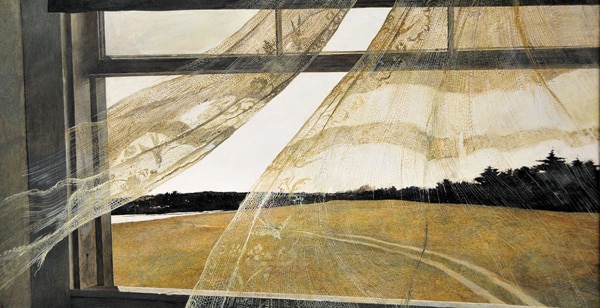
The two approaches are rather like this, visually. Both American artists were producing art roughly the same time. Both use understated natural scenes to evoke strong emotions, and neither with a human in sight.
Andrew Wyeth (1917 – 2009) tempera and watercolor
Charles Burchfield (1893 – 1967) watercolor

Other poets distinctly embrace complexity. I wouldn't want to be without, say, Auden's "As I Walked Out One Evening," a wonderfully complex, language-rich poem, also with a meaning we all related to in our personal experiences.
Ironically, I'm not doing well with words to describe the contrast I'm wishing to express.
The two approaches are rather like this, visually. Both American artists were producing art roughly the same time. Both use understated natural scenes to evoke strong emotions, and neither with a human in sight.
Andrew Wyeth (1917 – 2009) tempera and watercolor
Charles Burchfield (1893 – 1967) watercolor

16saskia17
>15 DebiCates: What a wonderfully vivid way to illustrate your point! Thank you.
I agree that one of Frost's strengths is in the deceptive simplicity of his poetry. It's one of the reasons he's so heavily featured in school curriculums; his language is approachable and allows students to think about the meaning of a poem without getting bogged down in literary tricks.
I agree that one of Frost's strengths is in the deceptive simplicity of his poetry. It's one of the reasons he's so heavily featured in school curriculums; his language is approachable and allows students to think about the meaning of a poem without getting bogged down in literary tricks.
17DebiCates
>16 saskia17: I'm glad you liked that, Nica. It might be fun sometime to just review a book or poem with visual art...
18DebiCates
>16 saskia17: Thank you, Nica. I'm so glad you liked it. I did go unconventional with that approach. I see the two images now in your own description, too. The Wyeth is so "approachable" that it only asks that you think about the subtle but unrelenting feeling of that moment; it still strikes me in the chest every time I look at it. Whereas the Burchfield asks the viewer to be in his different moment but also enjoy his visual "tricks," which I indeed do!

