compleat and udder nonsense studies
Talk Le Salon Littéraire du Peuple pour le Peuple
Join LibraryThing to post.
This topic is currently marked as "dormant"—the last message is more than 90 days old. You can revive it by posting a reply.
1Porius
We will be looking into all manifestations of nonsense. All things runcible that catch our ear or our eyes as we wander along the lonesome highways of life. We are for the runcible rhythms of ravenous ravens through the rookery rambling and raving - at writing desks or elsewhere.
2QuentinTom
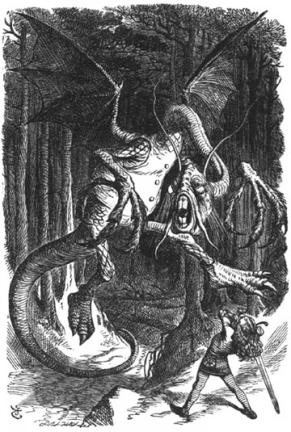
`Twas brillig, and the slithy toves
Did gyre and gimble in the wabe:
All mimsy were the borogoves,
And the mome raths outgrabe.
"Beware the Jabberwock, my son!
The jaws that bite, the claws that catch!
Beware the Jubjub bird, and shun
The frumious Bandersnatch!"
He took his vorpal sword in hand:
Long time the manxome foe he sought --
So rested he by the Tumtum tree,
And stood awhile in thought.
And, as in uffish thought he stood,
The Jabberwock, with eyes of flame,
Came whiffling through the tulgey wood,
And burbled as it came!
One, two! One, two! And through and through
The vorpal blade went snicker-snack!
He left it dead, and with its head
He went galumphing back.
"And, has thou slain the Jabberwock?
Come to my arms, my beamish boy!
O frabjous day! Callooh! Callay!'
He chortled in his joy.
`Twas brillig, and the slithy toves
Did gyre and gimble in the wabe;
All mimsy were the borogoves,
And the mome raths outgrabe.
Did gyre and gimble in the wabe:
All mimsy were the borogoves,
And the mome raths outgrabe.
"Beware the Jabberwock, my son!
The jaws that bite, the claws that catch!
Beware the Jubjub bird, and shun
The frumious Bandersnatch!"
He took his vorpal sword in hand:
Long time the manxome foe he sought --
So rested he by the Tumtum tree,
And stood awhile in thought.
And, as in uffish thought he stood,
The Jabberwock, with eyes of flame,
Came whiffling through the tulgey wood,
And burbled as it came!
One, two! One, two! And through and through
The vorpal blade went snicker-snack!
He left it dead, and with its head
He went galumphing back.
"And, has thou slain the Jabberwock?
Come to my arms, my beamish boy!
O frabjous day! Callooh! Callay!'
He chortled in his joy.
`Twas brillig, and the slithy toves
Did gyre and gimble in the wabe;
All mimsy were the borogoves,
And the mome raths outgrabe.
3Porius
A very old explanation.
The title of this enquiry comes, as all reader's of ALICE'S ADVENTURES IN WONDERLAND will know, from the famous riddle that the hatter put to Alice at the start of the Mad Tea-Party. It is famous because, when she asked the Hatter 'What's the Answer?' he replied that he had not the slightest idea. This provoked her weary comment that he might do something better with the time than waste it asking riddles with no answers - as well he might have, since by age-old tradition a riddle with no answer is dangerous nonsense. the forfeit for asking it being to lose your head.
from THE RAVEN AT THE WRITING DESK
The title of this enquiry comes, as all reader's of ALICE'S ADVENTURES IN WONDERLAND will know, from the famous riddle that the hatter put to Alice at the start of the Mad Tea-Party. It is famous because, when she asked the Hatter 'What's the Answer?' he replied that he had not the slightest idea. This provoked her weary comment that he might do something better with the time than waste it asking riddles with no answers - as well he might have, since by age-old tradition a riddle with no answer is dangerous nonsense. the forfeit for asking it being to lose your head.
from THE RAVEN AT THE WRITING DESK
4zenomax
Far and few, far and few...
http://www.youtube.com/watch?v=TrA0tub9p8M
Nigel Planner doing the honours.
....and no end of Stilton cheese!
http://www.youtube.com/watch?v=TrA0tub9p8M
Nigel Planner doing the honours.
....and no end of Stilton cheese!
5Porius
Of course, the Hatter never SAID it was a riddle when he asked it, so the charge that it is nonsense must fail, (' "You may go," said the King, and the Hatter hurriedly left the court, without waiting to put his shoes on.') To make the charge stick we must give nonsense a capital, as Carroll himself sometimes did, and call it Nonsense. (' " - and just take his head off outside," the Queen added to one of the officers.') Since he did the same to the Hatters riddle, we shall follow suit and call it the Riddle. These are simple enough changes but, as may already be suspected, they lead directly to some hair-raising matters. We shall hunt them down in good time, following Carroll's lead; but here we may usefully refer to the dictionary as one way of keeping our bearings. There, under 'capital', we find the entry: 'relating to the head involving the death penalty: placed at the head: . . . a large letter . . .: the stock of money used for carrying on any business . . .' (Chamber's 20th C. Dictionary.)
What has all this to do with the Riddle? Why, it was the Hatter who asked it. What is our justification for dragging in these puns by the heels? We shall find if we can make capital of two lines from Carroll's PHANTASMAGORIA (1869) :
"The man", says Johnson, "that would make A pun, would pick a pocket!"
Indeed he would. For if we return to the Tea-party that is endlessly taking place in front of the March Hare's house, we shall find that a silence fell over the company soon after the Riddle had been asked. The Hatter then took a watch out of his pocket, and asked what day of the month it was. Since his watch was two days wrong, this is evidence enough that Alice's complaint was justified by the punster himself, in whose company both he and the others lost their time: and what is more, he is still likely to steal a march on anyone who does not watch out for himself.
The reader may find this conclusion not only somewhat forced, but grotesque. Time was, however, when puns and word-play such as assonance were greeted with respect rather than groans, and were even used by theologians with set purpose.
'Verily', he thought, 'while I was worshipping (arcate) water appeared, therefore water is called arka (fire). Water surely comes to one who knows why water is called arka.'
(Brhad-aranyaka Upanisad 1.2.1., trans. Radhakrishnan)
Or, take an example of alliteration (that is, of head-rhymes) from Arthurian Romance:
The grene knyght upon the ground graythely hym dresses:
A littel hut with the hede, the lere he discovers:
His long lovelych lokkes he layed over his croun,
Let the naked nec to the note shewe.
Gauan gripped to his ax and gederes hit on hyght . . .
The second passage falls neatly to hand, considering what we have said about 'capital' and what we are to say about Anglo-Saxon. But did Carroll know GAWAIN? Perhaps: perhaps not. Perhaps we are dealing with a pun of another kind, namely a coincidence. We shall find plenty of these as we continue, some so odd, neat and crowding thick together that they haunt the imagination. In what spirit are we to take them? Nonsensically, of course: which is to say, with a wry seriousness. For just as puns illuminate the nature of language, so a coincidence sheds light on Nature herself. What are we to make of it is something else, as Carroll can tell us:
'Once a coincidence was taking a walk with a little accident, and they met an explanation - a very old explanation - so old that it was quite doubled up, and looked more like a conundrum -'
(Sylvie and Bruno Concluded, Chapter XX111)
We should move along with a wry seriousness, should we not?
http://www.youtube.com/watch?v=lGSVJUaji3M
What has all this to do with the Riddle? Why, it was the Hatter who asked it. What is our justification for dragging in these puns by the heels? We shall find if we can make capital of two lines from Carroll's PHANTASMAGORIA (1869) :
"The man", says Johnson, "that would make A pun, would pick a pocket!"
Indeed he would. For if we return to the Tea-party that is endlessly taking place in front of the March Hare's house, we shall find that a silence fell over the company soon after the Riddle had been asked. The Hatter then took a watch out of his pocket, and asked what day of the month it was. Since his watch was two days wrong, this is evidence enough that Alice's complaint was justified by the punster himself, in whose company both he and the others lost their time: and what is more, he is still likely to steal a march on anyone who does not watch out for himself.
The reader may find this conclusion not only somewhat forced, but grotesque. Time was, however, when puns and word-play such as assonance were greeted with respect rather than groans, and were even used by theologians with set purpose.
'Verily', he thought, 'while I was worshipping (arcate) water appeared, therefore water is called arka (fire). Water surely comes to one who knows why water is called arka.'
(Brhad-aranyaka Upanisad 1.2.1., trans. Radhakrishnan)
Or, take an example of alliteration (that is, of head-rhymes) from Arthurian Romance:
The grene knyght upon the ground graythely hym dresses:
A littel hut with the hede, the lere he discovers:
His long lovelych lokkes he layed over his croun,
Let the naked nec to the note shewe.
Gauan gripped to his ax and gederes hit on hyght . . .
The second passage falls neatly to hand, considering what we have said about 'capital' and what we are to say about Anglo-Saxon. But did Carroll know GAWAIN? Perhaps: perhaps not. Perhaps we are dealing with a pun of another kind, namely a coincidence. We shall find plenty of these as we continue, some so odd, neat and crowding thick together that they haunt the imagination. In what spirit are we to take them? Nonsensically, of course: which is to say, with a wry seriousness. For just as puns illuminate the nature of language, so a coincidence sheds light on Nature herself. What are we to make of it is something else, as Carroll can tell us:
'Once a coincidence was taking a walk with a little accident, and they met an explanation - a very old explanation - so old that it was quite doubled up, and looked more like a conundrum -'
(Sylvie and Bruno Concluded, Chapter XX111)
We should move along with a wry seriousness, should we not?
http://www.youtube.com/watch?v=lGSVJUaji3M
6zenomax
Norrington Brit
ate ought but grit
ought but grits or sprouts
from Brussels
or was it Oldham?
Or was?
And then a tree fell on him.
Spike Milligan.
Dredged from memory, I cannot vouch for strict accuracy. But this was my favourite poem as a child. My imagination was taken by the way the poem built in a sensible fashion but seemingly was about another world. A world slightly apart from our own where other things happen.
The last but one line particularly pleased me. A fitting line in the context of the rest of the verse, but leaving things unsaid and hanging. This allowed imagination to move in to the vacant space.
The final line was pure slapstick but in other world fashion.
ate ought but grit
ought but grits or sprouts
from Brussels
or was it Oldham?
Or was?
And then a tree fell on him.
Spike Milligan.
Dredged from memory, I cannot vouch for strict accuracy. But this was my favourite poem as a child. My imagination was taken by the way the poem built in a sensible fashion but seemingly was about another world. A world slightly apart from our own where other things happen.
The last but one line particularly pleased me. A fitting line in the context of the rest of the verse, but leaving things unsaid and hanging. This allowed imagination to move in to the vacant space.
The final line was pure slapstick but in other world fashion.
8zenomax
A digression from nonsense into absurdity:
"In Praise of Absurdity
Sometimes I inwardly, objectively observe delightful and absurd things which I can't even imagine seeing, for they are illogical to our eyesight - bridges that connect nothing to nothing, roads without beginning or end, upside-down landscapes.... - the absurd, the illogical, the contradictory, everything that detaches and removes us from reality and its vast entourage of practical thoughts, human feelings, and all notions of useful and profitable action."
Fernando Pessoa, The Book of Disquiet.
"In Praise of Absurdity
Sometimes I inwardly, objectively observe delightful and absurd things which I can't even imagine seeing, for they are illogical to our eyesight - bridges that connect nothing to nothing, roads without beginning or end, upside-down landscapes.... - the absurd, the illogical, the contradictory, everything that detaches and removes us from reality and its vast entourage of practical thoughts, human feelings, and all notions of useful and profitable action."
Fernando Pessoa, The Book of Disquiet.
9zenomax
"I'm surfeited with what I've never had and never will, jaded by gods that so far don't exist."
Now Pessoa feels a long way away in time and space from nonsense. What is it that is different?
Does absurdity ultimately have a point to make, whereas nonsense is indulgence in the imagination for its own sake?
Now Pessoa feels a long way away in time and space from nonsense. What is it that is different?
Does absurdity ultimately have a point to make, whereas nonsense is indulgence in the imagination for its own sake?
10Porius
When we come to the limit, what then? What do we come to? There must be either Something, or Nothing. . . That there should be neither of these is absurd.
I think nonsense is much more than imagination for it's own sake. Humpty-Dumpty. Impenetrability. Prof. Bartholomew (what a CLD name!) Price held that it was impossible for two particles of matter to occupy the same space at the same time. This cannot hold for nonsense, as we will show soon enough, whose particles are mutually inclusive rather than mutually exclusive.
If something vanishes , the Baker, for example, we may yet find him deep in this kind of preoccupation.
once again I take as my guide the little book by Francis Huxley, THE RAVEN AT THE WRITING DESK. Wry seriousness, needed for adventures in Chapel Perilous.
I think nonsense is much more than imagination for it's own sake. Humpty-Dumpty. Impenetrability. Prof. Bartholomew (what a CLD name!) Price held that it was impossible for two particles of matter to occupy the same space at the same time. This cannot hold for nonsense, as we will show soon enough, whose particles are mutually inclusive rather than mutually exclusive.
If something vanishes , the Baker, for example, we may yet find him deep in this kind of preoccupation.
once again I take as my guide the little book by Francis Huxley, THE RAVEN AT THE WRITING DESK. Wry seriousness, needed for adventures in Chapel Perilous.
11Porius
Another angle. These fellows are attempting to make absurd John Barton's series, Playing Shakespeare.
Nonsense has 7 types of ambiguity or more, while its distant relative, the absurd falls far short of that number.
Nonsense has more to do with a vision, there may be some absurd elements, but it always represents an attempt to see. With the absurd, there always comes a resignation of one sort or another. I see very little resignation in Lewis Carroll's Nonsense.
Though I realize all too well that this might be little more than an exercise in semantics.
http://www.youtube.com/watch?v=gL5aBB1ZPtE
Nonsense has 7 types of ambiguity or more, while its distant relative, the absurd falls far short of that number.
Nonsense has more to do with a vision, there may be some absurd elements, but it always represents an attempt to see. With the absurd, there always comes a resignation of one sort or another. I see very little resignation in Lewis Carroll's Nonsense.
Though I realize all too well that this might be little more than an exercise in semantics.
http://www.youtube.com/watch?v=gL5aBB1ZPtE
12absurdeist
"Reductio ad absurdum is my favorite drink."
--Fernando Pessoa, The Book of Disquiet
As a professing Absurdeist, I absolutely adore that book. Thank you, Zeno, for bringing Pessoa into the light. And thank you, poor-ious, for finally returning from N. MI to the Salon. Fabulous, largely yet unmined thread.
--Fernando Pessoa, The Book of Disquiet
As a professing Absurdeist, I absolutely adore that book. Thank you, Zeno, for bringing Pessoa into the light. And thank you, poor-ious, for finally returning from N. MI to the Salon. Fabulous, largely yet unmined thread.
13QuentinTom
I'm enjoying it very much as well!
Pessoa's book seems to be a Catechism for the Absurdiest.
Beauty is in the eye of the beholder.
Get it out with Optrex.
Spike Milligan.
Pessoa's book seems to be a Catechism for the Absurdiest.
Beauty is in the eye of the beholder.
Get it out with Optrex.
Spike Milligan.
14zenomax
poor-ious I like your definitions in #10, they ring true to me.
I'm also interested in your view that nonsense is about an attempt to see, whereas absurdity is ultimately about resignation. I guess that I have always tacitly believed that nonsense was ultimately whimsy played by those slightly apart from the world whereas absurdity was pointed if abtuse criticism by those against the world.
I would like to know more about the 7 types of amibiguity - why was I never taught this at my finishing school?
I'm also interested in your view that nonsense is about an attempt to see, whereas absurdity is ultimately about resignation. I guess that I have always tacitly believed that nonsense was ultimately whimsy played by those slightly apart from the world whereas absurdity was pointed if abtuse criticism by those against the world.
I would like to know more about the 7 types of amibiguity - why was I never taught this at my finishing school?
17Porius
It's not what it seems. Not the strange powers Shaw talks about in MAN AND THE ARMS. Just a book by William Empson pub. in 1930. 7 Types of Ambiguity. A seminal work in literary criticism. Mr. Empson defined ambiguity as 'any verbal nuance, however slight, which gives room for alternative reactions to the same piece of language.' The 9 to fivers wont discriminate between words like absurd and nonsense. It's only we, who are morbidly involved with words, etc. etc., who spend time trying to sort these matters out.
One's nonsense doesn't always suit someone else's nonsense.
Though all great theories were Nonsense before some great thinker made the necessary connections. And, of course, no one has the last word on the subject, any subject.
One's nonsense doesn't always suit someone else's nonsense.
Though all great theories were Nonsense before some great thinker made the necessary connections. And, of course, no one has the last word on the subject, any subject.
18zenomax
Nonsense and the cultural context?
Patrick Leigh Fermor:
"... this does seem to be territory where England has unintentionally staked the leading claim; and the claim is ungrudgingly allowed. Brief symptoms of an illogical poetic bent erupted at scattered points in the past - in pomanders, baillies' bells, parrots and haycocks, a whiff, a peal or a squeak, Browning's runaway is caught grazing on strange grass-blades, and reason closes in again - but it was never a large field; the full - grown authentic blooms are only two...."
Two issues raised here, one the scarcity of 'authentic' nonsensers (the mentioned 'two' I think are Lear & Carroll), and the second that it is the English who produce (and are the main audience for?) this artform.
Why should this be?
Patrick Leigh Fermor:
"... this does seem to be territory where England has unintentionally staked the leading claim; and the claim is ungrudgingly allowed. Brief symptoms of an illogical poetic bent erupted at scattered points in the past - in pomanders, baillies' bells, parrots and haycocks, a whiff, a peal or a squeak, Browning's runaway is caught grazing on strange grass-blades, and reason closes in again - but it was never a large field; the full - grown authentic blooms are only two...."
Two issues raised here, one the scarcity of 'authentic' nonsensers (the mentioned 'two' I think are Lear & Carroll), and the second that it is the English who produce (and are the main audience for?) this artform.
Why should this be?
19Macumbeira
Objction !
There is a lot of absurdity and nonsense in french literature too. If interested I can supply you a whole list of writers.
Problum with these kind of writings is that it does not translate well
There is a lot of absurdity and nonsense in french literature too. If interested I can supply you a whole list of writers.
Problum with these kind of writings is that it does not translate well
20zenomax
Is this to do with a love of wordplay?
Is the english art of nonsense related to the love of the clerihew, the malapropism, and the spoonerism?
Is the english art of nonsense related to the love of the clerihew, the malapropism, and the spoonerism?
21zenomax
#19 yes I would welcome broadening the cultural context - can you give us an idea of the French side of this, and also how it differs (if at all) from the english?
22zenomax
The influence of Lear on Milligan:
"On the Coast of Coromandel
Where the early pumpkins blow
In the middle of the woods
Lived the Yonghy-Bonghy-Bo..."
Written by Edward Lear.
Reading this it struck me that Milligan would not have been Milligan without that Lear had been there first.
"On the Coast of Coromandel
Where the early pumpkins blow
In the middle of the woods
Lived the Yonghy-Bonghy-Bo..."
Written by Edward Lear.
Reading this it struck me that Milligan would not have been Milligan without that Lear had been there first.
23Macumbeira
I had the luck to be educated in different languages, countries and cultures. I have seen that all cultures are using wordplay, nonsense and absurdity in their literature.
I am well acquinted with the French love of their language. Wordplay, the famous "calembours" come as easy to an educated Frenchman as breathing.
Unfortunately these "experiences" with words and sentences and language in general do not translate and therefore do not cross linguistic borders. Hence the reason few are aware what happens in the countries around them.
In France there are a lot of famous writers who dabbled in the absurd. For instance there is AntoninArtaud with his Ataud le Momo, Alfred Jarry ofcourse with his docteur Faustroll, Raymond Roussel with his impressions d'Afrique, Jean tardieu, Perec,, Marcel Duchamp etc etc
And why not JP Brisset . They call him the Prince of Thinkers !
I am well acquinted with the French love of their language. Wordplay, the famous "calembours" come as easy to an educated Frenchman as breathing.
Unfortunately these "experiences" with words and sentences and language in general do not translate and therefore do not cross linguistic borders. Hence the reason few are aware what happens in the countries around them.
In France there are a lot of famous writers who dabbled in the absurd. For instance there is AntoninArtaud with his Ataud le Momo, Alfred Jarry ofcourse with his docteur Faustroll, Raymond Roussel with his impressions d'Afrique, Jean tardieu, Perec,, Marcel Duchamp etc etc
And why not JP Brisset . They call him the Prince of Thinkers !
24Macumbeira
And you know what ?
I never heard of Edward Lear before this tread. Imagine !
And for the russians among you : check Khlebnikov !
For the Flemish and the dutch : Daan Zonderland !
I never heard of Edward Lear before this tread. Imagine !
And for the russians among you : check Khlebnikov !
For the Flemish and the dutch : Daan Zonderland !
25Porius
Edward Lear suffered epileptic seizures all his life. (1812-1888). Interesting. Some commentators say that Lear's Nonsense was not mere gibberish like CDL's. They find in Lear's poems an emotional intensity. Coupled with a teasing disparity between sound and meaning, which they thought made him the last of the 'Romantics' and the contemporary of Tennyson and Swinburne.
By conventional standards Lear led a strange, a very strange, some would say, life. Late in life he proposed to two girls many, many years his junior. He was fortunately turned down by both girls.
The 'Victorians' were a pretty serious lot; it's not easy to imagine Leslie Stephen penning a limerick about recusant cats, but as Jung and some of his followers would have it - there's always the flip side. Enantiodromia. Was it possible that the 'mystic' George MacDonald brokered a relationship between the austere John Ruskin and the childish Rose LaTouche? Thankfully this adventure went the way of all flesh, but it sure sounded like nonsense for awhile. Not the sort of nonsense we are pursuing here, but nonsense nevertheless.
The sort of Nonsense that catches my interest is the Nonsense that sees a relationship, sketchy as it might be, sometimes, between two unrelated, or seemingly unrelated things. We can find this sort of Nonsense in serious thinkers like Erwin Schrodinger, and more playful thinkers like Edward Lear.
What can Bell be after with this statement? In order to do what he says we must do, don't we have to follow, somewhat in the footsteps of the Tribe of Lear? I am inclined to think so. At the very least we must let our commonsense hair down.
One of the chief services which mathematics has rendered the human race in the past century is to put "common sense" where it belongs, on the topmost shelf next to the dusty canister labeled "discarded non-sense."
Eric Temple Bell
MATHEMATICS, QUEEN OF THE SCIENCES
I'm suggesting here, by the way. I am not, in any way, trying to suggest that Bell is operating under the same guidelines or principles that Lear is.
By conventional standards Lear led a strange, a very strange, some would say, life. Late in life he proposed to two girls many, many years his junior. He was fortunately turned down by both girls.
The 'Victorians' were a pretty serious lot; it's not easy to imagine Leslie Stephen penning a limerick about recusant cats, but as Jung and some of his followers would have it - there's always the flip side. Enantiodromia. Was it possible that the 'mystic' George MacDonald brokered a relationship between the austere John Ruskin and the childish Rose LaTouche? Thankfully this adventure went the way of all flesh, but it sure sounded like nonsense for awhile. Not the sort of nonsense we are pursuing here, but nonsense nevertheless.
The sort of Nonsense that catches my interest is the Nonsense that sees a relationship, sketchy as it might be, sometimes, between two unrelated, or seemingly unrelated things. We can find this sort of Nonsense in serious thinkers like Erwin Schrodinger, and more playful thinkers like Edward Lear.
What can Bell be after with this statement? In order to do what he says we must do, don't we have to follow, somewhat in the footsteps of the Tribe of Lear? I am inclined to think so. At the very least we must let our commonsense hair down.
One of the chief services which mathematics has rendered the human race in the past century is to put "common sense" where it belongs, on the topmost shelf next to the dusty canister labeled "discarded non-sense."
Eric Temple Bell
MATHEMATICS, QUEEN OF THE SCIENCES
I'm suggesting here, by the way. I am not, in any way, trying to suggest that Bell is operating under the same guidelines or principles that Lear is.
26zenomax
From Wikipedia, the last part of Lear's self portrait in verse:
He reads but he cannot speak Spanish,
He cannot abide ginger-beer;
Ere the days of his pilgrimage vanish,
How pleasant to know Mr. Lear!
Whats not to like?
He reads but he cannot speak Spanish,
He cannot abide ginger-beer;
Ere the days of his pilgrimage vanish,
How pleasant to know Mr. Lear!
Whats not to like?
27zenomax
The comfort provided by nonsense:
From George Orwell's war diary, December 8 1940 -
"During the bad period of the bombing, when everyone was semi-insane, not so much from the bombing itself as from broken sleep, interrupted telephone calls, the difficulty of communications, etc. etc. I found that scraps of nonsense poetry were constantly coming into my mind. They never got beyond a line or two and the tendency stopped when the bombing slacked off, but examples were:
An old Rumanian peasant
Who lived in Mornington Crescent
and
And the key doesn't fit and the bell doesn't ring,
But we all stand up for God save the King
and
When the Borough Surveyor has gone to roost
On his rod, his pole or his perch.
From George Orwell's war diary, December 8 1940 -
"During the bad period of the bombing, when everyone was semi-insane, not so much from the bombing itself as from broken sleep, interrupted telephone calls, the difficulty of communications, etc. etc. I found that scraps of nonsense poetry were constantly coming into my mind. They never got beyond a line or two and the tendency stopped when the bombing slacked off, but examples were:
An old Rumanian peasant
Who lived in Mornington Crescent
and
And the key doesn't fit and the bell doesn't ring,
But we all stand up for God save the King
and
When the Borough Surveyor has gone to roost
On his rod, his pole or his perch.
28zenomax
And would anyone care to guess who the author of this piece was?:
At the door of my own little hovel,
Reading a novel I sat;
And as I was reading the novel
A gnat flew away with my hat.
As fast as a fraudulent banker
Away with my hat it fled,
And calmly came to an anchor
In the midst of the cucumber-bed.
I went and purchased a yacht
And traversed the garden-tank,
And I gave it that insect hot
When I got to the other bank;
Of its life I made an abridgment
By squeezing it somewhat flat,
But I still cannot think what that midge meant
By running away with my hat.
At the door of my own little hovel,
Reading a novel I sat;
And as I was reading the novel
A gnat flew away with my hat.
As fast as a fraudulent banker
Away with my hat it fled,
And calmly came to an anchor
In the midst of the cucumber-bed.
I went and purchased a yacht
And traversed the garden-tank,
And I gave it that insect hot
When I got to the other bank;
Of its life I made an abridgment
By squeezing it somewhat flat,
But I still cannot think what that midge meant
By running away with my hat.
30rolandperkins
Van Winkem Van Blinkem and Van Nod, one night
Sailed often -- and wouldnʻt you?
Sailed, often aquiver with Crispness Night,
Under a sea of stew.
..."Wary ya glowing, and whaddaya which,
You old Manassa Tree?
....Furry Hearing, and gosh all gee:
Van Winkem, Van Blinkem, Van Nod.
-- Walt Kelly, in 1 of the "Pogo" comic strips of the 1950s
This is, of course a parody of an Edward Ldear classic, and will mean more to someone who remembers exactly what wording of Lear is being parodied (which I donʻt, not for all of it). It loses something by not having the cartoons that went with it, but still has something just as a poem in its own right. Iʻm quoting it from memory and donʻt remember the whole thing.
The obscurest part for a modern reader is the reference to alleged "subversive" physicist Wendell Furry, during the McCarthy Era.
Sailed often -- and wouldnʻt you?
Sailed, often aquiver with Crispness Night,
Under a sea of stew.
..."Wary ya glowing, and whaddaya which,
You old Manassa Tree?
....Furry Hearing, and gosh all gee:
Van Winkem, Van Blinkem, Van Nod.
-- Walt Kelly, in 1 of the "Pogo" comic strips of the 1950s
This is, of course a parody of an Edward Ldear classic, and will mean more to someone who remembers exactly what wording of Lear is being parodied (which I donʻt, not for all of it). It loses something by not having the cartoons that went with it, but still has something just as a poem in its own right. Iʻm quoting it from memory and donʻt remember the whole thing.
The obscurest part for a modern reader is the reference to alleged "subversive" physicist Wendell Furry, during the McCarthy Era.
31Porius
They went to see in a sieve
http://www.youtube.com/watch?v=TrA0tub9p8M
Portmanteau prosopopy?
http://www.youtube.com/watch?v=kLBjOIVIGqY&feature=related
http://www.youtube.com/watch?v=TrA0tub9p8M
Portmanteau prosopopy?
http://www.youtube.com/watch?v=kLBjOIVIGqY&feature=related
32QuentinTom
just to go back a bit, I was reflecting on the difference between nonsense and the absurd. You've probably all moved on a bit now, but I was wondering, if one considered the type of laughter that each is designed to evoke whether that would help to define the difference?
Absurd: Laughter that acknowledges the absurdity of the quest (for meaning)
Nonsense: Laughter that has liberated itself from the quest (for meaning)
One's nonsense doesn't always suit someone else's nonsense. wise words from Poor here, to which one could add that one man's nonsense is another mans' absurd... perhaps.
Would this be true for the authors you mentioned Mac? Thank you for that list by the way. You're right, nonsense is very hard to transfer across languages, but other languages definitely do have it. I think Paddy Leigh Fermor is wrong on this one, bless him. Mind you, he was (is - ooooops: is he still with us?) also a very accomplished linguist, with most of the main European languages under his belt.
Here is Jarry's Ubu Roi: UBU WAKE UP!
http://www.youtube.com/watch?v=lvnvwAYhZVM
hahah.
Absurd: Laughter that acknowledges the absurdity of the quest (for meaning)
Nonsense: Laughter that has liberated itself from the quest (for meaning)
One's nonsense doesn't always suit someone else's nonsense. wise words from Poor here, to which one could add that one man's nonsense is another mans' absurd... perhaps.
Would this be true for the authors you mentioned Mac? Thank you for that list by the way. You're right, nonsense is very hard to transfer across languages, but other languages definitely do have it. I think Paddy Leigh Fermor is wrong on this one, bless him. Mind you, he was (is - ooooops: is he still with us?) also a very accomplished linguist, with most of the main European languages under his belt.
Here is Jarry's Ubu Roi: UBU WAKE UP!
http://www.youtube.com/watch?v=lvnvwAYhZVM
hahah.
33zenomax
Murr, I certainly haven't moved on from the nonsense/absurd distinction. For me that is the most interesting of the multitude of interesting things this thread has thrown up.
And your stab at differentiation based on laughter evoked is an interesting one. I need to consider its implications before commenting further.
I admit my limitations here, as my knowledge of nonsense is largely limited to the english, whereas my european literature interests are often associated with the absurd (or my innate definition of the absurd). Thus, dada & surrealism, Camus, and in fact many of those I have been looking at on my thread recently (Kafka, Musil etc).
And your stab at differentiation based on laughter evoked is an interesting one. I need to consider its implications before commenting further.
I admit my limitations here, as my knowledge of nonsense is largely limited to the english, whereas my european literature interests are often associated with the absurd (or my innate definition of the absurd). Thus, dada & surrealism, Camus, and in fact many of those I have been looking at on my thread recently (Kafka, Musil etc).
35Macumbeira
( from Wiki )
The sentence "Colorless green ideas sleep furiously" was coined by Noam Chomsky as an example of nonsense. The individual words make sense and are arranged grammatically, yet the result is still nonsense. The inspiration for this attempt at creating verbal nonsense came from the idea of contradiction and irrelevant or immaterial characteristics (e.g., an idea may have a dimension of color, yet it is first specified to be without hue), both of which would be sure to make a phrase meaningless. The phrase "the square root of Tuesday" operates on the latter principle. This principle is behind the inscrutability of the koan "What is the sound of one hand clapping?", as one hand would supposedly require another hand to create clapping.
Part of what draws readers to nonsense literature is the overwhelming human desire to find meaning, anywhere and everywhere and where perhaps none exists. Others may argue that this description and analysis itself is proof that there is actually meaning -- that is, sense -- in works of nonsense.
The sentence "Colorless green ideas sleep furiously" was coined by Noam Chomsky as an example of nonsense. The individual words make sense and are arranged grammatically, yet the result is still nonsense. The inspiration for this attempt at creating verbal nonsense came from the idea of contradiction and irrelevant or immaterial characteristics (e.g., an idea may have a dimension of color, yet it is first specified to be without hue), both of which would be sure to make a phrase meaningless. The phrase "the square root of Tuesday" operates on the latter principle. This principle is behind the inscrutability of the koan "What is the sound of one hand clapping?", as one hand would supposedly require another hand to create clapping.
Part of what draws readers to nonsense literature is the overwhelming human desire to find meaning, anywhere and everywhere and where perhaps none exists. Others may argue that this description and analysis itself is proof that there is actually meaning -- that is, sense -- in works of nonsense.
36QuentinTom
Irony and buffoonery are expressions of the deepest contemplation of life in all its conditionality.
ETA Hoffmann
ETA Hoffmann
37Porius
Maybe it's not useful to drop into a book as Silas Wegg would drop into poetry, though I think there are a few nuggets here that will come to our aid in the search for nonsense and the absurd and just what is it that distinguishes one from the other or if there is such a distinction.
From the abovementioned Francis Huxley book, THE RAVEN AT THE WRITING DESK.
We might say the same of our own enquiries, but only after we have made a small but revolutionary correction. For when nonsense is given a capital N it allows us to do what Wittgenstein thought impossible, namely, to think on both sides of the limit. It remains true that there are things in Nonsense that cannot be thought, but these do not lie on the OTHER side of the limit: they lie on it. They are in fact the limit itself, which is therefore not peripheral but central.
All this may appear outlandish. Let me therefore give my own definition of Nonsense. Nonsense, then, is a logical game played with feeling by at least two people, in a spirit of self-contradiction, in such a way that one thing leads on to the other to the constant surprise and mutual enthusiasm of both parties. If there is anything that cannot be spoken in the game - and there is plenty of that also - it must be looked at for at the heart of the self-contradictions that have been put in play by it: and though they are speechless by themselves, they can properly be described as attitudes, which comprise some of the things the game leads on to, as well as being those from which it often starts.
Nonsense leads on to so many things that it is not worth our while to particularize them here. For it rests, in Wittgenstein's words, on the misunderstanding of the logic of our language, and it would therefore need a dictionary and grammar even to itemise them. In this it is as all-embracing as Alfred Jarry's 'Pataphysics, defined by it's author as 'the science of imaginary solutions, which symbolically attributes the properties of objects, described by their virtuality, to their lineaments.' Roger Shattuck, who quotes this passage in THE BANQUET YEARS (1959), also says of Jarry that he 'treated ambiguity as the stylistic manifestation of a universal principle of convertibility', which is more intimately to the point. For Nonsense uses the same principle, to such an effect that Carroll is a favorite author of those studying nuclear physics, or Time, or mirror imagery. or logic and semantics, or even Zen Buddhism: their aim being to convert what lies on the other side of the reasonable limit into their particular brand of Higher Nonsense.
Our enquiry intends to do the same for Carroll and his works, and if the reader can stand the incessant plays on words I must bring to his notice he will eventually find the Nonsense principle of convertibility stated openly, together with its mode of operation and the use Carroll made of it. We can briefly allude to what this last was, via a couplet from SYLVIE AND BRUNO:
'Tis a secret: none knows how it comes or goes:
But the name of the secret is Love!
I quote this at length only to help us to put more meat on the bones of our discussion. To have a useful discussion on these difficult matters I think it is important to have a playing field, and everything that is connected with a playing field. That limits the discussion, somewhat. I do not think this can be helped.
From the abovementioned Francis Huxley book, THE RAVEN AT THE WRITING DESK.
We might say the same of our own enquiries, but only after we have made a small but revolutionary correction. For when nonsense is given a capital N it allows us to do what Wittgenstein thought impossible, namely, to think on both sides of the limit. It remains true that there are things in Nonsense that cannot be thought, but these do not lie on the OTHER side of the limit: they lie on it. They are in fact the limit itself, which is therefore not peripheral but central.
All this may appear outlandish. Let me therefore give my own definition of Nonsense. Nonsense, then, is a logical game played with feeling by at least two people, in a spirit of self-contradiction, in such a way that one thing leads on to the other to the constant surprise and mutual enthusiasm of both parties. If there is anything that cannot be spoken in the game - and there is plenty of that also - it must be looked at for at the heart of the self-contradictions that have been put in play by it: and though they are speechless by themselves, they can properly be described as attitudes, which comprise some of the things the game leads on to, as well as being those from which it often starts.
Nonsense leads on to so many things that it is not worth our while to particularize them here. For it rests, in Wittgenstein's words, on the misunderstanding of the logic of our language, and it would therefore need a dictionary and grammar even to itemise them. In this it is as all-embracing as Alfred Jarry's 'Pataphysics, defined by it's author as 'the science of imaginary solutions, which symbolically attributes the properties of objects, described by their virtuality, to their lineaments.' Roger Shattuck, who quotes this passage in THE BANQUET YEARS (1959), also says of Jarry that he 'treated ambiguity as the stylistic manifestation of a universal principle of convertibility', which is more intimately to the point. For Nonsense uses the same principle, to such an effect that Carroll is a favorite author of those studying nuclear physics, or Time, or mirror imagery. or logic and semantics, or even Zen Buddhism: their aim being to convert what lies on the other side of the reasonable limit into their particular brand of Higher Nonsense.
Our enquiry intends to do the same for Carroll and his works, and if the reader can stand the incessant plays on words I must bring to his notice he will eventually find the Nonsense principle of convertibility stated openly, together with its mode of operation and the use Carroll made of it. We can briefly allude to what this last was, via a couplet from SYLVIE AND BRUNO:
'Tis a secret: none knows how it comes or goes:
But the name of the secret is Love!
I quote this at length only to help us to put more meat on the bones of our discussion. To have a useful discussion on these difficult matters I think it is important to have a playing field, and everything that is connected with a playing field. That limits the discussion, somewhat. I do not think this can be helped.
38eromsted
As a reference for readers of this thread I suggest A Nonsense Anthology collected by Carolyn Wells.
Two short selection, more or less at random.
IN THE DUMPS
We're all in the dumps,
For diamonds and trumps ;
The kittens are gone to St. Paul's !
The babies are bit,
The moon 's in a fit,
And the houses are built without walls.
Anonymous
THE YAK
By the way, anyone know how to get spacing so stick? The even lines in the second poem should be indented, but I don't know the correct html tag.
*Edited to add spacing. Thanks to solla.*
Two short selection, more or less at random.
IN THE DUMPS
We're all in the dumps,
For diamonds and trumps ;
The kittens are gone to St. Paul's !
The babies are bit,
The moon 's in a fit,
And the houses are built without walls.
Anonymous
THE YAK
As a friend to the children commend me the yak,
 You will find it exactly the thing :
It will carry and fetch, you can ride on its back,
 Or lead it about with a string.

A Tartar who dwells in the plains of Thibet
 (A desolate region of snow)
Has for centuries made it a nursery pet,
 And surely the Tartar should know !

Then tell your papa where the Yak can be got,
 And if he is awfully rich,
He will buy you the creature -- or else he will not,
 (I cannot be positive which).
Hillaire Belloc
By the way, anyone know how to get spacing so stick? The even lines in the second poem should be indented, but I don't know the correct html tag.
*Edited to add spacing. Thanks to solla.*
39solla
I don't think there is really an html tab, but you can get repeated spaces by typing out for each space you want the six characters
- it may take a lot to make a tab.
that took eight.
also it doesn't seem to be working quite right.
If you type
<pre>
</pre>
it might work
- it may take a lot to make a tab.
that took eight.
also it doesn't seem to be working quite right.
If you type
<pre>
 then you type some
 text with space
and stuff, then end with
</pre>
it might work
42zenomax
When a new edition of Edward Lear poetry was released in December 1945 (and what a time for it to be released - how was it received I wonder?), George Orwell reviewed it in his column for Tribune.
Orwell likes Lear best when he adds burlesque and 'perverted logic' to his more arbitrary elements. Thus Orwell praises 'The Pobble who has no toes', chiefly because it "... is haunted by the ghost of logic, and I think it is the element of sense in it that makes it funny." In Orwell's interpretation, when the Pobble loses its toes in a sea accident, and the Pobble's aunt states:
"It's a fact the whole world knows,
That Pobbles are happier without their toes..."
the piece is funny because "...it has a meaning, and one might even say a political significance. For the whole theory of authoritarian governments is summed up in the statement that Pobbles were happier without their toes."
What I find interesting here is that Orwell interprets this piece of nonsense doggerel according to his view of the world, turning it for him into a hidden message of sense.
Orwell also mentions Aldous Huxley's view that Lear's work was ultimately an 'assertion of freedom', where the 'They' in his limericks are equated with such things as 'common sense', legality' and what Orwell paraphrases as 'the duller virtues generally'. 'They' are the ones who try to stop you from 'doing anything worth doing'.
Orwell quotes as an example, 'The Old Man of Whitehaven':
"There was an Old Man of Whitehaven
Who danced a quadrille with a raven
But they said, 'It's absurd
To encourage this bird!'
So they smashed that Old Man of Whitehaven."
Orwell likes Lear best when he adds burlesque and 'perverted logic' to his more arbitrary elements. Thus Orwell praises 'The Pobble who has no toes', chiefly because it "... is haunted by the ghost of logic, and I think it is the element of sense in it that makes it funny." In Orwell's interpretation, when the Pobble loses its toes in a sea accident, and the Pobble's aunt states:
"It's a fact the whole world knows,
That Pobbles are happier without their toes..."
the piece is funny because "...it has a meaning, and one might even say a political significance. For the whole theory of authoritarian governments is summed up in the statement that Pobbles were happier without their toes."
What I find interesting here is that Orwell interprets this piece of nonsense doggerel according to his view of the world, turning it for him into a hidden message of sense.
Orwell also mentions Aldous Huxley's view that Lear's work was ultimately an 'assertion of freedom', where the 'They' in his limericks are equated with such things as 'common sense', legality' and what Orwell paraphrases as 'the duller virtues generally'. 'They' are the ones who try to stop you from 'doing anything worth doing'.
Orwell quotes as an example, 'The Old Man of Whitehaven':
"There was an Old Man of Whitehaven
Who danced a quadrille with a raven
But they said, 'It's absurd
To encourage this bird!'
So they smashed that Old Man of Whitehaven."
43zenomax
From poor-ious; The sort of Nonsense that catches my interest is the Nonsense that sees a relationship, sketchy as it might be, sometimes, between two unrelated, or seemingly unrelated things.
This connecting things is an important function for me too, and I can see how nonsense is one means of doing this.
Now consider this from Fernando Pessoa:
"Just imagine the folklore of the colourful people who inhabit paintings!"
Here, Pessoa tries to connect folklore - the tradition and wisdom of people through the generations - and images translated from an artists imagination onto a surface. Obviously such connections cannot really exist. But the very fact of Pessoa stating this sentence establishes a connection in my imagination. Just what would these 'people's' folklore be like?
For me, if an idea or concept is thought of, it automatically is provided with meaning. Moreover, it sparks new associations and thoughts, and - in the example above - perhaps adds to our view of folklore and to how we look at images of people in paintings in the future.
Macumbeira provided a Wiki definition, which included the following as a point for debate:
"Part of what draws readers to nonsense literature is the overwhelming human desire to find meaning, anywhere and everywhere and where perhaps none exists." My view I believe, is that meaning will always exist.
This connecting things is an important function for me too, and I can see how nonsense is one means of doing this.
Now consider this from Fernando Pessoa:
"Just imagine the folklore of the colourful people who inhabit paintings!"
Here, Pessoa tries to connect folklore - the tradition and wisdom of people through the generations - and images translated from an artists imagination onto a surface. Obviously such connections cannot really exist. But the very fact of Pessoa stating this sentence establishes a connection in my imagination. Just what would these 'people's' folklore be like?
For me, if an idea or concept is thought of, it automatically is provided with meaning. Moreover, it sparks new associations and thoughts, and - in the example above - perhaps adds to our view of folklore and to how we look at images of people in paintings in the future.
Macumbeira provided a Wiki definition, which included the following as a point for debate:
"Part of what draws readers to nonsense literature is the overwhelming human desire to find meaning, anywhere and everywhere and where perhaps none exists." My view I believe, is that meaning will always exist.
44QuentinTom
I agree. In fact, humanity, if one might paraphrase (correct) Aristotle, may be defined as a meaning-searching animal.
45QuentinTom
Zeno, this might tie in with what you said about the search for meaning.
http://www.miller-mccune.com/news/this-is-your-brain-on-kafka-1474
http://www.miller-mccune.com/news/this-is-your-brain-on-kafka-1474
46zenomax
45 - yes I like it. Anything that increases brain activity (as opposed to running it through the same well-used ruts in the road) must be a good thing.
47Porius
"What is the meaning of life?" The question is as old as mankind, and every answer is an interpretation of a world thick with enigmas. No answer is the final one, and none of them can answer the question completely. The answer changes as our knowledge of the world changes; meaning and unmeaning are part of the plentitude of life. "Life is crazy and meaningful at once. And when we do not laugh over the one aspect and speculate about the other, life is exceedingly drab, and everything is reduced to the littlest scale. There is then little sense and little nonsense either." Jung wrote this at the age of 59. 25 years later, the same thought acquires a strangely different intonation: "Which element we think outweighs the other, whether meaninglessness or meaning, is a matter of temperament.If meaninglessness were absolutely preponderant, the meaningfulness of life would vanish to an increasing degree with each step in our development. But that is - or seems to me - not the case. Probably, as in most metaphysical questions, both are true: Life is - or has - meaning and meaninglessness. I cherish the anxious hope that meaning will preponderate and win the battle." In old age the question of meaning becomes a fateful one that decides the value or valuelessness of one's own life. Jung was profoundly stirred by it, yet he knew that there is no final or clear-cut answer.
Aniela Jaffe, THE MYTH OF MEANING
The more we can see the polarities, etc. etc. in a thing the better we see. Shakespeare and Joyce among others help us in this.
We can see everything and everybody as a bank balance like, say, Tom DeLay, or we can see life in all it's delightfulness and ridiculousness as old John Cleese sees it. It's our choice, it seems to me.
Aniela Jaffe, THE MYTH OF MEANING
The more we can see the polarities, etc. etc. in a thing the better we see. Shakespeare and Joyce among others help us in this.
We can see everything and everybody as a bank balance like, say, Tom DeLay, or we can see life in all it's delightfulness and ridiculousness as old John Cleese sees it. It's our choice, it seems to me.
48zenomax
Well, Jung seems to be ultimately behind a lot of the ideas which spark my interest at the moment.
I like the idea that life is a combination of the meaningful and the meaningless as well. What fun!
I like the idea that life is a combination of the meaningful and the meaningless as well. What fun!
49absurdeist
Meaningless, meaningless! says the Teacher.
I'm in the salon, but I'm exiled from the salon.
You can check out any time you like, but you can never leave.
I'm in the salon, but I'm exiled from the salon.
You can check out any time you like, but you can never leave.
50WilfGehlen
>47 Porius: Meaningfulness and meaninglessness both revolve around the same truth, never reaching it. Just do, or, better, not do. With not doing, meaningfulness and meaninglessness will both slow their revolution, their orbits shrinking, each will finally collapse on the truth.
52Macumbeira
have a drink and a smile ?
55Macumbeira
Damn poor-ious, you unleashed a tempest in my head.
56Macumbeira
Only Darwin has uncovered the truth. And it does not really fit in our civilized world view.
57Porius
Not a teapot's Tempest, of course.
Nonsensers are good at this, it seems to me.
Shopenhauer reiterated the central point in Kant's criticism, but in language that is more readily understandable.
It is a common reaction to the ontological argument that it succeeds in "proving" it's conclusion only by first concealing that conclusion somewhere in its premises, and in this respect Shopenhauer compared it to a sleight-of-hand trick, wherein what is produced for the astonishment and wonder of the audience has been before them all the while, though carefully concealed until the appropriate time.
Please don't lean on or expect this little pas sage to solve any enigmas, just let it steep for a little bit.
It seems to me that Darwin only uncovered more loam, more loam removed in our attempt to uncover, nice word, the 'Truth'.
Nonsensers are good at this, it seems to me.
Shopenhauer reiterated the central point in Kant's criticism, but in language that is more readily understandable.
It is a common reaction to the ontological argument that it succeeds in "proving" it's conclusion only by first concealing that conclusion somewhere in its premises, and in this respect Shopenhauer compared it to a sleight-of-hand trick, wherein what is produced for the astonishment and wonder of the audience has been before them all the while, though carefully concealed until the appropriate time.
Please don't lean on or expect this little pas sage to solve any enigmas, just let it steep for a little bit.
It seems to me that Darwin only uncovered more loam, more loam removed in our attempt to uncover, nice word, the 'Truth'.
58Macumbeira
poor-ious, I am like Winnie the Pooh
long words bother me...
Did you ever stop to think, and forget to start again ?
Mac the Pooh
long words bother me...
Did you ever stop to think, and forget to start again ?
Mac the Pooh
59absurdeist
I don't believe in meaning. I believe in me.
60WilfGehlen
>51 Porius: poor-ious, this is what you should do:
In Buddhism there is no place for using effort. Just be ordinary and nothing special. Eat your food, move your bowels, pass water, and when you're tired go and lie down. The ignorant will laugh at me, but the wise will understand.
I quote this in my review of Zap Comix No. 0. You should read Zap itself in order to achieve a higher understanding.
In Buddhism there is no place for using effort. Just be ordinary and nothing special. Eat your food, move your bowels, pass water, and when you're tired go and lie down. The ignorant will laugh at me, but the wise will understand.
I quote this in my review of Zap Comix No. 0. You should read Zap itself in order to achieve a higher understanding.
62Macumbeira
This thread is absurd LOL
63Macumbeira
and full of nonsense
64absurdeist
Granted, this is obviously more psychedelia than the absurd, but it is udder nonsense, isn't it?
Picture yourself in a boat on a river,
With tangerine trees and marmalade skies.
Somebody calls you, you answer quite slowly,
A girl with kaleidoscope eyes.
Cellophane flowers of yellow and green,
Towering over your head.
Look for the girl with the sun in her eyes,
And she's gone.
Lucy in the sky with diamonds,
Lucy in the sky with diamonds,
Lucy in the sky with diamonds,
Ah... Ah...
Follow her down to a bridge by a fountain,
Where rocking horse people eat marshmallow pies.
Everyone smiles as you drift past the flowers,
That grow so incredibly high.
Newspaper taxis appear on the shore,
Waiting to take you away.
Climb in the back with your head in the clouds,
And you're gone.
Lucy in the sky with diamonds,
Lucy in the sky with diamonds,
Lucy in the sky with diamonds,
Ah... Ah...
Picture yourself on a train in a station,
With plasticine porters with looking glass ties.
Suddenly someone is there at the turnstile,
The girl with kaleidoscope eyes.
http://www.youtube.com/watch?v=A7F2X3rSSCU
http://www.youtube.com/watch?v=9aqGtxoXPLE&feature=fvw
Picture yourself in a boat on a river,
With tangerine trees and marmalade skies.
Somebody calls you, you answer quite slowly,
A girl with kaleidoscope eyes.
Cellophane flowers of yellow and green,
Towering over your head.
Look for the girl with the sun in her eyes,
And she's gone.
Lucy in the sky with diamonds,
Lucy in the sky with diamonds,
Lucy in the sky with diamonds,
Ah... Ah...
Follow her down to a bridge by a fountain,
Where rocking horse people eat marshmallow pies.
Everyone smiles as you drift past the flowers,
That grow so incredibly high.
Newspaper taxis appear on the shore,
Waiting to take you away.
Climb in the back with your head in the clouds,
And you're gone.
Lucy in the sky with diamonds,
Lucy in the sky with diamonds,
Lucy in the sky with diamonds,
Ah... Ah...
Picture yourself on a train in a station,
With plasticine porters with looking glass ties.
Suddenly someone is there at the turnstile,
The girl with kaleidoscope eyes.
http://www.youtube.com/watch?v=A7F2X3rSSCU
http://www.youtube.com/watch?v=9aqGtxoXPLE&feature=fvw
65Porius
Macumbeira, try this one for size: hippopotomonstrosesquipedalian. For me at times the longueur the better.
68Macumbeira
poorious, you sound like Mary Poppins !
70Macumbeira
I am not allowed to watch this at work so I'll sing :
chim chim-eney, chim chim-eney chim chim cheroooo..love this salon and hope you do tooooooo
chim chim-eney, chim chim-eney chim chim cheroooo..love this salon and hope you do tooooooo
72QuentinTom
And I'm starting it up again! Woohoo!
A great absurdist:
http://entertainment.timesonline.co.uk/tol/arts_and_entertainment/music/classica...
A great absurdist:
http://entertainment.timesonline.co.uk/tol/arts_and_entertainment/music/classica...
73Porius
Therefore the Fool goes to bed at noon.
THE SILENCE OF CORDELIA
Cordelia's 'Nothing' is a reply to Lear's 'What can you say about your love for me, using the language of your sisters?' Refusing to play by the sister's rules. Cordelia tries to establish her own. But her attempt to be honest about her love falls short. It's messy. Lear explodes.
She refuses to use the glib and oily language of the sisters. But finds she has no way of expressing herself in language.
According to archaic myth, Cordelia is the vessel containing the magical alphabet of poetry. Shakespeare's mouthpiece. But she fails.
The whole titanic drama turns on this 'Nothing' and the bizarre fact that C's true love cannot find words to declare itself. The treacherous sisters have the tongue for the job.
This speechlessness was a recurrent theme in the Sonnets. In the Sonnets WS was trying to communicate his own love, and failed to do so.
His sense of the problem as something ineffable, as a word locked up (the 'word within a word, unable to speak a word' - maybe he went out of his way to listen to Lancelot Andrewe's), is like a mystical apprehension. The Sonnets revolve around it as around a plain, self-evident enigma.
The particular kinds of truth that seem to give him the most trouble is the truth about love, and the truth which is the essence of beauty. This truth of beauty is not far off, maybe, from his notion of the truth of reality.
The solution that he reaches towards, instinctively, is the artist's solution: a blunt invocation of the thing itself.
Who is it that says most? which can say more
Than this rich praise - that you alone are you?
Sonnet 84, 1-2
more anon
THE SILENCE OF CORDELIA
Cordelia's 'Nothing' is a reply to Lear's 'What can you say about your love for me, using the language of your sisters?' Refusing to play by the sister's rules. Cordelia tries to establish her own. But her attempt to be honest about her love falls short. It's messy. Lear explodes.
She refuses to use the glib and oily language of the sisters. But finds she has no way of expressing herself in language.
According to archaic myth, Cordelia is the vessel containing the magical alphabet of poetry. Shakespeare's mouthpiece. But she fails.
The whole titanic drama turns on this 'Nothing' and the bizarre fact that C's true love cannot find words to declare itself. The treacherous sisters have the tongue for the job.
This speechlessness was a recurrent theme in the Sonnets. In the Sonnets WS was trying to communicate his own love, and failed to do so.
His sense of the problem as something ineffable, as a word locked up (the 'word within a word, unable to speak a word' - maybe he went out of his way to listen to Lancelot Andrewe's), is like a mystical apprehension. The Sonnets revolve around it as around a plain, self-evident enigma.
The particular kinds of truth that seem to give him the most trouble is the truth about love, and the truth which is the essence of beauty. This truth of beauty is not far off, maybe, from his notion of the truth of reality.
The solution that he reaches towards, instinctively, is the artist's solution: a blunt invocation of the thing itself.
Who is it that says most? which can say more
Than this rich praise - that you alone are you?
Sonnet 84, 1-2
more anon
74absurdeist
may there never be enough of nonsense poor-ious!
I declare this thread eternal....
I declare this thread eternal....
75Porius
It is also the dramatist's solution. Nothing can pretend to express the truth, he is saying, but the whole existential presence of the person, the man or woman, in all their complexity. As if human beings, and their actions, were the only valid lexicon. As if anything short of that were 'words, mere words.'
At its most genial, this apprehension roots him in a pragmatic stolidity, in those 'true, plain words by thy true-telling friend'. It is more than a disinclination to speak for effect.
My mistress' eyes are nothing like the sun;
Coral is far more red than her lips' red:
If snow be white, why then, her breasts are dun;
If hairs be wires, black wires grow on her head.
Sonnet 130 1-4
That is a joke, but it exploits his natural unease with anything but the thing as it is in life. And, as I say, at its most severe this apprehension locks him up altogether, as it does Cordelia.
All of this from Ted Hughes' SHAKESPEARE AND THE GODDESS OF COMPLETE BEING
more to come
At its most genial, this apprehension roots him in a pragmatic stolidity, in those 'true, plain words by thy true-telling friend'. It is more than a disinclination to speak for effect.
My mistress' eyes are nothing like the sun;
Coral is far more red than her lips' red:
If snow be white, why then, her breasts are dun;
If hairs be wires, black wires grow on her head.
Sonnet 130 1-4
That is a joke, but it exploits his natural unease with anything but the thing as it is in life. And, as I say, at its most severe this apprehension locks him up altogether, as it does Cordelia.
All of this from Ted Hughes' SHAKESPEARE AND THE GODDESS OF COMPLETE BEING
more to come
76Porius
Drama gave him the language of this silence. The words of immobilized actors convince nobody, except of the pathos of words without action, the pathos of fantasy. To be convincing the truth needs action. All the possible meanings of a developing action can be contemplated, and any verbal accompaniment can be interpreted, but the truth will only appear when the action is in some way completed. Then it becomes clear that the words played their usual role - the role played by deceptive or protective coloration, form and behavior in the dumb kingdom of flora and fauna. Shakespeare's sensitivity to this diss embling function of language was proportionate to the awe that he felt for the ineffability of the truth.
Considering S. as a moralist who would
through and through
Cleanse the foul body of the infected world,
AS YOU LIKE IT, II. vii. 59-60
Considering S. as a moralist who would
through and through
Cleanse the foul body of the infected world,
AS YOU LIKE IT, II. vii. 59-60
77Porius
one can see that his starting point had to be some revelation of the truth, of the purity of the truth. The voluble evils that serve any denial of the truth (of Divine Love) are to be measured, and revealed, only against the radiant dumbness of the truth. Conversely, the silent truth (of Divine Love) cannot be dramatized and demonstrated at all, except as a creature suffering in a world where the egomanic voices of the tragic error reject it, violate it, exploit it. Again, this is a Manichean vision, but one can see how in Shakespeare's case it is made manifest within a revelation of the truth which is not ideological but first-hand and mystical, and establishes the poles of a supercharged dramatic vision, which evolves within the larger visiion of Divine Complete Being.
there's more
there's more
78absurdeist
and we want more!
79Porius
Since ordinary words, in this vision, are inherently false, and relieved of any responsibility for Divine Truth, they are given a Saturnalian freedom. The tragic hero demands the Divine Truth - and receives only the mockery of words. At the moment in which Cressida's treachery is proved, and the poetic persona of the Sonnets becomes the protagonist of the tragedies, Troilus's cry 'Words, words, mere words, no matter from the heart' (v. iii. 109) emerges from that very axis of Shakespeare's universe.

