This topic is currently marked as "dormant"—the last message is more than 90 days old. You can revive it by posting a reply.
1avaland
I'm hoping to do a better job documenting my global wanderings this year.
I have no specific goals and have been fairly content with my international reading over the past several years. I do tend to read more global literature by women than men, this is a deliberate effort to support women writers. The tilt in the gender parity of my reading is also reinforced by the reading I do for www.Belletrista.com, a nonprofit literary magazine I founded for the purpose of celebrating women writers from around the world (which would not have been possible without the support of many of the LTers who also hang out here in Reading Globally).
I have been thinking that I might like to read more literature by women in Latin America.
Here is the last of my pertinent reading in 2009, not logged on my 2009 Global thread:
Portrait of the Writer as a Domesticated Animal by Lydie Salvayre: a short, satirical novel that pits a greedy and all-powerful magnate against a young, idealistic writer. Translated from the French.
Death Angels by Åke Edwardson. Fourth mystery novel in a series to be translated from Swedish into English; however, this is the earliest chronologically of the four. Edwardson's mystery reads very well - comparable to much of the literary fiction I read.
Speaking for Myself: An Anthology of Asia Women's Writing, edited by Sukrita Paul Kumar and Malashri Lai. Excellent 2009 anthology that aims to break stereotypes of Asian women and succeeds, imo. Covers 34 Asian countries.
Short Stories by Latin American Women: The Magic and the Real, edited by Celia Correas Zapata. A stellar anthology, a perfect antidote to the all-Borges-all-Bolano-all-the-time syndrome, and an introduction to Latin American writers who happen to be women. I'll definitely seek out individual works by some of these authors.
I have no specific goals and have been fairly content with my international reading over the past several years. I do tend to read more global literature by women than men, this is a deliberate effort to support women writers. The tilt in the gender parity of my reading is also reinforced by the reading I do for www.Belletrista.com, a nonprofit literary magazine I founded for the purpose of celebrating women writers from around the world (which would not have been possible without the support of many of the LTers who also hang out here in Reading Globally).
I have been thinking that I might like to read more literature by women in Latin America.
Here is the last of my pertinent reading in 2009, not logged on my 2009 Global thread:
Portrait of the Writer as a Domesticated Animal by Lydie Salvayre: a short, satirical novel that pits a greedy and all-powerful magnate against a young, idealistic writer. Translated from the French.
Death Angels by Åke Edwardson. Fourth mystery novel in a series to be translated from Swedish into English; however, this is the earliest chronologically of the four. Edwardson's mystery reads very well - comparable to much of the literary fiction I read.
Speaking for Myself: An Anthology of Asia Women's Writing, edited by Sukrita Paul Kumar and Malashri Lai. Excellent 2009 anthology that aims to break stereotypes of Asian women and succeeds, imo. Covers 34 Asian countries.
Short Stories by Latin American Women: The Magic and the Real, edited by Celia Correas Zapata. A stellar anthology, a perfect antidote to the all-Borges-all-Bolano-all-the-time syndrome, and an introduction to Latin American writers who happen to be women. I'll definitely seek out individual works by some of these authors.
2avaland
I seem to be 'traveling' in circles. Reading books from other places in the world, then circling back home. I've read two Joyce Carol Oates novellas in between the following two books:

Galore by Michael Crummey
Imagine yourself in an old, damp house near the Atlantic ocean, seated in front of a crackling fire with a hot mug of tea or ale in your hands. Across from you sits your storyteller and he begins with a tale of a whale washing ashore and the Newfoundland community setting out to butcher it.
The ugly work went on through the day. Black fires were burning on the beach to render the blubber to oil, and the stench stoppered the harbour, as if they were labouring in a low-ceilinged warehouse. The white underbelly was exposed where the carcass keeled to one side, the stomach's membrane floating free in the shallows. The Toucher triplets were poking idly at the massive gut with splitting knives and prongs, dirt seawater puring from the gash they opened, a crest of blood, a school of undigested capelin and herring, and then the head appeared, the boys screaming and falling away at the sight. it was a human head, the hair bleached white. One pale arm flopped through the ragged incision and dangled into the water.
And so begins a family saga that spans most of the 19th century and some of the 20th. Set in a backwater, medieval community of Newfoundland (Canada). The near albino man who is 'born' of the whale will be named "Judah" but would be known as "the Great White" and it is through his 'birth' that we meet the then matriarch of the Devine family known only as "Devine's widow."
In the tradition of oral storytelling, the story is part oral history, part folklore & fabulation - much in the way things are remembered in times when details are not written down. Crummey is a great storyteller and the place and characters are vivid in the telling. And in the end his narrative circles back to make for a great ending.
I suspect Crummey is Newfoundland's most notable novelist and poet, but I don't know that for sure. I came to him by way of his poetry, but his novel River Thieves won several awards and was longlisted for others, such as the Giller, the Commonwealth Writers Prize, and the Impac Dublin Award. His second novel, Wreckage, was longlisted for the Impac Dublin Award. "Galore" is his third novel.

The House of Paper by Carlos María Domínguez (translation, 2004; Uruguayan author)
A professor has died while reading Emily Dickinson's poetry while crossing the street. A book arrives for her after her death - a volume of Conrad encrusted with cement - and her replacement is intrigued by the mystery it presents and is determined to return it to its owner. As the story unfolds, this novella introduces us to all manner of extreme* bibliophiles and this I thought was the most delightful part of the book. I was a bit disappointed with how it ended though I'm not sure what I expected. Still, it's a quick read that will make you smile, if not chuckle.
* "extreme" - some of these reside on LT...

Galore by Michael Crummey
Imagine yourself in an old, damp house near the Atlantic ocean, seated in front of a crackling fire with a hot mug of tea or ale in your hands. Across from you sits your storyteller and he begins with a tale of a whale washing ashore and the Newfoundland community setting out to butcher it.
The ugly work went on through the day. Black fires were burning on the beach to render the blubber to oil, and the stench stoppered the harbour, as if they were labouring in a low-ceilinged warehouse. The white underbelly was exposed where the carcass keeled to one side, the stomach's membrane floating free in the shallows. The Toucher triplets were poking idly at the massive gut with splitting knives and prongs, dirt seawater puring from the gash they opened, a crest of blood, a school of undigested capelin and herring, and then the head appeared, the boys screaming and falling away at the sight. it was a human head, the hair bleached white. One pale arm flopped through the ragged incision and dangled into the water.
And so begins a family saga that spans most of the 19th century and some of the 20th. Set in a backwater, medieval community of Newfoundland (Canada). The near albino man who is 'born' of the whale will be named "Judah" but would be known as "the Great White" and it is through his 'birth' that we meet the then matriarch of the Devine family known only as "Devine's widow."
In the tradition of oral storytelling, the story is part oral history, part folklore & fabulation - much in the way things are remembered in times when details are not written down. Crummey is a great storyteller and the place and characters are vivid in the telling. And in the end his narrative circles back to make for a great ending.
I suspect Crummey is Newfoundland's most notable novelist and poet, but I don't know that for sure. I came to him by way of his poetry, but his novel River Thieves won several awards and was longlisted for others, such as the Giller, the Commonwealth Writers Prize, and the Impac Dublin Award. His second novel, Wreckage, was longlisted for the Impac Dublin Award. "Galore" is his third novel.

The House of Paper by Carlos María Domínguez (translation, 2004; Uruguayan author)
A professor has died while reading Emily Dickinson's poetry while crossing the street. A book arrives for her after her death - a volume of Conrad encrusted with cement - and her replacement is intrigued by the mystery it presents and is determined to return it to its owner. As the story unfolds, this novella introduces us to all manner of extreme* bibliophiles and this I thought was the most delightful part of the book. I was a bit disappointed with how it ended though I'm not sure what I expected. Still, it's a quick read that will make you smile, if not chuckle.
* "extreme" - some of these reside on LT...
3wandering_star
Wow - Galore sounds phenomenal. Great review.
4avaland

Everything in This Country Must: A Novella and Two Stories by Colum McCann (2000)
I read both short stories in this collection after reading the five Roth short stories before reading both the Roth and McCann novellas.
McCann writes beautifully and soulfully. Both the two stories and the novella are told from the viewpoint of children. In "Everything in This Country Must", a young girl is conflicted as she is torn between gratitude for the British soldier who risked his life to save his father's draft horse or allegiance to her Catholic father. In "Wood", a boy assists his mother as they covertly make banner poles for the Protestant marches in their mill under the nose of the husband/father disabled in bed. Although Protestant, he would disapprove, despite the fact that they sorely needed the money. I thought the ending on this latter story fell a little flat but both stories were powerful.
However, the price of the book was worth it for the 100 page novella "Hunger Strike." Set in early 1981 and against the 60+ day hunger strike of Irish Republican prisoners (remember Bobby Sands?), the novella captures the gut-wrenching struggle of a thirteen year old boy who is trying to parse out meaning behind his young uncle's hunger strike while mired in a complicated mess of feelings, the most powerful of which is anger. The fatherless boy (his father died years earlier in a road accident) never knew his uncle but struggles to make some connection to the event as the days of the strike click by and, much to the dismay of his mother, he becomes a bit obsessed with the hunger strike. The story also includes kayaking and chess pieces made out of bread, but I don't want to give everything away. The story is beautifully crafted, riveting and intense.
5avaland

Readings from Domestic Violence: Poems by Eavan Boland (Irish poet).
Boland is a Irish poet who currently teaches at Stanford. http://en.wikipedia.org/wiki/Eavan_Boland
Boland takes the proverbial seashell from the beach and holds it up our ears so that we may hear the ocean. Which is to say, she presents in the ordinary and personal, another greater and oftentimes more public thing. In the title poem "Domestic Violence", she presents a marriage powerfully as a metaphor for international violence.
My favorite of what I have read of her collection thus far is the following poem, one of many that I would love to hear her read in person:
"How It Was Once Was in Our Country"
In those years I owned a blue plate,
blue from the very edges to the center,
ocean-blue, the sort of under-wave blue
a mermaid could easily dive down into and enter.
When I looked aat the plate I saw the mouth
of a harbor, an afternoon without a breath
of air, the evening clear all the way to Howth
and back, the sky paler blue farther to the south.
Consider the kind of body that enters blueness,
made out of dead-end myth and mischievous
whispers of an old, borderless
existence where the body's meaning if both more and less.
Sea trawler, land siren: succubus to all the dreams
land has of ocean, of its old home.
She must have witnessed deaths. Of course she did.
Some say she stayed down there to escape the screams.
6avaland

Flesh & Blood: Stories by Michael Crummey
As noted above in my review of "Galore", Michael Crummey is quite a storyteller. He is also an intriguing poet. Now I can say that he is a talented short fiction writer. This collection contains thirteen connected short stories - all centered around the people of the mining town of Black Rock, Newfoundland (Canada). His stories are evenly told in a no-frills-across-the-kitchen-table style with his wonderful gift of detailed description. There are family stories here: stories of husbands and wives, brothers and sisters, fathers and daughters and so on, told with a gentleness and sometimes wit.
My favorite story is called "After Image" and is comprised of multiple short pieces told from the viewpoint of three different members of the same immediate family. Lise, a woman born with prescience. Winston, her husband and a man scarred badly by accident. And Leo, their adopted son. I also really like the story "Break and Enter" about two sisters who come together when the younger sister's relationship with a drug-addicted painter crumbles.
One can't separate Michael Crummey from his beloved Newfoundland but who would want to?
7avaland

Dark Things by Novica Tadic (Serbian poet)
I'm not much of a fan of translated poetry and I may have mentioned it before but I can't shake the sense that something will always be lost in translation, particularly the music of the language in the poetry. Still, every now and again, while perusing the bookstore shelves, I happen across something that intrigues me. And so it was with this collection by Tadic.
Tadic is a Serbian poet whose work is likened by Charles Simic his translator as what Hieronymus Bosch poetry might have sounded liked - if he had ever written poetry. I'm not much of a fan of Simic either (although i do have a few of his collections) but he wrote an interesting paragraph or two in the introduction about translating Tadic's work:
Even though his poems have grown less verbally intricate and more direct and plain-spoken over the years, he is still difficult to translate. At first glance, the poems' brevity and limited vocabulary suggest otherwise. The language is simple, the phrasing is idiomatic, but there are vestiges of folk poetry, folk sayings, and the Bible. Every once in a while Tadic will use an uncommon word or twist the syntax in an odd way to take the poem out of the realm of the familiar. Since his aim is extreme concision and lyric purity, there's very little room to maneuver.
He goes on to state his belief that the supreme authority for a translator "ought to be the author's style and form"; that strict literalism is his rule. That is, until he gets stuck. And here he is apologetic for the smallest liberties he may have taken and mentions poems he abandoned when he felt he could not do them justice with his translation.
-------------------------
The poems here do read simply. There are at least a few I'd label 'head-scratchers' but others which intrigue. In a poem called "Again That" there were a couple of lines, an image I found wonderfully original and amusing:
I saw white chairs startled
To be slapped by hot asses
Dropping on them out of the blue.
He's interested in the dark within us and the first poem in the collection to catch my attention—before I ever left the bookstore with it—is one that made me immediately think of literature's current lust for vampires and werewolves. A making literal and external the dark, abstract things within us.
DARK THINGS
Dark things open my eyes,
raise my hand, knot my fingers.
They are close and far away,
in a safe hideway
beyond nine hills.
Night is their kingdom,
and this day, just breaking,
is their cloak of light.
No force can revoke them,
untangle them, explain them.
They stay where they are,
in our breasts,
stirring in our hearts.
8rebeccanyc
You have been busy reading, Lois! I will look for the Colum McCann stories, as I was a big fan of Let the Great World Spin.
9avaland
>8 rebeccanyc: and I have just bought another collection of his!
10avaland

The Patience Stone by Atiq Rahimi (Afghani author)
translated from the French by Polly McLean, English edition 2009
As the book flap says, "According to ancient Persian folklore, sang-e saboor is the name of a magical stone, a patience stone, which absorbs the plight of those who confide in it."
A man lies unconscious suffering from a bullet to the neck received during a trivial argument with a fellow jihadist. He has been unconscious for several weeks while the neighborhood as become the latest "front line". His wife cares for him, prays over him, but as time goes by she begins to talk to him, pouring out everything she has been holding in her entire life.
It's a remarkable and powerful confession, part allegory, I suppose, written simply - it's narrative broken with bits of poetry. This little book won France's Le Prix Goncourt and has been translated beautifully.
11kidzdoc
This is the second glowing review of The Patience Stone I've read recently, so I'll put this at the top of my wish list.
12avaland

A Thousand Rooms of Dream and Fear by Atiq Rahimi
Translated from the Dari by Sarah Maguire and Yama Yari (©2002, Translation 2006)
Having recently read and enjoyed The Patience Stone, I wanted to read more by Afghan author and filmmaker Atiq Rahimi. Set in 1979 in Afghanistan, this novella tells the story of Farhad, a university student who, when heading home after curfew (a bit drunk) is stopped by soldiers, beaten and thrown into a roadside ditch. A young widow risks much to take the battered Farhad into her home where she cares for him. Farhad is semi-conscious and drifts in and out of reality. He is also somewhat naive and it takes time for him to realize the gravity of his situation.
There is a sense that A Thousand Rooms of Dream and Fear is very allegorical even if one doesn't exactly understand the allegory. In its telling, the story belies a great sympathy for the women of Afghanistan in particular. And while I think I like The Patience Stone better, this imaginative novella has weighed its words carefully and carries with it a deep soulfulness that lingers well beyond its pages.
13avaland
>11 kidzdoc: I think you would like Rahimi's work.
14avaland

The Rainforest by Alicia Steimberg (Argentina, 2000, translation 2006)
Translated from the Spanish by Andrea G. Labinger
In this autobiographical novel, Celia, an older middle-aged woman from Argentina, has come to a Brazilian spa on the edge of the rainforest to try to move beyond her anxiety and depression. She spends a fair amount of time seeking solace in the rainforest.
As the story moves forward, we also get the backstory of her husband's illness and death, and her drug-addicted son's chronic physical abuse of her. This is a painful and brutal past; however, it is told from a place of recovery and reflection and this place is filled with rainforest naps, good Argentine food, slow dancing, a bit hang-gliding, and the first tenuous steps into a new relationship.
I liked this carefully balanced tale of one woman's struggle to move beyond the past into a cautious joy. While the rainforest is not a major character in the story, and is featured less than I expected, it stands as a metaphor for Ceclia's journey - both "solace and tenuously controlled danger."
15wandering_star
That sounds extremely interesting - as do her other books, which I've just gone and had a look at. How did you come by this one?
16avaland
I saw this in the University of Nebraska press catalog when I was browsing for Belletrista. There's a lot of good translated literature there. It's a "horrible" job to have to scour catalogs for interesting-sounding books! (too bad I didn't get paid to do it!)
17lilisin
That's a great press catalog. I can see myself spending a lot of time looking through those books.
(.... but I won't since I have so many already. Ha.)
(.... but I won't since I have so many already. Ha.)
18avaland
>17 lilisin: you and me both!
19avaland

The Pigeon by Patrick Süskind (novella, German author, 1987, translation 1988)
An older middle-aged reclusive and fearful man lives an orderly, simple, contented life, by day ironically as a bank guard in Paris; that is, until an ordinary pigeon unhinges it all. And it is within the unhinging that a discovery is made. This is an enjoyable tale, slyly wittiy, and just about the right length. Just as you cannot take any more of this man's unhinging, something happens.
20avaland

Earth and Ashes by Atiq Rahimi (Afghan author, 2000, translation 2002)
Set during the Russian occupation of Afghanistan, this tiny book succinctly tells a moving story of grief and despair. Dastaguir and his grandson, Yassir, is waiting by the gatehouse of a mine for a vehicle to come along in which they will be able to catch a ride many miles to the mine itself where Dastaguir's son (Yassir's father) is working. While they wait, the reader gets the backstory of how they have come to be there.
This is the last of Rahimi's three published works that I had to read. It is his first, and was translated from his native language. The two later books, A Thousand Rooms of Dream and Fear and The Patience Stone were translated from the French, the language of the author's adopted country. All of these have been excellently told, skillfully rendered in a prose that wastes no words. I think my favorite of the three is the most recent, The Patience Stone, because it is a bit more lyrical, imo, and because it is about a woman, it speaks to me differently. I will definitely be keeping an eye out for what Rahimi writes next.
21avaland

The Beggar by Naguib Mahfouz
I have not read enough of French literature to say for sure, but I suspect that the over-brooding, angst-ridden, search-for-meaning (or identity) novel has its roots in French literature. Mahfouz wrote his novel in Arabic, but his literary influences were largely French ones.
Omar, a successful, wealthy, well-respected lawyer in Cairo, has reached a psychological crisis point in his middle-age. His despair and search for meaning turns him from his work, his family and eventually his friends. Once a young idealist in the 1930s trying to bring about socialist change, he now seems to fear irrelevancy more than anything ("irrelevancy" is the word used in the foreward). Of his other friends from his youth, one is a successful journalist and the other has spent almost 20 years in prison (they drew lots as to who would carry the bomb that day).
There is a fair amount of philosophy (Mahfouz is fond of philosophy) in Omar's conversations with his friends and in his questioning thoughts - bits about art, science, religion, the meaning of life...etc. In his prose, Mahfouz moves oddly about, and one has to stay sharp. I'm sure Omar's midlife crisis is also meant to be an allegory for Egypt's midlife crisis also.
But my emotional reaction to this book is to earnestly wish that Omar would get his head out of his posterior and get on with it. I found the whole crisis thing to be incredibly selfish, self-indulgent, and narcissistic (is that redundant?) - while he's out racing his car and banging whores and contemplating the meaning of life, he has left his children fatherless and his wife unexpectedly pregnant and alone. Did Mahfouz intend this reaction in his readers, I think not and I do not think women in general were his intended audience.
Still, I enjoyed Midaq Alley though was tepid about The Day the Leader was Killed, but this will not put me off The Cairo Trilogy when I get around to it.
22avaland

Dark Places by Kate Grenville (novel, 1994, Australian)
Set in the late 19th and early 20th centuries, Dark Places is the story of Albion Gridley Singer, the father of Lillian, the eccentric woman in Grenville's Lillian's Story, her 1985 debut novel*. If you have read that novel (or seen the movie starring Toni Colette), you might wonder why one would want to read, much less write about such a man.
The book begins when Albion is a boy being shaped by his own family and the society and culture of the time. Albion is an insecure boy who seems clumsy in navigating the world around him. Within him is an empty, gnawing place that cannot be filled. He craves the love and approval of his father, but is unsatisfied. As he grows older he finds ways to cover his failings and we watch as he develops a deep resentment against women. When his father dies, Albion takes over the successful stationary business, marries, and becomes "a family man" but, despite appearances, we never forget the gaping emptiness in Albion and how it manifests itself with controlled and sadistic cruelty or outright abuse as the story races towards its denouement.
Kate Grenville has wonderfully recreated a Victorian world that moves and changes into the 20th century. And with it she creates the social mores and atmosphere, the privileges and powers, and the regimented gender roles that will help shape the dark soul of of this man, so richly imagined by Grenville. The evolution of Albion Gridley Singer is as mesmerizing as it is disturbing.
*despite the fact that chronologically, Lillian's Story is a sequel to this book, it was written years prior and, imo, should be read first.
23vpfluke
# 2
Lois, I read The House of Paper and gave it a 4 1/2 star rating. I even reviewed it, so I was really taken, even though I had kind of forgotten about it when I saw your mention. Maybe even laughing at myself.
Lois, I read The House of Paper and gave it a 4 1/2 star rating. I even reviewed it, so I was really taken, even though I had kind of forgotten about it when I saw your mention. Maybe even laughing at myself.
24avaland
>23 vpfluke: Well, Bob, I wouldn't give it that kind of rating but I enjoyed it well enough.
25avaland

Touch by Adania Shibli (T 2010, Palestinian author)(no touchstone yet)
This is a tiny book, a novella, more like a prose poem - but not quite. It doesn't follow a straightforward linear narrative, but tells its story of a young Palestinian girl's impressions - colors, sounds, movement - in small vignettes. There is a certain distance in the prose that makes this ultimately a sad book but it's beautifully done and I will look for the author's other book that has been translated.
This book will be reviewed in full by Akeela in a future issue of Belletrista, I just couldn't resist reading it before mailing it off.
edited to add: Shibli's earlier book, We Are All Equally Far from Love, will be forthcoming from Clockroot books.
26jpyvr
#2 - "I suspect Crummey is Newfoundland's most notable novelist and poet, but I don't know that for sure.#
I can't speak as to Crummey has competition as Newfoundland's most notable poet, as I've not read his poetry, nor have I read other poets from Canada's magical island. But I'd wager a guess that Crummey would face strong competition as Newfoundland's most notable novelist from Wayne Johnston. I loved Galore and thought that it captured all that makes Newfoundland such a marvelous corner of the world, but I equally loved (and highly recommend) Johnston's work, particularly his mixture of history, literature and fable The Colony of Unrequited Dreams and the "sequel-but-not-a-sequel" The Custodian of Paradise. For anyone who enjoyed Galore, there's more in the treasure-box of Newfoundland literature, and it starts with Johnston.
I can't speak as to Crummey has competition as Newfoundland's most notable poet, as I've not read his poetry, nor have I read other poets from Canada's magical island. But I'd wager a guess that Crummey would face strong competition as Newfoundland's most notable novelist from Wayne Johnston. I loved Galore and thought that it captured all that makes Newfoundland such a marvelous corner of the world, but I equally loved (and highly recommend) Johnston's work, particularly his mixture of history, literature and fable The Colony of Unrequited Dreams and the "sequel-but-not-a-sequel" The Custodian of Paradise. For anyone who enjoyed Galore, there's more in the treasure-box of Newfoundland literature, and it starts with Johnston.
27avaland
>26 jpyvr: Yes, I thought of Wayne Johnston also, but have not read his work though often have seen The Colony of Unrequited Dreams. I still have not read Crummey's River Thieves also. The world is just too damn big and I just cannot read everything! (a general frustration of mine).
28jpyvr
>26 jpyvr: A big second for "The world is just too damn big and I just cannot read everything!"
When you have a spare moment or three however, please do give The Colony of Unrequited Dreams a chance to enchant you. You won't regret it, I promise.
When you have a spare moment or three however, please do give The Colony of Unrequited Dreams a chance to enchant you. You won't regret it, I promise.
29vpfluke
I haven't read anything of Michael Crummey, although I did live in Nfld for 1⅓ years. I didn't particularly relate to E Annie Proulx's Shipping News, perhaps because this is set in the NW corner of Newfoundland, and I lived in the SE corner (Argentia). River Thieves is the only Crummey book available in a Long Island library.
The Nfld novel I did like was Latitudes of Melt by Joan Clark, a kind of magic realism story set in SE Nfld.
The Nfld novel I did like was Latitudes of Melt by Joan Clark, a kind of magic realism story set in SE Nfld.
30avaland

Deep Hollow Creek by Sheila Watson (Canadian, British Columbia, 1992)
Deep Hollow Creek is the story of a young teacher's one year stay in a small village in British Colombia during the 1930s. Stella, a city girl, has chosen this adventure of slumming it in the wilds, and traveled to Deep Hollow Creek to find—first off—that two related families have been squabbling over who will have her as a boarder. And thus begins the year.
This is not a chronicle of Stella's teaching experiences, for we barely get to hear much about her one-room schoolhouse with its 10 or so pupils. What we do get is a wonderfully crafted tale of the land and its people during the tough economic times of the 1930s. As Stella gets to know both so do we.
The novella has a lyrical rhythm at times and Watson has a keen sense of language. I stopped more than once to read a passage out loud. Here's a sample:
"In the cleft of the valley the snow was falling on the roof for which old Adam Flower had freighted shingles from the coast. Over the mountain road which led from the Rock the snow was drifting in swirls and eddies, deepening in the hollows, crust forming on crust. The flakes fell and the cold tightened. Then the flakes stopped falling and the blue weight of a clear sky lay on the valley as the ice lay on the creek."
The dialog is written without quotation marks which creates a bit of distance, the feeling over looking at the story through a window, and lends a sort of wistfulness to the prose. Though largely autobiographical, written in the 1930s while Watson herself was a teacher staying in British Columbia, it was not published until 1992 and I cannot help but think that this wistfulness entered then. I can understand why this book is now considered a Canadian classic, the book captures brilliantly a time, a place and its people. Deep Hollow Creek is less a story of her becoming a part of this place than this place becoming a part of her.
*I heard about this book from Cait86 who read it earlier this year.
*A new edition of this book is coming out this August.
31aluvalibri
I will be seeking that out, Lois. It sounds quite interesting. Thanks!
32avaland

The Last Summer of Reason by Tahar Djaout
Translated from the French by Marjolijin de Jager
The Algerian author Tahar Djaout was :an outspoken critic of the extremism stirring his nation” and was assassinated in his country by Islamic fundamentalist group in 1993. This short novel was found among his papers.
The Last Summer of Reason tells the story of Boualem Yekker, a bookstore owner who holds out against the tide of religious extremism overrunning his community. What is valued in his community has now changed, and people no longer come to shop for literature. Boualem’s family has even left him. Still, Boualem carries on despite threats, taunts and vandalism but retreats further into his more pleasant memories to survive.
This is a deeply mournful book, the feeling of loss is palpable. We struggle with Boualem, and perhaps that is what is so affecting about this novel—because his fate becomes ours.
34dsstukes
avaland thanks for your review for Kraken, Mieville's The City and the City is on my TBR list and I hope to get to it in July.
35avaland
>34 dsstukes: that's funny, I didn't mean to post that here; I thought I had posted it on my Club Read thread (this will teach me to have two copies of LT on two different browsers up at the same time!) Well, I glad if you enjoyed it, goddesspt2.
36akeela
>32 avaland: I'll be looking out for The Last Summer of Reason. Thanks for your review!
37avaland

Rien ne va Plus by Margarita Karapanou (1993, T 2009, Greek author)
An artful book, this novel tells the story of a relationship - the marriage of Alkiviadis ("Alkis") a veterinarian, and our narrator, a would-be writer, whose name, Louisa, we learn near the end of the book. The story is told twice; in the first version the relationship is destructive and emotionally cruel and Alkis reveals himself, on their wedding night, to be gay. In the second version there is a power shift, it is Louisa who taints the relationship with her flagrant infidelities and outright lies.
The book is strangely, or perhaps surprisingly, compelling, considering neither relationship is particularly endearing. But, as the back of the book notes, "Karapanou's devastating exploration of just what makes us want to read each {version}, just what makes each so tempting to write." There's a revelation towards the end of the book that brings the two versions together followed by a short final section where the story switches to third person. I think one of the epigrams says it best:
People interpret an action, and each interpretation is different. Because in the telling and the retelling, people reveal not the action, but themselves —Akira Kurosawa's Rashomom
Recommended for readers who like artful fiction; where the form of the fiction plays a certain part in the telling.
38avaland

Stories from Contemporary China, 3 novellas by Bei Cun, Xu Yigua, and Li Er
I have waited too long after finishing this book to comment as the three novels are starting to fade in my memory. The three short novels presented here were all written in the last 20 years and are said to reflect various aspects of Chinese society. "The authors are representative of contemporary writers, as well as being young and active new stars," says Sun Yong in a one-page preface.
After reading the entries by Chinese authors in the very fine anthology Speaking for Myself: An Anthology of Asian Women's Writing, I have been casting about for more writing by contemporary Chinese author, so I admit I was drawn to this collection for the very reason the collection was put together - to introduce Westerners to contemporary Chinese literature, culture and people. The first story "Zhou Yu's Train" by Bei Cun is a tale of love, one woman's grief, and the difference being delusion and truth. In "The Sprinkler" by Xu Yigua tells of a story of the young Hehuan, a sprinkler truck driver (wets down the roads) and the mysterious disappearance of her husband. And lastly, in "The Crime Scene" by Li Er , a journalist interviews a gang of bank robbers and we hear the story of their crime from their points-of-view.
I enjoyed each of these stories finding the translation quite readable, the stories complex and certainly successful in their aim to show us the internal lives of a variety of Chinese people. A worthy read for those interested in Asian literature on any level.
39avaland

Bedside Stories, edited by José Luis Martín Nogales (2005, Spain)
Stories by Ignacio Padilla, Lola Beccaria, Juan Pimentel, Angel Olgoso, and Javier Sagarna.
What a great idea! Hotels giving out small collections of short stories to their customers! I found this collection of five stories by authors who write in Spanish (4 from Spain, 1 from Mexico) at a library sale, the detritus of someone's global wanderings - or so I imagine.
All of the authors in this collection are in their 40s now, four are men, one is a woman. I believe these stories might be samples of long-listed stories or winners of a short story competition in Spain sponsored by the NH hoteles chain. All of the stories - which varied considerably - were quite good and I'd love to find more of these little books (did I mention that they were the perfect size to fit in a purse?).
40avaland

The Country Where No One Ever Dies by Ornela Vorpsi (T 2009, Albanian)
More a collection of related vignettes or stories, than a novel, The Country Where No One Ever Dies pulls together stories, some perhaps autobiographical, about a young girl/woman growing up in the 1970s in Albania under the oppressive regime of Enver Hoxha. The tales are not chronological, and the girl/young woman's age varies, and she goes by varied but similar names, including the author's name, Ornela. One tale might be from a young girl's viewpoint, another might be told about the young girl in retrospect. One might think this would be confusing, and perhaps intellectually it could be, but I found it had an artful flow - like being caught in the current of a river.
The girl tells of visiting her father in prison, of swordfighting with some very ideal "sticks" which turned out to be her uncle's bones; of stealing the family jewelry piece by piece in trade for being able to read banned books, like Grimm's Fairy Tales. It's a rough life, a rough time; with anger and long-held fears, repressed sexuality, limitations and encultured oppression... and yet, Vorpsi adds a kind of undercurrent of hope because they survive.
A couple of books came to mind as I read this book. It's hard not to think of Herta Müller, although there is no similarity in writing styles. But here are two women authors who both lived under oppressive dictatorships and expressed their experiences artfully through writing. The other book which came to mind was Adania Shibli's Touch (no touchstone) which relates the impressions of a young girl living on the West Bank. Vorpsi has chosen to tell at least some of her story from the viewpoint of a child.
I thought for some time about why this author might have chosen to write her tale the way she did - darting back and forth in time, from different viewpoints, under different names and what came to me is that her book takes the form of remembering. When we remember, we do not remember chronologically, always with the earliest memory first; instead, our memories flit in and out in our consciousness somewhat randomly, and as we grow older we shape them a little differently each time we experience them. And so this is the way I've come to think of Vorpsi's tale.
I'm sure I am not doing this book justice. Not everyone would enjoy it, but I think it important to read for any number of reasons.
41avaland

Cold Earth by Sarah Moss (2009, UK author)
I thought this book intriguing when I saw it in a catalog last year and FlossieT agreed to review it for Belletrista. Her review convinced me that I had to have the book. This will be just come short comments.
A small team of archeologists have six weeks to work on a dig in Western Greenland to unearth a burial site at what is believed to be an old Viking settlement. The team members come from several countries, and as one would expect, have varied backgrounds and equally varied personalities. Moss did a particularly good job putting together this team.
As if the work and the rough camping conditions are not enough, there seems to be a pandemic beginning back home. The team has very limited access to the outside world and are desperate to know how their loved ones are faring. Then Nina, who isn't really an archeologist but has come as manual labor, begins to be plagued by dreams and hears things the others do not.
The story is told in successive narratives, each shorter than the previous, by each of the six team members, beginning with Nina. They are each writing to someone back home. The suspense builds slowly as the story unfolds and becomes delightfully excruciating.
I enjoyed the archeological detail (ooo, digging in the dirt for treasure!) in this debut novel, the Greenland setting (what do I know about Greenland?), the mix of personalities (Nina really irked me right at the beginning because she was snotty about Americans), and the "stuff" they are all personally "processing" while trying to work together and well, also, to survive.
42avaland

Nikolski by Nicolas Dickner (2005, T 2008 Quebeçois author)
I picked this up for the "Adventurous Reader Challenge" by browsing the bookstore shelf and was not familiar with the book or author.
Nicholas Dickner tells his story with a plain, charming, and easy-going, blue-jeans sort-of- style—as if he's just across the table from you. It works really well with the three characters he's created - Joyce, Noah and our narrator - all young, and each from different parts of Canada, each a bit restless, with nomadic tendencies of their own, or somewhere in their family history.
As you learn their stories, you also learn that they all are tied to the same family tree, blissfully ignorant of each other, and, as if following some internal compass, they all converge in Montreal. Now, if you think you know where the author is taking this, stop right here and leave those thoughts in the closest trash bin.
Nikolski is a charming story of self-discovery, fish, pirates, nomads and Canada. While I was a wee bit disappointed in how the book ended (in that my expectations were not fulfilled), I will be looking to see what else this new-to-me author has written and is translated.
43avaland

Truth by Peter Temple (2009, Australian, winner of the 2010 Miles Franklin Award)
Set in contemporary Melbourne, with fires raging outside the city, this is a police procedural of the highest order. Like his previous book, The Broken Shore, this book is more literary than most procedurals but often has the feel of the more hard-boiled crime novels.
Head of Homicide Steven Villani and his team investigate the death of a young woman–a teenager really–in an allegedly super secure, high end apartment building above a casino. In another part of town, the death and torture of three drug dealers is discovered. And, again like his previous book, The Broken Shore, the story—the cases—become more and more complex—deliciously so—as you move through the book. It's not long before it's clear that the story is about fighting corruption and, as glaringly suggested by the book's title, the "true or actual state" of a matter.
Steven Vallani, our tormented hero, is horribly flawed. He's a crap husband, guilt-ridden and lousy father; he has more than a few past sins, and breathes the tempting air of corruption around him. When the reader is not solving crime with boyos, we are in the head of a very introspective and tormented Vallani, who seems to be trying to make some sense of his life (the fires burning outside Melbourne reflect a bit of crucible-like symbolism here).
Temple's vision of Melbourne is exceedingly bleak, with little, if anything, of redeeming value. There's a bit of a glimmer in Vallani's introspection, but not much. The dialog is wonderfully done, the prose more literary than most procedurals. Temple introduces us to a huge cast of characters, so many that I began to keep a list to keep them all straight (I should note here that there are no female characters of any real significance, a bit regressive, imo). I like how Temple has once again used nature to reflect what's going on in the story. This truly is a complex, thoroughly entertaining book, albeit bleak, bleak, bleak. And because of the latter, I think his previous book is the better of the two.
Truth won the Miles Franklin Award in Australia this year. The first "genre" book to do so. While reading it, I thought about this. I think of literary awards as an attempt to intentionally shape or give voice to a country's cultural values. I mean, we are often defined by our popular culture and we can't do much about that, but we can deliberately choose literature that says something about our country, our culture, give it lasting value but giving an award.
I haven't read that many of the Miles Franklin winners, just a few, so I can't speak to how this fits among them. I'm not Australian either, so my view is from the outside, but this book says to me: bleak, fundamentally and depressingly patriarchal, it offers a certain kind of macho courage that often borders on stupidity, it feels entirely regressive - like "Life on Mars", the American version. But my brilliant conclusion is that Steve Vallani is the modern equivalent of Ned Kelly and I know the Aussies love their Ned Kelly legend.
44avaland
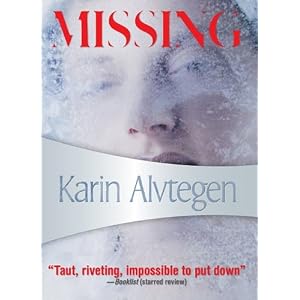
Missing (Saknad) by Karin Alvtegan (Swedish, 2000, T 2003)
Publishers are frantically scrambling now to find another Steig Larsson, but as we all know it's not just the story, but the timing and many other factors that come together to create super bestseller. Nordic crime has been "hot" for while now—even before Steig Larsson's books were translated—thanks to writers like Henning Mankell and Karin Fossum. I have read most of Mankell's Wallander series, and about three of Fossum's Konrad Seer mysteries (the Fossums didn't really grab me). I also read Åke Edwardson and Asa Larsson, and two Icelandic authors, but this is my first Karin Alvtegan. (I read Akeela's great review of her new book "Shadow" for the forthcoming issue of Belletrista and remembered I had seen some of her titles in the bookstore and, well...)
Alvtegan's Missing is not a police procedural or a standard thriller—she's unlikely to be the "next" Steig Larsson—but a psychological crime novel in the vein of Australian Patricia Carlon and UK's Barbara Vine (Ruth Rendell). In this novel, we are introduced to a young homeless woman, Sybilla, who, to get a nice bed and a bath occasionally, will scam a gullible man into booking her one (a little flirting, a lost wallet, damsel in distress, a man hoping to score...). But Sybilla's latest scam victim winds up brutally murdered, she becomes the prime suspect and is now not just homeless but on the run.
While Alvtegan is following Sybilla on the run, she is also telling us a fascinating story of how a woman from a privileged family ended up homeless, and in the process the reader swings back and forth between believing our protagonist is innocent or possibly guilty. If she's innocent, how would she—part of the disenfranchised of society—prove it?
Alvtegan has taken a story of a woman coming into her own and put it under extreme pressure. The results is a thoroughly engaging story with delicious slow building suspense. The action-packed ending is a bit less credible, but rest of the book is so good I was easily willing to forgive that.

Betrayal by Karin Alvtegan (Sweden 2003, T 2005, psychological suspense)
Betrayal is a good psychological suspense novel that takes the reader into the minds of its main characters. When we are introduced to them, Eva, is a definite type-A personality, is having marital problems and suspects her husband of having an affair; and Jonah, who is more than a little creepy, is glued to the bedside of a somewhat older lover, who is in a coma after a tragic accident. The narrative shifts back and forth between this unrelated twosome and we come to know their thought processes rather intimately. In their own ways both of these characters are moving from their perceived betrayals, closer and closer to a breaking point, or an edge of some kind, and Alvtegan does a good job working the psychological suspense throughout. It should be no surprise that the two characters will eventually connect in the story.
This was a good read—at different times gripping or creepy or interesting—but the characters in this story were less sympathetic to me than in her previous book I read, Missing, which I thought was very good. Still, it's in the vein of Patricia Carlon or Rendell's Barbara Vine books and an enjoyable, quick read.
45avaland
Now reading: Oil on Water by Nigerian author Helon Habila.
46avaland

Oil on Water by Helon Habila (2010, Nigerian)
Oil on Water is a mesmerizing story of two journalists who make a perilous trek into the forest in pursuit of "the story" - in this case, to interview the kidnappers of a white woman, a wife of a local oil executive. Rufus is a young journalist hoping to prove himself to his editor and co-workers, and Zaq is a veteran journalist, perhaps the most well-known in Nigeria, and clearly an alcoholic. They travel with a group of journalists for the interview but discover that the parties involved are not where they said they would be and that the island has seen some fighting. All of the journalist return at this point, except for Rufus and Zaq who continue on still in pursuit of "the story" and "the truth."
The two hire a man and his young son to take them by boat deeper into the jungle in pursuit of the kidnappers. The trip is perilous and, for the reader, riveting. Along the way we learn about Zaq and about Rufus, about the profound and devastating effects of the oil industry on Nigeria's land and people. Turns out "the story" is many stories, and "the truth" is something much bigger than Rufus imagined.
I was amazed that so much was told in such few pages. There is a lot going on and that, in addition to some flashbacks, does occasionally cause some confusion (where are we?), but I thought it a minor flaw. Habila's characters are wonderfully drawn, his prose carefully and beautifully crafted; he brings Nigeria vividly to life. The oil industry looms large in Nigeria and it's devastating is made all the more powerful coming on the heels of the Gulf oil disaster. The corruption and greed makes knowing who the "bad" and the "good" guys are. And in all this, a great affection for the land and its people comes through.
A short book, a great read. I enjoyed his previous boo, Measuring Time also.
47avaland

Buddha's Orphans by Samrat Upadhyay (2010, Nepal, Nepalese author)
Raja and Nilu are both orphans. Raja was abandoned as an infant just before his mother drowned herself, and Nilu was being brought up by a single mother who was often lost in the haze of alcohol and drugs. As children the two meet, he as the adopted son of a servant, and she as the daughter of the mistress of the house. It's an odd little relationship for the playmates at first, and Nilu begins to teach her little friend how to read. Theirs will be an epic love.
Set in Nepal during the later half of the 20th century, Buddha's Orphans is a tale of epic love—or perhaps an epic tale of a love that reaches across decades, caste, and anything else which might stand in its way. While reading it, Pasternak's Doctor Zhivago came to mind more than a few times, and while this novel doesn't reach the intensity of the classic, it certainly makes a brave attempt. His characters are superb, his stories—their stories—are set against the upheavals of Kathmandu as Nepal transforms itself from Monarchy to Democracy. The background-foreground connection doesn't work quite as well as it was probably intended, but I would not call it a failure as one is certainly transported to Nepal (and what do most of us know of Nepal?)
We've all read epic stories of love, set against war or other turmoil, but the most unusual thing about this epic love story is the very distinctive cyclical sense of it. Upadhyay has woven multiple stories in a way that suggests underpinnings of Hindu philosophy - that time is eternal and cyclical, a neverending cycle of birth, death, rebirth. This cyclical sense to the story was what really stayed with me after I had finished reading the book and perhaps it is this that gives the love story it's monumental feel.
48janeajones
Sounds fascinating, Lois -- it goes on my wish list.

