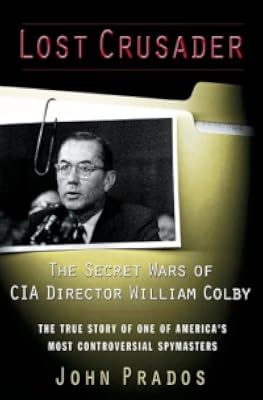
Lost Crusader: The Secret Wars of CIA Director William Colby
by John Prados
On This Page
Description
An account of one of the nation's most controversial CIA directors looks back on a life spent fighting Communism, from his salad days in the OSS to his involvement in the Phoenix program in Vietnam and the Indonesian coup of 1965.Tags
Recommendations













Member Reviews
Lost Crusader is a solid biography of William E Colby, director of the CIA from 1973 to 1976, focusing mostly on his significant accomplishments and occasionally on his serious lapses in judgement. My prior experience with Colby is from Valentine's The Phoenix Program, where Colby's anondyne Congressional testimony is contrasted against the brutal reality of Phoenix in the field. In Valentine's book Colby appears as a clear villain, but the reality is likely more nuanced.
Colby is very close to an archetypical CIA spy. Born in Minnesota to an army officer, Colby grew up in foreign stations around the world, attended Princeton, and joined the Army as an officer in 1940. He volunteered for parachute training, and then the OSS Jedburgh show more program, where he was parachuted into France and then Norway to aid local guerillas against the Nazi occupation. After the war, he joined the new CIA and set up stay-behind networks in Sweden and provided political assistance to the non-Communist Left in Italy. An ideological anti-communist liberal with an Ivy League degree, the only thing that marked Colby as different was his Catholicism, slightly out of line with the WASP establishment that defined the CIA.
In 1959, Colby was assigned as deputy station chief to Saigon, marking the start of a decade working in Vietnam in a variety of roles. Colby was committed to both pacification and President Ngô Đình Diệm. He was one of voices arguing against the 1963 coup, and for a unified command for civilian efforts which eventually became CORDS. Colby served as Division Chief for the Far East and later CORDS director, where he was responsible for the Phoenix Program.
One thing this book fails to square is Colby's committed idealism with many many compromises the CIA made in Vietnam. Covert war is hard to manage without covert funding, and associated corruption. However, the CIA's Air America massively facilitated the drug trade in South East Asia, and Colby appears to have at minimum turned a blind eye. Likewise, while the goal of Phoenix was to identify and "neutralize" high-ranking Viet Cong cadres, it rapidly and inevitably turned into a arbitrary detention and assassination program. Most tellingly, fewer than 20 Category A senior Viet Cong leaders were killed by Phoenix, and only 1 as a result of a targeted operation as opposed a random ambush. The vast majority of locals affected were Category B (tax collectors and the like), or Category C, which included anyone who made a pragmatic accommodation with the Viet Cong at any point.
After Vietnam, Colby returned to Langley, where he became CIA director in the midst of Watergate. Colby had the unenviable position of having to wind down an overgrown post-Vietnam covert warfare division, clear out decades of deadwood senior officers, finally get rid of the paranoid James Jesus Angleton, reform dissemination, and handle the release of the "Family Jewels" report. Colby wasn't responsible for the Family Jewels, which chronicle decades of CIA misdeeds from assassination missions to domestic surveillance to MKULTRA, but he did have to clean up the mess. This was arguably Colby's greatest success. Stonewalling would have likely seen the CIA defunded and broken up entirely, while a flawed release process could have seriously jeopardized national security. Colby's timed release and acquiescence to political realities protected the agency at the cost of his own career.
The book opens with the final act, Colby's mysterious disappearance in the Chesapeake Bay in 1996, but in this case, despite the drama of a missing spymaster the simplest solution is likely right. The 76 year old Colby had some sort of cardiac incident, fell out of his canoe, and drowned. His body was eventually found, and frankly, in the 90s its unclear who would have cared enough to kill him. Colby didn't lose the Vietnam War (that defeat had many fathers), but he didn't win it either. Ultimately, his legacy is preserving the CIA past 1975, for better or worse. show less
Colby is very close to an archetypical CIA spy. Born in Minnesota to an army officer, Colby grew up in foreign stations around the world, attended Princeton, and joined the Army as an officer in 1940. He volunteered for parachute training, and then the OSS Jedburgh show more program, where he was parachuted into France and then Norway to aid local guerillas against the Nazi occupation. After the war, he joined the new CIA and set up stay-behind networks in Sweden and provided political assistance to the non-Communist Left in Italy. An ideological anti-communist liberal with an Ivy League degree, the only thing that marked Colby as different was his Catholicism, slightly out of line with the WASP establishment that defined the CIA.
In 1959, Colby was assigned as deputy station chief to Saigon, marking the start of a decade working in Vietnam in a variety of roles. Colby was committed to both pacification and President Ngô Đình Diệm. He was one of voices arguing against the 1963 coup, and for a unified command for civilian efforts which eventually became CORDS. Colby served as Division Chief for the Far East and later CORDS director, where he was responsible for the Phoenix Program.
One thing this book fails to square is Colby's committed idealism with many many compromises the CIA made in Vietnam. Covert war is hard to manage without covert funding, and associated corruption. However, the CIA's Air America massively facilitated the drug trade in South East Asia, and Colby appears to have at minimum turned a blind eye. Likewise, while the goal of Phoenix was to identify and "neutralize" high-ranking Viet Cong cadres, it rapidly and inevitably turned into a arbitrary detention and assassination program. Most tellingly, fewer than 20 Category A senior Viet Cong leaders were killed by Phoenix, and only 1 as a result of a targeted operation as opposed a random ambush. The vast majority of locals affected were Category B (tax collectors and the like), or Category C, which included anyone who made a pragmatic accommodation with the Viet Cong at any point.
After Vietnam, Colby returned to Langley, where he became CIA director in the midst of Watergate. Colby had the unenviable position of having to wind down an overgrown post-Vietnam covert warfare division, clear out decades of deadwood senior officers, finally get rid of the paranoid James Jesus Angleton, reform dissemination, and handle the release of the "Family Jewels" report. Colby wasn't responsible for the Family Jewels, which chronicle decades of CIA misdeeds from assassination missions to domestic surveillance to MKULTRA, but he did have to clean up the mess. This was arguably Colby's greatest success. Stonewalling would have likely seen the CIA defunded and broken up entirely, while a flawed release process could have seriously jeopardized national security. Colby's timed release and acquiescence to political realities protected the agency at the cost of his own career.
The book opens with the final act, Colby's mysterious disappearance in the Chesapeake Bay in 1996, but in this case, despite the drama of a missing spymaster the simplest solution is likely right. The 76 year old Colby had some sort of cardiac incident, fell out of his canoe, and drowned. His body was eventually found, and frankly, in the 90s its unclear who would have cared enough to kill him. Colby didn't lose the Vietnam War (that defeat had many fathers), but he didn't win it either. Ultimately, his legacy is preserving the CIA past 1975, for better or worse. show less
Members
- Recently Added By
Author Information

35+ Works 1,445 Members
John Prados is a senior fellow of the National Security Archive in Washington, DC, where he helps bring newly declassified government records to public attention. He is the award-winning author of twenty-one books. including Islands of Destiny: The Solomons Campaign and the Eclipse of the Rising Sun. He also lectures widely on security, freedom of show more information, and other issues analyzes combat processes, serves as a historical advisor to filmmakers; and designs strategy board games, including the well-known Third Reich and new award-winning titles. show less
Common Knowledge
- People/Characters
- William Colby
Classifications
- Genres
- Nonfiction, Biography & Memoir, Politics and Government, History, General Nonfiction
- DDC/MDS
- 327.1273 — Society, government, & culture Political science International Relations: Spies Foreign policy and specific topics in international relations Espionage and subversion North America United States
- LCC
- UB271 .U52 .C657 — Military Science Military administration Military administration Intelligence
- BISAC
Statistics
- Members
- 63
- Popularity
- 480,019
- Reviews
- 1
- Rating
- (3.75)
- Languages
- English
- Media
- Paper, Ebook
- ISBNs
- 3