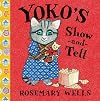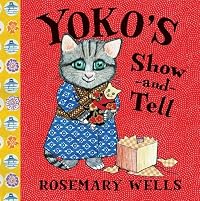
Yoko's Show-and-Tell (A Yoko Book)
by Rosemary Wells
On This Page
Description
When Yoko's grandparents send her a beautful antique doll all the way from Japan, Yoko the cat couldn't be happier. She places Miki on a windowsill and brings her candy every day. On Girls' Festival Day, Yoko wants to show Miki to her class and tell them all about the Japanese holiday. In her Big No voice Mama says, "We don't trouble trouble or trouble will trouble us." But Yoko is so excited about Girls' Day that she can't resist taking Miki to school. Mama will never know. What could show more possibly go wrong? show lessTags
Recommendations



Member Reviews
Yoko's grandparents send her a special doll from Japan, and Yoko wants to take it to school for show-and-tell - but some of her classmates take the doll and break it. Yoko and her mama take the doll to a doll hospital, and Yoko's mama sews it a new kimono, so when the grandparents visit, the doll is good as new. The boys who broke the doll do yard work in apologize.
Even though all of the characters are animals instead of people, Yoko's family has a distinct Japanese culture that is different from her classmates.
Even though all of the characters are animals instead of people, Yoko's family has a distinct Japanese culture that is different from her classmates.
The big idea of Yoko's Show and Tell is sometimes people make mistakes, but they can be mended, and you should always learn from your mistakes. In my opinion this was an okay book. One reason I liked the book was the plot was well paced and had a clear problem and solution. The book involves a Japanese holiday called Girls day, and her grandmother sends her a doll and without asking she take the doll to school which ends up getting broken. The solution to her problem was her mom told her she made a bad mistake, but she would still take the doll to the doll hospital. I thought the plot was realistic however it was a bit too simple and boring. A second reason I liked the book was the illustrations enhance the story. The illustrations show show more many traditional aspects of Japanese cultural, and without the photos I might not know what the author is talking about. For example, I never heard of red bean candy, but the illustrations depicted what that would look like. Finally, the language and writing style in the book is descriptive, yet clear. The language is simple for children to understand yet provides detail. An example of this is the following: "Yoko's mama helped Yoko arrange the red carpet for Miki. Yoko placed Miki in the window and brought her candy each morning. By evening, the candy was gone." The language and writing style helps the reader understand the tradition of what the doll does during Girl's Day. show less
The central message in the story is to treat family valuables very carefully. I like this book because of how the author’s diction. She chooses to use Japanese phrases, but translates them into English. For example, she writes, “halmoni” for grandma. In addition, I like the plot of the story. Yoko wants to bring her family’s special porcelain doll into show-and-tell really bad. However, her mother says, “No. because it is very breakable.” Yoko does not listen, and takes the doll to school anyways, and it gets broken. Luckily, her mother knows who can fix it! I think this plot is a great way to show readers the intentions their parents have good intentions for their children. The third reason I enjoyed this story is because show more of the illustrations. I like how the author uses red patterns throughout the story to help capture Yoko’s heritage. show less
37 months - O loves Yoko books and I have to admit I enjoy them too. Who hasn't taken something to school that they shouldn't have and had it either stolen or damaged. We can all relate.
Lovely book with beautiful illustrations. Picture book
Ratings
Members
- Recently Added By
Author Information

264+ Works 36,049 Members
Rosemary Wells was born in New York City on January 29, 1943. She studied at the Museum School in Boston. Without her degree, she left school at the age of 19 to get married. She began her career in publishing, working as an art editor and designer first at Allyn and Bacon and later at Macmillan Publishing. She is an author and illustrator of over show more 60 books for children and young adults. Her first book was an illustrated edition of Gilbert and Sullivan's I Have a Song to Sing-O. Her other works include Martha's Birthday, The Fog Comes on Little Pig Feet, Unfortunately Harriet, Mary on Horseback, and Timothy Goes to School. She also created the characters of Max and Ruby, Noisy Nora, and Yoko, which are featured in some of her books. She has won numerous awards including a Children's Book Council Award for Noisy Nora in 1974, the Edgar Allan Poe award for two young adult books, Through the Looking Glass and When No One Was Looking, and the Boston Globe-Horn Book Award for Shy Charles. (Bowker Author Biography) show less
Awards and Honors
Classifications
Statistics
- Members
- 58
- Popularity
- 528,536
- Reviews
- 5
- Rating
- (3.90)
- Languages
- English
- Media
- Paper
- ISBNs
- 2