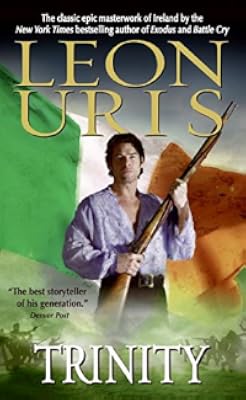
On This Page
Description
The "terrible beauty" that is Ireland comes alive in this mighty epic that re-creates that Emerald's Isle's fierce struggle for independence. Trinity is a saga of glories and defeats, triumphs and tragedies, lived by a young Catholic rebel and the beautiful and valiant Protestant girl who defied her heritage to join him. Leon Uris has painted a masterful portrait of a beleaguered people divided by religion and wealth--impoverished Catholic peasants pitted against a Protestant aristocracy show more wielding power over life and death. show lessTags
Recommendations

















Member Recommendations
Member Reviews
Let's begin by stipulating that Uris is a pulp fiction writer and should be read and reviewed on those terms. There's absolutely nothing wrong with pulp fiction - it's a great and wonderful genre full of entertainment value.
With Uris' books the formula is pretty simple: Our hero is noble, well-read, and self-sacrificing. He's closed himself off, but is waiting for the right woman. The right woman is also noble and self-sacrificing, but strong-willed and beautiful. He sets these folks down in the middle of some big historical conflict and then uses them to give readers a bit of a history lesson. He's typically got a bias, but most history does. These are good solid historical epics.
I really like Mila 18, his book about the Warsaw Ghetto show more Uprising. It inspired me to read a lot of actual history of the event including a number of diaries that were recovered from there. Likewise with Trinity, which I read once before, I will most likely go read more Irish history.
Trinity is a decent vehicle for imparting quite a bit of history from the Irish perspective. It's a good read for making you think about the impact of imperialism and industrialization. There's an excellent set of chapters on early twentieth century factories and a factory fire that will remind you why unions came about in a really visceral way.
This is a dense read, but it's entertaining and interesting in parts and is probably a good gateway to other more substantive reads on the subject matter. show less
With Uris' books the formula is pretty simple: Our hero is noble, well-read, and self-sacrificing. He's closed himself off, but is waiting for the right woman. The right woman is also noble and self-sacrificing, but strong-willed and beautiful. He sets these folks down in the middle of some big historical conflict and then uses them to give readers a bit of a history lesson. He's typically got a bias, but most history does. These are good solid historical epics.
I really like Mila 18, his book about the Warsaw Ghetto show more Uprising. It inspired me to read a lot of actual history of the event including a number of diaries that were recovered from there. Likewise with Trinity, which I read once before, I will most likely go read more Irish history.
Trinity is a decent vehicle for imparting quite a bit of history from the Irish perspective. It's a good read for making you think about the impact of imperialism and industrialization. There's an excellent set of chapters on early twentieth century factories and a factory fire that will remind you why unions came about in a really visceral way.
This is a dense read, but it's entertaining and interesting in parts and is probably a good gateway to other more substantive reads on the subject matter. show less
I reluctantly picked this book up after receiving it as a Christmas present. Boy was I wrong about my initial impressions. I devoured the entire book in less than a week. I found the story fascinating. The dichotomy between the haves and have-nots in Ireland and the constant struggle was intriguing. The author created well rounded characters, who seemed to suffer unimaginably. The book read like nonfiction. Overall, highly recommended.
This book offers up an interesting time in history in a country not given much thought aside from silly-jolly St. Patrick's Day. Some of the characters are drawn better than others, and there are large portions of the story that were very entertaining. Uris goes from telling his tale from first to third person, then back again as it seems to suit - whenever the protagonist's best buddy is around to pick up the narrative, we hear it all through him for a certain number of pages. Then, he's out of the story line and we're back to the tale recounted in third person. This type of approach may not bother many readers, but I found it disconcerting, like the author couldn't make up his mind how best to present it all. I'm glad I read it, if show more only to get a glimpse into the effects of the British Industrial revolution on their Irish subjects, and the ongoing political oppression that leads to the beginning of the Irish Republican Brotherhood.
Still, the style is rather simplistic (Irish Catholics: good! Irish Protestants and the British: bad!) and the book drags on from one injustice to another, leading up to what can only be a bad ending for our hero - and it's almost a relief when it's over. I'm glad I read the book, but not certain I could read the sequel without some seriously uplifting music playing in the background. show less
Still, the style is rather simplistic (Irish Catholics: good! Irish Protestants and the British: bad!) and the book drags on from one injustice to another, leading up to what can only be a bad ending for our hero - and it's almost a relief when it's over. I'm glad I read the book, but not certain I could read the sequel without some seriously uplifting music playing in the background. show less
Sprawling but increasingly engaging, Trinity gathers steam in proportion to its length. It's a lucky thing, too, since it's nearly 800 pages. Although I would have preferred at times more history and less novel, it deftly invoked powerful emotional responses (particularly feelings of futility leading to anger). Also, I kind of hate the British now.
1471 Trinity, by Leon Uris (read 21 Dec 1977) I was repelled by some aspects of this book: it wallows in obscenities as far as speech is concerned I thought I was reading the Watergate tapes, but there were no deleted obscenities--they were all there. It also reeks with anti-clerical, anti-Church sentiments. Uris is really a pulp writer, I think. He glories in gore. All in all I felt the book was not worth reading.
An historical novel, Trinity is about the Irish uprising and battle for independence. The author chose to show the plight of the Irish Catholics through fictional characters and fictionalized actual events. It covers the history of the conflict from about the mid-1800s to just before the Easter Rising, jumping back and forth between Catholic, Protestant and English characters.I appreciated the scope and depth of the information, I really knew very little about this moment in history. The author knows how to build a story and grip your emotions and sympathies for the characters and events, as well as set out clearly the motivations of the parties involved.At the end though, I felt as if I had been emotionally tweaked. I will not believe show more that every person committed to their faith is an evil, bigoted, hateful human being and that the only compassionate, sensible and decent human beings are the atheists and revolutionaries. Nor can I believe that every English man and woman is a beast who cares nothing for others. That is the impression the book leaves you with. It is not even-handed in any way. I don't like to be tweaked by ministers, politicians or writers, however, I am glad to have read this book, as it did give me insight to the bitterness and sorrows of a part of humanity, and what they did to overcome it. It also made me dig deeper into a part of history I had only glossed over until now. show less
When I read this book it opened my eyes to the English oppression of the Irish for centuries. The cruel and inhumane greed for a "colony" was mind blowing. I'm second generation Irish and it hurt my heart to know how my countrymen were treated. I've felt differently about the English ever since. I have great respect for them, but I don't completely trust them.
Members
- Recently Added By
Lists

Historical Fiction
889 works; 91 members
Favourite Books
1,820 works; 316 members

Tour of Ireland
40 works; 11 members

Revolutions
72 works; 5 members

World War I Fiction
94 works; 15 members

Swinging Seventies
255 works; 18 members

Stories set in The British Isles
51 works; 1 member

Fiction (Non-Fantasy) by Irish Authors Set in Ireland
87 works; 3 members

EU Fiction: 1950-2022
223 works; 70 members
Author Information

46+ Works 21,166 Members
Writer Leon Uris was born in Baltimore on August 3, 1924. He dropped out of school to join the Marines during World War II, but later returned to attend Baltimore City College. His first novel, Battle Cry (1953), was based on his time as a marine. He followed it with a series of New York Times bestsellers, including The Angry Hills, Exodus, Topaz, show more and Trinity. QB VII was adapted into a TV mini-series starring Ben Gazzara and Anthony Hopkins. Uris has also written non-fiction (including Ireland: A Terrible Beauty and Jerusalem: Song of Songs) and screenplays (Battle Cry and Gunfight at the O. K. Corral). He has won the John F. Kennedy Memorial Award from the Irish-American Society and the Scopus Award from the Hebrew University in Jerusalem. (Bowker Author Biography) show less
Some Editions
Awards and Honors
Distinctions
Series

Work Relationships
Is contained in
Contains
Common Knowledge
- Canonical title
- Trinity
- Original title
- Trinity
- Alternate titles
- Trinity
- Original publication date
- 1976
- People/Characters
- Connor Larkin; Seamus O'Neill; Larkin (family); MacLeod (family); Hubble (family)
- Important places
- Ireland
- Epigraph
- "There is no present or future - only the past,
happening over and over again - now."
EUGENE O'NEILL - A Moon for the Misbegotten - Dedication
- This book is dedicated to my wife, Jill
who is as much a part of these pages as
the Irish people. - First words
- MAY 1885
I recall with utter clarity the first great shock of my life. A scream came from the cottage next door. - Quotations*
- Er is geen heden of toekomst - alleen het verleden, dat altijd opnieuw gebeurt - nu. (Eugene O'Neill: "A moon for the misbegotten")
- Last words
- (Click to show. Warning: May contain spoilers.)When all of this was done, a republic eventually came to pass but the sorrows and the troubles have never left that tragic, lovely land. For you see, in Ireland there is no future, only the past happening over and over.
- Original language
- English
*Some information comes from Common Knowledge in other languages. Click "Edit" for more information.
Classifications
- Genres
- Fiction and Literature, General Fiction, Historical Fiction
- DDC/MDS
- 813.54 — Literature & rhetoric American literature in English American fiction in English 1900-1999 1945-1999
- LCC
- PZ4 .U76 — Language and Literature Fiction and juvenile belles lettres Fiction and juvenile belles lettres Fiction in English
- BISAC
Statistics
- Members
- 3,292
- Popularity
- 5,196
- Reviews
- 36
- Rating
- (4.03)
- Languages
- 11 — Danish, Dutch, English, Finnish, French, German, Hungarian, Norwegian (Bokmål), Norwegian, Spanish, Swedish
- Media
- Paper, Audiobook, Ebook
- ISBNs
- 49
- ASINs
- 52