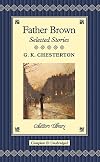
Father Brown: Selected Stories
by G. K. Chesterton
Father Brown (Collections and Selections — Selection, 18 Stories)
On This Page
Description
The amiable detective-priest Father Brown, who brought Chesterton to a wider public first appeared in The Innocence of Father Brown and remains one of the best-known names in crime fiction.These two novels were first published in 1911 and 1914 and contain 12 short stories each.
.
Tags
Recommendations






















Member Reviews
Eighteen Father Brown stories. One of the problems many modern mystery writers have is that by setting their murders in a specific community it leads one to believe it a dangerous place. In the same way crime follows Father Brown wherever he goes. I love the way Chesterton writes; he can go from serious to breezy ebullience in one sentence. On the other hand, he is often quite long-winded.
A good line from The Secret Garden: "As a soldier, he loathed all this secretive carnage; where were these extravagant amputations going to stop? First one head was hacked off, and then another; in this case (he told himself bitterly) it was not true that two heads were better than one."
A good line from The Secret Garden: "As a soldier, he loathed all this secretive carnage; where were these extravagant amputations going to stop? First one head was hacked off, and then another; in this case (he told himself bitterly) it was not true that two heads were better than one."
I partially enjoyed reading these 17 stories. Some of them seemed unusually slow and hard to get into. One reason for that is Chesterton’s careful development and description of scenes. He wanted the reader to really imagine where the story is taking place. In some cases, this helped draw me in the setting, but other times it distracted me: I suppose I’m so used to fast-moving action in fiction that the slow-pace distracted me. The other reason for the feeling of slowness was Father Brown nature: he is a character-interpreter. Father Brown wants to discuss with the other characters why people do what they do. This gives the stories a feeling of “telling” rather than showing that sometimes seemed excessive.
On the other hand, show more these stories were clever. It always amazes me when I read a story or a novel in which human nature is such an imperative part of the plot. How did Chesterton so accurately interpret motives, especially in the stories dealing with murder? I found these stories intriguing.
More thoughts on my blog show less
On the other hand, show more these stories were clever. It always amazes me when I read a story or a novel in which human nature is such an imperative part of the plot. How did Chesterton so accurately interpret motives, especially in the stories dealing with murder? I found these stories intriguing.
More thoughts on my blog show less
Women don't quite exist for G.K. Chesterton. I'm was puzzled that so many of the villians suicided. It seemed very cruel of Chesterton to deny his villains any forgiveness at all.
I already have copies of "The Incredulity" and "The Innocence" of Father Brown so was glad to find additional stories from "The Wisdom", "The Secret" and "The Scandal" in this volume, which contains 18 stories and should not be confused with The Complete Father Brown.
Once again Chesterton's hero solves the mysteries with modesty and compassion and reminds us never to overlook even the most humble individual. My favourite quote: "To be clever enough to get all that money, one must be stupid enough to want it" (from "The Paradise of Thieves").
Once again Chesterton's hero solves the mysteries with modesty and compassion and reminds us never to overlook even the most humble individual. My favourite quote: "To be clever enough to get all that money, one must be stupid enough to want it" (from "The Paradise of Thieves").
Catholic priest Father Brown investigates various crimes in 1900's England. As a preist, through confession, he is familiar with all the ways a human can attempt to elude justice and he always manages to fund the criminal's weak point. Some stories can be very rambling with long "atmospheric" passages and a lot of references to saving of souls.
A collection of short detective stories. Generally pretty good. Centered on understanding motivation, rather than observing details. Never invite Father Brown to a dinner party unless you want someone murdered.
Quite entertaining, but not as good as Sherlock Holmes.
Members
- Recently Added By
Author Information

Gilbert Keith Chesterton was born in London, England, in 1874. He began his education at St Paul's School, and later went on to study art at the Slade School, and literature at University College in London. Chesterton wrote a great deal of poetry, as well as works of social and literary criticism. Among his most notable books are The Man Who Was show more Thursday, a metaphysical thriller, and The Everlasting Man, a history of humankind's spiritual progress. After Chesterton converted to Catholicism in 1922, he wrote mainly on religious topics. Chesterton is most known for creating the famous priest-detective character Father Brown, who first appeared in "The Innocence of Father Brown." Chesterton died in 1936 at the age of 62. (Bowker Author Biography) show less
Some Editions
Series

Work Relationships
Contains
Common Knowledge
- Canonical title
- Father Brown: Selected Stories
- Original publication date
- 1955; 1995
- People/Characters
- Father Brown; Flambeau; Aristide Valentin
- First words
- Between the silver ribbon of morning and the green glittering ribbon of sea, the boat touched Harwich and let loose a swarm of folk like flies, among whom the man we must follow was by no means conspicuous - nor wished to be.... (show all) (The Blue Cross)
- Last words
- (Click to show. Warning: May contain spoilers.)And others have equal certitude that it has but one solution. (The Insoluble Problem)
- Original language
- English
- Disambiguation notice
- Collection of 18 selected Father Brown stories:
The Blue Cross;
The Secret Garden;
The Queer Feet;
The Invisible Man;
The Honour of Israel Gow;
The Hammer of God;
The Sign of the Broken Sword; ... (show all)
The Paradise of Thieves;
The Mistake of the Machine;
The Perishing of the Pendragons;
The Strange Crime of John Boulnois;
The Oracle of the Dog;
The Dagger with Wings;
The Mirror of the Magistrate;
The Blast of the Book;
The Green Man;
The Point of the Pin;
The Insoluble Problem
Classifications
Statistics
- Members
- 447
- Popularity
- 68,189
- Reviews
- 9
- Rating
- (3.56)
- Languages
- English, German, Italian
- Media
- Paper, Audiobook, Ebook
- ISBNs
- 6
- ASINs
- 14