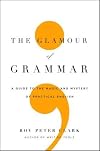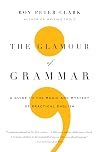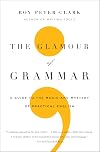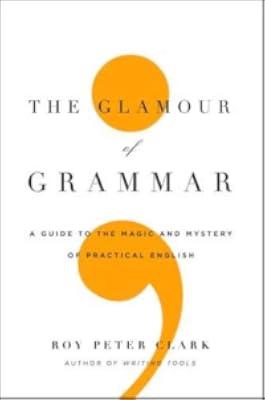
The Glamour of Grammar: A Guide to the Magic and Mystery of Practical English
by Roy Peter Clark
On This Page
Description
A practical guide to various parts of speech designed to improve communication and writing skills.Tags
Recommendations














Member Reviews
The Glamour of Grammar: A Guide to the Magic and Mystery of Practical English by Roy Peter Clark. If I could use only one word to describe this book, that word would be grammarous. You won't find grammarous in Webster's. But you will find it in The Urban Dictionary. Edward Butts, a linguist from Canada, even wrote a poem about it.
The Glamour of Grammar is a "how-to" book. And it is also a "why not?" book. Clark gives us all the rules of grammar, and then he tells us we can break them. In his section on Gender Equality, the author recommends the following usage:
A politician can kiss privacy good-bye when they run for office.
If that were the first thing I had read in this book, I would have heeded the author's advice and thrown the show more book out my nineteenth story window, only I don't have a nineteenth story window.
The first thing I looked at in Clark's book was the index. I wanted to see if he mentioned Strunk and White and The Elements of Style. Clark paid them and their book due homage, mentioning all of them a number of times. That is one thing in the author's favor. Another is that Clark is a fellow Floridian. Yet another is that he enjoys browsing at book fairs and book stores.
It is too early to tell if The Glamour of Grammar will be the next classic. But it already has my vote, and a place on my bookshelf close to my thirty-one copies of The Elements of Style.
If I had to choose, I would have called myself a diehard prescriptivist. I followed all the rules of grammar. But after reading The Glamour of Grammar, I am a wavering prescriptivist. Maybe even a - a … d-e-s-c-r-i-p-t-i-v-i-s-t! If a sentence fragment sounds better than a complete sentence, by golly, I'm gonna use it.
I did disagree with one thing in Clark's book. In his section on Standards, Clark chastised another author for writing that Republican e-mail senders were foaming at the mouth. Clark believed it was impossible for the author to know this for sure. Believe me! I have several Republican friends. And they all foam at the mouth. Especially when they talk or write about Obama! show less
The Glamour of Grammar is a "how-to" book. And it is also a "why not?" book. Clark gives us all the rules of grammar, and then he tells us we can break them. In his section on Gender Equality, the author recommends the following usage:
A politician can kiss privacy good-bye when they run for office.
If that were the first thing I had read in this book, I would have heeded the author's advice and thrown the show more book out my nineteenth story window, only I don't have a nineteenth story window.
The first thing I looked at in Clark's book was the index. I wanted to see if he mentioned Strunk and White and The Elements of Style. Clark paid them and their book due homage, mentioning all of them a number of times. That is one thing in the author's favor. Another is that Clark is a fellow Floridian. Yet another is that he enjoys browsing at book fairs and book stores.
It is too early to tell if The Glamour of Grammar will be the next classic. But it already has my vote, and a place on my bookshelf close to my thirty-one copies of The Elements of Style.
If I had to choose, I would have called myself a diehard prescriptivist. I followed all the rules of grammar. But after reading The Glamour of Grammar, I am a wavering prescriptivist. Maybe even a - a … d-e-s-c-r-i-p-t-i-v-i-s-t! If a sentence fragment sounds better than a complete sentence, by golly, I'm gonna use it.
I did disagree with one thing in Clark's book. In his section on Standards, Clark chastised another author for writing that Republican e-mail senders were foaming at the mouth. Clark believed it was impossible for the author to know this for sure. Believe me! I have several Republican friends. And they all foam at the mouth. Especially when they talk or write about Obama! show less
 This review was written for LibraryThing Early Reviewers.
Practical English indeed.
What a marvelous book Roy Clark has written on what many think of as a decidedly unmarvelous subject: Grammar.
Succinct, pithy, without the English Garden mazes one so often wanders dazedly through in dry recitations of rules, Mr. Clark's book is not only informative but fun, no small task given the subject's normal dry-as-dust theme. I have many books on style and accepted usage, but I have found none to be as readily translatable into the freeing (although frequently frustrating) act of putting words to paper as The Glamour of Grammar.
The book is divided up into five categories of usage: Words; Points (punctuation); Standards (acceptable usage); Meaning (applications); and Purpose (using the spice rack of show more our native tongue). Each of these larger concepts is in turn further honed by various specific subsets of the point Mr. Clark is making, each replete with lively and often humorous examples of just exactly what it is he is trying to show his audience.
For example, under the rubric of "Words", we find hints about your personal lexicography (think Humpty-Dumpty), the importance of distinction in clear writing and the joy of homophones and alliteration when used in moderation. "Points" refers to punctuation, and includes sections on the possessive apostrophe, the colon/dash/parenthesis battlefield and even "reclaiming" the exclamation point! "Standards" includes the difference (disappearing in public discourse) between literal and figurative (No John, the safety did not “literally” knock the receiver’s head off), and the constant battle (in my mind, at any rate) between the various uses and tenses of Lay and Lie. “Meaning”, among other things, highlights the flaccidity of the passive voice (politician-speak for when they have been caught with their hand in the till (or on a page)), and the isthmusian duties of the complex sentence. Finally, “Purpose” makes clear the to-often-misunderstood difference between Connotation and Denotation, the pox of the creeping CAPITAL, and the correctness of the “incorrect” (nonstandard and dialect) English in your writing.
A two-night read, this was an eight sticky-note book which gave me leads to four other books and/or authors- not bad for a grammar text. show less
What a marvelous book Roy Clark has written on what many think of as a decidedly unmarvelous subject: Grammar.
Succinct, pithy, without the English Garden mazes one so often wanders dazedly through in dry recitations of rules, Mr. Clark's book is not only informative but fun, no small task given the subject's normal dry-as-dust theme. I have many books on style and accepted usage, but I have found none to be as readily translatable into the freeing (although frequently frustrating) act of putting words to paper as The Glamour of Grammar.
The book is divided up into five categories of usage: Words; Points (punctuation); Standards (acceptable usage); Meaning (applications); and Purpose (using the spice rack of show more our native tongue). Each of these larger concepts is in turn further honed by various specific subsets of the point Mr. Clark is making, each replete with lively and often humorous examples of just exactly what it is he is trying to show his audience.
For example, under the rubric of "Words", we find hints about your personal lexicography (think Humpty-Dumpty), the importance of distinction in clear writing and the joy of homophones and alliteration when used in moderation. "Points" refers to punctuation, and includes sections on the possessive apostrophe, the colon/dash/parenthesis battlefield and even "reclaiming" the exclamation point! "Standards" includes the difference (disappearing in public discourse) between literal and figurative (No John, the safety did not “literally” knock the receiver’s head off), and the constant battle (in my mind, at any rate) between the various uses and tenses of Lay and Lie. “Meaning”, among other things, highlights the flaccidity of the passive voice (politician-speak for when they have been caught with their hand in the till (or on a page)), and the isthmusian duties of the complex sentence. Finally, “Purpose” makes clear the to-often-misunderstood difference between Connotation and Denotation, the pox of the creeping CAPITAL, and the correctness of the “incorrect” (nonstandard and dialect) English in your writing.
A two-night read, this was an eight sticky-note book which gave me leads to four other books and/or authors- not bad for a grammar text. show less
This review was written for LibraryThing Early Reviewers.I have long had a love-hate relationship with grammar. Although it is necessary for effective writing, I also have nightmares of the grammar exercises from school, and I always dreaded having to teach grammar to my high school students.
However, Roy Peter Clark’s "The Glamour of Grammar: A Guide to the Magic and Mystery of Practical English" illustrates that grammar does not have to be the dry, lifeless subject found in schools. By inviting readers to “embrace grammar… not as a set of rules but as a box of tools” (p.2), Clark manages to make a somewhat imposing subject into something that seems both approachable and relevant.
"The Glamour of Grammar" consists of 50 super-short chapters divided into five sections: Words, Points, show more Standards, Meaning, and Purpose. Within these sections, Clark covers every topic grammatical and writing topic imaginable, such as the difference between literal and figurative, and how to properly use an exclamation point. I particularly appreciated the “Keepsakes” he includes at the end of each chapter. These sections provide pithy sound bites of the chapter’s main points.
One of the main draws of "The Glamour of Grammar" is the writing. He takes what, in other people’s hands, could be an uninspiring topic and makes it fascinating. Furthermore, Clark does not just give lip service to language; he obviously loves words and grammar, as illustrated by the many writing samples he includes. His selection and analysis of these samples offer a glimpse of how Clark must approach reading. Rather than merely reading for information, I can imagine him savoring the language and feeling a great deal of excitement when he finds a great piece of writing.
All in all, this is one of the best books on grammar and writing I have encountered, and it would work equally well as a reference book or as a cover-to-cover read. Although I was skeptical before I started reading it, Clark does an excellent job emphasizing the beauty (and, yes, the “magic and mystery”) found in grammar. show less
However, Roy Peter Clark’s "The Glamour of Grammar: A Guide to the Magic and Mystery of Practical English" illustrates that grammar does not have to be the dry, lifeless subject found in schools. By inviting readers to “embrace grammar… not as a set of rules but as a box of tools” (p.2), Clark manages to make a somewhat imposing subject into something that seems both approachable and relevant.
"The Glamour of Grammar" consists of 50 super-short chapters divided into five sections: Words, Points, show more Standards, Meaning, and Purpose. Within these sections, Clark covers every topic grammatical and writing topic imaginable, such as the difference between literal and figurative, and how to properly use an exclamation point. I particularly appreciated the “Keepsakes” he includes at the end of each chapter. These sections provide pithy sound bites of the chapter’s main points.
One of the main draws of "The Glamour of Grammar" is the writing. He takes what, in other people’s hands, could be an uninspiring topic and makes it fascinating. Furthermore, Clark does not just give lip service to language; he obviously loves words and grammar, as illustrated by the many writing samples he includes. His selection and analysis of these samples offer a glimpse of how Clark must approach reading. Rather than merely reading for information, I can imagine him savoring the language and feeling a great deal of excitement when he finds a great piece of writing.
All in all, this is one of the best books on grammar and writing I have encountered, and it would work equally well as a reference book or as a cover-to-cover read. Although I was skeptical before I started reading it, Clark does an excellent job emphasizing the beauty (and, yes, the “magic and mystery”) found in grammar. show less
This review was written for LibraryThing Early Reviewers.Roy Peter Clark's The Glamour of Grammar is one of those books that starts out promising and then turns into an utter chore to finish. I have to admit I didn't get through the whole thing... just couldn't make myself pick it back up. And this after being initially delighted with the subject matter and fun style. It's astonishing how an author's bad habits can turn a reader so decidedly off his books.
Here's what I initially liked. Clark does make a nice connection between glamour (magic) and language, spells and spelling. His philosophy of grammar as tools instead of rules is an attractive one, but pretty simplistic for people already interested in grammar and language (i.e., everyone who would read this book). The tone is light and show more humorous (but more on that in a minute). The chapters are nice and short. And that's about all the positive stuff I can think of.
So here's why I dropped this book. The humor starts off fun but quickly becomes wearing. Clark gets overly cute and is clearly oh so impressed with his own punning. There are few things more tiresome than an author cackling over his own inane wordplays.
What really got old fast, however, were the political slams. Is it really necessary for you, Clark, to constantly use examples like, "When hell freezes over, when all the rivers run dry, and when swallows forget to come back to you-know-where, that's when I'll vote Republican" (71)? Or are you so smugly supercilious that you don't think anyone of that political persuasion might also be interested in your topic?
Clark probably thinks he's being funny, but comments like that are distracting and unnecessary. And I can't avoid the impression that he's really something of a jerk toward anyone who holds convictions different from his own. In the chapters I read he makes several nasty comments about another grammarian, Lynne Truss, and obviously thinks himself quite clever for making a pun on her last name. The sad thing is that Clark probably subscribes to all kinds of modern, high-sounding creeds of tolerance... but he displays this intolerant bigotry toward people of different beliefs and makes them the butt of his jokes. The hypocrisy there just isn't funny.
Maybe you'll be able to enjoy this book if you have a high tolerance level for bad puns and mean-spirited political and personal jabs. Maybe there is even something worthwhile about grammar and language in the chapters I did not read. But I just couldn't subject myself to any more of Clark's ego to get to it. show less
Here's what I initially liked. Clark does make a nice connection between glamour (magic) and language, spells and spelling. His philosophy of grammar as tools instead of rules is an attractive one, but pretty simplistic for people already interested in grammar and language (i.e., everyone who would read this book). The tone is light and show more humorous (but more on that in a minute). The chapters are nice and short. And that's about all the positive stuff I can think of.
So here's why I dropped this book. The humor starts off fun but quickly becomes wearing. Clark gets overly cute and is clearly oh so impressed with his own punning. There are few things more tiresome than an author cackling over his own inane wordplays.
What really got old fast, however, were the political slams. Is it really necessary for you, Clark, to constantly use examples like, "When hell freezes over, when all the rivers run dry, and when swallows forget to come back to you-know-where, that's when I'll vote Republican" (71)? Or are you so smugly supercilious that you don't think anyone of that political persuasion might also be interested in your topic?
Clark probably thinks he's being funny, but comments like that are distracting and unnecessary. And I can't avoid the impression that he's really something of a jerk toward anyone who holds convictions different from his own. In the chapters I read he makes several nasty comments about another grammarian, Lynne Truss, and obviously thinks himself quite clever for making a pun on her last name. The sad thing is that Clark probably subscribes to all kinds of modern, high-sounding creeds of tolerance... but he displays this intolerant bigotry toward people of different beliefs and makes them the butt of his jokes. The hypocrisy there just isn't funny.
Maybe you'll be able to enjoy this book if you have a high tolerance level for bad puns and mean-spirited political and personal jabs. Maybe there is even something worthwhile about grammar and language in the chapters I did not read. But I just couldn't subject myself to any more of Clark's ego to get to it. show less
This review was written for LibraryThing Early Reviewers.It would make sense that Roy Peter Clark, author of The Glamour of Grammar would have once played in a band which had its greatest moment in opening for ? and the Mysterians. Clark is a writer and writing educator whose passion for the “the magic and mystery of practical English” would lure even the grammar-averse reader into this fascinating book of language history and practical advice. (For example, have you ever thought about the relationship of glamour/glamour/grammar, punctual/puncture/punctuation, or at least two of the meanings of the word “spell?”)
There is more to the Oxford (i.e. serial) comma debate than the usual “my parents, Ayn Rand and God” example and Clark has converted me. I am also going to take his advice show more against becoming a ‘hypergrammarian.’ As someone who has been correcting the Rolling Stones for forty-five years on the subject of Satisfaction – yes, I was an insufferable ten year old hypergrammarian back in ’65 - I know that there is still much to learn and I will take the advice of The Glamour of Grammar to heart. I would recommend to any teachers of grammar who would like something to supplement Warriner’s Handbook etc. and to all readers who find language fun. show less
There is more to the Oxford (i.e. serial) comma debate than the usual “my parents, Ayn Rand and God” example and Clark has converted me. I am also going to take his advice show more against becoming a ‘hypergrammarian.’ As someone who has been correcting the Rolling Stones for forty-five years on the subject of Satisfaction – yes, I was an insufferable ten year old hypergrammarian back in ’65 - I know that there is still much to learn and I will take the advice of The Glamour of Grammar to heart. I would recommend to any teachers of grammar who would like something to supplement Warriner’s Handbook etc. and to all readers who find language fun. show less
This review was written for LibraryThing Early Reviewers.So, what do you think about when you hear the word “grammar”? As a kid, I would think “Uh oh; I guess I wrote something wrong again.” As a young adult I’d say, “Hey, that’s just the way I speak.” As an Englishwoman moving to America I’d groan that it’s not just the spellings that are different here but the grammar rules as well. And after reading this book I’d say, “Wow!”
So, what about my punctuation above? Why did I put that question mark outside the quotes when the exclamation point went inside at the end of the paragraph? I’d often wondered how to punctuate quotes, and since I want to be a writer, I’d often thought I really ought to learn. At last I have.
Clark’s book starts by pointing out that show more “glamour” and “grammar” come from the same root. I guess is makes sense. After all, we “spell” words correctly or otherwise, and wizards cast “spells.” Grammar’s just the next step.
I used to teach chess, and I’d explain to the kids that there are two types of rules. Some have to be obeyed (pawns move forwards for example), or else you’re not playing chess. Others are there to be understood and used judiciously (such as “Don’t get your queen out too soon”) to set or avoid falling into traps. Once you know the rules, you know what it means when they’re broken.
Spelling’s probably the first sort of rule, and Clark includes a chapter on how meanings can change where the wrong spelling or wrong word is used. Suddenly you’re not saying what you thought; your reader’s dragged out of the writing; you’re not playing the same game. But other grammar rules can be judiciously broken. We just have to know what we’re doing and why—be prepared for what the reader will see, and be ready to make sure it’s what we intend.
Clark’s chapters are written with delightful style, great voice, amazing examples, and just pure fun. (Yes, grammar can be fun!) There’s advice for aspiring writers that any of us could use—the value of the well-chosen long or short word, the nuances of sound or foreign phrase, the alliteration of short and long sentences… And then there are chapter endings with quick and easily read “Keepsakes.” There he might emphasize a point, help the reader practice a technique, or simply list the rules. (That’s how I learned how to punctuate my first paragraph.)
Clark doesn’t want to regiment our writing. He acknowledges how different countries (UK and US for example), industries (newspaper vs book), and even publishers have their own chosen styles. Obey the rules of your intended audience he says. But then he frees us to shift those chess pieces round and win the game.
Is grammar glamorous? It certainly is now. I love this book, and I’d recommend that everyone who loves reading or writing really should read it. I can hardly believe how lucky I was to get a copy to review—you’ll hardly believe how lucky you are if you get your own copy too. And, just for reference, since Roy Peter Clark is vice president and senior scholar at the Poynter Institute, I have no qualms about trusting him to give me, and you, the right facts. show less
So, what about my punctuation above? Why did I put that question mark outside the quotes when the exclamation point went inside at the end of the paragraph? I’d often wondered how to punctuate quotes, and since I want to be a writer, I’d often thought I really ought to learn. At last I have.
Clark’s book starts by pointing out that show more “glamour” and “grammar” come from the same root. I guess is makes sense. After all, we “spell” words correctly or otherwise, and wizards cast “spells.” Grammar’s just the next step.
I used to teach chess, and I’d explain to the kids that there are two types of rules. Some have to be obeyed (pawns move forwards for example), or else you’re not playing chess. Others are there to be understood and used judiciously (such as “Don’t get your queen out too soon”) to set or avoid falling into traps. Once you know the rules, you know what it means when they’re broken.
Spelling’s probably the first sort of rule, and Clark includes a chapter on how meanings can change where the wrong spelling or wrong word is used. Suddenly you’re not saying what you thought; your reader’s dragged out of the writing; you’re not playing the same game. But other grammar rules can be judiciously broken. We just have to know what we’re doing and why—be prepared for what the reader will see, and be ready to make sure it’s what we intend.
Clark’s chapters are written with delightful style, great voice, amazing examples, and just pure fun. (Yes, grammar can be fun!) There’s advice for aspiring writers that any of us could use—the value of the well-chosen long or short word, the nuances of sound or foreign phrase, the alliteration of short and long sentences… And then there are chapter endings with quick and easily read “Keepsakes.” There he might emphasize a point, help the reader practice a technique, or simply list the rules. (That’s how I learned how to punctuate my first paragraph.)
Clark doesn’t want to regiment our writing. He acknowledges how different countries (UK and US for example), industries (newspaper vs book), and even publishers have their own chosen styles. Obey the rules of your intended audience he says. But then he frees us to shift those chess pieces round and win the game.
Is grammar glamorous? It certainly is now. I love this book, and I’d recommend that everyone who loves reading or writing really should read it. I can hardly believe how lucky I was to get a copy to review—you’ll hardly believe how lucky you are if you get your own copy too. And, just for reference, since Roy Peter Clark is vice president and senior scholar at the Poynter Institute, I have no qualms about trusting him to give me, and you, the right facts. show less
Before you buy this book, you have to answer one simple question: do you already know a bit about the grammar of the English language? If you answer yes, I'd recommend skipping this volume and looking elsewhere for further enlightenment. Otherwise, dive in.
I previously read Roy Peter Clark's excellent book on Writing Tips, learning a massive amount that I was able to apply to my own writing immediately. The short chapters suited his material, and I felt like it was a good book to turn to for a few minutes each day to learn something new.
Unfortunately, as an experienced teacher of English as a foreign language, I already knew very nearly everything that Clark wanted to discuss here, and I have taught much of the same material or content show more points in far great depth to my own students. For example, the chapter on 'articles' (a, an, and the) is far too slight, and does not offer anything useful by way of differentiation between the different forms. To make matters worse, the zero article (so called because no article is present - 'England' has a zero article, whereas 'The United Kingdom' takes the definite article) is completely overlooked.
Where Clark is strongest is where there is overlap between this book and his Writing Tips. His discussion of the different ways in which sentences can be said to 'branch' was both interesting and informative, and carried with it enough examples - which Clark analyses - to be worth reading. This chapter is almost double the length of the one on articles, which is a curious thing to note given how tenuous the connection is between 'branching sentences' and 'English grammar'.
And that's the problem through much of this short text - there's simply not enough grammar to justify the glamour. show less
I previously read Roy Peter Clark's excellent book on Writing Tips, learning a massive amount that I was able to apply to my own writing immediately. The short chapters suited his material, and I felt like it was a good book to turn to for a few minutes each day to learn something new.
Unfortunately, as an experienced teacher of English as a foreign language, I already knew very nearly everything that Clark wanted to discuss here, and I have taught much of the same material or content show more points in far great depth to my own students. For example, the chapter on 'articles' (a, an, and the) is far too slight, and does not offer anything useful by way of differentiation between the different forms. To make matters worse, the zero article (so called because no article is present - 'England' has a zero article, whereas 'The United Kingdom' takes the definite article) is completely overlooked.
Where Clark is strongest is where there is overlap between this book and his Writing Tips. His discussion of the different ways in which sentences can be said to 'branch' was both interesting and informative, and carried with it enough examples - which Clark analyses - to be worth reading. This chapter is almost double the length of the one on articles, which is a curious thing to note given how tenuous the connection is between 'branching sentences' and 'English grammar'.
And that's the problem through much of this short text - there's simply not enough grammar to justify the glamour. show less
Members
- Recently Added By
Talk Discussions
Past Discussions
The Glamour of Grammar by Roy Peter Clark (July 2010 ER) in Reviews of Early Reviewers Books (September 2012)
Author Information

27+ Works 3,226 Members
Roy Peter Clark was born in 1948 in New York City and raised on Long Island. He graduated from Providence College in Rhode Island with a degree in English and earned a PhD from the State University of New York at Stony Brook. He was hired by St. Petersburg Times in 1977 to become a writing coach. He worked with the American Society of Newspaper show more Editors to improve newspaper writing nationwide. He was soon elected a distinguished service member which was a rare honor for a journalist who has never edited a newspaper. He has nurtured Pulitzer Prize winning writers such as Thomas French and Diana Sugg. He has worked full-time at The Poynter Institute starting in 1979 as director of the writing center, dean of the faculty, senior scholar and vice president. He has authored or edited several books on journalism and writing such as: Free to Write: A Journalist Teaches Young Writers; Coaching Writers: Editors and Reporters Working Together Across Media Platforms and Glamour of Grammar. (Bowker Author Biography) show less
Common Knowledge
- Original publication date
- 2010
- Dedication
- To Jane Dystel and Tracy Behar, my glamorous sisters of the word.
- First words
- My first rock 'n roll record, a heavy 78 rpm vinyl disk, was "Hound Dog" by Elvis Presley.
- Last words
- (Click to show. Warning: May contain spoilers.)Don't let anyone punish you for something you already know.
Classifications
Statistics
- Members
- 543
- Popularity
- 54,828
- Reviews
- 23
- Rating
- (3.73)
- Languages
- English
- Media
- Paper, Audiobook, Ebook
- ISBNs
- 7
- ASINs
- 6