On This Page
Description
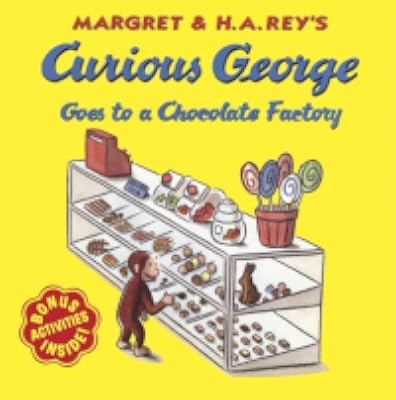
George's curiosity causes a problem at the chocolate factory, but his quick thinking and speedy action on the assembly line help save the candies.Tags
Recommendations






Member Recommendations
Member Reviews
Curious George and the Man in the Yellow Hat stop at a chocolate shop to buy some treats when George notices a tour of the chocolate factory going by. He lives up to his name by getting curious and ends up hopping into the machinery room and causing havoc. Luckily he is able to help the factory staff save all the chocolates.
This book follows the pattern of many of Curious George books in that George gets into trouble because of his curiosity but manages to redeem himself by being helpful. The language is clear and simple enough for children to easily grasp in a read-aloud or as beginner readers on their own. The illustrations are billed as "in the style of H.A. Rey" and that is certainly true. Like Rey's original illustrations, they are show more fairly simple yet detailed enough to provide plenty to look at without cluttering up the page with unnecessary items.
While this wasn't my favorite Curious George title out there, this is certainly a solid read that is worth sharing with kids who love George or just enjoy a good story with a little bit of mischief in it. show less
This book follows the pattern of many of Curious George books in that George gets into trouble because of his curiosity but manages to redeem himself by being helpful. The language is clear and simple enough for children to easily grasp in a read-aloud or as beginner readers on their own. The illustrations are billed as "in the style of H.A. Rey" and that is certainly true. Like Rey's original illustrations, they are show more fairly simple yet detailed enough to provide plenty to look at without cluttering up the page with unnecessary items.
While this wasn't my favorite Curious George title out there, this is certainly a solid read that is worth sharing with kids who love George or just enjoy a good story with a little bit of mischief in it. show less
The man in the yellow hat and Curious George take a trip to the chocolate factory! The man in the yellow hat takes a step away for a moment and George climbs up on a window to look at different chocolates. He hops onto a chocolate machine and he speeds up the chocolate machine on accident. The chocolates from the machine began to fly all over the place. George sat underneath the machine and ate all of the chocolate that was falling on the ground. He even began to put other chocolates into new boxes. Workers discovered what he was doing and they rewarded him for doing work but he did not want any more chocolate.
The Curious George series will always be timeless! The illustrations are so simple yet so wonderful! The book makes it clear show more that what George is doing is bad, but the book also praises George for the good work that he does. I think it teaches Children that good and bad things can come out of being curious. So it is always good to be curious, but it is also good to be smart about how you act upon that curiosity. show less
The Curious George series will always be timeless! The illustrations are so simple yet so wonderful! The book makes it clear show more that what George is doing is bad, but the book also praises George for the good work that he does. I think it teaches Children that good and bad things can come out of being curious. So it is always good to be curious, but it is also good to be smart about how you act upon that curiosity. show less
The book, Curious George Goes to a Chocolate Factory, is the story of a small monkey, named George, who visits a chocolate factory with his friend. At the factory, George allows his curiosity to get the best of him which results in him sneaking onto the production line at the factory and causing a debacle. By the end of the story, George is seen as a hero, but has a terrible stomach ache from eating too many chocolates. The message from the story would be to listen to your superiors; they have reasons for their demands and only wish to keep you safe. It is in my opinion that this book is an excellent read for students at second grade reading level. The book does a great job at providing a very sequenced order of events that is easy to show more follow, a mixture of simple and somewhat challenging vocabulary words, and terrific illustrations to accompany the text. In regards to the plot’s sequential order, the author lays out the order of events in a chronological order that they occurred, thus making it easier for younger audiences to follow the story. For example, transition words such as then are seen in the book to signal a new event; “Then the man with the tall white hat said to George…”. The story’s vocabulary is another great reason why this book is best suited for readers at a second grade level. While the book uses simple sight words often like good, with, of, a, etc. it also utilizes more difficult words such as trouble, tour, favorite, chocolate, etc. This makes this book ideal for transitioning readers. And lastly, the illustrations provide tremendous support to comprehension because they depict accurate descriptions of the text. For example, on the page where it lists each type of chocolate and how the swirl on top determines its filling, the illustrator includes and illustration of each swirl to accompany each portion of text that discusses the swirls. So, when the book says “this one says that caramel is inside,” there is a small picture of a chocolate with a distinct swirl on it. show less
The curious George series should be in every child's library. My children have always loved George. These classic stories are phenomenal.... every story teaches a lesson, while being entertaining and fun. I'm thrilled that the modern prints still use the original illustrations. George is such a curious little monkey!
Curious George always has a way of finding trouble. In this case, he is at the chocolate factory. While George was there he managed to get inside the room where all the chocolates were being made. As he was being curious he caused the machine to go faster and faster. The workers could not keep up with putting the chocolates in the boxes. George came to the rescue and helped save the day but left not wanting anymore chocolates because he had ate so many already.
This saga of Curious George revolves around George going to the chocolate factory. George gets into his typical trouble, which ends with him eating way, way too many chocolates. This book would be an excellent mentor text for teaching about some reading strategies, such as summarizing, as there are many different facets to the story.
George find his way into trouble, causing mishap with the factory machines. Then manages to fix what he has broken. In return the operator offers George more chocolate for his labor. Unfortunate for George he ate so many chocolates he could not eat any more.
Members
- Recently Added By
Author Information

130+ Works 53,076 Members
Margarete Elisabeth Waldstein was born in Hamburg on May 16, 1906. She briefly met her future husband, H. A. Rey, when she was a young girl, but then left for Hamburg to study art. They were reunited in 1935 in Rio de Janeiro, where Rey had gone to escape the political climate in Germany. Margret convinced Hans to leave the family business, and show more soon they were working together on a variety of projects. Hans and Margret were married in Brazil on August 16, 1935, but they soon moved to Paris. It was there that Hans published his first children's book, after a French publisher saw his newspaper cartoons of a giraffe and asked him to expand upon them. Raffy and the Nine Monkeys was the result, and the debuted the mischievous monkey named Curious George. After Raffy and the Nine Monkeys was published, the Reys began a book of Curious George's own. Before the new manuscript could be published, the Reys, both German Jews, found themselves being forced to flee the Nazi occupation. From Lisbon, they made their way to Brazil and on to New York City, where they began a whole new life as children's book authors. Curious George was published by Houghton Mifflin in 1941. All the Curious George books, including the seven original stories by Margret and Hans, have sold over 25 million copies and are so popular that the original story has never been out of print. Margret Rey passed away in 1996, but not before establishing the Curious George Foundation in 1989, which gives money to children and animals. (Bowker Author Biography) show less

295+ Works 70,272 Members
Hans Augusto Rey was born on September 16, 1898 in Hamburg, Germany. He escaped to Paris with his wife after the Nazi's invaded. While in Paris, Hans's animal drawings came to the attention of French publisher, who commissioned him to write a children's book. The result, Rafi and the Nine Monkeys, is little remembered today, but one of its show more characters, an adorably impish monkey named Curious George, was such a success that the couple considered writing a book just about him. Their work was interrupted with the outbreak of World War II. As Jews, the Reys decided to flee Paris before the Nazis seized the city. Hans built two bicycles, and they fled Paris just a few hours before it fell. Among the meager possessions they brought with them was the illustrated manuscript of Curious George. The books were published by Houghton Mifflin in 1941. Curious George was an instant success, and the Reys were commissioned to write more adventures of the mischievous monkey and his friend, the Man in the Yellow Hat. They wrote seven stories in all. Their title Happy Halloween made The New York Times Best Seller List in 2013. At first, Margret's name was left off the cover because there was a glut of women already writing children's fiction. In later editions, this was corrected, and Margret now receives full credit for her role in developing the stories. H. A. Rey died in 1977 and in 1989 Margaret Rey established the Curious George Foundation to help creative children and prevent cruelty to animals. (Bowker Author Biography) show less
All Editions
Some Editions
Series

Work Relationships
Is contained in
Common Knowledge
- Original title
- Curious George Goes to a Chocolate Factory
Classifications
Statistics
- Members
- 1,939
- Popularity
- 11,006
- Reviews
- 10
- Rating
- (3.62)
- Languages
- 6 — Danish, English, Finnish, French, German, Korean
- Media
- Paper, Ebook
- ISBNs
- 23
- UPCs
- 4
- ASINs
- 8