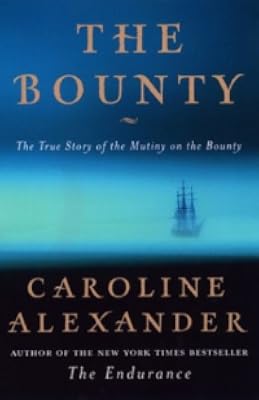
The Bounty: The True Story of the Mutiny on the Bounty
by Caroline Alexander
On This Page
Description
More than two centuries have passed since Master's Mate Fletcher Christian mutinied against Lieutenant Bligh on a small, armed transport vessel called Bounty. Why the details of this obscure adventure at the end of the world remain vivid and enthralling is as intriguing as the truth behind the legend. In giving the Bounty mutiny its historical due, Caroline Alexander has chosen to frame her narrative by focusing on the court-martial of the ten mutineers who were captured in Tahiti and show more brought to justice in England. This fresh perspective revivifies the entire saga, and the salty, colorful language of the captured men themselves conjures the events of that April morning in 1789, when Christian's breakdown impelled every man on a fateful course: Bligh and his loyalists on the historic open boat voyage that revealed him to be one of history's great navigators; Christian on his restless exile; and the captured mutineers toward their day in court. As the book unfolds, each figure emerges as a full-blown character caught up in a drama that may well end on the gallows. And as Alexander shows, it was in a desperate fight to escape hanging that one of the accused defendants deliberately spun the mutiny into the myth we know today-of the tyrannical Lieutenant Bligh of the Bounty. Ultimately, Alexander concludes that the Bounty mutiny was sparked by that most unpredictable, combustible, and human of situations-the chemistry between strong personalities living in close quarters. Her account of the voyage, the trial, and the surprising fates of Bligh, Christian, and the mutineers is an epic of ambition, passion, pride, and duty at the dawn of the Romantic era. show lessTags
Recommendations
































Member Recommendations


Member Reviews
It was not William Bligh's first voyage, but certainly the first of its kind. Despite Capt. Cook's death, investors like Joseph Banks, were determined to establish trade relations with Tahiti. Filled to the brim with gifts and an entire plant nursery, The Bounty set sail in 1787, and on the way Capt. Bligh boasted a healthy 46 member crew. However, slights and grievances started to build and in 1789, a small group led by Christian Fletcher mutinied. Bligh was placed in a launch with those who chose to remain loyal and set adrift. While the Bounty was never recovered, the mutineers were, much to their surprise! Those set adrift had not only lived, but they made it back to England!
I really looked forward to this one and was not show more disappointed! I have to applaud Alexander for making a "flashback" timeline work! It opens with the tumultuous recovery of the mutineers, then goes back in time to introduce you to the main cast, then the mutiny and trials. Alexander references Cook only as needed and doesn't dwell on the survivors' days at sea. It keeps the story moving so the book certainly doesn't feel like 350+ pages.
Alexander clears up the misconceptions and gives fair treatment to both sides as well. Fletcher was actually hard-working, well-liked, and experienced, and Bligh spoke highly of him. Veteran Bligh had a temper, but otherwise an ordinary, even lenient disciplinarian. He kept his men clean, fed, and did his best to emulate Capt Cook. The real culprit was the Royal Navy. They didn't invest in a larger crew, give Bligh his due or provide standard marine or officer reinforcement. Not only that, but they delayed the Bounty's launch so that Bligh couldn't return on schedule! And when you're an underpaid, exhausted, seaman halfway across the world, the possibility of staying in Tahiti - even if it means mutiny - is awfully tempting! show less
I really looked forward to this one and was not show more disappointed! I have to applaud Alexander for making a "flashback" timeline work! It opens with the tumultuous recovery of the mutineers, then goes back in time to introduce you to the main cast, then the mutiny and trials. Alexander references Cook only as needed and doesn't dwell on the survivors' days at sea. It keeps the story moving so the book certainly doesn't feel like 350+ pages.
Alexander clears up the misconceptions and gives fair treatment to both sides as well. Fletcher was actually hard-working, well-liked, and experienced, and Bligh spoke highly of him. Veteran Bligh had a temper, but otherwise an ordinary, even lenient disciplinarian. He kept his men clean, fed, and did his best to emulate Capt Cook. The real culprit was the Royal Navy. They didn't invest in a larger crew, give Bligh his due or provide standard marine or officer reinforcement. Not only that, but they delayed the Bounty's launch so that Bligh couldn't return on schedule! And when you're an underpaid, exhausted, seaman halfway across the world, the possibility of staying in Tahiti - even if it means mutiny - is awfully tempting! show less
I had heard of "Mutiny on the Bounty" but had no idea what it was about. I guess that shows how infamous this rebellious act was and I was engaged from the first page to learn about it.
This is a dense book; it took me a long time to read and every page is a wall of text. It reads like a really interesting textbook rather than a novel and it's so meticulously researched by the author that I legitimately wonder if there's any point to seeking out other sources on this matter. The fact that I learned about every single member of the crew their bio, what happened during and after the mutiny is incredible considering this happened more than 200 years ago. Sometimes with history books or interesting cases, there isn't closure - the murderer show more gets away with it, or the group in question is never to be found. My favorite part of the book is when, years later, American and British ships find the descendants and some still-alive mutineers on the Pitcairn Islands.
It's so much he-said, he-said that it turns into an incredible mystery during the court-martial. Who said what, how did he say it, how did he seem. I guess over time the narrative has changed a bit, but I can't ever imagine myself being on anything but Team Bligh. Fletcher Christian seemed like a knob with no plan and just wanted to have sex with hot island girls. What a wimp!
Seeing how Peter Heywood's family connections got him out of being executed was also thrilling to read. I guess some things never change!
Excited to watch a mini series or the 1984 movie soon. What a story! show less
This is a dense book; it took me a long time to read and every page is a wall of text. It reads like a really interesting textbook rather than a novel and it's so meticulously researched by the author that I legitimately wonder if there's any point to seeking out other sources on this matter. The fact that I learned about every single member of the crew their bio, what happened during and after the mutiny is incredible considering this happened more than 200 years ago. Sometimes with history books or interesting cases, there isn't closure - the murderer show more gets away with it, or the group in question is never to be found. My favorite part of the book is when, years later, American and British ships find the descendants and some still-alive mutineers on the Pitcairn Islands.
It's so much he-said, he-said that it turns into an incredible mystery during the court-martial. Who said what, how did he say it, how did he seem. I guess over time the narrative has changed a bit, but I can't ever imagine myself being on anything but Team Bligh. Fletcher Christian seemed like a knob with no plan and just wanted to have sex with hot island girls. What a wimp!
Seeing how Peter Heywood's family connections got him out of being executed was also thrilling to read. I guess some things never change!
Excited to watch a mini series or the 1984 movie soon. What a story! show less
I expected this book to be excellent simply by virtue of having been written by Caroline Alexander, whose previous work, The Endurance, was outstanding. If you haven't read that one and you are interested in Shackleton, I strongly suggest you find a copy and read it.
The Bounty is another one of those marvelous histories, which although documented (sources for each chapter are given at the end & thus there are no footnote encumbrances), reads likes a novel. I literally could not put this book down.
Synopsis:
Sunrise, April 28, 1789. William Bligh, who was actually a lieutenant captaining the ship Bounty, sent from England to the South Pacific to gather of all things breadfruit (you have to read the book to understand this)was rudely show more awakened at swordpoint from his bunk to be informed that he would be leaving the ship. In charge of this operation was Mr. Fletcher Christian, (and God help me, I can't help but think of Mel Gibson every time his name was brought up), who explained that he was in Hell and could no longer abide the captain's behavior. Wearing only a nightshirt, Bligh was bound and lowered into a launch. Others soon followed suit...the ship was then in the hands of Fletcher Christian and a few others of it seems, like minds. So...the question is what brought on the mutiny? Was Captain Bligh really as nefarious and evil as history has painted him? What conditions led to Fletcher Christian's decision? And then, in probably what is the true meat of this story, how were the majority of the mutineers rounded up & brought to justice? We all know that Fletcher Christian and a few of his associates landed on & settled Pitcairn Island, which lay largely undiscovered...so what was the real story here? So many questions, so many answers, from various viewpoints, keep this account lively & leave the reader wanting to read more.
The book opens with the collection & transport of the mutineers who had escaped to Tahiti; some of them voluntarily going to the ship & thus their certain fates and others who had to be rounded up. The story then moves to part two, in which we are introduced to each of the crew members including Captain Bligh & Fletcher Christian. The voyage of the Bounty commences, and this part of the book ends with the mutiny. Part three recalls Captain Bligh's feat of navigation and getting himself & the others consigned to go with him back to civilization, and investigating his court-martial for losing the Bounty. Part four...the political wheelings & dealings involved with the trial of the captured prisoners...and then finally, how the name of Captain Bligh came to be permanently associated with martinet-like behavior & came to be a dirty word. Here too you will find differing views on what happened once the main body of mutineers reached Pitcairn island.
One fun piece of information is worth noting. The night before the mutiny, Captain Bligh got into it with his officers about some missing coconuts. He called upon all of them to account for how many they'd eaten. Not that this is earthshaking in itself, but those of you who have read The Caine Mutiny (one of my favorite books of all time) will remember the dastardly Captain Queeg and the strawberry incident. I couldn't help but laugh and draw parallels & even wonder if Herman Wouk had incorporated this part of the Bounty mutiny into his own work.
I would very very highly recommend this book to anyone who is interested in this type of thing. Read it and savor it. Take it slow. Because Alexander (like any historian worth her salt) relies heavily on primary documents, the wording is often a bit difficult to read, but it is well worth the time you will take on it. show less
The Bounty is another one of those marvelous histories, which although documented (sources for each chapter are given at the end & thus there are no footnote encumbrances), reads likes a novel. I literally could not put this book down.
Synopsis:
Sunrise, April 28, 1789. William Bligh, who was actually a lieutenant captaining the ship Bounty, sent from England to the South Pacific to gather of all things breadfruit (you have to read the book to understand this)was rudely show more awakened at swordpoint from his bunk to be informed that he would be leaving the ship. In charge of this operation was Mr. Fletcher Christian, (and God help me, I can't help but think of Mel Gibson every time his name was brought up), who explained that he was in Hell and could no longer abide the captain's behavior. Wearing only a nightshirt, Bligh was bound and lowered into a launch. Others soon followed suit...the ship was then in the hands of Fletcher Christian and a few others of it seems, like minds. So...the question is what brought on the mutiny? Was Captain Bligh really as nefarious and evil as history has painted him? What conditions led to Fletcher Christian's decision? And then, in probably what is the true meat of this story, how were the majority of the mutineers rounded up & brought to justice? We all know that Fletcher Christian and a few of his associates landed on & settled Pitcairn Island, which lay largely undiscovered...so what was the real story here? So many questions, so many answers, from various viewpoints, keep this account lively & leave the reader wanting to read more.
The book opens with the collection & transport of the mutineers who had escaped to Tahiti; some of them voluntarily going to the ship & thus their certain fates and others who had to be rounded up. The story then moves to part two, in which we are introduced to each of the crew members including Captain Bligh & Fletcher Christian. The voyage of the Bounty commences, and this part of the book ends with the mutiny. Part three recalls Captain Bligh's feat of navigation and getting himself & the others consigned to go with him back to civilization, and investigating his court-martial for losing the Bounty. Part four...the political wheelings & dealings involved with the trial of the captured prisoners...and then finally, how the name of Captain Bligh came to be permanently associated with martinet-like behavior & came to be a dirty word. Here too you will find differing views on what happened once the main body of mutineers reached Pitcairn island.
One fun piece of information is worth noting. The night before the mutiny, Captain Bligh got into it with his officers about some missing coconuts. He called upon all of them to account for how many they'd eaten. Not that this is earthshaking in itself, but those of you who have read The Caine Mutiny (one of my favorite books of all time) will remember the dastardly Captain Queeg and the strawberry incident. I couldn't help but laugh and draw parallels & even wonder if Herman Wouk had incorporated this part of the Bounty mutiny into his own work.
I would very very highly recommend this book to anyone who is interested in this type of thing. Read it and savor it. Take it slow. Because Alexander (like any historian worth her salt) relies heavily on primary documents, the wording is often a bit difficult to read, but it is well worth the time you will take on it. show less
In December of 1787, the HMS Bounty, under the leadership of commanding lieutenant William Bligh, set out for the island of Tahiti to obtain breadfruit plants to grow in the West Indies. It was a routine trade mission. But Bligh’s return trip to England was far from routine. On the morning of April 28, 1789, ship’s mate Fletcher Christian led a mutiny against Bligh and took the ship. Bligh and 14 crewmen were placed on a small 23-foot launch and sent to go back home while the mutineers steered towards Tahiti. Without charts or a chronometer, Bligh still made it over 4,000 miles to Australian shores and eventually got home. The story of the infamous mutiny and aftermath are the subject for Caroline Alexander’s The Bounty, a complex show more and nuanced tale of leadership, loyalty, and love.
While the details about the mutiny are still unclear, the core issue was that many among the crew wanted to stay on Tahiti with those whom they were enamored, and Commander Bligh ordered them back to the ship. The mission was a moderate success—over 1,000 plants had been secured for transport—and the crew had spent a wonderful five months on the island. It was quite possibly the easiest mission there could be. But, several men of the Bounty, including the master’s mate grew attached to local women and didn’t want to leave. Bligh, being a man of dogmatic intensity and fierce devotion to his job, ordered them back or face severe consequences.
Alexander’s history tries to give a less heavy-handed version of the events than previous writers. Bligh is traditionally seen as a taskmaster with no real heart or humanity. Fletcher is the idealized image of every person finding happiness in a far-off land. But, the historical documents at hand tell a slightly different tale. True, there was a mutiny and, true, the men did disobey orders. Bligh was the only real officer on board and had to be the sole administrator of discipline and justice, but the extent to which his orders become tyrannical is up for debate. The author does an interesting job of countermanding previous assumptions and laying out a more balanced view of the story. A lively and entertaining book. show less
While the details about the mutiny are still unclear, the core issue was that many among the crew wanted to stay on Tahiti with those whom they were enamored, and Commander Bligh ordered them back to the ship. The mission was a moderate success—over 1,000 plants had been secured for transport—and the crew had spent a wonderful five months on the island. It was quite possibly the easiest mission there could be. But, several men of the Bounty, including the master’s mate grew attached to local women and didn’t want to leave. Bligh, being a man of dogmatic intensity and fierce devotion to his job, ordered them back or face severe consequences.
Alexander’s history tries to give a less heavy-handed version of the events than previous writers. Bligh is traditionally seen as a taskmaster with no real heart or humanity. Fletcher is the idealized image of every person finding happiness in a far-off land. But, the historical documents at hand tell a slightly different tale. True, there was a mutiny and, true, the men did disobey orders. Bligh was the only real officer on board and had to be the sole administrator of discipline and justice, but the extent to which his orders become tyrannical is up for debate. The author does an interesting job of countermanding previous assumptions and laying out a more balanced view of the story. A lively and entertaining book. show less
A riveting account of an event which most of us feel we already know about. It is very constructed to build up suspense in the 'storytelling' of the events. It is detailed and very well researched yet still leaves many questions unanswered - not least the confusing accounts of what may or may not have happened to Fletcher Christian after the mutiny.
Listened to the CD version, with reader Simon Prebble (one of my favorite readers). VERY DETAILED book, which seemed to me to be a bit "circular" at first. I suspect it would have been more clear to me had I been reading the print version and not had my attention torn between driving and listening carefully to names and the intricate descriptions of their backgrounds.
Definitely an interesting read, just glad I'm not to be tested on the contents as there was a bit much for me to absorb. I would consider reading the text version next time around.
Interesting to note that the history of the event was/is so strongly colored by the political activity of the day. A reminder that history is often written based on the participants ties to those show more with political influence. Author definitely attempted to put the event in the perspective of the times in which it occurred and how various factors contributed to the public knowledge of and opinion about the event. show less
Definitely an interesting read, just glad I'm not to be tested on the contents as there was a bit much for me to absorb. I would consider reading the text version next time around.
Interesting to note that the history of the event was/is so strongly colored by the political activity of the day. A reminder that history is often written based on the participants ties to those show more with political influence. Author definitely attempted to put the event in the perspective of the times in which it occurred and how various factors contributed to the public knowledge of and opinion about the event. show less
I've had this book in my library for years and finally picked it up a month or two ago. I had no idea that I'd be swept into one of the most interesting narrative histories I've ever read.
Alexander has done her research thoroughly and what I find most astounding is just how much source material she had to work with. I'm new to British Naval history and I was amazed that they'd managed to preserve the logs and letters.
What was even more astonishing was that the evidence she compiles for this book paints Bligh in such a contrasting light than the rest of the world knows him. We can all spout what we've 'heard' about the reputation of Captain Bligh, but when the facts are laid bare, the story changes dramatically.
I now find myself show more defending Captain Bligh at every turn and encouraging people to read this fantastic book. Alexander's writing is clear and supremely interesting. She takes the time to explain the naval lingo and the ramifications of log entries and the actions of the Admiralty.
I ended up feeling sympathy for Bligh and just a bit of rage at how he was mistreated. You may not be swept along as thoroughly as I was, but I doubt you'll be able to look at this epic true story in the same way again. show less
Alexander has done her research thoroughly and what I find most astounding is just how much source material she had to work with. I'm new to British Naval history and I was amazed that they'd managed to preserve the logs and letters.
What was even more astonishing was that the evidence she compiles for this book paints Bligh in such a contrasting light than the rest of the world knows him. We can all spout what we've 'heard' about the reputation of Captain Bligh, but when the facts are laid bare, the story changes dramatically.
I now find myself show more defending Captain Bligh at every turn and encouraging people to read this fantastic book. Alexander's writing is clear and supremely interesting. She takes the time to explain the naval lingo and the ramifications of log entries and the actions of the Admiralty.
I ended up feeling sympathy for Bligh and just a bit of rage at how he was mistreated. You may not be swept along as thoroughly as I was, but I doubt you'll be able to look at this epic true story in the same way again. show less
Members
- Recently Added By
Lists

Top Five Books of 2013
1,562 works; 721 members

Best Naval History Books
40 works; 12 members

Club Read's Recommended Nonfiction Written by Women
618 works; 30 members
Author Information

Some Editions
Awards and Honors
Common Knowledge
- Canonical title
- The Bounty: The True Story of the Mutiny on the Bounty
- Original publication date
- 2003
- People/Characters
- Fletcher Christian; William Bligh; Sir Joseph Banks; Duncan Campbell; Peter Heywood; Charles Churchill (show all 51); Mathew Thompson; Richard Skinner; Lieut. Robert Corner; John Brown; Michael Byrn; Henry Hilbrant; Thomas McIntosh; Thomas Burkett; John Millward; John Sumner; William Muspratt; William Oliver; Capt. Edward Edwards; Matthew Wallen; Lieut. Molesworth Phillips; Elizabeth Betham; John Fryer; William Wales; James Morrison; William Peckover; Joseph Coleman; Lawrence Lebogue; John Norton; Thomas Ellison; Richard Bentham; Edward Young; Charles Christian; Capt. John Rogers; Thomas Huggan; Capt. James Cook; Mathew Quintal; William Purcell; James Valentine; John Mills; William Brown; David Nelson; Chief Tynah; Iddeeah; Robert Lamb; Fanney Burney; James Modyford Heywood; Hester Heywood; William Peckover; Capt. John Nicholson; Aaron Graham
- Important places
- Tahiti, Society Islands, French Polynesia; Pitcairn Island, Pitcairn Islands, British Overseas Territory; Portsmouth, Hampshire, England, UK; Spithead, Hampshire, England, UK; The Nore, Thames Estuary, England, UK; Tenerife, Canary Islands, Spain (show all 17); Kupang, Timor, Indonesia; Matavai; Papara; Anamooka; Surabaya, Java, Indonesia; Timor Island, East Nusa Tenggara, Indonesia; Santa Cruz; Cape of Good Hope; False Bay; Adventure Bay; Tettahah
- Important events
- Mutiny on the Bounty (1789); Royal Navy mutiny Spithead and the Nore (1797)
- Related movies
- Mutiny on the Bounty (1935 | IMDb); Mutiny on the Bounty (1962 | IMDb)
- Dedication
- To Smokey
- First words
- His small vessel pitching in the squally winter sea, a young British naval lieutenant waited restlessly to embark upon the most important and daunting voyage of his still young but highly promising career.
- Quotations
- I am young in years, but old in what the World calls Adversity. It has made me acquainted with three Things, which are little known. First the Villainy & Censoriousness of Mankind - second, the Futility of all human Hopes... (show all) - & third, the Enjoyment of being content in whatever station it pleases Providence to place me in. - Peter Heywood
The passion for exploration and discovery, the hunger to learn all things about all aspects of the physical world, the great and preposterous optimism that held that such truths were in fact discoverable.
Sir your abuse is so bad that I cannot do my Duty with any Pleasure. I have been in hell for weeks with you. - Fletcher Christian - Last words
- (Click to show. Warning: May contain spoilers.)Surmounting the whole, in letters that had once been gold, was a simple phrase:
"In coelo quies"—There is peace in heaven. - Blurbers
- Klinkenborg, Verlyn
Classifications
- Genres
- History, Nonfiction, General Nonfiction
- DDC/MDS
- 996.18 — History & geography Oceania & Polar Regions Polynesia Southwest central Pacific, and isolated islands of southeast Pacific Isolated islands of southeast Pacific
- LCC
- DU20 .A53 — History of Europe, Asia, Africa and Oceania Oceania (South Seas) History of Oceania (South Seas)
- BISAC
Statistics
- Members
- 1,689
- Popularity
- 13,279
- Reviews
- 35
- Rating
- (3.88)
- Languages
- 7 — Czech, English, French, German, Polish, Portuguese, Spanish
- Media
- Paper, Audiobook, Ebook
- ISBNs
- 29
- ASINs
- 8