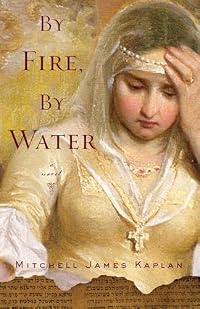
By Fire, By Water
by Mitchell James Kaplan
On This Page
Description
Luis de Santangel, chancellor to the court and longtime friend of the lusty King Ferdinand, has had enough of the Spanish Inquisition. As the power of Inquisitor General Tomas de Torquemada grows, so does the brutality of the Spanish church and the suspicion and paranoia it inspires. When a dear friend's demise brings the violence close to home, Santangel takes retribution into his own hands, though the risk is great. Santangel is from a family of conversos, and his Jewis heritage makes him show more an easy target. Soon, he finds himself implicated in the murder of the first Chief Inquisitor of Aragon and in possession of a mysterious text that has spelled death for Jews for centuries. As he witnesses the horrific persecution of his loved ones, he begins slowly to reconnect with the Jewish faith his family left behind. Feeding his curiosity about his past is his growing love for Judith Migdal, a clever and beautiful Jewis woman navigating the mounting tensions in Granada. While he struggles to decide what his reputation is worth and what he can sacrifice, one man offers him a chance he thought he'd lost... the chance to hope for a better world. Chistopher Columbus has plans to discover a route to paradise, and only Luis de Santangel can help him. show lessTags
Recommendations































Member Recommendations
Member Reviews
It is nearing the end of the 15th century, and Luis de Santangel is the chancellor to the Spanish King Ferdinand and Queen Ysabel. The Inquisition has made its way to Spain, and many Jewish people are in fear for their lives. de Santangel is a converso – of Jewish heritage, but converted to Christianity. He develops an interest in the religion of his ancestors – partly due to an ancient parchment which Cristobal Colon (Christopher Columbus) delivers to him – and in doing so, puts himself, his family, and friends who share his interest, in great danger. Tomas de Torquemada, the leader of the Inquisition becomes interested in de Santangel, and will go to any means necessary to capture him. While de Santangel’s position in the show more Kings Court may afford him some protection, he is well aware that there is a limit to such protection.
Meanwhile, Judith Migdal is a Jewish lady living in Granada. Mourning the loss of her brother and his wife, she takes on the role of looking after the wife’s father and her brother’s son. She determines to carry on the silversmith business which her brother had built up, but soon finds herself navigating a difficult landscape as she sees the persecution of Jews and the dangerous times which they will all be facing.
I thoroughly enjoyed reading this book. Initially I thought it might be hard going, but instead it was utterly absorbing and interesting. There is tremendous detail regarding the Inquisition, the instability of the times and the lives and cultures of people living in Spain at the time – it is clear that the author must have conducted extensive research. However, the book does not become bogged down with detail – the writing serves to help immerse the reader into the atmosphere in which the story is set, with the sights and sounds almost seeping out of the pages.
The somewhat explicit detailing of the torture and punishment inflicted on the Jewish people leaves little to the imagination, and at times made for uncomfortable reading.
Luis was a very well drawn character. I felt that throughout the book, the reader really got to know him very well. He was clearly an intelligent man in a posiion of privilege, who commanded respect. however, his life of comfort was not enough to stop him asking questions about the motivations of the Inquisition, and his own family history. Judith was also a wonderful character. She was strong and determined, because she had no choice but to be. I felt that the author really allowed the reader to see into these people’s lives and thoughts.
I really think that there are two stories contained in the book; that of Luis de Santagel and the events which take place and which drawn Judith Migdal into his orbit; and that of an unstable period of time when people were scared for their lives, practised their religion in private and were never sure who they could trust. Both stories are equally enjoyable. The integration of Christopher Columbus (prior to his most famous voyage) was interesting reading. Although Columbus does not appear in the book a great deal, he does play an important role.
Overall, this book is highly recommended – fantastically researched, very well written and fascinating. I would especially recommend it to fans of historical fiction, or anybody with even a passing interest in this period of history. It certainly inspired me to find out more about the Inquisition, and Luis de Santangel himself. show less
Meanwhile, Judith Migdal is a Jewish lady living in Granada. Mourning the loss of her brother and his wife, she takes on the role of looking after the wife’s father and her brother’s son. She determines to carry on the silversmith business which her brother had built up, but soon finds herself navigating a difficult landscape as she sees the persecution of Jews and the dangerous times which they will all be facing.
I thoroughly enjoyed reading this book. Initially I thought it might be hard going, but instead it was utterly absorbing and interesting. There is tremendous detail regarding the Inquisition, the instability of the times and the lives and cultures of people living in Spain at the time – it is clear that the author must have conducted extensive research. However, the book does not become bogged down with detail – the writing serves to help immerse the reader into the atmosphere in which the story is set, with the sights and sounds almost seeping out of the pages.
The somewhat explicit detailing of the torture and punishment inflicted on the Jewish people leaves little to the imagination, and at times made for uncomfortable reading.
Luis was a very well drawn character. I felt that throughout the book, the reader really got to know him very well. He was clearly an intelligent man in a posiion of privilege, who commanded respect. however, his life of comfort was not enough to stop him asking questions about the motivations of the Inquisition, and his own family history. Judith was also a wonderful character. She was strong and determined, because she had no choice but to be. I felt that the author really allowed the reader to see into these people’s lives and thoughts.
I really think that there are two stories contained in the book; that of Luis de Santagel and the events which take place and which drawn Judith Migdal into his orbit; and that of an unstable period of time when people were scared for their lives, practised their religion in private and were never sure who they could trust. Both stories are equally enjoyable. The integration of Christopher Columbus (prior to his most famous voyage) was interesting reading. Although Columbus does not appear in the book a great deal, he does play an important role.
Overall, this book is highly recommended – fantastically researched, very well written and fascinating. I would especially recommend it to fans of historical fiction, or anybody with even a passing interest in this period of history. It certainly inspired me to find out more about the Inquisition, and Luis de Santangel himself. show less
“We must recover that book. The log of his testimony.” Turning back to the priest, he affirmed aloud what they both knew. “And the canon, he must die. Pedro de Arbues,” he nodded slowly, “must die before he destroys you, me, and our associates.”
Caceres lowered his voice. “I know the man to do it. A horseman. A Basque. A skilled assassin.”
They looked into each other’s eyes. It occurred to Santangel that if he had ever felt anything akin to Christian love, it was in this moment, in their shared hatred. – from By Fire, By Water, page 74 -
Mitchell James Kaplan’s debut novel is set in fifteenth century Spain during the time of the New Inquisition when King Fernando and Queen Ysabel were waging war and expelling all Jews show more from Spain. This period is also remembered for Cristobal Colon (Christopher Columbus) and his discovery of the Western Hemisphere. Kaplan has taken all of these events and created an historical novel of depth, passion and faith which held me spellbound.
Luis de Santangel, a converso (the Spanish term which designates a person whose parents or grandparents abandoned their Jewish faith and embraced Christianity…usually under duress) and chancellor to the throne, takes center stage in By Fire, By Water. Horrified by what the Inquisition is doing, Luis finds himself deeply conflicted by his Christian faith. He longs to understand the differences between the Jewish and Christian beliefs. This struggle leads him to engage in secret meetings with a Jewish scribe and several others to learn more about the faith his family abandoned.
With Abram Serero, Luis de Santangel explored ideas that had intrigued him all his life. He argued about the nature of truth, God’s role in history, justice, and love. He came to feel an intellectual enfranchisement he had never felt before, invigorating and empowering. The freedom to navigate between the great ideas and sentiments of his own faith and that of his grandfather was a rare privilege. – from By Fire, By Water, page 52 -
When a close friend is arrested and dies, Luis becomes enraged at a system that punishes those who dare question the edicts and beliefs of the Church. His choice to silence the Chief Inquisitor of Aragon (Pedro de Arbues) puts his life and the lives of his family in danger.
A parallel story – that of a Jewish silversmith who is raising her orphaned nephew in the endangered city of Granada – is seamlessly inserted into the novel. Judith Migdal is a strong, inspiring character…and it is no surprise when her path crosses Luis’ as the Spanish war machine grinds ever closer to her home.
By Fire, By Water closely follows the historical record, but it is also very much a novel…bringing to life the streets of fifteenth century Spain, the horrors of the Inquisition (Kaplan does not spare readers the brutal torture endured by those arrested), and the drama of the time period when new lands were being discovered by sea exploration.
Big, passionate, brilliantly written, full of court intrigue and religious politics, I loved this novel. I read the last half of the book in one afternoon, unable to lay it aside until I knew what would happen. Kaplan’s descriptions are gorgeous. He effortlessly transports the reader into the past. He also brings forth the questions of the time: What were the motivations of King Fernando and Queen Ysabel? Were they simply religious fanatics, or were financial considerations the primary reason for supporting the Inquisition and the ultimate expulsion of the Jews from Spain?
Kaplan writes in his author’s note at the end of the book:
The purpose of a historical novel is to locate and reveal the dramatic core of history.
If that is the purpose, then I would congratulate Kaplan on achieving it. By Fire, By Water is a must read for historical fiction fans, especially those interested in fifteenth century Spain.
Highly recommended. show less
Caceres lowered his voice. “I know the man to do it. A horseman. A Basque. A skilled assassin.”
They looked into each other’s eyes. It occurred to Santangel that if he had ever felt anything akin to Christian love, it was in this moment, in their shared hatred. – from By Fire, By Water, page 74 -
Mitchell James Kaplan’s debut novel is set in fifteenth century Spain during the time of the New Inquisition when King Fernando and Queen Ysabel were waging war and expelling all Jews show more from Spain. This period is also remembered for Cristobal Colon (Christopher Columbus) and his discovery of the Western Hemisphere. Kaplan has taken all of these events and created an historical novel of depth, passion and faith which held me spellbound.
Luis de Santangel, a converso (the Spanish term which designates a person whose parents or grandparents abandoned their Jewish faith and embraced Christianity…usually under duress) and chancellor to the throne, takes center stage in By Fire, By Water. Horrified by what the Inquisition is doing, Luis finds himself deeply conflicted by his Christian faith. He longs to understand the differences between the Jewish and Christian beliefs. This struggle leads him to engage in secret meetings with a Jewish scribe and several others to learn more about the faith his family abandoned.
With Abram Serero, Luis de Santangel explored ideas that had intrigued him all his life. He argued about the nature of truth, God’s role in history, justice, and love. He came to feel an intellectual enfranchisement he had never felt before, invigorating and empowering. The freedom to navigate between the great ideas and sentiments of his own faith and that of his grandfather was a rare privilege. – from By Fire, By Water, page 52 -
When a close friend is arrested and dies, Luis becomes enraged at a system that punishes those who dare question the edicts and beliefs of the Church. His choice to silence the Chief Inquisitor of Aragon (Pedro de Arbues) puts his life and the lives of his family in danger.
A parallel story – that of a Jewish silversmith who is raising her orphaned nephew in the endangered city of Granada – is seamlessly inserted into the novel. Judith Migdal is a strong, inspiring character…and it is no surprise when her path crosses Luis’ as the Spanish war machine grinds ever closer to her home.
By Fire, By Water closely follows the historical record, but it is also very much a novel…bringing to life the streets of fifteenth century Spain, the horrors of the Inquisition (Kaplan does not spare readers the brutal torture endured by those arrested), and the drama of the time period when new lands were being discovered by sea exploration.
Big, passionate, brilliantly written, full of court intrigue and religious politics, I loved this novel. I read the last half of the book in one afternoon, unable to lay it aside until I knew what would happen. Kaplan’s descriptions are gorgeous. He effortlessly transports the reader into the past. He also brings forth the questions of the time: What were the motivations of King Fernando and Queen Ysabel? Were they simply religious fanatics, or were financial considerations the primary reason for supporting the Inquisition and the ultimate expulsion of the Jews from Spain?
Kaplan writes in his author’s note at the end of the book:
The purpose of a historical novel is to locate and reveal the dramatic core of history.
If that is the purpose, then I would congratulate Kaplan on achieving it. By Fire, By Water is a must read for historical fiction fans, especially those interested in fifteenth century Spain.
Highly recommended. show less
Reviewed for Author Exposure
http://www.authorexposure.com/2011/06/book-review-by-fire-by-water-by.html
By Fire, By Water transports the reader to a chaotic, shameful, yet unprecedented period in world history. Late in the 15th Century, Queen Ysabel of Castile and King Fernando of Aragon, politically connected through their marriage, sought not only to unite all of Spain’s kingdoms, but also to fully purge non-Christians from their unified Roman Catholic sovereignty. While the monarchy’s original intent to unify Spain spawned the transition from kingdoms to the development of nations, it is difficult to justify the methods utilized to acquire power without recognizing the emanating greed in the name of religion.
Amid this historically show more monstrous quagmire, one surprisingly unfaltering man stands out, Comptroller of the Treasury in Zaragoza, intimate of King Fernando. Luis de Santangel, a third-generation converso/marrano is respected and well-known far beyond the kingdoms of Spain. Luis detests not only the Inquisition, but also its detrimental influence upon Christians eager to conspire against each other.
Aware of the nefarious and depraved proceedings of the newly appointed Chief Inquisitor of Aragon, Luis instigates a plot to murder this man who now possesses infallible proof that may endanger the lives of family, friends and those in his service. Neither his prominent status, his friendship with the king nor his wealth prove sufficient to shield him from covetous eyes and ears that seek the Inquisition’s gratitude. Inquisitor General Torquemada’s relentless wrath is minutely assuaged by Luis’ imprisonment, despite its lack of total deprivation. With little more than the Scriptures in his secluded cell, Luis stumbles upon an auspicious passage prescient of his friend Cristobal Colon’s unwavering belief; the “fulfillment of his destiny.”
“Go swift messengers,
to a nation scattered and torn apart
to a people tall and smooth-skinned—
a trampled tribe, waiting and hoping—
whose land is divided by waters…” (247)
Though dismayed by his friend Luis’ perilous dilemma, an annoyingly obdurate Cristobal Colon boldly seeks a resolute Queen's financial support for his exploratory voyage in search of a westward route from Spain to the Indies. Irritated by Torquemada's rampancy, Fernando orders that Luis be released. Luis intercedes on his friend Colon’s behalf. The ultimate unification of Spain not only originates with the ostensibly peaceful Jewish diaspora, but also entails the essential crusade to expel Granada's Moors. Thus, Ysabel firmly demurs until Luis de Santangel startles the Queen with his offer:
“If I were to underwrite Senor Colon’s voyage, with all the benefits accruing to the Crowns, would you then consider supporting such an expedition?...”
“…Why would any man of sound mind contemplate doing such a thing?...”
“…Because it is time, Your Highness…Because it must be…” (270)
It is abysmally disappointing to discover how history is often distorted to assuage specific religious cultures' fallacious beliefs, indifferent to the callous inaccuracies. Yet, it is astonishingly redemptive to read such a profoundly elucidating and enlightening book that not only dispels the original premise one remembers, but also offers captivatingly comprehensive facets of a pivotal period in world history. The lyrical prose is ample motivation to linger through the pages. Why Mitchell James Kaplan’s By Fire, By Water is not on the top ten of all historical fiction lists is incomprehensible. If you read just one book this year, I highly recommend that it is this one.
“Who shall live and who shall die
Who at the measure of days and who before
Who by fire and who by water
Who by the sword and who by wild beasts
Who shall have rest and who shall go wandering
Who shall be brought low and who shall be raised high.” (272) show less
http://www.authorexposure.com/2011/06/book-review-by-fire-by-water-by.html
By Fire, By Water transports the reader to a chaotic, shameful, yet unprecedented period in world history. Late in the 15th Century, Queen Ysabel of Castile and King Fernando of Aragon, politically connected through their marriage, sought not only to unite all of Spain’s kingdoms, but also to fully purge non-Christians from their unified Roman Catholic sovereignty. While the monarchy’s original intent to unify Spain spawned the transition from kingdoms to the development of nations, it is difficult to justify the methods utilized to acquire power without recognizing the emanating greed in the name of religion.
Amid this historically show more monstrous quagmire, one surprisingly unfaltering man stands out, Comptroller of the Treasury in Zaragoza, intimate of King Fernando. Luis de Santangel, a third-generation converso/marrano is respected and well-known far beyond the kingdoms of Spain. Luis detests not only the Inquisition, but also its detrimental influence upon Christians eager to conspire against each other.
Aware of the nefarious and depraved proceedings of the newly appointed Chief Inquisitor of Aragon, Luis instigates a plot to murder this man who now possesses infallible proof that may endanger the lives of family, friends and those in his service. Neither his prominent status, his friendship with the king nor his wealth prove sufficient to shield him from covetous eyes and ears that seek the Inquisition’s gratitude. Inquisitor General Torquemada’s relentless wrath is minutely assuaged by Luis’ imprisonment, despite its lack of total deprivation. With little more than the Scriptures in his secluded cell, Luis stumbles upon an auspicious passage prescient of his friend Cristobal Colon’s unwavering belief; the “fulfillment of his destiny.”
“Go swift messengers,
to a nation scattered and torn apart
to a people tall and smooth-skinned—
a trampled tribe, waiting and hoping—
whose land is divided by waters…” (247)
Though dismayed by his friend Luis’ perilous dilemma, an annoyingly obdurate Cristobal Colon boldly seeks a resolute Queen's financial support for his exploratory voyage in search of a westward route from Spain to the Indies. Irritated by Torquemada's rampancy, Fernando orders that Luis be released. Luis intercedes on his friend Colon’s behalf. The ultimate unification of Spain not only originates with the ostensibly peaceful Jewish diaspora, but also entails the essential crusade to expel Granada's Moors. Thus, Ysabel firmly demurs until Luis de Santangel startles the Queen with his offer:
“If I were to underwrite Senor Colon’s voyage, with all the benefits accruing to the Crowns, would you then consider supporting such an expedition?...”
“…Why would any man of sound mind contemplate doing such a thing?...”
“…Because it is time, Your Highness…Because it must be…” (270)
It is abysmally disappointing to discover how history is often distorted to assuage specific religious cultures' fallacious beliefs, indifferent to the callous inaccuracies. Yet, it is astonishingly redemptive to read such a profoundly elucidating and enlightening book that not only dispels the original premise one remembers, but also offers captivatingly comprehensive facets of a pivotal period in world history. The lyrical prose is ample motivation to linger through the pages. Why Mitchell James Kaplan’s By Fire, By Water is not on the top ten of all historical fiction lists is incomprehensible. If you read just one book this year, I highly recommend that it is this one.
“Who shall live and who shall die
Who at the measure of days and who before
Who by fire and who by water
Who by the sword and who by wild beasts
Who shall have rest and who shall go wandering
Who shall be brought low and who shall be raised high.” (272) show less
Living in 15th century Spain, Luis de Santángel has just been caught in the cross-hairs of the new Inquisition. Santángel is a very wealthy and respected member of the community and also the chancellor to Fernando, the King of Aragon. But he is also a Jewish covert to Christianity, and when he begins to cast about looking for information and edification of his forgotten and displaced faith, he and his family are put into great danger. Though Santángel tries to exercise discretion and stealth in regards to his new curiosity, he attracts the attention of Thomas Torquemada, the leader of the new Inquisition, who goes to great and torturous lengths to punish both nonbelievers and those who he believes to be escaping from the fold. As show more Spain struggles to dominate and unify its kingdoms under severe Christian rule and Christopher Columbus petitions Ysabel and Fernando to finance a trip to the prosperous Indies, Santángel's once envious life begins to unravel. Meanwhile, Judith Migdal, a Jewish woman living in Granada, is facing her own trials. After losing half her family to tragedy, Judith must reorganize her life and learn the difficult craft of silversmithing in order to provide for the remaining family members. When a chance meeting between Santángel and Judith occurs, the two are inexplicably drawn towards one another, forcing each to examine the strength of their beliefs and the ways in which their futures may intersect. In this intricately crafted and exceptionally researched new historical novel, Kaplan brings to life a cast of characters who are caught in the craze of a dangerous religious fervor and explores the way in which those people remain true to themselves and to those that they love.
In the past few months, I have read quite a bit about the Inquisition and the effects it had on the people it persecuted. This has actually been a rather new area for me to study, and the more I'm exposed to it in the books I read, the more questions I have. What I really liked about this book was the way the repercussions for those affected were examined with great depth and sensitivity. After finally closing the book for the last time, I really felt it was the best representation of those fateful events that I could have sought out and read.
From the outset, it was clear to me that Luis de Santángel had an extremely comfortable life. Aside from his wealth and position, he had a family that loved and supported him, and I can imagine that it wasn't bad to have the king's ear and attention when he needed it. But Luis was hungering for something that he didn't have access to in his everyday life. He wanted answers about the faith that he was forced to leave behind, knowing that seeking these answers would endanger everything he held dear. I don't even think it was a matter of Luis wanting to convert back to Judaism. I think it was more a way for him to hold on to the values and ideals of his ancestors and a way for him to puzzle out some of the deeper questions he had about God. Luis' was a quest for knowledge, but in its discovery, his intentions got misconstrued and perverted. Although he tried to mitigate the disaster, the powers against him were too strong to resist successfully.
The representation of the Inquisition brought forth a lot of questions while I was reading. How does one man, or one group of men, come to believe that they can accurately police the spirituality that lives in another's soul? Indeed, what would God think about this? My religious education has taught me that God is a being of mercy and love who forgives those with sincerity in their hearts. But the Inquisitors had no room for mercy or forgiveness, and dealt with people brutally, leaving no room for those who were spiritually adrift or who questioned their faith. These men had an agenda that I believe was not from God, and I began to feel that all their punishments were only meant to dominate and subjugate those who they felt were spiritually unworthy. I can't imagine living in a time where your inner motives are constantly suspect and where another person has the right to torture you or take your life due to perceived spiritual discrepancies. It was was a shameful time, filled with shameful men who knew nothing about the love and forgiveness of God.
I also really liked the dual narrative half that focused on the life of Judith Migdal. She was a worthy heroine who embodied a clarity of purpose and an inner strength that I admired. When faced with a problem, Judith was resourceful and optimistic and she has great loyalty to those in her sphere. Pairing her with Luis also seemed like a brilliant move because both of them had similar strengths and resoluteness. Though they came from very different spiritual backgrounds, they were able to see beyond these things and get to the core of each other rather quickly. The fact that Luis became enamored of Judith was another danger that he took upon himself, but to him, this risk seemed to be of small consequence. The intertwining of these two characters gave the story an added layer of depth and resonance. I would have liked to have seen a more hopeful resolution to the story of Judith and Luis, but somehow what Kaplan did felt more realistic and faithful to the times he was describing.
Call me naïve, but it actually took me some time to figure out that the Cristobal Colon that was discussed in the narrative was none other than Christopher Columbus. It did became very clear in later sections, but for the first half of the story, it went by almost unnoticed. I liked the way that Kaplan fit Columbus into the story, and in his creation, Columbus came off as not only an adventurer but a scholar and a loyal friend. I was also surprised to learn that Luis (who was also a real historical figure) was the main financier for Columbus' trip to the Indies, and had it not been for him, the world may have been a different place today. This is one of the reasons I really enjoy well-written and researched historical fiction. It fills in the gaps in my education in a way that is inviting to read about and gives me a much more rounded and balanced picture of historical events and the way they played out.
As a reader and lover of historical fiction, I get very excited when I feel that a book has accurately and skillfully represented the times it describes. This book did that perfectly for me and I think other readers of historical fiction would also glean a great deal from it. Kaplan not only handles his history well, he also creates characters that are easy to identify with and care for, which made this book an engrossing read. The style of the writing was also very tight and fluid, which is something that earns it extra points in my book. If you are in any way interested in the events and place that Kaplan features so wonderfully in his book, I wouldn't hesitate to recommend picking up a copy and giving it a try. A great and absorbing read. show less
In the past few months, I have read quite a bit about the Inquisition and the effects it had on the people it persecuted. This has actually been a rather new area for me to study, and the more I'm exposed to it in the books I read, the more questions I have. What I really liked about this book was the way the repercussions for those affected were examined with great depth and sensitivity. After finally closing the book for the last time, I really felt it was the best representation of those fateful events that I could have sought out and read.
From the outset, it was clear to me that Luis de Santángel had an extremely comfortable life. Aside from his wealth and position, he had a family that loved and supported him, and I can imagine that it wasn't bad to have the king's ear and attention when he needed it. But Luis was hungering for something that he didn't have access to in his everyday life. He wanted answers about the faith that he was forced to leave behind, knowing that seeking these answers would endanger everything he held dear. I don't even think it was a matter of Luis wanting to convert back to Judaism. I think it was more a way for him to hold on to the values and ideals of his ancestors and a way for him to puzzle out some of the deeper questions he had about God. Luis' was a quest for knowledge, but in its discovery, his intentions got misconstrued and perverted. Although he tried to mitigate the disaster, the powers against him were too strong to resist successfully.
The representation of the Inquisition brought forth a lot of questions while I was reading. How does one man, or one group of men, come to believe that they can accurately police the spirituality that lives in another's soul? Indeed, what would God think about this? My religious education has taught me that God is a being of mercy and love who forgives those with sincerity in their hearts. But the Inquisitors had no room for mercy or forgiveness, and dealt with people brutally, leaving no room for those who were spiritually adrift or who questioned their faith. These men had an agenda that I believe was not from God, and I began to feel that all their punishments were only meant to dominate and subjugate those who they felt were spiritually unworthy. I can't imagine living in a time where your inner motives are constantly suspect and where another person has the right to torture you or take your life due to perceived spiritual discrepancies. It was was a shameful time, filled with shameful men who knew nothing about the love and forgiveness of God.
I also really liked the dual narrative half that focused on the life of Judith Migdal. She was a worthy heroine who embodied a clarity of purpose and an inner strength that I admired. When faced with a problem, Judith was resourceful and optimistic and she has great loyalty to those in her sphere. Pairing her with Luis also seemed like a brilliant move because both of them had similar strengths and resoluteness. Though they came from very different spiritual backgrounds, they were able to see beyond these things and get to the core of each other rather quickly. The fact that Luis became enamored of Judith was another danger that he took upon himself, but to him, this risk seemed to be of small consequence. The intertwining of these two characters gave the story an added layer of depth and resonance. I would have liked to have seen a more hopeful resolution to the story of Judith and Luis, but somehow what Kaplan did felt more realistic and faithful to the times he was describing.
Call me naïve, but it actually took me some time to figure out that the Cristobal Colon that was discussed in the narrative was none other than Christopher Columbus. It did became very clear in later sections, but for the first half of the story, it went by almost unnoticed. I liked the way that Kaplan fit Columbus into the story, and in his creation, Columbus came off as not only an adventurer but a scholar and a loyal friend. I was also surprised to learn that Luis (who was also a real historical figure) was the main financier for Columbus' trip to the Indies, and had it not been for him, the world may have been a different place today. This is one of the reasons I really enjoy well-written and researched historical fiction. It fills in the gaps in my education in a way that is inviting to read about and gives me a much more rounded and balanced picture of historical events and the way they played out.
As a reader and lover of historical fiction, I get very excited when I feel that a book has accurately and skillfully represented the times it describes. This book did that perfectly for me and I think other readers of historical fiction would also glean a great deal from it. Kaplan not only handles his history well, he also creates characters that are easy to identify with and care for, which made this book an engrossing read. The style of the writing was also very tight and fluid, which is something that earns it extra points in my book. If you are in any way interested in the events and place that Kaplan features so wonderfully in his book, I wouldn't hesitate to recommend picking up a copy and giving it a try. A great and absorbing read. show less
I am absolutely delighted to tell you about this book because this is one of those rare reads where everything is just right. A while back the author contacted me asking for a review of his debut novel and having never read anything set in Spain of that era I decided to give it a try. Reading it last week I congratulated myself on this decision more than once. This is an intelligent, well-written novel that combines drama, history, politics and, to a lesser degree, romance.
I really enjoyed the characters of the honorable Luis de Santangel, the resilient Judith, and the supporting cast who all played a role in the events. Sometimes it would seem that a completely new character was introduced for no observable reason but then time would show more pass and this seemingly-insignificant character's contribution would become obvious, be it to further the plot, make the setting more vivid, or aid in the development of the main characters. No character arc was left incomplete and seeing them all develop was deeply satisfying.
This isn't really a straightforward set the goal - overcome difficulties - achieve the goal type of novel. Cristobal Colon's endeavor to obtain the monarchs' support in sailing to India is a secondary plot. It is the life of Luis de Santangel and his struggle with his heritage at a time when practicing anything other than Christianity was a sure way to the stake is at the foreground of this story. The life of Judith and her family provides an excellent contrast by giving us a glimpse of a life the Jewish community had in Muslim Granada.
Mr. Kaplan spent six years doing research for this book and the work he's done brings a lot of credibility to the novel. The details shine through on every page and fortunately he didn't let history and theological debate overpower the story, at the end of the day it was still about Luis, Judith and their loved ones.
Usually at this point I talk about things that didn't work for me. Today there isn't anything for me to say. Go get this book. Read it. Enjoy it. This is a quality novel that is worth reading regardless of whether you're a fan of historical fiction or not. show less
I really enjoyed the characters of the honorable Luis de Santangel, the resilient Judith, and the supporting cast who all played a role in the events. Sometimes it would seem that a completely new character was introduced for no observable reason but then time would show more pass and this seemingly-insignificant character's contribution would become obvious, be it to further the plot, make the setting more vivid, or aid in the development of the main characters. No character arc was left incomplete and seeing them all develop was deeply satisfying.
This isn't really a straightforward set the goal - overcome difficulties - achieve the goal type of novel. Cristobal Colon's endeavor to obtain the monarchs' support in sailing to India is a secondary plot. It is the life of Luis de Santangel and his struggle with his heritage at a time when practicing anything other than Christianity was a sure way to the stake is at the foreground of this story. The life of Judith and her family provides an excellent contrast by giving us a glimpse of a life the Jewish community had in Muslim Granada.
Mr. Kaplan spent six years doing research for this book and the work he's done brings a lot of credibility to the novel. The details shine through on every page and fortunately he didn't let history and theological debate overpower the story, at the end of the day it was still about Luis, Judith and their loved ones.
Usually at this point I talk about things that didn't work for me. Today there isn't anything for me to say. Go get this book. Read it. Enjoy it. This is a quality novel that is worth reading regardless of whether you're a fan of historical fiction or not. show less
In By Fire, By Water, author Mitchell James Kaplan invites the reader to stand with Luis de Santàngel (Finance Minister to King Ferdinand) at perhaps the most pivotal moment in Spanish history.
Here, four events come together around Santàngel, illustrating him as a centrifugal force – seemingly at once controlling and controlled by the historical timeline. The events involved are the Spanish Inquisition, Ferdinand and Isabella (Ysabel)’s campaign against (and subsequent hegemony of) Granada, the exile of Jews from Spain, and Columbus’ “discovery” of the “New World.” Historically, these events did occur near-simultaneously, but in narrative that can become tricky, especially when the main character is involved in all of show more them.
Perhaps for this reason, Kaplan employs a somewhat indefinite timeline. The story seems to float in space, using ambiguous time markers, “some time later,” etc. While this ambiguity is useful, it has its casualties. Many of the supporting characters (male more than female – the female characters in the book are surprisingly strong and make for interesting, complicated studies) get lost in weak side plotlines (Serero, for example, seems to vanish into thin air).
Whereas there’s a lack of specificity in terms of time, there is sometimes over-specificity when it comes to historical detail. I speak here specifically, not of Kaplan’s grasp on visceral descriptions such as he uses for Estefan’s wounds or in the novel’s few depictions of murder but, of passages where Kaplan seeks factual accuracy as illustrated in his description of torture devices. Instead of using narrative foreboding, he lapses into stagnant dialogue, forcing the describing character to sound like an encyclopedia.
But aside from the minor stylistic deficiencies, this story is rich and, despite my lack of knowledge of this period, it kept me interested. The fictional characters (such as Judith Migdal) are woven together perfectly with those who have real history (such as Judith’s “nephew” Levi, who did in fact exist, by the name of Luis de Torres). My one issue on that point (and the only moment that seemed truly awkward within the narrative) was Torquemada’s vision. It’s the one really supernatural (divine?) moment (unless you count the promising appearance of the vivid rainbow in the sky later on), and it just feels out of place…a stitch or two off, you might say.
With the question of religion and the superiority of belief as the debate on the table, it seems curious that the author would include the veritable villain’s vision. But while there is much in the account to weigh on the soul, there is brightness in the message of freedom coupled with hope. It's a really excellent read (I might even call it essential) if you're into Spanish or Jewish history.
This period is so often glossed over as "and then Christopher Columbus got permission from Ferdinand and Isabel to go sailing and find a new Westerly route to India, but instead he found the Bahamas," and there's just so much more to it than that. And considering my information on the subject was limited to that, and "The Inquisition" song from Mel Brooks' "History of the World: Part I," I feel much more informed now.
Lauren Cartelli
www.theliterarygothamite.com show less
Here, four events come together around Santàngel, illustrating him as a centrifugal force – seemingly at once controlling and controlled by the historical timeline. The events involved are the Spanish Inquisition, Ferdinand and Isabella (Ysabel)’s campaign against (and subsequent hegemony of) Granada, the exile of Jews from Spain, and Columbus’ “discovery” of the “New World.” Historically, these events did occur near-simultaneously, but in narrative that can become tricky, especially when the main character is involved in all of show more them.
Perhaps for this reason, Kaplan employs a somewhat indefinite timeline. The story seems to float in space, using ambiguous time markers, “some time later,” etc. While this ambiguity is useful, it has its casualties. Many of the supporting characters (male more than female – the female characters in the book are surprisingly strong and make for interesting, complicated studies) get lost in weak side plotlines (Serero, for example, seems to vanish into thin air).
Whereas there’s a lack of specificity in terms of time, there is sometimes over-specificity when it comes to historical detail. I speak here specifically, not of Kaplan’s grasp on visceral descriptions such as he uses for Estefan’s wounds or in the novel’s few depictions of murder but, of passages where Kaplan seeks factual accuracy as illustrated in his description of torture devices. Instead of using narrative foreboding, he lapses into stagnant dialogue, forcing the describing character to sound like an encyclopedia.
But aside from the minor stylistic deficiencies, this story is rich and, despite my lack of knowledge of this period, it kept me interested. The fictional characters (such as Judith Migdal) are woven together perfectly with those who have real history (such as Judith’s “nephew” Levi, who did in fact exist, by the name of Luis de Torres). My one issue on that point (and the only moment that seemed truly awkward within the narrative) was Torquemada’s vision. It’s the one really supernatural (divine?) moment (unless you count the promising appearance of the vivid rainbow in the sky later on), and it just feels out of place…a stitch or two off, you might say.
With the question of religion and the superiority of belief as the debate on the table, it seems curious that the author would include the veritable villain’s vision. But while there is much in the account to weigh on the soul, there is brightness in the message of freedom coupled with hope. It's a really excellent read (I might even call it essential) if you're into Spanish or Jewish history.
This period is so often glossed over as "and then Christopher Columbus got permission from Ferdinand and Isabel to go sailing and find a new Westerly route to India, but instead he found the Bahamas," and there's just so much more to it than that. And considering my information on the subject was limited to that, and "The Inquisition" song from Mel Brooks' "History of the World: Part I," I feel much more informed now.
Lauren Cartelli
www.theliterarygothamite.com show less
Historical Fiction at Its Finest.
The Inquisition was a tribunal set by the Roman Catholics for uncovering heresy, and which initially started during the medieval time period in France. It subsequently made its way to Spain in the late 1400s, and focused on Jews and New Christians. Queen Isabel and King Ferdinand petitioned the Pope to establish the tribunals and Inquisition, and once approved, the beginning of a period of sadness began, with the eventual expulsion of all Jews in 1492 from Spain. Why have I only heard in quick passing the Inquisition and the actual horrors that surrounded this event? Sure, I know a little bit about this tragic event in history, but do I really know enough?
Two days with Mitchell James Kaplan's debut show more novel, By Fire, By Water has made me so energized to learn more about this time period, that I'm scrambling for additional knowledge. There are so many characters that I absolutely loved, and some that I completely and thoroughly despised because of their participation in such a sordid event. All, though, are plagued with an internal battle of right and wrong, and some deal with it in an honest and ethical manner in the spirit of ultimate discussion and the meeting of the minds, while some betrayed the very nature of humanity and instead became a vile part of history.
Mitchell James Kaplan has done what incredible historical fiction does best -- he has centered a story around a monumental event in history, attached to it etched in time real people, and crafted a meaningful and captivating tale of life in the late 14th century. There is terror, betrayal, love, and most especially, loss.
And my heart absolutely broke in two at the end. I highly recommend this book and am excited to read more from this author. show less
The Inquisition was a tribunal set by the Roman Catholics for uncovering heresy, and which initially started during the medieval time period in France. It subsequently made its way to Spain in the late 1400s, and focused on Jews and New Christians. Queen Isabel and King Ferdinand petitioned the Pope to establish the tribunals and Inquisition, and once approved, the beginning of a period of sadness began, with the eventual expulsion of all Jews in 1492 from Spain. Why have I only heard in quick passing the Inquisition and the actual horrors that surrounded this event? Sure, I know a little bit about this tragic event in history, but do I really know enough?
Two days with Mitchell James Kaplan's debut show more novel, By Fire, By Water has made me so energized to learn more about this time period, that I'm scrambling for additional knowledge. There are so many characters that I absolutely loved, and some that I completely and thoroughly despised because of their participation in such a sordid event. All, though, are plagued with an internal battle of right and wrong, and some deal with it in an honest and ethical manner in the spirit of ultimate discussion and the meeting of the minds, while some betrayed the very nature of humanity and instead became a vile part of history.
Mitchell James Kaplan has done what incredible historical fiction does best -- he has centered a story around a monumental event in history, attached to it etched in time real people, and crafted a meaningful and captivating tale of life in the late 14th century. There is terror, betrayal, love, and most especially, loss.
And my heart absolutely broke in two at the end. I highly recommend this book and am excited to read more from this author. show less
Members
- Recently Added By
Lists

Recommend the 20 best books you've read in the last five years
2,168 works; 601 members

Authors from the United States
245 works; 3 members

al.vick-parents books
301 works; 1 member
Author Information
3 Works 368 Members
Awards and Honors
Series
Belongs to Publisher Series
Common Knowledge
- Canonical title
- By Fire, By Water
- Original publication date
- 2010
- People/Characters
- Luis de Santángel; Christopher Columbus; Gabriel; Judith Midgal; Ferdinand II of Aragon; Estefan de Santángel (show all 12); Pedro de Arbues; Tomas de Torquemada; Sara; Baba Shlomo; Levi; Felipe de Almazon
- Important places
- Spain; Rome, Italy; Aragon, Spain
- Important events
- Spanish Inquisition
- First words
- PROLOGUE: July 1487, Under a silver moon, Luis de Santángel, royal chancellor of Aragon, trudged down a narrow street toward the center of the capital, his high boots softly clopping against the cobblestones.
CHAPTER I: Rome, six years later. A Turkish slave escorted Luis de Santángel and his translator, Cristobal Colon, through the wide marble hallways of the papal palace.
Classifications
Statistics
- Members
- 279
- Popularity
- 115,137
- Reviews
- 26
- Rating
- (3.87)
- Languages
- English, Italian
- Media
- Paper, Ebook
- ISBNs
- 4
- UPCs
- 1
- ASINs
- 2