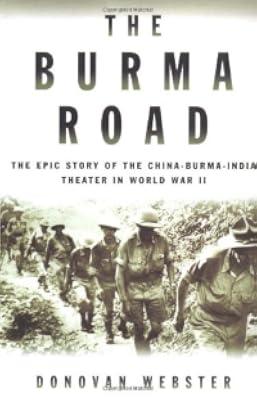
The Burma Road: The Epic Story of the China-Burma-India Theater in World War II
by Donovan Webster
On This Page
Description
The harrowing story of one of the greatest chapters of World War II---the building and defense of the Burma Road The Burma Road tells the extraordinary story of the China-Burma-India theater of operations during World War II. As the Imperial Japanese Army swept across China and South Asia at the war's outset--closing all of China's seaports--more than 200,000 Chinese laborers embarked on a seemingly impossible task: to cut a seven-hundred-mile overland route--which would be called the Burma show more Road--from the southwest Chinese city of Kunming to Lashio, Burma. But with the fall of Burma in early 1942, the Burma Road was severed, and it became the task of the newly arrived American General Stilwell to re-open it, while, at the same time, keeping China supplied by air-lift from India and simultaneously driving the Japanese out of Burma as the first step of the Allied offensive toward Japan. In gripping prose, Donovan Webster follows the breathtaking adventures of the American "Hump" pilots who flew hair-raising missions over the Himalayas to make food-drops in China; tells the true story of the mission that inspired the famous film The Bridge on the River Kwai; and recounts the grueling jungle operations of Merrill's Marauders and the British Chindit Brigades. Interspersed with vivid portraits of the American General "Vinegar Joe" Stilwell, the exceedingly eccentric British General Orde Wingate, and the mercurial Chinese Generalissimo Chiang Kai-Shek, The Burma Road vividly re-creates the sprawling, sometimes hilarious, often harrowing, and still largely unknown stories of one of the greatest chapters of World War II. show lessTags
Recommendations













Member Reviews
As near as I can tell, author Donovan Webster intended this book to be a sort of travelogue of his trek along the remnants of the Burma Road. That’s how it starts out; in the Prologue he’s trying to convince an Indian border guard officer to let him trek the few miles of the road in northwest India, despite not having a permit to travel in a restricted boarder area. He gets nowhere but manages a tone of offended incredulity. At the other end of the book, it’s clear from the acknowledgements that he did hike (or at least travel somehow) a good portion of the road (starting at the Chinese end), as he gives thanks to various hostelries and people in Myanmar for their hospitality. However, the rest of the work is a straightforward if show more journalistic history of the China-Burma-India theater in World War II.
Although suspicious of a WWII history written by a former senior editor at Outside magazine (expecting, perhaps, complaints that the Allies didn’t use ecologically sustainable methods to fight the Japanese) I was guiltily surprised. Although The Burma Road has some of the disadvantages of history as written by a journalist (overreliance on personal stories), it’s generally a pretty good history of the CBI – always the red-headed stepchild of WWII theaters of operation. The title probably came about because “Burma Road” is probably the only phrase the average American can connect with the campaign; as it happens very little text is devoted to it because although it was the focus of all the fighting in Burma by the time it was taken from the Japanese and the connecting Ledo Road was completed the war in China was no longer very important. Instead there are extensive accounts of the political infighting among General Joe Stilwell, Lord Mountbatten, and Generalissimo Chiang Kai-Shek; the irregular units that were initially the only way to take the war to the enemy in Burma (Kachin Levies, Chindits, and Merril’s Marauders); and the Japanese invasion of India in 1944 (even though it’s the “C” in CBI, fighting in China doesn’t get much coverage). Webster is very much a fan of Stilwell and Orde Wingate; complimentary to General William Slim; neutral to Lord Mountbatten, and doesn’t care very much for Claire Chennault or Chiang Kai-Shek. As the only American ground unit fighting in the theater (there were, of course, plenty of American pilots, air crew, supply units, and road engineers) the 5307th Composite Unit (Provisional), aka Galahad Force, aka Merril’s Marauders, gets a lot of coverage. (Webster cites an unnamed Marauder, pinned down on a riverbank by machinegun fire , suffering from malaria and jungle sores, and with the seat of his pants cut out to make things easier during dysentery attacks, shouting out to his comrades “Where the hell are the other 5306 Composite Units?”). There is also an obligatory mention of The Bridge on the River Kwai, and its ultimate destruction by a B-24 raid (one of the cases where the Norden bombsight worked to its full potential).
The maps are good, but there should be some more of them (although many of the actions in the Burmese jungle were so confused it’s probably impossible to map what was going on). Most of the first person accounts are from Americans or Japanese; I would have liked to see more from British, Burmese or Chinese participants. Overall a pretty good account of an underreported part of the war. show less
Although suspicious of a WWII history written by a former senior editor at Outside magazine (expecting, perhaps, complaints that the Allies didn’t use ecologically sustainable methods to fight the Japanese) I was guiltily surprised. Although The Burma Road has some of the disadvantages of history as written by a journalist (overreliance on personal stories), it’s generally a pretty good history of the CBI – always the red-headed stepchild of WWII theaters of operation. The title probably came about because “Burma Road” is probably the only phrase the average American can connect with the campaign; as it happens very little text is devoted to it because although it was the focus of all the fighting in Burma by the time it was taken from the Japanese and the connecting Ledo Road was completed the war in China was no longer very important. Instead there are extensive accounts of the political infighting among General Joe Stilwell, Lord Mountbatten, and Generalissimo Chiang Kai-Shek; the irregular units that were initially the only way to take the war to the enemy in Burma (Kachin Levies, Chindits, and Merril’s Marauders); and the Japanese invasion of India in 1944 (even though it’s the “C” in CBI, fighting in China doesn’t get much coverage). Webster is very much a fan of Stilwell and Orde Wingate; complimentary to General William Slim; neutral to Lord Mountbatten, and doesn’t care very much for Claire Chennault or Chiang Kai-Shek. As the only American ground unit fighting in the theater (there were, of course, plenty of American pilots, air crew, supply units, and road engineers) the 5307th Composite Unit (Provisional), aka Galahad Force, aka Merril’s Marauders, gets a lot of coverage. (Webster cites an unnamed Marauder, pinned down on a riverbank by machinegun fire , suffering from malaria and jungle sores, and with the seat of his pants cut out to make things easier during dysentery attacks, shouting out to his comrades “Where the hell are the other 5306 Composite Units?”). There is also an obligatory mention of The Bridge on the River Kwai, and its ultimate destruction by a B-24 raid (one of the cases where the Norden bombsight worked to its full potential).
The maps are good, but there should be some more of them (although many of the actions in the Burmese jungle were so confused it’s probably impossible to map what was going on). Most of the first person accounts are from Americans or Japanese; I would have liked to see more from British, Burmese or Chinese participants. Overall a pretty good account of an underreported part of the war. show less
Living in Asia focuses my reading interests and it was a recent visit to 'Vinegar Joe' Stilwell's former residence/office in Chungking, China two months ago, that was the impetus behind my wanting to put all the diverse bits of information I have acquired over the years of the CBI (the China-Burma-India Theatre in WWII) into a comprehensible whole. You know how it is--you've read books on Mao, on Chiang Kai-shek, on Chennault's Flying Tigers, on the Sino-Japanese War, and even Barbara Tuchman's superb work on Stilwell, but the pieces have never jelled.
This book does the trick, and I don't think it matters if you end up here, or start here, journalist/author Donovan Webster has done a superb job in weaving all those loose strands show more together into the rich tapestry of one of the most fascinating stories there is that came out of WWII. His characters are well drawn, the personal tales enrich the whole story in ways that simple facts wouldn't have cut it, and the book is one of the few I've found that tells a balanced story by including material taken from the diaries and biographies of the brave foot soldiers who fought this war regardless of uniform--Indian, American, Chinese, Burmese, Japanese. It's a page turner and if it leaves you wanting to know more, there are lots of excellent books on each of the major players in the story.
PS -- I've recommended this film in another review, but it's worth repeating. Anyone interested in this topic should do everything in their power to see the eloquent 1956 B&W Japanese anti-war movie directed by Kon Ishikawa that that tells the story of a young Japanese soldier who one day lays down his gun in Burma. It's called The Burmese Harp. show less
This book does the trick, and I don't think it matters if you end up here, or start here, journalist/author Donovan Webster has done a superb job in weaving all those loose strands show more together into the rich tapestry of one of the most fascinating stories there is that came out of WWII. His characters are well drawn, the personal tales enrich the whole story in ways that simple facts wouldn't have cut it, and the book is one of the few I've found that tells a balanced story by including material taken from the diaries and biographies of the brave foot soldiers who fought this war regardless of uniform--Indian, American, Chinese, Burmese, Japanese. It's a page turner and if it leaves you wanting to know more, there are lots of excellent books on each of the major players in the story.
PS -- I've recommended this film in another review, but it's worth repeating. Anyone interested in this topic should do everything in their power to see the eloquent 1956 B&W Japanese anti-war movie directed by Kon Ishikawa that that tells the story of a young Japanese soldier who one day lays down his gun in Burma. It's called The Burmese Harp. show less
This is one of those books that really makes you appreciate the size and scale of World War II. There are many books on the larger battles and campaigns of World War II. Bastogne, Normandy, Guadalcanal, Iwo Jima, Battle of the Bulge, etc... There are also plenty of books giving you the overview of combat operations in the European and Pacific theater. This book focuses on the lesser known battlefields of World War II. Don't be fooled by the title. This book is not just about the Burma Road. Yes, the Burma Road is mentioned throughout the book, but it is nowhere near the sole focus. It reminds me a lot of James Bradley's book Flyboys about WWII aviators in the Pacific. You think the book is simply about some US flyers that were captured show more after being shot down over Chichi Jima. It's much more than that.
What you get instead of a couple hundred pages about road construction in south east Asia is a fairly comprehensive overview of operations in India, China, Burma, and other south east Asia locales. The battle descriptions are just enough to let you know what was happening, but not so overwhelming with minute details that you feel like you are reading about every single bullet that was fired. The politics in terms of dealing with Chiang Kai Shek are covered in great detail. Even greater focus is placed on General "Vinegar Joe" Stilwell.
In the end, you get a fairly comprehensive overview of the battles that occurred in south east Asia. You also get insight into the arduous task of keeping China supplied during those years via large numbers of airplanes, and finally the Burma road itself. What is disappointing is that all the manpower and equipment the United States and others put into supplying China was effectively sabotaged by the one person who should have been the most grateful for the support. However, Chiang Kai Shek, like most politicians, was more interested in doing what was best for him than for the people of China.
If I had to pick one thing from the book that I enjoyed the most, it would be reading about British General Orde Wingate. He was by far the most interesting character in the book. I highly recommend this book. show less
What you get instead of a couple hundred pages about road construction in south east Asia is a fairly comprehensive overview of operations in India, China, Burma, and other south east Asia locales. The battle descriptions are just enough to let you know what was happening, but not so overwhelming with minute details that you feel like you are reading about every single bullet that was fired. The politics in terms of dealing with Chiang Kai Shek are covered in great detail. Even greater focus is placed on General "Vinegar Joe" Stilwell.
In the end, you get a fairly comprehensive overview of the battles that occurred in south east Asia. You also get insight into the arduous task of keeping China supplied during those years via large numbers of airplanes, and finally the Burma road itself. What is disappointing is that all the manpower and equipment the United States and others put into supplying China was effectively sabotaged by the one person who should have been the most grateful for the support. However, Chiang Kai Shek, like most politicians, was more interested in doing what was best for him than for the people of China.
If I had to pick one thing from the book that I enjoyed the most, it would be reading about British General Orde Wingate. He was by far the most interesting character in the book. I highly recommend this book. show less
This is the book in which I read the story of Lance Corporal John Harmon. Alone he attacked a Japanese machine gun position. Then hoisting the captured gun over his head he walked back to his lines. The next day he did it again. On the third day as he was again completing the feat a sniper's bullet struck his spine and his companions dragged him to safety. His last words were "It was worth it."
http://pixxiefishbooks.blogspot.com/2...
I'd read Webster's shorter article on the Burma Road in National Geographic some time back and it had tweaked my interest. Having been over in that part of the world (Kanchanaburi and the River Kwai in 2004) also helped.
Overall, it was a good read, but not the one I'd expected. The back of the book was a bit misleading - it made it sound like the River Kwai events would play a much larger part in the book than the one chapter that they were actually given. This in itself is a little odd since the whole fight for control of the River Kwai was not, at least as far as I know, part of the fight for the Burma Road at all (though, I guess, you could argue that control fo the River Kwai was at least show more partially necessary in order to further the fight to clear the Japanese out of Burma and, eventually, Thailand).
Webster did his research and develops the leading players quite well. I'd say it's more a book for the military history buffs out there than for li'l ol' me, however. It did have some interesting background on China and Chiang Kai-Shek, which is an area of history I'd like to learn more about. show less
I'd read Webster's shorter article on the Burma Road in National Geographic some time back and it had tweaked my interest. Having been over in that part of the world (Kanchanaburi and the River Kwai in 2004) also helped.
Overall, it was a good read, but not the one I'd expected. The back of the book was a bit misleading - it made it sound like the River Kwai events would play a much larger part in the book than the one chapter that they were actually given. This in itself is a little odd since the whole fight for control of the River Kwai was not, at least as far as I know, part of the fight for the Burma Road at all (though, I guess, you could argue that control fo the River Kwai was at least show more partially necessary in order to further the fight to clear the Japanese out of Burma and, eventually, Thailand).
Webster did his research and develops the leading players quite well. I'd say it's more a book for the military history buffs out there than for li'l ol' me, however. It did have some interesting background on China and Chiang Kai-Shek, which is an area of history I'd like to learn more about. show less
Very good book and information on a forgotten area of WWII.
As the Imperial Japanese Army swept across China and South Asia at World War II's outset, closing all of China's seaports, more than 200,000 Chinese laborers embarked on a seemingly impossible task: to cut a 700-mile overland route -- the Burma Road -- from the southwest Chinese city of Kunming to Lashio, Burma. But when Burma fell in 1942, the Burma Road was severed. As the first step of the Allied offensive toward Japan, American general Joseph Stilwell reopened it, while, at the same time, keeping China supplied by air-lift from India and simultaneously driving the Japanese out of Burma.
From the breathtaking adventures of the American "Hump" pilots who flew hair-raising missions over the Himalayas to make food-drops in China to the show more true story of the mission that inspired the famous film The Bridge on the River Kwai, to the grueling jungle operations of Merrill's Marauders and the British Chindit Brigades, The Burma Road vividly re-creates the sprawling, sometimes hilarious, often harrowing, and still largely unknown stories of one of the greatest chapters of World War II. show less
From the breathtaking adventures of the American "Hump" pilots who flew hair-raising missions over the Himalayas to make food-drops in China to the show more true story of the mission that inspired the famous film The Bridge on the River Kwai, to the grueling jungle operations of Merrill's Marauders and the British Chindit Brigades, The Burma Road vividly re-creates the sprawling, sometimes hilarious, often harrowing, and still largely unknown stories of one of the greatest chapters of World War II. show less
Members
- Recently Added By
Author Information
9+ Works 534 Members
Common Knowledge
- Canonical title
- The Burma Road: The Epic Story of the China-Burma-India Theater in World War II
- Original publication date
- 2003
- People/Characters
- Joseph Stilwell
- Important places
- Burma Road; Southeast Asia; Burma; Ledo Road; China; India
- Important events
- World War II (1939 | 1945); World War II, Pacific Theater (1941-12-07 | 1945-09-02); Burma Campaign (1942 | 1945)
- Disambiguation notice
- Full title (2003): The Burma road : the epic story of the China-Burma-India theater in World War II / Donovan Webster
Classifications
- Genres
- History, Nonfiction, General Nonfiction
- DDC/MDS
- 940.5425 — History & geography History of Europe History of Europe 1918- Military history of World War II Campaigns and battles by theatre East and South Asian theaters
- LCC
- D767.6 .W44 — History of Europe, Asia, Africa and Oceania History (General) World War II (1939-1945)
- BISAC
Statistics
- Members
- 284
- Popularity
- 113,391
- Reviews
- 8
- Rating
- (4.09)
- Languages
- English
- Media
- Paper, Audiobook
- ISBNs
- 9
- UPCs
- 1
- ASINs
- 2