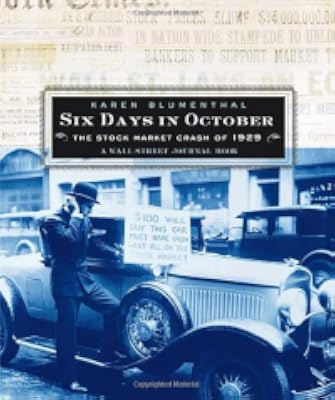
Six Days in October: The Stock Market Crash of 1929
by Karen Blumenthal
On This Page
Description
A comprehensive review of the events, personalities, and mistakes behind the Stock Market Crash of 1929, featuring photographs, newspaper articles, and cartoons of the day.Tags
Recommendations




























Member Reviews
My journey to being smarter than a fifth grader continues via middle-grade non-fiction. This was an apt choice, which may come in handy if the economy continues to tank. However, once I began, I learned that the stock market crash of October, 1929 did NOT start the Great Depression -- it just didn't help matters any.
This was nevertheless a very quick and interesting read, following (go figure) the six days in October 1929 when the stock market loses more than 25% of its value. Fascinating how the stock market worked then, how trades were conducted and recorded (oy, the paperwork! all the poor clerks pulling all-nighters during this crash!), all the collusion, and how the bankers tried (unsuccessfully) to prop up the market by marching show more in to the exchange and placing large buy orders in a commanding voice for over the asking price (so low tech!).
My own copy lacks the humiliating "Wall Street Journal Book for Children" so prominently placed. So it's cool; I can read it on the train. show less
This was nevertheless a very quick and interesting read, following (go figure) the six days in October 1929 when the stock market loses more than 25% of its value. Fascinating how the stock market worked then, how trades were conducted and recorded (oy, the paperwork! all the poor clerks pulling all-nighters during this crash!), all the collusion, and how the bankers tried (unsuccessfully) to prop up the market by marching show more in to the exchange and placing large buy orders in a commanding voice for over the asking price (so low tech!).
My own copy lacks the humiliating "Wall Street Journal Book for Children" so prominently placed. So it's cool; I can read it on the train. show less
Stunning and dramatic, Blumenthal tells of a story when America was wealthy and prosperous, and how in 6 days time, it hit the bottom. Blumenthal, being a Wall Street Journal bureau chief, educates children and teens about the stock market, by providing defintions and terms, who key players were during that period, and why the stock market crashed. This is an eerie resemblence as to what is taking place in the current stock market, and perhaps she inadvertanly reminds Americans, that things fall, but, as American's we will overcome disaster.
This was a quick and informative read. Blumenthal captures not only the events that lead up to the 1929 stock market crash, but she includes information boxes that explain everything from what a stock exchange is and how it operates, bull versus bear markets, stock splitting, as well as a good explanations of the Dow Jones Industrial Average, bonds and what it means to purchase stocks with a margin account. Filled with pictures, newspaper clippings and cartoons from the era, Blumenthal captures how the meteor-rising stock market in 1928 and the first 9 months of 1929 was a beacon to Americans from all social and financial classes as the path to wealth. The book goes into great detail to explain the key players involved and how show more activities like special stock deals, syndicate pools and rampant insider trading (all deemed illegal practices in our post-1929 stock market world) played a role in the stock market crash.
Written for the middle school audience, this book was an interesting and informative read for this adult reader. show less
Written for the middle school audience, this book was an interesting and informative read for this adult reader. show less
I actually really enjoyed reading this book. I have a thing for history so I wanted to read to this book. I thought the illustrations were fantastic. They were all in black and white so I think that would be a good thing for students to see what it was like in the past. I also liked how their were clippings of newspaper articles in the book. I thought that gave it more of a historical feel. This book also had charts of when the stock market crashed. This would be a great visual for the students. I also enjoyed the language of the book. It was very engaging and made me want to keep reading until the end. Overall, I thought it was an excellent book for students who want to learn about the stock market crash. The main idea of this book is show more to educate readers about the stock market crash of 1929. show less
Everyday for many months news of financial woe has been a prominent part of our news. Enron is a part of our national vocabulary. Blumenthal has written an award-winning title (Sibert honors for distinction in informational texts—for other Sibert prize winning books see, http://www.ala.org/alsc/sibert.html ) that should be required reading for those wishing to understand the historical roots of financial mismanagement and deceit. The players involved in the ‘29 stock market crash are not so different in personality than today’s players. The method of deceit in 1929, although much different in detail to the accounting fraud of Enron, still has much to teach us about how events like these happen. This book, filled with ads, show more pictures, graphs, charts, quotes, and other visual delights, shows how a mere six days changed the lives of rich and poor alike. These six days defined an entire era and continue to influence our country today. The book, however, is very reader friendly. You will even read about Grouch Marx and his losses during this grim time. show less
This Robert F. Sibert Honor Book should be required reading. It is an historical account of the six days beginning with Black Thursday, on October 24, 1929. Blumenthal's book is chock full of well-researched historical facts, as well as period photos and newspaper articles. Practical information, "What is a Stock Split?," "What are Bonds?," etc. is in highlighted text boxes. This book may be found in the children's section of your library, but there is something in it for everyone. In these troubled financial times, this is certainly a period worth remembering. For ages 12 and up.
A very readable explanation of the events leading up to the market crash of 1929 and its aftermath written at a middle school/high school level. This book is a good introduction to the subject for anyone interested in the stock market and the early days of the Great Depression.
Members
- Recently Added By
Lists

Robert F. Sibert Informational Book Medal
102 works; 1 member
Author Information

14 Works 1,794 Members
Awards and Honors
Awards
Distinctions
Notable Lists
Common Knowledge
- Canonical title
- Six Days in October: The Stock Market Crash of 1929
- Original publication date
- 2002
- Important events
- Great Depression; Stock Market Crash of 1929
Classifications
Statistics
- Members
- 268
- Popularity
- 120,693
- Reviews
- 9
- Rating
- (4.21)
- Languages
- English
- Media
- Paper, Ebook
- ISBNs
- 4
- ASINs
- 2