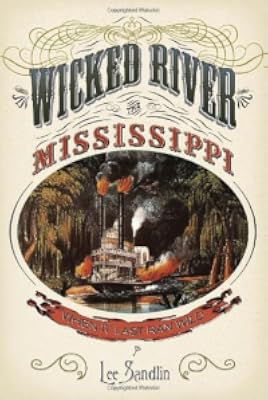
Wicked River: The Mississippi When It Last Ran Wild
by Lee Sandlin
On This Page
Description
A chronicle of the Mississippi River in the first half of the nineteenth century--before it was tamed by commerce and technology--draws on first-hand accounts to describe life along the river, natural and man-made disasters, acts of piracy, and cultural celebrations.Tags
Recommendations










Member Recommendations

Member Reviews
A semi-chronological narrative of life along the Mississippi River, primarily before the Civil War, when the river valley was still part of the frontier. It was a dangerous place, both from nature (storms, earthquakes, the river itself) and from other humans (lots of drunkenness and piracy). Includes the origin of the term "lynching", which didn't always mean hanging. Found myself unreasonably amused by the fact that the voyageurs (boatmen, somewhat expendable) were known for their red shirts. Tidbits that I want to use for future D&D games: the Crow's Nest, an island of pirates in the middle of the river, which was destroyed by the New Madrid quakes; Natchez-Under-the-Hill, the sketchy/wild town down by the river, partially built into show more the bluffs, with the "respectable" town up above. Ends with Mark Twain's last visit to the river, when few boats traveled it, the traffic all having gone to rail, and when the course of the river itself was being tamed; in the epilogue, he revisits the "panorama" paintings that were all the rage in the early 19th century, and how the last one disappeared. (Fittingly, part of it may still be hidden under a wall somewhere in South Dakota.) Very engaging; probably wouldn't have read it if it hadn't been one of the few non-fiction books available in Overdrive, but glad I did anyway. show less
A wild swirling ride of a book with back-eddies and quiet pools of history and thought bursting out again into the mayhems and disasters of this river, its peoples, histories and its traffic. Sandlin starts his wild river ride not at the true source, away up north in a quiet backwoods, but in his Illinois home-town standing over a storm drain that has become yet another tributary feeding ”Old Glory”.
Mark Twain (Samuel Clemens) returned to his river, of his youth, Huck Finn and his glory days of being a Mississippi Pilot to find it … gone. Embanked, straightened, lit with beacons and lighthouses, flood-controlled and, the biggest shock, empty of boats, traffic and trade. From the first steamboat in 1811 to just 1830 the traffic show more doubled, tripled and doubled again – to over four thousands boats plying the writhing stream.
Sandlin writes of the madness of the riverfolk, of a sort of continuous rage, induced by daily and regular intake of rye but stimulated too by poverty and unremitting hard work. Literally having to drag their boats back upstream against the roar of the flow, waist deep in chilling water and mud, full of rye and fever, they were mad.
The confluence of the relatively clean Missouri with the “Old River” causes a spectacle as each river rejects the other for several miles, the two streams visibly separate, a phenomena written of by Melville, Lewis and Clarke to, more recently, Jonathan Raban (in Old Glory). And, of course, Sandlin who also adds the pirates, the gamblers, the slaves or that “piebald parliament an anacharsis cloots congress of that multiform pilgrim species man” as Melville put it!
An exciting book then with aspects of history to interest, travel narratives to engage and wit to entertain. show less
Mark Twain (Samuel Clemens) returned to his river, of his youth, Huck Finn and his glory days of being a Mississippi Pilot to find it … gone. Embanked, straightened, lit with beacons and lighthouses, flood-controlled and, the biggest shock, empty of boats, traffic and trade. From the first steamboat in 1811 to just 1830 the traffic show more doubled, tripled and doubled again – to over four thousands boats plying the writhing stream.
Sandlin writes of the madness of the riverfolk, of a sort of continuous rage, induced by daily and regular intake of rye but stimulated too by poverty and unremitting hard work. Literally having to drag their boats back upstream against the roar of the flow, waist deep in chilling water and mud, full of rye and fever, they were mad.
The confluence of the relatively clean Missouri with the “Old River” causes a spectacle as each river rejects the other for several miles, the two streams visibly separate, a phenomena written of by Melville, Lewis and Clarke to, more recently, Jonathan Raban (in Old Glory). And, of course, Sandlin who also adds the pirates, the gamblers, the slaves or that “piebald parliament an anacharsis cloots congress of that multiform pilgrim species man” as Melville put it!
An exciting book then with aspects of history to interest, travel narratives to engage and wit to entertain. show less
Popular history done well. This reads like a collection of short narratives of life on and near the Mississippi River from the first European/American settlements to just after the Civil War when railroads reduced the importance of the river as a form of transportation and began to "tame" the river's natural cycles, making it safer but also less interesting. Lots of action and character sketches, a little light on historical background, this is definitely history as entertainment. But, Sandlin is careful to note sources and he also raises questions about the reliability of historical evidence that will leave the reader pondering.
A fascinating, if often hyperbolic and disjointed, look at the Mississippi River and especially the communities surrounding it, not to mention the customs and eccentric characters that thrived on the river frontier. It might also be called, the Book of Lists.
I was surprised by the importance of prostitution to communities in the 19th century frontier society. Their importance was so crucial as to be almost "structural." Women were a rarity, often outnumbered by men 20-1, and it was common for some women who wanted to secure their financial future to marry several at once, visiting them on a rotational basis and being provided for. It was a system that suited all parties, apparently. The institution was so crucial to the army, they were show more imported to all forts, respected and called seamstresses. Brothels in St. Louis could be lavish places and held in high esteem by the community despite ostensible moral antagonism.
Religious camp meetings were immensely popular. One such event pulled a gathering of 20,000 people at a time when the population of New Orleans was about half that. The events became occasions of ecstatic behavior with "jerkings," falling", other kinds of physical religious behavior we would now label pejoratively as "holy rollers." It also included orgies, the sexual component of ecstatic behavior being quite strong, and until the vigilantes moved in to put a lid on it, it was quite common for groups to move off into the woods to consummate their religious fervor resulting in a high birth rate about nine months after the camp meeting.
Corruption was endemic. It was assumed and understood that everyone along the river would cheat, shorting the steamboats on piles of wood, counterfeiting (although very much frowned on it was helped by the number of different banks issuing money, species being quite rare and always in demand.) Con men thrived.
The story of Stewart's pamphlet and John Murrell was fascinating. Stewart had written and published a pamphlet that purported to report on his infiltration into the infamous Murrell gang. Murrell supposedly had revealed to him that Murrell was orchestrating a vast conspiracy that would result in an enormous slave rebellion on July 4th, 1835. The names of many so-called conspirators who belonged to this "Mystic Klan" were fomenting the rebellion were included. The ultimate purpose was so they could rob and pillage virtually the entire south. Always fearful of slaves revolts, the end result of publicity surrounding the pamphlet was the formation of vigilante committees and extensive use of "Lynch Law." Fear of slaves spilled over into antagonism toward river-town gamblers in Vicksburg and soon bodies were hanging from trees on virtually every road. Some people, after interrogation by the "committees," were lucky to get off with 1,000 lashes. Neighbors would inform on neighbors they didn't like and it must have been like scenes out of mob actions of the French Revolution. (Tom Sawyer and Huck talk about looking for "Murel's treasure.")
Lots of really good stories and cultural history. If you are looking for information about the river itself, however, you might be better served by [b:The Big Muddy: An Environmental History of the Mississippi and Its Peoples, from Hernando de Soto to Hurricane Katrina|13687170|The Big Muddy An Environmental History of the Mississippi and Its Peoples, from Hernando de Soto to Hurricane Katrina|Christopher Morris|http://d.gr-assets.com/books/1348606093s/13687170.jpg|19307823] show less
I was surprised by the importance of prostitution to communities in the 19th century frontier society. Their importance was so crucial as to be almost "structural." Women were a rarity, often outnumbered by men 20-1, and it was common for some women who wanted to secure their financial future to marry several at once, visiting them on a rotational basis and being provided for. It was a system that suited all parties, apparently. The institution was so crucial to the army, they were show more imported to all forts, respected and called seamstresses. Brothels in St. Louis could be lavish places and held in high esteem by the community despite ostensible moral antagonism.
Religious camp meetings were immensely popular. One such event pulled a gathering of 20,000 people at a time when the population of New Orleans was about half that. The events became occasions of ecstatic behavior with "jerkings," falling", other kinds of physical religious behavior we would now label pejoratively as "holy rollers." It also included orgies, the sexual component of ecstatic behavior being quite strong, and until the vigilantes moved in to put a lid on it, it was quite common for groups to move off into the woods to consummate their religious fervor resulting in a high birth rate about nine months after the camp meeting.
Corruption was endemic. It was assumed and understood that everyone along the river would cheat, shorting the steamboats on piles of wood, counterfeiting (although very much frowned on it was helped by the number of different banks issuing money, species being quite rare and always in demand.) Con men thrived.
The story of Stewart's pamphlet and John Murrell was fascinating. Stewart had written and published a pamphlet that purported to report on his infiltration into the infamous Murrell gang. Murrell supposedly had revealed to him that Murrell was orchestrating a vast conspiracy that would result in an enormous slave rebellion on July 4th, 1835. The names of many so-called conspirators who belonged to this "Mystic Klan" were fomenting the rebellion were included. The ultimate purpose was so they could rob and pillage virtually the entire south. Always fearful of slaves revolts, the end result of publicity surrounding the pamphlet was the formation of vigilante committees and extensive use of "Lynch Law." Fear of slaves spilled over into antagonism toward river-town gamblers in Vicksburg and soon bodies were hanging from trees on virtually every road. Some people, after interrogation by the "committees," were lucky to get off with 1,000 lashes. Neighbors would inform on neighbors they didn't like and it must have been like scenes out of mob actions of the French Revolution. (Tom Sawyer and Huck talk about looking for "Murel's treasure.")
Lots of really good stories and cultural history. If you are looking for information about the river itself, however, you might be better served by [b:The Big Muddy: An Environmental History of the Mississippi and Its Peoples, from Hernando de Soto to Hurricane Katrina|13687170|The Big Muddy An Environmental History of the Mississippi and Its Peoples, from Hernando de Soto to Hurricane Katrina|Christopher Morris|http://d.gr-assets.com/books/1348606093s/13687170.jpg|19307823] show less
6. Wicked River: The Mississippi When It Last Ran Wild (Audio CD) by Lee Sandlin, read by Jeff McCarthy (2010, 368 pages in paper format, listened Jan 17-29)
A history of the Mississippi river that begins as a natural description, evolves into a history of early European settlement and use, then devolves into an overwrought, under-focused history of this and that with way way too much detail. Somewhere in here I think it lost sight the river in its entirety.
I would have liked this better about twenty years ago. The writing itself is fine and can be very good. I think structurally it was a trainwreck...but other readers did not seem to feel that. However, I'm so happy to have read a very clear and quite thorough description of the 1811 show more New Madrid earthquakes. Sandlin shows the timeline, covers the descriptions and explores the rumors, the backwash that caused the river to flow backward (only the shallower flow, apparently) and the two waterfalls that existed for a few weeks or so. That may have been worth all the hours wasted on southern brutality and the Civil War siege of Vicksburg.
2014
http://www.librarything.com/topic/163456#4536354 show less
A history of the Mississippi river that begins as a natural description, evolves into a history of early European settlement and use, then devolves into an overwrought, under-focused history of this and that with way way too much detail. Somewhere in here I think it lost sight the river in its entirety.
I would have liked this better about twenty years ago. The writing itself is fine and can be very good. I think structurally it was a trainwreck...but other readers did not seem to feel that. However, I'm so happy to have read a very clear and quite thorough description of the 1811 show more New Madrid earthquakes. Sandlin shows the timeline, covers the descriptions and explores the rumors, the backwash that caused the river to flow backward (only the shallower flow, apparently) and the two waterfalls that existed for a few weeks or so. That may have been worth all the hours wasted on southern brutality and the Civil War siege of Vicksburg.
2014
http://www.librarything.com/topic/163456#4536354 show less
Stories abound about the Mississippi River, and I've read several. This is by far one of my favorites. Lee Sandlin gives us a history of the River from the early 1800's up to the siege of Vicksburg in 1863. He focuses on some of the bigger events happening around the river, as well as focusing on the river itself before the attempts to "tame" it by the Army Corps of Engineers. It's amazing to realize how independently it flowed before then.
Lively! Brings out personalities and character of the river people. Loved Sandlin's use of the painted panorama as a central motif, and his focus on the American dialect of the day.
Members
- Recently Added By
Published Reviews
Mr. Sandlin begins, ingeniously, with a storm sewer in his own Illinois neighborhood, a tiny, filthy pre-tributary of that "industrial drainage system the length of a continent." We first see the expanse of the river valley through the author's childhood memories of speeding toward it in the family car, during a storm. But the book soon drifts into Mr. Sandlin's fascination: the great show more Mississippi River culture, as it grew from "somewhere in the 1810s until the Civil War," when "a new society had rapidly sprouted and come to a fantastic height" in the American interior. This was not the Mississippi that Twain knew best, show less
added by John_Vaughan
Lists

Mississippi River in Books
20 works; 3 members
Author Information

4+ Works 570 Members
Common Knowledge
- Original publication date
- 2010
- Important places
- Mississippi River, USA
Classifications
Statistics
- Members
- 384
- Popularity
- 81,820
- Reviews
- 11
- Rating
- (4.04)
- Languages
- English, German, Hebrew
- Media
- Paper, Audiobook, Ebook
- ISBNs
- 11
- UPCs
- 1
- ASINs
- 6