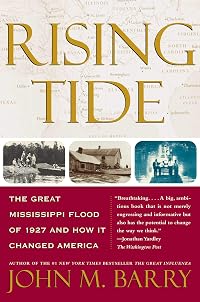
Rising Tide: The Great Mississippi Flood of 1927 and How It Changed America
by John M. Barry
On This Page
Description
In 1927, the Mississippi River swept across an area roughly equal in size to Massachusetts, Connecticut, New Hampshire, and Vermont combined, leaving water as deep as thirty feet on the land stretching from Illinois and Missouri south to the Gulf of Mexico. Close to a million people - in a nation of 120 million - were forced out of their homes. Some estimates place the death toll in the thousands. The Red Cross fed nearly 700,000 refugees for months. Rising Tide is the story of this show more forgotten event, the greatest natural disaster this country has ever known. But it is not simply a tale of disaster. The flood transformed part of the nation and had a major cultural and political impact on the rest. Rising Tide is an American epic about science, race, honor, politics, and society. Rising Tide begins in the 19th century, when the first serious attempts to control the river began. From the engineers and the dominant families in the Delta to the New Orleans elite, Rising Tide tells how the flood changed the face of American and laid the groundwork for the New Deal. show lessTags
Recommendations





















Member Recommendations

rebeccanyc One of the consequences of the great Mississippi flood was the African-American migration to the north and west. Barry discusses this and Wilkerson explores it in greater detail.

John_Vaughan How the 'ole Miss' changes lives and lands and the technology changes from the time of Harlan Hubbard.
Member Reviews
I have decided that I will never again read another book by James M. Barry. Not that the books aren't good, they are excellent. The problem is that I am currently 2 for 2 on having bad things associated with the book's subject matter happen when I read them. In 2020 I read The Great Influenza: The Story of the Deadliest Pandemic in History only to experience the next great pandemic. This month I am reading Rising Tide: the Great Mississippi Flood of 1927 and How it Changed America in preparation for a Mississippi riverboat cruise in two weeks only to learn today that the cruise line closed up shop and cancelled all future trips. Granted, that's not as bad as a pandemic or a great flood, but we're terribly disappointed.
Seriously, I show more really enjoyed most of it, starting with the history and geography of the river and the story of man's attempts to tame it, and moving on to the catastrophic flood itself. I was less impressed by the final chapters that described the cruel treatment of black refugees and the sordid political machinations to avoid making promised reparations.
Bottom line: This is an excellent book that drills deeply into not only the most consequential flood in U.S. history but into the events leading up to it and the short and long-term consequences of it.
I highly recommend it. show less
Seriously, I show more really enjoyed most of it, starting with the history and geography of the river and the story of man's attempts to tame it, and moving on to the catastrophic flood itself. I was less impressed by the final chapters that described the cruel treatment of black refugees and the sordid political machinations to avoid making promised reparations.
Bottom line: This is an excellent book that drills deeply into not only the most consequential flood in U.S. history but into the events leading up to it and the short and long-term consequences of it.
I highly recommend it. show less
Fraught with interesting similarities to Katrina, although the book dates to 1997 and was therefore not inspired by that event. Author John Barry starts his narrative back in the 1860s, when the Army Corps of Engineers and independent engineers James Buchannan Eads and George Ellet got involved in a three-way controversy over the correct way to “control” the Mississippi River. The COE insisted on a “levees only” policy, based on studies from the Po River in Italy; the other engineers wanted levees plus diversion channels plus detention reservoirs. Ellet was taken out of the picture when he was killed in the Civil War; Eads and the Corps continued to battle, with the Corps and “levees only” winning.
The theory behind “levees show more only” was that when the river was confined between levees, the average current velocity would increase and scour the river bottom; the deeper channel would then be less prone to flooding. The probably did work fine in Italy, where the levees along the Po defined the river channel; Mississippi levees were often more than a mile away from the average channel – thus the current never had a chance to “scour”. In fact, the Corps was so committed to the “levees only” policy that they closed natural diversion channels (all but the largest, the Atchafalaya River – and they were planning to dam that off in 1928). About all you can say is it seemed like a good idea at the time.
The winter of 1926 and the spring of 1927 had some of the most severe weather in history. New Orleans got five consecutive record-breaking rainstorms, and the river rose above highest recorded flood levels all the way from Illinois to the Gulf. Sandbag crews – mostly conscripted blacks – worked full time, and guards – all white – supervised and patrolled (if you are on, say, the west bank of the river, and the levee on the east bank happens to break, you’re saved. A lot of people noted that somebody else’s levee could be encouraged to break at the right spot with a few dozen sticks of dynamite. A number of dynamiters or alleged dynamiters were shot).
Although the engineering and hydraulic discussions are fairly good for a non-engineer, most of Barry’s enthusiasm is for people. The book really has no heroes, with the possible exception of Eads and LeRoy Percy, a traditional “Southern gentleman” and landowner in Greeneville, Mississippi. Barry is hard on every president involved – Wilson was a “dictator” created a “red scare”, reintroduced segregation and allowed the Ku Klux Klan to be reborn. In Centralia, Washington in 1919, veterans – not Klansmen, but American Legion members acting on Wilson’s “Americanism” program, dragged Wobbly Wesley Everest from jail, hanged him from a bridge, and used his body for target practice. The coroner ruled it a suicide.
Harding didn’t last long enough to incur Barry’s ire, but Coolidge is castigated for “doing nothing” about the flood. He doesn’t like most of the locals, either – landowners refused to evacuate blacks from threatened areas, worrying that if they left they would never come back (probably correctly). Even Percy, who had spoken out against the Klan, was worried about a black farm worker exodus. (Greenville was a remarkably tolerant city for the time and place; residents once broke into the jail and lynched a white man who had murdered a popular black resident. Not exactly due process, but it’s the thought that counts).
Eventually the inevitable happened and the levee at Mound City, Mississippi failed. A patrol noticed a small stream of water – two feet wide and one foot deep – overtopping the levee. By the time they got sandbaggers, it was a torrent, and in a few minutes the entire levee gave way. Other levees on the west side also broke, and the Atchafalaya carried away more water than the Mississippi did at normal flow (oddly, this saved New Orleans).
The disaster was vastly greater than Katrina – millions of acres were flooded. The death toll is unknown – most were blacks that nobody counted – but estimated to be in the thousands. Coolidge finally appointed Herbert Hoover the “flood czar” and gave him direct control over all Federal agencies (although most relief work was actually done by the Red Cross, the military did contribute tents, bedding, and airplanes to hunt for survivors). Barry doesn’t have much use for Hoover, either; he acknowledges that Hoover did an adequate job as the “flood czar” but accuses him of racial favoritism and of starting the reversal of the “Solid South”; Barry claims Hoover quietly abandoned the few blacks in the south who could vote (and who always voted Republican) in exchange for a “lily-white” southern Republican base.
All and all, pretty interesting. I’m a little skeptical of some of Barry’s commentary on individuals – he often writes as if he could read minds. Nevertheless, this was something I knew nothing about, and the role reversal of Democrats and Republicans provided some cognitive dissonance. Four stars, I think. show less
The theory behind “levees show more only” was that when the river was confined between levees, the average current velocity would increase and scour the river bottom; the deeper channel would then be less prone to flooding. The probably did work fine in Italy, where the levees along the Po defined the river channel; Mississippi levees were often more than a mile away from the average channel – thus the current never had a chance to “scour”. In fact, the Corps was so committed to the “levees only” policy that they closed natural diversion channels (all but the largest, the Atchafalaya River – and they were planning to dam that off in 1928). About all you can say is it seemed like a good idea at the time.
The winter of 1926 and the spring of 1927 had some of the most severe weather in history. New Orleans got five consecutive record-breaking rainstorms, and the river rose above highest recorded flood levels all the way from Illinois to the Gulf. Sandbag crews – mostly conscripted blacks – worked full time, and guards – all white – supervised and patrolled (if you are on, say, the west bank of the river, and the levee on the east bank happens to break, you’re saved. A lot of people noted that somebody else’s levee could be encouraged to break at the right spot with a few dozen sticks of dynamite. A number of dynamiters or alleged dynamiters were shot).
Although the engineering and hydraulic discussions are fairly good for a non-engineer, most of Barry’s enthusiasm is for people. The book really has no heroes, with the possible exception of Eads and LeRoy Percy, a traditional “Southern gentleman” and landowner in Greeneville, Mississippi. Barry is hard on every president involved – Wilson was a “dictator” created a “red scare”, reintroduced segregation and allowed the Ku Klux Klan to be reborn. In Centralia, Washington in 1919, veterans – not Klansmen, but American Legion members acting on Wilson’s “Americanism” program, dragged Wobbly Wesley Everest from jail, hanged him from a bridge, and used his body for target practice. The coroner ruled it a suicide.
Harding didn’t last long enough to incur Barry’s ire, but Coolidge is castigated for “doing nothing” about the flood. He doesn’t like most of the locals, either – landowners refused to evacuate blacks from threatened areas, worrying that if they left they would never come back (probably correctly). Even Percy, who had spoken out against the Klan, was worried about a black farm worker exodus. (Greenville was a remarkably tolerant city for the time and place; residents once broke into the jail and lynched a white man who had murdered a popular black resident. Not exactly due process, but it’s the thought that counts).
Eventually the inevitable happened and the levee at Mound City, Mississippi failed. A patrol noticed a small stream of water – two feet wide and one foot deep – overtopping the levee. By the time they got sandbaggers, it was a torrent, and in a few minutes the entire levee gave way. Other levees on the west side also broke, and the Atchafalaya carried away more water than the Mississippi did at normal flow (oddly, this saved New Orleans).
The disaster was vastly greater than Katrina – millions of acres were flooded. The death toll is unknown – most were blacks that nobody counted – but estimated to be in the thousands. Coolidge finally appointed Herbert Hoover the “flood czar” and gave him direct control over all Federal agencies (although most relief work was actually done by the Red Cross, the military did contribute tents, bedding, and airplanes to hunt for survivors). Barry doesn’t have much use for Hoover, either; he acknowledges that Hoover did an adequate job as the “flood czar” but accuses him of racial favoritism and of starting the reversal of the “Solid South”; Barry claims Hoover quietly abandoned the few blacks in the south who could vote (and who always voted Republican) in exchange for a “lily-white” southern Republican base.
All and all, pretty interesting. I’m a little skeptical of some of Barry’s commentary on individuals – he often writes as if he could read minds. Nevertheless, this was something I knew nothing about, and the role reversal of Democrats and Republicans provided some cognitive dissonance. Four stars, I think. show less
This book tells much more than just the tale of the 1927 flood. It is the tale of the entire engineering effort to control the Mississippi, starting in the early 1900s. It is a tale of corruption, power, elitism, race (not just racism), and one walks away with a much clearer sense of the history of the Deep South. More importantly, it shows that as the US grew, the complexity of society became such that no one local community could deal with major disasters. So the federal government became far more intrusive: the type of government we have today. And the 1927 Mississippi flood precipitated it. And Herbert Hoover was the hero of the hour as Secretary of Commerce, propelling him to national prominence and the Presidency. Excellent show more writing, engaging, and clearly outlining the engineering and technological issues facing people at the time. It makes the Katrina debacle much more understandable and why the Army Corp of Engineers made things worse. show less
Don’t let the title fool you, while the focus of the book is the great 1927 flood (an event overlooked today), this is a book about the Mississippi River and man’s attempt to live with and in some cases tame it. Full of rich descriptions of men and women whose lives were shaped by the river and the 1927 flood, and of powerful men who tried to control and profit from it, including one who became President, this book really grabs you from the outset.
Starting with early attempts to erect bridges over it, to map its courses and devise ways to keep it from hampering economic growth in the Mississippi Delta, through its role during the Civil War, and how it affected economics, culture and race relations in the south, the Mississippi River show more itself is a character in this story, with a personality all its own. This is expertly brought to life by Barry.
Most fascinating for me was the many ways in which the 1927 flood so profoundly changed the character of the deep south, and how in many ways it set back nascent progress on race relations. In order to combat the flood blacks were forced to work, shoring up levees, hauling supplies and digging trenches, all at gunpoint and without adequate food and shelter to sustain themselves. In many places (particularly Greenville, MS which in many ways was the epicenter of the flood), white leaders, aided and abetted by the Red Cross virtually re-instituted slavery. Prior to the flood, through the cooperation of local blacks and the relatively enlightened views of its leaders, particularly LeRoy Percy (a central figure in the latter half of the book), race relations had seen improvement. The flood, and the reaction of the white leadership to it nearly destroyed all that.
It also profoundly reshaped the labor system in the South. One reason why white leaders were so eager to keep blacks under foot during the crisis was to prevent them from leaving the Delta where they were the primary source of labor. However, once the waters had receded and it became apparent promises of restitution from local leaders and from the federal government were not going to be forthcoming, many blacks began migrating to the north. This caused a huge problem for large landowners who relied on the labor blacks provided, and from their percentage of income from sharecropper activities. It certainly helped hasten the transition to a de facto free labor system which had only existed in name only up until that time; a transition that continues to be a very painful one for the region.
Also interesting is the affect the flood had on presidential politics, and on the eventual shift in the relation between the federal government and her citizens that we saw under President Franklin Roosevelt. Herbert Hoover, Calvin Coolidge’s Commerce Secretary of Commerce was tasked to coordinate the government response to the flood. It was his work, and the positive press he received from it that propelled him to the White House.
Hoover was tasked by Coolidge to coordinate the efforts of mostly private organizations as they attempted to deal with the enormous human suffering that was the result of the flood. Coolidge himself refused to set what he considered a dangerous precedent by providing the type of government disaster relief we take for granted today. As a result he was the focus of extensive media and public criticism for what was viewed as a heartless reaction to the crisis. All the while Hoover was being lionized in the press as the only member of the administration willing to do something about the crisis. Coolidge’s opposition to government relief, however, was a policy with which Hoover totally agreed. It also foreshadowed the disastrous way he reacted to the Great Depression.
In hindsight the resources brought to bear by Hoover were wholly inadequate, and in many case failed to provide even minimally adequate relief. It was this same strategy that he used as President, to try and relieve the suffering experienced by so many during the Great Depression; a strategy that failed miserably and gave rise to FDR and the more active governmental role he implemented. It was also the beginning of the end of the alliance between African-Americans and the Republican Party.
I found very little to criticize in this book. Occasionally Barry provided a bit more detail, particularly about financial matters, than was probably necessary to make his point, but that is a minor quibble. Overall highly valuable book, about a significant even in American history that is often overlooked. Highly recommended!! show less
Starting with early attempts to erect bridges over it, to map its courses and devise ways to keep it from hampering economic growth in the Mississippi Delta, through its role during the Civil War, and how it affected economics, culture and race relations in the south, the Mississippi River show more itself is a character in this story, with a personality all its own. This is expertly brought to life by Barry.
Most fascinating for me was the many ways in which the 1927 flood so profoundly changed the character of the deep south, and how in many ways it set back nascent progress on race relations. In order to combat the flood blacks were forced to work, shoring up levees, hauling supplies and digging trenches, all at gunpoint and without adequate food and shelter to sustain themselves. In many places (particularly Greenville, MS which in many ways was the epicenter of the flood), white leaders, aided and abetted by the Red Cross virtually re-instituted slavery. Prior to the flood, through the cooperation of local blacks and the relatively enlightened views of its leaders, particularly LeRoy Percy (a central figure in the latter half of the book), race relations had seen improvement. The flood, and the reaction of the white leadership to it nearly destroyed all that.
It also profoundly reshaped the labor system in the South. One reason why white leaders were so eager to keep blacks under foot during the crisis was to prevent them from leaving the Delta where they were the primary source of labor. However, once the waters had receded and it became apparent promises of restitution from local leaders and from the federal government were not going to be forthcoming, many blacks began migrating to the north. This caused a huge problem for large landowners who relied on the labor blacks provided, and from their percentage of income from sharecropper activities. It certainly helped hasten the transition to a de facto free labor system which had only existed in name only up until that time; a transition that continues to be a very painful one for the region.
Also interesting is the affect the flood had on presidential politics, and on the eventual shift in the relation between the federal government and her citizens that we saw under President Franklin Roosevelt. Herbert Hoover, Calvin Coolidge’s Commerce Secretary of Commerce was tasked to coordinate the government response to the flood. It was his work, and the positive press he received from it that propelled him to the White House.
Hoover was tasked by Coolidge to coordinate the efforts of mostly private organizations as they attempted to deal with the enormous human suffering that was the result of the flood. Coolidge himself refused to set what he considered a dangerous precedent by providing the type of government disaster relief we take for granted today. As a result he was the focus of extensive media and public criticism for what was viewed as a heartless reaction to the crisis. All the while Hoover was being lionized in the press as the only member of the administration willing to do something about the crisis. Coolidge’s opposition to government relief, however, was a policy with which Hoover totally agreed. It also foreshadowed the disastrous way he reacted to the Great Depression.
In hindsight the resources brought to bear by Hoover were wholly inadequate, and in many case failed to provide even minimally adequate relief. It was this same strategy that he used as President, to try and relieve the suffering experienced by so many during the Great Depression; a strategy that failed miserably and gave rise to FDR and the more active governmental role he implemented. It was also the beginning of the end of the alliance between African-Americans and the Republican Party.
I found very little to criticize in this book. Occasionally Barry provided a bit more detail, particularly about financial matters, than was probably necessary to make his point, but that is a minor quibble. Overall highly valuable book, about a significant even in American history that is often overlooked. Highly recommended!! show less
I thought I should re-read this, now that I actually live in the Delta. This is a compact and rich history of area racism, engineering mismanagement, greed, injustice, determination and will. I find the discussions of levees versus outlets (fascinating). This especially around the 1922 flood that had broken no records for height and had threatened no levees above Cypress Creek, but it had broken records on every single gauge below Cypress Creek, from Greenville all the way to the Gulf of Mexico. Critics of the Army argued that the closure of Cypress Creek had made this issue. The 1927 flood sent vast amounts of water down and more floods will follow.
...in 1954 Congress passed emergency legislation to give the Corps money to prevent theshow more
Atchafalaya from claiming the entire Mississippi River. Keeping the Mississippi in its old channel has become by far the most serious engineering problem the Corps of Engineers faces. The Old River Control Structure was built to solve it, but the 1973 flood almost destroyed the structure by scouring out a hole 75 feet underwater that came close to causing its collapse. Many engineers believe that sooner or later, no matter what man does, the Mississippi will shift its channel to the Atchafalaya. And a finger of the sea will climb north past New Orleans, north to Baton Rouge.show less
Fascinating history of the river itself, the settling of the Delta region, race relations, and the development of - and contradictions within - both 19th and 20th century concepts of science and engineering. Early in the book, Barry discusses the dissension involved in establishing an authority to manage the Mississippi Valley region: would it be a scientific enterprise or a bureaucratic project? He notes: "Science...does not compromise. Instead, science forces ideas to compete in a dynamic process. This competition refines or replaces old hypotheses, gradually approaching a more perfect representation of the truth, although one can reach truth no more than one can reach infinity."
He goes on to describe how the Mississippi River show more commission became a U.S. Army Corps of Engineers bureaucracy. "The natural process of bureaucracy...tends to compromise competing ideas...then adopts the compromise as truth and incorporates it into its being...."
And as we see here, it led to a series of disasters that could have been mitigated or avoided. In many facets of American life, this basic confusion about or disregard of the scientific process continues to be a profound impediment to our progress. show less
He goes on to describe how the Mississippi River show more commission became a U.S. Army Corps of Engineers bureaucracy. "The natural process of bureaucracy...tends to compromise competing ideas...then adopts the compromise as truth and incorporates it into its being...."
And as we see here, it led to a series of disasters that could have been mitigated or avoided. In many facets of American life, this basic confusion about or disregard of the scientific process continues to be a profound impediment to our progress. show less
During a three-week road trip through the southern United States, a fellow guest at a B&B in Vicksburg, MI suggested I read this book -- to understand more about the Mississippi River, the levee system, and why flooding continues to be an issue in this area. It was a good suggestion.
I opted for the audiobook, to help pass the long hours in the car. The book is interesting, though it did not provide a completely satisfying explanation.
The focus of the book is on the Great Flood of 1927. But the story begins back in the 1800s with a battle of egos between Army Surveyor Andrew Humphreys (enter the Army Corps of Engineers) and James Eads, the first engineer to use steel to build a bridge across the Mississippi. Each has his own distinct show more approach to "controlling" the river.
Later, the story shifts to the Percy family -- a father and son -- who play significant roles. The Ku Klux Klan makes an appearance. So does an ambitious Herbert Hoover who uses flood relief as a way to feed his political aspirations for the Presidency.
One of the most interesting aspects of the story for me was all the ways racism continued to shape society, long after the Civil War ended -- as in, for example, the forced conscription (at gunpoint) of black men to do the back-breaking flood preparation work, while white families were evacuated.
The book is a bit overwritten for my taste. And while each story thread is interesting, taken as a whole, they don't hang together very well.
My big takeaways are:
• The Mississippi River plays a more essential role for many more millions of Americans (representing fully a third of the country's land mass) than I realized and to our nation's economy as a whole.
• The River is too powerful and variable to be controlled by ANY humanly conceived system (at least so far).
• The Army Corps of Engineers has been messing unsuccessfully with nature for longer than I knew.
• New Orleans was not built in a particularly smart location. show less
I opted for the audiobook, to help pass the long hours in the car. The book is interesting, though it did not provide a completely satisfying explanation.
The focus of the book is on the Great Flood of 1927. But the story begins back in the 1800s with a battle of egos between Army Surveyor Andrew Humphreys (enter the Army Corps of Engineers) and James Eads, the first engineer to use steel to build a bridge across the Mississippi. Each has his own distinct show more approach to "controlling" the river.
Later, the story shifts to the Percy family -- a father and son -- who play significant roles. The Ku Klux Klan makes an appearance. So does an ambitious Herbert Hoover who uses flood relief as a way to feed his political aspirations for the Presidency.
One of the most interesting aspects of the story for me was all the ways racism continued to shape society, long after the Civil War ended -- as in, for example, the forced conscription (at gunpoint) of black men to do the back-breaking flood preparation work, while white families were evacuated.
The book is a bit overwritten for my taste. And while each story thread is interesting, taken as a whole, they don't hang together very well.
My big takeaways are:
• The Mississippi River plays a more essential role for many more millions of Americans (representing fully a third of the country's land mass) than I realized and to our nation's economy as a whole.
• The River is too powerful and variable to be controlled by ANY humanly conceived system (at least so far).
• The Army Corps of Engineers has been messing unsuccessfully with nature for longer than I knew.
• New Orleans was not built in a particularly smart location. show less
Members
- Recently Added By
Lists

Disaster Books
74 works; 19 members

Best History Books about Disasters
33 works; 19 members

Accidents, Disasters, and Tragedies
175 works; 7 members

Books Read in 2018
4,360 works; 110 members
Author Information

5+ Works 7,057 Members
John M. Barry was born in 1947. He is a widely respected journalist who has covered national politics extensively. He has used this background to write two highly acclaimed books of nonfiction. The Ambition and the Power: A True Story of Washington (1989 is an examination of use and abuse of power. In Rising Tide: The Great Mississippi Flood of show more 1927 and How It Changed America (1997), he revisits the power theme, but this time in the setting of a natural disaster. Barry is a careful researcher who documents the devastating facts of the flood and intertwines it with the fascinating story of powerful men and their selfish agendas. The conflict between the ruling class and black racists, the clash of former Senator LeRoy Percy and demagogue James K. Vardaman, the candidacy of Herbert Hoover, and the backlash election of Huey Long, all had roots in the policies surrounding the flood. Barry's political expertise comes from his years as Washington editor of Dun's Review, where he covered national politics. He has written for the Washington Post and magazines such as Sports Illustrated, Newsweek, and Esquire. The Transformed Cell: Unlocking the Mysteries of Cancer, coauthored with oncologist Steven A. Rosenberg, has been published in twelve languages. Barry maintains two homes, one in New Orleans and another in Washington, D.C. (Bowker Author Biography) show less
Awards and Honors
Common Knowledge
- Original publication date
- 1997
- People/Characters
- Herbert Hoover; Calvin Coolidge; Andrew A. Humphreys; LeRoy Percy; Andrew Carnegie; Theodore Roosevelt (show all 60); James B. Eads; William Alexander Percy; Henry Baker; Claude Barnett; Percy Bell; Theodore Bilbo; James Pierce Butler, jr.; Herman Caillouet; Levye Chapple; Isaac Cline; O.B. Crittenden; L.O. Crosby; Dwight Davis; Jacob Dickinson; H. Generes Dufour; Charles Ellet, Jr.; James Fieser; Stuyvesant Fish; Col. Marcel Garsaud, USA; Gen. Curtis Green; Rudolph Hecht; Capt. Charles Howell, USA; Gen. Andrew Alexander Humphreys, USA; Gen. Edgar Jadwin; Ernest Lee Jahncke; James Kemper; John Klorer; Maj. John Lee, USA; Monte Lemann; John McMiller; John Martineau; L.A. Meraux; Manuel Molero; J. Blanc Monroe; Robert Russa Moton; Dennis Murphree; Arthur O'Keefe; John M. Parker; Maj. A.J. Paxton; Walker Percy; William "Will" lexander Percy; Leander Perez; Esmond Phelps; Leonidas Pool; Mary Grace Quackenbush; Julius Rosenwald; Charles Scott; Oramel H. Simpson; Huey Long; Alfred Stone; William Taussig; James Thomson; Rev. E.M. Weddington; James K. Vardaman
- Important places
- Mississippi River, USA; New Orleans, Louisiana, USA; Greenville, Mississippi, USA; Louisiana, USA; Mississippi, USA; Arkansas, USA (show all 9); Cairo, Illinois, USA; Memphis, Tennessee, USA; New Iberia, Louisiana, USA
- Important events
- Mississippi River Flood (1927); Disaster: Flood
- Epigraph
- And the rain descended, and the flood came, and the wind blew,
and beat upon that house;
and it fell, and great was the fall or it.
-- Matthew 7:27 - Dedication
- For Anne and Rose and Jane
- First words
- On the morning of Good Friday, April 15, 1927, Seguine Allen, the chief engineer of the Mississippi Levee Board in Greenville, Mississippi, woke up to the sound of running water.
- Last words
- (Click to show. Warning: May contain spoilers.)So the story ends as it began, with man determined to assert his will over the river.
- Publisher's editor
- Mayhew, Alice; Stein, Elizabeth
- Blurbers
- Haygood, Wil; Watkins, T H; Squires, Jim; Berry, Jason; Yardley, Jonathan
- Canonical DDC/MDS
- 977.032
- Canonical LCC
- F354
Classifications
Statistics
- Members
- 1,584
- Popularity
- 14,450
- Reviews
- 31
- Rating
- (4.18)
- Languages
- English
- Media
- Paper, Audiobook, Ebook
- ISBNs
- 9
- ASINs
- 8