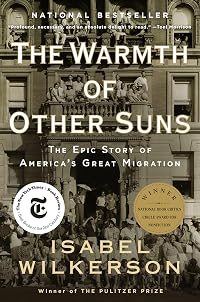
The Warmth of Other Suns: The Epic Story of America's Great Migration
by Isabel Wilkerson
On This Page
Description
In this epic, beautifully written masterwork, Pulitzer Prize-winning author Isabel Wilkerson chronicles one of the great untold stories of American history: the decades-long migration of black citizens who fled the South for northern and western cities, in search of a better life. From 1915 to 1970, this exodus of almost six million people changed the face of America.Tags
Recommendations










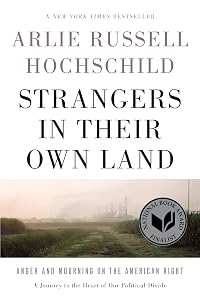
Member Recommendations
rebeccanyc One of the consequences of the great Mississippi flood was the African-American migration to the north and west. Barry discusses this and Wilkerson explores it in greater detail.
Member Reviews
25. The Warmth of Other Suns: The Epic Story of America's Great Migration by Isabel Wilkerson
reader: Robin Miles
published: 2010
format: digital audiobook (22:42)
acquired: from audible, on March 30, because of an essay by Jill Lepore
read: Mar 31 - May 8
rating: 5 stars
I was really carried away by this history of US black migration from south to north. The migration itself is interesting, six million African Americans fleeing the Jim Crow south over a period of 60 years, from WWI through the 1960's. And the elements around and about it are interesting. But what made this book special to me is what how Wilkerson presented it. The book is mainly the history of three individuals she started interviewing in the 1990's, each representing a show more different migration route. The history becomes, or is derived from, oral history and the migration becomes a human story—one of hopes and disappointment.
Her three main subjects were Bob Foster, George Swanson Starling and Ida Mae Brandon Gladney. Bob Foster was a success, eventually. Raised in Monroe, Louisiana, he became a leading doctor in Los Angeles, and Ray Charles' personal physician (and the Doctor Foster in the song Hide nor Hair). He lived a high life, and mostly estranged his family along the way. Wilkerson found George Swanson Starling living alone in a Harlem basement apartment. Unable to finish college because he lacked the funds needed to attend a school that allowed blacks, he later fled his central Florida community, where he had literally been targeted to be lynched after trying to organize orange grove pickers. He spent his life as the rough equivalent of a train conductor. Wilkerson's main apparent hero was Ida Mae Brandon Gladney, who she found in a Chicago inner city slum rife with crime and drug deals and violence. Ida Mae grew up in a share cropper community in rural Mississippi. She and her husband left when a relative was beat with chains for stealing turkeys, except that the missing turkeys had merely wandered off and would return the next day.
Wilkerson builds a picture of the African American world in south in the 1930's, 40's and 50's, and then of the world they transported themselves to. Wilkerson calls them immigrants, even as she says they each balked at that characterization. But the comparison works in several ways. The migrants were largely southern rural naive transplants with limited productive connections, full of false hope and ripe for disappointment. And they left Jim Crow just to land in other heavily racist, and restrictive communities. As Wilkerson puts it, they didn't really benefit from leaving the south, but they did benefit in the act itself as an effort to control their own lives.
But it's the personal stories that I really liked, the biographies, life stories, and the way Wilkerson tells them. She covers the same events several times, not from the perspectives of different people, but from the perspective of different contexts. We hear a story in some detail. Then it comes up again as someone's past, but she summarizes it as if the reader had never encountered the story before. The summaries add a few details, even as they leave most things out. And later she returns to the same story yet again from yet another context. And it works, actually it was a very effect technique as she used it, forcing the reader to rethink what we thought was familiar.
I could write a great deal more about this book. There are numerous really important, fascinating and sometime horrifying details. I found the history fascinating, and the book humanizing, really opening up this world—these worlds—to us in full color. We only really get three stories, but the implications go so much farther.
Not all reviews are fully positive. But I can only recommend this.
2016:
https://www.librarything.com/topic/220674#5581320 show less
reader: Robin Miles
published: 2010
format: digital audiobook (22:42)
acquired: from audible, on March 30, because of an essay by Jill Lepore
read: Mar 31 - May 8
rating: 5 stars
I was really carried away by this history of US black migration from south to north. The migration itself is interesting, six million African Americans fleeing the Jim Crow south over a period of 60 years, from WWI through the 1960's. And the elements around and about it are interesting. But what made this book special to me is what how Wilkerson presented it. The book is mainly the history of three individuals she started interviewing in the 1990's, each representing a show more different migration route. The history becomes, or is derived from, oral history and the migration becomes a human story—one of hopes and disappointment.
Her three main subjects were Bob Foster, George Swanson Starling and Ida Mae Brandon Gladney. Bob Foster was a success, eventually. Raised in Monroe, Louisiana, he became a leading doctor in Los Angeles, and Ray Charles' personal physician (and the Doctor Foster in the song Hide nor Hair). He lived a high life, and mostly estranged his family along the way. Wilkerson found George Swanson Starling living alone in a Harlem basement apartment. Unable to finish college because he lacked the funds needed to attend a school that allowed blacks, he later fled his central Florida community, where he had literally been targeted to be lynched after trying to organize orange grove pickers. He spent his life as the rough equivalent of a train conductor. Wilkerson's main apparent hero was Ida Mae Brandon Gladney, who she found in a Chicago inner city slum rife with crime and drug deals and violence. Ida Mae grew up in a share cropper community in rural Mississippi. She and her husband left when a relative was beat with chains for stealing turkeys, except that the missing turkeys had merely wandered off and would return the next day.
Wilkerson builds a picture of the African American world in south in the 1930's, 40's and 50's, and then of the world they transported themselves to. Wilkerson calls them immigrants, even as she says they each balked at that characterization. But the comparison works in several ways. The migrants were largely southern rural naive transplants with limited productive connections, full of false hope and ripe for disappointment. And they left Jim Crow just to land in other heavily racist, and restrictive communities. As Wilkerson puts it, they didn't really benefit from leaving the south, but they did benefit in the act itself as an effort to control their own lives.
But it's the personal stories that I really liked, the biographies, life stories, and the way Wilkerson tells them. She covers the same events several times, not from the perspectives of different people, but from the perspective of different contexts. We hear a story in some detail. Then it comes up again as someone's past, but she summarizes it as if the reader had never encountered the story before. The summaries add a few details, even as they leave most things out. And later she returns to the same story yet again from yet another context. And it works, actually it was a very effect technique as she used it, forcing the reader to rethink what we thought was familiar.
I could write a great deal more about this book. There are numerous really important, fascinating and sometime horrifying details. I found the history fascinating, and the book humanizing, really opening up this world—these worlds—to us in full color. We only really get three stories, but the implications go so much farther.
Not all reviews are fully positive. But I can only recommend this.
2016:
https://www.librarything.com/topic/220674#5581320 show less
This is a moving and detailed study of the great internal migration of African-Americans from the Deep South from WW I through the '70s. This work is made all the more personal and affecting by biographies of specific and varied participants. This includes the plucky sharecropper’s wife Ida Mae Gladney who left Mississippi after a family member was nearly beaten to death over the disappearance of a white man’s turkeys. She and her family end up in Chicago where she sees things she never imagined including the banality of crime in a declined South Side.
Possibly the most detailed subject here - at least the one that stands out for me - is Robert Joseph Pershing Foster. This 1953 transplant to Los Angeles from Monroe, La. overcame show more prejudice in and out of the military to acquire the famous patient Ray Charles. Charles would record a song about Dr. Foster’s way of running off with Mr. Charles’s women. (Wilkerson misidentified the writer of the song about Foster. While the song, “Hide Nor Hair”, was recorded by Ray Charles, who also commissioned it and suggested its subject matter, it was written by Percy Mayfield.) This ambitious surgeon who sought to escape the caste system of the South performed surgery for the United States Army but was not permitted to do a simple tonsillectomy in his hometown hospital. He eventually rose to high society in Los Angeles and became a friend to Charles, but was tragically drawn in to gambling and other vices. Foster deserves a book of his own! show less
Possibly the most detailed subject here - at least the one that stands out for me - is Robert Joseph Pershing Foster. This 1953 transplant to Los Angeles from Monroe, La. overcame show more prejudice in and out of the military to acquire the famous patient Ray Charles. Charles would record a song about Dr. Foster’s way of running off with Mr. Charles’s women. (Wilkerson misidentified the writer of the song about Foster. While the song, “Hide Nor Hair”, was recorded by Ray Charles, who also commissioned it and suggested its subject matter, it was written by Percy Mayfield.) This ambitious surgeon who sought to escape the caste system of the South performed surgery for the United States Army but was not permitted to do a simple tonsillectomy in his hometown hospital. He eventually rose to high society in Los Angeles and became a friend to Charles, but was tragically drawn in to gambling and other vices. Foster deserves a book of his own! show less
Finally had my second library hold come through so I could finish the last 50 pages, and I'm glad I held out. This is a really remarkable piece of journalism and writing. Aside from the enormous breadth of the story Wilkerson is telling—about the deep injustices of the Jim Crow South, this enormous migration of people north and west, the circumstances they had to adjust to once they got where they were going, and the steady but slow progress of the civil rights movement in the 1960s and 1970s, all playing out together—she humanizes these big histories by telling the detailed stories of three individuals who migrated from the South in different decades. The fact that she pulled off such a multilayered account so well, with a show more pitch-perfect rhythm swinging between micro and macro—and that she communicated the horror of the situations folks were escaping without being melodramatic—impressed the hell out of this writer. It's a balancing act of journalism and it feels seamless. And I learned a lot about a sweeping piece of American history. show less
I certainly got my money's worth with this book. It is hard to say enough about it.
Wilkerson tells the story of the Great Migration, the movement of African-Americans from the South to the West and North, from the beginning of the 20th century on into the 1970s. To illustrate the broader points, she tells the stories of three very different migrants, from different parts of the south, at different times, who left for different reasons. We get to know Ida Mae Brandon Gladney, George Swanson Starling, and Robert Joseph Pershing Foster as intimately as if they were in our own families.
Wilkerson uses their stories to illustrate larger issues and forces, providing the needed statistics to fill in the blanks. Ultimately she asks what provided show more the push to leave in spite of obstacles and how did this massive migration affect the country. Many sociologists and others have drawn conclusions that are incorrect. Through the use of many studies and reports she is able to prove some fundamental facts:
Those who left tended to be better educated than those who stayed. Those who left made better incomes, were employed more, had more long-term marriages. In general they did better not only than those they left behind but than those born in the North and West. I think the key word is perseverance. To make this journey and to stay on it took a lot. But it also took a sense of justice, an understanding that they were more than white Southerners believed, and they sought to prove it.
I became attached to the three for different reasons. Ida Mae held on, accepting of changes and adapting. George gained a different kind of education by being a porter on a train for many years. Robert Foster was forever proving himself, well beyond what anyone else might have needed from him.
More, I came to appreciate that many successful African-Americans were able to develop and use their talents because of the courage of their parents. Without this mass migration would we have advanced as much as we have?
This is a huge book but it is highly readable. So worth the time. An additional pleasure for me was the inclusion of quotations at the start of each chapter, including the quotation from Richard Wright:
I was leaving the South
To fling myself into the unknown.. .
I was taking a part of the South
To transplant in alien soil,
To see if it could grow differently,
If it could drink of new and cool rains,
Bend in strange winds,
Respond to the warmth of other suns
And, perhaps, to bloom. show less
Wilkerson tells the story of the Great Migration, the movement of African-Americans from the South to the West and North, from the beginning of the 20th century on into the 1970s. To illustrate the broader points, she tells the stories of three very different migrants, from different parts of the south, at different times, who left for different reasons. We get to know Ida Mae Brandon Gladney, George Swanson Starling, and Robert Joseph Pershing Foster as intimately as if they were in our own families.
Wilkerson uses their stories to illustrate larger issues and forces, providing the needed statistics to fill in the blanks. Ultimately she asks what provided show more the push to leave in spite of obstacles and how did this massive migration affect the country. Many sociologists and others have drawn conclusions that are incorrect. Through the use of many studies and reports she is able to prove some fundamental facts:
Those who left tended to be better educated than those who stayed. Those who left made better incomes, were employed more, had more long-term marriages. In general they did better not only than those they left behind but than those born in the North and West. I think the key word is perseverance. To make this journey and to stay on it took a lot. But it also took a sense of justice, an understanding that they were more than white Southerners believed, and they sought to prove it.
I became attached to the three for different reasons. Ida Mae held on, accepting of changes and adapting. George gained a different kind of education by being a porter on a train for many years. Robert Foster was forever proving himself, well beyond what anyone else might have needed from him.
More, I came to appreciate that many successful African-Americans were able to develop and use their talents because of the courage of their parents. Without this mass migration would we have advanced as much as we have?
This is a huge book but it is highly readable. So worth the time. An additional pleasure for me was the inclusion of quotations at the start of each chapter, including the quotation from Richard Wright:
I was leaving the South
To fling myself into the unknown.. .
I was taking a part of the South
To transplant in alien soil,
To see if it could grow differently,
If it could drink of new and cool rains,
Bend in strange winds,
Respond to the warmth of other suns
And, perhaps, to bloom. show less
What a fantastic read. I was aware of the Great Migration but Wilkerson brings the stories of three people and lots of other stories and histories to vivid life. Especially in our current time of finally looking at racial justice and injustice, it is a deeply thoughtful and insightful book that made me think of what has happened in this country, not in the distant past, but in my own lifetime.
Covering a time period from World War I into the 1970s, an estimated six million African Americans left their homes to escape racial violence and segregation in the Deep South, traveling to the North and West of the United States in hope of finding better economic opportunities. Despite the efforts of the Southern states to stem the departures and the dangers involved in doing so, the exodus was unstoppable and epic in scope. These migrants tended to settle in northern and midwestern industrial hubs, forever changing the makeup of such cities as Chicago, Detroit, Pittsburgh, and Milwaukee.
To tell such a sweeping story, journalist Isabel Wilkerson spent years researching the migration, collecting over 1,000 oral histories in the process. show more While the book is filled with a wealth of statistical data, what makes it truly unique is how she personalizes the account by focusing on three African American individuals and their families––Ida Mae Brandon, who grew up in rural Mississippi and eventually settled in Chicago during the Great Depression, George Swanson Starling who left Florida for New York City during World War II, and surgeon Robert Joseph Pershing Foster who left Florida in the 1950s for California. In each case, Wilkerson describes the discrimination they faced in the South, the difficulties encountered on their journeys, and the work it took to start over in cities that did not welcome them with open arms.
Published in 2010, this debut book from Wilkerson won her a Pulitzer Prize, and for good reason. It is a captivating read, and an informative one. Over the decades of the Great Migration and the ones following it, there have been many misconceptions regarding it. The Warmth of Other Suns does an excellent job of setting the record straight. Its personalized stories fully capture an event that changed the face of America, not only in the South, but in every corner of this country. show less
To tell such a sweeping story, journalist Isabel Wilkerson spent years researching the migration, collecting over 1,000 oral histories in the process. show more While the book is filled with a wealth of statistical data, what makes it truly unique is how she personalizes the account by focusing on three African American individuals and their families––Ida Mae Brandon, who grew up in rural Mississippi and eventually settled in Chicago during the Great Depression, George Swanson Starling who left Florida for New York City during World War II, and surgeon Robert Joseph Pershing Foster who left Florida in the 1950s for California. In each case, Wilkerson describes the discrimination they faced in the South, the difficulties encountered on their journeys, and the work it took to start over in cities that did not welcome them with open arms.
Published in 2010, this debut book from Wilkerson won her a Pulitzer Prize, and for good reason. It is a captivating read, and an informative one. Over the decades of the Great Migration and the ones following it, there have been many misconceptions regarding it. The Warmth of Other Suns does an excellent job of setting the record straight. Its personalized stories fully capture an event that changed the face of America, not only in the South, but in every corner of this country. show less
The Great Migration was the movement of Black Americans from southern states to the north and west of the country. It occurred over several decades from World War 1 through the 1960s when the Civil Rights movement demanded change to the Jim Crow laws in the south. Isabel Wilkerson documents this history through the stories of three people - Ida Mae Gladney, Robert Pershing Foster, and George Starling - to illuminate the reasons people left and their experiences in their new, chosen homes.
The three people we follow were very deliberately chosen. They each left in a different decade and settled in a different place. Their stories are compelling and help a large movement become personal. Wilkerson doesn't focus on the chronology, but on show more the emotion and individual experiences, interspersed with narrative that zooms out and gives context with census information, laws, or sociological writings about the Great Migration as a whole. The everyday racism encountered by Ida Mae, Robert, and George was appalling, not just in the south - where Robert couldn't practice medicine in a white hospital in the 1950s, and lynching for the smallest infraction was a real possibility - but once they reached their new location. Because in the north, there may not have been separate water fountains, but there were still unwritten expectations of where Black families could live and work.
Through her narrative, Wilkerson challenges the common narratives of the Great Migration, that there was one simple reason people left or that they brought broken families and crime to the north. In fact, as illustrated by Ida Mae, Robert, and George and shown be recently-released census data, the southern Black families were more likely to be two-parent homes, be better educated, and have a job than their northern counterparts. The children of immigrants and their descendents brought arts, music, and sports achievements we may not have seen without that movement. While it's impossible to say if the Great Migration made life better or worse for the families that moved - or stayed - it profoundly affected the country and their lives in ways that we still see today. show less
The three people we follow were very deliberately chosen. They each left in a different decade and settled in a different place. Their stories are compelling and help a large movement become personal. Wilkerson doesn't focus on the chronology, but on show more the emotion and individual experiences, interspersed with narrative that zooms out and gives context with census information, laws, or sociological writings about the Great Migration as a whole. The everyday racism encountered by Ida Mae, Robert, and George was appalling, not just in the south - where Robert couldn't practice medicine in a white hospital in the 1950s, and lynching for the smallest infraction was a real possibility - but once they reached their new location. Because in the north, there may not have been separate water fountains, but there were still unwritten expectations of where Black families could live and work.
Through her narrative, Wilkerson challenges the common narratives of the Great Migration, that there was one simple reason people left or that they brought broken families and crime to the north. In fact, as illustrated by Ida Mae, Robert, and George and shown be recently-released census data, the southern Black families were more likely to be two-parent homes, be better educated, and have a job than their northern counterparts. The children of immigrants and their descendents brought arts, music, and sports achievements we may not have seen without that movement. While it's impossible to say if the Great Migration made life better or worse for the families that moved - or stayed - it profoundly affected the country and their lives in ways that we still see today. show less
Members
- Recently Added By
Published Reviews
ThingScore 95
I give this book two enthusiastic thumbs up: you’ll not only learn a lot about this underappreciated part of recent America history (I see its remnants about me every day in Chicago, since I live on the South Side, perhaps the most famous destination of the Migration), but also become deeply involved in the lives of Ida Mae, George, and Robert. The ending is poignant and bittersweet, and show more will make you both proud of the migrants and sad about their fate. The writing is quite good (Wilkerson won a Pulitzer Prize for journalism—the first black woman to do so—for her work at The New York Times), and the scholarship, though thorough, is worn lightly. (The book was 15 years in the making and Wilkerson interviewed over 1200 people.) If there’s one flaw—and it’s a small one—the writing is occasionally awkward and more than occasionally repetitious, with the same facts repeated in different places. But that’s a trifle that should by no means put you off. show less
added by jimroberts
Wilkerson intersperses historical detail of the broader movement and the sparks that set off the civil rights era; challenging racial restrictions in the North and South; and the changing dynamics of race, class, geography, politics, and economics. A sweeping and stunning look at a watershed event in U.S. history.
added by sduff222
Wilkerson, a Pulitzer Prize-winning journalist, uses the journeys of three of them-a Mississippi sharecropper, a Louisiana doctor, and a Florida laborer--to etch an indelible and compulsively readable portrait of race, class, and politics in 20th-century America. History is rarely distilled so finely.
added by sduff222 — edited by ArrowStead
Lists

Must-Read Books by Black Authors
114 works; 92 members

Really Good Narrative Non-Fiction
65 works; 24 members

Top Five Books of 2013
1,562 works; 721 members

Non-Fiction Worth Reading
1,025 works; 264 members

Top Five Books of 2020
982 works; 350 members

Books recommended by Barack Obama
295 works; 29 members

Recommend the 20 best books you've read in the last five years
2,168 works; 604 members

TED 2013 Summer Reading List
190 works; 13 members

Top Five Books of 2015
811 works; 241 members

Top Five Books of 2014
1,064 works; 398 members

Top Five Books of 2022
736 works; 272 members

Ten books that most shaped your view of history
91 works; 12 members
Top Five Books of 2016
795 works; 228 members

Black Authors
386 works; 28 members

2008-2012 Notable Books for Adults
127 works; 10 members

Governerds Insider
32 works; 1 member

Top Five Books of 2025
954 works; 303 members

.
184 works; 1 member
Books That Changed Our Perspective
423 works; 168 members

Top Five Books of 2024
795 works; 264 members

Best Audiobooks
240 works; 114 members

Books We Discovered On LibraryThing
530 works; 130 members

NYT Readers best of 21st C
100 works; 8 members

NYT 100 best books of 21st C
100 works; 31 members

Maybe This Year? Books to Look Forward To
412 works; 9 members

Club Read's Recommended Nonfiction Written by Women
618 works; 30 members

2023 Update: The Best Twenty Books You've Read in the Past Five Years
40 works; 3 members

Books to Read
95 works; 2 members

Books Read in 2022
5,226 works; 115 members

Five star books
1,767 works; 109 members

The Zora Canon
98 works; 4 members

Zora Canon
100 works; 6 members
Female Author
1,234 works; 65 members

Charleston Syllabus (waitingtoderail)
143 works; 2 members
50 Books by Women Authors
50 works; 10 members

Schomburg Centennial Reading List
100 works; 4 members
Author Information

5+ Works 13,016 Members
Isabel Wilkerson was born in Washington, D.C. She received a bachelor's degree in journalism from Howard University. She won the Pulitzer Prize for her work as Chicago Bureau Chief of The New York Times in 1994, making her the first black woman in the history of American journalism to win a Pulitzer Prize and the first African-American to win for show more individual reporting. She also won the George Polk Award, a John Simon Guggenheim Fellowship, and she was named Journalist of the Year by the National Association of Black Journalists. Her first book, The Warmth of Other Suns: The Epic Story of America's Great Migration, won the 2010 National Book Critics Circle Award for Nonfiction, the 2011 Anisfield-Wolf Award for Nonfiction, the 2011 Hillman Book Prize, the 2011 Heartland Prize for Nonfiction, the Stephen Ambrose Oral History Prize, the Independent Literary Award for Nonfiction, and the NAACP Image Award for best literary debut. She has been a journalism professor at Princeton University and Emory University. She is currently Professor of Journalism and Director of Narrative Nonfiction at Boston University. (Bowker Author Biography) show less
Some Editions
Awards and Honors
Awards
Distinctions
Notable Lists
Common Knowledge
- Canonical title
- The Warmth of Other Suns: The Epic Story of America's Great Migration
- Original publication date
- 2010-09-07
- People/Characters
- Ida Mae Brandon Gladney; George Swanson Starling; Robert Joseph Pershing Foster
- Important places
- Chicago, Illinois, USA; Los Angeles, California, USA; Harlem, New York, New York, USA; Monroe, Louisiana, USA; Eustis, Florida, USA; Chickasaw County, Mississippi, USA
- Important events
- The Great Migration
- Epigraph
- I was leaving the South
To fling myself into the unknown. . . .
I was taking a part of the South
To transplant in alien soil,
To see if it could grow differently.
If it could drink of new and cool rains... (show all),
Bend in strange winds,
Respond to the warmth of other suns
And, perhaps, to bloom.
- Richard Wright - Dedication
- To my mother and
to the memory of my father,
whose migration made me possible,
and to the millions of others like them
who dared to act upon their dreams. - First words
- The night clouds were closing in on the salt licks east of the oxbow lakes along the folds in the earth beyond the Yalobusha River.
- Last words
- (Click to show. Warning: May contain spoilers.)She had learned long ago, when things were so much harder in the Old Country she left behind, that, after all she had been through, every day to her was a blessing and every breath she took a gift.
(Click to show. Warning: May contain spoilers.)(Epilogue) They did not ask to be accepted but declared themselves the Americans that perhaps few others recognized but that they had always been deep within their hearts. - Publisher's editor
- Godoff, Ann; Karp, Jonathan; Medina, Kate
- Blurbers
- Morrison, Toni; Brokaw, Tom; Talese, Gay; Meacham, Jon; Lewis, David Levering; West, Cornel
- Original language
- English
Classifications
- Genres
- History, General Nonfiction, Nonfiction
- DDC/MDS
- 304.80973 — Society, government, & culture Social sciences, sociology & anthropology Factors affecting social behavior Movement of people History, geography, biography
- LCC
- E185.6 .W685 — History of the United States United States Elements in the population Afro-Americans Status and development since emancipation
- BISAC
Statistics
- Members
- 6,710
- Popularity
- 1,798
- Reviews
- 208
- Rating
- (4.47)
- Languages
- 5 — Chinese, English, French, German, Italian
- Media
- Paper, Audiobook, Ebook
- ISBNs
- 27
- ASINs
- 25