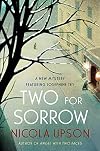
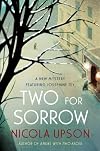
On This Page
Description
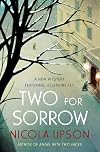
"A new and assured talent….Nicola Upson is to be congratulated." -P.D. James Author Nicola Upson brings legendary mystery writer Josephine Tey back for a third investigation in Two for Sorrow, the spellbinding follow-up to An Expert in Murder and Angel with Two Faces. Fans of P.D. James, Agatha Christie, and Jacqueline Winspear will relish this ingenious literary creation, as one of the most beloved mystery writers of the twentieth century, while doing research for a new novel based on a show more horrific case of multiple child murder in 1903 London, is drawn into a chillingly related hunt for a sadistic, present-day killer. show lessTags
Recommendations



Member Reviews
I was drawn to this book because I think that Josephine Tey was an extremely talented writer. What I liked about all of her books is that they were all different, but all good, and didn't remind me of anything else.
I realized that this book is the third in the series, other than a few minor references, not having read the previous two installments did not ruin my reading pleasure in any way.
The story takes the real life 1903 hanging of Amelia Sach and Annie Walters, who were sentenced to death for a series of newborn murders, while the birth mothers believed that their children were being given good homes and taken care of.
Josephine Tey's part of the story takes place in 1936, while she is researching the facts of this case for a book show more that she is writing. She then finds herself thrust in the middle of two other murders, which may or may not be related to baby murder case.
The story fell a little flat for me in that Josephine doesn't actually have anything to do with solving the current murders, but spends a lot of time with Inspector Archie Penrose who is in charge of the case and has feelings for Josephine, who is conflicted about embarking on a lesbian relationship. I never felt as though I had enough background about the baby killer case, and not having read the other two books, I wasn't sure of the history between Archie and Josephine. I will at some point, read the previous installments to satifsy my curiosity. show less
I realized that this book is the third in the series, other than a few minor references, not having read the previous two installments did not ruin my reading pleasure in any way.
The story takes the real life 1903 hanging of Amelia Sach and Annie Walters, who were sentenced to death for a series of newborn murders, while the birth mothers believed that their children were being given good homes and taken care of.
Josephine Tey's part of the story takes place in 1936, while she is researching the facts of this case for a book show more that she is writing. She then finds herself thrust in the middle of two other murders, which may or may not be related to baby murder case.
The story fell a little flat for me in that Josephine doesn't actually have anything to do with solving the current murders, but spends a lot of time with Inspector Archie Penrose who is in charge of the case and has feelings for Josephine, who is conflicted about embarking on a lesbian relationship. I never felt as though I had enough background about the baby killer case, and not having read the other two books, I wasn't sure of the history between Archie and Josephine. I will at some point, read the previous installments to satifsy my curiosity. show less
 This review was written for LibraryThing Early Reviewers.
I am loathe to start a series in the middle but I just couldn't swing the first two books by the time I needed to get to this one. Fortunately, I absolutely enjoyed this book despite my ignorance of the series and the characters!
The novel fictionalizes the life of mystery novelist Josephine Tey (Tey is a pen name, but the character goes by Josephine in this series) and the novel alternates, roughly, chapters of Tey's draft account of a thirty year old crime and her present day. Upson beautifully differentiates between Tey's writing -- which is straight-forward, moving, simple -- and the narration, creating a yummy sense of story-within-a-story. There's a kind of heft to Upson's style of writing: it isn't ornate but it is decorated. show more Sentences are long and descriptive, heavy with baubles, and it lends a lovely kind of fussiness to the narrative that makes the story seem almost like a character itself. There were passages so fun to read I actually felt bouncy, if that makes sense, exuberant at reading them.
There's quite a cast of characters and a web of smaller mysteries that immediately hooked me (although I was lost from time to time as the characters referenced events from previous books) and I raced through this book. The mystery is grim but not gruesome, and Tey's character as a writer (rather than a detective or police officer) allowed for some sympathetic musings about the motivations of the women involved. Class differences, the shifting political landscape of the UK in the mid-1930s, and the lingering scars of WWI color the action and characters as well, and I appreciated that -- this felt more than a pat mystery series set in the '30s.
I'm going back and reading the first two books for sure, so I can be caught up in time for the fourth Tey novel (should I be so lucky). Highly recommended -- start with An Expert in Murder and work your way to this one! show less
The novel fictionalizes the life of mystery novelist Josephine Tey (Tey is a pen name, but the character goes by Josephine in this series) and the novel alternates, roughly, chapters of Tey's draft account of a thirty year old crime and her present day. Upson beautifully differentiates between Tey's writing -- which is straight-forward, moving, simple -- and the narration, creating a yummy sense of story-within-a-story. There's a kind of heft to Upson's style of writing: it isn't ornate but it is decorated. show more Sentences are long and descriptive, heavy with baubles, and it lends a lovely kind of fussiness to the narrative that makes the story seem almost like a character itself. There were passages so fun to read I actually felt bouncy, if that makes sense, exuberant at reading them.
There's quite a cast of characters and a web of smaller mysteries that immediately hooked me (although I was lost from time to time as the characters referenced events from previous books) and I raced through this book. The mystery is grim but not gruesome, and Tey's character as a writer (rather than a detective or police officer) allowed for some sympathetic musings about the motivations of the women involved. Class differences, the shifting political landscape of the UK in the mid-1930s, and the lingering scars of WWI color the action and characters as well, and I appreciated that -- this felt more than a pat mystery series set in the '30s.
I'm going back and reading the first two books for sure, so I can be caught up in time for the fourth Tey novel (should I be so lucky). Highly recommended -- start with An Expert in Murder and work your way to this one! show less
I am suprised at some of the other reviews that I have read about this book. I did not find the plot difficult to follow despite the premise-that of a draft of a book being written. I found the mystery full of information about "baby farming", a subject I had little knowledge of prior to reading this book. I felt the facts were enough to educate me, but not too much as to confuse me. The characters were in turn, frightening and yet demanded my sympathy, in ways. The women involved in the crime were not monsters, yet acted monstrously. I would recommend this book, but advise those who might be squeamish about the subject matter.
Two for Sorrow by Nicola Upson is a mystery set in London in the 1930s featuring Josephine Tey who's there to write a book about the 1903 crimes of two women who murdered unwanted babies instead of putting them up for adoption. She ends up entangled in a mystery involving the very people that had a part in the drama of those crimes. London in the 1930s is very deftly brought to life in Upson's writing and all the characters of the book are fleshed out beautifully. The interesting technique of switching from character to character and getting their thoughts and feelings in the moment but leaving out just enough to keep the reader guessing is also quite interesting. I enjoyed this book very much and will on the lookout for the next in the show more series. show less
This review was written for LibraryThing Early Reviewers.This is the most recent of a series of books featuring the mystery writier, Josephine Tey, as a protagonist. Nocola Upson tries to weave elements of what we know about Tey's life, her books, and her life in the theater into new plot lines. The other one I read, "An Expert in Murder" was an OK read so I thought I would try another. This particular one involves a real-life situation where two women were hanged for what the English called "baby farming" - taking newborns, making the mothers believe they are being adopted and then killing them and keeping whatever monies have been paid to them. Upson takes the bones of this true story and has Tey reseaching it for a book, adds a "Miss Pym Disposes" incident and several cases of what I will show more call "mistaken" or "false" identity and makes a messy stew. I guessed the killer about half way through, but not her true identity. That was sprung on the reader out of the blue, at least it seemed so to me.
There is also a messy personal subplot romantic quadrangle with four of the characters: Marta, Lydia, Tey and Archie Penrose. It matters not to me if, in real life, Tey was lesbian or bi-sexual, but this, like the main storyline, is messy and contrived. The one I feel sorry for is Archie who knows the fictional Tey's sexual confusion and need for privacy and solitude and is so very patient.
I almost stopped reading three or four times, but got caught up is trying to see if I were correct about the killer's identity and wondering what plot twist Upson would thow at us next but I don't think I will read any more books in this series. show less
There is also a messy personal subplot romantic quadrangle with four of the characters: Marta, Lydia, Tey and Archie Penrose. It matters not to me if, in real life, Tey was lesbian or bi-sexual, but this, like the main storyline, is messy and contrived. The one I feel sorry for is Archie who knows the fictional Tey's sexual confusion and need for privacy and solitude and is so very patient.
I almost stopped reading three or four times, but got caught up is trying to see if I were correct about the killer's identity and wondering what plot twist Upson would thow at us next but I don't think I will read any more books in this series. show less
"Two For Sorrow" is the third in Nicola Upson's Josephine Tey Crime Series, but the first I've read. I've read and enjoyed all of Miss Tey's own mystery novels, but have mixed feelings about her being used as a character in Miss Upson's series. Basically, I don't see the point, other than drawing readers because of name recognition, because the real detective in this book was Inspector Archie Penrose of Scotland Yard. I liked him, as well as his sergeant, a lot, and was frankly distracted when the story would leave them to return to the character of Josephine Tey, who seemed to spend most of her time in this novel trying to sort out her love life - which I didn't find all that interesting.
I also felt there might have been too much of show more an assumption on Miss Upson's part as to how familiar readers would be with characters who apparently were introduced in her first two books. If nothing else, this third book is a major spoiler, which (as lukewarm as I feel about this book) makes me even more hesitant to spend time reading the first two.
On the other hand, I would gladly read another Inspector Penrose mystery. Maybe Josephine could retire to Inverness to continue writing her own books and let Archie handle the next case on his own. show less
I also felt there might have been too much of show more an assumption on Miss Upson's part as to how familiar readers would be with characters who apparently were introduced in her first two books. If nothing else, this third book is a major spoiler, which (as lukewarm as I feel about this book) makes me even more hesitant to spend time reading the first two.
On the other hand, I would gladly read another Inspector Penrose mystery. Maybe Josephine could retire to Inverness to continue writing her own books and let Archie handle the next case on his own. show less
This review was written for LibraryThing Early Reviewers.In London for a charity gala at her social club, author Josephine Tey uses the opportunity to conduct research for her current book, a novel about the events surrounding a real crime and the execution of the two women convicted for it. Several women associated with the Cowdray Club have first-hand knowledge of the 30-year-old events. The murder of a young woman during the preparations for the charity gala could be connected to the long-ago events. Josephine's research is useful to her good friend, Inspector Archie Penrose, who is brought in to investigate the murder.
I had already read the first two books in the series and, while I didn't like them as well as any of Tey's mysteries, I thought the series had great potential. This book show more fell short of my expectations. While Josephine freely shares important background information with Archie, she is not involved in the solution of the present day crime. Archie is unwilling to share details of the investigation with her because he doesn't want his suspicions to affect her behavior toward the suspects. Josephine shows little interest in the investigation, anyway. She is more absorbed in her own concerns.
Archie identifies the murderer with no basis other than a gut feeling. There is no physical evidence pointing to a guilty party, and Archie's suspect seemingly has an alibi. Upson tries to distract readers from the inherent problems in this situation by revealing the murderer's identity to the reader immediately before Archie leaps to his conclusion.
In the first two novels in the series, there seemed to be a mutual attraction between Josephine and Archie. The ghost of Josephine's first love – Archie's best friend – stood between them. In this novel Upson brings back a character from the first book and has Josephine contemplating a lesbian affair. The relationship seems out of place in this book. There is no connection with either the historic or present day crime, and these passages don't advance the plot in any way that I can see. This part of the book includes spoilers for the first book in the series.
In at least three instances, Josephine is rebuked by people associated with the historic crime for presuming to base a novel on real people whose lives and motives she didn't understand and who would therefore be misrepresented in her novel. Since the real Josephine Tey did not publish such a novel, the implication is that the fictional Josephine took this criticism to heart and did not publish the book. I found this ironic, as Upson has done the same thing with Tey's life. I wish she had made the same choice as the fictional Josephine.
This review is based on an advance reading copy provided by the publisher through LibraryThing's Early Reviewers program. show less
I had already read the first two books in the series and, while I didn't like them as well as any of Tey's mysteries, I thought the series had great potential. This book show more fell short of my expectations. While Josephine freely shares important background information with Archie, she is not involved in the solution of the present day crime. Archie is unwilling to share details of the investigation with her because he doesn't want his suspicions to affect her behavior toward the suspects. Josephine shows little interest in the investigation, anyway. She is more absorbed in her own concerns.
Archie identifies the murderer with no basis other than a gut feeling. There is no physical evidence pointing to a guilty party, and Archie's suspect seemingly has an alibi. Upson tries to distract readers from the inherent problems in this situation by revealing the murderer's identity to the reader immediately before Archie leaps to his conclusion.
In the first two novels in the series, there seemed to be a mutual attraction between Josephine and Archie. The ghost of Josephine's first love – Archie's best friend – stood between them. In this novel Upson brings back a character from the first book and has Josephine contemplating a lesbian affair. The relationship seems out of place in this book. There is no connection with either the historic or present day crime, and these passages don't advance the plot in any way that I can see. This part of the book includes spoilers for the first book in the series.
In at least three instances, Josephine is rebuked by people associated with the historic crime for presuming to base a novel on real people whose lives and motives she didn't understand and who would therefore be misrepresented in her novel. Since the real Josephine Tey did not publish such a novel, the implication is that the fictional Josephine took this criticism to heart and did not publish the book. I found this ironic, as Upson has done the same thing with Tey's life. I wish she had made the same choice as the fictional Josephine.
This review is based on an advance reading copy provided by the publisher through LibraryThing's Early Reviewers program. show less
This review was written for LibraryThing Early Reviewers.Members
- Recently Added By
Lists

Majkia's Mystery/ Thriller TBR
86 works; 3 members

Books Read in 2011
684 works; 20 members

Books Read in 2015
3,299 works; 129 members
Author Information

17+ Works 3,028 Members
Some Editions
Awards and Honors
Distinctions
Series

Common Knowledge
- Canonical title
- Two for Sorrow
- Original publication date
- 2010; 2011
- People/Characters
- Josephine Tey; Amelia Sach; Annie Walters; Celia Bannerman; Archie Penrose
- Important places
- London, England, UK
- Dedication
- For Mandy. Two for joy.
- First words
- (untitled)
by Josephine Tey
First Draft
Holloway Gaol, Tuesday 3 February 1903 - Last words
- (Click to show. Warning: May contain spoilers.)As she opened the door to the gymnasium and walked quietly across the floor, she hoped that Gerry would forgive her.
Classifications
Statistics
- Members
- 338
- Popularity
- 94,318
- Reviews
- 29
- Rating
- (3.52)
- Languages
- English, French
- Media
- Paper, Audiobook, Ebook
- ISBNs
- 16
- ASINs
- 7