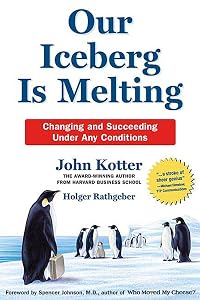
Our Iceberg Is Melting: Changing and Succeeding Under Any Conditions
by John Kotter, Holger Rathgeber
On This Page
Description
The revised and updated tenth anniversary edition of the classic, beloved business fable that has changed millions of lives in organizations around the world.Our Iceberg Is Melting is a simple story about doing well under the stress and uncertainty of rapid change. Based on the award-winning work of Harvard Business School’s John Kotter, it can help you and your colleagues thrive during tough times.
On an iceberg near the coast of Antarctica, group of beautiful emperor penguins show more live as they have for many years. Then one curious bird discovers a potentially devastating problem threatening their home—and almost no one listens to him.
The characters in the story—Fred, Alice, Louis, Buddy, the Professor, and NoNo—are like people you probably recognize in your own organization, including yourself. Their tale is one of resistance to change and heroic action, seemingly intractable obstacles and clever tactics for dealing with those obstacles. The penguins offer an inspiring model as we all struggle to adapt to new circumstances.
Our Iceberg Is Melting is based on John Kotter's pioneering research into the eight steps that can produce needed change in any sort of group. After finishing the story, you'll have a powerful framework for influencing your own team, no matter how big or small.
This tenth anniversary edition preserves the text of the timeless story, together with new illustrations, a revised afterword, and a Q&A with the authors about the responses they've gotten over the past decade. Prepare to be both enlightened and delighted, whether you're already a fan of this classic fable or are discovering it for the first time.
. show less
Tags
Recommendations


Member Reviews
I know that I should like this book and give it a good review but I didn't and I can't.
I think I would have preferred Kotter's original book about change management without all the animal nonsense that is in this.
This is the kind of book a manager goes out and buys for all their staff and says "Read this! It won't take you long. You'll have it finished by this afternoon/tonight!" And they'd be correct. It doesn't take long to read at all. So for goodness sake read it and have a discussion with me if you will.
I just object to the use of "dumbing-down" or sugar-coating management speak. The analogy for me is lame (OMG I'm using teenager type words - it must have really touched a sensitive nerve in me!)
What we're talking about here is show more change-management. In this "picture book for grown ups" we're presented with a fable about a group of penguins who are sitting on a melting iceberg. Where can they go? Will they listen to the wise lone penguin voice in the wilderness who says they have to go, when it would be so much more comfortable to stay (and all drown and witness their kids dying?????)
Let's forget about the fact that penguins can swim. Let's forget about the fact that penguins can't talk. Just humour me for a second. If you are willing to suspend disbelief and go along with penguins being as silly as humans, then you would understand why I have a fundamental problem with this tale. It just doesn't ring true. Maybe I am too cynical. Maybe I am reading this too literally. I don't think so. I don't think I am like the very subtly (deep cynicism here folks) named "NoNo" character in the book.
I just hate being spoken to as if I am a 3rd-grader. In this book we are to believe that all the penguins, if they cooperate and pull-together will re-locate to a better iceberg - every five years.
Oh puhleeeeeezzzzz. Anyone who has been through change knows that not all the penguins get to go......and it's never another better iceberg. Animal Farm would be a better read at this point I think....a better iceberg for some.
I'm not saying I object to change. I just wish someone would call it like it is for once. Be honest. Tell it like it is. Acknowledge that there will be collateral damage for the sake of the survival of the fittest and all that.
What do you think? Am I a "NoNo". Should I read Kotter's other book? show less
I think I would have preferred Kotter's original book about change management without all the animal nonsense that is in this.
This is the kind of book a manager goes out and buys for all their staff and says "Read this! It won't take you long. You'll have it finished by this afternoon/tonight!" And they'd be correct. It doesn't take long to read at all. So for goodness sake read it and have a discussion with me if you will.
I just object to the use of "dumbing-down" or sugar-coating management speak. The analogy for me is lame (OMG I'm using teenager type words - it must have really touched a sensitive nerve in me!)
What we're talking about here is show more change-management. In this "picture book for grown ups" we're presented with a fable about a group of penguins who are sitting on a melting iceberg. Where can they go? Will they listen to the wise lone penguin voice in the wilderness who says they have to go, when it would be so much more comfortable to stay (and all drown and witness their kids dying?????)
Let's forget about the fact that penguins can swim. Let's forget about the fact that penguins can't talk. Just humour me for a second. If you are willing to suspend disbelief and go along with penguins being as silly as humans, then you would understand why I have a fundamental problem with this tale. It just doesn't ring true. Maybe I am too cynical. Maybe I am reading this too literally. I don't think so. I don't think I am like the very subtly (deep cynicism here folks) named "NoNo" character in the book.
I just hate being spoken to as if I am a 3rd-grader. In this book we are to believe that all the penguins, if they cooperate and pull-together will re-locate to a better iceberg - every five years.
Oh puhleeeeeezzzzz. Anyone who has been through change knows that not all the penguins get to go......and it's never another better iceberg. Animal Farm would be a better read at this point I think....a better iceberg for some.
I'm not saying I object to change. I just wish someone would call it like it is for once. Be honest. Tell it like it is. Acknowledge that there will be collateral damage for the sake of the survival of the fittest and all that.
What do you think? Am I a "NoNo". Should I read Kotter's other book? show less
This book was recommended and later mandatory to read in our class "Management Strategy" which sounds a little bit posh, but I guess the teacher is all that matters, and it was a hell of a teacher!
This one is the one where at any age you can read it. Well...like from age 9 or smth tho. It is a fable but when you stop for a moment for thinking there is always more depth to it, and if you will make notes from this book, it is really easy to remember in your daily life through relatable and memorable people (read penguins). Yes, it is a book about penguins and it...just...awesome and crazy and the author knows it, which makes it even more fun to read.
I would categorize this book into lists if you need refreshments about managing tasks show more when you are working in a team or a group environment with people, doesn't matter if you leading or not. i say if you need refreshment because I will probably read it once more. show less
This one is the one where at any age you can read it. Well...like from age 9 or smth tho. It is a fable but when you stop for a moment for thinking there is always more depth to it, and if you will make notes from this book, it is really easy to remember in your daily life through relatable and memorable people (read penguins). Yes, it is a book about penguins and it...just...awesome and crazy and the author knows it, which makes it even more fun to read.
I would categorize this book into lists if you need refreshments about managing tasks show more when you are working in a team or a group environment with people, doesn't matter if you leading or not. i say if you need refreshment because I will probably read it once more. show less
I have two clients in a shifting online space who've both bought this book for their entire teams. It's a fanciful parable about a colony of penguins living in happy denial on an iceberg. When a member of the colony discovers the berg is -- you guessed it -- melting, it becomes a discussion of organizational and individual response to change. Having listened to Harvard Business School professor John Kotter lecture (via acetate sheets on an overhead projector, no less!), it was a little jarring to see his message dressed up as a children's book. But it is effective nonetheless. What I haven't heard yet is how much momentum the book has created for effective change management in the organizations that embrace it. But who doesn't like show more penguins? show less
I'm not sure what to say about this book. We were given copies of this book by our management team at work in connection with a pending divisional restructure. I think the book was intended to help us adapt to change but I don't really see a parallel between the fabricated and factually flawed fable of penguins on a melting iceberg and what we are facing at work.
The author actually did a good job of covering known facts about Emperor Penguins (e.g. their diving depth, lung capacity, and reliance on numbers for warmth) but he neglected one crucial fact that destroys the premise of his fable. Emperor Penguins are already nomadic; migrating up to 280 km each year to breed. (As found on this website of penguin facts: show more target="_top">http://bit.ly/HE7qQq)
Kotter should have also consulted the facts about icebergs. The average life cycle of an iceberg is 3 to 6 years. Given that this species of penguin reaches breeding age at around four years of age, mature penguins wouldn't really have the concept of a long-term or permanent home on such a temporary structure. (As found on the HowStuffWorks website: http://bit.ly/Hy6Cfb)
That being said, we can proceed as if the tenants of the story are factually based and there is a population of Emperor Penguins who have always lived on the same iceberg and never migrate. Now that iceberg is "melting" (actually, the threat of breaking apart at fault lines would pose the more imminent threat) and the penguins need to agree first on what is happening and then on a course of action.
I certainly didn't like the penguin named NoNo (the naysayer) but I also didn't like one of the apparent heroes (or in this case heroine). Alice was portrayed as the aggressive, go-getter on the council who made things happen. By the end of the story, it becomes clear that without Alice the "new vision" would never have been realized. However, she is impatient and rude; habitually cutting off the professor and not willing to hear his lengthy explanations or theories. She was a fear-monger who sold the concepts of imminent danger and immediate threat to scare people into action. Alice also mounted a propaganda campaign and quickly moved to shut down dissension in the ranks.
I also find it interesting that the author did a "bait and switch" in the story. From the outset, we had a group of complacent penguins who have to deal with the danger of a melting, cracking iceberg (which by the way, was never demonstrated or validated in the story). By the end of the story, the penguins found a safe and suitable replacement habitat but were constantly looking for a better one each year; having developed a group who thrives on constant change.
As a side note, I did not appreciate the misuse of the word "skeptical" in this story. Skeptics were portrayed as doubter and naysayers but that is not an accurate use of the word. When a person is skeptical, they follow wherever the evidence leads. As quoted on the etymology dictionary website, "Skeptic does not mean him who doubts, but him who investigates or researches as opposed to him who asserts and thinks that he has found." [Miguel de Unamuno, 'Essays and Soliloquies,' 1924]. (As found online at http://bit.ly/Hy7PEz) A more appropriate word in this story would have been either "dogmatist" or "denier".
In the end, I don't think this story is an accurate reflection of what we are facing at work and I would have appreciated more serious and more scholarly books on the subject. The best thing about Kotter's book was that it was short and easy to read but that was also its downfall. This is the kind of book that you might give to people who are uneducated, ignorant, and not very literate.
I have no doubt that there are books that better deal with the issues of globalization, outsourcing, and restructuring. I will try to find and read some of those and would also welcome any recommendations. I would prefer material that is not dumbed down to the masses and ideally, that would be backed with reliable research and data. show less
What a wonderful illustration of the power of story-telling. The authors use a parable about a colony of penguins who discover that their home is melting to illustrate how to lead and manage change within an organization. Easy to read, and written in a way that the messages are bound to stay with you. As a bonus, it is beautifully illustrated.
A fun and interesting fable using the story of a colony of Emperor Penguins as a metaphor for how an organization can go about making a needed change.
I enjoy business books in general, but among my favorites are the "story"-based books, such "The One-Minute Manager", "Who Moved My Cheese", "Inside the Magic Kingdom", "The Go-Giver", "It's Not About You", and others. These books take complex and sometimes fear-inducing subjects (like change) and present them in friendly ways to help readers understand how they can deal with them in their business and personal lives.
The focus of this book is leading change, and is based on John Kotter's "8 Steps to Leading Change" originally outlined in his book "Leading Change". The use of the penguin show more fable allows the authors to present these steps in the context of a story that illustrates how the steps work together in enabling the penguins to make a significant change in their lives.
I recommend this book to anyone involved in leading any sort of change, whether it be in your business, a local organization, your church, or even your personal life. show less
I enjoy business books in general, but among my favorites are the "story"-based books, such "The One-Minute Manager", "Who Moved My Cheese", "Inside the Magic Kingdom", "The Go-Giver", "It's Not About You", and others. These books take complex and sometimes fear-inducing subjects (like change) and present them in friendly ways to help readers understand how they can deal with them in their business and personal lives.
The focus of this book is leading change, and is based on John Kotter's "8 Steps to Leading Change" originally outlined in his book "Leading Change". The use of the penguin show more fable allows the authors to present these steps in the context of a story that illustrates how the steps work together in enabling the penguins to make a significant change in their lives.
I recommend this book to anyone involved in leading any sort of change, whether it be in your business, a local organization, your church, or even your personal life. show less
A well written book on change. The plot is interesting and of course the way it is written from the eyes and words of penguins (fictionally) is amazing.
Members
- Recently Added By
Published Reviews
ThingScore 75
As I have had a little bit of downtime in my first couple weeks here at Pearson I have used my time to abide by Pearson’s motto, always learning, and I have successfully completed my first book. The book I choose to read was a short fable called “Our Iceberg is Melting, changing and succeeding under any conditions” by John Kotter. The book told the story of a penguin named Fred who show more noticed that the iceberg his penguin colony was living on had some serious melting problems. Fred was not part of the highest penguin counsel and by some, was not taken seriously in his finding.
The book goes on about the leadership and change strategies that were used by Fred, Alice, and Louis to successfully change the traditions of the colony and move everyone to safety.
The steps were based off of the 8 steps that are laid out in Kotter’s more famous book, “Leading Change”. The Head Penguin of the colony Louis executed this 8 step plan by listening to Fred’s findings then creating a sense of urgency in the colony to deal with the problem at hand. He then worked to form a carefully selected group in charge of working through the change, even if that meant not including long standing members of the penguin counsel and including members who were less well known but had complimentary skill sets. Louis then sat down with his committee to create a vision of what was to be done, and clearly communicated that vision to the entire colony, in ways that even the dumbest penguin would understand and accept. The committee then sat down to work, the goal was to remove any complexities in the plan so that it was practical. When the original buzz started to wear off and some penguins were not excited about the vision anymore they created an event to show that the plan would have a quick success and never let up once the buzz was back. Finally, they ensured that the changes would not be overcome by stubborn, long standing traditions, held within the colony.
This process worked with the penguins and fortunately translates across species. Human behavior was exemplified by the situations in the book and the process proved to work against most, if not all, adversity that the counsel faced. It is always good to keep in mind as well that every member of a team has their own strengths; it’s like the quote, “Everyone’s a genius, but if you judge a fish on its ability to climb a tree it will live its whole life thinking that it’s stupid.” –Albert Einstein. Identifying, but more importantly utilizing everyone’s strengths can lead to great things.
As far as a recommendation for the book I would say it is a MUST READ. The lesson is easy to understand, but powerful in nature. It is a quick read it took less than two hours to get through 132 pages. But most importantly it will bring you to evaluate your position and ask yourself the right questions, such as “If my iceberg melting?”
-Matt Anderson show less
The book goes on about the leadership and change strategies that were used by Fred, Alice, and Louis to successfully change the traditions of the colony and move everyone to safety.
The steps were based off of the 8 steps that are laid out in Kotter’s more famous book, “Leading Change”. The Head Penguin of the colony Louis executed this 8 step plan by listening to Fred’s findings then creating a sense of urgency in the colony to deal with the problem at hand. He then worked to form a carefully selected group in charge of working through the change, even if that meant not including long standing members of the penguin counsel and including members who were less well known but had complimentary skill sets. Louis then sat down with his committee to create a vision of what was to be done, and clearly communicated that vision to the entire colony, in ways that even the dumbest penguin would understand and accept. The committee then sat down to work, the goal was to remove any complexities in the plan so that it was practical. When the original buzz started to wear off and some penguins were not excited about the vision anymore they created an event to show that the plan would have a quick success and never let up once the buzz was back. Finally, they ensured that the changes would not be overcome by stubborn, long standing traditions, held within the colony.
This process worked with the penguins and fortunately translates across species. Human behavior was exemplified by the situations in the book and the process proved to work against most, if not all, adversity that the counsel faced. It is always good to keep in mind as well that every member of a team has their own strengths; it’s like the quote, “Everyone’s a genius, but if you judge a fish on its ability to climb a tree it will live its whole life thinking that it’s stupid.” –Albert Einstein. Identifying, but more importantly utilizing everyone’s strengths can lead to great things.
As far as a recommendation for the book I would say it is a MUST READ. The lesson is easy to understand, but powerful in nature. It is a quick read it took less than two hours to get through 132 pages. But most importantly it will bring you to evaluate your position and ask yourself the right questions, such as “If my iceberg melting?”
-Matt Anderson show less
added by pem-org-quality
Lists

Applied Systems Agile Library
18 works; 2 members
Author Information

59+ Works 6,647 Members
John P. Kotter is a graduate of the Massachusetts Institute of Technology and Harvard University. He is the Konosuke Matashusita Professor of Leadership at the Harvard Business School and was one of the youngest people in Harvard history to receive full professorship. Kotter's works include Power and Influence: Beyond Formal Authority, The show more Leadership Factor and Corporate Culture and Performance. (Bowker Author Biography) show less
1 Work 1,537 Members
Some Editions
Common Knowledge
- Canonical title*
- Das Pinguin-Prinzip
- Original title
- Our iceberg is melting
- Original publication date
- 2006
- First words*
- Es war einmal eine Pinguinkolonie, die in der klirrend kalten Antarktis auf einem Eisberg lebte - nicht weit von dem Ort, den wir heute als Cape Washington kennen.
Veränderungen erfolgreich bewältigen: Fabeln können lustig sein, doch wie bei unserer Pinguingeschichte besteht ihr tiefergehende Wirkung darin, dem Leser zu klügerem Handeln zu verhelfen.
Das Anliegen dieses Buches: Im Jahre 1996 schrieb John Kotter Leading Change, das von Executive General zum Managementbuch des Jahres gekürt und in den folgenden zehn Jahren der führende Bestseller zum Thema "Veränderungen... (show all)" innerhalb von Unternehmen wurde. - Last words*
- (Click to show. Warning: May contain spoilers.)Und dafür liebte er sie umso mehr.
(Click to show. Warning: May contain spoilers.)Veränderungen erfolgreich bewältigen: Menschen können (bisweilen) sogar noch klüger sein als Pinguine.
(Click to show. Warning: May contain spoilers.)Das Anliegen dieses Buches: Das ist keine schlechte Zusammenfassung unseres Anliegens.
*Some information comes from Common Knowledge in other languages. Click "Edit" for more information.
Classifications
Statistics
- Members
- 1,533
- Popularity
- 14,997
- Reviews
- 26
- Rating
- (3.42)
- Languages
- 12 — Danish, Dutch, English, Finnish, French, German, Indonesian, Italian, Polish, Romanian, Spanish, Portuguese (Portugal)
- Media
- Paper, Audiobook, Ebook
- ISBNs
- 43
- UPCs
- 2
- ASINs
- 18
