
Jon R. Katzenbach
Author of The Wisdom of Teams: Creating the High-Performance Organization
About the Author
Jon R. Katzenbach is a founder of Katzenbach Partners, consultants in the areas of team, leadership, and workforce performance.
Image credit: Amazon
Works by Jon R. Katzenbach
Real Change Leaders: How You Can Create Growth and High Performance at Your Company (1995) 85 copies
The Discipline of Teams: A Mindbook-Workbook for Delivering Small Group Performance (2001) 66 copies
Leading Outside the Lines: How to Mobilize the Informal Organization, Energize Your Team, and Get Better Results (2010) 38 copies, 2 reviews
Why Pride Matters More Than Money: The Power of the World's Greatest Motivational Force (2003) 29 copies, 1 review
Teams an der Spitze 1 copy
Associated Works
HBR's 10 Must Reads on Managing People (with featured article "Leadership That Gets Results," by Daniel Goleman) (2011) — Contributor — 323 copies, 1 review
Harvard Business Review on Customer Relationship Management (2002) — Contributor, some editions — 31 copies, 1 review
Tagged
Common Knowledge
- Birthdate
- 1932-08-26
- Gender
- male
- Nationality
- USA
- Associated Place (for map)
- USA
Members
Reviews
Leading Outside the Lines: How to Mobilize the Informal Organization, Energize Your Team, and Get Better Results by Jon R. Katzenbach
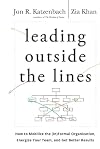
Katzenbach was McKinsey's point man on teamwork. His bestselling Wisdom of Teams is not bad and Jossey-Bass has a fine record of publishing good management books. This book, however, is a stinker of epic proportions.
The title "Leading Outside the Lines" touches on an increasingly important concept: Leading people who are not under your control or command. In a knowledge society, more and more value is created in loose networks of experts. How to influence those structures and provide show more informal leadership is certainly an interesting question.
Katzenbach provides few answers as he consequently misapplies the term. He uses informal leadership only in the sense of not using systems - which basically contradicts his title. All his examples are managers who manage their employees not according to written rules but informally, e.g. he presents the case of a NY school principal who fires some of her administrators, reassigns budgets and tasks. This is precisely and only leadership within the lines.
The author goes beyond the misapplication of his topic. He actively celebrates bad management. The Bush administration was especially fond of the "rules be damned, I shoot from the hip" school of management. No wonder Katzenbach fills his book with plenty of those cases (which he presents without reflection). He celebrates the management style of an assistant US ambassador to the United Nations who gloats about his job: "A hundred ninety-one nations against one. I like our odds!" This is both terrible math and horrible informal leadership. Prior to the UN, this gentleman deployed his skillz at - FEMA, another of those Bush success stories. Given the obvious abysmal results of these management practices, I really wonder why Katzenbach included and celebrated such obviously lousy management. He is also disingenious, e.g. he contrasts the ethics of Enron and McKinsey, without mentioning that many of Enron's leaders including its CEO (the youngest ever partner at McKinsey) came from McKinsey and that McKinsey provided the intellectual blueprint for Enron.
Finally, Katzenbach displays a Friedmanesque talent for coining wrong metaphors: He asks his leaders to "set the fast zebras free". Zebras, in contrast to horses, are not domesticated and thus cannot be set free. His leaders should "melt the frozen tundra". Apart from the horrible effect of the released methane on global warming, unfreezing the tundra results in morass which stops all movement, not exactly the change management behavior sought by Katzenbach.
To sum up, Katzenbach identifies an important topic but misapplies its meaning, supplies it with horrible, not-supporting cases and coins unhelpful terms. Scott-Morgan's The Unwritten Rules of the Game is better as are many knowledge management books with their distinction of tacit knowledge. show less
The title "Leading Outside the Lines" touches on an increasingly important concept: Leading people who are not under your control or command. In a knowledge society, more and more value is created in loose networks of experts. How to influence those structures and provide show more informal leadership is certainly an interesting question.
Katzenbach provides few answers as he consequently misapplies the term. He uses informal leadership only in the sense of not using systems - which basically contradicts his title. All his examples are managers who manage their employees not according to written rules but informally, e.g. he presents the case of a NY school principal who fires some of her administrators, reassigns budgets and tasks. This is precisely and only leadership within the lines.
The author goes beyond the misapplication of his topic. He actively celebrates bad management. The Bush administration was especially fond of the "rules be damned, I shoot from the hip" school of management. No wonder Katzenbach fills his book with plenty of those cases (which he presents without reflection). He celebrates the management style of an assistant US ambassador to the United Nations who gloats about his job: "A hundred ninety-one nations against one. I like our odds!" This is both terrible math and horrible informal leadership. Prior to the UN, this gentleman deployed his skillz at - FEMA, another of those Bush success stories. Given the obvious abysmal results of these management practices, I really wonder why Katzenbach included and celebrated such obviously lousy management. He is also disingenious, e.g. he contrasts the ethics of Enron and McKinsey, without mentioning that many of Enron's leaders including its CEO (the youngest ever partner at McKinsey) came from McKinsey and that McKinsey provided the intellectual blueprint for Enron.
Finally, Katzenbach displays a Friedmanesque talent for coining wrong metaphors: He asks his leaders to "set the fast zebras free". Zebras, in contrast to horses, are not domesticated and thus cannot be set free. His leaders should "melt the frozen tundra". Apart from the horrible effect of the released methane on global warming, unfreezing the tundra results in morass which stops all movement, not exactly the change management behavior sought by Katzenbach.
To sum up, Katzenbach identifies an important topic but misapplies its meaning, supplies it with horrible, not-supporting cases and coins unhelpful terms. Scott-Morgan's The Unwritten Rules of the Game is better as are many knowledge management books with their distinction of tacit knowledge. show less
Leading outside the lines : how to mobilize the (in)formal organization, energize your team, and get better results by Jon R. Katzenbach
Nice analysis of the balance between formal and informal organization.
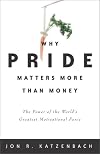
While others may be ok with this book, I am good with it. Very good insight on values. I enjoyed the Military aspect. I recommend.
You May Also Like


Associated Authors
Statistics
- Works
- 20
- Also by
- 2
- Members
- 1,136
- Popularity
- #22,595
- Rating
- 3.7
- Reviews
- 3
- ISBNs
- 57
- Languages
- 5
- Favorited
- 1