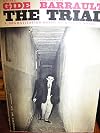
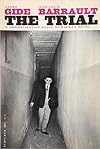
The Trial
by André Gide (Author), Jean Louis Barrault (Author)
On This Page
Tags
Recommendations















Member Reviews
I found this by chance at the library when I was looking for information on Kafka's novel. The process of adapting a story or literary work into another form -- whether through translation or producing it on stage -- fascinates me, so when I had a moment I picked this up.
As a written piece of work, it can't compare to the original novel. Plays are of course intended to be performed, not read, but some plays are captured better on the page than others. This one doesn't work quite so well in that form. It uses a lot of Kafka's original words, but for me, at least, with his text fresh in my mind, they lose something taken out of the context. Kafka's writing is descriptive and atmospheric, and stylistically fairly simple; his characters show more don't rise to great heights of eloquence. Which creates a challenge for anyone trying to adapt the text.
What it means is that a lot of the effectiveness depends on the presentation and staging, not on the dialogue, and that's harder (for me at least) to visualize with only the written text as a guide. I do have a sense for some of what is being attempted here: parts I understand and agree with, other parts I'm a bit dubious about. The action of the story is compressed, and at times the order of events is altered. This is logical enough; the dramatic requirements of the stage are different than in a novel. More interesting is the use of space, particularly the mingling of areas we expect to be kept separate, and the tendency of time to alter its normal patterns. Also the way in which the parable about the doorkeeper was worked into the main action of the play. This is very consistent with the themes and structure of Kafka's work -- it's simply less forcibly expressed in his novel.
Most of my reservations are about the interpretation of the meaning of the story. The novel can be read any number of ways. The play -- by necessity -- expresses the authors' ideas about Kafka's novel as much as (or more than) Kafka's own. This can be quite interesting, but sometimes it can also be distracting. At times I found the tension between the voice and vision of the original author and that of the adapters to be rather unsettling, although on the whole I think the play, taken for what it is, was probably well done. show less
As a written piece of work, it can't compare to the original novel. Plays are of course intended to be performed, not read, but some plays are captured better on the page than others. This one doesn't work quite so well in that form. It uses a lot of Kafka's original words, but for me, at least, with his text fresh in my mind, they lose something taken out of the context. Kafka's writing is descriptive and atmospheric, and stylistically fairly simple; his characters show more don't rise to great heights of eloquence. Which creates a challenge for anyone trying to adapt the text.
What it means is that a lot of the effectiveness depends on the presentation and staging, not on the dialogue, and that's harder (for me at least) to visualize with only the written text as a guide. I do have a sense for some of what is being attempted here: parts I understand and agree with, other parts I'm a bit dubious about. The action of the story is compressed, and at times the order of events is altered. This is logical enough; the dramatic requirements of the stage are different than in a novel. More interesting is the use of space, particularly the mingling of areas we expect to be kept separate, and the tendency of time to alter its normal patterns. Also the way in which the parable about the doorkeeper was worked into the main action of the play. This is very consistent with the themes and structure of Kafka's work -- it's simply less forcibly expressed in his novel.
Most of my reservations are about the interpretation of the meaning of the story. The novel can be read any number of ways. The play -- by necessity -- expresses the authors' ideas about Kafka's novel as much as (or more than) Kafka's own. This can be quite interesting, but sometimes it can also be distracting. At times I found the tension between the voice and vision of the original author and that of the adapters to be rather unsettling, although on the whole I think the play, taken for what it is, was probably well done. show less
Ratings
Members
- Recently Added By
Lists

Inspired by Kafka
18 works; 4 members
Author Information

Gide, the reflective rebel against bourgeois morality and one of the most important and controversial figures in modern European literature, published his first book anonymously at the age of 18. Gide was born in Paris, the only child of a law professor and a strict Calvinist mother. As a young man, he was an ardent member of the symbolist group, show more but the style of his later work is more in the tradition of classicism. Much of his work is autobiographical, and the story of his youth and early adult years and the discovery of his own sexual tendencies is related in Si le grain ne meurt (If it die . . .) (1926). Corydon (1923) deals with the question of homosexuality openly. Gide's reflections on life and literature are contained in his Journals (1954), which span the years 1889--1949. He was a founder of the influential Nouvelle Revue Francaise, in which the works of many prominent modern European authors appeared, and he remained a director until 1941. He resigned when the journal passed into the hands of the collaborationists. Gide's sympathies with communism prompted him to travel to Russia, where he found the realities of Soviet life less attractive than he had imagined. His accounts of his disillusionment were published as Return from the U.S.S.R. (1937) and Afterthoughts from the U.S.S.R. (1938). Always preoccupied with freedom, a champion of the oppressed and a skeptic, he remained an incredibly youthful spirit. Gide himself classified his fiction into three categories: satirical tales with elements of farce like Les Caves du Vatican (Lafcadio's Adventures) (1914), which he termed soties; ironic stories narrated in the first person like The Immoralist (1902) and Strait Is the Gate (1909), which he called recits; and a more complex narrative related from a multifaceted point of view, which he called a roman (novel). The only example of the last category that he published was The Counterfeiters (1926). Throughout his career, Gide maintained an extensive correspondence with such noted figures as Valery, Claudel, Rilke, and others. In 1947, he received the Nobel Prize for Literature. (Bowker Author Biography) show less

All Editions
Some Editions
Series
Belongs to Publisher Series
Work Relationships
Is an adaptation of
Common Knowledge
- Canonical title*
- Le procès. D'après le roman de Kafka
- Original title
- Le procès. D'après le roman de Kafka
- Original publication date
- 1948-01-19 (1e édition originale française, Blanche, Gallimard) (1e édition originale française, Blanche, Gallimard)
- Epigraph*
- /
- Dedication*
- /
- First words*
- NOTE LIMINAIRE
Je tiens d'abord à préciser ceci sans JeanLouis Barrault n'existerait non plus cette pièce inspirée par le célèbre roman de Kafka que ma traduction de Hamlet à laquelle son interprétation assure ... (show all)un succès triomphal. [...]
Distriibution
Par ordre d'entrée en scène
PREMIÈRE PARTIE
Jospef K. : Jean-Louis Barrault.
Franz : Albert Médina.
Wilhem : René Arrieu.
Madame Grubach : Catherine Fonteney.
[...] - Original language*
- Français
- Disambiguation notice*
- Le Procès a été représenté pour la première /oit, le 10 octobre 1947, sur la scène du Théâtre Marigny [direction Simonne Volterra,par la Compagnie Madeleine Renaud, Jean-Louis Barrault, (mise en scène de Jean-Louis ... (show all)Barrault, décors Félix Labroc), et sous la direction artistique de Jean-Louis Barrault.
*Some information comes from Common Knowledge in other languages. Click "Edit" for more information.
Classifications
Statistics
- Members
- 56
- Popularity
- 546,659
- Reviews
- 1
- Rating
- (3.75)
- Languages
- English, French, Italian
- Media
- Paper
- ISBNs
- 4
- ASINs
- 6