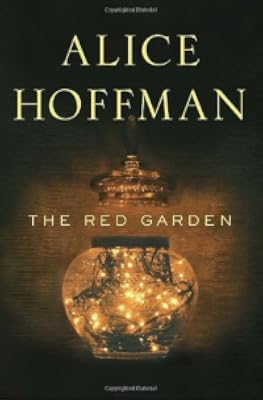
The Red Garden
by Alice Hoffman
On This Page
Description
A young wounded civil war solider is saved by a passionate neighbor, a woman meets a fiercely human historical character, a poet falls in love with a blind man, and a mysterious traveler comes to town in the year when summer never arrives. At the center of everyone's life is a mysterious garden where only red plants can grow, and where the truth can be found by those who dare to look.Tags
Recommendations







Member Reviews
The Red Garden by Alice Hoffman is a series of interconnected short stories about the founding, growth and development of a small town in the Berkshires of Massachusetts and the people who lived there or passed through. Originally named Beartown, it was eventually renamed Blackwell.
Reading about this small town is much like reading a condensed history of America as wars, epidemics, and politics frame each story but this is a book written by Alice Hoffman so there are touches of magic and the paranormal as well. I often felt like I was reading a fairy tale. In all there are 14 stories offered in chronological order that take us from the towns’ beginning in 1750 up to the present. Some of the stories had a greater impact than others, show more but overall I am in awe at both Hoffman’s imagination and writing ability.
Haunting and luminous, The Red Garden seems to be a bouquet celebrating New England. In rich and colorful words, Alice Hoffman gives us a vivid picture of the traditions and spirit that are to be found in this corner of America. show less
Reading about this small town is much like reading a condensed history of America as wars, epidemics, and politics frame each story but this is a book written by Alice Hoffman so there are touches of magic and the paranormal as well. I often felt like I was reading a fairy tale. In all there are 14 stories offered in chronological order that take us from the towns’ beginning in 1750 up to the present. Some of the stories had a greater impact than others, show more but overall I am in awe at both Hoffman’s imagination and writing ability.
Haunting and luminous, The Red Garden seems to be a bouquet celebrating New England. In rich and colorful words, Alice Hoffman gives us a vivid picture of the traditions and spirit that are to be found in this corner of America. show less
This set of small stories/vignettes spans 250 years of life in Blackwell, MA, originally named Bearsville by its founder, a woman by the name of Hallie Brady. She saved the founding expedition by giving them the milk of a hibernating bear. An odd place of calm bears, women who are really eels in human form, an apple tree (planted by Johnny Appleseed) that never fails to provide fruit and can bloom in winter, and the ghost of a young girl who drowned in the river, the Blackwell of these stories centers on the home of Brady, where the back garden lays unused some generations because everything planted there grows red. The red of blood; the red of life. But while uncanny things happen here, these stories are not about ghosts or bears, but show more about love. Love in all its forms- romantic love, brotherly love, parental love, love for an animal, love lost, love found, love denied. Love, and the joy and misery that it can bring.
The book moves through time with each chapter, using the descendants of the characters of the previous chapter. World events- the Civil War, the Spanish flu epidemic, the World Wars- touch and change (and sometimes kill) the residents of Blackwell, but are not allowed in. It’s obvious the town grows steadily, but the events take place in a small arena: the area first settled, the woods around it, and the Eel River. Hoffman’s writing draws the reader in hypnotically, leaving one wanting more, but the last chapter brings us up to current day Blackwell. This is one of Hoffman’s best. show less
The book moves through time with each chapter, using the descendants of the characters of the previous chapter. World events- the Civil War, the Spanish flu epidemic, the World Wars- touch and change (and sometimes kill) the residents of Blackwell, but are not allowed in. It’s obvious the town grows steadily, but the events take place in a small arena: the area first settled, the woods around it, and the Eel River. Hoffman’s writing draws the reader in hypnotically, leaving one wanting more, but the last chapter brings us up to current day Blackwell. This is one of Hoffman’s best. show less
The older I get, the more I appreciate magic. Not of the tacky abracadabra variety, but the kind of magic that comes from miraculous beauty, true love, the glory of nature, profound sorrow, serendipity, heartbreak, mystery, magnetism, whimsy, isolation, enchantment, and masterful storytelling. Alice Hoffman’s latest novel, The Red Garden, contains all of the above and more.
This was my introduction to Ms. Hoffman’s work, and all I can say about that is: So many books, so little time. The novel is composed of a series of 14 linked stories. The first tale, The Bear’s House, details the 1750 founding of the small Western Massachusetts town that came to be known as Blackwell. Hoffman writes:
“Blackwell was deep in Berkshire County, show more where the weather was mysterious and the people equally unpredictable. Several of the inhabitants were descendants of the foundling settlers, families who had intermarried often enough so that many of the women had red hair, with mercurial tempers that suited their coloring. The men were tall and quiet and good at most everything.”
That story introduces us to Hallie Brady, the first of those of strong-willed, red-haired women. In addition to keeping her fellow settlers alive that initial winter, it is Hallie that plants the eponymous garden. The red-soiled garden flourishes and flounders over the centuries, but is just one of many recurring elements featured in these tales. The book might just as easily have been named for the gentle bears or the haunted river, for the stories revolve far more around the town and its people than the red garden itself.
Each successive story moves forward in time, sometimes by just a few years, other times by decades. A child in one story is an adult in the next. A woman in her prime is soon on her death bed. The passing of time is measured not only in human terms. A field named Dead Husband’s Meadow by an unhappy wife soon becomes Husband’s Meadow and eventually Band’s Meadow over time, all without need for emphasis or punctuation. And stories that the reader “witnesses” first-hand early on in the book grow over time into the legends told later.
As these stories progress, we meet successive generations of Partridges and Kellys, Starrs and Motts. Some of the characters can trace their roots all the way back to the founding of Blackwell, others are just passing through. You may even recognize one or two of them. Each story within the novel is complete and does not necessarily lead in any direct way from one to the next, but usually there is a connection. The Red Garden could certainly be read as a short story collection, but there is far more to be savored when appreciating the whole.
Novels of this structure seem to be in vogue of late, but rather than compare it to any recent example, the novel I found myself thinking of as I read was Gabriel García Márquez’s One Hundred Years of Solitude. I read that book decades ago, and just about the only thing I remember is that it was so staggeringly beautiful that I didn’t realize just how truly sad it was until after significant reflection. It may be that the magical realism and similar themes of a town and its successive generations was what brought García Márquez’s masterpiece to mind, but I think it was the allure of Ms. Hoffman’s fables and the captivating beauty of her words. Her stories are not universally sad, but had me experiencing a wide spectrum of emotions. I suspect that I will be picking this book up again and again in years to come, as magic is rare and hard to come by. show less
This was my introduction to Ms. Hoffman’s work, and all I can say about that is: So many books, so little time. The novel is composed of a series of 14 linked stories. The first tale, The Bear’s House, details the 1750 founding of the small Western Massachusetts town that came to be known as Blackwell. Hoffman writes:
“Blackwell was deep in Berkshire County, show more where the weather was mysterious and the people equally unpredictable. Several of the inhabitants were descendants of the foundling settlers, families who had intermarried often enough so that many of the women had red hair, with mercurial tempers that suited their coloring. The men were tall and quiet and good at most everything.”
That story introduces us to Hallie Brady, the first of those of strong-willed, red-haired women. In addition to keeping her fellow settlers alive that initial winter, it is Hallie that plants the eponymous garden. The red-soiled garden flourishes and flounders over the centuries, but is just one of many recurring elements featured in these tales. The book might just as easily have been named for the gentle bears or the haunted river, for the stories revolve far more around the town and its people than the red garden itself.
Each successive story moves forward in time, sometimes by just a few years, other times by decades. A child in one story is an adult in the next. A woman in her prime is soon on her death bed. The passing of time is measured not only in human terms. A field named Dead Husband’s Meadow by an unhappy wife soon becomes Husband’s Meadow and eventually Band’s Meadow over time, all without need for emphasis or punctuation. And stories that the reader “witnesses” first-hand early on in the book grow over time into the legends told later.
As these stories progress, we meet successive generations of Partridges and Kellys, Starrs and Motts. Some of the characters can trace their roots all the way back to the founding of Blackwell, others are just passing through. You may even recognize one or two of them. Each story within the novel is complete and does not necessarily lead in any direct way from one to the next, but usually there is a connection. The Red Garden could certainly be read as a short story collection, but there is far more to be savored when appreciating the whole.
Novels of this structure seem to be in vogue of late, but rather than compare it to any recent example, the novel I found myself thinking of as I read was Gabriel García Márquez’s One Hundred Years of Solitude. I read that book decades ago, and just about the only thing I remember is that it was so staggeringly beautiful that I didn’t realize just how truly sad it was until after significant reflection. It may be that the magical realism and similar themes of a town and its successive generations was what brought García Márquez’s masterpiece to mind, but I think it was the allure of Ms. Hoffman’s fables and the captivating beauty of her words. Her stories are not universally sad, but had me experiencing a wide spectrum of emotions. I suspect that I will be picking this book up again and again in years to come, as magic is rare and hard to come by. show less
At its heart, The Red Garden is the story of the town of Blackwell, Massachusetts, peopled by fascinating and unforgettable characters. A series of short stories, the book has the feel of a novel because of the smooth flow of the stories through history. It starts with the story of the town’s founder, Hallie Brady. Several of the stories feature Hallie’s descendents or those of the other original townspeople, and highlight the way their lives intersect, collide and diverge throughout the years.
The writing is typical Alice Hoffman, smooth and addicting, with a hint of magic and the supernatural tucked in. There are ghosts, lucky trees, and a garden in which only red plants grow. Blackwell is clearly a special place and becomes a show more character in its own right; the people who visit and those who live there never really leave, even though they may journey elsewhere.
This was a quick read; I got through it in a day, because once I started it was impossible to put down. The beautiful writing and rich symbolism make this very worthwhile. show less
The writing is typical Alice Hoffman, smooth and addicting, with a hint of magic and the supernatural tucked in. There are ghosts, lucky trees, and a garden in which only red plants grow. Blackwell is clearly a special place and becomes a show more character in its own right; the people who visit and those who live there never really leave, even though they may journey elsewhere.
This was a quick read; I got through it in a day, because once I started it was impossible to put down. The beautiful writing and rich symbolism make this very worthwhile. show less
The Red Garden reads like a collection of interconnected short stories that weave together a generational tapestry of the Brady, Partridge, Starr, and Mott families in the small town of Blackwell, Massachusetts in the Berkshires. Each chapter is a treasure, and subtly communicates concepts of generational trauma, generational legacy, and something altogether a bit magical. The scenery isn't just a backdrop but an essential role in this drama, which is peppered with moments of light-heartedness. Hoffman is telling a tale of lives and while the stories of each person are interesting enough, it is the artful way in which she reaches the thread back to an earlier story and loops it in that made this book compelling. There are elements of show more magical realism: bonds with bears, a garden that turns all plants red, transformations, and ghosts, but it never distracts from the core humanity of the stories. On the contrary, these elements help illuminate the potential magic in our imaginations and maybe even our lives. show less
This is an exquisite collection of short stories about the people who live in the isolated town of Blackwell, Massachussets -- and I don't usually care for short stories.
I haven't read a lot of Alice Hoffman's books, but the ones I have read show her to be a writer very much in tune with the secret magic in life, as well as -- if you'll forgive the hackneyed phrase -- the magic of the human heart.
And Hoffman doesn't just tell the stories of the humans of Blackwell. Bears, eels, apple trees, residences, a river, and the eponymous red garden all have important stories of their own, although they are never point of view characters. In fact, I should confess that one of the reasons I liked this book so much was because of the repeated, show more vivid presence of bears weaving in and out of the human narratives.
The stories are all stand-alone, but each new story weaves an increasingly detailed and rich tapestry of Blackwell and its environs, as people -- and homes and eels and bears and ghosts -- carry forward the heritage of almost-forgotten ancestors. show less
I haven't read a lot of Alice Hoffman's books, but the ones I have read show her to be a writer very much in tune with the secret magic in life, as well as -- if you'll forgive the hackneyed phrase -- the magic of the human heart.
And Hoffman doesn't just tell the stories of the humans of Blackwell. Bears, eels, apple trees, residences, a river, and the eponymous red garden all have important stories of their own, although they are never point of view characters. In fact, I should confess that one of the reasons I liked this book so much was because of the repeated, show more vivid presence of bears weaving in and out of the human narratives.
The stories are all stand-alone, but each new story weaves an increasingly detailed and rich tapestry of Blackwell and its environs, as people -- and homes and eels and bears and ghosts -- carry forward the heritage of almost-forgotten ancestors. show less
Six-word review: Linked stories explore dimensions of solitude.
Extended review:
When it comes to fiction, I'm not much of a day tripper. I prefer long journeys. So I don't read many short stories, not when I can settle into a hefty novel and live with it for a while.
For the Kindle, however, it's nice to have some brief reading matter to pick up on my way out the door when I'm going to be sitting in a waiting room or taking someone on an errand. So, without seeking it out or particularly choosing it, I just sort of happened to find myself reading "The Bear's House," the first story in Alice Hoffman's The Red Garden.
This, my friends, is what serendipity is for.
The first of these lovely stories, which together span more than two hundred show more years, sets the scene and the tone: in an eighteenth-century settlement in the Berkshires of western Massachusetts, an unconventional young woman's courage and resourcefulness save a snowbound village from starvation. Hallie Brady, like the main characters in the stories that follow, lives within herself, a part of and yet apart from the community. The bond that she forms with an orphaned bear cub imparts a mystical quality that tinges all fourteen of these contemplative tales.
Each of the individual protagonists is out of step with the community, and yet not disconnected from it. The town of Blackwell and the surrounding area, including Hightop Mountain and the Eel River, supply context and definition. Familial links among generations of residents, local lore, and natural and man-made features blend in a tapestry that evokes memories in the reader akin to the collective memories of the villagers. There is a sense that these fourteen tales, selected as if from the portraits in a gallery, are but a few of the many that might be told but that remain tantalizingly beyond reach. The evolution of place names and folklore and the commemoration in ritual of past events remind us of the inextricable threads of history, tradition, and myth.
Taken together, these stories form a cycle with universal themes of survival and loss, belonging and isolation, and existential aloneness. I found them beautiful and satisfying.
(Kindle edition) show less
Extended review:
When it comes to fiction, I'm not much of a day tripper. I prefer long journeys. So I don't read many short stories, not when I can settle into a hefty novel and live with it for a while.
For the Kindle, however, it's nice to have some brief reading matter to pick up on my way out the door when I'm going to be sitting in a waiting room or taking someone on an errand. So, without seeking it out or particularly choosing it, I just sort of happened to find myself reading "The Bear's House," the first story in Alice Hoffman's The Red Garden.
This, my friends, is what serendipity is for.
The first of these lovely stories, which together span more than two hundred show more years, sets the scene and the tone: in an eighteenth-century settlement in the Berkshires of western Massachusetts, an unconventional young woman's courage and resourcefulness save a snowbound village from starvation. Hallie Brady, like the main characters in the stories that follow, lives within herself, a part of and yet apart from the community. The bond that she forms with an orphaned bear cub imparts a mystical quality that tinges all fourteen of these contemplative tales.
Each of the individual protagonists is out of step with the community, and yet not disconnected from it. The town of Blackwell and the surrounding area, including Hightop Mountain and the Eel River, supply context and definition. Familial links among generations of residents, local lore, and natural and man-made features blend in a tapestry that evokes memories in the reader akin to the collective memories of the villagers. There is a sense that these fourteen tales, selected as if from the portraits in a gallery, are but a few of the many that might be told but that remain tantalizingly beyond reach. The evolution of place names and folklore and the commemoration in ritual of past events remind us of the inextricable threads of history, tradition, and myth.
Taken together, these stories form a cycle with universal themes of survival and loss, belonging and isolation, and existential aloneness. I found them beautiful and satisfying.
(Kindle edition) show less
Members
- Recently Added By
Lists

History in the long view
55 works; 3 members
Author Information

74+ Works 61,283 Members
Alice Hoffman, an American novelist and screenwriter, was born in New York City on March 16, 1952. She earned a B.A. from Adelphi University in 1973 and an M.A. in creative writing from Stanford University in 1975 before publishing her first novel, Property Of, in 1977. Known for blending realism and fantasy in her fiction, she often creates show more richly detailed characters who live on society's margins and places them in extraordinary situations as she did with At Risk, her 1988 novel about the AIDS crisis. Her other works include The Drowning Season, Seventh Heaven, The River King, Blue Diary, The Probable Future, The Ice Queen, and The Dovekeepers. Her book, The Third Angel, won the 2008 New England Booksellers' Award for fiction. Two of her novels, Practical Magic and Aquamarine, were made into films. She has also written numerous screenplays, including adaptations of her own novels and the original screenplay, Independence Day. Her title's The Museum of Exteaordinary Things, The Marriage of Opposites, Seventh Heaven, and The Rules of Magic made The New York Times Best Seller List. (Bowker Author Biography) show less
Some Editions
Awards and Honors
Awards
Distinctions
Common Knowledge
- Canonical title
- The Red Garden
- Original title
- The Red garden
- Original publication date
- 2011-03-04
- People/Characters
- Johnny Appleseed
- Important places
- Blackwell, Massachusetts, USA
- Dedication
- In memory of Albert J. Guerard, the great critic, writer, and teacher, who in his fifty years at Harvard and Stanford universities changed the voice of American fiction and also changed my life
- First words
- The town of Blackwell, Massachusetts, changed its name in 1786.
- Quotations
- He felt...as if the cells of his body had expanded to include fir trees, foxes, streams of green water. (p. 222)
Anyone else might have guessed the garden she planted would be white, but Charles had seen it all exactly as she'd crafted it before he went away, the flash of scarlet, the trail of blood, the inside story of who she was. (p.... (show all)66)
"I intend to remind her that she's alive." (p.38) - Last words
- (Click to show. Warning: May contain spoilers.)He thought about where it was people went when they died, and how when he squinted he could see Cody, racing back and forth, barking, how his father seemed to stand right there on the riverbank, turning back the bees, closer than he'd ever been before.
- Original language
- English
Classifications
- Genres
- General Fiction, Fiction and Literature, Historical Fiction, Fantasy
- DDC/MDS
- 813.54 — Literature & rhetoric American literature in English American fiction in English 1900-1999 1945-1999
- LCC
- PS3558 .O3447 .R43 — Language and Literature American literature American literature Individual authors 1961-
- BISAC
Statistics
- Members
- 1,452
- Popularity
- 16,157
- Reviews
- 89
- Rating
- (3.74)
- Languages
- English, Finnish
- Media
- Paper, Audiobook, Ebook
- ISBNs
- 12
- ASINs
- 6