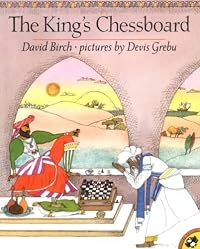
The King's Chessboard (Picture Puffins)
by David Birch
On This Page
Description
A proud king, too vain to admit what he does not know, learns a valuable lesson when he readily grants his wise man a special request.Tags
Recommendations



Member Reviews
The King's Chessboard is a creative telling to the importance of counting. A wise man served a king and the king wanted to reward the wise man for his services. What the king did not foresee is how doubling grains of rice on a chess board could lead to millions of tons of rice. This book would be great to read in a math class to show how important it is to be able to count and multiply. It also shows how seemingly small amounts can grow to be so large. This book also shows how pride looks foolish. There are many great discussions and themes throughout this delightful tale.
A great story for children learning mathematical concepts, The King’s Chessboard tells the story of a wise man who refuses the king’s reward for completing a favor. When the king insists the man accept a reward, the man proposes a deal: He will take a payment of rice equal to each square on the king’s chessboard—doubling the amount he receives with each day. This quickly empties out the royal coffers. . . .
The main point of “The King’s Chessboard” is to show that you shouldn’t push someone into something they don’t want to do. The other main point is that you should never let your pride get in the way of the things that you do. I really enjoyed this book because the illustrations convey and enhance the story. Throughout the story you see the king’s anguish of giving away so many grains of rice a day. The illustrations throughout the book are also full of vibrant colors; this allowed me as the reader to be fully engaged in the reading. For all of the colors seemed realistic and relevant to the story. The colors are always a sort of light yellow to enhance the idea of morning. Also the characters within this book are highly show more developed and know what they want to gain and loose for this experience. For instance when the wise man says that he doesn’t want anything from the king and then decides to make something up just to satisfy the king and not himself. He goes through this book collecting the grains and just giving it away to animals and people. Also the character of the king is a man who would rather give into something opposed to just saying he isn’t sure about something. This is shown when the king initially doesn’t want ask the wise man how much rice a grain on the chessboard doubled a day becomes at the end. The development of these characters is crucial because it shows the vital difference between the two and how they need to communicate and listen to one another to benefit form an agreement. show less
A great story for children learning mathematical concepts, The King’s Chessboard tells the story of a wise man who refuses the king’s reward for completing a favor. When the king insists the man accept a reward, the man proposes a deal: He will take a payment of rice equal to each square on the king’s chessboard—doubling the amount he receives with each day. This quickly empties out the royal coffers. .
Exponents! And a great lesson about kindness being its own best reward. A king wants to repay a wise man for his service but the wise man resists. After much pressure from the king, he agrees to a reward of grains of rice, each day multiplied twice the amount of the day before for as many days as there are squares on a chessboard. This becomes TONS (literally) of rice, and the king realizes his error.
Set in India. Detailed watercolor illustrations. Grades 4 and up and up... Do the math!
Set in India. Detailed watercolor illustrations. Grades 4 and up and up... Do the math!
“The King’s Chessboard” written by David Birch is a wonderful children’s story which teaches a wonderful lesson about pride. In this story, the King of Deccan wanted to reward a wise man who had performed various noble services. The wise man told the king he did not want to be rewarded, but the king insisted. Finally, the wise man asked the king to give him one grain of rice for the first square on his chessboard; and for each additional square, twice the number of grains on the square before it. The king agreed, but after several days of delivering rice, he determined this task was impossible. The king always said he could do anything and the wise man taught him a great lesson. This story is best suited for elementary students show more of all ages. show less
Genre: folktale
Age Appropriateness: Grade 2-6
Review:This is a tale full of exotic, old-world flavor which takes place at a palace in ancient India. The wise man served the king for several years and the king insist on rewarding him when he refuse to accept rewards. However, the king still wants to reward him so he asks for a payment of rice for each square of the king's chessboard--the amount to be doubled each day. The king allows him and soon the royal granaries are almost empty and he find out there is not enough rice in all the world he can give the wise man.
This book is a folktale because it is a story that is passed down from generation to generation, by the word of mouth.The story itself overall sounds logical and nothing in this show more book seems magical or dreamlike.The story also ended at teaching a lesson in our life, which is that we should understand the power of exponential function. show less
Age Appropriateness: Grade 2-6
Review:This is a tale full of exotic, old-world flavor which takes place at a palace in ancient India. The wise man served the king for several years and the king insist on rewarding him when he refuse to accept rewards. However, the king still wants to reward him so he asks for a payment of rice for each square of the king's chessboard--the amount to be doubled each day. The king allows him and soon the royal granaries are almost empty and he find out there is not enough rice in all the world he can give the wise man.
This book is a folktale because it is a story that is passed down from generation to generation, by the word of mouth.The story itself overall sounds logical and nothing in this show more book seems magical or dreamlike.The story also ended at teaching a lesson in our life, which is that we should understand the power of exponential function. show less
Members
- Recently Added By
Lists

The Story of the World: History for the Classical Child: Activity Book Two
415 works; 2 members
Author Information
5 Works 38 Members
Common Knowledge
- Original publication date
- 1988
- Important places
- India
- First words
- Once, long ago, in what is now India, there lived a wise man who performed a service for the King of Deccan.
- Last words
- (Click to show. Warning: May contain spoilers.)The king ruled wisely and justly for many, many years, and to the end of his days he kept the chessboard with its thirty-two grains of rice to remind him of the wise man's lesson--how easy it is for pride to make a fool of anyone, even a king.
- Original language
- English
Classifications
Statistics
- Members
- 572
- Popularity
- 51,295
- Reviews
- 17
- Rating
- (4.12)
- Languages
- English
- Media
- Paper
- ISBNs
- 8