
Ruby Dee (1922–2014)
Author of Two Ways to Count to Ten: A Liberian Folktale
About the Author
Works by Ruby Dee
Stephen King's The Stand 9 copies
Associated Works
Every Tongue Got to Confess: Negro Folk-tales from the Gulf States (2001) — Narrator, some editions — 421 copies, 4 reviews
Creme de la Femme: The Best of Contemporary Women's Humor (1997) — Contributor — 40 copies, 2 reviews
A Rock Against the Wind: African-American Poems and Letters of Love and Passion (1996) — Foreword — 24 copies
A Love Supreme: Real Life Stories of Black (African-American) Love (2000) — Foreword, some editions — 8 copies
The Sidney Poitier Collection: Edge of the City / Something of Value / A Patch of Blue / A Warm December (2009) 6 copies
American Experience: Roots of Resistance: The Story of the Underground Railroad [1990 TV episode] (2008) — Narrator — 3 copies
Edgar Allan Poe: Terror of the Soul (American Masters) [1995 TV episode] — Narrator — 1 copy
NOVA: Papua New Guinea: Anthropology on Trial [1983 TV episode] — Narrator — 1 copy
Tagged
Common Knowledge
- Other names
- Wallace, Ruby Ann (birth name)
- Birthdate
- 1922-10-27
- Date of death
- 2014-06-11
- Gender
- female
- Education
- Hunter College
- Occupations
- actress
civil rights activist - Awards and honors
- National Medal of Arts (1995)
Kennedy Center Honors (2004) - Relationships
- Davis, Ossie (husband)
- Nationality
- USA
- Birthplace
- Cleveland, Ohio, USA
- Places of residence
- New York, New York, USA
- Place of death
- New Rochelle, New York, USA
- Associated Place (for map)
- New York, USA
Members
Reviews

King Leopard searches for a worthy successor in this picture book retelling of a traditional Liberian tale. Deciding that he will give his kingdom and the hand of his beautiful daughter in marriage to the one who can pass his test, he invites all of the animals to a jungle tournament of sorts. Here he declares that the one who can throw his spear so high into the air that he has time to count to ten before it lands, will be the winner. But although many mighty animals, from the elephant to show more lion, make an attempt, no one is successful. Then slender antelope steps forward, and demonstrates that wisdom can be as important as strength, when it comes to getting the job done...
Actress and activist Ruby Dee made her children's book debut with Two Ways to Count to Ten: A Liberian Folktale, which was published in 1988, and which was illustrated by Susan Meddaugh, who three years before did the artwork for Verna Aardema's wonderful Bimwili and the Zimwi: A Tale from Zanzibar. I enjoyed this tale, even though I could see where it was headed—counting by twos instead of ones —from the beginning. After all, folklore often relies on tried and true themes and story lines, and while a surprise ending can be fun, a predictable one is no detriment. The lesson to be learned—that thinking outside of the box and approaching problems from a different perspective is an important skill—is well worth considering. The accompanying artwork was colorful and engaging. I do wish some source has been given for the tale, so I could track down the original, or possibly other tellings, but leaving that aside I would recommend this to young folklore enthusiasts. show less
Actress and activist Ruby Dee made her children's book debut with Two Ways to Count to Ten: A Liberian Folktale, which was published in 1988, and which was illustrated by Susan Meddaugh, who three years before did the artwork for Verna Aardema's wonderful Bimwili and the Zimwi: A Tale from Zanzibar. I enjoyed this tale, even though I could see where it was headed—
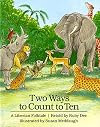
I loved Two Ways to Count to Ten for three reasons. First, the plot is simple yet effective. Essentially, the king of the jungle arranges a competition for all the animals in his kingdom. The plot chronicles each animal's attempt at the challenge. The plot comes together in the end when the "weak" antelope uses his brain to complete the challenge. The straightforward nature of the plot made it enjoyable to read and easy to understand.
Second, the illustrations in this book were fantastic. show more The illustrator used a combination of water color and colored pencils in this book. In addition, the illustrator used bright, vivacious colors. The illustrations added to the story because they conveyed the lighthearted tone of the text.
Third, this book subtly pushes readers to broaden their perspective. For example, the king says at the end of the book, "Remember, my friends, it is not always the biggest or the strongest, but sometimes the cleverest that wins the prize." As such, the "big picture" of this book is valuing intelligence and creative thinking. show less
Second, the illustrations in this book were fantastic. show more The illustrator used a combination of water color and colored pencils in this book. In addition, the illustrator used bright, vivacious colors. The illustrations added to the story because they conveyed the lighthearted tone of the text.
Third, this book subtly pushes readers to broaden their perspective. For example, the king says at the end of the book, "Remember, my friends, it is not always the biggest or the strongest, but sometimes the cleverest that wins the prize." As such, the "big picture" of this book is valuing intelligence and creative thinking. show less
Long ago, when all the animals lived together in peace, the mighty leopard was king of the jungle, and all the animals respected their king. But it came time to name a successor and all the animals vied for the position. Derived from a Liberian folk tale, this story shows that being strong is not the same as being smart and illustrates how clever math can solve a problem.
This was an interesting way to incorporate a story into a counting book. Counting books can often be boring and repetitive, but I though the story of acquiring a new king was super creative.
Lists
Awards


You May Also Like


Associated Authors
Statistics
- Works
- 13
- Also by
- 44
- Members
- 621
- Popularity
- #40,535
- Rating
- 4.0
- Reviews
- 17
- ISBNs
- 25