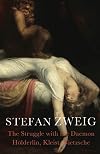
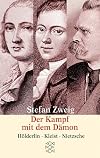
The Struggle with the Daemon: Hölderlin, Kleist and Nietzsche
by Stefan Zweig
Die Baumeister der Welt (Band 2)
On This Page
Description
This is the second volume in a trilogy in which Stefan Zweig builds a composite picture of the European mind through intellectual portraits selected from among its most representative and influential figures. In Hölderlin, Kleist, and Nietzsche, Zweig concentrates on three giants of German literature to portray the artist and thinker as a figure possessed by a powerful inner vision at odds with the materialism and scientific positivism of his time, in this case, the nineteenth show more century.Zweig's subjects here are respectively a lyric poet, a dramatist and writer of novellas, and a philosopher. Each led an unstable life ending in madness and/or suicide and not until the twentieth century did each make their full impact. Whereas the nineteenth-century novel is socially capacious in terms of subject and audience, the three figures treated here are prophets or forerunners of modernist ideas of alienation and exile. Hölderlin and Kleist consciously opposed the worldly harmoniousness of Goethe's classicism in favor of a visionary inwardness and dramatization of the subjective psyche. Nietzsche set himself as a destroyer and rebuilder of philosophy and critic of the degradation of the German spirit through nationalism and militarism.Zweig's choice of subjects reflects a division in his own soul. The image of Goethe recurs here as the ultimate upholder of Zweig's own ideals: scientist and artist, receptive to world culture, supremely rational and prudent. Yet Zweig was aware that Hölderlin, Kleist, and Nietzsche were more daring explorers of the dangerous and destructive aspects of man that needed to be seen and comprehended in the clarifying light of poetry and philosophy. show lessTags
Recommendations
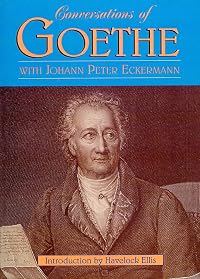
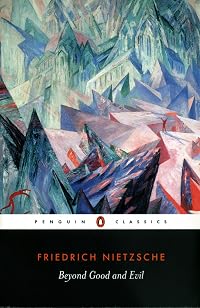
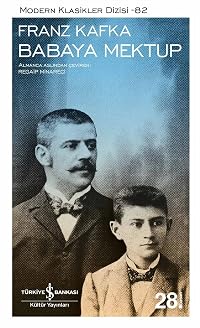


















Member Recommendations
Neurasthenio Eine andere Form der Darstellung, aber in beiden Fällen ein Versuch, die Elemente der Persönlichkeit eines Denkers einfühlend zu erfassen.
Member Reviews
I have little enough time for writing this review. So I won't. But what I can tell you is that this book is a fine and perfect example of great writing. Zweig is a master at teaching and expressing his thoughts clearly and he is so very interesting in his approach to this (and any) subject. Though he was profiling three great artists of their own particular time in Holderlin, Kleist, and Nietzsche, Zweig was primarily instructing us on the daemon, which is a word I had heard prior to this reading but never had it explained to me in such clear and precise language. Now, at least, I know what is wrong with me, or what is right, depending on your own personal perception of the artist's drive. How frustration and unhappiness continue to show more press us on to better work and more serious incisions into our consciousness. This book is amazing on so many levels. To say I loved it would be an inadequate expression of my feelings for it. It is a precious and important work written by a man who was such a great writer and thinker. Zweig certainly did justice to the good and lasting memory of these three subjects, misunderstood and rejected in their own time, but who now live on in immortality as the great writers they really were. The fact that all three were social outcasts was basically by their own design, and it offered them the opportunity to perfect their work privately in a most violent and disruptive way that is scary and a threat to those of us who are delusional in the comforts of our daily living. Truth is, the world is always in chaos and we better not ever forget it. show less
The only interest lies in seeing what passed for literary criticism in... 19th century--old-fashioned, rejected and surpassed already in Zweig's day. Vague, bombastic impressionistic descriptive twaddle about "Beauty", "Truth", "Damnation", "volcanic flames", "feverish winds", "sublime heights" etc. The best he can muster on the subject of Kant's philosophy is to say it is like "a block of ice". This idea-empty intoning and purple prosing becomes tiresome pretty quickly. It's shocking to remember that he was a contemporary of Benjamin's.
В русском переводе - три певца своей жизни.
Шикарно. Никогда не думал, что биографические очерки могут быть такими занимательными, поучительными и интересными, представленными в столь читабельной и литературной форме. Прочел с удовольствием. Полезно читать подобные вещи перед началом чтения серий автора.
Шикарно. Никогда не думал, что биографические очерки могут быть такими занимательными, поучительными и интересными, представленными в столь читабельной и литературной форме. Прочел с удовольствием. Полезно читать подобные вещи перед началом чтения серий автора.
AG-5
Nov 19, 2020Catalan
Hölderlin, Kleist, Nietzsche, tres personajes extraordinarios por los que Stefan Zweig, como «psicólogo por pasión, creador por voluntad creadora» sentía un profundo apego. Su inquietud vital los aleja de la contención de Goethe decidido a autoconstruirse: «La fórmula para la vida según Goethe es la representada por el círculo: una línea cerrada, la redondez absoluta que abarca toda existencia, el eterno retorno a uno mismo.» En cambio, «la forma de lo demoníaco», de la inquietud interna en Hölderlin, Kleist y Nietzsche, «se expresa por una parábola: un ascenso rápido e impetuoso en una única dirección, hacia lo superior, lo infinito, una curva perpendicular y una caída brusca.» El demonio, entendido por Stefan show more Zweig como remanente del caos original del mundo, es quien desafía a los hombres creativos, poseídos por él, y les «arranca de las manos, a la fuerza, el timón de la voluntad, de manera que... son tambaleados por la tempestad, y chocan contra las peñas de su destino.» show less
Feb 3, 2023Spanish
Le XIXème siècle. Après la fanfare de la Révolution Française, la chute des Rois, Bonaparte traçant les frontières de l’Europe à la pointe de l’épée, l’heure de la jeunesse est arrivée. Dans tous les pays se “dressent en même temps, le regard tourné vers les étoiles”, une jeunesse enthousiaste. Le XVIIIème a appartenu “aux vieillards et aux philosophes, à Voltaire et à Rousseau, à Leibnitz et à Kant, à Haydn et à Wieland, aux placides et aux tolérants, aux grands esprits et aux savants maintenant c’est le règne de la jeunesse et l’intrépidité.” Et pourtant pendant 15 ans, le moulin de la destruction lève sa hache. “Divers est leur trépas, mais pour tous il est précoce.” En France André show more Chénier, Apollon d’un nouvel hellénisme, trainé à la guillotine le dernier jour de la terreur. En Angleterre en quelques années, John Keats, Shelley et Lord Byron, la plus noble floraison lyrique est anéantie. Pour l’Allemagne Novalis, Kleist, Raimund, Büchner, Hauff, Schubert, expirent avant le temps. Leopardi, Bellini, Gridojedof, Pouchkine endeuillent Italie et Russie. Seul Goethe est toujours debout à Weimar. show less
Jun 21, 2011French
traduccion Joaquin Verdaguer
Nov 16, 2020Spanish
Members
- Recently Added By
Published Reviews
Hölderlin, Kleist, Nietzsche, tres personajes extraordinarios por los que Stefan Zweig, como «psicólogo por pasión, creador por voluntad creadora» sentía un profundo apego. Su inquietud vital los aleja de la contención de Goethe decidido a autoconstruirse: «La fórmula para la vida según Goethe es la representada por el círculo: una línea cerrada, la redondez absoluta que abarca show more toda existencia, el eterno retorno a uno mismo.» En cambio, «la forma de lo demoníaco», de la inquietud interna en Hölderlin, Kleist y Nietzsche, «se expresa por una parábola: un ascenso rápido e impetuoso en una única dirección, hacia lo superior, lo infinito, una curva perpendicular y una caída brusca.» El demonio, entendido por Stefan Zweig como remanente del caos original del mundo, es quien desafía a los hombres creativos, poseídos por él, y les «arranca de las manos, a la fuerza, el timón de la voluntad, de manera que... son tambaleados por la tempestad, y chocan contra las peñas de su destino.» show less
added by pacocillero
Lists

Books Read in 2023
5,638 works; 147 members
Author Information

Born in Vienna, the prolific Zweig was a poet in his early years. In the 1920s, he achieved fame with the many biographies he wrote of famous people including Balzac, Dostoevsky, Dickens and Freud. Erasmus with whom he closely identified, was the subject of a longer biography. He also wrote the novellas Amok (1922) and The Royal Game (1944). As show more Nazism spread, Zweig, a Jew, fled to the United States and then to Brazil. He hoped to start a new life there, but the haunting memory of Nazism, still undefeated, proved too much for him. He died with his wife in a suicide pact. (Bowker Author Biography) show less
Some Editions
Series

Belongs to Publisher Series
Work Relationships
Common Knowledge
- Canonical title
- The Struggle with the Daemon: Hölderlin, Kleist and Nietzsche
- Original publication date
- 1925
Classifications
- Genres
- Literature Studies and Criticism, Nonfiction, Biography & Memoir, Fiction and Literature
- DDC/MDS
- 830.9 — Literature & rhetoric German & related literatures German literature and literatures of related languages History, description, critical appraisal of works in more than one form
- LCC
- PT2359 .H2 .Z9413 — Language and Literature German, Dutch and Scandinavian literatures German literature Individual authors or works 1700-ca. 1860/70
- BISAC
Statistics
- Members
- 265
- Popularity
- 122,408
- Reviews
- 7
- Rating
- (3.85)
- Languages
- 7 — English, Estonian, French, German, Hungarian, Portuguese, Spanish
- Media
- Paper, Ebook
- ISBNs
- 27
- ASINs
- 15