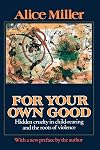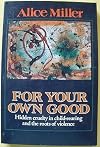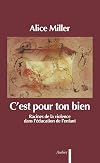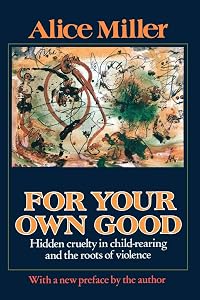
For Your Own Good: Hidden Cruelty in Child-Rearing and the Roots of Violence
by Alice Miller
On This Page
Description
For Your Own Good, the contemporary classic exploring the serious if not gravely dangerous consequences parental cruelty can bring to bear on children everywhere, is one of the central works by Alice Miller, the celebrated Swiss psychoanalyst. With her typically lucid, strong, and poetic language, Miller investigates the personal stories and case histories of various self-destructive and/or violent individuals to expand on her theories about the long-term affects of abusive child-rearing. show more Her conclusions-on what sort of parenting can create a drug addict, or a murderer, or a Hitler-offer much insight, and make a good deal of sense, while also straying far from psychoanalytic dogma about human nature, which Miller vehemently rejects. This important study paints a shocking picture of the violent world-indeed, of the ever-more-violent world-that each generation helps to create when traditional upbringing, with its hidden cruelty, is perpetuated. The book also presents listeners with useful solutions in this regard-namely, to resensitize the victimized child who has been trapped within the adult, and to unlock the emotional life that has been frozen in repression. show lessTags
Recommendations











Member Reviews
This book should be required reading for everyone. The way we raise and treat children is a reflection of the violence and chaos in the world we live in. Our fate as a decent, loving, and dynamic species lies in our ability to take the claims in this book seriously. Children's pain is real, and needs to be witnessed, respected, and honored. When we injure children, we create damaged adults who act through their unresolved and repressed childhood pain. We don't take children's pain seriously at the risk of annihilating ourselves as a species.
Old but never dated, this is among the 10 most important books ever written about psychology and human behaviour. The subject is intense but the book itself is easy to read, no technical jargon here. Should be mandatory in every school. Certainly not an uplifting book but one we really need.
I really liked this book by Alice Miller. In three distinct cases (and more) it outlines the childhood origins of destructive and self-destructive behaviour with empathetic objectivity. It also warns against "learning to regard human beings as machines in order to gain a better understanding of how they function."
Old but never dated, this is among the 10 most important books ever written about psychology and human behaviour. The subject is intense but the book itself is easy to read, no technical jargon here. Should be mandatory in every school.
from 1983 "Am Anfang war Erziehung", the childhood of Adolf Hitler and child murderer Jochen Bartsch
C'est pour ton bien, ou comment manipuler un enfant de la façon la plus sournoise pour le modeler tel que ses parents et la société le veulent.
Alice Miller démonte ici les mécanismes de ce qu’elle appelle la pédagogie noire, un mode d’éducation "pour le bien des enfants" basé sur les mauvais traitements physiques et moraux et montre à quelles catastrophes ça peut mener, aussi bien individuellement (en analysant le cas de Christiane F., une jeune droguée allemande) qu’internationalement (en analysant le cas de Hitler)
Alice Miller démonte ici les mécanismes de ce qu’elle appelle la pédagogie noire, un mode d’éducation "pour le bien des enfants" basé sur les mauvais traitements physiques et moraux et montre à quelles catastrophes ça peut mener, aussi bien individuellement (en analysant le cas de Christiane F., une jeune droguée allemande) qu’internationalement (en analysant le cas de Hitler)
Dec 16, 2010French
1
> C'EST POUR TON BIEN, Racines de la violence dans l'éducation de l'enfant, par Alice Miller. — Je crois que la compréhension des mécanismes inconscients est une étape cruciale dans l'évolution d'un individu. Comprendre le monde, c'est d'abord comprendre l'humain. Ce livre fascinant (et déstabilisant) peut vraiment contribuer a cette lucidité, cette sagesse dont notre monde a tant besoin. 7
--René Ouimet (ICI.Radio-Canada.ca)
> C'EST POUR TON BIEN, Racines de la violence dans l'éducation de l'enfant, par Alice Miller. — L.D. (LeTemps.ch) : La haine du père et la haine du juif, selon Alice Miller
16 mai 1998 … Dans C'est pour ton bien (Ed. Aubier), la psychanalyste zurichoise Alice Miller consacre une étude à l'enfance de show more Hitler. Sa thèse est que la haine du père, qui battait fréquemment le très jeune Adolf, aurait trouvé un exutoire chez le futur tyran dans la haine du juif. Si Alice Miller n'a pas lu The Jew of Linz, nous lui en avons transmis les grandes lignes :
« La thèse est absurde. Hitler est né dans une famille qui portait le soupçon d'être d'ascendance juive. Sa grand-mère, à l'époque jeune cuisinière dans une maison, aurait prétendument fauté avec le propriétaire, un juif. Le père de Hitler n'a jamais pu effacer ce soupçon, même si celui-ci n'était pas fondé. Il a très tôt battu et humilié son fils. Or les châtiments corporels au début d'une vie sont extrêmement dangereux. De plus, la tante de Hitler était schizophrène et sa propre mère était très angoissée par le comportement de son époux. Une phobie ne se développe jamais pendant l'adolescence, comme semble le suggérer Kimberley Cornish, mais bien dans la première enfance, surtout dans la première année de vie. De récentes études neurobiologiques l'ont confirmé: chez un très jeune enfant, la violence et le manque d'amour peuvent parfois créer des lésions cérébrales, dans le secteur qui commande les émotions. Encodées dans l'organisme, ces lésions déterminent des comportements adultes dénués d'émotion ou de compassion. C'était le cas de Hitler ». — L.D. show less
--René Ouimet (ICI.Radio-Canada.ca)
> C'EST POUR TON BIEN, Racines de la violence dans l'éducation de l'enfant, par Alice Miller. — L.D. (LeTemps.ch) : La haine du père et la haine du juif, selon Alice Miller
16 mai 1998 … Dans C'est pour ton bien (Ed. Aubier), la psychanalyste zurichoise Alice Miller consacre une étude à l'enfance de show more Hitler. Sa thèse est que la haine du père, qui battait fréquemment le très jeune Adolf, aurait trouvé un exutoire chez le futur tyran dans la haine du juif. Si Alice Miller n'a pas lu The Jew of Linz, nous lui en avons transmis les grandes lignes :
« La thèse est absurde. Hitler est né dans une famille qui portait le soupçon d'être d'ascendance juive. Sa grand-mère, à l'époque jeune cuisinière dans une maison, aurait prétendument fauté avec le propriétaire, un juif. Le père de Hitler n'a jamais pu effacer ce soupçon, même si celui-ci n'était pas fondé. Il a très tôt battu et humilié son fils. Or les châtiments corporels au début d'une vie sont extrêmement dangereux. De plus, la tante de Hitler était schizophrène et sa propre mère était très angoissée par le comportement de son époux. Une phobie ne se développe jamais pendant l'adolescence, comme semble le suggérer Kimberley Cornish, mais bien dans la première enfance, surtout dans la première année de vie. De récentes études neurobiologiques l'ont confirmé: chez un très jeune enfant, la violence et le manque d'amour peuvent parfois créer des lésions cérébrales, dans le secteur qui commande les émotions. Encodées dans l'organisme, ces lésions déterminent des comportements adultes dénués d'émotion ou de compassion. C'était le cas de Hitler ». — L.D. show less
Dec 6, 2018 (Edited)French
Members
- Recently Added By
Author Information

23+ Works 6,147 Members
Some Editions
Awards and Honors
Notable Lists
Series
Belongs to Publisher Series
suhrkamp taschenbuch (951)
Common Knowledge
- Canonical title
- For Your Own Good: Hidden Cruelty in Child-Rearing and the Roots of Violence
- Original title
- Am Anfang war Erziehung
- Original publication date
- 1980
- Epigraph
- Was für ein Glück für die Regierenden, daß die Menschen nicht denken. (Adolf Hitler)
- First words
- Jeder, der einmal Mutter oder Vater war and nicht in einer perfekten Verleugnung lebt, weiß aus eigener Erfahrung, wie schwer es einem Menschen fallen kann, bestimmte Seiten seines Kindes zu tolerieren.
- Last words
- (Click to show. Warning: May contain spoilers.)Denn die menschliche Seele ist praktisch unausrottbar, and ihre Chance, vom Tod aufzuerstehen, bleibt, solange der Körper lebt.
- Canonical DDC/MDS
- 649.1; 649; 649'.1
- Canonical LCC
- HQ769.M531613
Classifications
- Genres
- Nonfiction, General Nonfiction
- DDC/MDS
- 649.1 — Applied science & technology Home economics & family management Child rearing; home care of people with illnesses and disabilities by family and friends Parenting
- LCC
- HQ769 .M531613 — Social sciences The family. Marriage, Women and Sexuality The Family. Marriage. Women The family. Marriage. Home Children. Child development
- BISAC
Statistics
- Members
- 907
- Popularity
- 29,537
- Reviews
- 7
- Rating
- (4.24)
- Languages
- 12 — Dutch, English, Estonian, Finnish, French, German, Italian, Norwegian (Bokmål), Polish, Spanish, Swedish, Turkish
- Media
- Paper, Audiobook, Ebook
- ISBNs
- 29
- ASINs
- 7