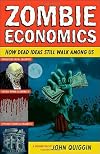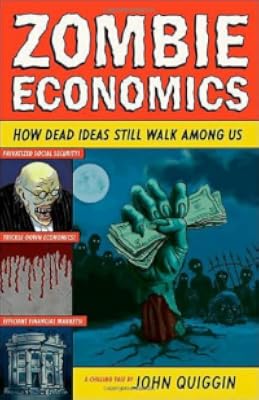
Zombie Economics: How Dead Ideas Still Walk Among Us
by John Quiggin
On This Page
Description
In the graveyard of economic ideology, dead ideas still stalk the land. The recent financial crisis laid bare many of the assumptions behind market liberalism--the theory that market-based solutions are always best, regardless of the problem. For decades, their advocates dominated mainstream economics, and their influence created a system where an unthinking faith in markets led many to view speculative investments as fundamentally safe. The crisis seemed to have killed off these ideas, but show more they still live on in the minds of many--members of the public, commentators, politicians, economists, and even those charged with cleaning up the mess. In Zombie Economics, John Quiggin explains how these dead ideas still walk among us--and why we must find a way to kill them once and for all if we are to avoid an even bigger financial crisis in the future. Zombie Economics takes the reader through the origins, consequences, and implosion of a system of ideas whose time has come and gone. These beliefs--that deregulation had conquered the financial cycle, that markets were always the best judge of value, that policies designed to benefit the rich made everyone better off--brought us to the brink of disaster once before, and their persistent hold on many threatens to do so again. Because these ideas will never die unless there is an alternative, Zombie Economics also looks ahead at what could replace market liberalism, arguing that a simple return to traditional Keynesian economics and the politics of the welfare state will not be enough--either to kill dead ideas, or prevent future crises. In a new chapter, Quiggin brings the book up to date with a discussion of the re-emergence of pre-Keynesian ideas about austerity and balanced budgets as a response to recession. show lessTags
Recommendations









Member Reviews
Only read this book if you are prepared to be grumpy. I've been wondering for the past 2-3 years why politicians have been arguing back and forth about the bailout, healthcare, the budget, etc. without really having any intelligent or substantial feedback from economists. I figured they were just ignoring the economists because they were dumb politicians. Actually, the truth is that there are hardly any macroeconomists who have had anything useful to say about the recession.
Quiggin does a very good job of explaining how macroeconomics went so wrong over the past forty years and demonstrating that mainstream ideas about market efficiency have very little relationship to reality. Despite lots of technical details, the book is fairly show more accessible to those of us who know embarrassingly little about economics and is a short, engaging read.
I am not enough of an expert on economics or politics to be able to properly argue against any dumb conservative objections to Quiggin's argument, but honestly all of the rebuttals I could imagine would have to start with the assumption that our current economic crisis, and the gross inequality that preceded it, is somehow better than the alternative. Yeah, sorry, I'm not buying it. show less
Quiggin does a very good job of explaining how macroeconomics went so wrong over the past forty years and demonstrating that mainstream ideas about market efficiency have very little relationship to reality. Despite lots of technical details, the book is fairly show more accessible to those of us who know embarrassingly little about economics and is a short, engaging read.
I am not enough of an expert on economics or politics to be able to properly argue against any dumb conservative objections to Quiggin's argument, but honestly all of the rebuttals I could imagine would have to start with the assumption that our current economic crisis, and the gross inequality that preceded it, is somehow better than the alternative. Yeah, sorry, I'm not buying it. show less
The author had a great idea for this book but it doesn't quite live up to my expectations. It is a good, simplified, history of the ups and downs (and returns to life) of various flavours of economics over the last century but doesn't do a good job of addressed the structural and cultural forces that play such a strong role in the curious revivification of ideas that by all logic should have long since withered. Indeed, it is a strangely apolitical book given the way in which economics and politics are two sides of the same coin.
A great concept, an even better title but rather meh results. In five chapters, Quiggin introduces, discusses and assesses the concepts of the Great Moderation/Goldilocks, the efficient market hypothesis, the Dynamic Stochastic General Equilibrium model, trickle-down economics and privatization. In this selection, the big missing elephant is deregulation. While some of these ideas might have played a role in the economic meltdown, the dereliction of duty of the regulators and the corruption of the rating agencies and risk managers was its prime cause. If Standards & Poor and Moody's had done their job, they would never have granted the AAAs. If the lawyers had done their job, they would never allow MBS trusts without a full complement show more of mortgages to be sold. If risk managers had done their duty, they would have required sufficient capital to be set aside to cover the exposure. If the regulators had done their job, they would have reined in speculation and increased margins. The world witnessed a complete breakdown of professionalism. Vicomte de Valmont's "It's beyond my control" when it clearly wasn't. Bad ideas played the least part.
Similar to the moral breakdown of the Catholic Church prior to the reformation in the 14th and 15th century, the failure lay not primarily in a misunderstanding of doctrine but a breakdown of professional practice. The clergy simply no longer cared to do their job and nobody held them accountable. It took a long long time until the peasant's complaints were heard. Actually, only when the cities became involved, did matters change. Given that today, the main centers of wealth are also the centers of corruption, we are in for the long haul.
The track record of the Christian belief in corporal resurrection, the original Zombies, exemplifies the longevity of strange ideas. Ideas, being immaterial, can not be killed. It takes great effort to change even the most strange beliefs (cf. creationism). In economics, bad ideas have taken over whole universities. Quiggin offers no plan how to neutralize the bad ideas machine that is the University of Chicago. It is unlikely that we will witness an internal collapse as happened to most Marxist economics. Quiggin's approach in discussing the successes and failures of his five selected concepts is of little help in convincing Zombies to change their behavior. show less
Similar to the moral breakdown of the Catholic Church prior to the reformation in the 14th and 15th century, the failure lay not primarily in a misunderstanding of doctrine but a breakdown of professional practice. The clergy simply no longer cared to do their job and nobody held them accountable. It took a long long time until the peasant's complaints were heard. Actually, only when the cities became involved, did matters change. Given that today, the main centers of wealth are also the centers of corruption, we are in for the long haul.
The track record of the Christian belief in corporal resurrection, the original Zombies, exemplifies the longevity of strange ideas. Ideas, being immaterial, can not be killed. It takes great effort to change even the most strange beliefs (cf. creationism). In economics, bad ideas have taken over whole universities. Quiggin offers no plan how to neutralize the bad ideas machine that is the University of Chicago. It is unlikely that we will witness an internal collapse as happened to most Marxist economics. Quiggin's approach in discussing the successes and failures of his five selected concepts is of little help in convincing Zombies to change their behavior. show less
Interesting read that helps me to contextualize and reimagine many of my positions and understandings on economic issues. The format is useful and rather cute too, separating the different ideas into chapters and as different kinds of zombies.
Written by a prominet academic, this is fairly heavy going and not always that accessible, but offers plenty to ponder.
Ratings
Members
- Recently Added By
Published Reviews
ThingScore 75
Apparently some economists have a sense of humor, dismal though it may be. Quiggin (economics, Univ. of Queensland, Australia) uses the 2008 global financial crisis as the focal point for examining five core macroeconomic and financial theories that have been—to use zombie terminology—killed by our current predicament. These concepts are essentially tenets of free-market economics, which show more Quiggin refers to as 'market liberalism.' Each chapter examines the birth, life, and death of an idea and offers suggestions for alternative views, along with extensive reading lists. He covers important territory such as the efficient-markets hypothesis, trickle-down economics, and privatization. Using examples that focus mainly on the United States, the UK, and his native Australia, he draws similar conclusions from markets and economies worldwide, starting with the Great Depression and working his way to the present global financial crisis. VERDICT: While this book's title and cover art imply pop economics, its content is considerably more academic. Because the embedded concepts require an understanding of macroeconomics, microeconomics, and finance, Quiggin clues readers in to key theories and concepts without bogging down the text. Economics students and interested lay readers will find this valuable. show less
added by sduff222
Lists

The Enlightened Economist
107 works; 1 member
Author Information

9 Works 347 Members
John Quiggin is the Laureate Professor in Economics at the University of Queensland in Brisbane, Australia. He is the author of Zombie Economics: How Dead Ideas Still Walk among Us (Princeton). Twitter@JohnQuiggin
Common Knowledge
- Canonical title
- Zombie Economics: How Dead Ideas Still Walk Among Us
- Original title
- Zombie Economics: How Dead Ideas Still Walk Among Us
Classifications
Statistics
- Members
- 268
- Popularity
- 121,208
- Reviews
- 5
- Rating
- (3.66)
- Languages
- English, Finnish, Italian
- Media
- Paper, Audiobook, Ebook
- ISBNs
- 9
- ASINs
- 6