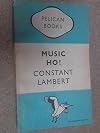
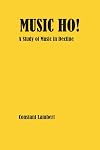
Music Ho!
by Constant Lambert
On This Page
Description
A brilliant analysis of the music of the twenties and thirties, also discusses the music of composers like Stravinsky, Satie, Gershwin, and considers the contributions of jazz and other pop music of the time with classical music.Tags
Recommendations























Member Reviews
The jaunty, even frivolous, title of this book sets just right tone for this work, and for its Author. Lambert was energetic, original, but not too utterly sold on his own world-historical significance, or indeed that of his chosen art. Still, he was an fine composer and conductor, whose accomplishments in both areas are still documented in readily available recordings. While it may be hard now to grasp why The Rio Grande was such a spell-binder in the Twenties, his Horoscope remains fresh and dear, and surprisingly subtle in 2012. There is also a chamber concerto which is fully as impressive as the roughly contemporary efforts of Janáček and Berg. The insider’s view of music is always important, and one can even, with the passage show more of time, forgive what we now see as his abysmal ignorance of Early Music, and his off-hand racism, expressed and implied. Incidentally, it may be unfamiliar to many otherwise experienced readers, and even music-lovers, to observe that Lambert wrote in an era of unequaled excellence in English-language music-criticism; indeed, I make so bold as to say that in the first half of the The Twentieth Century, English-language writers were the world-leaders in this now sadly debased art. It is no mean accomplishment to leave a book which can sit on the shelf without shame near the works of Newman, Gray, Cardus, Tovey, Haddow, and – in coming years – Mann, Mellers, Davies, Palmer, and Kennedy.
However, and it is a huge “however”, there is the subtitle of the book, which survived through multiple editions, despite what should have been the evidence of his senses. The idea that music was somehow “in decline” is true only for those with very peculiar assumptions. As little as I like lists, my mind is crowded with the names of musical immortals in many genres who were doing some of their best work even as this book appeared. True, the world had recently lost Respighi, Sibelius, Rakhmaninov, Gershwin, Ives, and sundry others either medically, or for all practical purposes musically. But how about Bartók, Beecham, Bloch, Big Bill Broonzy, Schoenberg, Furtwängler, Segovia, Louis Armstrong, Gieseking, Shostakovich, Walton, Ali Akbar Khan, Count Basie, Maria Callas, Poulenc, Hans Hotter, Barber, Virgil Thompson, Landowska, Goodman, Finzi, Britten, Copland, and the creators of Be-Bop and Bluegrass? During Lambert’s prime – and it is greatly to be regretted that he died decades too early –the biggest challenge to music was the biggest challenge to all life on this planet, namely World War II, and the subsequent descent into the nuclear age and the Cold War. Yet music, far from declining, came back, if not with re-doubled vigour, then at-least with an energy and significance such that anyone reading this review need only contemplate what his her own life would have been without the music of the past half-century, the supposed sink-hole into which Lambert saw music declining. Still, he loved music, he made music, he wrote about it with love (even if his archness and throwaway lines are a bit much) – in other words, he was and is one of us, and richly deserves to be read today. show less
However, and it is a huge “however”, there is the subtitle of the book, which survived through multiple editions, despite what should have been the evidence of his senses. The idea that music was somehow “in decline” is true only for those with very peculiar assumptions. As little as I like lists, my mind is crowded with the names of musical immortals in many genres who were doing some of their best work even as this book appeared. True, the world had recently lost Respighi, Sibelius, Rakhmaninov, Gershwin, Ives, and sundry others either medically, or for all practical purposes musically. But how about Bartók, Beecham, Bloch, Big Bill Broonzy, Schoenberg, Furtwängler, Segovia, Louis Armstrong, Gieseking, Shostakovich, Walton, Ali Akbar Khan, Count Basie, Maria Callas, Poulenc, Hans Hotter, Barber, Virgil Thompson, Landowska, Goodman, Finzi, Britten, Copland, and the creators of Be-Bop and Bluegrass? During Lambert’s prime – and it is greatly to be regretted that he died decades too early –the biggest challenge to music was the biggest challenge to all life on this planet, namely World War II, and the subsequent descent into the nuclear age and the Cold War. Yet music, far from declining, came back, if not with re-doubled vigour, then at-least with an energy and significance such that anyone reading this review need only contemplate what his her own life would have been without the music of the past half-century, the supposed sink-hole into which Lambert saw music declining. Still, he loved music, he made music, he wrote about it with love (even if his archness and throwaway lines are a bit much) – in other words, he was and is one of us, and richly deserves to be read today. show less
Ratings
Members
- Recently Added By
Author Information

Series
Belongs to Publisher Series
Pelican Books (A195)
Common Knowledge
- Original publication date
- 1934
- Original language
- English
Classifications
Statistics
- Members
- 67
- Popularity
- 464,773
- Reviews
- 1
- Rating
- (3.83)
- Languages
- English
- Media
- Paper, Ebook
- ISBNs
- 6
- ASINs
- 5