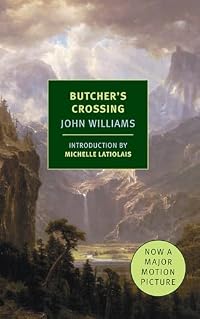
Butcher's Crossing
by John Williams
On This Page
Description
In his National Book Award-winning novel Augustus, John Williams uncovered the secrets of ancient Rome. With Butcher's Crossing, his fiercely intelligent, beautifully written western, Williams dismantles the myths of modern America. It is the 1870s, and Will Andrews, fired up by Emerson to seek "an original relation to nature," drops out of Harvard and heads west. He washes up in Butcher's Crossing, a small Kansas town on the outskirts of nowhere. Butcher's Crossing is full of restless men show more looking for ways to make money and ways to waste it. Before long Andrews strikes up a friendship with one of them, a man who regales Andrews with tales of immense herds of buffalo, ready for the taking, hidden away in a beautiful valley deep in the Colorado Rockies. He convinces Andrews to join in an expedition to track the animals down. The journey out is grueling, but at the end is a place of paradisiacal richness. Once there, however, the three men abandon themselves to an orgy of slaughter, so caught up in killing buffalo that they lose all sense of time. Winter soon overtakes them: they are snowed in. Next spring, half-insane with cabin fever, cold, and hunger, they stagger back to Butcher's Crossing to find a world as irremediably changed as they have been. show lessTags
Recommendations






Member Recommendations
gust De bizonjacht is de verbindende factor.
Member Reviews
John Williams is such a good writer. He has taken a subject I should have been revolted by and turned it into a book I would highly recommend.
Butcher's Crossing is a small western town on the brink of great things in the mid 1800s. Will Andrews arrives there from his comfortable life in Boston looking for an adventure. He meets a man named Miller who has been waiting a decade for someone to fund his next great adventure, traveling back to a Colorado valley where he saw thousands of buffalo ripe for the slaughter to gain their skins.
The two set out with a skinner, Schneider, and a wagon driver/cook, Charley Hoge. They have a tough journey out there, but arrive to find the promised herd. What follows is multiple chapters of details of the show more slaughter. It will turn your stomach. And then you realize that this is a story of greed and obsession. This greed has consequences. The men get snowed in to the valley for the entire winter. The second half of the book answers whether all of their work will be rewarded or if the trip is a bust.
I really liked this, despite the hunting. In fact, I thought the hunting scenes were an honest look at what could have driven white men to slaughter an entire species. Williams doesn't trivialize or sanction his characters' actions. show less
Butcher's Crossing is a small western town on the brink of great things in the mid 1800s. Will Andrews arrives there from his comfortable life in Boston looking for an adventure. He meets a man named Miller who has been waiting a decade for someone to fund his next great adventure, traveling back to a Colorado valley where he saw thousands of buffalo ripe for the slaughter to gain their skins.
The two set out with a skinner, Schneider, and a wagon driver/cook, Charley Hoge. They have a tough journey out there, but arrive to find the promised herd. What follows is multiple chapters of details of the show more slaughter. It will turn your stomach. And then you realize that this is a story of greed and obsession. This greed has consequences. The men get snowed in to the valley for the entire winter. The second half of the book answers whether all of their work will be rewarded or if the trip is a bust.
I really liked this, despite the hunting. In fact, I thought the hunting scenes were an honest look at what could have driven white men to slaughter an entire species. Williams doesn't trivialize or sanction his characters' actions. show less
In a way, it's surprising that I even picked up Butcher's Crossing, let alone genuinely liked it. I hated Stoner, John Williams' (bafflingly) well-received 1965 novel, and though I acknowledged at the time that Butcher's Crossing was more likely to be my cup of tea, I wasn't filled with confidence. I was on my guard throughout, and was particularly wary when it became apparent it was exploring many of the same themes as the execrable Stoner. However, I found that everything Stoner did wrong, the earlier Butcher's Crossing did right, and it was a thoroughly enjoyable read. (Note: if you did like Stoner, you will probably still like Butcher's Crossing as it is thematically and stylistically similar. I know I'm in the minority, but Stoner show more was just awful.)
First of all, the characters. In Stoner, the characters were all unlikeable and poorly-drawn: cartoonish, contemptible little creatures. In Butcher's Crossing they are real: flawed, no doubt, but a tangible and believable presence on the page. Williams uses fairly conventional character molds: the hard-living hunters, the idealistic, thoughtful young protagonist, the hooker with a heart of gold. But they never seem cliché and they allow the reader to be spared the confusing rollercoaster from Stoner, when every page seemed to announce its arrival with another laughably illogical decision from one of the main characters. Consequently, the reader can, to some extent, set the characters aside and engage with Williams' central themes.
The themes are similar to Stoner, but are presented much more coherently and sympathetically. Whereas Stoner seemed to revel in the fact that life was, and I quote, expended in cheerless labour" followed by thankless death, Butcher's Crossing's similar theme of futility in the actions of man is tempered with a thin thread of hope that is hard to summarise in words. By the end of the book, the reader gets a sense that Will Andrews, Butcher's' protagonist, has been irredeemably changed by the events he has experienced, even if we don't know quite how exactly. Whilst to a prospective reader this may seem like a cop-out, in reality it is rather profound: life lessons aren't always clear-cut and as much as we try to reason them out we might not succeed. We're shaped by the events in our lives in ways we don't always anticipate or even recognise; I'm sure everyone reading this will have tried to take stock of their lives at some point and failed to grasp any workable conclusions.
Butcher's Crossing is also more than a cut above Stoner as it has a ready-made genre to work with and explore. I love westerns, both the fast-paced, gunslinging outlaw type and the more stoic, slow-paced type. This novel is firmly in the latter category, and has a number of profound things to say about the West as a central piece of American national myth-making as well as a vehicle in which to speculate on wider themes about the nature of man. The romanticism of nature that Andrews and his party experience is incredibly evocative, particularly the untouched-by-man valley in the mountains and the massive herds of buffalo. Such sights are now long gone in modern America (particularly the herds of buffalo, which at their peak must have been a majestic sight in terms of their movement and in sheer scale), but Williams does an excellent job of conjuring them in the reader's mind. These parts of the prose are magical.
But Williams is no misty-eyed romantic. He juxtaposes this romanticism of nature with the cold, hard reality. He chillingly describes the massacre of the buffalo by the party of hunters, impressing on the reader that these are living, breathing animals and not just targets at the end of a gun barrel. He recounts in gruesome, unsentimental detail the stripping of their corpses for their hides and for meat, contrasting the grotesqueness of their defiled corpses with the dignity and majesty which these creatures had possessed in life just moments before. There is a sense of Andrews and the other hunters, particularly Miller, both embracing and rejecting nature. Killing is, of course, essential in the circle of life but the hunters go too far, exterminating systematically all of the buffalo in the valley and mechanically stripping their corpses - and all for money. The idea of man taming nature (the central precept of the American national myth: that of 'winning' the West) is turned on its head. The men cause their damage, and there is an underlying acceptance that things are fundamentally and irredeemably changed by human interference (readers will no doubt be aware of the eventual extinction of the buffalo herds and the relentless progress of the railroad). But nature endures and always wins out in the end: witness the snowstorm which exhausts the hunting party; witness the natural renewal of the valley in the months after the slaughter of the buffalo; witness the river which proves so indomitable and indiscriminate as the party makes its way back to town.
There is a lot more life in the western genre than is often credited; westerns have the potential to tell us a lot, and Butcher's Crossing says more than most. It is also incredibly eloquent and profound in doing so. It is refreshing that there is a western book out there which is comfortable with its literary endeavours without going overboard like Cormac McCarthy's later Blood Meridian. For Andrews, the West is "a vague country whose limits and extents were undefined" (pg. 43), but it is instructive that at the end, although Andrews still heads west, there are numerous references to the east: the rising sun, et cetera. I believe this is an important message from John Williams' Butcher's Crossing: yes, the West is central to the American national myth, but the east is integral too. It is the yin to the west's yang. The west is the wilder, more primal side of the American identity: relentless entrepreneurial progress, ruthless opportunism and attempt at dominance over nature. But this must be tempered by the east: from the east comes the ideals and moral values on which America was founded and enabled her to expand westwards. The more civilised east was what the Americans of the frontier endeavoured to bring westwards; without this aim, there would have been no force behind western expansion. When Andrews shuns the east and sets off into the wild terrain of the west as an escape, he is almost consumed by the wildness. I have heard Butcher's Crossing described as 'the Western Heart of Darkness', and it is certainly an appropriate comparison. It is this complete picture - that the west should be considered alongside the east in the American national myth - that Williams endeavours to present, and he succeeds in doing so. His success ensures that Butcher's Crossing can without any doubt be declared an exceptional novel." show less
First of all, the characters. In Stoner, the characters were all unlikeable and poorly-drawn: cartoonish, contemptible little creatures. In Butcher's Crossing they are real: flawed, no doubt, but a tangible and believable presence on the page. Williams uses fairly conventional character molds: the hard-living hunters, the idealistic, thoughtful young protagonist, the hooker with a heart of gold. But they never seem cliché and they allow the reader to be spared the confusing rollercoaster from Stoner, when every page seemed to announce its arrival with another laughably illogical decision from one of the main characters. Consequently, the reader can, to some extent, set the characters aside and engage with Williams' central themes.
The themes are similar to Stoner, but are presented much more coherently and sympathetically. Whereas Stoner seemed to revel in the fact that life was, and I quote, expended in cheerless labour" followed by thankless death, Butcher's Crossing's similar theme of futility in the actions of man is tempered with a thin thread of hope that is hard to summarise in words. By the end of the book, the reader gets a sense that Will Andrews, Butcher's' protagonist, has been irredeemably changed by the events he has experienced, even if we don't know quite how exactly. Whilst to a prospective reader this may seem like a cop-out, in reality it is rather profound: life lessons aren't always clear-cut and as much as we try to reason them out we might not succeed. We're shaped by the events in our lives in ways we don't always anticipate or even recognise; I'm sure everyone reading this will have tried to take stock of their lives at some point and failed to grasp any workable conclusions.
Butcher's Crossing is also more than a cut above Stoner as it has a ready-made genre to work with and explore. I love westerns, both the fast-paced, gunslinging outlaw type and the more stoic, slow-paced type. This novel is firmly in the latter category, and has a number of profound things to say about the West as a central piece of American national myth-making as well as a vehicle in which to speculate on wider themes about the nature of man. The romanticism of nature that Andrews and his party experience is incredibly evocative, particularly the untouched-by-man valley in the mountains and the massive herds of buffalo. Such sights are now long gone in modern America (particularly the herds of buffalo, which at their peak must have been a majestic sight in terms of their movement and in sheer scale), but Williams does an excellent job of conjuring them in the reader's mind. These parts of the prose are magical.
But Williams is no misty-eyed romantic. He juxtaposes this romanticism of nature with the cold, hard reality. He chillingly describes the massacre of the buffalo by the party of hunters, impressing on the reader that these are living, breathing animals and not just targets at the end of a gun barrel. He recounts in gruesome, unsentimental detail the stripping of their corpses for their hides and for meat, contrasting the grotesqueness of their defiled corpses with the dignity and majesty which these creatures had possessed in life just moments before. There is a sense of Andrews and the other hunters, particularly Miller, both embracing and rejecting nature. Killing is, of course, essential in the circle of life but the hunters go too far, exterminating systematically all of the buffalo in the valley and mechanically stripping their corpses - and all for money. The idea of man taming nature (the central precept of the American national myth: that of 'winning' the West) is turned on its head. The men cause their damage, and there is an underlying acceptance that things are fundamentally and irredeemably changed by human interference (readers will no doubt be aware of the eventual extinction of the buffalo herds and the relentless progress of the railroad). But nature endures and always wins out in the end: witness the snowstorm which exhausts the hunting party; witness the natural renewal of the valley in the months after the slaughter of the buffalo; witness the river which proves so indomitable and indiscriminate as the party makes its way back to town.
There is a lot more life in the western genre than is often credited; westerns have the potential to tell us a lot, and Butcher's Crossing says more than most. It is also incredibly eloquent and profound in doing so. It is refreshing that there is a western book out there which is comfortable with its literary endeavours without going overboard like Cormac McCarthy's later Blood Meridian. For Andrews, the West is "a vague country whose limits and extents were undefined" (pg. 43), but it is instructive that at the end, although Andrews still heads west, there are numerous references to the east: the rising sun, et cetera. I believe this is an important message from John Williams' Butcher's Crossing: yes, the West is central to the American national myth, but the east is integral too. It is the yin to the west's yang. The west is the wilder, more primal side of the American identity: relentless entrepreneurial progress, ruthless opportunism and attempt at dominance over nature. But this must be tempered by the east: from the east comes the ideals and moral values on which America was founded and enabled her to expand westwards. The more civilised east was what the Americans of the frontier endeavoured to bring westwards; without this aim, there would have been no force behind western expansion. When Andrews shuns the east and sets off into the wild terrain of the west as an escape, he is almost consumed by the wildness. I have heard Butcher's Crossing described as 'the Western Heart of Darkness', and it is certainly an appropriate comparison. It is this complete picture - that the west should be considered alongside the east in the American national myth - that Williams endeavours to present, and he succeeds in doing so. His success ensures that Butcher's Crossing can without any doubt be declared an exceptional novel." show less
We have something to say to each other, Andrews thought dimly, but we don't know what it is; we have something we ought to say.
In a word, harrowing. I read this immediately following No Country for Old Men, and it should tell you something that Williams's very literary story about buffalo hunting is a thousand times more upsetting than the blood-soaked grit of McCarthy's revisionist western. Through Williams's writing, we see a vision of the west as an utterly inhospitable place, of man in a one-sided war against all of God's creation. Miller, the hunter at the centre of the story, is not driven by greed, ambition, lust, or glory--not primarily, anyway. One rather gets the sense that Miller is a kind of elemental force, a feature of the show more landscape, totally dominated by alien logic that not even he understands. Miller doesn't know why he is driven to kill every last standing buffalo, and that's the horror at the centre of the story. If we are impelled by economic forces beyond our command, then how could our forays into nature end up meaning anything to us or showing us anything about ourselves? How else could they end, but in a meaningless, joyless slaughter? show less
A young man, Will Andrews, decides to leave his studies at Harvard, in the 1870s, to go have an experience at Butcher's Crossing, a town with a hide buyer. He asks around and finds Miller who seems like a charlatan, promising a paradise of buffaloes in a hidden valley between two peaks in Colorado. The novel's themes start to sink in when you see the relationship between these men is flimsy and strictly professional while they're trying to survive a long stretch without water. They reach the valley and the blind determination and the blood thirst of Miller leave them to hold for the whole winter. These men can't really win against nature, they end up torn apart physically and psychologically since they discover the futlity of everything show more they worked so hard to earn. The protagonist holds himself to a void the whole novel, never really sure where he's going or why. It's interesting the reflections John Williams have about becoming pure instinct to survive and holding yourself with the memories of your humanity and civilized self. That civilization and progress is what ends up betraying them at the end. Ain't that some shit!!
"Me ruin you?" McDonald laughed. "You ruin yourself, you and your kind. Every day of your life, everything you do. Nobody can tell you what to do. No. You go your own way, stinking the land up with what you kill. You flood the market with hides and ruin the market, and then you come crying to me that I've ruined you." Mcdonald's voice became anguished. "If you'd just listened - all of you. You're no better than the things you kill." show less
"Me ruin you?" McDonald laughed. "You ruin yourself, you and your kind. Every day of your life, everything you do. Nobody can tell you what to do. No. You go your own way, stinking the land up with what you kill. You flood the market with hides and ruin the market, and then you come crying to me that I've ruined you." Mcdonald's voice became anguished. "If you'd just listened - all of you. You're no better than the things you kill." show less
Butcher’s Crossing may be a “western” but it combines aspects of romanticism-meets-reality, coming of age, obsession, and the uncertainty of identity in wide open spaces. I’ll try to explain that last one before I’m finished.
The story is told from the perspective of Will Andrews. The setting is Kansas, still a frontier in the 1870s. Andrews has left his home in Boston, where he was studying at Harvard, and, at least partly under the inspiration of Ralph Waldo Emerson’s philosophically romantic vision of America, gone to explore the frontier and his own place there. Andrews’ age is given as in his early twenties.
He travels to the small town of Butcher’s Crossing, where, through his father’s connections, finds J. D. show more McDonald, a trader in buffalo hides. McDonald is less than completely enthusiastic about Andrews’ aspiration to learn about and potentially join a buffalo hunt, but he directs him toward a hunter named Miller, as someone who truly knows his way around the mountains and the buffalo herds that live in them.
Miller becomes a central character to the story, maybe as core to the reader as Andrews himself. Miller becomes a mentor and guide to Andrews. Andrews in turn finances a hunt that’s really more than just a hunt for Miller. Years ago, Miller had found a huge herd of buffalo in a valley set into the mountains of Colorado, a herd much larger than any now accessible in the nearly hunted-out areas that other hunters are making do with.
Already at this point in the story, Miller’s memory and his vision of this valley takes on a mythical feel, an El Dorado or even a great white whale. The greater part of the story follows the journey out to find the hidden valley, with Miller and Andrews accompanied by the buffalo skinner, Schneider, and Miller’s sidekick, a one-armed wagon-driver and cook named Charley Hoge.
I won’t spoil the action by saying that they do find Miller’s El Dorado, an untouched valley with thousands of buffalo there for the taking. At that point the similarity switches from El Dorado to the great white whale as Miller’s determination to take every single buffalo in the valley plays between an Ahah-like obsession and a kind of calm, experienced wisdom. And Andrews is in no position to be sure which it is.
Miller pushes too far, and nobody is left the person they were at the beginning of the story.
Andrews’ romance with the west isn’t really over, but it has slipped on into a new stage — what I meant by the uncertinaty of identity in wide open spaces. When he arrived, he was the young man in search of an experience, the experience of what Emerson’s vision had implanted. Now he’s been there. It’s really not clear what the west is or who he can be or will be in it. His encounter with its reality has left him more mature, but maturity here may have more to do with uncertainty than with settling in to a place in the world. show less
The story is told from the perspective of Will Andrews. The setting is Kansas, still a frontier in the 1870s. Andrews has left his home in Boston, where he was studying at Harvard, and, at least partly under the inspiration of Ralph Waldo Emerson’s philosophically romantic vision of America, gone to explore the frontier and his own place there. Andrews’ age is given as in his early twenties.
He travels to the small town of Butcher’s Crossing, where, through his father’s connections, finds J. D. show more McDonald, a trader in buffalo hides. McDonald is less than completely enthusiastic about Andrews’ aspiration to learn about and potentially join a buffalo hunt, but he directs him toward a hunter named Miller, as someone who truly knows his way around the mountains and the buffalo herds that live in them.
Miller becomes a central character to the story, maybe as core to the reader as Andrews himself. Miller becomes a mentor and guide to Andrews. Andrews in turn finances a hunt that’s really more than just a hunt for Miller. Years ago, Miller had found a huge herd of buffalo in a valley set into the mountains of Colorado, a herd much larger than any now accessible in the nearly hunted-out areas that other hunters are making do with.
Already at this point in the story, Miller’s memory and his vision of this valley takes on a mythical feel, an El Dorado or even a great white whale. The greater part of the story follows the journey out to find the hidden valley, with Miller and Andrews accompanied by the buffalo skinner, Schneider, and Miller’s sidekick, a one-armed wagon-driver and cook named Charley Hoge.
I won’t spoil the action by saying that they do find Miller’s El Dorado, an untouched valley with thousands of buffalo there for the taking. At that point the similarity switches from El Dorado to the great white whale as Miller’s determination to take every single buffalo in the valley plays between an Ahah-like obsession and a kind of calm, experienced wisdom. And Andrews is in no position to be sure which it is.
Miller pushes too far, and nobody is left the person they were at the beginning of the story.
Andrews’ romance with the west isn’t really over, but it has slipped on into a new stage — what I meant by the uncertinaty of identity in wide open spaces. When he arrived, he was the young man in search of an experience, the experience of what Emerson’s vision had implanted. Now he’s been there. It’s really not clear what the west is or who he can be or will be in it. His encounter with its reality has left him more mature, but maturity here may have more to do with uncertainty than with settling in to a place in the world. show less
Stumbled upon another juggernaut of a novel in research for my upcoming short story collection. “Butcher’s Crossing” is yet again a Western that subverts expectation, rises above its genre while comfortably immersing you in its world. There’s no real antagonist, no great revelation, no pretense to be “the great American novel”. Whenever tragedy looms, it most likely will get sidestepped. When you meet the naïve narrator, you clench teeth against the inevitable exploitation—it never comes. Even the prostitute doesn’t have a heart of gold as much as a desire to hold someone close before the whipping winds of life harden the skins of young men. The butchery of the buffalo hunt, the methodical skinning and gutting, is more show more akin to “Moby Dick” than anything in literary Westerns. Even the Ahab-esque obsession that Miller exhibits is more doomsday of the soul than extermination of a species. I consider it a great blessing to have read something so unique yet familiar, gorgeous and grotesque, heartfelt and heartless. And I’m glad that my stumbling over this virtually unknown classic will only help to influence the story in my own collection.
“During the last hour of the stand he came to see Miller as a mechanism, an automaton, moved by the moving herd; and he came to see Miller’s destruction of the buffalo, not as a lust for blood or a lust for the hides or a lust for what the hides would bring, or even at last the blind lust of fury that toiled darkly within him—he came to see the destruction as a cold, mindless response to the life in which Miller had immersed himself.”
And this bit of wisdom:
“I always save the balls,” he said. “They make mighty good eating, and they put starch in your pecker. Unless they come off an old bull. Then you better just stay away from them.”
—Butcher’s Crossing by John Williams
Alas, this paragon has only given us four novels show less
“During the last hour of the stand he came to see Miller as a mechanism, an automaton, moved by the moving herd; and he came to see Miller’s destruction of the buffalo, not as a lust for blood or a lust for the hides or a lust for what the hides would bring, or even at last the blind lust of fury that toiled darkly within him—he came to see the destruction as a cold, mindless response to the life in which Miller had immersed himself.”
And this bit of wisdom:
“I always save the balls,” he said. “They make mighty good eating, and they put starch in your pecker. Unless they come off an old bull. Then you better just stay away from them.”
—Butcher’s Crossing by John Williams
Alas, this paragon has only given us four novels show less
”You should have come back. It would have been all right.”
“I know,” Andrews said, “But I thought I couldn’t. And then I was too far away.”
For what started out as a cross between “manifest destiny” and “go out into the wilderness and become your truest self” as told through a long and impossibly arduous buffalo hunt, I never expected Butcher’s Crossing to be as moving as it was, or for it to take down those very concepts with such stunning brutality.
Williams’ prose is incredibly descriptive and vivid, so much so that by the time the hunt has come to its end, the reader feels as weary and changed as the characters do. What could be painfully dull is kept interesting by focusing on certain “movements” during show more the trip, from the parched days spent without water, rambling blearily over the dusty plains, to the frigid winter spent shivering within the bellies of the very animals they slaughtered with abandon in the fall.
The characterisation is subtle and wonderful. You get so caught up in this story of going out to chase a dream which eventually becomes a story of survival that, like the protagonist with which you witness the events, you hardly notice the changes until they’re laid bare before you, and you’re left reeling, wondering if these ghastly people have been warped by this terrible journey or if it’s simply revealed their true selves.
Butcher’s Crossing is not an easy book. At times, it is as gruelling and harsh as the expedition it follows. But it’s also starkly beautiful and packed with fascinating subtext, both historical and philosophical, which makes the journey more than worth it. show less
Members
- Recently Added By
Published Reviews
ThingScore 75
added by Josep_Ferres
Lists

Top Five Books of 2020
982 works; 348 members

Read These Too
458 works; 9 members

Books Read in 2021
5,361 works; 114 members

Classics
31 works; 1 member
Author Information

12 Works 13,599 Members
Some Editions
Awards and Honors
Distinctions
Series
Belongs to Publisher Series
Work Relationships
Is contained in
Contains
Common Knowledge
- Canonical title
- Butcher's Crossing
- Original title
- Butcher's Crossing
- Original publication date
- 1960
- People/Characters*
- Will Andrews
- Important places*
- Butcher's Crossing, Kansas, USA
- Epigraph*
- »Es giebt Tage …, wo jedes Ding, welches Leben in sich hat, ein Zeichen der Zufriedenheit von sich giebt, und das Vieh, das hingestreckt liegt, große und ruhige Gedanken zu haben scheint. Nach diesem Halcyon kann man mit ... (show all)ziemlicher Gewißheit bei jenem reinen October-Wetter aussehen, welches wir mit dem Namen des indischen Sommers bezeichnen. Der unendlich lange Tag ruht schlafend auf den breiten Hügeln und den warmen weiten Feldern. Alle seine sonnigen Stunden durchlebt zu haben, scheint langes Leben genug. Die einsamen Orte scheinen nicht ganz einsam. Beim Eintritt in den Wald ist der erstaunte Weltling gezwungen, seine großen und kleinen, weisen und thörichten Dinge, auf die er Werth in der Stadt legte, dahinten zu lassen. Der Knappsack der Gewohnheit fällt von seinem Rücken mit dem ersten Schritt, den er in diesen Bereich hinein thut. Hier ist ein Gottesfurcht, die unsere Religion beschämt, und Realität, die unsere Helden in Mißcredit setzt. Hier finden wir, daß die Natur der Umstand ist, der jeden andern Umstand klein für uns macht, und daß sie einem Gotte gleich alle Menschen richtet, die zu ihr kommen.«
Ralph Waldo Emerson, ›Nature‹, in: Essays, Second Series. Boston 1845, a.d. Amerikanischen von G. Fabricius, Hannover 1858
»Ja, und die Dichter schicken das kranke Gemüt auf die grünen Auen, wie man lahme Pferde unbeschlagen auf den Rasen schickt, damit ihre Hufe nachwachsen. Die Dichter, die auf ihre Art auch so was wie Kräuterdoktors sind, die meinen ja, die Natur ist die große Heilerin von Herzeleid und Lungenweh. Und wer hat meinen Fuhrmann in der Prärie zu Tode erfroren? Und wer hat den Wilden Peter zum Idioten gemacht?«
Herman Melville, Maskeraden oder Vertrauen gegen Vertrauen, a.d. Amerikanischen von Christa Schuenke, Berlin 1999 - First words*
- De postkoets van Ellsworth naar Butcher's Crossing was een oude manschappenwagen, zo aangepast dat hij behalve passagiers ook vracht kon vervoeren.
- Last words*
- (Click to show. Warning: May contain spoilers.)Hij reed verder zonder haast, en voelde achter zich de zon langzaam opkomen en de lucht tastbaar worden.
- Original language
- English
*Some information comes from Common Knowledge in other languages. Click "Edit" for more information.
Classifications
- Genres
- Fiction and Literature, General Fiction, Historical Fiction
- DDC/MDS
- 813.54 — Literature & rhetoric American literature in English American fiction in English 1900-1999 1945-1999
- LCC
- PS3545 .I5286 .B8 — Language and Literature American literature American literature Individual authors 1900-1960
- BISAC
Statistics
- Members
- 2,290
- Popularity
- 8,625
- Reviews
- 79
- Rating
- (4.14)
- Languages
- 16 — Catalan, Danish, Dutch, English, Finnish, French, German, Greek, Hebrew, Hungarian, Italian, Norwegian (Bokmål), Portuguese, Romanian, Spanish, Swedish
- Media
- Paper, Audiobook, Ebook
- ISBNs
- 64
- ASINs
- 21