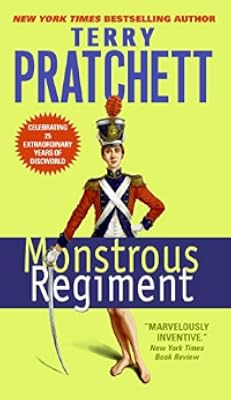
Monstrous Regiment
by Terry Pratchett
Discworld: Industrial (3), Discworld: City Watch, Discworld (31)
On This Page
Description
War has come to Discworld ... again. And, to no one's great surprise, the conflict centers around the small, arrogantly fundamentalist duchy of Borogravia, which has long prided itself on its unrelenting aggressiveness. A year ago, Polly Perks's brother marched off to battle, and Polly's willing to resort to drastic measures to find him. So she cuts off her hair, dons masculine garb, and -- aided by a well-placed pair of socks -- sets out to join this man's army. Since a nation in such dire show more need of cannon fodder can't afford to be too picky, Polly is eagerly welcomed into the fighting fold-along with a vampire, a troll, an Igor, a religious fanatic, and two uncommonly close 'friends.' It would appear that Polly 'Ozzer' Perks isn't the only grunt with a secret. But duty calls, the battlefield beckons. And now is the time for all good ... er ... 'men' to come to the aid of their country. show lessTags
Recommendations



Member Recommendations
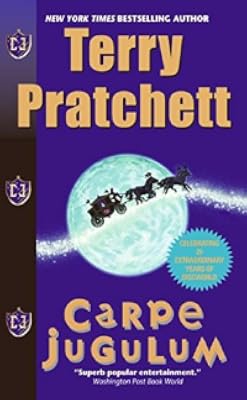
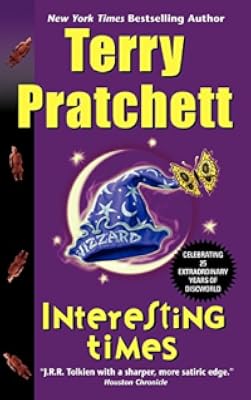
MyriadBooks For middle-grade readers who like mouthy protagonists who ignore naysayers: Because if Tiffany (age 9) isn't going to get help from any adult, she'll solve this on her own.
71


MyriadBooks For rising YA readers who like smart mouths and smarter brains, because when Lizbet(age 14) finds God's advice lacking any sort of practical application, she kicks off her quest with a heist. From the cathedral.
Member Reviews
And we're back. I was beginning to get worried that the last few novels in this series would deliver diminishing returns, but Pratchett comes roaring back with this entry.
Everything I want out of a Discworld book is present and accounted for here. A great story with some fun twists. Terrible puns and biting sarcasm. Humour. And an undercurrent of thoughtful discourse on a couple of topics.
Yup, this one is easily in the top five for the series.
Everything I want out of a Discworld book is present and accounted for here. A great story with some fun twists. Terrible puns and biting sarcasm. Humour. And an undercurrent of thoughtful discourse on a couple of topics.
Yup, this one is easily in the top five for the series.
Monstrous Regiment has the distinction of being the first Pratchett book I just fell into. No fighting with the narrative, no initial struggle to follow what was going on. It all just worked from the start.
In spite of this, something … wasn’t missing so much as, I suppose, this was a different kind of story than I was expecting, based on my one Sam Vimes book so far. This was much more satiric than my first City Watch, and really, much more blatant a satire than any of the Discworld books I’ve read so far.
Between this book and Carpe Jugulum I learned something about myself: I love good satire about the ‘smaller’ things in life, like politics, academia, and social mores, but I struggle to embrace satire about the ‘big’ show more things like religion and world politics. I think there are some things that are too big or too complex, to be effectively satirised, no matter that they make themselves such easy targets with their outsized human fallacies. Of course I’m not an advocate for war, nor am I an advocate for religion-for-profit, or religion-for-power, but I don’t believe that all, or even most, governments eagerly search out reasons to go to war, nor most followers or seekers of faith and guidance are less than sincere – though I’ve met more than a few of the latter in my life.
Now that I’ve said that, though, I want to give all the credit to Pratchett for what I felt was his attempt to be brutally, objectively, honest about his satire in Monstrous Regiment. A cynical reader might start reading this book and think ah, here’s the sop to feminism just about every bestselling male author writes anymore. A cynical reader would be wrong — which delights this cynical reader to no end. Truely, this is a book about how women can do anything men can do – and do it better. Pratchett’s just honest enough to point out that isn’t always something to be proud of, and he does it in the most extraordinary way.
His bitterness towards organised religion is as apparent, and almost as scathing, here as it was in Carpe Jugulum, but there’s also what feels like a newfound acknowledgment of the power of faith. Towards the end, it feels as though the author is wrestling with himself through his characters about the importance of belief in something greater than oneself.
This internal debate felt apparent to me not just in matters of faith, but in matters of politics and government. Polly’s realisation that she must play an ongoing, active part in her country’s fate, that lasting change doesn’t just happen because people want it to, that it’s a process that is forever going forward and backwards, feels like it’s a truth that’s only starting to be considered, rather than a wisdom being imparted to readers.
Then again, what do I know? Maybe I was just seeing zebras instead of horses, and disappointed by the lack of ginger root and oxen. What matters is that it’s a damn good story, and a more obviously philosophical one than any other discworld book I’ve read so far. show less
In spite of this, something … wasn’t missing so much as, I suppose, this was a different kind of story than I was expecting, based on my one Sam Vimes book so far. This was much more satiric than my first City Watch, and really, much more blatant a satire than any of the Discworld books I’ve read so far.
Between this book and Carpe Jugulum I learned something about myself: I love good satire about the ‘smaller’ things in life, like politics, academia, and social mores, but I struggle to embrace satire about the ‘big’ show more things like religion and world politics. I think there are some things that are too big or too complex, to be effectively satirised, no matter that they make themselves such easy targets with their outsized human fallacies. Of course I’m not an advocate for war, nor am I an advocate for religion-for-profit, or religion-for-power, but I don’t believe that all, or even most, governments eagerly search out reasons to go to war, nor most followers or seekers of faith and guidance are less than sincere – though I’ve met more than a few of the latter in my life.
Now that I’ve said that, though, I want to give all the credit to Pratchett for what I felt was his attempt to be brutally, objectively, honest about his satire in Monstrous Regiment. A cynical reader might start reading this book and think ah, here’s the sop to feminism just about every bestselling male author writes anymore. A cynical reader would be wrong — which delights this cynical reader to no end. Truely, this is a book about how women can do anything men can do – and do it better. Pratchett’s just honest enough to point out that isn’t always something to be proud of, and he does it in the most extraordinary way.
His bitterness towards organised religion is as apparent, and almost as scathing, here as it was in Carpe Jugulum, but there’s also what feels like a newfound acknowledgment of the power of faith. Towards the end, it feels as though the author is wrestling with himself through his characters about the importance of belief in something greater than oneself.
This internal debate felt apparent to me not just in matters of faith, but in matters of politics and government. Polly’s realisation that she must play an ongoing, active part in her country’s fate, that lasting change doesn’t just happen because people want it to, that it’s a process that is forever going forward and backwards, feels like it’s a truth that’s only starting to be considered, rather than a wisdom being imparted to readers.
Then again, what do I know? Maybe I was just seeing zebras instead of horses, and disappointed by the lack of ginger root and oxen. What matters is that it’s a damn good story, and a more obviously philosophical one than any other discworld book I’ve read so far. show less
"GOD hath revealed unto some in this our age, that it is more than a monster in nature that a Woman shall reign and have empire above Man. ...To promote a Woman to beare rule, or empire above any realme, nation or citie, is repugnant to nature, contumelie to God, and a thing moste contrariouse to his revealed and approved ordenance."
--John Knox, First Blast of the Trumpet Against the Monstrous Regimen of Women
. .
As sweet Polly Oliver lay musing in bed,
A sudden strange fancy came into her head.
"Father nor mother shall make me false prove,
I'll 'list as a soldier, and follow my love.
So early next morning she softly arose,
And dressed herself up in her dead brother's clothes.
She cut her hair close, and she stained her face brown,
And went show more for a soldier to fair London Town.
--Sweet Polly OliverBorn in the war-torn, misogynistic country of Borogravia, Polly Perks has grown up with the folksong echoing in the back of her mind. Perhaps, then, it is only natural that when her brother goes missing in action, Polly decides to use the song's example to find her brother. She cuts her hair, practices her swagger, and, equipped with a strategically-placed pair of socks, sets off to enlist. Of course, after countless years of war, Borogravia recruitment is scraping the bottom of the barrel. It isn't long before Polly discovers that she has joined in with a motley crew of trolls, vampires, Igors, and misfits--a truly monstrous regiment. "Oliver" Perks will fit right in.
Although this is one of my all-time favourite Pratchett books, I've avoided writing a review for it. It is simply too dense, too layered, too variable in tone and meaning, too good for me to feel comfortable sitting down for a half hour or so to pound out my thoughts. However, this blank space cries out for a review, and as Pratchett has a gift for the incisive phrase, I'm going to fill it with a jumbled collection of quotes, allusions, and unprocessed thoughts. (It's gonna be long. There are a lot of good quotes.) The tale of a woman dressing up as a soldier is not precisely original, but, as always, Pratchett puts a unique spin on the story. Granted, you'll pick up on the first twist early enough, but I promise there will be a few you didn't predict. Pratchett tells an entertaining, uplifting, and outrageously funny tale, but the story is also something more: a unique, humanistic exploration of fighting, faith, and feminism.And it's over the mountains and over the sea ...
Enlist my bonnie laddie and come awa with me.
--Recruiting Sergeant Monstrous Regiment is indeed a war story, but rather than showing us the adrenaline-filled front lines, we see only the war-torn, exhausted remnants the soldiers have left behind. The story starts with a view of Borogravia, a country so ingrained in jingoism that the language actually has words like "'Plogviehze!' that mean, 'The Sun Has Risen! Let's Make War!' As Pratchett notes, You needed a special kind of history to get all that in one word." Of course, Borogravia would have been left in--well, not peace, I suppose, but to its own devices--had it not impacted the economics of Ankh-Morpork by cutting down the clacks towers. Suddenly, it has become urgent to stop Borogravia, so Sam Vimes, commander of the watch, duke, and blackboard-monitor, has been sent to protect, as he puts it, "the interests of all money-lov...oops, sorry, all freedom-loving people everywhere." As Sam Vimes is one of my favorite characters, I loved seeing him in this cameo role, attempting to outwit William de Worde and making horrible faces behind Lord Rust's back. Since, as Pratchett puts it, Vimes thinks "war was simply another crime, like murder," he's willing to use any tricks available to him to put a stop to it.
In his humorous portrayal of Borogravia, Pratchett highlights the problems in defining patriotism as "My country, right or wrong":
"There was always a war....Borogravia was a peace-loving country in the midst of treacherous, devious, warlike enemies. They had to be treacherous, devious, and warlike, otherwise we wouldn't be fighting them, eh?"We, as humans, have a natural tendency to create groups by othering, by constructing an identity through shared hatreds. As Pratchett puts it, it can cause "an entire nation to be insane...Not the people, the nation...You take a bunch of people who don't seem any different from you and me, but when you add them together you get this sort of huge raving maniac with national borders and an anthem." What happens when patriotism becomes equivalent to exceptionalism?
"It came swiftly, like a blow, and Polly realized how wars happened. You took that shock that had run through her, and let it boil...it may be corrupt, benighted, and stupid, but it's ours...We have our pride. And that's what we're proud of. We're proud of being proud."Through the dual gazes of Polly and Vimes, Pratchett explores everything from the nature of the enemy to the hypocrisy of human interest:
"Have I got this right? Although many people have been killed and wounded in this wretched war, it's not been of much 'interest' to your readers? But it is now, just because of us? Because of a little skirmish in a town they've never heard of? And because of it, we're suddenly a 'plucky little country' and people are telling your newspaper that your great city should be on our side?"A few of my favourite quotes:hover for spoilerIn the end, Pratchett leaves the reader with one conclusion: "Revenge is not redress. Revenge is a wheel, and it turns backwards. The dead are not your masters."All I know is they fought so hard
They sent us all to hell, sir.
If ever I 'list for a soldier again
The devil shall be me sergeant.
--The Rogue's MarchAlthough less strident than Small Gods or Carpe Jugulum, Monstrous Regiment is also an exploration of faith. Borogravia's god, Nuggan, is long dead, and all that remains is a rather tetchy shell. The people now turn to the Dutchess, once their ruler, but now an icon of faith. While practical Polly has rejected both Nuggan and the Dutchess, one member of the Regiment, Wazzer, has the sort of belief that is so tangible it could be carved out of the sky. Wazz isn't precisely popular in the regiment, for, as Pratchett notes,
"The presence of those seeking truth is infinitely to be preferred to the presence of those who think they've found it."Throughout, Wazzer and Polly tangle over the meaning of faith:
"If you don't believe, or want to believe, or if you don't simply hope that there's nothing worth believing in, why turn round? And if you don't believe, who are you trusting to lead you out of the grip of dead men?"In the end, Pratchett both glorifies and condemns the power of faith hover for spoiler.
And so boldly did I fight, me boys, although I'm but a wench
And in buttoning up me trousers so often have I smiled
To think I lay with a thousand men and a maiden all the while.
--The Female DrummerThe theme that looms largest is the exploration of gender and identity. These types of stories usually portray a lone and unusually gifted and determined woman struggling to find her place in a man's world, creating the unfortunate implication that it takes an exceptional woman to achieve a man's position. Pratchett neatly turns this trope inside out. hover for spoiler Instead, Pratchett explores how such a role can change one's identity. Achieving such a role requires adaptation, but what happens if one gains acceptance by completely remolding one's personality until one becomes precisely what one sought to replace? At first, Polly is intoxicated by her ability to escape her gender:
"Have you noticed men talk.../i>listen to you differently too..It's like the world spins around your socks...Put on trousers and the world changes."However, she discovers that it is all too easy to lose herself in her role. Achieving equality by perfectly adopting the norms of the group, of becoming what you sought to conquer, is a pyrrhic victory at best. The trick, Polly discovers, is to decide which parts of her personality are her core, the aspects she wants to carry with her. hover for spoiler Throughout, the song, "The Girl I Left Behind Me" echoes in Polly's thoughts. She proves early on that she can play her role; the true challenge is to not allow it to swallow her identity, to not shed the truest version of herself as the girl she leaves behind her. hover for spoiler Jackrum, again, puts it succinctly:
So...whatever it is you are going to do next, do it as you. Good or bad, do it as you. Too many lies and there's no truth to go back to."A few more wonderful quotes:hover for spoiler
My review has focused on the political and social themes, but these are only a small part of the story. Pratchett also creates a host of original and multi-faceted characters, from the bellicose Sergeant Jackrum hover for spoiler to the coffee-addicted vampire Maladict to the rather weak-willed Shufti. The story is light and fun and uplifting and hilarious, but it is also thought-provoking and reflective. I don't know if this is a good fit for all readers, but if you are interested in a a deeply humanistic story or an incisive, multilayered, and often comedic examination of warcraft and religion and feminism and more, please give this book a read.
5 stars.I dreamt all men were equal
And there were no starving poor
And nations never did quarrel
Nor never went to war
I dreamt all men were angels
And women ne'er wore a frown
Old maids they had large families
As the world turned upside down
--The World Turned Upside Down (Chumbawamba) show less
This book was hilarious. I had zero idea of what it was about going into it, so I was pleasantly surprised all the way through. Polly Perks disguises herself as a boy in order to join the army and find her missing brother. There are a vampire, an 'Igor' and a troll in her regiment, and there is whispered advice in the latrine for her to stuff some socks down the front of her pants. I listened to this one via Audible. I imagine at some point I will listen to it again when I am in need of Pratchett's delightful wit. I practically piddled my pants with glee each and every time it was mentioned that something harmless, like shirts with six buttons, or something critical, such as crop rotation, was called an "abomination unto Nuggan."
Polly Perks can't remember a time when her country, Borogravia, wasn't at war. Her brother joined up and hasn't been heard of for months -- so she cuts off her hair, finds some trousers, and joins the army as a man. Once she's part of a regiment, things turn out to be even worse than she expected -- food is scarce, supplies are non-existent, and instead of getting trained, Polly and her fellow recruits are sent straight to the front, led by the veteran solider Sergeant Jackrum. Along the way, Polly starts to notice some strange things about her fellow soldiers, but she's not about to call them out when she's hiding something herself. Does Polly's regiment -- and Borogravia itself -- stand a chance?
This is one of my favorite Discworld show more novels, for sure. I think it was one of the first ones I read and I think it's a good entry point to the series, as it's a standalone and one of the best examples of Pratchett's humor and satirical talent. 5 stars. show less
This is one of my favorite Discworld show more novels, for sure. I think it was one of the first ones I read and I think it's a good entry point to the series, as it's a standalone and one of the best examples of Pratchett's humor and satirical talent. 5 stars. show less
Glad to see Sir Terry got on board with lesbianism. Disappointed but not surprised that the undeniable trans vibes in the book remain subtext however-- even Jackrum is she/her'd in the end. It's tough, because the book does an admirable job of tackling gender equality, institutional sexism, the complicity of ruling class women in the patriarchy, toxic masculinity, etc. But in the end, you're left with the feeling that Pratchett probably saw all the varied gender performances he'd written into the book as just... performances. Everyone is actually their original name and identity. The off-hand references to the unseen Captain Wrigglesworth also feel like cheap jibes.
I think I'm still going to rate this book highly, because I enjoyed it show more and it makes me happy to read my own ideas into the characters. Also... man, idk, maybe this is optimism, but I feel like Pratchett was very close to getting it. The book was written more than 20 years ago after all! There is something going on with how he wrotethe delay and privacy of Maladict's "gender reveal" moment , and Jackrum's unwillingness to dress as a washerwoman and ultimate happy ending as a man , and even General Froc's dance with the Duchess . And there is a lot of overlap and ambiguity with wartime cross-dressing (the obvious inspiration of the plot), gnc lesbianism (which seems to have been an influence on Pratchett, based on that one Gaiman interview), and transness. The issue is unclear. And I'm not an expert. Ultimately, all I can say is that Pratchett was a man born in the 40s after all, but I believe he was a kind person. And also that Maladict absolutely rules. Everything else is interpretation.
I haven't even touched on the other main themes of the book, which deal with jingoistic nationalism, organized religion, globalization, and advancing technology, among other things. These topics are obviously more familiar territory for Pratchett, and I think he writes them well. Despite the everpresent Discworld humor, I would call this one of Pratchett's "angry" books, which are my favorites of his (see most of the Tiffany Achings and Vimeses).
Also, I know this may have further annoyed our protagonist's main-character sensibilities, but I wish we'd gotten even more of Wazzer's absolutely off-the-wall Joan of Arc epic supernatural shit. I would kill for a sequel focused on that, maybe with some background antics of Sgt Perks & Mal making trouble in the military hierarchy, Tonker & Lofty's rage against the machine, and maybe a little nontraditional domesticity from Shufti, Paul, and baby Jack.
GNU Terry Pratchett show less
I think I'm still going to rate this book highly, because I enjoyed it show more and it makes me happy to read my own ideas into the characters. Also... man, idk, maybe this is optimism, but I feel like Pratchett was very close to getting it. The book was written more than 20 years ago after all! There is something going on with how he wrote
I haven't even touched on the other main themes of the book, which deal with jingoistic nationalism, organized religion, globalization, and advancing technology, among other things. These topics are obviously more familiar territory for Pratchett, and I think he writes them well. Despite the everpresent Discworld humor, I would call this one of Pratchett's "angry" books, which are my favorites of his (see most of the Tiffany Achings and Vimeses).
Also, I know this may have further annoyed our protagonist's main-character sensibilities, but I wish we'd gotten even more of Wazzer's absolutely off-the-wall Joan of Arc epic supernatural shit. I would kill for a sequel focused on that, maybe with some background antics of Sgt Perks & Mal making trouble in the military hierarchy, Tonker & Lofty's rage against the machine, and maybe a little nontraditional domesticity from Shufti, Paul, and baby Jack.
GNU Terry Pratchett show less
Tiny Borogravia is a plagued nuisance to her neighbors and has been for generations - border wars, poor weather, a god that abominates everything from the color blue to beets... But that's a country's rite, right? Sure it is - right up until the abomination and subsequent burning of the clax towers draws the attention of the powers that be in Ankh-Morpork. Obviously one little upstart country can't be allowed to pinch the transfer of news!
For Polly, international politics aren't even on the radar. All she wants to do is find her brother Paul, seasons gone for a soldier, and bring him home. Joining up seems the thing to do - all she needs is a haircut, a swagger, and a strategically placed roll of socks...
What happens when a group of raw show more recruits square off against the might of Ankh-Morpork? That's nothing compared to what happens when a group of women in disguise join the army. Funny from cover to cover. show less
For Polly, international politics aren't even on the radar. All she wants to do is find her brother Paul, seasons gone for a soldier, and bring him home. Joining up seems the thing to do - all she needs is a haircut, a swagger, and a strategically placed roll of socks...
What happens when a group of raw show more recruits square off against the might of Ankh-Morpork? That's nothing compared to what happens when a group of women in disguise join the army. Funny from cover to cover. show less
Members
- Recently Added By
Published Reviews
ThingScore 100
Like all of Pratchett's best work, this book bridges its classical sources to the present day, bringing feminist and trans themes to light along with contemporary ideas about religious wars, militarism, mercantilism and geopolitics.
And all of that in a novel that flies along with such sprightliness that you'd never suspect it was pulling such heavy freight.
And all of that in a novel that flies along with such sprightliness that you'd never suspect it was pulling such heavy freight.
added by lampbane
''Monstrous Regiment'' is most often spirited and shambolic, but it has some serious heft. Pratchett is on the side of those who make very little fuss, which means he gets to shiv those who do.
added by Shortride
Lists

Best Fantasy Novels
821 works; 361 members

Best Satire
188 works; 29 members

Female Protagonist
1,076 works; 57 members

Fantasy/Scifi Heroines Without Love Intrests
46 works; 10 members

Best 21st Century Books (So Far)
679 works; 86 members

Fantasy novels with a female protagonist
76 works; 15 members

Genre Benders: Comic Fantasy
97 works; 16 members

LGBTQ+ Speculative Fiction
821 works; 51 members

War Literature
101 works; 19 members

Mind Expanding Books by hackerkid
581 works; 8 members

Best Spec Fic Featuring Lesbians
27 works; 5 members

Books Read in 2014
2,344 works; 86 members

Girls Dressed as Boys
20 works; 4 members

Books Read in 2016
4,666 works; 199 members
Speculative Fiction to Read
706 works; 32 members

Books Read in 2017
4,249 works; 130 members

Huxley's reading log 2017
45 works; 1 member

Books Read in 2022
5,226 works; 115 members

Books Read in 2019
4,052 works; 108 members

Books Read in 2021
5,361 works; 114 members

Books Read in 2010
631 works; 11 members

Allie's Wishlist
217 works; 2 members

SciFi/Fantasy Without Romance!
37 works; 1 member

Best Feminist Science Fiction
188 works; 35 members

Unread books
1,063 works; 84 members
Author Information

454+ Works 582,062 Members
Terry Pratchett was on born April 28, 1948 in Beaconsfield, United Kingdom. He left school at the age of 17 to work on his local paper, the Bucks Free Press. While with the Press, he took the National Council for the Training of Journalists proficiency class. He also worked for the Western Daily Press and the Bath Chronicle. He produced a series show more of cartoons for the monthly journal, Psychic Researcher, describing the goings-on at the government's fictional paranormal research establishment, Warlock Hall. In 1980, he was appointed publicity officer for the Central Electricity Generating Board with responsibility for three nuclear power stations. His first novel, The Carpet People, was published in 1971. His first Discworld novel, The Colour of Magic, was published in 1983. He became a full-time author in 1987. He wrote more than 70 books during his lifetime including The Dark Side of the Sun, Strata, The Light Fantastic, Equal Rites, Mort, Sourcery, Truckers, Diggers, Wings, Dodger, Raising Steam, Dragons at Crumbling Castle: And Other Tales, and The Shephard's Crown. He was diagnosis with early onset Alzheimer's disease in 2007. He was knighted for services to literature in 2009 and received the World Fantasy award for life achievement in 2010. He died on March 12, 2015 at the age of 66. (Bowker Author Biography) show less
Some Editions
Awards and Honors
Awards
Distinctions
Notable Lists
Series


Belongs to Publisher Series
Work Relationships
Has the adaptation
Is abridged in
Common Knowledge
- Canonical title
- Monstrous Regiment
- Original title
- Monstrous Regiment
- Alternate titles
- Regimiento monstruoso (España) (España)
- Original publication date
- 2003-10
- People/Characters
- Polly Perks ('Oliver', 'Ozzer'); Corporal Strappi; Sergeant Jackrum; Duchess Annagovia (of Borogravia); Igor [Discworld] (Igorina); Sam Vimes (show all 25); Clarence Chinny (Ankh-Morpork consul to Zlobenia); Reg Shoe; Angua von Überwald; Prince Heinrich (of Zlobenia); Nuggan (god); Maladict (Maladicta); Carborandum (Jade); Tonker (Magda Halter); Shufti (Betty Manickle); Wazzer (Alice Goom); Lofty - Tilda Tewt; Lieutenant Blouse ('Daphne'); Paul Perks; Corporal Scallot; William de Worde; Otto von Chriek; Mrs. Enid; Major Clogston (Christine); General Froc (Mildred)
- Important places
- Borogravia, Discworld; Munz, Borogravia, Discworld; Plün, Borogravia, Discworld; Plotz, Borogravia, Discworld; Kneck, Borogravia, Discworld (valley and fortress)
- Epigraph
- [None]
- Dedication
- [None]
- First words
- Polly cut off her hair in front of the mirror, feeling slightly guilty about not feeling very guilty about doing so.
- Quotations
- The words "You heard me!" lined up to spring from Polly's tongue, but she hesitated. She told herself: it doesn't have to go this way. You don't have to let a pair of socks do the talking.
‘So where do [the Abominations] come from?’
‘From your fear... They come from the part that hates the Other, that will not change. They come from the sum of all your pettiness and stupidity and dullness. You fear tom... (show all)orrow, and you’ve made your fear your god.’ - Last words
- (Click to show. Warning: May contain spoilers.)And the new day was a great big fish.
- Original language
- English
Classifications
Statistics
- Members
- 10,532
- Popularity
- 921
- Reviews
- 150
- Rating
- (4.02)
- Languages
- 12 — Czech, Dutch, English, Estonian, Finnish, French, German, Hungarian, Polish, Russian, Spanish, Turkish
- Media
- Paper, Audiobook, Ebook
- ISBNs
- 64
- ASINs
- 33