
On This Page
Description
Brought to you by Penguin.Over 1 million Discworld audiobooks sold – discover the extraordinary universe of Terry Pratchett's Discworld like never before
The audiobook of Sourcery is read by Colin Morgan (Merlin; Testament of Youth; Belfast). BAFTA and Golden Globe award-winning actor Bill Nighy (Love Actually; Pirates of the Caribbean; Harry Potter and the Deathly Hallows) reads the footnotes, and Peter Serafinowicz (Star Wars: Episode I - The Phantom Menace; Shaun of the Dead) stars as show more the voice of Death. Featuring a new theme tune composed by James Hannigan.
'It's vital to remember who you really are . . . it isn't a good idea to rely on other people or things to do it for you, you see. They always get it wrong.'
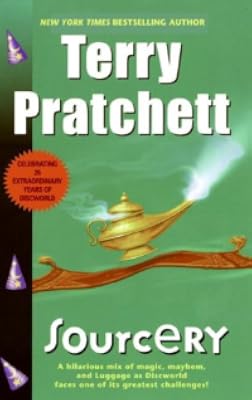
An eighth son of an eighth son is born, a wizard squared, a source of magic. A sourcerer.
Unseen University, the Discworld's most magical establishment, has finally got its wish: the emergence of a wizard more powerful than ever before. You'd think they would have been a little more careful what they wished for . . .
As the sourcerer takes over the University and sets his sights on the rest of the world, only one wizard manages to escape his influence. Unfortunately for everyone, it's Rincewind.
Once again the cowardly wizard must embark on a quest: to deliver a precious artefact - the very embodiment of magic itself - halfway across the Disc to safety. If he doesn't make it, the death of all wizardry is at hand.
And the end of the world, depending on who you listen to.
Sourcery is the third book in the Wizards series, but you can listen to the Discworld novels in any order.
The first book in the Discworld series - The Colour of Magic - was published in 1983. Some elements of the Discworld universe may reflect this.
'May well be considered his masterpiece . . . Humour such as his is an endangered species' The Times
'One of our greatest fantasists, and beyond a doubt the funniest' George R.R. Martin
© Terry and Lyn Pratchett 1988 (P) Penguin Audio 2022
. show less
Tags
Recommendations



Member Reviews
I think Sourcery is really the book where Pratchett starts to hit his stride as a writer. The humour gets more refined and more pervasive - in addition to at least one laugh per page, there are now numerous places where you can pause and smile a little to yourself. The little injokes he works in are used much more subtly in comparison to, say, The Colour of Magic - even if you don't know enough about the subject he's poking fun at, it's not blatant enough for you to feel irritated by it, or else it's subtle enough that you don't even notice it in the text. This is very different from TCoM, where the Wyrmberg section was a clear parody of a certain series of fantasy novels that I've not read, and large sections of which consequently went show more right over my head, to my annoyance.
Rincewind's character is developed much more in this, to the point where he's... well, not quite a hero. A reluctant coward forced into the role of a hero, perhaps. With half a brick in a sock. I'd still stick with Sam Vimes any day, though. The characters of Coin, Conina and Nijel also had a lot of potential, and I can't help but wish that Pratchett had developed them a bit more - especially Coin. It would have given the scene between him and Rincewind at the end a lot more kick. Still and all, a good read. show less
Rincewind's character is developed much more in this, to the point where he's... well, not quite a hero. A reluctant coward forced into the role of a hero, perhaps. With half a brick in a sock. I'd still stick with Sam Vimes any day, though. The characters of Coin, Conina and Nijel also had a lot of potential, and I can't help but wish that Pratchett had developed them a bit more - especially Coin. It would have given the scene between him and Rincewind at the end a lot more kick. Still and all, a good read. show less
Possibly my favorite Discworld book yet (I'm reading them in order). Some of the subplots are a bit neglected by the end, so I wonder if this tale grew larger in the telling, as many of the best books do.
Pratchett does a fabulous job making us care about the characters and, perhaps even more, the places in this novel. He also crafts a villain motivated by recognizable, mundane evil rather than the usual hankering for world domination. There's something powerful about a fantasist pointing at bad behavior that occurs in the real world and saying, "This? This is apocalypse material right here."
Also there are some funny bad jokes. And while Giles will always be the foremost fictional librarian in my heart, the Unseen University's Librarian show more comes in as a close second. He pretty much stole the show here. show less
Pratchett does a fabulous job making us care about the characters and, perhaps even more, the places in this novel. He also crafts a villain motivated by recognizable, mundane evil rather than the usual hankering for world domination. There's something powerful about a fantasist pointing at bad behavior that occurs in the real world and saying, "This? This is apocalypse material right here."
Also there are some funny bad jokes. And while Giles will always be the foremost fictional librarian in my heart, the Unseen University's Librarian show more comes in as a close second. He pretty much stole the show here. show less
Once again the most inept wizard in reality must face the end of the world as Rincewind goes up against the first sourcerer on the Disc in millennia, who just happens to be 10 years old. Terry Pratchett takes Rincewind, along with the readers, on an epic quest to save the Disc and wizardry that will obviously have epic failures with hilarious results.
Along with Rincewind is Conina, daughter of Cohen the Barbarian, the greatest thief in on the Disc who wants to be a hairdresser and Nijel, an aspiring Barbarian hero. Along the way they encounter slave trading pirates, a villainous vizier, an aspiring poet emir, a magic carpet with lamp. For part of the journey Rincewind is accompanied by Luggage who gets annoyed and leaves to begin its show more own interesting journey in the desert of Khali before wanting to return to Rincewind's side. The situations and conversations that all the characters have are top notch hilarious throughout the book, save for the vignettes of the drunkenness of three of the Horsemen of the Apocalypse that dragged on a little too long.
Overall at the end of Sourcery, the reader has a smile on his face and can't wait to see how Pratchett hilariously gets Rincewind out of the predicament he's in and what Luggage will do next. show less
Along with Rincewind is Conina, daughter of Cohen the Barbarian, the greatest thief in on the Disc who wants to be a hairdresser and Nijel, an aspiring Barbarian hero. Along the way they encounter slave trading pirates, a villainous vizier, an aspiring poet emir, a magic carpet with lamp. For part of the journey Rincewind is accompanied by Luggage who gets annoyed and leaves to begin its show more own interesting journey in the desert of Khali before wanting to return to Rincewind's side. The situations and conversations that all the characters have are top notch hilarious throughout the book, save for the vignettes of the drunkenness of three of the Horsemen of the Apocalypse that dragged on a little too long.
Overall at the end of Sourcery, the reader has a smile on his face and can't wait to see how Pratchett hilariously gets Rincewind out of the predicament he's in and what Luggage will do next. show less
On the Discworld, the eighth son of an eighth son is a wizard. But what of the eighth son of a wizard? As wizards insist that celibacy is necessary for magic, this question remained unanswered for over two thousand years. The answer is: a sourcerer. This sourcerer has come to the stronghold of Discworld wizardry, the Unseen University, and insisted that wizards are the rightful rulers of the world. Sounds great, but magical rule upsets the balance of things. Sourcery produces too much raw magic and kick-starts the Apocralypse (a portmanteau of apocryphal and apocolypse). Rincewind, the most cowardly wizard on the Disc has already run away by this point, leaving the Librarian (who is an orangutan--long story) to protect the magical books show more all by himself. Along with the help of a hero who wishes to be a hairdresser, a hick who thinks he's a hero, and a homicidal Luggage case, Rincewind must defeat the sourcerer and restore the natural balance of magic to Discworld. Can he do it, or will he just run away again? show less
It's not easy to write good comedy, and it's significantly harder to write good parody. So I can only imagine how difficult it must be to create satire that is not just meant as a one-off gag, but is in fact an entire fantasy series in its own right, with lore and worldbuilding and continuity that surpasses most of the things it's lampooning.
Sourcery is my first Discworld book, though of course I've heard of both the series and the author for decades. I knew that it - and he - had a great reputation, and after finishing the book I can say it is well earned if only for his ability to thread this particular needle.
The most important part of a comedy is that it's funny, and Sourcery is very funny. Jokes are delivered at a rate equivalent show more to a belt-fed mounted machine gun. Even if one joke fails to land, you barely need to wait for the next sentence before a new one is attempted. There's puns, irony, satire, poop jokes, deep references, obvious references, and tons of meta jokes that could really only be told in literary form.
It's remarkable, often brilliant, sometimes distracting, and other times... a little annoying.
Sourcery is firmly a fantasy novel, and it's trying to tell you a story like one, with worldbuilding and adventure and character arcs that one expects. Most of the time the humor adds to the tapestry being presented, but not always. It's a book that doesn't take itself seriously, yet it still makes the attempt to tell a real story, with real stakes and character motivations and tension. It's a difficult balancing act, and not an altogether successful one. The prose constantly undercuts itself, oscillating between Loony Toons logic and real (well, fantastical) logic without much of a breather in between.
It's a bit of a mishmash, and you can imagine a creative process in which the phrase "cut that, it doesn't fit" was rarely said.
Take Conina. She's a stealthy master thief, yet also an extremely violent barbarian, but really, she just wants to be a hairdresser. She's descended from Cohen, and like him her name is a pun. She is the love interest of 2 (maybe 3) men and a treasure chest. She's serious and smart except when she's dumb and naive. Of the 4(ish) members of the party, she's generally most competent, but I had no idea what her motivation was for remaining in the story, and I think you could have probably cut her after the first 50 pages without losing anything.
It's mostly obvious which parts of Conina are meant to be silly jokes and which are meant to be serious characterization. But when you smash all those traits into a single character, and the primary supporting role no less, it just doesn't gel right.
It's like eating a tasty meal that nevertheless feels off, as if the ingredients weren't measured in the right ratio, or didn't fully combine in the cooking process.
I liked Sourcery, and I think I'll read more Discworld books someday, but only when I'm in the mood for its particular brand of food. show less
Sourcery is my first Discworld book, though of course I've heard of both the series and the author for decades. I knew that it - and he - had a great reputation, and after finishing the book I can say it is well earned if only for his ability to thread this particular needle.
The most important part of a comedy is that it's funny, and Sourcery is very funny. Jokes are delivered at a rate equivalent show more to a belt-fed mounted machine gun. Even if one joke fails to land, you barely need to wait for the next sentence before a new one is attempted. There's puns, irony, satire, poop jokes, deep references, obvious references, and tons of meta jokes that could really only be told in literary form.
It's remarkable, often brilliant, sometimes distracting, and other times... a little annoying.
Sourcery is firmly a fantasy novel, and it's trying to tell you a story like one, with worldbuilding and adventure and character arcs that one expects. Most of the time the humor adds to the tapestry being presented, but not always. It's a book that doesn't take itself seriously, yet it still makes the attempt to tell a real story, with real stakes and character motivations and tension. It's a difficult balancing act, and not an altogether successful one. The prose constantly undercuts itself, oscillating between Loony Toons logic and real (well, fantastical) logic without much of a breather in between.
It's a bit of a mishmash, and you can imagine a creative process in which the phrase "cut that, it doesn't fit" was rarely said.
Take Conina. She's a stealthy master thief, yet also an extremely violent barbarian, but really, she just wants to be a hairdresser. She's descended from Cohen, and like him her name is a pun. She is the love interest of 2 (maybe 3) men and a treasure chest. She's serious and smart except when she's dumb and naive. Of the 4(ish) members of the party, she's generally most competent, but I had no idea what her motivation was for remaining in the story, and I think you could have probably cut her after the first 50 pages without losing anything.
It's mostly obvious which parts of Conina are meant to be silly jokes and which are meant to be serious characterization. But when you smash all those traits into a single character, and the primary supporting role no less, it just doesn't gel right.
It's like eating a tasty meal that nevertheless feels off, as if the ingredients weren't measured in the right ratio, or didn't fully combine in the cooking process.
I liked Sourcery, and I think I'll read more Discworld books someday, but only when I'm in the mood for its particular brand of food. show less
The more I read about Rincewind, the fonder I become
Rincewind, the wizard who consistently fails at wizarding magic, is tasked with saving the entirety of his world when an extremely powerful 10 year old sorcerer arrives to claim his throne. Rincewind's plan? Run away! Run away!
What can I say that hasn't been said? Rincewind is the kind of hero who knows he's the wrong man for the job, but somehow fate continues to pick on him. Pratchett has a style that always makes me laugh, and this time, I actually find myself rallying for the poor wizard to overcome his failures. I found this story gave our main character more heart than the ones before it. And the librarian proves to be the story's soul.
Rincewind, the wizard who consistently fails at wizarding magic, is tasked with saving the entirety of his world when an extremely powerful 10 year old sorcerer arrives to claim his throne. Rincewind's plan? Run away! Run away!
What can I say that hasn't been said? Rincewind is the kind of hero who knows he's the wrong man for the job, but somehow fate continues to pick on him. Pratchett has a style that always makes me laugh, and this time, I actually find myself rallying for the poor wizard to overcome his failures. I found this story gave our main character more heart than the ones before it. And the librarian proves to be the story's soul.
Summary: The eighth son of an eighth son becomes a wizard, able to use magic. But the eighth son of an eighth son of an eighth son becomes a wizard squared, a sourcerer, a source of magic. After the early sourcerers nearly destroyed the whole of reality, wizards were forbidden to have families to prevent any more sourcerers entering the world. But one renegade wizard left the university, and had eight sons, and the youngest, Coin, has come to claim his place as archchancellor of the Unseen University. But Coin's arrival (along with the spirit of his father in his enchanted staff) threatens to shake things up, and while the wizards enjoy the initial increase in their powers and abilities, once the status quo gets really threatened, they show more start to have second thoughts. So it's up to Rincewind, the Luggage, the Librarian (who happens to be an orangutan) and their unlikely cast of allies to stop Coin from destroying everything. But how can they, when he's the source of any magic they might try to use against him?
Review: This installment is the third of the Rincewind books, after The Color of Magic and The Light Fantastic. And it's definitely less loose and more self-contained and less sprawling than either of the previous two. It doesn't share the same episodic travelogue feel of those two; instead, all the action centers around the Unseen University (although we aren't with Rincewind the whole time; there are other characters who get points of view.) This is good in some ways - there's a very clear story thread and way less narrative wandering - but making the story more centralized also makes it feel smaller. And small is not really what you want in a novel when the fate of the fabric of reality is at stake. I also didn't feel like it had quite as many funny bits as the previous novels, either. That's not to say it wasn't funny - there were some great bits and one-liners, to be sure (although I don't think any of Pratchett's early books can stack up to his later ones) - but Twoflower added a comic element that was missing from this one, although the Luggage remains, and is frequently the best character around. Overall, I enjoyed this fine while I was reading it, although it didn't bowl me over with its awesomeness, and although lightness was what I was after when I picked it up, it was light enough that it's mostly evaporated from my memory a few months later. 3.5 out of 5 stars.
Recommendation: While this would work okay as a standalone, it's much better knowing who Rincewind is. And while I don't think the Rincewind books are Pratchett's best, they're good fun when you're in the mood for his combination of dry humor and utter silliness. show less
Review: This installment is the third of the Rincewind books, after The Color of Magic and The Light Fantastic. And it's definitely less loose and more self-contained and less sprawling than either of the previous two. It doesn't share the same episodic travelogue feel of those two; instead, all the action centers around the Unseen University (although we aren't with Rincewind the whole time; there are other characters who get points of view.) This is good in some ways - there's a very clear story thread and way less narrative wandering - but making the story more centralized also makes it feel smaller. And small is not really what you want in a novel when the fate of the fabric of reality is at stake. I also didn't feel like it had quite as many funny bits as the previous novels, either. That's not to say it wasn't funny - there were some great bits and one-liners, to be sure (although I don't think any of Pratchett's early books can stack up to his later ones) - but Twoflower added a comic element that was missing from this one, although the Luggage remains, and is frequently the best character around. Overall, I enjoyed this fine while I was reading it, although it didn't bowl me over with its awesomeness, and although lightness was what I was after when I picked it up, it was light enough that it's mostly evaporated from my memory a few months later. 3.5 out of 5 stars.
Recommendation: While this would work okay as a standalone, it's much better knowing who Rincewind is. And while I don't think the Rincewind books are Pratchett's best, they're good fun when you're in the mood for his combination of dry humor and utter silliness. show less
Members
- Recently Added By
Lists

20th Century Literature
1,161 works; 54 members

Books I've Read More Than Once
602 works; 49 members

Books Read in 2014
2,343 works; 89 members

1980s
356 works; 23 members

Genre Benders: Comic Fantasy
97 works; 16 members

Mind Expanding Books by hackerkid
581 works; 8 members

Huxley's reading log 2016
84 works; 3 members

Books Read in 2023
5,547 works; 144 members

Speculative Fiction to Read
706 works; 32 members

Books Read in 2017
4,249 works; 130 members

Books Read in 2005
174 works; 7 members

Books Read in 2015
3,299 works; 129 members
Books Read in 2016
4,666 works; 199 members

Books Read in 2021
5,361 works; 114 members

Allie's Wishlist
217 works; 2 members

Books Read in 2024
4,623 works; 126 members

Books Read in 2025
4,091 works; 97 members

naturallogg's 2025 in Books
50 works; 1 member
Author Information

424+ Works 579,809 Members
Terry Pratchett was on born April 28, 1948 in Beaconsfield, United Kingdom. He left school at the age of 17 to work on his local paper, the Bucks Free Press. While with the Press, he took the National Council for the Training of Journalists proficiency class. He also worked for the Western Daily Press and the Bath Chronicle. He produced a series show more of cartoons for the monthly journal, Psychic Researcher, describing the goings-on at the government's fictional paranormal research establishment, Warlock Hall. In 1980, he was appointed publicity officer for the Central Electricity Generating Board with responsibility for three nuclear power stations. His first novel, The Carpet People, was published in 1971. His first Discworld novel, The Colour of Magic, was published in 1983. He became a full-time author in 1987. He wrote more than 70 books during his lifetime including The Dark Side of the Sun, Strata, The Light Fantastic, Equal Rites, Mort, Sourcery, Truckers, Diggers, Wings, Dodger, Raising Steam, Dragons at Crumbling Castle: And Other Tales, and The Shephard's Crown. He was diagnosis with early onset Alzheimer's disease in 2007. He was knighted for services to literature in 2009 and received the World Fantasy award for life achievement in 2010. He died on March 12, 2015 at the age of 66. (Bowker Author Biography) show less
Some Editions
Awards and Honors
Series


Belongs to Publisher Series
Work Relationships
Is contained in
Has the adaptation
Is abridged in
Common Knowledge
- Canonical title*
- Der Zauberhut
- Original title
- Sourcery
- Alternate titles
- Rechicero (España) (Españ | a)
- Original publication date
- 1988-05
- People/Characters
- Rincewind; Nijel the Destroyer; Conina the Hairdresser; Death [Discworld]; The Librarian of Unseen University; The Luggage (show all 10); Coin [Discworld]; Ipsolore the Red; Havelock Vetinari; Creosote
- Important places
- Ankh-Morpork, Discworld; Klatch, Discworld; Discworld; Al-Khali, Discworld
- Epigraph
- [None]
- Dedication
- Many years ago I saw, in Bath, a very large American lady towing a huge tartan suitcase very fast on little rattly wheels which caught in the pavement cracks and generally gave it a life of its own. At that moment the ... (show all)Luggage was born. Many thanks to that lady and everyone else in places like Power Cable, Neb., who don't get nearly enough encouragement.
- First words
- There was a man and he had eight sons.
- Quotations
- The subject of wizards and sex is a complicated one, but as has already been indicated it does, in essence, boil down to this: when it comes to wine, women and song, wizards are allowed to get drunk and croon as much as they ... (show all)like.
Two thousand years of peaceful magic had gone down with the drain, the towers were going up again, and with all this new raw magic floating around something was going to get very seriously hurt. Probably the universe.
Strangely enough, he wasn't particularly angry. Anger is an emotion, and for emotion you need glands, and Death didn't have much truck with glands and needed a good run at it to get angry. But he was mildly annoyed. He sig... (show all)hed again. People were always trying this sort of thing. On the other hand, it was quite interesting to watch, and at least this was a bit more original than the usual symbolic chess game, which Death always dreaded because he could never remember how the knight was supposed to move.
There was a pause full of philosophy.
They convinced him that he wasn't mad because, if he was mad, that left no word at all to describe some of the people he met. - Last words
- (Click to show. Warning: May contain spoilers.)There would always be another morning.
- Original language
- English UK
- Canonical DDC/MDS
- 823.914
*Some information comes from Common Knowledge in other languages. Click "Edit" for more information.
Classifications
Statistics
- Members
- 12,405
- Popularity
- 676
- Reviews
- 178
- Rating
- (3.72)
- Languages
- 22 — Bulgarian, Czech, Danish, Dutch, English, Estonian, Finnish, French, German, Hungarian, Italian, Norwegian (Bokmål), Polish, Portuguese, Romanian, Russian, Serbian, Slovenian, Spanish, Swedish, Turkish, Ukrainian
- Media
- Paper, Audiobook, Ebook
- ISBNs
- 90
- UPCs
- 1
- ASINs
- 56